Hubbry Logo
NicomachusNicomachusMain
Open search
Nicomachus
Community hub
Nicomachus
logo
8 pages, 0 posts
0 subscribers
Be the first to start a discussion here.
Contribute something
Nicomachus
Nicomachus
from Wikipedia

Nicomachus of Gerasa (Ancient Greek: Νικόμαχος; c. 60 – c. 120 AD) was an Ancient Greek Neopythagorean philosopher from Gerasa, in the Roman province of Syria (now Jerash, Jordan). Like many Pythagoreans, Nicomachus wrote about the mystical properties of numbers, best known for his works Introduction to Arithmetic and Manual of Harmonics, which are an important resource on Ancient Greek mathematics and Ancient Greek music in the Roman period. Nicomachus' work on arithmetic became a standard text for Neoplatonic education in Late antiquity, with philosophers such as Iamblichus and John Philoponus writing commentaries on it. A Latin paraphrase by Boethius of Nicomachus's works on arithmetic and music became standard textbooks in medieval education.

Key Information

Life

[edit]

Little is known about the life of Nicomachus except that he was a Pythagorean who came from Gerasa.[1] His Manual of Harmonics was addressed to a lady of noble birth, at whose request Nicomachus wrote the book, which suggests that he was a respected scholar of some status.[2] He mentions his intent to write a more advanced work, and how the journeys he frequently undertakes leave him short of time.[2]The approximate dates in which he lived (c. 100 AD) can only be estimated based on which other authors he refers to in his work, as well as which later mathematicians who refer to him.[1] He mentions Thrasyllus in his Manual of Harmonics, and his Introduction to Arithmetic was apparently translated into Latin in the mid 2nd century by Apuleius,[2]while he makes no mention at all of either Theon of Smyrna's work on arithmetic or Ptolemy's work on music, implying that they were either later contemporaries or lived in the time after he did.[1]

Philosophy

[edit]

Historians consider Nicomachus a Neopythagorean based on his tendency to view numbers as having mystical properties rather than their mathematical properties,[3][4] citing an extensive amount of Pythagorean literature in his work, including works by Philolaus, Archytas, and Androcydes.[1] He writes extensively on numbers, especially on the significance of prime numbers and perfect numbers and argues that arithmetic is ontologically prior to the other mathematical sciences (music, geometry, and astronomy), and is their cause. Nicomachus distinguishes between the wholly conceptual immaterial number, which he regards as the 'divine number', and the numbers which measure material things, the 'scientific' number.[2] Nicomachus provided one of the earliest Greco-Roman multiplication tables; the oldest extant Greek multiplication table is found on a wax tablet dated to the 1st century AD (now found in the British Museum).[5]

Metaphysics

[edit]

Although Nicomachus is considered a Pythagorean, John M. Dillon says that Nicomachus's philosophy "fits comfortably within the spectrum of contemporary Platonism."[6] In his work on arithmetic, Nicomachus quotes from Plato's Timaeus[7] to make a distinction between the intelligible world of Forms and the sensible world, however, he also makes more Pythagorean distinctions, such as between Odd and even numbers.[6] Unlike many other Neopythagoreans, such as Moderatus of Gades, Nicomachus makes no attempt to distinguish between the Demiurge, who acts on the material world, and The One which serves as the supreme first principle.[6] For Nicomachus, God as the supreme first principle is both the demiurge and the Intellect (nous), which Nicomachus also equates to being the monad, the potentiality from which all actualities are created.[6]

Works

[edit]

Two of Nicomachus' works, the Introduction to Arithmetic and the Manual of Harmonics are extant in a complete form, and two others, a work on Theology of Arithmetic and a Life of Pythagoras survive in fragments, epitomes, and summaries by later authors.[1] The Theology of Arithmetic (Ancient Greek: Θεολογούμενα ἀριθμητικῆς), on the Pythagorean mystical properties of numbers in two books is mentioned by Photius. There is an extant work sometimes attributed to Iamblichus under this title written two centuries later which contains a great deal of material thought to have been copied or paraphrased from Nicomachus' work. Nicomachus's Life of Pythagoras was one of the main sources used by Porphyry and Iamblichus, for their (extant) Lives of Pythagoras.[1] An Introduction to Geometry, referred to by Nicomachus himself in the Introduction to Arithmetic,[8] has not survived.[1] Among his known lost work is another larger work on music, promised by Nicomachus himself, and apparently[citation needed] referred to by Eutocius in his comment on the sphere and cylinder of Archimedes.

Arabic manuscript of Introduction to Arithmetic, translated by Thābit ibn Qurra (d. 901). British Library: Oriental Manuscripts, Add MS 7473.

Introduction to Arithmetic

[edit]

Introduction to Arithmetic (Ancient Greek: Ἀριθμητικὴ εἰσαγωγή, Arithmetike eisagoge) is the only extant work on mathematics by Nicomachus. The work contains both philosophical prose and basic mathematical ideas. Nicomachus refers to Plato quite often, and writes that philosophy can only be possible if one knows enough about mathematics. Nicomachus also describes how natural numbers and basic mathematical ideas are eternal and unchanging, and in an abstract realm. The work consists of two books, twenty-three and twenty-nine chapters, respectively.

Nicomachus's presentation is much less rigorous than Euclid centuries earlier. Propositions are typically stated and illustrated with one example, but not proven through inference. In some instances this results in patently false assertions. For example, he states that from (a−b) ∶ (b−c) ∷ c ∶ a it can be concluded that ab=2bc, only because this is true for a=6, b=5 and c=3.[9]

Boethius' De institutione arithmetica is in large part a Latin translation of this work.

Manual of Harmonics

[edit]

Manuale Harmonicum (Ἐγχειρίδιον ἁρμονικῆς, Encheiridion Harmonikes) is the first important music theory treatise since the time of Aristoxenus and Euclid. It provides the earliest surviving record of the legend of Pythagoras's epiphany outside of a smithy that pitch is determined by numeric ratios. Nicomachus also gives the first in-depth account of the relationship between music and the ordering of the universe via the "music of the spheres." Nicomachus's discussion of the governance of the ear and voice in understanding music unites Aristoxenian and Pythagorean concerns, normally regarded as antitheses.[10] In the midst of theoretical discussions, Nicomachus also describes the instruments of his time, also providing a valuable resource. In addition to the Manual, ten extracts survive from what appear to have originally been a more substantial work on music.

Legacy

[edit]
Nicomachus's theorem states that a square whose side length is a triangular number can be partitioned into squares and half-squares whose areas add to cubes

Late antiquity

[edit]

The Introduction to Arithmetic of Nicomachus was a standard textbook in Neoplatonic schools, and commentaries on it were written by Iamblichus (3rd century) and John Philoponus (6th century).[1]

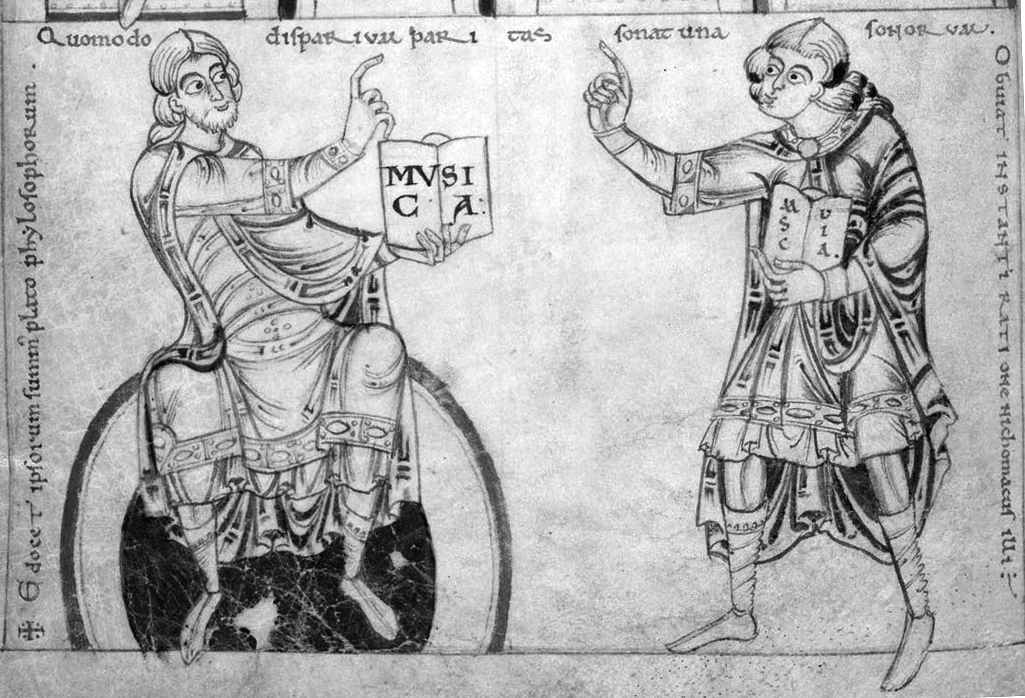
The Arithmetic (in Latin: De Institutione Arithmetica) of Boethius was a Latin paraphrase and a partial translation of the Introduction to Arithmetic.[11] The Manual of Harmonics also became the basis of the Boethius' Latin treatise titled De institutione musica.[12]

Medieval European philosophy

[edit]

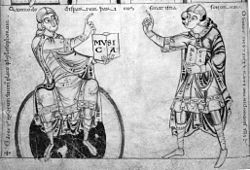
The work of Boethius on arithmetic and music was a core part of the Quadrivium liberal arts and had a great diffusion during the Middle Ages.[13]

Nicomachus's theorem

[edit]
Alternative proof using squares

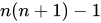
At the end of Chapter 20 of his Introduction to Arithmetic, Nicomachus points out that if one writes a list of the odd numbers, the first is the cube of 1, the sum of the next two is the cube of 2, the sum of the next three is the cube of 3, and so on. He does not go further than this, but from this it follows that the sum of the first n cubes equals the sum of the first odd numbers, that is, the odd numbers from 1 to . The average of these numbers is obviously , and there are of them, so their sum is Many early mathematicians have studied and provided proofs of Nicomachus's theorem.[14]

See also

[edit]

Notes

[edit]

Bibliography

[edit]
[edit]
Revisions and contributorsEdit on WikipediaRead on Wikipedia
from Grokipedia
Nicomachus of Gerasa (Greek: Νικόμαχος ὁ Γερασηνός; c. 60 – c. 120 AD) was a prominent Neo-Pythagorean philosopher and mathematician from Gerasa in (modern-day , ), renowned for his influential treatises on arithmetic and harmonics that emphasized the mystical and philosophical properties of numbers. His seminal work, Introduction to Arithmetic (Arithmetike eisagoge), treated arithmetic as a distinct discipline separate from , introducing concepts like perfect, abundant, and deficient numbers while incorporating Pythagorean rather than rigorous proofs. This text, which included the first known Greek multiplication table, became a standard arithmetic primer in the for over 1,000 years and profoundly shaped medieval European and Arab . In addition to arithmetic, Nicomachus contributed to music theory through his Manual of Harmonics, blending Pythagorean principles with Aristotelian ideas to explore the mathematical foundations of musical intervals and scales. He also authored Theologoumena arithmetikes (The Theology of Numbers), a two-volume work delving into the symbolic and divine significance of numbers, reflecting his deep Neo-Pythagorean beliefs that numbers underpin the cosmos. Though little is known about his personal life or education—possibly influenced by studies in Alexandria—Nicomachus's writings bridged philosophy and mathematics, portraying numbers not merely as quantities but as eternal, harmonious entities with spiritual implications. Nicomachus's legacy endures in the , where his qualitative approach to inspired later scholars like and , in contrast to the axiomatic approach of earlier thinkers like . His works preserved and popularized Pythagorean doctrines during a period when such ideas were revived in the , influencing fields from to the liberal arts in the .

Biography

Origins and Chronology

Nicomachus of Gerasa was born around 60 AD in Gerasa (Greek: Γέρασα), a Hellenistic city in the region of the of , corresponding to modern Jerash in . This urban center, known for its Greek cultural influences and architectural grandeur, served as a hub for intellectual exchange in the eastern Mediterranean during the Roman era. He was active as a Neopythagorean philosopher and primarily in the late first and early second centuries AD, producing works in Greek aimed at an educated audience familiar with philosophical and mathematical traditions. His Manual of Harmonics, for instance, was dedicated to a lady of noble birth, indicating his connections to elite patrons and his role in disseminating knowledge through written treatises. Personal details about Nicomachus remain sparse, drawn mainly from his own surviving texts and later references by Neoplatonist authors such as and Porphyry, who cite him in their discussions of Pythagorean biography and doctrine. Nicomachus's lifespan is estimated to extend until around 120 AD, based on his references to the astrologer Thrasyllus (d. 36 AD), the mid-second-century Latin translation of his Introduction to Arithmetic by , and his mention by (born c. 120 AD). He flourished during the reigns of emperors (r. 98–117 AD) and (r. 117–138 AD), a period marked by Roman imperial expansion and a revival of Pythagorean thought within the broader dominance of in the . This intellectual environment, blending Hellenistic legacies with Roman administration, provided the backdrop for Nicomachus's contributions to arithmetic and harmonics as vehicles for philosophical insight.

Influences and Intellectual Context

Nicomachus, active around 60–120 AD, was deeply shaped by , establishing himself as a pivotal Neopythagorean figure who connected the doctrines of early thinkers like and to the evolving Platonic tradition. His philosophical outlook reflected the revival of Pythagorean ideas in the late Hellenistic and early Roman periods, emphasizing and as foundational to understanding the while integrating them with Platonic metaphysics. Nicomachus maintained ties to the Platonic Academy's legacy through figures such as Thrasyllus, the astrologer to Emperor , whose scholarly edition of Plato's dialogues he appears to have consulted and referenced. This engagement positioned him within a broader network of intellectuals blending Pythagorean with Platonic idealism, facilitating the transmission of Greek philosophy amid Roman cultural expansion. Hailing from Gerasa, a thriving Greco-Roman city in the league, Nicomachus operated in a diverse environment marked by Jewish and Arab communities alongside Hellenistic settlers, which encouraged syncretic exchanges in , religion, and . The city's prosperity under Roman rule, with its temples, theaters, and markets, provided a fertile ground for intellectual pursuits that transcended ethnic boundaries. His possible travels or associations in centers like and can be inferred from interactions with contemporary Roman scholarly circles, reflecting the mobility of Greek philosophers in the . Furthermore, dedications in his writings to Roman elites, possibly including Plotina Augusta, the wife of Emperor , indicate that enabled him to disseminate Greek learning to non-Greek speakers, enhancing Pythagorean thought's reach within imperial society.

Philosophy

Metaphysics and Number Theory

Nicomachus viewed numbers as the fundamental archetypal principles of , asserting that arithmetic—the study of even and odd numbers and their multiples—holds ontological priority over , , and astronomy, serving as their common source. This hierarchy positions numerical relations as the essence from which spatial forms, harmonic intervals, and celestial motions derive their structure. At the core of his metaphysics lies the monad (1), conceived as the divine, indivisible source that generates all subsequent numbers and embodies unity and stability. The dyad (2), by contrast, introduces multiplicity, division, and the principle of matter, arising as the first emanation from the monad and representing the onset of opposition and change. These two principles form the foundational dyad of his cosmology, with the monad as the active, generative force and the dyad as the receptive substrate. Nicomachus classified numbers into primary categories of even and odd, further subdividing even numbers into evenly-even (e.g., powers of 2 like 4, 8, 16), evenly-odd (e.g., 6, 10, 14, which are 2 times an odd number), and oddly-even (e.g., 12, 20, which involve higher powers of 2 times odd numbers); odd numbers resist division into two equal integers and are further classified into primes, composites, and others based on factors. Among these, perfect numbers hold special significance, defined as those equal to the sum of their proper divisors excluding themselves; for instance, 6 is perfect because 1+2+3=61 + 2 + 3 = 6. He identified 6, 28, 496, and 8128 as the first such numbers, viewing them as exemplars of numerical and completeness. Numbers, for Nicomachus, possess mystical properties that reflect cosmic harmony, culminating in the tetractys—the sum of the first four numbers (1+2+3+4=101 + 2 + 3 + 4 = 10)—which he regarded as a sacred symbol encapsulating the structure of the and the progression from unity to multiplicity. This decadic figure represents the totality of creation, with its triangular arrangement evoking the eternal order of the . Drawing from Pythagorean traditions, Nicomachus integrated numerology with Platonic philosophy, portraying numbers as eternal intermediaries between the transcendent divine One and the sensible material world, akin to ideal forms that underpin sensible particulars. He favored this Pythagorean conception of numbers as substantive principles over Eleatic views of a singular, unchanging One or Aristotelian treatments of numbers as mere abstractions from quantity. His ideas show brief influence from earlier Pythagoreans like Philolaus, whose fragments on cosmic harmony informed Nicomachus's emphasis on numerical generation.

Theological and Ethical Dimensions

In Nicomachus's Neopythagorean framework, God is conceptualized as the Monad, an eternal and indivisible that serves as the , originating all existence through a process of numerical emanation from unity to multiplicity. This Monad embodies self-sufficiency and providence, containing the potential for all things seminally, much like the generative source of numbers themselves. As the supreme (nous), it imposes order on the , reflecting a theological vision where divine creation unfolds according to archetypal numerical principles rather than chaotic matter. The soul, in Nicomachus's view, possesses a numerical structure that mirrors cosmic harmony, composed of proportional relations among numbers that facilitate its immortality and rational order. Virtues are aligned with specific numerical proportions, such as justice corresponding to the 4:3 ratio, which evokes the musical fourth and symbolizes balanced equality between parts. Similarly, the tetrad encompasses the four cardinal virtues—wisdom, moderation, courage, and justice—establishing ethical harmony as a reflection of numerical symmetry within the soul. Ethical in Nicomachus's elevates as archetypes of , where the whole equals the sum of its parts, signifying completeness and divine favor. The hexad (6), the first , exemplifies wholeness and health, guiding the toward purification through of such orderly structures that transcend sensory illusions. This practice fosters an ascetic , echoing Pythagorean taboos against material excess, by directing the upward from bodily concerns to the unity of the divine. Nicomachus critiques by contrasting the stable, form-giving Monad with the indeterminate dyad, which represents formless prone to division and instability, urging a philosophical ascent through arithmetic to reclaim intellectual purity. In this Neopythagorean , numbers function as the essential language of creation, bridging rational philosophy and religious devotion by revealing the hidden principles through which the articulates the universe's harmony.

Major Works

Introduction to Arithmetic

The Introduction to Arithmetic (Greek: Arithmētikē eisagōgē), composed around 100 CE, stands as Nicomachus of Gerasa's most enduring mathematical , presenting a systematic exposition of arithmetic principles rooted in Pythagorean traditions. The work is divided into two books comprising 52 chapters in total, with Book I containing 23 chapters and Book II 29 chapters. The original Greek text survives only in fragmentary form, having been reconstructed primarily through medieval translations, such as those by Thābit ibn Qurra (), and Latin versions, including Boethius's influential 6th-century rendering, which preserved much of the content for Western audiences. Book I delves into the foundational properties of numbers, beginning with a classification of odd and even numbers into categories such as even-times-even, odd-times-odd, and odd-times-even, emphasizing their qualitative distinctions beyond mere computation. A central focus is on figurate numbers, which represent geometric forms through numerical patterns; for instance, triangular numbers (3, 6, 10, etc.) arise as the sum of successive integers, while square numbers (1, 4, 9, etc.) are generated by adding consecutive odd numbers. Nicomachus provides proof-like arguments for key properties, such as the theorem that the sum of the first n odd numbers equals n²: 1+3+5++(2n1)=n21 + 3 + 5 + \dots + (2n-1) = n^2 This is illustrated geometrically, showing how successive odd numbers fill layers to form a square. He introduces polygonal numbers, including pentagonal and hexagonal forms, as extensions of these patterns, marking an early systematic treatment of such concepts in non-Euclidean arithmetic. Additionally, the text features one of the earliest known multiplication tables in Greek literature, extending up to 10 × 10, serving as a practical tool for demonstrating numerical relations. Book II shifts to relational aspects of numbers, exploring multiples (e.g., doubles, triples) and their ratios, before addressing proportions and means. Nicomachus delineates seven types of proportion—arithmetic, , , and four others (subcontrary, anti-proportional, etc.)—along with corresponding means, such as the as the midpoint between two numbers and the as their square root product. The didactic style is non-rigorous, relying on verbal explanations, examples, and rather than axiomatic proofs, tailored for a philosophical interested in numbers' cosmic and ethical roles. It incorporates myths, such as the Pythagorean of numbers' discovery through observations of harmonious , underscoring arithmetic's mystical foundations. As one of the few surviving ancient texts on pure arithmetic, the Introduction exerted profound influence on subsequent mathematics, serving as a standard educational work through late antiquity and the Middle Ages, shaping number theory in Islamic and European traditions despite its occasional inaccuracies and lack of formal rigor.

Manual of Harmonics

The Manual of Harmonics (Enchiridion harmonikēs), composed around the late first or early second century CE, serves as a concise exposition of Pythagorean music theory, applying numerical proportions to the science of sound and melody. Structured in three books, each comprising sixteen chapters, the treatise systematically addresses the principles of musical scales, intervals, and concords, positioning music as an extension of arithmetic where harmony emerges from the rational ordering of numbers. Nicomachus draws on earlier Pythagorean traditions to argue that audible concords—such as the octave (ratio 2:1) and the perfect fifth (ratio 3:2)—reflect the inherent structure of the universe, bridging sensory experience with mathematical truth. In the opening book, Nicomachus establishes the foundational role of numbers in generating musical harmony, asserting that tones and semitones arise from precise divisions of vibrating strings or air columns, with consonance determined by simple integer ratios rather than empirical measurement alone. He illustrates this through the monochord, a theoretical instrument whose string is divided proportionally to produce intervals: for instance, halving the string length yields the octave, while a 3:2 division creates the fifth, demonstrating how these proportions yield pleasing sounds when struck simultaneously. The second book delves into scales and genera, detailing the construction of tetrachords and the integration of whole tones (9:8) and semitones to form complete systems like the diatonic scale, always prioritizing mathematical purity over auditory approximation. Throughout, Nicomachus critiques non-Pythagorean approaches, such as those of Aristoxenus, for relying on perception without numerical rigor, insisting that true harmony demands "pure" intervals derived from superparticular ratios to avoid dissonance. The third book extends these acoustic principles to speculative cosmology, positing that the , governed by planetary motions, produce an inaudible yet mathematically perfect analogous to earthly music. Nicomachus describes the seven known planets ( through Saturn) as emitting tones in a grand scale, with their orbital speeds and distances yielding intervals that mirror the monochord's divisions, thus embodying divine proportion in the . This "music of the spheres" underscores his view of as a universal force uniting the microcosm of sound with the macrocosm of creation. The treatise's style blends theoretical abstraction with practical utility, offering speculative insights into 's metaphysical significance alongside concrete examples for tuning lyres or other stringed instruments via proportional measurements. The original Greek text survives in an incomplete form, preserved primarily through medieval manuscripts that omit certain sections, and has been supplemented by later commentaries, notably Boethius's De institutione musica (c. 500 CE), which adapts and expands Nicomachus's framework for Latin audiences. Modern understanding relies on reconstructions like Flora R. Levin's 1994 English translation, which restores the work's coherence while highlighting its Pythagorean fidelity.

Lost and Attributed Works

Several works by Nicomachus of Gerasa are known only through references in later ancient authors, indicating a broader output in Pythagorean and than his surviving texts suggest. These lost treatises are reconstructed from fragments, quotations, and summaries, primarily by Neoplatonist writers such as , Porphyry, , and , who drew upon them for their own discussions of and Pythagorean doctrine. The most extensively referenced lost work is the Theology of Arithmetic (Theologoumena arithmetikē), a two-volume that explored the mystical, cosmological, and divine attributes of numbers in the Pythagorean tradition. quoted extensively from this text in his commentary on Nicomachus's Introduction to Arithmetic, using it to elaborate on the symbolic significance of numbers from one to ten as embodiments of gods and cosmic principles. The surviving Theologoumena Arithmeticae, often attributed to , is widely regarded by scholars as a or excerpted version of Nicomachus's original, compiling arithmological lore with additions from other sources like Anatolius of Laodicea. Another key lost work is the Life of Pythagoras (Bios Pythagorou), a biographical account that detailed the philosopher's life, teachings, and miracles, serving as a for subsequent biographies. Porphyry cited Nicomachus's version multiple times in his own Life of Pythagoras, including details on 's persuasive oratory and travels, while incorporated similar material into his expanded On the Pythagorean Life, often aligning with or expanding upon Nicomachus's narratives. This work contributed to the hagiographic tradition of but survives only in these indirect references. Nicomachus also composed an Introduction to Geometry (Eisagōgē geōmetrikē), which likely applied arithmetic principles to geometric figures and proofs, bridging his numerical with spatial forms. No direct fragments remain, though alluded to Nicomachus's geometric insights in his commentaries on and , suggesting connections to Pythagorean theorems on figures like and . Attributions to Nicomachus beyond his confirmed corpus are limited and debated, with no spurious works definitively linked to him in ancient catalogs. Variants of the Arithmetical Introduction appear in medieval manuscripts, but these are typically seen as editorial adaptations rather than distinct compositions by Nicomachus. Claims of authorship for early Christian arithmological texts remain unsubstantiated, as Nicomachus's Pythagorean focus lacks clear Christian interpolations in surviving citations. Scholarly reconstruction relies on stylistic analysis of quotations and cross-references, with ongoing debates about the extent of Iamblichus's editorial in preserving Nicomachus's ideas. No new fragments or discoveries of these works have emerged since 2021, leaving their full scope inferred from ancient testimonies. These lost texts highlight Nicomachus's in systematizing Pythagorean , extending arithmology into , , and .

Legacy

Late Antiquity and Neoplatonism

In Late Antiquity, Nicomachus's works profoundly shaped Neoplatonic thought, particularly through their integration into the philosophical frameworks of key figures like Plotinus and Porphyry. Plotinus drew upon Nicomachus's concepts of number and multiplicity in the Enneads, especially in treatises VI.6 and VI.7, where substantial number (ousiôdês arithmos) serves as an ontological principle organizing the intelligible realm and imposing limit on the Indefinite Dyad, reflecting Nicomachus's distinction between quantitative and paradigmatic forms of number. Porphyry, Plotinus's editor and disciple, explicitly referenced Nicomachus in his Life of Pythagoras, quoting him on Pythagoras's persuasive oratory and the introduction of numerical doctrines to Greece, thereby embedding Nicomachus's Pythagorean revival into Neoplatonic hagiography. Iamblichus elevated Nicomachus to authoritative status in his syncretic system, extensively quoting from the Introduction to Arithmetic in the Theologumena Arithmeticae, a compilation attributing theological significance to numbers one through ten and drawing on Nicomachus for their mystical properties, such as the monad's unity and the dyad's duality. This work, pseudonymously attributed to , preserves substantial excerpts from Nicomachus, using them to link arithmetic to divine hierarchies and cosmic order. 's commentaries further amplified this, positioning Nicomachus as a bridge between Pythagorean arithmology and Platonic metaphysics. The Introduction to Arithmetic became a cornerstone of Neoplatonic education, serving as the standard introductory text in schools at and during the 4th to 6th centuries. In , referenced Nicomachus in his Commentary on Plato's Timaeus, integrating his numerical theories into discussions of cosmic structure, while his lost commentary on the Introduction underscores its curricular role. In , commentators like produced detailed exegeses, treating it as essential preparation for advanced studies in and harmonics within the . Around 500 CE, translated the Introduction into Latin as De institutione arithmetica, adapting it for Western audiences and ensuring its preservation amid the decline of pagan institutions. Nicomachus's ideas facilitated in late pagan thought, blending Pythagorean number mysticism with the theurgic rituals of the and Hermetic traditions, particularly through Iamblichus's synthesis. In works like On the Pythagorean Life, merged Nicomachus's arithmological symbolism—such as numbers as divine emanations—with Chaldean concepts of paternal intellect and fiery symbols, viewing arithmetic as a tool for theurgic ascent. This fusion extended to , where numerical principles informed cosmological hierarchies in texts like the , reinforcing a unified pagan against emerging Christian dominance.

Medieval and Renaissance Influence

In the Islamic world, Nicomachus's Introduction to Arithmetic was translated into by Thābit ibn Qurra in the late , preserving and disseminating its Pythagorean-inspired concepts of and symbolism. This translation significantly influenced early Islamic philosophers, including al-Kindī, who provided commentaries on Nicomachean arithmetic, integrating it into his synthesis of Greek mathematics with Islamic theology. Similarly, the Ikhwān al-Ṣafāʾ drew upon these ideas in their Epistles, employing Nicomachean number symbolism to explore metaphysical hierarchies, cosmic order, and the spiritual dimensions of arithmetic as a reflection of divine unity. The transmission of Nicomachus's work to medieval Europe occurred primarily through Boethius's Latin adaptation in the early 6th century, which embedded arithmetic as a foundational element of the —the advanced liberal arts curriculum comprising arithmetic, , , and astronomy. This framework shaped educational practices across monastic and scholastic institutions, with and offering commentaries that abstracted and Christianized Nicomachean principles for broader accessibility. In the scholastic period, referenced Nicomachean numerical theology in his expositions on Boethius's De Trinitate, using concepts of proportion and harmony to elucidate divine order and the transcendental properties of being within the artes liberales. During the , Nicomachus's ideas experienced a revival through Marsilio Ficino's efforts in the Florentine Platonic Academy, where translations and interpretations of Pythagorean and Hermetic texts linked arithmetic to esoteric wisdom and cosmic symbolism. This intellectual current culminated in Kepler's Harmonices Mundi (1619), which adapted Nicomachean musical scales and proportional theories to model planetary harmonies, bridging ancient number mysticism with emerging astronomical . Recent scholarship from 2022 to 2025 has increasingly examined these transmissions, highlighting their role in exchanges, though detailed analyses remain somewhat limited compared to Greco-Latin studies.

Modern Mathematical Recognition

Nicomachus's contributions to number theory continue to be recognized in modern mathematics, particularly through his early insights into figurate numbers and perfect numbers, which prefigure key developments in the field. One notable result attributed to his Pythagorean-influenced framework is the identity that the sum of the first nn odd numbers equals n2n^2, often visualized geometrically as building squares by adding successive odd-numbered gnomon layers around a central unit square. Although this observation traces back to earlier Pythagorean traditions, Nicomachus elaborated on it in his Introduction to Arithmetic by classifying numbers into even, odd, and their subtypes, emphasizing their role in forming polygonal figures such as triangles and squares. A geometric proof involves arranging the odd numbers as L-shaped borders (gnomons) that successively complete squares: for n=1n=1, 1 forms 121^2; adding 3 yields 22=42^2=4; adding 5 gives 32=93^2=9, and so on, up to the nnth layer completing n2n^2. This visualization not only demonstrates the equality k=1n(2k1)=n2\sum_{k=1}^n (2k-1) = n^2 but also highlights Nicomachus's emphasis on numbers' spatial properties, influencing later combinatorial geometry. In the realm of perfect numbers, Nicomachus provided an algorithm for generating even perfect numbers, describing them as 2p1(2p1)2^{p-1}(2^p - 1) where 2p12^p - 1 is prime (a ), and listed the first four: 6, 28, 496, and 8128. This approach serves as a precursor to the Euclid-Euler theorem, which states that every even perfect number is of this form and conversely, if 2p12^p - 1 is a , then the expression yields a . Nicomachus's method, while lacking a full proof of completeness, laid foundational groundwork for the systematic study of abundance and deficiency in divisors, concepts central to modern . Contemporary computations, driven by the (GIMPS), have verified 52 even perfect numbers as of November 2025, all conforming to Nicomachus's pattern; the 52nd, corresponding to the 213627984112^{136279841} - 1 discovered in October 2024, has over 41 million digits and underscores the theorem's enduring predictive power. No odd s are known, and searches continue to bound their possible size, with efforts as of 2025 ruling out candidates below 10160010^{1600}. The rediscovery and critical analysis of Nicomachus's work in the , notably through scholarly editions like that of Franz Hultsch, revitalized interest in arithmetic as a rigorous precursor to modern . Hultsch's philological efforts in editing Greek mathematical texts helped authenticate Nicomachus's contributions, distinguishing his empirical patterns from later proofs by and Euler. This historiographical work bridged ancient and contemporary views, positioning Nicomachus's ideas as essential to understanding the evolution of functions and primality testing. Recent popular and has highlighted Nicomachus's legacy through timely examples, such as the observation in 2025 that 2025=4522025 = 45^2 equals the sum of the first 45 odd numbers (1 + 3 + ... + 89), illustrating the geometric in a calendar-relevant context. Ongoing studies in recreational math explore extensions of his classifications, including applications in and puzzle design, while leverages his in distributed prime searches. These engagements affirm Nicomachus's role in fostering conceptual tools that remain vital for both theoretical and .

References

Add your contribution
Related Hubs
Contribute something
User Avatar
No comments yet.