Hubbry Logo
MysticismMysticismMain
Open search
Mysticism
Community hub
Mysticism
logo
8 pages, 0 posts
0 subscribers
Be the first to start a discussion here.
Mysticism
Mysticism
from Wikipedia
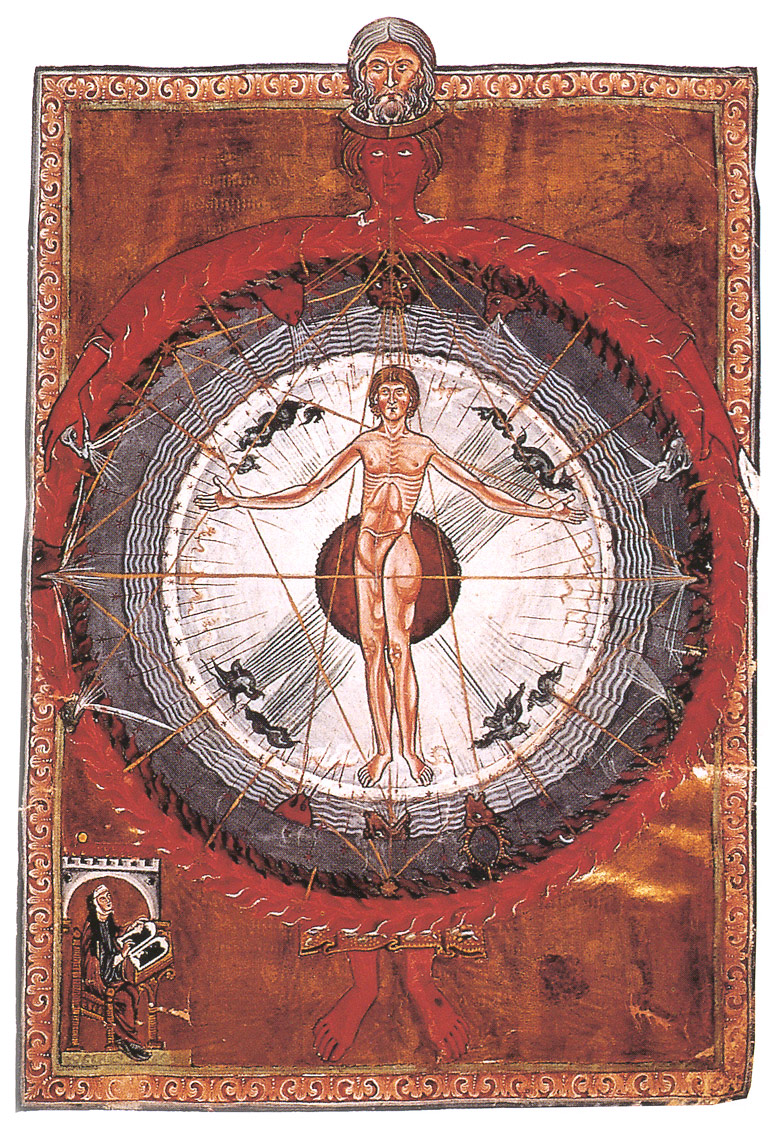
Liber Divinorum Operum, or the Universal Man of St. Hildegard of Bingen, 1185 (13th-century copy)

Mysticism encompasses religious traditions of human transformation aided by various practices [1] and religious experiences.[2][note 1][note 2] Popularly, mysticism is used synonymously with mystical experience, a neologism which refers to an ecstatic unitive experience of becoming one with God, the Absolute, or all that exists.[3][4]

Scholarly research since the 1970s had questioned this understanding, noting that what appears to be mysticism may also refer to the attainment of insight into ultimate or hidden truths, as in Buddhist awakening and Hindu prajna, in nondualism, and in the realisation of emptiness and ego-lessness, and also to altered states of consciousness such as samadhi.

The term "mysticism" has Ancient Greek origins with various historically determined meanings. Derived from the Greek word μύω múō, meaning "to close" or "to conceal", mysticism came to refer to the biblical, liturgical (and sacramental), spiritual, and contemplative dimensions of early and medieval Christianity.[5] During the early modern period, the definition of mysticism grew to include a broad range of beliefs and ideologies related to "extraordinary experiences and states of mind".[6]

Broadly defined, mysticism as a way of personal transformation can be found in a number of religious traditions, including Western mysticism and Western esotericism, Sufism, Buddhism, and Hinduism.

Etymology

[edit]

"Mysticism" is derived from the Greek μύω, meaning "I conceal",[2] and its derivative μυστικός, mystikos, meaning 'an initiate'. The verb μύω has received a quite different meaning in the Greek language, where it is still in use. The primary meanings it has are "induct" and "initiate". Secondary meanings include "introduce", "make someone aware of something", "train", "familiarize", "give first experience of something".[web 1]

The related form of the verb μυέω (mueó or myéō) appears in the New Testament. As explained in Strong's Concordance, it properly means shutting the eyes and mouth to experience mystery. Its figurative meaning is to be initiated into the "mystery revelation". The meaning derives from the initiatory rites of the pagan mysteries.[web 2] Also appearing in the New Testament is the related noun μυστήριον (mustérion or mystḗrion), the root word of the English term "mystery". The term means "anything hidden", a mystery or secret, of which initiation is necessary. In the New Testament it reportedly takes the meaning of the counsels of God, once hidden but now revealed in the Gospel or some fact thereof, the Christian revelation generally, and/or particular truths or details of the Christian revelation.[web 3]

According to Thayer's Greek Lexicon, the term μυστήριον in classical Greek meant "a hidden thing" or "secret". A particular meaning it took in Classical antiquity was a religious secret or religious secrets, confided only to the initiated and not to be communicated by them to ordinary mortals. In the Septuagint and the New Testament the meaning it took was that of a hidden purpose or counsel, a secret will. It is sometimes used for the hidden wills of humans, but is more often used for the hidden will of God. Elsewhere in the Bible it takes the meaning of the mystic or hidden sense of things. It is used for the secrets behind sayings, names, or behind images seen in visions and dreams. The Vulgate often translates the Greek term to the Latin sacramentum (sacrament).[web 3]

The related noun μύστης (mustis or mystis, singular) means the initiate, the person initiated to the mysteries.[web 3] According to Ana Jiménez San Cristobal in her study of Greco-Roman mysteries and Orphism, the singular form μύστης and the plural form μύσται are used in ancient Greek texts to mean the person or persons initiated to religious mysteries. These followers of mystery religions belonged to a select group, where access was only gained through an initiation. She found that the terms were associated with the term βάκχος (Bacchus), which was used for a special class of initiates of the Orphic mysteries. The terms are first found connected in the writings of Heraclitus. Such initiates are identified in texts with the persons who have been purified and have performed certain rites. A passage of Cretans by Euripides seems to explain that the μύστης (initiate) who devotes himself to an ascetic life, renounces sexual activities, and avoids contact with the dead becomes known as βάκχος. Such initiates were believers in the god Dionysus Bacchus who took on the name of their god and sought an identification with their deity.[7]

Until the sixth century the practice of what is now called mysticism was referred to by the term contemplatio, c.q. theoria.[8] According to Johnston, "[b]oth contemplation and mysticism speak of the eye of love which is looking at, gazing at, aware of divine realities."[8]

Definitions

[edit]

According to Peter Moore, the term "mysticism" is "problematic but indispensable".[9] It is a generic term which joins together into one concept separate practices and ideas which developed separately.[9] According to Dupré, "mysticism" has been defined in many ways,[10] and Merkur notes that the definition, or meaning, of the term "mysticism" has changed through the ages.[web 4] Moore further notes that the term "mysticism" has become a popular label for "anything nebulous, esoteric, occult, or supernatural".[9]

Parsons warns that "what might at times seem to be a straightforward phenomenon exhibiting an unambiguous commonality has become, at least within the academic study of religion, opaque and controversial on multiple levels".[11] Because of its Christian overtones, and the lack of similar terms in other cultures, some scholars regard the term "mysticism" to be inadequate as a useful descriptive term.[9] Other scholars regard the term to be an inauthentic fabrication,[9][web 4] the "product of post-Enlightenment universalism".[9]

Richard Jones notes that "few classical mystics refer to their experiences as the union of two realities: there is no literal 'merging' or 'absorption' of one reality into another resulting in only one entity."[12] He explicates mysticism with reference to one's mode of access in order to include both union of the mystic with some transcendent reality and the non-sensory revelation of that reality. The mystic experience can be defined by the mystic's purported access to "realities or states of affairs that are of a kind not accessible by way of ordinary sense-perception structured by mental conceptions, somatosensory modalities, or standard introspection."[12] Whether or not such an experience is veridical remains undecided.

Union and mystical experience

[edit]

Deriving from Neo-Platonism and Henosis, mysticism is popularly known as union with God or the Absolute.[3][4] In the 13th century the term unio mystica came to be used to refer to the "spiritual marriage", the ecstasy, or rapture, that was experienced when prayer was used "to contemplate both God's omnipresence in the world and God in his essence."[web 4] In the 19th century, under the influence of Romanticism, this "union" was interpreted as a "religious experience", which provides certainty about God or a transcendental reality.[web 4][note 3]

An influential proponent of this understanding was William James (1842–1910), who stated that "in mystic states we both become one with the Absolute and we become aware of our oneness."[14] William James popularized this use of the term "religious experience"[note 4] in his The Varieties of Religious Experience,[16][17][2] contributing to the interpretation of mysticism as a distinctive experience, comparable to sensory experiences.[18][2] Religious experiences belonged to the "personal religion",[19] which he considered to be "more fundamental than either theology or ecclesiasticism".[19] He gave a Perennialist interpretation to religious experience, stating that this kind of experience is ultimately uniform in various traditions.[note 5]

McGinn notes that the term unio mystica, although it has Christian origins, is primarily a modern expression.[20] McGinn argues that "presence" is more accurate than "union", since not all mystics spoke of union with God, and since many visions and miracles were not necessarily related to union. He also argues that we should speak of "consciousness" of God's presence, rather than of "experience", since mystical activity is not simply about the sensation of God as an external object, but more broadly about "new ways of knowing and loving based on states of awareness in which God becomes present in our inner acts."[21]

However, the idea of "union" does not work in all contexts. For example, in Advaita Vedanta, there is only one reality (Brahman) and therefore nothing other than reality to unite with it—Brahman in each person (atman) has always in fact been identical to Brahman all along. Dan Merkur also notes that union with God or the Absolute is a too limited definition, since there are also traditions which aim not at a sense of unity, but of nothingness, such as Pseudo-Dionysius the Areopagite and Meister Eckhart.[web 4] According to Merkur, Kabbala and Buddhism also emphasize nothingness.[web 4] Blakemore and Jennett note that "definitions of mysticism [...] are often imprecise." They further note that this kind of interpretation and definition is a recent development which has become the standard definition and understanding.[web 5][note 6]

According to Gellman, "A unitive experience involves a phenomenological de-emphasis, blurring, or eradication of multiplicity, where the cognitive significance of the experience is deemed to lie precisely in that phenomenological feature".[2][note 7]

Process and explanatory context

[edit]

Mysticism involves an explanatory context, which provides meaning for mystical and visionary experiences, and related experiences like trances. According to Dan Merkur, mysticism may relate to any kind of ecstasy or altered state of consciousness, and the ideas and explanations related to them.[web 4][note 8] Parsons stresses the importance of distinguishing between temporary experiences and mysticism as a process, which is embodied within a "religious matrix" of texts and practices.[24][note 9] Richard Jones does the same.[25] Peter Moore notes that mystical experience may also happen in a spontaneous and natural way, to people who are not committed to any religious tradition. These experiences are not necessarily interpreted in a religious framework.[26] Ann Taves asks by which processes experiences are set apart and deemed religious or mystical.[27]

Intuitive insight and enlightenment

[edit]

Some authors emphasize that mystical experience involves intuitive understanding of the meaning of existence and of hidden truths, and the resolution of life problems. According to Larson, "mystical experience is an intuitive understanding and realization of the meaning of existence."[28][note 10] According to McClenon, mysticism is "the doctrine that special mental states or events allow an understanding of ultimate truths."[web 6][note 11] According to James R. Horne, mystical illumination is "a central visionary experience [...] that results in the resolution of a personal or religious problem."[29][note 12]

According to Evelyn Underhill, illumination is a generic English term for the phenomenon of mysticism. The term illumination is derived from the Latin illuminatio, applied to Christian prayer in the 15th century.[30] Comparable Asian terms are bodhi, kenshō, and satori in Buddhism, commonly translated as "enlightenment", and vipassana, which all point to cognitive processes of intuition and comprehension.[31]

Spiritual life and re-formation

[edit]

Other authors point out that mysticism involves more than "mystical experience". According to Gellman, the ultimate goal of mysticism is human transformation, not just experiencing mystical or visionary states.[2][note 1][note 2] According to McGinn, personal transformation is the essential criterion to determine the authenticity of Christian mysticism.[21][note 15]

History of the term

[edit]

Hellenistic world

[edit]

In the Hellenistic world, 'mystical' referred to "secret" religious rituals like the Eleusinian Mysteries.[2] The use of the word lacked any direct references to the transcendental.[11] A "mystikos" was an initiate of a mystery religion.

Early Christianity

[edit]

In early Christianity the term "mystikos" referred to three dimensions, which soon became intertwined, namely the biblical, the liturgical and the spiritual or contemplative.[5] The biblical dimension refers to "hidden" or allegorical interpretations of Scriptures.[2][5] The liturgical dimension refers to the liturgical mystery of the Eucharist, the presence of Christ in the Eucharist.[2][5] The third dimension is the contemplative or experiential knowledge of God.[5]

Until the sixth century, the Greek term theoria, meaning "contemplation" in Latin, was used for the mystical interpretation of the Bible[8] and the vision of God. The link between mysticism and the vision of the Divine was introduced by the early Church Fathers, who used the term as an adjective, as in mystical theology and mystical contemplation.[11]

Theoria enabled the Fathers to perceive depths of meaning in the biblical writings that escape a purely scientific or empirical approach to interpretation.[35] The Antiochene Fathers, in particular, saw in every passage of Scripture a double meaning, both literal and spiritual.[36]

Later, theoria or contemplation came to be distinguished from intellectual life, leading to the identification of θεωρία or contemplatio with a form of prayer[37] distinguished from discursive meditation in both East[38] and West.[39]

Medieval meaning

[edit]

This threefold meaning of "mystical" continued in the Middle Ages.[5] According to Dan Merkur, the term unio mystica came into use in the 13th century as a synonym for the "spiritual marriage", the ecstasy, or rapture, that was experienced when prayer was used "to contemplate both God's omnipresence in the world and God in his essence."[web 4] Mysticism was also manifested in various sects of the time such as the Waldensians.[40]

Apophatic theology

[edit]

Under the influence of Pseudo-Dionysius the Areopagite the term mystical theology came to denote the investigation of the allegorical truth of the Bible,[5] and "the spiritual awareness of the ineffable Absolute beyond the theology of divine names."[41] Pseudo-Dionysius' Apophatic theology, or "negative theology", exerted a great influence on medieval monastic religiosity, although it was mostly a male religiosity, since women were not allowed to study.[42] It was influenced by Neo-Platonism, and very influential in Eastern Orthodox Christian theology. In western Christianity it was a counter-current to the prevailing Cataphatic theology or "positive theology".

Renaissance

[edit]

In the 1400s, leading theologian Jean Gerson wrote several books on "mystical theology" which was any theology (or divine-human knowledge) that occurred in the affective (relating to the will including the emotions) realm rather than the intellective. This kind of mysticism was a general category that included the positive knowledge of God obtained, for example, through practical "repentant activity" (e.g., as part of sacramental participation), rather being about passive esoteric/transcendent religious ecstasy: it was an antidote the "self-aggrandizing hyper-inquisitiveness" of Scholasticism and was attainable even by simple and uneducated people.[43]: 212  The outcome of affective mysticism may be to see God's goodness or love rather than, say, his radical otherness.[43]: 248 

The theology of Catherine of Sienna was analysed in terms of mystical theology by Baron Friedrich von Hügel in The Mystical Element of Religion as Studied in St. Catherine of Genoa and Her Friends (1908). Von Hügel proposed three elements of religious experience: the institutional/historical, the intellectual/speculative, and the mystical/experiential.

For Erasmus, mysticism subsisted in contemplating the deep secrets contained in the Bible,[44]: 43  notably the startling personality of Christ.[45]

Early modern meaning

[edit]
The Appearance of the Holy Spirit before Saint Teresa of Ávila, Peter Paul Rubens

In the sixteenth and seventeenth century, mysticism came to be used as a substantive.[11] This shift was linked to a new discourse[11] in which science and religion were separated.[46]

Luther dismissed the allegorical interpretation of the bible, and condemned Mystical theology, which he saw as more Platonic than Christian.[47] "The mystical", as the search for the hidden meaning of texts, became secularised, and also associated with literature, as opposed to science and prose.[48]

Science was also distinguished from religion. By the middle of the 17th century, "the mystical" is increasingly applied exclusively to the religious realm, separating religion and "natural philosophy" as two distinct approaches to the discovery of the hidden meaning of the universe.[49] The traditional hagiographies and writings of the saints became designated as "mystical", shifting from the virtues and miracles to extraordinary experiences and states of mind, thereby creating a newly coined "mystical tradition".[6] A new understanding developed of the Divine as residing within human, an essence beyond the varieties of religious expressions.[11]

Contemporary meaning

[edit]

The 19th century saw a growing emphasis on individual experience, as a defense against the growing rationalism of western society.[17][web 4] The meaning of mysticism was considerably narrowed:[web 4]

The competition between the perspectives of theology and science resulted in a compromise in which most varieties of what had traditionally been called mysticism were dismissed as merely psychological phenomena and only one variety, which aimed at union with the Absolute, the Infinite, or God—and thereby the perception of its essential unity or oneness—was claimed to be genuinely mystical. The historical evidence, however, does not support such a narrow conception of mysticism.[web 4]

Under the influence of Perennialism, which was popularised in both the west and the east by Unitarianism, Transcendentalists, and Theosophy, mysticism has been applied to a broad spectrum of religious traditions, in which all sorts of esotericism, religious traditions, and practices are joined together.[50][51][17] The term mysticism was extended to comparable phenomena in non-Christian religions,[web 4] where it influenced Hindu and Buddhist responses to colonialism, resulting in Neo-Vedanta and Buddhist modernism.[51][52]

In the contemporary usage "mysticism" has become an umbrella term for all sorts of non-rational world views,[53] parapsychology and pseudoscience.[54][55][56][57] William Harmless even states that mysticism has become "a catch-all for religious weirdness".[58] Within the academic study of religion the apparent "unambiguous commonality" has become "opaque and controversial".[11] The term "mysticism" is being used in different ways in different traditions.[11] Some call to attention the conflation of mysticism and linked terms, such as spirituality and esotericism, and point at the differences between various traditions.[59]

Variations

[edit]

Based on various definitions of mysticism, namely mysticism as an experience of union or nothingness, mysticism as any kind of an altered state of consciousness which is attributed in a religious way, mysticism as "enlightenment" or insight, and mysticism as a way of transformation, "mysticism" can be found in many cultures and religious traditions, both in folk religion and organized religion. These traditions include practices to induce religious or mystical experiences, but also ethical standards and practices to enhance self-control and integrate the mystical experience into daily life.[citation needed]

Dan Merkur notes, though, that mystical practices are often separated from daily religious practices, and restricted to "religious specialists like monastics, priests, and other renunciates.[web 4]

Shamanism

[edit]
Shaman

According to Dan Merkur, shamanism may be regarded as a form of mysticism, in which the world of spirit is accessed through religious ecstasy.[web 4] According to Mircea Eliade shamanism is a "technique of religious ecstasy".[60]

Shamanism involves a practitioner reaching an altered state of consciousness in order to perceive and interact with spirits, and channel transcendental energies into this world.[61] A shaman is a person regarded as having access to, and influence in, the world of benevolent and malevolent spirits, who typically enters into trance during a ritual, and practices divination and healing.[62]

Neoshamanism refers to "new"' forms of shamanism, or methods of seeking visions or healing, typically practiced in Western countries. Neoshamanism comprises an eclectic range of beliefs and practices that involve attempts to attain altered states and communicate with a spirit world, and is associated with New Age practices.[63][64]

Western mysticism

[edit]

Mystery religions

[edit]

The Eleusinian Mysteries, (Greek: Ἐλευσίνια Μυστήρια) were annual initiation ceremonies in the cults of the goddesses Demeter and Persephone, held in secret at Eleusis (near Athens) in ancient Greece.[65] The mysteries began in about 1600 B.C. in the Mycenean period and continued for two thousand years, becoming a major festival during the Hellenic era, and later spreading to Rome.[66] Numerous scholars have proposed that the power of the Eleusinian Mysteries came from the kykeon's functioning as an entheogen.[67]

Christian mysticism

[edit]
Early Christianity
[edit]

The apophatic theology, or "negative theology", of Pseudo-Dionysius the Areopagite (6th c.) exerted a great influence on medieval monastic religiosity, both in the East and (by Latin translation) in the West.[42] Pseudo-Dionysius applied Neoplatonic thought, particularly that of Proclus, to Christian theology.

Eastern Orthodox Christianity
[edit]

The Eastern Orthodox Church has a long tradition of theoria (intimate experience) and hesychia (inner stillness), in which contemplative prayer silences the mind to progress along the path of theosis (deification).

Theosis, practical unity with and conformity to God, is obtained by engaging in contemplative prayer, the first stage of theoria,[68][note 16] which results from the cultivation of watchfulness (nepsis). In theoria, one comes to behold the "divisibly indivisible" divine operations (energeia) of God as the "uncreated light" of transfiguration, a grace which is eternal and proceeds naturally from the blinding darkness of the incomprehensible divine essence.[note 17][68] It is the main aim of hesychasm, which was developed in the thought St. Symeon the New Theologian, embraced by the monastic communities on Mount Athos, and most notably defended by St. Gregory Palamas against the Greek humanist philosopher Barlaam of Calabria. According to Roman Catholic critics, hesychastic practice has its roots to the introduction of a systematic practical approach to quietism by Symeon the New Theologian.[note 18]

Symeon believed that direct experience gave monks the authority to preach and give absolution of sins, without the need for formal ordination. While Church authorities also taught from a speculative and philosophical perspective, Symeon taught from his own direct mystical experience,[71] and met with strong resistance for his charismatic approach, and his support of individual direct experience of God's grace.[71]

Western Europe
[edit]
Life of Francis of Assisi by José Benlliure y Gil

The High Middle Ages saw a flourishing of mystical practice and theorization in western Roman Catholicism, corresponding to the flourishing of new monastic orders, with such figures as Guigo II, Hildegard of Bingen, Bernard of Clairvaux, the Victorines, all coming from different orders, as well as the first real flowering of popular piety among the laypeople.

The Late Middle Ages saw the clash between the Dominican and Franciscan schools of thought, which was also a conflict between two different mystical theologies: on the one hand that of Dominic de Guzmán and on the other that of Francis of Assisi, Anthony of Padua, Bonaventure, and Angela of Foligno. This period also saw such individuals as John of Ruysbroeck, Catherine of Siena and Catherine of Genoa, the Devotio Moderna, and such books as the Theologia Germanica, The Cloud of Unknowing and The Imitation of Christ.

Moreover, there was the growth of groups of mystics centered around geographic regions: the Beguines, such as Mechthild of Magdeburg and Hadewijch (among others); the Rhineland mystics Meister Eckhart, Johannes Tauler, and Henry Suso; and the English mystics Richard Rolle, Walter Hilton, and Julian of Norwich. The Spanish mystics included Teresa of Avila, John of the Cross, and Ignatius Loyola.

The later post-reformation period also saw the writings of lay visionaries such as Emanuel Swedenborg and William Blake, and the foundation of mystical movements such as the Quakers. Catholic mysticism continued into the modern period with such figures as Padre Pio and Thomas Merton.

The philokalia, an ancient method of Eastern Orthodox mysticism, was promoted by the twentieth century Traditionalist School.

Western esotericism and modern spirituality

[edit]

Many Western esoteric traditions and elements of modern spirituality have been regarded as mysticism, such as Transcendentalism, Theosophy, the Fourth Way,[72] Martinus, spiritual science, and Neo-Paganism. Modern western spiritually and transpersonal psychology combine western psycho-therapeutic practices with religious practices like meditation to attain a lasting transformation. Nature mysticism is an intense experience of unification with nature or the cosmic totality, which was popular with Romantic writers.[73]

Jewish mysticism

[edit]
Portrait of Abraham Abulafia, Medieval Jewish mystic and founder of Prophetic Kabbalah

In the common era, Judaism has had two main kinds of mysticism: Merkabah mysticism and Kabbalah. The former predated the latter, and was focused on visions, particularly those mentioned in the Book of Ezekiel. It gets its name from the Hebrew word meaning "chariot", a reference to Ezekiel's vision of a fiery chariot composed of heavenly beings.

Kabbalah is a set of esoteric teachings meant to explain the relationship between an unchanging, eternal and mysterious Ein Sof (no end) and the mortal and finite universe (his creation). Inside Judaism, it forms the foundations of mystical religious interpretation.

Kabbalah originally developed entirely within the realm of Jewish thought. Kabbalists often use classical Jewish sources to explain and demonstrate its esoteric teachings. These teachings are thus held by followers in Judaism to define the inner meaning of both the Hebrew Bible and traditional Rabbinic literature, their formerly concealed transmitted dimension, as well as to explain the significance of Jewish religious observances.[74]

Kabbalah emerged, after earlier forms of Jewish mysticism, in 12th to 13th century Southern France and Spain, becoming reinterpreted in the Jewish mystical renaissance of 16th-century Ottoman Palestine. It was popularised in the form of Hasidic Judaism from the 18th century forward. 20th-century interest in Kabbalah has inspired cross-denominational Jewish renewal and contributed to wider non-Jewish contemporary spirituality, as well as engaging its flourishing emergence and historical re-emphasis through newly established academic investigation.

Regarding Jewish mysticism there are many "Segulot". "Segulot" are spiritual powers that have the ability to influence reality in our world. However, the "Segulot" do not necessarily "must" work. When there is some trouble, the main thing is to rummage through our actions to know what transgressions brought us the trouble, "and teshuvah, tefillah and tzedakah (In English they are repentance, prayer and charity) pass the evil of the decree". But if you already do teshuvah, and pray with all your heart, and give tzedakah, especially to support the scholars, then surely it is good and right to also add the power of "Segulot" to give, so to speak, an additional "push" to each one to reach the salvation he needs.[75]

Islamic mysticism

[edit]
Mawlānā Rumi's tomb, Konya, Turkey

The consensus is that Islam's inner and mystical dimension is encapsulated in Sufism.[76][77][78]

Classical Sufi scholars have defined Sufism as

[A] science whose objective is the reparation of the heart and turning it away from all else but God.[79]

A practitioner of this tradition is nowadays known as a ṣūfī (صُوفِيّ), or, in earlier usage, a dervish. The origin of the word "Sufi" is ambiguous. One understanding is that Sufi means wool-wearer; wool wearers during early Islam were pious ascetics who withdrew from urban life. Another explanation of the word "Sufi" is that it means 'purity'.[80]

Sufis generally belong to a halaqa, a circle or group, led by a Sheikh or Murshid. Sufi circles usually belong to a Tariqa which is the Sufi order and each has a Silsila, which is the spiritual lineage, which traces its succession back to notable Sufis of the past, and often ultimately to Muhammed or one of his close associates. The turuq (plural of tariqa) are not enclosed like Christian monastic orders; rather the members retain an outside life. Membership of a Sufi group often passes down family lines. Meetings may or may not be segregated according to the prevailing custom of the wider society. An existing Muslim faith is not always a requirement for entry, particularly in Western countries.

Sufi practice includes

  • Dhikr, or remembrance (of God), which often takes the form of rhythmic chanting and breathing exercises.
  • Sama, which takes the form of music and dance—the whirling dance of the Mevlevi dervishes is a form well known in the West.
  • Muraqaba or meditation.
  • Visiting holy places, particularly the tombs of Sufi saints, in order to remember death and the greatness of those who have passed.

The aims of Sufism include: the experience of ecstatic states (hal), purification of the heart (qalb), overcoming the lower self (nafs), extinction of the individual personality (fana), communion with God (haqiqa), and higher knowledge (marifat). Some sufic beliefs and practices have been found unorthodox by other Muslims; for instance Mansur al-Hallaj was put to death for blasphemy after uttering the phrase Ana'l Haqq, "I am the Truth" (i.e. God) in a trance.

Notable classical Sufis include Jalaluddin Rumi, Fariduddin Attar, Sultan Bahoo, Saadi Shirazi, and Hafez, all major poets in the Persian language. Omar Khayyam, Al-Ghazzali, and Ibn Arabi were renowned scholars. Abdul Qadir Jilani, Moinuddin Chishti, and Bahauddin Naqshband founded major orders, as did Rumi. Rabia Basri was the most prominent female Sufi.

Sufism first came into contact with the Judeo-Christian world during the time of Muslim ruled Iberia. An interest in Sufism revived in non-Muslim countries during the modern era, led by such figures as Inayat Khan, Idries Shah, and Abdalqadir as-Sufi (all in the UK), René Guénon (France), and Ivan Aguéli (Sweden). Sufism has also long been present in Asian countries that do not have a Muslim majority, such as India and China.[81]

Eastern mysticism

[edit]

Buddhism

[edit]

According to Paul Oliver, a lecturer at Huddersfield University, Buddhism is mystical in the sense that it aims at the identification of the true nature (anatman, sunyata, Buddha-nature) of our self, and live according to it.[82] Buddhism originated in India, sometime between the 6th and 4th centuries BCE, but is now mostly practiced in other countries, where it developed into a number of traditions, the main ones being Therevada, Mahayana, and Vajrayana.

Buddhism aims at liberation from the cycle of rebirth by self-control through meditation and morally just behaviour. Some Buddhist paths aim at a gradual development and transformation of the personality toward Nirvana, like the Theravada stages of enlightenment. Others, like the Japanese Rinzai Zen tradition, emphasize sudden insight, but nevertheless also prescribe intensive training, including meditation and self-restraint.

Although Theravada does not acknowledge the existence of a theistic Absolute, it does postulate Nirvana as a transcendent reality which may be attained.[83][84] It further stresses transformation of the personality through meditative practice, self-restraint, and morally just behaviour.[83] According to Richard H. Jones, Theravada is a form of mindful extrovertive and introvertive mysticism, in which the conceptual structuring of experiences is weakened, and the ordinary sense of self is weakened.[85] It is best known in the west from the Vipassana movement, a number of branches of modern Theravāda Buddhism from Burma, Cambodia, Laos, Thailand, and Sri Lanka, and includes contemporary American Buddhist teachers such as Joseph Goldstein and Jack Kornfield.

The Yogacara school of Mahayana investigates the workings of the mind, stating that only the mind[86] (citta-mātra) or the representations we cognize (vijñapti-mātra),[87][note 19] really exist.[86][88][87] In later Buddhist Mahayana thought, which took an idealistic turn,[note 20] the unmodified mind came to be seen as a pure consciousness, from which everything arises.[note 21] Vijñapti-mātra, coupled with Buddha-nature or tathagatagarba, has been an influential concept in the subsequent development of Mahayana Buddhism, not only in India, but also in China and Tibet, most notable in the Chán (Zen) and Dzogchen traditions.

Chinese and Japanese Zen is grounded on the Chinese understanding of the Buddha-nature as one true's essence, and the two truths doctrine as a polarity between relative and Absolute reality.[91][92] Zen aims at insight into one's true nature, or Buddha-nature, thereby manifesting Absolute reality in the relative reality.[93] In Soto, this Buddha-nature is regarded to be ever-present, and shikan-taza, sitting meditation, is the expression of the already existing Buddhahood.[92] Rinzai-zen emphasises the need for a break-through insight in this Buddha-nature,[92] but also stresses that further practice is needed to deepen the insight and to express it in daily life,[94][95][96][97] as expressed in the Three mysterious Gates, the Four Ways of Knowing of Hakuin,[98] and the Ten Ox-Herding Pictures.[99] The Japanese Zen-scholar D.T. Suzuki noted similarities between Zen-Buddhism and Christian mysticism, especially Meister Eckhart.[100]

The Tibetan Vajrayana tradition is based on Madhyamaka philosophy and Tantra.[101] In deity yoga, visualizations of deities are eventually dissolved, to realize the inherent emptiness of every-'thing' that exists.[102] Dzogchen, which is being taught in both the Tibetan Buddhist Nyingma school and the Bön tradition,[103][104] focuses on direct insight into our real nature. It holds that "mind-nature" is manifested when one is enlightened,[105] being nonconceptually aware (rigpa, "open presence") of one's nature,[103] "a recognition of one's beginningless nature".[106] Mahamudra has similarities with Dzogchen, emphasizing the meditational approach to insight and liberation.

Hinduism

[edit]

In Hinduism, various sadhanas (spiritual disciplines) aim at overcoming ignorance (avidya) and transcending one's identification with body, mind, and ego to attain moksha, liberation from the cycle of birth and death. Hinduism has a number of interlinked ascetic traditions and philosophical schools which aim at moksha[107] and the acquisition of higher powers.[108] With the onset of the British colonisation of India, those traditions came to be interpreted in Western terms such as "mysticism", resulting in comparisons with Western terms and practices.[109]

Yoga is a term for physical, mental, and spiritual practices or disciplines which aim to attain a state of permanent peace.[110] Various traditions of yoga are found in Hinduism, Buddhism, and Jainism.[111][112][113] The Yoga Sūtras of Patañjali define yoga as "the stilling of the changing states of the mind",[114] culminating in the state of samadhi.

Classical Vedanta gives philosophical interpretations and commentaries of the Upanishads, a vast collection of ancient hymns. At least ten schools of Vedanta are known,[115] of which Advaita Vedanta, Vishishtadvaita, and Dvaita are the best known.[116] Advaita Vedanta, as expounded by Adi Shankara, states that there is no difference between Atman (the world-soul) and Brahman (the divine). The best-known subschool is Kevala Vedanta or mayavada as expounded by Adi Shankara. Advaita Vedanta has acquired a broad acceptance in Indian culture and beyond as the paradigmatic example of Hindu spirituality.[117] In contrast Bhedabheda-Vedanta emphasizes that Atman and Brahman are both the same and not the same,[118] while Dvaita Vedanta states that Atman and God are fundamentally different.[118] In modern times, the Upanishads have been interpreted by Neo-Vedanta as being "mystical".[109]

Tantra

[edit]

Tantra is the name given by scholars to a style of meditation and ritual which arose in India no later than the fifth century AD.[119] Tantra has influenced the Hindu, Bön, Buddhist, and Jain traditions and spread with Buddhism to East and Southeast Asia.[120] Tantric ritual seeks to access the supra-mundane through the mundane, identifying the microcosm with the macrocosm.[121] The Tantric aim is to sublimate (rather than negate) reality.[122] The Tantric practitioner seeks to use prana (energy flowing through the universe, including one's body) to attain goals which may be spiritual, material or both.[123] Tantric practice includes visualisation of deities, mantras and mandalas. It can also include sexual and other (antinomian) practices.[citation needed]

Sikhism and Sant philosophy

[edit]
Guru Nanak and Bhai Mardana

Mysticism in the Sikh faith began with its founder, Guru Nanak, who, from his childhood, had profound mystical experiences.[124] Guru Nanak stressed that God must be seen with 'the inward eye', or the 'heart', of a human being.[125] Guru Arjan, the fifth Sikh Guru, added works from various religions' mystics (bhagat) into the holy scriptures that would eventually become the Guru Granth Sahib.

The goal of Sikhism is to be one with God.[126] Sikhs meditate as a means to progress towards enlightenment; devoted meditation, simran, is seen to enable communication between the Infinite and the finite human consciousness.[citation needed] There is no concentration on the breath (as in other Dharmic religions), but chiefly, the practice of simran consists of the remembrance of God through the recitation of the Divine Name.[127] A frequent metaphor is that of mystics "surrendering themselves to the Lord's feet."[128]

Taoism

[edit]

Taoist philosophy is centered on the Tao, usually translated "Way", an ineffable cosmic principle. The contrasting yet interdependent concepts of yin and yang also symbolise harmony, with Taoist scriptures often emphasising the Yin virtues of femininity, passivity and yieldingness.[129] Taoist practice includes exercises and rituals aimed at manipulating the life force Qi, and obtaining health and longevity.[note 22] These have been elaborated into practices such as Tai chi, which are well known in the west.

Mysticism and morality

[edit]

A philosophical issue in the study of mysticism is the relation of mysticism to morality. Albert Schweitzer presented the classic account of the incompatibility of mysticism and morality.[130] Arthur Danto also argued that morality is at least incompatible with Indian mystical beliefs.[131] Walter Stace, on the other hand, argued that not only is mysticism compatible with morality, it is also the source and justification of morality.[132] Other scholars of mysticism have found the relation of mysticism and morality is less simple.[133][134]

Richard King problematizes the individualist trend in contemporary mysticism as increasingly disengaged from political concerns:[135]

The privatisation of mysticism—that is, the increasing tendency to locate the mystical in the psychological realm of personal experiences—serves to exclude it from political issues as social justice. Mysticism thus becomes seen as a personal matter of cultivating inner states of tranquility and equanimity, which, rather than seeking to transform the world, serve to accommodate the individual to the status quo through the alleviation of anxiety and stress.[135]

See also

[edit]

Notes

[edit]

References

[edit]

Sources

[edit]

Printed

[edit]
  • Barnard, William G.; Kripal, Jeffrey J., eds. (2002), Crossing Boundaries: Essays on the Ethical Status of Mysticism, Seven Bridges Press
  • Belzen, Jacob A.; Geels, Antoon (2003), Mysticism: A Variety of Psychological Perspectives, Rodopi
  • Bryant, Ernest J. (1953), Genius and Epilepsy. Brief sketches of Great Men Who Had Both, Concord, Massachusetts: Ye Old Depot Press
  • Bryant, Edwin (2009), The Yoga Sutras of Patañjali: A New Edition, Translation, and Commentary, New York, USA: North Point Press, ISBN 978-0865477360
  • Cook, Brendan (2013), Pursuing Eudaimonia: Re-appropriating the Greek Philosophical Foundations of the Christian Apophatic Tradition, Cambridge Scholars Publishing
  • Danto, Arthur C. (1987), Mysticism and Morality, New York: Columbia University Press
  • Devinsky, O. (2003), "Religious experiences and epilepsy", Epilepsy & Behavior, 4 (1): 76–77, doi:10.1016/s1525-5050(02)00680-7, PMID 12609231, S2CID 32445013
  • Dumoulin, Heinrich (2005a). Zen Buddhism: A History. World Wisdom Books. Vol. 1: India and China. ISBN 978-0-941532-89-1.
  • Dumoulin, Heinrich (2005b), Zen Buddhism: A History, World Wisdom Books, Vol. 2: Japan, ISBN 978-0-941532-90-7
  • Dupré, Louis (2005), "Mysticism", in Jones, Lindsay (ed.), MacMillan Encyclopedia of Religion (1st ed.), MacMillan
  • Forman, Robert K., ed. (1997), The Problem of Pure Consciousness: Mysticism and Philosophy, Oxford University Press, ISBN 9780195355116
  • Gellman, Jerome (Summer 2011), "Mysticism", in Zalta, Edward N. (ed.), The Stanford Encyclopedia of Philosophy, Stanford University, archived from the original on 2018-09-11, retrieved 2013-11-06
  • Hanegraaff, Wouter J. (1996), New Age Religion and Western Culture. Esotericism in the mirror of Secular Thought, Leiden/New York/Koln: E. J. Brill
  • Harding, Sarah (1996), Creation and Completion – Essential Points of Tantric Meditation, Boston: Wisdom Publications
  • Harmless, William (2007), Mystics, Oxford University Press, ISBN 9780198041108, archived from the original on 2023-07-02, retrieved 2020-05-21
  • Harper, Katherine Anne; Brown, Robert L., eds. (2002), The Roots of Tantra, State University of New York Press, ISBN 0-7914-5306-5
  • Harvey, Peter (1995), An introduction to Buddhism. Teachings, history and practices, Cambridge University Press
  • Horne, James R. (1996). Mysticism and Vocation. Wilfrid Laurier University Press. ISBN 9780889202641. Archived from the original on 2023-07-02. Retrieved 2020-11-09.
  • Hood, Ralph W. (2003). "Mysticism". The Psychology of Religion. An Empirical Approach. New York: The Guilford Press. pp. 290–340.
  • Hori, Victor Sogen (1999), "Translating the Zen Phrase Book" (PDF), Nanzan Bulletin (23), archived (PDF) from the original on 2020-01-16, retrieved 2013-01-10
  • James, William (1982) [1902], The Varieties of Religious Experience, Penguin Classics
  • Johnston, William (1997), The Inner Eye of Love: Mysticism and Religion, HarperCollins, ISBN 0-8232-1777-9
  • Jones, Richard H. (2004), Mysticism and Morality, Lanham, Maryland: Lexington Books
  • Jones, Richard H. (2016), Philosophy of Mysticism: Raids on the Ineffable, Albany, New York: SUNY Press
  • Kapleau, Philip (1989), The Three Pillars of Zen, Knopf Doubleday Publishing, ISBN 978-0-385-26093-0
  • Katz, Steven T. (2000), Mysticism and Sacred Scripture, Oxford University Press
  • King, Richard (1995), Early Advaita Vedānta and Buddhism: The Mahāyāna Context of the Gauḍapādīya-kārikā, SUNY Press
  • King, Richard (1999), Orientalism and Religion: Post-Colonial Theory, India and "The Mystic East", Routledge
    • King, Richard (2001), Orientalism and Religion: Post-Colonial Theory, India and "The Mystic East", Taylor & Francis e-Library
    • King, Richard (2002), Orientalism and Religion: Post-Colonial Theory, India and "The Mystic East", Routledge
  • Klein, Anne Carolyn; Tenzin Wangyal (2006), Unbounded Wholeness : Dzogchen, Bon, and the Logic of the Nonconceptual: Dzogchen, Bon, and the Logic of the Nonconceptual, Oxford University Press
  • Klein, Anne Carolyn (2011). "Dzogchen". In Garfield, Jay L.; Edelglass, William (eds.). The Oxford Handbook of World Philosophy. Oxford University Press.
  • Kochumuttom, Thomas A. (1999), A buddhist Doctrine of Experience. A New Translation and Interpretation of the Works of Vasubandhu the Yogacarin, Delhi: Motilal Banarsidass
  • Kraft, Kenneth (1997), Eloquent Zen: Daitō and Early Japanese Zen, University of Hawaii Press
  • Leuba, J. H. (1925), The psychology of religious mysticism, Harcourt, Brace
  • Lidke, Jeffrey S. (2005), "Interpreting across Mystical Boundaries: An Analysis of Samadhi in the Trika-Kaula Tradition.", in Jacobson (ed.), Theory And Practice of Yoga: Essays in Honour of Gerald James Larson, BRILL, pp. 143–180, ISBN 9004147578, archived from the original on 2023-07-02, retrieved 2020-11-09
  • Low, Albert (2006), Hakuin on Kensho. The Four Ways of Knowing, Boston & London: Shambhala
  • Maezumi, Taizan; Glassman, Bernie (2007), The Hazy Moon of Enlightenment, Wisdom Publications
  • Magee, Glenn Alexander (2016), The Cambridge Handbook of Western Mysticism and Esotericism, Cambridge University Press
  • McGinn, Bernard (2005), "Mystical Union in Judaism, Christianity and Islam", in Jones, Lindsay (ed.), MacMillan Encyclopedia of Religion, MacMillan
  • McGinn, Bernard (2006), The Essential Writings of Christian Mysticism, New York: Modern Library
  • McMahan, David L. (2008), The Making of Buddhist Modernism, Oxford: Oxford University Press, ISBN 9780195183276
  • Mooney, Hilary Anne-Marie (2009), Theophany: The Appearing of God According to the Writings of Johannes Scottus Eriugena, Mohr Siebeck
  • Moore, Peter (2005), "Mysticism (further considerations)", in Jones, Lindsay (ed.), MacMillan Encyclopedia of Religion, MacMillan
  • Mumon, Yamada (2004), Lectures on the Ten Oxherding Pictures, University of Hawaii Press
  • Newberg, Andrew; d'Aquili, Eugene (2008), Why God Won't Go Away: Brain Science and the Biology of Belief, Random House, ISBN 9780307493156, archived from the original on 2023-07-02, retrieved 2020-11-09
  • Newberg, Andrew; Waldman, Mark Robert (2009), How God Changes Your Brain, New York: Ballantine Books
  • Newman, John (2001), "Vajrayoga in the Kalachakra Tantra", in White, David Gordon (ed.), Tantra in practice, Motilall Banarsidass
  • Nicholson, Andrew J. (2010), Unifying Hinduism: Philosophy and Identity in Indian Intellectual History, Columbia University Press
  • Nikhilanada (1992), Hinduism: Its Meaning for the Liberation of the Spirit, New York: Ramakrishna-Vivekananda Center, ISBN 0-911206-26-4
  • Oliver, Paul (2009). Mysticism: A Guide for the Perplexed. Bloomsbury Publishing. ISBN 9781441166678. Retrieved 2025-05-02.
  • Paden, William E. (2009), "Comparative religion", in Hinnells, John (ed.), The Routledge Companion to the Study of Religion, Routledge, pp. 225–241, ISBN 9780203868768
  • Parsons, William Barclay (2011), Teaching Mysticism, Oxford University Press
  • Picard, Fabienne (2013), "State of belief, subjective certainty and bliss as a product of cortical dysfuntion", Cortex, 49 (9): 2494–2500, doi:10.1016/j.cortex.2013.01.006, PMID 23415878, S2CID 206984751
  • Proudfoot, Wayne (1985), Religious Experiences, Berkeley: University of California Press
  • Raju, P. T. (1992), The Philosophical Traditions of India, Delhi: Motilal
  • Samy, AMA (1998), Waarom kwam Bodhidharma naar het Westen? De ontmoeting van Zen met het Westen (in Dutch), Asoka
  • San Cristobal, Ana Jiménez (2009), "The meaning of βάκχος and βακχεύειν in Orphism", in Casadio, Giovanni; Johnston, Patricia A. (eds.), Mystic Cults in Magna Graecia, University of Texas Press, ISBN 978-0292719026, archived from the original on 2023-07-02, retrieved 2020-11-09
  • Schweitzer, Albert (1938), Indian Thought and its Development, New York: Henry Holt
  • Sekida, Katuski (1996), Two Zen Classics. Mumonkan, the gateless gate. Hekiganroku, the blue cliff record, New York & Tokyo: Weatherhill
  • Sharf, Robert H. (1995), "Buddhist Modernism and the Rhetoric of Meditative Experience" (PDF), NUMEN, 42 (3): 228–283, doi:10.1163/1568527952598549, hdl:2027.42/43810, archived from the original (PDF) on 2019-04-12, retrieved 2013-12-06
  • Sharf, Robert H. (2000), "The Rhetoric of Experience and the Study of Religion" (PDF), Journal of Consciousness Studies, 7 (11–12): 267–87, archived from the original (PDF) on 2013-05-13, retrieved 2013-01-10
  • Sivananda, Swami (1993), All About Hinduism, The Divine Life Society, archived from the original on 2010-06-12, retrieved 2013-12-06
  • Stace, Walter Trence (1960), Mysticism and Philosophy, London: Macmillan
  • Stace, Walter (1960a), The Teachings of the Mystics, New York: The New American Library, ISBN 0-451-60306-0 {{cite book}}: ISBN / Date incompatibility (help)
  • Taves, Ann (2009), Religious Experience Reconsidered, Princeton: Princeton University Press
  • Underhill, Evelyn (2008), Practical Mysticism, Wilder Publications, ISBN 978-1-60459-508-6
  • Underhill, Evelyn (2012), Mysticism: A Study in the Nature and Development of Spiritual Consciousness, Courier Dover Publications, ISBN 9780486422381, archived from the original on 2023-07-02, retrieved 2020-11-09
  • Waaijman, Kees (2000), Spiritualiteit. Vormen, grondslagen, methoden (in Dutch), Kampen/Gent: Kok/Carmelitana
  • Waaijman, Kees (2002), Spirituality: Forms, Foundations, Methods, Peeters
  • White, David Gordon, ed. (2000), Tantra in Practice, Princeton University Press, ISBN 0-691-05779-6
  • White, David Gordon (2012), The Alchemical Body: Siddha Traditions in Medieval India, University of Chicago Press, ISBN 9780226149349, archived from the original on 2023-07-02, retrieved 2020-11-09
  • Wright, Dale S. (2000), Philosophical Meditations on Zen Buddhism, Cambridge: Cambridge University Press, ISBN 9780521789844, archived from the original on 2023-07-02, retrieved 2017-11-29

Web-sources

[edit]
  1. ^ "μυώ". WordReference English-Greek Dictionary. WordReference.com. Archived from the original on November 4, 2016. Retrieved April 24, 2016.
  2. ^ "3453. mueó". Strong's Concordance. Bible Hub. Archived from the original on March 19, 2021. Retrieved April 24, 2016.
  3. ^ a b c "3466. mustérion". Strong's Concordance. Bible Hub. Archived from the original on March 19, 2021. Retrieved April 24, 2016.
  4. ^ a b c d e f g h i j k l m n o "Mysticism". Encyclopedia Britannica. 4 May 2023. Archived from the original on 4 July 2019. Retrieved 11 September 2019.
  5. ^ a b c "Mysticism | Encyclopedia.com". www.encyclopedia.com. Archived from the original on 2021-03-19. Retrieved 2019-09-11.
  6. ^ a b "Content Pages of the Encyclopedia of Religion and Social Science". hirr.hartsem.edu. Archived from the original on 2015-11-05. Retrieved 2006-07-12.
  7. ^ a b "Vijñapti-mātra". Oxford Reference. Archived from the original on 2019-03-31. Retrieved 2019-09-11.

Further reading

[edit]
[edit]
Revisions and contributorsEdit on WikipediaRead on Wikipedia
from Grokipedia
Mysticism encompasses a diverse array of religious and spiritual practices, discourses, texts, institutions, traditions, and experiences aimed at human transformation through direct, often ineffable encounters with ultimate reality or the divine, typically involving nonsensory or unstructured sensory awareness beyond ordinary perception. These mystical experiences are characterized by attributes such as noetic quality—imparting profound knowledge—ineffability, making them difficult to articulate in conventional language, and paradoxicality, where they may present seemingly contradictory insights. Found across all major world religions and primal traditions, mysticism has been a central element in spiritual quests for millennia, influencing figures from ancient philosophers to medieval saints. Historically, mysticism emerged in various cultural contexts, with roots traceable to ancient practices in Hinduism, such as those described in the Upanishads, and in Western traditions through Neoplatonism and early Christian writings. In Christianity, mystics like Meister Eckhart and Teresa of Ávila emphasized union with God, while in Islam, Sufi traditions pursued ecstatic knowledge of the divine; similarly, Jewish Kabbalah and Buddhist enlightenment paths highlight transcendent awareness. These traditions often involve contemplative practices like meditation, prayer, or asceticism to induce states of unity or pure consciousness, adapting to cultural and doctrinal frameworks over time. Mysticism manifests in several types, including extrovertive experiences, which involve a unitive perception of the external world such as nature, and introvertive ones, centered on inward states of formless awareness or void. It can be theistic, involving relational encounters with a personal deity, or non-theistic, focusing on impersonal oneness, and ranges from apophatic approaches that stress the unknowable via negation to kataphatic ones that use affirmative imagery. Modern studies, including those on psychedelic-induced states, have explored parallels, suggesting neurobiological bases while preserving the experiential core. Philosophically, mysticism raises debates on its universality—whether it reveals a common core across cultures, as essentialists like William James argued, or is shaped by linguistic and social constructs, per constructivists. Epistemological questions persist about whether such experiences justify beliefs in transcendent realities, with proposals like treating mysticism as a "doxastic practice" akin to perceptual justification. Feminist critiques further highlight gender biases in traditional accounts, advocating for inclusive perspectives on women's mystical contributions.

Etymology and Definitions

Etymology

The word mysticism originates from the ancient Greek adjective mystikos (μυστικός), meaning "secret," "hidden," or "connected with mysteries," derived from the verb muō (μύω), which signifies "to close" or "to conceal"—often alluding to shutting the eyes or lips during initiation rites to maintain secrecy. This etymology is tied to the mystery cults of antiquity, particularly the Eleusinian Mysteries, a secretive religious practice centered on the goddesses Demeter and Persephone with origins in the Mycenaean period (c. 1600–1100 BCE) and flourishing in classical Greece from the 6th century BCE onward, where participants, known as mystai (initiates), underwent rituals promising spiritual insight and afterlife benefits. The term evolved through Latin mysticus, adopted in medieval Christian contexts to describe allegorical or hidden spiritual meanings in scripture, influencing Old French mistique by the 14th century. The modern English noun "mysticism" first appeared in 1736, referring to a reliance on direct spiritual illumination or intuition beyond rational comprehension, often with religious connotations but sometimes viewed skeptically as obscure or self-delusive. In German theological discourse, Friedrich August Gottreu Tholuck employed "Mystik" in his 1825 publication Blütenlese aus der morgenländischen Mystik (Selections from Oriental Mysticism), marking an early systematic use to characterize a devotional tendency emphasizing inner union with the divine, distinct from rational theology. Cross-linguistically, analogous concepts appear in Hebrew sōd (סוֹד), denoting "secret" or "counsel," which in Jewish esoteric traditions like Kabbalah refers to the hidden, mystical layer of scriptural interpretation. In Arabic, taṣawwuf (تصوف) designates Sufism, the introspective mystical path within Islam focused on purification and divine love, literally implying "woolen garb" as a symbol of asceticism. Similarly, Sanskrit jñāna (ज्ञान), meaning "knowledge" or "wisdom," underlies the mystical pursuit of ultimate reality through discriminative insight in Hindu Vedanta and Jnana Yoga traditions. Historically, usages of these terms shifted from emphasizing ritualistic secrecy and communal initiations in ancient settings to individualistic, contemplative experiences of transcendence in later periods, reflecting broader cultural adaptations of esoteric spirituality.

Core Concepts

Mysticism is fundamentally defined as a direct and intuitive encounter with the transcendent or ultimate reality, characterized by its ineffable nature—meaning it transcends verbal description—and its transformative impact on the individual, often leading to profound personal change and a sense of unity beyond ordinary perception. This encounter is typically unmediated, relying on inner experience rather than external rituals or doctrines, and is aimed at human transformation through distinctive practices and discourses across various traditions. Scholars like Bernard McGinn emphasize this as the core of mysticism, distinguishing it from mere religious sentiment by its emphasis on direct apprehension of the divine or absolute. Central to mystical thought are key elements such as unio mystica, the mystical union of the soul with the divine, often described not as literal absorption but as a profound communion or alignment of wills. In Christian contexts, this relates to theosis, or divinization, where the individual participates in divine life through grace, becoming godlike in virtues and communion without sharing God's essence. Similarly, in Sufism, fana represents the annihilation of the ego or self in the presence of God, a state of complete denial of personal identity that paves the way for union and abiding in divine reality. These concepts highlight mysticism's focus on experiential dissolution of the self-boundaries to achieve oneness with the transcendent. Mysticism serves as the experiential core of religion, emphasizing personal, transformative encounters over institutional doctrines, rituals, or ethical prescriptions, though it often operates within religious frameworks. While religions encompass communal beliefs and practices, mysticism prioritizes the inward, intuitive grasp of ultimate reality, as articulated by William James in his analysis of religious experiences that yield noetic qualities—knowledge felt as true and authoritative. Common features across mystical traditions include the use of paradoxical language to express the ineffable, where affirmations and negations coexist to point beyond conceptual limits. A prominent approach is via negativa or apophatic theology, which defines the divine by what it is not—immaterial, infinite, beyond categories—avoiding positive assertions that might limit the transcendent, as seen in works emphasizing unsaying to approach the unknowable. Additionally, many traditions outline progressive stages toward union, such as purgation (purification and detachment from worldly attachments), illumination (gaining insight into divine truths), and union (achieving transformative oneness), a schematic rooted in medieval Christian mysticism but echoed in broader contemplative paths.

Mystical Experiences

Mystical experiences are profound subjective encounters characterized by a sense of direct apprehension of ultimate reality, often involving altered states of consciousness that transcend ordinary perception. These experiences typically feature a dissolution of the ego and a profound sense of unity, serving as the experiential core of mysticism where the goal of union with the divine or absolute is realized. Common phenomenological reports include intense feelings of oneness with the cosmos or pure consciousness, accompanied by sensory elements such as visions and auditions or non-sensory states of inner peace and timelessness. For instance, altered states like samadhi in contemplative practices or unio mystica in ecstatic traditions exemplify these non-ordinary perceptions of boundless interconnectedness. Scholars have classified mystical experiences into distinct types based on their perceptual qualities. Extrovertive experiences involve a unitive perception of the external world, where the boundaries between self and cosmos dissolve, revealing an underlying unity in diversity, as described by W.T. Stace in his analysis of cross-cultural accounts. In contrast, introvertive experiences entail a withdrawal from sensory input, leading to a state of pure consciousness or "nothingness" devoid of content, yet filled with profound awareness of the absolute. William James further delineated four key marks of such experiences: ineffability, where the state defies verbal description and must be directly experienced; noetic quality, imparting authoritative knowledge felt as more real than sensory reality; transiency, with episodes typically lasting from moments to a few hours; and passivity, wherein the individual feels swept along by a higher power beyond personal control. These encounters often arise spontaneously or through specific triggers, remaining brief in duration but capable of lasting psychological impact. Common inducers include meditative practices, prayer, immersion in nature, or ingestion of psychedelics, with reports spanning ancient philosophers like Plotinus, who described being "lifted out of the body into myself" in ecstatic union, to contemporary near-death experiences featuring similar unitive and timeless elements. Durations are generally short, aligning with James' observation of limits around half an hour to two hours, though aftereffects such as enhanced well-being can persist. Classification systems provide frameworks for understanding the progression of these experiences. Evelyn Underhill outlined five stages in the mystical path: awakening, an initial stirring of spiritual longing; purgation, a phase of self-purification and detachment; illumination, marked by vivid insights and joy; the dark night, a period of spiritual aridity and trial; and union, the consummation of oneness with the transcendent. These stages capture the dynamic, often non-linear development from novice encounters to deeper realizations, drawing on diverse personal testimonies while emphasizing the subjective intensity common across reports.

Explanatory Frameworks

Explanatory frameworks for mysticism seek to interpret the nature, origins, and significance of mystical experiences through various theoretical lenses, drawing on philosophy, psychology, and historical analysis to address whether such phenomena reveal universal truths or are products of specific contexts. These models often treat phenomenological descriptions of mystical states—such as ineffability, noetic quality, transiency, and passivity—as foundational data for analysis. The perennialist approach posits a universal core of truth underlying diverse mystical traditions across religions, suggesting that mystics from different cultures access a common metaphysical reality. Aldous Huxley popularized this view in his 1945 book The Perennial Philosophy, arguing that the essence of mysticism involves direct apprehension of an ultimate divine ground shared by Hinduism, Christianity, Buddhism, and other faiths, transcending doctrinal differences. Earlier figures like William James contributed to this perspective in The Varieties of Religious Experience (1902), where he described mysticism as a primal, unifying force in human spirituality that produces authoritative insights into reality, evident in cross-cultural reports of unity and illumination. Similarly, Rudolf Otto's The Idea of the Holy (1917) emphasized the "numinous" dimension of mysticism—a non-rational encounter with the wholly other that evokes awe and fascination—as a perennial element in religious experience, independent of rational theology. Recent developments, such as neo-perennialism (as of 2023–2025), refine this by focusing on shared phenomenological patterns in mystical experiences rather than doctrinal universals, integrating constructivist insights on cultural variation while affirming cross-cultural commonalities in altered states. In contrast, constructivism challenges the notion of unmediated, universal mystical experiences, asserting that they are inevitably shaped by cultural, linguistic, and doctrinal preconceptions. Steven T. Katz advanced this framework in Mysticism and Philosophical Analysis (1978), contending that no pure, context-free mysticism exists; instead, experiences are "constructed" by the individual's prior beliefs and societal expectations, as seen in how Christian mystics interpret union with God differently from Sufi notions of fana (annihilation in the divine). Katz's argument rejects perennialist universality by highlighting how meditative practices and theological languages filter raw encounters, making claims of identical "core" experiences untenable without accounting for interpretive frameworks. Contextualism further refines this by emphasizing socio-historical influences on mysticism, viewing it as embedded in the lived dynamics of religious communities rather than isolated transcendence. Bernard McGinn, in The Foundations of Mysticism (1991), the first volume of his Presence of God series, analyzes early Christian mysticism as a transformative awareness of God's presence shaped by apocalyptic Judaism, Greco-Roman philosophy, and ecclesiastical structures, prioritizing historical particularity over abstract universals. This approach underscores how mystical expressions evolve within specific power relations, rituals, and intellectual currents, such as the role of monastic discipline in shaping medieval visions. Critiques of these frameworks often polarize between reductionist and holistic interpretations, with the former seeking to explain mysticism through non-spiritual mechanisms. Sigmund Freud's psychoanalytic lens, as elaborated in works like The Future of an Illusion (1927), pathologized mysticism as a regressive illusion rooted in infantile wishes for paternal protection and oceanic feelings of merger, reducing it to neurotic compensation rather than genuine insight. Such views contrast with holistic defenses that integrate perennialist or contextual elements to affirm mysticism's validity as a profound, adaptive dimension of human consciousness, resisting purely materialist dismissals.

Historical Development of the Term and Practice

The term "mysticism" emerged in the late 17th and early 18th centuries within Christian theological discourse, deriving from the Greek mystikos (meaning "hidden" or "secret," originally linked to mystery cults) and referring to direct, ineffable experiences of the divine beyond rational comprehension. A precursor, the Latin phrase unio mystica ("mystical union"), was coined in the 13th century to describe the soul's union with God, though it was rarely used by medieval mystics themselves and gained prominence only in modern scholarship. By the 19th century, the term expanded to encompass non-Christian traditions, applied retrospectively to ancient and medieval practices as scholars like William James and Evelyn Underhill analyzed mysticism as a universal phenomenon across religions. This conceptual evolution paralleled the historical practices outlined below, which predate the term but share core themes of transformative encounters with ultimate reality.

Ancient and Hellenistic Periods

Mystical ideas in ancient Greece emerged prominently through the Orphic and Pythagorean traditions around the 6th century BCE, emphasizing the soul's immortality, purification, and potential union with the divine. Orphism, associated with the mythical figure Orpheus, introduced a moralized view of the soul as an entity capable of transmigration (metempsychosis) and requiring ritual purification to escape cycles of reincarnation and achieve salvation. These mysteries involved secretive initiations and ascetic practices aimed at liberating the soul from bodily impurities, viewing it as divine in origin but trapped in a fallen state. Similarly, Pythagoreanism, founded by Pythagoras (ca. 570–490 BCE), promoted a structured way of life centered on numerical harmony and ethical conduct to purify the soul and facilitate its ascent toward divine order. Adherents believed in the soul's reincarnation into various forms, including animals, and sought release through philosophical contemplation and communal rituals, reflecting an early form of mystical ascent. Plato (ca. 428–348 BCE) built upon these foundations, integrating mystical elements into his philosophy, particularly in the Symposium and Phaedo. In the Symposium, eros (divine love) serves as a driving force for the soul's progressive ascent from appreciation of physical beauty to contemplation of the eternal Form of the Beautiful, culminating in a visionary union with the divine realm. This "ladder of love" (scala amoris) portrays philosophy as a mystical path of purification and intellectual ecstasy. The Phaedo further elaborates on the soul's immortality and separation from the body, advocating purification through dialectical reasoning and recollection (anamnesis) of the Forms to enable its return to a higher, immaterial existence. Plato's ideas thus transformed earlier mystery traditions into a systematic framework for achieving transcendent insight. During the Hellenistic period, Neoplatonism, as developed by Plotinus (204–270 CE), represented a culmination of these mystical currents in the Enneads. Plotinus described henosis—the soul's complete oneness with the One, the transcendent source of all reality—as the pinnacle of mystical experience, attained through contemplative ascent beyond intellect and multiplicity. This union involves a cathartic purification of the soul, allowing it to revert to its divine origin in ecstatic contact with the ineffable Good. Neoplatonism synthesized Platonic, Pythagorean, and Orphic elements into a hierarchical metaphysics where mystical union restores the soul's primordial unity. For contrast, early Upanishadic texts from India (ca. 800–200 BCE) paralleled these Western developments by articulating the unity of Atman (individual self) and Brahman (ultimate reality), positing mystical realization of this non-dual identity as liberation from samsara. Texts like the Brihadaranyaka and Chandogya Upanishads emphasize introspective knowledge leading to this oneness, influencing later Eastern mystical traditions.

Medieval and Early Modern Eras

In the medieval period, mysticism within Christianity was profoundly shaped by apophatic theology, which emphasized the transcendence of God beyond human comprehension. Pseudo-Dionysius the Areopagite, writing in the late 5th or early 6th century, articulated this approach in his Mystical Theology, portraying divine darkness as a realm of unknowing where the soul encounters God beyond all affirmative descriptions or intellectual grasp, drawing on the biblical image of Moses entering the cloud on Mount Sinai. This framework influenced later thinkers, including Meister Eckhart in the 13th and 14th centuries, who developed the concept of detachment (abgescheidenheit) as an essential practice for mystical union, urging the soul to release attachments to images, desires, and even virtues to become a "fruitful virgin" birthing the divine Word within. Eckhart's teachings, delivered in vernacular sermons, stressed acting "without a why" in alignment with God's will, enabling the soul's ground to merge indistinguishably with the divine essence. Parallel developments occurred in Islamic Sufism, where ecstatic expressions of unity with the divine became central. Abu Mansur al-Hallaj (d. 922), a prominent early Sufi, famously proclaimed "Ana al-Haqq" ("I am the Truth"), an utterance interpreted as a mystical identification with God during a state of annihilation (fana), which led to his execution for perceived heresy by Abbasid authorities. This paradox highlighted Sufism's emphasis on direct, experiential knowledge of the divine, often through love and intoxication metaphors. In the 13th century, Jalal al-Din Rumi advanced these themes through his poetic works, such as the Mathnawi, using imagery of the heart's metaphysics and divine love to depict the soul's journey toward union, portraying the mystic as a lover seeking the beloved in a dance of separation and reunion. Rumi's verses, inspired by his encounters with the Sufi mentor Shams al-Din Tabrizi, popularized Sufi mysticism across Persian and Islamic cultures, emphasizing joy, tolerance, and the erasure of ego in divine presence. Jewish mysticism flourished through Kabbalah, particularly with the emergence of the Zohar in 13th-century Spain, attributed to Moses de León. This foundational text describes the sefirot as ten dynamic emanations through which the infinite divine essence, known as Ein Sof ("Without End"), manifests and interacts with creation, forming a structured yet unified Godhead that the mystic contemplates for ascent. The Zohar integrates scriptural exegesis with symbolic imagery, portraying Ein Sof as utterly transcendent and unknowable, while the sefirot enable meditative unification with the divine flow. During the Renaissance, Giovanni Pico della Mirandola (1463–1494) bridged Kabbalah with other traditions, studying Hebrew texts to argue in his 900 Conclusions (1486) that Kabbalistic wisdom confirmed Christian doctrines like the Trinity and Christ's divinity, blending it with Chaldean oracles while largely sidelining Hermetic Egyptian sources in favor of this "ancient theology." These mystical currents faced institutional scrutiny, exemplified by the Inquisition's persecution of figures like Eckhart, whose trial began in Cologne in 1326 on charges of heresy derived from 74 propositions, culminating in Pope John XXII's 1329 bull In agro dominico condemning 28 articles as erroneous or heretical, though Eckhart himself was not formally declared a heretic before his death in 1328. Similarly, al-Hallaj's execution reflected broader tensions with orthodox authorities over ecstatic claims. The Council of Trent (1545–1563), responding to Protestant critiques, issued decrees that cautiously endorsed renewed Catholic piety and mysticism within doctrinal boundaries, promoting a universal call to holiness while curbing excesses through reformed sacraments and clerical oversight. These events marked mysticism's institutionalization amid efforts to align it with monotheistic orthodoxy, influenced briefly by Neoplatonic ideas of emanation and hierarchy from the Hellenistic era.

Modern and Contemporary Interpretations

In the 19th century, Romanticism revitalized interest in mysticism by emphasizing visionary experiences and individual intuition as pathways to the divine, drawing heavily from earlier esoteric traditions. William Blake, a key Romantic poet and artist, portrayed mysticism through his illuminated works, such as The Marriage of Heaven and Hell (1790–1793), where he depicted prophetic visions challenging conventional religious dogma and celebrating imaginative transcendence. Emanuel Swedenborg's mystical writings, including Heaven and Hell (1758), profoundly influenced 19th-century thinkers by describing detailed spiritual realms and correspondences between the material and divine worlds, inspiring Romantic notions of inner revelation and cosmic unity. This era also saw the emergence of Theosophy, founded in 1875 by Helena Petrovna Blavatsky, Henry Steel Olcott, and William Quan Judge in New York City, which synthesized Eastern and Western esoteric traditions to promote universal spiritual wisdom and human evolution beyond orthodox religion. Twentieth-century scholarship further secularized and psychologized mysticism, framing it as a universal human phenomenon amenable to empirical study. William James's The Varieties of Religious Experience (1902), based on his Gifford Lectures, analyzed mystical states as subjective, noetic experiences that could validate personal faith without requiring institutional dogma, influencing modern views of mysticism as a pragmatic aspect of consciousness. Evelyn Underhill's Mysticism: A Study in the Nature and Development of Spiritual Consciousness (1911) provided a comprehensive typology of mystical progression—from awakening to union—drawing on historical figures while emphasizing its psychological and ethical dimensions for contemporary spiritual seekers. In the contemporary period, mysticism has integrated into diverse cultural and scientific contexts, often detached from traditional religious structures. The New Age movement, emerging in the mid-20th century, blended mysticism with holistic healing, astrology, and Eastern philosophies, promoting personal transformation through practices like channeling and crystal therapy as accessible paths to cosmic consciousness. Psychedelic research in the 1960s, led by figures like Timothy Leary, explored substances such as LSD as catalysts for mystical insights, with Leary's The Psychedelic Experience (1964) framing trips as modern equivalents of ancient initiations, though this work faced legal and academic backlash. Post-Vatican II interfaith dialogues, initiated by the 1965 Nostra Aetate declaration, encouraged Catholic engagement with non-Christian mysticism, fostering mutual understanding of contemplative traditions across religions. Since the 1970s, mysticism has influenced global psychological and wellness practices, notably through mindfulness meditation—adapted from Buddhist sources—and transpersonal psychology. Abraham Maslow, a co-founder of transpersonal psychology, extended his humanistic framework in works like The Farther Reaches of Human Nature (1971) to include peak experiences and self-transcendence as mystical dimensions of growth, bridging spirituality with empirical therapy. These developments have popularized mysticism worldwide, often reviving medieval influences like Meister Eckhart's apophatic theology of divine detachment.

Mystical Traditions

Abrahamic Mysticism

Abrahamic mysticism encompasses the esoteric and experiential dimensions of Judaism, Christianity, and Islam, emphasizing direct communion with the divine through contemplative practices, visionary ascents, and the negation of conceptual knowledge about God. These traditions share apophatic elements, where the divine essence is approached via what it is not, fostering a sense of transcendent unity beyond rational comprehension. Influenced briefly by Hellenistic Neoplatonism's hierarchical emanations and the soul's ascent to the One, Abrahamic mystics adapted these ideas to monotheistic frameworks centered on prophetic revelation. In Judaism, Merkabah mysticism, flourishing from the 1st to 10th centuries CE, focused on meditative visions of the divine chariot described in Ezekiel, involving ecstatic ascents through heavenly palaces to encounter God's throne. Practitioners employed esoteric interpretations of scripture and theurgic rituals to navigate perilous spiritual realms, aiming for transformative glimpses of the divine glory. Later, Lurianic Kabbalah, developed by Isaac Luria in the 16th century, introduced the concept of tikkun (repair), portraying creation as a cosmic catastrophe where divine sparks fell into material shells, requiring human actions like prayer and ethical deeds to restore cosmic harmony and elevate the soul toward God. Christian mysticism traces early roots to the Desert Fathers of the 3rd and 4th centuries, whose hesychasm emphasized silent prayer and inner stillness to achieve theoria—a direct, unmediated vision of the divine light—through ascetic withdrawal and repetitive invocation of Jesus' name. In the 16th century, Teresa of Ávila's Interior Castle (1577) mapped the soul's journey through seven mansions, progressing from initial self-knowledge and purgative prayer to profound union with God in the innermost chamber, marked by ecstatic suspensions and spiritual betrothal. Quaker quietism, emerging in the 17th century under George Fox and Robert Barclay, stressed the "inner light" as a direct divine presence accessible through silent waiting and cessation of personal will, rejecting outward rituals in favor of communal discernment of the Spirit. Within Islam, Sufism manifests through tariqas (orders) like the Naqshbandi, founded in the 14th century but rooted in earlier Central Asian traditions, which prioritize silent dhikr (remembrance of God) and sober introspection to purify the heart and attain proximity to the divine without ecstatic displays. The 12th-13th century thinker Ibn Arabi articulated wahdat al-wujud (unity of being), positing that all existence manifests the singular divine reality, with the mystic realizing this through contemplative discernment of God's self-disclosures in creation, bridging the creator-creation divide without pantheistic collapse. Across these traditions, apophatic approaches converge in emphasizing God's ineffability, as seen in Jewish en-sof (infinite beyond), Christian via negativa, and Sufi fana (annihilation of self). Yet, they faced shared persecutions, such as the 13th-century Albigensian Crusade against Cathar mystics in southern France, whose dualistic quietism was deemed heretical, mirroring suppressions of Kabbalists and Sufis for perceived deviations from orthodoxy.

Eastern Mysticism

Eastern mysticism encompasses a rich array of traditions from Indian, Chinese, and related Asian philosophical and religious systems, all of which emphasize non-dual realizations—direct experiences of unity beyond subject-object distinctions—as central to spiritual awakening. These traditions often prioritize inner transformation through meditation, devotion, and alignment with ultimate reality, transcending everyday dualistic perceptions to achieve liberation or enlightenment. Unlike more theistic frameworks, Eastern mysticism frequently highlights the illusory nature of the phenomenal world and the cultivation of direct insight into an underlying oneness. In Hinduism, Advaita Vedanta, systematized by the 8th-century philosopher Śaṅkara, posits that the empirical world is characterized by maya, an illusory superimposition on the non-dual absolute reality of Brahman, leading to the realization of moksha (liberation) through knowledge of the identity between the individual self (atman) and Brahman. This non-dual realization dissolves the apparent multiplicity of existence, freeing the practitioner from the cycle of birth and death by negating ignorance (avidya). Complementing this intellectual approach, Bhakti traditions within Hinduism emphasize devotional love as a path to mystical union; the 16th-century poet-saint Mirabai exemplified this through her ecstatic songs expressing intense, personal longing for the divine Krishna, portraying bhakti as a transformative surrender that transcends social and ritual boundaries. Buddhist mysticism in the East manifests prominently in Zen and Tibetan Vajrayana practices, both fostering sudden or profound non-dual insights. In Zen Buddhism, particularly the Rinzai school, koans—paradoxical riddles like "What is the sound of one hand clapping?"—are employed during meditation (zazen) to shatter dualistic thinking and provoke satori, a sudden enlightenment revealing the practitioner's innate Buddha-nature and the emptiness of inherent distinctions. Similarly, Tibetan Vajrayana, emerging from Indian tantric traditions in the 8th century and transmitted to Tibet, utilizes deity visualizations in practices like yidam meditation, where practitioners imaginatively embody enlightened deities to experientially realize the non-dual unity of form and emptiness, accelerating the path to buddhahood. Taoist mysticism centers on harmony with the Dao, the ineffable way of the universe, through concepts like wu wei (non-action or effortless action), as articulated in the 4th-century BCE text Zhuangzi, which describes immortality not as physical longevity but as a spiritual transcendence of life-death dualities via spontaneous alignment with natural transformations. Zhuangzi's narratives, such as the story of the cook who effortlessly butchers an ox by following its natural lines, illustrate this non-interfering wisdom as a mystical attunement to the flux of existence. In the 11th century, Neo-Confucian thinkers like Zhou Dunyi integrated Taoist elements, such as wu wei and the cosmic unity of li (principle), into a moral metaphysics that emphasized intuitive realization of the non-dual pattern underlying all phenomena. Sikh mysticism, founded by Guru Nanak in the 15th century, revolves around naam simran (remembrance of the divine Name), a meditative repetition and contemplation of God's attributes that cultivates direct experiential union with the formless, non-dual ultimate reality (Ik Onkar). Nanak's teachings in the Guru Granth Sahib stress this inward practice as dissolving the ego and revealing the divine presence permeating all creation, integrating devotion with ethical living to achieve liberation (mukti) from illusion.

Indigenous and Esoteric Forms

Shamanism represents one of the oldest forms of mystical practice, with roots tracing back to prehistoric times in Siberia and among indigenous peoples of the Americas. Emerging among Tungusic-speaking groups in Western Siberia, shamanic traditions involve animistic cosmologies where shamans act as intermediaries between the human and spirit worlds through soul journeys, often conducted in rituals like the "dark tent" ceremony. These practices spread via ancient migrations, connecting Siberian rituals to Native American soul flights for healing and divination, with evidence of continuity introduced to North America around 5,000 years ago by Paleo-Eskimo groups. In Amazonian indigenous traditions, ayahuasca—a psychoactive brew made from Banisteriopsis caapi vine and Psychotria viridis leaves—facilitates profound visionary experiences central to shamanic mysticism. Archaeological evidence indicates use of Banisteriopsis caapi, a key ingredient in ayahuasca, dating to at least the 1st century BCE in Peru's Nazca culture, based on harmine traces in human hair samples, while a combined harmine-DMT preparation dates to around 1000 years ago in Bolivia; ethnographic records indicate millennia-old integration into rituals for spiritual insight and healing. Shamans, known as curanderos or vegetalistas among groups like the Shipibo, consume ayahuasca to enter trance states, communicating with plant spirits and diagnosing illnesses through vivid hallucinations. Mystery religions of the ancient world offered secretive initiations promising personal transformation and divine revelation, distinct from public cults. The Eleusinian Mysteries, centered on Demeter and Persephone at Eleusis near Athens, spanned from around 1500 BCE to the 4th century CE, attracting initiates for annual rites involving purification, fasting, and the consumption of kykeon—a barley-based potion likely containing ergot alkaloids for hallucinogenic visions of death and rebirth. These nocturnal ceremonies culminated in ecstatic epopteia, or "beholding," fostering a sense of immortality and unity with the divine. Similarly, Mithraism flourished among Roman soldiers and elites from the 1st to the 4th century CE, featuring underground mithraea as sites for graded initiations symbolizing ascent through cosmic levels. Drawing from Persian Mithra worship but adapted to Greco-Roman contexts, the cult emphasized the tauroctony— Mithras slaying a bull—as a mystical allegory of creation and salvation, with rituals progressing through seven grades like Raven and Lion to achieve spiritual enlightenment. The practice peaked in the 2nd and 3rd centuries before declining with Christianity's rise by the early 4th century. Western esotericism encompasses philosophical and magical traditions seeking hidden knowledge of the divine and cosmos, often syncretizing ancient sources. Hermeticism, articulated in the Corpus Hermeticum—a collection of 17 Greek treatises compiled in the 2nd-3rd century CE—attributes teachings to the mythical Hermes Trismegistus, blending Hellenistic philosophy, Egyptian religion, and early Christian elements to explore the soul's ascent to God through contemplation and theurgy. These texts emphasize prisca theologia, or primordial wisdom, influencing later occult revivals by positing harmony between the microcosm and macrocosm. The Rosicrucian movement emerged in early 17th-century Europe through anonymous manifestos calling for spiritual and societal reform. The Fama Fraternitatis, published in 1614 in Kassel, Germany, narrates the life of Christian Rosenkreuz (1378–1484) and his founding of a secret brotherhood dedicated to Hermetic wisdom, alchemy, and healing to counter moral decay. Followed by the Confessio Fraternitatis in 1615, these texts advocated divine illumination and a "general reformation," blending Paracelsian medicine with mystical Christianity to inspire esoteric orders. In the 20th century, Aleister Crowley's Thelema synthesized Eastern and Western occultism into a mystical system centered on discovering one's "True Will"—the authentic spiritual purpose aligned with the universe. Developed through Crowley's writings and rituals, influenced by the Hermetic Order of the Golden Dawn, Thelema employs yoga, invocation, and initiatory grades to achieve gnosis, as outlined in works like Magick in Theory and Practice. This philosophy, proclaimed via The Book of the Law in 1904, naturalized magic as psychological and experiential, impacting modern esotericism by prioritizing individual liberation over dogma. Modern paganism includes Wicca, a nature-based mystical tradition founded in mid-20th-century Britain by Gerald Gardner, who publicized it in the 1950s after the repeal of anti-witchcraft laws. Drawing from folk magic, ceremonial occultism, and fertility cults, Wicca reveres a dual deity of Goddess and God, with the Goddess embodying the earth's cycles and feminine divine. Rituals, often in covens, involve seasonal sabbats and esbats for invocation, spellwork, and communion with nature spirits, emphasizing personal empowerment and ecological harmony.

Themes and Interpretations

Mysticism and Morality

Mystical experiences often cultivate ethical virtues by fostering a sense of unity with the divine, which in turn promotes compassion toward others. In Sufi traditions, the practice of adab—encompassing refined comportment, courtesy, and ethical conduct—serves as a moral framework that integrates mystical insight with interpersonal harmony, emphasizing detachment from ego to enable selfless love and service to humanity. Similarly, in Christian mysticism, caritas (charitable love) arises from union with God, transforming the mystic's self-centered desires into a universal compassion that prioritizes divine friendship and neighborly care as pathways to salvation. This experiential noetic quality of mysticism, wherein divine knowledge guides action, reinforces such ethical imperatives without relying on external rules. However, mystical insight has also generated tensions with conventional morality, particularly through antinomianism—the rejection of moral law in favor of inner spiritual freedom. The 17th-century German mystic Jakob Böhme exemplified this by integrating alchemical symbolism into his theosophy, portraying spiritual rebirth as a transmutation that transcended ecclesiastical norms, which critics like Esaias Stiefel labeled as antinomian for blurring the lines between divine grace and human conduct. In the Indian bhakti movement, saints often pursued ecstatic devotion that defied social hierarchies and ritualistic ethics, manifesting as unconventional practices prioritizing personal surrender to the divine over orthodox constraints. Theoretical perspectives on mysticism's moral implications diverge sharply. Perennialist approaches, drawing from cross-cultural mystical reports, posit an ethics rooted in the unity of all being, implying a universal love that dissolves ego-boundaries and compels compassionate action toward the interconnected whole. In contrast, constructivist critiques argue that mystical experiences are filtered through cultural and personal constructs, leading to moral relativism where ethical interpretations vary without a transcendent absolute, thus challenging claims of universally binding love. Historical instances highlight these ethical conflicts, as seen in the Inquisition's persecution of mystics accused of immorality. In 1310, the beguine Marguerite Porete was tried and executed in Paris for her treatise The Mirror of Simple Souls, deemed heretical by inquisitor William of Paris for its apparent antinomianism and antisacerdotal ideas. Such cases underscore the institutional suspicion that mystical transcendence could undermine societal ethical structures.

Psychological Perspectives

Psychological perspectives on mysticism have evolved from early 20th-century interpretations viewing it as an altered state of consciousness influenced by suggestibility to contemporary neuroscientific and transpersonal frameworks that emphasize empirical measurement and therapeutic potential. William James, in his seminal analysis, described mystical experiences as involving a heightened susceptibility to subconscious influences, where individuals passively receive insights from a subliminal self, often triggered by suggestion or environmental cues, leading to feelings of unity and noetic certainty. This view posits mysticism not as pathology but as a natural psychological process akin to hypnotic states, where suggestibility facilitates access to deeper layers of consciousness, as evidenced in conversion narratives and mind-cure practices. James highlighted how such susceptibility varies by temperament, enabling profound transformations without requiring intellectual validation. Neuroscientific research in the 2000s has provided empirical support for mysticism as involving alterations in brain networks associated with self-referential thinking. Functional magnetic resonance imaging (fMRI) studies on meditation, a common mystical practice, demonstrate suppression of the default mode network (DMN)—comprising regions like the posterior cingulate cortex and medial prefrontal cortex—which is linked to mind-wandering and ego-centric processing. For instance, experienced meditators exhibit reduced DMN activation during focused attention practices compared to controls, correlating with decreased reports of mind-wandering and increased states of absorption akin to mystical unity. Similarly, high-dose psilocybin administration in controlled trials at Johns Hopkins University induced mystical-type experiences in 61% of participants, characterized by oceanic boundlessness and sacredness, with sustained positive changes in attitudes and behavior reported at two-month follow-up, mirroring spontaneous mystical episodes. These findings suggest that psychedelics and meditation temporarily disrupt DMN activity, fostering transcendent states through neurochemical and attentional mechanisms. More recent research, including a 2024 review, has advanced this understanding through network neuroscience approaches to religious and spiritual experiences. Transpersonal psychology, emerging in the mid-20th century, reframes mysticism as a pathway to self-actualization and higher consciousness beyond the personal ego. Abraham Maslow conceptualized "peak experiences" in the 1960s as transient moments of ecstasy, unity, and transcendence, often mystical in nature, that fulfill human potential and provide profound insights into values and reality, accessible to non-religious individuals through aesthetic or interpersonal triggers. These experiences, Maslow argued, enhance creativity and moral awareness, distinguishing "peakers" who integrate them into growth from those who do not. Complementing this, Stanislav Grof developed holotropic breathwork in the 1970s as a non-pharmacological method to evoke altered states, drawing on transpersonal principles to access perinatal and collective unconscious realms, facilitating healing and mystical encounters through accelerated breathing and evocative music. Grof's approach views such states as therapeutic portals to wholeness, validated through thousands of workshops emphasizing integration of visionary content. Early pathological interpretations contrasted mysticism with mental illness, yet some 1960s thinkers challenged this binary. James acknowledged "mystical susceptibility" as a trait predisposing individuals to such experiences, potentially overlapping with neurotic tendencies but ultimately adaptive if yielding positive fruits like ethical renewal. In opposition, R. D. Laing proposed in the 1960s that what society labels madness could represent a sane breakthrough amid an insane world, akin to mystical journeys that dismantle false selves and reveal authentic being, as explored in existential-phenomenological analyses of schizophrenia. Laing's perspective, influential in countercultural circles, suggested that mystical-like disruptions in psychosis might restore sanity by confronting alienated existence, though he cautioned against romanticizing breakdown without supportive contexts.

Philosophical and Cultural Critiques

Philosophical critiques of mysticism have often emanated from rationalist traditions, which view mystical experiences as irrational or illusory. In the 18th century, David Hume critiqued religious enthusiasm, associating it with delusion and fanaticism in works such as The Natural History of Religion, where he argued that such states arise from human passions rather than divine revelation, leading to social disorder. Similarly, the logical positivists of the Vienna Circle in the 1920s dismissed mystical claims as cognitively meaningless, adhering to the verification principle that only empirically verifiable or analytically true statements hold significance; mysticism, lacking such verifiability, was relegated to poetry or emotion. Postmodern approaches further challenge mysticism's foundational concepts, particularly its claims to ineffability and universality. Jacques Derrida's deconstructive analysis in essays like "How to Avoid Speaking: Denials" undermines the notion of mystical ineffability by revealing it as a linguistic structure dependent on binary oppositions, such as presence/absence, which deconstruction exposes as unstable and self-undermining. Feminist critiques, exemplified by Grace Jantzen's Power, Gender and Christian Mysticism (1995), argue that historical constructions of mysticism have been gendered, with male authorities defining and marginalizing women's mystical experiences to maintain patriarchal power structures. Culturally, mysticism has faced scrutiny for its role in colonial and modern appropriations. In 19th-century Theosophy, figures like Helena Blavatsky engaged in Orientalist appropriations, selectively interpreting Eastern mystical traditions through Western esoteric lenses to construct a universal spirituality, often exoticizing and simplifying non-Western sources in a colonial context. During the 1960s counterculture, hippie movements adopted mystical elements from Eastern traditions and psychedelics to foster communal utopianism, yet this often reflected a superficial rebellion against materialism rather than deep engagement, contributing to cultural commodification. Defenses of mysticism within philosophy include existentialist integrations that reframe it as a necessary response to rational limits. Søren Kierkegaard's concept of the "leap of faith," articulated in Fear and Trembling (1843), posits mysticism as an existential commitment beyond objective certainty, enabling authentic individual relation to the divine amid absurdity. Postmodern critiques have also targeted perennialist frameworks in mysticism, which posit a universal core across traditions, for essentializing diverse experiences and ignoring historical contingencies.

References

Add your contribution
Related Hubs
User Avatar
No comments yet.