Hubbry Logo
Hiberno-Scottish missionHiberno-Scottish missionMain
Open search
Hiberno-Scottish mission
Community hub
Hiberno-Scottish mission
logo
8 pages, 0 posts
0 subscribers
Be the first to start a discussion here.
Hiberno-Scottish mission
from Wikipedia

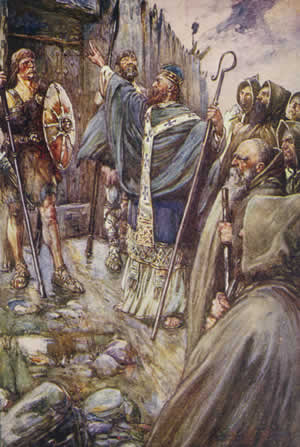
Saint Columba during a mission to the Picts

The Hiberno-Scottish mission was a series of expeditions in the 6th and 7th centuries by Gaelic missionaries originating from Ireland that spread Celtic Christianity in Scotland, Wales, England and Merovingian lands. Catholic Christianity spread first within Ireland. Since the 8th and 9th centuries, these early missions were called 'Celtic Christianity'.

There is dispute over the relationship of the Hiberno-Scottish mission to Catholic Christianity. Catholic sources claim it functioned under the authority of the Holy See,[1] while Protestant historians highlight conflicts between Celtic and Roman clergy.[2] There is agreement that the mission was not strictly coordinated.[3] As a whole, Celtic-speaking areas were part of Latin Christendom at a time when there was significant regional variation of liturgy and structure, but a general collective veneration of the Papacy was no less intense in Celtic-speaking areas.[4]

Etymology

[edit]

Hibernia is the Latin name for the island of Ireland.[5]

The Latin term Scotti refers to the Gaelic-speaking people of Ireland and western Scotland. From this term, developed an alternate Latin name for the territory in which the Scotti lived: Scotia.[6]

Schottenklöster (German for 'Scottish monasteries') is the name applied to the Bible schools established by Gaelic missionaries in Continental Europe, particularly to those in Germany that became Benedictine monasteries. Ireland's sobriquet "Island of Saints and Scholars" derives from this period.[1]

Columba in Scotland

[edit]

Columba was an Irish prince born in 521 and educated at the Bible school at Clonard. At the age of 25, Columba’s first mission involved the establishment of a school at Derry.[7] Following this, Columba spent seven years allegedly establishing over 300 churches and church schools.[8] Adamnan says of Columba:

He could not pass the space even of a single hour without applying himself either to prayer, or reading, or writing, or else to some manual labor.[9]

In 563, Columba sailed to Scotland with about 200 other missionaries hoping to spread Celtic Christianity among the largely pagan Picts.[8] The lord of the island of Mull, a Gael of Dál Riada, was a relative of Columba and granted the missionaries ownership of Iona, where they established a Bible school.[2] Bede writes that Columba converted the Picts to the word of God,[7] suggesting that Bible teaching was the central means of conversion. Students routinely studied for 18 years before ordination, an indicator of the depth of theological learning required by the Celtic Church.[10] This school remained Celtic until they were driven out by the Benedictines in 1204.[11]

See also

[edit]

Dunod in Wales

[edit]

Dunod was a disciple of Columba who established a Bible school at Bangor-on-Dee in 560. The school had such a large student body that seven deans presided over at least 300 students each.[12] The mission's conflict with Augustine is noteworthy. Pope Gregory I "invested Augustine with jurisdiction over all the bishops of the British Church" when he arrived in Britain in 597.[13] Neander writes:

The abbot of the most distinguished British monastery, at Bangor, Deynoch by name, whose opinion in ecclesiastical affairs had the most weight with his countrymen, when urged by Augustin to submit in all things to the ordinances of the Roman Church, gave him the following remarkable answer: “We are all ready to listen to the church of God, to the pope at Rome, and to every pious Christian, that so we may show to each, according to his station, perfect love, and uphold him by word and deed. We know not, that any other obedience can be required of us towards him whom you call the pope or the father of fathers.”[2]

Representatives from Bangor attended two conferences with Augustine, at which they declared “that they could not depart from their ancient customs without the consent and leave of their people” and that they could not accept the supremacy of the pope “nor receive [Augustine] as their archbishop”.[12] Dunod asserted his independence from Augustine on the grounds that they adhered to what their holy fathers held before them, who were the friends of God and the followers of the apostles.[14][15]

In Wales, Celtic Christianity long maintained its position with its peculiar ideas and exceptional beliefs.[16] The Bible school at Bangor was destroyed in 613 by King Æthelfrith.[17]

Aidan in England

[edit]

Aidan was educated at Iona.[18] In 634, King Oswald invited Aidan to the Northumbrian court to teach the doctrines of Celtic Christianity.[19] Oswald granted Aidan the island of Lindisfarne for a Bible school.[20] Upon his death in 651, Aidan was succeeded by Finan and then by Colman, both of whom had been educated at Iona.[21]

From Northumbria, Aidan's mission spread throughout the Anglo-Saxon kingdoms and similar Bible schools were established in Bernicia, Deira, Mercia and East Anglia.[22] It is estimated that two thirds of the Anglo-Saxon population were converted to Celtic Christianity at this time.[23]

Columbanus in Francia

[edit]

Columbanus was born in 543 and studied at Bangor Abbey until c. 590,[24] when he travelled to the continent with twelve companions,[25] including Attala, Columbanus the Younger, Gallus,[24] and Domgal.[26]

The mission was welcomed by King Guntram of Burgundy[26] and schools were established at Anegray, Luxeuil and Fontaines.[25] When Theuderic II expelled Columbanus from Burgundy in 610, Columbanus established Mehrerau Abbey at Bregenz with the support of Theudebert II.[25] When Theuderic II conquered Austrasia in 612, Columbanus fled to Lombardy, where he was welcomed by King Agilulf. In 614, he established a school at Bobbio.[25][26]

During the 7th century, the disciples of Columbanus and other Gaelic missionaries founded several monasteries in what are now France, Germany, Belgium, and Switzerland. The best known are: St. Gall in Switzerland, Disibodenberg in the Rhine Palatinate, Palatium at Besançon,[25] Lure and Cusance in the Diocese of Besançon, Bèze in the Diocese of Langres, Remiremont Abbey and Moyenmoutier Abbey in the Diocese of Toul, Fosses-la-Ville in the Diocese of Liège, Mont Saint-Quentin at Péronne, Ebersmunster in Lower Alsace, St. Martin's at Cologne, the Scots Monastery, Regensburg, Vienna, Erfurt and Würzburg.

In Italy, Fiesole produced Saint Donatus of Fiesole and Andrew the Scot of Fiesole. Another early Schottenkloster was Säckingen in Baden, founded by the Irish missionary Fridolin of Säckingen who is said to have founded another at Konstanz. Other Hiberno-Scottish missionaries active at the time, predominantly in Swabia, were Wendelin of Trier, Saint Kilian, Arbogast, Landelin, Trudpert, Pirmin (founded Reichenau abbey), Saint Gall (Abbey of St. Gall), Corbinian, Emmeram and Rupert of Salzburg.

After Columbanus (8th to 13th centuries)

[edit]
Schottenportal at the Scottish Monastery, Regensburg

Hiberno-Scottish activity in Europe continued after the death of Columbanus. There were monastic foundations in Anglo-Saxon England, the first in about 630 at "Cnobheresburgh", an unknown place in East Anglia but possibly Burgh Castle mentioned by Bede. Others such as Malmesbury Abbey, perhaps Bosham, and Glastonbury Abbey had strong Irish links. The profile of Iona declined, and from 698 until the reign of Charlemagne in the 770s, the Hiberno-Scottish efforts in the Frankish Empire were continued by the Anglo-Saxon mission – see Germanic Christianity.

Irish monks known as Papar are said to have been present in Iceland before its settlement from AD 874 onwards by the Norse.[27] The oldest source mentioning the Papar is the Íslendingabók ("Book of the Icelanders"), between 1122 and 1133.[28] The book states that the Norse found Irish priests, with bells and crosiers, at Iceland at the time of their arrival.[29] Such figures are also mentioned in the Icelandic Landnámabók ("Book of Settlements", possibly going back to the early 12th century).[30]

Among the Irish monks who were active in Central Europe were two particularly important theologians, Marianus Scotus and Johannes Scotus Eriugena. Legends of Irish foundations are recorded in a Middle High German text known as Charlemagne and the Scottish [Irish] Saints (Shaw, 1981).

The rule of St. Columbanus, which was originally followed in most of these monasteries, was soon superseded by that of St. Benedict. Later Gaelic missionaries founded Honau in Baden (about 721), Murbach in Upper Alsace (about 727), Altomünster in Upper Bavaria (about 749), while other Gaelic monks restored St. Michel in Thiérache (940), Walsort near Namur (945), and, at Cologne, the Monasteries of St. Clement (about 953), St. Martin (about 980), St. Symphorian (about 990), and St. Pantaléon (1042).

Towards the end of the 11th and in the 12th century, a number of Schottenklöster, intended for Irish monks exclusively, sprang up in Germany. About 1072, three monks, Marianus, Iohannus, and Candidus, took up their abode at the little Church of Weih-St-Peter at Regensburg (called Ratisbon in older literature). Their number soon increased and a larger monastery was built for them (about 1090) by Burgrave Otto of Regensburg and his brother Henry. This became the famous Scots Monastery of St. James in Regensburg, the mother-house of a series of other Schottenklöster. It founded the Abbeys of St. James at Würzburg (about 1134), St. Aegidius at Nuremberg (1140), St. James at Constance (1142), Our Blessed Lady at Vienna (1158), St. Nicolas at Memmingen (1168), Holy Cross at Eichstätt (1194), and the Priory of Kelheim (1231). These, together with the Abbey of St. James at Erfurt (1036), and the Priory of Weih-St-Peter at Ratisbon formed the famous congregation of the German Schottenklöster which was erected by Innocent III in 1215, with the Abbot of St. James at Ratisbon as abbot-general.

14th century onwards

[edit]

In the 14th and 15th centuries, most of these monasteries were on the decline, partly for want of Irish monks, and partly on account of great laxity of discipline and financial difficulties.

In consequence, the abbeys of Nuremberg and Vienna were withdrawn from the Irish congregation and repeopled by German monks in 1418. St. James's Abbey, Würzburg, was left without any monks after the death of Abbot Philip in 1497. It was then re-peopled by German monks and in 1506 joined the congregation of Bursfeld.

In 1595, however, it was granted to the Scottish congregation and occupied by Scottish monks until its suppression in 1803. The abbey of Constance began to decline in the first half of the 15th century and was suppressed in 1530. That of Memmingen also disappeared during the early period of the Protestant Reformation in the following century.

The Abbey of Holy Cross at Eichstatt seems to have ceased early in the 14th century. In consequence of the Protestant Reformation in Scotland many Scottish Benedictines left their country and took refuge in the Schottenklöster of Germany during the 16th century.

The Scottish monasteries in Ratisbon, Erfurt, and Würzburg again began to flourish temporarily, but all endeavours to regain the monasteries of Nuremberg, Vienna, and Constance for monks of Scottish nationality failed.

In 1692, Abbot Placidus Flemming of Ratisbon reorganized the Scottish congregation which now comprised the monasteries of Ratisbon Regensburg, Erfurt, and Würzburg, the only remaining Schottenklöster in Germany. He also erected a seminary in connection with the monastery at Ratisbon.

But the forced secularization of monasteries in 1803 put an end to the Scottish abbeys of Erfurt and Würzburg, leaving St. James's at Ratisbon as the only surviving Schottenkloster in Germany. Since 1827 this monastery was again permitted to accept novices but the number of its monks dwindled down to two capitulars in 1862.

There being no hope of any increase, Pope Pius IX suppressed this last Schottenkloster in his brief of 2 September 1862. Its revenues were distributed between the diocesan seminary of Ratisbon and the Scots College at Rome.

See also

[edit]

References

[edit]

Further reading

[edit]
Revisions and contributorsEdit on WikipediaRead on Wikipedia
from Grokipedia
The Hiberno-Scottish mission comprised a series of expeditions by Gaelic monks from and between the 6th and 8th centuries, aimed at evangelizing pagan populations and establishing monastic communities across Britain and parts of , thereby disseminating a distinctive form of characterized by ascetic monasticism and insular artistic traditions. Originating in , where had taken root without significant Roman influence following the withdrawal of Roman forces from Britain around 410 AD, these missions emphasized peregrinatio—voluntary for Christ's sake—and relied on self-sustaining monasteries as bases for preaching, copying manuscripts, and fostering learning. Pivotal to the mission's inception was the arrival of Irish abbot (c. 521–597 AD) in in 563 AD, where he founded the monastery on the Isle of off the western coast, serving as a hub for converting the Northern and of . From , missionaries like extended efforts to in 635 AD, establishing and aiding the Christianization of Anglo-Saxon kingdoms, which featured practices such as the distinctive Celtic tonsure and Easter dating divergent from Roman norms until the in 664 AD. Further afield, figures such as (c. 543–615 AD) ventured to and , founding influential monasteries like Luxeuil and , which preserved classical texts and influenced the through their scriptoria and scholarly output. These missions' achievements included not only territorial expansions of but also the transmission of Irish learning—encompassing metalwork, illuminated manuscripts like the precursors, and penitential systems—that bridged and medieval Europe, though their insular traditions eventually yielded to Roman standardization.

Origins and Context

Etymology and Terminology

The term "Hiberno-Scottish mission" designates the evangelistic endeavors undertaken by Gaelic monks originating from and the Irish-settled kingdom of in western , spanning roughly the 6th to 8th centuries AD, aimed at converting pagan peoples in Britain and parts of continental Europe. The prefix "Hiberno-" derives from , the classical Latin designation for Ireland, first attested in Julius Caesar's (c. 50 BC), where it describes the island west of Britain as inhabited by warlike tribes. Hibernia likely adapted a pre-Roman Celtic ethnonym Iveriu (referring to the Iverni, an ancient Irish tribal group), but was reshaped in Latin to align phonetically with hibernus ("wintry"), evoking the island's perceived foggy, temperate maritime climate rather than implying perpetual winter. "Scottish" refers to the Scotti, the Goidelic-speaking Irish migrants who established the kingdom of (encompassing parts of modern and ) by the 5th century AD, from which monastic centers like (founded 563 AD by the Irish ) launched key expeditions; this usage predates the later of the Picts, Britons, and Angles into modern Scots, avoiding with contemporary Scottish identity. Alternative terminologies include "Irish missions" or "peregrinatio" (Latin for the monks' voluntary exile for Christ's sake), emphasizing the Irish core, though "Hiberno-Scottish" better captures the integrated role of Dál Riatan bases in sustaining outreach to , Northumbrians, and , distinct from Roman papal missions under (arrived 597 AD). On the European mainland, such foundations were later known as Schottenklöster ("Scottish monasteries" in German), a designation applied from the medieval period onward to Irish-founded houses like St. Peter's in (c. 1070s), reflecting blurred perceptions of Gaelic origins as "Scottish" due to Iona's location and enduring cultural ties.

Pre-Mission Developments in Ireland and Scotland

In the early fifth century, had already established a foothold among some Irish communities, leading to dispatch Palladius as the first recorded bishop to in 431 AD to oversee and minister to these believers. Palladius's mission, though short-lived, marked formal ecclesiastical recognition from of an existing Christian presence, predating more extensive evangelization efforts. Subsequently, Patrick, a Romano-British former slave who had converted to during captivity in Ireland, returned as a around 432 AD, focusing on baptizing converts, founding churches, and organizing across the island until approximately 493 AD. His efforts, documented in his own Confessio, accelerated the faith's spread among pagan tribes, though Ireland's conversion remained gradual and incomplete by the century's end, with druidic traditions persisting in rural areas. By the early sixth century, the Irish church shifted toward a monastic model, emphasizing ascetic communities under abbatial authority rather than episcopal hierarchies, laying the groundwork for missionary expansion. In , Irish Gaels (Scotti) migrated to the western regions during the fifth century, establishing the kingdom of and introducing from their homeland, rendering this area a Christian stronghold by the early sixth century. 's rulers patronized the faith, integrating it with Gaelic customs, though organized ecclesiastical structures were limited without major monastic centers. Conversely, the Pictish territories in eastern and northern adhered to indigenous pagan practices, including Druidism, polytheistic worship of natural forces like the sun, and symbolic stone carvings reflecting animistic beliefs, with negligible Christian influence prior to external missions. This religious divide—Christian west versus pagan east—set the stage for targeted evangelization from Irish-Scottish bases.

Core Missions in the British Isles

Columba's Foundation of Iona and Evangelization of Picts

In 563, , an Irish born circa 521, sailed from with twelve companions and established a monastery on the island of , off Scotland's in territory. The site was granted by Conall mac Comgaill, king of (r. c. 558–574), a kinsman who ruled the Gaelic Scots settlers. This foundation provided a secure base amid potentially hostile surroundings, emphasizing ascetic with as , where monks engaged in copying manuscripts, prayer, and manual labor. The quickly became a hub for evangelizing the pagan , who dominated northern and eastern and practiced druidic resistant to Roman influences. personally led missions northward, culminating in a visit to King Bridei mac Maelchon (r. c. 554–584) at his fort near around 565. According to Adomnán's Vita Columbae (c. 700), composed from earlier testimonies, fearlessly approached the court despite armed guards, prophesied boldly, and performed acts interpreted as miraculous, such as calming a royal fear through prayer. Bridei, initially skeptical, relented by allowing church construction and granting safe passage to 's followers across Pictish lands. While Adomnán's hagiographic account includes supernatural elements, the core event of Columba's audience with Bridei aligns with Bede's Ecclesiastical History (c. 731), which dates Columba's Pictish outreach to his later years and credits it with initiating conversions among the northern . Archaeological evidence, including early Christian symbols on Pictish stones, supports gradual adoption post-563, though prior contacts via trade existed. Iona's monks, trained in Irish Celtic traditions, established daughter houses and itinerant preaching, contributing to Pictish kings' eventual Christian allegiance by the late sixth century. died at on June 9, 597, aged about 76, with his successor Baithéne continuing the mission.

Aidan's Mission to Northumbria and Lindisfarne

In 634, after defeating the British king Cadwallon at the , Oswald ascended the throne of , having been baptized during his exile at the monastery of around 616. Recognizing the need to evangelize his pagan subjects following the collapse of Roman-influenced Christianity under King , Oswald petitioned the for missionaries from the Irish-Scots tradition. An initial envoy, likely a monk named Corcoran, proved too severe in demanding immediate conversions, leading the Iona brethren to select , noted for his mild and persuasive manner, as bishop for the task. Aidan arrived in Northumbria in 635, accompanied by a small group of monks, and Oswald granted him the tidal island of —located opposite the royal stronghold of —as the base for the mission. There, Aidan founded a and , constructing a wooden church and establishing a monastic community patterned after Iona's Celtic model, emphasizing ascetic discipline, scriptural study, and pastoral outreach. The site's strategic position facilitated access to the mainland while providing seclusion for contemplation, mirroring the eremitic influences of Irish Christianity. Aidan's evangelistic efforts focused on itinerant preaching across , traveling chiefly on foot to reach both nobility and commoners, including slaves whom he often ransomed for . Oswald, fluent in Irish Gaelic, personally interpreted Aidan's sermons, enabling effective communication with the Anglo-Saxon populace and contributing to rapid conversions; records that Oswald donated estates, such as at , for church foundations. Aidan's approach emphasized humility, charity, and voluntary adherence over coercion, fostering monasteries and a school at Lindisfarne to train native clergy, which produced figures like Chad and Cedd. This mission reestablished Christianity in the region, sustaining it through Oswald's reign until his death in 642 and beyond, though it later faced challenges from Roman ecclesiastical norms. Aidan succumbed to illness on August 31, 651, amid a Mercian siege of led by King Penda, dying while propped against a church beam that survived ; his body was interred at , where his relics later drew pilgrims. portrays Aidan as exemplifying apostolic virtues—poverty, continence, and obedience—crediting him with miracles like fire-quenching and healings, though these accounts reflect hagiographic traditions reliant on oral testimonies preserved in monastic records. The mission's success hinged on symbiosis with royal patronage, yet its Celtic practices, including distinct tonsure and Easter computation, sowed seeds for future synodal reconciliations.

Dunod and Missions to Wales

Dunod, also rendered as Dunawd or Dinooth, was a 6th-century figure of North British origin, identified in Welsh tradition as the son of the chieftain Pabo Post from the Coel Godebog lineage. Having fled southward amid regional conflicts, he sought refuge in northern under the protection of Cyngen, son of Cadell Deyrnllwg, prince of . There, Dunod established the monastery of Bangor Iscoed (Bangor-on-Dee) in , serving as its inaugural alongside his sons Gwarthan, Cynwyl, and Deiniol, thereby contributing to the monastic expansion in Brythonic during a period of post-Roman consolidation. Bangor Iscoed emerged as a prominent Insular monastic center, emphasizing communal , scriptural study, and prayer, with traditions attributing to it a community of scholars and clerics active in regional affairs. Dunod participated in assemblies of Welsh bishops, including a likely convened under figures like St. David around the mid-6th century, which addressed disciplinary and liturgical matters amid threats from Anglo-Saxon incursions. Historical records, such as the Annales Cambriae, note the death of a "Dunaut rex" in 595, potentially referencing Dunod in a secular capacity, while identifies "Dinoot" as during the monastery's destruction. In 613, during of Northumbria's campaign at the , Bangor Iscoed suffered a devastating raid, with approximately 1,200 monks reportedly slain while engaged in penitential against the Anglo-Saxon forces—a casualty figure and context preserved in Bede's account, underscoring the monastery's alignment with British resistance to pagan English expansion. This event marked a severe blow to Welsh , scattering survivors and curtailing the site's influence, though it highlighted the vulnerability of border monasteries to inter-ethnic warfare. Regarding broader missions to , direct expeditions from Irish or sources appear limited, as the region maintained a pre-existing Romano-British Christian framework evangelized by local saints such as (d. ca. 589) and reinforced through native foundations like Bangor Iscoed. Dunod's efforts focused on internal consolidation and expansion within , including his son Deiniol's establishment of , rather than outreach to unconverted populations; any shared monastic practices with Hiberno-Scottish traditions stemmed from parallel Insular developments rather than documented Gaelic missions. Later hagiographic claims of Dunod's activity in lack primary corroboration and likely reflect retrospective saintly itineraries common in medieval vitae. His feast is observed on 7 September in Welsh calendars, affirming his enduring role in Powysian ecclesiastical memory.

Continental Expansion

Columbanus's Journeys and Monasteries in Francia and Italy

In 590, , an Irish monk trained at under Comgall, departed with twelve companions, traveling through Britain to the (modern-day ), driven by a peregrinatio pro Christo—a voluntary for zeal. They first settled at Annegray, an abandoned Roman fort in the , where established a rigorous monastic community emphasizing , , and strict discipline, attracting numerous local converts and recruits despite initial hostility from surrounding . By around 593, the community outgrew Annegray, prompting Columbanus to found Luxeuil Abbey nearby, which became the center of his Frankish mission and a model for continental with its rule blending Irish customs—such as private and perpetual fasts—with elements of Benedictine practice. Luxeuil flourished under his abbacy until approximately 610, spawning daughter houses like Fontaine-lès-Luxeuil and influencing Merovingian rulers, including Queen Brunhilda, who supported the mission amid the kingdom's political fragmentation. However, tensions escalated with Gallic bishops over Columbanus's adherence to the Irish Easter computus (dating Paschal full moon to 14 Nisan regardless of weekday) and the Celtic tonsure (shaving the front of the head), which deviated from Roman norms, leading to accusations of irregularity and his expulsion by King Clothar II following complaints from local . Expelled from Luxeuil in 610, Columbanus journeyed eastward with a small group, briefly evangelizing the Alamannic regions around and founding a short-lived at in 610–611 amid Lombard-Avar conflicts, before political instability forced relocation southward over the into . Arriving in around 612–613, he sought refuge under King and Queen Theudelinda in , then received a grant of in the Apennine valley from Lombard duke Arias of , where he founded in 614. , built around a restored , emphasized alongside , preserving classical texts and serving as a that transmitted Irish learning to ; governed it until his death on November 23, 615, after which it endured as a key Benedictine center despite his Irish rule's gradual assimilation. These foundations in and marked the Hiberno-Scottish mission's pivotal continental expansion, introducing insular monastic rigor to counter secular decay in post-Roman .

Followers and Broader European Outreach

Gallus, a disciple of from , accompanied his master to the continent and established a hermitage in the region of Alemannia (modern ) after parting ways in 610; this settlement evolved into the influential Abbey of St. Gall around 613, serving as a center for activity and among the Germanic tribes. 's other followers, including Attala and Bobo, continued his monastic foundations in , while the broader peregrini tradition—Irish monks undertaking voluntary exile for evangelization—facilitated outreach to emerging Frankish and Lombard territories. Independent Irish missionaries extended the mission's reach into during the 7th century. , originating from around 640, led a trio of missionaries (with Colman and Totnan) to in modern-day northern , , where he was consecrated bishop of and converted local nobility until his martyrdom circa 689 for challenging incestuous unions among the Thuringian elite. This effort established enduring sees and monasteries, embedding Celtic monastic practices in Germanic lands. In the 8th century, , an Irish scholar-monk possibly from Aghaboe, advanced missions eastward as bishop of from 749 until his death in 784; he evangelized the (Slavic peoples in modern and ), founding monasteries and defending cosmological views against Frankish critics, thus bridging Celtic learning with Alpine and Danubian regions. These endeavors, alongside figures like Donatus who reinforced Irish episcopal presence in , , from 829 to 876, disseminated ascetic discipline, penitential systems, and scriptoria across , Alemannia, , and beyond, influencing Carolingian reforms despite tensions over liturgical variances. By the , such foundations had catalyzed a network of over a dozen Irish-led monasteries in and , preserving classical texts amid post-Roman fragmentation.

Distinctive Features of Celtic Christianity

Monastic Structure and Ascetic Practices

In Hiberno-Scottish , authority rested primarily with abbots rather than bishops, reflecting a structure where monastic leaders governed ecclesiastical affairs within defined territories or spheres of influence, often independent of episcopal oversight until diocesan reforms in the . Abbots, frequently from the founding kin group, directed communities that integrated clerical, scholarly, and lay elements, with bishops either subordinate or holding ceremonial roles; this contrasted with Roman models emphasizing hierarchical bishoprics. Establishments like , founded by in 563, operated as federated clusters of cells for prayer, manual labor such as farming and fishing, and scriptorial work, without adherence to a uniform rule like Benedict's, which arrived only later. Columbanus adapted Irish traditions abroad, authoring the Regula Monachorum and Regula Coenobialis for Luxeuil (established c. 590) and (founded 614), which prescribed communal discipline including perpetual silence outside prayer times, collective labor, and private confession to enforce repentance. These rules emphasized cenobitic (communal) life over eremitic isolation, though local adaptations allowed for diverse expressions, such as the mobile, poetic discipline observed in Columba's . , modeled on Iona under Aidan from 635, mirrored this by prioritizing abbatial oversight and monastic training for evangelism, fostering a structure resilient to secular disruptions. Ascetic practices centered on rigorous as a response to , including , unceasing cycles, and physical labors viewed as spiritual exertion, sustaining monks amid isolation and evangelistic toil. exemplified this through arduous routines of manual work, scriptural copying, and prophetic , dividing Iona's monks into rotational duties to embody disciplined love of God over comfort. A hallmark was peregrinatio pro Christo, voluntary lifelong exile equated to "white martyrdom," wherein missionaries like (exiled to in 563), Aidan, and Columbanus (departing Ireland c. 591) renounced homeland for Christ's sake, emulating Abraham's wanderings and enabling mission without return. This practice, rooted in 6th-century Irish , propelled Hiberno-Scottish expansion while demanding total detachment from kin and property. Columbanus enforced such severity at Luxeuil through strict penitentials and communal austerity, drawing crowds yet provoking conflicts over unyielding discipline. Local environments further tailored these to stern simplicity, prioritizing and self-mortification over elaborate liturgies.

Liturgical and Doctrinal Variations from Roman Norms

The Hiberno-Scottish missionaries, operating from the 6th to 8th centuries, maintained fidelity to core Christian doctrines such as the , , and sacraments, with no evidence of substantive diverging from Nicene . Variations from Roman norms were primarily liturgical and disciplinary, arising from the insular isolation of and , which preserved earlier traditions influenced by Eastern or Gallican elements rather than direct Roman imposition. These included distinct computations for movable feasts and ritual forms, which fueled tensions during encounters with Roman-aligned clergy, as seen in Columbanus's correspondence with around 600, where he defended local practices while affirming papal authority. A primary liturgical divergence concerned the , with Hiberno-Scottish churches employing an older table based on an 84-year cycle (or potentially a 14-year in some Irish computations), leading to celebrations sometimes a month earlier than the Roman 19-year Alexandrian cycle adopted by the late 6th century. This discrepancy, rooted in adherence to of John's emphasis on the 14th of , persisted until reforms like those at the in 664, where Northumbrian adoption of Roman dating marked a shift away from Celtic norms. The variation was not doctrinal but calendrical, yet it symbolized broader autonomy, as Celtic computists like those at prioritized scriptural lunar alignment over Roman solar adjustments. The clerical exemplified another visible rite difference: Hiberno-Scottish monks practiced a transverse tonsure, shaving the hair from ear to ear across the forehead in a line, evoking St. John's tradition, in contrast to the Roman coronal tonsure, a circular shave on the crown symbolizing St. Peter's dome-like baldness. This practice, documented in Bede's accounts of 7th-century disputes, was defended by Irish clergy as apostolic but viewed by Romans as irregular, contributing to perceptions of separation despite shared sacramental validity. Baptismal and penitential rites also varied; Celtic immersion practices occasionally omitted Roman chrismation or immediate confirmation, prompting critiques of incompleteness, while private, repeatable penance—administered via tariffs in texts like the Paenitentiale Cummeani (c. 650)—contrasted with Roman public, once-only absolution for grave sins. The Celtic Mass, or rite, featured public yet optional participation, extended litanies, protective loricae prayers, and a contestatio (preface) without fixed post-communion variables, blending Gallican influences with local devotions rather than strict Roman canon uniformity. These elements, while enriching ascetic spirituality, were reconciled through synods rather than doctrinal rupture, underscoring that Hiberno-Scottish divergences emphasized monastic rigor over hierarchical conformity.

Conflicts and Reconciliation with Roman Authority

Disputes Over Easter, Tonsure, and Clerical Discipline

The primary disputes between the Hiberno-Scottish missionaries and Roman ecclesiastical authorities centered on the calculation of 's date, reflecting divergent computistical traditions. The Celtic churches adhered to the Latercus, an 84-year paschal cycle established by Victorius of in the 5th century, which fixed the vernal on March 25 and limited the paschal full moon to lunar ages 14 through 20, often resulting in falling later than the Roman preference or aligning closely with the Jewish . In contrast, Roman-influenced regions, including , followed a 19-year refined at and endorsed at the Council of Nicaea in 325, with an of March 21 and lunar limits of 16 to 22, prioritizing a post- Sunday observance to distinguish from Quartodeciman practices. These discrepancies caused practical discord, as Celtic could occur up to a month after the Roman date, leading to divided communities celebrating separately; for instance, Columbanus's monasteries in observed the Latercus amid local use of the Victorian 532-year table, prompting accusations of Judaizing tendencies. Columbanus actively defended the Celtic Easter reckoning in correspondence with Pope Gregory the Great around 600 AD, arguing that the Roman variants risked a "dark Easter" by allowing celebrations before the true equinox or outside biblical lunar bounds, while urging unity on core doctrine over calendrical variance. Tensions escalated at the of Chalon in 603, where Frankish bishops challenged Columbanus's practices, contributing to his eventual exile in 610, though his foundations like Luxeuil initially persisted with insular customs until papal privileges, such as Honorius I's 628 concession to , facilitated gradual adoption of the Roman table. Similar frictions arose in under , where Lindisfarne's monks kept the Celtic date, fostering perceptions of isolationism until the in 664 mandated Roman alignment. The dispute symbolized deeper cultural divides, with Celtic clergy sporting a frontal shave from ear to ear—leaving a long fringe of hair forward—contrasting the Roman coronal style, which shaved a circle atop the head to evoke St. Peter. , in his Historia Ecclesiastica (completed c. 731), described the Celtic form as uncanonical, linking it to the heretic and portraying its abandonment by Iona's monks post-Whitby as a marker of , though archaeological suggests possible druidic precedents without direct causation. justified the insular tonsure as apostolic, tied to St. John the Evangelist, in defenses against Frankish bishops around 603, viewing Roman critiques as petty amid shared faith. Clerical discipline diverged notably in penitential practices, where Hiberno-Scottish tradition emphasized private, repeatable confession to a "soul friend" (anamchara), guided by tariffed penitentials assigning fixed penances (e.g., one year for lay , five for clerics; three to twelve years for murder per status), drawing from Eastern monastic influences like Cassian. This contrasted Roman norms of public, one-time penance for grave sins like or , involving prolonged visible humiliation and irreversible status loss, as affirmed against private variants at the Third Council of Toledo in 589. Irish missionaries exported this flexible system during 7th-century continental outreach, enhancing clerical accountability through frequent reconciliation and influencing broader reform, though it invited Roman suspicions of laxity despite its rigor in promoting ongoing moral discipline. These variances, while not doctrinal heresies, underscored autonomy in insular , often framed by Roman sources like as barriers to unity rather than equivalent customs.

The Synod of Whitby (664) and Its Outcomes

The Synod of Whitby, convened in 664 at the monastery of Streanaeshalch (modern Whitby Abbey) under the presidency of King Oswiu of Northumbria, addressed longstanding ecclesiastical disputes between adherents of Celtic Christian practices—rooted in traditions from Ireland and Iona—and those favoring Roman customs introduced via Canterbury. The primary catalyst was the divergent calculation of Easter's date: Celtic computus followed an 84-year lunar cycle, often resulting in observance after the vernal equinox or coinciding with the Jewish Passover, whereas the Roman method, aligned with the Alexandrian 19-year cycle and refined at the Council of Nicaea (325), prioritized the Sunday following the first full moon after the astronomical equinox. A secondary issue was the clerical tonsure: the Celtic style involved shaving the front of the head from ear to ear, evoking a druidic heritage, while the Roman tonsure was a coronal ring on the crown, symbolizing the crown of thorns. Representing the Celtic position was Bishop Colman of Lindisfarne, successor to in the Hiberno-Scottish mission to , supported by Abbess , who hosted the assembly. The Roman advocates included Bishop of , who had studied in and argued for uniformity with continental churches to facilitate missionary outreach and imperial ties. Debates, as recorded by Bede, centered on scriptural and apostolic authority: Colman invoked the practices of Columba and early Irish predecessors, claiming fidelity to "the customs of John the Evangelist," while Wilfrid countered with appeals to Peter’s primacy, citing Matthew 16:18–19 and the broader acceptance of Roman usages by churches from Gaul to Asia. King Oswiu, observing Passover with Celtic rites in his youth but ruling a kingdom with Roman-influenced southern connections, ultimately deferred to Petrine authority, declaring, "Peter is the doorkeeper whom I intend without doubt to meet... I will not contradict him," thereby endorsing Roman computations and tonsure. The synod's rulings mandated Northumbria's adoption of Roman Easter reckoning and , extending to related observances like the liturgical calendar to align with and prevent . Colman, unwilling to conform, departed with approximately thirty Irish and English monks, relocating first to and then establishing a on Inishbofin off , where he later founded a community for English refugees at Mayo Abbey. Wilfrid's elevation to the bishopric of (initially shared, then consolidated) advanced Roman ecclesiastical organization, including diocesan structures over monastic supremacy. This decision facilitated Northumbria's integration into the broader Latin Christian orbit, diminishing the dominance of Hiberno-Scottish monastic missions in , though Celtic influences persisted in scholarship and peripheral regions like and . The synod did not eradicate outright but accelerated its marginalization in Anglo-Saxon territories, prioritizing doctrinal uniformity for political and evangelistic cohesion.

Long-Term Impact and Decline

Preservation of Scholarship and Cultural Transmission

Monasteries in Ireland and Scotland, relatively insulated from the Germanic invasions that disrupted continental learning after the fall of in 476, became repositories of classical and Christian texts during the 6th to 8th centuries. Irish scriptoria, such as those at Bangor and , produced illuminated manuscripts including biblical commentaries and patristic works by authors like Augustine and , alongside excerpts from and , ensuring the survival of Latin literacy amid widespread cultural decline elsewhere in . The mission's expansion facilitated active transmission of this scholarship to the continent. From , founded by in 563, missionaries carried manuscripts and pedagogical methods to , influencing centers like , where scribes adapted for works blending theology with artistic innovation, such as the completed around 715–720. Columbanus's foundations further exemplified this role; his abbey at , established in 614, amassed a library of over 600 volumes by the , including rare classical texts and early medieval theological treatises that withstood Lombard and later disruptions, serving as a key node for knowledge dissemination in . These efforts not only preserved but also reintroduced texts to regions recovering from chaos, laying groundwork for the through disciples who integrated Irish exegetical traditions into Frankish courts. Cultural transmission extended beyond texts to computational aids and ; Irish monks developed the precursor to the modern zero in their tables by the 7th century and authored annals like the (from ca. 431), chronicling events with a blend of native Gaelic and imported Roman chronologies, thus bridging oral traditions with written records. This synthesis sustained scholarly continuity, countering the era's fragmentation without reliance on Roman institutional remnants.

Evolution from 8th to 13th Centuries

In the , Hiberno-Scottish missionary activity persisted on the continent, exemplified by the Irish cleric (Fergal), who arrived in around 743 and was appointed bishop of by 749, overseeing the construction of its cathedral and extending missions into areas of modern-day Czechia and . New monastic foundations emerged, such as Honau around 721 and Murbach around 727, building on earlier Columban legacies while adapting to local Frankish contexts. These efforts emphasized scholarly pursuits, with Virgil noted for astronomical and geographical knowledge that occasionally conflicted with prevailing Roman views but advanced ecclesiastical infrastructure. During the , Irish scholars played a pivotal role in the , serving at courts of and his successors; figures like Dicuil contributed geographical texts, while Sedulius Scottus and Clement of taught grammar and theology, aiding the standardization of Latin and education across . Restorations of older houses, including St. Michel-en-Thiérache in 940 and Waulsort in 945, sustained Irish influence amid Viking disruptions in that temporarily curtailed peregrinations. By this period, continental monasteries increasingly adopted the Benedictine Rule, diluting distinct Celtic liturgical elements like the and computus in favor of Roman uniformity, though Irish monks retained a reputation for ascetic rigor and scriptural . From the 10th to 12th centuries, a resurgence occurred with organized Irish Benedictine groups establishing Schottenklöster ("Scottish monasteries") in , starting with St. James at around 1090, followed by in 1134, in 1140, and in 1158; these housed exclusively Irish or Scottish monks, fostering cultural transmission through scriptoria and . This phase marked a shift from individualistic peregrini to congregational models, with serving as a motherhouse. By 1215, eight abbeys and two priories formalized a congregation under 's , peaking Irish monastic presence amid the Controversy's resolution and economic growth. Into the 13th century, these institutions integrated further into the Holy Roman Empire's ecclesiastical framework, prioritizing Benedictine observance over Celtic peculiarities, yet preserving Irish hagiographical traditions and manuscript production; however, early strains appeared from recruiting shortages and internal laxity, foreshadowing later 14th-century declines linked to the and secularization pressures. Overall, the mission evolved from evangelistic expansion to scholarly and monastic consolidation, contributing to Europe's intellectual revival while gradually assimilating into pan-European Benedictinism.

Later Revivals and 14th-Century Onward Influence

In the fourteenth and fifteenth centuries, the continental monasteries founded by Irish and , known as Schottenklöster, entered a phase of marked decline, attributed to the diminishing supply of recruits from and , exacerbated by poverty, internal mismanagement, and the disruptions of regional conflicts such as the Hundred Years' War's indirect effects on trade and pilgrimage routes. These institutions, which had peaked in influence during the eleventh to thirteenth centuries as a continuation of the peregrinatio tradition, increasingly struggled to maintain their distinct Gaelic character, with many abbots and becoming localized by the late medieval period. Despite this trajectory, several Schottenklöster endured into the early , preserving elements of their foundational legacy through Benedictine observance and architectural patronage. The Scots Monastery of St. James in , established around 1090, operated continuously until its secularization in 1810 amid Bavarian reforms, during which time it supported scholarly activities and relic veneration tied to Irish saints like Erhard of Regensburg. Similarly, the Schottenkirche in , founded in 1155 under Irish Benedictine auspices, withstood pressures and contributed to Habsburg court spirituality until its monastic suppression under Emperor Joseph II in 1783, after which the church transitioned to parish use and retains its Romanesque portal as a testament to eleventh-century Hiberno-Scottish stylistic influences. The onward influence from the fourteenth century manifested primarily in localized monastic reforms and cultural transmission rather than expansive revivals, as the original itinerant zeal gave way to sedentary Benedictine integration. These houses occasionally inspired minor renewals, such as the 1412 renewals in and that reaffirmed ties to Regensburg's mother house, fostering a loose congregation under papal recognition from 1215. However, by the sixteenth century, Protestant seizures and centralization further eroded their autonomy, with surviving entities exerting influence mainly through hagiographic cults and manuscript collections that echoed earlier Celtic learning traditions, albeit diluted by Roman liturgical standardization. No widespread revival of the Hiberno-Scottish model occurred in this period, as continental monasticism shifted toward and centralized papal oversight.

Historiographical Debates and Modern Assessments

Catholic and Protestant Interpretations of Orthodoxy

Catholic interpretations emphasize the Hiberno-Scottish mission's full alignment with orthodox Catholic doctrine and its operation under the authority of the , viewing disciplinary variations—such as the and style—as peripheral customs rather than threats to core beliefs like the or sacraments. Historical evidence includes British bishops' participation in Roman synods, such as Arles in 314 AD, and appeals to papal intervention against , exemplified by Pope Celestine I's dispatch of in 429 AD to combat the heresy in Britain. The in 664 AD is seen not as an imposition of foreign orthodoxy but as a voluntary alignment with universal under , affirming the missionaries' prior orthodoxy and commitment to ecclesial unity. Protestant historiographical traditions, particularly from the onward, have at times portrayed the Celtic Church as a semi-independent embodying a simpler, more scriptural faith less encumbered by Roman hierarchical structures, using this narrative to legitimize breaks from papal authority. For instance, 19th-century Anglican and Reformed writers invoked an "ancient British Church" predating Augustine's 597 AD mission as evidence of native, non-papal , often exaggerating conflicts like those at to depict Rome as an intruder on apostolic purity. Such interpretations, rooted in confessional polemics, prioritized monastic autonomy and evangelistic zeal over Roman conformity, though they rarely alleged outright , instead framing differences as preservations of primitive practice. Contemporary Protestant scholarship, however, largely disavows romanticized claims of a uniquely "pure" Celtic orthodoxy, acknowledging the mission's doctrinal conformity to Nicene standards—evident in texts like St. Patrick's Confessio (c. 450 AD)—and its integration into the Latin West without substantive theological innovation or . Disputes over practices like hereditary abbacies or penitential systems are now assessed as regional adaptations that resolved through synodal processes, not indicators of , with Pelagian influences in Ireland condemned by local synods around 450 AD in line with universal Church condemnations. This shift reflects empirical reevaluation, diminishing earlier anachronistic projections of ideals onto early medieval .

Achievements Versus Criticisms in Missionary Efficacy

The Hiberno-Scottish missions achieved considerable success in pioneering Christian conversions in regions beyond the reach of earlier Roman efforts, particularly through monastic foundations that served as hubs for evangelism and education. In 563, St. Columba established Iona Abbey, which became instrumental in converting the Pictish King Bridei and his subjects in northern Britain, marking a foundational step in Christianizing Scotland. Similarly, in 634, St. Aidan, dispatched from Iona, founded Lindisfarne Priory in Northumbria at the behest of King Oswald, leading to mass baptisms among Anglo-Saxon pagans and the erection of churches and schools that promoted scriptural study and moral instruction. These initiatives demonstrated efficacy in adapting to local tribal structures, leveraging royal patronage for rapid dissemination without coercive force. On the European continent, figures like St. Columbanus extended this model, founding Luxeuil Abbey in around 590 and in by 612, where rigorous Celtic rules revitalized lax Merovingian and trained disciples who propagated Irish penitential practices and learning. These establishments not only converted elites but also preserved classical texts in scriptoria during periods of instability, laying groundwork for later scholastic traditions that influenced medieval universities. Overall, the missions' emphasis on personal and itinerant preaching enabled effective penetration into "barbarian" territories, contrasting with more hierarchical Roman strategies. Criticisms of their efficacy center on sustainability and adaptability, as the missions' insular practices—such as divergent dating and styles—fostered conflicts with Roman authorities, culminating in the in 664, where Northumbrian leaders prioritized Roman uniformity, sidelining Celtic customs and limiting their enduring influence in . This event underscores a key limitation: while excelling in initial, localized conversions, the approach's resistance to standardization hindered integration into the papacy's unifying framework, which proved more resilient for continental expansion. Further critiques highlight the monastic-centric model, which prioritized elite, cloistered communities over broad episcopal oversight, potentially restricting lay engagement and institutional depth compared to Roman missions' alignment with imperial governance. Historical analyses note that many Celtic foundations were later reformed under Benedictine rules, suggesting scalability issues in diverse polities, and occasional expulsions, as with from due to ritual disputes, reveal tensions with established clergy that undermined long-term stability. The uncoordinated, spontaneous nature of these efforts, while innovative, lacked the systematic coordination of Roman operations, contributing to their gradual absorption rather than dominance.

References

Add your contribution
Related Hubs
User Avatar
No comments yet.