



Community hub
Recent from talks
Contribute something
Nothing was collected or created yet.
Jacobsthal number
View on WikipediaIn mathematics, the Jacobsthal numbers are an integer sequence named after the German mathematician Ernst Jacobsthal. Like the related Fibonacci numbers, they are a specific type of Lucas sequence for which P = 1, and Q = −2[1]—and are defined by a similar recurrence relation: in simple terms, the sequence starts with 0 and 1, then each following number is found by adding the number before it to twice the number before that. The first Jacobsthal numbers are:

- 0, 1, 1, 3, 5, 11, 21, 43, 85, 171, 341, 683, 1365, 2731, 5461, 10923, 21845, 43691, 87381, 174763, 349525, … (sequence A001045 in the OEIS)
A Jacobsthal prime is a Jacobsthal number that is also prime. The first Jacobsthal primes are:
- 3, 5, 11, 43, 683, 2731, 43691, 174763, 2796203, 715827883, 2932031007403, 768614336404564651, 201487636602438195784363, 845100400152152934331135470251, 56713727820156410577229101238628035243, … (sequence A049883 in the OEIS)
Jacobsthal numbers
[edit]Jacobsthal numbers are defined by the recurrence relation:
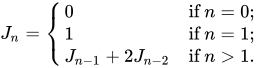
The next Jacobsthal number is also given by the recursion formula

or by

The second recursion formula above is also satisfied by the powers of 2.
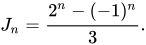
The Jacobsthal number at a specific point in the sequence may be calculated directly using the closed-form equation:[2]
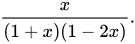
The generating function for the Jacobsthal numbers is
The sum of the reciprocals of the Jacobsthal numbers is approximately 2.7186, slightly larger than e.
The Jacobsthal numbers can be extended to negative indices using the recurrence relation or the explicit formula, giving

The following identities holds

- where is the nth Fibonacci number.


Jacobsthal–Lucas numbers
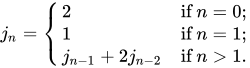
[edit]Jacobsthal–Lucas numbers represent the complementary Lucas sequence . They satisfy the same recurrence relation as Jacobsthal numbers but have different initial values:

The following Jacobsthal–Lucas number also satisfies:[2]

The Jacobsthal–Lucas number at a specific point in the sequence may be calculated directly using the closed-form equation:[2]

The first Jacobsthal–Lucas numbers are:
Jacobsthal Oblong numbers
[edit]The first Jacobsthal Oblong numbers are: 0, 1, 3, 15, 55, 231, 903, 3655, 14535, 58311, … (sequence A084175 in the OEIS)

References
[edit]- ^ Weisstein, Eric W. "Jacobsthal Number". MathWorld.
- ^ a b c Sloane, N. J. A. (ed.). "Sequence A014551 (Jacobsthal–Lucas numbers)". The On-Line Encyclopedia of Integer Sequences. OEIS Foundation.
Classes of natural numbers | |||||||||||||||||||||||||
|---|---|---|---|---|---|---|---|---|---|---|---|---|---|---|---|---|---|---|---|---|---|---|---|---|---|
| |||||||||||||||||||||||||
| |||||||||||||||||||||||||
| |||||||||||||||||||||||||
| |||||||||||||||||||||||||
| |||||||||||||||||||||||||
| |||||||||||||||||||||||||
| |||||||||||||||||||||||||
| |||||||||||||||||||||||||
| |||||||||||||||||||||||||
| |||||||||||||||||||||||||

Jacobsthal number
View on GrokipediaDefinition
Recurrence Relation
The Jacobsthal numbers are defined by the linear homogeneous recurrence relationfor . This relation generates the sequence iteratively, where each term is the sum of the previous term and twice the term before that. Unlike the Fibonacci sequence, which follows with a coefficient of 1 on the second term, the Jacobsthal recurrence incorporates a coefficient of 2, leading to faster exponential growth dominated by powers of 2.[6] To solve this second-order linear recurrence, one forms the characteristic equation by assuming a solution of the form , yielding
The roots of this quadratic equation are found using the quadratic formula:
giving and . These roots provide the basis for the general solution , where constants and are determined by initial conditions.[7] Applying the recurrence with initial values and illustrates its operation:
This computation shows the sequence beginning 0, 1, 1, 3, 5, 11, with terms roughly doubling each step due to the root .[4]
Initial Values and Examples
The Jacobsthal numbers are defined with initial conditions and .[1][4] These values allow the sequence to be generated using the recurrence relation for . The first 16 terms (for to ) are as follows:| 0 | 0 |
| 1 | 1 |
| 2 | 1 |
| 3 | 3 |
| 4 | 5 |
| 5 | 11 |
| 6 | 21 |
| 7 | 43 |
| 8 | 85 |
| 9 | 171 |
| 10 | 341 |
| 11 | 683 |
| 12 | 1365 |
| 13 | 2731 |
| 14 | 5461 |
| 15 | 10923 |
Closed-Form Expression
The closed-form expression for the Jacobsthal number is given by the Binet-like formula where , , and . This simplifies to [1][8] This formula arises from solving the characteristic equation of the recurrence relation , which yields the roots and . The general solution is a linear combination . Applying the initial conditions and gives the system and , solving to and .[1][4] Verification with initial values confirms the formula: for , ; for , .[1] Due to , the term has absolute value at most , so is the nearest integer to for . For example, rounds to 11, matching .[4]Properties
Generating Functions
The ordinary generating function for the Jacobsthal numbers , defined by the recurrence for with initial conditions and , is derived as follows. Let . Multiplying the recurrence by and summing from to infinity yields . Substituting the initial values simplifies to , so , hence This form facilitates analytic manipulations, such as coefficient extraction via series expansion.[9] The denominator factors as , corresponding to the roots and of the characteristic equation . Performing partial fraction decomposition gives Expanding each term as a geometric series, and , yields so the coefficients confirm the closed-form expression . This decomposition links the generating function directly to the explicit formula, enabling proofs of various identities through series operations.[10] The exponential generating function is obtained using the closed-form expression. Substituting with , , and gives This form arises from the Maclaurin series of the exponentials and provides a tool for deriving sum formulas or integral representations involving Jacobsthal numbers.[11] The generating functions also reveal the asymptotic behavior of . From the ordinary generating function, the dominant singularity is at (the reciprocal of the larger root ), leading to as , since the contribution from the term becomes negligible (). This growth rate underscores the exponential increase characteristic of the sequence.[10]Arithmetic Properties
The Jacobsthal numbers form a strong divisibility sequence, meaning that for all positive integers and .[12] This property holds without restrictions on the parity of the indices, as verified by the closed-form expression and properties of linear recurrences. For example, , where ; similarly, .[12] A direct consequence is the divisibility rule: divides if and only if divides .[12] This follows from the strong divisibility property and the fact that the sequence is non-degenerate. Representative examples include dividing every , dividing (since ) and (since ), and dividing (since ). Proofs typically rely on induction using the recurrence relation or the Binet form to show that is an integer when .[12] Regarding parity, is odd for all , while is even. This can be proved by induction on the recurrence . The base cases are (odd) and (odd). Assuming and are odd for , then is odd + even = odd.[13] The Jacobsthal sequence is periodic modulo any prime , analogous to the Pisano period for Fibonacci numbers. For , the terms satisfy for all , making the sequence eventually constant (period 1 after the initial term), though it does not return to the starting state .[13] For , the period is 6, with the sequence modulo 3 given by repeating. For odd primes , the period divides a multiple related to , and specifically for all . For instance, modulo 5 the period is 4: repeating.[13][14]Identities and Relations
One notable identity analogous to Cassini's identity for Fibonacci numbers is given byfor . This relation can be derived using the closed-form expression for Jacobsthal numbers or by properties of the associated companion matrix, whose determinant yields the alternating power of 2 factor.[1] A fundamental sum identity arises from the recurrence relation via telescoping. Consider the sum . Summing the recurrence from to leads to
Simplifying with the initial values and gives . Substituting yields , so
This holds for all , as verified by direct computation for small values.[1] Jacobsthal numbers admit a matrix representation via the companion matrix for the recurrence. Define
Then the powers are
for , with . This form follows from the linear recurrence and initial matrix , and can be proved by induction: assuming it holds for , multiplying by reproduces the entries using the recurrence .[15] As a special case of the Lucas sequences with parameters and , Jacobsthal numbers connect to the Fibonacci sequence through shared structural properties, such as similar generating functions and Binet-style formulas, though no simple direct equality exists between individual terms.[1]
Companion and Variant Sequences
Jacobsthal-Lucas Numbers
The Jacobsthal-Lucas numbers, denoted , constitute the companion sequence to the Jacobsthal numbers within the framework of Lucas sequences with parameters and . They satisfy the recurrence relation for , with initial conditions and .[1][16] The first few terms of the sequence are 2, 1, 5, 7, 17, 31, 65, 127, 257, 511, ....[16] The closed-form expression for the Jacobsthal-Lucas numbers is given by the Binet formula .[1] This formula arises from the roots of the characteristic equation , which are 2 and -1, the same roots shared with the closed-form of the Jacobsthal numbers .[1] Several identities relate the Jacobsthal-Lucas numbers to the Jacobsthal numbers. Notably, for , and .[17] Additionally, the product identity holds, providing a connection to doubled indices in the Jacobsthal sequence.[1] These relations highlight the intertwined nature of the two sequences, similar to those between Fibonacci and Lucas numbers. A discriminant-related identity is , where 9 is the discriminant of the characteristic equation.[17]Jacobsthal Oblong Numbers
The Jacobsthal oblong numbers, also known as Jacobsthal pronic numbers, form a sequence defined as the product of two consecutive terms from the Jacobsthal sequence: for , where denotes the th Jacobsthal number satisfying the recurrence with and .[18][17] This construction parallels the classical oblong (or pronic) numbers , but substitutes Jacobsthal numbers for consecutive integers.[18] The initial terms of the sequence are computed as follows, using the first Jacobsthal numbers , , , , , , , and so on:| 0 | 1 | 2 | 3 | 4 | 5 | 6 | 7 | 8 | 9 | |
|---|---|---|---|---|---|---|---|---|---|---|
| 0 | 1 | 3 | 15 | 55 | 231 | 903 | 3,655 | 14,535 | 58,311 |