Hubbry Logo
New JulfaNew JulfaMain
Open search
New Julfa
Community hub
New Julfa
logo
8 pages, 0 posts
0 subscribers
Be the first to start a discussion here.
New Julfa
New Julfa
from Wikipedia

New Julfa (Persian: نو جلفا, Now Jolfā, or جلفای نو, Jolfâ-ye Now; Armenian: Նոր Ջուղա, Nor Jugha) is the Armenian quarter of Isfahan, Iran, located along the south bank of the Zayanderud.

Key Information

Established and named after the older city of Julfa in the early 17th century (now divided as Jolfa, Iran and Julfa, Azerbaijan), it is still one of the oldest and largest Armenian quarters in the world (hy).

History

[edit]
Map of New Julfa (planimetry)
Map of New Julfa and Isfahan
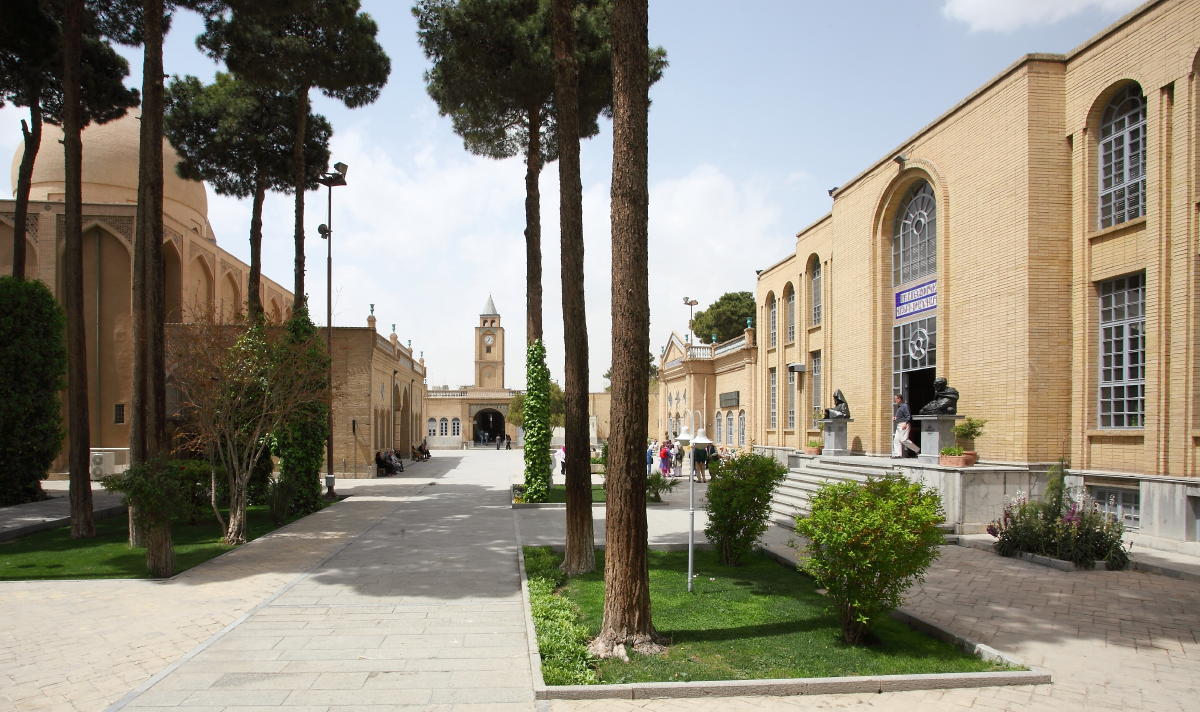
View of New Julfa

New Julfa was established in 1606 as an Armenian quarter by the mandate of Abbas the Great, sultan of Safavid Iran. Over 150,000 Armenians were forcibly moved there from Julfa (also known as Jugha or Juła, and now as Old Julfa) (hy) (hy). Iranian sources state that the Armenians came to Iran fleeing the Ottoman Empire's persecution. Nevertheless, historical records indicate that the residents of Julfa were treated well by Shah Abbas in the hopes that their resettlement in Isfahan would benefit Iran due to their knowledge of the silk trade.[1][2] Beginning in the early 1600s, New Julfa became home to a very small community of merchants and artisans as well as to a small group of Catholic missionary priests who served the Christian community. Among the residents of New Julfa was the Geneva clockmaker, Jacques Rousseau (1683-1753), who was the uncle of the philosopher Jean-Jacques Rousseau (1712-1778).[3]

Armenian Stamp commemorating 400th anniversary of the Armenian aettlement of New Julfa

The New Julfa dialect (hy) (hy) is a distinct form of Eastern Armenian spoken largely in Iran and Southern California. "This variety or lect is called “Persian Armenian” [pɒɻskɒhɒjeɻen] or “Iranian Armenian” [iɻɒnɒhɒjeɻen] by members of the community."[4]

New Julfa is still an Armenian-populated area with an Armenian school and sixteen churches, including Vank Cathedral. Armenians in New Julfa observe Iranian law concerning clothing, but retain a distinct Armenian language, identity, cuisine, and culture, which the Iranian government protects.[5]

Origins and Trade

[edit]

Since its foundation, New Julfa was administered by the Armenian noble house of Lazaryan, which relocated to Imperial Russia after Nader Shah's death in 1747.[6] One of its members, Ivan Lazarevich Lazarev, became a court banker to Catherine the Great and was made an Imperial Count in 1788. His brother established the Lazarev Institute of Oriental Languages in Moscow.

In 1947, the historian Fernand Braudel wrote that the Armenians had a trade network that stretched from Amsterdam to Manila in the Philippines. Many scholars in Armenia have done pioneering work on this network in the 1960s, 70s, and 80s. Levon Khachikyan and Sushanik Khachikyan have edited and published several New Julfan account books. Over the next few centuries, New Julfa became the hub of "one of the greatest trade networks of the early modern era,"[7] and as far west as Cádiz, London, and Amsterdam, with a few merchants traveling across the Atlantic or Pacific to Acapulco or Mexico City.

An old photograph of Vank Cathedral from the 1930s

A significant majority of Armenian trading families were based in New Julfa (hy). Due to their dispersal, many families that were originally from the older city of Julfa[2][1][8] created a main settlement in Bengal expanding the trade network based in New Julfa.[1] However, Some scholars argue that Surat, Bengal, and Hooghly were independent nodes and that the central control of New Julfa was not as important to their thriving Indian Ocean trade.[9] Many New Julfan Armenians later settled in Manila, Hong Kong, and also in Australia. Their networks have been studied based on Armenian sources.[1][2] Some also settled in Singapore, where Armenians from New Julfa became the mainstay of the Armenian community in the country. Most were traders, but perhaps better known were the Sarkies Brothers, who founded Singapore's Raffles Hotel in 1887.

A Christmas shop in New Julfa

According to David Petrosyan of the Central Asia-Caucasus Institute, New Julfa had 10,000–12,000 Armenian inhabitants in 1998.[10] As of today, it is still one of the world's largest ethnic Armenian quarters.

Sites

[edit]

Churches

[edit]
Holy Savior Cathedral, New Julfa
Ceiling of the Holy Savior Cathedral

Museums

[edit]
Museum of Khachatur Kesaratsi
  • The Museum of Khachatur Kesaratsi (fa), in the compound of the Holy Savior Cathedral – 1905
  • Armenian Ethnographical Museum of New Julfa (fa) - 2019
  • Museum of Armenian Music in New Julfa (fa) - 2021

Schools

[edit]
  • Samian (1831–1853) (hy)
  • Katarinyan (1858–now) (hy)
  • Azgayin Kntronakan (1880–now) (hy)
  • Gevorg Kananyan (1905–now) (hy)

Historic Houses

[edit]
Martha Peters House
  • House of Aro Martirossian (fa)
  • House of Garegin (fa)
  • House of Hovsep Amirkhan (fa)
  • House of Khvajeh Petros (hy)
  • House of Martha Peters (fa)
  • House of Martirossian (fa)
  • House of Simon (fa)
  • House of Sukiasian (fa)

Fire Temple

[edit]
  • Zoroastrian Fire Temple (Darb-e Mehr of Gowhar and Mehraban) (fa)

Notable people

[edit]
The statues at the entrance of the Museum of Khachatur Kesaratsi
Statue of Khachatur Kesaratsi, founder of the first publishing house in Iran
Statue of Mesrop Mashtots, the inventor of the Armenian alphabet
  • Apcar family – merchant family
  • Sceriman family – merchant family
  • De l'Estoile family – merchant family
  • Lazarian family (ru) – noble family
  • Sarkies Brothers – businessmen
  • Khwaja Safar (d. 1618) – mayor of Julfa
  • Martin the Armenian (hy) (d. 1619) – first Armenian-American / Iranian-American
  • Azaria Jughayetsi (hy) (16th century) – notary
  • Mesrop of Khizan (c. 1560 – c. 1652) – manuscript illuminator
  • Stepanos Dzik Jughayetsi (hy) (1583–1647) – writer
  • Khachatur Kesaratsi (1590–1646) – archbishop and publisher (hy)
  • Khvajeh Petros Velijanian (fa) (d. 1649) – merchant
  • Simeon Jughayetsi (ru) (d. 1657) – scholar
  • Hakob IV of Julfa (fr) (1598–1680) – Catholicos (1655–80)
  • Mirman Mirimanidze (17th century) – mayor of New Julfa
  • Otar Beg (1583–1663) – mayor of New Julfa
  • Hakop Jughayetsi (ru) (17th century) – manuscript illuminator
  • Siet Khachikian (hy) (17th century) – diplomat
  • Grigor Usta (hy) (17th century) – architect
  • Hovhannes Jughayetsi Ktreshents (hy) (17th century) – printer
  • Kostand Jughayetsi (hy) (17th century) – scholar
  • Marcara Avanchintz (17th century) – merchant
  • Minas (hy) (17th century) – painter
  • Hovhannes Jughayetsi Ktreshents (hy) (c.1610–c.1660) – publisher
  • Minas Jughayetsi (hy) (1610–1670) – painter
  • Mohammad Beg (d. 1671) – mayor of New Julfa
  • Voskan Yerevantsi (1614–1674) – publisher
  • Hajji Piri (d. 1694) – mayor of New Julfa
  • Bogdan Saltanov (1630–1703) – painter
  • Hovhannes Mrkouz (1643–1715) – philosopher
  • Egaz Norjughayetsi (hy) (1650–1734) – musician
  • Ghul Arzuni (hy) (1650–1750) – musician
  • Arzuni Jughayetsi (hy) (1650–1750) – musician
  • Arapiet di Martin (hy) (1650–1760) – musician
  • Petik and Sanos (16th and 17th centuries) – merchants
  • Stepanos Dashtetsi (ru) (1653–1720) – writer
  • Abgar Ali Akbar Armani (d. 1708) – merchant
  • Alexander I of Julfa (d. 1714) – Catholicos (1706–14)
  • Petros di Sargis Gilanents (ru) (d. 1724) – merchant
  • Hagopdjan de Deritchan (d. 1726) – diplomat
  • Coja Petrus Uscan (1680–1751) – merchant
  • Aghazar di Khachik (hy) (1690–1750) – military man
  • Grigor Harutiunian (ru) (d. 1763) – political leader
  • Aghazar Lazarian (hy) (1700–1782) – merchant
  • Zaccaria Seriman (it) (1709–1784) – writer
  • Tovmas Khojamalian (ru) (c.1720–1780) – historian
  • Shahamir Shahamirian (1723–1798) – political activist
  • Stefano Domenico Sceriman (it) (1729–1806) – writer
  • Ivan Lazarevich Lazarev (1735–1801) – jeweller
  • Petros Kalantarian (hy) (1735–1???) – physician
  • Minas Lazarian (hy) (1737–1809) – politician
  • Astvadsatour Babikian (de) (1738–1825) – writer
  • Khachatour Lazarian (hy) (1741–1774) – politician
  • Hovakim Lazarian (hy) (1743–1826) – political activist
  • Nikoghayos Aghababaian (hy) (1750–1809) – merchant
  • Khachatur Jughayetsi (hy) (18th century) – historian
  • Movses Baghramian (18th century) – political activist
  • Tadevos Soginian (hy) (18th century) – political activist
  • Ivan Karapet (hy) (18th century) – political activist
  • George Manook (1763–1827) – merchant
  • Alexander Raphael (1775–1850) – British-Armenian politician
  • Hakob Hovnatanyan (1806–1871) – painter
  • Tadevos Avetoumian (hy) (1811–1863) – writer
  • Zerouni Masehian (fa) (1811–18??) – goldsmith
  • Megrtich Emin (ru) (1815–1890) – scholar
  • Minus Megerdich Zorab (1833–1896) – painter
  • Tiruhi Ter-Nahapetian (hy) (19th century) – artist
  • Mirza Malkam Khan (1834–1908) – politician
  • Martiros Khan Davidkhanian (1843–1905) – general
  • Sarkis Khan Davidkhanian (1846-?) – general
  • Eskandar Khan Davidkhanian – professor and general
  • Markar Khan Davidkhanian (19th century) – minister of finance
  • Tiruhi Ter-Nahapetian (hy) (19th century) – artist
  • Vittoria Aganoor (1855–1910) – poet
  • Minas Manook Basil (Barseghian) (hy) (1857–1922) – physician
  • Diana Abgar (1859–1937) – diplomat
  • Matevos Aghakhan Karakhanian (fa) (1860–1946) – photographer
  • Arathoon Stephen (1861–1927) – businessman
  • Hovsep Mirzayan (hy) (1868–1935) – politician
  • Mesrovb Jacob Seth (1871–1939) – scholar
  • Hovhannes Abkarian (fa) (1875–1931) – musician
  • Freydoun Malkom (1875–1954) – the first Iranian participated in the Olympic Games in 1900
  • Tigran Abgarian (hy) (1877–1950) – philologist
  • Petros Abkar (fa) (1884–19??) – politician
  • Megrdich Abgar (hy) (1884–1967) – archbishop
  • Mkrtich Hakobian (hy) (1885–1971) – photographer
  • Minas Patkerhanian (hy) (1885–1972) – photographer
  • Markar Galstiants (fa) (1888–1985) – architect
  • Yeghia Velijanian (hy) (1889–1976) – artist
  • Guregh Israelian (1894–1949) – Armenian Patriarch of Jerusalem (1944–49)
  • Zabel Stepanian-Bartev (fa) (1894–1982) – telegraph technician
  • Karo Minassian (hy) (1897–1973) – physician
  • Meguertitch Khan Davidkhanian (1902–1983) – general and politician
  • Haykush Ter-Martirosian (hy) (1905–1987) – actress
  • Bersabe Hovsepian (hy) (1906–1999) – public figure
  • Rafael Atayan (hy) (1907–1990) – writer
  • Poghos Petrosian (hy) (1907–19??) – bishop
  • Abraham Gurgenian (hy) (1908–1991) – painter
  • Annik Shefrazian (1909–1996) – actress
  • Aramais Aghamalian (1910–1985) – film director
  • Johny Baghdasarian (fa) (1913–1979) – film director
  • Sumbat Der Kiureghian (1913–1999) – painter
  • Yervand Nahapetian (fa) (1916–2006) – painter
  • Emma Abrahamian (fa) (b. 1919) – sculptor
  • Alain John (1920–1943) – sculptor
  • Alenush Terian (1920–2011) – astronomer and physicist
  • Levon Minassian (fa) (1920–2013) – scholar
  • Sevak Saginian (fa) (1921–2003) – politician
  • Clara Abkar (hy) (1922–1996) – painter
  • Hrand Ghoukasian (fa) (1927–1996) – physician and translator
  • Arsham Yesayi (fa) (b. 1931) – tennis player
  • Neshan Sarkissian (Karekin I) (1932–1999) – Prelate of the Diocese of New Julfa (1971–75), Catholicos of Cilicia (1983–94) and Catholicos of All Armenians (1994–99)
  • Nechan Karakéhéyan (b. 1932) – Catholic bishop of New Julfa (2000–05)
  • Krzysztof Penderecki (b. 1933) – "Poland's greatest living composer"
  • Nikol Faridani (1935–2008) – photographer
  • Grish Davtian (hy) (b. 1935) – poet
  • Alek Ter-Khachatourian (fa) (b. 1935) – translator
  • Grigor Nazarian (hy) (b. 1937) – architect
  • Varouj Karapetian (fa) (b. 1938) – film technician
  • Arby Ovanessian (b. 1942) – film director
  • Sako Ghoukasian (fa) (1943–2015) – opera singer
  • George Bournoutian (b. 1943) – scholar
  • Megerdich Toumanian (hy) (b. 1943) – mathematician
  • Vartan Vartanian (fa) (b. 1943) – politician
  • Nelson Shirvanian (hy) (1944–2018) – sculptor
  • Tigran Toumanian (fa) (b. 1946) – film technician
  • Armen Der Kiureghian (b. 1947) – scholar
  • Herach Khachatourian (fa) (b. 1948) – politician
  • Caro Lucas (1949–2010) – scholar
  • Zaven Ghoukasian (fa) (1950–2015) – film director
  • Masis Hambarsounian (b. 1950) – boxer
  • Georgik Abrahamian (fa) (b. 1952) – politician
  • Artavazd Baghoumian (fa) (b. 1953) – politician
  • Jirayr Kocharian (hy) (b. 1955) – cartographer
  • Hrant Markarian (b. 1958) – politician and chairman of the Armenian Revolutionary Federation
  • Robert Beglarian (b. 1961) – politician
  • Vahik Trossian (fa) (b. 1967) – football player
  • Nairy Baghramian (b. 1971) – visual artist
  • Aren Davoudi (b. 1986) – basketball player
  • Oshin Sahakian (b. 1986) – basketball player
  • Kajayr Hakopian (hy) (b. 1989) – actor
  • Armen Tahmazyan (b. 1990) – football player

Friendly cities

[edit]

New Julfa has friendly relations with:[11]

[edit]

See also

[edit]

References

[edit]

Sources

[edit]
[edit]
Revisions and contributorsEdit on WikipediaRead on Wikipedia
from Grokipedia
New Julfa is the of , , situated along the southern bank of the River and established in 1605 by Shah ʿAbbās I of the through the forced deportation of from Old Julfa in Nakhichevan. The resettlement, part of a scorched-earth strategy against Ottoman advances, initially housed around 10,000 who were skilled merchants and artisans, transforming the area into a self-governing enclave granted lands and trade privileges in 1619. By the mid-17th century, the population had grown to approximately 30,000, with New Julfa emerging as a pivotal node in global commerce, as Armenian traders dominated Iran's silk monopoly and extended networks to , , , and beyond, amassing wealth that funded community institutions. The quarter is renowned for its ecclesiastical architecture, including at least 13 surviving churches from an original 24 built during the Safavid era, such as the —dedicated to the Holy Savior and begun in 1606—which blends Armenian frescoes depicting biblical scenes with Persian tilework and domes. This cultural synthesis, alongside the All Savior's Monastery that introduced printing to Iran in 1636, underscores New Julfa's role as a center of learning and intercultural exchange. Though diminished by events like the Afghan invasion of and subsequent migrations, New Julfa endures as a focal point for 's Armenian minority, with more than 8,000 residents maintaining Apostolic Christian traditions, historic sites, and a legacy of economic resilience in a predominantly Shiʿa Muslim society.

Geography and Demographics

Location and Urban Layout

New Julfa occupies the southern bank of the Zayandeh River in , , approximately 5 kilometers south of the city's historic core centered on . This positioning placed the quarter in a strategic suburban zone, separated from the main Muslim districts by the river, which facilitated both and controlled interaction with the capital's economy. The urban layout reflects Safavid-era planning principles, with a rectilinear network of narrow streets designed to enclose compact residential blocks interspersed with commercial zones and over a dozen Armenian churches. Key axes include north-south thoroughfares linking to bridges like and Marnan, while east-west streets connect major landmarks such as —serving as the quarter's religious and social nucleus—to peripheral sites like Julfa Square. This orthogonal grid, adapted from Persian urban models but infused with Armenian courtyard-house typology, supported dense habitation for up to 30,000 residents at its 17th-century peak, prioritizing defensibility through gated alleys and walled compounds. Over centuries, urban expansion has blurred original boundaries, integrating New Julfa into 's modern fabric via widened boulevards like Chaharbagh-e Khaju, yet preserving a core of low-rise structures amid contemporary infill. The layout's enduring coherence stems from communal oversight by Armenian kalantars, enforcing building codes that maintained open courtyards for family life and trade, distinct from the radial patterns of central . New Julfa was established as an exclusively Armenian settlement following the forced relocation of approximately 20,000–30,000 from Old Julfa by Shah Abbas I between 1604 and 1605, forming a homogeneous ethnic and religious community of Armenian Apostolic under Safavid patronage. By the mid-17th century, the population had grown to an estimated 30,000 residents, reflecting prosperity from silk trade monopolies and merchant networks, with no significant non-Armenian presence recorded in contemporary accounts. Population declined sharply after the Safavid collapse and Afghan invasions of 1722, which sacked and prompted merchant exodus, reducing the community to scattered families by the early ; by the Qajar era, censuses recorded 2,586 inhabitants in 1860 (predominantly Armenian) and 1,517 in 1870, indicating a sustained downturn due to economic stagnation and political instability. Further erosion occurred in the amid displacements, Soviet influence, and post-1979 Islamic Revolution pressures, including religious restrictions and , driving emigration to , , and ; Iran's total Armenian population fell from over 200,000 in the early to 70,000–100,000 by the , with New Julfa mirroring this trend through out-migration and low fertility rates. As of the early , New Julfa remains predominantly Armenian, comprising over 90% of residents who are ethnic Armenians affiliated with the , though small numbers of Persian and other minorities have integrated via intermarriage or proximity; current estimates place the Armenian at 6,000–8,000, concentrated in historic neighborhoods amid urban encroachment from greater . This composition underscores persistent ethnic enclaving, with trends showing continued gradual decline due to youth for and opportunities abroad, despite cultural preservation efforts like church maintenance and community schools.

Historical Development

Deportation from Old Julfa and Strategic Relocation

In 1603–1605, amid the Ottoman–Safavid War, Shah Abbas I (r. 1588–1629) pursued a scorched-earth strategy along the frontier, deporting populations to deny resources to invading Ottoman forces. The Armenian inhabitants of Julfa—a key trading hub on the Aras River known for its silk merchants and international networks—were targeted in late 1604 to early 1605, with entire communities forcibly marched southward under brutal winter conditions, resulting in significant mortality from exposure, starvation, and violence. The Julfan deportees, estimated at 15,000 to 20,000 individuals initially, were resettled on undeveloped land south of , Shah Abbas's newly fortified capital, forming the basis of New Julfa. This group comprised primarily wealthy merchants whose expertise in silk production and commerce Shah Abbas sought to harness; he granted them autonomy, tax privileges, and a monopoly on raw exports to , bypassing Ottoman intermediaries and bolstering Safavid revenues. To secure loyalty and productivity, the shah permitted religious freedom, church construction, and , distinguishing them from less-favored deportees in broader relocations affecting up to 300,000 across . Old Julfa was systematically destroyed post-deportation, with homes, bridges, and khachkars razed to eliminate any incentive or base for return, a policy reinforced in 1652 when Shah Abbas II ordered the demolition of surviving ruins. This act underscored the relocation's permanence, transforming a punitive measure into a calculated economic engine: Julfans' pre-existing trade links—from to —facilitated Safavid integration into global silk routes, yielding annual exports worth millions of tumans by the 1620s.

Establishment and Early Growth under Safavid Rule

In 1605, following the forced deportation of from Old Julfa amid Shah Abbas I's scorched-earth tactics against Ottoman advances, the Julfan deportees received temporary shelter in and commenced construction of a dedicated suburb on the right bank of the Zayandeh Rud River, designated New Julfa. This relocation, part of a broader displacement affecting an estimated 300,000 across border regions, positioned the skilled Julfan merchants—renowned for their role in transregional silk trade—near the Safavid capital to harness their economic expertise while denying Ottoman forces potential collaborators or resources. Shah Abbas granted the settlers privileges including land allocation, initial tax exemptions, and administrative autonomy under a kalantar () selected from their ranks, fostering rapid organization and development. Construction of began promptly, with the first church erected in 1606-1607, marking the suburb's emerging Christian character despite Safavid Islamic dominance; subsequent buildings included residences, markets, and communal facilities adapted to blend Armenian traditions with Persian architectural influences, such as onion domes. By the 1610s, New Julfa's population, primarily comprising Julfan traders and artisans, had stabilized, enabling the revival of processing and export activities that integrated the community into Safavid fiscal networks, with the enforcing a monopoly on raw silk sales to European buyers through Armenian intermediaries. These incentives spurred demographic and , transforming the initial refugee encampment into a self-sustaining enclave by the early decades of the 17th century, though under strict oversight to prevent unrest. The community's early expansion was evidenced by the establishment of guilds and charitable institutions, which supported orphans and the poor among deportees, while intermarriage with remained rare, preserving ethnic cohesion. By 1640, New Julfa had evolved into a notable cultural hub with multiple public structures, laying foundations for its later prosperity, though growth was tempered by occasional royal impositions like forced relocations within proper until reconfirmation of their suburb.

Peak Prosperity in the 17th Century

Following the relocation decreed by Shah ʿAbbās I in 1605, the community in New Julfa rapidly expanded its economic influence, leveraging privileges granted by the Safavid ruler to dominate international commerce. By 1619, the shah had established a crown monopoly on raw silk exports, according exclusive rights to the New Julfan to handle shipments to , positioning them as key agents in Iran's primary export commodity, which formed the core of the Safavid economy. This control extended to trading carpets and precious stones for imports from , , and the , fostering a semi-autonomous that amassed substantial wealth under subsequent shahs like Ṣafī and ʿAbbās II. Prosperity peaked in the mid-17th century, particularly during the reign of Shah ʿAbbās II (1642–1666), when New Julfa's trade networks linked Persia to global markets from and to and beyond, enabling Armenians to rival the wealthiest merchants of the . Population growth reflected this boom; traveler Jean Chardin estimated 3,400–3,500 families (approximately 30,000 individuals) in the 1660s–1670s, while John Fryer reported over 6,000 families by 1677, underscoring the influx drawn by commercial opportunities. Individual fortunes exemplified the scale: one merchant, Agha Piri, held assets valued at 2,000,000 livres tournois (equivalent to about 1,500 kg of ) in 1673, surpassing contemporary European magnates. Others accumulated up to 100,000 tomans, with each toman approximating £3 in value, funding extensive communal investments. This era's success stemmed from the pre-existing expertise in transit , honed since the in Old Julfa, combined with Safavid policies that prioritized their role over rivals like the British East India Company. Their operations generated vital state revenue while insulating the community from direct taxation in exchange for oversight, though began showing strains by the late 17th century due to shifting geopolitical pressures.

Economic Role

Silk Trade Monopoly and Silk Road Integration

The Armenian merchants of New Julfa, relocated by Shah Abbas I in 1604–1605 from Old Julfa, rapidly assumed a dominant role in the Safavid silk trade due to their pre-existing expertise in handling raw , which formed the backbone of Iran's 17th-century . To centralize control and bypass European interlopers, Abbas enforced a royal monopoly on Iranian production and starting around 1602, directing output primarily from Gilan and Mazandaran provinces toward Armenian intermediaries who processed and shipped it abroad. In 1617, Abbas revoked prior concessions to the English and formally awarded New Julfa's merchants exclusive rights to Iranian raw , enabling them to procure consignments directly from at fixed rates while retaining significant profits through their commercial acumen. This arrangement, reaffirmed in a 1619 granting communal lands and privileges, positioned the New Julfans as monopolists, handling an estimated 300–400 tons of annually by the 1620s, much of it re-exported to Ottoman territories and via overland caravans and maritime routes. Integration into the framework amplified this monopoly, as New Julfa's traders leveraged kin-based networks spanning to facilitate bidirectional flows of goods, transforming into a pivotal linking Persian Gulf ports with Central Asian overland paths and circuits. By the 1620s, these merchants had established colonies in key nodes such as , , , and , where they exchanged for silver, spices, and textiles, often financing operations through bills of exchange and partnerships that circumvented state oversight. Their dominance extended to transit trade, intermediating Chinese porcelain and Indian cottons northward while channeling Persian southward, with annual caravans from New Julfa carrying up to 200 loads (each roughly 250 kg) to markets in and the , sustaining Safavid revenues estimated at 300,000–500,000 tumans yearly from silk duties alone. This network's resilience stemmed from communal trust mechanisms, including shared religious feasts and arbitration by figures like the kalantar (community head), which minimized risks in long-distance ventures amid the fragmented geopolitics of the Silk Road. The monopoly's economic impact peaked under Abbas's successors until its erosion in the 1630s, when crown policies fluctuated between privileges and seizures, yet New Julfa's traders adapted by diversifying into broader commodities, maintaining connectivity through subsidiary hubs in and . By mid-century, their operations had generated communal wealth exceeding 200 million abbasis in capital reserves, funding local while underscoring the ' role as indispensable agents in Safavid global integration.

Global Merchant Networks and Financial Innovations

The Armenian merchants of New Julfa constructed one of the most expansive early modern diasporas, establishing commercial outposts across and beyond to facilitate the distribution of Iranian and other goods. By the mid-17th century, their network included settlements in European hubs such as , , , and ; Mediterranean ports like ; Indian centers including and Madras; and Southeast Asian entrepôts such as , with extensions into via and even tentative links to . This infrastructure integrated New Julfa into the and Mediterranean circuits, where merchants acted as intermediaries between Persian producers and European consumers, amassing wealth estimated in millions of tumans through diversified commodities like , textiles, and spices. Central to the network's efficacy was a trust system rooted in , shared Armenian Apostolic faith, and commensal rituals—such as communal feasts—that cultivated "quasi-impersonal" among unrelated agents over thousands of miles. Unlike state-backed European joint-stock companies, Julfan operations emphasized flexible, family-based partnerships (often termed avak assemblies) that pooled capital for voyages while minimizing formal hierarchies, enabling rapid adaptation to geopolitical disruptions like the fall of Safavid rule in 1722. This reduced transaction costs and mitigated risks from or currency fluctuations, sustaining trade volumes that, for instance, saw Armenian ships carrying up to 1,000 bales of annually to by the 1660s. Financially, New Julfa merchants advanced practices like the prolific deployment of bills of exchange (vejal or kambiyal), adapting Genoese and Florentine models to remit funds and extend across religious and imperial divides. These instruments, often endorsed in Armenian, Persian, or European languages, allowed a single bill to circulate through multiple hands for deferral or transfer, with remitters guaranteeing repayment via notarial endorsements rather than collateral. Their commercial houses maintained multilingual ledgers tracking multi-currency accounts, incorporating interest-bearing loans and insurance-like risk-sharing, which predated widespread European adoption in Asian circuits and supported remittances totaling thousands of sequins per transaction. Such innovations, embedded in derived from Armenian canon and Safavid statutes, underscored the merchants' role in , though vulnerabilities to internal disputes occasionally led to arbitrations by community elders.

Religious and Cultural Institutions

Churches and Architectural Synthesis

New Julfa features 13 Armenian Apostolic churches, all erected during the amid the community's economic ascent under Safavid . These structures exemplify an adaptive fusion of Armenian ecclesiastical traditions with Persian Islamic architectural norms, necessitated by local materials, regulatory constraints, and cultural exchange. Armenian masons, accustomed to stone vaulting from the , shifted to baked brick and mud-brick construction prevalent in , yielding durable yet unadorned exteriors that mirrored the austere facades of Safavid mosques to evade prohibitions on overt Christian iconography. Interiors, however, burst with opulence: domed halls supported by four pillars evoke Armenian basilica plans, augmented by Persian stucco reliefs, tile friezes in floral arabesques, and gilt motifs that integrate indigenous decorative repertoires. The Holy Savior Cathedral, known as Vank, stands as the district's architectural pinnacle, with construction commencing in 1606 under Shah Abbas I and culminating in 1664. Its rectangular layout diverges from the Armenian norm, incorporating a nave-like prayer hall and an adjoining assembly space, topped by a central dome and later a added in 1702. Exteriors remain stark in , but the sanctuary's walls teem with frescoes executed by Armenian painters from 1655 to 1669, blending biblical narratives—such as the Creation, , and —with European perspectival techniques absorbed via Armenian merchants' ties to Dutch and Italian traders, alongside influences in framing and coloration. This program, spanning over 4,000 square meters, underscores causal adaptations: prosperity from silk trade funded artistic imports, while Safavid oversight tempered overt Christian symbolism with abstract Islamic echoes. Other churches amplify this synthesis. The Church of (Surb Bedkhem), built circa 1628, deploys a gabled reminiscent of Persian iwans, enclosing a cross-vaulted interior adorned with khachkars—distinctive Armenian cross-stones—and narrative tiles. Saint Catherine's Church integrates narthexes with squinches, merging Armenian apse traditions with Safavid vaulting for acoustic resonance in chants. Church (Surb Nikołos Hayrapet) features analogous brick domes and cycles, evidencing iterative refinement: early builds prioritized functionality for , later ones lavishness signaling status. Collectively, these edifices document not mere stylistic borrowing but pragmatic evolution—Armenian resilience yielding to Persian dominance in form and medium, enriched by transcontinental motifs from , fostering a hybrid idiom unique to New Julfa's milieu.

Educational and Communal Facilities

The Armenian community in New Julfa established educational institutions emphasizing , trade skills, and religious instruction from the 17th century onward. In 1638, Archbishop Khachatur Kesaratsi introduced Iran's first at the Holy Savior Cathedral (Vank), producing the first Armenian Bible printed in Persia and facilitating the dissemination of religious texts to enhance communal education. This innovation supported broader efforts within the population, drawing on Mesrop Mashtots's earlier alphabet invention, and marked a pivotal advancement in regional printing capabilities. Secular education emerged in the , with the Getronagan School opening in 1833 as Isfahan's first secular Armenian institution, focusing on modern curricula including languages and commerce. By the 1880s, three church-affiliated schools merged to form the National Central School of Julfa, integrating instruction alongside Armenian subjects to meet imperial requirements while preserving ethnic identity. European missionary influences, such as the Church Missionary Society's efforts from 1862, introduced English and other foreign languages through schools like the George Joseph School in New Julfa, which later absorbed the Batavian School. Contemporary Armenian schools in New Julfa continue this tradition, serving over 500 students as of and incorporating bilingual programs in Armenian and Persian. One mixed-gender school, recognized as the top educational center in in 2019, emphasizes cultural preservation amid Iran's multilingual policies. Communal facilities bolster social cohesion and heritage preservation. The Khachatur Kesaratsi Museum, adjacent to , houses artifacts, textiles, religious items, and the historic , serving as an educational hub for visitors and locals. 's and museum archive artistic, literary, and archaeological documents, supporting scholarly research into Armenian-Persian interactions. In the , the community developed a cultural and athletic center for youth, alongside medical facilities, an elderly home, and social clubs to address welfare needs. These institutions reflect New Julfa's enduring role in fostering Armenian identity within Iran's diverse societal framework.

Decline, Challenges, and Modern Status

18th-19th Century Decline and External Pressures

The decline of New Julfa's Armenian accelerated following the weakening of the Safavid Empire in the early , marked by political instability, invasions, and economic disruptions that eroded the quarter's prosperity. The Afghan occupation of from 1722 to 1729 inflicted severe damage, including widespread looting, the imposition of a 70,000-toman (with 17,000 tomans initially paid and the remainder extracted forcibly), and the beheading of four prominent community leaders, such as the mayor Xačʽik. Hundreds of families fled to regions like , , , and , while 62 Armenian girls were abducted, further depleting the population and commercial networks. Under (r. until 1747), fiscal pressures intensified through annual taxes of 10,000 tomans that escalated over time, coupled with punitive fines; in 1745 alone, a 60,500-toman fine was levied, with 23,500 tomans extracted from ten merchant families and 37,000 from the community at large. Executions of key merchants, including Āqā Emniaz Minasean and Āqā Yarutʽiwn Šahrimaneancʽ in 1746, alongside eight others, scattered the elite trading class and disrupted commerce, which had already begun faltering after 1720 due to warfare, diseases, and reduced output (e.g., only 160 tons reported in 1750). Subsequent from 1747 to , exacerbated by , claimed over 500 Armenian lives in New Julfa in alone, with pillaging by warlords such as ʿAli-Mardān Khan, Āzād Khan (who imposed a 6,000-toman tax and sold communal manuscripts), and Moḥammad-Ḥasan Khan (exacting 8,000 tomans and seizing property). The under Karim Khan (d. 1779) offered relative fairness, encouraging some merchant returns, though a 1771 mission to failed to repatriate many expatriates. By , only 360 Armenian-owned houses remained, reflecting over 80% population loss from peak levels. In the Qajar period (from 1794), New Julfa's decline persisted amid ongoing external economic pressures, including the pébrine silkworm plague around 1860 that rendered silk exports negligible, alongside European competition from machine-made textiles and the shift to maritime trade routes bypassing Persian overland paths. An 1851 census recorded just 2,614 in 371 homes, with upper- and middle-class flight leaving a predominantly lower-class residue and contributing to cultural and artistic stagnation; twelve of the original 25 churches lay in ruins by the early , as the community increasingly depended on remittances from merchants abroad.

20th-21st Century Preservation and Revival Efforts

In the , the Armenian community of New Julfa established a framework for under church leadership, enabling the organized maintenance of its religious institutions and amid demographic shifts and political changes in . This included the preservation of the quarter's 13 active churches, which serve as centers for and community life, sustaining Armenian Apostolic traditions despite a from historical peaks. Restoration efforts intensified in the late 20th and early 21st centuries, with projects targeting the architectural integrity of key sites like (Holy Savior Cathedral). These initiatives repaired delicate frescoes, mosaics, and tiles, blending Armenian and Persian elements to prevent further deterioration from environmental factors and age. The adjacent Museum of Khachatur Kesaratsi, dedicated to the 17th-century who introduced to , houses artifacts such as early Armenian books and the original established in 1636, functioning as a repository for cultural preservation. Internationally, the Monastery of St. Amenaprkich ( complex) was inscribed on 's Tentative World Heritage List in 2019, highlighting its significance as a synthesis of Armenian and Safavid architecture and prompting enhanced conservation measures. Domestically, Iran's Cultural Heritage, Handicrafts and Tourism Organization conducted over 200 restoration projects across in the first nine months of the Iranian year 1403 (March-December 2024), including works on Armenian sites in New Julfa to bolster tourism and structural stability. Today, with approximately 6,000 residing in the quarter, revival efforts emphasize cultural continuity through festivals, educational programs, and of historic buildings, countering assimilation pressures while integrating with broader Isfahani heritage initiatives.

Notable Individuals

Prominent Merchants and Diplomats

The merchants of New Julfa, primarily from Old Julfa origins, amassed significant wealth through silk exports and diversified trade, often leveraging family networks across and ; prominent families included the Scerimans (Šahremāniān), who rose to dominance in the as Catholic holding key Safavid administrative roles while establishing branches in for Mediterranean commerce. The family patriarch, , exemplified this by patronizing churches and extending influence through sons like Iskandar, who managed European operations. Khoja Minas of the Minasian family emerged as a leading figure in mid-17th-century maritime trade, controlling routes from the Persian Gulf to the and by 1663, when English records described him as an "able and well reputed Armenian merchant" based in ; his ownership of vessels like the and familial ties to figures such as Panos Kalantar, who negotiated trade treaties on behalf of Julfan interests, underscored the integration of commerce with political leverage. Julfan merchants frequently doubled as diplomats for the Safavids, capitalizing on their linguistic skills and global ties; Khwāja Safar, an early New Julfa resident, acted as Shah ʿAbbās I's commercial agent and envoy to around 1609–1614, promoting Persian silk exports amid Ottoman threats and negotiating alliances, though facing setbacks from European rivalries. Similarly, in 1660, Zakar Shahrimanian, a Sceriman affiliate, joined other in missions to secure Dutch trade privileges for raw silk, blending mercantile expertise with Safavid . These roles highlighted the community's strategic value, as Shah ʿAbbās granted monopolies in exchange for such services, fostering New Julfa's prosperity until mid-century disruptions.

Cultural and Religious Leaders

The Armenian Prelacy of , centered in New Julfa, was established in to administer the religious affairs of the deported Armenian community, with successive archbishops serving as spiritual and cultural anchors amid Safavid Persia. These prelates oversaw the construction of over a dozen churches, including , and maintained doctrinal ties to the Armenian Apostolic Church's of Etchmiadzin while navigating Persian imperial oversight. Archbishop Mesrop, the inaugural from circa 1606 to 1623, organized early structures and facilitated community recovery following the forced relocation from Julfa in 1604-1605. His tenure laid foundational governance for the , which by mid-century encompassed dozens of across New Julfa's parishes. Khachatur Kesaratsi (c. 1590-1646), serving as archbishop from 1620 to 1646, stands out for pioneering Iran's first in 1636 within Vank Cathedral's premises, enabling production of Armenian liturgical books and reducing reliance on imported manuscripts. A native of Caesarea in the , Kesaratsi chronicled New Julfa's in works like History of the Julfa Armenians, documented merchant networks, and amassed libraries that preserved Armenian scholarship, blending religious leadership with cultural innovation during a period of economic ascent. Later prelates, including Jughayetsi (1652-1683), sustained these efforts by funding education and artistic patronage in churches, where murals fused Armenian iconography with Persian motifs, reinforcing communal resilience against assimilation pressures. Through the , such leaders mitigated declines from wars and migrations, with the prelacy adapting to reduced populations while upholding apostolic traditions.

International Ties

Sister Cities and Diaspora Connections

New Julfa, as the Armenian quarter of , maintains a twin town relationship with , a commune in the southwestern suburbs of , , formalized through mutual agreements to foster cultural and community exchanges between the Armenian populations. The quarter's diaspora connections trace to the 17th-century Safavid-era merchant networks, where New Julfa Armenians established trading outposts and settlements across , including in (such as and Madras), the (), and , forming foundational nodes of the global Armenian trade that linked , Persia, and . These historical ties persist in modern cultural and religious affiliations, with the community's Apostolic Church institutions and organizations sustaining links to Armenia's homeland institutions and diaspora centers in and , evidenced by reciprocal visits such as the 2014 courtesy trip by New Julfa's administrative leader to amid broader Isfahan- sister city cooperation signed in 2004.

References

Add your contribution
Related Hubs
User Avatar
No comments yet.