Recent from talks
Nothing was collected or created yet.
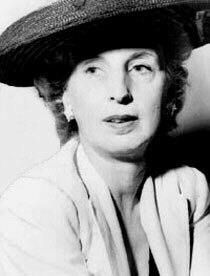
Kay Boyle
View on WikipediaKay Boyle (February 19, 1902 – December 27, 1992) was an American novelist, short story writer, educator, and political activist. Boyle is best known for her fiction, which often explored the intersections of personal and political themes. Her work contributed significantly to modernist literature, and she was an active participant in the expatriate literary scene in Paris during the 1920s.[2] She was a Guggenheim Fellow and O. Henry Award winner.
Key Information
Early years
[edit]The granddaughter of a publisher, Boyle was born in St. Paul, Minnesota, and grew up in several cities but principally in Cincinnati, Ohio. She had one sibling, an elder sister, Joan (1900–1993), later Mrs. Detweiler. Their father, Howard Peterson Boyle, was a lawyer, and their mother was Katherine (Evans) Boyle, a literary and social activist who believed the wealthy had an obligation to help the financially less fortunate. In later years, Kay Boyle championed integration and civil rights. She advocated banning nuclear weapons, and American withdrawal from the Vietnam War.[2]
Boyle was educated at the exclusive Shipley School in Bryn Mawr, Pennsylvania, then studied architecture at the Ohio Mechanics Institute in Cincinnati. Interested in the arts, she studied violin at the Cincinnati Conservatory of Music before settling in New York City in 1922 where she found work as a writer/editor with a small magazine.[2]
Marriages and family life
[edit]That same year, she met and married a French exchange student, Richard Brault, and they moved to France in 1923. This resulted in her staying in Europe for the better part of the next twenty years. Separated from her husband, she formed a relationship with magazine editor Ernest Walsh, with whom she had a daughter, Sharon, named for the Rose of Sharon, in March 1927, five months after Walsh's death from tuberculosis in October 1926.[3]
In 1928 she met Laurence Vail, who was then married to Peggy Guggenheim. Boyle and Vail lived together between 1929 until 1932 when, following their divorces, they married. With Vail, she had three more children - daughters Apple-Joan in 1929, Kathe in 1934, and Clover in 1939.[3] During her years in France, Boyle was associated with several innovative literary magazines and made friends with many of the writers and artists living in Paris around Montparnasse. Among her friends were Harry and Caresse Crosby who owned the Black Sun Press and published her first work of fiction, a collection titled Short Stories. They became such good friends that in 1928 Harry Crosby cashed in some stock dividends to help Boyle pay for an abortion.[4] Other friends included Eugene and Maria Jolas. Boyle also wrote for transition, one of the preeminent literary publications of the day. A poet as well as a novelist, her early writings often reflected her lifelong search for true love as well as her interest in the power relationships between men and women. Boyle's short stories won two O. Henry Awards.
In 1936, she wrote a novel, Death of a Man, an attack on the growing threat of Nazism. In 1943, following her divorce from Laurence Vail, she married Baron Joseph von Franckenstein, with whom she had two children - Faith in 1942 and Ian in 1943.[3] After having lived in France, Austria, England, and in Germany after World War II, Boyle returned to the United States.[2]
McCarthyism, later life
[edit]In the States, Boyle and her husband were victims of early 1950s McCarthyism. Her husband was dismissed by Roy Cohn from his post in the Public Affairs Division of the United States Department of State, and Boyle lost her position as foreign correspondent for The New Yorker, a post she had held for six years. She was blacklisted by most of the major magazines. During this period, her life and writing became increasingly political.
She and her husband were cleared by the United States Department of State in 1957.[5]
In the early 1960s, Boyle and her husband lived in Rowayton, Connecticut, where he taught at a private girls' school. He was then rehired by the State Department and posted to Iran, but died shortly thereafter in 1963.
Boyle was a writer in residence at the New York City Writer's Conference at Wagner College in 1962. In 1963, she accepted a creative writing position on the faculty of San Francisco State College, where she remained until 1979.[6]

During this period she became heavily involved in political activism. She traveled to Cambodia in 1966 as part of the "Americans Want to Know" fact-seeking mission. She participated in protests, and in 1967 was arrested twice and imprisoned. In 1968, she signed the "Writers and Editors War Tax Protest" pledge, vowing to refuse tax payments in protest against the Vietnam War.[7] In her later years, she became an active supporter of Amnesty International and worked for the NAACP. After retiring from San Francisco State College, Boyle briefly held writer-in-residence positions, including at Eastern Washington University in Cheney and the University of Oregon in Eugene.[citation needed]
She was one of the signatories of the agreement to convene a convention for drafting a world constitution.[8][9] As a result, for the first time in history, a World Constituent Assembly convened to draft and adopt the Constitution for the Federation of Earth.[10]
Boyle died at a retirement community in Mill Valley, California on December 27, 1992.[2]
Legacy
[edit]In her lifetime Kay Boyle published more than 40 books, including 14 novels, eight volumes of poetry, 11 collections of short fiction, three children's books, and French to English translations and essays. Most of her papers and manuscripts are in the Morris Library at Southern Illinois University in Carbondale, Illinois. Morris Library has the Ruby Cohn Collection of Kay Boyle Letters and the Alice L. Kahler Collection of Kay Boyle Letters.[11] A comprehensive assessment of Boyle's life and work was published in 1986 titled Kay Boyle, Artist and Activist by Sandra Whipple Spanier. In 1994 Joan Mellen published a voluminous biography of Kay Boyle, Kay Boyle: Author of Herself.[12]
A member of the American Academy of Arts and Letters, in addition to her two O. Henry Awards, she received two Guggenheim Fellowships and in 1980 received the National Endowment for the Arts fellowship for "extraordinary contribution to American literature over a lifetime of creative work".[13]
Bibliography
[edit]Novels
[edit]- Process (written in 1925, published by University of Illinois Press in 2001)
- Plagued by the Nightingale (Jonathan Cape and Harrison Smith, 1931)
- Year Before Last (Harrison Smith, 1932)
- Gentlemen, I Address You Privately (Harrison Smith and Robert Haas, 1933)
- My Next Bride (Harcourt, Brace and Co, 1934)
- Death of a Man (Harcourt, Brace and Co, 1936)
- Yellow Dusk by Bettina Bedwell (ghostwritten by Kay Boyle) (1937)[14]
- Monday Night (Harcourt, Brace and Co, 1938)
- The Crazy Hunter: Three Short Novels (Harcourt, Brace and Co, 1940). Includes The Crazy Hunter, The Bridegroom's Body, and Big Fiddle.
- Primer for Combat (Simon and Schuster, 1942)
- Avalanche (Simon and Schuster, 1944)
- A Frenchman Must Die (Simon and Schuster, 1946)
- 1939 (Simon and Schuster, 1948)
- His Human Majesty (McGraw-Hill, 1949)
- The Seagull on the Step (Knopf, 1955)
- Three Short Novels (Beacon Press, 1958). Includes The Crazy Hunter,The Bridegroom's Body, and Decision.
- Generation Without Farewell (Knopf, 1960)
- The Underground Woman (Doubleday, 1975)
Story collections
[edit]- Short Stories (Black Sun Press, 1929)
- Wedding Day and Other Stories (Jonathan Cape and Harrison Smith, 1930)
- The First Lover and Other Stories (Harrison Smith and Robert Haas, 1933)
- The White Horses of Vienna and Other Stories (Harcourt, Brace and Co, 1936). The title story was winner of the 1935 O. Henry Award.
- Thirty Stories (Simon and Schuster, 1946). Includes "Defeat", winner of the 1941 O. Henry Award.
- The Smoking Mountain: Stories of Postwar Germany (McGraw-Hill, 1951)
- Nothing Ever Breaks Except the Heart (Doubleday, 1966)
- Fifty Stories (Doubleday, 1980)
- Life Being the Best and Other Stories (New Directions, 1988)
Juvenile
[edit]- The Youngest Camel (Little, Brown, 1939). Revised edition published as The Youngest Camel: Reconsidered and Rewritten (1959).
- Pinky, the Cat Who Liked to Sleep (Crowell-Collier, 1966)
- Pinky in Persia (Crowell-Collier, 1968)
Poetry collections
[edit]- A Statement (1932)
- A Glad Day (1938)
- American Citizen: Naturalized in Leadville (1944)
- Collected Poems (1962)
- The Lost Dogs of Phnom Pehn (1968)
- Testament for My Students and Other Poems (1970)
- A Poem for February First (1975)
- This Is Not a Letter and Other Poems (1985)
- Collected Poems of Kay Boyle (Copper Canyon Press, 1991)
Non-fiction
[edit]- Relations & Complications. Being the Recollections of H.H. The Dayang Muda of Sarawak. (1929), Forew. by T.P. O'Connor (Gladys Milton Brooke) (ghost-written)[14]
- Breaking the Silence: Why a Mother Tells Her Son about the Nazi Era (1962)
- The Last Rim of The World in "Why Work Series" (1966)
- Being Geniuses Together, 1920-1930 (1968; with Robert McAlmon)
- Winter Night and a conversation with the author in New Sounds In American Fiction (1969)
- The Long Walk at San Francisco State and Other Essays (1970)
- Four Visions of America (1977; with others)
- Words That Must Somehow Be Said (edited by Elizabeth Bell; 1985)
Translations
[edit]- Don Juan, by Joseph Delteil (New York: Jonathan Cape and Harrison Smith, 1931)
- Mr Knife, Miss Fork, by René Crevel (Paris: Black Sun Press, 1931). A fragment of Babylon translated into English.
- The Devil in the Flesh, by Raymond Radiguet (Paris: Crosby Continental Editions, 1932)
- Babylon, by René Crevel (San Francisco: North Point Press, 1985)
Short fiction
[edit]| Title | Publication | Collected in |
|---|---|---|
| "Passeres' Paris" | This Quarter 1.1 (Spring 1925) | - |
| "Flight" | This Quarter 1.2 (Autumn 1925-Winter 1926) | - |
| "Collation" | The Calendar of Modern Letters 3.3 (October 1926) | - |
| "Summer" | London Calendar 4 (April 1927) | Short Stories |
| "Theme" | transition 1 (April 1927) | |
| "Portrait" | transition 3 (June 1927) | |
| "Polar Bear and Others" | transition 6 (September 1927) | Wedding Day and Other Stories |
| "Bitte Nehmen Sie Die Blumen" | transition 9 (December 1927) | Short Stories |
| "Madame Tout Petit" | The Second American Caravan (September 1928) | Wedding Day and Other Stories |
| "Vacation Time" | transition 14 (Fall 1928) | Short Stories |
| "Uncle Anne" | Short Stories (March 1929) | |
| "Spring Morning" | ||
| "On the Run" | transition 16/17 (June 1929) | Wedding Day and Other Stories |
| "Episode in the Life of an Ancestor" | Hound & Horn (Fall 1930) | |
| "Wedding Day" | Wedding Day and Other Stories (November 1930) | |
| "Letters of a Lady" | ||
| "Kroy Wen" | Front 1.1 (December 1930) | The First Lover and Other Stories |
| "Rest Cure" | Story (April–May 1931) | |
| "The First Lover" | Harper's Magazine (June 1931) | |
| "His Idea of a Mother" | Scribner's Magazine (July 1931) | |
| "One of Ours" | The New Yorker (October 17, 1931) | |
| "Christmas Eve" | The New Yorker (December 26, 1931) | - |
| "Black Boy" | The New Yorker (May 14, 1932) | The First Lover and Other Stories |
| "The Man Who Died Young" | The Yale Review (June 1932) | |
| "To the Pure" | Scribner's Magazine (June 1932) | |
| "Friend of the Family" | Harper's Magazine (September 1932) | |
| "Three Little Men" | The Criterion (October 1932) | |
| "Lydia and the Ring Doves" | Vanity Fair (November 1932) | |
| "The Art Colony" | The New Yorker (December 10, 1932) | |
| "I Can't Get Drunk" | Contempo (December 15, 1932) | |
| "The Meeting of the Stones" | The First Lover and Other Stories (March 1933) | |
| "Convalescence" | Story (April 1933) | The White Horses of Vienna |
| "White as Snow" | The New Yorker (August 5, 1933) | |
| "Life Being the Best" | Harper's Magazine (November 1933) | |
| "Keep Your Pity" | Brooklyn Eagle (November 26, 1933) | |
| "Peter Foxe" | Harper's Bazaar (December 1933) | |
| "Natives Don't Cry" | The American Mercury (March 1934) | |
| "Career" | Direction 1.1 (Autumn 1934) | |
| "Maiden, Maiden" | Harper's Bazaar (December 1934) | |
| "First Offense" | The New Yorker (January 5, 1935) | |
| "The White Horses of Vienna" | Harper's Magazine (April 1935) | |
| "Count Lothar's Heart" | Harper's Bazaar (May 1935) | |
| "I'm Ready to Drop Dead" | The New Yorker (July 6, 1935) | - |
| "Winter in Italy" | The New Yorker (November 23, 1935) | The White Horses of Vienna |
| "Major Alshuster" | Harper's Magazine (December 1935) | |
| "Astronomer's Wife" | The London Mercury (December 1935) | |
| "Venezuela" | The Dubuque Dial (December 1935) | 365 Days |
| "Portugal" | ||
| "March the Eleventh (Tasmania)" | Caravel 4 (1935) | |
| "July the Twenty-Seventh (Austria)" | ||
| "Security" | The New Yorker (January 25, 1936) | The White Horses of Vienna |
| "Your Body is a Jewel Box" | New Writers 1.2 (February 1936) | |
| "Rondo at Carraroe" | The Spectator (February 28, 1936) | |
| "Dear Mr. Walrus" | The White Horses of Vienna (February 1936) | |
| "How Bridie's Girl Was Won" | Harper's Magazine (March 1936) | Thirty Stories |
| "January the Eighth (Derry)" | Caravel 5 (March 1936) | 365 Days |
| "Volunteer" | The New Yorker (May 16, 1936) | - |
| (remaining pieces) | 365 Days (November 1936) | 365 Days |
| "The Herring Piece" | The New Yorker (April 10, 1937) | Thirty Stories |
| "The Baron and the Chemist" | The New Yorker (February 26, 1938) | - |
| "The Story I Wanted to Tell You" | transition 27 (April–May 1938) | - |
| "Life Sentence" | Harper's Bazaar (June 1938) | - |
| "The Bridegroom's Body" | The Southern Review 4.1 (Summer 1938) | The Crazy Hunter |
| "The Taxi Ride" | Seven 2 (Autumn 1938) | - |
| "War in Paris" | The New Yorker (November 26, 1938) | - |
| "Ben" | The New Yorker (December 24, 1938) | Thirty Stories |
| "Anschluss" | Harper's Magazine (April 1939) | Nothing Ever Breaks Except the Heart |
| "Listen Munich" | The New Yorker (August 19, 1939) | - |
| "Big Fiddle" | The Phoenix (Autumn 1938, Spring 1939 & Autumn 1939) | The Crazy Hunter |
| "Second Generation" | Seven 6 (Autumn 1939) | - |
| "Mrs. Carrigan's Daughter" | Kingdom Come 1.1 (November 1939) | - |
| "The Crows" | Kingdom Come 1.2 (December 1939-January 1940) | - |
| "Poor Monsieur Panalitus" | The New Yorker (January 20, 1940) | - |
| "Diplomat's Wife" | Harper's Bazaar (February 1940) | Thirty Stories |
| "The Crazy Hunter" | The Crazy Hunter (March 1940) | The Crazy Hunter |
| "Germans" | Kingdom Come 1.3 (Spring 1940) | - |
| "Effigy of War" | The New Yorker (May 25, 1940) | Thirty Stories |
| "A Blackout" | Harper's Bazaar (July 1940) | - |
| "Major Engagement in Paris" | The American Mercury (August 1940) | Thirty Stories |
| "They Weren't Going to Die" | The New Yorker (October 12, 1940) | |
| "T'en Fais Pas" | Harper's Bazaar (December 1940) | - |
| "Men" | Harper's Bazaar (February 1941) | Thirty Stories |
| "Defeat" | The New Yorker (May 17, 1941) | |
| "Nothing Ever Breaks Except the Heart" | The New Yorker (October 4, 1941) | Nothing Ever Breaks Except the Heart |
| "Let There Be Honour" | The Saturday Evening Post (November 8, 1941) | Thirty Stories |
| "Wanderer" | Accent 2.2 (Winter 1942) | - |
| "Their Name Is Macaroni" | The New Yorker (January 3, 1942) | Thirty Stories |
| "The Eternal Train" | Harper's Bazaar (June 1942) | - |
| "Hilaire and the Maréchal Pétard" | Harper's Magazine (August 1942) | Thirty Stories |
| "This They Took With Them" aka "This They Carried With Them" |
Harper's Bazaar (October 1942) | |
| "Frenchman's Ship" | The Saturday Evening Post (November 21, 1942) | Nothing Ever Breaks Except the Heart |
| "Cairo Street" | Accent 3.2 (Winter 1943) | - |
| "The Canals of Mars" | Harper's Bazaar (February 1943) | Thirty Stories |
| "The Little Distance" | The Saturday Evening Post (March 6, 1943) | Nothing Ever Breaks Except the Heart |
| "The Loneliest Man in the U.S. Army" | Woman's Home Companion (July 1943) | Thirty Stories |
| "Last Aviator Left Flying" | American Magazine (December 1943) | - |
| "Luck for the Road" | Woman's Home Companion (January 1944) | Nothing Ever Breaks Except the Heart |
| "The Ships Going to Glory" | The Saturday Evening Post (August 5, 1944) | - |
| "Hotel Behind the Lines" | The Nation (June 9 & 16, 1945) | Nothing Ever Breaks Except the Heart |
| "Winter Night" | The New Yorker (January 19, 1946) | Thirty Stories |
| "The Miracle Goat" | Woman's Home Companion (January 1947) | - |
| "Army of Occupation" | The New Yorker (June 7, 1947) | Nothing Ever Breaks Except the Heart |
| "One Small Diamond Please" | Woman's Home Companion (August 1947) | - |
| "Dream Dance" | The Saturday Evening Post (December 13, 1947) | - |
| "The Searching Heart" | Woman's Home Companion (January 1948) | - |
| "French Harvest" | Tomorrow (May 1948) | Nothing Ever Breaks Except the Heart |
| "Decision" aka "Passport to Doom" |
The Saturday Evening Post (May 15, 1948) | Three Short Novels |
| "Evening at Home" | The New Yorker (October 9, 1948) | Nothing Ever Breaks Except the Heart |
| "The Criminal" | The New Yorker (March 5, 1949) | The Smoking Mountain: Stories of Postwar Germany |
| "Begin Again" | The New Yorker (May 7, 1949) | |
| "Summer Evening" | The New Yorker (June 25, 1949) | |
| "Adam's Death" | The New Yorker (September 10, 1949) | |
| "Fife's House" | The New Yorker (October 15, 1949) | |
| "Frankfurt in Our Blood" | The Nation (October 15, 1949) | |
| "The Lovers of Gain" | The Nation (June 24, 1950) | |
| "A Disgrace to the Family" | The Saturday Evening Post (September 23, 1950) | Nothing Ever Breaks Except the Heart |
| "Home" | Harper's Magazine (January 1951) | The Smoking Mountain: Stories of Postwar Germany |
| "The Lost" | Tomorrow (March 1951) | |
| "Cabaret" | Tomorrow (April 1951) | |
| "Aufwiedersehen Abend" | Harper's Magazine (April 1951) | |
| "Diagnosis of a Selfish Lady" | The Saturday Evening Post (April 5, 1952) | - |
| "The Soldier Ran Away" | The Saturday Evening Post (February 28, 1953) | Nothing Ever Breaks Except the Heart |
| "The Daring Impersonation" | The Saturday Evening Post (August 8–15, 1953) | - |
| "Fear" | New Statesman and Nation (September 25, 1954) | - |
| "Carnival of Fear" | The Saturday Evening Post (December 11, 1954) | - |
| "A Puzzled Race" | The Nation (June 4, 1955) | Nothing Ever Breaks Except the Heart |
| "The Kill" | Harper's Magazine (August 1955) | |
| "Should Be Considered Extremely Dangerous" | Story (January–February 1963) | |
| "The Ballet of Central Park" | The Saturday Evening Post (November 28, 1964) | |
| "One Sunny Morning" | The Saturday Evening Post (July 3, 1965) | |
| "You Don't Have to Be a Member of the Congregation" | Liberation 11.2 (April 1966) | Nothing Ever Breaks Except the Heart |
| "The Wild Horses" | The Saturday Evening Post (April 9, 1966) | - |
| "Fire in the Vineyards" | Nothing Ever Breaks Except the Heart (June 1966) | Nothing Ever Breaks Except the Heart |
| "Seven Say You Can Hear Corn Grow" | ||
| "A Christmas Carol for Harold Ross" | ||
| "Nolo Contendere" | Antaeus 13/14 (Spring/Summer 1974) | - |
| "St. Stephen's Green" | The Atlantic (June 1980) | - |
References
[edit]- ^ "Kay Boyle". Ohioana Authors. Archived from the original on November 9, 2006.
- ^ a b c d e Eric Pace (December 29, 1992). "Kay Boyle, 90, Writer of Novels and Stories, Dies". New York Times. Retrieved 2016-05-30.
- ^ a b c Spanier, Sandra (2015). Kay Boyle: A Twentieth-Century Life in Letters. Urbana: University of Illinois Press. pp. Iiii.
- ^ "Remembering Harry Crosby: Kay Boyle, John Wheelwright". Archived from the original on July 2, 2010. Retrieved March 18, 2010.
- ^ "State Department Wipes Out Findings Against Novelist Kay Boyle and Husband". New York Times. April 22, 1957. Retrieved 2016-05-30.
- ^ "Kay Boyle Biography". Archived from the original on October 26, 2017. Retrieved August 28, 2015.
- ^ Writers and Editors War Tax Protest page 2.
- ^ "Letters from Thane Read asking Helen Keller to sign the World Constitution for world peace. 1961". Helen Keller Archive. American Foundation for the Blind. Retrieved 2023-07-01.
- ^ "Letter from World Constitution Coordinating Committee to Helen, enclosing current materials". Helen Keller Archive. American Foundation for the Blind. Retrieved 2023-07-03.
- ^ "Preparing earth constitution | Global Strategies & Solutions | The Encyclopedia of World Problems". The Encyclopedia of World Problems | Union of International Associations (UIA). Archived from the original on 2023-07-19. Retrieved 2023-07-15.
- ^ "Kay Boyle Letters at Morris Library, Southern Illinois University". Archived from the original on 2020-10-30. Retrieved 2011-04-10.
- ^ Joan Mellen (1994). Kay Boyle: Author of Herself. New York: Farrar, Straus & Giroux. ISBN 978-0-374-18098-0.
- ^ "Kay Boyle: Awards and Honors". Ohioana Authors list.
- ^ a b Sandra Whipple Spanier (1986). Kay Boyle, Artist and Activist. Carbondale: SIU Press. pp. 244–. ISBN 978-0-8093-1276-4.
External links
[edit]- Works by Kay Boyle at Open Library
- Modern American Poetry Archived 2008-12-19 at the Wayback Machine
- New York review of books, articles by Kay Boyle
- WOSU Presents Ohioana Authors | Kay Boyle
- Kay Boyle Collection at the Harry Ransom Center at the University of Texas at Austin
- Manuscripts and correspondence in Southwest Collection/Special Collections Library at Texas Tech University
- Kay Boyle Papers, 1914-1987 Archived 2016-03-03 at the Wayback Machine at Southern Illinois University Carbondale, Special Collections Research Center
- Kay Boyle at Find a Grave
- Kay Boyle addresses The New York Herald Tribune Book and Author Luncheon as heard on WNYC, March 14, 1960. Boyle speaks starting at 2:35.
- "The Teaching of Writing," an essay, at Narrative Magazine.
Kay Boyle
View on GrokipediaEarly Life and Education
Childhood and Family Background
Kay Boyle was born on February 19, 1902, in St. Paul, Minnesota, the younger daughter of Howard Peterson Boyle, a lawyer born in 1874, and Katherine Evans Boyle.[2][5] Her older sister, Joan, had been born two years earlier in 1900.[6] The family's prosperity derived from Boyle's paternal grandfather, Jesse Peyton Boyle, who built a successful business publishing legal texts.[7] Howard Boyle's career involved legal practice before he transitioned to operating the Boyle Motor Company garage amid financial difficulties that diminished the inherited family wealth.[7] Katherine Evans Boyle, a social activist with literary interests, instilled in her daughters a sense of obligation among the privileged to aid the less fortunate, shaping Boyle's early worldview through home discussions of literature and ethics.[1] The family relocated frequently due to Howard's pursuits, spending significant time in Cincinnati, Ohio, where Boyle primarily grew up, alongside periods in other Midwestern cities.[8] Plagued by chronic illnesses and a strong dislike for institutional schooling, Boyle received no formal education and was tutored at home, with her mother serving as her primary instructor and exposing her to avant-garde authors like James Joyce, whom Katherine regarded with equal openness as her daughter's own emerging ideas.[1][9] This unconventional upbringing fostered Boyle's early literary inclinations, free from conventional academic constraints but rooted in her mother's eclectic, self-directed curriculum.[1]Education and Initial Literary Influences
Kay Boyle's formal education was limited, consisting of a few terms at two private girls' schools and ending after the eighth grade, largely due to her family's nomadic lifestyle involving extended stays in Europe and frequent moves across the United States.[10][11] She briefly studied violin at the Cincinnati Conservatory of Music and pursued architecture for two years at the Ohio Mechanics Institute in Cincinnati, following her family's relocation there in 1916.[10] Her mother, Katherine Evans Boyle, served as her primary educator, providing instruction without reliance on traditional schooling and emphasizing self-directed learning amid the family's travels.[1] Boyle's initial literary influences stemmed heavily from her mother's advocacy for the arts; Katherine Evans Boyle, an arts enthusiast and social activist connected to figures like photographer Alfred Stieglitz, fostered an environment rich in music, art, and literature.[11][12] As a child, Boyle filled notebooks with stories and poems, encouraged by her mother to create handmade literary journals featuring original tales and illustrations.[11][12] Key early exposures included modernist literature and avant-garde art introduced by her mother, such as readings from Gertrude Stein's Tender Buttons and familiarity with James Joyce's work, which Boyle later recalled her mother embracing alongside other serious artists.[1][12] In 1913, at age 11, Boyle attended the Armory Show in New York City with her mother, encountering Marcel Duchamp's Nude Descending a Staircase and other radical modern works that shaped her aesthetic sensibilities.[1][12] These influences cultivated Boyle's affinity for experimental forms, evident in her early creative output before her move to Europe in 1923.[1]Expatriate Period and Early Career
Relocation to Europe and Paris Scene
In June 1923, Kay Boyle married French exchange student Richard Brault and relocated to France shortly thereafter, initially residing with his family in Saint-Malo during the spring and summer.[13] [14] This move marked the beginning of her nearly two-decade expatriate period in Europe, during which she lived primarily in France, England, and Austria.[15] The marriage, however, proved unstable, leading to separation by the late 1920s, after which Boyle established herself more independently in Paris as a working writer.[1] Upon settling in Paris around 1928, Boyle immersed herself in the city's expatriate literary milieu, contributing to avant-garde publications such as Broom, This Quarter, and transition, which published experimental modernist works.[16] She formed connections with prominent figures including James Joyce, Samuel Beckett, Ernest Hemingway, and William Carlos Williams, though she maintained a critical distance from the romanticized "Lost Generation" archetype, viewing it as overstated in later reflections.[1] [17] Her involvement in these circles facilitated early publications and honed her modernist style, emphasizing innovative narrative techniques amid the interwar cultural ferment.[18] Boyle's Paris years were characterized by frequent moves within Europe and evolving personal circumstances, including the birth of her first child in 1924 and subsequent divorces, yet the city served as a hub for her literary output and networks until the rise of political tensions in the 1930s prompted further relocations.[19] Despite associations with the scene's key innovators, she prioritized substantive artistic engagement over social legend, as evidenced by her collaborations and independent productivity during this era.[1]Initial Publications and Modernist Associations
Boyle began publishing poetry and prose in the early 1920s while still in the United States, with her debut appearance in print being a letter to the editor in Poetry: A Magazine of Verse in November 1921.[12] Her first poem, "Monody to the Sound of Zithers," followed in the December 1922 issue of the same magazine, marking her entry into literary circles.[15] Additional early works, such as "Morning," appeared in Broom around this period, aligning her with experimental outlets.[15] Upon relocating to Paris in 1923, Boyle immersed herself in the American expatriate community, contributing short stories to modernist periodicals like transition, where her work from 1927 onward reflected the era's innovative forms and themes of alienation.[18] She formed connections with figures such as Robert McAlmon, with whom she later collaborated on Being Geniuses Together, 1920-1930 (1968), a memoir compiling his original 1938 account of the Paris scene.[19] These associations exposed her to avant-garde presses, including the Black Sun Press run by Harry and Caresse Crosby, which issued her inaugural book-length collection, Short Stories, in 1929.[20] Boyle's ties to modernism extended through interactions in Paris's literary salons, though she later dismissed romanticized notions of the "Lost Generation" as overstated, emphasizing instead the fragmented, individualistic pursuits of expatriate writers.[1] Her early fiction, published in outlets frequented by Joyce and Pound affiliates, adopted stream-of-consciousness techniques and psychological depth characteristic of the movement. Subsequent volumes, including Wedding Day and Other Stories (1930) and her first novel Plagued by the Nightingale (1931), built on these foundations, earning notice in reviews for their stylistic experimentation.[1] A previously unpublished novel, Process (written circa 1924), surfaced in 2001, underscoring her precocious engagement with modernist narrative innovation during the expatriate years.[21]Major Literary Works
Novels and Thematic Focus
Kay Boyle authored fourteen novels, many reflecting her experiences as an expatriate in Europe and her engagement with political crises. Her debut, Plagued by the Nightingale (1931), draws from her early marriage in Brittany, portraying an American woman's marital conflicts within a clannish Breton family and contrasting American vitality with European traditions of age and death.[22][1] Death of a Man (1936), set in pre-Anschluss Austria, depicts a family's disintegration amid rising Nazism, emphasizing the intrusion of totalitarian politics into private affections and individual ethics.[23] Avalanche (1944), serialized in the Saturday Evening Post before book publication, was her sole commercial success and the earliest novel centered on the French Resistance, illustrating personal acts of defiance against occupation forces.[1] Other works, such as Monday Night (1938), explore urban displacement and existential loss among American expatriates in Paris.[24] Boyle's novels recurrently examine the collision of intimate human relations with historical upheavals, prioritizing moral integrity and resilience against authoritarian encroachment.[23] Family power dynamics, romantic betrayals, and ethical dilemmas—often framed through feminist lenses on gender expectations and autonomy—intersect with critiques of fascism and war's dehumanizing effects.[23][15] Her experimental modernist style, evident in lyrical prose and symbolic imagery, underscores individual agency amid societal complacency, as in portrayals of love clashing with duty or convention.[22][25] These themes, informed by her observations of interwar Europe, prefigure broader concerns with totalitarianism's erosion of personal freedoms, though her later works extend such scrutiny to postwar contexts.[23]Short Stories and Poetry
Kay Boyle's short fiction debuted with Short Stories in 1929, published by Black Sun Press in Paris, marking her entry into modernist literary circles.[26] Subsequent collections included Wedding Day and Other Stories (1930, Jonathan Cape and Harrison Smith), The First Lover and Other Stories (1933, Harrison Smith and Robert Haas), and The White Horses of Vienna and Other Stories (1936, Harcourt, Brace), the latter earning her recognition for nuanced portrayals of European social tensions.[26] Later works encompassed The Crazy Hunter: Three Short Novels (originally 1940, reissued by New Directions in 1991), Thirty Stories (1946, reissued 1957 by New Directions), The Smoking Mountain: Stories of Post-War Germany (1951, Knopf), Nothing Ever Breaks Except the Heart (1966, Doubleday), Fifty Stories (1980, reissued 1992 by New Directions), and Life Being the Best and Other Stories (1988, New Directions).[26] Across eleven collections, her stories frequently examined personal relationships, exile, and the psychological impacts of political upheaval, including post-World War II reconstruction in Germany.[26] [1] Boyle received two O. Henry Awards for Best Short Story of the Year, affirming her technical precision and thematic depth in the genre.[1] Boyle also produced eight volumes of poetry, blending introspective personal reflections with commentary on contemporary crises.[27] Her first published poem, "Monody to the Sound of Zithers," appeared in Poetry magazine in December 1918.[7] Early collections included A Glad Day (1938) and American Citizen: Naturalized in Leadville (1944), while later ones featured Testament for My Students, and Other Poems (1970, Doubleday), This Is Not a Letter, and Other Poems (1985, Sun and Moon Press), and the comprehensive Collected Poems of Kay Boyle (1991, Copper Canyon Press), which incorporated previously published work alongside new pieces spanning from the 1920s to the 1960s student movements.[28] [27] Her verse addressed moral imperatives amid poverty, war, and social injustice, often drawing from her expatriate experiences and activism.[17] Poetry awards included the Before Columbus Foundation Award and the 1989 Lannan Literary Award, alongside two Guggenheim Fellowships that supported her broader literary output.[28]Political Activism
Pre-World War II Engagements
Boyle's political engagements in the 1930s centered on opposition to rising fascism in Europe, shaped by her residence in Austria from 1932 onward alongside Joseph von Franckenstein, an anti-Nazi Austrian baron. In Kitzbühel, they resided in the town's sole hotel openly hostile to Nazi sympathizers, where Boyle observed and documented the gradual penetration of National Socialist ideology into local institutions and social life, including cross burnings by Nazi cells akin to Ku Klux Klan tactics.[29] Her experiences fueled literary works such as the 1936 short story collection The White Horses of Vienna, which depicted a Nazi party member's covert operations in an Austrian village, and the novel Death of a Man (1936), narrated from a fascist sympathizer's perspective to expose the moral failings enabling authoritarianism.[3] These writings served as vehicles for anti-fascist critique, reflecting Boyle's firsthand encounters with ideological threats prior to the 1938 Anschluss.[12] Boyle extended her anti-fascist stance to the Spanish Civil War (1936–1939), contributing to the 1937 anthology Authors Take Sides on the Spanish War with a declaration rejecting fascism as a materialist triumph devoid of spiritual value, explicitly opposing Franco and supporting Republican Spain.[30] This position aligned her with international literary opposition to authoritarian regimes, though she maintained physical distance from the conflict, focusing instead on ideological solidarity through public statements. Despite associations with leftist expatriate circles, Boyle rejected communism in personal correspondence amid peers' enthusiasm for the Spanish Revolution, emphasizing her independent anti-fascism over Marxist alignment.[31] Her Austrian period also involved practical resistance, including efforts to shield anti-Nazi associates amid increasing surveillance and arrests; Franckenstein's baronial status and opposition drew Gestapo attention, prompting their relocation to France in 1939 as war loomed.[32] These activities predated organized wartime resistance, marking Boyle's early shift from literary modernism to politically engaged writing without formal affiliation to partisan groups.World War II and Immediate Postwar Activities
During World War II, Kay Boyle resided in the United States after fleeing Europe in 1941, arriving in New York from Lisbon on July 14.[1] She relocated to Washington, D.C., where she worked for the Office of War Information, contributing to wartime information efforts.[34] In 1943, she moved to New York City and served as women's editor for the Associated Press.[34] That same year, she married Joseph von Franckenstein, an Austrian anti-Nazi exile who had joined the U.S. Army, serving in the Office of Strategic Services for intelligence operations behind enemy lines.[1] Boyle lectured across the U.S. on conditions in German-occupied France and published the novel Avalanche in 1944, one of the first American works depicting the French Resistance, serialized in The Saturday Evening Post.[1] She also wrote short stories for mass-market magazines to support her family and highlight European wartime realities.[1] In the immediate postwar period, Boyle returned to Europe in 1946 with her husband, who had entered the U.S. Foreign Service.[1] She worked as a foreign correspondent for The New Yorker, initially based in France before moving to occupied Germany.[35] By fall 1948, the family relocated to Frankfurt, where Franckenstein handled information services for the State Department, and Boyle contributed articles on the American occupation, denazification, and local hardships.[36] Her reporting covered trials of former Nazis, such as that of Heinrich Baab, convicted in Frankfurt for murders committed between 1938 and 1943.[37] These experiences informed her 1951 nonfiction collection The Smoking Mountain, comprising twelve pieces on postwar German society amid Allied zones of control, emphasizing the rubble-strewn landscape and moral reckonings.[36] Boyle's work critiqued aspects of the occupation while documenting civilian suffering and American administrators' encounters with the defeated populace.[37]Communist Sympathies and Government Scrutiny
Associations with Left-Wing Organizations
Kay Boyle publicly expressed support for the Republican government during the Spanish Civil War (1936–1939), signing the 1937 manifesto Authors Take Sides on the Spanish War and declaring opposition to fascism as "symbols of a material and not a spiritual triumph," while affirming solidarity with "the people of Spain."[30] This stance aligned her with anti-fascist literary circles that frequently overlapped with left-wing initiatives, though no evidence confirms her formal membership in aid organizations like the Medical Bureau to Aid Spanish Democracy. In the 1940s, Boyle was accused by the U.S. State Department of supporting communist front organizations, a charge stemming from her expatriate activities and associations during and after World War II, which indirectly implicated her husband Joseph Franckenstein's loyalty clearance for diplomatic service in 1952–1953.[31] Specific groups were not enumerated in public records, but the allegations echoed broader scrutiny of writers involved in peace and refugee advocacy efforts, some of which government reports later classified as fronts influenced by Soviet directives. Boyle denied these claims under oath, stating she had "never been a member of the Communist Party... nor have I knowingly associated with Communists," and emphasized her opposition to communism as a form of totalitarianism, evidenced by her anti-Soviet fiction such as stories set in Moscow and Siberia.[31] The accusations lacked substantiation beyond anonymous informant testimony, including false claims by ex-communist Louis Budenz linking Franckenstein to pro-Soviet activities, and were vacated in 1957 after review by a State Department loyalty board, clearing both of subversive affiliations or sympathies.[38] Boyle's engagements remained centered on humanitarian and literary anti-fascism rather than organizational membership, distinguishing her from direct party adherents amid the era's polarized attributions of guilt by ideological proximity.House Un-American Activities Committee Testimony and Blacklisting
In the early 1950s, during the height of McCarthy-era anti-communist investigations, Kay Boyle and her third husband, Joseph Franckenstein, an Austrian-born diplomat working for the U.S. State Department, faced loyalty-security probes stemming from alleged communist sympathies.[1] In 1951, an FBI informant falsely accused Boyle of Communist Party membership, triggering scrutiny that extended to Franckenstein's employment.[4] Franckenstein was dismissed from his State Department position in 1953 as a security risk, with charges implying communist ties that also implicated Boyle directly as a party member.[38] [31] Boyle publicly denied the allegations, stating she had never attended a Communist Party meeting or knowingly associated with party members, and emphasizing her opposition to totalitarianism in any form.[31] The couple contested the charges through loyalty-security hearings, enduring nine years of appeals and professional ostracism; Boyle lost her accreditation as a foreign correspondent for The New Yorker, effectively severing her ties with the magazine amid broader disassociation by publishers wary of perceived risks.[1] [12] No records indicate Boyle was subpoenaed or testified before the House Un-American Activities Committee (HUAC), though the era's climate—fueled by HUAC hearings and parallel FBI/State Department actions—amplified guilt by association for individuals like Boyle with prior left-wing activism.[39] The fallout manifested as literary blacklisting, with Boyle unable to place work in most major U.S. magazines for the remainder of the decade, severely curtailing her publishing output and income.[1] [40] Franckenstein's case was formally cleared by the State Department in 1957, wiping out prior findings, though full reinstatement and apologies came later in 1962.[38] [1] Boyle later described the period as one of unrelenting financial and reputational hardship, resorting to freelance efforts abroad before securing a teaching position at San Francisco State College in 1963.[40] Despite vindication, the episode underscored how unproven associations with communist-front causes—such as Boyle's prewar pacifist petitions—sufficed to impose lasting career penalties in the absence of membership evidence.[12]Personal Life
Marriages and Relationships
Kay Boyle's first marriage was to Robert Brault, an Austrian businessman, on June 24, 1923, following her move to France earlier that year.[13] The couple had one daughter, Sharon, born in 1924, but the marriage ended in divorce amid Boyle's growing literary pursuits and extramarital involvement.[41] In 1928, while still married to Brault, Boyle began a relationship with Laurence Vail, a writer and artist previously wed to Peggy Guggenheim; they commenced living together in 1929 and formalized their union in 1931 after Boyle's divorce.[42] This marriage produced two daughters, though Boyle and Vail had five daughters and one son in total from their blended family; their life together, marked by expatriate bohemianism in France, Austria, and England, dissolved acrimoniously around 1941 when Boyle departed for the United States with her daughters during World War II.[41][43] Boyle's third and final marriage occurred in 1943 to Baron Joseph von Franckenstein, an Austrian anti-Nazi diplomat and scholar she met in France; the union endured until his death in 1963, spanning postwar travels between Europe and the U.S.[21][44] Accounts describe Boyle's personal life as tempestuous, with relationships often intertwined with her nomadic lifestyle and political commitments, though no additional formal marriages are documented.[45]Family Dynamics and Children
Kay Boyle bore six children across her three marriages and an extramarital relationship. Her first child, daughter Katherine (known as Kathe), was born in 1924 during her marriage to Robert Brault.[46] Following an affair with poet Ernest Walsh, who died in 1927, she gave birth to daughter Sharon in March 1927 in Nice, France.[11] With her second husband, Laurence Vail, whom she married in 1932 after cohabiting since 1929, Boyle had three daughters: Apple-Joan (born circa 1929), Clover (born 1939), and another referred to in accounts as Bobby.[8][47] Her third marriage to Joseph von Franckenstein in 1943 produced daughter Faith (born 1942) and son Ian (born 1943 or 1944).[1] These children grew up in a blended household that included Vail's two children from his prior marriage to Peggy Guggenheim, Sinbad and Pegeen, fostering a large, extended family dynamic marked by frequent relocations across Europe and the United States.[12] The family's nomadic existence, driven by Boyle's expatriate writing pursuits and political travels, often strained domestic stability, with periods of financial hardship requiring reliance on relatives, such as moving in with Boyle's sister after Franckenstein's death in 1963.[11][9] Boyle maintained close, affectionate bonds with her children, evident in familial nicknames—such as "Pudie" for Apple-Joan, "Pussy Kat" for Katherine, and "Mumsy" for herself from daughter Bobby—though accounts note tensions, including one daughter's sense of loneliness amid the household's bohemian and intellectual milieu.[47] Her children were exposed early to literary and artistic circles, interacting on familiar terms with figures like Samuel Beckett and Leonard Bernstein, reflecting Boyle's integration of family life with her cosmopolitan network.[48] Boyle balanced child-rearing with prolific output, publishing extensively while managing a household of varying ages during wartime displacements, including the family's 1941 escape from Europe to the U.S. amid rising Nazi threats.[12] In later years, her children and grandchildren remained involved in her life, as documented in personal photographs depicting family gatherings and events.[49] This enduring familial connection persisted despite Boyle's political activism and professional demands, which occasionally prioritized ideological commitments over domestic routines.Later Career and Recognition
Teaching and Professional Roles
Following the death of her third husband, Joseph von Franckenstein, in 1963, Boyle secured a position as a professor of creative writing at San Francisco State College (later University), where she taught from 1963 until her retirement in 1979.[1][50] During this period, she supported the institution's 1968 student strike, participating alongside students and faculty for five months to advocate for the establishment of the first Ethnic Studies department; she marched daily, served on the Faculty Organization for Responsibility in College Education coordinating committee, held classes at her home after a brief dismissal, and documented the events in her work Testament for My Students, 1968–1969.[21] Upon retirement, she was honored as Professor Emerita.[21] Earlier, in 1957, Boyle taught a summer course in creative writing at the University of Delaware.[50] Into her later years, she continued accepting short-term teaching positions at various universities, including creative writing instruction into her eighties, often driven by financial necessity while maintaining her commitments to writing and social causes.[1] Beyond academia, Boyle held professional roles as a foreign correspondent for The New Yorker in postwar Occupied Germany until 1952, collaborating with her husband in U.S. Foreign Service contexts before McCarthy-era blacklisting curtailed such opportunities.[1]Awards, Honors, and Final Works
Boyle received two Guggenheim Fellowships, the first in 1934 for creative writing abroad and the second in 1961.[51][15] She won the O. Henry Award for best short story of the year twice: in 1935 for "The White Horses of Vienna" and in 1941 for "Defeat."[52][23] In recognition of her lifetime contributions, Boyle was awarded the Before Columbus Foundation Award and the Lannan Literary Award in 1989.[53][28] She also received the Los Angeles Times Book Award in 1986, a California Literature Medal, an NEA fellowship, and honorary membership in the American Academy of Arts and Letters.[54][55][56][1] Boyle's later publications shifted toward poetry and reflective essays, with notable volumes including Testament for My Students and Other Poems (1970) and This Is Not a Letter and Other Poems (1985).[57][7] Her final published work was Collected Poems of Kay Boyle in 1991, compiling selections from her poetic output spanning decades.[50] Despite health challenges in her final years, she continued public readings, such as one in 1989 at the Los Angeles Theatre Center.[58]Death and Legacy
Final Years and Passing
In her final years, following retirement from San Francisco State University, Boyle resided at The Redwoods retirement community in Mill Valley, California, to which she had relocated several years earlier after suffering a stroke.[59] [60] Her health had been in decline for about a year prior to her death, as noted by her son Ian von Franckenstein.[60] Despite her frailty, she published her last book, a collection of poems, in 1991 and delivered her final public reading in Los Angeles in 1990.[59] Boyle died on December 27, 1992, at age 90, at The Redwoods, from cancer and a heart ailment.[34]Critical Reception and Enduring Influence
Boyle's short stories garnered significant acclaim during her career, particularly in the 1930s and 1940s, with two receiving the O. Henry Award for Best Short Story of the Year: "The White Horses of Vienna" in 1935 and "Defeat" in 1941.[52] Early critics praised her experimental style and vivid imagery; Katherine Anne Porter, in a 1931 New Republic review, described Boyle as "among the strongest" emerging talents influenced by Gertrude Stein and James Joyce, noting her "fighting spirit, freshness of feeling, curiosity, the courage of her own attitude and idiom."[1] William Carlos Williams positioned her as a successor to Emily Dickinson, while publisher Harry Crosby hailed her as "the best girl writer since Jane Austen."[1] Her two Guggenheim Fellowships and membership in the American Academy of Arts and Letters, where she held the Henry James chair, further underscored this recognition.[1] Novels and longer works received more mixed responses, often critiqued for stylistic excess or overt political messaging despite their anti-fascist themes; a 1994 New York Times review characterized her novels as "dated and fussy" compared to the precision of her short fiction.[47] Works like Death of a Man (1936), addressing Nazism's rise, faced negative reviews partly due to its Gothic elements and alignment with isolationist sentiments, contributing to its marginalization in the modernist canon.[61] Boyle's integration of personal expatriate experiences with political critique was seen as innovative yet sometimes propagandistic, though rarely descending fully into it.[62] Boyle's enduring influence persists in modernist studies, particularly through reappraisals emphasizing her cosmopolitanism, gender dynamics, and ethical responses to totalitarianism, as explored in collections like Kay Boyle for the Twenty-First Century: New Essays (2010), which highlights renewed scholarly interest over two decades.[63] Her progressive reworking of modernist themes—inclusive of politics and expatriation—positions her within traditions of avant-garde production, influencing analyses of women's roles in interwar literature.[18] Though not a central figure like Hemingway, her oeuvre serves as a witness to 20th-century upheavals, with ongoing value in feminist and anti-authoritarian scholarship.[1]Modern Assessments and Critiques
In the early 21st century, scholarly interest in Kay Boyle's oeuvre has seen a modest revival, particularly through collections like Kay Boyle for the Twenty-First Century: New Essays (2010), which reevaluates her modernist techniques and political acuity for contemporary readers. Essays in this volume highlight her experimental prose in works such as Process (written 1924, published 2001), praising its fusion of political insight with linguistic innovation that eschews ideological binaries, and her feminist explorations of fluid gender roles in novels like My Next Bride (1929).[63] Contributors link her depictions of fascism's emotional allure in Death of a Man (1936) to broader modernist concerns, positioning her as a prescient critic of authoritarianism's psychological roots.[63] Critics affirm Boyle's contributions to American modernism, noting her lyrical prose and narrative experimentation as transformative influences across genres, with a focus on female autonomy and subversion of traditional gender norms through portrayals of nomadic women protagonists.[64] Recent theses and essays underscore her enduring appeal in studies of expatriation, politics, and gender, attributing her underappreciation to historical marginalization rather than artistic shortcomings.[65] However, assessments acknowledge stylistic limitations, such as an alienating abstraction in her prose that prioritizes poetic evocation over narrative clarity, evident in early novels.[66] Persistent critiques target her novels as often dated and overwrought, with emotional urgency supplanting structural coherence; for instance, Avalanche (1944) and Primer for Combat (1942) are dismissed as rushed "potboilers" marred by personal bias over craftsmanship, contributing to her postwar reputational decline.[64][47] Short fiction remains her strongest suit, lauded for immediacy and precision, while longer forms are faulted for fussiness and failure to cohere, reflecting a career where lived impulsivity sometimes undermined artistic discipline.[47] Biographies like Joan Mellen's (1994) have drawn scrutiny for blurring autobiographical facts with fictional elements, complicating objective evaluation of her legacy.[64]Bibliography
Novels
Plagued by the Nightingale (1931)[57] Year Before Last (1932)[7] My Next Bride (1934)[7] Death of a Man (1936)[23] Monday Night (1938)[7] The Youngest Camel (1939)[7] Three Short Novels (1940)[7] Avalanche (1944)[7] A Frenchman Must Die (1946)[7] His Human Majesty (1949)[7] The Seagull on the Step (1955)[7] Generation Without Farewell (1960)[7] The Underground Woman (1975)[7] Process (written 1925; published 2001)[7]Short Story Collections
Kay Boyle's short story collections, numbering ten in total, chronicle her evolution as a modernist writer, often drawing from her expatriate life in Europe, personal relationships, and engagements with political upheavals such as fascism and post-war reconstruction.[26] Her early works, published during the interwar period, emphasize experimental forms and psychological introspection, while later volumes incorporate journalistic elements from her time in Austria, Germany, and beyond. These collections garnered critical attention for their precise prose and thematic depth, with individual stories frequently appearing in magazines like Harper's and The New Yorker before compilation.[26] Her debut collection, Short Stories (1929, Black Sun Press, Paris), emerged from the avant-garde scene and featured concise, impressionistic pieces influenced by her associations with figures like Djuna Barnes and Harry Crosby.[26] This was followed by Wedding Day and Other Stories (1930, Jonathan Cape and Harrison Smith, New York), which explored marital tensions and cultural dislocations through vignettes set in France and Austria.[26] The First Lover and Other Stories (1933, Harrison Smith and Robert Haas, New York) delved into romantic obsessions and identity, reflecting Boyle's own turbulent personal life.[26] The 1936 collection The White Horses of Vienna and Other Stories (Harcourt, Brace, New York) marked a pivotal achievement, including the award-winning title story about resistance to Nazism, which earned an O. Henry Prize and highlighted her shift toward politically charged narratives amid rising European tensions.[26] During World War II, The Crazy Hunter: Three Short Novels (1940, reissued 1991 by New Directions, New York) blurred the line between novella and short form, examining survival and moral ambiguity in occupied territories.[26] Postwar collections like Thirty Stories (1946, reissued 1957 by New Directions, New York) anthologized earlier works with new additions, showcasing her range from lyrical to realist styles.[26] The Smoking Mountain: Stories of Post-War Germany (1951, reissued 1963 by Knopf, New York) drew directly from her experiences as a correspondent in occupied zones, portraying the human cost of defeat and denazification through stark, empathetic portraits.[26] Later volumes, including Nothing Ever Breaks Except the Heart (1966, Doubleday, New York), Fifty Stories (1980, reissued 1992 by New Directions, New York), and Life Being the Best and Other Stories (1988, New Directions, New York), reflected on aging, activism, and memory, compiling selections that affirmed her enduring productivity into her eighties.[26] These later works often revisited themes of exile and resilience, informed by her blacklisting during McCarthyism and subsequent advocacy for civil rights and peace movements.[26]Poetry Collections
Kay Boyle authored eight volumes of poetry, blending modernist experimentation with themes of exile, politics, and personal introspection.[67] Her early poetry collection Landscape for Wyn Henderson was published by Curwen Press in London in 1931, marking an initial foray into verse amid her expatriate years in Europe.[68] Another early work, A Statement, appeared from Modern Editions Press in New York around the same period, reflecting her evolving stylistic influences from avant-garde circles.[68] Later compilations, such as the Collected Poems of Kay Boyle released by Copper Canyon Press in 1991, assemble her oeuvre from the 1920s Paris scene through engagements with 1960s social upheavals, incorporating both intimate reflections and activist-oriented pieces on war and justice.[27]Non-Fiction and Essays
Kay Boyle produced a modest but impactful body of non-fiction, encompassing memoirs, political essays, and journalistic reflections shaped by her expatriate life in Europe, wartime observations, and later activism against McCarthyism, nuclear proliferation, and the Vietnam War. Her writings often blended personal narrative with sharp critiques of authoritarianism and social injustice, drawing from direct experiences in interwar France, Austria, and post-World War II Germany.[69] A key memoir, Being Geniuses Together, 1920-1930, originally published by Robert McAlmon in 1934, was revised and expanded by Boyle in 1968 with supplementary chapters providing her firsthand account of the Lost Generation's bohemian circles in Paris, including interactions with figures like James Joyce and Ernest Hemingway. The edition, issued by Doubleday, integrates Boyle's interpolations to offer a dual perspective on the era's literary ferment and personal rivalries.[70][71] In political non-fiction, Boyle addressed the Nazi threat in Breaking the Silence: Why a Mother Tells Her Son about the Nazi Era (Institute of Human Relations Press, 1962), a 38-page pamphlet commissioned by the American Jewish Committee to educate younger readers on the regime's atrocities, informed by her residency in Vienna during the 1930s Anschluss and subsequent exile. The work emphasizes eyewitness accounts of suppression and deportation, urging vigilance against totalitarianism.[72][73] Boyle's essays, frequently published in outlets like The New Yorker during her wartime correspondence from London, culminated in posthumous collections such as Words That Must Somehow Be Said: Selected Essays of Kay Boyle, 1927-1984 (North Point Press, 1985), edited by Elizabeth S. Bell. Spanning nearly six decades, these pieces cover literary criticism, anti-fascist advocacy, and opposition to U.S. foreign policy, with Boyle critiquing cultural complacency amid rising militarism.[74] Another volume, The Long Walk at San Francisco State and Other Essays (Grove Press, 1970), documents her 1960s protests alongside students against administrative censorship and the Vietnam War, reflecting her arrest and trial for supporting campus dissent.[69] Earlier, Boyle ghostwrote Relations and Complications: Being the Recollections of H.H. the Dayang Muda of Sarawak (Bodley Head, 1929), memoirs of Sylvia Brett recounting aristocratic life and scandals in Borneo, based on extensive interviews during Boyle's time in Europe. Though credited to Brett, Boyle's authorship infused the narrative with modernist stylistic flair.[75] These works underscore Boyle's commitment to documenting historical upheavals through intimate, evidence-based prose rather than abstract ideology.[69]Other Works
Boyle authored three children's books: The Youngest Camel (1939), Pinky, the Cat Who Liked to Sleep (1966), and Pinky in Persia.[76] These works, published by Little, Brown and Crowell-Collier, reflect her occasional ventures into juvenile literature amid her primary focus on adult fiction and poetry. She translated several French works into English, including Joseph Delteil's Don Juan (1931, Jonathan Cape and Harrison Smith), René Crevel's Mr. Knife, Miss Fork (1931, Black Sun Press) and Babylon (1985, North Point Press), and Raymond Radiguet's The Devil in the Flesh (1932, Crosby Continental Editions).[77] These translations, produced during her expatriate years in Paris and later, demonstrate her engagement with European modernist authors. Boyle ghostwrote Yellow Dusk (1937, Hurst and Blackett, London), credited to Bettina Bedwell.[78] This novel, drawing on Bedwell's experiences, was one of two such uncredited efforts attributed to Boyle. Among edited volumes, she co-edited the flash fiction anthology 365 Days (1936, Harcourt) with Laurence Vail and Nina Conarain, compiling daily short pieces from various contributors.[79] She also edited The Autobiography of Emanuel Carnevali. These editorial projects highlight her role in curating expatriate and modernist voices.References
- https://www.[encyclopedia.com](/page/Encyclopedia.com)/education/news-wires-white-papers-and-books/white-horses-vienna

