Hubbry Logo
King of HanoverKing of HanoverMain
Open search
King of Hanover
Community hub
King of Hanover
logo
8 pages, 0 posts
0 subscribers
Be the first to start a discussion here.
King of Hanover
King of Hanover
from Wikipedia

The King of Hanover (German: König von Hannover) was the official title of the head of state and hereditary ruler of the Kingdom of Hanover, beginning with the proclamation of King George III of the United Kingdom, as "King of Hanover" during the Congress of Vienna, on 12 October 1814 at Vienna, and ending with the kingdom's annexation by Prussia on 20 September 1866.

Key Information

History

[edit]

In 1692, the Holy Roman Emperor Leopold I elevated the Duchy of Brunswick-Lüneburg to the status of an Electorate, known as the Electorate of Hanover. This elevation allowed the Electors of Hanover to participate in the election of the Holy Roman Emperor and significantly increased their political influence. The first Elector of Hanover was Ernest Augustus, whose son, George Louis, ascended to the British throne as George I in 1714 due to the Act of Settlement 1701 and ensured a Protestant succession. This personal union of the British crown and the Electorate of Hanover lasted until 1837.

The Electorate of Hanover became the Kingdom of Hanover in 1814, following the defeat of Napoleon and the reorganization of German territories at the Congress of Vienna. The Kingdom was granted to George III, who had ruled the Electorate of Hanover with the title of Prince-elector. This marked Hanover's rise to greater political significance within the German Confederation. However, the dual monarchy system created complexities, especially as the British and Hanoverian thrones had separate succession laws. When Queen Victoria ascended the British throne in 1837, Hanoverian semi-Salic law (agnatic-cognatic) gave priority to all male lines before female lines. Consequently, Victoria's uncle, Ernest Augustus, Duke of Cumberland, became King of Hanover.

The Kingdom of Hanover faced significant challenges during the mid-19th century, particularly during the Austro-Prussian War in 1866. Despite aligning with the Austrian Empire, Hanover was annexed by Kingdom of Prussia after Austria's defeat, thereby forfeiting its autonomy as a kingdom. Subsequently, the region became part of the German Empire in 1871, following Prussia's unification of Germany. Local resistance and regional loyalty led Hans von Hardenberg, the civil commissioner who oversaw the integration of Hanover into Prussia, to remark that:

As a whole the Hanoverians are a tougher, less accommodating tribe than the Saxons. Their particularism rests not solely on Prussophobia ... but above all on a deep-rooted conviction that life is nowhere better than in Hanover. Theirs is a solid ... national feeling.

— Hans von Hardenberg [1]

The protests of George V of Hanover and the local population proved to be an effective obstacle to Hanover's assimilation into Prussia, and led to the founding of the German-Hanoverian Party, which received 46.6% of the Hanoverian vote in the March 1871 Reichstag election.[2]

List of Electors of Hanover

[edit]

Ernest Augustus was appointed as the first Elector of Hanover in 1692, but he died in 1698 before the Imperial Diet confirmed the elevation of Hanover to the status of an Electorate in 1708. His widow, Sophia of Hanover, was still known as Electress of Hanover. Their son was George I.

Image Name Reign Succession Notes
George I Louis 1708–1727 Son of Ernest Augustus. Became King of Great Britain in 1714. Acquired Bremen-Verden in 1719.
George II Augustus 1727–1760 Son of George I. Acquired Land Hadeln in 1731.
George III William Frederick 1760–1806 Grandson of George II. Became King of the United Kingdom (by way of the act of union with Ireland) in 1801. He acquired the Prince-Bishopric of Osnabrück in 1803. He lost (early 1801), regained (April 1801), lost again (May 1803), regained again (Autumn 1805), lost for a third time (early 1806), and regained for a third time (October 1813) de facto power in Hanover by various occupations and annexations during the Great French War (1801–1813). After the electoral title became defunct, with the dissolution of the Holy Roman Empire in 1806, nonetheless between 1806 and 1814, the dissolution of the Holy Roman Empire was not recognised and George III retained the electoral title until early 1814 when George was proclaimed King of Hanover, a title which was universally recognised during the Congress of Vienna (1814–15).

List of Kings of Hanover

[edit]
Monarch Reign Claim Royal House Consort
# Portrait Name Reign start Reign end Portrait Name
1 King George III
(1738–1820)
German: König Georg III
12 October 1814
29 January 1820 Grandson of George II Hanover Queen Charlotte
(1744–1818)
German: Königin Charlotte
2 King George IV
(1762–1830)
German: König Georg IV
29 January 1820 26 June 1830 Eldest son of George III Hanover Queen Caroline
(1768–1821)
German: Königin Caroline
3 King William IV
(1765–1837)
German: König Wilhelm IV
26 June 1830 20 June 1837 Third son of George III Hanover Queen Adelaide
(1792–1849)
German: Königin Adelaide
4 King Ernest Augustus
(1771–1851)
German: König Ernst August
20 June 1837 18 November 1851 Fifth son of George III Hanover Queen Frederica
(1778–1841)
5 King George V
(1819–1878)
German: König Georg V
18 November 1851 20 September 1866 Son of Ernest Augustus Hanover Queen Marie
(1818–1907)

Standard and coat of arms

[edit]

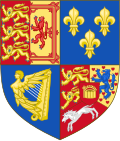
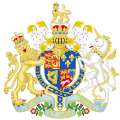
After the personal union with Great Britain ended in 1837, the monarchs of Hanover kept the British royal arms and standard, only introducing a new Crown (after the British model).

See also

[edit]

References

[edit]
Revisions and contributorsEdit on WikipediaRead on Wikipedia
from Grokipedia
The King of Hanover was the hereditary monarch of the Kingdom of Hanover, a sovereign German state in northwestern Europe established in 1814 at the as successor to the Electorate of Brunswick-Lüneburg and dissolved in 1866 following annexation by . From its origins in the early , the title reflected the House of Hanover's rule over territories that entered with the crowns of and in 1714, when Elector George Louis ascended as George I under the Act of Settlement. This persisted through the reigns of George I, George II, , , and , with the British monarchs exercising authority over as a distinct continental possession, often prioritizing alliances and defenses amid European conflicts. The arrangement ended in 1837 upon 's death, as followed semi-Salic law barring female inheritance while any male dynast lived, excluding Victoria from the Hanoverian throne and elevating her uncle Ernest as King Ernest I. Ernest Augustus's reign marked 's brief era of independent kingship, succeeded by his son until the kingdom's defeat and incorporation into the Prussian-led after siding with in the 1866 . The title encapsulated the dynastic interplay between British and Hanover's absolutist traditions, influencing and succession debates, though the kings' limited direct governance of Hanover—often delegated to viceroys—highlighted the personal nature of the union.

Origins of the Title

Electorate of Hanover

The emerged from the , particularly its Calenberg branch, when Leopold I elevated it to electoral status in to secure support amid conflicts with . This ninth electorate shifted the balance in the by creating an odd number of voters, enhancing Hanover's influence in selecting emperors and imperial policy. Ernest Augustus, who had unified key ducal territories including in 1705 through inheritance arrangements, served as the first elector from until his death on January 23, 1698. His son, George Louis, succeeded as elector, consolidating the house's position in northwestern . Hanover's strategic role extended to military engagements, notably the (1701–1714), where Elector George Louis allied with the Grand Alliance against and , deploying Hanoverian forces to defend imperial interests and contributing to campaigns in the and . The electorate's army, established for territorial defense, played a key part in these efforts, underscoring Hanover's alignment with Habsburg in broader European power dynamics. Domestically, the electorate pursued administrative centralization, with George Louis promoting and infrastructure like roads to integrate disparate lands stretching from the to the Mountains. The economy relied heavily on , leveraging fertile soils for grain and production, while routes facilitated exports of wool and timber; mining in the provided early industrial activity in silver and iron. By the mid-18th century, reforms addressed inefficiencies in tenure and , fostering gradual productivity gains amid a predominantly rural society. These foundations positioned as a stable, mid-sized German state, balancing imperial obligations with internal development until the Napoleonic disruptions.

Personal Union with Great Britain

The personal union between Great Britain and the Electorate of Hanover commenced on 1 August 1714, upon the accession of George Louis, Elector of Hanover, as George I to the British throne following Queen Anne's death. This arrangement stemmed directly from the Act of Settlement 1701, enacted by Parliament to secure Protestant succession by barring Catholics and designating Sophia of Hanover—granddaughter of James I—as heiress presumptive, with her son George inheriting after Sophia predeceased Anne by two months. The union persisted through the reigns of George I (1714–1727), George II (1727–1760), George III (1760–1820), George IV (1820–1830), and William IV (1830–1837), maintaining separate governance structures despite shared monarchy, as the entities operated under distinct legal and constitutional frameworks without merger. Britain's involvement yielded tangible benefits for Hanover's security amid continental rivalries, particularly against French expansionism. British subsidies and military deployments repeatedly shielded Hanover from invasion; during the War of the Austrian Succession, allied British-Hanoverian forces repelled French advances at the on 27 June 1743, marking the last battle commanded by a British king in person. In the Seven Years' War (1756–1763), Britain allocated over £7 million in subsidies to Prussia by 1762 to divert French resources and protect Hanoverian territory, enabling Hanover to maintain armed neutrality while avoiding direct subjugation—French forces occupied parts of Hanover in 1757, but Prussian and British efforts restored its independence via victories like in 1759. These measures exemplified causal linkages where British naval dominance and fiscal power extended continental deterrence, preserving Hanover as a without entangling it in Britain's overseas conflicts, such as the , where Hanover supplied 2,400 troops as auxiliaries to Britain but declared neutrality to evade reprisals. Tensions surfaced over perceived resource diversion, with British Whigs decrying "German distractions" that prioritized Hanoverian diplomacy over imperial priorities—evident in George II's 1740s push for alliances favoring Hanover, which strained relations with potential British partners like . Such critiques, voiced in parliamentary debates and by figures like , argued that union commitments inflated military expenditures and compromised strategic autonomy, yet empirical outcomes refute total detriment: Hanover's stability reinforced the dynasty's legitimacy against Jacobite restorations, as the shared crown underscored Protestant continuity post-1688, deterring internal rebellion by aligning electoral interests with British sovereignty. Proponents, including sympathizers, countered that dynastic fusion provided irreplaceable ballast, empirically sustaining the regime through 123 years without succession crisis until divergence in 1837.

Establishment of the Kingdom

Congress of Vienna

The Congress of Vienna (1814–1815) elevated the Electorate of Hanover to kingdom status under George III, who had refused to recognize the Holy Roman Empire's dissolution in 1806 and maintained separate diplomacy as elector. This upgrade, formalized in the Final Act signed on 9 June 1815, rewarded Hanover's loyalty amid Napoleonic occupations, where British forces, including the King's German Legion of Hanoverian exiles, resisted French control. British Foreign Secretary Viscount Castlereagh played a key role, leveraging Hanover's diplomatic network to advance Britain's strategy of a stable Continental balance, viewing the enlarged kingdom as a buffer against French resurgence and Prussian dominance in northern Germany. Hanover's territorial expansions included ceded from , the Bishopric of , and other ecclesiastical lands, augmenting its size by about 20 percent and bolstering its strategic position. These realignments reflected pragmatic motivations to counterbalance powers like , which relinquished claims reluctantly, fostering latent rivalries that later strained relations within the established concurrently. By parity with and —also raised to kingdoms—Hanover gained sovereign equality, enhancing its influence in the Confederation's assembly and contributing to post-war equilibrium without yielding to absolutist restorations elsewhere. The elevation underscored causal links between wartime contributions and peacetime recompense, prioritizing empirical alliances over ideological uniformity, though Prussian objections highlighted competing territorial appetites that the mitigated through divided spoils rather than outright concessions. This framework preserved Hanover's until mid-century pressures, affirming the Vienna system's emphasis on power equilibrium over national unification aspirations.

Constitutional Foundations

The Constitution of the Kingdom of Hanover was granted by King George III on December 17, 1819, replacing the pre-existing estates assembly with a structured under monarchical oversight. This document enshrined the king's absolute veto power over legislation, exclusive command of the military, direction of , and appointment of ministers answerable solely to , thereby preserving core elements of traditional authority amid the post-Napoleonic restoration. The bicameral legislature, known as the States General or , consisted of a First Chamber composed of hereditary nobles, high , and royal appointees, alongside a Second Chamber representing knightly estates, urban interests, and rural communities through indirect elections weighted by estate categories.) This arrangement curtailed some feudal noble exemptions inherited from the Electorate era, such as arbitrary seigneurial courts, while upholding an agrarian representational foundation that prioritized landed interests over urban mercantile expansion. The framework's emphasis on estate-based deliberation, rather than , fostered administrative continuity and insulated governance from the egalitarian upheavals that destabilized during its revolutionary cycles, enabling steady investment in infrastructure like expanded road networks sustained by modest land and excise revenues. Liberal critics in the , including burgher advocates and early constitutionalists, contended that the provisions unduly favored aristocratic dominance and excluded broader middle-class input, restricting legislative initiative to royal prerogative and estate vetoes. Nonetheless, the constitution's conservative calibration—rooted in empirical aversion to the fiscal and social disorders of radical experiments—correlated with Hanover's relative internal peace, as evidenced by the absence of widespread revolts until broader European pressures in , in contrast to the recurrent insurrections in more centralized, high-tax revolutionary states.

Succession and Separation

Application of Semi-Salic Law

The throne of Hanover adhered to semi-Salic succession, a system of agnatic that privileged male heirs descended through the male line, permitting female inheritance solely upon the total extinction of male descendants in the ruling house. This framework, rooted in the patrimonial traditions of the (Brunswick-Lüneburg), was codified in a comprehensive house law promulgated on , whereby all eligible male agnates formally affirmed the exclusion of female lines while any male claimant existed, thereby safeguarding patrilineal continuity across the dynasty's branches. The law's application ensured that collateral male relatives superseded direct female descendants, reflecting a causal mechanism designed to avert the fragmentation or dilution of authority observed in dynasties permitting earlier female precedence, such as intermittent in medieval English or Scottish lines prior to statutory reforms. Upon the death of King William IV on June 20, 1837, the semi-Salic rule dictated that the ian crown passed directly to his next senior male sibling, Ernest Augustus, Duke of Cumberland, rather than to his niece, Princess Victoria, who simultaneously acceded to the British throne under the United Kingdom's distinct Protestant succession principles established by the Act of Settlement of 1701. This divergence severed the between Britain and that had endured since George I's ascension in 1714, with British diplomatic recognition of Ernest Augustus's sovereignty following promptly through formal exchanges, averting any contestation over legitimacy. The transition proceeded without armed conflict or dynastic upheaval, underscoring the law's efficacy in channeling succession along predefined male lines. Critics, particularly from egalitarian perspectives in the emerging liberal of the , occasionally decried the exclusionary nature of semi-Salic principles as anachronistic and prejudicial toward female capability, yet empirical outcomes refute such characterizations by demonstrating sustained monarchical stability in : from the electorate's elevation in through 1837, no succession invoked female inheritance amid abundant males, and the system precluded the internecine wars or regency disputes plaguing realms with more flexible gender provisions, such as the Wars of the Roses in . By prioritizing agnatic descent, the causally reinforced territorial and institutional cohesion in a Germanic context prone to partition among heirs, enabling Hanover's orderly elevation to kingdom status at in without internal rupture. This male-line fidelity thus preserved the dynasty's integrity, contrasting with hypothetical egalitarian alterations that risked diluting authority amid contemporaneous revolutionary pressures across .

Ernest Augustus I's Ascension and Reforms

Ernest Augustus ascended the throne of the Kingdom of Hanover on 20 June 1837, immediately following the death of his brother, King William IV. The kingdom's semi-Salic law of succession, which prioritized male heirs over females in the presence of surviving male relatives, directed the crown to Ernest as the next eligible male descendant of , severing the with Britain where succeeded under Salic-influenced rules. On 5 July 1837, publicly declared that he did not regard himself as bound by the liberal promulgated in under , which had expanded parliamentary powers and . By November 1837, he formalized this stance through a royal patent revoking the 1833 document entirely and reinstating the more restrictive 1819 , which preserved greater monarchical prerogatives and limited legislative influence. This reversion dissolved the existing chambers of and prompted widespread liberal opposition, including refusals by several towns to nominate deputies to the new assembly. The revocation elicited notable resistance from the academic community, exemplified by the Göttingen Seven—professors including Jacob and Wilhelm Grimm—who issued a protest on 18 November 1837 condemning the act as a violation of sworn oaths and constitutional legitimacy, then refused the mandated oath of allegiance to Ernest's decree. In response, the king ordered their dismissal on 12 December 1837, effectively suppressing the protest through administrative action and threats of exile for non-compliance, measures framed as essential to preserving sovereign authority amid perceived challenges from intellectual elites. Ernest's governance emphasized conservative restoration in alignment with the post-Napoleonic order championed by figures like Metternich, featuring elements such as press restrictions that drew accusations of from liberal critics. Nonetheless, the reign achieved relative internal stability, avoiding the large-scale upheavals of the 1848 revolutions that destabilized much of the , with only minor disturbances quickly contained. Economic steadiness supported infrastructure initiatives, including the launch of the Royal Hanoverian State Railways in 1843, with the –Celle line inaugurating operations and a christened Ernst August symbolizing royal endorsement of modernization.

Reigns of the Kings

George V's Rule

George V ascended the throne on 18 November 1851 upon the death of his father, Ernest Augustus I. Completely blind since due to an injury and subsequent , he depended on close advisors, including his wife Queen , for governance, though no formal regency was established. Despite his , partial reliance on medical interventions did not restore significant vision, leading to a rule characterized by ministerial guidance rather than personal oversight. Under George V's reign, Hanover pursued administrative modernization, including the expansion of its railway network in the , which connected the kingdom to broader German routes and stimulated economic activity beyond traditional toward emerging industrial sectors. The kingdom's stood at approximately 1.8 million in the early , growing to over 2 million by the 1860s amid these developments. This infrastructure growth facilitated increased , though the economy remained predominantly agrarian with nascent proto-industrial elements like and machinery production. George V initially upheld Hanover's neutrality in German politics but aligned pro-Austrian, prioritizing loyalty to the German Confederation's federal structure over Prussian ambitions for centralization. This stance reflected a commitment to traditional confederalism, arguably safeguarding smaller states' autonomy against Prussian expansionism, though critics viewed it as isolationist and out of step with unification currents. In cultural spheres, he patronized the , adopting the site as his primary residence from 1857 and supporting its upkeep as a symbol of Hanoverian heritage.

Internal Governance and Challenges

The internal administration of the Kingdom of Hanover relied on a centralized overseen by the king's , which coordinated executive policies across provinces and managed routine in consultation with viceroys or ministers during periods of royal absence. Provincial estates provided limited representation for nobles, clergy, towns, and rural interests, functioning primarily in an advisory role on fiscal and local matters until the mid-19th century. This structure emphasized monarchical authority while incorporating traditional corporatist elements, reflecting the kingdom's conservative institutional continuity post-Napoleonic restoration. Social challenges emerged from gradual industrialization and rural-to-urban migration in the 1840s, prompting localized unrest amid economic pressures on agrarian communities, which the government addressed via localized and laws rather than centralized welfare expansion. In response to the 1848 revolutions sweeping German states, King George V promulgated a establishing a bicameral with a hereditary and an elected under property-based franchise, effectively channeling demands for while preserving dominance. Agrarian reforms, including enclosures and tenure adjustments enacted after , enhanced by facilitating consolidation and investment, bolstering in a predominantly rural . Fiscal policy prioritized restraint, maintaining public debt at modest levels—totaling approximately 48 million thalers by 1866—relative to the kingdom's output, which conservatives attributed to prudent budgeting and avoidance of expansive borrowing, contributing to internal stability amid continental upheavals. The Lutheran Church served as the state-established faith, yet policies extended formal tolerance to Catholic minorities concentrated in annexed bishoprics, permitting separate ecclesiastical structures without full equality. Liberals assailed the post-1848 restrictions, which confined voting in the to propertied males meeting tax thresholds, enfranchising only a narrow segment of the population; however, this arrangement correlated with averted revolutionary chaos, as evidenced by the kingdom's relative order compared to states undergoing broader democratic experiments.

End of the Monarchy

Role in German Affairs

The Kingdom of Hanover, as a founding member of the established on June 8, 1815, held representation in the Federal Diet at , where it exercised multiple votes commensurate with its status as one of the larger kingdoms, enabling influence in decisions on and internal affairs. Hanover consistently aligned with in Diet proceedings to resist Prussian initiatives aimed at centralizing authority and fostering economic or military dominance, thereby contributing to the maintenance of the Confederation's decentralized structure against premature unification schemes that threatened sovereign autonomy. This stance effectively obstructed Prussian-led centralist reforms during the period and beyond, preserving a balance of power among the 39 member states. Hanover demonstrated strategic caution toward the Prussian-initiated , formed in 1834, by withholding full accession to avoid ceding tariff sovereignty and bolstering Prussian economic leverage over confederal politics. Initial explorations of partial commercial treaties, such as those with north German states around 1841, reflected limited engagement without commitment to the union's framework, with comprehensive entry deferred until September 7, 1853, prioritizing political independence over integrated market benefits. This hesitancy underscored Hanover's broader policy of safeguarding fiscal and diplomatic discretion amid pressures for economic alignment that often presaged political subordination. Amid escalating tensions in 1866, Hanover under King George V adhered to its pro-Austrian orientation by voting in the Federal Diet on June 14 for the mobilization of troops to counter Prussian actions in , interpreting the move as a defensive measure to uphold collective obligations rather than an aggressive posture. Prussian leadership, viewing this as a breach of neutrality and pretext for dissolution of the Confederation, promptly invaded, leading to Hanoverian resistance including a at Langensalza on but ultimate capitulation to superior Prussian forces by late June. While Prussian accounts derided Hanover's alignment as reactionary obstructionism rooted in dynastic , this perspective overlooks the causal dynamics of small-to-medium state realism, wherein opposition to Prussian and served to avert the absorption of independent entities into a centralized , aligning with the 's foundational principle of mutual preservation.

Annexation by Prussia

The Kingdom of Hanover aligned with Austria in the Austro-Prussian War, mobilizing its army of approximately 18,000 men against Prussia on June 14, 1866, despite opposition from the Hanoverian Landtag urging neutrality. King George V rejected Prussian demands for disarmament and passage of troops, citing obligations under the German Confederation, which committed him to the Austrian-led coalition. Prussian forces under General Edwin von Manteuffel invaded Hanover on June 15, prompting the Hanoverian army, commanded by General Friedrich von Kielmansegg and King George V personally, to retreat southward toward the Main River to link with Bavarian allies. At the Battle of Langensalza on 27, 1866, Hanoverian troops numbering around 15,000 defeated a Prussian corps of 9,000 under General August Karl von Goeben at Flies, achieving a rare tactical success through superior positioning across the Salza River. However, reinforced Prussian forces totaling over 40,000 encircled the Hanoverians, forcing their surrender on 29 after failed breakout attempts; King George V escaped to with a small entourage. This capitulation ended organized Hanoverian resistance, as Prussian troops occupied the kingdom's major cities, including on June 28. Prussia's decisive victory at Königgrätz on July 3 against Austria enabled the annexation of Hanover without further negotiation, formalized by royal decree on August 23, 1866, as part of the Peace of Prague provisions allowing absorption of Austrian allies. The Kingdom of Hanover was dissolved and reorganized as the Prussian Province of Hanover effective October 1, 1866, with administrative integration completed by ceremonies on October 6. George V's refusal to yield, while defended by monarchists as adherence to dynastic honor and Confederation treaties, drew criticism for dooming Hanover's independence against Prussia's overwhelming advantages in industrialization, railway mobilization, and breech-loading rifles like the Dreyse needle gun, which outmatched Hanover's outdated forces. Prussian governance introduced administrative efficiencies and infrastructure modernization but imposed centralized control, diminishing Hanoverian autonomy.

Symbols and Representation

Coat of Arms

The coat of arms of the Kingdom of Hanover consisted of a shield tierced per pale: in the dexter, gules two lions passant guardant or (for Brunswick); in the middle, or semy of roses gules barbed and seeded proper (for Lüneburg); in the sinister, or semy of hearts gules a lion rampant azure crowned or (for the Principality of Calenberg-Grubenhagen). Prior to elevation to kingdom status in 1814, the shield was surmounted by an electoral bonnet reflecting its status within the Holy Roman Empire; following the Congress of Vienna and recognition as a kingdom in 1815, a royal crown replaced the bonnet atop the shield. This heraldic composition derived from grants to the House of Welf in the 14th century, emphasizing continuity with the medieval duchies of Brunswick and Lüneburg. The design encapsulated the territorial identity of the core Hanoverian lands, uniting symbols of Brunswick's lions—evident in ducal seals from the 13th century—and Lüneburg's roses and hearts, which represented ancient Saxon principalities integrated under Welf rule by 1235. Despite the kingdom's expansion to include (as the province of ) via the territorial adjustments, the royal arms retained their traditional form without incorporating Frisian elements like the or regional lions, prioritizing historical cohesion over administrative additions. Official depictions, including engravings and state seals from 1815 onward, consistently employed this to affirm dynastic legitimacy amid the post-Napoleonic reconfiguration. From a traditionalist perspective, the unchanged arms underscored causal fidelity to Welf origins, resisting modern alterations that might dilute medieval precedents; heraldic scholars note this preservation reinforced the monarchy's claim to pre-Reformation territorial sovereignty, as evidenced in continuity from Electoral seals to royal usage.

Royal Standards

The royal standard of the Kings of Hanover from 1816 to 1866 was a banner displaying the quartered arms of , , and , with a central escutcheon of the House of Hanover's arms topped by a royal crown of five arches without fleurs-de-lys. This design incorporated the Hanoverian escutcheon—divided per pale with Brunswick's two golden lions passant guardant on red, Lüneburg's crowned blue lion rampant on gold surrounded by red hearts, and Westphalia's white Saxon steed rampant on red—shielded by an inescutcheon bearing Charlemagne's crown. Adopted in 1816 during the personal union with , the standard persisted unchanged in after 1837, when the British royal banner was revised to exclude the Hanoverian elements due to Queen Victoria's accession. In 1837, following the end of the , the standard continued to symbolize the king's personal authority in , maintaining continuity with the electorate's heraldic traditions while asserting a distinct monarchical identity amid growing Prussian influence. By 1851, it was formalized as the Staats- und Regierungsfahne (state and flag), flown to denote the sovereign's presence on official buildings and occasions. Variants for naval or use followed similar protocols, adapting the for maritime state functions without recorded major deviations. Complementing the royal standard, the kingdom's civil and post-1815 was a white field bearing the red Saxon steed courant, crowned after , which reinforced regional symbolism derived from medieval Saxon and helped cultivate a separate identity from Prussian-dominated . This equine emblem, absent from the personal royal banner, underscored the kingdom's territorial representation while the standard emphasized dynastic sovereignty. No significant controversies arose over these standards, which empirically bridged electoral precedents and the kingdom's brief independence until annexation in 1866.

References

Add your contribution
Related Hubs
User Avatar
No comments yet.