


Community hub
Recent from talks
Contribute something
Nothing was collected or created yet.
Krnov
View on WikipediaKrnov (Czech pronunciation: [ˈkr̩nof]; German: Jägerndorf, Polish: Karniów or Krnów) is a town in Bruntál District in the Moravian-Silesian Region of the Czech Republic. It has about 23,000 inhabitants. The town is known for the production of the cola-based drink Kofola.
Key Information


Administrative division
[edit]Krnov consists of three municipal parts (in brackets population according to the 2021 census):[2]
- Pod Bezručovým vrchem (14,445)
- Pod Cvilínem (7,099)
- Krásné Loučky (573)
Geography
[edit]Krnov is located about 21 kilometres (13 mi) northwest of Opava and 49 km (30 mi) northwest of Ostrava, in the historic region of Czech Silesia on the border with Poland. The town is situated at the confluence of the rivers Opava and Opavice.
The northern part of the territory with the town proper lies in the Zlatohorská Highlands, the western and the southern part lie in the Nízký Jeseník range. A small part on the southeast extends into the Opava Hilly Land. The highest point is the hill Bednářský vrch at 588 m (1,929 ft) above sea level.
History
[edit]
The first written mention of Krnov is from 1240. At the latest in 1269 and probably already in 1253, Krnov was a town.[3] In the second half of the 13th century, town fortifications were built. In 1273, the Minorites came into the town and established a monastery.[4]
Krnov was a part of Duchy of Troppau until 1377, when the Duchy of Krnov separated and the town became its capital. Krnov prospered, guilds were established and textile crafts developed. In 1523, the Duchy of Krnov was acquired by the Hohenzollern family. They had built a castle here and during their rule, the town achieved its greatest prosperity and population growth.[4]
The prosperity ended with the Thirty Years' War. The battles caused the town to decline and subsequently stagnate. After the war, the duchy was acquired by the House of Liechtenstein who began the re-Catholicization of the entire duchy. In the 17th and 18th centuries, the town stagnated economically, but several Baroque monuments were created here. After the War of the Austrian Succession, Krnov became a border town. In 1779, a large fire destroyed almost the entire town.[4]
The development of the town was restored by the industrial revolution in the 19th century. Textile factories began to be established, and within a few decades Krnov more than doubled its population. The railway, which was opened in 1872, also helped the development.[4]
According to the Austrian census of 1910, the town had 16,681 inhabitants. The census had asked people for their native language; 15,390 (98.4%) were German-speaking and 247 (1.5%) were Czech-speaking. Jews were not allowed to declare Yiddish, thus most of them declared German as their native language. The most populous religious groups were Roman Catholics with 15,290 (91.7%), followed by Protestants with 885 (5.3%) and the Jews with 459 (2.8%).[5]
From 1938 to 1945 it was occupied by Germany and administered as a part of the Reichsgau Sudetenland. During World War II, the German administration operated a Gestapo prison[6] and four forced labour subcamps of the Stalag VIII-B/344 prisoner-of-war camp in the town.[7] After the war, the German population was expelled, in accordance to the Potsdam Agreement.
In 1948, refugees from Greece fleeing as a result of the Greek Civil War came into Czechoslovakia, and in Krnov and its surroundings they formed a significant community. They successfully assimilated, and although most of them returned to their homeland after 1975, several hundred of them still remain.[8]
In 2024, Krnov was damaged by the Central European floods.
Demographics
[edit]Historical population | ||||||||||||||||||||||||||||||||||||||||||||||||||||||||
|
|
| ||||||||||||||||||||||||||||||||||||||||||||||||||||||
| Source: Censuses[9][10] | ||||||||||||||||||||||||||||||||||||||||||||||||||||||||
Economy
[edit]Krnov is known for the production of cola-based drink Kofola by the eponymous company, which is the largest industrial employer based in the town.[11]
One of the largest local companies was Rieger–Kloss, which manufactured pipe organs. It was founded in 1873 and production has continued to the present, but after financial problems, it went into insolvency in 2018 and production was stopped.[12]
Transport
[edit].jpg)
Krnov is located on the Ostrava–Olomouc and Krnov–Głuchołazy railway lines. The town is served by has railway stations, Krnov and Cvilín.
The road border crossings Krnov-Horní Předměstí / Ciermięcice, Krnov / Pietrowice, and Chomýž / Chomiąża are located in the municipal territory.
Sights
[edit]

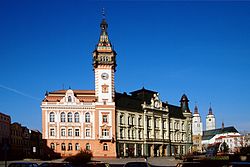
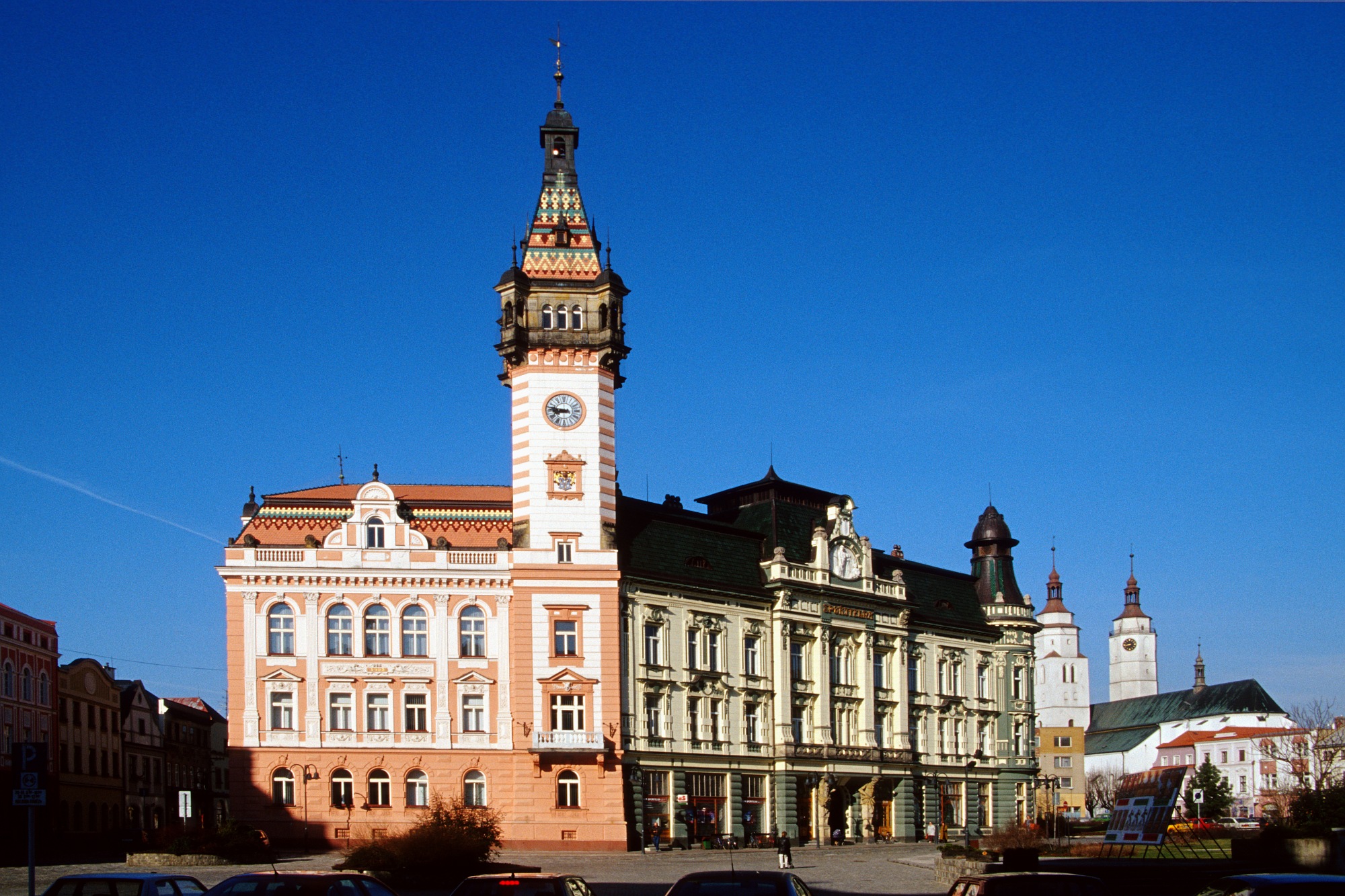
The landmark of the town square is the Neorenaissance town hall. It was built in 1901–1903 on the site of an old town hall from the 16th century. It has a richly decorated 52 metres (171 ft) high tower, which is a copy of the Währing town hall tower. The town hall was designed by Leopold Bauer, native of Krnov. The second urban landmark is the town savings bank, connected with the town hall. The Art Nouveau-Baroque building with a richly structured façade was built in 1906–1907.[13]
The Krnov Synagogue is the only synagogue in the region which survived to this day in its original form. The interior is the Moorish Revival style. Today it serves as an exhibition and concert hall.[14]
The Church of Saint Martin in the historic centre was first documented in 1281. The wooden church was replaced by the current stone one at the turn of the 14th and 15th centuries. The second tower was added in the 16th century. The 67 metres (220 ft) high towers were part of the town's defense system. One of the towers is open to the public as a lookout tower.[15]
The Church of Saint Benedict consists of a rotunda from the 13th century and a church without a tower. The interior is decorated with valuable frescoes from the period between the 13th and 15th centuries.[16]
The Baroque complex of the Minorite monastery with the Church of the Nativity of the Virgin Mary was built after 1779, when the original Gothic buildings were destroyed by a fire. The monastery was abolished in 1950 and restored in 1989.[17]
Krnov Castle was built in 1531–1535. Today it serves commercial purposes and as an administrative seat, only the courtyard is freely accessible.[4]
An important technical monument is the former spinning mill and warehouse of the Alois Larisch factory with a sample workshop, including a set of machinery. It is a Neoclassical building from 1922, protected as a national cultural monument.[18]
Cvilín
[edit]Cvilín is hill known as a pilgrimage site with the Church of Our Lady of the Seven Sorrows and Stations of the Cross. The church was built in 1722–1727 and replaced the wooden chapel, which did not have enough capacity for the number of believers participating in the pilgrimage. It is one of the most important Baroque monuments in the region.[19] Since 2018, it has been protected as a national cultural monument.[20]
On the hill is also a 26 metres (85 ft) high observation tower, constructed in 1902–1903. It is a stone romantic building topped by a lookout with a battlement. In the second part of the Cvilín hill is the ruin of the Cvilín Castle. It was built before 1253 and destroyed during the Thirty Years' War.[21]
Notable people
[edit]- Carol Benesch (1822–1896), architect
- Charles Louis Fleischmann (1835–1897), Austrian inventor and distiller
- Leopold Bauer (1872–1938), Austrian architect
- Grete Berger (1883–1944), Austrian-German actress
- Robert Hohlbaum (1886–1955), Austrian-German writer and playwright
- Liesl Herbst (1903–1990), Austrian tennis player
- Norbert Riedel (1912–1963), Austrian engineer and entrepreneur
- Hanns Cibulka (1920–2004), German poet
- Edith Ballantyne (born 1922), Canadian activist
- Jiří Georg Dokoupil (born 1954), Czech-German painter and graphic artist
- Zdeňka Šilhavá (born 1954), discus thrower
- Leon Koudelak (born 1961), classical guitarist
- Jaroslav Sakala (born 1969), ski jumper
- Radek Bonk (born 1976), ice hockey player
Twin towns – sister cities
[edit] Głubczyce, Poland
 Karben, Germany
 Lykovrysi-Pefki, Greece
- Mińsk Mazowiecki, Poland
 Nadvirna, Ukraine
- Prudnik, Poland
 Rajec, Slovakia
 Saint-Égrève, France
 Telšiai, Lithuania


Gallery
[edit]-
 Krnov Castle
 -
 Church of the Holy Spirit
 -
 Cvilín observation tower
 -
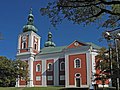 Church of Our Lady of the Seven Sorrows on Cvilín
 -
 Stations of the Cross on Cvilín
 -
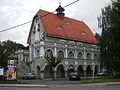 Shooting house
 -
 Swedish wall
.JPG)


References
[edit]- ^ "Population of Municipalities – 1 January 2025". Czech Statistical Office. 2025-05-16.
- ^ "Public Census 2021 – basic data". Public Database (in Czech). Czech Statistical Office. 2022.
- ^ "Povýšení Krnova 1253 či 1269" (in Czech). Town Museum Krnov. Retrieved 2022-02-23.
- ^ a b c d e "Zámek" (in Czech). Tourist Information Centre Krnov. Retrieved 2025-07-03.
- ^ Ludwig Patryn (ed): Die Ergebnisse der Volkszählung vom 31. Dezember 1910 in Schlesien, Troppau 1912.
- ^ "Gestapogefängnis Jägerndorf". Bundesarchiv.de (in German). Retrieved 12 November 2021.
- ^ "Working Parties". Lamsdorf.com. Archived from the original on 29 October 2020. Retrieved 12 November 2021.
- ^ "Řecká komunita slavila výročí". Bruntálský a Krnovský Deník (in Czech). Deník.cz. 2008-06-29. Retrieved 2022-08-23.
- ^ "Historický lexikon obcí České republiky 1869–2011" (in Czech). Czech Statistical Office. 2015-12-21.
- ^ "Population Census 2021: Population by sex". Public Database. Czech Statistical Office. 2021-03-27.
- ^ "Kofola letos plánuje další rozvoj. Financovat jej bude z prodeje akcií" (in Czech). iDNES.cz. 2022-02-15. Retrieved 2025-07-03.
- ^ Kuba, František (2018-03-20). "Čína nezaplatila. Slavná varhanářská firma Rieger-Kloss končí v dluzích". Deník.cz (in Czech). Retrieved 2022-02-23.
- ^ "Novorenesanční krnovská radnice" (in Czech). CzechTourism. Retrieved 2022-02-23.
- ^ "Krnov" (in Czech). CzechTourism. Retrieved 2022-02-23.
- ^ "Kostel sv. Benedikta" (in Czech). Tourist Information Centre Krnov. Retrieved 2022-02-23.
- ^ "Kostel sv. Martina" (in Czech). Tourist Information Centre Krnov. Retrieved 2022-02-23.
- ^ "Kostel Narození Panny Marie a klášter minoritů" (in Czech). Tourist Information Centre Krnov. Retrieved 2025-07-03.
- ^ "Kostel Povýšení sv. Kříže a Panny Marie Sedmibolestné" (in Czech). National Heritage Institute. Retrieved 2023-04-18.
- ^ "Poutní vrch Cvilín" (in Czech). Tourist Information Centre Krnov. Retrieved 2022-02-23.
- ^ "Kostel Povýšení sv. Kříže a Panny Marie Sedmibolestné" (in Czech). National Heritage Institute. Retrieved 2023-04-18.
- ^ "Rozhledna Cvilín u Krnova" (in Czech). CzechTourism. Retrieved 2022-02-23.
- ^ "Partnerská města" (in Czech). Město Krnov. Retrieved 2025-07-03.
External links
[edit]
- Official website
- Tourist information centre
- Sudeten German homeland district of Jägerndorf (in German)
- Krnov Friends' Club (in Czech)
| International | |
|---|---|
| National | |
| Geographic | |
| Other | |

Krnov
View on GrokipediaGeography
Location and Terrain
Krnov is situated in the Moravian-Silesian Region of the Czech Republic, within the historic region of Czech Silesia, at geographic coordinates approximately 50°05′N 17°42′E.[8] The municipality encompasses an area of 44.4 km².[3] The town occupies a position at the confluence of the Opava and Opavice rivers, marking a natural boundary in its Silesian setting.[9] Its terrain features the northeastern fringes of the Nízký Jeseník highlands, characterized by hilly elevations that gradually descend into the surrounding Silesian lowlands.[2] The mean altitude stands at 316 meters above sea level, contributing to a varied landscape of undulating hills and river valleys.[3] The northern extent of Krnov's municipal boundary directly adjoins Poland, forming part of the Czech-Polish frontier that has historically influenced regional connectivity due to its proximity rather than pronounced natural barriers like mountains.[1] This positioning in Upper Silesia underscores the area's role as a transitional zone between Czech and Polish territories, with the Opava River serving as a key hydrological feature shaping local landforms.[10]Climate
Krnov has a temperate continental climate (Köppen Dfb), featuring pronounced seasonal variations with cold, snowy winters and warm, humid summers. Average annual temperatures range from a January mean of approximately -1 °C (maximum 1 °C, minimum -3 °C) to a July mean of about 19 °C (maximum 24 °C, minimum 14 °C), based on historical data spanning multiple decades. [11] [12] Annual precipitation totals around 890 mm, distributed relatively evenly but with peaks in summer months due to convective activity, supporting local agriculture through adequate soil moisture while posing risks of waterlogging in low-lying areas. The nearby Jeseníky Mountains, rising to over 1,400 m just 20 km east, exert an orographic influence, enhancing winter snowfall (typically 50-100 cm cumulative depth in colder months, exceeding lowland Czech averages) through uplift of moist air masses and fostering frequent radiation fog in the Opava River valley, where inversions trap cool air during autumn and winter. [13] This results in 20-30 foggy days per winter month on average, reducing visibility and contributing to microclimatic chill. Summers occasionally see heatwaves exceeding 30 °C, while winters can drop below -15 °C during cold snaps.| Month | Mean Max Temp (°C) | Mean Min Temp (°C) | Avg Precipitation (mm) |
|---|---|---|---|
| January | 1 | -3 | ~40 |
| July | 24 | 14 | ~90 |
| Annual | - | - | 890 |
Administration
Municipal Organization
The Municipal Assembly of Krnov (Zastupitelstvo města Krnov), the primary legislative body, comprises 27 members elected by universal suffrage every four years during communal elections.[16][17] The most recent elections occurred on September 23–24, 2022, resulting in seats distributed among parties including ANO 2011 (9 seats), Krnovští patrioti (9 seats), and Svoboda a přímá demokracie (3 seats).[17][18] The mayor (starosta), currently Ing. Tomáš Hradil, leads the executive functions and chairs the Municipal Council (Rada města), an advisory body of 9 members that includes two deputy mayors: Ing. Miroslav Binar and Mgr. Monika Bala Dudová.[16][19][20] The assembly approves the municipal budget, land-use plans, and internal regulations, while the council executes decisions and oversees administrative operations through the Municipal Office (Městský úřad).[21] Krnov's administration manages local governance across its urban core and adjacent areas, including historical quarters like the town center and elevated districts such as Cvilín, without formal subdivision into independent municipal parts.[22] The local government coordinates internal planning, such as urban maintenance and community services, and engages in EU-funded initiatives for infrastructure resilience, exemplified by post-flood recovery efforts estimated at billions of Czech crowns in 2024.[23] These activities emphasize sustainable local development under Czech municipal law.Regional Context
Krnov is situated in the Bruntál District within the Moravian-Silesian Region, one of the Czech Republic's 14 higher territorial self-governing units (kraje), which handle regional development, education, and transport coordination.[1][24] The Moravian-Silesian Region, with its six districts including Bruntál, forms a NUTS-2 statistical unit (CZ08) under the European Union's nomenclature, enabling eligibility for EU structural funds channeled through the central government in Prague.[25] This integration directs national budgetary transfers—primarily from Prague—to regional priorities such as industrial revitalization in the Ostrava agglomeration, influencing local infrastructure investments in Krnov without direct municipal control over allocations.[24] The town's position near the Polish border fosters cross-border ties, particularly with the Opole Voivodeship, through frameworks like the Euroregion Silesia, founded in 1998 to coordinate Czech-Polish initiatives in economic development and environmental management.[26][24] These collaborations, involving subnational entities from both countries, have supported joint ventures in tourism and transport, leveraging the shared Silesian cultural and geographic continuum while adhering to EU cross-border program guidelines.[27] Post-1993 administrative reforms, following Czechoslovakia's dissolution, established the Czech Republic as a unitary state with regions empowered by the 2000 Act on Regions, granting Moravian-Silesian assemblies legislative roles in areas like spatial planning.[28] This structure enhanced regional discretion over local affairs compared to centralized communist governance, yet retained fiscal dependence on Prague for major funding, limiting autonomy amid persistent Moravian identity-based advocacy for devolution that has not yielded federal-like powers.[28] In practice, this balances central oversight with regional input, directing resources toward the Moravian-Silesian area's heavy industry legacy while constraining independent local fiscal maneuvers in municipalities like Krnov.[29]History
Medieval Foundations
The region encompassing Krnov featured Slavic settlements prior to the 13th century, as part of the broader Moravian and Silesian territories under early medieval Slavic principalities. The Mongol invasion of 1241, while not directly ravaging Krnov, contributed to regional instability and depopulation in adjacent areas like Poland and Hungary, prompting Přemyslid rulers to invite German colonists to bolster border defenses and exploit economic opportunities in sparsely populated lands. This Ostsiedlung process facilitated the establishment of Krnov as a fortified settlement, with its first documented reference occurring on April 27, 1240, in a charter issued by King Wenceslaus I of Bohemia, mentioning "Kyrnow" as an existing locale.[2][9] Under the feudal oversight of the Přemyslid dynasty, Krnov transitioned into a town with municipal privileges likely conferred shortly after the mid-13th century, though exact documentation is absent; these rights included market operations essential for trade in the burgeoning German-influenced economy. The settlement's strategic position near the Opava region underscored its role in feudal networks, where local lords managed agrarian production and defense against potential incursions. A wooden castle, constructed by Přemyslid authorities to anchor feudal control and early fortifications, is noted from the early 1300s, symbolizing the shift toward structured lordship amid colonization efforts.[2][30] By the late 13th century, town walls emerged to enclose the growing burgher community, reflecting enhanced autonomy and protection within the feudal hierarchy. These developments positioned Krnov as a key nodal point in the Přemyslid domains, fostering interactions between Slavic remnants and incoming German settlers under royal patronage, up to the dynasty's decline around 1306.[2]Early Modern Period under Habsburgs
Following the defeat of Protestant forces at the Battle of White Mountain on November 8, 1620, the Duchy of Krnov was confiscated from the Hohenzollern family, who had supported the Bohemian Revolt against Habsburg authority, and integrated into the Habsburg domains of Moravia-Silesia.[4][31] The duchy, previously acquired by the Hohenzollerns in 1523, passed to the loyal Catholic House of Liechtenstein, who administered it alongside the Duchy of Opava as feudal lords under imperial oversight, marking the onset of centralized Habsburg administrative control in the region.[32] This shift consolidated Habsburg influence in Silesian territories, subordinating local Protestant nobility to Vienna's authority and aligning Krnov with the broader Counter-Reformation policies.[33] The Thirty Years' War (1618–1648) brought severe devastation to Krnov, as Danish, Imperial, and Swedish armies repeatedly plundered the principality, exacerbating economic stagnation that had begun with the post-1620 political upheavals.[4] The conflict contributed to a regional population decline in Silesia from approximately 1.5 million to 1 million inhabitants, driven by battle casualties, famine, disease, and emigration, with Krnov experiencing similar losses that halved its pre-war numbers.[34] Recovery in the late 17th century relied on immigration of German-speaking settlers from Habsburg lands, who repopulated depopulated areas and reinforced linguistic Germanization amid ongoing religious tensions.[35] Under Liechtenstein rule, rigorous recatholicization efforts commenced after the war, reversing the Lutheran Reformation introduced by the Hohenzollerns in the 16th century and enforcing Catholic orthodoxy through church closures, expulsions of Protestant clergy, and incentives for conversion.[4][32] This process stabilized confessional conditions by the mid-17th century, integrating Krnov into the Habsburg ecclesiastical framework and diminishing Protestant influence.[36] The Baroque period saw cultural and architectural renewal, with post-war reconstructions funded by noble endowments, including the development of pilgrimage sites like the Church of Our Lady of the Seven Sorrows on Cvilín Hill, which featured Baroque chapels and Stations of the Cross to promote Catholic devotion.[37] Local churches, such as St. Michael's, underwent Baroque modifications, including window alterations in 1758, reflecting Habsburg-sponsored artistic patronage amid gradual economic stabilization.[38] Despite these developments, Krnov's political significance waned by the late 18th century, as administrative functions shifted to Opava in 1793.[4]19th-Century Industrialization
During the mid-19th century, Krnov transformed into a notable industrial hub within Austrian Silesia, spurred by the expansion of textile manufacturing after the removal of the town's medieval fortifications, which freed up land for factories. Textile production, centered on wool and cloth, became the dominant sector, with 27 enterprises operating by the late 1800s and supporting a network of trade that positioned Krnov as a regional nexus.[39] A prominent example was the wool textile firm established in 1876 by brothers Wilhelm and Jakob Bellak, which exemplified the scale of local investment in mechanized production.[40] Complementing textiles, engineering works emerged to produce machinery tailored for the industry, including looms and processing equipment, further embedding Krnov in the proto-industrial supply chains of the Habsburg economy.[6] The completion of the Moravian-Silesian industrial railway in 1872 markedly accelerated this development by linking Krnov to Opava and broader markets, enabling efficient raw material imports and finished goods exports while driving population growth that exceeded doubling within decades.[4][39] Industrial expansion reinforced the economic dominance of the German-speaking bourgeoisie, who owned and managed most enterprises, while drawing a modest influx of Czech-speaking workers from interior Bohemia and Moravia to fill labor demands in factories; nonetheless, Germans constituted the vast majority of residents throughout the period.[41] This ethnic stratification reflected broader patterns in Habsburg borderlands, where localized German entrepreneurial networks capitalized on proximity to Prussian markets and imperial trade privileges.[42]Interwar Sudeten German Era
Following the dissolution of Austria-Hungary in late 1918, Krnov (known as Jägerndorf to its predominantly German-speaking inhabitants) was incorporated into the new Czechoslovak state despite local protests from Sudeten Germans seeking alignment with German Austria. The town's German population, which formed the overwhelming majority, viewed the transfer as a violation of self-determination principles enshrined in U.S. President Woodrow Wilson's [Fourteen Points](/page/Fourteen Points), fostering immediate resentment toward Prague's central government. This ethnic configuration positioned Krnov within the broader Sudetenland borderlands, where Germans comprised about 3 million of Czechoslovakia's 14 million total population, but felt marginalized in a state dominated by Czechs and Slovaks.[43] The 1930 Czechoslovak census recorded Krnov's population at approximately 22,000, with ethnic Germans accounting for over 99.5% (Czechs numbered just 113, or 0.5%). Politically, this homogeneity translated into strong support for German nationalist parties, culminating in the rise of the Sudeten German Party (SdP) founded in 1933 by Konrad Henlein. The SdP, initially presented as advocating cultural autonomy, increasingly pursued irredentist goals aligned with Nazi Germany's revisionist demands, securing 68% of the Sudeten German vote in the 1935 parliamentary elections and dominating local politics in towns like Krnov. Henlein's rhetoric emphasized grievances over perceived economic discrimination, including land reforms that redistributed German-held properties to Czech settlers and state hiring preferences favoring non-Germans, which exacerbated separatist sentiments amid the global depression.[44] Economic conditions in interwar Krnov, an industrial center with textile mills and shoe factories, deteriorated sharply during the 1930s due to the Great Depression, with unemployment rates in Sudetenland districts reaching 20-30% by 1933—higher than in the Czech interior. Sudeten German leaders argued that Prague's policies, such as infrastructure investments skewed toward core regions and tariffs disadvantaging border industries, systematically disadvantaged German areas, fueling radicalization and demands for separation. These disparities were not merely perceptual; statistical analyses of the period show Sudetenland per capita income lagging 15-20% behind national averages, compounded by cultural policies like mandatory Czech-language education that alienated the German majority. While some local Czech officials documented isolated acts of German irredentist agitation, such as boycotts of Czech businesses, the SdP's monopoly minimized organized Czech resistance, though debates persist among historians over the extent of genuine local support versus coerced alignment with Henlein's pro-Nazi turn.[45][46] Tensions peaked in 1938 with escalating violence, including a Sudeten German Freikorps occupation of Krnov in March, amid broader SdP-orchestrated unrest that claimed dozens of lives across the Sudetenland. Nazi Germany's diplomatic pressure, culminating in the Munich Agreement of September 30, 1938, transferred Krnov and surrounding areas to the Third Reich without armed conflict, celebrated locally as liberation from "Czech oppression" by SdP adherents. Archival records indicate minimal resistance in Krnov itself, with most inhabitants welcoming the annexation, though a small number of anti-Nazi Germans faced intimidation; this acquiescence reflected both economic desperation and ideological sympathy rather than uniform enthusiasm for Nazism. The period underscored causal links between unresolved ethnic majorities in artificial post-Versailles states and irredentist crises, independent of later wartime atrocities.[47]Nazi Occupation and World War II
Following the Munich Agreement of September 30, 1938, German troops entered Krnov (German: Jägerndorf) on October 6, 1938, incorporating the town into the Reichsgau Sudetenland as part of Nazi Germany's administrative reorganization of annexed territories.[4] The local German-speaking majority, comprising over 75% of the population in the 1930s, experienced initial enthusiasm for the annexation, but Nazi governance imposed centralized control under Gauleiter Konrad Henlein, including economic integration into the Reich's war economy and suppression of non-German elements.[48] A Gestapo prison operated in the town to enforce loyalty and punish resistance, targeting remaining Czechs and political opponents.[49] The Jewish community, numbering approximately 444 persons in 1930 (1.3% of the total population), faced rapid persecution after incorporation. Religious services at the town's synagogue ceased in autumn 1938, with the building later damaged—possibly during Kristallnacht pogroms or subsequent actions—and repurposed for secular use, such as by German radio services.[50] [48] Most Jews were dispossessed through Aryanization policies, forced to emigrate where possible, or deported to concentration camps like Theresienstadt or Auschwitz by 1942, resulting in near-total elimination of the community; survivors numbered fewer than a dozen post-war.[50] [51] Wartime impacts included the establishment of four forced-labor subcamps affiliated with Stalag VIII-B/344 (Lamsdorf), housing Allied prisoners-of-war and civilian laborers compelled to work in local industries supporting the German war effort, such as manufacturing and infrastructure.[49] Conditions in these subcamps involved harsh discipline, inadequate rations, and exposure to Allied bombings, though Krnov itself avoided major destruction. As the Eastern Front collapsed, Soviet forces advanced through the Opava region in late April to early May 1945, occupying Jägerndorf by May 6 with minimal local fighting due to disintegrating German defenses.[4] [52]Post-1945 German Expulsion
Following the end of World War II, President Edvard Beneš issued decrees in May and August 1945 authorizing the expulsion of ethnic Germans from Czechoslovakia, framing it as retribution for the Sudeten Germans' support for the 1938 Munich Agreement and Nazi annexation.[53] These measures, including Decree No. 33 on August 2, 1945, revoked citizenship from approximately 2.5 million Germans, enabling property confiscation and population transfers endorsed by the Allied Potsdam Conference in July-August 1945.[54] In Krnov (German: Jägerndorf), where Germans formed the overwhelming majority, around 15,000-20,000 individuals from the town and surrounding district faced expulsion between 1945 and 1947. The initial phase consisted of "wild expulsions" from May to August 1945, characterized by uncoordinated actions from Czech revolutionary guards, militias, and civilians, who interned Germans in local camps, enforced forced marches toward borders, and committed documented acts of violence including assaults, rapes, and killings amid widespread retribution.[55] These irregular operations preceded more organized transports under Allied oversight, with expellees often allowed minimal possessions and subjected to harsh conditions contributing to fatalities from exhaustion, starvation, and untreated injuries.[56] Empirical records indicate a local mortality rate of approximately 1-2% during the expulsions in the Krnov area, consistent with verified Sudetenland figures where 6,000-15,000 deaths occurred from direct violence and related hardships out of 3 million total expellees, though German postwar commissions estimated national tolls as high as 270,000 including indirect causes like disease in transit.[53] Czech authorities justified the process as necessary collective punishment for wartime collaboration, while German expellee accounts emphasized the disproportionate human suffering and loss of life from disorganized brutality.[45] Confiscated German properties in Krnov, encompassing homes, farms, and businesses, were seized under the decrees without compensation and allocated to Czech resettlers primarily from central Bohemia and Moravia, who arrived in organized waves to claim the vacated assets.[57] This redistribution facilitated immediate economic repurposing but left expellees dispossessed upon arrival in Allied occupation zones in Germany.Communist Period (1948-1989)
Following the communist coup of February 1948, Krnov, as part of the Czechoslovak borderlands, experienced the rapid imposition of state socialism, including the nationalization of local industries such as textile firms previously operating in the district.[45] These measures aligned with broader central planning directives from Prague, transforming private enterprises into state-controlled entities under the national economy framework. Agricultural collectivization followed, compelling local farmers to join unified cooperatives by the mid-1950s, though resistance persisted in rural outskirts due to the region's recent post-war repopulation with Czech settlers.[58] Population levels stabilized around 25,000 inhabitants through the period, reflecting controlled internal migration and limited industrial labor influx amid housing shortages from wartime damage and expulsions.[59] The 1950s saw Stalinist purges extend to Krnov, targeting perceived class enemies, former Sudeten German sympathizers, and party deviants in show trials reminiscent of national campaigns against "bourgeois nationalists."[60] Lingering anti-German residue fueled investigations into "fascist remnants," exacerbating distrust in this frontier area still integrating resettled populations. Religious suppression intensified, with state oversight of churches leading to clandestine operations; Catholic and Protestant groups operated underground to evade registration mandates and ideological indoctrination, as official bodies like the Czech Hussite Church served regime loyalty tests.[61] Local associations, once vibrant in pre-war civic life, were subsumed into communist fronts like the National Front, stifling independent dissent.[62] Echoes of the 1968 Prague Spring reached Krnov through calls for reform under Alexander Dubček, sparking localized protests against rigid centralism and economic stagnation in factories.[63] Workers and intellectuals voiced grievances over production quotas and censorship, mirroring national demands for "socialism with a human face." The Warsaw Pact invasion on August 20, 1968, quelled these activities, imposing Gustáv Husák's normalization by 1969, which reinstated orthodoxy and purged reform sympathizers, further entrenching surveillance in the town.[64] Illegal samizdat printing persisted as subtle resistance, though at risk of severe reprisal.[65]Post-Velvet Revolution Developments
The Velvet Revolution of November 1989 marked the end of communist rule in Czechoslovakia, ushering in democratic reforms and economic liberalization that profoundly affected Krnov. Local governance transitioned to free elections, with the town integrating into the newly formed Czech Republic after the 1993 dissolution of Czechoslovakia. Economic restructuring emphasized privatization, targeting state-owned enterprises amid broader national efforts to shift from central planning to market mechanisms; in Krnov, this process unfolded through voucher schemes and direct sales in the early 1990s, though many firms struggled with adaptation.[66] Textile industries, once central to Krnov's economy, faced severe challenges during the 1990s privatization waves, as most factories could not compete in open markets, resulting in widespread closures and the termination of centuries-old manufacturing traditions; only a single textile operation endured. The Rieger Kloss organ factory, established in 1873, persisted through the transition, maintaining production as a niche survivor. A catastrophic flood in July 1997 inflicted significant damage on infrastructure and homes across the town, exacerbating recovery efforts amid ongoing economic adjustment. The Czech Republic's accession to the European Union on May 1, 2004, provided access to structural funds that supported regional infrastructure upgrades, including transport links in the Moravian-Silesian area, indirectly benefiting Krnov's connectivity and development potential.[66][66] Krnov's population reflected post-communist demographic shifts, declining from 25,419 residents in the 1991 census to 25,011 in 2001, 24,275 in 2011, and 22,743 in 2021, driven by out-migration, aging, and low birth rates common to peripheral Czech regions. Since 2010, the town has maintained stability, avoiding major political scandals or economic crises, with governance focused on local administration under mayoral leadership. The COVID-19 pandemic had limited direct impact, as Krnov's modest size and industrial base buffered severe disruptions compared to urban centers. Recent revival initiatives emphasize cultural preservation, sporting facilities, and tourism promotion, positioning the town as a quiet, clean locale with heritage sites to counter regional stagnation.Demographics
Population Trends
The population of Krnov grew substantially during the 19th and early 20th centuries due to industrialization and associated economic opportunities, doubling between 1869 and 1910 as textile and other manufacturing sectors expanded.[67] By 1930, the town reached its historical peak of approximately 34,000 inhabitants, reflecting sustained inward migration and urban development prior to World War II.[48] The end of World War II and subsequent mass expulsions led to a sharp demographic contraction, with the population plummeting to around 15,000 by 1947 as the town's pre-war residents were displaced en masse.[59] Recovery began in the 1950s under the communist regime, fueled by directed internal migration from other parts of Czechoslovakia to repopulate border areas and staff revived industries, pushing numbers above 20,000 by the mid-1950s and continuing upward through the 1980s to exceed 25,000.[68][59] Post-1989 economic transitions, including deindustrialization and outmigration to larger urban centers, halted growth and initiated stagnation in the 1990s, followed by gradual decline.[69] Czech Statistical Office data record 23,595 residents in 2018, falling to 23,130 by 2021, a trend consistent with broader regional patterns of aging populations and net emigration.[70] Absent interventions to boost local employment or attract settlers, projections aligned with national forecasts suggest further reduction toward 20,000 by 2030, driven by persistently low birth rates and ongoing outflows.[71]Ethnic Composition Changes
In the 1930 Czechoslovak census, ethnic Germans constituted the overwhelming majority in Krnov (then known as Jägerndorf), comprising approximately 95% of the population, with Czechs forming a small minority of less than 5%. This composition reflected the broader Sudetenland region's demographics, where German-speakers dominated border areas due to centuries of settlement and Habsburg administration.[43] Following the expulsion of Germans after World War II, the ethnic structure shifted dramatically; by 1947, the German population had declined to under 1%, while Czechs and Slovaks exceeded 90% of residents through resettlement programs.[45] This homogenization persisted into the communist era, with official censuses from 1950 onward recording Czechs as the predominant group, comprising over 94% nationally in formerly German-heavy areas. The Romani population in Krnov grew during the 1950s–1970s due to forced relocations from eastern Czechoslovakia, integrating former nomadic or rural groups into industrial border towns like Krnov as part of socialist assimilation policies.[72] Current estimates place the Romani community at around 1–2% of Krnov's approximately 23,000 inhabitants, though underreporting in censuses—due to stigma and self-identification as Czech—means official figures (e.g., 2021 census declaring only 0.1–0.3% nationally) underestimate the actual presence.[73] [74] Linguistically, Czech has been the dominant language since the late 1940s, with residual Sudeten German dialects effectively extinct in Krnov following the demographic upheaval; any remaining German varieties in the Czech Republic are confined to isolated elderly speakers or cultural revivals elsewhere, not reflecting everyday use in the town.[75]Religious Profile
Prior to 1945, Krnov's religious landscape was dominated by Roman Catholicism, which formed the base for over 90 percent of the population, reflecting the town's Sudeten German heritage. Small Protestant communities, rooted in the Reformation-era influences in Silesia, accounted for around 5 percent, while a Jewish minority of approximately 3 percent maintained a synagogue built in 1871.[36][76] Following the 1945 expulsion of the German-speaking populace, which encompassed the bulk of Catholics and Protestants, and amid communist suppression from 1948 to 1989, religious observance plummeted. Church properties faced nationalization, repurposing some for secular uses, contributing to institutional decline. The Jewish community was effectively eradicated through Holocaust losses and subsequent displacements, with no significant revival.[77] In the 2021 census, religious affiliation in the Moravian-Silesian Region, encompassing Krnov, mirrors national secularization trends, with roughly 10 percent identifying as Roman Catholic and total religious declarations at under 20 percent among respondents. Practicing Catholics are estimated lower, around 20 percent of affiliates in regional surveys, amid broader irreligiosity. Evangelical groups persist in pockets, tracing 500-year local history, while Muslim and Jewish presences remain negligible, though minor Orthodox initiatives exist for immigrant communities.[78][79][80]Economy
Historical Industries
In the 19th century, Krnov's economy centered on textile production, with factories emerging on lands freed after the demolition of medieval city walls, leveraging the town's position in the textile-rich Sudetenland region dominated by German-speaking industry.[6] Linen and wool processing formed early pillars, supported by local water-powered mills whose races traced back to at least 1870, facilitating the growth of weaving and spinning operations that employed much of the population.[81] By the early 20th century, these evolved into metalworking and engineering, particularly the manufacture of textile machinery, reflecting a shift toward capital goods production tied to the German industrial legacy in the area.[82] [6] During the interwar Sudeten German era and Nazi occupation, engineering firms in Krnov expanded, contributing to armaments-related output as part of the broader Reich effort to repurpose Czechoslovak industries for war production, though specific local allocations remain less documented amid regional steel and machinery demands.[83] Post-1945, following German expulsions, communist authorities nationalized surviving textile and engineering enterprises, relocating some Krnov firms to integrate into centralized planning, while surrounding agriculture underwent collectivization into state farms (jednotné zemedelské družstva) by the 1950s, prioritizing output quotas over private holdings.[83] [45] Legacy engineering works, such as those producing machine tools for textiles and railways, persisted into the communist period as state enterprises, maintaining Krnov's pre-1990 role in precision manufacturing despite disruptions from expulsions and relocations.[82] [45] These sectors, rooted in 19th-century German entrepreneurial foundations, underscored the town's industrial continuity until the Velvet Revolution shifted toward market reforms.[6]Contemporary Sectors and Challenges
Following the Velvet Revolution in 1989, Krnov underwent significant deindustrialization, with the closure or restructuring of inefficient state-run textile and heavy industries that had dominated the local economy under communism. Privatization efforts led to a contraction in manufacturing employment, prompting diversification into food processing and metal fabrication; notable firms include Krnovská Škrobárna, the Czech Republic's largest wheat starch producer, and metal forming companies like Erdrich Umformtechnik serving automotive supply chains.[84][85] The services sector has since expanded to comprise around 60% of employment, mirroring national trends where services dominate at 61%, supported by retail, public administration, and emerging logistics in the town's industrial zones.[86][24] Tourism remains nascent but holds potential, capitalizing on Krnov's architectural heritage, Cvilín Hill's trails and observation tower, and proximity to the Czech-Polish border for cross-border visitors; the town functions as a summer resort and winter sports hub, bolstered by initiatives like digital totems for public management and promotion.[87] However, the sector's growth is constrained by limited infrastructure and marketing compared to larger regional destinations. Economic diversification continues through expansions like the Červený Dvůr industrial zone, spanning 48 hectares near the Polish border, aimed at attracting logistics and light manufacturing to offset manufacturing declines.[88] Key challenges include brain drain, as skilled youth emigrate to urban centers like Ostrava and Prague amid low regional entrepreneurship rates, exacerbating labor shortages in a area with historically elevated unemployment.[89] Dependence on automotive suppliers heightens vulnerability to global supply chain disruptions and sector slowdowns, given the Czech economy's export reliance on autos exceeding 70% of certain outputs.[90] Local growth has stabilized at approximately 2% annually from 2015 to 2023, aligning with national patterns and avoiding severe 2020-2025 shocks through EU-funded resilience measures, though sustained diversification is essential to counter demographic pressures.[91]Infrastructure
Transportation Networks
Krnov is connected by regional road I/45, which links the town to the Polish border crossing at Pietrowice, facilitating cross-border road travel at an elevation of 349 meters.[92] This route supports local and international vehicular access, with driving times to nearby cities such as Opava (26 minutes) and Ostrava (43 minutes).[93] The town lacks direct access to major motorways like D1, which lies approximately 50 kilometers south near Ostrava, requiring connections via secondary roads. The primary railway station, Krnov, handles domestic passenger services with ticketing and limited seat reservations for inland and some international routes.[94] A secondary station, Krnov-Cvilín, also provides inland ticketing.[95] Regional trains on line S15 and R27 operate through Krnov, with hourly services to Ostrava-Svinov (49 minutes).[96] Connections to Prague run up to 26 times daily, averaging 3 hours 30 minutes.[97] Czech Railways regional trains extend to Jeseník four times daily over a 60-kilometer, 90-minute route.[98] Public bus services operate from Krnov's bus station, integrating with regional networks like IDSOK for connections to Ostrava and beyond.[96] Local lines, such as route 807, serve intra-town and nearby stops.[99] Buses provide alternatives to rail for shorter trips, including to Jeseník, with reliable schedules available through national transport systems.[100] Cycling infrastructure in the surrounding Jeseníky Mountains supports tourism, with Krnov as a starting point for routes like cycle no. 55 to Kravaře, rated moderately challenging over varied terrain.[101] Long-distance trails, part of the Silesia network, link to Jeseník and offer asphalt and off-road paths for recreational and mountain biking.[102]
Public Utilities and Services
The Sdružené zdravotnické zařízení Krnov (SZZ Krnov) serves as the principal healthcare facility, delivering inpatient and outpatient care, diagnostic services, emergency treatment, and specialized medical interventions to residents of Krnov and surrounding communities in the Moravian-Silesian Region.[103] Equipped with contemporary medical infrastructure, the hospital employs professionals across departments including internal medicine, surgery, and intensive care, supporting regional health needs through routine and acute care provisions.[104] Krnov maintains a municipal wastewater treatment plant (WWTP) responsible for processing sewage from the town and nearby areas, ensuring compliance with environmental discharge standards. In September 2021, the facility integrated two advanced blower units (type 3D80B-250K, each 132 kW) to optimize aeration processes and enhance treatment capacity.[105] Waste management operations in Krnov align with the Czech Republic's implementation of the EU Waste Framework Directive (2008/98/EC), which mandates hierarchical priorities of prevention, reuse, recycling, and recovery over disposal. Local services emphasize separate collection of recyclables, hazardous waste, and organics, integrated into national targets for municipal waste recycling rates exceeding 50% by 2020, with ongoing monitoring by regional authorities.[106] Public utilities incorporate energy efficiency measures, including engineering, procurement, and construction (EPC) projects in municipal buildings, contributing to annual savings of over 300 million CZK across participating Czech localities as of recent implementations.[107] These initiatives focus on reducing consumption in public sector facilities without specified renewable pilots unique to Krnov.Cultural Heritage
Architectural Sights
Krnov Castle, initially a wooden fortification from the 13th century, underwent major reconstruction between 1531 and 1535 under George of Brandenburg-Ansbach, transforming it into a stone Renaissance residence for the princes of Krnov.[108] This rebuild replaced earlier structures demolished during his reign, incorporating defensive features adapted for residential use.[109] The castle remains closed to the public, preserving its historical integrity amid the town's center.[110] The town hall, a neo-Renaissance landmark on the main square, was constructed from 1901 to 1903 on the foundations of a 16th-century predecessor destroyed in prior conflicts.[111] Designed to evoke opulence, it draws stylistic inspiration from Vienna's Währing district town hall, featuring a prominent tower offering panoramic views following recent renovations.[112] [113] The Krnov Synagogue, built in 1871 in an eclectic style with twin towers and round-arched windows, served the local Jewish community continuously until the 1938 annexation by Nazi Germany.[112] [114] Unlike many regional synagogues, it escaped arson during the November 1938 pogroms, ordered preserved by SS command for potential repurposing into storage, though partially demolished thereafter.[5] It stands as one of three surviving synagogue structures in the Moravian-Silesian Region, with remnants reflecting pre-deportation Jewish life before occupants were transported to camps starting in 1942.[76] Krnov's industrial architecture emerged prominently in the 19th century amid the textile boom, with factories harnessing local watercourses for cloth production dating back to a 1570 guild.[115] Multi-story wool mills, some featuring innovative reinforced concrete frames by architect Bruno Bauer, dotted the landscape south of the castle, built over former moats and walls by 1861.[116] [4] These structures, integral to the town's economic ascent within Austria-Hungary, persist as vestiges of early mechanized industry despite post-war shifts.[9]Cvilín Hill
Cvilín Hill, specifically its prominent Front Cvilín Hill (Přední Cvilínský kopec), rises to 441 meters above sea level southeast of Krnov and serves as a key local landmark offering panoramic views of the town and surrounding Nízký Jeseník foothills.[117] Archaeological findings indicate prehistoric settlement on the hill, representing the earliest evidence of human activity in the Krnov area.[117] The hill features an observation tower constructed in 1903, initially named the Lichtenstein Lookout Tower after a benefactor, standing 26 to 29 meters tall with 144 internal stone steps leading to a viewing platform.[118][119] This structure dominates the skyline and attracts visitors for its vistas, accessible via hiking trails that traverse the wooded slopes.[119] Adjacent to the tower stands the Baroque Pilgrimage Church of Our Lady of the Seven Sorrows, built between 1722 and 1727 as a site for devotion, featuring fourteen surrounding chapels depicting the Stations of the Cross.[120][121] The area supports recreational uses including marked pedestrian paths for hiking and, more recently, cross-country running routes developed in 2021 to cater to local and cross-border enthusiasts from Czechia and Poland.[122] Remnants of World War II-era bunkers dot the terrain, remnants of defensive fortifications in the Sudetenland region.[123] Annual events, such as pilgrimages to the church and seasonal hill climb activities, draw participants for cultural and athletic purposes.[124]Local Customs and Festivals
Krnov's local customs and festivals embody a synthesis of Czech and Silesian traditions, with lingering echoes of pre-1945 German-Silesian influences that have largely attenuated following the expulsion of the German population after World War II, leading to a partial dilution of dialect-specific folklore and communal rites. Easter celebrations feature annual markets where artisans display painted eggs, pomlázky (willow whips used in traditional light-hearted rituals symbolizing fertility and renewal), and regional crafts, fostering community ties amid the spring thaw. The Velikonoční jarmark, for instance, occurred on April 6, 2019, from 9:00 to 16:00, drawing locals to the town center for sales and demonstrations of these practices.[125] St. Nicholas Day observances on December 6 perpetuate Central European folklore through parades involving costumed figures of St. Nicholas, angels, and devils who visit homes and public spaces to reward or admonish children based on their behavior, a custom documented in regional ethnographic studies as integral to moral education in Silesian communities.[126] These events preserve performative elements of dialectal storytelling in Lachian-Silesian variants, though post-expulsion shifts toward standardized Czech have reduced their linguistic purity. Preservation efforts by local cultural groups emphasize revival, countering earlier 20th-century disruptions, yet participation remains modest compared to pre-war eras when German-Silesian guilds organized more elaborate processions. The annual Krnovské Hudební Slavnosti, evolving from a modest organ and classical music gathering into a multi-genre festival held in venues like the Church of the Holy Spirit and the synagogue, underscores musical heritage as a fusion point, attracting performers and audiences since its inception and serving as a platform for both traditional Silesian folk tunes and contemporary interpretations.[127] Beer-related customs tie into broader Czech brewing prowess, with modern microbreweries like Nachmelená Opice—founded in 2016—hosting tastings and seasonal releases that evoke communal toasting rituals, though lacking deep pre-industrial roots specific to Krnov unlike monastic traditions elsewhere in Bohemia.[128] Christmas customs highlight Silesian culinary folklore, including dishes such as kutia (wheat pudding with poppy seeds and honey), houbový kuba (mushroom barley bake), and štědrák (Christmas Eve soup variations), prepared in households to invoke abundance and ancestral continuity, as chronicled in regional accounts of Opava-Silesian practices. These observances, shared across the Opava district, resist full dilution by integrating Czech elements while retaining ethnic markers, though ethnographic surveys note declining adherence among younger demographics due to urbanization.Social Dynamics
Roma Community and Integration
The Roma population in Krnov is estimated at approximately 1,000 individuals, representing around 4-5% of the town's roughly 23,000 residents, though unofficial figures including surrounding catchment areas reach up to 1,600.[59] [129] This community is primarily concentrated in peripheral neighborhoods, such as the areas around Mánesova, Vrchlického, Alšova, and Zapletalova streets, which have historically included socially excluded localities (SVL) characterized by substandard housing and limited infrastructure.[130] [131] Krnov has implemented targeted integration policies since 2001, including participation in the "Terénní sociální práce" (field social work) program until 2014, which focused on community outreach, family support, and conflict mediation.[132] These efforts earned the town recognition as a national example of good practice, with nominations for integration awards in 2014 and selection among the top three municipalities.[133] By 2023, Krnov successfully eliminated all designated SVL through housing renovations, relocations, and infrastructure improvements, reducing segregation and improving living conditions for affected families.[129] [134] In education, Krnov adopted desegregation measures in primary schools, promoting mixed classrooms and support programs that have positioned it as a model for Roma pupil integration, with increased enrollment in elite secondary schools and higher completion rates for basic education.[135] [136] Despite these advances, achievement gaps persist, with Roma students facing lower academic outcomes compared to peers, attributed to socioeconomic factors and uneven family engagement.[135] Debates continue over welfare dependency, with local analyses noting high reliance on social benefits within the community alongside arguments for structural discrimination hindering employment.[59]Ethnic Tensions and Debates
In the decades following the 1945–1947 expulsion of approximately 3 million Sudeten Germans from areas including Krnov (formerly Jägerndorf), Czech discourse has often highlighted the resulting ethnic homogeneity as a factor in reducing intergroup conflicts and fostering social stability, with proponents arguing that the absence of large German minorities eliminated historical grievances over land ownership and cultural dominance.[45] Restitution claims by Sudeten German organizations for confiscated properties have persisted into the 21st century but faced consistent rejection by Czech courts and policymakers, who cite the collective punishment under the Beneš Decrees as justified retribution for collaboration with Nazi occupation, thereby reinforcing the post-expulsion status quo without legal reversals.[137] Contemporary ethnic debates in Krnov center on the Roma minority, drawing parallels to past German expulsions in critiques of failed integration policies that have led to persistent segregation rather than assimilation. Right-leaning voices, including local supporters of parties like the Freedom and Direct Democracy movement, advocate for mandatory cultural assimilation and stricter enforcement of civic norms over multicultural accommodations, positing that diversity without shared values exacerbates frictions, as evidenced by recurring local disputes.[138] Left-leaning critics, often from NGOs and academic circles, counter that such positions reflect xenophobia rooted in historical prejudices, though empirical data on teacher perceptions in Krnov reveal widespread concerns over Roma students' behavioral disruptions and academic underperformance in integrated settings, fueling calls for practical separation over ideological inclusion.[135] Verifiable incidents underscore these tensions: In October 2009, a group of youths firebombed homes of a Roma family in Krnov, injuring several members in what police classified as a racially motivated attack, leading to arrests and convictions amid public debates on minority crime rates.[139] School conflicts in the 2010s involved protests over de facto segregation, with mixed classrooms in Krnov experiencing higher truancy and violence linked to ethnic differences, prompting parental petitions for specialized classes despite European Court rulings against language-based separation.[135] Housing disputes peaked in the mid-2010s, as Roma evictions from socially excluded localities like those near Krnov highlighted failures in subsidized relocation programs, with residents citing repeated tenancy violations and neighborhood deterioration as grounds for exclusion, intensifying arguments for policy reforms prioritizing community standards.[140]Notable Figures
Born in Krnov
Radek Bonk, born on January 9, 1976, in Krnov, emerged as a prominent professional ice hockey player, drafted third overall by the Ottawa Senators in the 1994 NHL Entry Draft and accumulating over 800 NHL games across teams including the Senators, New York Islanders, and Nashville Predators before returning to Czech leagues.[141][142] His career highlights include representing Czechia internationally, underscoring Krnov's role in fostering athletic talent that often migrated abroad for professional opportunities in North American leagues.[143] Veronika Zvařičová, born December 8, 1988, in Krnov, competed as a biathlete for Czechia, securing a gold medal in the junior world championships relay at Canmore in 2009 and participating in Olympic events, though she retired following a severe training accident.[144][145] Her achievements reflect the town's production of endurance athletes who trained locally but competed on global stages, with limited infrastructure in smaller Czech locales prompting reliance on national programs.[146] In architecture, Leopold Bauer, born September 1, 1872, in Krnov (then Jägerndorf, Austrian Silesia), trained in Brno and Vienna, designing notable structures like the Vienna Stock Exchange extension and influencing modernist transitions through his professorship at the Vienna University of Technology.[147][148] Bauer's relocation to Austria exemplifies early 20th-century talent outflow from Silesian border regions amid economic and cultural shifts, with his work bridging regional traditions and urban European developments.[149] The performing arts include Pavel Fieber, born September 30, 1941, in Krnov to a Jewish family interned during World War II, who became a theater actor and director in Germany, appearing in productions like Tatort and staging operas until his death in 2020.[150][151] Adéla Petřeková, born March 3, 1988, in Krnov, pursued acting after studying at DAMU in Prague, featuring in films such as Bohéma (2017) and television roles that highlight her distinctive style developed from local artistic roots.[152][153] These figures' international trajectories, often driven by post-war expulsions, political upheavals, and better prospects elsewhere, illustrate Krnov's pattern of brain drain, where native talents contributed more significantly abroad than sustaining local cultural institutions.[154]Associated with Krnov
Prince Karl I of Liechtenstein (1569–1627), elevated to princely status in 1608, was granted the Duchy of Krnov by Emperor Ferdinand II in 1623 as a reward for his loyalty during the Bohemian Revolt, merging it with the Duchy of Opava under Liechtenstein rule.[155] This endowment shifted Krnov from an independent duchy to a fiefdom, reducing its residential prominence but integrating it into broader Habsburg administrative structures that facilitated regional stability and feudal development until the 19th century.[156] Subsequent Liechtenstein princes maintained oversight, supporting cultural and social initiatives that preserved local heritage amid industrialization.[32] In the 19th century, Alois Larisch (1810–1880), a textile industrialist, established and expanded weaving factories in Krnov, contributing to the town's emergence as a key manufacturing center within Austria-Hungary, where by 1895 over 49 textile firms operated.[2] As mayor from 1864 to 1872, Larisch influenced municipal policies that promoted economic growth, including infrastructure supporting the influx of workers and small factories, though his tenure coincided with rising German-speaking dominance in local industry.[2] Leo Kammel (1885–1948), a Prague-trained architect born in Kamenický Šenov, designed the Town Theatre in Krnov around 1926–1927, blending functionalist elements with regional styles to create a venue that hosted cultural events amid the interwar period's economic shifts.[157] His work enhanced Krnov's architectural profile, reflecting efforts to modernize public spaces despite the town's peripheral status in the new Czechoslovak state.International Ties
Twin Towns
Krnov maintains twin town partnerships primarily with municipalities in neighboring Poland and select cities in Germany and Ukraine, aimed at fostering cross-border cooperation, cultural exchanges, educational programs, and economic ties. These relationships often emphasize reconciliation—particularly with German partners given Krnov's historical German-speaking population prior to post-World War II expulsions—and practical initiatives like tourism development and youth mobility.[158][159]| Twin Town | Country | Establishment Date | Key Purposes and Projects |
|---|---|---|---|
| Głubczyce | Poland | 26 May 2001 | Sports and cultural exchanges; cross-border infrastructure and administrative cooperation, including police collaboration and early tourism initiatives predating formal agreement.[160][161] |
| Prudnik | Poland | 2002 | Tourism promotion and joint events; 20+ years of projects including cultural commemorations, friendship symbols like planted trees, and shared cross-border funding for local development.[162][163] |
| Karben | Germany | Formalized 23 January 2015 (cooperation since ~1998) | Educational and vocational training via EU programs like Leonardo da Vinci; reconciliation efforts through exchanges, public gifts (e.g., partnership bench in 2014), and mutual visits.[158][159][164] |
| Nadvirna | Ukraine | 23 January 2015 | Humanitarian support, especially post-2022 Russian invasion (e.g., generators and refugee aid); broader cultural and economic ties extended via Polish intermediaries like Prudnik.[158][165][166] |
| Mińsk Mazowiecki | Poland | 1 May 2020 | Emerging cultural and youth exchanges; limited public details, focused on regional networking within Visegrád Group frameworks.[158] |