Hubbry Logo
Light fixtureLight fixtureMain
Open search
Light fixture
Community hub
Light fixture
logo
8 pages, 0 posts
0 subscribers
Be the first to start a discussion here.
Light fixture
Light fixture
from Wikipedia
Various examples of light fixtures throughout history

A light fixture (US English), light fitting (UK English) or luminaire is an electrical lighting device containing one or more light sources, such as lamps and all the accessory components required for its operation to provide illumination to the environment.[1][2][3] All light fixtures have a fixture body and one or more lamps. The lamps may be in sockets for easy replacement; in the case of some LED fixtures, they may be hard-wired in place.

Fixtures may also have a switch to control the light, either attached to the housing (i.e., chassis) or—in the case of some portable luminaires—attached to the power cable. Permanent light fixtures, such as dining room chandeliers, may have no switch on the fixture itself, but rely on a wall switch.

Fixtures require an electrical connection to a power source, typically AC mains power, but some run on battery power for camping or emergency lights. Permanent lighting fixtures are directly wired. Movable lamps have a plug and cord that plugs into a wall socket.

Light fixtures may also have other features, such as reflectors for directing the light, an aperture (with or without a lens), an outer shell or housing for lamp alignment and protection, an electrical ballast or power supply, and a shade to diffuse the light or direct it towards a workspace (e.g., a desk lamp). A wide variety of special light fixtures are created for use in the automotive lighting industry, aerospace, marine and medicine sectors.[4][5]

Portable light fixtures are often called lamps, as in table lamp or desk lamp. In technical terminology, the lamp is the light source, which, in casual terminology, is called the light bulb. Both the International Electrotechnical Commission (IEC) and the Illuminating Engineering Society (IES) recommend the term luminaire for technical use.[6]

History

[edit]

Fixture manufacturing began soon after production of the incandescent light bulb.[citation needed] When practical uses of fluorescent lighting were realized after 1924, the three leading companies to produce various fixtures were Lightolier, Artcraft Fluorescent Lighting Corporation, and Globe Lighting in the United States.[7]

Fixture types

[edit]

Light fixtures are classified by how the fixture is installed, the light function or lamp type.

Free-standing or portable

[edit]

Fixed

[edit]
  • Ceiling dome – the light source(s) are hidden behind a translucent dome typically made of glass, with some combination of frosting and surface texturing to diffuse the light. These can be flush-mount fixtures mounted into the ceiling, or semi-flush fixtures separated by a small distance (usually about 50 mm to 300 mm [3–12"]).
    • Open ceiling dome – the translucent dome is suspended a short distance below the ceiling by a mechanism that is hidden with the exception of a screw-knob or other device appearing on the outer dome face, and pulling this knob releases the dome.
    • Enclosed ceiling dome – the translucent dome mates with a ring that is mounted flush with the ceiling.
  • Recessed light – the protective housing is concealed behind a ceiling or wall, leaving only the fixture itself exposed. The ceiling-mounted version is often called a downlight.
    • "Cans" with a variety of lamps – this term is jargon for inexpensive downlighting products that are recessed into the ceiling, or sometimes for uplights placed on the floor. The name comes from the shape of the housing. The term "pot lights" is often used in Canada and parts of the US.
    • Cove light – indirect lighting recessed into the ceiling in a long box against a wall.
    • Troffer – recessed fluorescent light fixtures, usually rectangular in shape to fit into a drop ceiling grid.
Chandeliers and table lamps in the Bibliothèque Mazarine (Paris)
  • Surface-mounted light – the finished housing is exposed, not flush with the surface.
    Low-bay lighting with sphere outline
    • Chandelier – Ceiling light fixture
    • Pendant light – suspended from the ceiling with a chain or pipe.
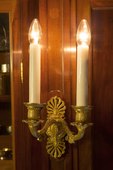
    • Sconce – provide up or down lights; can be used to illuminate artwork, architectural details; commonly used in hallways or as an alternative to overhead lighting.
    • Track lighting fixture – individual fixtures ("track heads") can be positioned anywhere along the track, which provides electric power.
    • Under-cabinet light – mounted below kitchen wall cabinets.
    • Display case or showcase light – shows merchandise on display within an enclosed case such as jewelry, grocery stores, and chain stores.
    • Ceiling fan – may sometimes have a light, often referred to as a light kit mounted to it. Ceiling fans with built-in lights may eliminate the need for separate overhead light fixtures in a room, and light kits can also replace any ceiling-mounted light fixtures that were displaced by the installation of the ceiling fan.
    • Emergency lighting or exit sign – connected to a battery backup or to an electric circuit that has emergency power if the mains power fails.
    • High- and low-bay lighting – typically used for general industrial lighting in retail, big-box stores, warehouses and workshops, and is characterised by wide beam angles and diffused light, but minimal glare, making the lamps suitable for use in a wide range of environments. Such lamps are usually divided into the categories of low-bay lighting for ceiling heights around 3.5 to 6 meters, and high-bay lighting for ceiling heights of 6 to 14 meters.
    • LED strip light – flexible LEDs that usually comes with an adhesive backing, used for accent lighting, backlighting, task lighting, and decorative lighting applications, such as cove lighting
    • Strip lights or industrial lighting – often long lines of fluorescent lamps used in a warehouse or factory.
A decorative outdoor lamp at Leeds Town Hall
A garden solar lamp is an example of landscape lighting
  • Outdoor lighting and landscape lighting – used to illuminate walkways, parking lots, roadways, building exteriors and architectural details, gardens, and parks. Outdoor light fixtures can also include forms similar to indoor lighting, such as pendants, flush or close-to-ceiling light fixtures, wall-mounted lanterns and dome lights.
    • High-mast, usually pole – or stanchion-mounted – for landscape, roadways, and parking lots.
    • Bollard – a type of architectural outdoor lighting that is a short, upright ground-mounted unit typically used to provide cutoff type illumination for egress lighting, to light walkways, steps, or other pathways.
    • Solar lamp
    • Street light
    • Yard light

Special-purpose lights

[edit]

Lamp types

[edit]

Light-fixture controls

[edit]

There are various types of devices used to manage the amount of light used:[8]

See also

[edit]

References

[edit]
[edit]
Revisions and contributorsEdit on WikipediaRead on Wikipedia
from Grokipedia
A light fixture, also known as a luminaire in technical terminology, is a complete lighting unit consisting of a light source or sources, along with or components where applicable, and the associated parts designed to distribute the , position and protect the source, and connect it to the power supply. The evolution of light fixtures traces back to prehistoric torches as the earliest fabricated light sources, progressing to shell or rock lamps fueled by animal fats or vegetable oils around 4500 BC in ancient civilizations. Gas lamps emerged in during the 1790s and were soon adopted in U.S. homes for both illumination and cooking, marking a significant advancement in controlled . The shift to electric began in the early 1800s with initial electric lamp designs, followed by experimental incandescent bulbs in the 1840s and arc lights—known as limelights—in the same decade for theatrical applications in places like . Thomas Edison's 1879 carbon-filament incandescent bulb revolutionized fixtures, coinciding with the rollout of in the early 1880s and later that decade, which enabled citywide . Key 20th-century developments included the development of fluorescent in the early 20th century (with commercial viability in the 1930s), mercury vapor lamps in , high-intensity discharge technologies like sodium and lamps, signs primarily using gas (with variants employing or other ), and energy-efficient LEDs from the 1960s onward, which as of 2025 dominate modern fixtures for their efficiency and longevity. Light fixtures are broadly classified by installation (such as portable, fixed, recessed, and outdoor) and function, providing ambient lighting for overall space illumination, task lighting to support specific activities like reading or cooking, and to emphasize architectural features, artwork, or focal points. In and , light fixtures are essential for ensuring visibility and safety while enhancing aesthetic appeal, emotional impact, and spatial experience, with modern integrations offering greater energy efficiency, longevity, and customization.

Fundamentals

Definition and Purpose

A light fixture, also known as a luminaire, is defined as a complete lighting unit consisting of a source or sources, such as a lamp, together with the parts designed to distribute the , position and protect the sources, and connect them to the power supply. This encompasses wiring, sockets, ballasts or drivers, reflectors, diffusers, and housings that ensure safe and effective operation. Unlike a standalone lamp, which refers solely to the light-emitting source itself, a light fixture integrates these elements into a cohesive device for practical installation and use. The primary purpose of a light fixture is to deliver controlled illumination that supports visual tasks, enhances , and creates desired environments, such as providing for work, ambiance for relaxation, task for precision activities, or to highlight features. Fixtures play a key role in distribution by optimizing output efficiency and integrating with architectural designs to blend functionality with . Through components like reflectors and lenses, they influence distribution patterns, enabling direct that projects illumination straight onto surfaces for clear task performance and indirect that reflects off ceilings or walls to minimize and foster a softer atmosphere.

Basic Components

A light fixture, also known as a luminaire, consists of several core components that work together to house, power, and direct the source. The socket, or lamp holder, serves as the receptacle that securely attaches the lamp to the fixture and connects it to the electrical supply, ensuring stable and easy replacement. The , often integrated with a reflector, encases the internal parts and directs light output; reflectors, typically parabolic or elliptical in shape, focus or spread the light to achieve desired illumination patterns. Diffusers or shades, made from translucent materials, soften and distribute the light while protecting the lamp from damage and reducing glare. Electrical elements, including wiring, ballasts for fluorescent lamps, drivers for LED sources, or transformers for low-voltage systems, regulate power delivery, start the lamp, and maintain operation, often connected via a for safe integration with building wiring. Common materials in light fixtures prioritize durability, safety, and performance. Metals such as aluminum and are widely used for housings and reflectors due to their strength, resistance, and ability to conduct away from sensitive components. or forms the diffusers and shades, providing transparency or while withstanding ; ceramics or insulators in sockets prevent electrical hazards by resisting high temperatures and moisture. Assembly principles emphasize stability, efficient heat dissipation, and precise light control. Components are interconnected through mounting hardware like brackets, chains, or rods to ensure secure positioning and vibration resistance, while materials like aluminum facilitate passive cooling by dissipating heat generated by the lamp and electronics. Reflectors and diffusers are aligned to manipulate light direction and intensity, optimizing uniformity and minimizing waste, with overall design promoting airflow or heatsinks where necessary to prevent overheating. Variations in components adapt fixtures to specific environments; for outdoor use, housings incorporate weatherproof seals and corrosion-resistant coatings to protect against and UV exposure, while indoor versions may prioritize aesthetic trims without such ruggedization.

Historical Development

Pre-electric Era

The origins of light fixtures trace back to ancient civilizations, where simple holders for flames provided essential illumination. In , candelabra served as stands for oil lamps made of terracotta or , often featuring intricate designs with lion-paw bases and hooks for additional lamps via chains. These fixtures, along with wall-mounted sconces, were commonly used in homes and public spaces to hold olive oil-fueled lamps, marking an early shift from open torches to more controlled flame sources. By the medieval period, iron candelabras and chandeliers emerged as prominent designs, typically forged from in the form of circular coronae or multi-armed branches to support multiple candles made from or . Portable lanterns, enclosed in metal or to shield flames from wind, became widespread for outdoor and travel use, while wall sconces and fixtures illuminated castles and monasteries. Advancements in the significantly improved the brightness and safety of oil-based fixtures, driven by innovations in fuel and design. lamps, prized for their clear-burning properties and used from the late 18th to 19th centuries, were housed in or holders with single or multiple wicks, providing a steadier than earlier candles. The pivotal development came in 1780 with the , invented by Swiss chemist Aimé Argand, which featured a cylindrical wick allowing air circulation for a brighter, soot-free —up to six times more luminous than traditional lamps—often paired with chimneys and parabolic reflectors made of silvered metal or to direct efficiently. These fixtures, including table lamps and wall-mounted versions, reduced fire risks compared to open flames by enclosing the wick, though they still required careful handling to prevent spills. Materials like polished for durability and for reflectors enhanced both functionality and aesthetics, making such lamps staples in affluent households. In the social and architectural spheres, pre-electric light fixtures evolved from utilitarian tools to symbols of status, particularly in grand settings. Elaborate chandeliers, often multi-tiered iron or structures holding dozens of candles, adorned palaces and cathedrals as displays of wealth, requiring servants for maintenance and ceremonies. The progression toward enclosed designs, such as glass-shaded oil lamps and later gas lanterns, addressed growing concerns over fire hazards in densely built environments, minimizing open flames that had caused numerous blazes in wooden structures. By the late , gas fixtures—ranging from simple wall brackets to ornate crystal chandeliers with Argand-style burners—dominated urban interiors and streets, offering adjustable valves for control and brighter illumination from . Introduced commercially in the early 1800s following William Murdoch's 1792 demonstrations, these fixtures, with their fishtail or batswing burners, peaked in popularity by mid-century, illuminating theaters and homes while laying the groundwork for electrical integration through similar mounting and reflector designs.

Electric Era Innovations

The advent of electricity revolutionized light fixtures, beginning with Thomas Edison's invention of the practical incandescent bulb in 1879, which featured a carbonized cotton thread filament lasting 14.5 hours and paved the way for widespread electric illumination. This breakthrough prompted the rapid development of early socket fixtures, initially constructed from wood with strips to connect to the bulb's base, enabling the integration of electric lights into existing home structures by the early . By the and 1890s, innovations like pull-chain switches and ceiling roses further enhanced usability and aesthetics; Harvey Hubbell patented a pull-chain socket in that allowed simple on/off control via a chain, while ceiling roses—decorative plaster medallions concealing wiring and sockets—became standard for converting gas chandeliers to electric pendants. In the 20th century, fixture designs advanced to accommodate new light sources, with fluorescent tube fixtures emerging in the 1930s as a more efficient alternative to incandescents; commercialized the first practical fluorescent lamps in 1938, featuring mercury vapor excitation of phosphor coatings for brighter, cooler light, often housed in linear troffers for offices and homes. Post-World War II, incandescent reflector lamps, such as (PAR) types developed in the late 1930s for automotive use and adapted for homes by the 1940s, provided focused beams for task lighting, while track lighting systems—introduced by Lightolier in the 1960s—allowed modular, adjustable heads along electrified rails, popularizing flexible illumination in modern kitchens and living spaces. Industrial influences accelerated these changes through standardization and manufacturing efficiencies; the Illuminating Engineering Society, founded in 1906, established early guidelines for fixture design and illumination levels, promoting uniform safety and performance standards that influenced electrical codes by the 1910s. Concurrently, techniques, including stamped metal components and assembly-line methods adopted in the and , drastically reduced costs, making electric fixtures affordable for middle-class households and shifting production from artisanal to industrialized scales. Cultural shifts in the and reflected broader artistic movements, transitioning from ornate fixtures—characterized by geometric chrome and glass designs evoking luxury and machine-age glamour—to the minimalist style, which emphasized functional, unadorned forms using simple metals and to prioritize light distribution over decoration.

Modern Advancements

The adoption of (LED) technology in light fixtures began accelerating in the , following breakthroughs in materials that enabled the production of high-brightness LEDs, which combined with red and green LEDs to generate efficient white light. This innovation allowed for the design of slimmer, more compact fixtures that consumed significantly less energy than traditional incandescent or fluorescent alternatives, reducing operational costs and heat output while extending fixture longevity. By the early , LEDs had become viable for general applications, transforming fixtures into versatile, low-maintenance systems suitable for residential, commercial, and architectural uses. In the 2010s, the integration of (IoT) connectivity marked a pivotal advancement, enabling fixtures to communicate with smart home ecosystems for , automation, and energy optimization. Systems like , launched in 2012, exemplified this shift by incorporating wireless protocols such as , allowing users to adjust color, intensity, and schedules via mobile apps or voice assistants. This IoT-enabled approach not only enhanced user convenience but also facilitated data-driven efficiency, such as occupancy-based dimming, contributing to broader smart home adoption. As of 2025, human-centric lighting (HCL) has emerged as a key development, utilizing tunable white LEDs to dynamically adjust color temperatures and intensities in order to align with human circadian rhythms, promoting alertness during the day and relaxation at night. These systems mimic natural daylight variations, with cooler (higher ) light in mornings to boost melatonin suppression and warmer tones in evenings, supported by sensors for personalized adjustments. Concurrently, the accelerated the incorporation of UV-C LED technology into fixtures for disinfection, where 254-280 nm wavelengths inactivate pathogens like on surfaces and in air without mercury, as validated in controlled studies. Additionally, has enabled highly customizable fixtures, allowing for intricate, on-demand designs that integrate seamlessly with spaces while minimizing waste through additive . Global trends toward modular designs have gained prominence in the , featuring interchangeable components like LED modules and drivers that facilitate easy upgrades and repairs, thereby extending fixture lifespans and reducing . This modularity supports adaptability in evolving smart environments and aligns with regulatory pressures, such as the European Union's Ecodesign Directive (2009/125/EC), which from 2009 onward imposed stringent energy efficiency standards on lighting products, mandating phase-outs of inefficient sources and promoting recyclable materials to curb environmental impact. Looking ahead, emerging technologies like organic light-emitting diode () panels promise ultra-thin, diffuse illumination with superior glare reduction and design flexibility for architectural integration. Meanwhile, wireless power transmission, leveraging resonant inductive or optical methods, is being explored to eliminate cords in fixtures, with demonstrations achieving efficient energy delivery over short distances for portable and embedded applications.

Fixture Types

Portable Fixtures

Portable light fixtures, also known as portable luminaires, are electrical devices containing one or more light sources that are designed for easy mobility and non-permanent placement, typically featuring a flexible cord and plug for connection to standard electrical outlets. Common examples include table lamps, which provide localized illumination on surfaces like nightstands or desks; floor lamps such as torchieres that direct light upward for ambient room lighting; and desk lamps optimized for task-oriented use like reading or working. These fixtures rely on plug-in power for corded models, enabling straightforward setup without specialized installation. Key design features of portable fixtures emphasize stability and versatility to accommodate their movable nature. Many incorporate weighted bases made of materials like metal or stone to prevent tipping, ensuring safe operation on various surfaces. Adjustable components, such as articulated arms or flexible necks, allow users to direct light precisely where needed, often with swivel joints offering up to 360-degree rotation for targeted illumination. Battery-powered variants provide cordless freedom, utilizing rechargeable lithium-ion batteries for operation in areas without outlets, with run times typically ranging from 4 to 20 hours depending on brightness settings. In residential settings, portable fixtures serve as reading lights for bedrooms or studies, offering focused beams that reduce during prolonged use, and as flexible accents to enhance room ambiance without altering permanent wiring. For temporary events like parties or outdoor gatherings, they deliver quick-deploy illumination, such as string lights or lanterns that can be repositioned as needed. Their primary advantages include ease of relocation between spaces, which supports adaptive layouts, and lower installation costs compared to fixed options, as no electrical modifications or professional labor are required. The evolution of portable fixtures traces from pre-electric era designs to contemporary innovations. Early versions emerged in the mid-19th century with lamps, which featured portable glass reservoirs and wicks for wick-based combustion, providing brighter and cleaner light than candles for mobile use in homes and travel. The advent of electricity in the late shifted to incandescent bulb-based portables, improving safety and portability through corded designs. Modern advancements incorporate LED with USB-rechargeable batteries, enabling compact, energy-efficient models that offer dimmable outputs and extended battery life, as seen in fixtures from brands like and .

Fixed Fixtures

Fixed fixtures are light fixtures permanently attached to a building's structure, such as ceilings or walls, to deliver consistent, integrated illumination without reliance on temporary power sources. These installations ensure reliable performance in fixed environments, contrasting with portable alternatives that offer mobility but lack permanence. Common examples include ceiling-mounted types like recessed cans, also known as downlights, which are embedded flush into the ceiling for unobtrusive ambient lighting; pendants, which suspend from chains or rods to focus over tables or workspaces; and systems, consisting of adjustable heads mounted on a continuous electrified rail for directional versatility. Wall-mounted sconces provide targeted illumination along hallways or beside mirrors, often directing upward or downward for accent effects. Installation of fixed fixtures requires hardwiring directly to boxes secured to framing members, in compliance with the (NEC) Article 410, which mandates secure attachment to prevent hazards and ensure accessibility. Junction boxes must provide sufficient volume for conductors per NEC 314.16 and be positioned to allow wiring access without structural damage, with heavier fixtures needing additional support like braces or bars. Flush-mount installations position the fixture level with the surface for a seamless appearance, while surface-mount types affix directly to the exterior, suitable for exposed ceilings or walls. These fixtures offer advantages in seamless architectural integration, blending into building designs to enhance without visible cords or bases, which is particularly valued in both commercial spaces for uniformity and residential settings for elegant continuity. Their permanent wiring and positioning provide higher output stability, minimizing fluctuations from movement or loose connections, and support higher wattages for broader coverage in fixed applications. Maintenance for fixed fixtures focuses on periodic bulb replacement and cleaning, often facilitated by access panels or removable trim rings in recessed designs to reach internal components without demolition. Fixtures are engineered for durability against vibrations, using robust housings and secure mounts to withstand building movements in commercial environments like offices or retail spaces.

Specialized Fixtures

Specialized light fixtures are engineered for demanding or niche environments, incorporating protective ratings, backup systems, and adjustable to meet precise functional requirements. Outdoor fixtures, such as landscape and pathway lights, often feature IP65 or higher ingress protection ratings to withstand dust, rain, and weather exposure, ensuring reliable illumination in gardens, walkways, and facades. Floodlights with similar IP66 ratings provide broad-area coverage for security and architectural highlighting, resisting water jets and environmental ingress per IEC 60529 standards. Emergency fixtures prioritize uninterrupted operation during power outages, with exit signs equipped with nickel-cadmium, sealed lead-acid, or lithium-based battery backups capable of sustaining illumination for at least 90 minutes, as mandated by UL 924 and NFPA 101 Life Safety Code. These units automatically activate upon power failure, providing an initial illumination that is at least an average of (10.8 ) along the path of egress at floor level, with no point less than 0.1 foot-candle, to facilitate safe evacuation. Theatrical fixtures employ advanced for dynamic performance lighting, including spotlights with ellipsoidal reflectors that allow precise beam control through framing shutters and iris diaphragms. Gobos—metal or templates inserted into these fixtures—project patterned beams, such as foliage or logos, to shape for scenic effects and atmospheric enhancement in stages and studios. Underwater fixtures achieve IP68 ratings for continuous submersion up to specified depths, making them essential for pool and installations where they must endure constant water contact without electrical failure. Surgical lights incorporate sterile, autoclavable handles for focus and intensity adjustments, providing shadowless illumination with color rendering indices (CRI) exceeding 90 to accurately reveal tissue details during procedures. and indirect lighting systems, recessed into architectural ledges or cornices, diffuse upward light off ceilings and walls to create subtle accents, enhancing spatial depth without direct glare. In industrial settings, hazardous location fixtures comply with ATEX Directive 2014/34/EU, featuring explosion-proof enclosures that contain arcs and prevent ignition in zones with flammable gases or dust, such as refineries and chemical plants. Vehicular fixtures, including headlights, adhere to FMVSS 108 standards, integrating sealed-beam or LED assemblies for forward illumination with photometric patterns ensuring visibility up to 500 feet while minimizing glare. Display applications utilize museum track systems, where adjustable spotlights on low-voltage rails deliver targeted, UV-filtered beams to highlight artifacts, preventing fading while achieving even illumination across exhibits. Innovations in specialized fixtures include solar-powered garden lights, which integrate photovoltaic panels with lithium-ion batteries for autonomous operation, providing up to 12 hours of runtime on a single charge and reducing grid dependency in remote landscapes. Adaptive fixtures for greenhouses employ dynamic LED arrays that modulate spectra in real-time, incorporating UV enhancements (280-400 nm) to boost plant and production, optimizing growth cycles via sensor-driven controls.

Light Sources

Traditional Lamp Compatibility

Light fixtures designed for traditional sources primarily support incandescent, halogen, and fluorescent lamps through standardized interfaces that ensure electrical and mechanical compatibility. Incandescent and bulbs commonly use Edison screw-base sockets, such as the E26 medium base in and E27 in , which feature a 26- or 27-mm diameter thread for secure fitting in most table lamps, ceiling fixtures, and wall sconces. These bases allow for wattages up to 300W in rated fixtures, with variants often requiring or heat-resistant sockets due to higher operating temperatures. Compact fluorescent lamps (CFLs) integrate via bases like E26 for direct replacement of incandescents or pin bases such as 2-pin (G23/GX23) and 4-pin (G24q) for recessed or modular fixtures, enabling plug-in operation without altering the socket. Linear fluorescent , including T8 (1-inch diameter) and T12 (1.5-inch diameter) models, employ G13 medium bi-pin sockets at each end, which provide tombstones for end-to-end support in linear troffers and ensure proper alignment for optimal light distribution. Adaptations in fixtures address operational needs of these sources. Fluorescent lamps require ballasts to limit current and provide starting voltage; magnetic ballasts, used historically with T12 tubes, operate at 60 Hz and can produce noticeable , whereas electronic ballasts for T8 and CFLs run at 20-60 kHz to eliminate visible flicker, cut energy use by 20-30%, and reduce audible hum. Dimming poses challenges: incandescent and lamps dim smoothly to near 1% output with standard dimmers, but non-dimmable CFLs may , overheat, or fail prematurely if used with them, necessitating "dimmable" labeled CFLs or specialized low-voltage dimmers for 10-30% range. Key performance aspects include light output and thermal handling. Incandescent bulbs deliver around 800-1,600 lumens from 60-100W at a 2700K for warm white illumination, while equivalent CFLs produce similar lumens from 13-26W at the same temperature, maintaining visual comfort in fixtures. Heat management is critical, as incandescents dissipate 90% of as (reaching 250°C surface temperatures) and 80%, so fixtures incorporate vents, insulators, or spacing to prevent , extending bulb life to 1,000-2,500 hours by avoiding envelope blackening. Regulatory shifts have impacted compatibility. The U.S. Department of 's 2023 efficiency standard required general service lamps to achieve at least 45 lumens per watt, phasing out most incandescents and from retail by August 1, 2023; however, this ban was reversed in early 2025, allowing their continued availability. Similar global mandates, such as the EU's 2009-2012 ban on inefficient incandescents, remain in effect and have prompted fixture updates to maintain compatibility with remaining traditional stocks. Additionally, U.S. DOE standards finalized in 2024 require the phase-out of most compact and linear fluorescent lamps by July 2028 due to mercury content and efficiency, with several states implementing earlier bans on their sale starting January 2025 (e.g., , Washington), further encouraging transitions to LED-compatible fixtures.

Contemporary Light Source Integration

Contemporary light source integration in fixtures emphasizes the adoption of light-emitting diodes (LEDs), which offer superior efficiency and adaptability compared to traditional sources. LEDs are typically arranged in modular arrays, with two primary configurations: chip-on-board (COB) LEDs, which mount multiple chips directly on a substrate for compact, high-lumen output suitable for focused applications like spotlights, and surface-mount device (SMD) LEDs, which provide flexibility and high-density packing for broader illumination in troffers or panels. Unlike fluorescent systems that rely on ballasts for current regulation, LED fixtures incorporate dedicated drivers that supply to maintain stable performance and prevent overheating, enabling seamless replacement in legacy installations. High-quality LEDs achieve a (CRI) greater than 90, ensuring accurate color reproduction for environments like retail or healthcare where visual fidelity is essential. Integration methods for LEDs vary to accommodate existing and new designs. Retrofit allow direct replacement of incandescent or fluorescent bulbs in conventional fixtures, often bypassing old ballasts to connect via compatible drivers and achieving up to 75% energy savings. Native LED fixtures incorporate the diodes with integrated heat sinks—such as aluminum fins or channels—to dissipate the minimal heat generated, extending operational reliability in recessed or . Smart bulbs, designed for screw-in compatibility, integrate wireless protocols like for hub-based control, enabling fixtures to support networked dimming and color adjustment without major rewiring. The benefits of LED integration drive widespread adoption, with fixtures delivering 50-90% energy reductions over incandescents through lower wattage requirements while providing lifespans exceeding 50,000 hours—up to 50 times longer than traditional bulbs. Tunable RGBW (red, green, blue, white) configurations allow dynamic lighting effects, such as emulation or mood-based color shifts, enhancing versatility in residential and commercial settings. Emerging sources further expand fixture possibilities, including organic LED () panels that enable ultra-thin, flexible luminaires with diffuse, glare-free output and CRI values up to 92, ideal for architectural integrations like wall washes. Laser diodes, offering coherent high-precision beams, are gaining traction in specialized fixtures for applications requiring intense, collimated light, such as surgical suites or projection systems.

Controls and Features

Manual Control Mechanisms

Manual control mechanisms for light fixtures encompass a range of physical interfaces that allow users to directly operate lighting without relying on electronic automation or remote signals. These include wall-mounted switches, fixture-integrated controls, and dimming devices, each designed for straightforward on/off or intensity adjustments in residential and commercial settings. Common types of wall switches feature toggle and rocker designs, where a toggle switch uses a that flips between positions to complete or interrupt the electrical circuit, while a rocker switch employs a flat, rocking paddle for the same function, both operable with minimal force and no gripping required. Pull chains, often integrated into ceiling fan light fixtures or pendant lamps, consist of a chain attached to a rotary switch within the fixture housing, enabling multi-speed or on/off control through sequential pulls, as seen in standard three-speed mechanisms for fan-integrated lights. Rotary dimmers typically employ TRIAC-based phase-control technology to adjust brightness in compatible fixtures by varying the portion of the AC waveform delivered to the lamp, originally developed for incandescent and bulbs to achieve smooth dimming without flicker. These devices are rated for specific wattages, such as up to 600 watts for standard installations, and are commonly used in table lamps or wall controls for ambient lighting. Three-way switches enable multi-location control of a single light fixture, typically from two points such as hallway entrances, using a pair of switches connected by traveler wires that alternate the circuit path to toggle the light on or off regardless of the other switch's position. In wiring configurations, the common terminal on each three-way switch handles the hot line from the power source or to the fixture, while the two traveler terminals link via a three-wire cable (black, red, and white neutral), ensuring the circuit completes only when the switches are in opposite positions. Single-pole switches, in contrast, control a fixture from one location using a simpler two-wire setup with a hot line and neutral, connected to two terminals plus ground, suitable for basic applications like lights. Compatibility considerations are essential; for instance, standard rheostat dimmers designed for incandescents can cause flickering, reduced lifespan, or failure in compact fluorescent lamps (CFLs) if not using dimmable-rated CFLs with compatible ballasts, as non-dimmable CFLs require steady voltage to maintain stable operation. Installation of these mechanisms involves adhering to wiring standards for , such as using non-metallic sheathed cable (NM) for single-pole setups with grounded connections to prevent shocks, where the bare ground wire attaches to the switch's and box if metallic. For multi-way systems, additional travelers necessitate three-wire NM cable between switches, with all grounds interconnected to the electrical panel's grounding system, ensuring fault currents safely dissipate and complying with codes like Article 404 for switch installations. Common issues with manual dimmers include audible buzzing, often resulting from incompatible bulb types like LEDs on incandescent-rated dimmers, which generate , or from loose wiring causing arcing under load. Overloading beyond the dimmer's rating, such as exceeding 300 watts with multiple fixtures, can also produce and , necessitating replacement with appropriately rated devices. Recent manual designs have evolved to include touch-sensitive pads, which use to detect finger proximity for on/off or dimming control, offering a low-force alternative to mechanical toggles while maintaining direct user interaction, as recommended for in multifamily .

Automated and Smart Systems

Automated and smart systems in light fixtures represent a significant in control, shifting from manual interventions to sensor-based and networked operations that enhance , , and integration with broader or building ecosystems. These systems employ electronic components to automate lighting responses to environmental cues or user commands, often without requiring physical interaction. As of 2025, such technologies are widely adopted in residential and commercial settings, driven by advancements in connectivity and standards. Core technologies enabling automation include timers, photocells, and motion sensors. Timers allow programmed on/off cycles for fixtures, ensuring lights activate or deactivate at preset times to mimic natural patterns or align with routines. Photocells, or photo sensors, detect ambient light levels to enable dusk-to-dawn operation, automatically illuminating outdoor fixtures when natural light diminishes below a threshold. Motion sensors, such as passive infrared (PIR) types that detect heat signatures from movement or ultrasonic variants that use sound wave echoes, trigger lights in response to occupancy, commonly integrated into indoor and high-bay fixtures for energy savings. Dual-technology sensors combining PIR and ultrasonic detection further improve reliability by reducing false triggers in varied environments. Smart systems extend these capabilities through connected hubs and protocols, facilitating remote and voice-activated control. Integration with platforms like Amazon Alexa or Google Home occurs via Wi-Fi or low-power networks such as Zigbee, allowing fixtures to join smart home ecosystems for seamless operation. The Matter standard, launched in 2022 by the Connectivity Standards Alliance, promotes interoperability across devices from different manufacturers, enabling a single light fixture to respond to commands from multiple assistants without proprietary bridges. Key features include scene setting for customized lighting moods, voice control for hands-free adjustments, and adaptive brightness that modulates intensity based on time of day or user preferences. Energy monitoring via companion apps tracks consumption patterns, providing insights to optimize usage and reduce costs. In applications, these systems create automated zones in homes, where fixtures adjust collectively to support activities like reading or entertaining, often linking with other devices for holistic control. Commercially, daylight harvesting uses sensors to dim artificial lights in response to natural illumination, maximizing energy efficiency in offices and warehouses. Security enhancements integrate fixtures with cameras, activating illumination upon motion detection to deter intruders or improve visibility. Recent advancements incorporate (AI) for predictive adjustments, analyzing occupancy patterns to preemptively alter lighting and minimize energy waste by up to 40% in tested scenarios. As of 2025, trends enable low-latency processing directly at the fixture level, reducing reliance on cloud servers for faster responses to like motion or light changes, enhancing reliability in smart buildings.

Design and Applications

Aesthetic and Functional Design

Light fixtures are designed to harmonize visual appeal with practical utility, drawing on aesthetic principles that integrate seamlessly into interior and exterior environments. Styles such as emphasize clean lines, geometric shades, and sculptural forms to evoke simplicity and innovation, often using materials like molded glass or metal for a timeless look. Industrial designs, by contrast, highlight exposed bulbs and raw finishes to convey authenticity and robustness, enhancing the textural quality of urban or spaces. Material choices, including brushed nickel for its subtle, matte sheen that resists fingerprints and complements contemporary palettes, or colored glass shades that diffuse light while adding vibrancy, allow fixtures to serve as decorative elements that elevate overall decor. Functionally, light fixtures prioritize performance through elements like beam angle control, where narrow angles (e.g., 15-30 degrees) focus light for precise task illumination such as reading, while wider angles (60-120 degrees) provide ambient coverage for larger areas, optimizing energy use and visual comfort. Glare reduction is achieved via integrated louvers, diffusers, or reflectors that shield direct light sources, minimizing in workspaces or high-traffic zones. Scalability is addressed through layered plans, combining ambient, task, and accent fixtures to adapt illumination to room size and activity, ensuring even distribution without overwhelming smaller spaces or underlighting expansive ones. The design process for light fixtures incorporates advanced tools and human-centered considerations to refine both form and function. simulation software, such as Speos, enables engineers to model light distribution, material interactions, and beam patterns virtually, reducing prototyping costs and ensuring accurate performance before manufacturing. plays a key role, particularly in fixtures, where adjustable arms and balanced illumination account for user posture and , preventing fatigue by aligning light with natural and task demands. Emerging trends in light fixture design reflect a shift toward nature-inspired and interactive elements. Biophilic designs mimic through organic shapes, soft gradients, and fixtures resembling foliage or water reflections, fostering wellness by simulating daylight cycles in indoor settings. Customizable options, enabled by app-controlled systems, allow users to adjust color temperatures and hues dynamically—ranging from warm 2700K tones for relaxation to vibrant RGB spectrums—personalizing ambiance for occasions like holidays or daily routines.

Safety, Standards, and Sustainability

Safety features in light fixtures are designed to mitigate risks such as fire, electrical shock, and environmental exposure. Certifications like UL (Underwriters Laboratories) and ETL () ensure that fixtures undergo rigorous testing to prevent electrical hazards and fire risks, verifying compliance with safety standards for components and construction. For instance, UL-listed fixtures are tested for performance under normal and abnormal conditions to avoid ignition or explosion in enclosed spaces. IP ratings, defined by the (IEC), classify protection against dust and moisture ingress; an IP65 rating, common for outdoor fixtures, provides complete dust-tight enclosure and resistance to low-pressure water jets from any direction, making it suitable for weather-exposed applications. Overheating protection is often incorporated through thermal cutoffs, which are safety devices that interrupt electrical current when a fixture exceeds a specific temperature threshold, such as 110°C in recessed ceiling models, preventing potential fire hazards from insulation contact or high-wattage misuse. Global and regional standards govern the design, testing, and performance of light fixtures to promote uniformity and safety. The IEC 60598 series, particularly IEC 60598-1, establishes general requirements for luminaires operating on supply voltages up to 1,000 V, covering aspects like mechanical construction, electrical insulation, and resistance to heat and fire, with specific parts addressing types like outdoor or water-contact fixtures. In the United States, the Energy Star certification program for LED light fixtures, which until its discontinuation on December 31, 2024, mandated minimum efficacy levels such as at least 100 lumens per watt for certain commercial models, alongside requirements for color rendering and longevity, helped ensure energy efficiency without compromising safety or performance. Following the sunset of Energy Star for lighting, programs like the DesignLights Consortium (DLC) continue to provide premium quality standards for energy-efficient commercial LED luminaires. These standards collectively facilitate international trade while prioritizing user protection. Sustainability in light fixtures emphasizes material choices and end-of-life management to minimize environmental impact. The phaseout of compact fluorescent lamps (CFLs) containing mercury, driven by regulations like the EU's RoHS Directive, has accelerated the shift to mercury-free alternatives such as LEDs, with CFL production halted in many regions by early 2024 to prevent toxic releases into landfills. Lifecycle assessments (LCAs) evaluate the full environmental footprint of fixtures, from raw material extraction to disposal, revealing that modular LED designs can reduce impacts by enabling component upgrades rather than full replacements. practices, including the use of recyclable materials like aluminum housings and easily disassemblable structures, support reuse and refurbishment, with studies showing that refurbished luminaires cut carbon emissions by up to 65% compared to new production. As of 2025, updates to RoHS compliance continue to restrict hazardous substances like lead, mercury, , and certain flame retardants in light fixtures, with exemptions for specific lamp types expiring, such as those for non-linear tri-band lamps by February 2025, further promoting safer, eco-friendly manufacturing. Efficient designs, particularly LEDs, contribute to reductions by consuming up to 90% less energy than incandescents, lowering over the fixture's lifespan and aligning with global goals.

References

Add your contribution
Related Hubs
User Avatar
No comments yet.