


Community hub
Recent from talks
Contribute something
Nothing was collected or created yet.
List of bow tie wearers
View on Wikipedia

This is a list of notable bow tie wearers, real and fictional; notable people for whom the wearing of a bow tie (when not in formal dress) is also a notable characteristic.
Bow tie wearing can be a notable characteristic for an individual. Men's clothier Jack Freedman told The New York Times that wearing a bow tie "is a statement maker" that identifies a person as an individual because "it's not generally in fashion".[1] Numerous writers and bow tie sellers have observed that the popularity of this type of neckwear can rise and fall with the fortunes of the well-known people who wear them.[2][3]
Until the 20th century, the bow tie was the general rule for neckties. Starting in early 20th century, the bow tie started to become more rare.
In 1996, The Wall Street Journal quoted statistics from the Neckwear Association of America showing that bow ties represent three percent of the 100 million ties sold each year in the United States, most of them part of formal wear, such as for white tie and black tie.[4]
Attention to famous bow tie wearers in commerce and fashion commentary
[edit]Those who write about bow ties often mention famous people who wear or have worn them. These writers often make the point that the image conveyed to others by a bow tie can be affected by associations with celebrities and famous people in the past.
A common fashion accessory in the 19th century, the bow tie had positive associations by mid-20th century, bolstered by real-world personalities, including President Franklin Roosevelt and Sir Winston Churchill, as well as "devil-may-care" characters portrayed in films by actors, including Humphrey Bogart and Frank Sinatra.[5] By the 1970s, however, the bow tie became associated with nerds and geeks, such as the slapstick characters played by Jerry Lewis, and Mayberry's fictional deputy sheriff, Barney Fife. This perception was reinforced by the bow tie's association with Pee-wee Herman and U.S. Senator Paul Simon.[6]
The perceptions associated with bow ties started to take another turn in the 1980s, when Success Magazine's founder, W. Clement Stone, spoke out in support of the neck wear after the publication by fashion author John Molloy which observed, "Wear a bow tie and nobody will take you seriously."[7] Stone associated bow-tie wearing with virility, aggressiveness, and salesmanship.[8][9] In further defense of the bow tie, its use by figures such as Daniel Patrick Moynihan and Saul Bellow has been cited.[10]
Celebrities' effect on bow-tie wearing
[edit]
When a celebrity is noticed wearing a bow tie, it can affect bow tie sales; sales see an improvement when the accessory is associated with younger celebrities such as Tucker Carlson. When Raj Bhakta wore one during his stint on The Apprentice, haberdashers reported customers asking for a bow tie which looked like his.[2] Similarly, after Matt Smith made his debut as the bow tie-wearing Eleventh Doctor in Doctor Who, Topman reported a significant increase in demand for bow ties (from 3% of all tie sales to 14%).[11]
Arthur M. Schlesinger Jr. wrote about his decision as a college student to start wearing bow ties in his memoir A Life in the Twentieth Century: Innocent Beginnings, 1917–1950. Schlesinger remarked that he made his decision in part because a number of famous men he admired had a penchant for the neck wear. In addition, he noted that they prevent dinner mishaps, saying, "It is impossible, or at least it requires extreme agility, to spill anything on a bow tie."[12]
Commercial interests using famous wearers to encourage sales
[edit]Bow tie sellers often cite famous people who have worn the neckwear as a way of encouraging more customers. Jack Cutone, co-founder of Boston Bow Tie, noted that there is ample evidence to support the uniqueness and stature of those who wear bow ties, including Abraham Lincoln, Winston Churchill, Albert Einstein and Sigmund Freud.[13] Beau Ties Ltd., an online bow tie seller, has featured a "C. Everett Koop bow tie," complete with an endorsement by Koop, who was Surgeon General of the United States during the Reagan administration.[14] Carrot & Gibbs, another bow tie seller, lists several famous wearers on its bow tie web page.[15]
Bow tie wearers of the nineteenth century
[edit]Bow ties were conventional attire in the nineteenth century. Portraits of U.S. presidents from Van Buren through McKinley commonly show them in bow ties. Wearing of a bow tie was seldom commented upon and did not form part of the public perception of figures such as American inventor Thomas Edison.[16]
Bow tie wearers in the twentieth and twenty-first centuries
[edit]Architects
[edit].jpg)
- Le Corbusier (1887–1965), architect who wore "his trademark bow tie"[17]
- Peter Eisenman (born 1932), architect and academic[18][19][20][21]
- Walter Gropius (1883–1969), architect, six of whose bow ties are kept by Harvard[22]
- Louis Kahn (1901/1902–1974), architect and academic[23]
- Owen Luder (1928–2021), architect[24]
Educators
[edit]College and university professors
[edit]- Leon Botstein (born 1946), president of Bard College[25][26]
- George S. Bridges, former Whitman College and current Evergreen State College president[27][28][29]
- George Campbell Jr. (born 1945), president of Cooper Union[30][31]
- James E. Cofer, Fulbright Scholar and President of Missouri State University and the University of Louisiana at Monroe.[citation needed]
- Donald J. Cram, chemist, Nobel Prize laureate.[32]
- Angus Deaton, Dwight D. Eisenhower Professor of Economics and International Affairs Emeritus at the Woodrow Wilson School of Public and International Affairs and the Economics Department at Princeton University, Nobel Memorial Prize in Economic Sciences laureate[33][34]
- William Durden, president of Dickinson College[29][35]
- E. Gordon Gee (born 1944), president of West Virginia University and former president of Vanderbilt University, Brown University, the University of Colorado at Boulder, and Ohio State University: "When E. Gordon Gee was fifteen years old, he made a defining sartorial decision. He began wearing a bow tie."[29][36]
- Alexander Fleming (1881–1955), Scottish biologist, pharmacologist, Nobel Prize laureate[37]
- Jerry Herron, dean of the Irvin D. Reid Honors College at Wayne State University[citation needed]
- Richard Hofstadter, American historian[citation needed]
- Eric R. Kandel (born 1929), neurobiology professor and Nobel Prize laureate with a "trademark bow tie"[38]
- Fritz Albert Lipmann, German-American biochemist, Nobel Prize laureate.[39]
- William Lipscomb, physicist, Nobel Prize laureate.[40]
- R. Bowen Loftin (born 1949), chancellor of the University of Missouri. Quoted as saying "The similarity between Bowen and Bowtie tends to help people remember my name."[41][42]
- Bohumil Makovsky, Director of Bands at Oklahoma A&M College[citation needed]
- Jean-Luc Marion, French philosopher[43]
- Santa Ono (born 1962), President & Vice-Chancellor of The University of British Columbia, President Emeritus of University of Cincinnati, President of University of Michigan. Immunologist and vision researcher.
- Paul C. Pribbenow, president of Augsburg University.[citation needed]
- Paul Samuelson (1915–2009), professor emeritus of economics at the Massachusetts Institute of Technology and a Nobel Prize winner.[44][45]
- Erwin Schrödinger, father of quantum physics[46][47]
- Eugene H. Spafford, cybersecurity pioneer, professor at Purdue University, and founder of the CERIAS research institute.[48][49]
- Edward C. Taylor, Princeton University Professor of Chemistry and inventor of certain chemotherapeutic pharmaceuticals.[50]
- William E. Troutt, 19th president of Rhodes College in Memphis, Tennessee.[citation needed]
- Celâl Şengör Turkish Geologist[citation needed]
Other educators
[edit]
- Daniel J. Boorstin (1914–2004), U.S. historian, professor, attorney, writer, U.S. Librarian of Congress 1975-1987[51]
- Bill Nye (born 1955), television science program host, is a "gangly guy in the blue lab coat and bow tie".[52] On why he wears bow ties: "If you're working with liquid nitrogen and your tie falls into it, it's funny in a way to the audience but it's also — pun intended — a little bit of a pain in the neck."[53]
- Alexander Oparin (1894–1980), Soviet biochemist notable for his contributions to the theory of the origin of life[54]
- Murray Rothbard (1926–1995), libertarian economist and historian who "always wore a conservative suit and bow tie."[55]
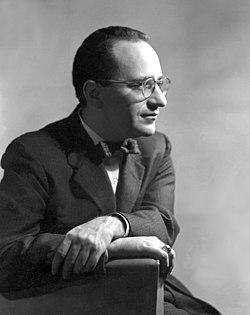
Murray Rothbard author of For a New Liberty - Arthur Schlesinger, Jr. (1917–2007), "famed for his trademark bow ties"[56][57]
- Chris Whittle (born 1947), founder of Channel One News and Edison Schools[58][59]
- Peter Morici (born 1948) economist, political commentator and Professor of International Business at the R.H. Smith School of Business at the University of Maryland, College Park.[citation needed]

Entertainers and media personalities
[edit].jpg)
Comedians
[edit]- Fred Allen, American radio and TV comedian [60]
- Charlie Chaplin, renowned comic actor of the silent film era[1]
- Raymond Devos, French humorist[61]
- Fyvush Finkel, comedic actor best known for roles on TV series produced by David E. Kelley, sometimes nicknamed "Bowtie Finkel"[62]
- Pee-wee Herman, played by Paul Reubens[63]
- Marc Evan Jackson, American comedian and actor, who "has played Sparks Nevada, Marshal on Mars wearing a bow tie invariably during every performance"[64] as well as wearing them when he is out of character[65]
- Stan Laurel, comedian, typically wore a bow tie when in character[66]
- Jerry Lewis ("in nutty character")[16][67]
- Groucho Marx, American comedian[68]
- David Mitchell, actor, comedian, and raconteur of Mitchell and Webb fame. David's bow ties were known as a source of amusement during his early career.[69]
- Garry Moore, comedian who hosted game and variety shows, was known for his crew cut and bow ties[70][71][72]
- Frank Muir, British comedy writer and broadcast personality "famous for his pink bow tie and mispronunciation", according to the BBC[73]
- Mo Rocca, identified by the New York Times as one of several comedians who have worn bow ties "ironically"[1]
- Mark Russell, American political comedian, pianist, and parody song author. "Mr. Russell knows from bow ties. They have been his signature for years, along with a star-spangled piano that he plinks every few minutes ..."[74]
- Paul F. Tompkins, American comedian known for his dapper appearance on stage[75] including a penchant for bow ties[76]
Journalists and commentators
[edit]- Tucker Carlson, conservative American commentator[2][77] In 2005 he told the New York Times he had consistently worn bow ties since childhood, but he acknowledged that bow ties often provoke negative reactions, "like a middle finger protruding from your neck."[1] Following his tenure on CNN's Crossfire (Jon Stewart famously knocked the bow tie during his infamous 2004 appearance on the show), he has switched primarily to long neckties or no ties at all.[78]
- John Daly, journalist and host of What's My Line?, was often photographed in a bow tie;[79] evening dress (which included bow ties) was worn by the host and panelists on that game show[80]
- Sir Robin Day (1923–2000), British television commentator and interviewer; his BBC News obituary said "With his thick horn-rimmed spectacles and trade mark polka-dot bow tie, he was the great inquisitor"[81]
- Troy Dungan, retired chief weather anchor for WFAA-TV (ABC) in Dallas-Fort Worth, owns approximately 220 bow ties[82]
- Dave Garroway (1913–1982), American broadcaster, first host of the Today show[83][84]
- Tom Keene, host of Bloomberg Surveillance on Bloomberg TV and Bloomberg Radio.[citation needed]
- Roger Kimball (born 1953), no longer a bow-tie wearer, U.S. art critic and social commentator, co-editor and co-publisher of The New Criterion and publisher of Encounter Books[85]
- Irving R. Levine (1922–2009), the first foreign correspondent accredited in the Soviet Union.,[86][87][88] the former economics reporter for NBC television, known for his "trademark bow tie", appeared for the first time in public wearing a necktie for the Brown University commencement in 1994. "I needed help in tying it," he later said.[89]
- Russell Lynes (1910–1991), American art historian, photographer, author and editor of Harper's Magazine[90]
- Tom Oliphant, writer for the Boston Globe[91][92]
- Charles Osgood (1933–2024), American broadcast journalist, described as having a "trademark bow tie"[93][94]
- Gene Shalit (born 1926), U.S. film critic and regular commentator on the Today show[95][96][97]
- Harry Smith (born 1951), TV journalist, wore a "trademark" bow tie during his early career at a Denver station, but stopped wearing them when he joined CBS in 1987, when a network official told him that Charles Osgood was CBS' bow-tie-wearing personality and "We can't have two guys wearing bow ties."[98]
- Jeffrey Tucker, editorial director of the American Institute for Economic Research[99]
- Timothy White (1952–2002), rock journalist and "debonair dandy who "always wore his bow tie in public"[100] and prided himself in his jaunty bow tie and white buckskin shoes.".[101]
- Tim Wonnacott, English antiques expert and television presenter best known for presenting Bargain Hunt.[102]
- George Will (born 1941), American conservative syndicated columnist and regular on the This Week Sunday morning program on ABC television. He sometimes appears with a bow tie, sometimes with a long tie, as can be seen on the covers of his books. In 2005, he told the New York Times that whenever he wore a regular necktie, people commented on the absence of his bow tie.[1]
- Matthew Winkler, editor-in-chef emeritus of Bloomberg News.[citation needed]
Other entertainment personalities
[edit]
- Fred Astaire[1]
- Raj Bhakta, 2005 contestant on The Apprentice television program, later ran for Congress and lost[2]
- Bud Collyer, American television game show host in the 1950s and early 1960s, typically wore a bow tie[103][104]
- Keith Floyd, bon viveur, restaurateur and TV chef[105]
- John Houseman (1902–1988), actor [67]
- Vladimir Horowitz (1903–1989), pianist, wore a "trademark bow tie."[67][106]
- Christopher Kimball, cooking writer and TV host[107][108]
- Matthew Lesko, American author and late-night television personality whose customary garish outfits include bow ties [109]
- Magician James Randi frequently wore a bow tie in his public appearances.[110]
- Stromae (Paul Van Haver), Belgian singer-songwriter[111]
- Brendon Urie of Panic! At The Disco is often seen wearing a bow tie to correspond with the historic element in their music.[112]
Fashion designers
[edit]- Manolo Blahnik, shoe designer, sports a "signature bow tie"[113][114]
- Alber Elbaz (1961–2021), Israeli fashion designer[115]
Lawyers
[edit].jpg)
- Archibald Cox (1912–2004), the Watergate special prosecutor, constantly wore "his trademark bow tie, neatly knotted as always"[86][116]
- Edward H. Levi (1911–2000), United States Attorney General, described by The New York Times as looking unready for political combat in "his signature bow tie and thick glasses"[117]
- Louis Lowenstein (1925–2009), professor at Columbia University School of Law[118]
- John Paul Stevens (1920–2019), U.S. Supreme Court Justice who "rarely, if ever, wears any other neckwear on the bench"[119]
- Joseph N. Welch (1890–1960), head attorney for the U.S. Army in the Army–McCarthy hearings of the 1950s[120][121]
Politicians and political activists
[edit]The regular wearing of bow ties by a politician is often the subject of comment — from friends, foes and journalists:
.jpg)

- Thomas J. Bliley, Jr., former U.S. Representative from Virginia[4][122]
- Earl Blumenauer, U.S. Representative from Oregon, wears "his trademark bow tie"[123]
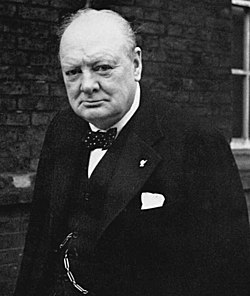
- Winston Churchill, British statesman, prime minister, Nobel Literature Prize laureate[10][13][124]
- Tom Connally, U.S. Senator from Texas[125]
- Adolfo Ruiz Cortines, Mexican politician and president.[citation needed]
- Lawrence Coughlin, former U.S. Representative from Pennsylvania[citation needed]
- Mo Cowan, U.S. Senator from Massachusetts[126][127]
- Elio Di Rupo, former Belgian prime minister, once described by a reporter as "the bow tie wearing Socialist"[128]
- Peter Dunne, former New Zealand politician.[citation needed]
- Abdul Kadir Sheikh Fadzir, Malaysian politician and former Member of Parliament.[citation needed]
- Tom Fink, former Speaker of the Alaska House of Representatives and mayor of Anchorage, Alaska.[129]
- Christian Herter, Governor of Massachusetts, U.S. Secretary of State[130]
- Toomas Hendrik Ilves, president of Estonia, "well-known for always sporting his trademark bow tie"; has even been "dubbed an 'American in a bow tie' by his opponents"[131]

- Stjepan Kljuić, Bosnian politician, former member of tripartite President Council.[citation needed]
- Janusz Korwin-Mikke, Polish liberal conservative publisher and politician[132]
- Patrick McHenry, U.S. representative from North Carolina, acting speaker pro tempore of the House of Representatives[133]
- Farzad Mostashari, the former National Coordinator for Health Information Technology at the U.S. Department of Health and Human Services.[134]
- Daniel Patrick Moynihan, U.S. Senator from New York, whom Hillary Clinton remembered in a speech as having had "three signature items: his horn rimmed glasses, a bow tie, and a great idea"[10][135]
- Donald Payne Jr., U.S. Representative from New Jersey[136]
- Lester B. Pearson, Canadian prime minister, Nobel Peace Prize laureate, "with his trademark blue polka dot blue" bow tie[124][137]
- Otis G. Pike, U.S. Representative from New York[138]
- Franklin D. Roosevelt, 32nd President of the United States[1]
- Theodore Roosevelt, 26th President of the United States[1]
- Wolfgang Schüssel, Austrian Chancellor from 2000 to 2007[139]
- Karel Schwarzenberg, Czech politician, foreign minister[140]
- Ardalan Shekarabi, Swedish politician and minister for public administration.[citation needed]
- George P. Shultz, U.S. Secretary of Labor, the Treasury, and State, consistently wore bow ties in the early 1970s[67][86]
- Paul Simon, U.S. senator from Illinois[10][67][141]
- Otto Suhr, Governing Mayor of Berlin (mayor of West Berlin) from 1955 to 1957 [142]
- Albert Thomas, former U.S. Representative from Texas[citation needed]
- Donald Tsang, former Chief Executive of Hong Kong — "The bow tie is such an integral part of Tsang's identity that he is nicknamed "bow tie Tsang," according to an Associated Press story[143]
- Julio César Turbay Ayala, president of Colombia from 1978 to 1982[144]
- Daniel Turp, Canadian Parti Québécois politician, formerly known for wearing bow ties.[145]
- Charlie Vanik, Congressman from Ohio, often wore a bow tie through his tenure in the House[citation needed]
- Getúlio Vargas, Brazilian statesman[citation needed]
- Anthony A. Williams, former mayor of Washington, D.C. and nicknamed "Mr. Bow Tie"[146]
- G. Mennen Williams, former governor of the State of Michigan.[citation needed]
- Woodrow Wyatt, a British Labour politician, published author, journalist and broadcaster[147]
- Andrew Muir, member of the Northern Ireland assembly and minister of Agriculture, Environment and Rural Affairs.[148]
Psychiatrists and psychologists
[edit]- Aaron T. Beck, the psychiatrist known as "the father of cognitive therapy" dresses in "his signature bow tie"[149]
- Alfred Kinsey, the influential sex researcher, wore a "trademark bow tie"[150]
- Theodore Millon (1928–2014), psychologist and expert on personality disorders.[citation needed]
Athletes
[edit]- Richard Sherman, Defensive Back of the 2014 Super Bowl Champions Seattle Seahawks is frequently seen wearing a bow tie, and has a YouTube video on how to tie a bow tie.[151]
- Bruce Bowen, longtime National Basketball Association player for the San Antonio Spurs[152]
- Frank Cashen, longtime Major League Baseball executive with the Baltimore Orioles and New York Mets[153]
- Mike Hawthorn, racing driver, co-winner of the 1955 24 Hours of Le Mans, and 1958 Formula One World Driver's Champion[154][155]
- Dhani Jones, professional football player, has long worn bow ties and has created a line of bow ties for sale[2][156]
- Tim Lincecum, pitcher for baseball's San Francisco Giants[157]
- Jim Phelan, basketball coach for Mount St. Mary's University. Numerous fans and fellow coaches honored his retirement by wearing bow ties.[158]
- Ken Rosenthal, Lead field reporter for Major League Baseball on Fox is known for wearing a wide variety of bow ties.[citation needed]
- Bill Torrey (1934–2018), General manager who built the New York Islanders into a dynasty that won four consecutive Stanley Cups, known as "Bow-Tie" Bill, after the signature bow tie he always wore.[159]
- Lee Tressel, college football coach at Baldwin–Wallace College and a hall-of-fame member; described as "a cerebral coach who always wore a bow tie and a buzzcut,"[160]
Other 20th-/21st-century people associated with wearing bow ties
[edit]

- Saul Bellow, novelist, often wore one late in life.[10]
- Finn M. W. Caspersen, financier, philanthropist, often wore bow ties.[161]
- Brian P. Cleary, award-winning author of more than 50 children's books.[citation needed]
- Aleister Crowley, English occultist, often wore extravagant bow ties.[162]
- Robert Denning, interior designer, wore bow ties exclusively the last fourteen years of his life.[163]
- Louis Farrakhan, noted anti-Semite and leader of the Nation of Islam organization[10]
- Ace Greenberg, former CEO and chairman of Bear Stearns[164]
- C. Everett Koop, former U.S. Surgeon General known for his "omnipresent red bow tie"[77][165]
- Howard Phillips, former spokesman for Nintendo as well as first editor of Nintendo Power magazine from the early 1980s until 1991[166]
- Orville Redenbacher (1907–1995), owner of an American popcorn business who appeared in commercials for it and had his image on the boxes — always wearing horn-rimmed glasses and a bow tie.[77][167]
- Jim Rogers (born 1942), author[168]
- Albert Schweitzer, German physician, humanitarian, Nobel Peace Prize laureate[169]
- W. Clement Stone (1902–2002), businessman and philanthropist, had a collection of 250 bow ties.[9]
- James Strong, Australian businessman who was CEO of Qantas from 1993 to 2001.[170]
- Colonel Sanders (1890–1980), American businessman who founded KFC [171]
Fictional characters
[edit]Bow ties are a consistent element in the depiction of some fictional characters.
Characters in film and television
[edit]Film and television characters portrayed by human actors as consistently wearing bow ties have included:
- Blaine Anderson, a character in Glee, can frequently be seen wearing a bow tie.[citation needed]
- Chuck Bass, a character in Gossip Girl known for his dandy sense of style, is often seen sporting a bow tie with a matching pocket square.[citation needed]
- Buckaroo Banzai, titular neurosurgeon, particle physicist, race car driver, rock star and comic book hero from The Adventures of Buckaroo Banzai Across the 8th Dimension, sports a bow tie throughout the film.
- Billy Bunter, a character in the works of Charles Hamilton[citation needed]
- Gil Chesterton, a character on Frasier, was never seen without a bow tie.[citation needed]
- Bertram Cooper, a character in the drama series Mad Men who is never seen without a bow tie.[172]
- The Doctor, central character of Doctor Who, in his second, third and eleventh incarnations; and during his sixth one undercover, and during his tenth and thirteenth ones with their tuxedos.[173][174] Actor Matt Smith pressed for the bow tie in his characterisation who regularly declares that "bow ties are cool".[175]
- Richard Gilmore, the patriarch of the Gilmore family on the TV series Gilmore Girls, played by actor Edward Herrmann, was always seen wearing a bow tie.[176][177]
- Mr. Hooper, Sesame Street character played by Will Lee[178][179][180]
- Indiana Jones of the Indiana Jones (franchise) is frequently seen wearing a bow tie with his suit.[citation needed]
- Dr. Donald "Ducky" Mallard, M.D., M.E. the Chief Medical Examiner in NCIS is always seen wearing a bow tie of various colors.[181]
- Michael, the "architect" in The Good Place, played by Ted Danson, usually wears a bow tie except when relevant to the story line to have him without one.[182]
- Brother Mouzone, the enforcer who appears in The Wire television series, wears a "trademark suit and bowtie" and glasses, consistent with his image of being "more like a banker or entrepreneur or scholar" than a hitman.[183]
- Les Nessman, character in WKRP in Cincinnati television sitcom [184]
- Hercule Poirot, fictional detective[185]
- Sidney Reilly as played by Sam Neill in the BBC television mini-series Reilly, Ace of Spies.[citation needed]
- Baxter Stockman wears a bow tie in the 1987 Teenage Mutant Ninja Turtles series.[186]
- Uncle Wally, Sesame Street character played by Bill McCutcheon[180]
- Sheldon Cooper, character in Young Sheldon[citation needed]
- Aziraphale, a character in Good Omens, wears his signature bow tie in all his modern day outfits, including in the Final Fifteen scene[187][188]
Characters in comics, cartoons, and anime
[edit]Bow ties are a consistent part of the depiction of many characters created by artists for entertainment media including comics, cartoons, and anime.
Among these are many Hanna-Barbera cartoon characters:
- Boo-Boo Bear[189]
- The mouse Pixie and the cat Mr. Jinks in the cartoon Pixie and Dixie and Mr. Jinks[190]
- Magilla Gorilla[191]
- Huckleberry Hound[192]
- Jerry Mouse in Tom and Jerry (1975–1977)[193]
- Snagglepuss, Hanna-Barbera cartoon character created in 1959, a pink anthropomorphic mountain lion.[194]
Other artist-created characters consistently or frequently depicted in bow ties include:
- In spin-off animated film series My Little Pony: Equestria Girls, Twilight Sparkle wears a pink mini bow tie as a human.[citation needed]
- Bernard Bernoulli of the Maniac Mansion and Day of the Tentacle computer games.[195]
- Siblings Caliborn[196] and Calliope[197] from Homestuck who used to share a body and thus wear the same bow tie between them.
- Dagwood Bumstead, character in Blondie comic strip[198][199]
- The Cat in the Hat[200]
- Donald Duck, Disney cartoon character[15][124][201]
- Count Duckula always wore a red bow tie as part of his ensemble.[202]
- Conan Edogawa, alias of character Jimmy Kudo in "Detective Conan" manga and anime comics[203]
- Harvey, in the play and film of the same name, the invisible, bow-tied, 6-foot rabbit whose portrait was shown in the play and film with him wearing a bow tie[204]
- Carl Fredricksen, the main character in the 2009 Pixar film, Up.[205] Prior to that, he wore neckties from the 1950s through the 1990s.
- Hoppity Hooper, cartoon character in Jay Ward Productions[citation needed]
- Krusty the Clown, cartoon character in The Simpsons[206]
- Leopold the Cat, the namesake of a Russian cartoon series, wears a bow tie, even when he goes swimming.[207]
- Mickey Mouse[208]
- Mister Peabody, the main character of Peabody's Improbable History.[citation needed]
- Porky Pig, Looney Tunes cartoon character.[citation needed]
- Franklin "Foggy" Nelson. In the Marvel Daredevil comics, Nelson is a lawyer, best friend and longtime business partner of blind lawyer Matthew M. Murdock (a.k.a. the masked vigilante Daredevil). Even though Foggy Nelson occasionally wears standard neckties, he is partial to bow ties.[209]
- Jimmy Olsen often was depicted wearing a bow tie in the comic titles Superman and Superman's Pal Jimmy Olsen[210]
- Opus the Penguin, character in Bloom County comic strip[211]
- The Penguin, in the Batman franchise, though some versions of him wear cravats instead such as Batman Returns, Justice League Action, Gotham, and Harley Quinn.[212]
- Jack Point, character in Judge Dredd comic books.[213] The bow tie is part of his clown-like clothing.
- Rich Uncle Pennybags, aka Mr. Monopoly, from the board game Monopoly is frequently shown wearing a bow tie.[citation needed]
- Zatanna, the virtuous sorceress from the DC Universe[citation needed]
- Bill Cipher from Gravity Falls.[citation needed]
- Professor Porter, the father-in-law for the title character of Tarzan.[citation needed]
- The Master on the Doctor Who episodes Survival and Spyfall.[citation needed]
- Rock Bottom from Felix the Cat.
See also
[edit]Notes
[edit]- ^ a b c d e f g h St. John, Warren (2005-06-26). "A Red Flag That Comes in Many Colors". The New York Times. Retrieved 2010-03-18.
- ^ a b c d e Sheehan, Jennifer (2005-08-15). "Bow Ties Come Bouncing Back into Fashion". Eastern Pennsylvania Business Journal.
- ^ Fitch, Thomas (2006-11-06). "Why must the bow tie die?". TuscaloosaNews.com. Tuscaloosa News. Retrieved 19 March 2010.
- ^ a b Milbank, Dana (1996-06-27). "Detractors Galore Don't Slow Sales Of Classy Ties to Rich and Famous". The Wall Street Journal. Dow Jones. Retrieved 16 November 2008.
- ^ O'Brien, Glenn (September 2003). "Why a bow tie's not just for schmucks". GQ.com. Conde Naste Digital. Retrieved 1 March 2010.
O'Brien noted that a bow tie "can be a badge of courage," as personified by the World War II "bow-tie alliance of Franklin Roosevelt and Winston Churchill," or the "mark of the urbane, independent, devil-may-care or rakish personality" such as characters portrayed by Humphrey Bogart and Frank Sinatra.
- ^ Anderson, Susan Heller (1991-07-29). "Chronicle". New York Times. Retrieved 19 March 2010.
- ^ Quoted in Welters, Linda (2005). Twentieth-century American Fashion. Berg Publisher. ISBN 1-84520-073-X.
- ^ Conroy, Sarah Booth (1986-01-26). The Washington Post.
Stone believed bow-tie wearers to be "full of vim and vigour, aggressive and full of drive. They are the best salesmen and entrepreneurs."
{{cite news}}: Missing or empty|title=(help) - ^ a b Kelly, Karen (2007). The Secret of the Secret. Macmillan. pp. 189. ISBN 978-0-312-37790-8.
- ^ a b c d e f Epstein, Joseph (2001-05-04). "Fit To Be Tied: The enemies of civilization find a new target, just below the chin". Opinion Journal. Retrieved 17 March 2010.
First, though, let me organize a lineup of bow tie wearers to establish a variety. The most distinguished of all, of course, was Winston Churchill, whose favorite was a fine floppy blue job with white polka dots. Daniel Patrick Moynihan, a tall man, often adds a giant butterfly to his getup, which gives his appearance a light and rakish air. Saul Bellow has taken to wearing bow ties late in life. Former Sen. Paul Simon is a habitual bow tie wearer, though, oddly, he seems never to have learned to tie them properly, for the right side of his ties never quite make it to full bow form. For diversity's sake, it would be good to have an NFL linebacker instead of Louis Farrakhan to round off this roster, but Churchill, Moynihan, Bellow, Simon and Farrakhan (a clip-on man, I surmise) perhaps provide sufficient diversity in themselves.
- ^ "Doctor Who prompts surge in popularity of bow ties". The Daily Telegraph. London. 30 April 2010. Retrieved 1 May 2010.
- ^ Schlesinger, Arthur M. (2002). A Life in the Twentieth Century: Innocent Beginnings, 1917–1950. Houghton Mifflin Books. p. 109. ISBN 978-0-618-21925-4.
- ^ a b "Boston Bow Tie Launches Web Site to Market Distinctive and Stylish Bow Ties with a Traditional Flair | Business Wire | Find Articles at BNET.com". Archived from the original on 2008-03-04. Retrieved 2007-01-18."Boston Bow Tie Launches Web Site to Market Distinctive and Stylish Bow Ties With a Traditional Flair" news release posted on Business Wire, December 30, 1999, according to the LookSmart FindArticles Web site, accessed January 17, 2007
- ^ http://www.beautiesltd.com/NewsItem.aspx?pn_deptid=6352 Archived 2008-03-04 at the Wayback Machine News release from Beau Ties Ltd., dated October 3, 2006 and titled "Dr. C. Everett Koop, Former U.S. Surgeon General, and Beau Ties Ltd. Create Birthday Bow Tie"
- ^ a b http://www.greatbows.com/store/index.asp?pageid=2 Archived 2007-02-23 at the Wayback Machine Web page titled "The Definitive Bow" at the Carrot & Gibbs Web site, accessed January 17, 2007
- ^ a b http://men.style.com/gq/fashion/styleguy/accessories/96 Archived 2007-03-14 at the Wayback Machine Style Guy column at MensStyle.com Web site (associated with GQ magazine), dated September 2003, accessed January 17, 2006
- ^ "A Reign of Harmony". Tennessee Valley Authority. Retrieved 23 November 2008.
- ^ Eisenman is shown wearing a yellow bow tie in the photo illustrating the article in Archinect, July 27, 2004 [1]
- ^
"Peter Eisenman". KMP Furniture. Retrieved 23 November 2008.
Known as an eccentric, Eisenman is often seen in a bowtie and a sweater with a small hole.
- ^ Kester Rattenbury, Robert Bevan, and Kieran Long, Architects Today, Volume 2004, page 1988. Describes Eisenman as "the consummate intellectual New Yorker (big specs, big bow tie, big hair)..."
- ^ John Taylor, Mr. In-Between: Deconstructing Peter Eisenman, New York Magazine, October 17, 1988, pages 46–52. "Eisenman wears bow ties and suspenders and those owlish glasses that for some reason are so popular among architects."
- ^ http://www.iceandcoal.org/nfa/harvardephemera.html While not absolutely clear, this Web page indicates Gropius was known for his bow ties: Web page titled "Stories from 'The Chronicle': Cataloguing Harvard's Ephemera", article by Lawrence Biemiller at Biemiller's Web site, the Web page indicates the article is from "The Chronicle of Higher Education. Published January 23, 2004." accessed January 18, 2007: "After three years of work, Ms. Norris not only knows how many of Walter Gropius's bow ties Harvard has (six), but also where they are (the Graduate School of Design)"
- ^ McNeil, Peter; Karaminas, Vicki (2009). The Men's Fashion Reader. Berg Publishers. ISBN 978-1-84520-786-1.
- ^ "A Reign of Harmony". Tennessee Valley Authority. Retrieved 23 November 2008.
- ^ DePalma, Anthony (1992-10-04). "The Most Happy College President: Leon Botstein of Bard". The New York Times. ISSN 0362-4331. Retrieved 2022-10-16.
- ^ Jacob M. Appel, 04/issue/col_botstein.html Leon Botstein: The Maestro of Annandale, Education Update, January 2004. Refers to his "trademark bowtie."
- ^ Office of the President, Whitman College website, archived from the original on 2011-05-30, retrieved 2011-06-03
- ^ Bow Tie[permanent dead link], Whitman College Bookstore, accessed June 2, 2011. "Our Whitman College president proudly wears a bow tie every day. Maybe you should too..."
- ^ a b c Troop, Don (March 19, 2010). "Presidents Who Wear Bow Ties". Chronicle of Higher Education.
- ^ "Man on a Mission". ASEE Prism. American Society for Engineering Education. September 2000.
the bespectacled, bow-tied Campbell...
- ^ Clem Richardson, Cooper Union president George Cambell to exit -- on own terms, NY Daily News, May 3, 2010
- ^ Maugh II, Thomas H. (June 20, 2001). "Donald Cram; Creative UCLA Chemist, Nobel Prize Winner". Los Angeles Times.
Many UCLA students have fond memories of Cram, wearing his trademark bow tie, playing his guitar and singing folk tunes in class as the semester end neared.
- ^ "Nobel economist Angus Deaton on a year of political earthquakes". Financial Times. December 22, 2016.
- ^ "Angus Deaton - Facts". The Nobel Prizes. Retrieved 2017-02-16.
- ^ "Haute Stuff". Dickinson Magazine. Dickinson College. Summer 2004. Archived from the original on 2009-03-09. Retrieved 23 November 2008.
President William G. Durden '71 is known around campus for his strong personal fashion sense—his penchant for wearing bow ties as well as his different colors of glasses frames ....
- ^ http://www.brownalumnimagazine.com/storydetail.cfm?ID=1113 Archived 2006-11-13 at the Wayback Machine Boucher, Norman, "E. Gordon Gee: Introducing the seventeenth president", Brown Alumni Magazine, September/October 1997
- ^ Ho, David (March 29, 1999). "Bacteriologist Alexander Fleming". Time. Archived from the original on October 16, 2007.
He was a short man, usually clad in a bow tie, who even in his celebrity never mastered the conventions of polite society.
Alt URL - ^ http://www.nyas.org/snc/update.asp?UpdateID=21 Burke, Adrienne, "Gazing at Science Stars: An Ansel Adams protégée captures the nature of brilliance", article in Science and the City webzine of the New York Academy of Sciences, September 16, 2005, accessed January 18, 2007
- ^ Kennedy, Eugene P. (1992). "Sailing to Byzantium". Annual Review of Biochemistry. 61: 1–28. doi:10.1146/annurev.bi.61.070192.000245. PMID 1497305.
With abundant hair just becoming a little gray, and usually wearing a soft bow tie, Lipmann presented a figure closer to the stereotype of the artist than of the scientist.
- ^ "Nobel Laureates". Retrieved 2013-01-08.
The scientist, known for his clarinet playing and Western-style bow ties, describes his mode of reasoning: "I am inclined to make large intuitive jumps and then set about to test the conclusions."
- ^ "Spotlight: Texas A&M University at Galveston". Archived from the original on 2014-08-11. Retrieved 2013-12-11.
- ^ "Texas A&M President Website". Texas A&M University. 18 June 2009. Archived from the original on 9 December 2008. Retrieved 23 November 2008.
The similarity between Bowen and Bowtie tends to help people remember my name.
- ^ Yoo, Anne-Sophie (2010-05-03). "Jean-Luc Marion, lecteur de l'invisible". Valeurs actuelles (in French). Retrieved 2025-10-27.
- ^ Gabor Steingart (December 11, 2007). "The End of Globalization?". Spiegel Online. Retrieved December 13, 2009.
The hallway eventually leads to an office where a 92-year-old man [Samuelson] wearing a bowtie is sitting at his desk eating sushi.
- ^ Cassidy, John (December 14, 2009). "Postscript: Paul Samuelson". The New Yorker. Condé Nast Digital. Retrieved December 17, 2009.
Then [Samuelson] bounced in on the soles of his feet, a diminutive man dressed in a light gray suit, a red-and-white-striped shirt, and a snazzy bow tie.
- ^ James, Ioan (2004), Remarkable Physicists, Cambridge University Press, p. 301, ISBN 0-521-01706-8,
Professors were expected to dress formally; Schrodinger usually wore a sweater and bow tie in winter
- ^ Gribbin, John (2013), Erwin Schrodinger and the Quantum Revolution, p. 1920, ISBN 978-1-118-33188-0,
Schrodinger addressed his students wearing a sweater and a jaunty bow tie ...
- ^ "Dr. Gene Spafford talks CERIAS-ly about bow ties". YouTube. April 2014. Retrieved 7 December 2014.
- ^ "Charity Auction — Some of Spaf's Bow Ties". July 2014. Retrieved 7 December 2014.
- ^ "His Find Became Tumors' Nemesis". The Trenton Times. May 9, 2010. Retrieved 1 June 2016.
- ^ "Jefferson's Legacy: A Brief History of the Library of Congress -- LIBRARIANS OF CONGRESS". www.loc.gov. Retrieved 2022-10-16.
- ^ "Floridian: Bill Nye, the successful guy". Archived from the original on 2008-03-05. Retrieved 2008-01-26. Davis, Pamela, "Bill Nye, the successful guy", article in The St. Petersburg Times, October 11, 1999, accessed January 18, 2007
- ^ Humor is a part of his program, so the bow tie may spoof academics and associate him with comedians.[2] Rahner, Mark, "Eye to eye with Bill Nye the Science Guy", article in The Seattle Times, April 26, 2005, accessed January 18, 2007
- ^ A. L. Kursanov, Sketches to a Portrait of A.I. Oparin Archived 2011-07-22 at the Wayback Machine, Lecture presented at the Opening of the International Symposium "Biochemistry of the 21st Century: Problems and Frontiers", devoted to The One Hundredth Anniversary of the Birth of A. I. Oparin, Moscow, May 13—18, 1995. "The bow tie ... was an immutable detail of ... Oparin's attire for his whole life. This tie ... was almost a part of his personality, one that added some aura of self-confidence and authority to his whole demeanor."
- ^ http://www.libertystory.net/LSTHINKROTHBARDLIFE.htm Archived 2007-02-19 at the Wayback Machine Web page titled "The Life and Times of Murray N. Rothbard [...]" at Libertystory.net Web site, accessed January 18, 2006
- ^ "Anecdotage". anecdotage.com. Retrieved 2022-10-16.
- ^ "40 Years After Missile Crisis, Players Swap Stories in Cuba". www.latinamericanstudies.org. Retrieved 2022-10-16.
- ^ National Public Radio profile: Christopher Whittle, June 28, 2000: "Whittle is a bow-tie wearing entrepreneur determined to reform education, while making a profit."
- ^ Pope Brock, Christopher Whittle; This Man Wants to Teach Your Children Well—and for Profit, People 38(12), September 21, 1992: "He's a man of disarming charm, his signature bow tie and his grin both a little lopsided."
- ^ "Photo at Museum of Broadcasting website shows him in a bowtie". Archived from the original on 13 August 2011. Retrieved 6 May 2023.
- ^ Yoo, Anne-Sophie (1999-04-02). "L'ombre d'un double". Libération (in French). Retrieved 2025-10-27.
- ^ "A Mega Bar Mitzvah for Actor Fyvush Finkel". The Forward. 2004-07-16. Retrieved 2022-10-16.
- ^ Image:Pee-Wee Herman (1988).jpg shows the character in typical neckwear
- ^ "Thrilling Adventure Hour: The Graphic Novel... and Beyond!". Retrieved 2014-03-10.
- ^ "Marc Evan Jackson". 2013-05-27. Retrieved 2014-03-10.
- ^ http://www.frankelcostume.com/proddetail.php?prod=Stan_Laurel Archived 2006-10-19 at the Wayback Machine Web site for Frankel's Costume, describes its ventriloquist dummy resembling Laurel as "This Stan Laurel Doll has been faithfully reproduced with his blue overalls, a long-sleeved white shirt, and a red, polka-dotted bow tie.", accessed January 18, 2007
- ^ a b c d e Tommasini, Anthony (1988-09-25). "HOROWITZ AT 85: STILL PLAYING FREE". The New York Times. ISSN 0362-4331. Retrieved 2022-10-16.
- ^ Soibelman, David (1993-12-03). "What Poets, Presidents and Groucho Shared Bow ties: Only a few men can master these sartorial butterflies". Los Angeles Times. Archived from the original on March 4, 2009. Retrieved 2008-11-14.
- ^ Bow Ties extract from David Mitchell's autobiography, Back Story. Read by author [audiobook extract], retrieved 2022-10-16
- ^ "Garry Moore, 78, the Cheery Host Of Long-Running TV Series, Dies". The New York Times. 1993-11-29. Retrieved 2008-07-11.
- ^ Garry Moore, Britannica Online
- ^ "Moore for Housewives - TIME". 2008-12-22. Archived from the original on 2008-12-22. Retrieved 2022-10-16.
- ^ "BBC News | UK | Comedy writer Frank Muir dead at 77". news.bbc.co.uk. Retrieved 2022-10-16.
- ^ Haberman, Clyde (March 30, 1997). "Mark Russell's High-Wire Act With No Net". The New York Times. Retrieved May 8, 2010.
- ^ Brumby, Arian (2012-05-23). "An Interview with Paul F. Tompkins: A Very Fancy Man". Retrieved 2014-03-10.
- ^ "A Web Series about Dressing Like a Grownup". 2011-10-13. Retrieved 2014-03-10.
- ^ a b c http://www.styledash.com/2006/11/02/never-trust-a-man-in-a-bow-tie/ Archived 2007-09-27 at the Wayback Machine Metz, Ann, "Never trust a man in a bow tie" posted at StyleDash Web site November 2, 2006 at 12:43 p.m., accessed January 17, 2007
- ^ Sanneh, Kelefa (2017-04-03). "Tucker Carlson's Fighting Words". The New Yorker. ISSN 0028-792X. Retrieved 2025-09-21.
- ^ "RockerMouse (tm): What's My Line?". rockermouse.com. Retrieved 6 May 2023.
- ^ Terry Teachout, The Games People Played in a Simpler Time, The New York Times, October 28, 2001
- ^ bbc.co.uk "Sir Robin Day: 1923–2000" article at BBC News website, August 7, 2000, accessed January 18, 2007
- ^ http://www.wfaa.com/tdungan/ Troy Dungan career retrospective, retrieved on 29 July 2007.
- ^ Gamarekian, Barbara. " Rummaging in Broadcasting's Attic", The New York Times, October 8, 1988. Accessed November 17, 2008. "There is Jimmy Durante's battered hat, Rudy Vallee's megaphone and Dave Garroway's trademark glasses and bow tie."
- ^ "Dave Garroway New York Times Obituary". www.richsamuels.com. Retrieved 6 May 2023.
- ^ Bernard Chapin, The Highest Criterion: An interview with Roger Kimball, History News Network, March 17, 2003. "Here before us, bespectacled and sporting a bowtie, is one of our greatest enforcers."
- ^ a b c http://tvnews.vanderbilt.edu/program.pl?ID=471532 Vanderbilt Television News Archive, Web page titled "NBC Evening News for Monday, Jul 20, 1973", accessed January 17, 2007, "Abstract: (Studio) NBC's Irving R. Levine known for bow tie ... John Dunlop, Archibald Cox and George Shultz dogmatically disregard faddish widths".
- ^ |level=2–3|pageid=3905-1386[permanent dead link] Levenger Web site, Web page titled "How They Work: Gifts of a Journal" by Steve Leveen: "With his serious reporting on NBC and ubiquitous bow tie, Irving R. Levine became a television icon to a generation of Americans.", accessed January 17, 2007
- ^ http://www.newsbios.com/newslum/levine.htm The Business News Luminaries Web site, Web page titled "Irving R. Levine" One sentence states: "The economics assignment gave Mr. Levine a mild-mannered persona, and his trademark bow tie did little to subtract from a Mr. Peepers image." accessed January 17, 2007
- ^ http://www.brownalumnimagazine.com/november/december_2000/journalism.html Archived 2008-03-04 at the Wayback MachineBrown Alumni Magazine Web page titled "Journalism", section titled "Irving R. Levine '44", dated November/December 2000, accessed February 2, 2008
- ^ Russell Lynes, 80, an Editor and Arbiter of Taste (obituary) by Richard Severo, September 16, 1991, The New York Times, retrieved February 18, 2008: "He was tweedy, bow-tied, pipe-smoking, buttoned-down and urbane, an aficionado of things like Bugatti cars and Downing cottages."
- ^ Alessandra Stanley and Maureen Dowd (September 1988). "The Dweebs on the Bus". GQ.
The bow-tied and whimsical Boston Globe reporter Tom Oliphant...
- ^ Zimmerman, William (2011). Troublemaker: A Political Memoir of the Sixties. Random House Digital. p. 323. ISBN 978-0-385-53348-5.
Tom wore his signature business suit, bow tie, and beat-up running shoes.
- ^ New Jersey Q & A: Charles Osgood; A New Face at CBS 'Sunday Morning', by Albert J. Parisi, The New York Times, April 24, 1994
- ^ Charles Osgood biography, CBS News Sunday Morning website
- ^ Photos of him always include a bow tie, for example the photo illustrating "Gene Shalit on his gay son," The Advocate website (accessed May 23, 2008)
- ^ Biography Research Guide: "He is known for frequent use of puns, oversized handlebar moustache, and for wearing colorful bowties."[3]
- ^ A 2006 news story about Shalit's daughter referred to "his trademark horned-rimmed glasses, handlebar mustache and bow tie."
- ^ Off Limits: Holy Moses!, Denver WestWord, October 17, 2002
- ^ "Cobden Centre's Toby Baxendale talks UK monetary reform with Jeff Tucker of the Mises Institute". Gold News. June 3, 2011.
Jeff Tucker (he of bow-tie fame)
- ^ Pareles, Jon (July 1, 2002), "Timothy White, 50, Billboard Editor in Chief", New York Times
- ^ Obituary in The Independent, accessed January 18, 2007
- ^ Knight, Gordon Kanki (5 August 2016). "Meet Bargain Hunt's Tim Wonnacott". adelaidenow. Retrieved 6 May 2023.
- ^ http://www.440.com/twtd/archives/dec18.html Archived 2007-01-24 at the Wayback Machine Web page titled "Those Were the Days: December 18" at the 440 International Web site, accessed January 18, 2007, from the Web page: "1956 – One of America's great panel shows debuted on CBS-TV. Bud Collyer, bow tie and all, hosted To Tell the Truth."
- ^ Ray Broadus Browne and Pat Browne, The Guide to United States Popular Culture, 2001, Popular Press, ISBN 0-87972-821-3, ISBN 978-0-87972-821-2, page 308: "[Collyer] always wore a bow tie."
- ^ Booth, Jenny (September 15, 2009). "Flamboyant TV chef Keith Floyd dies of heart attack". The Times. London. Archived from the original on March 14, 2010. Retrieved May 8, 2010.: "Each [of his shows] featured the bow tie-wearing chef raising plentiful glasses of red wine while sloshing ingredients into a pan and barking orders at his cameraman."
- ^ http://www.concertonet.com/scripts/edito.php?ID_edito=63 Kirshnit, Frederick L., "Instruments of Mass Seduction III" article at "Concerto.net" Web site dated June 2, 2004, accessed January 18, 2007
- ^ Stephen Metcalf, Sexy Food Nerds: Cooking geeks get hot on America's Test Kitchen, Slate.com, October 13, 2003: "As host of ATK, [Kimball] sports the standard-issue ATK apron, granny glasses, a doofy bow tie, and helmet hair."
- ^ http://www.cooksillustrated.com/magazine/ About Cook's Magazine at Cook's Illustrated
- ^ Marked Man, by Peter Carlson, The Washington Post, Sunday, July 15, 2007
- ^ Montgomery, Roger (January 24, 1981). "Dispelling the Myth of Mysteries". The Day.
- ^ Nettelbladt, Sonja (October 29, 2013). "Stromae". Radar Magazine. In addition to his music, Stromae is also known for his artistic videos and sharp style, often dressed in colourful, clean-cut clothes and his trademark bow tie.
- ^ Mahlmeister, Chrissy (May 5, 2011). "Hot Dude Of The Day: Panic! At The Disco's Brendon Urie Makes Us Force Our Boyfriends To Dress Like Him". MTV Style. Archived from the original on May 7, 2011.
- ^ http://www.footwearaheadspain.com/index.php?sid=709&pressrelease=60 Archived 2007-02-02 at the Wayback Machine Anniss, Elisa, "Manolo Blahnik's interview", FN Footwear News, "Vol. 62 NO 22", dated May 29, 2006
- ^ Higgins, Natasha (November 16, 2010). "The Aesthete Manolo Blahnik". Financial Times. Retrieved November 24, 2010.
I almost always wear a bow tie
- ^ Manning, Charles (7 September 2018). "Alber Elbaz Finally Explains Those Colorful Bow Ties". Retrieved 6 May 2023.
- ^ https://www.washingtonpost.com/wp-dyn/content/article/2004/05/30/AR2005040302499_pf.html Barnes, Bart, "Watergate Prosecutor Faced Down the President", The Washington Post, front-page obituary, May 30, 2004, accessed January 18, 2007
- ^ Taubman, Philip. "Editorial Observer; An Attorney General Who Trusted the Law", The New York Times, March 9, 2000. Accessed November 16, 2008. "With his signature bow tie and thick glasses, he hardly looked ready for political combat."
- ^ In Memoriam: Louis Lowenstein Archived 2011-07-27 at the Wayback Machine, Columbia Law Review, v. 109, no. 6, October 2009; pages 1263–1277
- ^ https://query.nytimes.com/gst/fullpage.html?res=9A0DE7D61139F934A25752C0A960948260 Clarity, James F., and Weaver, Warren Jr., "Briefing: Bow Ties and Skullcaps", The New York Times, January 17, 1986, accessed January 18, 2007 (both years are correct)
- ^ Welch wore a bow tie in a photo that appeared on the cover of the July 16, 1954 issue of Life [4] Archived 2007-11-28 at the Wayback Machine
- ^ Nathan Rabin, in Point Of Order & Punishment Park (avclub.com, November 23, 2005), a review of a documentary on the Army-McCarthy hearings, describes Welch as "the special counsel for the U.S. Army whose bow-tie-clad folksiness masks a brilliant mind and devastating wit."
- ^ Brett Lieberman, Virginia's high-tech bloc Archived 2009-03-09 at the Wayback Machine, Virginia Business, November 2000. Article says of Bliley, "his trademark is a bow tie."
- ^ http://www.walksacramento.org/blum.html Archived 2007-03-17 at the Wayback Machine Pierce, Neal R., columnist for the Washington Post Writers Group, "Smart Growth's Johnny Appleseed", column, February 21, 1999, accessed January 18, 2007
- ^ a b c https://www.theglobeandmail.com/servlet/story/LAC.20070108.FACTS08/TPStory/Facts%20&%20Arguments Saunders, Allan, "The Mistress and the Bow-tie Boys", The Toronto Globe and Mail, undated article, although the Web address indicates it likely appeared on January 8, 2007 and not August 1 because it was accessed January 18, 2007: "Consider the fact that some of history's most famous men wore bow ties – Churchill, Roosevelt, Truman, Abraham Lincoln – even our own Lester Pearson with his trademark polka dot blue. Don't forget Donald Duck who dared to be different from other ducks with his red bow."
- ^ Robert J. Donovan (1977). Conflict and Crisis: The Presidency of Harry S. Truman, 1945-1948. WW Norton & Co. p. 257.
Senator Tom Connally, reared on a Texas farm, affected broad-rimmed black hats, full-cut black coats, gold studs, and black bow tie, and let his silverly lockscurl down over his stiff white collar.
- ^ Schoenberg, Shira (February 7, 2013). "William 'Mo' Cowan is sworn in as U.S. senator from Massachusetts". MassLive.com. Retrieved March 3, 2013.
Cowan wore a suit and his trademark bow tie.
- ^ "Gov. picks William 'Mo' Cowan as John Kerry's replacement in Senate". New York Daily News. January 30, 2013. Retrieved March 3, 2013.
- ^ http://blogs.telegraph.co.uk/foreign/davidrennie/may06/constitution.htm [dead link] Blog (unnamed?) of David Rennie, Brussels foreign correspondent for The Daily Telegraph at the newspaper's Web site, in a post dated May 29, 2006, 17:04, describes Rupo as "the bow tie wearing Socialist" (accessed January 17, 2007)
- ^ "All the Fink's Men". Fairbanks Daily News-Miner. Associated Press. April 4, 1973. Retrieved July 24, 2017 – via Newspapers.com.
House coalition members bedecked in Speaker Tom Fink outfits--regulation bow ties and corncob pipes--pose with the Anchorage Republican, top center, last weekend.
- ^ Stephen J. Dryden (1991). "America's Trade Warriors–Still Searching for the Right Weapon". Retrieved 2013-01-09.
Herter's tweeds, bow ties, and towering height give him the air of an aloof patrician, but he was attuned to political realities, having served as a Massachusetts state legislator, congressman and governor.
- ^ http://www.jbanc.org/ilves2006.html Archived 2007-02-07 at the Wayback Machine Web page titled "Ilves wins Estonian presidency", dated September 23, 2006, at Web site of JBANC, the Joint Baltic American National Committee, Inc., accessed January 18, 2007
- ^ http://korwin-mikke.blog.onet.pl Archived 2016-01-26 at the Wayback Machine Janusz Korwin-Mikke's official blog clearly showing him with a bowtie.
- ^ Maloy, Ashley Fetters (6 October 2023). "Patrick McHenry is part of a long, bipartisan history of bow ties in politics". The Washington Post. Retrieved 13 January 2024.
- ^ "Farzad Mostashari (@Farzad_MD) | Twitter". twitter.com. Retrieved 2016-08-01.
- ^ http://www.ppionline.org/ndol/ndol_ci.cfm?kaid=106&subid=122&contentid=251430 Archived 2007-09-26 at the Wayback Machine Clinton, Hillary Rodham, speech reprinted at the Democratic Leadership Forum Web site, Web page titled "Statement of Senator Clinton in Tribute to Senator Daniel Patrick Moynihan", March 26, 2003
- ^ Goodin, Emily (March 11, 2013). "Congressional style". thehill.com. Retrieved March 18, 2013.
Freshman Rep. Donald Payne Jr. (D-N.J.) is often spotted sporting a bow tie. "I predominantly am a bow tie wearer," he told The Hill.
- ^ Allan Gerald Levine (1993). Scrum Wars. Dundurn Press. pp. 246.
- ^ Kleinfeld, N.R. "Otis G. Pike, 92, Dies; Long Island Congressman Took On C.I.A.". nytimes.com.
A tall, wavy-haired man who wore bow ties exclusively [...]
- ^ "Wolfgang Schüssel, an Austrian abroad". The Economist. ISSN 0013-0613. Retrieved 2015-12-05.
- ^ Lopatka, Jan (2013-01-12). "Former PM to square off with prince for Czech presidency". Reuters. Archived from the original on January 26, 2016. Retrieved 2013-01-13.
Currently foreign minister in the centre-right cabinet, the bow-tied, pipe-smoking Schwarzenberg is personally untainted by graft scandals.
- ^ Wright, Michael (1999-03-07). "Dark Horse in a Bow Tie". The New York Times. Retrieved 2008-11-15.
- ^ Lietzmann, Sabine (1954-12-30). "Otto Suhr". Die Zeit Online. Retrieved 2016-12-13.
- ^ http://www.theage.com.au/news/fashion/tsang-loves-his-bow-ties/2005/07/12/1120934222121.html No byline, "Tsang loves his bow ties", article attributed to the Associated Press appearing in The Age, July 15, 2005, accessed January 18, 2007
- ^ Julio César Turbay (obituary), The Telegraph, 14 September 2005: "Turbay was a large, burly man who usually sported a bow tie."
- ^ A 2003 Le Devoir article reads: "The bow that serves him as a tie has become the trademark of the péquiste (Parti Québécois member or politician) candidate in Mercier (electoral riding), Daniel Turp." [5] Archived 2012-03-08 at the Wayback Machine
- ^ https://www.washingtonpost.com/wp-srv/local/longterm/library/dcelections/candidates/williams0807.htm Powell, Michael, "'Mr. Bow Tie' Becomes the Bull's-Eye", The Washington Post, August 7, 1998, Page A01
- ^ BBC News | Obituaries | "Voice of Reason" Lord Wyatt dies aged 79
- ^ Davenport, Mark (28 April 2024). "Andrew Muir: Out and proud Stormont Minister in charge of Northern Ireland's farming". Irish Times. Retrieved 6 June 2024.
When Muir was appointed to his Agriculture and Environment job there was some joking he might not be able to maintain his penchant for bow ties and natty dressing down on the farm.
- ^ http://www.apa.org/monitor/oct00/meeting.html Chamberlin, Jamie, "An historic meeting of the minds: The fathers of cognitive therapy and rational-emotive behavior therapy exchanged banter at APA's 2000 Annual Convention", article in the Monitor on Psychology, Volume 31, No. October 9, 2000, American Psychological Association Web site, accessed January 18, 2007
- ^ Gostin, Nikki, "A prude awakening" article in The Age, January 5, 2005, accessed January 18, 2007
- ^ "How to Tie a Bow Tie With Richard Sherman". YouTube. 18 October 2013.
- ^ "Bruce Bowen Talks Bow Ties". NBA.com. Retrieved 2013-01-08.
Stacey Mitch from Spurs.com caught up with former Spur and ESPN Analyst Bruce Bowen to talk about his famous Bow Ties and life after basketball
- ^ Weber, Bruce, "Conversations/Frank Cashen; Mr. Mets Takes a Swing At the Baseball He Misses", article, The New York Times, November 22, 1992. Retrieved February 22, 2007. "[...]Mr. Cashen appears his familiar teddy bear-shaped self, down to his trademark bow tie."
- ^ Daley, Robert (2005-04-15). The Cruel Sport: Grand Prix Racing 1959-1967. St. Paul, MN USA: MotorBooks International. p. xv. ISBN 978-0-76032-100-3. Retrieved 2013-02-04.
The world champion that year was the Ferrari driver Mike Hawthorn, a tall, blond young man who always wore a bow tie when racing. Always. He considered this important. It was his style.
[permanent dead link] - ^ Salmon, Dick (2007-05-01). Brm: A Mechanic's Tale. Dorchester, UK: Veloce Publishing. p. 58. ISBN 978-1-84584-082-2. Retrieved 2013-02-04.
Invariably he would greet his friend Peter Collins with the words 'mon ami, mate' and was famous for his bow tie, which earned him the nickname 'Le Pappilon' (sic), meaning the butterfly.
- ^ Magsaysay, Melissa (November 29, 2009), "Dhani Jones is leading a bow-tie revolution: The NFL linebacker hopes others will join his league of well-dressed gentlemen", Los Angeles Times
- ^ "MLB Major League Baseball News, Expert Analysis, Rumors, Live Updates, & more". Yahoo Sports. Retrieved 6 May 2023.
- ^ Dishneau, David (1 March 2003). "Phelan and his bow tie say 'bye' after 49 years". USA Today.
- ^ Nobles, Charlie. "NHL PLAYOFFS;Torrey Turns Florida Into Hot Hockey Property", The New York Times, May 23, 1996. Accessed November 16, 2008. "Bill Torrey sat back in his chair at the Florida Panthers' practice arena, trademark bow tie neatly in place, and let out a hearty laugh."
- ^ Jim Tressel reveals little about himself, Evansville Courier-Press, October 7, 2010
- ^ Mascarenhas, Rohan (September 9, 2009). "Former N.J. power broker, philanthropist Finn Caspersen dies in apparent suicide". The Star-Ledger.
Friends in New Jersey, who remembered Caspersen for his trademark bow tie and courtly demeanor...
- ^ Punch Magazine, vol. 229, 1955, Jul–Dec, p.266. "The mage [...] received me in a suit of green checked plus fours and a huge tartan bow tie."
- ^ Volk, Patricia (October 8, 2006). "The Sweet Smell of Excess". New York Times. Retrieved 2008-11-19.
- ^ Bear Stearns: Like 'Titantic,' But Without Kate Winslet, New York magazine, May 28, 2008. Refers to his "trademark bow tie."
- ^ http://www.beautiesltd.com/NewsItem.aspx?pn_deptid=6352 Archived 2008-03-04 at the Wayback Machine News release from Beau Ties Ltd., dated October 3, 2006 and titled "Dr. C. Everett Koop, Former U.S. Surgeon General, and Beau Ties Ltd. Create Birthday Bow Tie"; from the news release: "Dr. C. Everett Koop, the former U.S. Surgeon General easily recognized by his omnipresent red bow tie, served from 1982 to 1989 under President Ronald Reagan [...]"
- ^ "Howard Philips". Retrieved 2008-11-18. "He appeared as a blond-haired bowtie-clad know-it-all in the "Howard & Nester" comics series".
- ^ Andrew F. Smith (2006), Encyclopedia of junk food and fast food, Bloomsbury Academic, p. 227, ISBN 978-0-313-33527-3
- ^ Is pictured wearing a pink bow tie on the cover of his book Hot Commodities : How Anyone Can Invest Profitably in the World's Best Market (2004; ISBN 1-4000-6337-X)
- ^ "With Albert Schweitzer in Gabon". 1964–1965. Retrieved 2013-01-08.
His dress is unvarying: white sun helmet on top, a neat black bow-tie, short sleeved white shirt, shapeless, often patched gray trousers and big brown shoes, which still get plenty of use.
- ^ Smith, Fiona. "How James Strong got his bow tie". Business Review Weekly. Fairfax Media. Archived from the original on 26 January 2016. Retrieved 4 March 2013.
- ^ Asbury, Edith (December 17, 1980). "Colonel Sanders Obituary". NY Times.
- ^ Bertram Cooper, Mad Men, AMC Networks website, accessed 15 October 2011. "A nattily bow-tied iconoclast, Bertram Cooper is a Founding Partner in the newly formed Sterling Cooper Draper Pryce advertising agency."
- ^ Mark Walton-Cook (22 March 2010), "Dickie bow fever - the latest nerdy fashion trend for men", Evening Standard, archived from the original on 2010-03-25, retrieved 2010-04-03
- ^ Doctor Who Magazine (418), 3 February 2010
{{citation}}: Missing or empty|title=(help) - ^ Piers D. Britton (2011), TARDISbound: Navigating the Universes of Doctor Who, Bloomsbury Academic, p. 104, ISBN 978-1-84511-925-6
- ^ Valby, Karen (May 16, 2007), "Stars Hollow Ending", Entertainment Weekly, archived from the original on May 18, 2007,
Richard [Gilmore] ... is turning into one giant-size, bow-tied teddy bear.
- ^ Ryan, Maureen (May 15, 2007), "7 things I'll miss about 'Gilmore Girls' after 7 seasons", Chicago Tribune,
Richard [Gilmore] could have been a bow-tie wearing stuffed shirt.
- ^ "Where Are They Now Special: The Cast of Sesame Street...: Will Lee aka Mr. Hooper". Comedy Central UK. Archived from the original on July 12, 2012. Retrieved May 9, 2012.
- ^ Purcell, Amy (March 27, 2009). "Where's Mr. Hooper When You Need Him?". The Grist Mill. Archived from the original (blog) on 2009-04-01. Retrieved 2012-05-10.
- ^ a b "Additional Cast". SesameStreet.org. Archived from the original on March 15, 2012. Retrieved May 9, 2012.
- ^ Mullaney, Andrea. "Dysfunctional detectives will get the job done", The Scotsman, December 10, 2007. Accessed November 19, 2008. "During all this entertaining tosh, up popped dear old David McCallum as Dr Donald 'Ducky' Mallard, sporting a huge bow tie and red braces as his contribution to the general quirkiness."
- ^ Ferrier, Morwenna (2020-12-07). "TV style icons of 2020: Ted Danson as The Good Place's dapper demon". The Guardian. ISSN 0261-3077. Retrieved 2023-02-25.
- ^ Brother Mouzone; Played By Michael Potts, The Wire Cast and Crew, HBO website, accessed November 30, 2008
- ^ Jerry Buck, Nessman Grew to Silver Sow, Associated Press story published in Wilmington Morning Star, July 27, 1981
- ^ At least as portrayed in Murder on the Orient Express film and by actor David Suchet on television, Poirot wears a bow tie, whether or not he typically wears one in the original Agatha Christie novels
- ^ Kahler, Jason (9 August 2017). "8 Ninja Turtles Supporting Characters Who Ruled (And 7 Who Sucked)". CBR. Retrieved 26 November 2017.
- ^ Emmy Contender: How Good Omens designed 6,000 years of costumes for Aziraphale and Crowley, SYFY website, accessed May 18, 2025
- ^ Take a closer look at David Tennant and Michael Sheen's Good Omens costumes, Radio Times, accessed May 18, 2025
- ^ Hanna-Barbera website "Yogi Bear's bow-tie wearing best buddy ..."; retrieved November 17, 2008
- ^ The bow ties are evident in images of Pixie and Dixie and Mr. Jinks at the Big Cartoon DataBase
- ^ The Cartoon-O-Rama website picture gallery for the Magilla Gorilla cartoon shows the character wearing his typical bow tie [6]
- ^ Hanna, Bill, with Tom Ito (2000), A Cast of Friends[permanent dead link], p 101. (Hanna describes the character this way: "The blue canine with the red bow tie, sleepy eyes and Southern drawl had made good. Huckleberry Hound was on his way to becoming television's first cartoon superstar.") Da Capo Press, ISBN 978-0-306-80917-0. Retrieved August 7, 2009
- ^ Wikipedia article for Tom and Jerry shows the title card (Image:Tom Jerry Show.jpg) for the "Tom and Jerry Show" in 1975 with red bow tie on Jerry and cites three overall sources in the References section of the article: Adams, T.R. (1991); Tom and Jerry: Fifty Years of Cat and Mouse Crescent Books; Barrier, Michael (1999) Hollywood Cartoons: American Animation in Its Golden Age. Oxford: Oxford University Press; Maltin, Leonard (1980, updated 1987). Of Mice and Magic: A History of American Animated Cartoons. New York: Penguin Books. ISBN 0-452-25993-2.
- ^ Skalman, Adam. "Cartoons paved the way for gays on TV", Daily Bruin, October 9, 2001. Accessed November 19, 2008. "Snagglepuss: I don't know how many of you remember this guy.... Imagine the Wildean urbanity of Rupert Everett in the wardrobe of a Chippendale's dancer: starchy white cuffs and collar and a perfectly knotted bow tie."
- ^ "Maniac Mansion". Retrieved 2008-11-19.[dead link]"He wears a white shirt, a black bow-tie and black pants".
- ^ "[A6I4] ==>". Retrieved 2020-09-12.
- ^ "==>". Retrieved 2020-09-12.
- ^ In discussing the early days of the strip, 75 Years of Blondie (University of Florida Special Collections, 2005) states (on page 2) that Hiho Hennepin, Dagwood's rival for Blondie's affections, "was a shorter prototype of Dagwood right down to the trademark bow tie they both sport."
- ^ This "logo" or publicity image File:Blondie Logo 2007.png shows Bumstead in typical red bow tie; an image at the King Features Web site describing Bumstead [7] Archived 2008-02-15 at the Wayback Machine also uses an image with him in the same red bow tie; Google Image search of "Dagwood Bumstead" on January 17, 2007 shows the comic character as well as television character wearing bow ties
- ^ File:Seuss-cat-hat.gif
- ^ This comic book cover File:Donald Duck - Lost in the Andes Coverart.png and this still File:Donald duck debut.PNG from an early cartoon "The Wise Little Hen", show what clearly looks like a bow tie, although it may be another kind of tie worn with the character's typical sailor suit
- ^ "Plush Count Duckula". Retrieved 2008-11-19.
- ^ These two Web pages, one for Conan Edogawa, the other for Jimmy Kudo, both show the character wearing a bow tie; since the tie is shown on the character on the main page for that character, it seems extremely likely that the bow tie is typical wear for that character (accessed January 17, 2007): Case Closed Jimmy Kudo page Archived 2010-01-05 at the Wayback Machine; Case Closed Conan Edogawa page Archived 2009-07-07 at the Wayback Machine
- ^ http://www.schulsonautographs.com/enter.htm Archived 2007-02-18 at the Wayback Machine David Shulman Autographs Catalog Web site, Web page titled "Entertainment: Including Cinema & Theatre", accessed January 18, 2007. The store was selling an autograph of Jimmy Stewart; part of the description: "In black marker, he has drawn the rabbit's elongated face, under which he has also drawn Harvey's signature striped bow tie"
- ^ Press Association, Is it a bird? Is it a plane? … No, it's the 2011 International Birdman competition, The Guardian, 14 August 2011. Description of a contestant whose costume was "inspired by movie character Carl Fredricksen from the 2009 CGI film Up," states: "She wore a grey wig, a suit and a bow-tie bought from a charity shop."
- ^ "Most promotional images show him with a blue bow tie". Archived from the original on 2009-02-09. Retrieved 2008-05-18.
- ^ Balina, Marina (2008). Russian Children's Literature and Culture. Routledge. p. 165. ISBN 978-0-415-97864-4. "The gentleman cat sports a bow tie".
- ^ Anne Brydon, S. A. Niessen (1998). Consuming Fashion. Berg. p. 769. ISBN 978-1-85973-964-8.
- ^ "marvel legends matched with build a figure". Archived from the original on 2008-06-07. Retrieved 2008-11-19. "Franklin "Foggy" Nelson: also from Guardian Devil; comes with removable suit jacket, big-ass bow-tie".
- ^ "The Superman Super Site – Jimmy Olsen". Retrieved 2008-11-19."Jimmy is usually depicted as a bow tie-wearing young red-haired man".
- ^ http://www.berkeleybreathed.com/pages/favorite_strips.asp Archived 2007-01-17 at the Wayback Machine Berkeley Breathed Web site, Web page titled "Favorite Strips", Opus is wearing a red bow tie in each; according to Wikipedia article Opus the Penguin he has been known to switch to a regular tie when running for public office
- ^ See any of the pictures in the Wikipedia article Penguin (comics) where he sports a bow tie, except in the 1992 movie, as the article notes
- ^ Jack Point, International Catalogue of Superheroes website
![[4]](http://img.timeinc.net/Life/covers/1954/cv072654.jpg)

List of bow tie wearers
View on GrokipediaCultural Perceptions and Significance
Historical Origins and Evolution
The bow tie emerged in early 19th-century Europe as a streamlined alternative to the intricate cravat, which demanded elaborate tying techniques unsuitable for the era's burgeoning professional class amid the Industrial Revolution. This evolution prioritized functionality, allowing self-tying with minimal effort while maintaining a polished appearance for intellectuals and businessmen who lacked the time or servants for complex arrangements.[8][9] Among early prominent adopters, British author Charles Dickens (1812–1870) frequently wore bow ties in daily portraits and photographs, reflecting their practicality for literary and social pursuits. A 1859 carte-de-visite image depicts him in a black bow tie paired with a tartan waistcoat and navy jacket, underscoring its role as unpretentious yet refined everyday neckwear for creative professionals.[10][11] By the late 1800s, the bow tie solidified as a marker of individual style over rigid formality, particularly through figures like Oscar Wilde, whose dandy aesthetic embraced it amid the Aesthetic Movement's push against Victorian constraints. Wilde's 1893 quotation in A Woman of No Importance—"A well-tied tie is the first serious step in life"—highlighted its symbolic weight, transforming the accessory from mere utility to a deliberate emblem of nonconformity among artists and thinkers.[2][12]Societal Stereotypes and Empirical Findings
Surveys conducted by HCD Research, a media research firm, in the late 2000s involving hundreds of respondents consistently found that bow tie wearers are perceived as more intelligent than those wearing conventional neckties, with 54 percent associating bow ties with higher intellect compared to 25 percent for neckties.[13] However, the same studies revealed negative connotations, including 39 percent viewing bow tie wearers as "brainy and a little weird" and 40 percent describing them as eccentric, far exceeding similar judgments for necktie wearers at 6 percent.[13] [14] Additional stereotypes from these polls linked bow ties to older age (over 36), Republican political affiliation (45 percent of respondents), and lower-status occupations like store clerks, though some data suggested perceptions of managerial roles in other contexts.[15] [13] In professional environments such as law, these perceptions often translate to reduced trustworthiness, with legal practitioners reporting that bow ties evoke suspicion or unapproachability among clients and peers, potentially hindering initial rapport in adversarial settings.[16] A field experiment on interviewer attire further indicated that while bow ties enhance compliance in casual survey interactions—similar to standard ties—they do not universally mitigate biases against nonconformity in high-stakes scenarios.[17] Countering the predominant "nerdy" or outdated trope, commentary highlights bow ties as markers of contrarian sophistication, signaling deliberate deviation from norms without outright rebellion, which can project resolve or intellectual independence rather than mere eccentricity.[18] [19] Historical perceptions underscore this variability, with bow ties evoking radicalism in some eras—owing to associations with leftist intellectuals—yet also aligning with conservative steadfastness in others, illustrating that stereotypes oversimplify diverse wearer profiles and outcomes beyond simplistic "weirdness."[20] Such mixed empirical and anecdotal evidence reveals no monolithic view, as positive attributions of uniqueness and confidence coexist with drawbacks in likability and conventional appeal.[21] [22]Influence on Fashion, Commerce, and Identity
The adoption of bow ties by prominent figures in the early 20th century, such as Charlie Chaplin, elevated their visibility in popular culture, with Chaplin's signature black bow tie in silent films like The Kid (1921) associating the accessory with comedic everyman appeal and contributing to its widespread recognition during the 1920s.[6][23] This cultural linkage spurred demand, as evidenced by fashion histories noting bow ties' integration into everyday menswear patterns alongside suits and vests.[24] In the realm of personal identity, extensive collections underscore bow ties' role in self-presentation, exemplified by businessman W. Clement Stone's assemblage of over 250 unique ties, which he paired with pinstripe suits to project optimism and distinction in professional settings from the mid-20th century onward.[6] Such curation signals deliberate nonconformity to standard necktie norms, often evoking perceptions of intellectual confidence or elite eccentricity, as bow ties require manual tying and deviate from mass-produced alternatives.[25][26] Contemporary red-carpet appearances have fueled periodic commercial interest, with actors like Pedro Pascal donning a white bow tie at the 2019 Met Gala—aligning with the event's "Camp" theme—and Colman Domingo incorporating bow ties or bow-inspired elements at events including the 2025 SAG Awards and Met Gala, where brands like Valentino and Louis Vuitton showcased custom variants.[27][28][29] These endorsements parallel earlier spikes, such as the 2010 surge in bow tie sales following Matt Smith's Doctor Who portrayal, where retailers reported up to 94% increases tied to the character's advocacy for "bow ties are cool."[30][31] Fashion houses have capitalized on this by marketing limited-edition lines invoking celebrity aesthetics, though empirical sales data remains episodic rather than sustained.[32]Notable Wearers in History
Pre-Twentieth Century Figures
Abraham Lincoln, the 16th President of the United States (1809–1865), regularly wore a black bow tie, often appearing slightly askew in mid-19th-century portraits and photographs, consistent with the era's preference for pre-tied stocks or cravats that denoted understated formality.[33][34] Charles Dickens, the English novelist (1812–1870), sported bow ties in daily attire, as evidenced by colorized daguerreotypes revealing them paired with patterned waistcoats, a style that contrasted with the typical stiff Victorian neckwear and suited his active public readings and travels during the 1850s and 1860s.[35] Oscar Wilde, the Irish playwright and poet (1854–1900), adopted bow ties as part of his aesthetic dandyism in the 1880s, visible in early photographic portraits from his North American lecture tour and London society appearances, where they complemented velvet suits in non-formal intellectual settings.[36][37] Pierre Lorillard IV, the American industrialist (1833–1901), introduced the bow tie to modern formal ensembles in 1886 by wearing it with a tailless jacket at the inaugural Autumn Ball of the Tuxedo Club, a practical adaptation amid rising industrial mobility that influenced subsequent non-tuxedo applications.[1][38] Thomas Edison, the inventor (1847–1931), consistently wore bow ties in late-19th-century laboratory and portrait photographs from the 1870s onward, reflecting their utility for hands-on work during the Second Industrial Revolution, before electric lighting patents like the 1879 incandescent bulb.[39] These examples, drawn from biographical records and visual documentation, illustrate the bow tie's early transition from military cravat derivatives to a marker of creative and inventive pursuits, distinct from rigid formal cravats.[40]Military and Statesmen
Winston Churchill, who served as First Lord of the Admiralty during World War I and Prime Minister leading Britain's military efforts in World War II, frequently wore a navy blue silk bow tie adorned with white polka dots, which emerged as his sartorial signature by the 1940s. [41] This choice reflected his commitment to British elite elegance amid wartime austerity, symbolizing personal defiance and continuity of tradition during speeches and official portraits. [41] Churchill's bow tie, often self-tied, underscored a deliberate projection of resolve, countering any perceptions of vulnerability in leadership. [42] Harry S. Truman, a World War I artillery captain who later commanded Allied forces as U.S. President from 1945 to 1953, regularly donned bow ties, continuing a habit from his Senate years and haberdasher background. [43] Photographs from 1945 capture Truman tying a bow tie on his first full day in the White House, emphasizing his meticulous grooming as a marker of disciplined public image during post-war reconstruction and the Korean War. [44] This attire choice aligned with his emphasis on straightforward, traditional American leadership, worn even in informal settings to maintain an air of reliability. [43] Paul Simon, U.S. Senator from Illinois serving from 1985 to 1997, made bow ties a hallmark of his appearance alongside horn-rimmed glasses, adopting them full-time to cultivate a recognizable, integrity-focused persona in Congress. [45] His consistent wear during legislative debates and public addresses in the 1980s and 1990s projected scholarly resolve and ethical steadfastness, distinguishing him among statesmen and reinforcing associations of the bow tie with principled governance. [45] Simon's style choice, noted by contemporaries as symbolic of unpretentious authority, helped solidify his image amid policy battles on human rights and fiscal reform. [46]
Scientists and Inventors
Alfred Kinsey (1894–1956), the American biologist and sex researcher who authored the influential Kinsey Reports based on empirical surveys of sexual behavior, frequently appeared in bow ties during the 1940s and 1950s, including in formal portraits and interviews that documented his academic persona.[47] A notable example is a Bettmann Archive photograph from this period showing Kinsey seated in a suit with a bow tie, reflecting the professional attire common among mid-century academics engaged in data-driven fieldwork.[48] Richard Feynman (1918–1988), the American theoretical physicist who contributed to quantum electrodynamics and received the 1965 Nobel Prize in Physics for his Feynman diagrams, incorporated bow ties into his post-World War II casual lecture attire and portraits, aligning with his eccentric yet practical approach to scientific communication.[49] Archival images, such as a 1963 black-and-white portrait, depict him in a bow tie and suit jacket, underscoring his distinctive style during lectures at institutions like Caltech.[50] This choice complemented his hands-on, bongo-playing persona without compromising the rigor of his empirical demonstrations in quantum mechanics and particle physics.[51]Twentieth and Twenty-First Century Wearers
Academics and Educators
Prominent historians and university leaders in the twentieth century often adopted bow ties as a signature element of their attire, signaling intellectual distinction and personal style. Arthur Schlesinger Jr. (1917–2007), a two-time Pulitzer Prize-winning historian and professor at Harvard University, was frequently photographed wearing bow ties, including a trademark dotted bow tie that complemented his professional suits.[52] [53] Similarly, Daniel Boorstin (1914–2004), a historian who served as professor at the University of Chicago and Librarian of Congress from 1975 to 1987, regularly sported bow ties, such as a red one, alongside tweed jackets and horn-rimmed glasses in public appearances.[54] [55] Economist Murray Rothbard (1926–1995), a professor at institutions including New York University and a key figure in Austrian economics and libertarian thought, consistently wore conservative suits paired with bow ties throughout his career.[56] In the late twentieth and early twenty-first centuries, university administrators continued this tradition. E. Gordon Gee, president of West Virginia University since 2017 (and previously at Ohio State University and Brown University), maintains a collection exceeding 1,000 bow ties, which he displays and wears regularly, including patterns themed to institutional affiliations.[57] [58] Michael Maxey, who served as president of Roanoke College from 2000 to 2022, became known for his bow ties and even conducted group lessons on tying them for students and colleagues.[59] [60]
These individuals' preferences for bow ties reflect a broader association of the accessory with scholarly eccentricity and formality among academics, though empirical data on prevalence remains anecdotal rather than systematic.[61]
University Professors and Researchers
Arthur Meier Schlesinger Jr. (1917–2007), a Pulitzer Prize-winning historian and longtime professor of history at Harvard University, frequently wore bow ties, including a red one noted in photographs from his service as special assistant to President John F. Kennedy (1961–1963).[62][63] His sartorial choice complemented his public persona as a prominent intellectual figure in mid-20th-century American academia.[53] Richard Phillips Feynman (1918–1988), a theoretical physicist and professor at the California Institute of Technology from 1950 until his death, was often photographed in bow ties, such as in a 1963 portrait capturing his distinctive style.[49][64] Feynman, who shared the 1965 Nobel Prize in Physics for advances in quantum electrodynamics, embodied an eccentric scholarly image through this accessory.[65] Daniel J. Boorstin (1914–2004), a historian and professor at the University of Chicago, consistently favored bow ties, pairing them with yellow shirts and tweed jackets in public appearances throughout his career.[54] Boorstin, who later served as Librarian of Congress (1975–1987) and won two Pulitzer Prizes, maintained this look into his tenure at the Smithsonian Institution.[66][67] Murray Newton Rothbard (1926–1995), an economist and historian who held professorships at New York University and the University of Nevada, Las Vegas, always dressed in conservative suits accented by bow ties, reflecting his formal scholarly demeanor.[56] Rothbard's attire underscored his role as a key figure in Austrian economics and libertarian theory.[56]
Other Intellectuals
Murray Rothbard (1926–1995), a leading libertarian economist, historian, and political philosopher, invariably dressed in a conservative suit paired with a bow tie, reflecting his formal and principled approach to scholarship.[56] His attire complemented his advocacy for anarcho-capitalism and Austrian economics, as detailed in works like For a New Liberty (1973).[6] George Will (born 1941), a Pulitzer Prize-winning conservative columnist and political commentator, has long favored bow ties, which enhance his image as a erudite public intellectual appearing on programs like ABC's This Week.[68] Will's consistent use of the accessory underscores a tradition among thinkers signaling intellectual distinction, as he opined on topics from constitutional law to baseball in columns for The Washington Post.[69] William F. Buckley Jr. (1925–2008), founder of National Review and host of Firing Line, embodied the bow-tied conservative intellectual archetype through his tweedy, formal style that paired with his debates on free markets and anti-communism.[70] Buckley's sartorial choice aligned with his role in shaping modern American conservatism, as seen in his authorship of God and Man at Yale (1951) and numerous televised confrontations.[71] Saul Bellow (1915–2005), the Nobel Prize-winning novelist and essayist, occasionally donned distinctive bow ties, evoking the eccentric intellectual persona in his explorations of urban alienation and human nature in novels like Herzog (1964).[6] His attire choices mirrored the bohemian yet thoughtful demeanor of mid-century literary figures.Entertainers and Media Figures
Comedians and Actors
Paul Reubens, performing as Pee-wee Herman, featured a signature red bow tie in his children's television series Pee-wee's Playhouse, broadcast from September 1986 to November 1990 on CBS.[72] Charlie Chaplin incorporated a black bow tie into his iconic Tramp character attire across numerous silent films, including The Kid (1921) and Modern Times (1936), popularizing the accessory in early 20th-century comedy.[23] Fred Astaire frequently wore bow ties in his film roles and performances, such as in Top Hat (1935), blending them with his sophisticated dance style.[23]Journalists and Broadcasters
Charles Osgood, host of CBS's Sunday Morning from 1994 to 2016, made the bow tie his personal trademark, often selecting patterned varieties to complement his on-air presence.[73] Ken Rosenthal, a sports journalist for Fox Sports since 2005, adopted bow ties for MLB broadcasts as a distinctive style choice, continuing the practice through charitable affiliations.[74] Ernie Johnson Jr., host of NBA on TNT since 1990, routinely wears bow ties during telecasts, integrating them into his professional broadcasting wardrobe.[75]Musicians and Performers
Vladimir Horowitz, the Russian-American pianist active from the 1920s until his death in 1989, was photographed in formal attire featuring bow ties during concerts and public appearances. Janelle Monáe, the American singer and actress, regularly incorporates bow ties into her androgynous black-and-white stage ensembles, as seen in performances from her debut album The ArchAndroid (2010) onward.[76] Harry Connick Jr., jazz pianist and vocalist, has adopted bow ties as part of his signature elegant style in concerts and recordings since the 1980s.[77]Comedians and Actors
Charlie Chaplin (1889–1977), the pioneering English comic actor and filmmaker, incorporated a small black bow tie into his iconic Tramp character, which appeared in silent films such as The Kid (1921) and Modern Times (1936), symbolizing the figure's whimsical yet poignant style.[6] Fred Allen (1894–1956), an American comedian prominent in radio and early television, frequently wore bow ties during broadcasts, as documented in photographs from his shows in the 1940s and 1950s.[78][79] Fyvush Finkel (1922–2016), a Lithuanian-born American actor and comedian known for Yiddish theater and roles in television series like Picket Fences (1992–1996), adopted a trademark style of three-piece suits paired with bow ties.[80][81] Paul Reubens (1952–2023), through his alter ego Pee-wee Herman, popularized a red bow tie as a central feature of the childlike, eccentric character's wardrobe in the CBS series Pee-wee's Playhouse (1986–1991) and the film Pee-wee's Big Adventure (1985).[72]Journalists and Broadcasters
Tucker Carlson, a prominent American conservative commentator and former host of shows on CNN, MSNBC, and Fox News, wore bow ties as a hallmark of his on-air persona during his early career, beginning in the 1990s and continuing until April 11, 2006, when he announced the change during his final MSNBC broadcast, citing a desire for a fresh image.[82] George Will, a Pulitzer Prize-winning conservative columnist and political analyst who has contributed to The Washington Post since 1974 and appeared regularly on ABC's This Week, has long been associated with bow ties as part of his distinctive, intellectual style, though he reportedly ceased wearing them by the early 2020s.[69] Charles Osgood, longtime anchor of CBS's Sunday Morning from 1994 to 2016, made bow ties a defining feature of his broadcasts, amassing a collection that reflected his poetic and whimsical on-air delivery; one such tie was donated to the Smithsonian Institution in 2016.[83] Ken Rosenthal, a veteran sportswriter and Fox Sports MLB reporter since 2005, adopted bow ties for postseason broadcasts starting in the late 2000s, turning them into a viewer-favorite tradition that he committed to wearing year-round by 2011.[84] Eugene Shalit, a critic and correspondent for NBC's Today show from 1961 to 1984 known for his colorful bow ties and bushy mustache, used the accessory to complement his engaging, anecdotal style in film and book reviews.[85]Musicians and Performers
Vladimir Horowitz (1903–1989), the Russian-born American virtuoso pianist, amassed a personal collection of nearly 600 bow ties starting in the 1950s and regularly wore them during concerts and in portraits, as evidenced by artifacts preserved in the Horowitz Papers at Yale University.[86][87] Frank Sinatra (1915–1998), the influential American singer, actor, and entertainer, frequently donned bow ties as part of his refined stage and public persona, including a black silk barathea bow tie used in live performances.[88][89] Janelle Monáe (b. 1985), the American singer, songwriter, and actress, consistently features bow ties in her tuxedo-inspired wardrobe, complementing her monochromatic aesthetic across performances and appearances.[76] Harry Connick Jr. (b. 1967), the New Orleans-born jazz pianist, singer, and conductor, incorporates bow ties into his formal attire for concerts and events, enhancing his classic jazz-era style.[90][77] The fictional character Pee-wee Herman, created and portrayed by Paul Reubens (1952–2023), is iconic for his red bow tie, an element introduced in 1978 during the development of the stage show and retained in television and film adaptations.[91]Politicians and Public Servants
Winston Churchill, who served as Prime Minister of the United Kingdom from 1940 to 1945 and again from 1951 to 1955, frequently wore navy blue bow ties with white polka dots, a style that became his sartorial trademark during political appearances and wartime leadership.[41] This attire underscored his adherence to British elite elegance amid global conflict.[41] Harry S. Truman, President of the United States from 1945 to 1953, regularly donned bow ties in official capacities, reflecting a preference for practical yet formal neckwear during post-World War II governance.[92] Franklin D. Roosevelt, serving as President from 1933 to 1945, also wore bow ties on numerous occasions, including during New Deal policy announcements and wartime addresses.[92] G. Mennen Williams, Governor of Michigan from 1949 to 1961, was recognized for sporting a signature green and white polka dot bow tie at official state functions, symbolizing his approachable yet distinctive public persona.[93] Elio Di Rupo, Prime Minister of Belgium from 2011 to 2014, maintained a trademark red bow tie throughout his tenure, earning descriptions as the "bow tie wearing Socialist" in political coverage.[94] His consistent choice highlighted personal style amid coalition negotiations.[94] Janusz Korwin-Mikke, a Polish member of the European Parliament since 2014 and founder of libertarian parties, consistently appears in bow ties during parliamentary sessions and public debates, aligning with his traditionalist and contrarian political image.[95] In the U.S. Congress, Representative Earl Blumenauer (D-OR), serving since 1996, has worn bow ties for years as part of his legislative attire, often in committee hearings on transportation and environment.[96] Representative Patrick McHenry (R-NC), chair of the House Financial Services Committee since 2023, continues a bipartisan tradition of bow tie use in congressional proceedings.[96] George P. Kent, a U.S. State Department diplomat testifying in 2019 impeachment hearings, drew attention for his bow tie, interpreted by observers as a marker of composed authority in foreign policy roles.[97][98]Business Leaders and Innovators
William Clement Stone (1902–2002), founder and president of Combined Insurance Company of America, amassed a personal collection of over 250 bow ties, which he regularly wore as a signature element of his professional attire alongside pinstripe suits and large gold cufflinks.[6][99] Starting as a newsboy in Chicago, Stone built his insurance empire through aggressive sales techniques and motivational philosophy, emphasizing positive thinking in business success.[100] His bow tie preference reflected a deliberate choice for distinctive, upbeat personal branding amid the formal corporate culture of mid-20th-century America. David Ogilvy (1911–1999), British-born founder of the advertising agency Ogilvy & Mather, often sported bow ties with tweed suits, aligning with his reputation as an innovative marketer who prioritized creativity over conventional conformity.[101] Ogilvy's approach revolutionized advertising through data-driven campaigns and consumer research, as detailed in his 1963 book Confessions of an Advertising Man, where he advocated for research-backed strategies that boosted client sales, such as the Rolls-Royce ad campaign launched in 1958. James Strong (1944–2013), Australian executive who served as CEO of Qantas Airways from 1993 to 2001, earned the nickname "Mr. Bow Tie" for his consistent use of colorful bow ties, which became a hallmark of his leadership style across aviation, retail, and investment sectors.[102][103] During his tenure at Qantas, Strong oversaw fleet modernization and route expansions, later chairing Woolworths Limited from 2006 to 2012, where his bow tie collection symbolized a blend of approachability and authority in high-stakes corporate environments.[104]Professionals in Law, Medicine, and Design
Lawyers and Judges
Archibald Cox (1912–2004), Harvard Law School professor and U.S. Solicitor General from 1961 to 1965, served as special prosecutor in the Watergate investigation in 1973; his personal style included crew-cut hair, button-down shirts, and skinny bow ties as consistent trademarks.[105][106]
John Paul Stevens (1920–2019), Associate Justice of the U.S. Supreme Court from 1975 to 2010, regularly wore bow ties, a habit he discussed publicly on his final day in office, June 28, 2010, when reporters emulated the style in tribute.[14]
Physicians, Psychologists, and Designers
Peter Hotez (born 1958), pediatrician, vaccinologist, and founding dean of the National School of Tropical Medicine at Baylor College of Medicine since 2018, has worn bow ties consistently, earning the nickname "Bono with a bow tie" for the accessory's prominence in his public appearances.Le Corbusier (1887–1965), Swiss-French architect and urban planner influential in modernist design, frequently wore bow ties, aligning with the sartorial motif adopted by mid-20th-century architects to signify creative nonconformity.[107]
I. M. Pei (1917–2019), Chinese-American architect known for projects like the Louvre Pyramid completed in 1989, incorporated bow ties into his professional attire as part of the distinctive style common among prominent 20th-century architects.[107]
Peter Marino (born 1949), American architect specializing in luxury retail and residential design, wore Hermès bow ties with Armani suits during his early career, evolving from formal to more varied personal style while maintaining the accessory's edge.[108]
Lawyers and Judges
Archibald Cox (1912–2004), Harvard law professor, U.S. Solicitor General under President John F. Kennedy, and special prosecutor in the Watergate investigation, consistently wore bow ties as a signature element of his attire, often highlighted in media coverage of his confrontations with President Richard Nixon in 1973.[105][106] Joseph N. Welch (1890–1960), chief counsel for the U.S. Army during the 1954 Army-McCarthy hearings, was frequently depicted and described as a "bow-tied barrister" for his preference for bow ties, which complemented his elfin and wry courtroom demeanor.[109][110] Clarence Darrow (1857–1938), renowned defense attorney in high-profile cases including the Scopes Trial of 1925, appeared in photographs and descriptions wearing a bow tie, contributing to his image as an unconventional yet sharp-dressed litigator.[111][112] John Paul Stevens (1920–2019), Associate Justice of the U.S. Supreme Court from 1975 to 2010, habitually wore bow ties, a practice his clerks honored by donning them at his retirement ceremony and which he attributed to comfort and tradition in public reflections.[113] David Fleischer, a judge in Texas known for his colorful bow ties and viral courtroom presence since at least 2024, incorporates them into his judicial style to project approachability while delivering rulings.
Physicians, Psychologists, and Designers
Peter Hotez, a pediatrician, vaccinologist, and dean of the National School of Tropical Medicine at Baylor College of Medicine, frequently wears patterned bow ties in public appearances, earning him the nickname "Bono with a bow tie" for their resemblance to the musician's style.[114] Daniel V. Schidlow, a pediatrician and former dean of Drexel University College of Medicine, amassed a collection of over 200 bow ties by 2018, incorporating them into his professional attire to foster rapport with young patients and colleagues.[115] Howard Tucker, a neurologist practicing in Cleveland since 1947, became known for his extensive bow tie collection and continued wearing them into his later years, including at age 101 in 2023, often featured in his social media videos.[116] Aaron T. Beck, the psychiatrist who developed cognitive behavioral therapy in the 1960s, adopted bright bow ties—frequently red—as a signature element of his wardrobe, pairing them with tailored suits during clinical work, lectures, and interviews throughout his career until his death in 2021.[117][118][119] Among designers, verifiable examples of consistent bow tie wearers remain limited in primary sources, with interior and fashion figures occasionally noted but lacking robust photographic or biographical confirmation beyond commercial commentary.Athletes and Sports Personalities
Dhani Jones, a former NFL linebacker who played for teams including the New York Giants and Philadelphia Eagles from 2000 to 2010, promoted bow ties as a stylish alternative to conventional neckwear, stating in 2009 that "just because you wear a bow tie doesn't mean you're a nerd."[120] Malcolm Jenkins, a Pro Bowl safety who played in the NFL for the Philadelphia Eagles and New Orleans Saints from 2009 to 2021, popularized bow ties among players through custom designs and public appearances, earning recognition as a leader in what was termed the "cult of the bow tie."[121] Cam Newton, the Carolina Panthers quarterback and 2015 NFL MVP, frequently incorporated bow ties into his off-field fashion, including a feather-accented design in 2016 that complemented his signature hats.[122] Ken Rosenthal, a longtime MLB reporter for Fox Sports since 1997, began wearing bow ties on air after encouragement from network executive David Hill, establishing it as his trademark look by the early 2000s and continuing through World Series coverage.[123] Ernie Johnson Jr., host of NBA on TNT since 1990, consistently wears bow ties during basketball broadcasts, blending the accessory with his on-air persona as noted in interviews discussing his professional style.[75] Craig Melvin, co-host of NBC's Today show since 2019 with prior sports anchoring experience at WRC-TV, has adopted bow ties in recent appearances, including collaborations with brands favored by athletes.[124]Other Contemporary Notables
Aleister Crowley (1875–1947), the English occultist and founder of Thelema, frequently incorporated extravagant bow ties into his distinctive Edwardian-era attire, reflecting his flamboyant persona and ceremonial aesthetics.[125] Louis Farrakhan (born 1933), leader of the Nation of Islam since 1981, regularly wears bow ties, a practice rooted in the organization's uniform tradition established by predecessor Elijah Muhammad, symbolizing discipline and unity among adherents.[76][126]Fictional and Iconic Characters
In Film, Television, and Literature
In film and television, bow ties often signify sophistication, quirkiness, or intellectual detachment, appearing as signature elements for characters navigating high-stakes intrigue or whimsical adventures. James Bond, the British secret agent created by Ian Fleming in his 1953 novel Casino Royale and portrayed across 25 Eon Productions films from 1962 to 2021, consistently wears a black silk bow tie with his tuxedo during formal sequences, symbolizing refined elegance amid espionage; this motif traces to Fleming's descriptions of Bond's black-tie attire in novels like Diamonds Are Forever (1956), where formal dress codes imply the accessory.[127][128] The Doctor, the time-traveling alien protagonist of the BBC's Doctor Who series (1963–present), adopts bow ties across multiple regenerations, most iconically with the Eleventh Doctor (portrayed by Matt Smith, 2010–2013), who popularized the phrase "bow ties are cool" in the episode "The Eleventh Hour" (2010), boosting global sales of the accessory by associating it with clever nonconformity and temporal adventuring.[30][129] Pee-wee Herman, the man-child character originated by Paul Reubens in the stage show The Pee-wee Herman Show (1980) and extended to films like Pee-wee's Big Adventure (1985), sports a oversized red bow tie as a core visual identifier, originating from Reubens' 1978 improvisations with Los Angeles' Groundlings troupe and emblematic of Pee-wee's childlike absurdity in Saturday-morning-style escapades.[91]  Hercule Poirot, Agatha Christie's Belgian detective introduced in The Mysterious Affair at Styles (1920) and visualized in adaptations like the ITV series (1989–2013) starring David Suchet, favors a black bow tie with his fastidious suits, underscoring his meticulous, anachronistic formality in solving murders through psychological deduction.[130] In literature, Billy Bunter, the gluttonous schoolboy from Frank Richards' Greyfriars School stories (first appearing in The Magnet magazine, 1908), is routinely illustrated in striped bow ties, reflecting Edwardian schoolboy dandyism and contributing to the character's enduring archetype of comic excess in British boys' fiction serialized until 1940.[131]In Comics, Animation, and Other Media
In animation, particularly from mid-20th-century American studios like Hanna-Barbera, bow ties served as a common accessory for anthropomorphic animal characters, facilitating limited animation techniques by allowing head movements without redrawing entire torsos while signifying a touch of formality or personality quirk.[132]- Huckleberry Hound, the laid-back blue dog protagonist of the 1958–1961 The Huckleberry Hound Show, consistently sports a red bow tie as part of his signature look, paired with a straw hat, emphasizing his folksy, optimistic demeanor across 58 episodes.[132][133]
- Boo-Boo Bear, Yogi Bear's diminutive, cautious sidekick in the Yogi Bear series debuting in 1958, wears a blue bow tie that underscores his role as the voice of reason amid Yogi's schemes, appearing in numerous shorts and specials through the 1960s and beyond.[134]
- Magilla Gorilla, the anthropomorphic ape from The Magilla Gorilla Show (1964–1967), dons a purple bow tie with green suspenders and red shorts, highlighting his gentle, marketable persona in 31 episodes marketed toward children.[135]
- Mr. Jinks, the irritable orange cat antagonist in Pixie and Dixie and Mr. Jinks segments of The Huckleberry Hound Show (1958–1961), features a blue bow tie as his primary attire, accentuating his pompous frustration with the mice duo in 57 shorts.[136]
- Pixie, one of the clever mouse duo in the same Hanna-Barbera series, wears a bow tie to denote his scheming cleverness, contrasting Mr. Jinks' pursuits across the episodes.[137]