



Community hub
Recent from talks
Contribute something
Nothing was collected or created yet.
Truth table
View on Wikipedia| Logical connectives | ||||||||||||||||||||||||||
|---|---|---|---|---|---|---|---|---|---|---|---|---|---|---|---|---|---|---|---|---|---|---|---|---|---|---|
|
||||||||||||||||||||||||||
| Related concepts | ||||||||||||||||||||||||||
| Applications | ||||||||||||||||||||||||||
 Category Category |


A truth table is a mathematical table used in logic—specifically in connection with Boolean algebra, Boolean functions, and propositional calculus—which sets out the functional values of logical expressions on each of their functional arguments, that is, for each combination of values taken by their logical variables.[1] In particular, truth tables can be used to show whether a propositional expression is true for all legitimate input values, that is, logically valid.
A truth table has one column for each input variable (for example, A and B), and one final column showing the result of the logical operation that the table represents (for example, A XOR B). Each row of the truth table contains one possible configuration of the input variables (for instance, A=true, B=false), and the result of the operation for those values.
A proposition's truth table is a graphical representation of its truth function. The truth function can be more useful for mathematical purposes, although the same information is encoded in both.
Ludwig Wittgenstein is generally credited with inventing and popularizing the truth table in his Tractatus Logico-Philosophicus, which was completed in 1918 and published in 1921.[2] Such a system was also independently proposed in 1921 by Emil Leon Post.[3]
History
[edit]Irving Anellis's research shows that C.S. Peirce appears to be the earliest logician (in 1883) to devise a truth table matrix.[4]
From the summary of Anellis's paper:[4]
In 1997, John Shosky discovered, on the verso of a page of the typed transcript of Bertrand Russell's 1912 lecture on "The Philosophy of Logical Atomism" truth table matrices. The matrix for negation is Russell's, alongside of which is the matrix for material implication in the hand of Ludwig Wittgenstein. It is shown that an unpublished manuscript identified as composed by Peirce in 1893 includes a truth table matrix that is equivalent to the matrix for material implication discovered by John Shosky. An unpublished manuscript by Peirce identified as having been composed in 1883–84 in connection with the composition of Peirce's "On the Algebra of Logic: A Contribution to the Philosophy of Notation" that appeared in the American Journal of Mathematics in 1885 includes an example of an indirect truth table for the conditional.
Applications
[edit]Truth tables can be used to prove many other logical equivalences. For example, consider the following truth table:
| T | T | F | T | T |
| T | F | F | F | F |
| F | T | T | T | T |
| F | F | T | T | T |


This demonstrates the fact that is logically equivalent to .
Truth table for logic gates
[edit]Here is a truth table that gives definitions of each of the 6 possible 2-input logic gate functions of two Boolean variables P and Q:
| T | T | T | T | F | F | F | T |
| T | F | F | T | T | F | T | F |
| F | T | F | T | T | F | T | F |
| F | F | F | F | T | T | F | T |
| Name (function) |
AND (conjunction) |
OR (disjunction) |
NAND (non-conjunction) |
NOR (non-disjunction) |
XOR (non-equivalence) |
XNOR (equivalence) | |
|
where T means true and F means false | |||||||


Condensed truth tables for binary operators
[edit]For binary operators, a condensed form of truth table is also used, where the row headings and the column headings specify the operands and the table cells specify the result. For example, Boolean logic uses this condensed truth table notation:
|
|
This notation is useful especially if the operations are commutative, although one can additionally specify that the rows are the first operand and the columns are the second operand. This condensed notation is particularly useful in discussing multi-valued extensions of logic, as it significantly cuts down on combinatoric explosion of the number of rows otherwise needed. It also provides for quickly recognizable characteristic "shape" of the distribution of the values in the table which can assist the reader in grasping the rules more quickly.
Truth tables in digital logic
[edit]Truth tables are also used to specify the function of hardware look-up tables (LUTs) in digital logic circuitry. For an n-input LUT, the truth table will have values (or rows in the above tabular format), completely specifying a Boolean function for the LUT. By representing each Boolean value as a bit in a binary number, truth table values can be efficiently encoded as integer values in electronic design automation (EDA) software. For example, a 32-bit integer can encode the truth table for a LUT with up to 5 inputs.

When using an integer representation of a truth table, the output value of the LUT can be obtained by calculating a bit index k based on the input values of the LUT, in which case the LUT's output value is the kth bit of the integer. For example, to evaluate the output value of a LUT given an array of n Boolean input values, the bit index of the truth table's output value can be computed as follows: if the ith input is true, let , else let . Then the kth bit of the binary representation of the truth table is the LUT's output value, where


Truth tables are a simple and straightforward way to encode Boolean functions, however given the exponential growth in size as the number of inputs increase, they are not suitable for functions with a large number of inputs. Other representations which are more memory efficient are text equations and binary decision diagrams.
Applications of truth tables in digital electronics
[edit]In digital electronics and computer science (fields of applied logic engineering and mathematics), truth tables can be used to reduce basic Boolean operations to simple correlations of inputs to outputs, without the use of logic gates or code. For example, a binary addition can be represented with the truth table:
| A | B | C | R |
|---|---|---|---|
| T | T | T | F |
| T | F | F | T |
| F | T | F | T |
| F | F | F | F |
where A is the first operand, B is the second operand, C is the carry digit, and R is the result.
This truth table is read left to right:
- Value pair (A, B) equals value pair (C, R).
- Or for this example, A plus B equal result R, with the Carry C.
This table does not describe the logic operations necessary to implement this operation, rather it simply specifies the function of inputs to output values.
With respect to the result, this example may be arithmetically viewed as modulo 2 binary addition, and as logically equivalent to the exclusive-or (exclusive disjunction) binary logic operation.
In this case it can be used for only very simple inputs and outputs, such as 1s and 0s. However, if the number of types of values one can have on the inputs increases, the size of the truth table will increase.
For instance, in an addition operation, one needs two operands, A and B. Each can have one of two values, zero or one. The number of combinations of these two values is 2 × 2, or four. So the result is four possible outputs of C and R. If one were to use base 3, the size would increase to 3 × 3, or nine possible outputs.
The first "addition" example above is called a half-adder. A full-adder is when the carry from the previous operation is provided as input to the next adder. Thus, a truth table of eight rows would be needed to describe a full adder's logic:
A B C* | C R
0 0 0  | 0 0
0 1 0  | 0 1
1 0 0  | 0 1
1 1 0  | 1 0
0 0 1  | 0 1
0 1 1  | 1 0
1 0 1  | 1 0
1 1 1  | 1 1

Same as previous, but..
C* = Carry from previous adder
Methods of writing truth tables
[edit]Regarding the guide columns[5] to the left of a table, which represent propositional variables, different authors have different recommendations about how to fill them in, although this is of no logical significance.[6]
Alternating method
[edit]Lee Archie, a professor at Lander University, recommends this procedure, which is commonly followed in published truth-tables:
- Write out the number of variables (corresponding to the number of statements) in alphabetical order.
- The number of lines needed is 2n where n is the number of variables. (E. g., with three variables, 23 = 8).
- Start in the right-hand column and alternate T's and F's until you run out of lines.
- Then move left to the next column and alternate pairs of T's and F's until you run out of lines.
- Then continue to the next left-hand column and double the numbers of T's and F's until completed.[5]
This method results in truth-tables such as the following table for P → (Q ∨ R → (R → ¬P)), produced by Stephen Cole Kleene:[7]
| T | T | T | F |
| T | T | F | T |
| T | F | T | F |
| T | F | F | T |
| F | T | T | T |
| F | T | F | T |
| F | F | T | T |
| F | F | F | T |


Combinatorial method
[edit]Colin Howson, on the other hand, believes that "it is a good practical rule" to do the following:
to start with all Ts, then all the ways (three) two Ts can be combined with one F, then all the ways (three) one T can be combined with two Fs, and then finish with all Fs. If a compound is built up from n distinct sentence letters, its truth table will have 2n rows, since there are two ways of assigning T or F to the first letter, and for each of these there will be two ways of assigning T or F to the second, and for each of these there will be two ways of assigning T or F to the third, and so on, giving 2.2.2. …, n times, which is equal to 2n.[6]
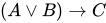
This results in truth tables like this table "showing that (A→C)∧(B→C) and (A∨B)→C are truth-functionally equivalent", modeled after a table produced by Howson:[6]
| T | T | T | T | T |
| T | T | F | F | F |
| T | F | T | T | T |
| F | T | T | T | T |
| F | F | T | T | T |
| F | T | F | F | F |
| T | F | F | F | F |
| F | F | F | T | T |


Size of truth tables
[edit]If there are n input variables then there are 2n possible combinations of their truth values. A given function may produce true or false for each combination so the number of different functions of n variables is the double exponential 22n.
| n | 2n | 22n | |
|---|---|---|---|
| 0 | 1 | 2 | |
| 1 | 2 | 4 | |
| 2 | 4 | 16 | |
| 3 | 8 | 256 | |
| 4 | 16 | 65,536 | |
| 5 | 32 | 4,294,967,296 | ≈ 4.3×10⁹ |
| 6 | 64 | 18,446,744,073,709,551,616 | ≈ 1.8×10¹⁹ |
| 7 | 128 | 340,282,366,920,938,463,463,374,607,431,768,211,456 | ≈ 3.4×1038 |
| 8 | 256 | 115,792,089,237,316,195,423,570,985,008,687,907,853,269,984,665,640,564,039,457,584,007,913,129,639,936 | ≈ 1.2×1077 |
Truth tables for functions of three or more variables are rarely given.
Function Tables
[edit]It can be useful to have the output of a truth table expressed as a function of some variable values, instead of just a literal truth or false value. These may be called "function tables" to differentiate them from the more general "truth tables".[8] For example, one value, G, may be used with an XOR gate to conditionally invert another value, X. In other words, when G is false, the output is X, and when G is true, the output is . The function table for this would look like:

| F | |
| T |


Similarly, a 4-to-1 multiplexer with select imputs and , data inputs A, B, C and D, and output Z (as displayed in the image) would have this function table:


| Z | ||
|---|---|---|
| F | F | A |
| F | T | B |
| T | F | C |
| T | T | D |
Sentential operator truth tables
[edit]Overview table
[edit]Here is an extended truth table giving definitions of all sixteen possible truth functions of two Boolean variables p and q:[note 1]
| T | T | F | F | F | F | F | F | F | F | T | T | T | T | T | T | T | T | |
| T | F | F | F | F | F | T | T | T | T | F | F | F | F | T | T | T | T | |
| F | T | F | F | T | T | F | F | T | T | F | F | T | T | F | F | T | T | |
| F | F | F | T | F | T | F | T | F | T | F | T | F | T | F | T | F | T | |
| Com |  |
|
|
|
|
|
|
| ||||||||||
| Assoc | |
|
|
|
|
|
|
| ||||||||||
| Adj | ||||||||||||||||||
| Neg | ||||||||||||||||||
| Dual | ||||||||||||||||||
| L id | F | F | T | T | T, F | T | F | |||||||||||
| R id | F | F | T | T | T, F | T | F | |||||||||||


where
- T = true.
- F = false.
- The Com row indicates whether an operator, op, is commutative – P op Q = Q op P.
- The Assoc row indicates whether an operator, op, is associative – (P op Q) op R = P op (Q op R).
- The Adj row shows the operator op2 such that P op Q = Q op2 P.
- The Neg row shows the operator op2 such that P op Q = ¬(P op2 Q).
- The Dual row shows the dual operation obtained by interchanging T with F, and AND with OR.
- The L id row shows the operator's left identities if it has any values I such that I op Q = Q.
- The R id row shows the operator's right identities if it has any values I such that P op I = P.[note 2]
Wittgenstein table
[edit]In proposition 5.101 of the Tractatus Logico-Philosophicus,[9] Wittgenstein listed the table above as follows:
Truthvalues Operator Operation name Tractatus[note 3] 0 (F F F F)(p, q) ⊥ false Opq Contradiction p and not p; and q and not q 1 (F F F T)(p, q) NOR p ↓ q Xpq Logical NOR neither p nor q 2 (F F T F)(p, q) ↚ p ↚ q Mpq Converse nonimplication q and not p 3 (F F T T)(p, q) ¬p, ~p ¬p Np, Fpq Negation not p 4 (F T F F)(p, q) ↛ p ↛ q Lpq Material nonimplication p and not q 5 (F T F T)(p, q) ¬q, ~q ¬q Nq, Gpq Negation not q 6 (F T T F)(p, q) XOR p ⊕ q Jpq Exclusive disjunction p or q, but not both 7 (F T T T)(p, q) NAND p ↑ q Dpq Logical NAND not both p and q 8 (T F F F)(p, q) AND p ∧ q Kpq Logical conjunction p and q 9 (T F F T)(p, q) XNOR p iff q Epq Logical biconditional if p then q; and if q then p 10 (T F T F)(p, q) q q Hpq Projection function q 11 (T F T T)(p, q) p → q if p then q Cpq Material implication if p then q 12 (T T F F)(p, q) p p Ipq Projection function p 13 (T T F T)(p, q) p ← q if q then p Bpq Converse implication if q then p 14 (T T T F)(p, q) OR p ∨ q Apq Logical disjunction p or q 15 (T T T T)(p, q) ⊤ true Vpq Tautology if p then p; and if q then q
The truth table represented by each row is obtained by appending the sequence given in Truthvaluesrow to the table[note 3]
p T T F F q T F T F
For example, the table
p T T F F q T F T F 11 T F T T
represents the truth table for Material implication. Logical operators can also be visualized using Venn diagrams.
Nullary operations
[edit]There are 2 nullary operations:
- Always true
- Never true, unary falsum
Logical true
[edit]The output value is always true, because this operator has zero operands and therefore no input values
| p | T |
|---|---|
| T | T |
| F | T |
Logical false
[edit]The output value is never true: that is, always false, because this operator has zero operands and therefore no input values
| p | F |
|---|---|
| T | F |
| F | F |
Unary operations
[edit]There are 2 unary operations:
- Unary identity
- Unary negation
Logical identity
[edit]Logical identity is an operation on one logical value p, for which the output value remains p.
The truth table for the logical identity operator is as follows:
| p | p |
|---|---|
| T | T |
| F | F |
Logical negation
[edit]Logical negation is an operation on one logical value, typically the value of a proposition, that produces a value of true if its operand is false and a value of false if its operand is true.
The truth table for NOT p (also written as ¬p, Np, Fpq, or ~p) is as follows:
| p | ¬p |
|---|---|
| T | F |
| F | T |
Binary operations
[edit]There are 16 possible truth functions of two binary variables, each operator has its own name.
Logical conjunction (AND)
[edit]Logical conjunction is an operation on two logical values, typically the values of two propositions, that produces a value of true if both of its operands are true.
The truth table for p AND q (also written as p ∧ q, Kpq, p & q, or p q) is as follows:

| p | q | p ∧ q |
|---|---|---|
| T | T | T |
| T | F | F |
| F | T | F |
| F | F | F |
In ordinary language terms, if both p and q are true, then the conjunction p ∧ q is true. For all other assignments of logical values to p and to q the conjunction p ∧ q is false.
It can also be said that if p, then p ∧ q is q, otherwise p ∧ q is p.
Logical disjunction (OR)
[edit]Logical disjunction is an operation on two logical values, typically the values of two propositions, that produces a value of true if at least one of its operands is true.
The truth table for p OR q (also written as p ∨ q, Apq, p || q, or p + q) is as follows:
| p | q | p ∨ q |
|---|---|---|
| T | T | T |
| T | F | T |
| F | T | T |
| F | F | F |
Stated in English, if p, then p ∨ q is p, otherwise p ∨ q is q.
Logical implication
[edit]Logical implication and the material conditional are both associated with an operation on two logical values, typically the values of two propositions, which produces a value of false if the first operand is true and the second operand is false, and a value of true otherwise.
The truth table associated with the logical implication p implies q (symbolized as p ⇒ q, or more rarely Cpq) is as follows:
| p | q | p ⇒ q |
|---|---|---|
| T | T | T |
| T | F | F |
| F | T | T |
| F | F | T |
The truth table associated with the material conditional if p then q (symbolized as p → q) is as follows:
| p | q | p → q |
|---|---|---|
| T | T | T |
| T | F | F |
| F | T | T |
| F | F | T |
p ⇒ q and p → q are equivalent to ¬p ∨ q.
Logical equality
[edit]Logical equality (also known as biconditional or exclusive nor) is an operation on two logical values, typically the values of two propositions, that produces a value of true if both operands are false or both operands are true.
The truth table for p XNOR q (also written as p ↔ q, Epq, p = q, or p ≡ q) is as follows:
| p | q | p ↔ q |
|---|---|---|
| T | T | T |
| T | F | F |
| F | T | F |
| F | F | T |
So p EQ q is true if p and q have the same truth value (both true or both false), and false if they have different truth values.
Exclusive disjunction
[edit]Exclusive disjunction is an operation on two logical values, typically the values of two propositions, that produces a value of true if one but not both of its operands is true.
The truth table for p XOR q (also written as Jpq, or p ⊕ q) is as follows:
| p | q | p ⊕ q |
|---|---|---|
| T | T | F |
| T | F | T |
| F | T | T |
| F | F | F |
For two propositions, XOR can also be written as (p ∧ ¬q) ∨ (¬p ∧ q).
Logical NAND
[edit]The logical NAND is an operation on two logical values, typically the values of two propositions, that produces a value of false if both of its operands are true. In other words, it produces a value of true if at least one of its operands is false.
The truth table for p NAND q (also written as p ↑ q, Dpq, or p | q) is as follows:
| p | q | p ↑ q |
|---|---|---|
| T | T | F |
| T | F | T |
| F | T | T |
| F | F | T |
It is frequently useful to express a logical operation as a compound operation, that is, as an operation that is built up or composed from other operations. Many such compositions are possible, depending on the operations that are taken as basic or "primitive" and the operations that are taken as composite or "derivative".
In the case of logical NAND, it is clearly expressible as a compound of NOT and AND.
The negation of a conjunction: ¬(p ∧ q), and the disjunction of negations: (¬p) ∨ (¬q) can be tabulated as follows:
| p | q | p ∧ q | ¬(p ∧ q) | ¬p | ¬q | (¬p) ∨ (¬q) |
|---|---|---|---|---|---|---|
| T | T | T | F | F | F | F |
| T | F | F | T | F | T | T |
| F | T | F | T | T | F | T |
| F | F | F | T | T | T | T |
Logical NOR
[edit]The logical NOR is an operation on two logical values, typically the values of two propositions, that produces a value of true if both of its operands are false. In other words, it produces a value of false if at least one of its operands is true. ↓ is also known as the Peirce arrow after its inventor, Charles Sanders Peirce, and is a Sole sufficient operator.
The truth table for p NOR q (also written as p ↓ q, or Xpq) is as follows:
| p | q | p ↓ q |
|---|---|---|
| T | T | F |
| T | F | F |
| F | T | F |
| F | F | T |
The negation of a disjunction ¬(p ∨ q), and the conjunction of negations (¬p) ∧ (¬q) can be tabulated as follows:
| p | q | p ∨ q | ¬(p ∨ q) | ¬p | ¬q | (¬p) ∧ (¬q) |
|---|---|---|---|---|---|---|
| T | T | T | F | F | F | F |
| T | F | T | F | F | T | F |
| F | T | T | F | T | F | F |
| F | F | F | T | T | T | T |
Inspection of the tabular derivations for NAND and NOR, under each assignment of logical values to the functional arguments p and q, produces the identical patterns of functional values for ¬(p ∧ q) as for (¬p) ∨ (¬q), and for ¬(p ∨ q) as for (¬p) ∧ (¬q). Thus the first and second expressions in each pair are logically equivalent, and may be substituted for each other in all contexts that pertain solely to their logical values.
This equivalence is one of De Morgan's laws.
See also
[edit]

- Boolean domain
- Boolean-valued function
- Espresso heuristic logic minimizer
- Excitation table
- State-transition table
- First-order logic
- Functional completeness
- Karnaugh maps
- Logic gate
- Logical connective
- Logical graph
- Mathematical table
- Method of analytic tableaux
- Propositional calculus
- Truth function
- Decision table
Notes
[edit]- ^ Information about notation may be found in (Bocheński 1959), (Enderton 2001), and (Quine 1982).
- ^ The operators here with equal left and right identities (XOR, AND, XNOR, and OR) are also commutative monoids because they are also associative. While this distinction may be irrelevant in a simple discussion of logic, it can be quite important in more advanced mathematics. For example, in category theory an enriched category is described as a base category enriched over a monoid, and any of these operators can be used for enrichment.
- ^ a b Wittgenstein used a different mapping. In proposition 5.101 of the Tractatus one has to append Truthvaluesrow to the table
p T F T F q T T F F
This explains why Tractatusrow in the table given here does not point to the same Truthvaluesrow as in the Tractatus.
References
[edit]- ^ Enderton 2001
- ^ von Wright, Georg Henrik (1955). "Ludwig Wittgenstein, A Biographical Sketch". The Philosophical Review. 64 (4): 527–545 (p. 532, note 9). doi:10.2307/2182631. JSTOR 2182631.
- ^ Post, Emil (July 1921). "Introduction to a general theory of elementary propositions". American Journal of Mathematics. 43 (3): 163–185. doi:10.2307/2370324. hdl:2027/uiuo.ark:/13960/t9j450f7q. JSTOR 2370324.
- ^ a b Anellis, Irving H. (2012). "Peirce's Truth-functional Analysis and the Origin of the Truth Table". History and Philosophy of Logic. 33: 87–97. doi:10.1080/01445340.2011.621702. S2CID 170654885.
- ^ a b "How to Construct a Truth Table". philosophy.lander.edu. Retrieved 2024-04-05.
- ^ a b c Howson, Colin (1997). Logic with trees: an introduction to symbolic logic. London; New York: Routledge. p. 10. ISBN 978-0-415-13342-5.
- ^ Kleene, Stephen Cole (2013). Mathematical Logic. Dover Books on Mathematics. Courier Corporation. p. 11. ISBN 9780486317076.
- ^ Mano, M. Morris; Ciletti, Michael (2018-07-13). Digital Design, Global Edition (6th ed.). Pearson Education, Limited. ISBN 9781292231167.
- ^ Wittgenstein, Ludwig (1922). Tractatus Logico-Philosophicus (PDF). Proposition 5.101.
Works cited
[edit]- Bocheński, Józef Maria (1959). A Précis of Mathematical Logic. Translated by Bird, Otto. D. Reidel. doi:10.1007/978-94-017-0592-9. ISBN 978-94-017-0592-9.
{{cite book}}: ISBN / Date incompatibility (help) - Enderton, H. (2001). A Mathematical Introduction to Logic (2nd ed.). Harcourt Academic Press. ISBN 0-12-238452-0.
- Quine, W.V. (1982). Methods of Logic (4th ed.). Harvard University Press. ISBN 978-0-674-57175-4.
External links
[edit]
- "Truth table", Encyclopedia of Mathematics, EMS Press, 2001 [1994]
- Truth Tables, Tautologies, and Logical Equivalence
- Converting truth tables into Boolean expressions
| General |  | ||||
|---|---|---|---|---|---|
| Classical logics | |||||
| Principles | |||||
| Rules |
| ||||
| People | |||||
| Works | |||||
| General | |||||||||
|---|---|---|---|---|---|---|---|---|---|
| Theorems (list) and paradoxes | |||||||||
| Logics |
| ||||||||
| Set theory |
| ||||||||
| Formal systems (list), language and syntax |
| ||||||||
| Proof theory | |||||||||
| Model theory | |||||||||
| Computability theory | |||||||||
| Related | |||||||||


Truth table
View on GrokipediaFundamentals
Definition and Purpose
A truth table is a mathematical table used in propositional logic to systematically list all possible combinations of truth values for the atomic propositions in a given logical expression and to determine the resulting truth value of the compound statement formed by those propositions.[11] This tabular representation provides a complete enumeration of how the truth or falsity of a compound statement depends on the truth or falsity of its constituent simple statements.[1] Propositional logic deals with propositions, which are declarative statements that are either true (denoted as T) or false (denoted as F), but not both.[12] Atomic propositions, such as "It is raining," serve as the fundamental units that cannot be broken down further into simpler logical components.[11] Compound statements, in contrast, are constructed by combining atomic propositions using logical connectives, such as conjunction (and) or disjunction (or), to form more complex expressions like "It is raining and the ground is wet."[12] The primary purpose of a truth table is to exhaustively evaluate a logical expression across every possible assignment of truth values to its atomic propositions, enabling the identification of key logical properties without ambiguity.[13] Specifically, it verifies whether an expression is a tautology (true in all cases), a contradiction (false in all cases), or a contingency (true in some cases and false in others), thus facilitating formal verification and analysis of logical validity.[14] This method ensures a precise, mechanical assessment of propositional relationships, bridging natural language reasoning with rigorous formal systems.[15] For illustration, consider a single atomic proposition . Its truth table enumerates the two possible truth values:| T |
| F |
Basic Components
A truth table is structured as a tabular array consisting of rows and columns that systematically represent the possible truth values of logical expressions. The columns are dedicated to each atomic proposition, serving as inputs, with an additional column for the compound expression that functions as the output. This layout allows for the evaluation of how the truth value of the compound expression depends on the inputs.[1] The rows correspond to all possible combinations of truth values for the atomic propositions, resulting in rows where is the number of distinct atomic propositions. This principle of exhaustive enumeration ensures that every conceivable assignment of truth values to the inputs is accounted for, providing a complete overview of the expression's behavior.[1][17] Truth values in the table are conventionally denoted by 'T' for true and 'F' for false, although the binary notation '1' for true and '0' for false is also frequently used, particularly in computational contexts. The organization proceeds from left to right, with input columns preceding the output column, and each column is labeled with a header identifying the proposition or subexpression it represents.[1] As an illustration, for the compound expression involving two atomic propositions and , the basic structure features four rows capturing the input combinations and their corresponding output evaluations, presented below:| T | T | T |
| T | F | F |
| F | T | F |
| F | F | F |
Historical Development
Origins in Symbolic Logic
The development of truth tables emerged from foundational advancements in symbolic logic during the late 19th century, particularly through efforts to create systematic notations for expressing logical relations beyond traditional syllogistic forms. Gottlob Frege's Begriffsschrift (1879) introduced a formal notation modeled on arithmetic, enabling the precise representation of judgments, implications, and quantifiers, which laid the groundwork for modern propositional and predicate logics by shifting focus from categorical syllogisms to functional expressions of truth values.[18] Similarly, Charles Sanders Peirce's work in 1893 on graphical logic and the algebra of relatives advanced truth-functional analysis, incorporating the enumeration of possible combinations in Boolean algebras to analyze relational structures and hypothetical syllogisms, thereby emphasizing exhaustive case consideration as a deductive tool.[19] These innovations occurred amid philosophical debates in the 19th century contrasting Aristotelian syllogistic logic, which emphasized term relations in categorical propositions, with emerging propositional calculi inspired by George Boole's algebraic approach, where logic was treated as a system of operations on truth values rather than fixed syllogistic moods.[20] Frege and Peirce contributed to this shift by mechanizing deduction through symbolic systems that abstracted from natural language ambiguities, allowing for the verification of logical validity via systematic enumeration of possibilities, a precursor to tabular representations.[21] A pivotal formalization came with Emil Post's 1921 dissertation, "Introduction to a General Theory of Elementary Propositions," which explicitly introduced truth tables as matrices enumerating all possible truth-value assignments to atomic propositions, demonstrating the completeness of propositional logic for tautologies and contradictions. Truth tables were independently introduced around 1920–1921 by Post, Ludwig Wittgenstein, and Jan Łukasiewicz, the latter extending the method to multi-valued logics. Post credited Wittgenstein's unpublished notes from 1918–1919, which outlined truth tables in the context of his picture theory of language, influencing Post's method for reducing compound propositions to truth-functional forms.[22][23]20th-Century Advancements
In the early 1920s, Ludwig Wittgenstein advanced the conceptual framework of truth tables through his Tractatus Logico-Philosophicus (1921), where he employed them implicitly as a diagrammatic tool to depict the truth conditions of elementary propositions and their combinations, particularly in propositions 4.31 and 4.42, which illustrate how tautologies and contradictions arise from all possible truth-value assignments. This representation emphasized the bipolar nature of propositions—capable of being true or false—and solidified truth tables as a method for analyzing logical form without reference to content.[24] Preceding Wittgenstein slightly, Clarence Irving Lewis's A Survey of Symbolic Logic (1918) marked a pivotal extension by introducing strict implication in modal logic through axiomatic systems, incorporating modalities such as necessity and possibility to evaluate implications beyond classical two-valued systems.[25] Lewis's approach addressed limitations in material implication by considering alternative possible situations, laying groundwork for non-classical logics while demonstrating the versatility of symbolic methods in reasoning. During the 1930s, truth tables gained mathematical rigor through integration with Boolean algebra in works by logicians including Haskell Curry, whose foundational explorations in combinatory logic and later texts referenced binary truth tables to define functional completeness and propositional connectives.[26] This formalization aligned truth tables with algebraic structures, enabling systematic proofs of equivalence and completeness in propositional systems. Alan Turing's seminal 1936 paper, "On Computable Numbers, with an Application to the Entscheidungsproblem," further highlighted their utility by contrasting the decidability of propositional logic—resolvable via finite truth table enumeration—with the undecidability of higher-order predicate logic, underscoring their role in computability theory. In mid-20th-century analytic philosophy, truth tables facilitated precise examinations of meaning and analyticity, as evident in Willard Van Orman Quine's Methods of Logic (1950), which utilized truth-functional tables to dissect logical truths and challenge the analytic-synthetic distinction through examples of synonymy and interchangeability.[27] Quine's application emphasized truth tables' power in revealing the conventional aspects of logic, influencing debates on language and empiricism throughout the 1950s. By the decade's end, Irving M. Copi's Introduction to Logic (1953) popularized and standardized truth table notation in pedagogical contexts, presenting them as an essential technique for constructing and verifying truth-functional compounds in propositional arguments.[28] The 1960s witnessed truth tables' migration from theoretical tools to practical applications in computing, where they informed early digital verification processes within computer-aided design systems for integrated circuits, enabling simulation and error-checking of Boolean networks.[29] This shift, exemplified in IBM's 1966 development of electronic design automation tools, bridged logical analysis with hardware synthesis, accelerating the verification of complex gate-level behaviors.Construction Techniques
Alternating Method
The alternating method provides a straightforward procedure for generating the input combinations in a truth table by filling variable columns with systematic patterns of true (T) and false (F) values, ensuring all possible combinations are exhaustively covered without duplication or omission. This approach is especially suitable for small numbers of variables, typically up to four or five, where manual construction is feasible.[30] To apply the method, begin with the leftmost column, assigning T to the first half of the rows and F to the second half. For the next column, alternate T and F in blocks of two rows each, repeating the pattern across the entire table. Proceed to subsequent columns by halving the block size for each (e.g., blocks of four, then two, then one), always alternating between T and F blocks. This progressive blocking guarantees a complete enumeration of the combinations for variables.[30] For three variables , , and , the input columns are constructed as follows:| T | T | T |
| T | T | F |
| T | F | T |
| T | F | F |
| F | T | T |
| F | T | F |
| F | F | T |
| F | F | F |
Combinatorial Method
The combinatorial method for constructing the input section of a truth table enumerates all possible truth value assignments to the propositional variables by forming the Cartesian product of the set {T, F} raised to the power of the number of variables, yielding every conceivable combination systematically. This approach treats each variable independently, ensuring that the rows represent the complete set of interpretations for the formula under consideration.[11] The order of these combinations can follow binary numerical sequencing, where F maps to 0 and T to 1, progressing from 0 to in binary representation, or lexicographical ordering based on treating T and F as symbols. For instance, with two variables and , the rows are:| T | T |
| T | F |
| F | T |
| F | F |
Scale and Representation
Determining Table Size
The size of a truth table for a propositional formula in classical binary logic is determined by the number of atomic propositions, denoted as . The table requires rows to enumerate all possible truth value assignments to these propositions, with each row representing one unique combination of true (T) or false (F) values. In addition to these rows, the table features columns for the input variables and at least one column for the output of the formula, yielding a minimum of columns.[35][36] This exponential growth renders truth tables feasible only for modest . For instance, a single variable produces 2 rows, three variables yield 8 rows, and ten variables result in 1,024 rows, already approaching the limits of manual or simple computational handling. Beyond such scales, the sheer volume of entries—reaching over a million for —makes exhaustive tabulation impractical for analysis or verification.[31][37] The presence of connectives in the formula, such as negations or conjunctions, does not increase the row count, which remains fixed by , but each connective necessitates an extra column for evaluating its subformula's truth values step by step. In extensions to multi-valued logics, where each proposition can take one of truth values (e.g., true, false, and indeterminate), the row count escalates to , amplifying the challenges of scale./02%3A_Logic/2.03%3A__Constructing_Truth_Tables) These computational constraints have prompted alternatives like Karnaugh maps for , which visualize and simplify Boolean functions without requiring the full table's enumeration.[38]Boolean Function Tables
A truth table for a Boolean function with variables fully specifies the function by listing all possible input combinations and their corresponding outputs.[39] The rows where the output is 1 identify the minterms of the function, which are the product terms (conjunctions) of the literals corresponding to those inputs; conversely, rows with output 0 define the maxterms, which are the sum terms (disjunctions) for those inputs.[40] This representation ensures that every possible Boolean function can be uniquely encoded, providing a complete enumeration of its behavior.[41] From the minterms, the function can be expressed in its canonical disjunctive normal form (DNF), also known as sum-of-products form, which is the disjunction (OR) of all minterm products.[39] Similarly, the maxterms yield the canonical conjunctive normal form (CNF), or product-of-sums form, as the conjunction (AND) of all maxterm sums.[42] For example, the exclusive-or (XOR) function for two variables and , which outputs 1 only when the inputs differ, has minterms for inputs (0,1) and (1,0), leading to the DNF expression: [43] This canonical form is unique for a given variable ordering and directly derives from the truth table, facilitating algebraic manipulation and circuit synthesis.[39] A practical illustration is the majority function for three variables , , and , which outputs 1 if at least two inputs are 1. The truth table is as follows:| 0 | 0 | 0 | 0 |
| 0 | 0 | 1 | 0 |
| 0 | 1 | 0 | 0 |
| 0 | 1 | 1 | 1 |
| 1 | 0 | 0 | 0 |
| 1 | 0 | 1 | 1 |
| 1 | 1 | 0 | 1 |
| 1 | 1 | 1 | 1 |
Truth Tables for Connectives
Nullary Connectives
Nullary connectives in propositional logic are operators that take no arguments and evaluate to a fixed truth value regardless of any propositional variables, serving as constant propositions. They are denoted by the symbols ⊤ (top, representing logical true) and ⊥ (bottom, representing logical false), which function as logical constants in formal systems.[49] These connectives are fundamental in truth-functional semantics, where their meaning is defined solely by their constant output under any truth assignment.[50] The truth table for ⊤ is a single-row table with no input columns, as it depends on zero propositions, and its output is always true (T), embodying a tautology that holds universally. In contrast, the truth table for ⊥ has a single row with output false (F), signifying a contradiction that never holds. These tables are the simplest form of truth tables, with just one possible "assignment" (the empty one).[51]| ⊤ |
|---|
| T |
| ⊥ |
|---|
| F |
Unary Connectives
Unary connectives in propositional logic are operators that take a single proposition as input and produce a truth value based on that input alone, resulting in truth tables with two rows corresponding to the possible truth values of the input proposition, true (T) or false (F). These connectives are fundamental for building more complex expressions and are distinct from nullary connectives, which yield constant outputs independent of any input. The most prominent unary connective is logical negation, denoted by ¬ or ~, which inverts the truth value of its argument. The truth table for logical negation ¬P is presented below, where the output is false when P is true and true when P is false:| P | ¬P |
|---|---|
| T | F |
| F | T |
| P | id(P) |
|---|---|
| T | T |
| F | F |
| P | P ↓ P |
|---|---|
| T | F |
| F | T |
Binary Connectives
Binary connectives in classical propositional logic combine two propositions, P and Q, each of which can be true (T) or false (F), yielding four possible input combinations that determine the output via a truth table. These connectives form the foundation for expressing complex logical relationships, with their semantics defined exhaustively by such tables.[11] The conjunction (∧), also known as logical AND, is true only when both inputs are true; otherwise, it is false. Its truth table is as follows:| P | Q | P ∧ Q |
|---|---|---|
| T | T | T |
| T | F | F |
| F | T | F |
| F | F | F |
| P | Q | P ∨ Q |
|---|---|---|
| T | T | T |
| T | F | T |
| F | T | T |
| F | F | F |
| P | Q | P → Q |
|---|---|---|
| T | T | T |
| T | F | F |
| F | T | T |
| F | F | T |
| P | Q | P ↔ Q |
|---|---|---|
| T | T | T |
| T | F | F |
| F | T | F |
| F | F | T |
| P | Q | P ⊕ Q |
|---|---|---|
| T | T | F |
| T | F | T |
| F | T | T |
| F | F | F |
| P | Q | P ↑ Q |
|---|---|---|
| T | T | F |
| T | F | T |
| F | T | T |
| F | F | T |
| P | Q | P ↓ Q |
|---|---|---|
| T | T | F |
| T | F | F |
| F | T | F |
| F | F | T |
Applications
Propositional Logic Analysis
In propositional logic, truth tables serve as a fundamental method for evaluating the semantic properties of compound formulas, enabling the classification of formulas based on their behavior across all possible truth value assignments to their atomic propositions. This analysis is crucial for understanding logical validity, inconsistency, and equivalence without relying on syntactic derivations alone.[1] Key classifications include tautologies, which are formulas that yield true (T) in every row of their truth table; contradictions, which yield false (F) in every row; and contingencies, which produce a mix of T and F outcomes depending on the variable assignments.[58] These properties help identify formulas that hold universally, those that are impossible, or those whose truth varies with context.[59] The standard procedure involves listing all possible combinations of truth values for the distinct propositional variables in the formula, then computing the formula's value row by row using the definitions of the connectives, and finally examining the resulting output column to determine the classification.[60] A classic example of a tautology is the law of excluded middle, , which asserts that a proposition is either true or false. Its truth table confirms this property:| T | F | T |
| F | T | T |
| T | T | T | F | T | T |
| T | F | F | F | F | T |
| F | T | T | T | T | T |
| F | F | T | T | T | T |
Digital Logic Design
In digital logic design, truth tables serve as a foundational tool for specifying and verifying the behavior of logic gates, which directly implement Boolean connectives in hardware. The AND gate corresponds to the conjunction connective, outputting true only when all inputs are true; its truth table for two inputs A and B is:| A | B | A ∧ B |
|---|---|---|
| 0 | 0 | 0 |
| 0 | 1 | 0 |
| 1 | 0 | 0 |
| 1 | 1 | 1 |
| A | B | S (A ⊕ B) | C (A ∧ B) |
|---|---|---|---|
| 0 | 0 | 0 | 0 |
| 0 | 1 | 1 | 0 |
| 1 | 0 | 1 | 0 |
| 1 | 1 | 0 | 1 |
| S1 | S0 | Y |
|---|---|---|
| 0 | 0 | I0 |
| 0 | 1 | I1 |
| 1 | 0 | I2 |
| 1 | 1 | I0 |