


Community hub
Recent from talks
Contribute something
Nothing was collected or created yet.
Meat ant
View on Wikipedia
| Meat ant | |
|---|---|

| |
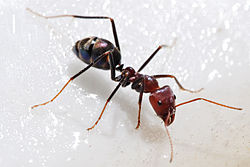
| Meat ant worker feeding on honey | |
Scientific classification 
| |
| Kingdom: | Animalia |
| Phylum: | Arthropoda |
| Class: | Insecta |
| Order: | Hymenoptera |
| Family: | Formicidae |
| Subfamily: | Dolichoderinae |
| Genus: | Iridomyrmex |
| Species: | I. purpureus
|
| Binomial name | |
| Iridomyrmex purpureus (Smith, 1858)
| |
| Synonyms[1] | |
| |
The meat ant (Iridomyrmex purpureus), also known as the gravel ant or southern meat ant, is a species of ant endemic to Australia. A member of the genus Iridomyrmex in the subfamily Dolichoderinae, it was described by British entomologist Frederick Smith in 1858. The meat ant is associated with many common names due to its appearance, nest-building behaviour and abundance, of which its specific name, purpureus, refers to its coloured appearance. It is among the best-known species of ant found throughout Australia; it occurs in almost all states and territories except for Tasmania. Its enormous distribution, aggression and ecological importance have made this ant a dominant species.
The meat ant is monomorphic (occurs in a particular form), although there is evidence that certain populations can be polymorphic. It is characterised by its dark-bluish body and red head. It is a medium to large species, measuring 6–12 mm (0.24–0.47 in). The workers and males are approximately the same sizes at 6–7 mm (0.24–0.28 in) and 8 mm (0.31 in), respectively. The queens are the largest and appear mostly black, measuring 12.7 mm (0.50 in). The iridescence in workers ranges from green or blue to plain green and purple, varying in different body parts and castes. Meat ants inhabit open and warm areas in large, oval-shaped mounds that are accompanied by many entrance holes. The nest area is always cleared of vegetation and covered with materials including gravel, pebbles and dead vegetation. They are also polydomous, where a colony may be established in a series of satellite nests connected by well-defined paths and trails. Satellite nests are constructed away from the main nest and nearby areas with valuable food sources so workers can exploit them.
Queens mate with a single male and colonies may have more than one queen until the workers arrive, where they both exhibit antagonism. It takes around one or two months for an individual egg to develop into an adult. Colonies range in size, varying between 11,000 individuals to over 300,000. The meat ant is a diurnal species (active throughout most of the day), especially when it is warm. It forages on trees and collects sweet substances such as honeydew and nectar, and also captures insects or collects the remains of animals. A number of predators eat these ants, including the short-beaked echidna (Tachyglossus aculeatus), numerous species of birds, blind snakes and spiders. This species is also a competitor of the banded sugar ant (Camponotus consobrinus). Meat ants establish territorial borders with neighbouring colonies and solve disputes through ritualised fighting.[2]
Meat ants play an important role in both the environment and for humans. A single nest is capable of dispersing over 300,000 plant seeds; moreover, meat ants have formed symbiotic relationships with many insects. This ant may be used as a form of pest control to kill the cane toad, an invasive species. They can also help farmers to remove animal carcasses by consuming and reducing them to bones in a matter of weeks. Despite this, meat ants are sometimes pests around urban areas and eradicating them is difficult.
Taxonomy
[edit]
The meat ant was first described in 1858 by British entomologist Frederick Smith in his Catalogue of Hymenopterous Insects in the Collection of the British Museum part VI, under the binomial name Formica purpurea from a holotype worker ant he collected in Melbourne, Victoria.[3] The type material is currently housed in the Natural History Museum, London.[4] In 1862, Austrian entomologist Gustav Mayr erected the genus Iridomyrmex, and reclassified the meat ant as a member of Iridomyrmex rather than the genus Formica.[5] The ant was named Iridomyrmex purpurea in 1862. Mayr renamed the ant as Iridomyrmex purpureus one year after.[6] I. purpureus was later classified as a synonym of Iridomyrmex detectus, and this taxon was designated as the type species of Iridomyrmex in 1903.[7][8][9]
In 1993, I. detectus was synonymised with I. purpureus and grouped into the I. purpureus species complex. I. detectus was described as a separate species by Smith the same year as I. purpureus from two syntype queens he collected from the Hunter River in New South Wales. Although the name I. purpureus was used by many authors, Karl Wilhelm von Dalla Torre reused I. detectus and this was adopted by several authors, replacing I. purpureus.[10] By the 1960s I. purpureus once again became preferred over I. detectus. While the two names were described in the same year and publication, the name I. purpureus is the valid name for the species in accordance with the International Code of Zoological Nomenclature. Entomologist B.T. Lowne was the first person to revise I. purpureus and I. detectus, and he synonymised the two species.[10][11]
Several synonyms have either been classified as a separate species from the meat ant or even a subspecies. Iridomyrmex purpureus sanguineus and I. p. viridiaeneus were classified as subspecies in 1974, previously being recognised as two species. I. detectus castrae was originally described as a variant of the meat ant in 1925 (as I. d. var. castrae), but the taxon was reclassified as a subspecies in 1985; subsequently, a 1993 revision reclassified I. p. sanguineus and I. p. viridiaeneus at species level while I. d. castrae was synonymised, based on morphological examinations of collected material.[10][12][13]
Camponotus horni, Formica smithii and Liometopum aeneum were described as three distinct species in three different ant genera, but these classifications were short-lived, as scientists discovered that these taxa were all identical, and subsequently synonymised them with the meat ant.[10][14] Camponotus horni was described by English entomologist William Forsell Kirby in 1896 from worker and queen syntypes he collected at Palm Creek in the Northern Territory. In 1930, Australian entomologist John S. Clark reviewed these specimens and synonymised the taxon with the meat ant. However, the queen was later found to be distinct from the workers and C. horni was redescribed as a species. The information provided by Clark makes it sufficient to retain the validity of the name, making Clark the new author of C. horni. Due to the uncertain taxonomic status of Clark's C. horni, a proposal to rename the species cannot be carried through. Clark's C. horni is currently a junior homonym for Kirby's C. horni.[10]

One synonym, Iridomyrmex greensladei, was described as a separate species from the meat ant based on the anatomical differences of its head and pronotum (the dorsal portion of the prothorax's exoskeletal plates), which are the same colour as its mesosoma. In the meat ant, the head and pronotum are usually lighter than the mesosoma.[4] American entomologist Steve Shattuck notes that the two ants are non-sympatric (they exist in the same geographic area and regularly encounter each other), and supporting evidence to separate them as two distinct species emerged when the enzymes esterase and amylase were examined and the results show that they had different amylase allele.[16][17]
These examinations did not take any account of any distinction in colour between populations previously known as I. greensladei and I. purpureus. For example, colonies residing in Western Australia may have lighter heads whereas those living in the eastern states have darker heads. An unpublished study examining the mitochondrial DNA did not find any distinction between eastern and western populations of I. greensladei and I. purpureus.[4] Additional evidence suggests that the populations found in the east and west are the same species.[4]
Despite this evidence, there are several problems: forms intended to be I. greensladei were found in the Yorke Peninsula by a 1987 study, which noted that while the ants were morphologically indistinguishable from both I. greensladei and I. purpureus populations, their nests only contained a single nest hole (whereas I. purpureus nests have many).[18] Shattuck also collected workers for his holotype and paratype specimens from Israelite Bay in Western Australia, rather than collecting those from Yorke Peninsula. The forms in Yorke Peninsula have also never been subject to study, so future research may shed light as to whether or not these ants are genetically different from the meat ant.[4]
Under the present classification, the meat ant is a member of the genus Iridomyrmex in the tribe Leptomyrmecini, subfamily Dolichoderinae. It is a member of the family Formicidae, belonging to the order Hymenoptera,[19] an order of insects containing ants, bees, and wasps. The genus Froggattella is the sister group of Iridomyrmex, both of which are in a clade that is 23 million years old.[20] Fossils related to the meat ant and other species are from the Eocene and Oligocene.[21]
Forms
[edit]

In the early 1970s, scientists discovered several different forms of meats ants, forming the Iridomyrmex purpureus species group; three forms were identified (the regular I. purpureus and the other two forms I. sanguineus and I. viridiaeneus), differing in colour and nest structure. However, as there were no clear morphological differences among these variations, the taxonomic status and evolutionary relationship of these ants remained uncertain.[22][23] Colouration varies from ants with a red head and thorax and a blue metallic sheen, to those with a yellowish body and a bluish-purple gaster. Others may be darker, appearing metallic-bluish to purplish-black.[22]
Owing to their different geographical ranges, the behaviour and ecology of these forms differentiated, based on examinations where multiple forms were sympatric.[23] Each form had its own geographical limit, although the regular I. purpureus form is very common, inhabiting at least one-third of the Australian continent. Some forms may be dominant in certain habitats; for example, one form may be widespread throughout moist environments in dry areas, and others in cool and dry areas.[22]
In 1974, I. sanguineus and I. viridiaeneus were classified as two subspecies of the meat ant by P.J. Greenslade. He also recognised another form, an undescribed blue form that was first studied several years earlier.[24][25][26] Greenslade did not propose any taxonomic recognition of the newly discovered taxon, but instead referred to it as a "form".[10] In 1975, a study examined the distinctiveness of three forms by comparing the amylase enzyme allele frequencies. The blue form was found to be genetically isolated and its allele frequencies differed significantly from the forms purpureus and viridiaeneus, but the same study concluded that these latter two forms were similar.[27] During this time, Greenslade would continue to study these forms to include a dark yellow, yellow, orange and a small purple form.[10]
In addition, two new forms were recognised in later studies, but these two forms were not given any formal species description. Instead, they were only recognised by their colour and the genitalia of the males.[28] Although these forms most likely represented undescribed, yet distinct species, the I. purpureus species group only contained a single valid species, three subspecies and seven different forms. In 1993, all known forms and subspecies were either revived or classified at species level in an article revising the group, concluding the separation of the forms from each other.[10]
Etymology and common names
[edit]The specific epithet of the meat ant, purpureus, derives from Latin, in which it means "purple", "purple-coloured" or "dark-red", referencing the coloured appearance of the ant.[29] In classical Latin, purpureus primarily translated to "dyed purple", while the word purpura, used by Smith for the meat ant (Formica purpura), translates to "purpled-dyed cloth".[3][30] The generic name, Iridomyrmex, translates to "rainbow ants" from Ancient Greek, another reference which points to its appearance. This, in particular, is due to its blue-green iridescence colour.[31] It is a compound of two Ancient Greek words – iris, meaning "rainbow", and myrmex, that means "ant".[32][33]
The ant is commonly known as the meat ant because of its habit of stripping the meat off dead vertebrates.[34] Alternative names include the gravel ant,[35] Greenslade's meat ant,[36] meat-eater ant, mound ant,[37] or southern meat ant. The name "southern meat ant" is due to its extreme abundance in the southern regions of Australia.[38]
Description
[edit]
In general, meat ants are medium to large in size, measuring 6–12 mm (0.24–0.47 in), and can be easily recognised by their dark-bluish body and red head.[39] Generally, their heads and pronotums share similar colours and are lighter than the mesothorax (the middle of the three segments in the thorax) and the propodeum (the first abdominal segment), which are reddish brown. However, the head may sometimes be lighter, and the pronotum and mesothorax may share similar colours. The mesosomal setae (as in hair found on the mesosoma) are dark and sometimes translucent. The iridescence between the compound eyes and the lateral portion of the head ranges from slightly purple to strong and dark purple. The colour of the legs and coxae (the basal segment of the insect leg, which attaches to the body) are darker than the mesothorax, and the petiole (narrow waist) is reddish brown and also darker than the mesothorax.[10]
The lateral portion of the second gastral tergite (a dorsal segment other than the head) is shiny, and the iridescence varies among workers, from green or blue to plain green and purple. The soft hairs on the head are frequent around the occipital margin, and around the mandibular insertion, three to eight pale setae are usually seen. The soft hairs are also common around the first gastral tergite. Examined specimens show no known ocelli. Erect setae on the pronotum are abundant. The anterodorsal (meaning in front and toward the back) portion of the propodeum is arched and flat.[10]
There are no allometric differences among workers.[4] On average, workers measure around 6–7 mm (0.24–0.28 in); this character distinguishes these ants from queens, as well as the different variety of colours they exhibit on their bodies.[4][40] The head and pronotum range from orange to brick-red, and the mesonotum and propodeum are either light, same in colour or darker than the head. The gaster can be brown or black with blue or purple iridescence and the legs are either orange or brown. The iridescence around the foreparts is blue, pink, pale greenish yellow and purple. The erect setae are brown. The head has a concave posterior margin (as in the end of an organism from its head) with erect setae abundant in front of the face. The sides of the head are convex.[4]
Fully erect setae on the genal (side region of the head) are either present or absent, although a small number of setae may be seen around the mandibular insertion. The eyes are semicircular and positioned around the midpoint of the ants' head capsule. The frontal carinae (a keel-shaped ridge or structure) are convex and the antennal scapes extend beyond the head's posterior margin by two or three times the diameter. Erect setae are found all over the antennal scape and noticeably prominent on the clypeal margin (a shield-like plate at the front of an insect). The mandibles are elongated and triangular, with long curved setae around the head capsule.[4]
The pronotum is evenly curved with at least 12 or more pronotal setae present. These setae are mostly short and bristly. The mesonotum is sinuous (meaning it has many curves), and, like the pronotum, has 12 or more mesonotal setae. The mesothoracic spiracles are very small and the propodeal dorsum is smooth or convex. There are also a number of propodeal setae.[4] The dorsum of the node (a segment between the mesosoma and gaster) is thin, scale-like and sometimes vertical. There are both non-marginal and marginal setae present on the first gastral tergite around the gaster.[4]

Queens are easily distinguishable from workers by their black colour and larger size, measuring 12.7 mm (0.50 in).[3] Queens are black, being mostly dark. The antennae and legs are ferruginous (rust-like colour), the head is fusco-ferruginous, and the sides beneath the face and mandibles are ferruginous. The head is wider than the thorax and emarginate. There is an impressed line that runs from the anterior (nearer to the front of the body) stemma to the base of the clypeus.[3] The thorax is ovate (has an oval-shaped outline) and thinly covered with short reddish brown pubescence (soft short hair). The wings are subhyaline, exhibiting a glassy appearance. The wings are yellowish along the anterior margin of the superior pair and also around the base; the nervures (the veins of the wings) are rufo-fuscous.[3]
Like the thorax, the abdomen is ovate and several abdominal segments appear rufo-piceous, making it reddish-brown or glossy brownish black.[3] Males are smaller than queens, measuring 8 mm (0.31 in). Males are bright violet, and the antennae (except for the first joint) and tarsi are ferruginous.[11] The first pair of the legs look almost ferruginous, and the head, legs and thorax are covered with black pubescence. Like the queen, the wings are subhyaline (imperfectly hyaline) and the nervures are rufo-fuscous. The abdomen shows a bright green tinge when seen under certain light.[11]

Larvae measure 2.7–2.9 mm (0.11–0.11 in).[41] The body is stout-shaped and the dorsal side is longer whereas the ventral side (the bottom portion of the body) is shorter and more straight. The head and anus are ventral. The integument is covered in spinules that are either isolated from each other or in short rows on the posterior somite and on the ventral surface. The body hairs are very short, measuring 0.008–0.016 mm (0.00031–0.00063 in).[41] The cranium on its dorsal side outlines a curve which is smooth, and the spinules are moderately large. These spinules are either isolated or seen in near parallel rows. Several head hairs are present but they are small at 0.013–0.025 mm (0.00051–0.00098 in) in length.[41]
The labrum is narrow and bilobed (consisting of two lobes). Each lobe has spinules and three sensilla (simple sensory receptors) around the anterior surface. The ventral border only has two sensilla and a number of spinules, and on the posterior surface, there are several rows of spinules and three sensilla. The mandibles have a central apical (most distal plate or appendage from the body) tooth which is clearly noticeable and sharp. The maxillae have lobes, and the labial palps (sensory structures on the labium) are knob-shaped.[41]
Meat ant workers may be confused with those of I. lividus, as the two appear similar and are grouped in the same species complex.[4] I. lividus and the much more localised I. spadius can be distinguished from other members of the I. purpureus group by the shape of the pronotum. Aside from colour differentiation that was a key morphological character to distinguish I. purpureus and the synonym I. greensladei from each other, some meat ant populations exhibit polymorphism despite being monomorphic (occurs in a particular form); specifically, body size among meat ants may vary geographically. For example, those that are found in very hot regions tend to be larger, whereas those found in regions of high humidity tend to be smaller than average.[42]
Examined workers once referred to as I. greensladei from southwestern Western Australia have erect setae on the genae (lateral sclerites), whereas those studied elsewhere have glabrous genae, meaning that these areas have no hairs.[4] Such patterns are most likely clinal, where several characteristics may gradually differentiate over a geographical area.[10] The colour of the setae throughout the body and the iridescence may vary geographically. For example, populations restricted to the coasts of Western Australia usually have pale setae, compared to most colonies throughout the country, which have the common blackish setae.[4] In 1993, Shattuck could not separate populations with pale setae when other key diagnostic traits that would separate these populations were not considered.[10]
Meat ants from the Western Australian wheatbelt and goldfields show different iridescence; the iridescence in some collected specimens ranged from pale greenish-blue to yellowish-green, especially around the humeri (a structure which forms the basal corner of an insect's wing or wing case) and frons. The variation of the iridescence is, however, a consistent pattern found in other Iridomyrmex species with little distinction, making it a subtle character.[4] The colour variation is less marked in all collected specimens of I. purpureus, as well as its close relative I. viridiaeneus, which is found in dry regions around the south-western regions. Shattuck further notes that populations found throughout the Northern Territory and South Australia have reduced pubescence on the first gastral tergite, but this is different elsewhere.[4]
Distribution and habitat
[edit]
The meat ant is one of the best-known species of ant endemic to Australia; it has an enormous geographical range, covering at least one-third of the continent.[22][43] Its range spans 4,000 kilometres (2,500 mi) from east to west, and 3,000 kilometres (1,900 mi) from north to south.[42] This extensive range has allowed the meat ant to form large nesting grounds in areas where no development has occurred, and large amounts of gravel and open space have led to an abundant supply of materials (i.e. pebbles and dead pieces of vegetation)[35] used to construct nests. Its isolation has also allowed meat ants to form associations with neighbouring nests of the same species.[44] The ant is particularly dominant and frequently seen across the coastal and inland regions of southeastern Australia.[45][2] Based on examined material, meat ants are widespread throughout New South Wales, the Australian Capital Territory and Victoria. In Queensland, they are frequently encountered in the eastern regions, whereas their abundance is limited around the north and central parts.[4][10] The ants are common in the southwestern regions of Western Australia, though not in the north.[4] However, the Division of Entomology of the CSIRO states that the ant's presence in the state has not been verified.[46] Most specimens collected in South Australia are from the south-east, but some populations are known in the north-west and northeast regions of the state. In the Northern Territory, specimens have been collected in the north and south regions but compared to other jurisdictions the ant is uncommon.[4] No specimens have been collected from Tasmania or any outlying islands surrounding Australia.[47]
Meat ants thrive in varied habitats, especially where it is open and warm.[48] These ants are adapted to and thrive in warm climates and areas with constant high temperatures. The meat ant shares its distribution with many other animals and insects, some of which may cause harm to the ant or rival it, such as the banded sugar ant (Camponotus consobrinus).[44][49] Nests are seen in box-pine scrubs, Callitris forests, dry and wet sclerophyll woodland, eucalypt open woodland, in farm pastures, flat savannah woodland, mallee woodland, heath, mulga, riparian woodland, around roads and cracks in sidewalks, and urban areas such as urban gardens and parkland.[35][45][50] Nests are also common in lateritic ridges, granite outcrops and clay formations. Meat ants are able to survive in dry areas if there is a rich supply of water and food resources (such as honeydew and arthropod prey), especially along river banks, station properties and irrigated areas. Meat ants typically occur at altitudes of 5 and 1,170 m (16 and 3,839 ft) above sea level, though at times they can be found at heights of 915 m (3,002 ft).[22][50] Those that are found at these altitudes are always associated with Eucalyptus rubida, and colonies situated in eastern New South Wales tend to nest near E. melliodora and E. blakelyi. In the south coast of New South Wales, meat ants are mainly found in heath shrubland, but are absent from heavily timbered slopes and cannot build nests in quartz. Other areas where the ants do not occur include dense pastures, dense bushes, tropical rainforests and treeless areas.[47] For example, the Canberra suburb of Turner was constructed on subterranean clover pasture, which meat ants do not nest around. Their populations would later flourish and nests became numerous around houses after shrubs and trees were planted.[22]
Nests
[edit]
Meat ants are well known for their large, oval-shaped nest-mounds (normally 1 or 2 metres (3.3 or 6.6 ft) in diameter) that are encountered in areas of occurrence, and obvious to identify.[24][35][51][52] These nests are often associated with many entrance holes; most nests have 20 to 35 holes. On the surface on the nest, workers clear the area of vegetation and cover the mound with gravel, but may use other materials that are available, including sand, pebbles, dead vegetation, eucalyptus fruits and twig fragments.[35][51] Nests are built in the sun and hardly in the shade to keep them warm. The ant is a polydomous species, meaning that they live in more than one nest.[53] Some colonies are known to create "super-nests": workers construct many nests connected through established paths, extending up to 650 metres (2,130 ft) in length.[21] In one extreme case, a single colony was found to occupy over 10 hectares (25 acres) of land with 85 individual nests and 1,500 entrance holes.[54] While they show no aggression toward their own nest mates, meat ants are aggressive to occupants of different nests within the same colony.[53][55] Polydomy within a colony is typically favoured as it improves access to forage, as workers deliver most of their food to the nest that is closest to any site they forage in.[56]
At any size, a meat ant nest always has a possibility of dying out in any year, but the site may be reoccupied by another colony. Hence, nests can be very old as suggested in one study.[57] Some nests may never be reoccupied for unknown reasons. The regrowth of vegetation which shades the nest, soil damage or even a disease may wipe out a colony and leave the nest site completely abandoned.[51][58] The death of a colony may be obvious when competing colonies increase in population and size by expanding their territories with well-established satellite nests in order exploit the food sources once used by a former colony. Satellite nests may diverge from their parent nests to become independent, as suggested by the antagonism of worker ants from different nests or when others are uninhabitable by insecticide treatment. After the eradication of a nest, satellite nests emerge nearby, and may sever their connections with the parent nest.[37][59][60] The separation of a satellite nest is an effective way for a nest to exploit food sources, and a colony with less than 11 entrance holes is recognised as non-mature (a nest is mature at 12). As most satellite nests have 11 holes and accept a queen of their own, a satellite nest may easily develop maturity in one year.[51]

All entrance holes of a given nest lead into a separate set of galleries.[61] Entrance holes tend to be very small with only enough space for a single worker to fit through, but others may be 1 centimetre (0.4 in) wide. Beneath the surface, there are widened circular vertical shafts which are 1.5 centimetres (0.6 in) wide. Below these shafts, the tunnels turn into irregular galleries with paths going outward and downward which form more galleries. Almost all of these galleries are clustered together 15 to 20 centimetres (5.9 to 7.9 in) beneath the soil, which is extensively reworked by worker ants in the area above the nest.[61] These sets of galleries are isolated from others connecting to neighbouring holes, although some may come close. However, there is no known physical connection. Each gallery has a flat floor, a domed roof and is irregularly oval-shaped. A gallery is typically 1.5 centimetres (0.6 in) high and 5 to 7 centimetres (2.0 to 2.8 in) wide. Below the galleries are a small number of shafts in undisturbed soil with large, yet scattered chambers where the population remains during the winter. In the upper areas of the colony, the galleries and shafts only account for 7–10% of nest space. For example, the galleries of excavated colonies occupy 420 cubic centimetres (26 cu in) whereas the total volume is around 5,000 cubic centimetres (310 cu in). Overall, a nest may dwell extremely deep beneath the soil as excavated nests are as deep as 3 metres (9.8 ft).[61]
Life cycle and reproduction
[edit]Nuptial flights
[edit]
Nuptial flight usually occurs during spring, in October.[62] Reproductive females only mate with a single male and begin establishing their own colonies afterwards.[63] Nuptial flight occurs after rain, where the males emerge from their nest first, followed by the virgin queens; groups of 20 to 40 females emerge after the males have flown away.[51] The alates (the reproductive males and females) position themselves on top of the nest in order to heat themselves, and all fly at the same time once they are warm. This process may happen multiple times unless the weather had changed, otherwise, the queens would return to their nest.[51] Nuptial flight may continue for days until all virgin queens have withdrawn from the nest. Most of the time, a single queen will start her own colony and lay eggs that will take around 44 to 61 days to fully develop and emerge as adults,[64][65] but colonies can also be founded through multiple queens cooperating with each other, adoption into an existing colony, or "budding" (also called "satelliting" or "fractionating"), where a subset of the colony including queens, workers and brood (eggs, larvae and pupae) leave the main colony for an alternative nest site.[65] Around 10% of queens will have at least another queen with them during colony foundation.[66] Many queens are killed during colony founding; major aspects include predation by birds and other ants, even those of the same species, due to the fact they attempt to establish their nests near large colonies.[62] However, some queens are successful, sometimes with the assistance of neighbouring workers, who help the queen dig some chambers. Other causes of queen deaths include disease and starvation.[51] A queen's ovaries may take four weeks to mature, and she lays around 20 eggs that may develop into larvae in less than a month.[51] Workers have been observed laying eggs, presumably trophic eggs. The function of these unfertilised eggs are nutritional, not reproduction.[67][68]
Populations
[edit]The number of individuals in a colony varies. A mature nest of several years old can hold between 11,000 and 64,000 ants, while other colonies can house around 300,000.[57][69] In some cases, enormous colonies can have as many as a million ants.[59] Observed colonies are known to contain nearly 70,000 larvae and 64,000 workers; some can have 20,000 males and over 1,000 virgin queens, but others may have more virgin queens than males.[51] The ratio of worker ants to the number of the larvae in colonies ranges from one worker for every two larvae or two larvae for every worker.[51] The population of a nest can be affected or altered by several factors: human interference can severely damage or completely destroy nests which potentially devastates the nest population, and overshadowing is the main cause of a nest's demise. As well as that, neighbouring nests may increase in population if damaged or abandoned sites are taken over. Meat ants also rely on their nests to withstand climatic stress in summer and winter, as foraging activity and food sources are sometimes limited in summer and in winter, workers are unable to survive cold temperatures. As a result, meat ants overwinter, which is a process where some organisms wait out the winter season due to cold conditions making everyday activity and survivability almost impossible; populations may be affected greatly.[70][71]
Number of queens
[edit]
Most colonies are monogyne, meaning that a colony only has a single queen,[72] but based on observations, some nests contain more than a single queen.[51] Some nests are known to contain two queens, with some even having as many as four in a single colony, making them polygynous; a high proportion of queens living in polygynous nests are unrelated to one another.[73] Some colonies are oligogynous, which means that multiple queens are present in a colony, but they are tolerated by all workers birthed from different queens and treated equally.[65][74] Tolerance still occurs even when new reproductive females and males are born,[65] but recognition based on kin from queens and workers is known, hinting brood discrimination when the larvae are fed or groomed;[75] queens will only take care of their own brood and neglect to look after broods laid by other queens.[76] The queens, on the other hand, will only cooperate with each other during nest founding, but will be antagonistic once there are workers present in the colony.[77] Queens become more intolerant of each other as the colony grows, and eventually separate within the nest, resulting in the queen laying more eggs.[65] Such cases usually happen when pleometrotic founding occurs, or if a queen ant is adopted by a colony, setting up aggressive relationships.[65][78] Physical fights between queens in the same colony are rare.[65]
Polydomy
[edit]As most meat ant colonies rarely have a second queen, polydomy is not always associated with polygyny, although the two are frequently associated with each other because polygynous colonies reproduce by budding. This means that the ecological factors that promote polydomy and polygny both differ. Studies show that most meat ants are produced by a single, inseminated queen due to the high level of relatedness in all but one tested colonies. Colonies that are not closely related are the result of colony fusion (meaning that two unrelated and separate colonies form a single entity).[53] Meat ants also show nest fidelity: in polydomous colonies, workers from different nests will always mingle with others from different nests but never return to a nest they do not originate from. Instead, they return to the nest they enclosed in. This means that colonies may only homogenise through brood transfer.[53][79] Nestmates from different nests will always be aggressive towards each other, but this is due to a number of factors: genetic and spatial distance in nests can correlate with the level of aggression exhibited by the ants. However, they exhibit more aggression to ants of different species from adjoining territories. They are also aggressive to conspecific ants from distant colonies, suggesting that environmental cues play a vital role in nestmate recognition.[80] An example is that background odours in a particular environment may impair ants from identifying their own nestmates, and may need to make more attempts to determine an ant's identity.[81]
Behaviour and ecology
[edit]Foraging and dominance
[edit]
A diurnal species (active mainly during the day), the meat ant shows minimal interaction with nocturnal ant species when their territories overlap.[82] The meat ant and other members of the I. purpureus species group are regarded as a dominant group of diurnal species in Australia, as they are highly active, aggressive, and have an enormous geographical range.[83] During the day, the bulk of the workers attend and feed on honeydew secreted by insects that live on the leaves of Eucalyptus trees.[51] These trees are connected by foraging trails formed by meat ants, which also connect to satellite nests that are a part of a single colony;[51][84] these trails are easily visible due to the absence of vegetation and lead to important food and water sources.[51] Other workers in smaller numbers will often scavenge around the nest area for dead insects, or other proteinaceous foods to bring back to their colony.[51] Their dominance is clear when meat ants are capable of finding food sources more successfully than most ants, capable of displacing many ants and other insects.[85][86] Food sources are also discovered more rapidly and greatly reduces the foraging efficiency of other ants, including those of Iridomyrmex. However, some ants such as the green-head ant (Rhytidoponera metallica) are not affected by the presence of meat ants and are still successful in finding food sources.[86] As green-head ants are general predators and forage singularly and cannot recruit other nestmates, they are unable to defend food sources from dominant ants. They heavily rely on any food source and the impossibility of successfully defending it from other ants may have led to its peaceful coexistence with dominant species, including meat ants. This means green-head ants avoid conflict with meat ants.[86] Certain myrmicines, which are highly competitive, are capable of defending themselves from foraging workers; the rapid recruitment of nestmates and the use of chemicals for defence allows them to withstand attacks from meat ants. In particular, Monomorium ants have been observed occupying baits regardless of the presence or absence of the meat ant.[87] This is not the case with mealworms, but they have moderate success with honey baits.[86] In foraging areas where meat ants are excluded or not present, the number of other ants observed is far greater and activity dramatically increases. However, the presence of meats ants does not affect abundant species, and most of the time it is only Iridomyrmex ants that increase their foraging rate.[83][85][88]

The impact of meat ants on other species varies, depending on the habitat and type of food source, and the ecological role the ant plays.[86] The deliberate exclusion of meat ants show that not only can they alter the amount of sources available, but the dynamics of resource use on entire outcrops. If present, meat ants rely on rapidly discovering food sources and retain their dominance so other ants cannot collect them, as well as exploitation and interference which helps displace other ants. The habitat meat ants live in may affect their dominance among the fauna. They are less successful in complex habitats and more successful in open areas, allowing workers to forage efficiently; for example, workers forage around rocks and collect food sources more successfully in contrast to those in vegetation.[86] Meat ants are even more dominant than other I. purpureus species group members in non-complex habitats. Meat ants are normally larger than other Iridomyrmex species and can displace or even kill those trying to compete for food sources. The similar behaviours among meat ants and certain Iridomyrmex species have increased the level of conflict among each other, especially those in open habitats.[86]
The rate of movement of workers is associated with temperature, and foraging workers leave the nest after sunrise when the nest is warmed in the early morning.[51][89] Meat ants emerge and start foraging when temperatures are approximately 14 °C (57 °F), but they are capable of withstanding extremely hot temperatures, as workers have been seen foraging in 43 °C (109 °F) heat.[90] Workers may only forage for several minutes when soil temperature is well above their thermal limit at 45.8 °C (114.4 °F)). At 50 °C (122 °F) soil surface temperature, foraging activity is reduced even further. As these ants exhibit high running speeds during hot days, their speed decreases after temperatures of 50 °C (122 °F) due to the physiological stress put onto them. Workers can withstand such temperatures by exhibiting opportunistic thermal responses to adjust their behaviour in order to handle high trail temperatures and alter their thermal biology for low temperatures. They will also deliberately expose themselves closely to their thermal maxima.[91]
The success of meat ants depends on what resource they are dealing with. In one study, the removal of meat ants allowed the successful foraging of Iridomyrmex ants at carbohydrate sources, but not for protein baits.[86] The success of the ants also did not increase with mealworm baits, suggesting that competition does not always occur between meat ants and other species, and factors, such as food preference, may be involved. In contrast with camponotines and some myrmicines, both of their success was affected at numerous food sources with meat ants present. Camponotines exhibit no aggression and cannot defend themselves.[87]
Diet
[edit]
Like other Iridomyrmex species, the meat ant is an omnivore, retrieving food sources from various insects it tends, including caterpillars and various sorts of butterflies, particularly the larvae of the Waterhouse's hairstreak (Jalmenus lithochroa).[35][92] Meat ants usually feed on honeydew from sap-sucking insects, flower nectar, sugar and other sweet substances.[45][93] In captive colonies, workers prefer to consume small pieces of grapes rather than honey solutions and other sweet foods.[94] These ants prey on various insects and animals, collecting both live and dead invertebrates and acquire meat from dead vertebrates.[93] Insects the meat ants prey on include giant lacewings, which they swarm up trees to kill,[95] the butterfly genoveva azure Ogyris genoveva,[96][97] Indian mealmoths, almond moths, the Western Australian jarrah leafminer and the larvae of the wasp Trichogramma.[98][99][100] Large and developed larvae of the cabbage butterfly (Pieris rapae) are attacked more effectively by meat ant workers than those of other Iridomyrmex species.[101] On sandy beaches, this species is observed preying on the polychaete annelid worm, Armandia intermedia, causing high mortality rates on them (rates of 30 percent).[102] These ants will feed on a number of dead or alive animals, including metamorphic crucifix toads,[103] snakes, lizards, and birds. On some occasions, swarms of workers have been found on dead foxes.[45][104] The meat ant is the only known ant in Australia that feeds on fresh guano.[105] The collection of guano by a nearby meat ant colony shows the opportunistic nature of the species. Observations show that trails of workers in groups of two to four were found collecting the guano under an active bat roost within an abandoned mine and proceeded to return it to the nest. The collection of guano by any Australian ant colony was never recorded prior to these observations, but it is unknown why meat ants collect fresh guano.[105]

Meat ants are among the very few native species of Australia that are not harmed by the toxins of the cane toad, an invasive species. Most of the time, foraging workers target metamorph toads.[106][107] Observations show that workers would forage around ponds and seize any toadlet. This normally starts with a single worker making contact with an individual and tracing its movements, followed by three or four workers capturing it. All the participating ants would grab a limb and sever the legs, returning the prey item back to their nest. Most of the time these tactics do not work. For example, most toadlets are able to escape the ants by displaying aversion-like behaviour; an individual may escape by struggling erratically or forcing the ants to release their grip by returning to the water. This aversion behaviour leads to most toadlets remaining in the water or staying on objects such as water lilies, pieces of bark that the ants cannot access, or moving around on moist substrates.[106] It is unknown if meat ant predation on the toadlets affected the population, but based on the population density of the toadlets within the studied site and the foraging time and efficiency, approximately 2,700 toadlets could be removed per day. As the toadlet population density is extremely high, the impact of meat ant predation is minor. However, the survivability of the toadlets may be affected if the ants prevent the toadlets from foraging into many areas of moist substrate.[106]
Water is an important resource for colonies living in dry and arid environments, but sometimes it may not be available. To counter this, workers are able to extract a significant amount of water from the sand with 2%–4% water content and 4% from the soil.[108] Meat ants are unable to retrieve as much water from the soil, whereas with sand they are able to attain a greater amount of water; however, the soil contains a wide variety of particles, including clay and coarse sand, which causes water to be bound firmly. Ants may retrieve it by digging or directly suck on the soil itself at a low metabolic cost. This may be an evolved response based on tested ants, but no observations show meat ants doing this. Meat ants are known to dig into moist soil to gain access to water or where water has been spilt, either if the site is nearby their nest or far away.[108]
Predators
[edit]Despite their dominance among ants, a number of animals are known to prey on meat ants. The short-beaked echidna (Tachyglossus aculeatus) is a prominent predator of the meat ant, mostly due to the high fat levels in virgin queens:[109] These queens can contain almost 47% fat, and when no queens are available after an attack, an echidna may stop attacking the nest.[110] However, these ants are normally consumed either in low numbers or avoided entirely.[109] Attacking echidnas burrow down into the hole they have made and consume them while handling the bites from the ants, as they frequently scratch themselves on the head and chest.[111][112] The echidna does not consume meat ants throughout the whole year;[112] instead, echidnas only attack meat ant nests from August to October, which is when nuptial flight (meaning that virgin queens and males emerge to mate) occurs.[112] This time period makes it much easier for echidnas to prey on the winged females since they are directly above on the nest. Despite attacks, colony growth is not affected by echidnas.[113]

Several birds prey on meat ants. The masked woodswallow (A. personatus) and the white-browed woodswallow (Artamus superciliosus) will gather around meat ant nests and swoop at them, catching several ants before eating them.[114] Pieces of meat ants have been found in the faeces of the red-capped robin (Petroica goodenovii), rufous whistler (Pachycephala rufiventris), hooded robin (Melanodryas cucullata) and the red-browed treecreeper (Climacteris erythrops).[115] Meat ants that forage on Ventilago viminalis trees are often eaten by the apostlebird.[116] Some large ground-feeding birds, such as currawongs, magpies and ravens dig out newly established colonies after a queen has found a suitable spot to nest. Small domes of excavated soil are present at such spots, revealing the queens' presence to these birds.[51] As a result, many queens are consumed by birds, leaving many abandoned nest chambers.[51]
The blind snake Ramphotyphlops nigrescens follow trails laid by meat ants to locate them, and the snakes are also known to feed on the brood.[117] Various species of spiders prefer to prey on meat ants, mainly attracted by the alarm pheromone the ants release.[118] One spider, in particular, the cursorial spider Habronestes bradleyi, is a specialist predator against these ants and uses their alarm pheromones that are released during territorial disputes to locate them.[119][120][121][122] These alarm signals are created by oscillating the body along the longitudinal axis, which are mostly released when an ant encounters a nest mate.[123]
Cyclotorna monocentra moths feed on meat ant broods.[124] The larvae of these moths are parasites to leafhoppers and will move to meat ant colonies to complete their development, where they will proceed to consume the brood; the females lay many eggs near ant trails which are close to the leafhoppers tended by ants.[124][125][126] Other observations show that the Iphierga macarista larvae are scavengers in meat ant nests,[124][127] while Sphallomorpha beetles live in burrows near nests of meat ants, where the larvae capture and prey on workers passing by.[128] The larvae of the spitfire sawfly and Pseudoperga guerini are able to regurgitate a fluid against the meat ant if they are getting attacked by them; depending on how much is regurgitated, an ant will either walk away and clean itself or become fatally affected by it.[129] Lizards such as the thorny dragon, which is a sit and wait predator, consume meat ants,[130] but other lizards which eat Iridomyrmex ants usually reject this species.[131]
Ritualised fighting
[edit]
Meat ants are highly territorial and aggressive ants which establish firm borders between neighbouring colonies.[2] While the boundaries are not physical, worker ants maintain them by engaging in ritualised fighting with opponent ants, an interaction most colonies engage in. Fatalities are rare on both sides, but fights may cause injuries to several workers. This fighting enables territory to be contested between opposing colonies without them killing each other and costing many casualties on both sides.[2] Because of this, it is a method of avoiding casualties and promotes intercolony communication and assessment. A drainage of the work force would occur if these boundaries acted as a conflict zone if ritualised fighting did not take place. Lethal fighting only occurs if the colony is under attack.[132]
Encounters between workers last for 15 seconds.[2] Ritualised fighting only occurs with two worker ants who come into contact with each other, but if both ants are from the same colony, they break contact and groom themselves. Afterwards they walk around until they make contact with another ant.[2] A meat ant detects a foreign worker by intense antennation (the act of touching with the antennae) and gaping of the mandibles, and stretch themselves upward to appear taller and larger, suggesting that meat ants will do this in a display of size-matching.[132] Workers perform a behaviour known as "front leg boxing"; both workers have their front legs sweeping up and down, where it would flex at the coxal joint in a paddling motion.[2] This paddling motion is aimed at each other during the fight, going on for three to five seconds on average. From this point on, this would determine who is a "loser" and who is the "winner".[2]
The ant who lost the ritual fight will lower its body, and lean sideways from the victorious ant. The victorious ant will remain raised upward and reach down to the worker and open its mandibles wider, grasping on the opponent's mandibles, and then tug and shake its head slightly for a few moments.[2] However, the fight may continue if neither worker backs down, and will commence a side to side posture.[2] Both ants circle each other and present their gasters directed to their opponent, and on some occasions, either one or both of the ants would kick outward using their legs at each other. Eventually, they will break contact and groom once appeasement has been reached and continue to search for another ant.[2]
Relationship with other organisms
[edit]
Meat ants have been observed blocking banded sugar ant nesting holes with pebbles and soil to prevent them from leaving their nest during the early hours of the day. Banded sugar ants counter this by preventing meat ants from leaving their nest by blocking their nesting holes with debris, a behaviour known as nest-plugging.[49][133] If meat ant nests are encroached by trees or other shade, banded sugar ants may invade and take over the nest, since the health of the colony may deteriorate from overshadowing.[58] Members of an affected meat ant colony later move to a nearby satellite nest that is placed in a suitable area, while invading banded sugar ants fill nest galleries up with a black resinous material.[61] Meat ants sometimes attract cats because of the chemicals they secrete (dihydronepetalactone, isodihydronepetalactone and iridomyrmecin).[134]
Meat ants are generally intolerant of myrmecophiles (which are insects or other organisms that share positive interspecies associations with ants) living in their colonies, but Cyclotorna larvae are known to dwell in colonies.[51][135] Although Sphallomorpha larvae sometimes prey on workers as discussed earlier, some are inquilines and live in the nest commensally. Unused or abandoned areas inside colonies are sometimes occupied by other species of ants and in some cases, termites.[51] Meat ants may deliberately destroy the colonies of the termite Amitermes laurensis if competition between the two intensify.[136]
Meat ants play an important role in seed dispersal. A meat ant colony is capable of dispersing 334,000 individual bellyache bush seeds per hectare, which shows a strong ant-seed relationship among the two.[137]
Common jassid (Eurymela fenestrata) nymphs excrete a sugary sap that is collected by the ants, which protect this valuable food resource.[citation needed]
Relationship with humans
[edit]Meat ants are able to kill poisonous cane toads, an introduced pest, as the toxins exuded by the toad, usually lethal against its predators, do not affect the meat ants.[138] Due to this, scientists in Australia have considered using meat ants as a form of pest control to reduce the cane toad population.[139] One way of doing this is by establishing meat ant nests in habitats where cane toad numbers are high.[140] In rural Australia, meat ants are important to farmers, who place animal carcasses on ant nests to get rid of them. In a matter of weeks, the entire carcass is consumed and reduced to bones.[35] Due to the meat ants' aggression, workers will pour out of entrance holes to attack if a human or animal disturbs their nest.[4]
As pests
[edit]Despite their beneficial importance to humans, meat ants are sometimes considered pests, due to these ants disturbing the soil in urban areas and entering human houses occasionally to feed. The nests may cause annoyance if they are built around gravel paths, tennis courts and other cleared spaces.[141][142] Although meat ants enter houses occasionally, they have adapted well to urbanisation and populations can flourish in urban areas. During the early days of the city of Canberra, newly constructed suburbs provided new nest sites for meat ants. Unpaved streets, gravel paths and driveways are among the many new sites meat ants could nest in, making them a commonly encountered ant that may pose as a considerable pest to many. The abundance of food supplies from parks, plantations and home gardens also attracted meat ants to urban areas.[52][59] They pose a serious problem for citrus growers in eastern Australia, because they affect the biological control of Hemiptera insects, specifically those who produce honeydew.[143] Meat ants cannot sting, but they can induce irritating bites and secrete a defensive fluid from the end of their abdomen.[36] Meat ants have been reported causing mortality amongst poultry.[144]
Many attempted methods of eradicating meat ants have proven unsuccessful. The first investigations were made in the 1930s to control meat ant populations in urban areas by fumigation, using carbon disulfide and calcium cyanide. Although these methods successfully eradicated some nests, they were rapidly reoccupied by those living in satellite or rival nests. However, the reoccupation of these nests by incipient colonies (young colonies beginning to develop) does not occur. This is because colony founding is often difficult and rare when most areas are nested by mature colonies.[59] This behaviour has led to long-term maintenance and repeated treatments to ensure the nests are not resettled. In addition, not all nests can be treated, and some may remain undetected from pest controllers.[145] In 1973, Greaves notes that the poor penetration of insecticides into all nest galleries may be the reason why nests are reoccupied, but owing to the nest structure, the insecticides have to be poured into each individual hole as no gallery connects the holes to one another. Missing a single gallery can lead to the reoccupation of the nest site.[59] Greaves concludes that dieldrin is the most effective insecticide to control meat ants, capable of killing the ants quickly and being the most long-lasting chemical used.[59]
The difficulty of eradicating meat ants has led to further studies. Two studies between 1996 and 2002 studied the effects of granular baits on meat ant colonies. Bait containing hydramethylnon and fipronil effectively reduced the number of workers foraging.[146][147] However, this was only effective when 10 g (0.35 oz) of bait was placed on citrus trees or onto mounds. The ant bait Amdro was used in a recent study to identify an effective method of eradicating meat ants, but results showed that the bait failed to reduce ant populations significantly. There was evidence that the amount of active mounds declined, but this effect was only temporary. This is due to colonies only having 5 g (0.18 oz) of bait which was insufficient to eliminate further nests, but the effect may have been more dramatic if extra bait was used.[142]
See also
[edit]References
[edit]- ^ Johnson, Norman F. (19 December 2007). "Iridomyrmex purpureus (Smith)". Hymenoptera Name Server version 1.5. Columbus, Ohio, USA: Ohio State University. Retrieved 1 April 2015.
- ^ a b c d e f g h i j k Ettershank, G.; Ettershank, J. A. (1982). "Ritualised fighting in the meat ant Iridomyrmex purpureus (Smith) (Hymenoptera: Formicidae)". Australian Journal of Entomology. 21 (2): 97–102. doi:10.1111/j.1440-6055.1982.tb01772.x. S2CID 84189103.
- ^ a b c d e f Smith, F. (1858). Catalogue of Hymenopterous Insects in the Collection of the British Museum part VI (PDF). London: British Museum. pp. 36–40.
- ^ a b c d e f g h i j k l m n o p q r s t Shattuck, S.; Heterick, B.E. (2011). Revision of the ant genus Iridomyrmex (Hymenoptera: Formicidae) (PDF). Vol. 2845. pp. 1–74. doi:10.11646/zootaxa.2743.1.1. ISBN 978-1-86977-676-3. ISSN 1175-5334.
{{cite book}}:|journal=ignored (help) - ^ Mayr, G. (1862). "Myrmecologische studien" (PDF). Verhandlungen der Zoologisch-Botanischen Gesellschaft in Wien. 12: 649–776. doi:10.5281/zenodo.25912.
- ^ Mayr, G. (1863). "Formicidarum index synonymicus" (PDF). Verhandlungen der Zoologisch-Botanischen Gesellschaft in Wien. 13: 385–460. doi:10.5281/zenodo.25913.
- ^ André, E. (1896). "Fourmis nouvelles d'Asie et d'Australie" (PDF). Revue d'Entomologie (Caen). 15: 251–265. doi:10.5281/zenodo.27114.
- ^ Forel, A.H. (1902). "Fourmis nouvelles d'Australie" (PDF). Revue Suisse de Zoologie. 10: 405–548. doi:10.5281/ZENODO.14495.
- ^ Bingham, C.T. (1903). The Fauna of British India, including Ceylon and Burma. Hymenoptera (PDF). Vol. II. Ants and Cuckoo-wasps. London: Taylor and Francis. p. 297.
- ^ a b c d e f g h i j k l m Shattuck, S.O. (1993). "Revision of the Iridomyrmex purpureus species-group (Hymenoptera: Formicidae)". Invertebrate Systematics. 7 (1): 113–149. doi:10.1071/IT9930113.
- ^ a b c Lowne, B.T. (1865). "Contributions to the natural history of Australian ants" (PDF). The Entomologist. 2: 275–280. doi:10.5281/zenodo.25931.
- ^ Taylor, Robert W.; Brown, D.R.; Cardale, Josephine C. (1985). Hymenoptera, Formicoidea, Vespoidea and Sphecoidea. Zoological catalogue of Australia. Vol. 2. Canberra: Australian Government Publishing Service. p. 102. ISBN 978-0-644-03922-2.
- ^ Viehmeyer, H. (1925). "Formiciden der australischen Faunenregion. (Fortsetzung)". Entomologische Mitteilungen. 14: 25–39. doi:10.5281/zenodo.24938.
- ^ Mayr, G. (1876). "Die australischen formiciden" (PDF). Journal des Museum Godeffroy. 12 (4): 56–115. doi:10.5281/zenodo.25857.
- ^ "Specimen: CASENT0909519 Iridomyrmex purpureus". AntWeb. The California Academy of Sciences. Retrieved 21 January 2016.
- ^ Halliday, R.B. (1978). "Esterase variation at three loci in meat ants". The Journal of Heredity. 70 (1): 57–61. doi:10.1093/oxfordjournals.jhered.a109190. PMID 469224.
- ^ Halliday, R. B. (1981). "Heterozygosity and genetic distance in sibling species of meat ants (Iridomyrmex purpureus group)". Evolution. 35 (2): 234–242. doi:10.2307/2407834. JSTOR 2407834. PMID 28563365.
- ^ Greenslade, P.J.M. (1987). "Environment and competition as determinants of local geographical-distribution of 5 meat ants, Iridomyrmex-purpureus and allied species (Hymenoptera, Formicidae)". Australian Journal of Zoology. 35 (3): 259–273. doi:10.1071/ZO9870259.
- ^ Bolton, B. (2014). "Iridomyrmex purpureus". AntCat. Retrieved 19 December 2015.
- ^ Ward, P.S.; Brady, S.G; Fisher, B.L.; Schultz, T.R. (2010). "Phylogeny and biogeography of dolichoderine ants: effects of data partitioning and relict taxa on historical inference". Systematic Biology. 59 (3): 342–362. doi:10.1093/sysbio/syq012. PMID 20525640.
- ^ a b Shattuck, S.O.; Barnett, N. (2010). "Iridomyrmex Mayr, 1862". Ants Down Under. CSIRO Entomology. Archived from the original on 6 June 2010. Retrieved 23 May 2015.
- ^ a b c d e f Greaves, T. (1971). "The distribution of the three forms of the meat ant Iridomyrmex purpureus (Hymenoptera: Formicidae) in Australia". Australian Journal of Entomology. 10 (1): 15–21. doi:10.1111/j.1440-6055.1971.tb00004.x.
- ^ a b Halliday, R.B. (1979). Genetic studies of meat ants (Iridomyrmex purpureus) (PDF) (PhD). University of Adelaide. pp. 1–3. Archived from the original (PDF) on 26 January 2016.
- ^ a b Greenslade, P.J.M. (1974). "Distribution of two forms of the Meat ant, Iridomyrmex purpureus (Hymenoptera: Formicidae), in parts of South Australia". Australian Journal of Zoology. 22 (4): 489–504. doi:10.1071/ZO9740489.
- ^ Greenslade, P.J.M. (1974). "The identity of Iridomyrmex purpureus form viridiaeneus Viehmeyer (Hymenoptera: Formicidae)". Australian Journal of Entomology. 13 (3): 247–248. doi:10.1111/j.1440-6055.1974.tb02181.x.
- ^ Greenslade, P. J. M. (1970). "Observations on the inland variety (v. viridiaeneus Viehmeyer) of the meat ant Iridomyrmex purpureus (Frederick Smith) (Hymenoptera: Formicidae)". Australian Journal of Entomology. 9 (3): 227–231. doi:10.1111/j.1440-6055.1970.tb00796.x.
- ^ Halliday, R.B. (1975). "Electrophoretic variation of amylase in Meat ants, Iridomyrmex purpureus, and its taxonomic significance". Australian Journal of Zoology. 23 (2): 271. doi:10.1071/ZO9750271.
- ^ Greenslade, P.J.N.; Halliday, R.H. (1982). Distribution and speciation in meat ants, Iridomyrmex purpureus and related species (Hymenoptera: Formicidae) In: W.R. Barker and P.J.M. Greenslade (Eds.) Evolution of the Flora and Fauna of Arid Australia. Frewville, South Australia: Peacock Publishing. pp. 249–255. ISBN 978-0-909209-62-9.
- ^ purpureus. Charlton T. Lewis and Charles Short. A Latin Dictionary on Perseus Project.
- ^ Karkov, C.E.; Brown, G.H. (2012). Anglo-Saxon Styles. SUNY Press. p. 231. ISBN 978-0-7914-8614-6.
- ^ AntWeb. "Genus: Iridomyrmex". The California Academy of Sciences. Retrieved 12 April 2015.
- ^ Rosenthal, G.A.; Berenbaum, M.R. (2012). Herbivores: their Interactions with Secondary Plant Metabolites: The Chemical Participants (2nd ed.). Academic Press. p. 299. ISBN 978-0-323-13940-3.
- ^ Harper, Douglas. "Formica". Online Etymology Dictionary.
- ^ Kastelic, P.; Koeshall, J. "Iridomyrmex purpureus: interactions". University of Wisconsin System. Archived from the original on 7 February 2016. Retrieved 7 February 2016.
- ^ a b c d e f g Australian Museum. "Animal Species: Meat Ant". Retrieved 16 April 2015.
- ^ a b "Iridomyrmex purpureus (Smith, 1858): Greenslade's Meat Ant". Atlas of Living Australia. Government of Australia. Retrieved 18 December 2015.
- ^ a b Duncan-Weatherley, A.H. (1953). "Some aspects of the biology of the mound ant Iridomyrmex detectus (Smith)". Australian Journal of Zoology. 1 (2): 178–192. doi:10.1071/ZO9530178.
- ^ Andersen, A.N. (2002). "Common names for Australian ants (Hymenoptera: Formicidae)" (PDF). Australian Journal of Entomology. 41 (4): 285–293. CiteSeerX 10.1.1.1009.490. doi:10.1046/j.1440-6055.2002.00312.x.
- ^ The Concise Encyclopedia of Australia. Vol. 2. Australia: Horowitz. 1979. p. 620. ISBN 978-0-7255-0597-4.
- ^ Thomas, M.L.; Parry, L.J.; Allan, R.A.; Elgar, M.A. (1999). "Geographic affinity, cuticular hydrocarbons and colony recognition in the Australian meat ant Iridomyrmex purpureus". Naturwissenschaften. 86 (2): 87–92. Bibcode:1999NW.....86...87T. doi:10.1007/s001140050578. S2CID 34184156.
- ^ a b c d Wheeler, G.C.; Wheeler, J. (1974). "Ant larvae of the subfamily Dolichoderinae: second supplement (Hymenoptera: Formicidae)". Pan-Pacific Entomologist. 49: 396–401. doi:10.5281/zenodo.25094.
- ^ a b Gollan, J. R.; Ashcroft, M. B.; Ramp, D. (2013). "Fine-grained climate data alters the interpretation of a trait-based cline" (PDF). Ecosphere. 4 (12): 154. doi:10.1890/ES13-00275.1. hdl:10453/26489.
- ^ "Formicidae Family". CSIRO Entomology. Retrieved 26 January 2016.
- ^ a b Crawley, A. "Iridomyrmex purpureus: habitat". Fantastic Pest Control Australia.
- ^ a b c d Shattuck, S.; Barnett, N. (2011). "Iridomyrmex purpureus (Smith, 1858)". Ants Down Under. CSIRO Entomology. Archived from the original on 20 October 2011. Retrieved 15 April 2015.
- ^ "Southern meat ants – Iridomyrmex purpureus (Smith)". CSIRO Division of Entomology. 18 September 2004. Archived from the original on 26 September 2018. Retrieved 27 January 2016.
- ^ a b Cavill, G.W.K.; Robertson, P.L.; Brophy, J.J.; Duke, R.K.; McDonald, J.; Plant, W.D. (1984). "Chemical ecology of the meat ant, Iridomyrmex purpureus sens. strict" (PDF). Insect Biochemistry. 14 (5): 505–513. doi:10.1016/0020-1790(84)90004-0.
- ^ Andersen, A.N. (1995). "A classification of Australian ant communities, based on functional groups which parallel plant life-forms in relation to stress and disturbance". Journal of Biogeography. 22 (1): 15–29. Bibcode:1995JBiog..22...15A. doi:10.2307/2846070. JSTOR 2846070.
- ^ a b Hölldobler & Wilson 1990, p. 424.
- ^ a b "Species: Iridomyrmex purpureus". AntWeb. The California Academy of Sciences. Retrieved 27 January 2016.
- ^ a b c d e f g h i j k l m n o p q r s t Greaves, T.; Hughes, R. D. (1974). "The population biology of the meat ant". Australian Journal of Entomology. 13 (4): 329–351. doi:10.1111/j.1440-6055.1974.tb02212.x.
- ^ a b "Ants and ant nests". Access Canberra. ACT Government. 2015. Archived from the original on 5 March 2017. Retrieved 25 January 2016.
- ^ a b c d van Wilgenburg, E.; Ryan, D.; Morrison, P.; Marriott, P. J.; Elgar, M. A. (2006). "Nest- and colony-mate recognition in polydomous colonies of meat ants (Iridomyrmex purpureus)". Naturwissenschaften. 93 (7): 309–314. Bibcode:2006NW.....93..309V. doi:10.1007/s00114-006-0109-y. ISSN 1432-1904. PMID 16555093. S2CID 1258420.
- ^ Greenslade, P. J. M.; Halliday, R. B. (1983). "Colony dispersion and relationships of meat ants Iridomyrmex purpureus and allies in an arid locality in south Australia". Insectes Sociaux. 30 (1): 82–99. doi:10.1007/BF02225659. ISSN 1420-9098. S2CID 41643917.
- ^ Frizzi, F.; Ciofi, C.; Dapporto, L.; Natali, C.; Chelazzi, G.; Turillazzi, S.; Santini, G.; Martin, S.J. (2015). "The rules of aggression: how genetic, chemical and spatial factors affect intercolony fights in a dominant species, the mediterranean acrobat ant Crematogaster scutellaris". PLOS ONE. 10 (10) e0137919. Bibcode:2015PLoSO..1037919F. doi:10.1371/journal.pone.0137919. PMC 4596555. PMID 26445245.
- ^ Wilgenburg, E. van; Elgar, M. A. (2007). "Colony structure and spatial distribution of food resources in the polydomous meat ant Iridomyrmex purpureus". Insectes Sociaux. 54 (1): 5–10. doi:10.1007/s00040-007-0903-3. S2CID 7931931.
- ^ a b Greenslade, P.J.M. (1974). "Some relations of the meat ant, Iridomyrmex purpureus (hymenoptera: formicidae) with soil in South Australia". Soil Biology and Biochemistry. 6 (1): 7–14. Bibcode:1974SBiBi...6....7G. doi:10.1016/0038-0717(74)90004-2.
- ^ a b Cowan, J. A.; Humphreys, G. S.; Mitchell, P. B.; Murphy, C. L. (1985). "An assessment of pedoturbation by two species of mound-building ants, Camponotus intrepidus (Kirby) and Iridomyrmex purpureus (F. Smith)". Australian Journal of Soil Research. 23 (1): 95. Bibcode:1985SoilR..23...95C. doi:10.1071/SR9850095.
- ^ a b c d e f Greaves, T. (1973). "Biological problems in the control of the meat ant, Iridomyrmex purpureus (Hymenoptera: Formicidae)". Australian Journal of Entomology. 12 (4): 284–288. doi:10.1111/j.1440-6055.1973.tb01674.x.
- ^ Greenslade, P.J.M. (1975). "Dispersion and history of a population of the meat ant Iridomyrmex purpureus (Hymenoptera: Formicidae)". Australian Journal of Zoology. 23 (4): 495–510. doi:10.1071/ZO9750495.
- ^ a b c d Ettershank, G. (1968). "The three dimensional gallery structure of the nest of the meat ant Iridomyrmex purpureus (SM.) (Hymenoptera: Formicidae)". Australian Journal of Zoology. 16 (4): 715–723. doi:10.1071/ZO9680715.
- ^ a b Hölldobler & Wilson 1990, p. 210.
- ^ Hölldobler & Wilson 1990, p. 156.
- ^ Hölldobler & Wilson 1990, p. 170.
- ^ a b c d e f g Hölldobler, B.; Carlin, N.F. (1985). "Colony founding, queen dominance and oligogyny in the Australian meat ant Iridomyrmex purpureus". Behavioral Ecology and Sociobiology. 18 (1): 45–58. Bibcode:1985BEcoS..18...45H. doi:10.1007/BF00299237. ISSN 1432-0762. JSTOR 4599861. S2CID 20847952.
- ^ Hölldobler & Wilson 1990, p. 217.
- ^ Trager 1988, p. 168.
- ^ Trager 1988, p. 187.
- ^ Hölldobler & Wilson 1990, p. 163.
- ^ Greenslade, P.J.M. (1975). "Short-term change in a population of the meat ant Iridomyrmex purpureus (Hymenoptera: Formicidae)". Australian Journal of Zoology. 23 (4): 511–522. doi:10.1071/ZO9750511.
- ^ Schmid-Hempel, Paul (1998). Parasites in Social Insects. New Jersey: Princeton University Press. p. 19. ISBN 978-0-691-05924-2.
- ^ Trager 1988, p. 203.
- ^ Carew, M.E.; Tay, W.T.; Crozier, R.H. (1997). "Polygyny via unrelated queens indicated by mitochondrial DNA variation in the Australian meat ant Iridomyrmex purpureus". Insectes Sociaux. 44 (1): 7–14. doi:10.1007/s000400050018. S2CID 27075001.
- ^ Michelucci, P. (2013). Handbook of Human Computation. New York, NY: Springer New York. p. 931. ISBN 978-1-4614-8806-4.
- ^ Hölldobler & Wilson 1990, p. 202.
- ^ Trager 1988, pp. 271–272.
- ^ Hölldobler & Wilson 1990, p. 159.
- ^ Hölldobler & Wilson 1990, p. 201.
- ^ Halliday, R. B. (1983). "Social organization of meat ants Iridomyrmex purpureus analysed by gel electrophoresis of enzymes". Insectes Sociaux. 30 (1): 45–56. doi:10.1007/BF02225656. S2CID 34985521.
- ^ Wilgenburg, E. van (2007). "The influence of relatedness, neighbourhood and overall distance on colony mate recognition in a polydomous ant". Ethology. 113 (12): 1185–1191. Bibcode:2007Ethol.113.1185W. doi:10.1111/j.1439-0310.2007.01431.x.
- ^ Conversano, J.; Tan, E.J; van Wilgenburg, E.; Elgar, M.A. (2014). "Background odour may impair detection of chemical signals for social recognition". Austral Entomology. 53 (4): 432–435. doi:10.1111/aen.12087. S2CID 83619649.
- ^ Greenslade, P.J.M. (1976). "The meat ant Iridomyrmex purpureus (Hymenoptera: Formicidae) as a dominant member of ant communities". Australian Journal of Entomology. 15 (2): 237–240. doi:10.1111/j.1440-6055.1976.tb01700.x.
- ^ a b Andersen, A.N.; Patel, A.D. (1994). "Meat ants as dominant members of Australian ant communities: an experimental test of their influence on the foraging success and forager abundance of other species". Oecologia. 98 (1): 15–24. Bibcode:1994Oecol..98...15A. doi:10.1007/BF00326085. ISSN 1432-1939. PMID 28312791. S2CID 9403175.
- ^ McIver, J. D. (1991). "Dispersed central place foraging in Australian meat ants". Insectes Sociaux. 38 (2): 129–137. doi:10.1007/BF01240963. S2CID 29121295.
- ^ a b Gibb, H.; Hochuli, D.F. (2004). "Removal experiments reveal limited effects of a dominant species on ant assemblages". Ecology. 85 (3): 648–657. doi:10.1890/03-0007. S2CID 83889439.
- ^ a b c d e f g h Gibb, H. (2005). "The effect of a dominant ant, Iridomyrmex purpureus, on resource use by ant assemblages depends on microhabitat and resource type". Austral Ecology. 30 (8): 856–867. Bibcode:2005AusEc..30..856G. doi:10.1111/j.1442-9993.2005.01528.x.
- ^ a b Westermann, F.L.; McPherson, I.S.; Jones, T.H.; Milicich, L.; Lester, P.J. (2015). "Toxicity and utilization of chemical weapons: does toxicity and venom utilization contribute to the formation of species communities?". Ecology and Evolution. 5 (15): 3103–3113. Bibcode:2015EcoEv...5.3103W. doi:10.1002/ece3.1595. PMC 4559053. PMID 26357539.
- ^ Gibb, H.; Hochuli, D.F. (2003). "Colonisation by a dominant ant facilitated by anthropogenic disturbance: effects on ant assemblage composition, biomass and resource use". Oikos. 103 (3). Nordic Society Oikos: 469–478. Bibcode:2003Oikos.103..469G. doi:10.1034/j.1600-0706.2003.12652.x.
- ^ Andrews, E.A. (1927). "Ant-mounds as to temperature and sunshine". Journal of Morphology. 44 (1): 1–20. Bibcode:1927JMorp..44....1A. doi:10.1002/jmor.1050440102. S2CID 84354818.
- ^ Hölldobler & Wilson 1990, p. 381.
- ^ Andrew, N.R.; Hart, R.A.; Jung, M.P.; Hemmings, Z.; Terblanche, J.S. (2013). "Can temperate insects take the heat? A case study of the physiological and behavioural responses in a common ant, Iridomyrmex purpureus (Formicidae), with potential climate change". Journal of Insect Physiology. 59 (9): 870–880. Bibcode:2013JInsP..59..870A. doi:10.1016/j.jinsphys.2013.06.003. PMID 23806604.
- ^ Braby, M.F. (2004). The Complete Field Guide to Butterflies of Australia. Collingwood, Victoria, AU: CSIRO Publishing. p. 246. ISBN 978-0-643-09027-9.
- ^ a b "Southern Meat Ant". Queensland Museum. Government of Queensland. Retrieved 7 February 2016.
- ^ Kim, J.H.; Toia, R.F. (1989). "Biosynthesis of 6-Methylhept-5-en-2-one in the Australian meat ant, Iridomyrmex purpureus". Journal of Natural Products. 52 (1): 63–66. Bibcode:1989JNAtP..52...63K. doi:10.1021/np50061a007.
- ^ Tillyard, R. J. (1922). "The life-history of the Australian moth-lacewing, Ithone fusca, Newman (Order Neuroptera: Planipennia)". Bulletin of Entomological Research. 13 (2): 205–223. doi:10.1017/S000748530002811X. ISSN 0007-4853. OCLC 1537749.
- ^ Hölldobler & Wilson 1990, p. 518.
- ^ Samson, P.R.; O'Brien, C.F. (1981). "Predation on Ogyris genoveva (Lepidoptera: Lycaenidae) by meat ants". Australian Entomological Magazine. 8 (2–3): 21.
- ^ Good, N.E.; Cotton, R.T. (1937). Annotated List of the Insects and Mites Associated with Stored Grain and Cereal Products, and of their Arthropod Parasites and Predators. U.S. Department of Agriculture (USDA). p. 44.
iridomyrmex detectus.
- ^ Common 1990, p. 60.
- ^ Kitching, R.L. (1999). Biology of Australian butterflies. Vol. 6. CSIRO Publishing. p. 140. ISBN 978-0-643-05027-3.
- ^ Jones, R. E. (1987). "Ants, parasitoids, and the cabbage butterfly Pieris rapae". The Journal of Animal Ecology. 56 (3): 739–749. Bibcode:1987JAnEc..56..739J. doi:10.2307/4945. JSTOR 4945.
- ^ Palomo, G.; Martinetto, P.; Perez, C.; Iribarne, O. (2003). "Ant predation on intertidal polychaetes in a SW Atlantic estuary" (PDF). Marine Ecology Progress Series. 253: 165–173. Bibcode:2003MEPS..253..165P. doi:10.3354/meps253165. Archived from the original (PDF) on 4 March 2016. Retrieved 15 April 2015.
- ^ Sharman, M.; Williamson, I.; Ramsey, D.S.L. (1995). "Observations on the early life history stages of Notaden bennettii in the Chinchilla area of southern Queensland". Memoirs of the Queensland Museum. 38 (2): 667–669.
- ^ Gurney, W. B. (April 1909). "Foods of Australian Ants". The Australian Naturalist. 1 (11): 169 – via Biodiversity Heritage Library.
- ^ a b Moulds, T. (2006). "The first Australian record of subterranean guano-collecting ants" (PDF). Helictite. 39 (1): 3–4.
- ^ a b c Clerke, R. B.; Williamson, I. (1992). "A note on the predation of Bufo marinus juveniles by the ant Iridomyrmex purpureus". Australian Zoologist. 28 (1–4): 64–67. doi:10.7882/AZ.1992.015.
- ^ Cabrera-Guzmán, E.; Crossland, M.R.; Shine, R. (2015). "Invasive cane toads as prey for native arthropod predators in tropical Australia". Herpetological Monographs. 29 (1): 28–39. doi:10.1655/HERPMONOGRAPHS-D-13-00007. S2CID 83896545.
- ^ a b Ettershank, G. (1978). "Acquisition of water from soil by the meat-ant, Iridomyrmex purpureus (Smith) (Hymenoptera: Formicidae)". Insectes Sociaux. 25 (1): 31–38. doi:10.1007/BF02224483. S2CID 37188831.
- ^ a b Abensperg-Traun, M.A. (1988). "Food preference of the echidna, Tachyglossus aculeatus (Monotremata: Tachyglossidae), in the wheatbelt of Western Australia". Australian Mammalogy. 11 (2): 117–123. doi:10.1071/AM88015. ISSN 0310-0049. S2CID 254721562.
- ^ Griffiths, M.; Simpson, K.G. (1966). "A seasonal feeding habit of Spiny Ant-eaters". CSIRO Wildlife Research. 11 (1): 137–143. Bibcode:1966WildR..11..137G. doi:10.1071/CWR9660137.
- ^ Augee, M.; Gooden, B.; Musser, A. (2006). Echidna: Extraordinary Egg-Laying Mammal. CSIRO Publishing. p. 97. ISBN 978-0-643-09885-5.
- ^ a b c Griffiths, M. (2012). The Biology of the Monotremes. Elsevier. pp. 21, 84–85. ISBN 978-0-323-15331-7.
- ^ Wilgenburg, E. van; Elgar, M. A. (2007). "Colony characteristics influence the risk of nest predation of a polydomous ant by a monotreme". Biological Journal of the Linnean Society. 92 (1): 1–8. doi:10.1111/j.1095-8312.2007.00868.x.
- ^ "Stray feathers". The Emu. 19: 244–247. 1919. ISSN 0046-192X. OCLC 1567848.
- ^ Lea, M.L. (1915). "Stomach contents of birds". Transactions of the Royal Society of South Australia. 39: 760–766. LCCN 95641248. OCLC 7487493.
- ^ Jackson, S.W. (1912). "Haunts of the spotted bowerbird (Chlamydodera maculata, Gld.)". The Emu. 12 (2): 65–104. Bibcode:1912EmuAO..12...65J. doi:10.1071/MU912065. ISSN 0046-192X. OCLC 1567848.
- ^ Webb, J.K.; Shine, R. (1992). "To find an ant: trail-following in Australian blindsnakes (Typhlopidae)". Animal Behaviour. 43 (6): 941–948. doi:10.1016/S0003-3472(06)80007-2. S2CID 53165253.
- ^ Drijfhout, F. (2010). "Chemical Ecology". Encyclopedia of Life Sciences. eLS (Encyclopedia of Life Sciences). doi:10.1002/9780470015902.a0003265.pub2. ISBN 978-0-470-01617-6.
- ^ Herberstein, M.E. (2011). Spider Behaviour: Flexibility and Versatility. Cambridge University Press (CUP). p. 139. ISBN 978-1-139-49478-6.
- ^ Capinera, J.L. (2008). Encyclopedia of Entomology. Vol. 4. Springer Science & Business Media. p. 93. ISBN 978-1-4020-6242-1.
- ^ Litwack, G. (2010). Pheromones. Vol. 83. Academic Press. p. 227. ISBN 978-0-12-381533-0. ISSN 0083-6729.
{{cite book}}:|journal=ignored (help) - ^ Allan, R.A.; Elgar, M.A.; Capon, R.J. (1996). "Exploitation of an ant chemical alarm signal by the zodariid spider Habronestes bradleyi Walckenaer". Proceedings of the Royal Society B: Biological Sciences. 263 (1366): 69–73. Bibcode:1996RSPSB.263...69A. doi:10.1098/rspb.1996.0012. S2CID 84389017.
- ^ Oberst, S.; Baro, E.N.; Lai, J.C. S.; Evans, T.A.; Graham, P. (2014). "Quantifying ant activity using vibration measurements". PLOS ONE. 9 (3) e90902. Bibcode:2014PLoSO...990902O. doi:10.1371/journal.pone.0090902. PMC 3962336. PMID 24658467.
- ^ a b c Pierce, N.E. (1995). "Predatory and parasitic Lepidoptera: Carnivores living on plants". Journal of the Lepidopterists' Society. 49: 412–453. ISSN 0024-0966.
- ^ Common 1990, p. 308.
- ^ Dodd, F.P. (1912). "Some remarkable ant-friend Lepidoptera". Transactions of the Entomological Society of London. 1911: 577–589. doi:10.1111/j.1365-2311.1912.tb02198.x.
- ^ Common 1990, p. 179.
- ^ Moore, B.P. (1974). "The larval habits of two species of Sphallomorpha Westwood (Coleoptera: Carabidae: Pseudomorphinae)". Australian Journal of Entomology. 13 (3): 179–183. doi:10.1111/j.1440-6055.1974.tb02171.x.
- ^ Hairston, N.G. (1989). Ecological Experiments: Purpose, Design and Execution. Cambridge, Massachusetts: Cambridge University Press (CUP). p. 96. ISBN 978-0-521-34692-4.
- ^ Withers, P.C; Dickman, C.R (1995). "The role of diet in determining water, energy and salt intake in the thorny devil Moloch horridus (Lacertilia: Agamidae)" (PDF). Journal of the Royal Society of Western Australia. 78 (3).
- ^ Tyler, M.J. (1960). "Observations on the diet and size variation of Amphibolurus adelaidensis (Gray) (Reptilia-Agamidae) on the Nullarbor Plain". Transactions of the Royal Society of South Australia. 83: 111–117.
- ^ a b Elgar, M.A.; Wilgenburg, E. van; Lieshout, E. van (2005). "Conflict resolution strategies in meat ants (Iridomyrmex purpureus): ritualised displays versus lethal fighting". Behaviour. 142 (6): 701–716. doi:10.1163/1568539054729150. JSTOR 4536265.
- ^ Gordon, D.M. (1988). "Nest-plugging: interference competition in desert ants (Novomessor cockerelli and Pogonomyrmex barbatus)". Oecologia. 75 (1): 114–118. Bibcode:1988Oecol..75..114G. doi:10.1007/BF00378823. ISSN 1432-1939. PMID 28311843. S2CID 18989762.
- ^ Tucker, A.O.; Tucker, S.S. (1988). "Catnip and the catnip response" (PDF). Economic Botany. 42 (2): 214–231. Bibcode:1988EcBot..42..214T. doi:10.1007/BF02858923. S2CID 34777592.
- ^ Moore, B.P. (1964). "Australian larval carabidae of the subfamilies Broscinae, Poydrinae and Pseudomorphinae (Coleoptera)" (PDF). Pacific Insects. 6 (2): 242–246.
- ^ Holt, J. A.; Greenslade, P. J. M. (1980). "Ants (Hymenoptera: Formicidae) in mounds of Amitermes laurensis (Isoptera: Termitidae)". Australian Journal of Entomology. 18 (4): 349–361. doi:10.1111/j.1440-6055.1979.tb00866.x.
- ^ Lundgren, J.G. (2009). Relationships of Natural Enemies and Non-prey Foods. Dordrecht: Springer Dordrecht. p. 220. ISBN 978-1-4020-9235-0.
- ^ Sweeney, Claire (31 March 2009). "Killer ants are weapons of mass toad destruction". Times Online. Archived from the original on 4 June 2011. Retrieved 31 March 2009.
- ^ "Meat ant the new weapon against cane toads". The Sydney Morning Herald. 31 March 2009. Retrieved 18 December 2015.
- ^ Grebner, D.L.; Bettinger, P.; Siry, J.P. (2013). Introduction to Forestry and Natural Resources (1st ed.). Academic Press. p. 142. ISBN 978-0-12-386902-9.
- ^ "The Farm Home. Control of Ants". The Grenfell Record and Lachlan District Advertiser. NSW: National Library of Australia. 20 August 1934. p. 4. Retrieved 21 July 2015.
- ^ a b Webb, G.; Mayer, R.; Thomson, R. (2014). "Control of meat ants (Iridomyrmex sanguineus Forel) in a Western Australian sandalwood plantation using bait technology" (PDF). General and Applied Entomology. 43 (1): 43–49. Archived from the original (PDF) on 10 March 2015.
- ^ James, D. G.; Stevens, M. M.; O'Malley, K. J. (1998). "Prolonged exclusion of foraging ants (Hymenoptera: Formicidae) from citrus trees using controlled-release chlorpyrifos trunk bands". International Journal of Pest Management. 44 (2): 65–69. doi:10.1080/096708798228338.
- ^ "Poultry Notes". The Daily Advertiser. Wagga Wagga, N.S.W.: National Library of Australia. 13 July 1940. p. 3.
- ^ Greaves, T. (1939). "The control of meat ants (Iridomyrmex detectus Sm.)". Journal of the Council for Scientific and Industrial Research. 12: 109–114.
- ^ James, D.G.; Stevens, M.M.; O'Malley, K.; Heffer, R. (1996). "Activity of a hydramethylnon-based bait against the citrus ant pests, Iridomyrmex rufoniger gp. spp. and I. purpureus". Plant Protection Quarterly. 11 (3): 122–125.
- ^ Stevens, M. M.; James, D. G.; Schiller, L. J. (2002). "Attractiveness of bait matrices and matrix/toxicant combinations to the citrus pests Iridomyrmex purpureus (F.Smith) and Iridomyrmex rufoniger gp sp. (Hym., Formicidae)". Journal of Applied Entomology. 126 (9): 490–496. doi:10.1046/j.1439-0418.2002.00699.x. S2CID 83848726.
Cited literature
[edit]- Common, I.F.B. (1990). Moths of Australia. Burwood, Victoria: Brill. ISBN 978-90-04-09227-3.
- Hölldobler, B.; Wilson, E.O. (1990). The Ants. Cambridge, Massachusetts: Belknap Press of Harvard University Press. ISBN 978-0-674-04075-5.
- Trager, J.C. (1988). Advances in Myrmecology (1st ed.). Leiden, Netherlands: E.J. BRILL. ISBN 978-0-916846-38-1.
External links
[edit]

- Iridomyrmex purpureus at the AntWiki – Bringing Ants to the World
Meat ant
View on GrokipediaTaxonomy and nomenclature
Classification and synonyms
The meat ant, Iridomyrmex purpureus, is classified within the family Formicidae, subfamily Dolichoderinae, and genus Iridomyrmex.[8][1] It was first described by British entomologist Frederick Smith in 1858 from specimens collected in Australia.[2] Historical synonyms of I. purpureus include Iridomyrmex detectus (Smith, 1858), originally described as Formica detecta, and Iridomyrmex rufoniger (Lowne, 1865), along with others such as Liometopum aeneum (Mayr, 1862) and Iridomyrmex greensladei (Shattuck, 1993).[9] These names arose from early taxonomic confusion due to morphological variation across populations, but comprehensive revisions have synonymized them under I. purpureus.[10] A 2011 morphological revision by Heterick and Shattuck confirmed I. detectus and I. rufoniger as junior synonyms, emphasizing I. purpureus's priority based on type specimens and distribution.[10] Subsequent analyses, including CO1 DNA barcoding in related Iridomyrmex complexes, have supported I. purpureus as a distinct species despite ongoing debates on intraspecific forms. The genus Iridomyrmex is Australia's most ecologically dominant ant group, comprising an estimated 350 or more species, many of which exhibit aggressive behaviors and large colony sizes similar to I. purpureus.[11]Forms and subspecies
The meat ant, Iridomyrmex purpureus, displays notable morphological variation across its range, primarily manifested in three main forms correlated with environmental gradients: the purple-headed form typical of coastal habitats, the red-headed form in inland areas, and the black-headed form in arid regions. These forms vary in head coloration, body size, and gaster sheen; for instance, the purple-headed form exhibits a strong purple iridescence on the head and thorax with a bluish gaster, while the red-headed form features a reddish head and thorax with less pronounced iridescence, and the black-headed form shows darker, metallic-black tones with reduced sheen overall. Size differences also occur clinally, with larger individuals in hotter, drier interiors compared to smaller ones in humid coastal zones.[2] No formal subspecies are currently recognized within I. purpureus, following taxonomic revisions, including the 1993 revision of the purpureus species-group by Shattuck and the 2011 genus revision by Heterick and Shattuck, that elevated previously proposed subspecies, such as I. p. sanguineus and I. p. viridiaeneus, to full species status based on morphological and distributional distinctions.[2][12][10] These variations complicate field identification, as overlapping traits often necessitate integrative approaches combining morphology, genetics, and geographic context to accurately assign specimens to forms during ecological surveys.[2]Etymology and common names
The scientific name of the meat ant, Iridomyrmex purpureus, reflects its distinctive appearance. The genus name Iridomyrmex derives from the Greek words iris (rainbow) and myrmex (ant), alluding to the iridescent, rainbow-like sheen observed on the bodies of ants in this genus.[13] The specific epithet purpureus comes from Latin, meaning "purple" or "dark-red," in reference to the purple coloration of the ant's gaster.[2] The common name "meat ant" is an Australian vernacular term originating from the species' observed propensity for aggressively scavenging and feeding on meat, such as carrion.[14] Alternative common names include "gravel ant," which stems from the species' habit of incorporating small pebbles, sand, and gravel into the mounded surface of its nests, and "southern meat ant," denoting its prevalence in southern regions of Australia.[1] In early 20th-century literature, the species was sometimes referred to as the "meat-eater ant," a variant emphasizing its carnivorous tendencies.Physical characteristics
Worker morphology
Worker ants of Iridomyrmex purpureus typically measure 6–10 mm in length, with some populations reaching up to 12 mm.[15][16] The worker caste is generally monomorphic, but evidence indicates polymorphism with minor and major castes in certain populations, allowing for division of labor in foraging and nest maintenance.[11] The body coloration is characteristically dark purplish-brown, featuring a metallic iridescence on the gaster that shifts from purple to green or blue depending on light angle. In some forms, the head and thorax exhibit reddish-brown hues, contrasting with the darker gaster. Size can vary by population and form, with some exhibiting larger individuals.[1][15] Key morphological adaptations include large, powerful mandibles suited for cutting vegetation, capturing prey, and defensive biting during territorial conflicts. Antennae are elbowed with 12 segments, enabling precise chemosensory detection of food trails and nestmates. Lacking a true sting as in other ant subfamilies, workers deploy a potent defensive spray from the pygidial gland at the abdomen's tip, consisting of irritant chemicals such as iridodials and terpenoids, often in combination with mandibular gaping and biting. Long legs with strong spines facilitate rapid ground foraging and climbing, supporting the species' aggressive patrolling behavior.[1][15][8][17]Reproductive castes
The queens of the meat ant (Iridomyrmex purpureus) represent the largest reproductive caste, typically measuring 12–13 mm in length, with a predominantly black coloration and ferruginous antennae and legs.[2] These queens exhibit pronounced sexual dimorphism, featuring large wings in their alate form prior to the nuptial flight, which facilitate long-distance dispersal during mating.[18] The mesosoma (thorax) is robust and expanded relative to workers, supporting both flight musculature and the physiological demands of oogenesis, enabling substantial egg production in the early colony phase.[19] Males, in contrast, are smaller and more slender, averaging 6–8 mm in length, with a violet iridescence and winged alate morphology adapted for mate location and short-lived reproductive roles.[2] Post-mating, males exhibit a brief lifespan, typically dying shortly after inseminating queens during nuptial flights.[18] This dimorphism underscores the males' specialized function in gamete delivery, with minimal investment in somatic maintenance beyond reproduction. Both queens and males possess alate forms with wing venation characteristic of the genus Iridomyrmex, including a forewing with 1–2 closed cubital cells and a single discoidal cell, which aids in taxonomic identification within the Dolichoderinae subfamily.[20] These reproductive castes play a critical role in colony propagation through synchronized nuptial flights.[18]Distribution and habitat
Geographic range
The meat ant (Iridomyrmex purpureus) is endemic to Australia, with a widespread distribution primarily in the southern and eastern regions of the continent. It occurs from the southwestern coastal areas of Western Australia, across southern South Australia, and extends through Victoria, New South Wales, and the Australian Capital Territory into southeastern Queensland, as well as scattered populations in the Northern Territory. The species is notably absent from Tasmania, the tropical northern extremes of Queensland and the Northern Territory, and the hyper-arid interior deserts such as the Great Sandy Desert and Simpson Desert. This range spans approximately 4,000 km east-west and 3,000 km north-south, covering at least one-third of the Australian mainland, where it thrives in temperate to subtropical climates with adequate rainfall. Populations are recorded from sea level up to altitudes of approximately 700 m, including montane sites in the Mt Lofty Ranges of South Australia.[5][21] A long-term study (2010-2022) in South Australian populations revealed colony relocations in response to severe drought (2017-2019), resulting in increased nest density and shifts in spatial distribution within the existing range, highlighting the species' adaptability to environmental stress while maintaining core distribution limits tied to moisture availability.[22]Nest architecture and site preferences
The nests of the meat ant, Iridomyrmex purpureus, are characterized by distinctive pebble-mound superstructures that serve as the primary above-ground features, typically forming low, oval-shaped mounds covered in gravel and pebbles. These mounds can reach diameters exceeding 1.5 meters in mature colonies, with heights generally remaining modest at around 0.5 meters, providing a cleared area free of vegetation to facilitate entrance access and environmental regulation.[5][23] Multiple entrances, often clustered and spaced at least 15 cm apart, dot the mound surface, each typically leading to a separate set of subterranean galleries rather than a unified central chamber system.[23] Beneath the mound, the nest architecture consists of extensive subterranean chambers and tunnels excavated primarily in the upper soil profile, with vertical shafts extending downward to depths of 2-3 meters in established colonies. These galleries are constructed from excavated soil drawn from the A and B horizons, reinforced with imported gravel that enhances drainage and structural stability against potential flooding. The design promotes polydomy, where interconnected satellite nests form networks linked by underground tunnels, allowing colonies to expand across multiple sites while maintaining cohesion.[2][24][5] Meat ants exhibit clear site preferences for nest establishment, favoring open savannah woodlands and grasslands in southern Australia where soils are well-drained, such as lateritic podzolic types that provide stable, non-loose substrates for excavation. They avoid waterlogged or excessively sandy areas that could compromise nest integrity, instead selecting locations that balance solar exposure for warmth with partial shade to prevent overheating. This strategic placement supports the colony's thermoregulation and foraging efficiency in arid to semi-arid environments.[5][24]Reproduction and colony dynamics
Nuptial flights and mating
Nuptial flights of the meat ant (Iridomyrmex purpureus) primarily take place during late spring in Australia, often in October, though they can extend into early summer (November–December) depending on regional conditions. These events are triggered by warm, humid weather following rainfall, which synchronizes emergence across multiple colonies to enhance outbreeding and genetic diversity.[8][25] The process begins with the emergence of alate males and virgin queens from mature nests. Males typically depart first, forming swarms above the nest or nearby vegetation, while queens fly into these aggregations for mating, which occurs mid-air or within the swarm. Queens generally mate with a single male, after which males die soon thereafter, and mated queens land, shed their wings through dealation, and disperse to initiate independent colony founding. The reproductive queens' morphology, including large wings suited for sustained flight, supports this dispersal phase.[26] Dispersal during these flights allows queens to travel distances that promote gene flow between populations, typically on the order of hundreds of meters to 1 km, reducing inbreeding and aiding the species' wide distribution across arid and semi-arid habitats. Synchronization and mid-air mating ensure effective reproductive success in this pugnacious species, where intercolony aggression is common on the ground.Colony establishment and growth
After mating during the nuptial flight, a single dealate queen of Iridomyrmex purpureus initiates colony founding through haplometrosis by excavating a small initial chamber in the soil, sealing herself inside in a fully claustral manner, and laying her first batch of eggs using stored reserves without external feeding.[18] The emerging first brood consists of nanitic workers, which are notably smaller than subsequent generations and primarily tasked with initial nest expansion and foraging to support further brood production.[5] Colony growth proceeds through distinct phases: an incipient stage dominated by the queen and nanitic workers, followed by a growing phase where worker numbers increase and the nest expands via additional chambers and entrance holes. Mature colonies typically reach several thousand workers within 1-2 years, enabling the production of alates and further territorial development, though growth is generally slow at an average of one new entrance hole every four years in established nests.[18][5][22] Colonies of I. purpureus exhibit remarkable longevity, persisting for 10-20 years or more as social units, with some nest structures estimated to be decades to hundreds of years old based on soil profile evidence from long-term monitoring. Recent population biology studies, including 2025 research on experimental suppression, indicate that growth and abundance are significantly reduced in disturbed habitats—such as those subjected to insecticide and mechanical interventions—compared to natural settings, where nest density and worker populations remain stable over time.[5][27][22]Queen polygyny and polydomy
The meat ant, Iridomyrmex purpureus, exhibits facultative polygyny, transitioning from initial monogyny to multiple queens in mature colonies. Colonies typically begin with a single founding queen via haplometrosis or cooperative groups of queens through pleometrosis, where dominance hierarchies form through ritualized antennation and physical interactions, allowing a dominant queen to suppress egg-laying by subordinates.[18] In established colonies, antagonism among queens diminishes, enabling oligogyny or broader polygyny where coexisting queens contribute equally to reproduction without overt conflict.[18] Genetic analyses confirm that polygynous colonies often harbor unrelated queens, leading to reduced intracolony relatedness. Mitochondrial DNA studies reveal multiple haplotypes within nests, indicating incorporation of foreign queens via adoption or rare colony fusions rather than kin-based multiple mating.[28] Queen adoption near mature nests enhances colony productivity by integrating additional reproductive individuals, though effective queen numbers remain low in most cases, with some nests containing up to four queens.[18][2] Complementing polygyny, I. purpureus displays facultative polydomy, forming networks of interconnected nests linked by persistent worker trails. Colonies average seven nests, spanning decentralized structures that facilitate resource access without relying on queen relocation.[29] Polydomy correlates with spatial distribution of food resources, such as hemipteran honeydew on trees, rather than queen numbers or relatedness, as no significant association exists between nest count and genetic structure.[29][30] These multi-nest systems enhance colony resilience and foraging efficiency, with workers exchanging brood and resources across nests during fusions or expansions.[29]Behavior and ecology
Foraging strategies and territorial dominance
Meat ants (Iridomyrmex purpureus) exhibit primarily diurnal foraging activity, with workers adjusting their excursions based on environmental temperatures to avoid extreme heat, typically limiting activity to cooler parts of the day in arid habitats.[31][32] Foraging occurs along well-defined trunk trails that radiate from nests to food sources, often extending tens of meters—up to approximately 50 m in some colonies—and are meticulously cleared of vegetation and debris by workers to facilitate efficient transport.[33][6] These trails support mass recruitment, where successful foragers deposit pheromones to guide additional workers to resources, enabling rapid colony-wide mobilization without individual scouting.[34][35] Colonies maintain territorial dominance through aggressive exclusion of competing ant species, leveraging their high abundance and pugnacious behavior to monopolize resources and suppress intruders via direct confrontations or displacement.[36][37] Recent research highlights that collective displays—formations of hundreds of workers aggregating at boundaries—primarily serve resource defense rather than strict territorial demarcation, with colonies signaling relative size to deter rivals from high-value sites while minimizing lethal conflicts.[38] These displays, often involving ritualized postures, escalate based on resource stakes, reflecting an economical strategy to assess and bluff colony strength.[39] Trail clearing exhibits non-random spatial patterns, as observed in studies from 2019 to 2023, where workers prioritize obstacle removal along optimal paths, creating narrower, vertically aligned routes that reduce travel distances more effectively than random clearing.[6][34] In experimental setups simulating detours, colonies increased clearing effort by up to 60% when faced with longer barriers, optimizing flow and shortcut formation to enhance foraging efficiency.[40] This decentralized process integrates pheromone cues briefly to reinforce cleared paths, underscoring the adaptive nature of their spatial behaviors.[34]Diet composition
The meat ant (Iridomyrmex purpureus) exhibits an omnivorous diet, primarily consisting of arthropod prey such as insects and spiders, which forms a substantial portion of its intake, alongside plant exudates like honeydew and nectar, and smaller amounts of seeds and carrion.[1][5] Arthropod prey provides essential proteins, with workers actively hunting live invertebrates or scavenging dead ones, while honeydew—harvested from hemipteran insects on eucalypt trees—serves as a key carbohydrate source, often comprising a major energy component.[5][41] Seeds and occasional carrion supplement the diet, reflecting the species' opportunistic foraging.[1] The common name "meat ant" derives from the species' pronounced preference for protein-rich dead animals, demonstrating high scavenging efficiency that allows colonies to rapidly decompose carcasses, including those of livestock placed on mounds by farmers in rural Australia.[1] This behavior underscores their role in nutrient recycling, with workers efficiently breaking down organic matter into skeletal remains within weeks.[1] Dietary composition exhibits seasonal shifts, with increased reliance on nectar during summer months when arthropod availability may decline due to higher temperatures and limited foraging activity.[2] Studies in chemical ecology have investigated volatile attractants, such as iridoids and oxygenated compounds emitted by the ants, which may enhance prey detection and influence foraging efficiency for protein sources.[17]Predators and defenses
The meat ant (Iridomyrmex purpureus) faces predation from a variety of natural enemies, including vertebrates and invertebrates. Among birds, numerous species consume these ants, particularly during foraging on the ground near nests. Reptiles such as lizards (e.g., the thorny devil, Moloch horridus, a sit-and-wait predator) and blind snakes prey on workers and alates. The short-beaked echidna (Tachyglossus aculeatus) raids nests seasonally, especially from August to October when nuptial flights occur, leading to high mortality rates among dispersing queens and males due to intense predation pressure. Spiders, notably the cursorial specialist Habronestes bradleyi (Zodariidae), actively hunt meat ant workers by exploiting their alarm pheromones to locate prey. Intraguild predation by other ant species, such as certain Camponotus species, occurs in competitive interactions where smaller colonies may fall victim to meat ant dominance, though meat ants often reverse such encounters.[2][31][2] To counter these threats, meat ants employ chemical and behavioral defenses. Workers spray formic acid from their abdomens, a volatile compound that causes burning pain and irritation to attackers, serving as both a repellent and alarm signal to recruit nestmates. This species is highly pugnacious, responding to disturbances with mass swarming and aggressive biting using strong mandibles, overwhelming intruders through numerical superiority. Nest architecture enhances protection; colonies construct large mounds covered in pebbles and gravel, which regulate internal temperature and create physical barriers that deter burrowing predators like echidnas while facilitating rapid worker egress during attacks. Mortality remains elevated during nuptial flights, where alates are particularly vulnerable to aerial and ground predators before establishing new colonies. These defenses contribute to the species' ecological dominance, though they may briefly reference ritualized intercolony conflicts with competitors to minimize lethal outcomes.[31][4][8]Ritualized fighting and intercolony interactions
Meat ants (Iridomyrmex purpureus) engage in ritualized fighting, a form of agonistic behavior where workers from neighboring colonies confront each other at designated display grounds to resolve territorial disputes with minimal casualties. This jousting-like interaction typically involves pairs of ants locking their mandibles, rearing up on their hind legs, and attempting to flip opponents over, often resulting in one ant being thrown aside without serious injury. Such behaviors allow colonies to assess relative strengths and establish boundaries over shared resources, such as foraging areas, while preserving worker populations for essential tasks.[42] These confrontations occur primarily along territorial boundaries in southern Australian habitats, where colonies maintain distinct ranges through repeated skirmishes at neutral sites midway between nests. Observations indicate that these patterns are driven by competition for resources like honeydew from hemipterans on eucalypt trees, with display grounds serving as arenas for non-lethal posturing that reinforces spatial separation. These ritualized displays highlight the adaptive value of such strategies in reducing fitness costs to the colonies involved. While full-scale intercolony raids leading to widespread mortality are rare, common skirmishes at resource-rich sites can intensify based on the perceived value of contested food. Recent studies show that colonies deploy more workers and escalate to lethal grappling—intense physical grapples resulting in injury—when defending high-value protein sources, such as after carbohydrate deprivation, compared to lower-stakes contests. These dynamics underscore how resource displays influence the frequency and intensity of aggressive interactions, with territorial defenders more likely to initiate fatal encounters during heightened competition.[43]Chemical communication and symbiosis
Meat ants (Iridomyrmex purpureus) rely on an intricate system of chemical communication mediated by pheromones and semiochemicals to coordinate colony activities. Research has identified twelve volatile compounds from the species, including 2,5-dimethyl-3-ethyl-pyrazine, iridodials, and 6-methyl-5-hepten-2-one, which are produced primarily from mandibular, Dufour's, and poison glands.[44] These volatiles facilitate alarm signaling, trail marking, and recognition among nestmates, with variations in composition observed across Australian populations.[44] A key example is the alarm pheromone 6-methyl-5-hepten-2-one, released by disturbed workers to trigger rapid defensive responses, such as biting and spraying formic acid, thereby alerting the colony to threats.[45] Trail pheromones, likely involving pyrazines from the mandibular glands, guide foragers along established paths and support recruitment to food sources. Recent chemical ecology studies, including analyses up to 2023, emphasize how these defense and trail signals integrate with visual and tactile cues to optimize colony efficiency in dynamic environments.[46] Beyond intraspecific interactions, meat ants form mutualistic symbioses with other organisms that enhance resource acquisition. Workers actively tend aphids (Aphididae) and scale insects (Coccidae), stroking them to stimulate honeydew excretion—a sugary byproduct of phloem feeding—while defending the hemipterans from predators and parasites in exchange.[47] This trophobiosis provides the ants with a reliable carbohydrate supply, constituting a major component of their diet during peak foraging periods.[47] Meat ants also engage in protective mutualisms with Acacia species (Acacia spp.), dispersing seeds via myrmecochory by retrieving elaiosome-bearing diaspores to nest sites, where they remove the lipid-rich attachments and deposit the seeds nearby, aiding seedling establishment and potentially reducing herbivory through territorial patrolling. In return, the ants access extrafloral nectar from the plants.[48] These interactions contribute to broader ecosystem dynamics, as meat ant colonies disperse seeds, promoting plant regeneration in arid woodlands.[48] Meat ants form mutualistic relationships with certain lycaenid butterfly caterpillars, protecting them from predators and parasites in exchange for sugary secretions provided by the caterpillars.[1] Colony health is safeguarded against biotic threats through behavioral and chemical defenses. Meat ants avoid parasitoids, such as certain ichneumonid wasps that target workers, via proactive hygiene practices including mutual grooming (allogrooming) and nest sanitation to remove pathogens and debris. Fungal infections remain rare, controlled by secretions from metapleural glands that produce antifungal compounds, alongside waste management that limits pathogen proliferation within nests.[49] These mechanisms ensure low infection rates even in dense, polydomous colonies.[49]Interactions with humans
Pest status and control
Meat ants (Iridomyrmex purpureus) are considered a nuisance pest in urban and rural settings across Australia due to their large nest mounds, which can displace turf and destabilize paved surfaces such as paths and driveways.[3] These mounds, often constructed with gravel and soil, reach up to 80 cm (2.6 ft) in diameter and can interfere with landscaping and maintenance activities.[1][50] While not medically significant, their bites deliver painful irritation and welts through strong mandibles, particularly when nests are disturbed, leading to en masse attacks that intimidate humans during outdoor activities like picnics near colonies.[3][1] In agricultural contexts, meat ants contribute to conflicts by transporting aphids and scale insects to orchard trees, promoting outbreaks of these sap-sucking pests that damage crops such as citrus. Although they scavenge animal carcasses efficiently, their foraging behavior can disrupt plantation operations, as observed in sandalwood and citrus groves where they protect honeydew-producing insects.[50] Native and endemic to Australia, meat ants pose no invasive threat outside the continent.[1] Effective control strategies focus on targeted baiting to reduce colony activity without broad environmental impact. Fipronil-based gel baits, such as Maxforce Quantum, and hydramethylnon formulations like Amdro are applied near nest entrances or broadcast at rates of 2-2.5 kg/ha, achieving up to 85% reduction in foraging workers and mound activity within weeks to months.[3][50] Nest disruption through excavation is suitable for smaller colonies, while physical barriers like gravel-free zones or insecticidal dusts around structures provide avoidance measures in high-risk areas.[3]Ecological significance and research
The meat ant (Iridomyrmex purpureus) serves as a keystone species in Australian ecosystems, particularly in arid and semi-arid savannah woodlands and grasslands, where its nesting and foraging activities significantly influence soil structure and nutrient cycling. By excavating extensive subterranean tunnels and constructing large pebble mounds, meat ant colonies aerate the soil, enhancing water infiltration and root penetration while incorporating organic matter from deeper horizons into surface layers.[24] These activities promote soil fertility and support plant growth in nutrient-poor environments. Additionally, meat ants contribute to seed dispersal as myrmecochorous agents, transporting seeds of native plants over distances exceeding 100 meters in disturbed habitats, thereby facilitating vegetation regeneration and patch dynamics in open landscapes.[48] Their predatory behavior further regulates arthropod populations, suppressing herbivorous insects and maintaining balance in ground-dwelling invertebrate communities through aggressive foraging and territorial dominance.[51] In terms of biodiversity impacts, meat ants play a crucial role in suppressing invasive species through aggressive foraging and territorial dominance, which helps preserve native arthropod diversity in tropical Australian ecosystems.[1] Their trail-clearing activities create and maintain vegetation-free paths between nests and foraging sites, optimizing foraging efficiency.[6] This dominance in habitat structuring underscores their importance in preventing biodiversity loss associated with habitat homogenization. A 2025 study from James Cook University demonstrated the potential for ecosystem disruption if dominant ants like I. purpureus decline, using field experiments to suppress colonies and observe community responses; while functional redundancy from subordinate species initially compensated for lost ecological functions such as predation and soil turnover, long-term declines could lead to cascading effects on native plant and invertebrate assemblages.[52] Recent research from 2020 to 2025 has focused on behavioral adaptations, including investigations into population-level laterality in worker interactions, revealing no consistent left-right biases but highlighting context-dependent decision-making during foraging.[53] Studies on collective displays have shown that meat ants use synchronized waving behaviors to signal relative colony strength during intercolony conflicts, providing economical yet informative cues that reduce unnecessary aggression.[39] Work on population dynamics has emphasized the species' polydomous structure and resilience in variable environments, with models indicating stable nest distributions driven by resource availability.[5] Despite these advances, significant research gaps persist regarding the effects of climate change on meat ant populations, particularly how rising temperatures and prolonged droughts may alter long-term colony persistence and ecosystem services, with current studies limited to short-term behavioral responses rather than predictive modeling of range shifts or extinction risks.[54]References
- https://www.antwiki.org/wiki/Iridomyrmex_purpureus
- https://www.antwiki.org/wiki/Iridomyrmex
- https://www.antwiki.org/wiki/Nuptial_Flights_and_Mating