Hubbry Logo
AlborzAlborzMain
Open search
Alborz
Community hub
Alborz
logo
8 pages, 0 posts
0 subscribers
Be the first to start a discussion here.
Alborz
Alborz
from Wikipedia
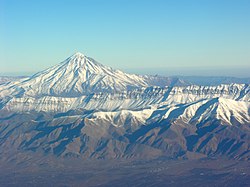
Alborz Mountains in semnan province. A combination of snow and desert.

Key Information

The Alborz (Persian: البرز, pronounced [ʔælˈboɹz] ; also spelt Alburz, Elburz or Elborz) is a mountain range in northern Iran that stretches from the border of Azerbaijan along the western and entire southern coast of the Caspian Sea and finally runs northeast and merges into the smaller Aladagh Mountains and borders in the northeast on the parallel mountain ridge Kopet Dag in the northern parts of Khorasan. All these mountains are part of the much larger Alpide belt. The Alborz range is divided into the Western, Central, and Eastern Alborz Mountains. The Western Alborz Range (usually called the Talysh) runs south-southeastward almost along the western coast of the Caspian Sea. The Central Alborz (the Alborz Mountains in the strictest sense) runs from west to east along the entire southern coast of the Caspian Sea. In contrast, the Eastern Alborz Range runs in a northeasterly direction, toward the northern parts of the Khorasan region, southeast of the Caspian Sea. Mount Damavand, the highest mountain in Iran, measuring 5,610.0 m (18,405.5 ft), is located in the Central Alborz Mountains. Mount Damavand is the 12th most prominent peak in the world and the second most prominent in Asia after Mount Everest.

Alborz on a geographic map of Iran
Damavand, the highest summit of Alborz

Etymology

[edit]

The name Alborz is derived from Harā Barazaitī, a legendary mountain in the Avesta, the main text of Zoroastrianism. Harā Barazaitī is from a Proto-Iranian name, Harā Bṛzatī, meaning "Mountain Rampart". Bṛzatī is the feminine form of the adjective bṛzant- "high", the ancestor of modern Persian bouland and BarzBerazandeh, cognate with Sanskrit Brihat. Harā may be interpreted as "watch" or "guard", from an Indo-European root *ser- "protect". In Middle Persian, Harā Barazaitī became Harborz, Modern Persian Alborz, which is a cognate with Elbrus, the highest peak of the Caucasus.[1]

Alborz Mountain range seen from Tehran
Areial view of Tehran and damavand and Alborz mountain in summer

Mythology

[edit]

Zoroastrians seem to identify the range with the dwelling place of the Peshyotan, and the Zoroastrian Ilm-e-Kshnoom sect identifies Mount Damavand as the home of the Saheb-e-Dilan ('Masters of the Heart'). In his epic Shahnameh, the poet Ferdowsi speaks of the mountains "as though they lay in India."[1] This could reflect older usage, for numerous high peaks were given the name, and some even reflect it to this day, including Mount Elbrus in the Caucasus Mountains and Mount Elbariz (Albariz, Jebal Barez) in the Kerman area above the Strait of Hormuz. All these names reflect the same Iranian language compound, and have been speculatively identified, at one time or another, as the legendary mountain Hara Berezaiti of the Avesta.

Geology

[edit]

The Alborz mountain range forms a barrier between the south Caspian and the Iranian plateau. It is only 60–130 km wide and consists of sedimentary series dating from Upper Devonian to Oligocene, prevalently Jurassic limestone over a granite core. Continental conditions regarding sedimentation are reflected by thick Devonian sandstones and by Jurassic shales containing coal seams. Marine conditions are reflected by Carboniferous and Permian strata that are composed mainly of limestones. In the Eastern Alborz Range, the far eastern section is formed by Mesozoic (chiefly Triassic and Jurassic) rocks, while the western part of the Eastern Alborz Range is made primarily of Paleozoic rocks. Precambrian rocks can be found chiefly south of the city of Gorgan situated in the southeast of the Caspian Sea and, in much smaller amounts, in the central and western parts of the Central Alborz Range. The central part of the Central Alborz Range is formed mainly of Triassic and Jurassic rocks, while the northwestern section of the range is mainly composed of Jurassic rocks. Very thick beds of Tertiary (mostly Eocene) green volcanic tuffs and lavas are found mainly in the southwestern and south-central parts of the range. The far northwestern part of the Alborz, that constitutes the Western Alborz Range or the Talish Mountains, is mainly made up of Upper Cretaceous volcano-sedimentary deposits, with a strip of Paleozoic rocks and a band of Triassic and Jurassic rocks in the southern parts, both in a northwest–southeast direction. As the Tethys Sea was closed and the Arabian plate collided with the Iranian plate, and was pushed against it, and with the clockwise movement of the Eurasian plate towards the Iranian plate and their final collision, the Iranian plate was pressed from both sides. The collisions finally caused the folding of the Upper Paleozoic, Mesozoic, and Paleogene rocks and the Cenozoic (chiefly the Eocene) volcanism, to form the Alborz Mountains, primarily during the Miocene. The Alpine orogeny began, therefore, with Eocene volcanism in southwestern and south-central parts of the Alborz, and continued with the uplift and folding of the older sedimentary rocks in the northwestern, central and eastern parts of the range, during the most important orogenic phases, which date from the Miocene and Pliocene epochs.

Ecoregions, flora and fauna

[edit]

While the southern slopes of the Alborz Mountains are usually semiarid or arid, with irregular and low precipitation, the northern slopes of the range are usually humid, especially in the western parts of the Central Alborz. The Alborz is the easternmost extent of many European plant species. In the southern slopes or the Elburz Range forest steppe ecoregion, the higher elevations are arid with few trees. Juniper is the most common tree in inaccessible areas and at high elevation, while common shrubs are pistachio, maple, and almond. But in the northern slopes, the Caspian Hyrcanian mixed forests ecoregion is lush and forested. The natural vegetation of this region grows in distinct zones:

  • Hyrcanian forests on the lowest levels,
  • beech forests in the middle zone,
  • oak forests in higher regions.

The wild cypress is the dominant form of vegetation in some valleys, while olive trees grow in the western valleys of the Central Alborz near the Sefidrud. The bezoar ibex, Blanford's fox, Rüppell's fox, red fox, Persian fallow deer, wild boar, Syrian brown bear, Persian leopard, Indian wolf, buzzard, goose, woodpecker, griffon vulture, and eagle are among important animals and birds found in the Alborz Mountains. The extinct Caspian tiger also lived in the Alborz Mountains.

Prehistory

[edit]
Alborz mountains in Amol county, Mazandaran, Iran. taken from Haraz road

Archaeological evidence from Alborz indicates that early human groups were present in the region since at least late Lower Paleolithic. The Darband Cave located at the Gilan Province contains evidence for late Lower Paleolithic. Stone artifacts and animal fossils were discovered by a group of archaeologists of the Department of Paleolithic of the National Museum of Iran and ICHTO of Gilan. The presence of large numbers of cave bear and brown bear remains and sparse stone artifacts at the site indicates that Darband primarily represents a bear den. The co-occurrence of artifacts and bear bones does not imply human predation or scavenging. Because there are no clear cut marks, except a few burning signs on the bear bones, they probably accumulated through natural processes.[2] During Middle Paleolithic period, Neanderthals were most probably were present in the region as their fossil have been found at northwest of Alborz, in the Azykh Cave. Their stone tools found in the Buzeir Cave and Kiaram cave and number of other surveyed sites.[3] Evidence for Modern human comes from a river side site called Garm Roud in the Mazandaran Province which dates back to about 30,000 years ago.[4]

Ski resorts

[edit]

Due to the snowy winters of the Alborz Mountains, there are several ski resorts in different places across the range. Some of them, according to ski enthusiasts, are among the best in the world.[5]

Mounts, summits, alpine lakes and attractions

[edit]

The Alborz four-thousanders with at least 300 meters of topographic prominence:

Name Height (m) Prominence (m)
1 Damavand 5610 4661
2 Alam-Kuh 4828 1848
3 Kalahoo 4412 345
4 Azad Kuh 4398 980
5 Kholeno 4375 746
6 Do Khaharan 4310 644
7 Avidar 4286 503
8 Great Nazer 4260 510
9 Kaman-Kuh 4234 533
10 Zarrin-Kuh 4198 451
11 Sarakchal 4194 317
12 Sialan 4160 1160
13 Kolunbastak 4156 359
14 Shah Alborz 4125 931
15 Naz 4108 1018
16 Do Berar 4082 1352
17 Kahoun 4075 342
18 Varavašt 4025 852
19 Korma-Kuh 4020 359
20 Parchenan 4015 1144
21 Saat 4003 428

The peaks with altitude of 3800 m - 4000 m, with at least 300 meters of topographic prominence:

Name Height (m) Prominence (m)
1 Mishineh Marg 3990 562
2 Tochal 3964 1164
3 Karkas Neshin 3950 537
4 Khashechal 3945 645
5 Vantar 3944 544
South Kharsang 3940 293
6 Sechal 3936 436
7 Sineza 3933 336
8 Shahvar 3932 1923
9 Mehrchal 3912 759
10 Keyoonchal 3910 390
11 Pashooreh 3896 814
12 Small Nazer 3881 444
13 Gavingchal 3880 344
14 Deev Asiab (Alarm) 3880 421
15 Zarrin-Kuh 3850 858
Kushgak (Sorkhak) 3843 299
16 Gavkoshan 3840 1160
17 Khozanak 3840 402
18 Asemankuh 3819 499
19 Lake Tar 3200 500

The peaks with at least 1000 meters of topographic prominence:

Name Height (m) Prominence (m)
1 Damavand 5610 4661
2 Shahvar 3932 1923
3 Alam-Kuh 4828 1848
4 Neyzeva 3730 1510
5 Do Berar 4082 1352
6 Tochal 3964 1164
7 Sialan 4160 1160
8 Gavkoshan 3840 1160
9 Parchenan 4015 1144
10 Shahdar Kuh 3252 1107
11 Ghadamgah 3563 1057
12 Badleh Kuh 3203 1036
13 Naz 4108 1018
Map of central Alborz Peaks: 1 Alam-Kuh
  −25 to 500 m (−82 to 1,640 ft)
  500 to 1,500 m (1,600 to 4,900 ft)
  1,500 to 2,500 m (4,900 to 8,200 ft)
  2,500 to 3,500 m (8,200 to 11,500 ft)
  3,500 to 4,500 m (11,500 to 14,800 ft)
  4,500 to 5,610 m (14,760 to 18,410 ft)
2 Azad Kuh 3 Damavand
4 Do Berar 5 Do Khaharan
6 Ghal'eh Gardan 7 Gorg
8 Kholeno 9 Mehr Chal
10 Mishineh Marg 11 Naz
12 Shah Alborz 13 Sialan
14 Tochal 15 Varavašt
Rivers: 0
1 Alamut 2 Chalus
3 Do Hezar 4 Haraz
5 Jajrood 6 Karaj
7 Kojoor 8 Lar
9 Noor 10 Sardab
11 Seh Hazar 12 Shahrood
Cities: 1 Amol
2 Chalus 3 Karaj
Other: D Dizin
E Emamzadeh Hashem K Kandovan Tunnel
* Latyan Dam ** Lar Dam

See also

[edit]

Sources

[edit]
  • North, S.J.R., Guide to Biblical Iran, Rome 1956, p. 50

References

[edit]
[edit]
Revisions and contributorsEdit on WikipediaRead on Wikipedia
from Grokipedia
The Alborz Mountains, also spelled Elburz, constitute a prominent mountain range in northern Iran, extending approximately 900 kilometers from the Azerbaijan border in the northwest to the Turkmenistan border in the northeast, parallel to the southern shore of the Caspian Sea. This range, averaging 60 to 120 kilometers in width, rises abruptly to an average elevation of about 2,743 meters, with its highest point being the dormant stratovolcano Mount Damavand at 5,670 meters, the tallest peak in Iran and the Middle East. Geologically, the Alborz formed through complex tectonic processes involving the Cimmeride and Alpide orogenies, comprising seven main tectonostratigraphic units ranging from to deposits, including epicontinental sequences, volcanics, carbonates, and synorogenic . The range's structure features sheets and duplex systems transported northward, with rock types such as slates, metagraywackes, metavolcanics, and metacarbonates reflecting a history of continental shelf , , and . Volcanic activity, exemplified by Damavand's cone, underscores the region's arc-type magmatic assemblages from the Upper to . Climatically, the Alborz serves as a formidable barrier, trapping moist air from the on its northern slopes—where dense forests thrive under 1,000 to 2,000 millimeters of annual rainfall—while the southern flanks remain arid with only about 300 millimeters, contributing to the Iranian Plateau's semi-desert conditions. This orographic effect supports diverse ecosystems, including glaciers in the central , which hosts Iran's largest collection of these features, and enables on peaks like Damavand. Historically, the Alborz has shaped regional dynamics by isolating the lush Caspian littoral from the central plateau, fostering independent polities such as the Buyids (10th century) and serving as a stronghold for the Assassins at Alamut Castle from 1090 to 1256 CE. Key passes like the Chalus (over 2,000 meters) and Caspian Gates facilitated ancient Silk Road trade routes, exchanging Caspian rice and salt for plateau grains and textiles, while the range's rugged terrain influenced Qajar dynasty control in the 19th and 20th centuries. Notable peaks such as Alam Kuh (4,850 meters) add to its mountaineering allure, with sheer walls and U-shaped valleys evidencing past glaciation.

Geography

Location and Extent

The occupies northern , extending approximately 900 km in an east-west arc from the border with in the northwest to the vicinity of in the northeast. This positioning places it along the southern margin of the South Caspian Basin, forming a key orographic feature in the region. The range varies in width from 60 to 130 km, creating a formidable barrier that separates the humid lowlands of the to the north from the arid to the south. Its central portion lies roughly between latitudes 35° to 37° N and longitudes 50° to 53° E, encompassing diverse terrain influenced by its proximity to major population centers. Adjacent to the southern foothills is , Iran's capital, situated at the edge of the range, while the northern slopes drain into the provinces of Mazandaran and Gilan along the Caspian coast. The central-southern area includes , named after the range and encompassing key access points to its interior. Elevations within the Alborz span from near at the Caspian coastal margins to a maximum of 5,670 m at , the range's highest peak.

Topography and Hydrology

The Alborz features a distinctive topographic profile characterized by steep northern escarpments that descend abruptly to the Caspian lowlands, forming a formidable barrier that rises sharply from near to elevations exceeding 3,000 meters in short distances. In contrast, the southern slopes are gentler, gradually ascending from the central at altitudes of 1,100–1,500 meters, allowing for broader transitional zones with rolling foothills. The central core of the range consists of high axial plateaus and intermontane valleys, where elevations rarely fall below 3,500 meters, punctuated by prominent peaks such as Kuh-e at 4,108 meters and broader upland basins that facilitate local drainage patterns. These landforms create a compact, linear orographic system approximately 60–130 kilometers wide, with overall elevations peaking between 3 and 5 kilometers across much of the range. The of the Alborz is defined by its role as a major watershed divide, separating northern exoreic flows draining to the from southern endoreic systems that feed into closed central basins. Key northern rivers, including the , Haraz, and Chalus, originate in the high central Alborz and flow northward through deep gorges, delivering substantial discharge to the Caspian via short, steep gradients that support fertile coastal plains. The , one of Iran's longest rivers at 600–780 kilometers, exemplifies this system with its extensive catchment influencing regional sediment transport and coastal dynamics. On the southern flank, rivers like the emerge from the central Alborz, traversing urban and agricultural areas before terminating in saline lakes within the endoreic central plateau, such as the Daryacheh-ye Namak. This river, spanning about 245 kilometers with a basin of 2,800 square kilometers, exemplifies the southward drainage that sustains but faces challenges from and human diversion. The Alborz's hydrological significance extends to water resource management, serving as a critical source for reservoirs and aquifers that supply , , and to major urban centers, including the Tehran metropolis home to over 10% of Iran's population. Dams such as , Latyan, and harness these flows, mitigating seasonal variability and supporting economic activities in densely populated regions. Climatic influences, particularly higher precipitation on northern slopes, enhance runoff volumes, though southern aridity limits recharge in endoreic zones. Small glaciers persist on high peaks like Damavand at 5,670 meters, where two remnant ice fields—retreated since 1930—contribute seasonal meltwater to local streams, augmenting dry-season flows despite their diminished extent.

Geology

Tectonic Formation

The Alborz mountain range owes its origin to the collisional tectonics between the Arabian and Eurasian plates, with initial uplift commencing during the Miocene epoch around 23 million years ago as the Arabian Plate began converging northward with Eurasia. This collision initiated widespread shortening across the Iranian Plateau, leading to the development of foreland basins and early compressional deformation in the Alborz region by the early to middle Miocene, approximately 20–12 million years ago. Uplift rates remained relatively modest during this phase, with sediment accumulation in adjacent basins indicating low tectonic activity of less than 0.05 mm/year until the late Miocene. Deformation accelerated significantly during the Pliocene and Pleistocene epochs, driven by intensified plate convergence that partitioned basins and elevated the range to its current topography exceeding 4,000 meters in places. This phase involved episodic pulses of contraction, with thermochronological data revealing enhanced exhumation rates from the late Miocene to early Pliocene onward. The Alborz forms part of the broader Alpine-Himalayan orogenic belt, serving as a critical link between the Caucasus Mountains to the northwest and the Zagros fold-thrust belt to the south, where similar collisional processes accommodate ongoing Arabia-Eurasia convergence. Structurally, the Alborz is dominated by a fold-and-thrust belt featuring north-verging folds and thrusts, particularly along its southern margin, where fault-propagation folds breach anticlines in strata. Double-verging fold systems and reverse faults characterize much of the range, with left-lateral strike-slip faults accommodating lateral escape, including the prominent Khazar Fault along the margin, which exhibits active thrusting at rates up to 3.6 mm/year. Minimum north-south shortening across the belt is estimated at 36 km since the , reflecting the cumulative effects of this tectonic regime. The region remains highly seismic due to continued compression, with GPS measurements indicating ongoing north-south at rates of approximately 5–8 mm/year across the Alborz. Notable events include the 1957 Sangchal (Caspian) earthquake, which reached a moment magnitude of 7.1 along the North Alborz Fault system at a shallow depth of about 15 km, causing significant surface rupture and damage. This activity underscores the Alborz's role in absorbing a substantial portion of the Arabia-Eurasia convergence, estimated at 22–25 mm/year regionally.

Rock Composition and Volcanism

Geologically, the Alborz comprises seven main tectonostratigraphic units ranging from to deposits: (1) uppermost to lower epicontinental sequence; (2) to mafic magmatic assemblage; (3) to upper continental shelf sequence; (4) upper to lower foreland siliciclastics; (5) middle to upper discontinuous epicontinental/ succession; (6) upper and arc-type magmatic assemblage; and (7) Tertiary and synorogenic mostly siliciclastic molasse deposits. The Alborz Mountains are characterized by a diverse array of rock types, predominantly sedimentary formations from the to periods, including thick layers of , , and . These sedimentary rocks, such as those in the Shemshak Formation, represent ancient marine and continental deposits that form much of the mountain's stratigraphic framework, with limestones often exhibiting platform carbonate characteristics and sandstones indicating fluvial environments. In the core zones of the range, metamorphic rocks like gneisses, phyllites, and granites occur, derived from to basement materials subjected to regional during tectonic events. Volcanism in the Alborz is primarily associated with activity centered on , Iran's highest peak and a prominent rising to 5,670 meters. This volcano consists mainly of trachyandesite lavas with andesitic affinities, featuring radially directed lava flows and subordinate pyroclastic deposits, including fallout and ignimbrites, accumulating to over 400 km³ in volume. Its eruptive spans three main phases from approximately 1.8 million years ago to 7,300 years ago, with the most recent activity involving dome extrusion and associated fumarolic emissions persisting today; this volcanism is attributed to post-collisional magmatic processes related to the Arabia-Eurasia convergence. The Alborz hosts notable mineral resources, particularly in its eastern sectors where deposits occur within the Jurassic Shemshak Formation, exploited historically in areas like Shahrood and Zirab for their vitrinite-rich seams formed in ancient swamps. , including skarn-type deposits, and copper mineralization, often linked to igneous activity, are found in eastern extensions such as the Sangan , contributing to Iran's metallogenic belts. In the southern foothills, evaporitic deposits of and salt dominate sedimentary sequences, exemplified by the Garmsar Salt Nappe, which influences local tectonics and provides resources for industrial use. Erosion and processes in the Alborz are pronounced in the extensive terrains, leading to well-developed landscapes characterized by dissolution features such as , sinkholes, and enclosed depressions. These systems, prominent in formations like the Lar Limestone, result from the interaction of high —up to 2,000 mm annually in northern slopes—with soluble carbonates, creating hypogene cave networks and surface sinkholes that enhance and habitat diversity.

Climate and Ecology

Climatic Zones

The Alborz mountain range displays pronounced climatic zonation driven by its topographic barrier between the humid Caspian lowlands and the arid . The northern slopes feature a , with annual typically ranging from 1,000 to 2,000 mm, concentrated during winter and spring due to moisture-laden air from the . In contrast, the southern slopes exhibit a semi-arid , receiving only 200 to 500 mm of rainfall annually, much of it irregular and influenced by the effect. Above elevations of 2,500 m, an alpine cold prevails across both slopes, characterized by heavy snowfall exceeding 1,000 mm in water equivalent during winter, supporting seasonal snow cover that persists into summer at higher altitudes. Seasonal patterns vary sharply across the range. On the northern flanks, winters are mild and wet, with average temperatures around 5–10°C and frequent events, transitioning to relatively cool summers averaging 20–25°C. The southern slopes experience hot, dry summers with temperatures often exceeding 35°C and minimal rainfall, while winters are cooler but still arid, with averages of 5–15°C and occasional frost. Temperature extremes underscore this variability: lowland southern areas can reach 40°C in summer, whereas highland regions, particularly above 3,000 m, drop to -30°C during intense winter cold snaps, influenced by continental polar air masses. Microclimates within the Alborz are shaped by topographic interactions with . on north-facing slopes enhances and as moist westerly and northerly air masses ascend, creating wetter conditions and frequent in valleys. Conversely, foehn winds—warm, dry downslope gusts—originate from the north and descend the southern slopes, accelerating and contributing to , with documented events causing rapid temperature rises of up to 20°C in hours. These localized effects amplify the north-south , with northern peaks receiving up to three times more moisture than adjacent southern elevations at similar heights. Recent has intensified these patterns, with surface temperatures in the Alborz rising by approximately 1–2°C since the 1980s, particularly at higher elevations where warming exceeds 0.3°C per decade. This trend has led to accelerated retreat, including significant mass loss in central Alborz systems like the Alamkooh and Khersan glaciers, with areal reductions of 20–50% observed since the late . Altered regimes, including a 10–20% decline in winter snowfall, further exacerbate on southern slopes and contribute to shifting seasonal cycles. As of 2025, ongoing warming is driving altitudinal migrations in large mammals, such as the Persian leopard and , adapting to higher elevations within the range.

Flora, Fauna, and Protected Areas

The Alborz Mountains host a rich array of flora shaped by their diverse altitudinal and climatic gradients, transitioning from lush Hyrcanian broadleaf forests on the northern slopes to arid steppes on the southern flanks and alpine meadows at higher elevations. The northern Hyrcanian forests, part of the temperate deciduous broadleaved ecosystem, are dominated by oriental beech (Fagus orientalis), chestnut-leaved oak (Quercus castaneifolia), and Caucasian hornbeam (Carpinus betulus), which form dense canopies supporting understories of alder (Alnus subcordata) and maple species. On the southern slopes, xerophytic vegetation prevails, including scattered juniper (Juniperus spp.) woodlands, pistachio (Pistacia vera) thickets, and almond (Amygdalus spp.) shrubs adapted to drier conditions. Above the treeline, alpine meadows feature cushion plants like Potentilla gelida and endemics such as Acantholimon demavandicum, contributing to the region's overall vascular plant diversity of approximately 1,584 species across 117 families, with around 8% being endemic to Iran. This floral richness underscores the Alborz's role as a biodiversity hotspot, though overgrazing and habitat fragmentation pose ongoing threats. The fauna of the Alborz reflects its position as a transitional zone between humid Caspian influences and arid Iranian plateaus, supporting a mix of forest, steppe, and montane species. Key mammals include the endangered Persian leopard (Panthera pardus tulliana), which inhabits remote forested and rocky areas, the Syrian brown bear (Ursus arctos syriacus)—estimated at 500–1,000 individuals in the late 1990s and relying on alpine meadows and forests for foraging—and the Caucasian lynx (Lynx lynx dinniki), an elusive predator in higher elevations. Avian diversity is notable, with raptors like the golden eagle (Aquila chrysaetos) soaring over open terrains and the Caspian snowcock (Tetraogallus caspius) nesting in summit crags. Reptiles such as the blunt-nosed viper (Macrovipera lebetina), a venomous ambush predator in rocky habitats, add to the herpetofaunal variety. Habitat loss from urbanization and agricultural expansion, coupled with poaching, threatens these populations, particularly the leopard and bear, which face human-wildlife conflicts. Ecologically, the Alborz falls within the Elburz Range forest-steppe as designated by the World Wildlife Fund, encompassing about 6.3 million hectares and bridging the hygrophilous of the Caspian lowlands with the xerophilous Irano-Turanian steppes to the south. This features a mosaic of temperate coniferous forests at mid-elevations, open woodlands, and high-altitude grasslands, fostering high endemism in small mammals like the noble mouse-like hamster (Calomyscus nobilis). The transition zones enhance biodiversity by providing refugia for species adapted to varying moisture levels, though coal mining, dam construction, and overgrazing degrade connectivity between habitats. Protected areas in the Alborz are vital for conserving this biodiversity amid mounting pressures. The Central Alborz Protected Area, spanning approximately 400,000 hectares across diverse terrains from montane forests to peaks over 4,000 meters, safeguards 48 mammal species, 156 bird species, 1,400 plant taxa, and 26 reptile species, serving as a core habitat for the Persian leopard and brown bear. Lar National Park, integrated within this protected landscape, protects alpine ecosystems and wild sheep (Ovis orientalis) populations but faces challenges from land-use changes, including a 4.2% increase in low-density pastures over three decades, which fragments habitats. Similarly, the Jajrud Protected Area, covering 55,424 hectares on the southern slopes, hosts 517 plant species and serves as a key refuge for wild goats (Capra aegagrus) and 38 mammal species, yet contends with deforestation, invasive species proliferation, and urban encroachment that exacerbate ecological risks. Conservation initiatives emphasize ranger patrols, alternative livelihoods for local communities, and management plans to mitigate these threats, though invasive plants and overgrazing continue to challenge ecosystem integrity.

History and Human Activity

Prehistoric Occupation

The Alborz Mountains region preserves evidence of early human occupation dating back to the Middle Paleolithic period, with open-air sites such as Moghanak and Otchounak in the southern foothills yielding lithic artifacts associated with Mousterian and Ante-Mousterian technologies. These assemblages, characterized by Levallois reduction techniques and side-scrapers, indicate hominin activities including tool production and possibly short-term hunting camps, associated with Middle Paleolithic technologies based on comparative stratigraphic and technological analyses from the broader Iranian plateau. Further evidence from Upper Paleolithic open-air localities like Garm Roud 2, dated to approximately 33,800 calibrated years before present through radiocarbon analysis, reveals bladelet production and hunting-related debris, underscoring the range's role in supporting episodic human presence during the Late Pleistocene. The transition to the and periods around 10,000 BCE is marked by shifts toward early farming and herding practices in sites adjacent to the Plain, such as Tepe Pardis, where archaeological layers document the onset of sedentary agropastoral economies with evidence of features and domesticated plant remains. Lithic inventories from these contexts highlight resource exploitation and exchange networks during the Neolithic expansion across the Iranian Central Plateau. Key archaeological findings across these periods consist primarily of stone artifacts, including flakes, cores, and retouched tools, alongside faunal remains that point to hunting strategies focused on ungulates such as (Cervus elaphus) and wild goats (Capra aegagrus), as inferred from bone scatters at open-air sites in northern . No evidence of permanent settlements appears until the , with occupations limited to transient camps reflecting mobile foraging lifeways adapted to the mountainous terrain. The prehistoric record of the Alborz integrates with the wider prehistory of the , positioning the mountain range as a critical corridor for hominin dispersal between the Caspian lowlands, , and the southern plateaus during Pleistocene climatic fluctuations. This connectivity is evidenced by the technological affinities of Alborz assemblages to those in adjacent regions, suggesting repeated migrations and cultural exchanges that facilitated human adaptation across diverse ecozones.

Historical Settlements and Development

During the , beginning around 1200 BCE, settlement patterns in the Alborz region underwent significant changes, marked by a shift toward fortified hilltop communities likely influenced by defensive needs amid migrations and cultural transitions. Archaeological evidence from indicates a clustering of sites influenced by environmental factors such as types and , with pre-Iron Age settlements showing a negative correlation with higher altitudes, while Iron Age patterns emphasized elevated positions for protection. This aligns with broader Iranian trends seen at sites like , where Cemetery A layers reflect Iron Age , including gray wares and fortified structures that may have inspired similar adaptations in northern central . Concurrently, emerged prominently with the arrival of Iranian tribes, such as proto-Medes and , who practiced semi-nomadic herding of , sheep, and across the plateau's pastures, integrating mobility with seasonal highland use in the Alborz foothills. From the Achaemenid period (c. 550–330 BCE) through the Sassanid era (224–651 CE), the Alborz Mountains served as a critical natural defensive barrier against northern invaders, with passes fortified to protect the Iranian heartland. The range's eastern gaps facilitated Silk Road trade routes, enabling commerce between the Caspian lowlands and central Iran, while valleys supported small agricultural communities reliant on terraced farming and herding. In the medieval period, particularly the 11th to 13th centuries, valleys like Alamut became centers for strategic settlements, exemplified by the Nizari Ismaili Assassins' stronghold at Alamut Castle, where a network of fortified villages sustained a self-sufficient economy based on agriculture and local crafts amid political isolation. In the , southern Alborz foothills experienced rapid urbanization, particularly in , which grew from about 15,000 residents in the 1950s to 1.4 million by 2006, reaching approximately 1.6 million as of 2024, driven by industrial expansion, , and proximity to . Government policies under the promoted nomad sedentarization, resettling pastoral groups into permanent villages in the Anti-Alborz highlands to integrate them into national development, shifting economies from to settled . Key infrastructure like the (Amir Kabir) Dam, completed in 1961, boosted irrigation for farming, hydroelectric power, and , while activities in the range's mineral-rich zones contributed to economic diversification. As of 2024, the areas adjacent to the Alborz Mountains host approximately 5-6 million people, primarily in provinces like Alborz (3.0 million) and southern , reflecting dense along the foothills. Ongoing migration from rural highland villages to continues, fueled by economic opportunities in the capital, though it strains resources and alters traditional highland demographics.

Cultural Significance

Etymology and Mythology

The name Alborz originates from the term Harā Bərəzaitī, referring to a legendary cosmic mountain that encircles the world and serves as its central axis. This phrase, literally meaning "High Watchpost" or "high watch/guard," evokes the idea of an elevated sentinel overlooking creation, a motif common in ancient Indo-Iranian cosmology where mountains symbolized protection and cosmic order. Over time, the term evolved linguistically: in , it became Harborz or Alburz, denoting the mythical range surrounding the world, before simplifying to modern Persian Alborz. Alternative spellings and names include Elburz and Alburz, reflecting phonetic variations in regional languages, while in it appears as Alborz or Jabal al-Borz. In Zoroastrian mythology, Alborz—embodied as Harā Bərəzaitī—holds profound cosmological significance as the primordial mountain rising from the center of the earth, around which the stars, sun, and moon revolve, marking it as the of the universe. It is the sacred abode of divine forces, notably the source of the spring Ardvi Sura , the bountiful waters personified as a (divine being) who flows from its peaks into the mythical sea Vourukasha, nourishing all earthly rivers and life. This association underscores Alborz's role in fertility and purification rituals within texts like the Yashts. Legends also link it to heroic feats, such as the binding of the dragon-demon Azhi Dahaka beneath its highest peak, , by the culture hero Thraētaona (), symbolizing the triumph of order over chaos—a motif echoed in later Pahlavi texts like the . Alborz's mythic prominence extends into epic literature, particularly Ferdowsi's , where it functions as a cosmic pillar and refuge for mythical beings, including the Simurgh, a benevolent nesting on its slopes and embodying and guidance for heroes like Zal and . In this narrative, the range reinforces themes of divine intervention and the eternal struggle between good and evil, drawing directly from Zoroastrian cosmology to portray Alborz as a barrier against demonic incursions. Persian folklore further preserves these motifs, including the daily ascent of the sun from its eastern flanks, linking it to cycles of renewal and enlightenment in oral traditions. In broader Persian literature, Alborz symbolizes enduring strength and natural beauty, appearing in the poetry of classical figures like and Saadi as a for spiritual ascent and protection. In modern ian culture, it represents national heritage, featured in art, festivals, and as a backdrop for celebrations symbolizing renewal.

Recreation and Tourism

Skiing and Winter Sports

The Alborz Mountains, with their providing reliable snowfall from December to April, offer prime conditions for , attracting both locals and international visitors to its high-altitude resorts. Average snow depths reach 2-3 meters at peak elevations during the season, ensuring consistent coverage for and . The development of these facilities began in the , introduced by Swiss and Swedish engineers working in , who shared their expertise with local enthusiasts. By the mid-20th century, the Iranian Ski Federation, established in 1947 and affiliated with the International Ski Federation (FIS) in 1957, oversaw further growth, including the construction of lifts and runs, though progress slowed after the 1979 revolution before resuming in subsequent decades. Key resorts in the Alborz include , located just north of and reaching elevations up to 3,700 meters, which opened in the late with an extensive 7.5-kilometer system connecting multiple stations for easy access. , the largest resort in and one of the highest in the at 3,600 meters, features over 20 kilometers of varied runs suitable for all levels and was developed in the 1960s under the Pahlavi era, boasting modern facilities like hotels and multiple chairlifts. Shemshak, the earliest major site operational since 1958, spans from 2,550 to 3,050 meters and serves as a hub for national competitions, with its steep terrain and five lifts supporting events organized by the Iranian . These resorts collectively provide such as on-site accommodations, equipment rentals, and night skiing options at select locations like Shemshak, enhancing their appeal for extended stays. As of 2025, to these sites has grown with eased regional travel. Winter sports in the Alborz emphasize and on groomed pistes, alongside cross-country trails for more exploratory pursuits. International FIS competitions, including slalom and events, have been hosted at and Shemshak, highlighting 's growing presence in global since the federation's FIS integration. The combination of uncrowded slopes, dry powder snow, and proximity to —often just an hour's drive—makes these highlands a unique destination for winter recreation in the region.

Mountaineering, Lakes, and Other Attractions

, standing at 5,670 meters as 's highest peak and a dormant , dominates the central Alborz range and attracts climbers worldwide for its accessible yet challenging southern route, which features a key —Bargah Sevom at 4,200 meters—for overnight stays before the final ascent to the . The mountain's prominence of 4,667 meters makes it the 12th most prominent peak globally, drawing thousands of climbers annually, with guided tours emphasizing acclimatization to mitigate risks. Foreign climbers must obtain permits from the Mountaineering and Sport Climbing Federation, ensuring safety protocols like weather monitoring and emergency evacuations are followed. Alam-Kuh, at 4,850 meters in the western Alborz, offers more technical with its faces and classic routes like the southwest ridge, appealing to experienced alpinists seeking multi-pitch climbs amid stunning Takht-e Soleyman Lake views. Mount Sabalan, rising to 4,811 meters in the northwestern extension of the range near , provides a less crowded alternative with its and straightforward summit paths, often combined with Alborz treks for broader exploration. The Alborz hosts several alpine lakes and reservoirs that enhance and recreational appeal. Tar and Havir Lakes, situated at around 2,500 meters near Damavand, are seasonal tarns fed by streams, offering serene spots and reflections of surrounding peaks during summer months. The Latyan Reservoir, formed by the Latyan Dam on the Jajrud River east of , supports boating and fishing amid forested foothills, while the Amir Kabir (Karaj) Reservoir provides similar water-based activities with its expansive blue waters against the rugged Alborz backdrop. Further west, the Taleqan Reservoir offers tranquil boating and picnicking in a cooler, highland setting. Beyond peaks and waters, the Alborz features diverse attractions for year-round exploration. Larijan Hot Springs, near Damavand at about 2,200 meters, bubble with sulfur-rich waters reaching 62°C, used historically for therapeutic bathing in individual pools and public areas, drawing visitors for relaxation post-climb. The Yakh Morad (Morad) Cave, an ice-filled cavern near Gachsar at 2,640 meters, showcases stalactites and ancient fossils, accessible via a short hike for speleologists and adventurers. Hiking trails abound, with Lar Valley in the central Alborz providing multi-day routes through wildflower meadows, rivers, and views of Damavand, part of the protected ideal for and . Cultural sites include the ruins of in the Rudbar-Alamut region, a 11th-century fortress perched on a 2,100-meter cliff, once headquarters of the Nizari Ismailis, now explorable via trails revealing stone remnants and panoramic valley vistas. Guided tours for these sites stress environmental respect, permit requirements, and seasonal safety to preserve the range's fragile ecosystems.

References

Add your contribution
Related Hubs
User Avatar
No comments yet.