


Community hub
Recent from talks
Contribute something
Nothing was collected or created yet.
New Jersey Institute of Technology
View on Wikipedia
New Jersey Institute of Technology (NJIT) is a public research university in Newark, New Jersey, United States, with a graduate-degree-granting satellite campus in Jersey City.[12][13] Founded in 1881 with the support of local industrialists and inventors, especially Edward Weston,[14] NJIT opened as Newark Technical School in 1885 with 88 students.[a][b] As of fall 2022 the university enrolls 12,332 students from 92 countries, about 2,500 of whom live on its main campus in Newark's University Heights district.[5][16]
Key Information


NJIT offers 51 undergraduate (Bachelor of Science/Arts) majors and 71 graduate (Masters and PhD) programs.[17] Via its Honors College, it also offers professional programs in Healthcare and Law in collaboration with nearby institutions including Rutgers Medical School and Seton Hall Law School.[18][19] Cross-registration with Rutgers University-Newark which borders its campus is also available. NJIT is classified among the "R1: Doctoral Universities – Very high research activity".[20] It operates several off-campus facilities including the Big Bear Solar Observatory, home of the Goode Solar Telescope; the Owens Valley Radio Observatory (both in California); and a suite of automated observatories across Antarctica, South America and the U.S.[21][22]
NJIT is a member of the Sea grant and Space grant research consortia. It has participated in the McNair Scholars Program since 1999.[23][24] NJIT is a designated Asian American Native American Pacific Islander serving institution (AANAPISI) and a designated Hispanic-serving institution (HSI).
History
[edit]Founding
[edit]The New Jersey Institute of Technology has a history dating back to the 19th century. Originally introduced from Essex County, New Jersey, on March 24, 1880, and revised with input from the Newark Board of Trade in 1881, an act of the New Jersey State Legislature drew up a contest to determine which municipality would become home to the state's urgently needed technical school. The challenge was straightforward: the state would stake "at least $3,000 and not more than $5,000" and the municipality that matched the state's investment would earn the right to establish the new school.[citation needed]
19th century
[edit]The Newark Board of Trade, working jointly with the Newark City Council, launched a campaign to win the new school. Many of the city's industrialists, along with other private citizens, supported the fund-raiser. By 1884 the necessary funds were raised. Newark Technical School opened its doors in February 1885.
The first 88 students, mostly evening students, attended classes in a rented building at 21 West Park Street. That facility soon became inadequate for the growing number of students. A second fundraiser, the institution's first capital campaign, was launched to support the construction of a home for Newark Technical School. In 1886, under the leadership of the school's first director, Charles A. Colton, the cornerstone was laid at the intersection of High Street and Summit Place for a three-story building later to be named Weston Hall in honor of the institution's early benefactor.
20th century
[edit]
A laboratory building called Colton Hall was added to the campus in 1911.
Allan Cullimore led the institution from 1920 to 1949 transforming Newark Technical School into Newark College of Engineering (NCE), a name change that was adopted in 1930. Campbell Hall was erected in 1925. Due to the Depression and World War II, only the former Newark Orphan Asylum, now Eberhardt Hall, was purchased and modestly renovated in the succeeding decades. Cullimore left an unpublished history of the institution dated 1955.[25]
In 1946, about 75% of the freshman class had served in the U. S. Armed Forces. Cullimore Hall was built in 1958 and two years later the old Weston Hall was razed and replaced with the current seven-story structure. Doctoral level programs were introduced in 1960. Six years later, in 1966, an 18-acre (7.3 ha), four-building expansion was completed.
With the addition of the New Jersey School of Architecture in 1973, the institution had evolved into a technological university, offering a widening range of graduate and undergraduate degrees and an increasing focus on research and public service. William Hazell, president at the time, decided the school's name should be changed to more clearly reflect its ongoing evolution. Alumni were solicited for suggestions. The winning suggestion was submitted by Joseph M. Anderson '25. Anderson's suggestion, New Jersey Institute of Technology, emphasized the increasing scope of educational and research initiatives at the institution. The Board of Trustees approved the name change in September 1974. Newark College of Engineering officially became New Jersey Institute of Technology on January 1, 1975. The Newark College of Engineering name was retained for NJIT's engineering school.
The establishment of a residential campus and the opening of NJIT's first dormitory (Redwood Hall) in 1979 began a period of steady growth that continues today under an evolving Master Plan. Two new schools were established at the university during the 1980s, the College of Science and Liberal Arts in 1982 and the School of Industrial Management in 1988. The Albert Dorman Honors College was established in 1994, and the newest school, the College of Computing Sciences, was created in 2001. Also, three residential halls, Cypress, Oak, and Laurel which house about 1500 students in total, were placed in service in the 1990s.
21st century
[edit]On May 2, 2003, Robert Altenkirch was inaugurated as president. He succeeded Saul Fenster who was named the university's sixth president in 1978.[26] In September 2011 Altenkirch elected to return to the South having been offered the presidency of the University of Alabama in Huntsville. On January 9, 2012, NJIT Trustees named Joel Bloom president.[27]
In 2003, the opening of the new Campus Center on the site of the former Hazell Hall centralized campus social events. Construction of a new Atrium, Bookstore, Dining Hall, computer lab, Information Desk facility, and new student organization offices continued into 2004. In 2005 a row of automobile chop shops adjacent to campus were demolished. In 2006 construction of an near-campus residence hall by American Campus Communities began in the chop shops' location. The new hall, which opened in 2007, is dubbed the University Centre. In addition to NJIT students, it houses students from Rutgers-Newark, Seton Hall University and Rutgers Law School.
Also in 2005, Eberhardt Hall was fully renovated and re-inaugurated as the Alumni Center and the symbolic front door to the university.[28] Its restored tower was the logo of the former Newark College of Engineering. A rebranding campaign with the current slogan, "NJIT – New Jersey's Science and Technology University – The Edge in Knowledge", was launched to emphasize NJIT's position as New Jersey's science-and-technology-focused public research university.
NJIT's business school, the Martin Tuchman School of Management, focuses on utilizing technology to serve business needs.[29] The school, which is an AACSB-accredited business school, benefits from its proximity to New York City and lower Jersey City aka, "Wall Street West". Wall Street itself (lower Manhattan) is twenty-five minutes away via Newark Light Rail and the PATH system's Newark-World Trade Center line. NJIT has a multi-faceted collaboration with its neighbor, Rutgers-Newark. The collaboration involves the Rutgers and NJIT business schools; their federated departments of Biology and History; and the joint Theater Arts Program.[30][31] In 2008 NJIT began a program with the Heritage Institute of Technology in West Bengal, India under which 20 students come to NJIT for summer internships.
In 2009, the New Jersey School of Architecture was enlarged and reorganized as the College of Architecture and Design (COAD). Within the college, the New Jersey School of Architecture continues, along with the newly established School of Art + Design.[32]
In June 2010, NJIT purchased the old Central High School building which is located between the NJIT and Rutgers–Newark campuses.[33] With the completion of the purchase, Summit Street, from Warren Street to New Street, was converted into a pedestrian walkway. Since then the high school building was extensively renovated, preserved, and updated per the Campus Master Plan.[34]
Between 2016 and 2018, several facilities opened, including a 209,000-square-foot (19,400 m2) multi-purpose Wellness and Events Center, "The WEC", which features a retractable-seating arena that can accommodate 3,500 spectators or 4,000 event participants; a 24,000-square-foot (2,200 m2) Life Sciences and Engineering Center; a 10,000-square-foot (930 m2) Makerspace, and a parking garage with spaces for 933 cars.[35][36]
Academics
[edit]Rankings
[edit]| Academic rankings | |
|---|---|
| National | |
| Forbes[37] | 101 |
| U.S. News & World Report[38] | 80 |
| Washington Monthly[39] | 91 |
| WSJ/College Pulse[40] | 19 |
| Global | |
| ARWU[41] | 701-800 |
| QS[42] | 761-770 |
| THE[43] | 401–500 |
| U.S. News & World Report[44] | 826 |
- In U.S. News 2025 edition, NJIT is ranked tied for 80th in national universities.[45]
- In the 2024 edition of the Princeton Review NJIT was ranked 23rd in the list of the fifty best value public colleges in the US.[46]
- In June 2024, Money rated NJIT a 5-star (the highest) institution.[47]
- In 2024, Washington Monthly ranked NJIT 101st among 438 national universities in the U.S. based on NJIT's contribution to the public good, as measured by social mobility, research, and promoting public service.[48]
- In September 2023, the Wall Street Journal, using a more outcome-oriented methodology than in the past, ranked NJIT #2 among public universities and #19 among all national universities in its List of the Best Colleges in the U.S. for 2024.[49]
- In June 2022, a Money article titled "The Best 10 Colleges for Engineering Majors" cited NJIT for its economic mobility performance and ranked it 10th best in the country.[50]
- In the 2021 edition of the QS World University Ranking USA, NJIT was ranked 90th (2-way tie) out of the 352 US Institutions listed (more than 750 considered).[51]
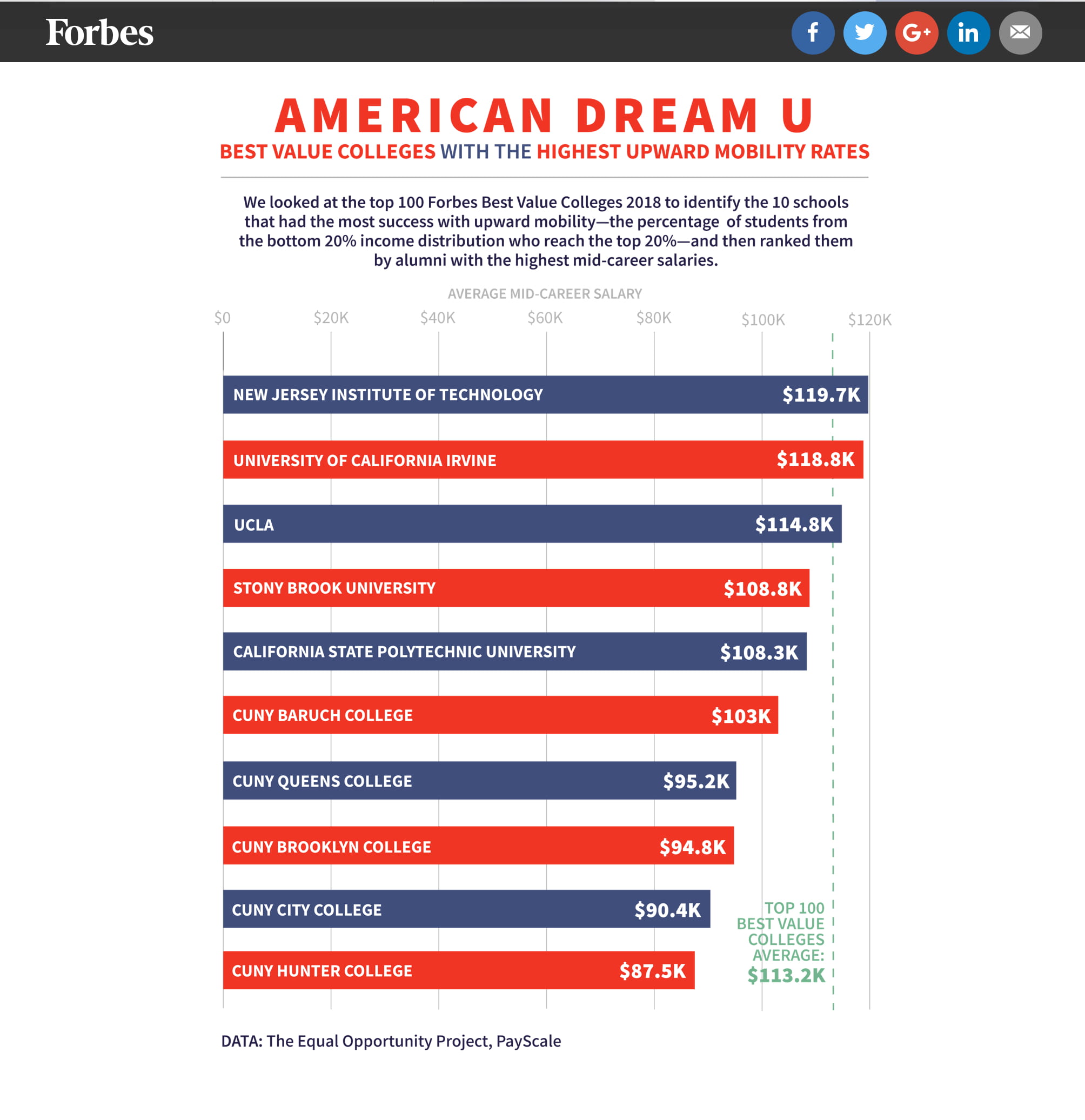
- In April 2018, Forbes ranked NJIT #1 in the country in upward mobility defined in terms of moving students from the bottom fifth of the income distribution to the top fifth.[52] In the 2024-25 Forbes list of America's top colleges, NJIT was ranked 193rd out of the top 500 rated private and public colleges and universities in America for the 2024-25 report. NJIT was also ranked 88th among public colleges and 77th in the northeast.[53]
- In U.S. News' 2018 rankings, four of NJIT's suite of on-line graduate programs were ranked among the best 100 in the country, including its information technology programs, which were ranked 17th.[54]
- In PayScale's 2017 College ROI Report, which covers 1833 institutions, NJIT ranked 27th and 42nd for return on investment, based on in-state and out-of-state tuition respectively.[55]
- NJIT placed 133rd out of 662 universities in the US in R&D expenditures in 2016 by the National Science Foundation (NSF).[56]
- In 2015, NJIT was ranked in the top 25 colleges for earning six figures before attaining a graduate degree in Time's Money's list.[57]
Colleges and schools
[edit]Comprising five colleges and one school, the university is organized into 21 departments, three of which, Biological Sciences, History, and Theater Arts are federated with Rutgers-Newark whose campus abuts NJIT's.[58]
With a student population that is 20.6% international, 20.2% Hispanic, 8.8% Black and 19.1% Asian (2022), NJIT is ranked among the most ethnically diverse national universities in the country.[59]
NJIT has multiple study abroad options along with extensive co-op, internship, and service opportunities.[60][61][62]
Newark College of Engineering (NCE)
[edit]Newark College of Engineering, which was established in 1919, is among the oldest and largest professional engineering schools in the United States. It offers 13 undergraduate degree programs, 16 master's and 10 doctoral degree programs. Undergraduate enrollment is more than 2,500, and more than 1,100 are enrolled in graduate study. The faculty includes engineers and scholars who are widely recognized in their fields.[63] An estimated one in four professional engineers in the State of New Jersey are NCE/NJIT alumni.
Jordan Hu College of Science and Liberal Arts (JHCSLA)
[edit]The College of Science and Liberal Arts was formed in 1982.[64] It was originally known as the Third College having been preceded by Newark College of Engineering and the New Jersey School of Architecture. In 1986 its name was changed to the College of Science and Liberal Arts as a result of a more sharply defined mission and direction. The College of Science and Liberal Arts is located inside a building sharing the same name. The building was originally named Cullimore Hall, and is still referred to as that by students. Growing steadily ever since, JHCSLA has spawned two of NJIT's colleges: the Albert Dorman Honors College, which evolved out of the Honors Program that was founded in JHCSLA in 1985, and the College of Computing Sciences, which developed out of JHCSLA's Computer and Information Science Department.
Today the college consists of six academic departments:
- Biological Sciences (federated with Rutgers-Newark)
- Chemistry and Environmental Science
- History (federated with Rutgers-Newark)
- Humanities
- Mathematical Sciences
- Physics
JHCSLA also houses:
- Department of Aerospace Studies[65]
- Rutgers/NJIT Theater Arts Program[66]
- Interdisciplinary Program in Materials Science[67]
- Center for Applied Mathematics and Statistics[68]
- Center for Solar Research[69]
- Big Bear Solar Observatory[70]
- Owens Valley Solar Array[71]
J. Robert and Barbara A. Hillier College of Architecture and Design (HCAD)
[edit]
The College of Architecture and Design houses the School of Architecture (SOA) and the School of Art and Design.[72] The college offers undergraduate degrees in architecture, digital design, industrial design, and interior design as well as graduate degrees in architecture, infrastructure planning, and urban systems.[73] HCAD is the only college at NJIT to have its own designated library.[74] The library contains materials related to the majors offered in HCAD in the form of periodicals, reference materials, rare books, visual materials, including architectural drawings, prints, postcards, and maps, digital databases, and a materials library.[75]
The college offers a pre-college summer program for high school students.[76]
Albert Dorman Honors College (ADHC)
[edit]Ying Wu College of Computing Sciences (YWCC)
[edit]The Computer Science department, part of the Ying Wu College of Computing Sciences, is the largest at NJIT, comprising more than one fifth of the student population.[77] It is also the largest computer science department among all research universities in the New York metropolitan area.
The department offers a full range of degree programs in computer science (BA/BS, MS and PhD), in addition to emerging interdisciplinary programs: Telecommunication (MS), Bioinformatics (BS/MS), and Computing and Business (BS/MS). The Bioinformatics degree is also available in a pre-med option.
In December 2019, the school opened a satellite site in Jersey City that focuses on financial technology training for those working in the financial industry on Wall Street and in Jersey City.[78]
Martin Tuchman School of Management (MTSM)
[edit]The Martin Tuchman School of Management was established in 1988 and was accredited by the Association to Advance Collegiate Schools of Business in 1997. It offers programs in finance, accounting, marketing, management information systems, international business, technological entrepreneurship, and corporate communications in conjunction with Rutgers University.[79]
Degrees available include a Bachelor of Science program (four years, 124 credits), a Master of Science in management program (30 credits), and two Master of Business Administration (MBA) programs: One regular (48 credits; two years for full-time students, three or four years for part-time students) and the other an accelerated 18-month Executive MBA program for managers and professionals. MTSM also offers a PhD. degree in Business Data Science. Research areas include fintech, innovation management, and the advancement of technologies in the business domain including deep learning and distributed ledgers.[79]
MTSM hosts entrepreneurship programs for the regional community, including the NSF I-Corps, the New Venture Assistance Program, and the Greater Newark–Jersey City Regional Business Model Competition.
Research
[edit]

.jpg)
NJIT's R&D expenditures were $142 million in 2017 and $162 million in 2018.[80][81] Areas of focus include applied mathematics, materials science, biomedical engineering, cybersecurity, and solar-terrestrial physics – of which the Center for Solar-Terrestrial Research is a world leader.[82] A key agent in regional economic development,[83] NJIT hosts VentureLink, formally the Enterprise Development Center (EDC), an on-campus business incubator that houses over 90 start-ups, and the New Jersey Innovation Institute (NJII) which offers R&D services to business.[84][85]
The university has engaged in research in nanotechnology, solar-terrestrial physics, polymer science, and the development of a smart gun technology. [citation needed] The university research centers include the National Center for Transportation and Industrial Productivity and SmartCampus. The university hosts the Metro New York FIRST Robotics office. NJIT also hosts the Center for Solar-Terrestrial Research which owns and operates the Big Bear Solar Observatory, one of the world's largest solar observatories which is in Big Bear Lake, California, and operates the Owens Valley Solar Array, near Bishop, California.
NJIT was home to the Computerized Conferencing and Communications Center (CCCC), a research center that specialized in computer-mediated communication. The systems which resulted from this research are the Electronic Information Exchange System, as well as the continuations: The Electronic Information Exchange System 2 (EIES2), and the Tailorable Electronic Information Exchange System (TEIES)[who?]. One of the foremost developments of EIES was that of the "Virtual Classroom", a term coined by Dr. Starr Roxanne Hiltz in the context of Connected Education. This was the first e-learning platform in the world and was unique in that it evolved onto an existing communications system, rather than having a system created specifically for it. Their missions completed, the CCCC and EIES were terminated in the mid-90s.
The university currently operates a Class-10 cleanroom and a Class-1000 cleanroom on campus for academic and research purposes[86] including counter-bioterrorism research.[87]
The university maintains an advanced 67-node supercomputer cluster in the Mathematics Department for research purposes.
NJIT conducts cybersecurity research in a number of areas including cross-domain information sharing, data security and privacy, data mining for malware detection, geospatial information security, secure social networks, and secure cloud computing. The university is designated a National Center of Academic Excellence (CAE) in Cyber Defense Education through the 2020 academic year by the National Security Agency and Department of Homeland Security.[88]
Libraries and archives supporting research
[edit]

NJIT's Main Library, The Robert W. Van Houten Library, is in the Central Avenue Building, a facility for quiet and group study, researching, and browsing print and online sources. Since 1997 the Van Houten Information Commons has housed 120 computer workstations.
The Barbara and Leonard Littman Library for Architecture and Design is located in Weston Hall. It houses a core collection that includes print and electronic books, journals, maps, drawings, models, e-images, materials samples, and over 70,000 slides.
Included among NJIT's information resources are the university's historical archive including items developed and manufactured by Edward Weston, a scientist, prolific inventor, and a founding member of the board of trustees of the university. Dr. Weston's collection of artifacts and rare books is housed in the Van Houten Library and is available to scholars interested in the history of science and technology.[89]
Residence life
[edit]| Race and ethnicity | Total | ||
|---|---|---|---|
| White | 30% | ||
| Hispanic | 28% | ||
| Asian | 21% | ||
| Black | 10% | ||
| International student | 5% | ||
| Two or more races | 3% | ||
| Unknown | 2% | ||
| Economic diversity | |||
| Low-income[c] | 42% | ||
| Affluent[d] | 58% | ||

About 80% of NJIT students commute to campus.[91] The Residence Life (on-campus) community currently includes a little over 2,500 students.
There are six residence halls on the NJIT campus. Redwood Hall, constructed in 1978, was the first, followed by Cypress, Oak, and Laurel (constructed in 1997 and extended in 1999). Cypress and Redwood are primarily used for freshman students, while Laurel and Oak house upperclassmen. The fifth, Warren Street Village (now called John Martinson Residence Hall), which opened in the fall of 2013, provides housing for Dorman Honors College students and several Greek houses (called Greek Way) which together provide space for about 600 students. The Warren Street Village also houses the Albert Dorman Honors College itself. A sixth dorm hall, Maple Hall, which accommodates 500 students opened in the fall of 2022.
A new almost-on-campus residence hall known as University Centre (run by American Campus Communities) was completed in 2007. Located near NJIT's Guttenberg Information Technologies Center (GITC) building, it houses students from NJIT, Rutgers–Newark, Rutgers Medical School and Seton Hall University. Many students from local institutions find housing in nearby neighborhoods and towns including Harrison, Kearny, Fairmount and East Orange.
Student newspaper
[edit]The Vector is an independent weekly student newspaper published by the students of NJIT, originally established in 1924.[92] It has both on-line and print versions. The tabloid print edition has an estimated circulation of 3,000[93] from on-campus distribution and a readership of approximately 9,000.[94] The Vector won the Honor Rating of First Class from the Associated Collegiate Press in 1989–1990. The Vector is a current member of the Associated Collegiate Press.[95] The Vector won two awards in the New Jersey Press Foundation's 2019-2020 awards, scoring a second place win for Arts & Entertainment writing and third place for General Excellence.[96]
Athletics
[edit]NJIT sponsors 19 NCAA- Division I varsity teams and 1 ACHA non-varsity Division 2 team.[97] It also sponsors 2 club-level sports.[98] Its teams are called the Highlanders. The school colors are red and white with blue accent. NJIT's teams compete at the NCAA Division I level primarily as members of the America East Conference (AEC). Several teams have affiliations outside of AEC as follows: women's and men's tennis compete in the Big South Conference (BSC), men's fencing team is a member of the Mid-Atlantic Collegiate Fencing Association (MACFA). As of 2016, the women's fencing team is independent. Men's volleyball competes in the Eastern Intercollegiate Volleyball Association (EIVA). Woman's volleyball competes in the AEC.
On December 6, 2014, NJIT's basketball team, unranked and independent at the time, made headlines in national sports reports when they defeated the nationally ranked (#17) Michigan Wolverines.[99]
NCAA Division I sports at NJIT are:
- (M) Baseball
- (M) (W) Basketball
- (M) (W) Cross country
- (M) (W) Fencing, men compete in MACFA, woman compete as an independent
- (M) Lacrosse
- (M) (W) Soccer
- (M) Swimming & diving, team competes in the ECAC
- (M) (W) Tennis, compete in BSC
- (M) (W) Track & field (indoor)
- (M) (W) Track & field (outdoor)
- (M) (W) Volleyball, men compete in EIVA, woman compete in the American East Conference
ACHA Division II sports:
- (M) Ice Hockey, compete in CSCHC
Club-level sports:
- (M) Ice Hockey
- (M) Bowling
Facilities
[edit]
In 2017, the institution opened the Wellness and Events Center, (the WEC), a major facility that includes a 3500-seat basketball and volleyball arena that can be converted into an event space capable of accommodating 4,000 attendees. In 2019, a new soccer and lacrosse field opened. The WEC replaced the Estelle & Zoom Fleisher Athletic Center.[100]
Notable faculty and alumni
[edit] |
Since its founding in 1881, NJIT has issued degrees to nearly 80,000 graduates.[101] NJIT alumni have gone on to pursue distinguished careers in many sectors. As of May 2022, the school's founders, faculty and alumni include: Judea Pearl, a Turing Award winner (2011); Harry L. Ettlinger, a Congressional Gold Medal winner (2015); John J. Mooney, a National Medal of Technology and Innovation recipient (2002); Edward Weston (chemist), a Franklin Medal winner (1924); and Wally Schirra (attended, transferred to USNA).
Up to 2025, 26 members of NJIT's faculty have been elected to the National Academy of Inventors, including 16 Fellows and 10 Senior Members.[102] Student awards as of 2025 include: 7 Fulbright scholars, 26 Benjamin A. Gilman International Scholarships, 21 Goldwater Scholars, 27 National Science Foundation Graduate Research Fellowships and 9 German Academic Exchange internships.[103]
Faculty and administrators at other universities
[edit]- Victor J. Stenger (class of 1956), professor of physics at University of Hawaii
- Yuriy Tarnawsky (class of 1956), professor of Ukrainian literature and culture at Columbia University
- A. Michael Noll (class of 1961), dean at University of Southern California
- Judea Pearl (class of 1961), professor at University of California, Los Angeles; winner of Turing Award in 2011 (co-listed under Science and Engineering) [104]
- Pierre Ramond (class of 1965), distinguished professor of physics at University of Florida
- Charles Speziale (class of 1970), scientist at NASA Langley Research Center and professor at Boston University
- Gary Thomas, (NJIT Provost, 1990–1998) (deceased), Chancellor of Missouri University of Science and Technology (2000–2005).
- John Pelesko, (class of 1997) professor (2002–2023) and dean (2018–2023) at the University of Delaware, NJIT Provost 2023–present
Business and industry
[edit]- Albert Dorman (deceased, class of 1945, Hon ScD 1999) founder and chairman of AECOM Technology Corp., a member of the National Academy of Engineering, a fellow of the American Institute of Architects, and a distinguished member of the American Society of Civil Engineers.[105]
- Ying Wu (MSEE 1988) Telecommunications engineer and entrepreneur, Chairman of the China Capital group. Founder and ex-CEO of UTStarcom (China) Ltd.[106][107]
- Ehsan Bayat (born 1963, class of 1986), chairman and founder of Afghan Wireless Communication Company, Ariana Television and Radio, Bayat Foundation, Bayat Energy
- Robert S. Dow (born 1945, class of 1969), senior partner, former managing partner of Lord Abbett, and Olympic fencer[108] (He is also listed under Sports.)
- Frederick Eberhardt (deceased, class of 1884), president of Gould & Eberhardt, a Newark-based machine tool manufacturer, and one of 88 in NJIT's inaugural class
- Phil L. Rinaldi (class of 1968), founder CVR Energy, PES Energy, and several other large energy companies
- Vince Naimoli (class of 1962), owner of the Tampa Bay Devil Rays[109]
- Victor Pelson (deceased, class of 1959), American executive at AT&T Corporation.[110]
- Jim Stamatis (class of 1985), vice president at Louis Berger Group
- Dick Sweeney (class of 1981), co-founder of Keurig[111]
Military, politics and government
[edit]- Harry L. Ettlinger (1926 - 2018, class of 1950), one of the Monuments Men; awarded the Congressional Gold Medal in 2015,
- Ellen M. Pawlikowski (class of 1978), 4-Star General of the United States Air Force (retired August 2018), elected to the National Academy of Engineering in 2014,
- Paul Sarlo (born 1968, BS 1992, MS 1995), politician who has served in the New Jersey Senate since 2003, where he represents the 36th Legislative District,[112]
- Funsho Williams (MSc 1974), Nigerian civil servant and politician.
Science and engineering
[edit]
- Sara Del Valle, (class of 2001), mathematical epidemiologist at the Los Alamos National Laboratory.
- Judea Pearl, (class of 1961) prominent worker on superconducting electronic components and artificial intelligence. Winner of the Turing Award
- Pierre Ramond (class of 1965) Theoretical physicist who made significant contributions to string theory, winner of the Dannie Heineman Prize for Mathematical Physics (2015).
- Gerard J. Foschini, (class of 1961) prominent telecommunications engineer at Bell Labs, winner of the IEEE Alexander Graham Bell Medal. He is a member of the National Academy of Engineering.
- Beatrice Hicks (1919–1979, class of 1939), founder of the Society of Women Engineers and member of the National Academy of Engineering.
- Paul Charles Michaelis, (BSEE and MS Physics) researcher of magnetic bubble memory, received the IEEE Morris N. Liebmann Memorial Award in 1975.
- John J. Mooney (MSc 1960), co-inventor of the three-way catalytic converter, winner of National Medal of Technology in 2002.
- T. J. O'Malley (class of 1936), aerospace engineer, winner of the NASA Distinguished Public Service Medal, 1969, 1974.
- John Sawruk (1946–2008), mechanical engineer, Boss Kettering Award winner for his work on the GM 2.4L 4 cylinder engine[113]
- Wally Schirra (1923–2007), astronaut, only person to fly in all of America's first three space programs (Mercury, Gemini and Apollo)[114]
- Victor J. Stenger (1935–2014) BSEE, class of 1956. Noted particle physicist, philosopher, and religious skeptic. Author of 13 books for the general reader, and numerous essays, many of which relate to the existence of God.
Entertainment
[edit]- Rashia Fisher, rapper who is known as Rah Digga and a member of Flipmode Squad (attended, but did not graduate)[115]
Sports
[edit]- Raymond E. Blum (class of 1950), speed skater who competed in the 1948 Winter Olympics in St. Moritz, Switzerland
- Robert Dow (fencer) (class of 1969) He competed in the team sabre event in the 1972 Summer Olympics.
- Hernan "Chico" Borja (deceased, class of 1980) (soccer, player and coach) First NJIT men's player to be named an ALL American. He played for several professional teams including the New York Cosmos. He was a member of the US national team from 1982 to 1988.
- James Cipperly (born 1984, class of 2007), better known as Orange Cassidy, professional wrestler currently signed to All Elite Wrestling.[116]
- Isaiah Wilkerson (class of 2012), professional basketball player.
- Chris Flores (class of 2013), professional basketball player
- Mark Leiter Jr., (class of 2016) professional baseball player[117]
- Damon Lynn (class of 2017), professional basketball player (NBA G League)[118]
Notable faculty
[edit]University presidents
[edit]- Charles A. Colton, 1st Director (NTS), 1884–1918
- Daniel Hodgdon, 2nd Director (NTS), 1918–1920
- Allan Cullimore, 3rd Director (NTS), 1920–1930; 1st President (NCE), 1930–1947
- Robert Van Houten, acting President (NCE), 1947–1950; 2nd President (NCE), 1950–1970, class of 1930.
- William Hazell, 3rd President (NCE)/(NJIT), 1970–1975
- Paul H. Newell Jr, 4th President (NJIT), 1975–1976
- Charles R. Bergman, 5th President (NJIT), Interim appointment, 1977
- Saul Fenster, 6th president, 1978–2002
- Robert A. Altenkirch, 7th president, 2002–2011
- Joel Bloom, 8th president (non-faculty), 2011–2022
- Teik C. Lim, 9th president, 2022–present
Faculty and administrators at NJIT
[edit] |
- Ali Akansu, professor of electrical and computer engineering. He is an IEEE Fellow.
- Julie Ancis, professor of Cyberpsychology. She is an American Psychological Association (APA) Fellow.
- David Bader, distinguished professor of data science. He is an IEEE, AAAS, SIAM and ACM Fellow.
- Yeheskel Bar-Ness, (deceased) professor emeritus of electrical and computer engineering. He was an IEEE Fellow.
- Denis Blackmore (deceased), professor of mathematics.
- Kevin Belfield, dean of NJIT's College of Science and Liberal Arts. He was elected a fellow of the American Chemical Society in 2020 and a fellow of the Royal Society of Chemistry in 2022.
- Jeannette Brown (deceased), chemist, historian, writer, Elected a fellow of the Association for Women in Science in 2007.
- Bernard Friedland, professor emeritus of electrical and computer engineering, recipient of the 1982 Rufus Oldenburger Medal
- Dale Gary, distinguished professor of physics and director of the Owens Valley Radio Observatory was elected a fellow of the American Astronomical Society (AAS) in 2025. Dr. Gary is also a Fellow of the American Association for the Advancement of Science.
- Ian Gatley, professor of physics.
- Erol Gelenbe, former professor of computer science at NJIT, dean at the University of Central Florida and professor at Imperial College London.
- Lillian Gilbreth, (deceased) professor at NJIT, 1941–43, and first female member of the National Academy of Engineering.
- Philip R. Goode, professor emeritus of physics. He is a Fellow of the American Physical Society, the American Geophysical Union and the American Astronomical Society.
- Craig Gotsman, former dean of the Ying Wu college of computing. He is Professor in Practice of Electrical and Computer Engineering at University of Miami.[119]
- Starr Roxanne Hiltz, professor emerita of information systems, recipient of Electronic Frontier Foundation Pioneer Award (1994).
- Michael Hinchey, professor of computer science at NJIT, and professor at the University of Limerick, Hinchey is a member of Academia Europaea.
- Moshe Kam, dean of the Newark college of engineering, and professor of electrical and computer engineering. 49th President and CEO of IEEE.
- Burt Kimmelman, poet and professor of English.
- Gregory Kriegsmann (deceased), professor of mathematics, elected as a Fellow of the Society for Industrial and Applied Mathematics (SIAM) in 1994.
- David Kristol, professor emeritus of biomedical engineering.
- Louis J. Lanzerotti, distinguished research professor of physics. He is a member of the National Academy of Engineering and an IEEE fellow.
- Paul Magriel, mathematics professor at NJIT, and leading backgammon player.
- Brandon 'Scoop B' Robinson professor of humanities.[120]
- Omowunmi Sadik, distinguished professor of chemistry and environmental science. She is a fellow of the American Institute for Medical and Biological Engineering, and a fellow of the Royal Society of Chemistry.
- Sunil Saigal, distinguished professor of civil engineering; a Fellow of both the American Society of Mechanical Engineers and the American Society of Civil Engineers.
- Karl W. Schweizer, professor of history, Fellow of the British royal historical society and the royal society of arts
- Kamalesh Sirkar, professor of chemical engineering. Sirkar holds 25 US patents.
- Georgeen Theodore, professor of design in the school of Architecture, Hillier College, is a member of the College of Fellows of the American Institute of Architects.[121] Professor Theodore is also a past winner of The Architectural League Prize.
- Murray Turoff, (deceased) professor emeritus of computer and information systems, recipient of Electronic Frontier Foundation Pioneer Award (1994), co-author of 'The Network Nation' with his wife Starr Roxanne Hiltz.[122]
- Guiling (Grace) Wang, distinguished professor of computer science. She is an IEEE Fellow.
- Zhi Wei, distinguish professor in the Ying Wu College of Computing is an IEEE Fellow and a Fellow of the American Association for the Advancement of Science.
- Edward Weston, (deceased) prominent member of the founding board of trustees; co-founder of the Weston Electric Light Company; holder of 334 US patients. Awards include: the Elliott Cresson Medal (1910), the Franklin Medal (1924), and the IEEE Lamme Medal.
- Mengchu Zhou, professor of electrical and computer engineering. He is also a professor at the Macau University of Science and Technology. He is the chairman of IKAS Industries of Shenzhen in China and a board member of OneSmart Education Group headquartered in China. He is a fellow of the IEEE, the American Association for the Advancement of Science and Chinese Association of Automation.
See also
[edit]Footnotes
[edit]- ^ a b A precursor institution, the Newark Industrial Institute, opened in 1850 but closed during the Civil War (1861 – 1865) as most of its students were called to arms.[15]
- ^ Frederick Eberhardt was a member of the first class.
- ^ The percentage of students who received an income-based federal Pell grant intended for low-income students.
- ^ The percentage of students who are a part of the American middle class at the bare minimum.
References
[edit]- ^ a b "New Jersey Institute of Technology Consolidated Financial Statements".
- ^ "Teik C. Lim Begins Tenure as Ninth President of NJIT". NJIT. Retrieved July 1, 2022.
- ^ McMains, Andrew. "NJIT's New Provost on His Goals, Approach and Why He Pops into Classrooms", NJIT News, August 1, 2023. Accessed August 30, 2023. "As the new provost of New Jersey Institute of Technology, John Pelesko brings decades of experience as a professor, department chair, associate dean and most recently dean at the University of Delaware, where he had spent 21 years."
- ^ "The Office of Institutional Effectiveness, Faculty". NJIT. Retrieved August 17, 2022.
- ^ a b c d "The Office of Institutional Effectiveness, Enrollment-Demographics page 1, Geographics page 2". NJIT. Retrieved August 5, 2022.
- ^ "College Navigator - New Jersey Institute of Technology". nces.ed.gov.
- ^ "NJIT@JerseyCity". NJIT. Retrieved February 14, 2023.
- ^ "The Vector". New Jersey Institute of technology. Retrieved November 7, 2022.
- ^ NJIT Branding Guidelines; Color Palette (pg. 41) (PDF). Retrieved September 7, 2022.
- ^ "New Jersey Institute of Technology Highlanders". NJIT Athletics. Retrieved April 2, 2015.
- ^ "The NJIT Highlander". NJIT. Retrieved August 6, 2015.
- ^ "NJIT@JerseyCity". NJIT. Retrieved February 14, 2023.
- ^ "NJIT, Ben-Guiron University Unveil Home of Institute for Future Technologies". NJIT. Retrieved September 21, 2022.
- ^ "BIOGRAPHIES, Edward Weston (1850 - 1936)". Corrosion Doctors. Retrieved October 2, 2023.
- ^ Allan R. Cullimore (1955). "History of the Newark Technical School and the Newark College of Engineering, Charter III: In Newark (page 43)" (PDF). unpublished manuscript in the Van Houten Library at NJIT, Newark, NJ. Retrieved June 15, 2006.
- ^ "Residence Life, Campus Living". University website. New Jersey Institute of Technology. Retrieved May 26, 2017.
- ^ "Majors & Degree Finder". NJIT. Retrieved August 6, 2022.
- ^ "Your Career in Healthcare or Law starts here at NJIT". NJIT. Retrieved October 13, 2014.
- ^ "Honors College, Freshman Applicants". NJIT. Retrieved February 24, 2016.
- ^ "Carnegie Classifications Institution Lookup". carnegieclassifications.iu.edu. Center for Post-secondary Education. Retrieved December 16, 2021..
- ^ "Center for Solar-Terrestrial Research, Welcome!". New Jersey Institute of Technology. Archived from the original on September 20, 2020. Retrieved August 31, 2020.
- ^ "NJIT researchers awarded $4.6m to unlock mysteries of solar eruptions". EurekAlert! AAAS. Retrieved September 8, 2023.
- ^ "Embrace His Legacy. Create Your Own. McNair Scholars Program". U.S. Department of Education. Retrieved September 9, 2023.
- ^ "McNair Achievement Program". NJIT. Retrieved April 20, 2012.
- ^ Allan R. Cullimore (1955). "History of the Newark Technical School and the Newark College of Engineering" (PDF). unpublished manuscript in the Van Houten Library at NJIT, Newark, NJ. Retrieved June 15, 2006.
- ^ "NJIT President Saul K. Fenster Announces His Retirement After Serving 23 Years". NJIT. Archived from the original on February 5, 2012. Retrieved December 16, 2012.
- ^ "NJIT Trustees Appoint Joel Bloom President". NJIT. Archived from the original on January 30, 2012. Retrieved January 10, 2012.
- ^ "NJIT to receive honor from Newark Preservation Committee". EurekAlert! AAAS. January 30, 2006. Retrieved September 13, 2023.
- ^ "Martin Tuchman" (Press release). Retrieved September 15, 2023.
- ^ "Rutgers University Newark – Theater Arts and Technology Program". Rutgers University, Newark. Retrieved September 9, 2023.
- ^ "NJIT Theater Arts and Technology Program; About Theater Arts and Technology". New Jersey Institute of Technology. Retrieved September 9, 2023.
- ^ "NJIT: News: News Archives". njit.edu. Archived from the original on March 19, 2012. Retrieved April 2, 2015.
- ^ "NJIT: Office of the President: Status of Central High". njit.edu. June 24, 2010. Archived from the original on January 3, 2011. Retrieved April 2, 2015.
- ^ "Master Planning Principles" (PDF). NJIT. Archived from the original (PDF) on August 9, 2010.
- ^ "Education: NJIT cuts ribbon on WEC, an athletic facility and more (slideshow)". ROI. November 10, 2017. Retrieved November 13, 2017.
- ^ Brendan Prunty (February 15, 2015). "NJIT will Get an Arena, but It Still Needs a Home". The New York Times. Retrieved September 14, 2023.
- ^ "America's Top Colleges 2025". Forbes. September 6, 2025. Retrieved October 3, 2025.
- ^ "2025-2026 Best National Universities Rankings". U.S. News & World Report. September 23, 2025. Retrieved October 3, 2025.
- ^ "2024 National University Rankings". Washington Monthly. August 25, 2024. Retrieved August 29, 2024.
- ^ "2025 Best Colleges in the U.S." The Wall Street Journal/College Pulse. September 4, 2025. Retrieved October 3, 2025.
- ^ "2024 Academic Ranking of World Universities". ShanghaiRanking Consultancy. August 15, 2024. Retrieved August 21, 2024.
- ^ "QS World University Rankings 2026". Quacquarelli Symonds. June 19, 2025. Retrieved June 19, 2025.
- ^ "World University Rankings 2025". Times Higher Education. October 9, 2024. Retrieved June 19, 2025.
- ^ "2025-2026 Best Global Universities Rankings". U.S. News & World Report. June 17, 2025. Retrieved June 17, 2025.
- ^ "US News and World Report 2025 Best Colleges--New Jersey Institute of Technology".
- ^ "Top 50 Best Value colleges Public Schools". Princeton Review. Retrieved July 10, 2024.
- ^ "Money and Sofi Team Up to Release The 2024 Best Colleges List with More Than 700 Schools Across the Country" (Press release). PR Newswire. Retrieved June 13, 2024.
- ^ "2024 National University Rankings". Washington Monthly. Retrieved March 3, 2025.
- ^ "NJIT is No.19 (yes, No.19) in Wall Street Journal/College Pulse national ranking". roi-nj.com. September 6, 2023. Retrieved September 9, 2023.
- ^ ""The Best 10 Colleges for Engineering Majors"". money.com. Retrieved January 4, 2023.
- ^ "QS World University Rankings: USA 2021". QS World University Rankings. Retrieved May 7, 2021.
- ^ "American Dream U; Best Value Colleges with the Highest Upward Mobility Rates". Forbes. Retrieved April 19, 2018.
- ^ "New Jersey Institute of Technology". Forbes. Retrieved February 22, 2025.
- ^ "US News Best On-Line programs, New Jersey Institute of Technology". U.S. NEWS. Retrieved January 18, 2018.
- ^ "College ROI Report: Best Value Colleges". PayScale. Retrieved December 9, 2017.
- ^ "NSF – NCSES Academic Institution Profiles – Academic Institution Profiles". NSF.gov. Retrieved April 25, 2016.
- ^ "Top 25 Colleges for earning six figures". Time. August 26, 2015. Archived from the original on August 28, 2015.
- ^ "Theatre Arts & Technology Program". NJIT. Retrieved April 1, 2015.
- ^ "Campus Ethnic Diversity National Universities". US News. Retrieved January 2, 2023.
- ^ "Study Abroad". NJIT. Retrieved July 15, 2015.
- ^ "Cooperative Education". NJIT. Retrieved June 26, 2012.
- ^ "Student Organizations". NJIT. Archived from the original on November 6, 2014. Retrieved November 7, 2014.
- ^ "Newark College of Engineering • NJIT". Engineering.njit.edu. Retrieved April 2, 2015.
- ^ "College of Science and Liberal Arts • NJIT". csla.njit.edu. Retrieved April 2, 2015.
- ^ "AFROTC Detachment 490". njit.edu. Retrieved April 2, 2015.
- ^ "Rutgers-NJIT Theater Arts Program • NJIT". theater.njit.edu. Retrieved April 2, 2015.
- ^ "Interdisciplinary Program in Materials Science & Engineering• NJIT". Mtse.njit.edu. Retrieved April 2, 2015.
- ^ "NJIT: Mathematical Sciences: Research". Math.njit.edu. Retrieved April 2, 2015.
- ^ "CSTR – Center for Solar-Terrestrial Research – NJIT". Solar.njit.edu. Archived from the original on April 10, 2015. Retrieved April 2, 2015.
- ^ "Big Bear Solar Observatory". bbso.njit.edu. Retrieved April 2, 2015.
- ^ "Owens Valley Solar Array – New Jersey Institute of Technology". Ovsa.njit.edu. Retrieved April 2, 2015.
- ^ "College of Architecture and Design • NJIT". Design.njit.edu. Retrieved April 2, 2015.
- ^ "About | College of Architecture and Design". design.njit.edu. Retrieved November 2, 2015.
- ^ "NJIT: Barbara and Leonard Littman Architecture and Design Library: Welcome to Barbara & Leonard Littman Architecture Library". archlib.njit.edu. Retrieved November 2, 2015.
- ^ "NJIT: Barbara and Leonard Littman Architecture and Design Library: Collections". archlib.njit.edu. Archived from the original on September 13, 2015. Retrieved November 3, 2015.
- ^ "NJIT: College of Architecture and Design: Summer Programs • NJIT". Design.njit.edu. Retrieved April 2, 2015.
- ^ "College of Computing Sciences • NJIT". Ccs.njit.edu. Retrieved April 2, 2015.
- ^ Birritteri, Anthony. "NJIT's Busy Day of Running with Scissors", New Jersey Business, December 5, 2019. Accessed December 9, 2019. "In Jersey City, the institution opened the Ying Wu College of Computing (YWCC) on the 36th floor of 101 Hudson Street, Jersey City, to meet the demand for fin-tech data scientists and professionals in Hudson County and New York City."
- ^ a b "School of Management • NJIT". Management.njit.edu. Retrieved April 2, 2015.
- ^ "Ranking by total R&D expenditures". National Science Foundation. Archived from the original on December 5, 2018. Retrieved February 5, 2016.
- ^ "The Office of Institutional Effectiveness, NSF Research R&D". NJIT. Archived from the original on December 3, 2018. Retrieved April 27, 2012.
- ^ "Center for Solar-Terrestrial Research". NJIT. Archived from the original on September 20, 2020. Retrieved April 21, 2016.
- ^ "APLU Announces Designation of 18 Institutions in the 2015 Class of Innovative & Economic Prosperity Universities". Association Of Public & Land-Grant Universities. June 24, 2015. Retrieved January 2, 2016.
- ^ "Enterprise Development Center (EDC)". NJIT. Retrieved August 2, 2015.
- ^ "New Jersey Innovation Institute". NJIT. Archived from the original on July 30, 2015. Retrieved August 2, 2015.
- ^ "Facility". Mfc.njit.edu. Retrieved April 2, 2015.
- ^ "A New Phase in Fighting Terrorism" (PDF). Magazine.njit.edu. Archived from the original (PDF) on March 3, 2016. Retrieved April 2, 2015.
- ^ "NJIT Certified as a National Center of Academic Excellence in Cyber Defense Education". njit.edu. Archived from the original on August 3, 2015. Retrieved November 13, 2011.
- ^ "NJIT Library Annual Reports". Google Docs. Archived from the original on August 4, 2020. Retrieved December 12, 2016.
- ^ "College Scorecard: New Jersey Institute of Technology". College Scorecard. United States Department of Education. Retrieved July 27, 2025.
- ^ "Getting Involved at NJIT". New Jersey Institute of Technology. Archived from the original on February 7, 2014. Retrieved March 5, 2014.
- ^ "The Vector". College Publisher. Retrieved April 28, 2008.
- ^ "NJIT Vector". Modo Times The Worldwide Media Directory. Retrieved April 28, 2009.
- ^ "Fall 2007 Undergraduate Enrollment by School, Class Level and Gender" (PDF). The New Jersey Institute of Technology. Retrieved April 28, 2009.
- ^ "New Jersey Collegiate Press Association". Retrieved April 28, 2009.
- ^ "2019-20 NJ College Newspaper Contes Results" (PDF). Retrieved August 20, 2022.
- ^ "NCAA Directory, New Jersey Institute of Technology". National Collegiate Athletic Association (NCAA). Retrieved October 5, 2020..
- ^ "Club Sports Homepage". NJIT Athletics. Retrieved June 19, 2020.
- ^ Dana O'Neil (December 6, 2014). "How does NJIT beat Michigan?". ESPN Men's College Basketball Blog. Retrieved August 6, 2016.
- ^ "Facilities". NJIT Athletics. Retrieved May 5, 2020.
- ^ "NJIT: News: News Archives". njit.edu. Retrieved April 2, 2015.
- ^ "National Academy of Inventors". National Academy of Inventors. Retrieved February 20, 2025.
- ^ "Fellowships & Awards". Albert Dorman Honors College, NJIT. Retrieved October 8, 2018.
- ^ "Judea pearl United States 2011".
- ^ Daniel Druhora (Spring 2018). "The Last Word: The Al Dorman Way". Viterbi Magazine, University of Southern California, Viterbi School of Engineering. Retrieved September 16, 2023.
- ^ "China Capital Group". Goggle. Retrieved September 21, 2018.
- ^ "Ying Wu '88". NJIT. Retrieved September 21, 2018.
- ^ Staff. "For Two NJIT Computing Engineering Majors, Dream Jobs at Microsoft Await Come Graduation", Newark Patch, May 12, 2014. Accessed March 19, 2018. "AECOM Executive Chairman John M. Dionisio and distinguished financial expert Robert S. Dow '69 will each receive an honorary Doctor of Science."
- ^ "Naimoli Donates Five Million To Joyce Center Renovation", University of Notre Dame, October 20, 2006. Accessed February 27, 2018. "He's also on the board of overseers of the New Jersey Institute of Technology (he graduated from NJIT in 1962)."
- ^ "Victor A. Pelson: Executive Profile & Biography - Bloomberg". www.bloomberg.com. Retrieved May 15, 2018.
- ^ "Coffee Talk: Keurig Co-Founder Richard Sweeney '81 Shares Life Experiences at ADHC Colloquium", NJIT, October 27, 2016. Accessed March 19, 2018. "Richard (Dick) Sweeney '81, vice chairman of NJIT's Albert Dorman Honors College Board, shared his life experiences yesterday as co-founder of Keurig Green Mountain, Inc. and its iconic single-portion pack coffee brewing system at an Albert Dorman Honors College Colloquium."
- ^ Senator Paul A. Sarlo (D), New Jersey Legislature. Accessed February 27, 2018. "Education: B.S., M.S. N.J. Institute of Technology (Civil Engineering)"
- ^ "John Sawruk Bio". Pontiac Preservation Association. Retrieved June 27, 2019.
- ^ Walter M. Schirra Biographical Data. NASA. Accessed February 27, 2018. "Education: Newark College of Engineering (N.J.I.T.), 1941"
- ^ Whitney Nichole Stevens Features (March 25, 2010). "Exclusive Hip Hop News, Interviews, Rumors, Rap & Music Videos | Allhiphop » Rah Digga: The Resurrection of Dirty Harriet". Allhiphop. Retrieved April 19, 2016.
- ^ Banas, Erica. "Orange Cassidy Facts That Only Hardcore Fans Know", Wrestling Inc., December 21, 2022. Accessed August 27, 2023. "Orange Cassidy was in college during the early years of his wrestling career. During that time, he earned a bachelor's degree in architecture from the New Jersey Institute of Technology in 2007."
- ^ Rubin, Roger. "Leiter family comes full circle with Mark Jr. on the Phillies", Newsday, July 2, 2017. Accessed February 27, 2018. "Out of Toms River North High, Leiter Jr. opted to go to NJIT because of the chance to start right away — 'he needed to pitch if he was going to be able to dial it to 90,' his father said — but his profile really turned up on May 3, 2013, when the senior struck out 20 hitters from Chicago State."
- ^ Carino, Jerry. "Career over, but Damon Lynn's legacy will last at NJIT", Asbury Park Press, January 30, 2017. Accessed March 19, 2018. "NJIT senior Damon Lynn, who defied the odds and rose from unrecruited to virtually unstoppable as a mid-major guard, lifting the Highlanders from obscurity in the process, has undergone surgery for a ruptured Achilles tendon."
- ^ College of Engineering, University of Miami, New Faculty Fall 2024.
- ^ Rzeppa, Brian (May 25, 2016). "Former Nets Radio Prodigy Brandon Robinson Catches on at CBS Sports". Nothin' But Nets. Retrieved October 8, 2016.
- ^ "AIA elevates 93 Architects to College of Fellows". American Institute of Architects. Retrieved February 22, 2025.
- ^ "The Network Nation, Revised Edition". The MIT Press. Retrieved July 8, 2018.
External links
[edit]


| International | |
|---|---|
| National | |
| Other | |