Hubbry Logo
Violent non-state actorViolent non-state actorMain
Open search
Violent non-state actor
Community hub
Violent non-state actor
logo
8 pages, 0 posts
0 subscribers
Be the first to start a discussion here.
Violent non-state actor
from Wikipedia
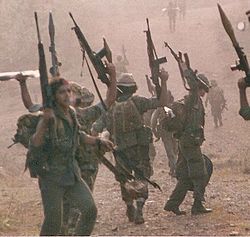
Contras in Nicaragua, 1987

In international relations, violent non-state actors (VNSAs), also known as non-state armed actors or non-state armed groups (NSAGs), are individuals or groups that are wholly or partly independent of governments and which threaten or use violence to achieve their goals.[1][2]

VNSAs vary widely in their goals, size, and methods. They may include narcotics cartels, popular liberation movements, religious and ideological organizations, corporations (e.g. private military contractors), self-defence militia, and paramilitary groups established by state governments to further their interests.[1][3]

While some VNSAs oppose governments, others are allied to them.[1] Some VNSAs are organized as paramilitary groups, adopting methods and structure similar to those of state armed forces. Others may be informally structured and use violence in other ways, such as kidnapping, using improvised explosive devices, or hacking into computer systems.

Description

[edit]
MS-13 gang graffiti

Thomas, Kiser, and William Casebeer asserted in 2005 that "VNSA play a prominent, often destabilizing role in nearly every humanitarian and political crisis faced by the international community".[4] As a new type of actor in international relations, VNSAs represent a departure from the traditional Westphalian sovereignty system of states in two ways: by providing an alternative to state governance; and by challenging the state's monopoly of violence.

Phil Williams stated in 2008 that in the 21st century, they "have become a pervasive challenge to nation-states".[5] Williams argues that VNSAs develop out of poor state governance but also contribute to the further undermining of governance by the state. He explains that when weak states are "unable to create or maintain the loyalty and allegiance of their populations", "individuals and groups typically revert to or develop alternative patterns of affiliation".[6] This causes the family, tribe, clan or other group to become "the main reference points for political action, often in opposition to the state".[6] According to Williams, globalization has "not only... challenged individual state capacity to manage economic affairs, it has also provided facilitators and force multipliers for VNSAs".[6] Transnational flows of arms, for example, are no longer under the exclusive surveillance of states. Globalization helps VNSAs develop transnational social capital and alliances as well as funding opportunities.[7]

The term has been used in several papers published by the US military.[8][9][10][11]

Types

[edit]

Violent non-state actors engage in combat in all terrains. Common and influential types of VNSAs include:

Phil Williams, in an overview article, identifies five types of VNSAs:[21]

Relationship to terrorism

[edit]

There is no commonly accepted definition of "terrorism",[22][23][24] and the term is frequently used as a political tactic to denounce opponents whose status as terrorists is disputed.[25] An attempt at a global definition appears in the working draft of Comprehensive Convention Against International Terrorism, which defines terrorism as a type of act, rather than as a type of group.[26] Specifically, "terrorism" in the draft refers to the threatened or actual intentional injury to others, and serious damage to property resulting in major economic loss:

when the purpose of the conduct, by its nature or context, is to intimidate a population, or to compel a Government or an international organization to do or to abstain from doing any act.[26]

Use of children

[edit]

Violent non-state actors have drawn international condemnation for relying heavily on children under the age of 18 as combatants, scouts, porters, spies, informants, and in other roles[27][28] (although many state armed forces also recruit children).[29] In 2017, for example, the United Nations identified 14 countries where children were widely used by armed groups: Afghanistan, Colombia, Central African Republic, Democratic Republic of the Congo, Iraq, Mali, Myanmar, Nigeria, Gaza - Palestinian Territories, The Philippines, Singapore, South Sudan, Sudan, Syria, and Yemen.

Not all armed groups use children, and approximately 60 that used to do so have entered agreements to reduce or end the practice since 1999.[30] For example, by 2017 the Moro Islamic Liberation Front (MILF) in the Philippines had released nearly 2,000 children from its ranks,[31] and the FARC-EP guerilla movement in Colombia agreed in 2016 to stop recruiting children.[32] In other situations, the use of children was increasing in 2017, particularly in Afghanistan, Iraq, Nigeria and Syria, where Islamist militants and groups opposing them intensified efforts to recruit children.[33][28]

Humanitarian engagement

[edit]

Researchers at the Overseas Development Institute propose that engagement with VNSAs, which they call armed non-state actors, is essential to humanitarian efforts in conflicts. They claim that it is often necessary to do so to facilitate access to those affected and to provide humanitarian assistance.[34] However, humanitarian agencies often fail to engage strategically with VNSAs. This tendency has strengthened since the end of the Cold War, partly because of the strong discouragement of humanitarian engagement with VNSAs in counterterrorism legislation and donor funding restrictions. In their opinion, further study is necessary to identify ways in which humanitarian agencies can develop productive dialogue with VNSAs.[34]

The International Security Department and the International Law Programme at Chatham House are seeking to understand the dynamics that will determine support for a principle-based approach to engagement by humanitarian actors with VNSAs.[35]

See also

[edit]

References

[edit]

Further reading

[edit]
[edit]
Revisions and contributorsEdit on WikipediaRead on Wikipedia
from Grokipedia
Violent non-state actors (VNSAs) are individuals, groups, or organizations that employ unlawful violence or intimidation, particularly against civilians, to advance political, ideological, economic, religious, or criminal objectives outside the framework of state authority. This distinguishes them from state militaries by their lack of legitimate monopoly on force and frequent reliance on asymmetric tactics that undermine governance and security. VNSAs encompass diverse entities such as terrorist networks, insurgent movements, drug cartels, militias, and warlords, often thriving in regions of weak state control where they may seize territory, extract resources, or impose parallel authority. Their proliferation has intensified in the post-Cold War era, fueled by state fragility, technological innovations enabling remote coordination and lethal operations, and global illicit economies that provide financing through trafficking and extortion. Defining characteristics include adaptability to counter state forces, ideological cohesion or profit-driven pragmatism, and the capacity to exploit power vacuums, sometimes achieving temporary territorial dominance as seen with groups controlling swathes of ungoverned spaces. VNSAs pose multifaceted threats to international stability, eroding sovereignty, perpetuating cycles of violence, and complicating peacekeeping efforts, with empirical data indicating their involvement in a rising share of global conflicts since the 1990s. Controversies arise over their classification—distinguishing genuine insurgents from criminals or terrorists—and state complicity in proxy usages, which can prolong instability while evading direct accountability.

Definition and Characteristics

Core Definition

A violent non-state actor (VNSA) is a non-sovereign entity—typically an organized group, movement, or network—that employs unlawful or to advance political, ideological, economic, or territorial objectives, operating independently of or in direct opposition to established state authority. Unlike state militaries, which derive legitimacy from governmental control and international recognition, VNSAs contest the state's monopoly on legitimate force through asymmetric tactics, including , , or , often exploiting governance vacuums or weak institutions. These actors encompass a spectrum of organizations, from ideologically driven militants like jihadist networks to profit-oriented criminal syndicates such as cartels, and opportunistic militias in civil conflicts, all unified by their reliance on decoupled from state accountability. Empirical analyses indicate that VNSAs thrive in environments of state fragility, where deficiencies in provision or legitimacy enable them to recruit, fundraise, and sustain operations, as evidenced by their proliferation in post-colonial insurgencies and failed-state scenarios since the late . Their activities frequently involve targeting civilians, , or rival groups to coerce compliance or extract resources, distinguishing them from non-violent non-state entities like NGOs.

Distinguishing Features

Violent non-state actors (VNSAs) are fundamentally distinguished from state entities by their lack of sovereign authority and formal accountability under , operating instead to challenge or erode the state's monopoly on legitimate violence without deriving legitimacy from recognized structures. Unlike conventional state militaries, which possess hierarchical command systems, national resources, and obligations under treaties like the , VNSAs typically employ asymmetric strategies—such as guerrilla tactics, , or cyber operations—stemming from their relative material disadvantages and need for adaptability in contested environments. This non-state status enables them to evade traditional diplomatic or military deterrence mechanisms, often thriving in regions of weak state capacity where they can exploit vacuums. Within the spectrum of non-state , VNSAs differ from purely criminal organizations through their frequent pursuit of ideological, political, or territorial objectives beyond mere , though hybrid cases blur lines, as seen in groups like transnational criminal organizations that govern territories and impose rules while trafficking , contributing to over 109,000 U.S. overdose deaths in 2023. Terrorists within this category emphasize coercive fear to achieve ideological ends, insurgents focus on mobilizing populations to seize power, and militias provide armed protection or proxy warfare, yet all share a capacity for sustained against state or civilian targets independent of legal frameworks. This contrasts with apolitical , where serves economic gain without systemic challenges to . Organizationally, VNSAs exhibit resilient, often decentralized or networked structures—from hierarchical groups to fluid alliances like affiliates—allowing them to recruit diversely, fund operations through crime or external patrons, and integrate advanced technologies such as AI or for enhanced lethality and reach. These features enable parallel , including provision of security, , or economic regulation in ungoverned spaces, thereby undercutting state legitimacy and complicating counter-strategies that rely on targeting formal leadership. Their transnational potential further amplifies threats, as local cells can coordinate globally without state-like logistical constraints.

Scale of Threat and Capabilities

Violent non-state actors (VNSAs) pose a variable but often substantial threat, with global terrorism deaths reaching approximately 8,000 in 2023 according to the Institute for Economics & Peace's Global Terrorism Index, though regional hotspots like the Sahel accounted for over half of all fatalities by 2024, marking it as the epicenter of global terrorism. The four deadliest groups—Islamic State, Al-Shabaab, Jamaat Nusrat Al-Islam wal-Muslimin, and Tehrik-e-Taliban Pakistan—intensified operations in 2024, driving an 11% rise in fatalities, while the number of countries experiencing attacks increased to 66. Beyond terrorism, VNSAs such as drug cartels in Mexico contribute to homicide rates exceeding 30,000 annually, with peaks at 33,341 in 2018 and up to 80% of killings linked to organized crime activities including territorial disputes and extortion. ![Mara Salvatrucha graffiti representing gang territorial markings][float-right] Capabilities of VNSAs range from rudimentary insurgent operations to quasi-state functions, with groups like the (ISIS) at its 2014-2015 peak controlling nearly 110,000 square kilometers across and —equivalent to about 40% of Iraq and a third of Syria—supported by an estimated 30,000 fighters funded through oil revenues exceeding $1 million daily via black-market sales. These actors demonstrate adaptability in , employing commercial drones for surveillance and attacks; ISIS alone conducted hundreds of sorties against coalition forces. In urban environments, VNSAs leverage local recruitment, funding from illicit economies, and minimal logistics to sustain prolonged control, often providing governance-like services such as security and in ungoverned spaces, which enhances their resilience against state counteroperations. The threat scale is amplified by transnational networks and proxy dynamics, where VNSAs receive indirect state support for or , enabling operations that destabilize regions without direct attribution. In , cartel conflicts, such as the post-2024 arrest of leader Ismael "El Mayo" Zambada, have spiked homicides by 400% in affected areas through intensified turf wars involving advanced weaponry smuggled from the . While VNSAs rarely match conventional state militaries in firepower, their decentralized structures and ideological motivation allow sustained low-intensity violence, with economic impacts from alone estimated in billions annually through disrupted and infrastructure damage. This asymmetry underscores their capacity to erode state legitimacy over time, particularly in fragile regions where they control populations exceeding millions.

Historical Evolution

Early and Pre-Modern Examples

The , a radical subgroup of Jewish active in Judaea from approximately 50 CE until the fall of in 70 CE, exemplified early organized non-state violence through targeted assassinations of Roman officials and Jewish elites perceived as collaborators. Concealing short daggers known as sicae under their cloaks, they struck in crowded public spaces to maximize psychological impact and sow fear, with notable victims including the Jonathan ben Ananus around 57 CE. Their tactics, blending stealth and ideological zeal for national liberation, escalated unrest and contributed to the outbreak of the First Jewish-Roman War in 66 CE, though they operated independently of formal state structures. In the during the late , formed loose but effective non-state maritime syndicates from the 140s BCE, basing operations in rugged coastal enclaves of southern and expanding to control key sea lanes. Numbering fleets that captured an estimated 400 cities and thousands of vessels annually by the 70s BCE, they enslaved over a million people and extorted tribute from trade hubs like , severely hampering Roman commerce until Pompey's sweeping naval campaign in 67-66 BCE destroyed over 1,000 pirate ships and resettled 10,000 fighters inland. These groups thrived amid weakened Seleucid authority post-110 BCE, relying on hit-and-run tactics rather than territorial control. The Third Servile War, led by the Thracian gladiator from 73 to 71 BCE, mobilized up to 120,000 escaped slaves and rural poor into a mobile army that routed multiple Roman legions, including those under praetors and Publius Varinius, while foraging across . Originating from a Capua gladiatorial school breakout involving just 70-78 fighters, the revolt challenged Roman slavery's foundations through and tactical discipline, defeating forces totaling around 40,000 before Crassus's 60,000-strong army crucified 6,000 survivors along the . Medieval precedents include the Nizari Ismailis, or Hashashin, who from 1090 CE maintained a decentralized network of mountain fortresses in Persia and under leaders like Hassan-i Sabbah, conducting over 50 documented assassinations of Sunni caliphal officials, Seljuk viziers, and Crusader commanders to defend their Shia sect against existential threats. Employing fida'is—suicidal agents trained for infiltration and public killings, such as the 1092 murder of —their asymmetric strategy compensated for military inferiority until Mongol forces razed in 1256 CE, dismantling the order.

20th Century Emergence

The (IRA), reorganized in 1919 from earlier nationalist militias, conducted a sustained guerrilla campaign against British rule during the from 1919 to 1921, employing ambushes, assassinations, and that resulted in over 1,400 British and police deaths alongside civilian casualties. This conflict highlighted the tactical advantages of non-state actors in against imperial powers weakened by , setting a precedent for irregular forces challenging state authority through targeted violence rather than conventional battles. Post-World War II decolonization accelerated the emergence of violent non-state actors as nationalist groups exploited European exhaustion and ideological vacuums to launch insurgencies across and . In , the Front de Libération Nationale (FLN) initiated armed struggle against French colonial rule in 1954, escalating into a war that claimed over 1 million lives by 1962 and culminated in independence, demonstrating how such groups could sustain prolonged campaigns with popular support and external aid. Similar patterns emerged in Kenya's Mau Mau Uprising (1952–1960) and Indonesia's revolution against Dutch forces (1945–1949), where non-state fighters used hit-and-run tactics to force concessions from overstretched colonial administrations. During the , superpower rivalries amplified the role of violent non-state actors through proxy warfare, with the and arming insurgent groups to avoid direct confrontation. In , U.S.-backed forces, numbering up to 100,000 fighters by the mid-1980s, waged guerrilla operations against the Soviet invasion from 1979 to 1989, inflicting heavy casualties and contributing to the USSR's withdrawal. In , the , supported by the Reagan administration from 1981 to 1990, conducted sabotage and raids against the Sandinista government, illustrating how state sponsorship enabled non-state actors to project power transnationally and prolong conflicts. These dynamics proliferated VNSAs globally, as ideological patrons provided funding, training, and weapons, transforming local grievances into protracted internationalized struggles.

Post-Cold War Proliferation and Recent Trends

Following the dissolution of the Soviet Union in 1991, the bipolar structure of the Cold War gave way to a multipolar environment characterized by power vacuums in regions like Afghanistan, the Balkans, and sub-Saharan Africa, facilitating the proliferation of violent non-state actors (VNSAs). Surplus small arms and battle-hardened fighters from proxy conflicts, such as the Soviet-Afghan War (1979–1989), diffused globally, enabling groups like al-Qaeda—formed in 1988 by Osama bin Laden—to expand operations beyond local insurgencies into transnational jihadist networks. This era saw a shift from state-sponsored insurgencies to ideologically driven VNSAs exploiting weak governance, with the number of armed conflicts surging in the 1990s, many intra-state and involving multiple non-state factions. The rise of Salafi-jihadist organizations exemplified this trend, as al-Qaeda's 1998 fatwa against the U.S. and its allies culminated in the September 11, 2001, attacks, killing 2,977 people and prompting a global response. Subsequent U.S.-led interventions in (2001) and (2003) inadvertently fueled further proliferation, birthing groups like the (IS), which declared a in 2014 across and , controlling territory the size of Britain at its peak and inspiring affiliates in , , and the . By the , VNSA fragmentation accelerated, with IS affiliates like IS-West Africa Province (linked to ) and al-Qaeda branches such as al-Shabaab in conducting operations in failed states, contributing to over 66,000 recorded terrorist incidents since 2007 per the . In , post-Cold War economic liberalization and U.S. demand for narcotics militarized drug trafficking organizations, transforming them into VNSA-like entities with paramilitary capabilities. Mexican cartels, such as the , amassed billions annually by the 1990s through cocaine routes, evolving into violent syndicates like —former defectors—who escalated turf wars after 2006, resulting in over 400,000 homicides in Mexico's drug conflict by 2023. Similarly, Central American gangs like , originating in in the 1980s but proliferating regionally post-1990s deportations, engaged in and assassinations, underscoring how criminal VNSAs blurred lines with insurgents. Recent trends indicate persistent decentralization and hybridization, with non-state conflicts rising: in 2023, groups drove 79% of fatalities in such battles, per data. The 2025 reports an 11% increase in deaths in 2024, led by IS and affiliates like Tehrik-e-Taliban Pakistan, though global totals remain below the 2014 ISIS peak of 44,000 deaths; outside Afghanistan, deaths rose 4%, reflecting localized surges in the and . VNSAs increasingly leverage technology for recruitment and drones, while lone-actor attacks in the West—often jihadist-inspired—highlight evolving threats amid state retrenchment. This proliferation stems from causal factors like state fragility and illicit economies, rather than monolithic ideological waves, with empirical data showing VNSAs now dominant in 50% of global conflicts.

Classifications and Types

By Primary Objectives

Violent non-state actors (VNSAs) are classified by their primary objectives, which fundamentally shape their strategies, targets, and interactions with states. These objectives range from achieving political transformation through or to pursuing economic dominance via criminal enterprises, with some groups blending motives in hybrid forms. Political objectives dominate in cases where groups seek to alter governance structures, often employing sustained or selective violence to undermine state legitimacy, as seen in separatist movements like the (PKK), which has pursued Kurdish autonomy in since 1984 through attacks on military and civilian targets. In contrast, purely economic objectives prioritize profit over , exemplified by drug cartels such as Mexico's , which from 2006 onward escalated violence to control trafficking routes, resulting in over 150,000 homicides linked to cartel rivalries by 2020. ![Mara Salvatrucha graffiti representing gang territorial claims][float-right] Insurgent groups with revolutionary objectives aim to overthrow existing regimes and install alternative systems, frequently drawing on ideological frameworks like or religious fundamentalism. The (FARC), active from 1964 to 2016, exemplified this by targeting state institutions to establish a , financing operations through kidnappings and narcotics that generated an estimated $500 million annually at peak. Separatist VNSAs, however, focus on territorial independence, using violence to expel state forces from claimed regions; the (LTTE) in controlled northern territories from 1983 to 2009, employing suicide bombings and conventional tactics that killed over 100,000 in the civil war. Terrorist organizations prioritize ideological enforcement, leveraging high-impact attacks to instill fear and coerce societal or policy shifts, as with Al-Qaeda's 9/11 operations in 2001, which aimed to expel Western influence from Muslim lands and provoked global responses. Criminal VNSAs, driven by profit maximization, deploy violence instrumentally to protect illicit markets rather than pursue governance changes. Transnational gangs like Mara Salvatrucha (MS-13), originating in Los Angeles in the 1980s and expanding to Central America, enforce extortion rackets and smuggling, with U.S. authorities attributing over 10,000 murders in El Salvador alone to gang violence between 2015 and 2020. Warlord-led groups blend personal power accumulation with resource extraction, controlling territories for tribute and trade; in Somalia, figures like Mohamed Farrah Aidid commanded militias in the 1990s that fragmented the state post-1991, profiting from ports and aid diversion amid famine that claimed 300,000 lives. Hybrid actors, such as Hezbollah, integrate political, ideological, and economic goals—receiving Iranian funding since 1982 for attacks on Israel while providing social services in Lebanon—demonstrating how objectives evolve, often eroding distinctions between categories as groups adapt to sustain operations. Empirical analyses indicate that objective purity is rare; many VNSAs shift toward criminality for funding when political gains stall, as observed in the Taliban’s opium trade, which supplied 90% of global heroin by 2000.

By Ideological Drivers

Violent non-state actors (VNSAs) are frequently classified by their ideological drivers, which shape their grievances, goals, and methods of violence. Prominent categories derived from databases like the include religious, nationalist/separatist, left-wing, right-wing, and single-issue motivations. These ideologies often overlap with operational contexts, such as insurgencies or , but religious extremism has dominated global lethality since the 1990s, accounting for the majority of terrorism deaths in recent years. For instance, the reports that in 2023, over 6,700 terrorism deaths occurred worldwide, with 87% concentrated in conflict zones driven primarily by religiously motivated groups like the , Islamic State Khorasan Province (IS-K), and Al-Shabaab. Religious ideologies, especially jihadist Salafi-jihadism, motivate VNSAs seeking to establish caliphates or enforce strict interpretations of Islamic law through violence against perceived apostates, governments, and civilians. , founded in 1988, popularized global , inspiring affiliates that conducted attacks like the 1998 U.S. embassy bombings in and , killing 224 people. The , peaking in 2014-2017, controlled territory in and , executing systematic atrocities including the 2015 Paris attacks that killed 130. These groups recruit via ideological propaganda emphasizing apocalyptic narratives, with GTD data showing religious-motivated incidents rising sharply post-2000, comprising over 50% of global attacks by 2020. Non-Islamist religious VNSAs, such as historical Sikh militants like responsible for the 1985 bombing (329 deaths), remain outliers with limited sustained impact. Nationalist and separatist ideologies drive VNSAs pursuing ethnic or regional independence, often through protracted insurgencies blending and . The (PKK), active since 1978, has waged a separatist campaign in , with GTD recording over 5,000 PKK-linked attacks causing thousands of casualties. Similarly, the (LTTE) in pioneered suicide bombings, fighting from 1976 to 2009 and assassinating Indian Prime Minister in 1991. These groups frame violence as defensive against state oppression, sustaining operations via funding and local support, though many, like the PKK, persist despite territorial losses. Left-wing revolutionary ideologies, rooted in Marxist-Leninist or Maoist frameworks, historically motivated VNSAs aiming to overthrow capitalist or feudal systems via class warfare. In the 1970s-1980s, groups like Peru's , founded in 1980, killed over 30,000 in rural insurgency before leader Abimael Guzmán's 1992 capture. Colombia's FARC, operational from 1964 to 2016, financed via cocaine trade and kidnappings, inflicted 220,000 deaths in a . Post-Cold War, such groups declined globally, but remnants like India's Naxalites continue low-level violence, with GTD noting left-wing attacks dropping to under 5% of totals by 2020. Right-wing ideologies, emphasizing racial supremacy, anti-immigration, or authoritarian , fuel VNSAs focused on preserving perceived cultural dominance through targeted . Globally, these are less organized than religious counterparts, but in the U.S., right-wing extremists perpetrated 57% of ideologically motivated attacks from 2007-2016 per GTD analysis. Examples include Norway's 2011 Anders Breivik massacre (77 deaths) inspired by anti-Islam manifestos, and fragmented cells like plotting bombings. Accelerationist factions seek , using online , though their global impact remains marginal compared to Islamist groups, with fatalities under 1% of annual totals. Anti-communist insurgents like Nicaragua's (1981-1990), backed by U.S. aid exceeding $300 million, exemplified Cold War-era right-leaning VNSAs combating leftist regimes through and raids.

Hybrid and Transnational Variants

Hybrid violent non-state actors blend conventional military capabilities with irregular tactics, political influence, and socio-economic functions, often mimicking state-like governance while engaging in asymmetric violence. These groups challenge traditional distinctions between combatants and civilians, insurgents and criminals, by integrating , precision-guided munitions, and cyber operations alongside and . exemplifies this model, operating as a Lebanese with parliamentary representation since , a parallel welfare system providing education and healthcare to Shiite communities, and a estimated at 20,000-50,000 fighters equipped with Iranian-supplied advanced weaponry, including over 150,000 rockets demonstrated in the against , where it inflicted significant casualties through ambushes and anti-tank missiles despite lacking air superiority. This hybrid structure enables resilience, as Hezbollah's 2023-2025 escalations along Israel's border combined drone strikes and tunnel networks with diplomatic maneuvering via its state-embedded legitimacy. Transnational variants extend operations across sovereign borders, leveraging global networks for recruitment, financing, and attacks, thereby eroding state monopolies on violence beyond their primary theaters. The (ISIS) pursued a spanning and from 2014 to 2019, controlling up to 100,000 square kilometers and generating $1-3 billion annually from oil, extortion, and foreign donations, while inspiring over 100 attacks in and affiliates conducting operations in 20+ countries, including ISIS-West Africa Province's territorial seizures in since 2015 that displaced thousands. Mexican transnational criminal organizations, such as the and (CJNG), dominate cross-border drug trafficking, smuggling and into the via routes supporting over 100,000 annual overdose deaths, while perpetuating intra-cartel warfare in that has claimed more than 30,000 lives yearly since 2018 through militarized tactics like armored vehicles and drone bombings. These actors exploit weak governance and , with cartels infiltrating U.S. communities via alliances with local gangs, as evidenced by Sinaloa's operational cells in 50+ American cities. Overlaps between hybrid and transnational forms amplify threats, as groups like coordinate with Iranian proxies in and for Red Sea disruptions since October 2023, combining ideological militancy with criminal revenue streams, while ISIS affiliates adapt hybrid governance in ungoverned spaces, taxing locals and enforcing to sustain cross-continental . Such variants demand multifaceted countermeasures, as their adaptability—evident in cartels' diversification into human and yielding billions—outpaces unilateral state responses.

Operational Approaches

Tactics and Asymmetric Warfare

Violent non-state actors engage in to exploit disparities in conventional military capabilities, employing irregular tactics that avoid direct confrontation with state forces while targeting vulnerabilities in , morale, and political will. These strategies, rooted in principles, emphasize mobility, surprise, and dispersion to prolong conflicts and impose disproportionate costs on adversaries. By operating in small, decentralized units, actors such as insurgents and terrorists blend into civilian populations, utilize terrain for cover, and conduct hit-and-run operations that erode enemy resources over time. Key tactics include ambushes, improvised explosive devices (IEDs), and suicide bombings, which enable low-cost, high-impact strikes against superior forces. In southern from 2006 onward, fighters frequently used small ambushes combined with IEDs and suicide attacks to target patrols and convoys, inflicting casualties while evading sustained engagements. Insurgents in synchronized IEDs—often roadside or vehicle-borne—with follow-on ambushes and raids, accounting for a significant portion of losses between 2003 and 2011. Suicide bombings, as seen in operations by groups like affiliates, aim to maximize psychological disruption by attacking soft targets and provoking retaliatory responses that alienate local populations. Additional asymmetric approaches encompass of , assassinations of key personnel, and the use of to amplify tactical successes and recruit supporters. These methods sustain operational tempo without requiring territorial control, allowing non-state actors to outlast state opponents in protracted conflicts. Over time, adaptations such as evolving from pure guerrilla hit-and-run to coordinated maneuvers, as demonstrated by the in Helmand Province operations around 2018, reflect learning curves in response to pressures.

Financing, Logistics, and Innovation

Violent non-state actors (VNSAs) derive funding from diverse licit and illicit sources tailored to their operational environments, including , , trafficking in goods and humans, , taxation of local populations, and exploitation of natural resources such as oil or minerals. Legitimate businesses, such as firms or charities, often serve as fronts for , while ideological donations from sympathizers provide steady inflows, particularly for groups with transnational appeal. State sponsorship, though declining post-Cold War, persists in cases like Iranian support for proxies via arms and cash transfers. Empirical analyses indicate that control over territory enables resource extraction, with groups like the generating hundreds of millions annually from opium taxes and mining as of 2023. Logistics for VNSAs rely on informal, resilient networks that exploit weak , including smuggling routes across borders for arms, explosives, and personnel. These supply chains often converge with criminal enterprises, forming a crime-terror-insurgency nexus where cartels provide routes and safe houses in exchange for protection fees. Local sustains fuel, food, and medical supplies, while captured state stockpiles supplement needs during offensives. Disruptions, such as border closures, force adaptations like decentralized caching of munitions in urban areas, as observed in insurgent operations in and . VNSAs demonstrate tactical innovation by adapting commercial technologies to , notably deploying off-the-shelf drones for reconnaissance, bombings, and swarming attacks since 2020. Groups affiliated with Iran-backed militias pioneered one-way attack drones in strikes like the January 2024 Tower 22 incident, killing three U.S. personnel and highlighting low-cost, high-impact modifications such as GPS guidance and explosive payloads. Cryptocurrencies and digital wallets facilitate anonymous financing, evading traditional banking scrutiny, with reports of terrorist use surging post-2021 sanctions. Advanced manufacturing, including 3D-printed components for weapons, lowers , enabling in remote bases. These adaptations exploit dual-use tech proliferation, outpacing state countermeasures in agility.

Internal Organization and Recruitment

Violent non-state actors (VNSAs) exhibit diverse internal structures, ranging from hierarchical command systems to decentralized networks, shaped by strategic imperatives such as survivability against state forces and operational flexibility. Hierarchical organizations, like the FARC insurgency in , relied on top-down decision-making with regional fronts reporting to a central secretariat, enabling coordinated large-scale operations until the group's demobilization in 2016. In contrast, decentralized models predominate in resilient groups facing intense pressure; transitioned to a franchise-based structure post-2001, with autonomous affiliates like conducting independent attacks to mitigate decapitation risks. Criminal VNSAs, such as , operate via loosely connected cliques that maintain transnational ties while allowing local autonomy in activities like and violence. These structures influence internal cohesion and adaptability; militarized VNSAs gaining territorial control often centralize authority to professionalize forces, as evidenced in empirical analyses of insurgent groups balancing with combat roles. Hybrid variants emerge in weak states, where VNSAs like Mexican cartels blend hierarchies with entrepreneurial subunits, fostering innovation in logistics but risking fragmentation from internal rivalries. Recruitment into VNSAs typically exploits personal vulnerabilities, ideological narratives, and social ties, with empirical studies identifying pathways through kinship, peer influence, and perceived grievances. Terrorist organizations like Al-Shabaab employ multifaceted strategies, including forced conscription in Somalia—recruiting over 4,000 fighters annually in peak years—and ideological indoctrination via mosques and online platforms. Boko Haram similarly uses abductions, with data from 2014-2018 showing thousands of children coerced into service, alongside voluntary joins motivated by economic desperation in northeastern Nigeria. Far-right groups in the U.S. recruit via online forums and personal networks, with profiles indicating prior military experience in 20-30% of cases, facilitating skill transfer. Gangs and cartels prioritize youth from marginalized communities, using coercion and status incentives; targets adolescents in Central American and U.S. neighborhoods, initiating recruits through violent rituals that bind members via shared trauma, contributing to an estimated 10,000 U.S. affiliates by 2025. Cartels in recruit via familial ties and payments, with empirical data linking gang disengagement challenges to entrenched in regions like . Success in recruitment correlates with operational victories, as seen in Al-Qaeda's post-attack spikes, underscoring causal links between perceived and inflow. Retention often hinges on internalization of group ideology, evident in cases where recruits embraced apocalyptic narratives, per psychological assessments.

State Interactions and Responses

Proxy Dynamics and Sponsorship

States employ violent non-state actors (VNAs) as proxies to advance geopolitical objectives while maintaining plausible deniability and avoiding direct military confrontation, a strategy prevalent in proxy warfare. This approach allows sponsors to project power cost-effectively, leveraging local forces for asymmetric operations that align with broader strategic interests, such as countering adversaries or securing resources, without risking full-scale escalation. Proxy dynamics often involve material support like funding, arms, training, and intelligence, enabling VNAs to conduct operations that extend the sponsor's influence in contested regions. During the , the sponsored the in from 1981 onward to counter the Sandinista government, providing over $100 million in military and by 1986 despite congressional restrictions, framing it as resistance to Soviet-backed expansion. This support included CIA training and logistics, illustrating how sponsorship can destabilize regimes aligned with rival powers but risks domestic backlash and operational scandals, as seen in the Iran-Contra affair. Similarly, Soviet and Cuban aid to the Sandinistas exemplified bipolar proxy competitions, where VNAs served as extensions of superpower rivalries. In contemporary contexts, maintains an extensive proxy network across the , designating it a state sponsor of by the U.S. State Department for providing financial and military aid to groups like , , , and Houthi militants. has received an estimated $700 million annually from , including advanced weaponry, enabling sustained operations against and influence in and . 's support for Houthis in includes missile technology transfers, enhancing their disruptions since 2014, though proxies retain autonomy that can complicate sponsor control. has utilized the as a proxy in since 2015, deploying thousands of mercenaries to secure oil fields and support Assad's regime in exchange for resource concessions, with operations extending to post-2014 annexation of . Sponsorship entails risks, including loss of proxy loyalty, as evidenced by Wagner's 2023 against Russian military leadership, which exposed tensions over operational and resource shares. Proxies may pursue independent agendas, leading to uncontrolled escalation or blowback, such as Iranian-backed militias conducting attacks beyond Tehran's directives, complicating sponsor deniability. Empirical analyses indicate that while proxies amplify state reach in grey-zone conflicts, poor oversight can result in strategic miscalculations, regime instability, or , underscoring the causal trade-offs between indirect leverage and potential agency losses.

Erosion of State Monopoly on Violence

Violent non-state actors (VNAs) erode the state's monopoly on legitimate violence—defined as the Weberian that only the state holds exclusive over the use of physical force within its territory—by establishing control over territories, providing parallel structures, and outmatching state security forces in localized conflicts. This erosion manifests through mechanisms such as territorial seizures, of state institutions, and the imposition of alternative legal and economic orders, often in contexts of weak or post-conflict vacuums. Empirical evidence from conflict zones indicates that VNAs succeed where states fail to maintain coercive capacity, leading to fragmented and heightened instability. In and , the () exemplified this process from 2014 to 2017 by capturing approximately 100,000 square kilometers of territory and exerting monopoly control over violence in urban centers like , where it established a police force, judicial system, and taxation generating $1–2 billion annually from oil sales and . 's administrative apparatus, including hisba units to regulate public order, directly supplanted state functions, enabling it to govern populations exceeding 10 million while marginalizing national militaries through asymmetric tactics and ideological . This territorial dominance persisted until offensives reclaimed key areas by 2017, but residual VNA networks continue to challenge residual state authority. Mexican drug cartels have similarly undermined federal control since the mid-2000s, particularly in regions like and , where groups such as the Zetas and exert greater influence over local than government forces, controlling smuggling routes and imposing cobro de piso () taxes on businesses. By 2009, cartel violence had escalated to over 15,000 homicides annually, surpassing state security capabilities and fostering that infiltrated and elected officials, as documented in U.S. assessments. Cartels' use of targeted assassinations against candidates—over 100 political killings reported in the 2021 election cycle—further erodes democratic legitimacy and state coercive monopoly, creating ungovernable zones where private militias fill security voids. ![Mara Salvatrucha graffiti symbolizing gang territorial claims][float-right] In , the progressively eroded the post-2001 government's through sustained , proxy support, and territorial gains, culminating in the collapse of on August 15, 2021, after U.S. withdrawal. Prior to the takeover, shadow governance in rural provinces involved parallel taxation (ushr) and courts, controlling up to 50% of the country's districts by 2020 and outpacing Afghan National Army effectiveness amid and desertions. This erosion was exacerbated by external proxies and internal state failures, transforming the from a VNA into a state apparatus while perpetuating cycles of violence that displaced millions. Across these cases, VNAs exploit state weaknesses—such as fiscal insolvency or military overextension—to institutionalize alternative violence monopolies, often leading to neomedieval fragmentation where multiple actors contest authority without clear hierarchies. Quantitative analyses reveal correlations between VNA territorial control and state revenue shortfalls, with implications for global security as eroded monopolies facilitate transnational threats like arms proliferation and refugee flows. Countering this requires restoring state legitimacy through targeted capacity-building, though historical precedents underscore the challenges of reversing entrenched VNA footholds.

Governmental and International Countermeasures

Governments employ a range of countermeasures against violent non-state actors (VNSAs), including enhanced gathering, targeted operations, and reforms. In the United States, the Department of Homeland Security's Strategic Framework for Countering Terrorism and Targeted Violence emphasizes disrupting domestic threats inspired by through improved information sharing among agencies and community partnerships, implemented since 2019 to address ideologically motivated attacks. (COIN) doctrines, refined through empirical analysis of historical cases, prioritize protecting civilian populations, addressing insurgent motives, and employing more effective practices than ineffective ones, with studies of 30 insurgencies from 1978 to 2005 finding that successes correlated with sustained efforts over years rather than quick kinetic wins. For instance, U.S. advisory roles in COIN operations focus on training host-nation forces to erode VNSA support bases, as seen in during the 1980s where political and social dimensions complemented combat efforts. Financial and legal tools form a core of national responses, with asset freezes and designations disrupting VNSA funding. The U.S. Treasury's (OFAC) administers sanctions under counter-terrorism programs, blocking properties of designated entities and prohibiting transactions, which has pressured groups to curtail activities by limiting resources. Domestically, executive actions like the September 2025 directive on countering mandate federal agencies to identify and prevent through enhanced monitoring and prevention efforts. These measures, however, require balancing with , as overreach can alienate populations and bolster VNSA recruitment narratives. Internationally, coalitions and multilateral sanctions amplify state efforts against VNSAs. The imposes targeted financial sanctions under Article 41, including asset freezes, travel bans, and arms embargoes on designated terrorists and affiliates, with resolutions like those post-9/11 facilitating global asset seizures exceeding billions in value. NATO's counter-terrorism initiatives, updated as of August 2025, support operations against groups like through intelligence sharing, capacity-building, and resilience measures against hybrid threats from state and non-state actors. The U.S. State Department's designation of Foreign Terrorist Organizations (FTOs) enables international pressure, with over 60 groups listed as of 2023, leading to coordinated disruptions of networks spanning 170 nations via arrests and frozen assets. Effectiveness varies; while coalitions degraded 's territorial by 2019 through combined airstrikes and ground operations, persistent challenges like foreign fighter flows highlight the need for addressing root failures rather than solely military action.

Societal and Humanitarian Dimensions

Civilian Impacts and Atrocities

Violent non-state actors (VNSAs) impose profound direct and indirect harms on civilians, including intentional killings, , and psychological terror to coerce compliance or assert territorial control. One-sided —defined as organized armed attacks on unarmed civilians causing at least 25 deaths per actor-year—by non-state groups has surged, with 35 such actors recorded in 2024 responsible for a significant share of the over 13,900 global civilian fatalities from this form of , surpassing state-perpetrated incidents. These acts often escalate during territorial contests, where VNSAs target non-combatants to undermine state legitimacy and extract resources, leading to widespread internal displacement; for instance, non-state conflicts and associated displaced millions in regions like and the between 2010 and 2023. Terrorist VNSAs exemplify systematic atrocities through mass executions, abductions, and indiscriminate bombings. The in accounted for the majority of civilian casualties from 2009 to 2021, with the Assistance Mission in Afghanistan (UNAMA) documenting 7,559 civilian deaths and injuries in one period alone, primarily from improvised explosive devices, suicide attacks, and targeted assassinations of educators and officials. Similarly, Boko Haram's in since 2009 has resulted in tens of thousands of civilian deaths via village raids, market bombings, and mass kidnappings, including the April 2014 abduction of 276 schoolgirls in Chibok, which highlighted the group's strategy of targeting and vulnerable communities to enforce ideological dominance. These groups justify such violence as for perceived with states, though empirical patterns reveal opportunistic terror to maintain and fear-based . Criminal VNSAs, such as drug cartels in Mexico, generate staggering civilian tolls through inter-group warfare, extortion rackets, and public displays of brutality. Since the Mexican government's 2006 escalation against cartels, over 460,000 homicides have occurred, with civilians—often caught in crossfire, displaced by threats, or killed in massacres like the 2011 San Fernando killings of 193 migrants—comprising a substantial portion amid turf battles involving groups like Sinaloa and Jalisco New Generation. Gang affiliates, including transnational entities like Mara Salvatrucha (MS-13), amplify urban civilian suffering through territorial enforcement via machete attacks, rapes, and child recruitment, contributing to homicide spikes in Central America where non-combatant deaths exceed 20,000 annually in peak years. Such patterns underscore how VNSAs exploit weak governance to normalize civilian victimization, eroding social cohesion without equivalent accountability mechanisms found in state forces.

Exploitation of Vulnerable Populations

Violent non-state actors frequently target economically disadvantaged, displaced, and socially marginalized individuals, leveraging conditions of , lack of , and instability to sustain operations through coerced and labor. These groups exploit vulnerabilities inherent in failed or contested state environments, where weak governance leaves populations susceptible to promises of income, protection, or ideological belonging, often masking underlying . Empirical data indicate that such exploitation serves both manpower needs and revenue generation, with children and migrants comprising disproportionate shares of victims due to their limited agency and family support networks. Child soldier recruitment exemplifies this pattern, with non-state armed groups abducting or enticing minors from impoverished rural areas and refugee camps for combat roles, suicide missions, and auxiliary tasks. In Nigeria's Lake Chad Basin, Boko Haram and its splinter Islamic State West Africa Province abducted over 2,000 children between 2013 and 2018, including the 2014 Chibok kidnapping of 276 schoolgirls, of whom 82 remained in captivity as of April 2024; by 2017, the group had incorporated approximately 8,000 children into its ranks through force, indoctrination, and economic incentives amid widespread poverty. Similarly, guerrilla organizations in Colombia, such as dissident FARC factions and the ELN, have drawn from poor, remote communities, recruiting at least 15 students from a single school in the past year via social media appeals highlighting economic desperation, with historical patterns linking poverty and inequality to child trafficking for armed service. The United Nations recognizes such practices as human trafficking, entailing recruitment by deception or abduction for exploitation in conflict zones. Sexual and gender-based exploitation further underscores the predatory nature of these actors toward vulnerable women and girls, often framed ideologically but rooted in control and demographic engineering. The systematically enslaved thousands of Yazidi women and girls during its 2014 capture of , , subjecting them to , , and sale in markets as part of a genocidal campaign, with survivors reporting organized systems of affecting an estimated 6,800 individuals. Boko mirrored this in abductions for forced marriages and sexual servitude, integrating captured girls into domestic and combat roles while denying them escape through violence and isolation. These acts not only demoralize targeted communities but also generate internal cohesion and value, exploiting cultural and familial disruptions in unstable regions. Transnational criminal organizations, including drug cartels classified as violent non-state actors, exploit migrant flows for fees and labor trafficking, preying on Central American and other vulnerable transients fleeing or poverty. Mexican cartels control routes into the , subjecting migrants to , forced labor in drug operations, and , with reports documenting increased trafficking risks amid policy shifts that prolong border exposure. In fiscal year 2022, U.S. authorities intercepted thousands of operations linked to cartels, where victims faced and abandonment in deserts, amplifying humanitarian crises while funding cartel arsenals. Such practices blur lines between voluntary migration and coerced exploitation, sustained by the cartels' monopoly on illicit corridors.

Interactions with Aid and Governance

Violent non-state actors frequently divert humanitarian and development aid to sustain their operations, imposing taxes or extorting convoys in territories under their influence. In Afghanistan, following the Taliban's 2021 takeover, the group has systematically exploited aid flows by compelling non-governmental organizations to register with them and pay fees, with U.S. Special Inspector General for Afghanistan Reconstruction (SIGAR) audits revealing that Taliban intermediaries and vendors siphon portions of assistance intended for civilians, enriching the group's networks amid ongoing humanitarian crises. Similarly, the Islamic State (ISIS) in Iraq and Syria from 2014 to 2017 taxed agricultural outputs and aid-related commerce in controlled areas, integrating extortion into a broader economic system that generated millions in revenue annually, as documented in analyses of their financial reports. These practices not only fund violence but also incentivize VNSAs to perpetuate instability, as prolonged aid dependency creates opportunities for predation rather than resolution. VNSAs undermine formal by establishing parallel structures that mimic state functions, often through coercive taxation and selective service provision to cultivate legitimacy among populations. Al-Shabaab in , for instance, has maintained a shadow administration since the mid-2000s, collecting taxes from businesses and households—estimated at up to $100 million annually by 2025—while enforcing and basic order in rural areas, which bolsters recruitment and erodes authority. In Haiti's gang-dominated regions, non-state armed groups control food distribution and local security since 2021, diverting international aid to loyalists and imposing levies that displace state institutions, as evidenced in studies of their role in crises. Such shadow prioritizes control over welfare, with taxation serving non-economic aims like signaling and disciplining civilians, per empirical reviews of insurgent practices across . This dynamic fosters dependency on VNSAs, complicating state reconstruction, as post-conflict fiscal capacities remain weakened by entrenched rebel revenue systems. Attacks on aid workers further illustrate VNSAs' strategic interference, aiming to monopolize relief and prevent rival . United Nations data from 2019 highlighted escalating threats from non-state groups in conflict zones, with tactics like ambushes in and designed to force aid routing through VNSA channels, thereby amplifying their influence over humanitarian access. In contexts like the Democratic Republic of Congo, groups such as the have targeted health facilities since 2017, diverting medical aid to fund operations while portraying state responses as inadequate. These interactions reveal a causal : VNSAs exploit aid not merely opportunistically but as a tool to erode state legitimacy, substituting for in voids.

Case Studies and Empirical Analysis

Enduring Historical Cases

The Nizari Ismaili order, commonly known as the Assassins, represented one of the longest-operating violent non-state actors in medieval history, functioning from 1090 until their principal strongholds were dismantled by Mongol forces between 1256 and 1275. Established by Hassan-i Sabbah in the Alamut fortress in Persia, the group maintained a decentralized network of mountain redoubts across Persia and Syria, employing fedayeen operatives for precision assassinations targeting Sunni Muslim rulers, Crusader commanders, and rival Ismaili leaders perceived as threats to their doctrinal autonomy. Notable operations included the killing of the Seljuk vizier Nizam al-Mulk on October 10, 1092, which destabilized Seljuk administration, and the assassination of Raymond II, Count of Tripoli, in 1152, alongside multiple attempts on Saladin between 1174 and 1176 that forced him to divert resources from military campaigns. Their strategy of psychological terror through unpredictable, high-profile strikes—often involving suicide missions—enabled a small force of fewer than 10,000 to extract tribute and truces from larger empires, sustaining operations for nearly two centuries without conventional armies. In , the Thuggee networks—hereditary bands of ritual stranglers operating under the guise of religious devotion to the goddess —persisted for at least five centuries, with documented activities from the 13th century through the early 19th, preying on travelers along trade routes in centralized . These groups, numbering in the thousands across familial clans, ritualized robbery and murder, estimating victims in the tens of thousands annually by the 1830s, through methods like silk nooses to avoid bloodshed and maintain secrecy. British colonial records under Captain William Sleeman identified over 4,400 Thugs convicted between 1831 and 1837, with suppression efforts via the Thuggee and Acts of 1836–1848 leading to the capture of key leaders and dispersal of organized bands by 1840, though sporadic remnants endured into the 1850s. Empirical data from approver testimonies and forensic evidence confirmed intergenerational transmission of techniques, distinguishing Thuggee from mere banditry by its cultic oaths and omens, which facilitated endurance amid Mughal and Maratha state fragmentation. The Barbary corsairs, autonomous maritime raiders based in North African ports like , , and Tripoli, conducted predatory operations spanning from the early to the 1830s, capturing an estimated 1 to 1.25 million European captives for enslavement and ransom over three centuries. Operating with state-sanctioned letters of marque but functioning as independent entrepreneurs, corsair captains like the Barbarossa brothers commandeered fleets of up to 100 galleys, launching seasonal raids into the Atlantic as far as by 1631, disrupting Mediterranean trade and extracting annual tribute from European powers totaling millions in value. U.S. engagement culminated in the (1801–1805), where naval victories under Commodore reduced Tripoli's fleet from 22 to three ships, followed by the Second Barbary War (1815), which curbed ' activities; full eradication occurred via French conquest of in 1830. Their persistence stemmed from geographic advantages, slave economy integration, and weak Ottoman oversight, challenging European naval supremacy until industrialized warships shifted the balance.

Contemporary High-Impact Examples

The (ISIS), a Salafi-jihadist group, declared a on June 29, 2014, after capturing , Iraq's second-largest city, and rapidly expanded to control approximately 88,000 square kilometers across and , encompassing an estimated 10 million people by mid-2015. This territorial hold enabled systematic revenue generation through oil sales, taxation, and extortion, funding operations that included mass executions, enslavement of (with over 5,000 killed and 7,000 women and children abducted in August 2014 alone), and global terrorist attacks such as the November 2015 Paris assaults killing 130. By March 2019, ISIS lost its last territorial foothold in Baghuz, , following a U.S.-led campaign involving over 100,000 airstrikes and ground operations by Kurdish-led forces, though the group persisted through insurgent tactics, causing over 33,000 deaths in and from 2014 to 2018 per U.N. estimates. Mexican drug trafficking organizations, such as the and New Generation cartels, have sustained high levels of violence since President Felipe Calderón's 2006 military offensive against them, resulting in over 360,000 homicides by 2020, with annual rates peaking at 34,600 in 2019 and exceeding 30,000 yearly since 2018 amid territorial disputes and state confrontations. These groups control routes, extort local economies, and engage in beheadings, mass graves (e.g., over 1,000 bodies discovered in hidden sites since 2006), and corruption of officials, eroding governance in regions like and ; by 2025, disappearances totaled over 110,000, predominantly linked to cartel activities. Their operations, driven by U.S. demand for narcotics, have defied strategies, with leaders like Joaquín "El Chapo" Guzmán's 2016 capture yielding fragmented successor violence rather than decline. The , an Islamist insurgent network, executed a rapid offensive in 2021, capturing on August 15 after U.S. forces withdrew per the February Doha Agreement, regaining control over and ending the post-2001 republic with minimal resistance, resulting in fewer than 1,000 combat deaths during the final advance but enabling subsequent extrajudicial killings and enforced disappearances of former officials. Prior to the takeover, the group inflicted over 47,000 civilian casualties from 2009 to via suicide bombings, assassinations, and IEDs, per U.N. data, while imposing sharia-based governance in controlled areas that suppressed and dissent. Hamas, a Palestinian Islamist organization, orchestrated coordinated attacks on , 2023, breaching 's border from Gaza with over 3,000 rockets, ground incursions, and paragliders, killing approximately 1,200 people—mostly civilians—in communities like Kibbutz Be'eri and at a Nova music festival, while abducting 250 hostages in the deadliest assault on since 1948. The operation, planned over two years with Iranian technological aid alleged by Israeli intelligence, exploited intelligence failures and highlighted Hamas's hybrid tactics of governance in Gaza (since 2007) combined with , prompting Israel's subsequent military response. This event underscored VNSAs' capacity for mass-casualty surprise attacks amid asymmetric conflicts, with Hamas's charter-derived ideology framing the violence as resistance despite targeting non-combatants.

Lessons from Failures and Successes

Empirical analyses of over 70 insurgencies from 1944 to 2010 reveal that violent non-state actors achieve outright victory in approximately 25% of cases, while governments prevail in 40%, with the remainder resulting in draws or ongoing conflicts. Successes often hinge on sustained external state sponsorship, ideological cohesion that garners local support, and the insurgents' ability to outlast foreign interventions rather than decisively defeating superior military forces. For instance, the Taliban regained control of Afghanistan on August 15, 2021, after two decades of insurgency, capitalizing on the Afghan government's corruption, ethnic divisions, and the U.S. withdrawal, which eroded central authority without the Taliban needing to win conventional battles. Similarly, Hezbollah has endured since 1982 through Iranian funding exceeding $700 million annually by 2010, provision of social services to build legitimacy among Shiite communities, and opportunistic alliances that avoided overextension. Failures predominate due to internal fragmentation, loss of popular backing from indiscriminate violence, and effective counterinsurgency measures like population isolation and leadership decapitation. In 89% of terrorist campaigns examined from 1968 to 2008, groups collapsed without achieving strategic aims, often through implosion from infighting or transition to non-violent politics under pressure. The Islamic State's territorial caliphate, declared in June 2014 across 88,000 square kilometers, disintegrated by March 2019 after coalition airstrikes destroyed 70% of its fighting force, severed oil revenues funding 40% of operations, and exploited Sunni disillusionment from governance abuses like extortion and purges. Al-Qaeda's core, post-9/11 attacks killing 2,977 on September 11, 2001, fragmented after the deaths of leaders like in 2011 and in 2022, combined with financial sanctions that reduced funding from $30 million annually in the 1990s to near insolvency. Key lessons underscore that overreliance on terrorism alienates potential supporters, as seen in the Provisional IRA's shift from bombings—peaking at 1,778 incidents in 1972—to political engagement via the 1998 , which ended the campaign after 3,500 deaths. External support proves double-edged: it prolongs conflicts but invites international coalitions, as with the in , who, despite $100 million in U.S. aid from 1982-1989, failed to topple the Sandinistas due to internal disunity and Cuban counter-aid, leading to electoral defeat rather than military victory in 1990. Conversely, adaptability through —blending guerrilla tactics with governance—enhances resilience, though most actors falter when states commit to comprehensive strategies emphasizing local alliances over kinetic operations alone. These patterns affirm that causal factors like resource denial and legitimacy erosion, rather than ideological appeal alone, determine longevity and outcomes.

Debates and Critical Perspectives

Claims of Legitimacy and Rationality

Violent non-state actors (VNAs) commonly assert legitimacy by positioning themselves as corrective forces against state failures, such as , inequality, or cultural imposition, often through ideological narratives that promise alternative structures. For instance, the (FARC), formed in 1964, justified its insurgency as a Marxist-Leninist struggle to dismantle oligarchic rule and redistribute land, framing violence as essential for in rural areas where state presence was minimal. Similarly, the (LTTE) in , active from the 1970s, claimed ethnic self-determination against Sinhalese-majority dominance, institutionalizing a with taxation and to cultivate consent among . These claims draw on local grievances, but empirical analyses indicate they succeed primarily in fragmented contexts, where VNAs provide tangible services like , as Al-Shabaab did in post-2006 by enforcing collections and media propaganda. Religious justifications feature prominently among jihadist VNAs, who invoke divine sanction to legitimize violence as defensive or restorative. Al-Shabaab in , emerging after the 2006 state collapse, rationalized attacks on civilians and foreign forces as fulfilling Islamic unity against apostate governance, gaining traction by regulating aid NGOs in controlled territories to extract compliance and resources. The in similarly framed its 1990s rise and 2021 resurgence as imposing to purge corruption and Western influence, portraying suicide bombings and territorial seizures—such as capturing on August 15, 2021—as rational steps toward a purified , despite alienating segments through brutal enforcement like public executions. , at its 2014 peak, declared a across 88,000 square kilometers in and , justifying beheadings and as scriptural imperatives against "unbelievers," with magazines in 2015 arguing that short-term bloodshed yielded eternal legitimacy under divine law. Such rationales appeal to transnational recruits, but data from operations show they erode domestic support when VNAs prioritize ideology over welfare, as ISIS's overreach contributed to its territorial defeat by March 2019. VNAs rationalize violence strategically, treating it as a cost-benefit mechanism to provoke state overreactions, recruit via demonstrated resolve, or coerce negotiations, per rational-choice models applied to . Osama bin Laden's 2002 "Letter to America" defended the , 2001, attacks—killing 2,977—as proportional retaliation for U.S. military bases in and support for , aiming to force policy shifts through asymmetric leverage. Insurgents like the FARC employed kidnappings and bombings from the 1980s onward, calculating that economic disruption would compel land reforms, though internal documents revealed factional motives often prioritized personal enrichment over ideology. Critiques grounded in outcomes question this rationality: while VNAs may achieve short-term gains, such as the LTTE's control of northern until 2009, indiscriminate tactics typically invite unified state responses, leading to operational collapse without sustainable legitimacy, as evidenced by FARC's under the 2016 peace accord after 52 years of attrition. Academic narratives, often influenced by grievance-focused paradigms, may overstate the coherence of these claims, underemphasizing how ideological absolutism—rather than pragmatic adaptation—drives persistent failure, with peer-reviewed studies showing VNAs lose legitimacy faster in areas with restored state services.

Measured Effectiveness Against States

Empirical assessments of violent non-state actors (VNAs) confronting states reveal a pattern of limited strategic , with outright military victories against incumbent governments occurring infrequently. In a comprehensive of insurgencies spanning over 200 years, states achieved —defined as suppressing or defeating the VNA—in 54% of engagements, underscoring the inherent advantages of state actors in resources, legitimacy, and coercive capacity. Similarly, a study of 89 modern insurgencies from the mid-20th century onward found that governments prevailed in the majority of decisively resolved cases, particularly through sustained efforts, while VNA triumphs often hinged on external state sponsorship, which boosted their win ratio from 1:4 without it to 2:1 with it. These outcomes highlight that VNAs rarely translate tactical guerrilla advantages into strategic dominance without exogenous factors like foreign intervention or internal state decay. Key metrics of effectiveness include territorial control duration, casualty infliction relative to objectives, and inducement of policy concessions or withdrawals. For instance, VNAs have occasionally forced high-cost retreats, as in the in 1989 after a decade-long that inflicted over 15,000 Soviet deaths and eroded domestic support, yet the mujahideen failed to consolidate power immediately, leading to prolonged factional conflict. In contrast, the achieved rapid territorial gains in August 2021 following U.S. forces' exit, capturing after 20 years of resistance, but this success stemmed primarily from the Afghan National Army's collapse—exacerbated by corruption and dependency on foreign aid—rather than decisive VNA military superiority, with Taliban forces numbering around 75,000 against a 300,000-strong army. Quantitative data from RAND indicates that weak VNAs, lacking robust organization or sanctuaries, secured victories in only about 50% of decided cases, often via government missteps like excessive force alienating civilians, but such wins were exceptional and not replicable against resilient states. Factors constraining VNA effectiveness against states include logistical vulnerabilities, dependence on civilian acquiescence, and the scalability of asymmetric tactics. Studies emphasize that VNAs struggle to hold urban or economically vital areas long-term without transitioning to functions, as evidenced by the Islamic State's peak control of 88,000 square kilometers in and by 2015, which collapsed within three years under coalition airstrikes and ground offensives that reclaimed 100% of territory by March 2019, inflicting over 80,000 fighter losses. Negotiation endpoints, occurring in fewer than one-third of modern cases, sometimes yield partial gains like autonomy but rarely full regime change, as in the 1998 ending the IRA's armed campaign against the without dismantling British rule in . External variables, such as cross-border sanctuaries (e.g., Vietnam's use of Cambodian bases against U.S.-backed until 1975), amplify VNA persistence but falter when states adapt with border securitization or diplomacy, as seen in Colombia's counter-FARC operations from 2002 onward, which reduced the group's strength from 20,000 fighters to under 2,000 by 2016 through U.S.-supported intelligence and mobility. Overall, while VNAs can impose asymmetric attrition—evidenced by Vietnam's communists sustaining a 58,000 U.S. death toll leading to 1973 withdrawal—their capacity to supplant states remains empirically constrained, succeeding in roughly 25-40% of historical insurgencies depending on sponsorship and , but far less against democratically accountable governments employing population-centric strategies. This low baseline effectiveness persists because states leverage superior , , and economic endurance, often outlasting VNA cohesion, which fractures under sustained pressure or leadership decapitation, as in the post-2011 degradation of core capabilities. Such patterns affirm that VNAs excel at disruption over conquest, with transformative impacts requiring aligned state frailties or international abandonment rather than inherent superiority.

Biases in Academic and Media Narratives

Academic and media portrayals of violent non-state actors (VNSAs) often exhibit systematic biases, influenced by prevailing ideological orientations in these domains, which prioritize narratives of structural oppression and state culpability over the autonomous agency and ideological coherence of the actors themselves. In academia, research on terrorism has shown a marked shift toward emphasizing far-right extremism as the preeminent threat since the mid-2010s, despite quantitative analyses revealing that Islamist VNSAs have inflicted disproportionately higher fatalities globally; for instance, a 2022 study of over 3,500 extremist attacks found Islamist perpetrators more likely to cause deaths than right-wing ones, with Islamist violence escalating sharply post-2001 due to groups like al-Qaeda and ISIS. This focus persists even as Islamist incidents have declined in the West since 2017, suggesting an overcorrection driven by institutional sensitivities to domestic political dynamics rather than raw empirical incidence rates. Media coverage amplifies these distortions through selective labeling and framing. Attacks by Islamist VNSAs receive extensive attention—up to 449% more than others in some U.S. cases—but are frequently contextualized with qualifiers attributing causality to failures or socioeconomic marginalization, diluting the centrality of jihadist ideology. Conversely, right-wing incidents, such as the 2015 , are more readily branded as and linked to broader systemic ideologies, while left-wing VNSA actions, including Antifa-linked arsons during 2020 U.S. unrest (resulting in over 200 federal cases), are often minimized as "fiery but mostly peaceful protests" or excluded from databases altogether. Congressional inquiries have highlighted federal agencies' underreporting of left-wing threats, with DHS assessments post-2020 downplaying organized against property and personnel despite documented escalations. These patterns stem from source credibility issues, including left-leaning dominance in (e.g., 90%+ self-identification as liberal in U.S. outlets per surveys) and academia, where peer-reviewed terrorism studies increasingly incorporate lenses that relativize VNSA as reactive to "imperialism" or "colonial legacies," particularly for non-Western actors. Such framing underemphasizes causal realism—e.g., the doctrinal imperatives in Salafi-jihadism or Marxist-Leninist insurgencies—favoring instead grievance-based models that align with institutional priors, as critiqued in analyses of 50 years of terrorism scholarship revealing thematic silos over integrated threat assessments. Empirical discrepancies, like the University of Maryland's findings that Islamist extremists outpace others in lethal intent across datasets, underscore how these biases can misdirect policy toward less probabilistically severe risks.

References

Add your contribution
Related Hubs
User Avatar
No comments yet.