Hubbry Logo
Normal matrixNormal matrixMain
Open search
Normal matrix
Community hub
Normal matrix
logo
7 pages, 0 posts
0 subscribers
Be the first to start a discussion here.
Contribute something
Normal matrix
Normal matrix
from Wikipedia

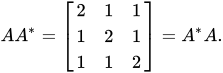
In mathematics, a complex square matrix A is normal if it commutes with its conjugate transpose A*:

The concept of normal matrices can be extended to normal operators on infinite-dimensional normed spaces and to normal elements in C*-algebras. As in the matrix case, normality means commutativity is preserved, to the extent possible, in the noncommutative setting. This makes normal operators, and normal elements of C*-algebras, more amenable to analysis.

The spectral theorem states that a matrix is normal if and only if it is unitarily similar to a diagonal matrix; that is, any matrix A satisfying the equation A*A = AA* is diagonalizable. Thus we have the factorizations and where is a diagonal matrix whose diagonal values are in general complex and is a unitary matrix.


The left and right singular vectors in the singular value decomposition of a normal matrix differ only in complex phase from each other and from the corresponding eigenvectors, since the phase must be factored out of the eigenvalues to form singular values.

Special cases

[edit]

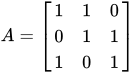
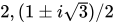
Among complex matrices, all unitary, Hermitian, and skew-Hermitian matrices are normal, with all eigenvalues being unit modulus, real, and imaginary, respectively. Likewise, among real matrices, all orthogonal, symmetric, and skew-symmetric matrices are normal, with all eigenvalues being complex conjugate pairs on the unit circle, real, and imaginary, respectively. However, it is not the case that all normal matrices are either unitary or (skew-)Hermitian, as their eigenvalues can be any complex number, in general. For example, is neither unitary, Hermitian, nor skew-Hermitian, because its eigenvalues are ; yet it is normal because
Consequences

[edit]

PropositionA normal triangular matrix is diagonal.

Proof

Let A be any normal upper triangular matrix. Since using subscript notation, one can write the equivalent expression using instead the ith unit vector () to select the ith row and ith column: The expression is equivalent, and so is

which shows that the ith row must have the same norm as the ith column.

Consider i = 1. The first entry of row 1 and column 1 are the same, and the rest of column 1 is zero (because of triangularity). This implies the first row must be zero for entries 2 through n. Continuing this argument for row–column pairs 2 through n shows A is diagonal. Q.E.D.

The concept of normality is important because normal matrices are precisely those to which the spectral theorem applies:

PropositionA matrix A is normal if and only if there exist a diagonal matrix Λ and a unitary matrix U such that A = UΛU*.

The diagonal entries of Λ are the eigenvalues of A, and the columns of U are the eigenvectors of A. The matching eigenvalues in Λ come in the same order as the eigenvectors are ordered as columns of U.

Another way of stating the spectral theorem is to say that normal matrices are precisely those matrices that can be represented by a diagonal matrix with respect to a properly chosen orthonormal basis of Cn. Phrased differently: a matrix is normal if and only if its eigenspaces span Cn and are pairwise orthogonal with respect to the standard inner product of Cn.

The spectral theorem for normal matrices is a special case of the more general Schur decomposition which holds for all square matrices. Let A be a square matrix. Then by Schur decomposition it is unitary similar to an upper-triangular matrix, say, B. If A is normal, so is B. But then B must be diagonal, for, as noted above, a normal upper-triangular matrix is diagonal.

The spectral theorem permits the classification of normal matrices in terms of their spectra, for example:

PropositionA normal matrix is unitary if and only if all of its eigenvalues (its spectrum) lie on the unit circle of the complex plane.

PropositionA normal matrix is self-adjoint if and only if its spectrum is contained in . In other words: A normal matrix is Hermitian if and only if all its eigenvalues are real.

In general, the sum or product of two normal matrices need not be normal. However, the following holds:

PropositionIf A and B are normal with AB = BA, then both AB and A + B are also normal. Furthermore there exists a unitary matrix U such that UAU* and UBU* are diagonal matrices. In other words A and B are simultaneously diagonalizable.

In this special case, the columns of U* are eigenvectors of both A and B and form an orthonormal basis in Cn. This follows by combining the theorems that, over an algebraically closed field, commuting matrices are simultaneously triangularizable and a normal matrix is diagonalizable – the added result is that these can both be done simultaneously.

Equivalent definitions

[edit]

It is possible to give a fairly long list of equivalent definitions of a normal matrix. Let A be a n × n complex matrix. Then the following are equivalent:

  1. A is normal.
  2. A is diagonalizable by a unitary matrix.
  3. There exists a set of eigenvectors of A which forms an orthonormal basis for Cn.
  4. for every x.
  5. The Frobenius norm of A can be computed by the eigenvalues of A: .
  6. The Hermitian part 1/2(A + A*) and skew-Hermitian part 1/2(AA*) of A commute.
  7. A* is a polynomial (of degree n − 1) in A.[a]
  8. A* = AU for some unitary matrix U.[1]
  9. U and P commute, where we have the polar decomposition A = UP with a unitary matrix U and some positive semidefinite matrix P.
  10. A commutes with some normal matrix N with distinct[clarification needed] eigenvalues.
  11. σi = |λi| for all 1 ≤ in where A has singular values σ1 ≥ ⋯ ≥ σn and has eigenvalues that are indexed with ordering |λ1| ≥ ⋯ ≥ |λn|.[2]


Some but not all of the above generalize to normal operators on infinite-dimensional Hilbert spaces. For example, a bounded operator satisfying (9) is only quasinormal.

Normal matrix analogy

[edit]

It is occasionally useful (but sometimes misleading) to think of the relationships of special kinds of normal matrices as analogous to the relationships of the corresponding type of complex numbers of which their eigenvalues are composed. This is because any function (that can be expressed as a power series) of a non-defective matrix acts directly on each of its eigenvalues, and the conjugate transpose of its spectral decomposition is , where is the diagonal matrix of eigenvalues. Likewise, if two normal matrices commute and are therefore simultaneously diagonalizable, any operation between these matrices also acts on each corresponding pair of eigenvalues.

As a special case, the complex numbers may be embedded in the normal 2×2 real matrices by the mapping which preserves addition and multiplication. It is easy to check that this embedding respects all of the above analogies.

See also

[edit]

Notes

[edit]

Citations

[edit]

Sources

[edit]
  • Horn, Roger Alan; Johnson, Charles Royal (1985), Matrix Analysis, Cambridge University Press, ISBN 978-0-521-38632-6.
  • Horn, Roger Alan; Johnson, Charles Royal (1991). Topics in Matrix Analysis. Cambridge University Press. ISBN 978-0-521-30587-7.
Revisions and contributorsEdit on WikipediaRead on Wikipedia
from Grokipedia
In linear algebra, a normal matrix is a square matrix AA over the complex numbers that commutes with its AA^\dagger, satisfying the equation AA=AAA A^\dagger = A^\dagger A. This defining property distinguishes normal matrices from more general square matrices and ensures they share key algebraic behaviors with simpler forms like diagonal matrices. Normal matrices encompass several important subclasses, including Hermitian matrices (where A=AA = A^\dagger), unitary matrices (where AA=IA^\dagger A = I), real symmetric matrices (Hermitian with real entries), and skew-Hermitian matrices (where A=AA^\dagger = -A). These subclasses arise naturally in applications such as , , and , where the normality condition preserves and stability under transformations. Beyond these, normal matrices can be non-Hermitian, as illustrated by the matrix (1111)\begin{pmatrix} 1 & -1 \\ 1 & 1 \end{pmatrix}, which satisfies the commutativity but belongs to none of the above categories. The most notable theorem associated with normal matrices is the , which states that a matrix AA is normal if and only if it is unitarily diagonalizable: there exists a UU such that UAUU^\dagger A U is diagonal, with the diagonal entries being the eigenvalues of AA. This diagonalization implies that eigenvectors corresponding to distinct eigenvalues are orthogonal, facilitating computations like eigenvalue decomposition in finite-dimensional Hilbert spaces. Consequently, normal matrices play a central role in the study of linear operators, extending to infinite-dimensional settings via normal operators in .

Definition and Fundamentals

Definition

In linear algebra, a normal matrix is defined as a complex that commutes with its . Specifically, for an n×nn \times n matrix ACn×nA \in \mathbb{C}^{n \times n}, AA is normal if AA=AAA A^\dagger = A^\dagger A, where AA^\dagger denotes the conjugate transpose (adjoint) of AA, given by A=ATA^\dagger = \overline{A}^T. Simple examples of normal matrices include the II, for which II=II=II I^\dagger = I^\dagger I = I, and any D=diag(d1,,dn)D = \operatorname{diag}(d_1, \dots, d_n) with complex entries diCd_i \in \mathbb{C}, since D=diag(d1,,dn)D^\dagger = \operatorname{diag}(\overline{d_1}, \dots, \overline{d_n}) and both products DDD D^\dagger and DDD^\dagger D yield the diagonal matrix with entries di2|d_i|^2. Normal matrices generalize (Hermitian) operators while encompassing a broader class, including unitaries that preserve the Euclidean norm, making them essential in applications such as , where they represent operators that can be diagonalized in orthonormal bases to model observables and evolutions. A distinguishing feature is that every normal matrix is unitarily diagonalizable over the complex numbers. Although the definition is formulated for complex matrices to leverage the inner product structure of Cn\mathbb{C}^n, an analogous notion for real matrices involves commuting with the transpose ATA^T instead, but such real normal matrices do not necessarily share all spectral properties with their complex counterparts.

Notation and Conventions

In discussions of normal matrices, the conjugate transpose (also known as the adjoint) of a matrix AA is standardly denoted by AA^\dagger, obtained by transposing AA and taking the complex conjugate of each entry. The elementwise complex conjugate of AA, without transposition, is denoted by AA^*. The operator norm of a matrix AA, which measures its maximum amplification of vectors, is denoted by A\|A\|. A normal matrix must be square, as the definition involves commutativity between the matrix and its , a relation that presupposes equal dimensions for rows and columns. Such matrices typically have complex entries and act on finite-dimensional complex vector spaces, distinguishing them from rectangular matrices where the relation does not apply in the same way. Unless otherwise specified, this article assumes matrices over the field of complex numbers, reflecting the standard finite-dimensional setting for normal matrices. Extensions to other skew fields, such as the s, are noted where relevant, adapting the via the quaternion conjugate. The term "normal matrix" was coined by in 1932, originating in his foundational work on in Hilbert spaces.

Properties and Consequences

Basic Properties

A normal matrix AA satisfies Ax=Ax\|Ax\| = \|A^\dagger x\| for every vector xx, where \|\cdot\| denotes the Euclidean norm and AA^\dagger is the conjugate transpose of AA. This equality follows directly from the definition AA=AAA A^\dagger = A^\dagger A, since Ax2=xAAx=xAAx=Ax2\|Ax\|^2 = x^\dagger A^\dagger A x = x^\dagger A A^\dagger x = \|A^\dagger x\|^2. This property implies that AA acts as an isometry between the range of AA^\dagger and the range of AA. The class of normal matrices is closed under unitary similarity: if AA is normal and UU is a , then B=UAUB = U A U^\dagger is also normal. To see this, note that B=UAUB^\dagger = U A^\dagger U^\dagger, so BB=UAUUAU=UAAUB B^\dagger = U A U^\dagger U A^\dagger U^\dagger = U A A^\dagger U^\dagger and BB=UAAUB^\dagger B = U A^\dagger A U^\dagger, with the normality of AA ensuring the equality. For a normal matrix AA, the trace satisfies Tr(AA)=Tr(AA)=iλi2\operatorname{Tr}(A A^\dagger) = \operatorname{Tr}(A^\dagger A) = \sum_i |\lambda_i|^2, where λi\lambda_i are the eigenvalues of AA. This follows from the cyclic property of the trace, which equates Tr(AA)\operatorname{Tr}(A A^\dagger) and Tr(AA)\operatorname{Tr}(A^\dagger A), and the unitary diagonalizability of normal matrices, which aligns the Frobenius norm with the sum of squared eigenvalue moduli. A concrete example of normal matrices that are not Hermitian is provided by scalar multiples of the . Consider σx=(0110)\sigma_x = \begin{pmatrix} 0 & 1 \\ 1 & 0 \end{pmatrix}; then A=iσx=(0ii0)A = i \sigma_x = \begin{pmatrix} 0 & i \\ i & 0 \end{pmatrix}. The adjoint is A=iσxA^\dagger = -i \sigma_x, and AA=(iσx)(iσx)=σx2=IA A^\dagger = (i \sigma_x)(-i \sigma_x) = \sigma_x^2 = I, while AA=(iσx)(iσx)=σx2=IA^\dagger A = (-i \sigma_x)(i \sigma_x) = \sigma_x^2 = I, confirming normality. Similar computations hold for iσyi \sigma_y and iσzi \sigma_z, yielding AA=AA=IA A^\dagger = A^\dagger A = I in each case, with Tr(AA)=2\operatorname{Tr}(A A^\dagger) = 2.

Spectral Properties and Diagonalization

A fundamental consequence of normality is the spectral theorem, which asserts that every normal matrix over the complex numbers is unitarily diagonalizable. Specifically, for a normal matrix ACn×nA \in \mathbb{C}^{n \times n}, there exists a unitary matrix UU and a DD such that A=UDUA = U D U^\dagger, where UU^\dagger denotes the of UU, and the diagonal entries of DD are the eigenvalues of AA. This decomposition implies that normal matrices possess an orthonormal basis of eigenvectors, facilitating analysis in the eigenbasis. The eigenvalues of a normal matrix are complex numbers, and a key property is that the spectral radius ρ(A)\rho(A), defined as the maximum modulus of its eigenvalues, equals the operator norm induced by the Euclidean vector norm, A2=ρ(A)\|A\|_2 = \rho(A). This equality holds because the unitary diagonalization preserves the 2-norm, bounding Ax2ρ(A)x2\|Ax\|_2 \leq \rho(A) \|x\|_2 for x2=1\|x\|_2 = 1, with equality achieved for an eigenvector corresponding to the eigenvalue of largest modulus. A standard proof of the spectral theorem relies on Schur triangularization and the structure imposed by normality. By the Schur theorem, every matrix AA admits a unitary UU such that UAU=TU^\dagger A U = T, where TT is upper triangular with the eigenvalues of AA on its diagonal. For normal AA, compute AA=AAA^\dagger A = A A^\dagger, leading to TT=TTT^\dagger T = T T^\dagger; since TT is upper triangular, this commutativity forces all superdiagonal entries of TT to vanish, rendering TT diagonal. Moreover, normal matrices have orthogonal eigenspaces: if v1,v2v_1, v_2 are eigenvectors for distinct eigenvalues λ1λ2\lambda_1 \neq \lambda_2, then v1,v2=0\langle v_1, v_2 \rangle = 0, as (λ1λ2)v1,v2=Av1,v2v1,Av2=0(\lambda_1 - \overline{\lambda_2}) \langle v_1, v_2 \rangle = \langle A v_1, v_2 \rangle - \langle v_1, A^\dagger v_2 \rangle = 0. Induction on the dimension, reducing to invariant subspaces, completes the diagonalization. In , the unitary diagonalizability of normal matrices corresponds to that of normal operators on Hilbert spaces, enabling efficient simulation of their actions, such as or measurements, by transforming to the eigenbasis where operations reduce to phase shifts or projections.

Characterizations

Algebraic Characterizations

A matrix AMn(C)A \in M_n(\mathbb{C}) is normal if and only if the [A,A]=AAAA=0[A, A^\dagger] = AA^\dagger - A^\dagger A = 0, where AA^\dagger denotes the conjugate transpose of AA. This condition is equivalent to the defining property AA=AAAA^\dagger = A^\dagger A. Another algebraic characterization is that AA is normal if and only if p(A)p(A) is normal for every polynomial pp with complex coefficients. Equivalently, AA is normal if and only if A=p(A)A^\dagger = p(A) for some polynomial pp. In this case, the minimal polynomial of AA^\dagger is obtained from the minimal polynomial of AA by conjugating the coefficients. The Fuglede–Putnam theorem provides a related algebraic property: if AA and BB are normal operators on a Hilbert space and AB=BAAB = BA, then AB=BAA B^\dagger = B^\dagger A.

Analytic and Geometric Characterizations

A matrix ACn×nA \in \mathbb{C}^{n \times n} is normal if and only if the matrices AAAA^\dagger and AAA^\dagger A have the same eigenvalues, counting algebraic multiplicities. These shared eigenvalues are the squares of the singular values of AA, and for a normal matrix, they equal λi2|\lambda_i|^2, where λi\lambda_i are the eigenvalues of AA. The numerical range of a matrix AA, defined as W(A)={xAxxx  |  xCn,x0},W(A) = \left\{ \frac{x^\dagger A x}{x^\dagger x} \;\middle|\; x \in \mathbb{C}^n, x \neq 0 \right\},
Add your contribution
Related Hubs
Contribute something
User Avatar
No comments yet.