Hubbry Logo
NympholepsyNympholepsyMain
Open search
Nympholepsy
Community hub
Nympholepsy
logo
8 pages, 0 posts
0 subscribers
Be the first to start a discussion here.
Nympholepsy
Nympholepsy
from Wikipedia

Nympholepsy is the belief of the ancient Greeks that individuals could be possessed by the nymphs. Individuals who considered themselves nympholepts would display a great religious devotion to the nymphs. An example is Archedemos of Thera, who built the sanctuary of the nymphs in the Vari Cave northeast of Attica, Greece.[1]

Etymology

[edit]

Nympholepsy, a term first used in 1775 by Richard Chandler in Travels in Greece,[2] is described as “frenzy or rapture [that was] supposed to take hold of a man upon gazing on a nymph”.[3] It originates from the Greek word nymphe, meaning “bride”, “beautiful young woman”, then “semi-divine being in the form of a beautiful maiden”,[4] and epilepsy, from the Greek word epilepsis, meaning “a seizure”.[5] Though the root of nympholepsy implies a fit or seizure, according to Socrates, as presented in the writings of Plato, a person could experience nympholepsy without any “tearing of clothes, the biting of lips, or convulsions, or frenzies”.[1] Plato implies in his writings that nympholepsy showed itself in others by “heightened awareness and eloquence”.[1] Ancient Greece also had the word nymphleptos, meaning “caught by nymphs”.[3]

Nymphs

[edit]
Relief sculpture of nymph Basile and Echelos

Nymphs were known as female spirits of the natural world, and were minor goddesses of various aspects in nature – forests, rivers, springs, meadows, mountains and seas.[6] They were often depicted as beautiful young women with attributes symbolizing whatever natural formation they ruled over.[6]

Nymphs are most often described as either the daughters of Zeus,[6] the river Oceanus,[6] or Gaia,[6] though various other gods and goddesses have been attributed to their parentage over the years. Many gods are also described as having various nymph companions; for example, Artemis is known for her band of huntress nymphs, Poseidon is often accompanied by sea nymphs called Nereides, and nymph handmaidens were common companions to the goddesses of Olympos.[6] Some elder nymphs, such as those of the Oceanids and Nereids class, were known as immortal goddesses, but most nymphs had a finite, though very long, lifespan.[6]

Archedemos and the Vari Cave

[edit]
The steps in the Vari Cave, featuring a relief that depicts Archedemos

The Vari Cave, also known as the Nympholyptos Cave, lies northeast of Vari in Attica, Greece. Along with being a shrine to the nymphs, the Vari Cave is also a shrine devoted to the gods Pan and Apollo. It is also known as the Cave of Pan, and is unique for the reliefs cut into the rock by nympholept Archedemos.[2] Archedemos was a native of Thera, an island which is now known as modern-day Santorini [7] and is located 318 kilometers from the Vari Cave.[8] According to Richard Chandler's writings in his account in Travels in Greece, Archedemos moved from his native town and settled in Attica, Greece, which was 35.5 kilometers from the Cave of Vari [9] where he would later create his shrine to the nymphs, Apollo, and Pan.

Though it is a shrine devoted to Apollo and Pan as well, Archedemos created the cave "for the nymphs, by whom he was possessed".[2] By the writings of Archedemos in the cave, it is presumed that the Vari Cave was furnished with a dwelling and a garden for the nymphs, as well as a well of water.[2]

Richard Chandler, an English antiquary, was the first scientist to report his findings of the Vari Cave in 1765,[2] but the cave was not excavated until 1901 by Charles Heald Weller.[10]

[edit]

In modern culture, nympholepsy is also defined as "passion aroused in men by beautiful young girls", and "wild frenzy caused by desire for an unattainable ideal".[3] The most famous example is in Vladimir Nabokov's Lolita, where the main character Humbert Humbert has an obsession with prepubescent girls he refers to as nymphets and self-describes as a nympholept.[11] The obsession with young girls is explained with the loss of his first love when she was a young age, referring back to the definition of an unattainable ideal.

References

[edit]

Further reading

[edit]
Revisions and contributorsEdit on WikipediaRead on Wikipedia
from Grokipedia
Nympholepsy is a term denoting a state of frenzy or rapture believed in to afflict mortals upon encountering or being seized by nymphs, semi-divine female nature spirits, often resulting in ecstatic possession or union with the divine. In , this phenomenon encompassed religious devotion, inspiration, and sometimes erotic or maternal bonds between humans and goddesses, particularly nymphs, as evidenced in myths such as 's seduction of in the Homeric Hymn to Aphrodite and Odysseus's encounters with Calypso and in the Odyssey. Such experiences were commemorated through , practices in cave sanctuaries, and epigraphic records from the Archaic to Hellenistic periods, highlighting nympholepsy's role in bridging mortal and divine realms. The word "nympholepsy" entered English in the late , coined in 1775 by British antiquarian Richard Chandler in his Travels in , derived from the Greek nympholēptos ("caught by s" or "frenzied"), combining nymphe ("" or "bride") with lambanein ("to seize"). Modelled on "," it originally captured the ancient notion of demonic or by a , but by the , its meaning extended metaphorically to describe any intense, uncontrollable emotional frenzy, especially a passionate pursuit of something unattainable. This broader usage appears in literature to evoke obsessive longing, as in modern interpretations linking it to themes of unrequited desire or psychological ecstasy.

Origins and Definition

Etymology

The term nympholepsy derives from Ancient Greek nymphe (νύμφη), signifying "bride," "beautiful young woman," or a semi-divine nature spirit, combined with the verbal root from lambanein (λαμβάνειν), "to seize" or "to take hold of." This formation parallels epilēpsía (ἐπιληψία), or "epilepsy," evoking a sense of sudden seizure or possession. The word was coined in 1775 by English archaeologist and traveler Richard Chandler in his seminal work Travels in Greece, or an Account of a Tour Made at the Expense of the Society of Dilettanti, published in 1776. Chandler introduced the term to describe a frenzied state induced by the sight of nymphs, stating: "Nympholepsy is characterized as a frenzy, which arose from having beheld [nymphs]." This usage drew on classical accounts of divine rapture to interpret ancient sites encountered during his expedition. By the late , nympholepsy had broadened beyond literal possession by nymphs to encompass a metaphorical ecstasy or stemming from unfulfilled desire for the unattainable, often idealized beauty or perfection. This shift reflected Enlightenment interests in and emotional extremes. The earliest documented appearances of the term in English literature date to the , primarily through Chandler's phrasing, which established it as a descriptor for both historical and poetic frenzy.

Ancient Greek Concept

In ancient Greek thought, denoted the state of being seized (λῆψις, from λαμβάνειν, "to take or seize") by nymphs—divine female spirits of nature, rivers, and groves—resulting in a profound form of divine possession that manifested as heightened religious fervor, poetic , or an ecstatic rather than mere physical capture. This condition was seen as a sacred encounter bridging the human and divine, often inspiring acts of devotion or creative expression without implying . Plato illustrates nympholepsy in his dialogue Phaedrus, set in a riverside grove sacred to the nymphs, where warns Phaedrus of impending possession: "Don’t you see that I shall clearly be possessed by those nymphs into whose clutches you deliberately threw me?" (241e). Here, the experience aligns with 's broader concept of (divine madness), a benevolent inspiration from deities that elevates the soul, akin to prophetic frenzy from or poetic rapture from the Muses, but occurring without violent convulsions or loss of control typical of human ailments. ' subsequent speech becomes dithyrambic—rhythmic and exalted—demonstrating how nympholeptic seizure fosters spiritual insight and rhetorical power as a gift from the gods. Culturally, nympholepts were regarded as figures of intense , compelled by their possession to pursue solitary communion with the nymphs in wild, rural locales, embodying a trance-like devotion that symbolized harmony with nature's divine forces. This perception framed nympholepsy as a voluntary religious rather than an affliction, sharply distinguishing it from (selēniazō, or "moonstruck" ), which ancient sources like the treated as a natural disease of the body, devoid of supernatural elevation.

Mythological Foundations

Role of Nymphs

In mythology, nymphs were minor female deities or spirits embodying the vitality of the natural world, each tied to specific landscapes and elements. Dryads inhabited forests and trees, serving as guardians of oak groves and woodlands; naiads presided over rivers, springs, and fountains, ensuring the flow of fresh waters; and oreads roamed mountains and rocky terrains, symbolizing the untamed heights. These classifications reflected the ' perception of as animated by divine presences, with nymphs personifying fertility, growth, and the inherent beauty of their domains. Nymphs traced their origins to the progeny of major gods, often emerging as daughters of , the Titan , or the primordial , which positioned them within the divine hierarchy while linking them to elemental forces. For instance, the , a vast group of freshwater nymphs, were born to and his sister-wife Tethys, numbering in the thousands and embodying the encircling river of the world (, Theogony 346 ff.). While elder nymphs like the and enjoyed full , younger varieties such as dryads possessed extraordinarily long lifespans but remained vulnerable to mortal interactions, including seduction, pursuit, or transformation by higher deities. This susceptibility underscored their liminal status between the divine and human realms. Nymphs frequently appeared as companions to greater gods, enhancing their roles as alluring yet perilous figures in the mythological landscape. They attended , the goddess of hunting and chastity, as her huntress entourage, joining her in woodland pursuits and embodying ideals of purity amid wild settings (Homeric Hymn 27 to Artemis). In contrast, their association with Pan, the rustic god of shepherds and wild , cast them as elusive temptresses in pastoral scenes, often fleeing his amorous advances in the Arcadian hills and thereby evoking the chaotic wildness of nature. These connections highlighted nymphs' dual nature: embodiments of serene beauty intertwined with untamed danger. In artistic representations, particularly on Attic vase paintings from the Archaic and Classical periods, nymphs were portrayed as youthful, semi-nude women with flowing hair and graceful forms, dancing or reclining in natural settings to inspire awe, erotic desire, or trepidation among mortals. Such depictions, often juxtaposed with satyrs or heroes, emphasized their ethereal allure and the mortal fascination they provoked.

Possession and Ecstasy in Mythology

In , the concept of nympholepsy often manifests through narratives of mortals overcome by an overwhelming, supernatural attraction to nymphs, resulting in states of rapture, frenzy, or permanent loss. A seminal example is the myth of , the youthful companion and beloved of during the Argonautic expedition. As described in Apollonius Rhodius' , ventures alone to a Mysian spring called Pegae to draw water under the moonlight. Enamored by his beauty and grace, the water nymphs—instigated by the desire-stirring influence of (Cypris)—emerge and seize him; one nymph embraces and kisses him before dragging him into the depths, claiming him as her eternal consort. This abduction symbolizes the nymphs' power to induce an ecstatic possession that erases the victim's ties to the mortal world, leaving in frenzied grief as he searches vainly, his cries echoing through the night. Theocritus elaborates on this theme in his s, portraying nymph encounters as catalysts for poetic and unquenchable longing. In Idyll 13, the nymphs Eunica, Malis, and Nycheia, struck by ' charm at the spring, flutter with love and pull him under like a falling star, evoking the same irresistible seizure as in Apollonius while emphasizing the emotional turmoil of loss—' desperate, thrice-repeated calls underscore a madness born of separation. Similarly, Idyll 1 depicts the shepherd pining to death from , questioning the nymphs' absence during his torment in idyllic landscapes like the vales of Peneius and glens of ; their elusive presence heightens his erotic and existential longing, transforming personal suffering into a song of bucolic rapture that inspires the poet Thyrsis. These encounters blend desire with a divine , where the nymphs' proximity sparks a creative ecstasy akin to prophetic inspiration. Another example appears in Ovid's (Book 4), where the nymph spies the youthful mortal Hermaphroditus bathing in her pool. Overcome by desire, she seizes him, praying to the gods for eternal union, resulting in their bodies merging into a single androgynous form. This tale illustrates the nymph's active possession of the mortal, leading to transformative ecstasy and blurring of identities. Underlying these stories is the broader Greek lore of nymphs as intermediaries of , where possession elevates mortals spiritually even as it disrupts them physically or rationally. As explored in scholarly analyses, nympholepsy represents a poetic and cultic trope of being "seized" by these nature spirits, fusing carnal desire with higher revelation—much like the Muses, nymphs infuse poets and visionaries with frenzied creativity, blurring the line between erotic obsession and sacred transport in Archaic to Hellenistic traditions.

Historical Evidence

Archedemos and the Vari Cave

Archedemos of Thera, originating from the island of approximately 318 km distant, emerged as a prominent 4th-century BCE devotee who journeyed to driven by what he described as divine inspiration from the nymphs. Identifying himself explicitly as a nympholeptos—a term denoting one seized or possessed by nymphs—he transformed a cave into a personal shrine, inscribing declarations of his work throughout the site. One key inscription reads: "Archedemos the Theraian, the nympholept... crafted this by the guidance of the Nymphs," underscoring his belief in their direct influence and oracular endowment. The Vari Cave, situated near the village of Vari at the southeastern base of Mount Hymettus approximately 35.5 km from , served as the focal point of Archedemos' devotion. He meticulously shaped the cave's interior, carving a series of rock-cut steps ascending to the entrance, multiple chambers with niches for votive offerings, and altars dedicated to the s, Apollo, and Pan. Additional features included a functional well or basin channeling sacred spring water—essential to worship—a modest area for residence, and traces of a cultivated , all integrated to create a self-sustaining . carvings, such as a figure possibly representing Archedemos himself wielding a hammer and chisel, further personalized the space, blending artistry with . The 's modern rediscovery occurred during British antiquarian Richard Chandler's 1765 travels through , where he documented the cave's inscriptions praising the nymphs and noted its sculpted elements amid the rugged landscape. Systematic excavation followed in 1901 under Charles H. Weller of the American School of Classical Studies at , uncovering the full scope of Archedemos' modifications, including additional inscriptions repeating his name and title five times, and confirming the cave's role as a dedicated site rather than a mere natural formation. Scholars interpret the Vari Cave as a vivid archaeological testament to nympholeptic fervor, where Archedemos' isolation and laborious enhancements reflect a profound, potentially ecstatic personal bond with the nymphs, manifesting in a hermetic worship space attuned to their watery, natural realms. The emphasis on hydraulic features and secluded rock-cut elements highlights the devotee's intent to emulate and honor the nymphs' , embodying the notion of divine possession as both burdensome and revelatory.

Other Archaeological and Literary References

In addition to the well-documented Vari Cave, other sites in Attica yield inscriptions and dedications attesting to nymph cults and potential nympholeptic devotion. The Klepsydra Cave, located at the northwest base of the Acropolis near the Pnyx and dedicated to the nymph Empedo, features a perennial spring, a Classical spring house, and votive pottery spanning the Late Helladic IIIC to Roman periods, reflecting sustained rituals centered on water nymphs and ecstatic communion. Similarly, the Marathon Pan Cave on the hill of Oinoe contains a Hellenistic inscribed stele (SEG 36.267) from 61/0 BCE regulating ephebic access and offerings, alongside stalactites that Pausanias likened to Pan's petrified goats, underscoring the intertwined worship of Pan and nymphs in cave settings conducive to possession experiences. Literary sources further illuminate these practices through descriptions of shrines where mortals pursued nymph encounters. In his , Pausanias details several such loci, including the Sphragidium Cave of the Cithaeronian nymphs below Mount Cithaeron in , a site for sacrifices and rituals evoking divine . These accounts portray shrines as spaces for seeking nymph-induced ecstasy, often tied to natural features like springs and grottoes. Votive offerings and reliefs from various sanctuaries across provide material evidence of cult practices linked to ecstatic nymph experiences. In sites like the Eleusis Pan Cave and the slopes, marble reliefs depict nymphs dancing in cave-like scenes with Pan or Hermes, serving as dedications from devotees commemorating divine unions or possessions; 113 such reliefs from the Classical and Hellenistic periods have been cataloged, many featuring processional motifs symbolizing states. At the Pharsalus Nymph Cave in , inscriptions by the nympholept Pantalkes record his personal bond with the nymphs, including self-commemorative verses and altars, mirroring dedicatory patterns indicative of widespread possession cults. Hellenistic literature extends these themes into poetic portrayals of nymph-induced trances. In Nonnus' Dionysiaca, episodes among ' followers depict mortals seized by s in frenzied ecstasies during Bacchic rites, blending possession with landscape-inspired madness and highlighting the motif's endurance in late antique epic. Such references, analyzed in studies of nympholepsy, underscore how literary allusions reinforced archaeological evidence of trance experiences in .

Modern Interpretations

Psychological and Symbolic Meanings

In the , the concept of nympholepsy underwent a significant shift from its ancient religious connotations to a metaphorical representation of Romantic frenzy for ideal beauty and unattainable inspiration. Poets such as popularized this usage, employing the term in (1812–1818) to describe an ecstatic yet despairing longing for lost ideals, as in his line portraying Rome's past as "The nympholepsy of some fond despair." Similarly, John ' poetry evoked nymph-like figures as symbols of transcendent beauty and creative rapture, as seen in works like Endymion (1818), where the pursuit of ethereal nymphs mirrors an intense emotional seizure by artistic ideals. This metaphorical evolution reflected the Romantic emphasis on subjective passion and the sublime, transforming nympholepsy into a literary device for the soul's yearning toward perfection. Psychoanalytic interpretations in the further reframed nympholepsy as a manifestation of sublimated and obsessive fixation, particularly among middle-aged men drawn to youthful . Sigmund Freud's "A Special Type of Choice of Object by Men" (1910) described such attractions as rooted in unconscious phantasies of salvation and defloration, where the idealized young woman serves as a fetishized object alleviating . Later psychoanalytic works built on this, viewing nympholepsy as a "" of , crystallizing youth as an erotic ideal to negotiate repressed desires. In Jungian and post-Jungian , it symbolizes possession by the anima archetype—the unconscious feminine principle—manifesting as an obsessive projection onto youthful, nature-linked figures that blend muse-like inspiration with destructive allure. James Hillman's extended this, portraying nympholepsy as an instinctual seizure by Pan-like forces, evoking both creative ecstasy and pathological panic without literal divine intervention. Modern dictionary definitions underscore this psychological dimension, defining nympholepsy as an emotional frenzy or for something unattainable, often with undertones, distinct from ancient notions of possession. In contemporary , it serves symbolically as a model for the duality of creative ecstasy—wherein unattainable ideals fuel artistic or imaginative breakthroughs—and pathological fixation, such as obsessive idealization leading to emotional distress or social withdrawal. This framework emphasizes internal psychological dynamics over external , highlighting nympholepsy's role in exploring human longing for the eternal and youthful in the psyche.

Usage in Literature and Art

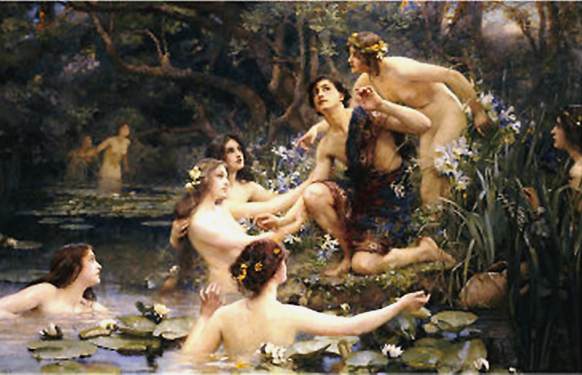
In 19th-century Romantic literature, nympholepsy emerged as a for ecstatic inspiration and unfulfilled longing inspired by and ideal. popularized the term in (Canto IV, stanza 77), describing the of Egeria as evoking "the nympholepsy of some fond despair," where the represents an elusive beauty and love that haunts the human spirit with purifying yet sorrowful desire. This Byronic conception influenced the Romantic circle, including , whose correspondence with references nympholepsy as a feverish mythological obsession, reflecting the era's blend of pagan ecstasy and personal turmoil in encounters with the sublime landscape. Victorian literature adapted nympholepsy to explore aesthetic and sensual rapture, often linking it to the pursuit of beauty amid moral constraints. Walter Pater's Studies in the History of the (1873) depicted the trance-like induced by , akin to ancient possession by nymphs, as in his discussion of Giorgione's where such ecstasy borders on the divine and ephemeral, framing it as a heightened sensory state symbolizing the artist's obsessive communion with ideal forms, which echoed broader Victorian anxieties about desire and restraint. In 20th-century visual art, Pre-Raphaelite traditions revived nympholepsy through depictions of mythical pursuits that embodied unattainable allure and fatal obsession. John William Waterhouse's Hylas and the Nymphs (1896) portrays the Argonaut entranced and pulled underwater by water nymphs, their ethereal beauty luring him to doom and symbolizing the perilous madness of idealization in a modern gaze. This painting, exhibited at the Royal Academy, captured the theme's evolution into a visual meditation on beauty's seductive danger, influencing later interpretations of and psychological entrapment. Modernist literature transformed nympholepsy into a motif of inner conflict and alienation, portraying the psychological distress of chasing illusory ideals in fragmented realities. William Faulkner's "Nympholepsy," likely written around 1925 and published posthumously in 1973, follows a man's frenzied quest for a phantom-like amid Southern decay, illustrating the torment of solipsistic desire and that defines modernist . Similarly, George Moore's Memoirs of My Dead Life (, with modernist echoes) employs the term to evoke a "malady" of obsessive passion for youthful beauty, underscoring the era's shift toward depicting nympholepsy as a source of existential unease rather than mere rapture.

Cultural Depictions

In Vladimir Nabokov's 1955 novel , the protagonist Humbert Humbert explicitly identifies as a "nympholept," describing his obsessive attraction to young girls he terms "nymphets" as a form of ecstatic possession akin to ancient mythological frenzy. This portrayal draws on the classical concept of nympholepsy to frame Humbert's pathological desires, blending literary allusion with psychological introspection. The term's connotations of forbidden, trance-like desire carried over into film adaptations of Lolita, including Stanley Kubrick's 1962 version starring as Humbert and as Lolita, and Adrian Lyne's 1997 remake with and . Both films emphasize Humbert's obsessive pursuit through visual and narrative cues that echo the novel's nympholeptic theme, highlighting the illicit allure central to the story while navigating and cultural sensitivities of their eras. References to nympholepsy also surface in music, particularly indie and experimental tracks that evoke the term's themes of rapturous and historical . Greek composer Yiorgis Sakellariou's 2019 album Nympholepsy uses electroacoustic soundscapes to channel the ecstatic spirits of ancient Messene's ruins, linking archaic possession to auditory immersion. Similarly, British chap-hop artist Mr. B The Gentleman Rhymer's 2012 track "Nympholepsy" from The Tweed Album playfully riffs on the concept through whimsical, period-inspired lyrics.

Contemporary Relevance

In contemporary scholarship, nympholepsy continues to inform studies in and , where it is examined as a cultural phenomenon of divine possession and human-divine interaction in society. Corinne Ondine Pache's 2011 monograph, A Moment's Ornament: The of Nympholepsy in , provides a seminal analysis of the theme across cultic practices and from the Archaic to Hellenistic periods, highlighting how encounters with nymphs or goddesses inspired poetic and ritual expressions of . More recent anthropological work, such as Esther Eidinow's 2022 article "I-Thou-Nymph: A Relational Approach to Religious Devotion," reframes nympholepsy through modern relational theories, drawing on cognitive Scott Atran's models to interpret nympholeptic behaviors—like shrine-building and engagement—as forms of committed devotion rather than mere , offering insights into ancient environmental and spiritual interrelations. Within , nympholepsy serves as a lens for dissecting power dynamics in ancient myths, particularly the interplay of male desire and divine agency. Pache's study elucidates how narratives of mortal men seized by nymphs often underscore vulnerability and the disruptive agency of deities, challenging traditional views of passive in . This perspective aligns with broader examinations of gendered desire in ancient contexts, where nympholeptic unions reveal tensions between human pursuit and divine autonomy, as explored in anthropological analyses of and roles. In modern , the term nympholepsy appears rarely as a for obsessive or frenzied pursuits, evoking an intense, almost trance-like fixation distinct from clinical diagnoses such as . The defines it as "a state of supposed to be inspired in men by nymphs; hence, an ecstasy or of , as for something unattainable," reflecting its shift from mythological possession to symbolic representation of unattainable desires in psychoanalytic and contexts. For instance, in discussions of obsessive behaviors, it illustrates emotional overinvestment without implying pathological sexual deviation, as noted in scholarly deconstructions of its erotic connotations in 20th-century . Nympholepsy's symbolism extends to environmental movements and eco-literature, where it represents human or entanglement with spirits, emphasizing ecological devotion amid contemporary crises. Eidinow's relational framework positions nympholeptic interactions as prototypes for modern eco-spiritual practices, portraying the ancient "" by nymphs—tied to specific landscapes—as a model for reciprocal human- bonds in anthropological . In eco-literary works, motifs of encounters with nymphs symbolize the perilous allure of natural forces, inspiring narratives that advocate for harmonious of the environment through mythic reverence for animistic entities.

References

Add your contribution
Related Hubs
User Avatar
No comments yet.