


Community hub
Recent from talks
Contribute something
Nothing was collected or created yet.
Battle of Inchon
View on Wikipedia
| Battle of Incheon | |||||||
|---|---|---|---|---|---|---|---|
| Part of the Korean War | |||||||
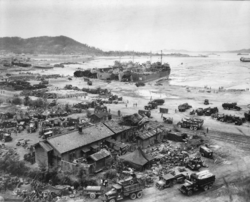
 Four tank landing ships unload men and equipment on Red Beach one day after the amphibious landings on Incheon. | |||||||
| |||||||
| Belligerents | |||||||
|
 North Korea North Korea | ||||||
| Commanders and leaders | |||||||
| Units involved | |||||||
|
| ||||||
| Strength | |||||||
|
About
| ||||||
| Casualties and losses | |||||||
|
224 killed 809 wounded 2 cruisers damaged 3 destroyers damaged 1 LST lost and 3 damaged 1 aircraft destroyed |
| ||||||


The Battle of Incheon (Korean: 인천 상륙 작전; Hanja: 仁川上陸作戰; RR: Incheon Sangnyuk Jakjeon), also called Incheon landing, was an amphibious invasion and a battle of the Korean War that resulted in a decisive victory and strategic reversal in favor of the United Nations Command (UN). The operation involved some 75,000 troops and 261 naval vessels and led to the recapture of the South Korean capital of Seoul two weeks later.[4] The code name for the Incheon operation was Operation Chromite.
The battle began on 15 September 1950 and ended on 19 September. Through a surprise amphibious assault far from the Pusan Perimeter that UN and Republic of Korea Army (ROK) forces were desperately defending, the largely undefended city of Incheon was secured after being bombed by UN forces. The battle ended a string of victories by the North Korean Korean People's Army (KPA). The subsequent UN recapture of Seoul partially severed the KPA's supply lines in South Korea.
The UN and ROK forces were commanded by General of the Army Douglas MacArthur of the United States Army. MacArthur was the driving force behind the operation, overcoming the strong misgivings of more cautious generals to a risky assault over extremely unfavorable terrain. The battle was followed by a rapid collapse of the KPA; within a month of the Incheon landing, the Americans had taken 135,000 KPA troops prisoner.[5]
Background
[edit]Pusan Perimeter
[edit]From the outbreak of the Korean War following the invasion of South Korea by North Korea on 25 June 1950, the KPA had enjoyed superiority in both manpower and ground combat equipment over the ROK and UN forces dispatched to South Korea to prevent it from collapsing.[6] The North Korean strategy was to aggressively pursue UN and ROK forces on all avenues of approach south and to engage them, attacking from the front and initiating a double envelopment of both flanks of the defending units, which allowed the KPA to surround and cut off the opposing force, forcing it to retreat in disarray.[7] From their initial 25 June offensive to fighting in July and early August, the KPA used this tactic to defeat the UN forces they encountered and push southward.[8] However, with the establishment of the Pusan Perimeter in August, UN forces held a continuous line which the KPA could not flank. The KPA advantages in numbers decreased daily as the superior UN logistical system brought in more troops and supplies to the UN forces.[9]
When the KPA approached the Pusan Perimeter on 5 August, they attempted the same frontal assault technique on the four main avenues of approach into the perimeter. Throughout August, they conducted direct assaults resulting in the Battle of Masan,[10] the Battle of Battle Mountain,[11] the First Battle of Naktong Bulge,[12][13] the Battle of Taegu,[14][15] and the Battle of the Bowling Alley.[16] On the east coast of the Korean Peninsula, the ROK repulsed three KPA divisions at the Battle of P'ohang-dong.[17] The KPA attacks stalled as UN forces repelled the attack.[18] All along the front, the KPA reeled from these defeats, the first time in the war North Korean tactics had failed.[19]

By the end of August the KPA had been pushed beyond their limits and many of the original units were at far reduced strength and effectiveness.[9][20] Logistic problems wracked the KPA, and shortages of food, weapons, equipment and replacement soldiers proved devastating for their units.[7][21] However, the KPA retained high morale and enough supply to allow for another large-scale offensive.[8] On 1 September the KPA threw their entire military into one final bid to break the Pusan Perimeter, the Great Naktong Offensive, a five-pronged simultaneous attack across the entire perimeter.[22] The attack caught UN forces by surprise and almost overwhelmed them.[23][24] KPA troops attacked Kyongju,[25] surrounded Taegu[26] and Ka-san,[27] recrossed the Naktong Bulge,[28] threatened Yongsan,[29] and continued their attack at Masan, focusing on Nam River and Haman.[30] However, despite their efforts, in one of the most brutal fights of the Korean War, the KPA were unsuccessful.[31] Unable to hold their gains, the KPA retreated from the offensive a much weaker force, and vulnerable to counterattack.[32]
Planning
[edit]
Days after the beginning of the war, General of the Army Douglas MacArthur, the US Army officer in command of all UN forces in Korea, envisioned an amphibious assault to retake the Seoul area. The city had fallen in the first days of the war in the First Battle of Seoul.[33] MacArthur later wrote that he thought the KPA would push the ROK back far past Seoul.[34] He also said he decided days after the war began that the battered, demoralized, and under-equipped ROK, many of whom did not support the South Korean government put in power by the United States, could not hold off the KPA even with American support. MacArthur felt that he could turn the tide if he made a decisive troop movement behind KPA lines,[35] and preferred Incheon, over Chumunjin-up or Kunsan as the landing site. He had originally envisioned such a landing, code-named Operation Bluehearts, for 22 July, with the US Army's 1st Cavalry Division landing at Incheon. However, by 10 July the plan was abandoned as it was clear the 1st Cavalry Division would be needed on the Pusan Perimeter.[36] On 23 July, MacArthur formulated a new plan, code-named Operation Chromite, calling for an amphibious assault by the US Army's 2nd Infantry Division and the United States Marine Corps (USMC)'s 5th Marine Regiment in mid-September 1950. This, too fell through as both units were moved to the Pusan Perimeter. MacArthur decided instead to use the US Army's 7th Infantry Division, his last reserve unit in East Asia, to conduct the operation as soon as it could be raised to wartime strength.[37]
In preparation for the invasion, MacArthur activated the US Army's X Corps to act as the command for the landing forces, and appointed Major General Edward Almond, his chief of staff, as Corps' commander, anticipating the operation would mean a quick end to the war.[38] Throughout August, MacArthur faced the challenge of re-equipping the 7th Infantry Division as it had sent 9,000 of its men to reinforce the Pusan Perimeter and was far understrength. He also faced the challenge that the USMC, reduced in size following World War II, had to rebuild the 1st Marine Division, using elements of the 1st Provisional Marine Brigade fighting at Pusan as well as the 1st Marine Regiment and the 7th Marine Regiment, which pulled US Marines from as far away as the Mediterranean Sea to Korea for the task.[39] MacArthur ordered Korean Augmentation To the United States Army (KATUSA) troops, ROK conscripts assigned to US Army units, to reinforce the 7th Infantry Division, while allocating all equipment coming into Korea to X Corps, despite it being crucially needed by the US Army's Eighth Army on the Pusan Perimeter.[40]

MacArthur decided to use the Joint Strategic and Operations Group (JSPOG) of his United States Far East Command (FECOM). The initial plan was met with skepticism by the other generals because Incheon's natural and artificial defenses were formidable. The approaches to Incheon were two restricted passages, which could be easily blocked by naval mines. The current of the channels was also dangerously quick—3 to 8 knots (3.5 to 9.2 mph; 5.6 to 14.8 km/h)—and tides were so extreme as to prevent immediate follow-on landings. Finally, the anchorage was small and the harbor was surrounded by tall seawalls. United States Navy Commander Arlie G. Capps noted that the harbor had "every natural and geographic handicap."[41] US Navy leaders favored a landing at Kunsan, closer to the Pusan perimeter and the KPA main axis of supply through Taejon, but MacArthur did not think landing there would produce a sufficiently decisive victory.[42] He also felt that the KPA, who also thought the conditions of the Incheon channel would make a landing impossible, would be surprised and caught off-guard by the attack.[43][44]
On 23 August, the commanders held a meeting at MacArthur's headquarters in Tokyo.[42] Chief of Staff of the United States Army General Joseph Lawton Collins, Chief of Naval Operations Admiral Forrest Sherman, and United States Air Force (USAF) operations deputy Lieutenant General Idwal H. Edward all flew from Washington, D.C., to Japan to take part in the briefing; Chief of Staff of the United States Air Force General Hoyt Vandenberg did not attend, possibly because he "did not want to legitimize an operation that essentially belong[ed] to the Navy and the Marines." The Marine Corps staff, who were to be responsible for leading the landing at Incheon, were not invited, which became a contentious issue. During the briefing, nine members of the staff of US Navy Admiral James H. Doyle spoke for nearly 90 minutes on every technical and military aspect of the landing.[45] MacArthur told the officers that although a landing at Kunsan would bring a relatively easy linkup with the Eighth Army, it "would be an attempted envelopment that would not envelop" and would place more troops in a vulnerable pocket of the Pusan Perimeter. MacArthur won over Sherman by speaking of his affection for the US Navy and relating the story of how the Navy carried him out of Corregidor to safety in 1942 during World War II. Sherman agreed to support the Incheon operation, leaving Doyle furious.[46]

MacArthur spent 45 minutes after the briefing explaining his reasons for choosing Incheon.[47] He said that, because it was so heavily defended, the North Koreans would not expect an attack there, that victory at Incheon would avoid a brutal winter campaign, and that, by invading a northern strong point, UN forces could cut off KPA lines of supply and communication.[48] Sherman and Collins returned to Washington, D.C., and reported back to Secretary of Defense Louis A. Johnson. The Joint Chiefs of Staff approved MacArthur's plan on 28 August. President Truman also provided his approval.[49]
The landing at Incheon was not the first large-scale amphibious operation since World War II. That distinction belonged to the United Nations landing that took place on 18 July 1950 at Pohang, South Korea. However, that operation was not made in KPA-held territory and was unopposed.[50]
Admiral Arthur Dewey Struble's Joint Task Force 7 consisted of Fast Carrier Task Force 77 for fighter cover, interdiction, and ground attack; Royal Navy Admiral William Andrewes' Task Force 91 for blockade and covering force; Rear Admiral George R. Henderson's Task Force 99 for patrol and reconnaissance; Captain Bernard L. Austin's Service Squadron 3, operating Task Force 79 for logistics support; Admiral James H. Doyle's Invasion Force - Attack Task Force 90; and the Military Sea Transportation Service, which was to bring in the United States Army's 7th Infantry Division on 18 September 1950.[51]
Wolmi Do, states Robert Heinl, was the tactical key to Incheon. "Its peak commands the harbor and the city. General Smith's planners, recognizing Wolmi Do's importance, quickly concluded that the island - which must be captured first - should be taken with a separate landing on the morning tide, and that the main landings at Incheon proper could then proceed in the evening."[52]
Prelude
[edit]Before the main land battle, UN forces landed spies in Incheon and bombarded the city's defenses via air and sea. Deception operations were also carried out to draw North Korean attention away from Incheon.
Maintaining surprise
[edit]On June 27, 1950, in the Dogfight over Incheon, the US Air Force shot down a North Korean plane over Incheon.

With men, supplies, and ships obviously concentrating at Pusan and in Japanese ports for a major amphibious operation and the press in Japan referring to the upcoming landings as "Operation Common Knowledge," the UN command feared that it would fail to achieve surprise in the Incheon landings. Exacerbating this fear, the leader of a North Korean-Japanese spy ring arrested in Japan in early September 1950 had a copy of the plan for Operation Chromite, and the UN forces did not know whether he had managed to transmit the plan to North Korea before his arrest. US Navy patrol aircraft, surface warships, and submarines operated in the Sea of Japan (East Sea) and the Yellow Sea to detect any reaction by North Korean, Soviet, or People's Republic of China military forces, and on 4 September 1950 F4U Corsair fighters of Fighter Squadron 53 (VF-53) operating from the aircraft carrier USS Valley Forge shot down a Soviet Air Force A-20 Havoc bomber after it opened fire on them over the Yellow Sea as it flew toward the UN naval task force there.[51]
In order to ensure surprise during the landings, UN forces staged an elaborate deception operation to draw North Korean attention away from Incheon by making it appear that the landing would take place 105 miles (169 km) to the south at Kunsan. On 5 September 1950, aircraft of the USAF's Far East Air Forces began attacks on roads and bridges to isolate Kunsan, typical of the kind of raids expected prior to an invasion there.[51][53] A naval bombardment of Kunsan followed on 6 September, and on 11 September USAF B-29 Superfortress bombers joined the aerial campaign, bombing military installations in the area.[51]
In addition to aerial and naval bombardment, UN forces took other measures to focus North Korean attention on Kunsan. On the docks at Pusan, USMC officers briefed their men on an upcoming landing at Kunsan within earshot of many Koreans, and on the night of 12–13 September 1950 the Royal Navy frigate HMS Whitesand Bay landed US Army special operations troops and Royal Marine Commandos on the docks at Kunsan, making sure that North Korean forces noticed their visit.[51]
UN forces conducted a series of drills, tests, and raids elsewhere on the coast of Korea, where conditions were similar to Incheon, before the actual invasion. These drills were used to perfect the timing and performance of the landing craft,[50] but also were intended to confuse the North Koreans further as to the location of the invasion.
Incheon infiltration
[edit]
On 17 August 1950, a ROK Navy intelligence unit infiltrated the islands of Yonghung-do and Tokchok-do as part of Operation X-ray, and obtained information on the conditions there until 14 September.[54]
Separately on 1 September 1950, UN reconnaissance team (members were from US military intelligence Unit including KLO, CIA) also infiltrated in Yonghung-do to obtain information on the conditions there.[55][56][57][58]
The team, led by US Navy Lieutenant Eugene F. Clark,[59] landed at Yonghung-do, an island in the mouth of the harbor. From there, the team relayed intelligence back to the UN Command. With the help of locals, Clark gathered information about tides, beach composition, mudflats, and seawalls. A separate reconnaissance mission codenamed Operation Trudy Jackson,[60] which dispatched Youn Joung (former ROK Navy Lieutenant) and Ke In-ju (former ROK Army Colonel) to Incheon to collect further intelligence on the area, was mounted by the US military.[61]
The tides at Incheon have an average range of 29 feet (8.8 m) and a maximum observed range of 36 feet (11 m), making the tidal range there one of the largest in the world and the littoral maximum in all of Asia. Clark observed the tides at Incheon for two weeks and discovered that American tidal charts were inaccurate, but that Japanese charts were quite good.[62] Clark's team provided detailed reports on KPA artillery positions and fortifications on the island of Wolmi-do, at Incheon and on nearby islands. During the extended periods of low tide, Clark's team located and removed some North Korean naval mines, but, critically to the future success of the invasion, Clark reported that the North Koreans had not in fact systematically mined the channels.[63]
When the KPA discovered that the agents had landed on the islands near Incheon, they made multiple attacks, including an attempted raid on Yonghung-do with six junks. Clark mounted a machine gun on a sampan and sank the attacking junks.[64] In response, the KPA killed perhaps as many as 50 civilians for helping Clark.[65]
Bombardments of Wolmi-do and Incheon
[edit]_at_anchor_1956.jpg)

On 10 September 1950, five days before the Incheon landing, 43 American warplanes flew over Wolmi-do, dropping 93 napalm canisters to "burn out" its eastern slope in an attempt to clear the way for American troops.[66]
The flotilla of ships that landed and supported the amphibious force during the battle was commanded by Vice Admiral Arthur D. Struble, an expert in amphibious warfare. Struble had participated in amphibious operations in World War II, including the Normandy landings and the Battle of Leyte.[67] He got underway for Incheon in his flagship, the heavy cruiser USS Rochester, on 12 September 1950. Among his ships were the Gunfire Support Group, consisting of Rochester, the heavy cruiser USS Toledo, the British light cruisers HMS Jamaica and HMS Kenya, and the six US destroyers of Task Element 90.62, made up of USS Collett, USS De Haven, USS Gurke, USS Henderson, USS Lyman K. Swenson, and USS Mansfield.[68] Royal Canadian Navy destroyers HMCS Cayuga, HMCS Athabaskan and HMCS Sioux also participated in the invasion task force.
_fires_at_targets_at_Inchon,_in_September_1950.jpg)
At 07:00 on 13 September, the U.S. Navy's Destroyer Squadron 9, headed by Mansfield, steamed up Flying Fish Channel and into Incheon Harbor, where it fired upon KPA gun emplacements on Wolmi-do and in Incheon. Between them, two British cruisers and six American destroyers fired almost a thousand 5-inch (127-mm) and 6-inch (152-mm) shells onto the fortifications. The attacks tipped off the KPA that a landing might be imminent, and the KPA officer in command on Wolmi-do assured his superiors that he would throw their enemies back into the sea.[69] North Korea's 918th Coastal Artillery Regiment returned fire, hitting Collett seven times, Gurke three times, and Lyman K. Swenson twice. Aboard Lyman K. Swenson, Lieutenant (junior grade) David H. Swenson was killed and eight others were wounded.[51]: 26
_underway_off_Boston,_Massachusetts_(USA),_31_May_1944_(19-N-130517).jpg)
The American destroyers withdrew after bombarding Wolmi-do for an hour and Rochester, Toledo, Jamaica, and Kenya proceeded to bombard the KPA batteries for the next three hours from the south of the island. Lieutenant Clark and his South Korean squad watched from hills south of Incheon, plotting locations where KPA machine guns were firing at the flotilla. They relayed this information to the invasion force via Japan in the afternoon.[70]
During the night of 13–14 September, Struble decided on another day of bombardment, and the destroyers moved back up the channel off Wolmi-do on 14 September. They and the cruisers bombarded the island again that day, and planes from the carrier task force bombed and strafed it.[51]: 26

At 00:50 on 15 September 1950, Lieutenant Clark and his South Korean squad activated the lighthouse on the island of Palmido.[71] Later that morning, the ships carrying the amphibious force followed the destroyers toward Incheon and entered Flying Fish Channel, and the US Marines of the invasion force got ready to make the first landings on Wolmi-do.[72]
Naval mine clearance
[edit]Within weeks of the outbreak of the Korean War, the Soviet Union had shipped naval mines to North Korea for use in coastal defense, with Soviet naval mine warfare experts providing technical instruction in laying and employment of the mines to North Korean personnel. Some of the mines were shipped to Incheon.[73] The UN forces did not become aware of the presence of mines in North Korean waters until early September 1950, raising fears that this would interfere with the Incheon invasion. It was too late to reschedule the landings, but the North Koreans laid relatively few and unsophisticated mines at Incheon. Destroyers in the assault force visually identified moored contact mines in the channel at low tide and destroyed them with gunfire. When the invasion force passed through the channel at high tide to land on the assault beaches, it passed over any remaining mines without incident.[74]
Battle
[edit].svg)
.jpg)
Green Beach
[edit]
At 06:30 on 15 September 1950, the lead elements of X Corps hit "Green Beach" on the northern side of Wolmido. The landing force consisted of the 3rd Battalion, 5th Marines, led by Lieutenant Colonel Robert Taplett and nine M26 Pershing tanks from the USMC 1st Tank Battalion.[75] One tank was equipped with a flamethrower and two others had bulldozer blades. The battle group landed from LCVPs and LSUs.[52]: 90–92 The entire island was captured by noon at the cost of just 14 casualties.[76]
The KPA defenders were outnumbered by more than six to one by the UN troops. KPA casualties included over 200 killed and 136 captured, primarily from the 918th Artillery Regiment and the 226th Independent Marine Regiment.[77] The North Koreans had not been expecting an invasion at Incheon.[78]
According to Heinl, with the capture of So Wolmi Do at 1115, the 3d Battalion, 5th Marines had accomplished its mission. Now, all they had to do was wait for the tide to rise again."[52]: 95–96
The KPA 22nd Infantry Regiment had moved to Incheon before dawn on 15 September, but retreated to Seoul after the main landing that evening.[79] According to Heinl,"The 70th Regiment was ordered to Seoul from Suwon and, even more important, the 18th Division, which had been headed for the Naktong, was immediately recalled to the capital. The 22th Regiment and the remnants of the 918th Coast Artillery could only await the impending blow."[52]: 97
Red Beach
[edit]

At 1724 eight LCVPs crossed the line of departure, carrying the first wave of the 5th Marines 1st and 2nd Battalions. Their objective was to seize Cemetery Hill, British Consulate Hill, and then Observatory Hill. Eight LSTs followed at 1800. Taplett on Wolmi Do would advance his 3d Battalion across the causeway in support.[52]: 99–105
The Red Beach forces, made up of the Regimental Combat Team 5, which included the 3rd Battalion of the Republic of Korea Marine Corps (ROKMC), used ladders to scale the sea walls. Lieutenant Colonel Raymond L. Murray, serving as commanding officer of the 5th Marines, had the mission of seizing an area 3,000 yards (2,700 m) long and 1,000 yards (910 m) deep, extending from Cemetery Hill (northern) at the top down to the Inner Tidal Basin (near Tidal Basin at the bottom) and including the promontory in the middle called Observatory Hill. (See Map) The 1st Battalion, 5th Marines would be on the left, against Cemetery Hill and northern half of Observatory Hill. The 2nd Battalion, 5th Marines would take the southern half of Observatory Hill and Inner Basin.[81]

Late on the afternoon of 15 September the LSTs approached Red Beach and as the lead ships, they came under heavy mortar and machine gun fire from KPA defenders on Cemetery Hill. Despite the concentrated fire, they disembarked assault troops and unloaded vital support equipment. In addition, their guns wiped out KPA batteries on the right flank of Red Beach. Three (USS King County, USS Lafayette County, and LST 973) of the eight LSTs took some hits from mortar and machine gun fire, which killed a sailor and injured a few others.[82]
Blue Beach
[edit]Lewis "Chesty" Puller's 1st Marine Regiment objective was Blue Beach, 4 miles (6.4 km) southeast of Red Beach. A beachhead there covered the main approach to the Yeongdeungpo District and Seoul. The 2d Battalion and 3d Battalion would land abreast, with the 1st Battalion in reserve behind the 3d. The 2.5 miles of mud flats defining the approach necessitated the use of 172 Amtracs, supported by two LSMRs, launching 2000 5-inch rockets each. At 1730, the first three waves reached the beach. A cove to the right served as a landing point for LVTs able to navigate with only four guide boats in a crosscurrent amidst the smoke, gloom and rain. Yet the beachhead was secured with those three assault waves, allowing the remaining 22 to come ashore. By 2150, the 105mm 1st and 2d Battalions, 11th Marines, were in position and ready to lend artillery support. Through the night, Henry Pierson Crowe's 1st Shore Party Battalion worked unloading their eight LSTs.[52]: 27, 108–117
Immediately after KPA resistance was extinguished in Incheon, the supply and reinforcement process began. Seabees and Underwater Demolition Teams (UDTs) that had arrived with the US Marines constructed a pontoon dock on Green Beach and cleared debris from the water. The dock was then used to unload the remainder of the LSTs. Early that morning of 16 September, Lieutenant Colonel Murray and Puller had their operational orders from 1st Marine Division commander General Oliver P. Smith. The 5th Marines (from Red and Green Beaches) started generally east along the Incheon-Seoul road, intending to link up with the left of the 1st Marine Regiment so both regiments could move on Seoul. Six solitary T-34 tanks moving west towards Incheon appeared as the advancing 5th Marines reached the village of Kansong-ni. A strike force of eight Marine F4U Corsairs from VMF-214 attacked the tanks, destroying two and driving the others off.[83] M26 Pershing tanks of the 1st Tank Battalion destroyed three more KPA tanks shortly thereafter. South of the 5th Marines, the 1st Marines, having spent most of the day consolidating its scattered units, did not move east until about 16:00.
During the night of 16–17 September, the 2nd Battalion, 5th Marines, occupied a forward defensive position commanding the Seoul highway just west of Ascom City. Behind it the 1st Battalion held a high hill. From a forward roadblock position, members of an advanced platoon of D Company, at 05:45 on the 17th, saw the dim outlines of six tanks on the road eastward. Infantry accompanied the tanks, some riding on the armor. The KPA armored force moved past the hidden outpost of D Company. At 06:00, at a range of 75 yards (69 m) yards, rockets fired from a bazooka set one of the tanks on fire. Pershing tanks now opened fire on the T-34s and recoilless rifles joined in. Within five minutes combined fire destroyed all six enemy tanks and killed 200 of an estimated 250 enemy infantry. Only one man in the 2nd Battalion was wounded.[84]
Air attack on USS Rochester and HMS Jamaica
[edit]Just before daylight at 05:50 on 17 September, two Soviet-made North Korean aircraft, a Yakovlev Yak-3 and a Stormovik Ilyushin Il-10,were seen overhead from Jamaica, and while trying to identify them any doubts about their allegiance and intentions were resolved by the explosion of a bomb close to the port side of Rochester. Four bombs were dropped, one hitting and denting Rochester's crane but not exploding. There were no American casualties. As the aircraft turned away Jamaica opened fire with her port 4-inch (102 mm) battery on the leading aircraft. The aircraft then turned to port to strafe Jamaica, scoring several hits: one armor-piercing round entering Y turret through the armor at the back of the gun house and wounding a man in the leg; one chipping the side armor of the ship; one exploding round burst on the plate surrounding the loaders of a quadruple pom-pom, wounding three men (one of whom died later of his wounds after being transferred to the hospital ship USS Consolation); and one on the foremast at the level of the gun direction platform, scattering small splinters. Every close range weapon available opened fire on the Stormovik, which disintegrated as it went over the ship, crashing close to the starboard side of Jamaica.[85][52]: 141
Breakthrough
[edit]Kimpo Airfield
[edit]Kimpo airfield was the largest and most important in Korea and MacArthur demanded its early capture.[86] Once it was secured, the Fifth Air Force and USMC aviation units could bring fighters and bombers over from Japan to operate more easily against North Korea.[87]

The 5th Marines advanced rapidly on the 17th and by 18:00 its 2nd Battalion was at the edge of Kimpo airfield. In the next two hours the battalion seized the southern part of the airfield. The 400-500 KPA soldiers who ineffectively defended it appeared surprised and had not even mined the runway. During the night several small enemy counterattacks hit the perimeter positions at the airfield between 02:00 and dawn, 18 September. The Marines repulsed these company-sized counterattacks, inflicting heavy casualties on the KPA troops, who finally fled to the northwest; E Company and supporting tanks played the leading role in these actions. Kimpo was secured during the morning of 18 September.[88][89][90] Kimpo airfield was in excellent shape; the North Koreans had not had time to do any major demolition. In fact, several North Korean planes were still on the field, including a Yak-3 and two Stormoviks. Kimpo would now become the center of UN land-based air operations.[91][52]: 141
The Marine VMO-6's Sikorsky HO3S-1 was the first American aircraft to land on the field, while the Yak-3 was flown to Japan for USAF technical evaluation.[52]: 141–142
On 19 September US engineers repaired the local railroad up to 8 miles (13 km) inland. After the capture of Kimpo airfield, transport planes began flying in gasoline and ordnance for the aircraft stationed there. The Marines continued unloading supplies and reinforcements. By 22 September they had unloaded 6,629 vehicles and 53,882 troops, along with 25,512 tons (23,000 tonnes) of supplies.[92]
Advance to the Han River
[edit]On the 18th, the 2nd Battalion, 5th Marines, sent units on to the Han River beyond the airfield, and the 1st Battalion captured Hill 99 northeast of it and then advanced to the river. Continuing its sweep along the river, the 1st Battalion, 5th Marines, on the 19th swung right and captured the last high ground (Hills 118, 80, and 85) a mile west of Yongdungp'o. At the same time, the 2nd Battalion seized the high ground along the Han River in its sector. At nightfall, 19 September, the 5th Marines held the south bank of the Han River everywhere in its zone and was preparing for a crossing the next morning.[93]

Meanwhile, the 2nd Engineer Special Brigade relieved the ROK Marines of responsibility for the security of Incheon, and the ROK's moved up on the 18th and 19th to the Han River near Kimpo. Part of the ROK Marines extended the left flank of the 5th Marines, and its 2nd Battalion joined them for the projected crossing of the Han River the next day. In this action, the 1st Marines had attacked east toward Yongdungp'o astride the Seoul highway. Its armored spearheads destroyed four KPA tanks early on the morning of the 17th. Then, from positions on high ground (Hills 208, 107, 178), 3 miles (4.8 km) short of Sosa, a village halfway between Incheon and Yongdungp'o, a regiment of the KPA 18th Division checked the advance. At nightfall the Marine regiment dug in for the night a mile from Sosa. At Ascom City, just west of Sosa, American troops found 2,000 tons of ammunition for American artillery, mortars, and machine guns, captured there by the North Koreans in June, all still in good condition.[93]
On the morning of the 18th the 1st Marines resumed their attack and passed through and around the burning town of Sosa at midmorning. By noon the 3rd Battalion had seized Hill 123, a mile east of the town and north of the highway. KPA artillery fire there caused many casualties in the afternoon, but neither ground nor aerial observers could locate the artillery firing from the southeast. Beyond Sosa the North Koreans had heavily mined the highway and on 19 September the tank spearheads stopped after mines damaged two tanks. Engineers began the slow job of removing the mines and, without tank support, the infantry advance slowed. But at nightfall advanced elements of the regiment had reached Kal-ch'on Creek just west of Yongdungp'o.[85]
On the morning of 18 September, the 7th Infantry Division's 2nd Battalion, 32nd Infantry Regiment landed at Incheon and the remainder of the regiment went ashore later in the day. The next morning, the 2nd Battalion moved up to relieve a Marine battalion occupying positions on the right flank south of Seoul. Meanwhile, the 7th Division's 31st Infantry Regiment came ashore at Incheon. Responsibility for the zone south of Seoul highway passed to the 7th Division at 18:00 on 19 September. The 7th Infantry Division then engaged in heavy fighting with KPA forces on the outskirts of Seoul.[85]
Battle of Seoul
[edit]

In contrast to the quick victory at Incheon, the advance on Seoul was slow and bloody.
Before the battle, North Korea had just one understrength division in the city, with the majority of its forces south of the capital.[94] X Corps commander Almond assumed command of the operation on 21 September and was in an enormous hurry to capture Seoul by 25 September, exactly three months after the North Korean assault across the 38th Parallel.[95] On 20 September, the Marines entered Seoul and casualties mounted as the forces engaged in house-to-house fighting.
Almond declared Seoul liberated the evening of 25 September, a claim repeated by MacArthur the following day. However, at the time of Almond's declaration, US Marines were still engaged in house-to-house combat as the KPA remained in most of the city. It was not until 28 September that the last of the KPA elements were driven out or destroyed.[96]
Pusan Perimeter breakout
[edit].jpg)
While the 5th Marines came ashore at Incheon, the last KPA troops in South Korea still fighting were defeated when Walton H. Walker's Eighth Army breakout from the Pusan Perimeter started on 16 September, joining the Army's X Corps in a coordinated attack on KPA forces. By 22 September the KPA forces around the Perimeter were in full retreat and the Eighth Army and ROK forces began a full counteroffensive to pursue the KPA on 23 September. Of the 70,000 KPA troops around Pusan, in the aftermath of the Pusan Perimeter battle, KPA casualties from 1–15 September ranged from 36,000 to 41,000 killed and captured, with an unknown total number of wounded.[97] However, because UN forces had concentrated on taking Seoul rather than cutting off the KPA's withdrawal north, the remaining 30,000 KPA soldiers escaped to the north, where they were soon reconstituted as a cadre for the formation of new KPA divisions hastily re-equipped by the Soviet Union. The UN assault continued into North Korea on 30 September.
Analysis
[edit]Most military scholars consider the battle one of the most decisive military operations in modern warfare. Spencer C. Tucker, the American military historian, described the Incheon landings as "a brilliant success, almost flawlessly executed," which remained "the only unambiguously successful, large-scale US combat operation" for the next 40 years.[98] Commentators have described the Incheon operation as MacArthur's "greatest success"[99] and "an example of brilliant generalship and military genius."[100]
However, Russell Stolfi argues that while the landing itself was a strategic masterpiece, it was followed by an advance to Seoul in ground battle so slow and measured that it constituted an operational disaster, largely negating the successful landing. He contrasts the US military's 1950 Incheon-Seoul operation with the German offensive in the Baltic in 1941. American forces achieved a strategic masterpiece in the Incheon landing in September 1950 and then largely negated it by a slow, tentative, 11-day advance on Seoul, only 20 miles (32 km) away. By contrast, in the Baltic region in 1941 the German forces achieved strategic surprise on the first day of their offensive and then, exhibiting a breakthrough mentality, pushed forward rapidly, seizing key positions and advancing almost 200 miles (320 km) in four days. The American advance was characterized by cautious, restrictive orders, concerns about phase lines, limited reconnaissance and command posts well in the rear, while the Germans positioned their leaders as far forward as possible, relied on oral or short written orders, reorganized combat groups to meet immediate circumstances, and engaged in vigorous reconnaissance.[101] Despite this criticism, Incheon was taken within 24 hours with the loss of only a few dozen U.S. troops and General Walton Walker refused to go on the offensive in southeastern South Korea unless the Incheon landings were successful.
In popular culture
[edit]- Inchon (1981), directed by Terence Young with Laurence Olivier as General Douglas MacArthur. Unification Church founder Sun Myung Moon was an executive producer of the film.[102]
- Wolmi Island (1982) North Korean film.[103]
- Operation Chromite (2016), directed by John H. Lee (Lee Jae-han). Starring Lee Jung-jae, Lee Beom-soo, and Liam Neeson as General MacArthur.[104]
Notes
[edit]References
[edit]- ^ Halberstam 2007, p. 302
- ^ Utz, Curtis (2000). Assault from the Sea: The Amphibious Landing at Inchon. Washington: Naval Historical Center, Dept. of the Navy. p. 24. ISBN 0945274270.
- ^ Hoyt 1984, p. 11. They did not anticipate any air opposition for, as far as intelligence knew, the North Koreans had only nineteen planes left.
- ^ The Independent, 16 September 2010, p. 35 reporting on a 60th-anniversary re-enactment.
- ^ Stueck, William W. (2002), Rethinking the Korean War: A New Diplomatic and Strategic History, Princeton, NJ: Princeton University Press, ISBN 978-0691118475 Page 202.
- ^ Appleman 1998, p. 392.
- ^ a b Varhola 2000, p. 6.
- ^ a b Fehrenbach 2001, p. 138
- ^ a b Appleman 1998, p. 393.
- ^ Appleman 1998, p. 367.
- ^ Bowers, Hammong & MacGarrigle 2005, p. 149
- ^ Fehrenbach 2001, p. 130
- ^ Alexander 2003, p. 139.
- ^ Appleman 1998, p. 353.
- ^ Alexander 2003, p. 143.
- ^ Catchpole 2001, p. 31
- ^ Fehrenbach 2001, p. 136
- ^ Appleman 1998, p. 369.
- ^ Fehrenbach 2001, p. 135
- ^ Millett 2000, p. 506
- ^ Bowers, Hammong & MacGarrigle 2005, p. 157
- ^ Fehrenbach 2001, p. 139
- ^ Alexander 2003, p. 180.
- ^ Appleman 1998, p. 180.
- ^ Millett 2000, p. 557
- ^ Appleman 1998, p. 411.
- ^ Fehrenbach 2001, p. 140
- ^ Appleman 1998, p. 443.
- ^ Millett 2000, p. 532
- ^ Bowers, Hammong & MacGarrigle 2005, p. 158
- ^ Varhola 2000, p. 7.
- ^ Appleman 1998, p. 600.
- ^ Appleman 1998, p. 488.
- ^ MacArthur 1964, p. 333.
- ^ MacArthur 1964, p. 350.
- ^ Halberstam 2007, pp. 294–295.
- ^ Appleman 1998, p. 489.
- ^ Appleman 1998, p. 490.
- ^ Appleman 1998, p. 491.
- ^ Appleman 1998, p. 492.
- ^ Marolda 2007, p. 68
- ^ a b Appleman 1998, p. 493.
- ^ Appleman 1998, p. 494.
- ^ Halberstam 2007, p. 299.
- ^ Halberstam 2007, pp. 298–299.
- ^ Halberstam 2007, p. 300.
- ^ Utz 1994, p. 18
- ^ MacArthur 1964, pp. 349–350.
- ^ Korea Institute of Military History 2000, p. 601.
- ^ a b "Landings By Sea Not New In Korea", The New York Times, p. 3, 15 September 1950
- ^ a b c d e f g Utz 1994, pp. 20–22
- ^ a b c d e f g h i Heinl, Robert (1979). Victory At High Tide: The Inchon-Seoul Campaign. Baltimore: The Nautical & Aviation Publishing Company of America. p. 46. ISBN 0933852037.
- ^ Korea Institute of Military History 2000, p. 610.
- ^ 문화체육관광부 국민소통실 (16 August 2016). "영화'인천상륙작전'실재 주인공에게 듣다". 대한민국 정책브리핑. Ministry of Culture, Sports and Tourism – via Naver News.
- ^ 팔미도 등대 가동시키고「킬로이 다녀간다」고 낙서까지 했다!
- ^ "팔미도 등댓불 밝힌 최규봉, 전세 역전 희망불 밝혀". Archived from the original on 14 September 2023. Retrieved 12 September 2023.
- ^ 美 클라크 대위“팔미도 등댓불 내가 밝혔다” 주장
- ^ 어느 전쟁 영웅의 '인천상륙작전'
- ^ Clark later published a book, The Secrets of Inchon: The Untold Story of the Most Daring Covert Mission of the Korean War, an account of his exploits at Incheon.
- ^ US Army Combinded Arms Center - Over the Beach US Army Amphibious Operations in the Korean War (pp. 172–174)
- ^ Korea Institute of Military History 2000, pp. 609–610.
- ^ Francis E. Wylie, Tides and the Pull of the Moon, p. 214 et seq. The Stephen Greene Press, Brattleboro, Vermont, 1979
- ^ Shaw, Ronald, Reinventing Amphibious Hydrography: The Incheon Assault and Hydrographic Support for Amphibious Operations, 2008, Naval War College, Newport, RI, pp. 4–5
- ^ Clark 2002, pp. 216–222
- ^ Fleming, Thomas, epilogue to The Secrets of Inchon, 2002, p. 323
- ^ Choe, Sang-Hun (3 August 2008), "South Korea Says U.S. Killed Hundreds of Civilians", The New York Times
- ^ Parrott, Lindesay (18 September 1950), "United States Marines Headed For Seoul", The New York Times, p. 1
- ^ Schelling, Robert. "Captain". USS DEHAVEN, Six Sitting Ducks.
- ^ Utz 1994, p. 25
- ^ Clark 2002, pp. 294
- ^ Clark 2002, pp. 419, 430
- ^ Hoyt 1984, p. 13
- ^ Melia, Tamara Moser, "Damn the Torpedoes:" A Short History of U.S. Naval Mines Countermeasures, 1777–1991, Naval Historical Center, Department of the Navy, Washington, D.C., 1991, p. 72.
- ^ Melia, Tamara Moser, "Damn the Torpedoes:" A Short History of U.S. Naval Mines Countermeasures, 1777–1991, Naval Historical Center, Department of the Navy, Washington, D.C., 1991, p. 73.
- ^ Appleman 1998, p. 505-6.
- ^ Alexander, Joseph H.; Horan, Don (1999), The Battle History of the U.S. Marines: A Fellowship of Valor, New York: HarperCollins, p. v, ISBN 0-06-093109-4
- ^ Gammons, Stephen L.Y. The Korean War: The UN Offensive. United States Army Center of Military History. CMH Pub 19-7. Archived from the original on 13 July 2014.
- ^ Clark 2002, pp. 206, 280
- ^ "The Korean War: The UN Offensive". www.army.mil. Archived from the original on 19 July 2012.
- ^ "The Inchon Invasion, September 1950: Overview and Selected Images" from Naval Historical Center and " First Lieutenant Baldomero Lopez, USMC" from US Marine Corps Archived 30 April 2007 at the Wayback Machine
- ^ Hoyt 1984, p. 20
- ^ Hoyt 1984, p. 31
- ^ Appleman 1998, p. 508-9.
- ^ Appleman 1998, p. 509-10.
- ^ a b c Appleman 1998, p. 512.
- ^ Hoyt 1984, p. 36
- ^ Hoyt 1984, p. 56
- ^ Appleman 1998, p. 510-11.
- ^ Hoyt 1984, pp. 58–59
- ^ Sheldon, Walt (1968). Hell Or High Water: MacArthur's Landing at Inchon. Macmillan.
- ^ Hoyt 1984, p. 61
- ^ Over-the-Beach Logistics, U.S. Navy History.
- ^ a b Appleman 1998, p. 511.
- ^ Baldwin, Hanson W. (27 September 1950), "Invasion Gamble Pays", The New York Times, p. 6, retrieved 18 June 2006
- ^ Hoyt 1984, p. 77
- ^ Blair 1987, p. 293.
- ^ Appleman 1998, p. 604
- ^ Tucker, Spencer C. (1995). "Inchon Landings, 1950". The Korean War : an encyclopedia. Stanley Sandler. New York: Garland Pub. p. 145. ISBN 0-8240-4445-2. OCLC 31900252.
- ^ Pearlman, Michael D. "Douglas MacArthur and the Advance to the Yalu, November 1950". Studies in Battle Command. U.S. Army Command and General Staff College: 137.
- ^ Brunson, Robert O. (7 April 2003). "The Inchon Landing: An Example of Brilliant Generalship". Strategy Research Project. U.S. Army War College.
- ^ Stolfi, Russel H. S. (2004), "A Critique of Pure Success: Inchon Revisited, Revised, and Contrasted", Journal of Military History, 68 (2): 505–525, doi:10.1353/jmh.2004.0075, ISSN 0899-3718, S2CID 159845366
- ^ "Inchon (1981)". IMDb. Retrieved 22 May 2018.
- ^ "Wolmi Island (1982)". IMDb. Retrieved 5 September 2020.
- ^ "Operation Chromite (2016)". IMDb. Retrieved 19 July 2016.
Bibliography
[edit]- Over the Beach US Army Amphibious Operations in the Korean War - US Army Combinded Arms Center
- Alexander, Bevin (2003). Korea: The First War We Lost. New York City, New York: Hippocrene Books. ISBN 978-0-7818-1019-7.
- Appleman, Roy E. (1998). South to the Naktong, North to the Yalu: United States Army in the Korean War. Washington, D.C.: Department of the Army. ISBN 978-0-16-001918-0. Archived from the original on 21 June 2021. Retrieved 20 December 2011.
- Blair, Clay (1987). The Forgotten War: America in Korea, 1950–1953. New York: Times Books. ISBN 0-8129-1670-0.
- Bowers, William T.; Hammong, William M.; MacGarrigle, George L. (2005), Black Soldier, White Army: The 24th Infantry Regiment in Korea, Honolulu, Hawaii: University Press of the Pacific, ISBN 978-1-4102-2467-5
- Catchpole, Brian (2001), The Korean War, London, United Kingdom: Robinson Publishing, ISBN 978-1-84119-413-4
- Clark, Eugene Franklin (2002), The Secrets of Inchon: The Untold Story of the Most Daring Covert Mission of the Korean War, Putnam Pub Group, ISBN 0-399-14871-X
- Fehrenbach, T.R. (2001), This Kind of War: The Classic Korean War History – Fiftieth Anniversary Edition, Washington D.C.: Potomac Books, ISBN 978-1-57488-334-3
- Halberstam, David (2007). The Coldest Winter: America and the Korean War. New York: Hyperion. ISBN 978-1-4013-0052-4.
- Hoyt, Edwin P. (1984), On to the Yalu, New York: Stein and Day, ISBN 0-8128-2977-8
- Korea Institute of Military History (2000). The Korean War. Vol. 1. Lincoln, Nebraska: University of Nebraska Press. ISBN 978-0-8032-7794-6.
- Krulak, Victor H. (Lt. Gen.) (1999), First to Fight: An Inside View of the U.S. Marine Corps, Naval Institute Press, ISBN 978-1-55750-464-7
- MacArthur, Douglas (1964). Reminiscences. New York City, New York: Ishi Press. ISBN 978-4-87187-882-1.
{{cite book}}: ISBN / Date incompatibility (help) - Marolda, Edward (2007), The US Navy in the Korean War, Annapolis, Maryland: Naval Institute Press, ISBN 978-1-59114-487-8
- Millett, Allan R. (2000), The Korean War, Volume 1, Lincoln, Nebraska: University of Nebraska Press, ISBN 978-0-8032-7794-6
- Utz, Curtis (1994), Assault from the Sea: The Amphibious Landing at Inchon, Washington DC: Naval Historical Center, ISBN 978-0-16-045271-0, archived from the original on 17 October 2004
- Varhola, Michael J. (2000). Fire and Ice: The Korean War, 1950–1953. Mason City, Iowa: Da Capo Press. ISBN 978-1-882810-44-4.
External links
[edit]
- Max Hermansen (2000) "Inchon – Operation Chromite" Archived 20 November 2005 at the Wayback Machine
- Invasions of Inchon and Wonsan remembered French and English supported operations. Allies provide a unique perspective of naval operation in the Korean War.
- "Operation Inchon: Korean War Amphibious Assault" on YouTube
25 June 1950 – 27 July 1953 | |||||||||||||||
| Background | |||||||||||||||
| Belligerents |
| ||||||||||||||
| Medical (non-combat) participants | |||||||||||||||
| Political leaders | |||||||||||||||
| Military commanders | |||||||||||||||
| Order of battle | |||||||||||||||
Military operations Chinese and Soviet forces • South Korean, U.S., Commonwealth and United Nations forces |
| ||||||||||||||
| Aftermath | |||||||||||||||
| Popular culture | |||||||||||||||
| Other | |||||||||||||||
| |||||||||||||||


37°29′N 126°38′E / 37.483°N 126.633°E
| International | |
|---|---|
| National | |
| Other | |


Battle of Inchon
View on GrokipediaStrategic Context
Origins of the Korean War
Following the surrender of Japan on September 2, 1945, which ended its 35-year colonial rule over Korea, the United States and the Soviet Union agreed to a temporary division of the Korean Peninsula along the 38th parallel north to facilitate the acceptance of Japanese surrenders and the disarmament of Japanese forces.[6] Soviet troops occupied the area north of the parallel, while American forces administered the south, with the arrangement intended as provisional pending a unified Korean government under international trusteeship.[6] This division, hastily proposed by U.S. Army colonels Dean Rusk and Charles Bonesteel without Korean input, reflected emerging Cold War mistrust rather than geographic or cultural logic, as the line bisected the peninsula arbitrarily and separated families, infrastructure, and economic zones.[7] Efforts to reunify Korea faltered amid ideological clashes. The U.S.-Soviet Joint Commission, established by the 1945 Moscow Conference, collapsed by May 1946 due to Soviet insistence on excluding Korean communists' domestic opponents from consultations and U.S. demands for free elections.[8] In the North, the Soviets consolidated power under Kim Il-sung, a former anti-Japanese guerrilla trained in the USSR, establishing the Democratic People's Republic of Korea on September 9, 1948, with Soviet military aid including T-34 tanks and artillery.[9] In the South, the U.S. supported Syngman Rhee, an anti-communist nationalist, leading to the Republic of Korea's formation on August 15, 1948, after separate UN-supervised elections boycotted by the North.[6] U.S. policy shifted from trusteeship to bolstering the South as a non-communist bulwark, though troop withdrawals began in 1949 amid budget constraints and Dean Acheson's January 1950 National Press Club speech, which omitted Korea from America's Pacific defense perimeter, potentially signaling vulnerability.[10] Tensions escalated with frequent border incursions and guerrilla activities, including South Korean raids into the North and North Korean infiltrations, but the war's catalyst was North Korea's full-scale invasion on June 25, 1950.[11] Kim Il-sung, after persistent appeals to Joseph Stalin—who initially demurred due to risks of U.S. intervention—secured Soviet approval in spring 1950, with Stalin providing strategic guidance, weaponry for 135,000 troops, and air cover assurances while abstaining from direct involvement to avoid escalation.[12] Approximately 75,000 North Korean People's Army soldiers, spearheaded by four infantry divisions and an armored brigade, crossed the 38th parallel at multiple points, rapidly overrunning South Korean defenses and capturing Seoul by June 28. This unprovoked aggression, framed by North Korea as liberating the South from "reactionaries," aimed at forcible unification under communist rule, exploiting perceived U.S. disinterest.[13]North Korean Invasion and UN Response
On June 25, 1950, North Korean forces, backed by the Soviet Union, launched a surprise invasion across the 38th parallel into the Republic of Korea (South Korea), initiating the Korean War.[13][14] The Korean People's Army (KPA), equipped with Soviet-supplied tanks and artillery, overwhelmed the outnumbered and poorly prepared Republic of Korea Army, advancing rapidly southward and capturing the South Korean capital of Seoul within three days.[15] This unprovoked aggression stemmed from North Korean leader Kim Il-sung's ambition to unify the peninsula under communist rule, with approval from Joseph Stalin, who provided material support but avoided direct Soviet involvement to prevent escalation with the United States.[16] The United Nations Security Council responded swiftly to the invasion. On the same day as the attack, June 25, it adopted Resolution 82, which condemned North Korea's armed aggression and demanded its immediate cessation and withdrawal north of the 38th parallel; the resolution passed due to the Soviet Union's absence from the meeting, as it was boycotting over the UN's refusal to seat the People's Republic of China.[17] Two days later, on June 27, Resolution 83 was passed, recommending that UN member states furnish military assistance to South Korea to repel the armed attack and restore international peace.[18] U.S. President Harry S. Truman authorized American air and naval forces to support South Korean defenses that evening, marking the beginning of U.S. commitment without a formal declaration of war.[19] By July 7, 1950, the Security Council adopted Resolution 84, establishing a unified command under the United States to coordinate UN efforts, with General Douglas MacArthur appointed as commander of the United Nations Command (UNC).[13] This enabled a multinational coalition, eventually including forces from 16 nations, to bolster the defense of the shrinking Pusan Perimeter in southeastern South Korea, where South Korean and U.S. troops held against the KPA's offensive.[20] The UN's collective action, unhindered by Soviet veto, represented a rare instance of multilateral military intervention against communist expansionism in the early Cold War era.[21]Defense of the Pusan Perimeter
The Defense of the Pusan Perimeter encompassed a series of engagements from late July to mid-September 1950, during which United Nations Command (UNC) forces under Lieutenant General Walton H. Walker of the U.S. Eighth Army consolidated and held a 140-mile defensive arc in southeastern Korea, centered on the critical port of Pusan.[22] [23] This line formed after successive retreats from North Korean People's Army (KPA) advances that had overrun much of the peninsula following the invasion on June 25, 1950, with UNC troops crossing the Naktong River to establish positions by July 31.[24] The defense prevented the KPA from capturing Pusan, the primary UNC supply hub, and bought time for reinforcements and the planning of Operation Chromite at Inchon.[22] Principal UNC ground units included the U.S. 24th Infantry Division and 25th Infantry Division in the southwest sector guarding against breakthroughs toward Masan, the 1st Cavalry Division defending Taegu in the north, the newly arrived 2nd Infantry Division, the 1st Provisional Marine Brigade, and the 5th Regimental Combat Team, alongside multiple Republic of Korea (ROK) Army divisions such as the 1st, 3rd, 6th, and 8th.[22] [25] Reinforcements like the British 27th Infantry Brigade, which landed on August 29, and smaller Philippine and Australian contingents augmented the line amid initial shortages of equipment and low morale among inexperienced troops.[23] Air superiority and naval gunfire support proved decisive, disrupting KPA logistics while signals intelligence from the Armed Forces Security Agency provided early warnings of enemy movements.[24] KPA forces, numbering around 98,000 in 13 divisions by early August, mounted piecemeal assaults that escalated into coordinated offensives, including a double envelopment of Taegu on August 19 and drives toward Masan, Pohang-dong, and the Naktong Bulge.[22] [24] Task Force Kean, led by Major General William B. Kean from August 7 to 11, counterattacked southwest of the perimeter, securing Chinju Pass and inflicting heavy losses on a veteran KPA division.[22] Despite near-breaches, such as at the Naktong River where KPA troops infiltrated positions, UNC counterattacks recaptured key areas like Yongdok and P'chang-dong, with the 1st Marine Brigade stabilizing the southern flank after its arrival on August 7.[22] A final KPA push on August 31 across four fronts faltered due to attrition and UNC firepower.[24] The perimeter held for approximately 45 days, exacting severe tolls on the KPA through sustained UNC defenses, though at significant cost to UNC forces: U.S. casualties reached 4,280 killed in action, 12,377 wounded, and 2,107 missing during the two-month stalemate.[25] This tenacity exhausted KPA reserves and fixed their divisions in place, creating an opportunity for General Douglas MacArthur's amphibious envelopment at Inchon on September 15, which prompted the Eighth Army's breakout northward.[22]Planning Operation Chromite
MacArthur's Strategic Vision
General Douglas MacArthur, as United Nations Command supreme commander, developed a strategic vision for Operation Chromite amid the dire situation in August 1950, when UN forces were besieged in the Pusan Perimeter following the North Korean invasion launched on June 25. Rather than continue a defensive posture vulnerable to attrition, MacArthur advocated an amphibious assault at Inchon, a port city on South Korea's Yellow Sea coast approximately 110 miles behind North Korean lines, to execute a deep envelopment. This maneuver aimed to exploit the North Korean People's Army's overextended supply lines, which were critically dependent on rail and road links converging at Seoul.[1][26] The core rationale hinged on surprise and decisive disruption: Inchon's selection leveraged its status as a major logistical hub directly connected to Seoul via rail, enabling UN forces to sever enemy reinforcements and retreat routes southward. MacArthur envisioned landings on September 15, 1950, followed by rapid seizure of Inchon, advance to Kimpo Airfield by September 19, and liberation of Seoul by September 28, coordinating with a Eighth Army breakout from Pusan to trap and annihilate North Korean divisions south of the 38th parallel. This approach sought not merely to stabilize the front but to destroy the invading army, liberate South Korea, and potentially overthrow the North Korean regime to unify the peninsula.[1][26] MacArthur first proposed the Inchon concept in early July 1950, overriding interservice skepticism from figures like Generals Dwight D. Eisenhower and Omar Bradley, who questioned the feasibility of large-scale amphibious operations post-World War II. He countered concerns over Inchon's extreme 30-foot tidal range, vast mudflats, and seawalls—obstacles that rendered it seemingly impregnable—by emphasizing that such hazards would deter North Korean expectations of attack there, enhancing the element of surprise. MacArthur's persistence stemmed from a doctrinal commitment to offensive maneuver warfare, viewing the operation as a low-cost gamble compared to prolonged defense, with potential to transform the conflict through a single, bold stroke.[27][26]Feasibility Assessments and Internal Debates
General Douglas MacArthur first outlined the concept for an amphibious assault at Inchon during a July 1950 meeting with subordinates, emphasizing its potential to sever North Korean supply lines despite acknowledged geographic hazards.[28] Planners identified extreme tidal fluctuations of up to 30 feet as a primary obstacle, restricting viable landing windows to high tide periods when craft could clear mudflats, with only September 15, 1950, offering suitable conditions before monsoon rains. Vast expanses of mudflats, extending up to two miles at low tide, posed risks of immobilizing landing vehicles and forcing infantry to wade through viscous terrain under fire, while narrow, serpentine approach channels vulnerable to mines and reversing currents further complicated naval maneuvering.[28][29] Seawalls averaging 12 to 15 feet in height along the harbor required specialized ladders for scaling, and limited beach areas offered scant room for assembly amid potential enemy reverse-slope defenses and urban obstacles in Inchon proper.[28] Weather forecasts added uncertainty, with typhoon risks potentially disrupting the operation's tight timeline. These factors fueled widespread skepticism among military leaders, who viewed Inchon as violating established amphibious doctrine favoring beaches with gentle slopes, predictable tides, and open approaches.[30] Vice Admiral C. Turner Joy, Commander of U.S. Naval Forces Far East, and his staff questioned the Navy's capacity to execute under such constraints, citing insufficient specialized equipment for mudflat traversal and seawall assaults.[28] Rear Admiral James H. Doyle, amphibious task force commander, expressed strong doubts during planning sessions, warning of high casualties from tidal traps and enemy interdiction.[28] MacArthur's own staff, including General Edward Almond, initially resisted, arguing resources should reinforce the precarious Pusan Perimeter defense rather than risk a diversionary strike.[31] The Joint Chiefs of Staff initially opposed the plan during an August 23, 1950, briefing in Tokyo, where representatives—including Army Chief of Staff General J. Lawton Collins, Chief of Naval Operations Admiral Forrest P. Sherman, and Air Force Lieutenant General Idwal H. Edwards—highlighted the operation's high risk amid the unfolding Pusan crisis, fearing it could collapse UN defenses if the landing faltered.[32] Collins and naval advisors emphasized logistical strains and the improbability of surprise given Inchon's fortifications, while some urged alternative sites like Kunsan with fewer natural barriers.[30] MacArthur countered that the site's very inaccessibility rendered it psychologically unthreatening to North Korean commanders, who had concentrated forces southward, and that amphibious expertise from World War II could mitigate physical challenges through innovative tactics like helicopter support and pre-assault raids.[33] Sherman, despite broader service reservations, endorsed proceeding with Marines leading, influencing a reluctant consensus.[28] Approval came on August 28, 1950, after MacArthur's persistent advocacy and Truman's deference to his theater command, though with caveats for rapid reinforcement if initial phases succeeded.[32] This decision reflected a calculated gamble on strategic surprise outweighing tactical perils, as MacArthur argued the Pusan stalemate demanded bold action to avoid protracted attrition, a view substantiated post-operation but rooted in his assessment of enemy overextension rather than untested optimism.[31] Debates underscored tensions between doctrinal conservatism and operational necessity, with critics like Collins later acknowledging the outcome validated MacArthur's risk calculus despite near-unanimous pre-approval dissent.[30]Secrecy, Deception, and Logistical Preparations
The planning for Operation Chromite emphasized stringent secrecy to preserve the element of surprise against North Korean forces, who had largely dismissed Inchon as a viable landing site due to its challenging terrain. General Douglas MacArthur restricted detailed knowledge of the Inchon assault to a core group of planners, including key X Corps and naval commanders, while broader U.S. Far East Command elements were informed only of general amphibious preparations without specifics on the target. Covert reconnaissance missions, such as the insertion of a small naval intelligence team under Lieutenant Eugene Clark on Yonghung-do Island near Inchon from August 19 to September 6, 1950, gathered critical data on tides, seawalls, and defenses without detection, relying on local Korean collaborators for support. These efforts confirmed the accuracy of Japanese-era tide tables and revealed that Inchon's mudflats could bear no vehicular weight, informing subsequent adaptations.[34] Deception operations formed a critical component to divert North Korean attention southward, reinforcing the perception that any UN amphibious counterstroke would target more accessible sites like Kunsan. In early September 1950, Task Force 77 conducted intensified naval bombardments and feints at Kunsan, simulating landing rehearsals with troop movements and gunfire to mimic an imminent assault there, thereby drawing enemy reserves away from Inchon. A diversionary raid by British 41 Commando Royal Marines on September 1-2, 1950, further bolstered this ruse, involving small-boat incursions and flares to suggest larger-scale operations, which succeeded in prompting North Korean reinforcements to the area without exposing the true objective. These measures exploited North Korean overextension along the Pusan Perimeter, where intelligence assessments indicated limited coastal fortifications at Inchon itself.[34][35] Logistical preparations grappled with Inchon's extreme environmental hazards, including a tidal range averaging 27 feet and reaching 33 feet, which exposed vast mudflats at low tide and restricted viable landing windows to high slack tide periods twice daily. Only September 15, 1950, offered optimal conditions with a maximum high tide of 31.2 feet before deteriorating weather, necessitating precise synchronization of the 230-ship invasion fleet, including 51,000 Marines and soldiers of X Corps supported by 13,000 vehicles and 180,000 tons of supplies. Amphibious doctrine adaptations included massing LVT-3 and LVT-5 "alligators" for mudflat traversal during the fleeting high-tide coverage, supplemented by helicopter-borne resupply—the first combat use of HRS-1s for evacuations—and pre-fabricated causeways to enable vehicle offload once beaches were secured. Scaling the 10- to 15-foot seawalls required specialized ladders and Bangalore torpedoes for breaching, with rehearsals at Japanese ports incorporating tide simulators to mitigate risks from the harbor's reversing falls and narrow channels. These preparations, coordinated under Vice Admiral Arthur D. Struble's Task Force 77, overcame initial supply chain strains from reconstituting the 1st Marine Division after Guadalcanal disbandment.[36][37][38]Prelude to the Landings
Reconnaissance Infiltration Teams
Lieutenant Eugene F. Clark, a U.S. Navy officer, led the primary reconnaissance infiltration team for Operation Chromite, inserted onto Yonghung-do Island in Inchon Harbor on August 29, 1950. The team comprised Clark and approximately ten South Korean personnel, including Navy Lieutenant Youn Joung, a bilingual interpreter, and Colonel Ke In-Ju, a former Korean counterintelligence officer, transported by a South Korean junk under cover of night to evade North Korean patrols. Their mission focused on verifying tidal patterns, assessing seawall scalability for amphibious ladders, mapping beach approaches, and evaluating enemy troop dispositions and fortifications around Inchon, amid skepticism from naval commanders about the site's extreme tidal range exceeding 30 feet and mudflats.[39][40] From a concealed base on Yonghung-do, the team conducted daily forays, measuring water depths with weighted lines during low tide, confirming seawall heights at about 12 feet manageable with extension ladders, and observing minimal North Korean garrison strength—estimated at under 200 troops with light defenses on nearby islands like Taemuido. Clark's group engaged in limited sabotage, destroying enemy observation posts and signaling equipment, while evading detection through disguises as fishermen and nighttime movements; they maintained radio contact with U.S. forces via a hidden transmitter, relaying data that directly informed assault planning and boosted confidence in the operation's feasibility despite logistical challenges. The team's efforts incurred risks including close encounters with patrols and supply shortages, but yielded actionable intelligence absent from aerial reconnaissance alone.[39][40] Complementing Clark's operation, a separate U.S. military intelligence team, incorporating personnel from the Korean Liaison Office (KLO) and Central Intelligence Agency (CIA), infiltrated Yonghung-do on September 1, 1950, to corroborate findings and monitor last-minute enemy reinforcements. This group focused on human intelligence collection through local contacts and visual confirmation of defensive preparations, reporting no significant buildup that could thwart the landings. These infiltration efforts, conducted under Operation Trudy Jackson, provided ground-truth data overriding conservative hydrographic surveys and internal debates, enabling General Douglas MacArthur to proceed with the high-risk amphibious assault on September 15.[39]Naval and Air Bombardments
The naval and air bombardments supporting Operation Chromite commenced on September 13, 1950, as Joint Task Force 7, commanded by Vice Admiral Arthur D. Struble, initiated strikes to neutralize North Korean defenses at Inchon harbor.[41] Five U.S. destroyers—USS De Haven (DD-727), USS Mansfield (DD-728), USS Lyman K. Swenson (DD-729), USS Collett (DD-730), and USS Gurke (DD-783)—advanced into the channel to target Wolmi-do island's artillery batteries and associated fortifications, which commanded the harbor approaches.[41] Heavy cruisers USS Rochester (CA-124) and USS Toledo (CA-133), supplemented by Royal Navy cruisers HMS Jamaica and HMS Kenya plus Canadian destroyers HMCS Cayuga, HMCS Athabaskan, and HMCS Sioux, delivered sustained gunfire against coastal positions and inland routes to disrupt reinforcements.[41] Concurrent air operations involved carrier-based aircraft from Task Force 77, including squadrons from USS Valley Forge and USS Philippine Sea, striking coastal artillery, supply depots, and troop concentrations to soften defenses across the Inchon area.[1] These efforts, part of a 48-hour preparatory phase involving over 230 allied ships, aimed to suppress enemy fire and clear obstacles amid challenging tidal conditions.[42] North Korean return fire damaged USS Lyman K. Swenson, USS Collett, and USS Gurke, killing one U.S. sailor—Lieutenant (junior grade) David H. Swenson—on the first-named vessel.[41] Bombardments resumed and escalated on September 14, focusing renewed fire on Wolmi-do and adjacent targets to isolate the island.[41] On D-Day, September 15, a final 45-minute combined naval and air preparation fire preceded H-hour for the main landings, enabling Marine assault troops to secure Wolmi-do by noon with minimal resistance after approximately 1,000 estimated defenders were neutralized or suppressed.[43] [1] The bombardments' precision, despite limited visibility and enemy counterfire, proved decisive in overcoming Inchon's natural and man-made obstacles, though some North Korean guns remained active inland.[1]Assault on Wolmi-do Island
The assault on Wolmi-do Island, a fortified outpost commanding the entrance to Inchon Harbor, began at 0630 hours on 15 September 1950 with the amphibious landing of the 3rd Battalion, 5th Marines, reinforced, from the 1st Provisional Marine Brigade.[44][45] Commanded by Lieutenant Colonel Robert D. Taplett, the battalion—totaling approximately 1,400 men—disembarked from landing craft under covering fire from adjacent naval forces, including destroyers positioned in Flying Fish Channel.[44] The Marines encountered disorganized North Korean resistance from an estimated garrison of several hundred troops entrenched in concrete bunkers, pillboxes, and artillery positions, many of which had been targeted by preliminary naval and air bombardments starting 13 September.[1][40] Advancing rapidly across the 1.5-mile-long island, Company I led the push from the southern beaches, neutralizing strongpoints with grenades, flamethrowers, and small-arms fire while supported by onshore naval gunfire adjustments.[45] Company L assaulted from the north, facing similar fortified positions but overcoming them through coordinated infantry maneuvers and demolitions.[45] By 0830, most objectives were captured, though pockets of holdouts required mopping-up operations; the island was fully secured by noon, allowing UN forces to establish observation posts and fire support bases overlooking the main Inchon landing sites.[33][46] U.S. casualties were light, with no fatalities and 17 wounded, reflecting the effectiveness of pre-assault bombardments that had silenced much of the enemy's heavy weaponry.[45] North Korean losses included over 100 killed and several dozen captured, with survivors surrendering after the rapid Marine advance disrupted their command structure.[45] The swift capture of Wolmi-do neutralized a key defensive chokepoint, enabling safer transit for the subsequent landings at Red, Blue, and Green Beaches during the high tide window that afternoon, and demonstrated the viability of the high-risk amphibious operation despite Inchon's challenging mudflats and extreme tidal range of 30 feet.[47][44]Execution of the Amphibious Assault
Landings at Red, Blue, and Green Beaches
The main amphibious landings of Operation Chromite occurred simultaneously at Red Beach and Blue Beach following the midday seizure of Wolmi-do Island, commencing around 1730 hours on 15 September 1950 as high tide allowed sufficient water depth for assault craft.[48] These beaches were targeted by elements of the U.S. 1st Marine Division to establish secure lodgments in Inchon proper and to the south, exploiting the extreme tidal range of up to 30 feet that had rendered the area seemingly impregnable to defenders.[1] North Korean forces, caught off-guard by the envelopment far from the Pusan Perimeter, offered only sporadic resistance from lightly held positions, with naval gunfire from cruisers and destroyers having neutralized most shore batteries earlier in the day.[48] At Red Beach, located in the seawall-enclosed dock area north of the Wolmi-do causeway, the remaining battalions of the 5th Marines (1st and 2nd Battalions) executed the assault, scaling vertical concrete seawalls averaging 10 to 14 feet high using ladders, grapnels, and cargo nets slung from landing ships.[48] Encountering machine-gun fire and small-arms fire from North Korean troops atop the walls and in adjacent buildings, the Marines cleared the area methodically, capturing Cemetery Hill and Observatory Hill by nightfall despite challenges from urban terrain and occasional friendly naval fire that resulted in 1 killed and 23 wounded.[48] First Lieutenant Baldomero López of Company A, 1st Battalion, 5th Marines, was posthumously awarded the Medal of Honor for shielding his platoon from a grenade during the climb.[48] Eight landing ship tanks (LSTs) beached overnight to discharge vehicles and supplies directly onto the sand, enabling rapid buildup of the beachhead with minimal enemy counterattacks.[48] Blue Beach, situated several miles south of Inchon at Posung-ni amid expansive mudflats exposed at low tide, saw the 1st Marine Regiment under Colonel Lewis B. "Chesty" Puller land using 170 amphibious tractors (LVTs) provided partly by the U.S. Army's 56th Amphibian Tractor Battalion to traverse the soft terrain.[48] The Marines faced initial resistance from North Korean positions, killing at least 50 defenders in close-quarters fighting, but secured their objectives by evening, reinforced with 105-mm howitzers and M26 Pershing tanks unloaded via causeways.[48] Tidal constraints limited follow-on waves, but the light opposition—due to the North Koreans' focus on frontal defenses elsewhere—allowed consolidation without major setbacks.[1] Green Beach, designated for supporting elements including the Republic of Korea 1st Marine Regiment alongside U.S. Marine attachments, served as an auxiliary landing site primarily for reserve and logistical forces south or adjacent to Blue Beach, with assaults aligning to the afternoon tide cycle.[1] Resistance here was negligible, facilitating the influx of additional troops and materiel to link up with the primary beachheads by dusk. Overall, the day's landings incurred approximately 70 U.S. fatalities and 470 wounded across X Corps in the initial phase, with enemy losses exceeding several hundred from the combined assaults.[1] The success hinged on precise naval and air support, which suppressed defenses and enabled the Marines to overcome natural obstacles like seawalls and mud, establishing a firm foothold for the push inland.[48]Securing Initial Objectives and Overcoming Terrain Challenges
The initial landings at Inchon on September 15, 1950, targeted three primary beach sectors—Red, Blue, and Green—each presenting unique terrain obstacles that demanded specialized equipment and tactics. At Blue Beach (divided into Red 1 and Red 2 sub-sectors), the 5th Marines faced extensive mudflats extending up to 1,400 yards seaward at low tide, rendering traditional landing craft immobile without mechanical assistance. Amphibious tractors (LVTs or "amtracs") were employed to traverse these viscous flats, which could immobilize vehicles under their own weight, followed by scaling vertical seawalls averaging 12 to 15 feet in height using extension ladders, wooden ramps, and hooked scaling devices.[44] Despite sporadic North Korean fire from elevated positions, the Marines secured the beach exits and adjacent port facilities by 2000 hours, capturing key infrastructure including warehouses and the city's power plant with fewer than 20 casualties.[31] Green Beach, assigned to elements of the 1st Marines and supporting units, encountered similar challenges with a narrow, tide-dependent approach flanked by sheer cliffs and mud-silt expanses that complicated vehicle mobility and supply offloading. Troops debarked from landing ship tanks (LSTs) positioned as close as possible during the evening high tide, using amtracs to ford the mudflats and breach barbed-wire entanglements reinforced by seawalls. Engineers deployed bulldozers and portable causeways to construct hasty roads over the terrain, enabling the rapid movement of artillery and supplies inland. By midnight, this sector's objectives—high ground overlooking the Flying Fish Channel and initial road junctions—were under control, neutralizing an estimated 200 North Korean defenders in hand-to-hand fighting.[36] Red Beach, utilized by Marine Observation Squadron 6 and reserve elements, benefited from slightly firmer ground but still required overcoming a reverse slope and fortified revetments amid fluctuating tides exceeding 30 feet. LVTs equipped with grousers—metal cleats for traction—proved essential in navigating the slippery inclines, while naval gunfire suppressed enemy positions atop nearby hills. Securing this area involved clearing minefields and demolishing obstacles with Bangalore torpedoes, allowing the establishment of a command post and helicopter landing zone by dawn on September 16. Overall, these efforts consolidated a beachhead encompassing approximately 4 miles of waterfront, with the 1st Marine Division linking up across sectors and repelling counterattacks, though logistical strains from the terrain delayed full reinforcement until subsequent tides.[44][49]Consolidation and Counteroffensive
Capture of Kimpo Airfield
Following the amphibious landings at Inchon on September 15, 1950, and the securing of Wolmi-do Island, the U.S. 1st Marine Division initiated an inland advance toward key objectives, including Kimpo Airfield, located approximately 15 miles northeast of Inchon and serving as Seoul's primary airport.[1] The airfield, held by elements of the North Korean People's Army (KPA), represented a critical target for enabling air operations to support the push on Seoul.[2] On September 17, 1950, the 5th Marines, comprising the division's vanguard, conducted a rapid motorized and foot advance along the Inchon-Seoul road, bypassing minor KPA pockets and reaching the airfield's perimeter by late afternoon.[50] The 2nd Battalion, 5th Marines, led the assault after the 1st Battalion cleared intermediate objectives, encountering sporadic small-arms fire and artillery from withdrawing KPA units but facing no organized defense; the airfield's 6,000-foot runway and facilities fell with negligible Marine casualties reported for the action.[50][40] KPA defenders, surprised by the UN maneuver and prioritizing the defense of Seoul, abandoned the site overnight, leaving behind undamaged infrastructure including hangars and fuel stores.[2] The capture enabled immediate engineering efforts to repair minor damage and prepare the field for operations; by September 18, U.S. Marine Corps and Air Force aircraft began landing, facilitating close air support for ground forces and rapid resupply via transport planes.[1] This development shortened logistics lines from Inchon and neutralized a potential KPA staging area, contributing to the momentum of X Corps' offensive.[48] Subsequent KPA counterattacks on the airfield were repelled by Marine defenders, securing it as a forward base through the Seoul campaign.[2]Advance to and Battle for Seoul
Following the capture of Kimpo Airfield on September 17–19, 1950, elements of the U.S. 1st Marine Division, comprising the 1st and 5th Marine Regiments, initiated their advance toward Seoul along the main coastal road northwest of Inchon.[1] Major General Oliver P. Smith directed the division to push inland approximately 20 miles, overcoming terrain challenges including mud flats, rice paddies, and multiple destroyed bridges over rivers like the Han's tributaries. U.S. Army engineer units rapidly constructed pontoon bridges and repaired causeways, enabling tanks and artillery to support the infantry; initial resistance from North Korean People's Army (NKPA) rearguards was sporadic, as the enemy prioritized retreat to defend the capital, allowing the Marines to cover 10–15 miles daily with minimal delays. By September 20–21, the division reached the southeastern outskirts of Seoul after skirmishes at intermediate positions such as Anyang-ni, where Marine patrols encountered NKPA ambushes involving small arms and mortars but inflicted disproportionate losses through superior firepower and air support.[51] The 5th Marines advanced from the northwest, securing high ground overlooking the city, while the 1st Marines maneuvered from the east, linking with the U.S. 7th Infantry Division approaching from the south and the Republic of Korea (ROK) 1st Division, which crossed the Han River to envelop NKPA defenders.[1] NKPA forces, estimated at 10,000–15,000 in the Seoul area, had fortified urban chokepoints with barricades, machine-gun nests in buildings, and anti-tank mines, but their cohesion eroded due to severed supply lines from Inchon, leading to desertions and improvised defenses. Urban combat intensified on September 22 as Marines entered central Seoul, employing flamethrowers, bazookas, and demolitions to clear NKPA holdouts in a house-to-house assault reminiscent of Pacific island fighting; the "Battle of the Barricades" from September 26–28 featured NKPA counterattacks using civilian garb for infiltration, resulting in close-quarters engagements that pinned Marine platoons.[51] Artillery barrages from X Corps and naval gunfire from offshore ships suppressed NKPA positions, while ROK troops handled mopping-up in southern districts; by September 25, key government buildings like the Capitol were secured, though pockets of resistance persisted in industrial areas.[1] On September 28, Seoul was declared liberated, with South Korean President Syngman Rhee returning to the city amid celebrations, though isolated NKPA units fought on until early October.[1] The advance and battle cost X Corps approximately 600 killed, 2,750 wounded, and 65 missing, concentrated in the urban phase due to ambushes and booby traps; NKPA losses exceeded 14,000 killed and 7,000 captured across the Inchon-Seoul campaign, reflecting the defensive toll on disorganized defenders.[1] Marine after-action reports highlighted the effectiveness of combined arms—infantry with tank and air integration—against a numerically superior but logistically starved foe, though urban terrain amplified casualties from sniper fire and civilian crossfire risks. The recapture severed NKPA retreat routes, collapsing their southern front and enabling the Pusan breakout.[20]Breakout from the Pusan Perimeter
On 16 September 1950, the Eighth United States Army, under Lieutenant General Walton H. Walker, launched a coordinated counteroffensive from the Pusan Perimeter, exploiting the disruption caused by the Inchon landings two days earlier, which severed North Korean People's Army (KPA) supply lines to the south.[52] The operation involved multiple divisions, including the U.S. 1st Cavalry, 24th Infantry, 25th Infantry, and 2nd Infantry Divisions alongside Republic of Korea (ROK) Army units, advancing northward across the Naktong River and other defensive lines previously held against KPA assaults.[22] Initial resistance was stiff in sectors like the Taegu and Masan areas, where KPA forces, unaware of the full extent of their northern isolation, continued probing attacks even as intelligence reports confirmed their high command's shift to defensive withdrawals.[52] By 23 September, KPA units were in full retreat across the perimeter, abandoning heavy equipment and suffering heavy casualties from air interdiction and ground pursuits that captured over 23,000 prisoners; the Eighth Army's advance averaged 10-15 miles per day in key corridors, linking up with X Corps elements near Suwon by late September.[52] U.S. forces employed tank-led assaults and artillery barrages to shatter KPA cohesion, with the 1st Cavalry Division spearheading crossings that outflanked remaining pockets, while ROK 1st Division secured eastern flanks.[22] This breakout, synchronized with the push from Inchon toward Seoul, encircled and effectively destroyed the KPA's operational army, reducing it from an estimated 70,000-100,000 combat-effective troops in the south to scattered remnants.[52] The operation concluded by 27 September with the perimeter fully breached and UN forces advancing unimpeded toward the 38th Parallel, though logistical strains from rapid movement and monsoon-damaged roads limited exploitation depth.[22] Eighth Army casualties totaled 790 killed and 3,544 wounded, reflecting the transition from defensive attrition to offensive momentum against demoralized KPA formations already withdrawing to cover Pyongyang.[52] This phase marked the reversal of the defensive stalemate since August, enabling the unified UN command to pursue total expulsion of KPA from South Korea.[53]Casualties and Material Losses
United Nations forces incurred light casualties during the Battle of Inchon, primarily among U.S. Marines conducting the amphibious assault. In the two days following the landings on September 15–16, 1950, Marine units reported 222 casualties, comprising 22 killed in action, 2 missing, and 2 who died of wounds.[40] The assault on Wolmi-do Island alone resulted in 14 U.S. casualties, reflecting effective pre-landing naval and air bombardments that neutralized much of the North Korean resistance.[54] North Korean People's Army (KPA) losses were substantially heavier, with estimates of approximately 1,350 killed during the defensive stands at Inchon and Wolmi-do.[4] Over 200 KPA personnel were killed and 136 captured on Wolmi-do, where the defenders, primarily from the 918th Artillery Regiment, were outnumbered and caught unprepared.[54] Exact KPA figures remain uncertain, as many survivors fled inland amid the rapid UN advance, but the surprise element and overwhelming firepower contributed to disproportionate defender attrition.| Force | Killed | Wounded/Missing | Captured |
|---|---|---|---|
| UN (primarily U.S. Marines) | 22 (post-landing phase) | ~200 (total initial casualties) | N/A |
| North Korean People's Army | ~1,350 | Unknown | ~136 (Wolmi-do) |