Hubbry Logo
Otrar CatastropheOtrar CatastropheMain
Open search
Otrar Catastrophe
Community hub
Otrar Catastrophe
logo
8 pages, 0 posts
0 subscribers
Be the first to start a discussion here.
Otrar Catastrophe
Otrar Catastrophe
from Wikipedia
Otrar Catastrophe
Part of the Mongol invasion of the Khwarazmian Empire
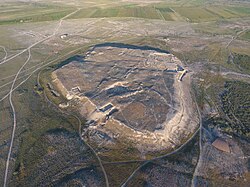
Aerial photograph of the archaeological site of Otrar.
The remnants of the citadel at Otrar, which was comprehensively destroyed by the Mongols.
DateDecember 1219-February 1220
Location
Otrar, present-day Kazakhstan
42°51′N 68°18′E / 42.85°N 68.30°E / 42.85; 68.30
Result Mongol victory
Belligerents
Mongol Empire Khwarazmian Empire
Commanders and leaders
Units involved
City garrison
Strength
50,000–75,000 5,000–15,000
Casualties and losses
Minimal Extremely high
Otrar is located in Kazakhstan
Otrar
Otrar
Location of the siege on a map of modern Kazakhstan

The Otrar Catastrophe was a siege that took place between December 1219 and February 1220 during the Mongol invasion of the Khwarazmian Empire at Otrar, a large trading city on the Syr Darya river. Inalchuq, the city's governor, had seized the goods of a Mongol trade caravan the previous year; after more provocations from Inalchuq's liege and ruler of the Khwarazmian Empire, Shah Muhammad II, Genghis Khan launched a full-scale invasion of the empire.

The city had been extensively garrisoned and fortified, and the Mongol troops found it difficult to breach the battlements. Progress was slowly made, and by February Genghis felt confident enough to detach part of his army and head southwards towards Transoxiana. His sons Chagatai and Ogedei were left behind to continue the siege. Qaracha, the leading general of the city, deserted in February 1220 and the inner citadel fell soon afterwards. Inalchuq was captured alive, and was executed. Some sources relate that he was executed by having molten metal poured into his orifices; this story, symbolising his greed in seizing the caravans, is almost certainly apocryphal.

Muhammad had expected the nomadic invaders to fail in capturing Otrar. Its seizure left the Khwarazmian heartland open to conquest—the Mongols would isolate and capture the great cities of Bukhara, Samarkand, and Gurganj in turn. The Otrar oasis would revive as the Syr Darya shifted in its course; the Khwarazmian citadel would remain abandoned.

Background

[edit]

The Otrar oasis, comprising ten walled towns and fifty smaller villages, covered an area of 200 square kilometres (77 sq mi) near the confluence of the Syr Darya river and its tributary, the Arys; both rivers provided water for an extensive network of irrigation canals. The oasis, which had been inhabited since the second century BC, formed a buffer zone between the nomadic steppe to the north and the sedentary cultures to the south. The eponymous city of Otrar was strongly fortified, being located atop a 20 metres (66 ft) high earthwork called a "tobe".[2][3] Otrar was also the junction for several major trade routes of the Silk Road, which led westwards to Gurganj and Europe, south to Samarkand and other major cities of Central Asia, and eastwards to China through the Dzungarian Gate.[4]

The city of Otrar is known to have been under the control of a Qarakhanid dynast named Taj ad-Din Bilge-khan in 1204 AD, who as a vassal of the Qara Khitai khanate led an army to assist Muhammad II of Khwarazm against the Ghurids.[5][6] The Qara Khitai were weakened by events on their eastern frontier: Genghis Khan had begun to establish hegemony over the Mongol tribes, causing great instability in the region.[7] Kuchlug, a Naiman prince who had been defeated by the Mongols, managed to usurp the Qara Khitai throne in 1211, and Muhammad took advantage of the anarchy to greatly expand the Khwarazmian domains.[8] He took possession of the whole of Transoxania and territories as far north as Otrar between 1210 and 1212, and replaced the native governors with his own, exiling Taj ad-Din to Nesa where he was killed.[9][10]

By 1218, the Khwarazmian Empire controlled most of Central Asia and Persia, and Muhammad was flattered with the title of "Second Alexander".[11][12] However, Khwarazmian power was tenuous. His empire was vast and newly formed, with a still-developing administration.[13] In addition, his mother Terken Khatun still wielded substantial power in the realm - the historian Peter Golden termed the relationship between the Shah and his mother as "an uneasy diarchy", which often acted to Muhammad's disadvantage.[14] The Soviet historian Ziya Buniyatov noted that Muhammad's decrees were frequently invalidated by Terken Khatun, while she effectively appropriated the Khwarazmian capital of Gurganj as her own domain, forcing Muhammad to take his court to Samarkand.[15] The Khatun, originally a tribal princess of the Kipchaks, manipulated the succession, discrediting the claim of Muhammad's oldest son Jalal al-Din in favour of his half-brother Uzlagh, who was half Kipchak. She also placed many of her kinsmen in high positions in the Khwarazmian administration.[16][17]

An illustration of two women, one holding a child, walking in front of four men on horses
A depiction of Terken Khatun (left) after her later capture by the Mongols.

These promoted kinsmen were strongly disliked by many other Khwarazmian subjects. In addition to their not being Muslim converts, the Kipchaks auxiliaries in Muhammad's army were brutal, avaricious, and often disloyal.[18] It is thus unsurprising that the major accounts of the Mongol invasion of Khwarazmia, all written by Muslim authors, focus blame on Kipchak greed: they specifically mention one of Terken Khatun's nephews, a man named Inalchuq, sometimes titled Gayir Khan or Inal Khan, who was instituted as governor of Otrar, now a frontier town of the Khwarazmian realm.[18][19]

Prelude

[edit]

In its capacity as a centre of trade, Otrar received a Mongol trading caravan of 450 merchants in winter 1218-19.[20] These merchants, who brought a large amount of luxury goods such as gold, silver, sable furs, and silk, were followers of Genghis Khan's noyans (close companions).[21][22] Inalchuq accused them of espionage and had them killed, appropriating their goods for himself. There has been debate on both the involvement of Shah Muhammad and the validity of this accusation. While some chroniclers, such as al-Nasawi attribute blame solely to Inalchuq's greed, most others state that Muhammad either allowed or explicitly ordered the massacre.[23] Paul Ratchnevsky notes that Inalchuq must have at least had "tacit agreement" from Muhammad to carry out such a taboo diplomatic action.[24] It is likely that the charge of espionage was somewhat accurate: both the Khwarazmians and Mongols were known to use merchants and diplomats, who would learn valuable strategic information and spread favourable propaganda as part of their missions, as spies.[22][25]

The execution of the merchants at Otrar served as a casus belli for two reasons. Firstly, envoys of any kind were considered inviolate in Mongol law, and any slight done to them demanded reparations or vengeance. Muhammad's subsequent humilation of the Mongol envoys sent to repair relations did not help matters.[22][26] Secondly, the massacre served as the opening of economic warfare. The steppe nomads had always been greatly concerned with the sanctity and security of trade routes: as the Khwarazmians controlled all the routes beyond Otrar, the Mongols were now completely cut off from trading partners in the Near East.[21][27] Furthermore, Kuchlug's usurpation of the Qara Khitai and subsequent actions had created religious and territorial tensions in Turkestan.[27][28]

After all his diplomatic overtures were rebuffed, Genghis Khan prepared for war. He left his general Muqali as viceroy in North China to continue the war against the Jin and gathered the bulk of his army in the Altai Mountains.[29][30] While early 20th century historians such as Vasily Bartold judged the Mongol invasion force to be between 150,000 and 200,000 men,[31] more recent scholars have produced estimates of between 50,000 and 75,000.[32][33] Shah Muhammad was reported to have more than 400,000 soldiers,[34] and medieval sources state Otrar housed between 15,000 and 50,000, but these numbers could be exaggerated by a factor of ten.[35] A portion of the city's troops was commanded by Qaracha, a general sent by the Shah to assist Inalchuq.[36]

Siege

[edit]

The Mongol forces arrived on the Syr Darya in autumn 1219, having forded several rivers and received reinforcements from allies. Genghis' second and third sons, Chagatai and Ogedei, were sent forward to besiege the city, while the Khan himself stayed across the river, laying a trap for the Shah—if he came forward to engage the besieging forces, Genghis would cross the river and annihilate the Khwarazmian army in pitched battle. Shah Muhammad did not take the bait, so Genghis changed plans. As the siege of Otrar was proving lengthy, he split his forces. The Khan's firstborn Jochi was sent northwards to capture cities along the Syr Darya, while the top generals Subutai and Jebe were sent southwards into the Fergana Valley with a small force. Genghis himself took his youngest son Tolui and, aided by local guides, disappeared into the Kyzyl Kum desert to launch a surprise attack on Bukhara.

References

[edit]
Revisions and contributorsEdit on WikipediaRead on Wikipedia
from Grokipedia
The Otrar Catastrophe was the siege and systematic destruction of , a prosperous city in medieval , by Mongol forces commanded by from late autumn 1219 until early 1220, marking the onset of the Mongol Empire's conquest of the Khwarezmian Empire. This event stemmed directly from the 1218 execution of a Mongol caravan and diplomatic envoy by Otrar's governor, , who acted with the tacit approval of Khwarezmian Muhammad II, suspecting amid rising tensions between the expanding powers. Genghis Khan's response escalated when the sultan rejected demands for justice, instead beheading the Mongol , prompting the of approximately 150,000 troops to punish the affront and secure the empire's frontiers. The ensuing five-month encirclement showcased Mongol innovations in warfare, including the deployment of trebuchets, battering rams, and wall-sapping techniques, which overcame Otrar's formidable fortifications despite fierce resistance from its defenders. Upon the city's capitulation in February 1220, following the separate surrender of its inner citadel, was executed by having molten silver poured into his eyes and ears—a retribution symbolizing the khan's demand for the governor's accumulated wealth—while the surviving population endured enslavement or slaughter, leaving the urban center in ruins from which it never recovered. The catastrophe's repercussions extended far beyond , catalyzing a broader campaign that annihilated key Khwarezmian strongholds like and , precipitated the empire's collapse within two years, and facilitated Mongol dominance over and the . Historical accounts, primarily drawn from Persian chroniclers such as Juvayni writing decades later, underscore the event's brutality, though they may inflate casualty figures amid the era's rhetorical conventions.

Historical and Geographical Context

Otrar's Location and Economic Role

Otrar was located in southern , on the right bank of the River at its confluence with the Arys River, within the Otyrar Oasis near the Karatau Mountains. This positioning placed the city at the junction of multiple caravan routes, serving as a critical link between the agricultural lowlands of and the regions to the north. As a major economic center in the Khwarezmian Empire, Otrar functioned as a thriving hub, facilitating commerce in goods such as , spices, and metals between settled urban populations and nomadic groups. The city's prosperity stemmed from its role as the nucleus of a fertile agricultural district, where irrigation-supported farming produced surplus crops, alongside artisanal production evidenced by archaeological remains of workshops, palaces, mosques, and public bathhouses. Originally established as a trading settlement on the northern branch of the , Otrar attracted merchants and served as an administrative outpost, underscoring its strategic value in regional exchange networks prior to the Mongol invasions.

The Khwarezmian Empire and Internal Dynamics


The Khwarezmian Empire reached its territorial zenith under Shah ʿAlāʾ-al-Din Muḥammad II, who ascended the throne in 1200 following the death of his father, Tekish, and expanded into Transoxiana by defeating the Qara Khitai in 1210, thereby incorporating regions from the Aral Sea to the Indus River. This expansion relied on a military structure dominated by Turkic Qangli tribesmen, who formed the core of the empire's cavalry forces estimated at around 40,000 prior to the Mongol incursions. However, the empire's administration blended Persian bureaucratic traditions with nomadic Turkic elements, fostering dependencies on tribal loyalties rather than unified central command.
Internal dynamics were characterized by a between the and his mother, Terken , a Naiman princess who seized substantial authority upon Tekish's death in 1200 and maintained her own (administration) with independent chancery staff issuing edicts under her seal. Terken commanded personal fiefs, income sources, and Qangli contingents, including kinsmen such as Inālčiq Qāyer Khān, the of Otrār, granting her leverage over key appointments and regional governance. The , while nominally absolute, routinely consulted her and rarely opposed her decisions, even as he reportedly resented her dominance during his campaigns, which undermined his ability to enforce centralized policies. This power-sharing arrangement exacerbated political instability, as Terken Khatun favored certain heirs like Uzlāḡšāh for governorships in core provinces such as Khwārazm, , and Māzandarān, complicating succession amid the Shah's numerous sons. Local governors enjoyed significant , often prioritizing tribal or familial allegiances over imperial directives, while the empire grappled with unresolved internal rivalries that fragmented responses to external threats by 1217. Such divisions, rooted in the interplay of maternal influence and decentralized military command, contributed to administrative inefficiencies despite periods of economic prosperity under Terken Khatun's oversight in 1219–1220.

The Triggering Incident

The Mongol Caravan and Diplomatic Mission

In late 1218, Genghis Khan organized and dispatched a substantial trade caravan to Otrar, a key frontier city in the Khwarezmian Empire, comprising around 450 Muslim merchants, attendants, and possibly a Mongol ambassador, all under Mongol imperial protection. The mission aimed to initiate or expand commercial exchanges, leveraging the Silk Road networks to integrate Mongol economic interests with those of the Khwarezmians, reflecting Genghis Khan's strategy of using trade diplomacy to extend influence without immediate conquest. One account from a survivor—a camel driver who escaped execution—later informed Genghis of the caravan's fate, underscoring the incident's role as a catalyst for escalation. Following reports of the caravan's destruction, dispatched a formal diplomatic delegation of three envoys in early 1219 to the Khwarezm Shah, Ala al-Din Muhammad II, demanding restitution, including the handover of Otrar's governor, , for his role in the merchants' seizure and killing. This mission adhered to established diplomatic norms, where envoys carried authority derived from their khan's mandate and were traditionally inviolable to avoid provoking retaliation. The Shah's court, however, viewed the envoys with suspicion amid internal about Mongol intentions, leading to their mistreatment: one was beheaded, while the others suffered humiliation such as beard-shaving before release or execution. This violation of diplomatic protocol, compounded by the prior caravan losses, shifted Mongol policy from negotiation to , as Genghis perceived it as an existential affront to his and the reliability of protected trade.

Inalchuq's Actions and Shah Muhammad's Involvement

, the governor of and a relative of Khwarezm II (often identified as his ), ordered the seizure and execution of a Mongol caravan that arrived in the city in 1218. The caravan, consisting of approximately 400 to 500 merchants and including Mongol envoys bearing diplomatic gifts intended for the , was suspected by of amid heightened border tensions following Khwarezmian conquests in the region. confiscated the caravan's goods—reportedly laden with silver ingots and items—and had its members executed, an act that violated established diplomatic norms for merchant missions. One survivor, a member of the Tartar subgroup, escaped and relayed the incident to , providing the initial catalyst for Mongol retaliation. Shah Muhammad II was directly informed of the massacre upon the caravan's arrival but declined to intervene or punish , effectively endorsing the governor's unilateral decision despite the presence of official Mongol representatives. This inaction stemmed from the 's paranoia regarding Mongol intentions, influenced by recent Khwarezmian expansions against former Mongol vassals like the , and possibly pressure from his mother, , who favored aggressive stances. When dispatched a follow-up embassy of three envoys—two Muslim merchants and one Mongol—to demand restitution and the surrender of , the Shah escalated the provocation by ordering the execution of the Mongol envoy in and the humiliation of the others through beard-shaving and expulsion, further breaching diplomatic protocol. These actions by and the Shah's complicity transformed a local into a , as Mongol custom regarded the killing of envoys as an unforgivable affront warranting . Contemporary Persian chroniclers, such as Juvayni and al-Nasawi, attribute the Shah's decisions to overconfidence in Khwarezm's defenses and underestimation of Mongol resolve, though these accounts reflect the biases of post-conquest survivors seeking to explain the empire's rapid collapse. The Shah's refusal to prioritize over loyalty to a provincial governor underscored internal Khwarezmian fractures, including favoritism toward Turkic military elites like , which prioritized short-term gains from seized goods over long-term strategic risks.

Immediate Aftermath of the Massacre

Following the execution of the 450 merchants in the caravan, , motivated by greed and suspicion, seized their goods and dispatched a to Muhammad II in , presenting a share of the spoils alongside news of the killings. The Sultan sanctioned the governor's conduct, deeming the property lawful booty regardless of whether the victims were spies or legitimate traders, and retained his portion without foreseeing the gravity of Mongol retaliation. This endorsement from the Khwarezmian sovereign, who viewed the act as a prudent measure against potential threats, reflected overconfidence in the empire's defenses and underestimation of nomadic capabilities, as contemporary Persian chroniclers later attributed the Shah's decision to amid internal power struggles. Meanwhile, a single merchant evaded execution and fled westward, eventually reaching Genghis Khan's camp to report , providing the first direct of the betrayal to Mongol leadership. The incident's proximity to the Syr Darya frontier amplified its impact, disrupting established Silk Road commerce under Mongol protection and eroding fragile trust built through prior embassies, though no immediate Khwarezmian reprisals or investigations followed Inalchuq's report.

Mongol Response and Preparations

Genghis Khan's Strategic Deliberations

Upon learning of the caravan's massacre in Otrar during late 1218, Genghis Khan initially pursued diplomatic recourse by sending a delegation of three envoys—one Muslim and two Mongols—to Shah Ala ad-Din Muhammad II, demanding the extradition of Governor Inalchuq, restitution for the seized goods valued at several hundred camels' loads of merchandise, and punishment for the affront. The Shah's refusal, marked by the beheading of the Muslim envoy Barchuk and the shaving of the beards of the Mongol ambassadors before their dismissal, constituted a direct challenge to Mongol sovereignty and the sanctity of envoys, a principle central to steppe diplomacy that Genghis had rigorously enforced in prior conquests. This escalation transformed a local incident into a casus belli, as failing to respond would undermine the Khan's authority over his nomadic confederation, where personal honor and retribution dictated alliances and deterrence. Genghis Khan's strategic assessment balanced the imperative of vengeance against the empire's overextension, as Mongol forces were actively engaged in protracted campaigns against the Xi Xia (ongoing since 1209 and not fully subdued until 1227) and the Jin dynasty (invaded in 1211, with completion delayed until 1234). Internal Khwarezmian fractures—exacerbated by the Shah's paranoia, familial rivalries, and decentralized military structure under semi-autonomous governors—presented exploitable vulnerabilities, yet the 1,500-mile distance from Mongol heartlands posed logistical risks, including supply lines across deserts and mountains. To mitigate a two-front war, Genghis delegated the Jin front to his noyan Mukhali with a substantial detached force, enabling the main army's pivot westward while maintaining pressure on eastern foes. Intelligence gathering through scouts and defectors informed this calculus, highlighting the Shah's dispersed armies totaling up to 400,000 but lacking cohesion, against the ' estimated 90,000–200,000 highly mobile . By early 1219, following a assembly where key noyans and sons like Chagatai affirmed unity, Genghis resolved on , framing the campaign as punitive justice to deter future violations and secure trade routes essential for the empire's economic expansion via the . This decision prioritized causal retaliation—directly linking the provocation to systemic destruction—over protracted , reflecting first-principles adherence to reciprocal violence in nomadic , where unchecked insults eroded command legitimacy. Mobilization ensued in spring 1219, with forces divided for parallel advances: Genghis targeting , Jochi toward , Chagatai and Ögedei to and , and detached tumens under and for flanking maneuvers. The deliberations underscored Genghis's adaptive command, leveraging decentralized execution to achieve operational tempo across vast theaters despite initial hesitations over timing.

Assembly of Forces and Division of Command

In response to the execution of Mongol envoys and merchants at in late 1218, initiated mobilization of his forces across the Mongol heartlands during 1219, drawing on the decimal-based tumen system to assemble a campaign army estimated at around 200,000 warriors, including core Mongol and auxiliary contingents from subjugated tribes such as the Kereit and Naiman. This force represented one of the largest mobilizations of up to that point, supported by extensive involving horse relays and parties to sustain long-distance marches from westward through the territories of the recently subdued Kara-Khitan Khanate. The overall command structure emphasized decentralized execution under Genghis's strategic oversight, dividing the invasion into coordinated columns to exploit the Khwarezmian Empire's dispersed garrisons and vast frontiers. Genghis led the central column personally toward , arriving on the River in October 1219 after fording multiple waterways and integrating local reinforcements. Upon reaching the vicinity, he assigned the direct of to his second son Chagatai and third son Ögedei, entrusting them with a substantial portion of the army—likely several tumens—to prosecute the prolonged encirclement while he diverted southward in pursuit of Shah Muhammad II. Concurrently, Genghis directed his eldest son to advance a northern column from the steppe frontiers along the lower , tasked with neutralizing Turkic tribes allied or sympathetic to Khwarezm and securing the empire's exposed northern flank to prevent reinforcements from reaching or the capital at . This pronged approach aimed to overwhelm the Khwarezmians through simultaneity, though familial rivalries—particularly Jochi's disputed legitimacy and policy differences with Chagatai—later hindered unified operations, as evidenced by delays in joint assaults during subsequent phases of the campaign.

The Siege

Mongol Siege Tactics and Engineering

The Mongol siege of , directed by Genghis Khan's sons Chagatai and Ögedei from December 1219 onward, showcased the integration of nomadic mobility with acquired engineering prowess to counter fortified urban defenses. Having learned from campaigns against the Jin and Xi Xia dynasties, the conscripted Chinese and Central Asian engineers to fabricate and deploy heavy , marking a shift from their early limitations in warfare. This adaptation allowed sustained of Otrar's thick mud-brick walls, which resisted initial assaults despite the city's strategic position on the [Syr Darya](/page/Syr Darya) River. Key engineering efforts included the construction of mangonels and early counterweight trebuchets, capable of propelling stones weighing up to 100 kilograms to breach battlements and demoralize defenders. These machines, supplemented by ballistae for precision strikes, were positioned behind protective screens of wicker shields and mobile towers to shield operators from counterfire. The also employed incendiary bombs and, in some instances during the Khwarezm campaign, primitive devices for explosive effects, overwhelming the garrison's arrow supplies over the five-month ordeal. To facilitate direct assaults, sappers tunneled beneath the walls for undermining while laborers raised earthen ramps—piled with soil, timber, and debris—to enable scaling ladders and towers to reach the ramparts. Encircling trenches and palisades, dug and fortified rapidly by disciplined tumens, isolated the city, preventing sorties or reinforcements and forcing reliance on internal resources. This methodical combination of , , and , executed with logistical precision to sustain 20,000–30,000 troops, gradually eroded the defenders' resolve until enabled the final breach in February 1220.

Khwarezmian Defenses and Key Figures

Otrar, a major frontier fortress of the Khwarezmian Empire situated at the of the Arys and rivers, featured robust defensive architecture including thick mud-brick walls enclosing the main city, multiple gates, and a prominent atop a central hillock that served as the final stronghold during sieges. These fortifications, developed over centuries, were designed to withstand assaults from nomadic incursions, with providing elevated command positions and water access via underground channels. The city's during the Mongol reportedly numbered between 20,000 and 60,000 troops, including regular horsemen and local militia, according to contemporary Persian chroniclers Rashid al-Din (favoring the lower estimate) and (the higher figure); these defenses enabled a prolonged resistance against Mongol engines and infantry assaults. The primary Khwarezmian commander was (also spelled Inalchuk), the of and uncle to Muhammad II, who bore the Turkic title Ghayir-Khan and bore direct responsibility for the initial provocation of the Mongol invasion by executing the trade caravan and in 1218. personally oversaw the city's defense from December 1219, directing counterattacks and holding the citadel until its breach in early 1220, reportedly fighting to the last despite offers of surrender; historical accounts portray him as resolute but isolated, receiving no significant reinforcements from the fleeing . Supporting him was Qaracha (or Karacha) Khajib, a senior military commander who initially bolstered the outer defenses but deserted with his forces in February 1220, facilitating the fall of the inner citadel and contributing to the collapse of organized resistance. No other major Khwarezmian figures are prominently noted in the defense, reflecting the empire's fragmented command structure amid the broader invasion.

Prolonged Stalemate and Internal Betrayals

The Mongol of , commencing in 1219 under the command of Chagatai and Ögedei, quickly settled into a prolonged due to the city's formidable mud-brick walls, extensive fortifications, and a large that repelled initial assaults. The defenders, bolstered by Governor Inalchuq's determination, numbered in the tens of thousands, enabling sustained resistance despite the ' encirclement tactics, which severed supply lines along the River and prevented reinforcements from the Khwarezmian Shah. For the first two months, the besiegers focused on isolation rather than direct attack, as their forces lacked adequate heavy siege engines, which had to be transported overland from Mongol territories in —a logistical challenge that extended the impasse into early 1220. As privations mounted within , internal fractures emerged among the defenders, exacerbated by famine and the ' psychological , including offers of to potential deserters. Mercenaries and rank-and-file troops increasingly abandoned their posts, eroding and ; historical analyses note this as a recurring vulnerability in Khwarezmian garrisons facing prolonged . In January 1220, a key commander named Qaracha attempted to flee the city but was intercepted, captured, and executed by Inalchuq's forces, signaling deepening distrust. The stalemate broke in February 1220 when starvation-driven civilians, acting independently of the military leadership, opened a side gate to the outer city, permitting Mongol infantry to pour in and overwhelm the defenses. Local Kazakh historical traditions identify the betrayer as Karadzha, whose act of facilitated the breach, after which he was promptly executed by the remaining defenders before the city's total fall. This internal betrayal, combined with the arrival of Mongol trebuchets and mining operations against the walls, shifted the siege's momentum decisively, though the central held out for an additional month under Inalchuq's personal command.

Fall and Immediate Consequences

Breach of the City Walls

The prolonged of , lasting from October 1219 to February 1220, culminated in a breach facilitated by internal rather than a direct assault overcoming the fortifications. and desperation among the civilian population, exacerbated by the Mongol of food and water supplies, led to mass desertions from the walls and eventual betrayal by city inhabitants who opened a side gate to the invaders. This act allowed Mongol troops under the command of Chagatai and Ögedei to pour into the outer city, overwhelming the disorganized defenses. Contemporary accounts attribute the garrison's initial strength to between 20,000 and 60,000 men, including 10,000 under Governor reinforced by 50,000 troops led by General Qaracha, though attrition from failed sorties and executions—such as Qaracha's in January 1220 after an escape attempt—severely weakened resistance prior to the breach. Mongol engineers, including Chinese specialists, had employed operations beneath the walls, which contributed to structural failures, but the decisive entry point remained the compromised rather than a mined collapse of the main perimeter. Once inside, Mongol forces rapidly secured the , though pockets of resistance persisted in the inner citadels. retreated to a , where further by the attackers collapsed part of the structure, enabling his capture alive as per Genghis Khan's orders. The breach marked the effective end of organized Khwarezmian defense, transitioning the conflict to mopping up operations within the citadels by early 1220.

Execution of Inalchuq and Massacres

, the governor whose execution of envoys had precipitated the invasion, was captured alive after the inner citadel fell in February 1220, following the desertion of his leading general Qaracha to the . , upon his return to oversee the final stages of the siege, ordered 's execution by pouring molten silver into his ears and eyes—a method detailed in Persian chronicles as symbolic retribution for his seizure of the envoys' silver-laden goods. Some accounts vary slightly, specifying the silver poured down his neck or into his orifices, while modern analyses suggest the gruesome detail may be apocryphal or embellished for moral emphasis on greed. The city's capture triggered immediate massacres, beginning with the nighttime slaughter of Inalchuq's unprepared , estimated by the 14th-century historian Rashid al-Din at 20,000 troops. Mongol forces then systematically killed much of the male population, adhering to their policy of for cities that resisted after provoking the khan—Otrar's role as the invasion's ensured was given. Surviving women and children were largely enslaved, with contemporary reports indicating few inhabitants escaped death or bondage, though exact civilian casualties remain unquantified in primary sources due to the era's limited record-keeping. This brutality served both punitive and terror-inducing purposes, deterring further defiance across Khwarezm.

Looting and Systematic Destruction

Following the breach of Otrar’s defenses in February 1220, Mongol forces under the command of , Chagatai, and Ögedei systematically looted the city, seizing accumulated wealth, goods, and any remaining valuables from households, markets, and fortifications as recompense for the prolonged and the prior execution of Mongol envoys. This plunder adhered to established Mongol military protocol for cities that resisted capitulation, wherein troops were granted a limited period—typically several days—to ransack structures before organized demolition commenced, ensuring disciplined extraction of resources to sustain the campaign. Subsequent to looting, the princes ordered the razing of Otrar, involving the deliberate dismantling of walls, citadels, and buildings through fire, manual , and possibly engineered collapse to render the site uninhabitable and symbolically erase Khwarezmian defiance. Persian chroniclers such as and Rashid al-Din, drawing from Mongol and local records, portray this as total devastation, with the city’s reduced to to deter future resistance across the empire; Juvayni notes the fulfillment of ’s vow for retribution against the governor ’s treachery, framing the destruction as causal for initiating the broader . While these accounts emphasize comprehensive obliteration, they reflect perspectives shaped by post-conquest Ilkhanid patronage, potentially amplifying the scale for propagandistic effect against Khwarezmian rule.

Broader Impact and Legacy

Catalyst for the Khwarezmian Conquest

The execution of a Mongol caravan in in 1218 provided the immediate provocation for Genghis Khan's of the Khwarezmian Empire, shifting Mongol ambitions from to . A delegation of Muslim merchants under Mongol auspices arrived at the city, but , the governor and a relative of II, seized their goods—valued for their potential intelligence—and ordered the execution of approximately 450 individuals, suspecting amid rising tensions with nomads. This act, reportedly endorsed by the due to his distrust of Mongol overtures despite prior diplomatic exchanges, violated established norms of commerce along the routes. Genghis Khan responded by sending a trio of envoys—one Muslim and two —to in late 1218, demanding Inalchuq's surrender and reaffirming intentions for peaceful trade rather than aggression. The , however, escalated the crisis by ordering the killing of one envoy outright, while the surviving pair faced humiliation—such as beard-shaving—or further execution, constituting a direct affront to customs that held ambassadorial safety as sacrosanct, punishable by total reprisal. These killings, documented in Persian chronicles as a fatal misjudgment by II amid his internal insecurities and reports of ferocity, eliminated any prospect of negotiation. The affront compelled Genghis to redirect resources from his Jin campaign, assembling an army of 100,000–200,000 by autumn 1219 and launching a coordinated offensive across the Jaxartes River, with designated as the primary target for vengeance. The ensuing five-month , culminating in the city's fall in February 1220, not only resulted in Inalchuq's execution but established a template of psychological terror and systematic reduction of fortified centers, propelling Mongol tumens toward , , and beyond, dismantling the Khwarezmian Empire within two years. This chain of events underscored the catalytic role of , where local avarice and imperial ignited a war of annihilation against a realm already strained by succession disputes and overextension.

Long-Term Effects on Central Asia

The Mongol conquest of Khwarezm, triggered by the Otrar siege's conclusion in February 1220, precipitated a regional demographic catastrophe, with Persian chroniclers such as documenting the near-total annihilation of urban populations in cities like (where over 100,000 defenders and civilians reportedly perished) and widespread flight or enslavement across . This resulted in a sustained estimated at 50-75% in core affected areas by the mid-13th century, based on comparative analyses of pre- and post-invasion tax records and settlement surveys, disrupting social structures and labor availability for generations. Economically, the deliberate flooding and sabotage of infrastructure—canals, qanats, and dams vital to the region's oasis —led to sharp contractions in cultivated land, with archaeological evidence from sites in the and basins showing abandonment of fields and urban peripheries persisting into the . Such disruptions fostered chronic and pastoral nomadization, marginalizing sedentary economies in Khwarezm and southern , though Ilkhanid and Chagatai administrative reforms partially mitigated losses through repopulation incentives by the 1260s. Recent hydromorphic studies, integrating of features with paleoclimate proxies, indicate that low flows and megadroughts from circa 1000-1400 CE initiated system failures predating the invasions, with Mongol tactics accelerating collapse and post-1220 preventing full rehabilitation. Politically and culturally, Central Asia's incorporation into the (established circa 1227) ended independent Persianate polities, imposing nomadic hierarchies that diluted local governance traditions while enabling trans-Eurasian trade under stabilized Mongol oversight. This shift eroded scholarly centers—libraries in and lost irreplaceable manuscripts—contributing to a perceived "dark age" in regional intellectual output until Timurid revival in the late , though Mongol pluralism later facilitated Islamic conversion among rulers and syncretic administrative innovations.

Rebuilding of Otrar and Regional Recovery

Otrar was rebuilt in the decades following its destruction in February 1220, with economic activity resuming rapidly as indicated by archaeological layers showing continuity in and craftsmanship. Within a generation, the city's had stabilized, challenging narratives of total devastation and suggesting adaptive resilience among survivors and Mongol administrators who repaired essential infrastructure like irrigation canals. Under the , which governed the region from the 1220s onward, Otrar served as an administrative and minting center, issuing dirhams during reigns such as that of Tarmashirin (1331–1334), reflecting restored monetary functions and integration into the broader Mongol economic network. Despite this revival, the city never recaptured its pre-conquest status as a premier hub, hampered by ongoing from disrupted qanats and shifting caravan routes favoring northern paths. By the Timurid period (14th–15th centuries), Otrar experienced a late flourishing but began a slow decline, culminating in abandonment around the late 17th to early after assaults by Dzungar forces, which exacerbated prior vulnerabilities. Excavations reveal stratified deposits extending into the , confirming prolonged but diminishing occupation before the site's desertion. In the broader region, recovery was gradual amid initial depopulation estimated at 75–90% in major cities, yet stabilized under early Mongol khans like Ögedei (r. 1229–1241), who ordered repairs and reforms to revive agriculture. The facilitated Silk Road commerce, boosting Transoxiana's role in east-west trade by the mid-13th century, with cities like reconstructing mosques and bazaars despite fiscal strains from Mongol exactions. Long-term, however, persistent damage to hydraulic systems contributed to , delaying full agricultural rebound until Turkic-Mongol successor states like the Timurids promoted renewed in the .

Archaeological Evidence

Modern Excavations and Findings

Systematic archaeological excavations at began in 1969 under the auspices of Kazakh institutions, focusing on the Kyzylkum region site spanning over 250 hectares. These efforts have uncovered the pentagonal citadel rising 15-18 meters, surrounded by fortified city walls and suburbs, confirming Otrar's role as a major fortress. Annual digs have yielded abundant ceramics, including unglazed such as hums, khumchas, jugs, kumgans, tagars, and , alongside glazed tiles and metal artifacts indicative of pre-Mongol prosperity. In 2020, excavations emphasized stratigraphic analysis and artifact cataloging, revealing layers of urban development from the 8th to 13th centuries, with evidence of industrial zones for and . Post-1969 work has documented the site's , including multi-story residences and public buildings, with findings of coins and seals attesting to administrative functions. Regarding the Mongol conquest, 2017 fieldwork identified stratigraphic sequences with ceramic and numismatic evidence of occupation persisting into the 13th-15th centuries under Turco-Mongol rule, suggesting limited disruption rather than wholesale abandonment. Burn layers and scattered weapon fragments have been noted in upper strata, aligning partially with accounts of sacking, yet continuous traditions indicate rapid resettlement or survival of peripheral areas. These findings challenge narratives of total devastation, as urban features like water management systems show rather than post-1220. Recent 2023 surveys in the oasis have exposed pre-Mongol agricultural sites with channels, providing context for the city's vulnerability during but underscoring environmental factors in long-term decline over direct conquest effects.

Insights into Pre- and Post-Mongol Otrar

Archaeological excavations at , initiated by Soviet teams in 1969 and supplemented by recent international efforts, illuminate the city's urban sophistication prior to the Mongol conquest of 1219–1220. The site spanned roughly 170 hectares, featuring a prominent shahristan elevating to 18 meters, indicative of advanced defensive architecture and centralized planning in pre-Mongol Khwarezmian society. Layers from this era, reaching depths of up to 1.3 meters in some areas, disclose dense residential occupation and economic vitality as a nexus, with artifacts reflecting trade in ceramics, metals, and textiles. Specialized craft districts further underscore pre-conquest prosperity, including a potters' quarter with workshops containing multiple —two outdoor for summer use and one indoor for winter—facilitating year-round production, alongside earlier identified bakers' areas. These findings, derived from systematic digs exposing streets, courtyards, and functional structures like plastered walls with niches and ovens, evidence a stratified urban reliant on , artisanship, and commerce along the River. Post-Mongol strata reveal notable continuity of settlement into the 13th and 14th centuries under Turco-Mongol oversight, challenging historiographical claims of wholesale annihilation drawn from Persian sources like Juvaini and Rashid al-Din. Fieldwork in 2017, employing stratigraphic profiling and environmental sampling, uncovered no traces of burning or systematic looting in invasion-linked layers, suggesting localized disruption rather than city-wide obliteration. Abandonment deposits hint at temporary upheaval, yet subsequent occupations indicate reconstruction and adaptation, with persistent building traditions and artifact assemblages implying demographic resilience amid imperial reconfiguration. This posits that while the 1219–1220 inflicted severe material and human costs—aligning with broader patterns of Mongol punitive campaigns—the absence of terminal destruction layers supports a view of as enduring, albeit diminished, into the medieval Islamic era, informing causal assessments of conquest dynamics over exaggerated barbarism narratives.

Historiographical Debates

Disputed Role of Muhammad

The role of Ala ad-Din Muhammad II in the execution of the Mongol caravan at remains a point of contention among historical accounts, with primary sources differing on the extent of his direct involvement versus his subsequent inaction. According to Ata-Malik Juvayni's Tarikh-i Jahangushay, composed in the mid-13th century under Mongol patronage, a caravan of approximately 450 Muslim merchants dispatched by arrived at in late 1218, bearing goods for trade under guarantees of safe passage. Juvayni reports that Governor , a relative of the 's mother Terken , arrested the group on suspicions of , executed them, and confiscated their property, with the explicitly sanctioning these actions without hesitation, unaware or unconcerned with the repercussions. This portrayal aligns with Juvayni's broader depiction of the 's as a causal factor in Khwarezm's downfall, though as a serving the Mongol , Juvayni's narrative may emphasize the 's culpability to justify the invasion. Contrasting accounts, such as those in Shihab al-Din al-Nasawi's biography of Jalal al-Din (the Shah's son), suggest acted more independently, motivated by greed under the pretext of spying, with the Shah's approval limited or absent at the initial stage; instead, familial and political constraints prevented punishment after the fact. 's ties to , who wielded significant influence as the Shah's mother and favored Turkic elites, placed in a bind: extraditing his relative risked alienating powerful court factions and sparking internal rebellion, as noted in modern analyses of these dynamics. When dispatched envoys in 1219 demanding 's surrender and reparations—estimated at the value of the seized goods, around 1,000 camel-loads— refused, reportedly dismissing the as nomads unworthy of deference and executing or humiliating the envoys (accounts vary on whether one was beheaded or merely degraded). This refusal, whether stemming from direct complicity or political paralysis, effectively endorsed the incident and served as the for the Mongol invasion, though some scholars argue the Shah's broader strategic miscalculations, including dispersed defenses and overreliance on fortified cities, amplified the provocation's consequences. Historiographical debate centers on whether Muhammad's agency was decisive or constrained by Khwarezmian court intrigue, with Persian sources like Juvayni and Rashid al-Din (who echoes the approval narrative indirectly through Otrar's garrison details) potentially biased toward portraying the as arrogant to legitimize Mongol conquests. Later interpreters, drawing on al-Nasawi and Juzjani, highlight systemic weaknesses—such as the 's inability to centralize amid rivalries between Persian and Turkic elements—as causal, rather than personal folly alone. from the era's diplomatic norms underscores that failing to punish officials for violating envoy inviolability, a near-universal and Islamic custom, equated to , rendering the distinction between approval and inaction semantically fine but practically moot in escalating the conflict.

Assessments of Destruction and Mongol Atrocities

The siege of , lasting from late 1219 to 1220, culminated in the systematic razing of the city and of its inhabitants, as detailed in contemporary Persian chronicles. recounts that after breaching the walls, forces slaughtered the male population, enslaved women and children, and spared only approximately 400 skilled artisans for deportation to , while the citadel's defenders were annihilated following its surrender. The governor, , faced a targeted execution ordered by : molten silver was poured into his eyes and ears, symbolizing retribution for his role in ambushing envoys and merchants with those senses and his accumulated wealth. Rashid al-Din provides a corroborating account, estimating the at 20,000 fighters, though he offers fewer specifics on casualties, emphasizing the city's strategic border position and the ' prolonged investment with trebuchets and mining tactics. Assessments of the destruction's scale vary due to the sources' potential biases as post-conquest narratives composed under Mongol patronage, which may understate or frame atrocities to align with Ilkhanid legitimacy. Juvayni and Rashid al-Din depict near-total demolition, with buildings leveled and systems disrupted, rendering uninhabitable for generations and contributing to regional depopulation. Modern scholars estimate pre-siege population at around 16,000 based on archaeological proxies like and settlement size from the 9th–12th centuries, suggesting casualties in the tens of thousands if civilians were systematically targeted, though exact figures remain unverifiable absent census data. Archaeological layers confirm layers of and abandonment post-1220, but evidence of rapid partial recovery by the late — including rebuilt structures without uniform burning—indicates the catastrophe was severe yet not an absolute , challenging hyperbolic portrayals in some chronicles. Historiographical debates frame the atrocities not merely as barbaric excess but as rational instruments of asymmetric warfare, given the Mongols' numerical disadvantages against larger sedentary forces. Proponents of strategic rationality, drawing from Genghis Khan's Yassa codes, argue that total annihilation of resisters like Otrar served as deterrence, prompting surrenders elsewhere (e.g., Bukhara) and minimizing Mongol casualties while maximizing psychological submission across Central Asia. Critics, however, highlight the disproportionate cruelty—such as the governor's execution and enslavement—exceeding contemporaneous norms in Islamic or Chinese warfare, potentially reflecting nomadic cultural practices of total retribution rather than pure calculus, with chroniclers' Muslim perspectives amplifying perceptions of infidel savagery. Empirical analysis favors the former, as Mongol operations elsewhere spared yielding cities and integrated survivors, indicating atrocities were conditional on resistance rather than indiscriminate, though the Otrar precedent escalated the invasion's overall terror campaign, estimated to have halved regional populations.

Strategic Rationality vs. Barbarism Narratives

The traditional historiographical portrayal of the Mongol assault on Otrar emphasizes elements of barbarism, drawing from Persian chroniclers like Juvayni who described the five-month siege (September 1219–February 1220) culminating in the execution of Governor Inalchuq by pouring molten silver into his eyes and ears, followed by the enslavement and slaughter of the city's population, estimated at tens of thousands, with heads piled into pyramids as a deterrent. These accounts, echoed in later Western narratives, frame the destruction as indiscriminate savagery driven by Genghis Khan's personal vendetta for the 1218 execution of Mongol envoys and merchants by Inalchuq, portraying the Mongols as nomadic hordes unleashing primal fury without regard for civilized norms. Such depictions often highlight the razing of Otrar's infrastructure and irrigation systems, contributing to long-term desolation, as evidence of gratuitous cruelty rather than measured policy. In contrast, revisionist analyses interpret the Otrar catastrophe as a of strategic , where terror served as a deliberate instrument of to coerce submission and conserve Mongol resources. Historians note that Genghis Khan's pre-invasion demands for justice targeted specifically, yet the broader campaign against Khwarezmia employed calibrated escalation: cities yielding without resistance, such as some along the , were often spared, while Otrar's defiance—fortified by reinforcements from Shah Muhammad II—necessitated exemplary punishment to signal the costs of opposition. This approach minimized prolonged engagements; post-Otrar, major centers like and capitulated rapidly upon witnessing the fate of resisters, averting higher Mongol casualties and expediting conquest across an empire spanning over 2 million square kilometers by 1221. The rationality narrative underscores causal mechanisms beyond vengeance: Mongol doctrine, rooted in steppe warfare traditions, prioritized mobility and deterrence, using atrocities not as ends but as means to dismantle enemy cohesion and loyalty, as evidenced by the systematic beheading of artisans for enslavement elsewhere while executing elites to decapitate command structures. Empirical outcomes support this view; the Khwarezmian Empire's internal fractures, exacerbated by the shah's erratic dispersal of forces, were exploited through feigned retreats and intelligence networks, rendering barbaric optics a facade for efficient realpolitik rather than irrational bloodlust. Critics of the barbarism frame argue it stems from biased contemporary sources—often from conquered literati incentivized to exaggerate for pathos—overlooking how Mongol administrative integration, including tax reforms and trade revival in subdued regions, followed initial shocks. Debates persist on the balance between retribution and , with some scholars attributing Otrar's to Genghis's cultural imperative of honoring envoys as extensions of khanly , yet framing it within a broader where the invasion's 1.5–2 million estimated deaths facilitated empire-building without equivalent pre-Mongol precedents for speed and scale. Primary Mongol sources, like the Secret History, justify the response as proportional to the affront, while modern assessments weigh the rationality against ethical absolutes, noting that while terror achieved short-term dominance, it entrenched enduring perceptions of Mongol in violence. Ultimately, the Otrar episode exemplifies how strategic imperatives—deterrence via credible threats—intersected with , challenging binary barbarism labels with evidence of adaptive, outcome-oriented .

References

Add your contribution
Related Hubs
User Avatar
No comments yet.