


Community hub
Recent from talks
Contribute something
Nothing was collected or created yet.
Pakokku
View on Wikipedia | This article needs additional citations for verification. (August 2013) |
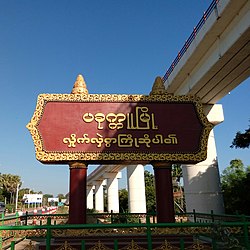
Pakokku (Burmese: ပခုက္ကူမြို့, [pəkʰoʊʔkù]) is the largest city in the Magway Region of Myanmar. It is situated about 30 km northeast of Bagan on the Irrawaddy River. It is the administration seat of Pakokku Township, Pakokku District and Gangaw District. Pakokku Bridge is part of the India–Myanmar–Thailand Trilateral Highway and is the longest bridge in Myanmar. It is home of the Pakokku Airport.
Key Information


The city is the location of Computer University, Pakokku, Pakokku Education College, Technological University, Pakokku, and Pakokku University. Thiho Shin Pagoda (The Lord of Sri Lanka Pagoda), Shwe Ku Pagoda, Shwe Mothtaw Pagoda, Shwe Tant Tit, and Phaung Taw Oo Pagoda are famous pagodas in Pakokku. Pakokku is also the largest rice market city of Upper Myanmar.
Name origin
[edit]According to legend, the name Pakokku originated during the reign of King Alaungsithu of Pagan. While traveling along the Irrawaddy River by royal barge, King Alaungsithu arrived at Pauk Inn Village. There, Me Sein Nyo, one of his concubines (some versions of the story describe her as a minor queen consort), saw a handsome fisherman and laughed loudly to get his attention. King Alaungsithu noticed this interaction and, in his anger, ordered her execution.[2]
After her death, it was discovered that Me Sein Nyo was pregnant. The executioners separated the unborn child from her body and built a tomb and a small pagoda. The place where this occurred was initially called Tharhtokegu, which means "Child Out Cave". Over many centuries, the name evolved into Pakokku.[3]
History
[edit]Before British occupation, Pakokku was a small village and part of both Pakhangyi and Bagan districts. The British occupied Upper Burma on 29 November 1885. On 1 December 1887, British India Government established Pakokku Municipal. On 21 December 1887, British India government ordered Pakokku as a town of Pakhangyi District with a population of 1,985. By the order degree (201) of British Government, Pakhangyi District was abolished and Pakokku District was established on 21 July 1888. In 1901, the population of Pakokku was 19,456. During 13 years, Pakokku's population and developments were increased rapidly.
In 1896, Pakokku became a capital city of Pakokku Hill Tracts Districts. The area under its administration included Pakokku District, Chin State outside Paletwa township, Gangaw District, Naga Self-Administered Zone, Nagaland, Mizoram, Tripura, Manipur and Meghalaya outside Shillong township.
In the early months of 1930, political speeches for Burma's colonial separation from British India were held in Shwegu Pagoda. U Lwin was appointed a new mayor of Pakokku on 7 November 1930. Pakokku Municipal election was held on 10 December 1930. In the early morning of 22 March 1931, heavy fire burned in Pakokku and more than 3,000 people were homeless, so Pakokku Fire Brigade was established on 7 April 1931.
When Burma won independence in 1948, Pakokku Hill Tracts Districts was divided into two sections. Pakokku District, Gangaw District, Naga Self-Administered Zone and Chin State became parts of Burma and Nagaland, Mizoram, Tripura, Manipur and Meghalaya became a parts of India.
By the 1947 Constitution of the Union of Burma, Pakokku Province was established with two districts in 1948. They are Pakokku District and Kanpetlet District with 11 townships. Townships are Pakokku, Kanpetlet, Yesagyo, Pauk, Seikphyu, Myaing, Gangaw, Htilin, Saw, Mindat and Matupi. Pakokku was occupied by Communist rebels in 1949 and held until 1955, when it was liberated by government forces. In 1958, the name of Kanpetlet District was changed into Mindat District and Kanpetlet District's Capital was moved to Mindat from Kanpetlet. Province's Capital city was Pakokku.
On 2 March 1962, the military led by General Ne Win took control of Burma through a coup d'état, and the government has been under direct or indirect control by the military. A new constitution of the Socialist Republic of the Union of Burma was adopted in 1974.
By the 1974 Constitution, Pakokku Province was abolished and Pakokku District was added to the Magway Division and Mindat District was added to the Chin State. On 4 April 1998, Pakokku District was divided into two districts. Pakokku, Pauk, Yesagyo, Myaing and Seikphyu became Pakokku District and Gangaw, Saw and Htilin became Gangaw District.
Pakokku Bridge construction was started on 15 December 2009 and ended on 31 December 2011. It was opened on 1 January 2012, and is the longest bridge in Myanmar.
Notable Places
[edit]Climate
[edit]Located in the powerful rain shadow of the Arakan Mountains, Pakokku has a hot semi-arid climate (Köppen BSh), receiving only about two-fifteenths as much rain as Sittwe at the same latitude on the Bay of Bengal coast. Unlike most monsoonal semi-arid climates, the rainy season is relatively long at around five to six months, while variability and extreme monthly and daily rainfalls are much lower than usual with this type of climate.[4]
| Climate data for Pakokku (1981–2010) | |||||||||||||
|---|---|---|---|---|---|---|---|---|---|---|---|---|---|
| Month | Jan | Feb | Mar | Apr | May | Jun | Jul | Aug | Sep | Oct | Nov | Dec | Year |
| Mean daily maximum °C (°F) | 29.1 (84.4) |
32.3 (90.1) |
36.4 (97.5) |
39.0 (102.2) |
37.5 (99.5) |
35.3 (95.5) |
34.9 (94.8) |
33.9 (93.0) |
33.5 (92.3) |
32.7 (90.9) |
30.6 (87.1) |
28.7 (83.7) |
33.7 (92.7) |
| Mean daily minimum °C (°F) | 13.2 (55.8) |
14.7 (58.5) |
18.6 (65.5) |
22.1 (71.8) |
24.2 (75.6) |
23.6 (74.5) |
23.8 (74.8) |
23.5 (74.3) |
23.0 (73.4) |
21.6 (70.9) |
18.1 (64.6) |
15.1 (59.2) |
20.1 (68.2) |
| Average rainfall mm (inches) | 0.9 (0.04) |
0.3 (0.01) |
3.9 (0.15) |
11.1 (0.44) |
88.2 (3.47) |
89.7 (3.53) |
38.2 (1.50) |
90.6 (3.57) |
117.8 (4.64) |
132.0 (5.20) |
29.6 (1.17) |
4.0 (0.16) |
606.3 (23.88) |
| Source: Norwegian Meteorological Institute[5] | |||||||||||||
Transport
[edit]Pakokku's strategic location in Central Myanmar makes it an important hub for transport of people and goods. The city is connected to other parts of the country and to China, Thailand and India by multiple modes of transportation.
Air
[edit]River
[edit]The irrawaddy River remains an important arterial route for transporting goods such as farm produce including rice, beans and pulses, cooking oil, pottery, bamboo and teak. Pakokku river port is one of the most important ports, the third largest port in Myanmar after Yangon port and Mandalay port. Pakokku port is a major port of Magway Region.
Rail
[edit]
Division 10 Pakokku
Pakokku Railway Station is the terminus of Myanmar Railways's main rail line from Yangon and the starting point of branch lines to Pyin U Lwin (Maymyo), Monywa, Mandalay, Kalay, Gangaw, and to the south, Bagan, Minbu, Thayet, Pyay and Kyangin.Pakokku Railway Station is the major Railway Station of Magwe Division.
Pakokku does not have an intra-city metro rail system.
Roads
[edit]Pakokku is a part of Myanmar's road network. The highway network includes roads towards:[7]
- Upper Burma and China—
Pakokku—Myingyan-Mandalay-Tagaung–Bhamo–Myitkyina Road, Pakokku-Chaung Oo-Sagaing-Mandalay Road, Pakokku-Mandalay–Lashio–Muse Road (part of Asian Highway)[8]
- Western Burma and India—
Pakokku-Pauk-Saw-Htilin-Gangaw-Kale-Tamu Road, Pakokku-Pauk-Kyaukhtu-Mindat-Matupi Road, Pakokku—Chaung Oo–Monywa–Kalewa–Tamu Road (part of India–Myanmar–Thailand Trilateral Highway)[8]
- Lower Burma and Thailand—
Pakokku-Nyaung-Oo-Chauk-Pyay-Bago-Yangon Road, Pakokku-Meiktila – Nay Pyi Taw – Thaton – Hpa-an – Kawkareik – Myawaddy Road (part of India–Myanmar–Thailand Trilateral Highway)[8]
Most stretches of these highways are one-lane roads in poor condition. Pakokku Bridge is part of the India–Myanmar–Thailand Trilateral Highway and is the longest bridge in Myanmar.

Education
[edit]List of universities and colleges in Pakokku
[edit]- Pakokku Teacher Training Degree College (Pakokku Education Degree College)
- Pakokku University
- Computer University, Pakokku
- Technological University, Pakokku
- Nursing College, Pakokku
- East Pali University of Buddhism, Pakokku (Maha Vijara Rama)
- Middle Pali University of Buddhism, Pakokku (Maha Visuta Rama)
- West Pali University of Buddhism, Pakokku (Mandalay tike)
Sports
[edit]List of Ethnic Groups in Pakokku
[edit]Religion
[edit]- Buddhism (99.0%)
- Islam (0.50%)
- Christianity (0.29%)
- Hinduism (0.16%)
- Atheist (0.05%)
Buddhism is the practised by the majority of the population. A sizable minority, however, adheres to Islam, Christianity, Atheism, and Hinduism.
Pakokku is the second most important and populated city of Buddhist monks in Myanmar with three Pali university of Buddhism.
Health care
[edit]Public Hospitals
[edit]- Pakokku General Hospital
- Pakokku Traditional Medicine Hospital
- Pakokku Women's and Children's Hospital
- Pakokku Sangha Hospital
Private Hospitals
[edit]- ChanMyae Hospital
- ThaPyaeNyo Hospital
References
[edit]- ^ Census Report. The 2014 Myanmar Population and Housing Census. Vol. 2. Naypyitaw: Ministry of Immigration and Population. May 2015.
- ^ "ပခုက္ကူမြို့နယ်ဒေသဆိုင်ရာအချက်အလက်များ" (PDF). MOI.
- ^ "ရှေ့နေနှင့် ပခုက္ကူ". Myanmar DigitalNews (in Burmese).
- ^ See Camberlin, Pierre (2010). "More variable tropical climates have a slower demographic growth" (PDF). Climate Research. 41: 157–167. doi:10.3354/cr00856.
- ^ "Myanmar Climate Report" (PDF). Norwegian Meteorological Institute. pp. 23–36. Archived from the original (PDF) on 8 October 2018. Retrieved 1 December 2018.
- ^ Division 10 Pakokku
- ^ Thiha Aung (13 February 2005). "Mandalay Division marching to new golden land of unity and amity". New Light of Myanmar.
- ^ a b c "Asian Highway in Myanmar" (PDF). unescap.org. Retrieved 12 January 2009.
- ^ Department of Population Ministry of Labour, Immigration and Population MYANMAR (July 2016). The 2014 Myanmar Population and Housing Census Census Report Volume 2-C. Department of Population Ministry of Labour, Immigration and Population MYANMAR. pp. 12–15.

Capital: Magway | ||
| Gangaw District |   | |
| Magway District | ||
| Chauk District | ||
| Minbu District | ||
| Pakokku District | ||
| Thayet District | ||
| Aunglan District | ||
| Main cities and towns | ||
Pakokku
View on GrokipediaEtymology
Origins and meanings
The name Pakokku derives from the Burmese term ပခုက္ကူ (transliterated as pa.hkukku or pəkʰòʊkù), referring to the city in Myanmar's Magway Region.[5] This linguistic borrowing reflects the Burmese naming conventions for settlements along the Irrawaddy River, though the term's phonological structure suggests indigenous origins tied to local topography or flora without confirmed historical documentation predating the 19th century in European records.[6] The precise etymology and semantic meaning of Pakokku remain uncertain, with no established breakdown into root components in Burmese lexicon analyses; scholarly sources attribute it directly to the place name without deriving a literal translation such as references to natural features or actions.[7] Early attestations appear in British colonial surveys from the 1820s onward, indicating the name's stability over at least two centuries, but pre-colonial origins lack philological consensus beyond its Burmese script form.[6]Geography
Location and physical features
Pakokku lies in the Magway Region of central Myanmar, on the western bank of the Irrawaddy River, roughly 30 kilometers northeast of Bagan. Its coordinates are approximately 21°20′N 95°05′E.[1] The city serves as a key river port and transportation hub in the region. The terrain around Pakokku is predominantly flat, with low mountains present in the western areas of the township.[8] It sits at an elevation of about 70 meters above sea level.[9] The surrounding landscape features undulating gravelly and sandy soils typical of Myanmar's dry zone, supported by alluvial deposits from the Irrawaddy and nearby Chindwin rivers.[10]Climate and environment
Pakokku experiences a tropical savanna climate classified as Aw under the Köppen-Geiger system, characterized by a pronounced dry season from November to April and a wet season from May to October.[11][12] Average annual temperatures range around 26.5 °C, with highs reaching 34.9 °C and lows about 23.7 °C.[13] Precipitation totals approximately 1,200 mm annually, concentrated in the wet months, where July, August, and September each see about 143 mm and around 20 rainy days.[13][11] Situated in Myanmar's Central Dry Zone, Pakokku faces environmental challenges including water scarcity, drought vulnerability, and deforestation driven by agricultural expansion and fuelwood collection.[14] The Ayeyarwady River, adjacent to the city, supports irrigation and transportation but suffers from siltation due to upstream deforestation, bank erosion, and agricultural runoff pollution.[15][16] These factors exacerbate soil degradation and flood risks during monsoons, while weak enforcement of environmental regulations limits mitigation efforts.[17]History
Pre-colonial and early settlement
Prior to the British annexation of Upper Burma in 1885, the site of modern Pakokku functioned as a small rural village situated along the Irrawaddy River, administratively divided between the Pakhangyi and Bagan districts under the Konbaung Dynasty's governance of central Myanmar.[18][19] This modest settlement supported local agriculture and riverine trade in a dry-zone landscape conducive to rice and pulse cultivation, reflecting the decentralized township (myo) structure typical of Burmese kingdoms where villages like Pakokku served as peripheral nodes to larger centers such as Pakhangyi.[20] Archaeological evidence from the Pakokku district points to earlier human activity in the surrounding Upper Burma region, with sites linked to the Pagan Kingdom (1044–1287 CE), including structures like the Tantkyitaung Zedi on the western bank of the Irrawaddy, which attest to Buddhist monumental construction and settlement expansion during that era.[21][22] However, no records indicate Pakokku itself as a significant urban or political center before the colonial period; its growth remained limited, overshadowed by nearby hubs like Bagan until British administrative reforms elevated it.[23] The area's prehistoric roots trace to broader Pyu and early Bamar migrations into the Irrawaddy valley from the first millennium BCE, fostering agrarian communities amid seasonal flooding and arid conditions.[24]Colonial period
Following the Third Anglo-Burmese War, British forces annexed Upper Burma, including the Pakokku area, on November 29, 1885, ending Konbaung Dynasty rule and initiating direct colonial governance.[19] Prior to annexation, Pakokku existed as a minor village subordinated to the Pakhangyi and Bagan districts under Burmese administration.[18] Colonial authorities reorganized local governance rapidly to consolidate control and promote revenue collection. On December 1, 1887, the British Indian government established the Pakokku Municipality to manage urban services.[19] Twenty days later, on December 21, 1887, Pakokku was formally designated a town within Pakhangyi District, with an enumerated population of 1,985 residents.[18] A Deputy Commissioner was appointed to oversee district-level administration, encompassing civil, revenue, judicial, and security duties, reflecting standard British practices for pacifying and administering annexed territories.[25] Administrative boundaries were further rationalized on July 21, 1888, when Government Order Degree 201 abolished Pakhangyi District and created Pakokku District, with Pakokku as its headquarters town on the Irrawaddy's right bank.[19] This new district incorporated surrounding hill tracts and riverine areas, facilitating British oversight of trade routes along the Chindwin and Yaw rivers. Economically, Pakokku developed as a nodal point for river navigation and commerce, exporting teak timber, earth oil (petroleum), cotton, and palm products to downstream markets, bolstered by improved steamboat services and rudimentary road links like the Pakokku-Pauk route.[26] By the early 20th century, these changes had elevated its status from a peripheral settlement to a key entrepôt in Upper Burma's interior economy, though growth remained constrained by seasonal flooding and limited rail connectivity until later decades.[27]Independence era and socialist rule
Following Myanmar's independence from Britain on January 4, 1948, the country descended into widespread instability due to multiple insurgencies by communist, ethnic separatist, and other rebel groups challenging the central government.[28] In March 1949, White Flag Communist (BCP-WF) rebels captured Pakokku as part of their advances in central Myanmar, occupying the town amid broader control over parts of the Ayeyarwaddy Delta and surrounding districts.[28] Government forces, bolstered by U Nu's administration and military campaigns, recaptured Pakokku around 1955, restoring central authority after years of rebel dominance that disrupted local trade and administration.[19] The subsequent parliamentary era under Prime Minister U Nu (1948–1958 and 1960–1962) saw efforts to consolidate control through military operations and negotiations, though insurgencies persisted in the region, limiting development in commercial hubs like Pakokku.[28] On March 2, 1962, General Ne Win seized power in a coup d'état, dissolving parliament and establishing one-party socialist rule under the Burma Socialist Programme Party (BSPP).[29] This "Burmese Way to Socialism" emphasized state control, nationalizing private enterprises, collectivizing agriculture, and enforcing economic isolationism, which stifled trade in export-oriented areas.[30] As a riverside trading center for timber, palm sugar, and goods from the Chindwin River basin, Pakokku faced economic contraction under these policies, with state monopolies replacing private commerce and recurrent demonetizations exacerbating shortages and inflation nationwide, including in the dry central zones.[31] [32] The regime's focus on self-reliance and suppression of dissent maintained superficial stability in urban centers like Pakokku but fueled underlying grievances over rationing, corruption, and agricultural failures, setting the stage for later unrest without major localized revolts during this period.[33]Military governance and uprisings
Following the 1988 nationwide 8888 Uprising, which was brutally suppressed by the military, the State Law and Order Restoration Council (SLORC) established direct control over administrative divisions including Magway Region, where Pakokku is located. Local governance in Pakokku Township fell under the framework of military-led Peace and Development Councils, with township-level councils typically chaired by a military officer or appointee reporting to regional commands, enforcing policies such as forced labor for infrastructure projects and suppression of dissent.[34][35] In 1997, SLORC reorganized as the State Peace and Development Council (SPDC), continuing this structure amid international criticism for human rights abuses, though specific data on Pakokku's council operations remains limited due to restricted access under junta rule.[36] The most significant uprising in Pakokku during military rule occurred in September 2007, amid nationwide protests triggered by fuel price hikes announced on August 15, 2007. On September 5, several hundred Buddhist monks marched in Pakokku—a key religious center—denouncing the price increases, joined by cheering crowds; security forces, including army troops and pro-junta militias like the Union Solidarity and Development Association (USDA), responded by firing warning shots, beating monks and bystanders with bamboo sticks and rifle butts, and reportedly tying at least two monks to a lamppost for assault, injuring three severely (one requiring stitches).[37][38][39] The violence catalyzed escalation: on September 6, around 1,000 monks and civilians besieged government officials at Maha Visutarama Monastery, burning four official vehicles during a six-hour standoff and demanding the release of detained monks and an apology, which authorities evaded. This incident spurred the formation of the All Burma Monks' Alliance, which issued an ultimatum on September 9 for the junta to meet demands including economic relief and release of political prisoners; the subsequent nationwide "Saffron Revolution" saw monks withhold alms from military personnel starting September 17, leading to protests in over 25 cities before a violent crackdown from September 26 that killed dozens and defiled monasteries, including turning Pakokku's major ones into military camps. Pakokku's events marked a pivotal turning point, transforming localized economic grievances into a monk-led challenge to SPDC authority.[37][38][40]Post-2021 coup developments
Following the 2021 military coup, Pakokku experienced widespread protests that escalated into armed resistance by local People's Defense Force (PDF) units affiliated with the National Unity Government. These groups conducted ambushes and attacks on junta checkpoints, with a notable assault on a military outpost in November 2023.[41] The city, serving as headquarters for the junta's 101st Light Infantry Division, became a focal point for clashes amid broader unrest in Magway Region.[42] Junta forces responded with retaliatory measures, including the torching of villages in Pakokku Township in January 2023 and further burnings of displaced villagers' homes reported in September 2025.[43] In July 2025, the Southern YSO PDF ambushed a junta patrol near Pakokku Airport, killing at least six soldiers and seizing weapons, highlighting persistent guerrilla tactics.[44] The military revived the disused Pakokku Airport in November 2024 to support airstrikes against resistance positions, underscoring efforts to reinforce control despite ongoing attrition.[45] Logistical challenges for the junta intensified, as evidenced by a 140-vehicle convoy from Pakokku to nearby Pauk Township in August 2025, which faced 84 days of resistance attacks over just 75 km, resulting in delays and casualties.[46][47] By late 2025, Pakokku remained under nominal junta administration, but sustained PDF operations and supply line disruptions reflected a pattern of low-intensity conflict, contributing to broader territorial pressures on the regime in central Myanmar.[47]Demographics
Population statistics
The population of Pakokku Township, as enumerated in the 2014 Myanmar Population and Housing Census conducted by the Department of Population, was 290,139, comprising 130,261 males and 159,878 females, with a sex ratio of 81 males per 100 females.[3] [2] This figure represented a growth from 257,258 recorded in the 1983 census.[2] Provisional results from the 2024 Myanmar Population and Housing Census indicate a township population of 269,948, reflecting a decline of about 7% over the decade, consistent with national trends amid emigration and potential undercounting in regions affected by political instability.[2] [48] Urban population within the township, primarily the Pakokku city wards, totaled 107,557 in 2014, accounting for approximately 37% of the township's residents and yielding a density of over 1,000 persons per square kilometer in urban areas given the township's total area of 1,313 square kilometers.[3] [2] The overall township density in 2024 was approximately 206 persons per square kilometer.[2]| Census Year | Township Population | Urban Population (Pakokku City) |
|---|---|---|
| 1983 | 257,258 | Not separately reported |
| 2014 | 290,139 | 107,557 |
| 2024 (provisional) | 269,948 | Not yet detailed |
Ethnic composition
Pakokku Township's population is overwhelmingly composed of the Bamar ethnic group, reflecting its location in Myanmar's central dry zone heartland. According to data from the Township General Administration Department compiled in March 2016, Bamar individuals accounted for 99.822% of the total population of 316,811.[50] Ethnic minorities, totaling just 564 people or 0.188%, include small numbers of Kachin (35), Kayin (81), Chin (222), Rakhine (133), Shan (53), Kayah (3), and Mon (15).[50] These minority groups are reported to be fully assimilated into Bamar society, primarily residing in urban or peri-urban areas rather than rural settlements, and showing no distinct cultural or economic separation.[50] Subgroups such as the Yaw, who inhabit nearby regions and share linguistic and cultural ties to the Bamar, are typically classified within the broader Bamar category in administrative records. The negligible presence of non-Bamar groups aligns with Magway Region's overall demographic profile as a Bamar-majority area, where ethnic diversity is minimal compared to border regions.[50]Religious demographics
According to data from the 2014 Myanmar Population and Housing Census for Pakokku District, which encompasses Pakokku Township where the city is located, Buddhists constitute 98.8% of the population, reflecting the dominance of Theravada Buddhism in the region.[3] Christians, primarily Baptists and Catholics among ethnic minorities such as Chin or Karen, make up 0.7%.[3] Muslims account for 0.3%, likely consisting of small communities of Burmese Muslims or descendants of Indian traders, while Hindus represent 0.1%, and animists 0.1%.[3] These figures align with broader patterns in Magway Region, where Buddhism prevails due to historical Bamar cultural influence, though no more recent census data exists post-2014 owing to political instability.[51] The township's total enumerated population was 290,139 as of March 29, 2014.[3]Government and Politics
Administrative structure
Pakokku District, within Magway Region, encompasses five townships: Pakokku, Myaing, Pauk, Seikphyu, and Yesagyo, with Pakokku Township serving as the district's administrative headquarters.[52] This structure aligns with Myanmar's national framework, where regions are subdivided into districts and townships for governance, revenue collection, and public services delivery.[53] Pakokku Township is further divided into 15 urban wards and 55 rural village tracts, as recorded in the 2014 Population and Housing Census conducted by the Department of Population.[3] Wards manage urban areas including the core city of Pakokku, handling matters such as resident registration and basic municipal services, while village tracts oversee rural clusters of villages, focusing on agriculture, land disputes, and community development. Each subdivision is led by appointed administrators—ward administrators for urban zones and village tract administrators for rural ones—who operate under the Township General Administration Department.[54] The township-level administration is headed by a township officer from the General Administration Department, responsible for implementing central directives, coordinating local security, and interfacing with district authorities. This setup ensures vertical integration from village tract or ward levels up to regional governance, though effectiveness has varied amid Myanmar's political transitions.[54]Key political events and controversies
Pakokku served as a catalyst for the 2007 Saffron Revolution against Myanmar's military government, triggered by economic grievances including sharp fuel price hikes. On September 5, 2007, several hundred Buddhist monks marched in the city—a major center of monastic learning—holding placards denouncing the increases, joined by cheering residents.[37] Authorities fired warning shots before security forces and pro-government militias, including USDA and Swan Arr Shin members, beat monks and bystanders with bamboo sticks and rifle butts; unconfirmed accounts reported one monk killed and others tied to a lamppost for public beating.[37][38] The incident, involving at least three monks severely injured and arrested, provoked outrage and led to the next day's siege of a monastery by monks and civilians during officials' attempted apology, resulting in four government vehicles burned during a six-hour standoff.[37][34] These events in Pakokku galvanized the Buddhist clergy, prompting formation of the All-Burma Monks' Alliance (ABMA) on September 9, 2007, which issued demands including a government apology by September 17 and initiated a religious boycott (patta nikkujjana kamma) against officials and military personnel.[34] The violence escalated protests nationwide, with further marches in Pakokku on September 20—hundreds of monks proceeding without interference—and October 31, 2007, amid ongoing resistance to the crackdown.[37][55] In response to the February 1, 2021, military coup, Pakokku hosted anti-junta demonstrations as part of the broader Civil Disobedience Movement, with residents rallying against the regime's seizure of power. Local resistance evolved into armed groups like the Pakokku People's Defense Force (PDF), aligned with the National Unity Government, which conducted attacks on military targets, including one on October 29, 2021, in Magway Region.[56] The PDF executed a sniper attack on junta forces at Pakokku Technological University on October 1, 2023.[57] The military's countermeasures in the Dry Zone, including Pakokku, from mid-2021 to early 2023 relied on airstrikes, village burnings, and indiscriminate violence to dismantle resistance networks, displacing thousands and prompting surrenders such as eight PDF and allied fighters in Pakokku Township in late May 2023.[58][59] These operations, documented as part of a "four cuts" strategy to sever rebel supplies, intensified local controversies over civilian targeting amid ongoing guerrilla activity.[60]Economy
Agricultural base
Agriculture in Pakokku Township forms the backbone of the local economy, with over 46% of the population historically dependent on farming activities amid the challenges of the Central Dry Zone's arid conditions and limited irrigation infrastructure.[14] The region's rain-fed systems predominate, making output highly sensitive to erratic monsoons and soil degradation, though supplemental tubewell and river-based irrigation supports diversification in select areas.[8] [61] Key crops encompass pulses and beans, occupying 131,738 acres in the 2021 growing season, alongside edible oilseeds like sesame and groundnuts covering 201,042 acres, which serve as major export-oriented commodities from the Dry Zone.[62] Maize spans 19,196 acres, while cotton cultivation reached 5,550 acres of long-staple varieties that year, often intercropped with pulses or sesame to mitigate pest risks and enhance soil fertility.[62] [63] Paddy rice, though less dominant due to water constraints, covers 60,962 acres, primarily in flood-prone lowlands near the Ayeyarwady River.[62] Household-level strategies emphasize mixed cropping—combining sesame, pulses, maize, and groundnuts—to balance commercial sales with subsistence needs, though productivity lags national averages owing to low mechanization and fertilizer access.[64] Recent shifts in some villages show declining agricultural reliance, with participation dropping from 50% of households in 2009 to 15% by later surveys, as non-farm activities like weaving gain traction amid climate variability.[65] Efforts to introduce water-saving technologies and agroforestry aim to bolster resilience, yet persistent water stress constrains expansion.[66][67]Industry and commerce
Pakokku's industrial sector remains limited, primarily centered on small-scale manufacturing and processing activities tied to local resources. The township hosts a state-owned Spinning and Weaving Factory, operated under the Ministry of Industry, which focuses on textile production using cotton as a key input.[68] Small and medium-sized enterprises (MSMEs) contribute through operations like yarn dyeing, natural dye application, and cotton processing, exemplified by businesses such as Sein Ngar Pwint, which supplies yarn and related products amid broader efforts to support local textile value chains.[69] Garment manufacturing exists on a modest scale, with facilities like Full Rich Garment engaging in cut-make-pack operations for export-oriented production.[70] These activities reflect a nascent industrial base, constrained by infrastructure limitations and reliance on agricultural feedstocks, though proposals for an inland port on the Ayeyarwaddy River aim to enhance cargo handling and logistics to support manufacturing growth.[71] Commerce in Pakokku is dominated by wholesale and retail trade, which accounts for 12.4% of employment, second only to agriculture at 37.9%, according to 2014 census data from the Department of Population.[3] Trading activities focus on agricultural commodities such as sesame seeds, where supply chains involve local wholesalers and intermediaries linking producers in Pakokku Township to markets in Mandalay and beyond, though inefficiencies in marketing margins and transportation persist.[72] Repair services for motor vehicles and motorcycles form a notable subset, supporting regional mobility and trade logistics. Overall, commercial vibrancy depends on riverine and road connectivity, with potential expansion linked to broader regional extractive industries like petroleum, though Pakokku itself lacks significant heavy industry.[54]Infrastructure and Transport
Road and rail networks
Pakokku's road network features motorable roads linking townships within the district, with eight main roads in Pakokku Township, four in Yesagyo, seven in Myaing, five in Pauk, and five in Seikphyu.[73] Connectivity improved after 1988 through additions like the Pathein-Monywa Highway and bridges such as Anawyahta and Sinbyushin, facilitating access to Mandalay and Yangon markets.[73] However, roads in hilly areas remain underdeveloped and seasonal, requiring upgrades for all-weather use.[73] The Ayeyarwady Bridge (Pakokku), a combined rail and road structure measuring 3.46 km in length, spans the Irrawaddy River and integrates with the India-Myanmar-Thailand Trilateral Highway, enhancing east-west connectivity.[74][71] Opened on December 31, 2011, the bridge's road and rail components support freight and passenger movement across the river.[74][75] Rail transport centers on Pakokku Railway Station, headquarters of Myanma Railways Division 10.[75] Key branch lines include the 33.5-mile Pakokku-Minywa line, operational since December 12, 1993; the Pakokku-Myaing-Myosoe line since November 13, 1994; and the Pakokku-Kyungchaung line since November 20, 2009.[75][73] The Ayeyarwady Bridge's rail approach, opened December 31, 2011, links these lines to the national network via Bagan.[75] Further extensions, such as Pakokku-Gangaw (142.5 miles, completed 1997) and proposed lines to Kyangin (320 miles), aim to bolster regional freight and passenger services, though progress in hilly terrain lags.[73]River and air transport
Pakokku's location on the western bank of the Ayeyarwady River supports essential river transport links to Bagan on the eastern bank and upstream destinations like Mandalay. Local ferry crossings operate regularly for passengers and goods, enabling short trips across the waterway that typically last under an hour.[76] Private boats are also available for downriver journeys from Pakokku to Bagan, often used in tourism contexts with onboard amenities.[77] While no fixed-schedule public ferries run directly from Pakokku to Bagan, ad hoc services and tourist excursions fill this role, contrasting with road alternatives that take about one hour by car.[78] Larger river cruises between Bagan and Mandalay occasionally dock at Pakokku, providing intermittent passenger options and underscoring the river's historical and ongoing significance for regional connectivity and trade.[79] Pakokku Airport (IATA: PKK, ICAO: VYPU), situated 11 km north of the city, maintains a 1,225-meter runway in good condition, alongside functional terminal and control tower facilities requiring some upkeep.[80][81] Designed as a domestic regional hub under the Ministry of Transport, it has historically supported limited flights for small aircraft but lacks regular commercial services.[82] As of November 2024, the facility, previously disused for civilian purposes, was reactivated by Myanmar's military for airstrike operations amid escalating conflicts in Magway Region, further constraining public air access.[45] No scheduled commercial flights operate from the airport, with travel sites showing no active routes or bookings.[83]Education
Higher education institutions
Pakokku University, situated on University Mying Road in the city's 6th Quarter, functions as the main public institution for general higher education. It originated as Pakokku Regional College, opening on 23 May 1977 at the site of No. (2) State High School, before advancing through stages including Pakokku Degree College in 1999 to full university status. The university delivers bachelor's degree programs across arts and sciences disciplines, operating under Myanmar's Ministry of Education.[84][85][86] Technological University, Pakokku, emphasizes engineering and applied technology training. Established initially as Government Technological Institute on 27 December 1999, it progressed to Government Technological College in 2002 and achieved university designation on 20 January 2007. With an enrollment of approximately 5,000 students, it provides undergraduate and postgraduate engineering degrees aligned with national technical education standards.[87][88] University of Computer Studies, Pakokku, targets computer science and information technology fields. Founded as Government Computer College on 21 January 2002, it offers bachelor's degrees and diplomas featuring coursework in artificial intelligence, data mining, Python programming, networking, and related subjects.[89][90]Primary and secondary schooling
Primary and secondary education in Pakokku Township is delivered through Myanmar's basic education system, overseen by the Department of Basic Education, encompassing primary schooling for grades 1–5 (ages 6–10), lower secondary for grades 6–9 (ages 11–14), and upper secondary for grades 10–11 (ages 15–16). State-run institutions predominate, with multiple Basic Education Primary Schools (e.g., No. 9 BEPS), Basic Education Middle Schools (e.g., No. 1 BEMS and No. 3 BEMS on Myoma Road), and Basic Education High Schools (e.g., No. 1 BEHS and No. 2 BEHS) serving the township's population of approximately 317,000 as of the 2014 census.[91][3] Specialized public vocational options include the Government Technological High School in Pakokku Township, which enrolled 65 students as of December 2017.[92] Literacy rates in the township reflect relatively strong foundational education access, with 91.2% of the population aged 15 and older literate (95.6% male, 87.9% female) and 97.0% among youth aged 15–24 (97.3% male, 96.8% female), exceeding national averages in some metrics.[3] Among adults aged 25 and older, 20.7% have completed primary school (grade 5), though 22.1% never attended any schooling, with rural areas showing higher non-attendance at 27.2%. School enrollment remains higher than the national union average for ages 12–21, but attendance typically declines after age 12 due to factors like family economic pressures and limited upper secondary access.[3][93] Environmental and security challenges periodically disrupt schooling. In July 2025, nine basic education schools in Pakokku Township closed temporarily from July 3 due to Irrawaddy River flooding, affecting primary and secondary levels as a precaution against inundation. Conflict in the broader Pakokku District has led to attacks on educational facilities, such as a school in nearby Myaing Township targeted by the Phoenix Ranger Force in September 2023, exacerbating national trends of enrollment drops—over 40% decline reported for 2022–23 amid post-2021 instability. Additional barriers include adolescent girls' menstrual hygiene issues in Magway Region, which hinder attendance and contribute to gender disparities in completion rates.[94][95][96][97]Healthcare
Public health facilities
Pakokku's public health facilities are managed under Myanmar's Ministry of Health and Sports, forming a tiered system that includes a central general hospital, station hospitals, rural health centers, and sub-rural health centers to serve the township's population of approximately 34,789 in its catchment area.[98][99] The flagship institution is Pakokku General Hospital, a 200-bedded facility providing comprehensive services such as general medicine, surgery, obstetrics, and emergency care.[98] Assessments of emergency signal functions indicate deficiencies, particularly in trauma care, with only partial compliance to essential standards like airway management and fracture stabilization.[98] The hospital has faced infrastructure challenges, including aging buildings with foundation cracks and flood damage from 2011, impacting service delivery.[99] Supporting the general hospital are three station hospitals—Kan Ma (No. 109), Myit Chay (No. 110), and Kaing (No. 111)—which handle secondary care including surgery, delivery, and newborn services for peripheral areas.[99] At the primary level, seven rural health centers (RHCs) offer outpatient consultations, maternal and child health services, and basic deliveries, while 32 sub-rural health centers (SHCs) focus on preventive care and minor treatments.[99] Staffing shortages persist, with vacancies in roles like health assistants and midwives at some RHCs.[99] Japan International Cooperation Agency (JICA) supported upgrades around 2013, including construction of two new RHCs (Lay Taing No. 112 and Ywa Thit Kone No. 115), equipment provision for existing RHCs, SHCs, one township hospital, and the three station hospitals, aimed at improving access to primary care and facility-based births.[99] Public facilities in Pakokku Township remain vulnerable amid ongoing conflict, with reports of a public hospital in the district being torched by Myanmar military forces in March 2023.[100] A traditional medicine hospital also operates publicly, integrating Burmese herbal and acupuncture treatments, though specific capacity details are limited.[101]Private and specialized care
Private healthcare in Pakokku supplements the public system with a small number of facilities focused on general and outpatient services. Chan Myae Private Hospital, located on Myoma Road in Pakokku Township, serves as the main private provider, offering inpatient and basic medical care to residents seeking alternatives to government hospitals.[102][103] Specialized care remains limited, with eye treatment available at Linn Eye Clinic, which operates on Myoma Road and provides ophthalmic examinations and related services.[104][103] Other private clinics exist for general consultations, but advanced specialties such as cardiology or oncology are typically unavailable locally, requiring travel to larger cities like Mandalay or Yangon.[98] Ongoing civil conflict has impacted private facilities, including a military raid on a private clinic in Myit Chay town, Pakokku Township, on October 12, 2024, highlighting vulnerabilities in service delivery.[105] Despite these challenges, private options cater to those able to afford out-of-pocket payments, as Myanmar's healthcare relies heavily on such funding amid limited public resources.[98]Culture and Society
Notable landmarks and attractions
Shwe Ku Pagoda stands as one of Pakokku's most prominent religious sites, distinguished by its intricate wood carvings and a central Buddha image seated on a lotus throne.[106][107] The pagoda attracts visitors for its architectural details and serene environment, though it remains less crowded than major temples elsewhere in Myanmar.[107] Thiho Shin Pagoda, also known as the Lord of Sri Lanka Pagoda, represents another key attraction, emphasizing Pakokku's deep Buddhist heritage with its historical stupa and surrounding monastic structures.[10] Nearby, Tantkyi Taung Pagoda offers panoramic views from its elevated position, serving as a site for pilgrimage and local devotion.[108] The Pakokku Bridge, spanning the Irrawaddy River, functions as a vital infrastructure landmark connecting Pakokku to regions like Bagan, facilitating trade and travel across the waterway.[10] Described in travel accounts as among the longest bridges of its type in Myanmar, it underscores the city's role in regional connectivity, though its primary significance lies in utility rather than tourism.[109] Additional sites include the Pakhangyi Archaeological Museum, which houses artifacts from ancient Pyu settlements in the vicinity, providing insight into pre-Burman civilizations in the Magway Region.[110] These attractions, primarily pagodas and riverine infrastructure, reflect Pakokku's identity as a riverside hub with modest cultural and historical draws, overshadowed by more renowned destinations like Bagan.[10]Sports and recreation
Football is the predominant sport in Pakokku, with local clubs such as Pakokku Football Club competing in regional leagues and amateur matches.[111][112] Youth and community teams, including Royal United Football Club, engage in frequent games, often on pitches near the Irrawaddy River or in rural areas.[113] Informal matches are common among villagers and monks, reflecting the sport's grassroots popularity.[114][115] Dedicated facilities include Pakokku Stadium, a multi-use venue primarily for football, alongside pitches at the University of Pakokku and in Kamma township.[116][117][118] Futsal variants are played by clubs like PC Futsal Club, emphasizing indoor and small-sided competition.[119] Recreational activities center on community parks such as Bo Gyoke Aung San Park, which hosts casual gatherings and light exercise.[116] Fitness centers like Olympia Fitness Center and UWO Gym provide options for weight training and aerobics, catering to urban residents.[116] Traditional Burmese games, including chinlone—a non-competitive cane-ball sport blending footwork and performance—are practiced informally, aligning with national customs though without dedicated local leagues.[120] Occasional events like tug-of-war contests occur in the broader Magway Region for cultural rituals, such as invoking monsoon rains.[121]Social customs and ethnic integration
Pakokku's social customs align closely with those of the broader Bamar Burmese population, centered on Theravada Buddhism, which influences daily rituals and community interactions. Residents commonly engage in merit-making practices, such as offering alms to monks at local monasteries and participating in pagoda festivals, reinforcing social cohesion through shared religious obligations. Traditional etiquette includes using both hands when giving or receiving objects, removing footwear upon entering homes or temples, and avoiding direct eye contact or touching others' heads, as these are considered disrespectful. Family structures remain extended and hierarchical, with elders holding authority in decision-making, including marriages, though urban influences have increased individual choice since the 2010s economic openings.[122][123] Attire reflects practicality in the dry zone climate, with men and women wearing longyi skirts paired with thanaka, a yellowish paste derived from ground bark applied to the face for sun protection and cosmetic purposes, a custom dating back centuries among Burmese women. Local crafts, such as cheroot (Burmese cigar) rolling—primarily by women in home-based workshops—and blanket weaving, serve as social and economic activities that preserve gender roles and community bonds. Festivals like Thingyan (April water festival marking the Burmese New Year) involve communal splashing to wash away misfortunes, while regional events tied to the Irrawaddy River emphasize boat races and offerings.[10][124] Ethnically, Pakokku and surrounding areas in Magway Region are overwhelmingly Bamar, exceeding 95% of the population, with minorities including small Chin, Rakhine, Karen, and Shan communities comprising under 5%. Chin groups, numbering a few thousand in Pakokku District as of recent estimates, often maintain distinct Christian practices introduced via missionary work in the early 20th century, alongside some adherence to animist traditions. Integration is facilitated by linguistic assimilation to Burmese and economic participation in agriculture and trade, with no recorded major ethnic conflicts in the township since independence in 1948, unlike Myanmar's border regions. Minorities typically reside in peripheral villages, intermarrying infrequently but coexisting through shared Buddhist-majority institutions where applicable, though Christian Chin subgroups operate separate churches.[125][126][50]References
- https://en.wiktionary.org/wiki/Pakokku