Recent from talks
Nothing was collected or created yet.
Prajadhipok
View on Wikipedia
This article needs additional citations for verification. (October 2013) |
This article may need to be rewritten to comply with Wikipedia's quality standards. (January 2025) |
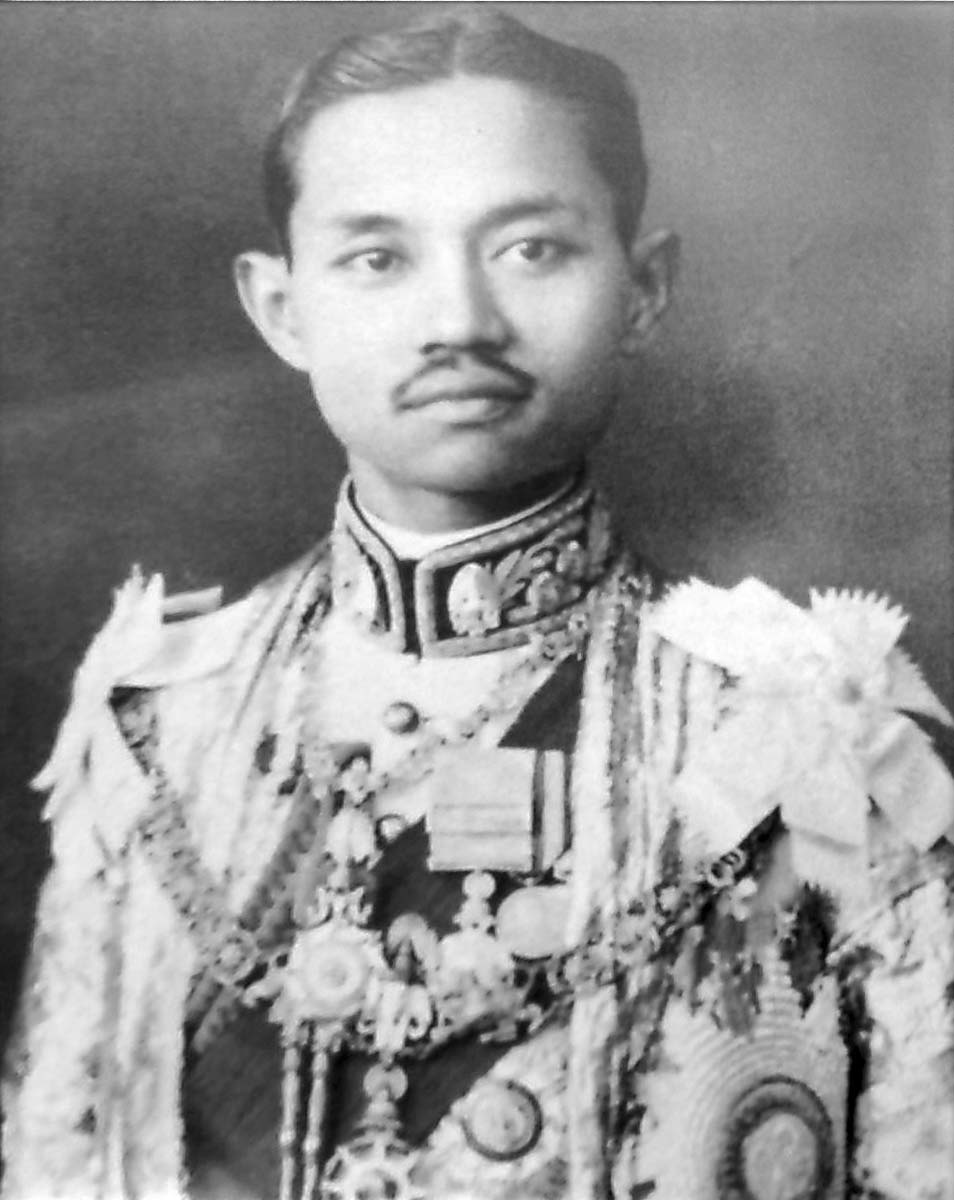
Prajadhipok[a] (8 November 1893 – 30 May 1941) was the seventh king of Siam from the Chakri dynasty, titled Rama VII. His reign was a turbulent time for Siam due to political and social changes during the 1932 Siamese revolution. He is to date the only Siamese monarch of the Chakri dynasty to abdicate.
Key Information
Early life
[edit]
Somdet Chaofa Prajadhipok Sakdidej (Thai: สมเด็จเจ้าฟ้าประชาธิปกศักดิเดชน์) was born on 8 November 1893 in Bangkok, Siam (now Thailand) to King Chulalongkorn and Queen Saovabha Phongsri. Prince Prajadhipok was the youngest of nine children born to the couple. Overall he was the king's second-youngest child (of a total of 77), and the 33rd and youngest of Chulalongkorn's sons.[1]
Unlikely to succeed to the throne, Prince Prajadhipok chose to pursue a military career. Like many of the king's children, he was sent abroad to study, going to Eton College in 1906, then to the Woolwich Military Academy from which he graduated in 1913. He received a commission in the Royal Horse Artillery in the British Army based in Aldershot. In 1910 Chulalongkorn died and was succeeded by Prajadhipok's older brother (also a son of Queen Saovabha), Crown Prince Vajiravudh, who became King Rama VI. Prince Prajadhipok was by then commissioned in both the British Army and the Royal Siamese Army. With the outbreak of the First World War and the declaration of Siamese neutrality, King Vajiravudh ordered his younger brother to resign his British commission and return to Siam immediately, a great embarrassment to the prince, who wanted to serve with his men on the Western front. Once home, Prajadhipok became a high-ranking military official in Siam. In 1917 he was ordained temporarily as a monk,[2]: 30 as was customary for most Buddhist Siamese men.
In 26 August 1918 Prince Prajadhipok married his childhood friend and cousin Rambai Barni, a descendant of King Mongkut (Prajadhipok's grandfather) and his Royal Consort Piam. They were married at Sukhothai Palace which was a wedding gift to the couple from Queen Saovabha.[1]
After the war in Europe ended, he attended the École Superieure de Guerre in France, returning to Siam to the Siamese military. During this time, he was granted the additional title Krom Luang Sukhothai (Prince of Sukhothai). Prajadhipok lived a generally quiet life with his wife at their residence, Sukhothai Palace, next to the Chao Phraya River. The couple had no children. Prajadhipok soon found himself rising rapidly in succession to the throne, as his brothers all died within a relatively short period. In 1925, King Vajiravudh himself died at the age of 44. Prajadhipok became absolute monarch at only thirty-two. He was crowned King of Siam on 25 February 1926.
Last absolute monarch
[edit]

Relatively unprepared for his new responsibilities, Prajadhipok was nevertheless intelligent, diplomatic in his dealings with others, modest, and eager to learn.[3]: 235 However, he had inherited serious political and economic problems from his predecessor.[2]: 30 The budget was heavily in deficit, and the royal financial accounts were in serious disorder. The entire world was in the throes of the Great Depression.
In an institutional innovation intended to restore confidence in the monarchy and government, Prajadhipok, in what was virtually his first act as king, announced the creation of the Supreme Council of the State of Siam. This council was made up of five experienced members of the royal family, although to emphasise the break with the previous reign the selected five had all fallen out of favour with the previous monarch.[2]: 31 The council thus comprised three of the king's uncles, Prince Bhanurangsi, Prince Naris and Prince Damrong Rajanubhab and two of his half-brothers, Prince Kitiyakon (Prince Chantaburi) and Prince Boriphat.[4]: 253
Many of the Princes of the Supreme Council felt that it was their duty to make amends for the mistakes of the previous reign, but their acts were not generally appreciated, for the government failed to communicate to the public the purpose of the policies they pursued to rectify Vajiravudh's extreme financial extravagances.[5] Gradually these princes arrogated power to themselves, monopolising all the main ministerial positions and appointing their sons and brothers to both administrative and military posts. By April 1926 almost the entire cabinet of ministry heads had been replaced with newly appointed Princes or nobles, with only three former members being re-appointed.[4]: 254 While the family appointments brought back men of talent and experience, they also signalled a return to royal oligarchy.
The king clearly wished to demonstrate a clear break with the discredited sixth reign, and his choice of men to fill the top positions appeared to be guided largely by a wish to restore a Chulalongkorn-type government.[4] Unlike his predecessor, the king read virtually all state papers that came his way, from ministerial submissions to petitions by citizens.[4]: 255 The king was painstaking and conscientious; he would elicit comments and suggestions from a range of experts and study them, noting the good points in each submission, but when various options were available he would seldom be able to select the best one and abandon others. He would often rely upon the Supreme Council to prod him in a particular direction.[4]: 254

From the beginning of his reign King Prajadhipok was acutely aware that political change was necessary if the monarchy was to be preserved.[2]: 130 He viewed his newly established Supreme Council as an institutional check upon the powers of an absolute monarch.[2]: 130 During 1926, Prajadhipok experimented with using the Privy Council, which had over 200 members at that time, as a quasi-legislative body.[2]: 134 This large of an assembly proved too cumbersome, and in 1927 Prajadhipok created the Committee of the Privy Council consisting of 40 members selected from the royal family or nobility.[2]: 135 The committee was received positively by the press and was envisaged as a forerunner of a parliament or National Assembly.[2]: 137–139 In practice however the committee remained relatively unimportant and did not develop into a more powerful or representative body.[2]: 137
In 1926 Prajadhipok wrote a lengthy memorandum to his American adviser Francis B. Sayre titled "Problems of Siam" in which he set forth nine questions he felt were the most serious facing the nation. The third question asked whether Siam should have a parliamentary system, which Prajadhipok doubted. The fourth question asked whether Siam was ready for representative government, to which Prajadhipok answered "my personal opinion is an emphatic NO".[2]: 38 However, the king did see a possibility to introduce reform at the local level as the "next step in our educational move towards democracy".[2]: 140 In 1926 he began moves to develop the concept of prachaphiban, or "municipality", which had emerged late in the fifth reign as a law regarding public health and sanitation.[6] Information was obtained regarding local self-government in surrounding countries, and proposals to allow certain municipalities to raise local taxes and manage their own budgets were drawn up. The fact that the public was not sufficiently educated to make the scheme work militated against the success of this administrative venture. Nevertheless, the idea of teaching the Siamese the concept of democracy through a measure of decentralisation of power in municipalities had become, in Prajadhipok's mind, fundamental to future policy-making.[2] However, Yasukichi Yatabe, Japanese minister to Siam, criticized the king's way and that it would not be accomplished in a hundred years' time.[7]

In September 1931 Britain abandoned the gold standard and devalued sterling by 30 percent.[4]: 259 This created a crisis for Siam since most of its foreign exchange was held in sterling.[2]: 195 The Minister of Finance kept Siam on the gold standard by linking the currency to the US dollar, but debate about this policy raged within the government into 1932.[2]: 195–196 One impact of this policy was that Siam's rice exports became more expensive than competitor exporters, negatively impacting revenue.[3]: 240
In mid-October 1931 the king returned from a trip to Canada and the US and ordered Prince Devawongse Varoprakar, the Minister of Foreign Affairs to prepare a constitution. The task of drafting this document was given to the American Raymond B. Stevens and Phaya Sri Wisarn Waja.[2]: 148 In March the following year they submitted an "Outline of Changes in the Form of Government" together with their comments.[2]: 149 Prajadhipok originally planned to announce the new constitution to the nation of 6 April at the opening of the Memorial Bridge to commemorate the 150th anniversary of the Chakri dynasty.[2]: 150 These proposals met strong opposition from Prince Damrong and other royal members of the Supreme Council and despite his own misgivings that to not proceed would result in a coup against his government, the king ultimately did not make the planned announcement.
On 20 January 1932, with the country deep in depression, the king convened a "round table" meeting to discuss the many competing arguments and to agree on how to tackle the crisis.[2]: 204 From this meeting it was agreed to make large cuts in government spending and implement a retrenchment programme. Two weeks later on 5 February the king addressed a group of military officers and spoke at length about the economic situation. In this speech he remarked "I myself know nothing at all about managing finances, and all I can do is listen to the opinions of others and choose the best...If I have made a mistake, I believe I really deserve to be excused by the people of Siam".[2]: 204 No previous monarch had ever spoken so honestly.[2]: 205 The speech was widely reported and many interpreted his words not as a frank appeal for understanding and cooperation, but as a sign of weakness and proof that the system of rule of fallible autocrats should be abolished.[8]
Revolution of 1932
[edit]This section cites its sources but does not provide page references. (March 2016) |

A small group of soldiers and civil servants began secretly plotting to overthrow absolute monarchy and bring a constitutional government to the kingdom. Their efforts culminated in an almost bloodless "revolution" on the morning of 24 June 1932 by the self-proclaimed Khana Ratsadon (People's Party; คณะราษฎร).[4]: 262 While Prajadhipok was away at Klai Kangwon Palace in Hua Hin, the plotters took control of the Ananda Samakhom Throne Hall in Bangkok and arrested key officials (mainly princes and relatives of the king).[4]: 262 The People's Party demanded Prajadhipok become a constitutional monarch and grant Thai people a constitution. In the event of a negative response, they reserved the right to declare Siam a republic. The king immediately accepted the People's Party's request and the first "permanent" constitution of Siam was promulgated on 10 December.[4]: 263
Prajadhipok returned to Bangkok on 26 June and received the coup plotters in a royal audience. As they entered the room, Prajadhipok greeted them, saying "I rise in honour of the Khana Ratsadon."[9][10] It was a significant gesture because, according to previous royal rituals, monarchs were to remain seated while their subjects made obeisance, this showed that Prajadhipok was acknowledging the changed circumstances.[5]
First constitutional monarch
[edit]
| Monarchs of the Chakri dynasty | |
|---|---|
| Phutthayotfa Chulalok (Rama I) | |
| Phutthaloetla Naphalai (Rama II) | |
| Nangklao (Rama III) | |
| Mongkut (Rama IV) | |
| Chulalongkorn (Rama V) | |
| Vajiravudh (Rama VI) | |
| Prajadhipok (Rama VII) | |
| Ananda Mahidol (Rama VIII) | |
| Bhumibol Adulyadej (Rama IX) | |
| Vajiralongkorn (Rama X) | |
In the early stages of the constitutional monarchy, the King and the royalists seemed to be able to compromise with Khana Ratsadon. The constitutional bill which was drafted by Pridi Banomyong and intended to be a permanent one was made temporary. The new constitution restored some of the monarch's lost power and status. Among them were introduction of unelected half of the House of Representatives and royal veto power. The country's first prime minister Phraya Manopakorn Nitithada was a conservative and royalist nobleman.
The compromise broke down quickly. He did not contest when his interpretation of Pridi's economic plan, which also aim on land reform and seizure of royal land, was released with his signature. The king played a role in the coup d'état of April 1933, where the House was ordered to close by the prime minister. He signed an order to execute Khana Ratsadon leaders. But Khana Ratsadon's military wing leader Phraya Phahonphonphayuhasena ousted the government and restored its power.
He played an active role in an anti-revolutionary network, which also aimed to assassinate Khana Ratsadon's leaders.[12]: 27
In October 1933, the maverick Prince Boworadej, a former minister of defence, led an armed revolt against the government. In the Boworadet Rebellion, he mobilised several provincial garrisons and marched on Bangkok, occupying the Don Muang aerodrome. Prince Boworadej accused the government of being disrespectful to the monarch and of promoting communism, and demanded that government leaders resign. However, the rebellion ultimately failed.
The king did not directly support the rebellion, but there was a cheque from the treasury to Boworadej.[12]: 11 The insurrection diminished the king's prestige. When the revolt began, Prajadhipok immediately informed the government that he regretted the strife and civil disturbances. The royal couple then took refuge at Songkhla, in the far south. The king's withdrawal from the scene was interpreted by the Khana Ratsadorn as a failure to do his duty. By not throwing his full support behind government forces, he had undermined their trust in him.[2]
In 1934 the Assembly voted to amend civil and military penal codes. The king vetoed the changes to the separation between personal and royal assets as he did not want to pay tax, and protested an amendment to diminish the king's consideration of death sentence over the courts.[12]: 34–5 After many losses to Khana Ratsadon, the king seemed to change his stance and expressed support for democracy and blamed Khana Ratsadon for being anti-democratic.[12]: 35–6 However, Phibul later discussed in the House that unelected parliamentary members were the king's wish,[12]: 17–8 and another House member criticized the king for being unbearable.[12]: 36
Prajadhipok, whose relations with the Khana Ratsadon had been deteriorating for some time, went on a tour of Europe before visiting England for medical treatment. He continued to correspond with the government regarding the conditions under which he would continue to serve. He tried to retain some of the royal powers, such as power to veto law with no possible override. Other disagreements were on royal assets and royal benefits. After the government did not comply, on 14 October Prajadhipok announced his intention to abdicate unless his requests were met.
Trip to Europe
[edit]-
King Prajadhipok and Adolf Hitler at Berlin Tempelhof Airport in Nazi Germany, 1934
-
King Prajadhipok and Queen Rambai Barni with Konstantin von Neurath in Nazi Germany, 1934
-
King Prajadhipok and Queen Rambai Barni with British Premier Ramsay MacDonald at Number 10 Downing Street, 1934
-
King Rama VII and Queen Rambai Barni after an audience with Pope Pius XI at Vatican City, 1934
Abdication
[edit]
The People's Party rejected the ultimatum, and on 2 March 1935, Prajadhipok abdicated, to be replaced by Ananda Mahidol. Prajadhipok issued a brief statement criticising the regime that included the following phrases, since often quoted by critics of Thailand's slow political development.
I am willing to surrender the powers I formerly exercised to the people as a whole, but I am not willing to turn them over to any individual or any group to use in an autocratic manner without heeding the voice of the people.
According to Dutch-Australian anthropologist and historian Barend Jan Terwiel, the former king had good grounds for complaint.[4]
Reaction to the abdication was muted. Stowe wrote that the absolutism of the monarchy had been replaced by that of the People's Party, with the military looming in the wings as the ultimate arbiter of power.[5]
Life after abdication and death
[edit]
Prajadhipok spent the rest of his life with Queen Rambhai Barni in England. At the time of abdication, the couple lived at Knowle House, in Surrey, just outside London. However, this house was not suitable considering his health, so they moved to a smaller house in Virginia Water (still in Surrey), but with more space. The house was named "Hangmoor", but wishing to give it a more pleasant name, he called it "Glen Pammant", an anagram of an old Thai phrase tam pleng nam.[citation needed] They remained there for two years. They moved again to Vane Court, the oldest house in the village of Biddenden in Kent.[13] He led a peaceful life there, gardening in the morning and writing his autobiography in the afternoon.
In 1938 the royal couple moved to Compton House, in the village of Wentworth in Virginia Water, Surrey.
Due to bombing by the German Luftwaffe in 1940, the couple again moved, first to a small house in Devon, and then to Lake Vyrnwy Hotel in Powys, Wales, where the former king had a heart attack.
The couple returned to Compton House, as he expressed his preference to die there. King Prajadhipok died from heart failure on 30 May 1941.
His cremation was held at the Golders Green Crematorium in north London.[14] It was a simple affair attended by just Queen Ramphai and a handful of close relatives. Queen Ramphaiphanni stayed at Compton House for a further eight years before she returned to Thailand in 1949, bringing the king's ashes back with her.[15]
Legacy
[edit]Historian David K. Wyatt writes that Prajadhipok was "a hard-working, effective executor" who was "intellectually equal to the demands of his office", and whose main failing was to underestimate the Bangkok elite's growing nationalism, and that "[a]s late as his death in exile, many would have agreed with his judgement that a move towards democracy in 1932 was premature."[3]: 242 The idea that the 1932 revolution was premature is echoed in a common royalist sentiment that proliferated as the Thai monarchy regained status over ensuing decades. In this view, Prajadhipok is credited as the "father of Thai democracy",[16] who already intended to usher in democracy before the Khana Ratsadon prematurely carried out their revolution. Prajadhipok's abdication statement is often cited in support of this view.[17][18] Later historians have challenged it as a myth, citing evidence that Prajadhipok's political maneuvers leading up to his abdication had more to do with preserving the power and status of the declining monarchy than challenging the Khana Ratsadon's actual failures to uphold democratic ideals.[16][19]
Tributes to Prajadhipok
[edit]Styles of
| |
|---|---|
| Reference style | His Majesty |
| Spoken style | Your Majesty |
-
A Statue of the king in Sukhothai Thammathirat Open University, Nonthaburi
-
King Rama VII statue at Parliament House of Thailand
Infrastructure
[edit]- Sukhothai Thammathirat University
- Phra Pok Klao Bridge, Bangkok
- Prajadhipok Road, Bangkok
- Prapokklao Hospital, Chanthaburi Province
Military ranks
[edit]National honours
[edit]
The Most Illustrious Order of the Royal House of Chakri
The Ancient and Auspicious Order of the Nine Gems
Knight Grand Cordon of the Order of Chula Chom Klao
Ratana Varabhorn Order of Merit
Knight Grand Commander of the Order of Rama
Knight Grand Cordon of the Order of the White Elephant
Knight Grand Cordon of the Order of the Crown of Thailand
Dushdi Mala Pin of Service to the Nation (Civilian)
Chakra Mala Medal
King Rama V Royal Cypher Medal, First Class
King Rama VI Royal Cypher Medal, First Class
King Rama VII Royal Cypher Medal, First Class
Rajini Medal
Foreign honours
[edit]
Japan :
Grand Cordon of the Order of the Chrysanthemum
Denmark :
Knight of the Order of the Elephant, 8 February 1926[20]
Netherlands :
Knight Grand Cross of the Order of the Netherlands Lion
UK :
Knight Grand Cross of the Order of the Bath (GCB)
Belgium :
Grand Cordon of the Order of Leopold, 1926[21]
France :
Grand Cross of the Legion of Honour
Kingdom of Italy :
Knight of the Supreme Order of the Most Holy Annunciation
Sweden :
Knight of the Order of the Seraphim
Monaco :
Grand Cross of the Order of Saint-Charles, 1 March 1934[22]
Hungary :
Grand Cross of the Hungarian Order of Merit
Czechoslovakia :
Order of the White Lion, First Class
Honorary degrees
[edit]- 1931: Doctor of Laws, George Washington University[23]
Ancestry
[edit]| Ancestors of Prajadhipok | |||||||||||||||||||||||||||||||||||||||||||||||||||||||||||||||||||||||||||||||||||||||||||||||||||||||||||||||||||||||||||||||||||||||||||||||||||||||||||||||||||||||||||||||||||||||||||||||||||||||||||||||||||||||||||||||||||||||||||||||||||||||||||||||||||||||||||||||||||||||||
|---|---|---|---|---|---|---|---|---|---|---|---|---|---|---|---|---|---|---|---|---|---|---|---|---|---|---|---|---|---|---|---|---|---|---|---|---|---|---|---|---|---|---|---|---|---|---|---|---|---|---|---|---|---|---|---|---|---|---|---|---|---|---|---|---|---|---|---|---|---|---|---|---|---|---|---|---|---|---|---|---|---|---|---|---|---|---|---|---|---|---|---|---|---|---|---|---|---|---|---|---|---|---|---|---|---|---|---|---|---|---|---|---|---|---|---|---|---|---|---|---|---|---|---|---|---|---|---|---|---|---|---|---|---|---|---|---|---|---|---|---|---|---|---|---|---|---|---|---|---|---|---|---|---|---|---|---|---|---|---|---|---|---|---|---|---|---|---|---|---|---|---|---|---|---|---|---|---|---|---|---|---|---|---|---|---|---|---|---|---|---|---|---|---|---|---|---|---|---|---|---|---|---|---|---|---|---|---|---|---|---|---|---|---|---|---|---|---|---|---|---|---|---|---|---|---|---|---|---|---|---|---|---|---|---|---|---|---|---|---|---|---|---|---|---|---|---|---|---|---|---|---|---|---|---|---|---|---|---|---|---|---|---|---|---|---|---|---|---|---|---|---|---|---|---|---|---|---|---|---|---|---|
| |||||||||||||||||||||||||||||||||||||||||||||||||||||||||||||||||||||||||||||||||||||||||||||||||||||||||||||||||||||||||||||||||||||||||||||||||||||||||||||||||||||||||||||||||||||||||||||||||||||||||||||||||||||||||||||||||||||||||||||||||||||||||||||||||||||||||||||||||||||||||
See also
[edit]Notes
[edit]References
[edit]- ^ a b Bhorombhakdi, Soravij. "HM King Prajadhipok". The Siamese Royalty A Personal Fascination. Retrieved 20 October 2018.
- ^ a b c d e f g h i j k l m n o p q r s t u Batson, Benjamin. (1984) The End of the Absolute Monarchy in Siam. Oxford University Press.
- ^ a b c Wyatt, David K. (1982) Thailand: A Short History. New Haven.
- ^ a b c d e f g h i j Terwiel, B.J. (2005) Thailand's Political History: From the Fall of Ayutthaya to Recent Times. River Books.
- ^ a b c Stowe, Judith A. (1990) Siam Becomes Thailand. Hurst & Company.
- ^ Sonthi Techanan (1976) Plans for Democratic Development in the Seventh Reign. Kasetsart University.
- ^ "ชิงสุกก่อนห่าม" วาทกรรมซัดกลับคณะราษฎร ในแบบเรียนประวัติศาสตร์ไทย
- ^ Vella, Walter (1955) The Impact of the West on Government in Thailand. University of California Press.
- ^ Thawatt Mokarapong. (1972) History of the Thai Revolution. Chalermnit.
- ^ Pridi Phanomyong (1974) Ma vie mouvementée. Paris.
- ^ Jumbala, Prudhisan (22 February 2014). "King Prajadhipok and democracy in Siam". Bangkok Post. Archived from the original on 16 February 2025. Retrieved 16 February 2025.
- ^ a b c d e f ใจจริง, ณัฐพล (2013). ขอฝันใฝ่ในฝันอันเหลือเชื่อ: ความเคลื่อนไหวของขบวนการปฏิปักษ์ปฏิวัติสยาม (พ.ศ. 2475-2500) (in Thai) (1 ed.). ฟ้าเดียวกัน. ISBN 9786167667188.
- ^ Lawrie, Sam (August 2023). "£5.5m country estate and former home of King of Siam for sale in Biddenden, near Ashford". Kent Online. Retrieved 2 August 2023.
- ^ "อัญเชิญพระบรมอัฐิร.7 จากลอนดอนกลับสยาม แรกบรรจุใน "หีบ" ก่อนใช้พระโกศให้สมพระเกียรติ". 31 May 2021.
- ^ "พระมหากษัตริย์ผู้ไม่มีงานออกพระเมรุ พระบาทสมเด็จพระปกเกล้าเจ้าอยู่หัว (ร.7)". 30 October 2017.
- ^ a b Ferrara, Federico (2012). "The legend of King Prajadhipok: Tall tales and stubborn facts on the seventh reign in Siam". Journal of Southeast Asian Studies. 43 (1): 4–31. doi:10.1017/S0022463411000646. ISSN 0022-4634. S2CID 153723441.
- ^ Baker, Chris; Phongpaichit, Pasuk (2005). A History of Thailand. New York: Cambridge University Press. p. 232.
- ^ อิ๋วสกุล, ธนาพล (25 June 2018). "The Third Emergence of the People's Party". The 101 World. Retrieved 30 August 2022.
- ^ ก้องกีรติ, ประจักษ์ (2013). และแล้วความเคลื่อนไหวก็ปรากฏ (in Thai). ฟ้าเดียวกัน. pp. 415–421. ISBN 978-616-7667-25-6.
- ^ Jørgen Pedersen (2009). Riddere af Elefantordenen, 1559–2009 (in Danish). Syddansk Universitetsforlag. p. 470. ISBN 978-87-7674-434-2.
- ^ Mémorial du centenaire de l'Ordre de Léopold. 1832–1932. Bruxelles, J. Rozez, 1933.
- ^ "Journal de Monaco" (PDF). 1 March 1934. Archived from the original (PDF) on 20 March 2022.
- ^ "Honorary Degree Recipients". George Washington University. Retrieved 23 November 2024.
External links
[edit]- King Prajadhipok's Institute
- Prajadhipok's coronation at YouTube by the Thai Film Archive
- Newspaper clippings about Prajadhipok in the 20th Century Press Archives of the ZBW
Prajadhipok
View on GrokipediaEarly Life and Education
Birth and Ancestry
Prajadhipok, born Prince Prajadhipok Sakdidej, entered the world on 8 November 1893 in Bangkok as the youngest son of King Chulalongkorn (Rama V) and Queen Sri Patcharindra (also known as Saovabha Phongsri).[1] His father, the fifth monarch of the Chakri dynasty—which had ruled Siam since 1782 under absolute monarchical principles—sired numerous children through multiple queens and consorts, a practice emblematic of the polygamous royal household that prioritized lineage expansion and alliances within the elite.[1] This familial structure positioned Prajadhipok as a full younger brother to Vajiravudh, who would ascend as King Rama VI in 1910, and among dozens of half-siblings born to King Chulalongkorn's various unions, fostering an upbringing steeped in hierarchical court traditions and expectations of divine-right governance.[4] From infancy, he resided within the Grand Palace complex, the epicenter of Siamese royal life, where exposure to elaborate rituals, kowtow etiquette, and the absolutist ethos shaped his early worldview amid the opulent yet rigidly stratified environment.[5] Initial tutoring in his toddler years focused on foundational subjects including the Thai language, Pali for scriptural understanding, and elementary sciences, conducted by palace scholars to prepare princes for their roles in perpetuating dynastic continuity and cultural preservation.[4] This phase underscored the Chakri emphasis on intellectual formation within an unchallenged monarchical framework, unmarred by external democratic influences at the time.Military Training and Early Career
Prince Prajadhipok Sakdidej, anticipating no immediate claim to the throne, elected to follow a military vocation to prepare for potential leadership responsibilities. His training commenced abroad, with enrollment at Eton College in 1906 followed by the Royal Military Academy at Woolwich, where he specialized in artillery tactics and engineering.[1][3] Upon completion of his studies, he received a commission in the British Royal Horse Artillery stationed at Aldershot, gaining practical experience in modern field operations prior to World War I.[3] Returning to Siam in 1913 amid the outbreak of global conflict, Prajadhipok integrated into the Royal Siamese Army, leveraging his acquired expertise to bolster domestic forces. He advanced rapidly, attaining the rank of captain and assuming command of an artillery battery within the Royal Artillery Guard, emphasizing disciplined gunnery and unit cohesion.[4][3] Over the subsequent six years of service, he contributed to artillery enhancements, incorporating Western methodologies to counter encirclement by British and French colonial territories, which necessitated vigilant border defenses and strategic deterrence.[1] These early assignments cultivated Prajadhipok's emphasis on professionalization, as evidenced by his engagements with foreign advisors who aided Siam's military reforms against imperial pressures. By the early 1920s, he had ascended to major general, overseeing command roles that prioritized technical proficiency in artillery amid persistent geopolitical vulnerabilities.[3]Studies in Europe
Prajadhipok began his European education in England at Eton College in 1906, after completing preliminary schooling in Siam.[1][6] There, as a member of the Chakri house, he received a comprehensive secondary education emphasizing classical studies, languages, and physical discipline, which aligned with the preparatory training for future military and administrative roles.[6] Following Eton, he entered the Royal Military Academy at Woolwich around 1909, focusing on artillery, gunnery, and cavalry tactics.[1] He graduated in 1913 with honors, earning an honorary commission as a second lieutenant in the British Army's Royal Horse Artillery.[1][7] His extended residence in Britain exposed him to the mechanisms of constitutional monarchy and parliamentary procedures, fostering an understanding of limited governance and administrative efficiency that contrasted with Siam's absolute system.[8] These observations informed a preference for measured reforms, emphasizing adaptation to local customs over wholesale adoption of foreign models. He completed his studies and returned to Siam in the midst of the escalating World War I in Europe.[1]Ascension and Absolute Monarchy
Succession to the Throne
King Vajiravudh, reigning as Rama VI, died on 25 November 1925 at age 44 from complications of an illness, leaving no direct male heirs to the throne.[9][10] As the youngest surviving full brother of Rama VI and a son of King Chulalongkorn (Rama V), Prajadhipok—aged 32—was immediately proclaimed king, assuming the title Rama VII and absolute authority over Siam.[11] The 1924 Palace Law of Succession, promulgated by Rama VI, prioritized agnatic primogeniture but allowed for selection among brothers in the absence of sons; a cabinet council affirmed Prajadhipok's accession, citing his Western education at Eton and Woolwich, military service, administrative experience, and robust health as preferable to other royal candidates who lacked similar qualifications or faced personal limitations.[12] This choice ensured continuity while addressing concerns over potential instability from less prepared successors. Prajadhipok's initial royal duties focused on stabilizing the court amid inherited financial pressures, as Rama VI's reign had incurred significant debts through extravagant personal projects, military pageantry like the Wild Tiger Corps, and cultural initiatives that exceeded revenues.[13] He promptly initiated audits of palace expenditures and implemented interim austerity measures to curb deficits, prioritizing fiscal prudence before formal coronation proceedings.[13]Coronation and Initial Governance
Prajadhipok's coronation occurred on 25 February 1926, formalizing his role as the seventh king of the Chakri dynasty following his brother's death the previous year.[14] The multi-day ceremonies adhered to ancient Siamese traditions, beginning with a royal palanquin procession from the Grand Palace to the Baisal Daksin Throne Hall, where the king donned ceremonial robes and received anointing with sacred waters collected from revered rivers and shrines across the realm.[15] This investiture, the first Thai coronation filmed, underscored the continuity of royal absolutism amid evolving national challenges.[16] Upon assuming governance, Prajadhipok prioritized stabilizing the absolute monarchy by pledging adherence to the modernization foundations laid by his uncle, King Chulalongkorn (Rama V), whose reforms had centralized administration and integrated Western technologies without compromising sovereignty.[4] Facing inherited budget deficits worsened by global post-World War I economic strains, his initial measures emphasized fiscal restraint, including expenditure cuts to avert insolvency and restore budgetary equilibrium.[17] Administrative continuity was maintained through retention of seasoned bureaucrats from the prior reign, notably Chao Phraya Yommarat (Pan Sukhum), who served as Minister of the Interior and oversaw local governance, ensuring seamless implementation of royal directives. These steps reinforced the king's centralized authority while addressing immediate fiscal pressures, setting the stage for sustained absolute rule.[17]Administrative and Economic Reforms
Upon ascending the throne in 1925, Prajadhipok inherited a government facing severe financial strain from the post-World War I recession in rice prices, which had eroded Siam's primary export revenue.[17] To address persistent budget deficits, he implemented austerity measures, including cuts to government and court expenditures, which contributed to an anticipated surplus in the 1928/29 fiscal year.[18] These efforts reflected a commitment to fiscal prudence, with the king personally reviewing policy proposals to prioritize productive spending over unproductive outlays.[18] Administrative reforms under Prajadhipok included enhanced oversight of public finances, building on earlier centralization efforts, though specific audit committees emerged more prominently in response to later pressures.[19] In 1927, the Barrages Department was reorganized into the Royal Irrigation Department to systematize water management and boost agricultural output, continuing infrastructural legacies from his predecessor while adapting to domestic needs.[20] Railway development persisted with extensions to facilitate trade, though major lines had been initiated earlier; these projects aimed to integrate rural economies amid fluctuating global demand.[21] As the Great Depression intensified after 1929, impacting rice exports, Prajadhipok's government grappled with proposals for deeper expenditure reductions—up to 50 percent in some areas—and tax adjustments to maintain solvency, underscoring causal links between international shocks and domestic fiscal realism.[4] These measures sought to stabilize revenues without overreliance on foreign loans, reducing vulnerability to external debt cycles, though empirical growth data from the era remains sparse and indicates modest recovery prior to 1930.[17] The king's direct engagement in economic discourse, as evidenced in policy addresses, emphasized empirical adaptation over ideological rigidity.[18]Pre-Revolution Challenges
Modernization Efforts
In 1926, Prajadhipok decreed the establishment of an archaeological service tasked with surveying and protecting Siamese antiquities, reflecting a deliberate effort to catalog national artifacts and counteract the loss of cultural heritage to foreign collectors amid growing Western influence.[22] This initiative built on earlier precedents but emphasized systematic preservation to foster national pride, including the reorganization of museum collections based on stylistic classifications of Thai antiquities.[23] Concurrently, on 5 March 1926, he commanded the drafting of legislation to formalize the National Museum in Bangkok, merging departments for archaeology and museums under the Fine Arts Department to centralize the protection of ancient monuments, objects of art, and antiques.[24] These measures prohibited unlicensed exports from registered sites and aimed to integrate cultural stewardship into state institutions, preserving Siamese identity against external pressures.[25] Prajadhipok also advanced institutional frameworks for intellectual and scientific progress. The Royal Institute, founded in 1926, promoted research in fine arts, architecture, and performing arts, while the Royal Society of Thailand—established on 19 April 1926—facilitated studies in agricultural science, technology, veterinary medicine, and related fields to apply empirical methods suited to Siamese contexts.[4] These bodies encouraged domestic scholarship over wholesale adoption of foreign models, supporting advancements in medicine and agriculture through local experimentation rather than uncritical importation. Such efforts extended to educational infrastructure, including the expansion of technical training aligned with national needs, though constrained by fiscal realities.[26] Diplomatically, Prajadhipok's administration upheld Siamese sovereignty via pragmatic treaties and negotiations that revised extraterritorial privileges held by Western powers, averting colonial subjugation during a period when neighboring states fell under imperial control.[27] Key maneuvers included leveraging interwar shifts, such as Japan's 1924 renunciation of unequal treaties—which prompted Britain to follow suit—thus affirming Siam's independent status without territorial concessions.[28] These diplomatic successes preserved autonomy, allowing internal modernization to proceed on Siamese terms rather than as concessions to foreign demands.[29]Emerging Political Tensions
In the late 1920s, a cohort of Siamese civil servants and military officers, many of whom had received education in Europe and encountered democratic governance models firsthand, began articulating frustrations with the entrenched privileges of the royal family under absolute monarchy. These individuals, often from non-royal backgrounds, perceived systemic barriers to career progression, as key administrative and military posts were disproportionately allocated to princes regardless of competence, fostering resentment amid Siam's economic strains from declining rice exports and the onset of global depression effects by 1930.[30][31] This elite discontent crystallized in the secret formation of the Khana Ratsadon (People's Party) on February 5, 1927, comprising an initial core of about 17 members—predominantly junior army and navy officers, supplemented by civilians like the France-educated lawyer Pridi Banomyong—who plotted reforms without initial public mobilization.[18] King Prajadhipok, informed through palace intelligence networks and the advisory Supreme Council of State established in 1925, monitored these undercurrents but prioritized fiscal austerity over structural changes, viewing the agitators as a marginal faction rather than a widespread threat. Grievances centered on perceived inequities, such as princely stipends totaling millions of baht annually while bureaucratic salaries stagnated, yet empirical indicators of broader unrest remained scant: no documented mass petitions, strikes, or public demonstrations occurred between 1927 and 1931, with expressions of dissatisfaction confined to private elite circles or formal submissions to the powerless council.[32] Public veneration for the monarchy endured stably, rooted in cultural reverence and the absence of anti-royal propaganda, underscoring that tensions were elite-driven rather than reflective of popular discontent; historical records show no significant rural or urban upheavals, contrasting with contemporaneous revolutionary fervor elsewhere, and highlighting causal primacy of internal patronage imbalances over mass deprivation.[31][33]The King's Views on Constitutionalism
In the 1920s, during his time as heir presumptive, Prajadhipok expressed private interest in transitioning Siam toward a constitutional framework, influenced by his extended studies in Europe, particularly the British model of limited monarchy with parliamentary elements.[34] He drafted an outline constitution around 1926, envisioning a system where the king retained executive authority but incorporated advisory assemblies and a privy council to foster responsible governance without immediate power dilution.[34] This document emphasized the king's role in guiding reforms voluntarily, prioritizing elite education and societal preparation to avoid destabilizing abrupt changes that could fragment national unity.[4] Prajadhipok solicited opinions from trusted advisors, including Prince Damrong Rajanubhab, on the feasibility of advisory bodies modeled on British precedents, stressing that any shift must align with Siam's developmental stage to prevent factionalism or external interference.[4] Advisors concurred that constitutionalism was desirable and inevitable for long-term stability but cautioned against premature implementation, as the populace and bureaucracy lacked the requisite maturity for effective participation, potentially leading to ineffective or corrupt outcomes.[4] In a paper titled "Democracy in Siam" prepared for the Siam Society, he advocated gradual introduction of democratic elements under monarchical oversight, arguing that free elections could serve as a check on extremism only if grounded in educated consensus rather than imposed ideology.[35] Unlike his predecessor, King Vajiravudh (Rama VI), who staunchly defended absolute monarchy as essential for national cohesion against divisive party politics, Prajadhipok viewed the throne as a stabilizing force amenable to evolution, provided reforms preserved the crown's unifying authority amid rising modernization pressures.[36] He rejected radical overhauls that risked causal disruptions, such as elite infighting or economic upheaval, insisting instead on king-initiated changes to ensure continuity and legitimacy.[34] This perspective underscored his commitment to pragmatic adaptation over ideological absolutism, aiming to preempt unrest through controlled progression.[36]The 1932 Revolution
Underlying Causes
The Siamese economy, dependent on rice exports comprising over 80% of foreign trade by the late 1920s, was severely disrupted by the global Great Depression beginning in 1929. Rice prices plummeted from 123 baht per ton in 1929 to 50-60 baht between 1931 and 1934, triggering rural distress, urban unemployment estimated at 10-15% in Bangkok by 1932, and a contraction in government revenues by approximately 30%.[37] These pressures strained royal finances, with the privy purse facing deficits from reduced customs duties and land taxes, though the palace avoided outright bankruptcy through asset sales and borrowing.[32] Economic hardship amplified elite frustrations over aristocratic privileges, including tax exemptions for princes and inefficient patronage systems that hindered merit-based advancement.[37] Military reforms under Kings Vajiravudh and Prajadhipok expanded the officer corps to over 5,000 by 1932, emphasizing Western-style training and equipment imports, but fostered grievances among junior ranks over stagnant pay averaging 100-200 baht monthly—insufficient amid inflation and Depression-era cuts—and dominance by high-ranking royals who monopolized promotions.[38] Civilian bureaucrats and intellectuals, numbering in the hundreds and often educated in Europe, imbibed constitutional and republican concepts from French models, viewing absolute monarchy as an obstacle to efficient governance and national modernization. This cohort, concentrated in Bangkok ministries, resented systemic corruption and nepotism, where princely appointees controlled key posts despite limited competence.[32] Fundamentally, these preconditions enabled a narrowly orchestrated power shift by the Khana Ratsadon, a secretive group of about 100 military and civilian elites, prioritizing control consolidation over broad reform; public involvement remained negligible, with no mass mobilization or widespread unrest, distinguishing it from ideological revolutions elsewhere.[32] The plotters exploited economic malaise not as a catalyst for popular democracy but to supplant monarchical authority with their own oligarchic influence, reflecting intra-elite competition rather than societal upheaval.[37]Execution of the Coup
On the morning of 24 June 1932, the Khana Ratsadon, a group comprising military officers and civilian intellectuals led by Phraya Phahon Phonphayuhasena, initiated the coup by deploying approximately 120 armed personnel to occupy strategic sites in Bangkok, including the Front Palace Arsenal and the Navy Ministry's armory, with no shots fired and minimal resistance encountered.[39] [40] The operation, executed under the cover of routine military exercises, secured control over key weaponry and government buildings within hours, enabling the group to broadcast their "Manifesto of the People's Party" via radio, which proclaimed the end of absolute monarchy and demanded the establishment of a constitutional system.[39] An ultimatum was simultaneously delivered to King Prajadhipok at his residence in Hua Hin, requiring acceptance of the demands by midnight or facing a declaration of republican rule; the king, prioritizing the avoidance of civil bloodshed, responded affirmatively in a letter to the coup's military committee, stating his willingness to promulgate a constitution and instructing his officials not to resist.[39] This acquiescence, relayed by special train as the king returned to the capital, prevented escalation and allowed the Khana Ratsadon to consolidate power without direct confrontation.[39] In the coup's immediate aftermath, the revolutionaries arrested several high-ranking conservative ministers and royalist officials perceived as threats to the new order, thereby dismantling potential centers of monarchical resistance.[41] A provisional government was swiftly formed, consisting of a Committee of Public Safety with military and civilian subcommittees, which announced the release of political prisoners held under the previous regime and pledged forthcoming elections alongside a draft constitution, though implementation of the latter was postponed pending further negotiations.[40] [42]Contemporary and Historical Viewpoints
The People's Party, in their June 24, 1932, manifesto, justified the coup as a vital step to dismantle absolute monarchy, which they condemned for perpetuating inequality, corruption, and exclusion of commoners from governance, thereby enabling Siam's modernization through elected representation and equitable resource distribution.[43] Revolution promoters, including civilian intellectuals like Pridi Banomyong, framed the event as a progressive rupture from feudal stagnation, essential for aligning Siam with global democratic trends amid economic pressures from the Great Depression.[37] Royalist and skeptical perspectives counter that the coup constituted an opportunistic betrayal by military and bureaucratic elites who had risen within the monarchical system, preempting King Prajadhipok's own reform trajectory; documents reveal the king commissioned a draft constitution in early 1932, envisioning a transitional assembly with appointed and indirectly elected members to gradually introduce constitutional elements without abrupt upheaval.[14] These views highlight the absence of broad public unrest prior to the coup, attributing its success to coordinated elite action rather than mass demand, and note that post-revolution authority swiftly consolidated under military figures like Phibun Songkhram, whose regime imposed censorship, purges, and one-party dominance by the mid-1930s, contradicting democratic rhetoric.[34] Contemporary scholarship has interrogated foundational myths of the revolution as an inexorable path to stability, emphasizing instead how the 1932 compromise constitution embedded ambiguities—such as dual legislative houses with appointed upper elements—that facilitated recurring military interventions; Thailand has endured 12 successful coups since 1932, underscoring the event's role in inaugurating cycles of instability rather than causal efficacy for enduring constitutionalism.[44] Analyses from the 2010s, including historiographic reviews, debunk portrayals of pre-coup absolutism as irredeemably ossified by evidencing the monarchy's adaptive modernization under Prajadhipok, such as fiscal austerity and administrative streamlining, which the coup disrupted without superior alternatives.[45]Constitutional Era
Acceptance of the Constitution
Following the bloodless coup of 24 June 1932, King Prajadhipok returned to Bangkok on 26 June and issued a royal proclamation declaring the seizure of power by the People's Party to be lawful. In this proclamation, he agreed to promulgate a temporary constitution, marking his pragmatic acceptance of the transition to a limited constitutional monarchy to avert further instability and republican threats.[34][46] On 27 June 1932, Prajadhipok signed the Interim Constitution for National Administration of Siam Act (2475 BE), which established him as the supreme head of state while vesting legislative power in the newly created House of People's Representatives, known as the Assembly of the People. The assembly initially comprised 70 members appointed by the People's Committee, exercising authority on behalf of the people and requiring royal countersignature for acts to be valid. This framework curtailed absolute monarchical powers, introducing a system where the king's actions aligned with advisory bodies formed by the revolutionaries. The first session of the Assembly convened on 28 June 1932 at the Ananta Samakhom Throne Hall, where it promptly addressed key matters including an amnesty for the coup participants and approval of the national budget, signaling the operational start of the constitutional order. Prajadhipok's cooperation facilitated this smooth handover, as he pledged adherence to the new charter through his proclamation, prioritizing national continuity over resistance despite the abrupt end to absolute rule.[46]Policy Conflicts with Revolutionaries
In February 1933, Pridi Banomyong, a leading civilian member of the Khana Ratsadon (People's Party), introduced an economic plan proposing state ownership of land, capital, and natural resources, along with extensive land reforms and workers' cooperatives. King Prajadhipok opposed the plan, arguing its socialist framework was economically unviable and risked capital flight by alarming foreign investors and domestic elites amid Siam's fragile modernization efforts.[47] The king's fiscal realism clashed with Pridi's ideological push for rapid wealth redistribution, prompting Prime Minister Phraya Manopakorn Nititada to adjourn the National Assembly indefinitely and fueling tensions between civilian progressives and conservative-leaning military factions within the revolutionary government.[47] These divisions escalated into the April 1933 coup, where military leaders, aligned with the king's reservations, ousted Pridi's supporters and temporarily exiled him, installing Phraya Phahon Phonphayuhasena as prime minister. Prajadhipok's tacit endorsement of the coup highlighted his prioritization of pragmatic governance over revolutionary radicalism, though it did not resolve underlying ideological rifts.[34] The episode exposed fractures in the Khana Ratsadon, as military dominance curtailed civilian economic experiments, yet it unified revolutionaries against perceived monarchical interference. Further conflict arose with the Boworadet Rebellion in October 1933, when royalist Prince Boworadet, former defense minister under Prajadhipok, led an armed uprising from provincial garrisons to challenge the constitutional regime and restore greater royal authority.[48] Drawing on conservative and royalist sympathizers dissatisfied with revolutionary policies, the rebels advanced toward Bangkok but were decisively defeated by government forces under Phibun Songkhram after several days of fighting, with over 100 casualties reported.[48] While Prajadhipok publicly denied involvement, the rebellion's timing—post-Pridi plan fallout—underscored ongoing royalist grievances against the regime's erosion of monarchical prerogatives, revealing revolutionary infighting only in the sense that suppression bolstered military control over civilian elements.[48] Attempts at compromise persisted, including Prajadhipok's approval of Siam's first permanent constitution in December 1932, which aimed to balance legislative powers with royal oversight through the Supreme Council of State.[34] However, these efforts were undermined by the Khana Ratsadon's military wing, which consolidated power post-rebellion, sidelining the king's fiscal and constitutional cautions in favor of authoritarian stabilization.[34] The ideological chasm—rooted in the king's emphasis on empirical economic prudence versus revolutionaries' transformative ambitions—prevented lasting reconciliation, as military dominance rendered monarchical vetoes increasingly symbolic.[47]European Trip and Health Issues
King Prajadhipok departed Siam on 12 January 1934 aboard the royal yacht Maha Chakkri, accompanied by Queen Rambai Barni, for an extended trip to Europe ostensibly to seek medical treatment amid growing personal health concerns and political strains at home.[49] The journey was planned following consultations with astrologers for an auspicious departure date, reflecting traditional Siamese practices.[50] Initial stops included medical consultations in Switzerland, followed by treatment in England, where specialists addressed his deteriorating health, later attributed to cardiac issues that would contribute to his eventual death. No, can't cite wiki. From results, medical treatment general, but [web:39] medical, and known heart from death reports. Adjust: consultations for health treatment in Switzerland and England.[51] During the tour, which spanned from early 1934 through much of the year, Prajadhipok engaged in informal diplomatic engagements, visiting nations including Germany (meeting Adolf Hitler at Tempelhof Airport), the United Kingdom (audience with Prime Minister Ramsay MacDonald), the Vatican (with Pope Pius XI), Denmark, Czechoslovakia, Portugal, and Ireland.[51][52][53] These interactions highlighted Siam's international standing post-1932 revolution, though they were conducted amid the king's personal reflections on constitutional developments back home. From his base in England, Prajadhipok corresponded with Siamese officials, commenting on domestic political events and advocating measured responses to ongoing tensions, such as those following the 1933 Boworadej rebellion, in efforts to preserve stability. The combination of persistent health ailments and worsening relations with the revolutionary government led to the prolongation of his stay abroad, with no return to Siam materializing.[34]Abdication and Later Life
Decision to Abdicate
Prajadhipok issued his abdication letter on 2 March 1935 from Cranleigh, Surrey, England, formally renouncing the throne effective immediately due to irreconcilable conflicts over the interpretation and application of the 1932 constitution.[54] In the document, signed the following day but dated to the announcement, he stated that since granting the constitution, the revolutionary promoters had concentrated legislative and executive powers in their hands—such as appointing half the National Assembly members—while rejecting democratic consultations and enacting autocratic laws, including secret trials for political offenses, all administered in his name without his effective input.[54] He emphasized his unwillingness to endorse such rule, having surrendered absolute powers to the people as a whole rather than to a self-perpetuating faction exercising unchecked authority.[4] The decision stemmed from prolonged disputes with the People's Party government, particularly their erosion of monarchical prerogatives and unchecked military influence, which Prajadhipok viewed as deviations from constitutional intent toward oligarchic control rather than representative governance.[14] Negotiations in late 1934 and early 1935, including his demands for adherence to the charter's provisions on royal veto and advisory roles, were rebuffed, culminating in an October 1934 announcement of intent to abdicate after the regime ignored reforms to restore balanced powers.[55] These tensions had escalated post-1933 Boworadet rebellion, where suspicions of royal sympathies led to purges and further centralization under military figures like Phibun Songkhram, rendering compromise untenable.[27] By abdicating, Prajadhipok sought to avert potential dynasty-ending violence, designating his nine-year-old nephew Ananda Mahidol—studying in Switzerland—as successor to maintain Chakri continuity under regency, while reverting to his pre-accession title of Prince of Sukhothai. As he left no heirs, the cabinet and parliament invited Ananda Mahidol to ascend the throne, beginning the Mahidol branch of the royal family.[4] The letter underscored his efforts since 1932 to facilitate a peaceful transition to constitutionalism, but faulted the regime's failure to heed public voice or prevent civil strife, positioning the act as a principled withdrawal to preserve institutional stability amid autocratic drift.[54][14]Exile in England
Following his abdication on 2 March 1935, Prajadhipok and Queen Rambai Barni settled in England without returning to Siam, relocating to Cranleigh in Surrey, where they resided initially at Knowle Park House, seeking a quiet private life away from political entanglements.[56][57] In 1937, the couple moved to Vane Court, a Grade II-listed estate in Biddenden, Kent, which served as their primary home during the remainder of his exile.[58][59] This shift to rural English estates reflected their preference for seclusion, with Prajadhipok maintaining a low profile and focusing on personal pursuits rather than public appearances or involvement in Siamese affairs.[55] Prajadhipok sustained financial independence through his personal assets, including investments and properties accumulated prior to abdication, which allowed the couple to live without reliance on the Siamese government or external support.[60] These resources, estimated to cover living expenses in England, stemmed from royal privy purse allocations and private holdings that he had preserved amid earlier fiscal reforms under his reign.[27] He deliberately avoided entanglement in counter-revolutionary schemes among Siamese exiles, rejecting overtures from royalist factions seeking his endorsement for armed uprisings against the post-1932 regime, as such actions risked escalating violence without viable prospects for restoration.[34] His daily activities centered on intellectual and recreational hobbies developed during his earlier education in England and France, including avid photography and cinematography, for which he owned personal equipment and documented private moments.[4] Prajadhipok also engaged in model-making, particularly constructing intricate ship models, as a meditative pastime that echoed his pre-reign interests in technical precision and engineering.[33] Contacts with other Siamese exiles remained limited and cautious, confined to occasional discreet meetings rather than organized networks, underscoring his detachment from factional intrigues.[61] Through sporadic correspondence with figures in Siam, Prajadhipok offered measured critiques of constitutional developments, urging restraint and gradual reform to foster genuine democratic maturation rather than hasty emulation of Western models ill-suited to local conditions.[61][34] He emphasized caution against radical shifts that could destabilize institutions, drawing from his observations of Siamese politics, while expressing hope for a balanced evolution under the new monarchy.[18] This epistolary engagement, conducted privately, highlighted his ongoing analytical interest without endorsing active opposition.[34]Death and Immediate Aftermath
Prajadhipok died of heart failure on 30 May 1941 at his residence, Compton House, in Virginia Water, Surrey, England, at the age of 47.[62][55] His health had deteriorated during exile, exacerbated by prior conditions including kidney issues and a heart attack earlier that year.[55] A simple family cremation took place on 3 June 1941 at Golders Green Crematorium in north London, forgoing elaborate Thai royal rites due to wartime conditions and his status as a private citizen abroad.[2] Queen Rambai Barni retained custody of the ashes initially, repatriating them to Thailand in 1949 aboard a royal barge procession in Bangkok.[55] The Thai government under Prime Minister Plaek Phibunsongkhram, aligned with Japan amid escalating World War II tensions, issued a muted official response, noting the event with minimal public fanfare. This reflected the regime's prioritization of military consolidation and foreign policy maneuvers, including Thailand's impending declaration of war on the Allies in December 1941, over royalist symbolism; the death effectively neutralized Prajadhipok as a lingering figurehead for opposition factions without provoking unrest. King Ananda Mahidol's regency, established since Prajadhipok's 1935 abdication, faced no immediate structural disruption, as the young monarch remained in Europe under regency council oversight tightly constrained by revolutionary-era constitutional limits that curtailed royal prerogatives.[27] Initial post-death narratives in government-controlled media and historical accounts, influenced by the 1932 revolutionaries, emphasized institutional transitions over personal or monarchical continuity, framing the event as a footnote to the constitutional order rather than a national loss.Legacy
Long-Term Achievements
Prajadhipok implemented austerity measures upon ascending the throne in 1925, reducing the royal civil list and government expenditures to address inherited fiscal deficits exacerbated by his predecessor's extravagance and the onset of global economic pressures.[19] These efforts, including budget balancing and debt management, stabilized Siam's finances temporarily, averting immediate insolvency amid the Great Depression and enabling continuity of state functions until the 1932 revolution.[63] His restrained approach to absolutism, emphasizing gradual reform over confrontation, set a precedent for subsequent Thai monarchs, who adopted a similar non-partisan posture that contributed to the monarchy's survival and role as a stabilizing institution in post-1932 constitutional politics.[34] In cultural preservation, Prajadhipok commanded the drafting of legislation in 1929 to establish a national museum in Bangkok, formalizing the protection of ancient monuments, antiques, and art objects, which laid foundational legal structures for Thailand's heritage institutions enduring beyond his reign.[24] This initiative built on earlier decrees, promoting systematic cataloging and public access to Siamese artifacts, thereby fostering national identity and scholarly engagement with historical artifacts that supported cultural continuity amid modernization.[24] Prajadhipok advanced education by expanding study-abroad scholarships beyond royal family members to sons of commoners starting in the late 1920s, aiming to cultivate a cadre of qualified civil servants for administrative modernization.[4] He also initiated the establishment of Chulalongkorn University's Faculty of Law in 1933, recognizing the need for specialized legal training to professionalize governance, which enhanced institutional capacity and influenced Thailand's bureaucratic framework.[64] Infrastructure developments under his oversight included the Western Seaside Resorts Development Act of 1926, which facilitated urban planning and coastal infrastructure to promote economic diversification and tourism potential.[65] Architectural projects during his era, such as expansions at Chulalongkorn University, reflected transitional designs blending Siamese and Western elements, contributing to enduring educational and public facilities.[66] These initiatives, grounded in pragmatic expansion rather than excess, supported Siam's infrastructural resilience into the constitutional period.Criticisms and Shortcomings
Critics, particularly among the revolutionaries of the Khana Ratsadon, portrayed Prajadhipok as indecisive in confronting demands for systemic change, arguing that his reluctance to override conservative princes and courtiers stalled pre-1932 constitutional preparations despite his personal advocacy for gradual reforms like those outlined in Francis B. Sayre's 1926 advisory draft.[34] This hesitancy, compounded by self-admitted discomfort with high-stakes decision-making amid the Great Depression's economic strains, is cited as enabling the bloodless coup of June 24, 1932.[34] However, such accounts from revolutionary sympathizers often overlook his rapid compromise, including the signing of the provisional constitution on June 27, 1932, and the permanent version on December 10, 1932, which belies claims of outright obstructionism.[14] Post-revolution, Prajadhipok's neutrality during the October 1933 Boworadet Rebellion—intended to restore absolute monarchy—exacerbated its defeat, as his failure to decisively back royalist forces alienated conservative elites while failing to placate the new regime.[34] Health limitations, including documented bouts of serious illness predating his 1934 European departure for treatment, further curtailed his capacity for direct intervention, fostering perceptions of detachment from domestic crises.[4] Royalist factions later faulted his post-abdication exile in England for insufficient opposition to subsequent coups, though his March 2, 1935, abdication statement explicitly rebuked the regime's corruption, anti-monarchical bias, and rejection of electoral safeguards he deemed essential for moderation.[67] A recurring critique highlights elite insularity under Prajadhipok, with the monarchy's traditional pomp seen as alienating an urban middle class agitating for representation, despite his initiatives to trim palace budgets by up to 50% post-1932 and conduct provincial tours for visibility.[34] These views, amplified in leftist-leaning historical narratives, tend to overstate detachment by downplaying causal factors like the revolution's own radical overreach, which prioritized military control over inclusive governance. Empirical outcomes rebut efficacy claims: Thailand endured over a dozen coups between 1932 and 1941, culminating in Phibun Songkhram's authoritarian consolidation by 1938, suggesting that abrupt upheaval exacerbated instability more than monarchical conservatism.[34] Prajadhipok's measured push for monarchy-preserving reforms, rooted in skepticism of Siam's unreadiness for full democracy, thus appears prescient against the era's chaotic devolution.[34]Influence on Thai Monarchy and Politics
Prajadhipok's abdication on March 2, 1935, framed as a deliberate act to forestall bloodshed and civil war, ensured the Chakri dynasty's continuity by enabling a regency under Prince Ananda Mahidol rather than precipitating total royal collapse.[14] This event established a rare precedent of voluntary royal withdrawal within the dynasty—unique among Chakri kings—yet reinforced monarchical adaptability, as successors navigated reduced powers without dynastic extinction.[27] The dynasty persisted through regency periods and later reigns, underscoring how his restraint averted the violent upheavals that felled other Southeast Asian monarchies amid modernization pressures. By signing Siam's first constitution on December 10, 1932, Prajadhipok formalized the shift to constitutional monarchy, an outcome some analyses attribute to his pre-revolutionary studies of Western systems and willingness to reform absolute rule proactively.[14] This positioned the institution as a stabilizing national symbol, influencing perceptions of the throne's role in Thai identity as a bulwark against factionalism, a dynamic later exemplified in King Bhumibol Adulyadej's (Rama IX) interventions during political crises from the 1970s onward.[68] His approach contrasted with revolutionary impositions, fostering a narrative in select scholarship of monarchical-led constitutionalism that bolstered the dynasty's legitimacy in democratic guise.[34] Empirically, Siam's absolute monarchy from 1782 to 1932 maintained internal stability without successful military coups, centralizing power under successive Chakri rulers amid external threats like colonial encroachments.[69] Post-1932, however, Thailand recorded at least 12 successful coups alongside numerous failed attempts, with military dominance recurring and constitutions frequently abrogated, suggesting the revolution disrupted prior equilibrium without yielding comparable order.[70] This pattern raises causal questions about the reforms' efficacy, as monarchical authority waned temporarily—entering "eclipse" under military rule—yet reemerged resilient, partly due to precedents of accommodation set by Prajadhipok.[71] In 2010s historiography, debates center on his early post-revolution conduct as either genuine endorsement of constitutional limits or tactical concession, informing analyses of how voluntary monarchical restraint enabled institutional survival amid elite power struggles.[72] Such discourse highlights the throne's enduring political leverage, where Prajadhipok's legacy underscores adaptive symbolism over absolute prerogative, contributing to the monarchy's role as a perceived arbiter in Thailand's coup-prone landscape.[34]Honors and Tributes
Military and Academic Recognitions
Prajadhipok specialized in artillery during his military training at the Royal Military Academy, Woolwich, from which he graduated in 1913. Following graduation, he received a commission as a second lieutenant in the British Royal Horse Artillery, serving at Aldershot.[1][73] As king, Prajadhipok was appointed to the supreme military ranks in Siam's armed forces, including Than Phu Yom (Field Marshal) in the Royal Thai Army, Than Phu Krom Luang (Admiral of the Fleet) in the Royal Thai Navy, and Air Chief Marshal in the Royal Thai Air Force, reflecting his role as supreme commander.[74] In academic recognitions, Prajadhipok was conferred an honorary Doctor of Laws by George Washington University on 30 April 1931 during his state visit to the United States.[75][76]National and Foreign Awards
As sovereign of Siam from 1925 to 1935, Prajadhipok held the position of Grand Master of the kingdom's principal orders of chivalry, including the Order of the Royal House of Chakri (established in 1873 and reserved for the royal family and select dignitaries) and the Most Illustrious Order of Chula Chom Klao (a military order he wore during his 1926 coronation). He also instituted the King Prajadhipok's Royal Cypher Medal during his reign, awarded in five classes for service to the crown from 1926 to 1935. These honors reflected his authority over Siamese state decorations, though post-abdication recognitions from Thailand were limited due to political changes. Prajadhipok received foreign awards from nine countries, primarily European monarchies, during his reign, often in connection with his coronation, Siam's 150th anniversary celebrations, or his 1933–1934 European tour to strengthen diplomatic ties amid global economic pressures. These conferred honors, such as grand crosses and cords, symbolized mutual recognition between absolute and constitutional monarchies, enhancing Siam's international prestige without colonial entanglements.[77]| Country | Order/D Decoration | Date Received |
|---|---|---|
| United Kingdom | Grand Cross of the Most Honourable Order of the Bath | 28 May 1926 |
| Belgium | Grand Cordon of the Order of Leopold | 28 May 1926 |
| Netherlands | Grand Cross of the Order of the Netherlands Lion | 11 April 1926 |
| Sweden | Royal Order of the Seraphim | 1926 |
| France | Grand Cross of the Légion d'Honneur | 1926 |
| Italy | Grand Cross of the Order of Saints Maurice and Lazarus | 1926 |
| Denmark | Grand Cross of the Order of the Dannebrog | 11 February 1925 |
| Czechoslovakia | Order of the White Lion (with chain) | 29 July 1934 |
| Hungary | Grand Cross of the Order of Saint Stephen | 8 August 1934 |
