


Community hub
Recent from talks
Contribute something
Nothing was collected or created yet.
Random geometric graph
View on Wikipedia| Part of a series on | ||||
| Network science | ||||
|---|---|---|---|---|
| Network types | ||||
| Graphs | ||||
|
||||
| Models | ||||
|
||||
| ||||

In graph theory, a random geometric graph (RGG) is the mathematically simplest spatial network, namely an undirected graph constructed by randomly placing N nodes in some metric space (according to a specified probability distribution) and connecting two nodes by a link if and only if their distance is in a given range, e.g. smaller than a certain neighborhood radius, r.
Random geometric graphs resemble real human social networks in a number of ways. For instance, they spontaneously demonstrate community structure - clusters of nodes with high modularity. Other random graph generation algorithms, such as those generated using the Erdős–Rényi model or Barabási–Albert (BA) model do not create this type of structure. Additionally, random geometric graphs display degree assortativity according to their spatial dimension:[1] "popular" nodes (those with many links) are particularly likely to be linked to other popular nodes.
Percolation theory on the random geometric graph (the study of its global connectivity) is sometimes called the Gilbert disk model[2] after the work of Edgar Gilbert, who introduced these graphs and percolation in them in a 1961 paper.[3] A real-world application of RGGs is the modeling of ad hoc networks.[4] Furthermore they are used to perform benchmarks for graph algorithms.
Definition
[edit]
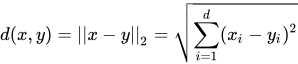
In the following, let G = (V, E) denote an undirected Graph with a set of vertices V and a set of edges E ⊆ V × V. The set sizes are denoted by |V| = n and |E| = m. Additionally, if not noted otherwise, the metric space [0,1)d with the euclidean distance is considered, i.e. for any points the euclidean distance of x and y is defined as

- .
A random geometric graph (RGG) is an undirected geometric graph with nodes randomly sampled from the uniform distribution of the underlying space [0,1)d.[5] Two vertices p, q ∈ V are connected if, and only if, their distance is less than a previously specified parameter r ∈ (0,1), excluding any loops. Thus, the parameters r and n fully characterize a RGG.
Algorithms
[edit]Naive algorithm
[edit]The naive approach is to calculate the distance of every vertex to every other vertex. As there are possible connections that are checked, the time complexity of the naive algorithm is . The samples are generated by using a random number generator (RNG) on . Practically, one can implement this using d random number generators on , one RNG for every dimension.


Pseudocode
[edit]V := generateSamples(n) // Generates n samples in the unit cube.
for each p ∈ V do
for each q ∈ V\{p} do
if distance(p, q) ≤ r then
addConnection(p, q) // Add the edge (p, q) to the edge data structure.
end if
end for
end for
As this algorithm is not scalable (every vertex needs information of every other vertex), Holtgrewe et al. and Funke et al. have introduced new algorithms for this problem.
Distributed algorithms
[edit]Holtgrewe et al.
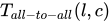
[edit]This algorithm, which was proposed by Holtgrewe et al., was the first distributed RGG generator algorithm for dimension 2.[6] It partitions the unit square into equal sized cells with side length of at least . For a given number of processors, each processor is assigned cells, where For simplicity, is assumed to be a square number, but this can be generalized to any number of processors. Each processor then generates vertices, which are then distributed to their respective owners. Then the vertices are sorted by the cell number they fall into, for example with Quicksort. Next, each processor then sends their adjacent processors the information about the vertices in the border cells, such that each processing unit can calculate the edges in their partition independent of the other units. The expected running time is . An upper bound for the communication cost of this algorithm is given by , where denotes the time for an all-to-all communication with messages of length l bits to c communication partners. is the time taken for a point-to-point communication for a message of length l bits.




Since this algorithm is not communication free, Funke et al. proposed[6] a scalable distributed RGG generator for higher dimensions, which works without any communication between the processing units.
Funke et al.
[edit]The approach used in this algorithm[6] is similar to the approach in Holtgrewe: Partition the unit cube into equal sized chunks with side length of at least r. So in d = 2 this will be squares, in d = 3 this will be cubes. As there can only fit at most chunks per dimension, the number of chunks is capped at . As before, each processor is assigned chunks, for which it generates the vertices. To achieve a communication free process, each processor then generates the same vertices in the adjacent chunks by exploiting pseudorandomization of seeded hash functions. This way, each processor calculates the same vertices and there is no need for exchanging vertex information.


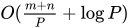
For dimension 3, Funke et al. showed that the expected running time is , without any cost for communication between processing units.
Properties
[edit]Isolated vertices and connectivity
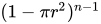
[edit]The probability that a single vertex is isolated in a RGG is .[7] Let be the random variable counting how many vertices are isolated. Then the expected value of is . The term provides information about the connectivity of the RGG. For , the RGG is asymptotically almost surely connected. For , the RGG is asymptotically almost surely disconnected. And for , the RGG has a giant component that covers more than vertices and is Poisson distributed with parameter . It follows that if , the probability that the RGG is connected is and the probability that the RGG is not connected is .




![{\textstyle P[X=0]\sim e^{-\mu }}](https://wikimedia.org/api/rest_v1/media/math/render/svg/844e08613654d9bf5ad2c12a4794aed84dcac38f)
![{\textstyle P[X>0]\sim 1-e^{-\mu }}](https://wikimedia.org/api/rest_v1/media/math/render/svg/913baa3d78d99d70fc13f1e93fce60435445b5ff)
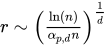
For any -Norm ( ) and for any number of dimensions , a RGG possesses a sharp threshold of connectivity at with constant . In the special case of a two-dimensional space and the euclidean norm ( and ) this yields .




Hamiltonicity
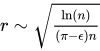
[edit]It has been shown, that in the two-dimensional case, the threshold also provides information about the existence of a Hamiltonian cycle (Hamiltonian Path).[8] For any , if , then the RGG has asymptotically almost surely no Hamiltonian cycle and if for any , then the RGG has asymptotically almost surely a Hamiltonian cycle.



Clustering coefficient
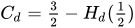
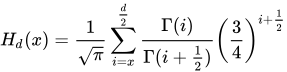
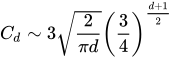
[edit]The clustering coefficient of RGGs only depends on the dimension d of the underlying space [0,1)d. The clustering coefficient is [9]
for even and for odd whereFor large , this simplifies to .


Generalized random geometric graphs
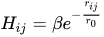
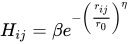
[edit]In 1988, Bernard Waxman[10] generalised the standard RGG by introducing a probabilistic connection function as opposed to the deterministic one suggested by Gilbert. The example introduced by Waxman was a stretched exponential where two nodes and connect with probability given by where is the euclidean separation and , are parameters determined by the system. This type of RGG with probabilistic connection function is often referred to a soft random geometric Graph, which now has two sources of randomness; the location of nodes (vertices) and the formation of links (edges). This connection function has been generalized further in the literature which is often used to study wireless networks without interference. The parameter represents how the signal decays with distance, when is free space, models a more cluttered environment like a town (= 6 models cities like New York) whilst models highly reflective environments. We notice that for is the Waxman model, whilst as and we have the standard RGG. Intuitively these types of connection functions model how the probability of a link being made decays with distance.






Overview of some results for Soft RGG
[edit]In the high density limit for a network with exponential connection function the number of isolated nodes is Poisson distributed, and the resulting network contains a unique giant component and isolated nodes only.[11] Therefore by ensuring there are no isolated nodes, in the dense regime, the network is a.a.s fully connected; similar to the results shown in [12] for the disk model. Often the properties of these networks such as betweenness centrality [13] and connectivity [11] are studied in the limit as the density which often means border effects become negligible. However, in real life where networks are finite, although can still be extremely dense, border effects will impact on full connectivity; in fact [14] showed that for full connectivity, with an exponential connection function, is greatly impacted by boundary effects as nodes near the corner/face of a domain are less likely to connect compared with those in the bulk. As a result full connectivity can be expressed as a sum of the contributions from the bulk and the geometries boundaries. A more general analysis of the connection functions in wireless networks has shown that the probability of full connectivity can be well approximated expressed by a few moments of the connection function and the regions geometry.[15]

References
[edit]- ^ Antonioni, Alberto; Tomassini, Marco (28 September 2012). "Degree correlations in random geometric graphs". Physical Review E. 86 (3) 037101. arXiv:1207.2573. Bibcode:2012PhRvE..86c7101A. doi:10.1103/PhysRevE.86.037101. PMID 23031054. S2CID 14750415.
- ^ Bobrowski, Omer; Kahle, Matthew (2018). "Topology of random geometric complexes: a survey". Journal of Applied and Computational Topology. 1 (3–4): 331–364. arXiv:1409.4734. doi:10.1007/s41468-017-0010-0. MR 3975557.
- ^ Gilbert, Edgar N (1961). "Random Plane Networks". Journal of the Society for Industrial and Applied Mathematics. 9 (4): 533–543. doi:10.1137/0109045.
- ^ Nekovee, Maziar (28 June 2007). "Worm epidemics in wireless ad hoc networks". New Journal of Physics. 9 (6): 189. arXiv:0707.2293. Bibcode:2007NJPh....9..189N. doi:10.1088/1367-2630/9/6/189. S2CID 203944.
- ^ Penrose, Mathew. (2003). Random geometric graphs. Oxford: Oxford University Press. ISBN 0-19-850626-0. OCLC 51316118.
- ^ a b c von Looz, Moritz; Strash, Darren; Schulz, Christian; Penschuck, Manuel; Sanders, Peter; Meyer, Ulrich; Lamm, Sebastian; Funke, Daniel (2017-10-20). "Communication-free Massively Distributed Graph Generation". arXiv:1710.07565v3 [cs.DC].
- ^ Perez, Xavier; Mitsche, Dieter; Diaz, Josep (2007-02-13). "Dynamic Random Geometric Graphs". arXiv:cs/0702074.
- ^ Perez, X.; Mitsche, D.; Diaz, J. (2006-07-07). "Sharp threshold for hamiltonicity of random geometric graphs". arXiv:cs/0607023.
- ^ Christensen, Michael; Dall, Jesper (2002-03-01). "Random Geometric Graphs". Physical Review E. 66 (1 Pt 2) 016121. arXiv:cond-mat/0203026. Bibcode:2002PhRvE..66a6121D. doi:10.1103/PhysRevE.66.016121. PMID 12241440. S2CID 15193516.
- ^ Waxman, Bernard M (1988). "Routing of multipoint connections". IEEE Journal on Selected Areas in Communications. 6 (9): 1617–1622. doi:10.1109/49.12889.
- ^ a b Mao, G; Anderson, B.D (2013). "Connectivity of large wireless networks under a general connection model". IEEE Transactions on Information Theory. 59 (3): 1761–1772. Bibcode:2013ITIT...59.1761M. doi:10.1109/tit.2012.2228894. S2CID 3027610.
- ^ Penrose, Mathew D (1997). "The longest edge of the random minimal spanning tree". The Annals of Applied Probability: 340361.
- ^ Giles, Alexander P.; Georgiou, Orestis; Dettmann, Carl P. (2015). "Betweenness centrality in dense random geometric networks". 2015 IEEE International Conference on Communications (ICC). pp. 6450–6455. arXiv:1410.8521. Bibcode:2014arXiv1410.8521K. doi:10.1109/ICC.2015.7249352. ISBN 978-1-4673-6432-4. S2CID 928409.
- ^ Coon, J; Dettmann, C P; Georgiou, O (2012). "Full connectivity: corners, edges and faces". Journal of Statistical Physics. 147 (4): 758–778. arXiv:1201.3123. Bibcode:2012JSP...147..758C. doi:10.1007/s10955-012-0493-y. S2CID 18794396.
- ^ Dettmann, C.P; Georgiou, O (2016). "Random geometric graphs with general connection functions". Physical Review E. 93 (3) 032313. arXiv:1411.3617. Bibcode:2016PhRvE..93c2313D. doi:10.1103/physreve.93.032313. PMID 27078372. S2CID 124506496.
Random geometric graph
View on GrokipediaFundamentals
Definition
A random geometric graph is an undirected graph formed by placing vertices independently and uniformly at random in the -dimensional unit cube , with an edge between two distinct vertices and if and only if the Euclidean distance , where is the connection radius. This model, often studied in two dimensions (), captures spatial dependencies in networks where proximity determines connectivity. To mitigate boundary effects in the cube, the vertices may instead be placed on the -dimensional torus obtained by identifying opposite faces of the cube. The key parameters are the number of vertices , the dimension (typically ), and the radius . The average degree of the graph is , where denotes the volume of the -dimensional ball of radius , given by with the volume of the unit ball. In the two-dimensional case, , so . The model was originally introduced by Gilbert in 1961 as a continuum percolation process on the plane, using a Poisson point process for vertex placement.[5] A related infinite model arises by placing vertices according to a homogeneous Poisson point process of intensity in , with edges formed under the same distance rule; this distinguishes from the finite binomial model by lacking a fixed number of vertices or bounded domain. In the finite two-dimensional case, the connectivity threshold—the smallest such that the graph is connected with high probability as —satisfies corresponding to average degree . This threshold highlights the phase transition from disconnected to connected graphs as increases.Historical Development
The random geometric graph model was introduced by Edgar N. Gilbert in 1961 as part of his work on Boolean models and continuum percolation, where points are randomly placed in a space and connected if within a fixed distance, modeling phenomena like crystal formation or network connectivity in continuous settings.[6] This foundational model drew heavily from percolation theory, which examines phase transitions in random systems, and spatial statistics, which analyzes point patterns and their dependencies in geometric spaces. In the 1990s and early 2000s, the model gained renewed interest through applications to wireless ad hoc networks, where nodes represent devices with limited transmission ranges, linking it to sensor networks and communication protocols. A key milestone came in 2002 with the work of Dall and Christensen, who explored threshold phenomena such as connectivity and giant component emergence in random geometric graphs, providing empirical and analytical insights into scaling behaviors.[7] Subsequently, Mathew Penrose's 2003 monograph formalized the probabilistic properties of random geometric graphs, establishing rigorous foundations for asymptotic analysis and influencing subsequent theoretical advancements.[8]Construction Algorithms
Naive Algorithm
The naive algorithm for constructing a random geometric graph begins by generating points uniformly at random in the -dimensional unit cube . An undirected edge is then added between every pair of distinct points whose Euclidean distance is at most the fixed radius .[8] This construction requires evaluating the Euclidean distance between all pairs of points, resulting in a time complexity of .[9] The space complexity is in the worst case, which occurs when the graph is dense and an adjacency matrix is used to store the edge information.[9] The following pseudocode outlines the procedure, assuming points are stored in an array and the graph is represented as an adjacency list:# Initialize graph as empty adjacency list with n vertices (indices 0 to n-1)
G = [[] for _ in range(n)]
# Generate n points uniformly in [0,1]^d
points = generate_random_points(n, d)
# Compute distances for all pairs i < j
for i in range(n):
for j in range(i+1, n):
dist = euclidean_distance(points[i], points[j])
if dist <= r:
G[i].append(j)
G[j].append(i)
# Initialize graph as empty adjacency list with n vertices (indices 0 to n-1)
G = [[] for _ in range(n)]

# Generate n points uniformly in [0,1]^d
points = generate_random_points(n, d)

# Compute distances for all pairs i < j
for i in range(n):
    for j in range(i+1, n):
        dist = euclidean_distance(points[i], points[j])
        if dist <= r:
            G[i].append(j)
            G[j].append(i)