Hubbry Logo
Reynard the FoxReynard the FoxMain
Open search
Reynard the Fox
Community hub
Reynard the Fox
logo
8 pages, 0 posts
0 subscribers
Be the first to start a discussion here.
Reynard the Fox
Reynard the Fox
from Wikipedia

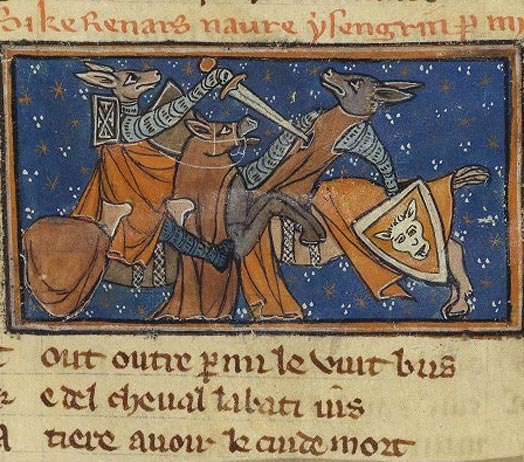
An illumination from a late 13th century manuscript of the Roman de Renart

Reynard the Fox is a literary cycle of medieval allegorical Dutch, English, French and German fables. The first extant versions of the cycle date from the second half of the 12th century. The genre was popular throughout the Late Middle Ages, as well as in chapbook form throughout the Early Modern period.

The stories are largely concerned with the main character Reynard, an anthropomorphic red fox and trickster figure. His adventures usually involve his deceiving other anthropomorphic animals for his own advantage, or trying to avoid their retaliatory efforts. His main enemy and victim across the cycle is his uncle, the wolf, Isengrim (or Ysengrim).

While the character of Reynard appears in later works, the core stories were written during the Middle Ages by multiple authors and are often seen as parodies of medieval literature, such as courtly love stories and chansons de geste, as well as a satire of political and religious institutions.[1] The trickster fox, Reynard, lives in a society of other talking animals (lion, bear, wolf, donkey, etc), making the stories a beast epic.[2]

The original copies were written in Old French, and have since been translated into many different languages. However, the tales of Reynard come from all across Europe and each retelling has details that are specific to its area.[3] The tales, no matter where they take place, are designed to represent the society around them and include the structures of society around them, such as a noble court. While the authors take many liberties with the story telling, not all of the satire is meant to be rude or malicious in intent.[3]

Characters

[edit]
A defaced Reynard preaches to a rooster.

The main characters are anthropomorphic animals. The given names of the animals are of Old High German origin. Most of them were in common use as personal names in medieval Lorraine. The characters of Reynard the Fox were based on the medieval hierarchy, and are treated as human throughout the tales. Since multiple authors wrote the text, characters' personalities often change. Throughout the stories, these characters often switch between human and animal form and often without notice.[4]

The characters who switch between human and animal form are often those of elite status, while the characters who don't change tend to be peasants. Often, the readers will find themselves able to empathize with Reynard. They find that the situations he is in are not often that different from their own lives, and this carries across the decades.[5] The common usage of animals as characters in tales has made it so the stories that touch on morally gray areas are easier to understand and accept.[6]

  • Reynard the Fox. The given name Reynard is from Reginhard, Raginohardus "strong in counsel". Because of the popularity of the Reynard stories, renard became the standard French word for "fox", replacing the old French word for "fox", which was goupil from Latin vulpēcula. Since Reynard has been written about in many different times and places across the world, it is not uncommon to see changes in his appearance to fit the natural surroundings of his story. His fur is often used as a camouflage, meaning if the story was written in a snowy landscape he will have white fur, or yellow fur for desert areas, and in the wooded areas of a forest, he is depicted in red fur.[3]
  • Isengrim the Wolf, see Ysengrimus
  • Tibert the Cat. See Tybalt, Prince of cats
  • King Noble the Lion; see king of beasts
  • Bruin the Bear
  • Grimbard the Badger
  • Baldwin the Ass
  • Bayard the Horse
  • Hirsent the She-wolf
  • Kyward the Hare, also Coart, Cuwaert, a coward.[7]
  • Chanticleer the Cock
  • Bellin the Ram
  • Martin the Ape, who had a son named Moneke who may be the source of the word monkey.[8][9]

In medieval European folklore and literature

[edit]
A studious fox in a monk's cowl, in the margins of a book of hours, Utrecht, c. 1460

Foxes in general have the reputation of tricksters in traditional European folklore.[10] The specific character of Reynard is thought to have originated in Lorraine folklore, from where it spread to France, Germany, and the Low Countries.[11][need quotation to verify] Alternatively, a 19th-century edition of a retelling of the Reynard fable states definitively with "no doubt whatever that it is of German origin" and relates a conjecture associating the central character with "a certain Reinard of Lorraine, famous for his vulpine qualities in the ninth century".[12]

Joseph Jacobs, while seeing an origin in Lorraine, traces classical, German, and "ancient northern folk-lore" elements within the Reynard stories.[13] Jacob Grimm in his Reinhart Fuchs (Berlin, 1834) provided evidence for the supposition on etymological grounds that "stories of the Fox and Wolf were known to the Franks as early as the fourth, fifth, and sixth centuries".[14]

From the twelfth and thirteenth centuries there are around twenty-six different tales of Reynard the Fox that survive today. These were written by multiple authors, some of whom are anonymous.[4]

An extensive appearance of the character is in the Old French Le Roman de Renart written by Pierre de Saint-Cloud around 1170, which sets the typical setting. Reynard has been summoned to the court of king Noble (or Leo), the lion, to answer charges brought against him by Isengrim the wolf. Other anthropomorphic animals, including Bruin the bear, Baldwin the ass, and Tibert (Tybalt) the cat, all attempt one stratagem or another. The stories typically involve satire, whose usual butts are the aristocracy and the clergy, making Reynard a peasant-hero character.[11] The Catholic Church used the story of the preaching fox, as found in the Reynard literature, in church art as propaganda against the Lollards.[15]

Reynard's principal castle, Maupertuis, is available to him whenever he needs to hide away from his enemies. Some of the tales feature Reynard's funeral, where his enemies gather to deliver maudlin elegies full of insincere piety, and which feature Reynard's posthumous revenge. Reynard's wife Hermeline appears in the stories, but plays little active role. In some versions she remarries when Reynard is thought dead, thereby becoming one of the people he plans revenge upon. Isengrim, alternate French spelling: Ysengrin, is Reynard's most frequent antagonist and foil.[4] He generally ends up outwitted, though he occasionally gets revenge.

An individual tale might span several genres, which makes classification difficult. Tales often include themes from contemporary society with references to relics, pilgrimage, confession, and the crusades.[4] There is debate over whether or how closely they related to identifiable societal events, but there is a growing camp[who?] that see direct societal connections and even implicit political statements in the tales. The stories are told in a way that makes associations easy to make, but difficult to substantiate.[citation needed]

Reynard stories translate difficult laws and legal concepts into common language, allowing people to both understand them and enjoy the legal predicaments and antics of the characters. The court operates just as those in medieval society. The king heard cases only on one specified date, and all disputes were heard at once.[16]

Ysengrimus

[edit]

Reynard appears first in the medieval Latin poem Ysengrimus, a long Latin mock-epic written c. 1148–53 by the medieval poet Nivardus, that collects a great store of Reynard's adventures. He also appears in a number of Latin sequences by the early-13th-century preacher Odo of Cheriton. Both of these early sources seem to draw on a pre-existing store of popular culture featuring the character.

Roman de Renart

[edit]

The first "branch" (or chapter) of the Roman de Renart appears in 1174, written by Pierre de St. Cloud, although in all French editions it is designated as "Branch II". The same author wrote a sequel in 1179—called "Branch I". From that date onwards, many other French authors composed their own adventures for Renart li goupil ("the fox"). There is also the Middle High German text Reinhard Fuchs by Heinrich der Glïchezäre, dated to c. 1180. Roman de Renart fits into the genre of romance. Roman de Renart gets its start using the history of fables that have been written since the time of Aesop.[6]

The romance genre of the middle ages is not what we think of the romance genre of today. It was a fictional telling of a character's life.[17] The protagonist of the romance genre often has an adventure or a call to action, almost always caused by an outside force.[18] In the 13th century, French was a standard literary language, and many works during the Middle Ages were written in French, including Reynard the Fox. Many popular works from the Middle Ages fall into the romance genre.[17]

Pierre de St. Cloud opens his work on the fox by situating it within the larger tradition of epic poetry, the fabliaux and Arthurian romance:

Seigneurs, oï avez maint conte
Que maint conterre vous raconte
Conment Paris ravi Elaine,
Le mal qu'il en ot et la paine,
De Tristan que la Chievre fist
Qui assez bellement en dist
Et fabliaus et chançons de geste
Romanz d'Yvain et de sa beste
Maint autre conte par la terre.
Mais onques n'oïstes la guerre
Qui tant fu dure de gran fin,
Entre Renart et Ysengrin.

Translation:

Lords, you have heard many tales,
That many tellers have told to you.
How Paris took Helen,
The evil and the pain he felt
Of Tristan that la Chevre
Spoke rather beautifully about;
And fabliaux and epics;
Of the Romance of Yvain and his beast
And many others told in this land
But never have you heard about the war
That was difficult and lengthy
Between Reynard and Isengrim

Van den vos Reynaerde

[edit]

A mid-13th-century Middle Dutch version of the story by Willem die Madoc maecte (Van den vos Reynaerde, Of Reynaert the Fox), is also made up of rhymed verses (the same AA BB scheme). Van den vos Reinaerde and Reinaert Historie (referred to as R I and R II, respectively) are two poems written by two different authors with R II being a continuation of R I.[19]

With different writers comes different variations. This can best be seen with Reynard. While describing the same character the Reynard from R I has many different character traits of that in R II.[20] While a finished and completed poem by itself, Van den vos Reinaerde does not have a set ending.

Like Pierre, very little is known of the author, other than the description by the copyist in the first sentences:[2]

Willem, die Madocke maecte,
daer hi dicken omme waecte,
hem vernoyde so haerde
dat die avonture van Reynaerde
in Dietsche onghemaket bleven
– die Arnout niet hevet vulscreven –
dat hi die vijte dede soucken
ende hise na den Walschen boucken
in Dietsche dus hevet begonnen.

Translation:

Willem who made Madocke,
which often kept him awake,
was so extremely annoyed
that the tales of Reynaert
– which Arnout has not finished –
remained unwritten in Dutch
that he had the life looked for
and, following the French books
he began it in Dutch as follows.

A 1498 illustration from Hans van Ghetelen, in Reinke de Vos

Madocke or Madoc is thought to be another one of Willem's works that at one point existed but had been lost. The Arnout mentioned was an earlier Reynard poet whose work Willem (the writer) alleges to have finished. However, there are serious objections to this notion of joint authorship, and the only thing deemed likely is that Arnout was French-speaking ("Walschen" in Middle Dutch referred to northern French-speaking people, specifically the Walloons).[21] Willem's work became one of the standard versions of the legend, and was the foundation for most later adaptations in Dutch, German, and English, including those of William Caxton, Goethe, and F. S. Ellis.[2]

Chaucer

[edit]

Geoffrey Chaucer used Reynard material in the Canterbury Tales; in "The Nun's Priest's Tale", Reynard appears as "Rossel" and an ass as "Brunel". Reynard (spelt "Renard") is also briefly mentioned in The Legend of Phyllis from Chaucer's The Legend of Good Women.

Early Modern tradition

[edit]

In 1481, the English William Caxton printed The Historie of Reynart the Foxe, which was translated from Van den vos Reynaerde.[11] Also in the 1480s, the Scottish poet Robert Henryson devised a highly sophisticated development of Reynardian material as part of his Morall Fabillis in the sections known as The Talking of the Tod. In 1498, Hans van Ghetelen, a printer of Incunabula in Lübeck, printed a Low German version called Reinke de Vos. It was translated to Latin and other languages, which made the tale popular across Europe. Reynard is also referenced in the Middle English poem Sir Gawain and the Green Knight during the third hunt.

Tybalt in Shakespeare's Romeo and Juliet is named after the cat in Reynard the Fox, and is called 'Prince of Cats' by Mercutio in reference to this. Jonson's play Volpone is heavily indebted to Reynard.[22]

With the invention of the printing press, the tales of Reynard the fox became more popular and started to be translated and recreated in many different languages.[23] The tales of Reynard don't follow the typical sense of reprinting, as there is no clear chronology to the stories. Many of the original pages to these stories have been lost, so it is difficult to tell what the exact literary changes are, of which there aren't many, with the exception of the typical changes that are seen from the early days of the printing press.[23]

There are also slight changes to the wording that show modernization of the uses and differing orders of the words. While the changes might appear to be mistakes, they are not thought of as such and are often kept in the modernization of the tales.[23] There were few many [which?] attempts to better the works during the fifteenth and sixteenth centuries. Changes to the tales during the fifteenth century are not seen as mistakes because of specific roles in the process of printing designed to eliminate mistakes.[23] In the early modern editions of Reynard the Fox, the characteristics of the animals were based on literary topoi, appealing to the middle class reader.[24]

The trickster figure Reynard the Fox as depicted in an 1869 children's book by Michel Rodange

Modern treatment

[edit]

19th century

[edit]

Reinecke Fuchs by Goethe is a poem in hexameters, in twelve parts, written 1793 and first published 1794. Goethe adapted the Reynard material from the edition by Johann Christoph Gottsched (1752), based on the 1498 Reynke de vos.

In Friedrich Nietzsche's 1889 The Twilight of the Idols, Nietzsche uses Reynard the Fox as an example of a dialectician.[25]

German artist Johann Heinrich Ramberg made a series of thirty drawings, which he also etched and published in 1825.[26]

Renert [full original title: Renert oder de Fuuß am Frack an a Ma'nsgrëßt],[27][28] was published in 1872 by Michel Rodange, a Luxembourgeois author. An epic satirical work—adapted from the 1858 Cotta Edition of Goethe's fox epic Reineke Fuchs to a setting in Luxembourg. It is known to be a satirical mirror image of Luxembourg's social sphere after the turmoils of the Luxembourg Crisis, whereby the author transposed his criticism and social scepticism to the animal society in which his fox 'Renert' lives.[27] Beyond that, it is insightful analysis of the different regional and sub-regional linguistic differences of the country, where distinct dialects are used to depict the fox and his companions.

20th century

[edit]

Ladislas Starevich produced The Tale of the Fox in 1937.

The 1962 Oscar-winning documentary Black Fox: The Rise and Fall of Adolf Hitler uses Reynard the Fox as a parallel to the main narrative.

Disney's Robin Hood animated film from 1973 is partly based on Reynard the Fox.[29]

21st century

[edit]

In the SyFy fantasy television show The Magicians (which aired from December 2015 to April 2020) there is a Pagan trickster god played by Mackenzie Astin named Reynard the Fox. SyFy's The Magicians is an adaptation of Lev Grossman's urban fantasy series The Magicians, in which Reynard the Fox appears first as a folk tale and is later revealed to be a minor deity. Fitting within contemporary tropes of trickster gods, Reynard is a major driving force of the narrative in The Magician King, yet remains only referenced in passing for much of the story.

This version of Reynard has little to do with the character as traditionally depicted, his purpose is more in line with that of the gods in greek literature, with his role being to punish mortals for their hubris. This deviation from the character's actual history is indirectly addressed in the story, in which Reynard himself fabricates light-hearted tales to trick people into underestimating the danger he represents.[30]

See also

[edit]

Notes

[edit]

Bibliography

[edit]
[edit]
Revisions and contributorsEdit on WikipediaRead on Wikipedia
from Grokipedia

Reynard the Fox is the anthropomorphic protagonist of the Roman de Renart, a cycle of satirical beast fables originating in late 12th-century , where the cunning fox repeatedly employs deception, wit, and manipulation to triumph over physically superior animals representing feudal lords and .
Composed by multiple anonymous authors between approximately 1171 and 1250, the tales parody chivalric epics and courtly literature by depicting animal society as a microcosm of medieval hierarchies, with Reynard embodying the resourceful who subverts authority through schemes involving , lechery, and false . Key recurring adversaries include the brutish wolf Ysengrim, whom Reynard mutilates and humiliates, and the lion King Noble, before whom the fox feigns repentance to evade execution, often by fabricating evidence of hidden treasures or divine favor.
The stories' enduring appeal lay in their critique of , social inequities, and institutional hypocrisy, resonating particularly with lower classes amid cycles of and abundance that underscored survival instincts over noble ideals. From French origins building on earlier Aesopic traditions, the Reynard cycle proliferated across , yielding vernacular adaptations such as the Middle Dutch Van den vos Reynaerde around 1260 and the German Reineke Fuchs, while William Caxton's 1481 English translation marked its entry into print, cementing its status as an "anti-romance" that inverted heroic conventions. Though condemned by some ecclesiastical authorities for obscenity and anti-clerical barbs, the fables' popularity endured, influencing later archetypes in and .

Origins

Etymology and Linguistic Roots

The name Reynard derives from the Proto-Germanic personal name Raginaharduz, formed from raginą (", advice, decision") and harduz ("hard, firm, brave, hardy"), connoting "strong" or "bold in counsel." This anthroponymic root aligns with medieval Germanic naming practices, where human proper names were anthropomorphically assigned to animals in fables to emphasize their cunning or deceptive traits, as documented in sources on medieval . In literature, the name evolved to Renart, first attested in the Roman de Renart, a cycle of beast fables whose earliest branches date to approximately 1175–1176, composed by Pierre de Saint-Cloud as Branch I. The frequent portrayal of the fox protagonist as Renart in these narratives led to the term supplanting the Latin-derived goupil (diminutive of vulpes) as the standard French word for by the . Linguistic variants emerged with the fable's transmission across vernaculars: Middle Dutch adapted it as Reynaert in Van den vos Reynaerde (ca. 1250), reflecting phonetic shifts in dialects; rendered it as Reynke or Reineke (a form), seen in later adaptations like Reineke Fuchs; and borrowed Reynard directly from French, retaining it as a proper name for the in translations. These adaptations underscore the cycle's diffusion from epic traditions into Germanic literary spheres, where the name's consistency preserved the character's archetypal identity amid regional phonological divergences.

Pre-Literary and Folkloric Influences

The fox as a cunning outwitting stronger adversaries features prominently in ancient fables attributed to , a semi-legendary Greek storyteller active around the 6th century BCE, where examples include the fox tricking a into dropping cheese and exploiting the vanity of other beasts. These narratives, preserved in collections like 124 ("The Fox and the Crow"), emphasize the fox's intellect over brute force, a motif echoed in later European animal tales. Such stories likely circulated orally across the Mediterranean before textual compilation in the 5th century BCE by Phaedrus and others, providing a precedent for anthropomorphic deception in beast fables. In ancient Near Eastern traditions, the held symbolic roles as a messenger of deities, appearing in Mesopotamian mythology as early as the BCE, where its elusive nature symbolized guile and survival against odds. Comparative trace Indo-European archetypes—embodying chaos, , and —to shared proto-mythic , with the fox variant manifesting in tales of evasion and manipulation predating 12th-century by millennia. These elements, disseminated via trade routes and migratory storytelling, form causal precursors to regional fox-centric narratives, as verified by cross-cultural fable parallels rather than direct lineage claims. Oral traditions in the and northern , particularly Lorraine from the early medieval period, preserved anthropomorphic animal motifs through communal tales before their 12th-century literary crystallization. Ethnographic analysis of surviving beast epics indicates that pre-literate cycles in these areas featured foxes as sly protagonists in disputes with wolves and lions, reflecting agrarian society's valuation of resourcefulness amid power imbalances. Archaeological hints, such as 9th-10th century carvings and marginalia in Carolingian manuscripts depicting foxes in deceptive poses, suggest embedded folkloric continuity without reliance on written cycles. This oral substrate, sustained by itinerant performers and monastic retellings, causally informed the Reynard archetype's emphasis on verbal agility and moral ambiguity.

Principal Characters

Reynard as Protagonist

Reynard appears in medieval beast epics as an anthropomorphic characterized by acute cunning, rhetorical skill, and a propensity for deceit, enabling survival amid stronger foes in both anthropomorphic courts and natural environments. In the 12th-century Latin , he exemplifies verbal agility, employing manipulation and fabricated pretexts to evade retribution for predatory acts. These traits persist across vernacular branches, where Reynard consistently prioritizes self-preservation through guile over direct confrontation or honorable conduct. Central to his portrayal is an amoral , marked by in feigning or virtue to mask self-serving motives, as in episodes where he adopts clerical guises to perpetrate . In the Roman de Renart cycle (late 12th to 13th centuries), Reynard embodies trickery, leveraging articulate deception to invert accusations and secure impunity, such as by contriving evidence that undermines his pursuers' credibility during judicial assemblies. His triumphs underscore a reliance on intellectual superiority and opportunistic fabrication rather than physical prowess or ethical adherence, a pattern verifiable in primary branches like the Dutch Van den Vos Reynaerde. This depiction highlights Reynard's role as a defined by adaptive deceit, consistently outmaneuvering antagonists through calculated .

Supporting Figures and Archetypes

Isengrim the wolf functions as Reynard's principal adversary, embodying a brutish and aggressive noble who repeatedly seeks retribution but falls victim to the fox's cunning manipulations, often suffering physical and reputational defeats. Noble the lion, as the sovereign king of beasts, presides over the central animal court, representing a flawed whose is undermined by Reynard's intrigues and the inefficiencies of his feudal assembly. These figures contrast Reynard's intellect with raw power and institutional inertia, highlighting tensions in medieval power dynamics. Other recurring characters include Bruin the bear, depicted as a lumbering, guileless figure tricked into serving Reynard's ends, and Tibert the cat, a sly but ultimately duped operative whose loyalty to the fox leads to his entrapment. Grimbert the badger appears as Reynard's pragmatic kinsman and occasional mediator, bridging conflicts within the animal society. Collectively, these archetypes map onto medieval social strata, with wolves and bears evoking martial or rural elites prone to folly, cats alluding to clerical duplicity, and the lion's court satirizing hierarchical governance riddled with corruption and poor judgment. Linguistic traditions introduce variations in emphasis; French branches prioritize episodic rivalries among underlings like Isengrim and Bruin, while Dutch adaptations, such as Van den Vos Reynaerde, accentuate courtly protocols around Noble's throne, aligning characters more closely with burgher critiques of aristocratic pomp. This shift underscores regional adaptations where supporting figures reinforce local satirical targets, from peasant-like simplicity in bears to hypocritical intermediaries in cats, without altering their core roles as foils to Reynard's subversive agency.

Literary Evolution

Early Latin Works

The foundational Latin text of the Reynard cycle is the poem Ysengrimus, a mock-epic beast poem composed circa 1148–1152 by the cleric Nivardus of in the region of modern-day . This work, spanning approximately 5,800 lines in elegiac couplets, introduces Reinardus the as a cunning who relentlessly torments the hapless wolf Ysengrimus through a series of anthropomorphic fables laced with biting against ecclesiastical corruption and monastic . Central episodes depict Ysengrimus suffering grotesque mutilations at Reinardus's hands, including the severing of his tail and genitals after being lured into a trap disguised as a , symbolizing the of foolish . The wolf's subsequent vengeful pursuits, such as ambushing the fox and forcing him into false confessions, invariably backfire, underscoring themes of predatory deception and futile retribution in a raw, unsparing allegorical framework. These narratives prioritize visceral over redemption, portraying animal as a mirror to human institutional failings without overt . Surviving in at least seven medieval s, primarily from monastic scriptoria in the and northern , Ysengrimus circulated within learned ecclesiastical networks during the 12th and 13th centuries, influencing subsequent Latin beast poems and providing raw material for vernacular adaptations. Its dissemination reflects the era's clerical fascination with satirical , though its scatological and violent content limited broader lay access until later copies emerged. The poem's attribution to Nivardus rests on acrostics and internal references, though some scholars note uncertainties in precise authorship amid the anonymous manuscript tradition.

Vernacular Branches in French and Dutch

The Roman de Renart, composed in primarily between the late 12th and mid-13th centuries (circa 1175–1250), marked a pivotal expansion of the Reynard cycle through its episodic structure of independent yet interconnected branches. These branches, totaling 27 in the core cycle edited by modern scholars like , feature Reynard's cunning exploits against noble animals representing feudal hierarchy, with early installments like Branch I (Le Plaid) focusing on intrigue around 1180. The format allowed for modular additions by various anonymous authors, fostering widespread copying—over 100 fragments and complete codices survive, many richly illuminated to depict satirical scenes of deception and social inversion, as in manuscripts Fr. 1581 and Fr. 12584 from the 13th century. In parallel, the Dutch adaptation Van den vos Reynaerde by the poet (active circa 1250) transformed select French branches, particularly Branch I, into a unified epic poem of over 3,400 lines, emphasizing narrative cohesion through a linear plot of Reynard's trial and triumph over King Nobel's court. This Flemish vernacular work, datable to around 1240–1260 based on linguistic analysis, innovated by amplifying regional elements like topography and merchant-class wit, subtly underscoring resistance to centralized feudal authority via Reynard's victories. Its popularity is evidenced by five surviving manuscripts (two complete, three fragmentary), reflecting dissemination in urban Flemish centers and integration into local literary pride as a counterpoint to courtly epics. Both traditions spurred vernacular innovation by prioritizing accessible dialects over Latin, with the French cycle's modularity enabling rapid proliferation and the Dutch version's epic form promoting holistic retellings that resonated in manuscript illuminations and oral recitations across northern Europe by the late 13th century.

English and Other Regional Adaptations

Geoffrey Chaucer integrated Reynard the Fox motifs into his Canterbury Tales during the late 14th century, most prominently in "The Nun's Priest's Tale," composed around 1390. In this beast fable, the fox—named Daun Russell—employs flattery and cunning to lure the rooster Chauntecleer from his perch, mirroring deceptive episodes from the broader Reynard cycle where the fox preys on avian vanity. The narrative expands the simple Aesopic fox-rooster encounter into a mock-heroic satire, incorporating dream warnings, domestic disputes, and moral digressions to critique human pride and credulity. Chaucer's adaptation transforms the Reynard material by embedding it within a pilgrimage framework, using anthropomorphic animals to allegorize clerical and lay follies while preserving the trickster's triumph through wit over strength. This English rendering draws indirectly from French and Low Countries branches but localizes the tale with Middle English verse and allusions to contemporary theology, such as Boethian fatalism in Chauntecleer's escape. In German-speaking regions, Heinrich der Glîchezâre authored Reinhart Fuchs circa 1180, the earliest extant beast epic featuring the Reinhart. This work adapts French Renart branches into a cohesive of courtroom intrigue and predation, emphasizing the 's rhetorical manipulations against figures like the Isegrim. The poem's 1,500 verses highlight causal chains of deception, such as Reinhart's feigned piety leading to Isegrim's humiliation, reflecting feudal power dynamics through animal archetypes. Low German variants emerged in medieval prose manuscripts, influenced by Flemish-Dutch sources around the 13th century, though these often fragmented into episodic chapbooks rather than unified epics. Distinct regional echoes in Scandinavian or Italian literatures remain sparse, with comparative identifying only motif parallels in isolated fables rather than full cycle adaptations.

Early Modern Developments

Printed Editions and Dissemination

The invention of the movable-type around 1450 by enabled the mass production of Reynard the Fox narratives, shifting dissemination from labor-intensive manuscripts confined to clerical and noble circles to mechanically reproduced volumes that reached merchants, artisans, and literate urban dwellers, driven by printers' recognition of the tales' commercial viability as entertaining moral fables. In , William printed the first vernacular edition, The History of Reynart the Fox, in Westminster on June 20, 1481, drawing from Dutch and French exemplars to produce approximately 800 copies, which broadened access beyond Latin-reading elites and helped standardize the English version amid the era's orthographic variability. Continental Europe saw even earlier prints, with the Dutch Reynaerts Historie appearing in prose form around 1479 in the , establishing a printed tradition rooted in the 13th-century verse epic by die Madocke maecte and fueling subsequent editions that capitalized on regional markets for beast epics. German printers followed suit, issuing a Low German translation in in 1498 under the title Reinke de Vos, which incorporated illustrations to visually depict the fox's deceptions, appealing to bourgeois readers seeking affordable yet artistically enriched literature. These lavish editions in the and , often featuring reusable woodblock images of anthropomorphic animals, reflected technological refinements in inking and press operation, as well as market incentives to differentiate products in competitive urban printing centers like and . Subsequent reprints, such as Wynkyn de Worde's illustrated English edition of 1495, perpetuated the woodcuts—many signed by artists like E.B.—into the , ensuring the tales' endurance despite occasional editorial moralizations that framed Reynard's cunning as cautionary rather than purely triumphant, though the underlying satire on ecclesiastical and noble hypocrisy remained intact across variants. By the early , multiple editions across languages had circulated widely, with printers like those in and producing over a dozen versions, standardizing key episodes while adapting and dialects to local conventions, thus embedding the cycle in early modern .

Key 18th-Century Adaptations

In 1794, Johann Wolfgang von Goethe published Reineke Fuchs, a verse epic composed in hexameter that drew primarily from medieval Low German beast epics and the second Middle Dutch Van den Vos Reynaerde, synthesizing disparate episodes into a cohesive narrative emphasizing Reynard's unrepentant cunning and triumph over brute force. Goethe's adaptation transformed earlier prosaic versions, such as Johann Christoph Gottsched's 1752 rendering, by infusing classical serenity with subversive undertones that critiqued Enlightenment ideals of order while preserving the fox's amoral trickster archetype. This work, spanning over 4,000 lines, portrayed Reynard's deceptions—such as feigned piety and fabricated accusations against rivals like Isegrim the wolf—as emblematic of natural law's preference for wit over convention, reflecting Goethe's interest in primal instincts amid rationalist discourse. English chapbook editions, such as The History of Reynard the Fox, proliferated in the mid-18th century through inexpensive prints that adapted medieval tales for broader audiences, often appending lessons to episodes of Reynard's schemes while censoring overt to align with emerging bourgeois sensibilities. These versions retained the core dynamics, depicting Reynard's evasion of justice through guile, as in his before Noble the lion, but softened satirical barbs against and noble figures to emphasize didactic restraint over unrestrained critique. French counterparts, circulated in moralized pamphlets with illustrative devices, similarly prioritized propriety by framing Reynard's victories as cautionary tales, yet preserved the archetype's essence of survival through deception amid aristocratic . These adaptations fueled a surge in translations across German, English, and French markets, evidenced by multiple print runs and cross-lingual borrowings that integrated Reynard into nascent national literary canons, sustaining the cycle's relevance as a counterpoint to Enlightenment rationalism's emphasis on . By unifying fragmented medieval branches while navigating contemporary propriety, they ensured the fox's enduring role as a symbol of pragmatic realism over idealistic .

Modern Adaptations

19th-Century Revivals

In the , scholarly interest in Reynard the Fox intensified through philological compilations and critical editions, particularly in and , where medieval texts were systematically analyzed for linguistic and literary value. Johann Wolfgang von Goethe's 1794 verse adaptation Reineke Fuchs, drawing from sources, spurred further editions; an 1855 English rendering after Goethe's version preserved the satirical beast epic's structure while emphasizing its poetic form. German scholars contributed to by tracing variants back to medieval originals, viewing the cycle as a key to understanding early European vernacular , though these efforts prioritized historical reconstruction over moral endorsement. English translations and editions proliferated, often building on William Caxton's 1481 print, with Henry Morley's mid-century scholarly edition of Caxton's text hailed for its fidelity and annotations, facilitating academic study of the fable's dissemination. Thomas Roscoe's 1847 prose translation, The Pleasant History of Reynard the Fox, illustrated with nearly 100 designs, popularized the narrative for broader audiences while retaining its episodic cunning-versus-force dynamics. These works advanced empirical by collating manuscripts, yet some Victorian commentators critiqued the fox's triumph as emblematic of moral laxity, arguing it glorified deceit over ethical order, in contrast to celebrations of its wit as a counter to rigid authority. In , folkloristic revivals tied Reynard—known as Van den Vos Reynaerde—to emerging amid the 19th-century , which sought cultural autonomy from French dominance by resurrecting literature. The beast epic was reframed as a "mirror of the Flemish soul," symbolizing the resourceful underdog's defiance of elite power structures, with local editions and discussions reinforcing its role in regional heritage during Belgium's post-1830 independence era. This linkage balanced scholarly rigor with , though it occasionally overlooked the tale's transnational roots in favor of localized symbolism.

20th-Century Artistic Interpretations

In 1924, Czech composer Leoš Janáček premiered his opera The Cunning Little Vixen (Příhody lišky Bystroušky) on November 6 in Brno, adapting a contemporary Czech novella and serialized comic strip by Rudolf Těsnohlídek that featured an anthropomorphic vixen embodying cunning and defiance against human authority, themes resonant with the Reynard trickster archetype in broader European folklore. While not a literal retelling of the medieval Reynard cycle, the work's portrayal of a resourceful fox navigating forest society and evading capture parallels the satirical animal fables of Reynard, reflecting interwar interests in nature cycles and subversion of anthropocentric norms. A landmark in animation, Russian émigré director completed The Tale of the Fox (Le Roman de Renard) in 1937, a 65-minute stop-motion puppet film directly adapting the , depicting the fox's deceptions against antagonists like the wolf Isengrim and the , with intricate handmade figures emphasizing the tale's moral ambiguities. First screened publicly at the 1937 International Exposition in , it received a wider French release in 1941, marking one of the earliest feature-length animated interpretations of the cycle and showcasing Starevich's pioneering techniques in and multi-plane effects for allegorical storytelling. Walt Disney Productions explored an animated feature adaptation of Reynard in the 1930s, commissioning storyboards and concept art that reimagined the fox as a roguish antihero amid medieval animal courts, but abandoned the project by the early 1940s owing to the character's unrepentant trickery, which clashed with Disney's emphasis on redeemable protagonists and family-friendly morals. This unproduced effort influenced later Disney anthropomorphic animal tales, such as the fox-centric elements in Robin Hood (1973), though the original Reynard's darker satire remained untamed. Postwar illustrations revitalized the cycle in print, with American artist providing dynamic, expressive drawings for a 1945 children's edition retold by Harry DeLapp and Joseph Gaer, capturing Reynard's escapades with fluid lines that evoked both whimsy and sly intrigue for mid-century audiences. Similarly, Fritz Eichenberg contributed meticulous wood engravings to editions like Johann Wolfgang von Goethe's versified Reineke Fuchs adaptations in the 1950s, rendering the fox's courtly deceptions with stark contrasts that underscored the fable's critique of power structures. These visual works, produced amid recovering European and American markets, preserved Reynard's satirical edge while adapting it for modern graphic traditions.

21st-Century Scholarship and Media

In the early , scholarly collections have traced Reynard's enduring social and cultural transformations, extending analyses from medieval origins to contemporary resonances. The edited volume Reynard the Fox: Cultural Metamorphoses and Social Engagement in the Beast Epic from the to the Present, published by Berghahn Books, compiles fifteen essays examining the cycle's evolution, including its satirical critique of power structures and adaptations in modern contexts. This work highlights empirical textual comparisons across branches, privileging evidence over interpretive speculation. Post-2010 initiatives have advanced comparative scholarship through accessible online repositories of primary sources. Platforms like the host digitized editions of early prints and translations, enabling researchers to analyze textual variants and dissemination patterns without reliance on physical manuscripts. Such tools have spurred debates on philological accuracy versus adaptive liberties in branches, with studies cross-referencing Flemish Reinaert manuscripts against English counterparts for insights into regional cunning motifs. Media adaptations have revitalized Reynard for modern audiences, notably Anne Louise Avery's 2020 retelling, published by the . Drawing on William Caxton's 1481 English translation of the original, Avery expands select episodes into a emphasizing Reynard's wit as against , incorporating vivid depictions of medieval landscapes and intrigue. This edition, praised for its flair over strict fidelity, aligns with broader revivals in Dutch-speaking regions, where recent discussions underscore ties to identity. Online archives, such as the USC Digital Folklore Archives, have begun cataloging 21st-century oral variants, documenting personal retellings that adapt Reynard's to contemporary ethical dilemmas.

Themes and Interpretations

Satire on Authority and Society

The Reynard cycles utilize anthropomorphic animal societies to allegorically dissect the pretensions and failings of feudal , as exemplified by the lion king 's repeated gullibility and inability to enforce despite his regal status, a portrayal that underscores the causal disconnect between hereditary and effective in medieval hierarchies. This mockery draws from 12th- and 13th-century socio-political realities in regions like , where urban economic expansion and burgher influence began eroding traditional feudal dominance, paralleling the fox's subversive maneuvers against stronger beasts. In branches of the Roman de Renart compiled between approximately 1175 and 1250, Noble's court serves as a microcosm of institutional inertia, where accusations against Reynard devolve into chaotic assemblies that expose the nobility's reliance on brute force over rational adjudication. Clerical institutions face similar derision through depictions of greed and , such as in Van den Vos Reynaerde (c. 1250), where the cat Tybert's entrapment in a pastor's residence satirizes the church's opportunistic exploitation of the , reflecting documented 13th-century critiques of clerical wealth accumulation amid disputes. These elements causally link to broader medieval tensions, including the Flemish counts' struggles for regional autonomy against French Capetian overlords from the late onward, where local narratives like Reynard's amplified resilience as a veiled endorsement of pragmatic over absolutist rule. Legal farces amplify this exposure, as in recurrent scenes across the cycles—such as Reynard's fabricated of a noble conspiracy in Van den Vos Reynaerde—which privilege rhetorical cunning over evidentiary standards, thereby illustrating how medieval courts, often swayed by status and oratory, perpetuated systemic inequities rather than resolving them. Yet the satire maintains a dual edge: while subverting by unmasking its hypocrisies—evident in Reynard's of envoys like the bear Bruin with illusory feasts that parody chivalric hospitality—the cycles ultimately reinforce hierarchies, as the fox's victories depend on exploiting existing power structures rather than advocating their abolition, aligning with 13th-century Flemish patrician interests in navigating rather than upending social orders. This balance causally stems from the beast epic's vernacular origins in ' manuscript traditions, where direct confrontation risked , favoring allegorical indirection that critiqued without inciting outright rebellion, as seen in the cycles' dissemination amid guild-based urban autonomy movements from the 1180s. Such portrayals privileged empirical observation of institutional flaws—noble incompetence yielding to wit, clerical traps backfiring—over idealized moral reforms, offering a realist lens on how personal agency could mitigate, if not resolve, entrenched feudal and dysfunctions.

Trickster Dynamics and Cunning vs. Force

In the medieval cycles of Le Roman de Renart (circa 1170–1250), Reynard exemplifies the archetype by consistently leveraging deception to overcome physically superior foes, particularly the wolf Ysengrin, whose reliance on brute strength leads to repeated failures. This dynamic recurs across branches of the narrative, where Reynard's intellect exploits the wolf's aggression and , resulting in Ysengrin's physical harm or humiliation without the fox engaging in equitable combat. Empirical patterns in these episodes demonstrate cunning as a pragmatic counter to force: for instance, Reynard lures Ysengrin into pursuing illusory prey or hazardous situations, such as inserting his head into a hollow tree to reach bait, only for the fox to trap and assault him. Such tactics underscore a causal among predators, where the weaker actor's hinges on anticipating and subverting the stronger's predictable impulses rather than matching . Ysengrin's assaults, driven by immediate or vengeance, expose vulnerabilities that Reynard targets through feigned vulnerability or false alliances, as seen in ambushes disguised as cooperative hunts. This is not glorified prowess but an observed realism in anthropomorphic beast societies modeled on feudal predation, where direct force favors the dominant while guile equalizes disparities for the subordinate. European variants, including the German Reinhart Fuchs (circa 1180–1200) and Dutch adaptations, preserve these motifs, with Reynard's deceptions against wolfish antagonists reinforcing the pattern across linguistic traditions. In the Latin precursor Ysengrimus (1148–1149), the fox's precursor already employs verbal misdirection and traps to thwart the wolf's superior size, establishing the cycle's foundational opposition of adaptive wit to unyielding might. These recurring outcomes—over 20 documented encounters in the French branches alone—illustrate deception's efficacy as a repeatable strategy, yielding the fox's evasion or dominance without the risks of prolonged strife.

Moral Ambiguity and Reception Debates

In medieval Christian , Reynard the Fox embodied devilish and treachery, frequently depicted in bestiaries as a symbol of luring souls through , akin to biblical warnings against and falsehood. Yet, within beast epics such as the 13th-century Le Roman de Renart, he functions as a resilient , leveraging against superior physical force to survive a hierarchical, predatory rife with among the powerful. This inherent tension—villainous predator versus cunning survivor—sparked early reception disputes, evidenced by the tales' appeal to monastic readers despite clerical condemnations of their irreverence. By the Reformation period, portrayals of clerical imposture and unrepentant amorality prompted ecclesiastical prohibitions, with editions recurrently listed among heretical texts by the from the 16th century due to blasphemous elements like the fox's monastic disguises. William Caxton's 1481 English translation of The History of Reynard the Fox reflects this critique, framing the protagonist's deceits as a cautionary model of self-interested that harms communal bonds, even as the narrative's satirical edge on ensured its . Persistent popularity, including over 20 compilations between 1171 and 1250, underscores empirical audience preference for Reynard's subversive triumphs over doctrinal rebukes, suggesting a pragmatic valorization of adaptive cunning in imperfect systems. Twentieth- and twenty-first-century scholarship perpetuates these debates, with some analyses casting Reynard as an anti-authoritarian whose tricks expose institutional flaws, echoing medieval on power. Counterviews, rooted in Caxton's framing, argue that glorifying such deceit fosters ethical , incentivizing over and thereby eroding societal trust—a causal risk often downplayed in interpretations favoring amid broader academic inclinations toward deconstructing without equivalent scrutiny of deceit’s long-term costs.

Cultural Legacy

Influence on Subsequent Literature

Johann Wolfgang von Goethe's Reineke Fuchs, published in 1794, adapted the medieval beast epic Reinke de Vos (1498) into a poem, preserving Reynard's cunning triumphs while infusing Romantic irony and social critique, thus linking the cycle to modern literary forms. Goethe drew directly from earlier Reynard traditions, transforming episodic fables into a cohesive that emphasized the fox's subversive against hierarchical authority. This version, based on Johann Christoff Gottsched's rendering, amplified the tradition's satirical edge, influencing German Romantic literature by recasting medieval as a vehicle for Enlightenment-era commentary on power dynamics. The Reynard cycle's beast epic structure, with its anthropomorphic animals enacting human vices, informed 18th-century satire, as seen in Jonathan Swift's engagement with fable conventions; Swift cited Reynard alongside and other cycles in analyzing allegorical forms, applying similar ironic detachment in works like (1726), where rational horses critique Yahoo-like depravity. Swift's parodic references to Reynard in commentaries further echoed the fox's role as a sly narrator exposing , adapting the tradition's causal chain of deception and retribution to prose satire. Subsequent 19th-century beast fables drew on Reynard's lineage for episodic trickster tales, evident in English adaptations like those building on William Caxton's 1481 translation, which proliferated through multiple editions and shaped allegorical storytelling. The cycle's intertextual reach is quantifiable in its translation history: from Caxton's Middle English print to Goethe's synthesis, it spawned dozens of vernacular versions across Europe by the 1800s, sustaining direct narrative borrowings in fables where cunning protagonists undermine brute force. This enduring adaptability fostered indirect causal ties to 20th-century allegories, such as George Orwell's Animal Farm (1945), which revived beast epic hierarchies for political critique, though Orwell innovated beyond explicit Reynard plotting. The cunning of Reynard endures in idiomatic expressions across European languages, where the symbolizes and . In English literature, phrases such as "sly as Reynard" depict the character's resourceful guile, appearing in 19th-century to describe elusive figures evading pursuit. Similarly, the French term renard for originated from the medieval tales, replacing Latin-derived goupil and embedding Reynard's traits into everyday lexicon by the . These linguistic remnants preserve folk perceptions of the as a survivor reliant on intellect over strength, distinct from broader animal symbolism. Reynard's recurs in 20th-century visual media, adapting folk motifs into accessible formats without altering core dynamics. Early animated interpretations include a series of 19th-century Victorian lantern slides illustrating Reynard's escapades, which projected the tales for public entertainment and reinforced oral traditions through projected imagery. Later cartoons echoed this by portraying anthropomorphic foxes outmaneuvering foes, maintaining the unvarnished of authority present in original branches. In hunting lore, the embodies Reynard-like evasion, with European traditions recounting pursuits where the animal's ruses confound and riders, fueling narratives of cunning prey in documentation. This symbolism intersects modern conservation debates, where foxes are framed variably as requiring control or intelligent wildlife deserving protection; for instance, the UK's 2004 hunting ban shifted emphases from to ethical , yet folk tales of fox ingenuity persist in rural idioms. Such elements underscore Reynard's folk continuity, prioritizing empirical observations of animal behavior over moralized reinterpretations.

References

  1. https://en.wiktionary.org/wiki/Reineke
  2. https://en.wikisource.org/wiki/The_Works_of_the_Rev._Jonathan_Swift/Volume_2/Analytical_Table
Add your contribution
Related Hubs
User Avatar
No comments yet.