


Community hub
Recent from talks
Contribute something
Nothing was collected or created yet.
Tarifit
View on Wikipedia
| Tarifit | |
|---|---|
| Riffian, Tarifiyt | |
| Tmaziɣt ⵜⴰⵔⵉⴼⵉⵜ الريفية | |
| Pronunciation | [θmæzɪχt] |
| Native to | Northern Morocco, Melilla |
| Region | Rif Mountains |
| Ethnicity | Riffians |
Native speakers | 1.2 million (2024)[1] |
| Latin,[2] Tifinagh,[2] Arabic[2] | |
| Language codes | |
| ISO 639-3 | rif |
| Glottolog | tari1263 |
 | |
Tarifit (Tarifit: Tmaziɣt, ⵜⴰⵔⵉⴼⵉⵜ, pronounced [θmæzɪχt]; Arabic: الريفية, romanized: ar-rīfīyah), also known as Riffian, is a Zenati Berber language spoken in the Rif region in northern Morocco. It is spoken natively by some 1,200,000[3][4] Riffians, comprising 3.2% of the population of Morocco,[1] primarily in the Rif provinces of Nador, Al Hoceima and Driouch.
Name
[edit]The traditional autonym of the language is Tmaziɣt (Tamazight), a term that is widely used, albeit in different forms, among Berber speaking groups all over northern Africa. Tarifiyt (pronounced Tarifect in central dialects), as a linguistic term, is a new coinage, developed when it became more and more relevant to distinguish it from other Berber varieties.[2][5]
Classification
[edit]Riffian is a Zenati Berber language[6] which consists of various sub-dialects specific to each clan and of which a majority are spoken in the Rif region, a large mountainous area of Northern Morocco, and a minority spoken in the western part of neighbouring Algeria.[7][8]
Geographic distribution
[edit]
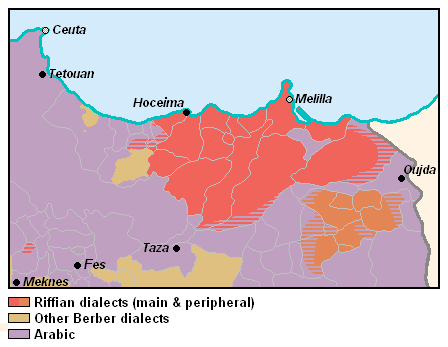
Riffian is spoken mainly in the Moroccan Rif on the Mediterranean coast and in the Rif mountains, with a large minority in the Spanish autonomous city of Melilla.[9] There are also speakers of Riffian in Morocco outside the Rif region, notably in the rest of Moroccan cities where they compose a minority. The neighbour state of Algeria is also home to Rif minorities. A Riffian-speaking community exists in the Netherlands and Belgium as well as to a lesser extent other European countries.[10][11]
Morocco
[edit]There is a large amount of dialectal variation in Riffian Berber; this can easily be seen using the dialect Atlas (Lafkioui, 1997), however Riffian compose a single language with its own phonetical innovations distinct from other Berber languages. Majority of them are spoken in Northern Morocco, this includes the varieties of Al Hoceima, Temsamane, Nador, Ikbadene (including Iznasen) and the more southernly variety in the Taza province. Besides Riffian, two other related and smaller Berber languages are spoken in North Morocco: the Sanhaja de Srair and the Ghomara languages. They are only distantly related to Riffian and are not mutually intelligible with it.[5]
Algeria
[edit]
A few Riffian dialects are or used to be in the western part of Algeria, notably by the Beni Snouss tribe of the Tlemcen, as well in Bethioua but also in various colonial districts Riffians started to emigrate to since the 19th century.[12][13]
Dialects
[edit]
There is no consensus on what varieties are considered Riffian and not, the difference of opinion mainly lie in the easternmost dialects of the Iznasen and the westernmost dialects of Senhaja de Sraïr and Ketama.[5] Dialects include West-Riffian (Al Hoceima), Central-Riffian (Nador) and East-Riffian (Berkane). Iznasen (Beni Znassen) is counted as a dialect in Kossman (1999), but Blench (2006) classifies it as one of the closely related Mzab–Wargla languages.
Lafkioui (2020) argues that the Berber varieties of the Rif area (North, Northwest, and Northeast Morocco), – including the varieties of the Senhaja (westernmost group) and of the Iznasen (easternmost group) – form a language continuum with 5 stable core aggregates:
- Western Rif Berber: cities such as Ketama and Taghzout.
- West-Central Rif Berber: cities such as Al Hoceima, Targuist, Imzouren.
- Central Rif Berber: cities such as Nador, Midar and Kassita.
- East-Central Rif Berber: cities such as Al Aaroui, Driouch and Ain Zohra.
- Eastern Rif Berber: cities such as Berkane and Ras Kebdana.
They cut across the traditionally used groupings of Senhaja, Rif, Iznasen which are in fact ethnonyms and hold no classification value of any kind, neither do they correspond to the sociolinguistic landscape of the Rif area, which shows considerable complexity.[14]
| Western | West-Central | Central | East-Central | Eastern | |
|---|---|---|---|---|---|
| Cat | amcic | amcic | mucc | miccew | mucc |
| Chick | asiwsiw, afullus | afiǧus, fiǧus | fiǧus | iceḵʷcew, icewcew | iceḵʷcew, icewcew |
| Ram | abeɛɛac | abeɛɛac, iḵerri, iḵaari | icaari, acaari, acraa | iḵaari, aḵraa | iḵerri |
| Land | tamazirt | tamurt, tamuat | tammuat | tammuat, tamuat | tammurt |
| Woman | tameṭut, tamɣert | tamɣert, tamɣaat | tamɣaat, tameṭṭut, tameṭut | tamɣaat, tameṭut | tamɣert, tameṭṭut, tameṭut |
Phonology
[edit]Vowels
[edit]| Front | Central | Back | |
|---|---|---|---|
| High | i | u | |
| Mid | (ə) | ||
| Low | a |
- A mid-central vowel /ə/ can occur in lax positions.
- Lax allophones of /i, a, u/ are heard as [ɪ, æ, ʊ].
- In the vicinity of pharyngealized consonants, /i, a, u/ are heard as [ɪˤ, ɑˤ, ʊˤ].
- Vowels lengthen in closed final syllables, e.g. tisit [θɪsɪˑθ] 'mirror'.
Vocalized r
[edit]| Vocalization[5] | Example | |||
|---|---|---|---|---|
| Phonemically | Phonetically | IPA | Originally | Translation |
| /iɾ/ | [ɛa] | [sːɛað] | ssird | to wash |
| /uɾ/ | [ɔa] | [ʊjɔa] | uyur | to walk |
| /aɾ/ | [a ~ æ] | [zəmːa ~ æ] | zemmar | to be able to |
| /iɾˤ/ | [ɪˤɑ] | [ɪˤɑðˤ] | iṛḍ | to dress |
| /uɾˤ/ | [ʊˤa] | [ʃːʊˤa] | ccuṛ | to fill |
| /aɾˤ/ | [ɑˤ] | [θɑˤmɣɑˤθ] | tamɣaṛt | woman |
Consonants
[edit]All consonants except for /ŋ/, /tʃ/ and /ʔ/ have a geminate counterpart. Most of the time, a geminate is only different from its plain counterpart because of its length. Spirantized consonants have long stops as their geminate counterparts, e.g. yezḏeɣ [jəzðəʁ] 'he lives' vs. izeddeɣ [ɪzədːəʁ] 'he always lives'. There are only a few phonotactic exceptions to this, e.g. in verb suffixes before vowel-initial clitics, ṯessfehmeḏḏ-as [θəsːfəɦməðːæs]. A few consonants have divergent geminated counterparts; ḍ (/dˤ/ and /ðˤ/) to ṭṭ (/tˤː/), w (/w/) to kkʷ (/kːʷ/), ɣ (/ʁ/) to qq (/qː/), and ř (/r/) to ǧ (/dʒː/). There are some exceptions to this. This is most common with ww, e.g. acewwaf [æʃəwːæf] 'hair', and rarely occurs with ɣɣ and ḍḍ e.g. iɣɣed [ɪʁːəð] 'ashes', weḍḍaạ [wədˤːɑˤ] 'to be lost'. /dʒ/ and /dʒː/ are allophonic realizations of the same phoneme, both are common.[2]
| Labial | Dental | Alveolar | Post- alveolar |
Palatal | Velar | Uvular | Pharyngeal | Glottal | |||||||
|---|---|---|---|---|---|---|---|---|---|---|---|---|---|---|---|
| plain | phar. | plain | phar. | plain | phar. | plain | phar. | plain | lab. | ||||||
| Nasal | m | n | ŋ | ||||||||||||
| Plosive | voiceless | p | pˤ | t | tˤ | tʃ | k | kːʷ | q | ʔ | |||||
| voiced | b | d | dˤ | dʒ | g | gːʷ | |||||||||
| Fricative | voiceless | f | θ | s | sˤ | ʃ | ʃˤ | ç | x ~ χ | ħ | |||||
| voiced | β | ð | ðˤ | z | zˤ | ʒ | (ʝ) | ɣ ~ ʁ | ʕ | ɦ | |||||
| Approximant | l | lˤ | j | w | |||||||||||
| Flap | ɾ | ɾˤ | |||||||||||||
| Trill | r | rˤ | |||||||||||||
Notes:
- /ʝ/ has become /j/ in most of Central Riffian e.g. ayenduz [æjəndʊz] instead of aɡ̠enduz [æʝəndʊz] 'calf'.
- /ç/ has mostly become /ʃ/ in Central Riffian and only occurs in a few words, e.g. seḵsu [səçsʊ] 'couscous'.
- Pharyngealization is a spreading feature, it may spread to a whole word.
- The only pharyngealized consonants common in Berber roots are /dˤ/, /ðˤ/, /zˤ/ and /rˤ/; the others seem to mainly occur in words of Arabic and Spanish origin.
- /ʃˤ/ seems to only occur in the nouns ucca [ʊˤʃˤ:ɑˤ] 'greyhound' and mucc [mʊˤʃˤ:] 'cat'.
- /ŋ/ occurs exclusively before the consonant /w/, it may be an assimilatory variant of n.
- Labialization only occurs with the geminates /kːʷ/ and /gːʷ/.
Assimilations
[edit]There are quite a few assimilations that occur with the feminine suffixes t and ṯ.[2]
- ḇ + ṯ = fṯ/ft (e.g. tajeǧeft < tajeǧeḇṯ 'gown/djellaba')
- z + ṯ = sṯ/st (e.g. talwist < talwizṯ 'gold coin')
- ẓ + ṯ = ṣṯ/ṣt (e.g. tayạạẓiṣt < tayạạẓiẓṯ 'hare')
- j + ṯ = cṯ/ct (e.g. taɛejjact < taɛejjajṯ 'dust')
- ɣ + ṯ = xṯ/xt (e.g. tmazixt < tmaziɣt 'Berber language')
- ɛ + ṯ = ḥṯ/ḥt (e.g. tqubeḥt < tqubeɛṯ 'little bird')
There are also other assimilations.
- ḏ + ṯ = tt (e.g. tabritt < tabriḏṯ 'path')
- d + ṯ = tt (e.g. a t-tawi < a d-ṯawi 'she will bring here')
- ḍ + ṯ = ṭṭ (e.g. tyaẓiṭṭ < tyaẓiḍṯ 'hen')
- m + ṯ = nt (e.g. taxxant < taxxamṯ 'small room')
- ř + ṯ = č (e.g. tameǧač < tameǧařṯ 'egg')
Spirantized consonants become stops after the consonant 'n', this occurs between words as well.
- qqimen da < qqimen ḏa 'they sit here'
- tilifun tameqqṛant < tilifun ṯameqqṛant 'the big phone'
Sound shifts
[edit]Zenati sound shifts
[edit]The initial masculine a- prefix is dropped in certain words, e.g., afus 'hand' becomes fus, and afiɣaṛ 'snake' becomes fiɣạṛ. This change, characteristic of Zenati Berber varieties, distances Riffian from neighbouring dialects such as Atlas-Tamazight and Shilha.[5]
L and ř
[edit]In the history of Western and Central Riffian /l/ has become /r/ in a lot of words. In most dialects there is no difference in this consonant (ř) and in original r, but in some dialects it is more clearly distinguished by the fact that ř is trilled while r is a tap. The difference becomes clearer when they are preceded by a vowel, because only original r has a heightening effect on the vowel preceding it e.g. aři [æɾɪ] vs ari [aɾɪ]. This sound shift has affected other consonants as well.
- /l/ in other dialects corresponds to 'ř' (/r/) in Riffian (e.g. ul > uř 'heart')
- The geminate equivalent, (/lː/) in other dialects corresponds to 'ǧ' (/dʒː/) in Riffian (e.g. yelli > yeǧi 'my daughter'). It is underlyingly řř.
- /lt/ in other dialects corresponds to 'č' (/tʃ/) in Riffian (e.g. weltma > wečma 'my sister'). It is underlyingly řt.
These sound shifts do not occur in the easternmost Riffian dialects of Icebdanen and Iznasen and the westernmost dialects.[5]
| Riffian letter | Riffian word | Original word | English meaning |
|---|---|---|---|
| Ř ř | uř | ul | heart |
| aɣyuř | aɣyul | donkey | |
| awař | awal | speech / word | |
| Ǧ ǧ | azeǧif | azellif | head |
| yeǧa | yella | he is / he exists | |
| ajeǧid | ajellid | king | |
| Č č | wečma | weltma | my sister |
| tacemřač | tacemlalt | blonde / white | |
| taɣyuč | taɣyult | female donkey (jenny) |
R vocalization
[edit]Postvocalic /r/ preceding a consonantal coda is vocalized, as in taddart > taddaat 'house/home'. Thus in tamara 'hard work/misery' the /r/ is conserved because it precedes a vowel. These sound shifts do not occur in the easternmost Riffian dialects of Icebdanen and Iznasen and the westernmost dialects beyond Ayt Waayaɣeř.[5]
Writing system
[edit]Like other Berber languages, Riffian has been written with several different systems over the years. Unlike the nearby Tashelhit (Shilha), Riffian Berber has little written literature before the twentieth century. The first written examples of Riffian Berber start appearing just before the colonial period. Texts like R. Basset (1897) and S. Biarnay (1917) are transcribed in the Latin alphabet but they are transcribed in a rather deficient way. Most recently (since 2003), Tifinagh has become official throughout Morocco. The Arabic script is not used anymore for writing Riffian Berber. The Berber Latin alphabet continues to be the most used writing system online and in most publications in Morocco and abroad.[2]
Grammar
[edit]Nouns
[edit]Tarifiyt has two genders, masculine and feminine. In countable nouns with Berber affixes, gender is derivative: in principle, every masculine noun has a feminine counterpart. Gender derivation is relatively straightforward. The feminine is derived from the masculine form by adding an element /t-/ to the prefix, and a suffix /-t/, as in most Berber languages. With humans and higher animals, masculine and feminine mark natural gender,[2] e.g.
- aḥenjia (M) 'boy' → taḥenjiat (F) 'girl'
- ayyaw (M) 'grandson' → tayyawt (F) 'granddaughter'
- asaadun (M) 'male mule' → tasaadunt (F) 'female mule'
- afunas (M) 'ox' → tafunast (F) 'cow'
For a few basic items there exist suppletive pairs, e.g.
- aayaz (M) 'man' → tamɣaat (F) 'woman'
- amyan (M) 'he-goat' → tɣaṭṭ (F) 'she-goat'
- icarri (M) 'ram' → tixsi (F) 'ewe'
- yis (M) 'horse' → řɛawda (F) 'mare'
Tarifiyt countable nouns distinguish a singular from a plural. Masculine plurals generally take the prefix /i-/, feminines /ti-/, and take the suffix /-en/ in the masculine and /-in/ in the feminine,[2] e.g.
- axxam (SG) 'room' → ixxamen (PL) 'rooms'
- tafunast (SG) 'cow' → tifunasin (PL) 'cows'
A few nouns have suppletive plurals:
- uma (SG) 'my brother' → ayetma (PL) 'my brothers'
- učma (SG) 'my sister' → issma (PL) 'my sisters'
Nouns with Berber affixes distinguish two forms, which are related to the syntactic context and function of the noun, "Free State" and "Annexed State". The Annexed State is used for subjects placed after the verb, after all prepositions except ař and břa, as a posttopic put in extraposition to the central clause and after a few prenominal elements. The Annexed State is formed as follows: in masculines, initial /a/ becomes /we/ and initial /i/ becomes /ye/. In feminines, initial /ta/ usually becomes /te/ and initial /ti/ also usually becomes /te/,[2] e.g.
- asnus → wesnus 'donkey foal (M)'
- tasnust → tesnust 'donkey foal (F)'
- isnas → yesnas 'donkey foals (M)'
- tisnas → tesnas 'donkey foal (F)'
In the Annexed State of the masculine, the high vowels u and i are used instead of the semivowels w and y when the noun stem starts with a consonant followed by a vowel (including schwa). The feminine AS prefix does not have schwa under this condition. This has to do with the constraint on schwa in open syllables,[2] e.g.
- afunas → ufunas 'bull'
- tafunast → tfunast 'cow'
- ifunasen → ifunasen 'bulls'
- tifunasin → tfunasin 'cows'
Lexicon
[edit]Basic vocabulary
[edit]| 1 | water | aman (plurale tantum) |
| 2 | nose | tinzaa (plurale tantum) |
| 3 | to run | azzeř |
| 4 | fire | timessi |
| 5 | mouth | aqemmum, imi |
| 6 | tongue | iřes |
| 7 | meat | aysum ~ aksum |
| 8 | bone | iɣess |
| 9 | clothes | aṛṛud |
| 10 | word | awař |
| 11 | neck | iri |
| 12 | people | iwdan |
| 13 | why? | mayemmi, maɣaa |
| 14 | to eat | cc |
| 15 | to cut | qess ~ qqes |
| 15 | to be scared | uggʷed |
| 16 | cold | aṣemmaḍ |
| 17 | room | axxam |
| 18 | to write | ari |
| 19 | dog | aqzin, aydi |
| 20 | when? | meřmi |
| 21 | to speak | siweř |
| 22 | cow | afunas |
Loanwords
[edit]Tarifit has loaned a fair amount of its vocabulary from Arabic, Spanish and French.[16] Around 51.7% of the vocabulary of Tarifit is estimated to have been borrowed (56.1% of nouns and 44.1% of verbs).[17] All loaned verbs follow Riffian conjugations, and some loaned nouns are Berberized as well. A lot of loans are not recognizable because of sound shifts that have undergone, e.g. ǧiřet [dʒːɪrəθ] 'night' (Arabic: al-layla), hřec [ɦrəʃ] 'sick' (Arabic: halaka).
Examples of words loaned from Classical/Moroccan Arabic
[edit]- ddenya: 'world' (orig. al-dunyā الدنيا)
- tayezzaat: 'island' (orig. jazīra جزيرة)
- řebḥaa: 'ocean' (orig. al-baḥr البحر)
- lwalidin: 'parents' (orig. al-wālidayn الوالدين)
- ḥseb: 'to count' (orig. ḥasaba حسب)
Examples of words loaned from Spanish
[edit]- familiya: 'family' (orig. familia)
- tpabut: 'duck' (orig. pavo)
- ṣpiṭạạ: 'hospital' (orig. hospital)
- pṛubaa: 'to try' (orig. probar)
- arrimaa: 'to land' (orig. arrimar)
Examples of words loaned from French
[edit]- maamiṭa: 'pot' (orig. marmite)
- furciṭa: 'fork' (orig. fourchette)
- ṣuṣis: 'sausage' (orig. saucisse)
- fumaḍa: 'cream' (orig. pommade)
- jjarḍa: 'garden' (orig. jardin)
Examples of words loaned from Latin
[edit]- faacu: 'eagle' (orig. falco)
- aqninni: 'rabbit' (orig. cuniculus)
- fiřu: 'thread' (orig. filum)
- aɣaṛṛabu: 'boat' (orig. carabus)
- asnus: 'donkey foal' (orig. asinus)
Sample text
[edit]From 'An introduction to Tarifiyt Berber (Nador, Morocco)' by Khalid Mourigh and Maarten Kossmann: Sirkuḷasyun (trafic)[2]
A:
A:
Ssalamuɛlikum.
peace.upon.you(PL)
A: Hello.
B:
B:
Waɛlikumssalam.
and.upon.you(PL).peace
B: Hello.
A:
A:
Teẓṛid
you(SG).saw
lakṣiḍa-nni
accident-that
yewqɛen?
happening
A: Did you see the (car) crash that happened?
B:
B:
Lla,
no
sřiɣ
i.heard
xas
on.it
waha.
only
B: No, I only heard about it.
A:
A:
Tewqeɛ
it(F).happened
deggʷ
in
brid
road(AS)
n
of
Wezɣenɣan.
zeghanghane(AS)
A: It happened on the Zeghanghane road.
B:
B:
Wah,
yes
lakṣiḍa
accident
d
PRED
tameqqṛant.
big(F:SG:FS)
B: Yeah, it was a big (car) crash.
A:
A:
Abrid
road(FS)
ibelleɛ
it.is.closed
maṛṛa.
all
A: The whole road is closed.
B:
B:
Immut
he.died
din
there
ca
some
n
of
yijjen?
one(M:AS)
B: Did anybody die there?
A:
A:
Wah,
yes
yemmut
he.died
ijjen
one
waayaz
man(AS)
d
and
mmi-s,
son-his
msakin.
poor.guys
A: Yes, one man and his son died, the poor guys.
B:
B:
Mamec
how
temsaa?
it(F).happened
B: How did it happen?
A:
A:
Yesḥạạq
he.burned
ssṭupp
traffic.light
uca
then
tudef
it(F).entered
daysen
in.them(M)
ijjen
one
ṭṭumubin.
car
A: He crossed the red light and then a car hit them.
B:
B:
Tuɣa
PAST
itazzeř
he.runs
ɛini.
probably
Iwa,
well
a
AD
ten-yạạḥem
them(M:DO)-he.has.mercy
sid-ạạbbi.
sir-lord
B: He was probably speeding. Well, may them rest in peace.
A:
A:
Ttḥawař
be.careful!
waha,
only
din
there
aṭṭas
much(FS)
n
of
ṭṭumubinat.
cars
A: Just be careful. There are many cars.
B:
B:
A
o
wah,
yes
yewseɣ
it(M).is.many
uqedduḥ.
tin.can(AS)
B: Yes, there are many tin cans (i.e. cars).
References
[edit]- ^ a b Gauthier, Christophe. "كلمة افتتاحية للسيد المندوب السامي للتخطيط بمناسبة الندوة الصحفية الخاصة بتقديم معطيات الإحصاء العام للسكان والسكنى 2024". Site institutionnel du Haut-Commissariat au Plan du Royaume du Maroc (in French). Retrieved 23 December 2024.
- ^ a b c d e f g h i j k l m n o Maarten Kossmann; Khalid Mourigh (2020). An introduction to Tarifiyt Berber (Nador, Morocco). Ugarit Verlag. ISBN 9783868353075.
- ^ Maaroufi, Youssef. "Recensement général de la population et de l'habitat 2004". Site institutionnel du Haut-Commissariat au Plan du Royaume du Maroc (in French). Archived from the original on 5 July 2011. Retrieved 2 June 2022.
- ^ "Population légale des régions, provinces, préfectures, municipalités, arrondissements et communes du Royaume d'après les résultats du RGPH 2014" (Xls). Morocco. Haut Commissariat au Plan. Retrieved 15 February 2016.
- ^ a b c d e f g h Mena Lafkioui (2007). Atlas linguistique des variétés berbères du Rif. Rüdiger Köppe Verlag. ISBN 978-3-89645-395-2.
- ^ Tarifit at Ethnologue (18th ed., 2015) (subscription required)
- ^ Destaing, Edmond (1907). Leroux, Ernest (ed.). Etude sur le dialecte Berbère des Beni-Snous (in French).
- ^ Biarnay, Samuel (1910). Étude sur les Bet'-t'ioua du Vieil-Arzeu.
- ^ "CpM moción regular Tamazight Melilla tomando ejemplo Bable Asturias". 14 April 2010. Archived from the original on 14 April 2010. Retrieved 7 March 2017.
{{cite web}}: CS1 maint: bot: original URL status unknown (link) - ^ Gazzah, Miriam (2008). Rhythms and Rhymes of Life: Music and Identification Processes of Dutch-Moroccan Youth. ISIM Dissertations. Amsterdam: Amsterdam University Press. p. 12. ISBN 978-90-485-0649-1.
It is estimated that roughly 60 to 80 % of the Moroccans in the Netherlands trace their roots back to the mountainous Rif area (Benali and Obdeijn 2005: 211) and speak a Berber language (Douwes et al. 2005: 29). [...] This has produced a rather heterogeneous Dutch-Moroccan population, which consists of Moroccan Berbers and non-Berbers, some speaking a Berber language and Moroccan-Arabic (and Dutch), others speaking only a Berber language (and Dutch), and later generations only speaking Dutch (Chafik 2004: 129). [...] The Berbers from the Rif speak Tarifit.
- ^ Mourigh, Khalid; Kossmann, Maarten (2019). An Introduction to Tarifiyt Berber (Nador, Morocco). Ugarit-Verlag. p. 12. ISBN 978-3-86835-307-5.
According to the most recent census data, Tarifiyt is spoken by 4.0 % of the Moroccan population, which amounts to about 1.35 million people. One may add to this number sizeable communities outside Morocco, especially in the Netherlands, Belgium, Germany and Spain.
- ^ Destaing, Edmond (1907). Leroux, Ernest (ed.). Etude sur le dialecte Berbère des Beni-Snous (in French).
- ^ Biarnay, Samuel (1910). Étude sur les Bet'-t'ioua du Vieil-Arzeu.
- ^ B. Lafkioui, Mena. "Rif Berber: From Senhaja to Iznasen. A qualitative and quantitative approach to classification". ResearchGate. Mena B. Lafkioui. Retrieved 26 November 2024.
- ^ a b Serhoual, Mohammed (2002). Dictionnaire tarifit-français (PhD thesis). Université Abdelmalk Essaidi.
- ^ Kossmann, Maarten (2009), Haspelmath, Martin; Tadmor, Uri (eds.), Tarifiyt Berber, Max Planck Institute for Evolutionary Anthropology
- ^ Kossmann, Maarten (2009). Loanwords in Tarifiyt, a Berber language of Morocco. De Gruyter Mouton. ISBN 9783110218435.
Sources
[edit]- Biarnay, Samuel (1911). Etude sur le dialecte des Bet't'ioua du Vieil-Arzeu. Alger: A. Jourdan. OCLC 458532850.
- Biarnay, Samuel (1917). Etude sur les dialectes berbères du Rif: Lexique, textes et notes de phonétique (in French). Paris: Leroux.
- Cadi, Kaddour (1987). Système verbal rifain: forme et sens ; linguistique tamaziqht (Nord Marocain). Études ethno-linguistiques Maghreb-Sahara. Paris: Peeters. ISBN 978-2-85297-195-0.
- Colin, Georges Séraphin (1929). "Le parler berbère des Gmara" (PDF). Hespéris. 9: 43–58.
- Kossmann, Maarten (2000). Esquisse grammaticale du rifain oriental. M. S. - Ussun amazigh. Paris: Peeters. ISBN 978-90-429-0892-5.
- Lafkioui, Mena (2007). Atlas linguistique des variétés berbères du Rif (in French). Köln: Rüdiger Köppe. ISBN 978-3-89645-395-2.
- McClelland, Clive (1996). "Interrelations of Prosody, Clause Structure and Discourse Pragmatics in Tarifit Berber". Faculty Dissertations.
- McClelland, Clive W. (2000). The Interrelations of Syntax, Narrative Structure, and Prosody in a Berber Language. Edwin Mellen Press. ISBN 978-0-7734-7740-7.
- Mourigh, Khalid; Kossmann, Maarten (2019). An Introduction to Tarifiyt Berber (Nador, Morocco). Ugarit-Verlag. ISBN 978-3-86835-307-5.
- Renisio, Amédée (1932). Étude sur les dialectes berbères des Beni Iznassen, du Rif, et des Senhaja de Sraïr: grammaire, textes et lexique (in French). Paris: E. Leroux.
- Abarrou, Jamâl (2023). Dictionnaire rifain-français illustré: Le parler d'Ayt Weryaghel (Rif central). Maroc (in French). Editions L'Harmattan. ISBN 978-2-14-032788-9.
External links
[edit]


- Tarifiyt Berber Vocabulary List (from the World Loanword Database)
- INALCO report on Tarifit (fr)
| International | |
|---|---|
| National | |
| Other | |

Tarifit
View on GrokipediaNames
Etymology
The term Tarifit derives from the Arabic word rīf, which denotes a rural or coastal area, particularly the "edge of cultivated land" in northern Morocco. This etymology reflects the language's close association with the Rif mountains and surrounding region, where it has been spoken for centuries. In Berber linguistic traditions, the name incorporates the characteristic feminine prefix ta-, used to designate languages or feminine nouns linked to a specific ethnic group or locale, paralleling formations like Tamazight for the broader Berber language family.[9][10][11] The Rif region and its Berber inhabitants are documented in medieval Arabic historical texts on the Emirate of Nekor (710–1019 CE), an early Islamic state in the area where Berber was spoken alongside Arabic, though without specific references to the language varieties ancestral to modern Tarifit. These references highlight the Rif Berbers' interactions with Arab conquerors and their role in early North African Islamic polities.[12] The designation Tarifit evolved into its current form during the French colonial era in Morocco (1912–1956), as European linguists and anthropologists began documenting and classifying Berber dialects amid efforts to administer the protectorate. Pioneering studies, such as those by Spanish and French scholars in the early 20th century, standardized Tarifit (or variants like Riffian) to distinguish it from other Berber languages like Central Atlas Tamazight. Post-independence scholarship, including ethnographic works by David M. Hart in the 1970s, further solidified the term in academic and sociolinguistic contexts, emphasizing its Zenati affiliation and regional dialects.[13][14]Alternative names
Tarifit is referred to by various endonyms and exonyms that reflect its speakers' self-identification, regional associations, and external linguistic designations. The primary endonym is Tarifit itself, which derives from the Rif region where it is predominantly spoken, while another common endonym is Tmaziɣt n Rif (or Tmaziγt n Rrif), translating to "the Berber language of the Rif" and emphasizing its place within the broader Amazigh linguistic tradition.[15] In international contexts, Tarifit is widely known by exonyms such as Riffian or Rif Berber in English, Rifain in French, and Rifeno (or Rifeño) in Spanish, names that highlight its geographic ties to the Rif mountains and are used in academic and colonial-era descriptions.[16][17] Other occasional exonyms include Arrif, Rifi, and Rifiya, often appearing in multilingual resources or diaspora communities.[17] Historically, in Arabic sources, the language has been termed Zenatiya, a name connected to the medieval Zenata Berber tribal groups whose territories aligned with the Rif area, underscoring its ancient ethnic and migratory roots.[18] These alternative names illustrate the interplay between local usage and external perceptions, without altering the language's core identity as a Zenati Berber variety.Classification
Place in Berber family
Tarifit, also known as Riffian, belongs to the Berber branch of the Afro-Asiatic language family, which encompasses approximately 40 languages spoken across North Africa.[19] This branch is characterized by shared typological features typical of Afro-Asiatic, including root-and-pattern morphology where consonantal roots combine with vocalic patterns and affixes to derive words, as seen in Tarifit's verbal and nominal derivations.[19] Berber languages, including Tarifit, exhibit noun state alternations (e.g., free and annexed states) and complex pronominal systems that reflect this morphological structure.[19] Within the Berber family, Tarifit is classified as a Northern Berber language, primarily spoken in northern, northeastern, and northwestern Morocco, distinguishing it from Southern Berber varieties such as Zenaga in Mauritania and Tuareg across the Sahara-Sahel region.[19][14] Northern Berber forms one of three main subdivisions, alongside Southern and Eastern groups, with Tarifit forming part of a dialect continuum that includes languages like Kabyle and Tamazight of the Middle Atlas.[19] In contrast, Southern Berber languages like Tuareg and Zenaga show greater geographical isolation and distinct phonological profiles, yet all share a common Berber origin traceable to prehistoric North Africa.[14] Genetic relationships among Berber languages, including Tarifit, are evidenced by shared innovations such as spirantization in verbal morphology, where stops become fricatives in certain contexts, and vocalization processes affecting liquids like /r/ and /ṛ/.[20] These innovations, alongside morphological oppositions in imperfective verb forms (e.g., gemination and prefixing), indicate internal developments that unify Northern Berber varieties like Tarifit with the broader family while highlighting subgroup coherence.[20] Tarifit's affiliation within the Zenati subgroup of Northern Berber further underscores these ties through specific lexical and morphological retentions.[19]Zenati affiliation
Tarifit belongs to the Zenati subgroup of Northern Berber languages, a major branch within the Berber family distinguished by a set of shared phonological and morphological innovations that set it apart from other Northern varieties like Kabyle or the Atlas languages.[21] The Zenati subgroup encompasses languages primarily spoken in northern Morocco, Algeria, and adjacent areas, including Ghomara (in the western Rif region), Senhaja varieties (northwestern Morocco), Tarifit itself (central and eastern Rif), the Mzab-Wargla group (such as Mozabite in the Mzab Valley and Wargla in the Aurès region of Algeria), and eastern extensions like Shawiya (Chaouia) and Figuig.[22][23] Linguist Maarten Kossmann identifies three key morphological innovations as defining features of Zenati: the merger of biradical verb classes into y-əBCa/u perfective forms (e.g., y-əgra), the restriction of prefix vowel-less nouns to certain CV- forms (e.g., Ø-šal "earth"), and the analogical change of BCu verbs to BCa (e.g., bḍu > bḍa, y-əbḍa).[23] Phonologically, Zenati languages exhibit consistent shifts, such as velar softening (*ḱ, ǵ > š, ž).[23] These innovations underscore Tarifit's integration into the subgroup, with Tarifit preserving them alongside innovations specific to its Rif varieties, like certain vowel reductions.[21] The internal classification of Zenati remains a subject of debate among Berber linguists, particularly regarding the degree of closeness between northwestern varieties like Tarifit and eastern ones like Shawiya. While Kossmann's analysis groups Tarifit within a northwestern cluster (including Ghomara and Senhaja) that shares broader Zenati traits with the eastern cluster (Shawiya, Mzab-Wargla), some studies highlight lexical similarity between Tarifit and Shawiya compared to non-Zenati neighbors, suggesting potential deeper ties or diffusion across the subgroup.[21][24] However, boundaries are described as fuzzy, with ongoing discussions on whether certain peripheral varieties (e.g., Timimoun or Zenaga) fully align or represent transitional forms influenced by contact.[25]Geographic distribution
In Morocco
Tarifit is predominantly spoken in the Rif region of northern Morocco, encompassing the provinces of Al Hoceima, Nador, and Driouch, where it serves as the primary language of local communities. This mountainous area, stretching along the Mediterranean coast, forms the linguistic and cultural heartland of the language, with usage concentrated in villages and towns nestled within the Rif Mountains.[26] The language is closely associated with several Berber tribal groups that inhabit these provinces, including the Aith Waryaghar, Ibuqquyen, AithAmmarth, Igzinnayen, Thimsaman, Axt Tuzin, Aith Said, Aith Wurishik, and Iqar`ayen, who identify as Irifiyen or Riffians and maintain Tarifit as their native tongue in traditional social structures and daily interactions. These tribes represent the core custodians of the language, embedding it in oral traditions, kinship networks, and local governance practices that have persisted despite historical influences from Arabic and colonial powers.[26]
In urban centers such as Al Hoceima, the provincial capital, Tarifit coexists with Moroccan Arabic and French in multilingual settings, particularly among literate and educated residents who use it for family communication, cultural expression, and community events. Rural areas, by contrast, exhibit stronger monolingual or dominant Tarifit usage, where the language reinforces tribal identities and agricultural lifestyles, though urbanization trends are gradually introducing bilingualism even in remote villages.[8][27]
In Algeria
Tarifit maintains a limited presence in Algeria, primarily in border regions adjacent to Morocco's eastern Rif areas, such as those near Oujda and Berkane, where the Iznasen dialect continuum extends across the national boundary into Algerian territory. This cross-border distribution reflects the historical continuity of Zenati Berber speech communities along the frontier. Further inland, isolated pockets persist in western Algeria, notably around Tlemcen, where the Beni Snous variety—closely affiliated with Tarifit through shared Zenati features—remains spoken by small groups.[28][29][30] Algerian Arabic exerts considerable linguistic pressure on these Tarifit varieties, leading to substantial lexical borrowing and structural adaptations. For instance, in the Beni Snous dialect, Arabic influence is evident in terms for everyday concepts like "night" (ǧǧiřǝṯ < Arabic layla) and domestic items. Phonological integration of Arabic sounds, such as emphatic consonants and gutturals, is common, while syntactic patterns like resumptive pronouns in relative clauses mirror Algerian Arabic constructions. This influence has accelerated language shift in communities like Arzew, where younger speakers increasingly favor Algerian Arabic over Tarifit.[30][30][30] Under Algeria's Berber language policy, Tarifit falls within the broader framework of Tamazight recognition, which was designated a national language in 2002 and elevated to official status alongside Arabic in 2016. This policy mandates the promotion of all Tamazight varieties, including their use in public life and cultural preservation. In education, Tamazight instruction has expanded to 44 provinces by 2019–2020, serving over 600,000 students through 15,000 classes, though implementation for marginal dialects like Tarifit remains uneven due to resource constraints and focus on dominant varieties such as Kabyle.[31][31][31]Speaker demographics
According to the 2024 Moroccan census, Tarifit is the native language of 3.2% of the population, or about 1.18 million people, with the majority residing in northern Morocco and significant diaspora communities in Europe, particularly the Netherlands and Belgium, where it serves as the primary heritage language for over 70% of Moroccan-origin residents. In the Netherlands, where Moroccans of Rif origin form about 70% of the ~400,000 Moroccan diaspora (as of 2023), Tarifit serves as a key heritage language for many, reflecting substantial migration from the Rif region since the mid-20th century.[32] Tarifit is spoken by an estimated 1.2 million native speakers worldwide as of 2024. The language's speaker demographics show a skew toward older generations, with intergenerational transmission weakening among youth due to urbanization, education in Arabic and French, and economic pressures favoring dominant languages.[8][33] In Morocco, children of Tarifit-speaking families often acquire Arabic as a second language early through schooling and social interactions, leading to code-switching and reduced exclusive use of Tarifit at home.[34] Diaspora youth in Europe exhibit similar shifts, prioritizing Dutch, French, or Arabic in public domains while maintaining Tarifit in familial contexts.[33] Tarifit holds a "vulnerable" status according to UNESCO's framework for language vitality, indicating that while it remains the first language for most children in core communities, its use is increasingly restricted to domestic and informal settings, with limited institutional support.[35] Revitalization efforts include educational programs in Morocco through the Royal Institute of Amazigh Culture (IRCAM), which develops standardized materials for Tarifit alongside other Berber varieties, and community initiatives in Europe, such as language classes in Belgium aimed at reconnecting youth with their heritage.[36][37] These interventions seek to counter decline by promoting literacy and media presence, though challenges persist due to fragmented dialectal standardization.[3]Dialects
Major varieties
Tarifit forms a dialect continuum across northern Morocco's Rif region, with principal varieties distinguished primarily by geographic location and degrees of innovation in phonology and lexicon. The major varieties include Western Rif Berber, spoken in the western areas around Tetouan and Ketama; West-Central and Central Rif Berber, centered in regions like Al Hoceima and Targuist; and Eastern Rif Berber, extending to areas near Nador and the Algerian border.[15] The Western Rif variety exhibits relatively conservative phonological features, such as limited vocalization of emphatic liquids like /r/ and /ṛ/, preserving older Berber patterns more closely than eastern counterparts.[15] This variety, sometimes including the distinct Ghomara subdialect near Tetouan, shows marked differences from central forms in morphology and syntax.[38] In contrast, the Central Rif variety around Al Hoceima is often featured in Rifian media, broadcasting, and cultural productions, reflecting its central position in the speech area and relative uniformity.[2] It balances innovations from both western conservatism and eastern influences, with phonological traits like progressive vocalization of liquids becoming more prominent eastward.[15] The Eastern Rif variety, encompassing the Iznassen (Beni Snassen) dialect near Nador and Oujda, displays stronger Arabic lexical borrowings and phonological adaptations, such as assimilation patterns influenced by neighboring Moroccan Arabic dialects, due to extended contact in border zones.[15][39] Although locally sometimes distinguished from core Rifian speech east of the Oued Kert river, it remains part of the broader Tarifit continuum.[38] Approximate isoglosses delineate these varieties, including variations in vowel length realization; for instance, comparisons across dialects reveal coerced vowel lengthening in compensatory contexts more variably in eastern forms than in western ones, where short vowels predominate without phonemic contrast.[40]Dialectal variation
Tarifit exhibits significant lexical variation across its dialects, particularly in core semantic fields such as body parts and kinship terms, as documented in a geolinguistic analysis of 169 lexical items collected from 141 locations in the Rif region.[28] For instance, the word for "hand" appears as fus in eastern varieties influenced by Zenati features, while western varieties retain afus, reflecting substrate influences from pre-Berber layers.[28] These differences arise from historical layering, with western dialects preserving Senhaja-derived forms and eastern ones incorporating Zenati innovations, leading to a patchwork of synonyms that can obscure mutual comprehension in peripheral areas.[28] The dialects form a phonetic continuum stretching from west to east across the Rif Mountains, characterized by gradual shifts in sound patterns and morphological markers that increase divergence over distance.[28] Western dialects, such as those around Ktama, maintain conservative Senhaja traits like the absence of gender agreement in plural verbs, whereas central varieties around Al Hoceima blend these with emerging Zenati elements, and eastern dialects near Iznasen feature pronounced palatalization, such as the shift of velar k to š (e.g., šəm "you" instead of kəm).[28] This east-west gradient results in decreasing mutual intelligibility eastward, where Zenati traits dominate and create barriers to full comprehension between speakers from opposite ends of the continuum, though adjacent varieties remain highly intelligible.[28] Sociolinguistic factors further shape dialectal dynamics, with Tarifit varieties from the central region holding prestige due to their use in media and broadcasting initiatives by institutions like the Royal Institute of Amazigh Culture (IRCAM).[2] Since 2001, IRCAM has promoted Tarifit through national television news bulletins and planned dedicated channels, elevating its status as a standardized form and reducing stigma associated with peripheral Senhaja or Zenati-influenced speech.[2] In 2024, IRCAM launched a free online platform for learning Tarifit and other Amazigh varieties, further supporting educational access and standardization efforts.[41] This prestige influences language attitudes, encouraging speakers from eastern and western areas to accommodate central features in formal contexts, though activist movements are increasingly valorizing peripheral varieties to counter historical marginalization.[28]Phonology
Vowel system
Tarifit possesses a vowel system comprising three short vowels: /i/, /a/, /u/. These vowels exhibit varying degrees of openness and rounding, with /i/ and /u/ being high, and /a/ low central. In certain analyses, long counterparts such as /iː/, /eː/, /aː/, /oː/, and /uː/ are recognized as phonemic, particularly in dialects where length contrasts affect meaning, though this remains debated among linguists.[42][43] A central feature of the system is the epenthetic schwa /ə/, a mid-central vowel that is not underlyingly phonemic but inserted to resolve consonant clusters, ensuring syllabic well-formedness. For example, in forms like underlying /ns/ surfacing as [əns], the schwa functions as a nuclear element in otherwise vowelless syllables. This process is systematic across dialects and highlights the language's preference for CV or CVC syllable structures.[44][43] Vowel harmony occurs in specific morphological contexts, such as certain nominal forms, where adjacent vowels assimilate in height or backness to maintain phonological uniformity. This is evident in some Tarifit nouns where stem vowels align features from the prefixal vowel.[11] In unstressed positions, vowels undergo reduction, often centralizing to [ə] or lowering in quality, which contributes to the surface realization of mid vowels like /e/ and /o/ as variants of high vowels in rapid speech. This reduction is particularly prominent in non-initial syllables and interacts with stress patterns to simplify the vocalic profile.[45]Consonant system
Tarifit possesses a consonant inventory of approximately 30 phonemes, comprising stops, fricatives, affricates, nasals, liquids, glides, and laryngeals/glottals. These include bilabials (/p, b, f, m/), alveolars and dentals (/t, d, n, s, z, l/), post-alveolars (/ʃ, ʒ, tʃ, dʒ/), velars (/k, g, x, ɣ/), uvulars (/q/), and glides (/j, w/), along with the liquid /r/ and glottals /h, ʔ/. A prominent feature of the system is the plain-emphatic contrast, realized through pharyngealization—a secondary articulation involving retraction of the tongue root and lowering of the pharynx, which lowers the vowels and affects adjacent segments. Emphatic consonants, denoted with a dot or ˤ in IPA (e.g., /tˤ, dˤ, sˤ, zˤ, ʃˤ, ʒˤ/), occur primarily among coronal stops, fricatives, and sibilants, though not all consonants have emphatic counterparts. This opposition is phonemic and contributes to lexical distinctions, such as in minimal pairs differing only in the emphatic quality. The inventory also features uvular consonants, including the voiceless uvular stop /q/ and fricatives /x/ and /ɣ/, the latter often realized with variable velar-uvular articulation depending on context. Pharyngeals /ħ/ and /ʕ/ are present, adding to the language's pharyngeal series and influencing vowel quality through coarticulatory effects.[46] Allophonic variation is observed in the rhotic /r/, which typically appears as a trill in geminate or emphatic contexts but as a flap [ɾ] in intervocalic singleton positions, reflecting positional constraints on articulatory effort.[47] The full consonant chart for the Iharassen variety of Tarifit is presented below, distinguishing short forms (long/geminate variants also occur phonemically for most).| Manner/Place | Bilabial | Labiodental | Dental/Alveolar | Post-Alveolar | Palatal | Velar | Uvular | Pharyngeal/Glottal |
|---|---|---|---|---|---|---|---|---|
| Stops | p, b | t, d, tˤ, dˤ | k, g | q | ʔ | |||
| Fricatives | f | s, z, sˤ, zˤ | ʃ, ʒ, ʃˤ, ʒˤ | x, ɣ | ħ, ʕ, h | |||
| Affricates | tʃ, dʒ | |||||||
| Nasals | m | n | ||||||
| Laterals | l | |||||||
| Rhotics | r | |||||||
| Glides | j | |||||||
| Labial-velar | w |
Phonological processes
Tarifit exhibits several phonological processes that alter sounds in specific contexts, including assimilations and historical sound shifts characteristic of its Zenati subgroup affiliation. Regressive voicing assimilation is a prominent synchronic process, where a voiceless obstruent becomes voiced when following a nasal consonant within the same syllable. For instance, in the Iharassen dialect, the form /taqmun/ "small mouth" surfaces as /taqmund/ due to the change /t/ → /d/ after /n/.[43] This rule applies prior to syllabification and is constrained to syllable boundaries, ensuring that voicing spreads only locally.[43] Place assimilation also occurs, particularly in clitics, where the place of articulation of a nasal or liquid adjusts to match an adjacent consonant; for example, the genitive clitic /n-/ assimilates to coronal place before dental stops, yielding forms like /n-tadunt/ → /n̩-tadunt/ "of the fat."[43] These assimilations contribute to the language's fluid syllable structure, which permits complex codas up to CVCC but favors resyllabification to resolve illicit clusters post-vowel syncope.[43] As a Zenati Berber language, Tarifit reflects historical sound shifts distinguishing it from other branches, such as the merger of /l/ to /r/ in many roots, especially in Western and Central Riffian varieties. This shift, /l/ > /r/, affects words like Proto-Berber *ul > Tarifit ur "heart," where the lateral becomes a rhotic tap or trill, and is widespread in the Central Rif, though exceptions persist in peripheral dialects.[48] Another Zenati innovation involves intervocalic changes, but the /l/-rhoticization exemplifies the subgroup's areal diffusion, driven by internal phonetic weakening.[48] R-vocalization represents a key diachronic process in Tarifit, where coda /r/ and emphatic /ṛ/ weaken and vocalize, producing long vowels or diphthongs to maintain syllable well-formedness. In Central Rif varieties, this yields forms like *aṯḇir > aṯḇī [aθbɪː] "pigeon," with /r/ → /iː/, or *urṯu > ūṯu [uːθu] "fig tree," creating /uː/ from postvocalic /r/.[48] This process adheres to syllable structure constraints prohibiting non-syllabic codas beyond two segments, triggering resyllabification in compounds or after epenthesis; for example, /n + tadunt/ → /nətadunt/ → /nə.da.dunt/ "of the fat," reassigning the nasal to a new onset.[43] Such changes expand the vowel inventory and highlight Tarifit's tolerance for vowelless onsets while enforcing coda limitations.[48]Orthography
Latin script
The standardized Latin-based orthography for Tarifit, developed by the Royal Institute of Amazigh Culture (IRCAM) in Morocco, extends the basic Latin alphabet with digraphs and diacritics to accommodate the language's phonological inventory. This system, part of the broader standardization for Moroccan Tamazight varieties including Tarifit, uses characters such as <č> to represent the affricate /tʃ/ and <ṛ> for the vocalized or rhotic sound involving r.[49] Vowel representation relies on diacritics for precision, with <ă> denoting the central schwa vowel and <â> marking a long open a, alongside standard letters for i and u. Other modifications include underdots for emphatic consonants (e.g., <ḍ>, <ṭ>) and letters like <ɣ> for the voiced velar fricative.[49] Although developed by IRCAM following its 2001 establishment and the 2011 recognition of Amazigh as an official language, the official script for Amazigh education and public domains is Neo-Tifinagh. The Latin orthography remains in use alongside Tifinagh for informal writing and diaspora communities.[50]Tifinagh script
The Tifinagh script, in its modern Neo-Tifinagh form, serves as the primary orthographic system for writing Tarifit, a Northern Berber language spoken primarily in northern Morocco and parts of Algeria. Developed as an adaptation of ancient Libyco-Berber writing, Neo-Tifinagh consists of 33 basic characters designed to represent the core phonemes of Berber languages, including vowels, which were absent in traditional variants.[51] This alphabet was standardized by the Royal Institute of Amazigh Culture (IRCAM) in Morocco to accommodate dialectal variations, such as the Rif-specific voiced velar fricative /ɣ/, rendered with the dedicated character ⵖ (U+2D56, Tifinagh Letter Yagh).[52] IRCAM's version, adopted officially in 2003 as the script for Tamazight (encompassing Tarifit), promotes a unified yet flexible system that extends the base set for regional sounds without altering the fundamental structure.[53] Neo-Tifinagh traces its immediate origins to revival efforts by Algerian Berber activists through the Berber Academy, established in Paris in 1966 by Kabyle intellectuals seeking to adapt Tuareg Tifinagh for broader Northern Berber use, including early applications to Riffian varieties like Tarifit.[54] In Algeria, where Tarifit communities exist along the border, adaptations emphasize Latin script for education, but Neo-Tifinagh variants persist in cultural and activist contexts, often aligning with IRCAM's extensions for phonetic accuracy in /ɣ/ and similar Rif phonemes.[55] These adaptations ensure compatibility across Berber dialects while preserving the script's geometric, abjad-like simplicity, with characters typically written left-to-right in modern usage. Digitally, Tifinagh gained Unicode support in version 4.1 (2005), enabling its integration into computing platforms for Tarifit texts, though initial proposals aligned with Morocco's 2003 adoption.[56] This has facilitated its appearance in Moroccan media, such as television broadcasts on channels like 2M and Arryadia, educational materials, and public signage at airports, government buildings, and roadways, where Tarifit phrases are inscribed alongside Arabic and French to promote Amazigh visibility.[55][57] In Algeria, digital use remains limited but growing in online cultural resources for border Tarifit speakers.Arabic script
Tarifit, like other Berber languages, has traditionally employed a modified form of the Arabic script to transcribe its phonology, especially in religious and literary contexts where additional diacritics address sounds absent from standard Arabic. A key adaptation is the letter ݣ (U+0763, Arabic Letter Keh with three dots above), which represents the voiced velar stop /g/. This script was fully vocalized using diacritics such as fatḥah for /a/, kasrah for /i/, and ḍammah for /u/, along with shaddah for gemination and sukūn for vowel-less consonants.[58] Historically, the Arabic script prevailed in pre-colonial Tarifit manuscripts and poetry, with evidence of Berber texts—including varieties like Tarifit—dating to the 12th century CE, predominantly religious works influenced by Islamic scholarship.[58] These adaptations facilitated the preservation of oral traditions in written form among Rifian communities before the widespread adoption of Latin and Tifinagh scripts. Today, the Arabic script plays a limited role in Tarifit writing, primarily in bilingual Arabic-Tarifit settings or by older generations, reflecting its occasional use in informal or traditional publications.[58] Surveys among Moroccan Amazigh speakers show it accounts for around 29% of script choices in emails and 22% in SMS, underscoring its niche persistence amid dominant Latin usage.[58]Grammar
Nominal morphology
Tarifit nouns inflect for two genders: masculine, which is the default and typically unmarked, and feminine, which is overtly marked by a suffix -t in the singular. Masculine gender often carries an augmentative semantic connotation, while feminine gender may indicate diminutive or neutral meanings, though these correlations are not always predictable and depend on the lexical root. For instance, the masculine noun a-ðnʤa denotes a "big spoon," whereas its feminine counterpart ð-a-ðnʤaj-t simply means "spoon."[11] Nouns also distinguish singular and plural number, with marking involving prefixes, suffixes, and often internal vowel alternations or "broken" plurals. Masculine singular nouns are prefixed with a- in the free state, while plurals typically feature an i- prefix and -n suffix, yielding forms like a-funās (singular "bull") becoming i-funās-n (plural "bulls"). Feminine singulars are prefixed with ta- or tə- and suffixed with -t, with plurals often marked by t-...-t, as in tafruxt (singular "girl") to tfrx-t (plural "girls"), though some classes use ti-...-in. Plural formation follows several classes, with about 10% of nouns lacking overt prefixes, relying instead on stem changes.[11][59] Tarifit employs a distinction between the free state (FS), the default form used for independent nouns or adjuncts, and the construct state (CS), a marked form required for annexation in possessive, genitive, or certain syntactic contexts such as post-verbal subjects or prepositional complements. In the FS, masculine singular nouns begin with a-, but in the CS, this shifts to i- or u-, often accompanied by vowel elision or alternation, as in the free a-rgaz ("man") becoming the construct irgaz. Feminine nouns in CS may involve schwa insertion or prefix reduction, e.g., ta-sdir-t ("bucket," FS) to t-sdir-t or u-sdir in possessive use. Adjectives and pre-verbal subjects remain in FS regardless of syntactic role.[11] Annexation rules trigger the CS on the head noun (the possessed element), forming a phonological unit with the possessor or governing head, which stays in FS. This applies to genitives via the particle n (e.g., a-mzzuʁ u-funās "the bull's ear," where u-funās is the CS of "bull") and datives with clitics (e.g., u-sdir ins "her bucket"). The CS is syntactically conditioned by c-command from tense (T) or prepositional (P) heads, excluding lexical roots and targeting functional projections for gender and number features; no CS marking occurs in coordinate structures or with adjectives.[59][11]Verbal morphology
Tarifit verbal morphology is characterized by a root-and-pattern system, in which primarily triconsonantal roots combine with affixes and internal vocalic modifications to encode grammatical categories, drawing from the broader Afroasiatic tradition but adapted to Berber specifics. Roots themselves are acategorial, acquiring verbal status only when merged syntactically with a verbal functional head (v), which introduces argument structure and aspectual properties. For instance, the root √z r 'see' can form i-zra 'he saw' in the perfective aspect. This system allows for non-concatenative processes like gemination and ablaut alongside prefixes and suffixes.[11] Aspect and tense in Tarifit are primarily aspectual, with the aorist serving as the unmarked, neutral base form often used for imperatives, habits, or generics; for example, zra 'see!' (imperative aorist). The perfective aspect, indicating completed events, is marked by a vocalic pattern such as -a- in eventive verbs (e.g., nḍa from √nḍ 'kill', meaning 'I killed'), while stative verbs use it for present states. The imperfective, denoting ongoing or habitual actions, employs a t- prefix or ablaut (e.g., t-zra 'she is seeing/habitually sees'), defaulting to present or progressive interpretations. Intensive forms, emphasizing repetition or intensity, arise through gemination of root consonants, as in ʃʃaθ 'hit repeatedly' from √ʃ a θ 'hit'. Negative constructions require the perfective and particle ur, with additional marking like -i on the verb's final syllable (e.g., ur i-zri 'he did not see') or circumfixes u-...-yi/gi in complex clauses (e.g., u-s-suq-yi 'he did not buy it'). Future tense is expressed via the prefix aḍ- or the auxiliary ʁa (e.g., ʁa i-uɣu 'he will go'), while past imperfective uses a-ra- prefix.[11][60] Subject agreement is obligatorily prefixed to the verb, reflecting person, gender, and number, while object agreement appears as suffixes; these clitics are essential, as no finite verbal clause lacks subject marking. Common subject prefixes include n- for 1st singular (e.g., n-zra 'I saw'), i- for 3rd masculine singular (e.g., i-zra 'he saw'), and ð- (or t- in some dialects) for 3rd feminine singular (e.g., ð-zra 'she saw'). Plural subjects trigger suffixes like -n (e.g., zri-n 'they (masc.) saw') or prefixes i- with -n (e.g., i-zri-n 'they (fem.) saw'). Object suffixes encode direct objects, such as -θ for 3rd masculine singular (e.g., ð-zri-θ 'she saw him') or -sn for 3rd plural (e.g., i-zri-sn 'he saw them'). In extraction contexts, such as focus or wh-questions, subject agreement may simplify to a participial form y-...-n (e.g., yzrin 'having seen'), suppressing full φ-features.[11][60][61] Derivational morphology in Tarifit creates valency-altering forms through prefixes, often interacting with the root's voice head. The causative is formed with the prefix s-, which transitivizes intransitives or adds a causer (e.g., s-ẓar 'teach' from √ẓ r 'learn'; i-s-nbjiw-n 'he fed the guests' from √nbjw 'be hungry'). An allomorph ss- appears with gemination when followed by certain segments, intensifying the causation (e.g., ss- variants in contexts like immediate object adjacency). Reflexives and reciprocals employ the root √ixf 'self' with possessives (e.g., ixf-n-š 'myself'; ixf-nsnd 'each other') or the prefix m- for middles/reciprocals (e.g., m-txəmm 'they hurt each other' from √txm 'hurt'). Passives are rare for transitives and use the prefix twa- (e.g., i-twa-çsi 'the bag was taken' from √çs 'take') or m- for inchoatives/middles (e.g., m-nz 'got sold' from √nz 'sell'), often preferring intransitive alternates over true passives.[11][60]Syntax and word order
Tarifit Berber exhibits a topic-prominent syntax, with a historical basic word order of Verb-Subject-Object (VSO) that has shifted toward Subject-Verb-Object (SVO) in modern usage, particularly in root clauses with lexical arguments. This evolution reflects a broader trend toward topic-comment structures, where the subject often topicalizes in Spec,TP, making SVO the preferred order in discourse (approximately 75% of cases). For instance, the sentence "Nunja i-zra a-qzin" ("Nunja saw the dog") illustrates the unmarked SVO pattern, while the VSO variant "?i-zra Nunja a-qzin" is less frequent and may sound marked or archaic. The shift to SVO prominence is attributed to contact with SVO-dominant languages like Moroccan Arabic and French, though the language retains VSO in embedded clauses and specific pragmatic contexts. Pronominal clitics play a central role in sentence structure, with subject clitics functioning as agreement prefixes that attach preverbally to the tense or negation host, while object clitics suffix postverbally to the verb. In the absence of tense marking, the verb raises to host the clitics, yielding forms like "i-zri-θ Nunja" ("He saw her, Nunja"), where "-θ" is the feminine object clitic. Dative clitics precede accusative ones and may front to precede the verb under prosodic adjacency conditions, as in "að-as-n wʃǝ-ʀ" ("I will give them to him"), ensuring clitic clusters remain verb-adjacent without clause climbing. Question formation distinguishes between content and polar types. Wh-questions involve fronting the wh-element (e.g., "min" for "what," "mani" for "where") to Spec,CP, accompanied by verb movement to C, enforcing a VSO order in the clause; preposition stranding is disallowed, so pied-piping occurs, as in "mi gi- i-ʃa aman g-mi?" ("What did he put water in?"). Yes/no questions are marked by the preverbal particle ma, often with rising intonation, allowing flexible word order but typically retaining SVO or VSO; an example is "ma yuri yas sskasar?" ("Did his sugar level go up?"), answered affirmatively with nisan ("yes").Vocabulary
Core Berber lexicon
The core lexicon of Tarifit comprises the indigenous vocabulary inherited from Proto-Berber, forming the essential building blocks for communication among speakers in northern Morocco's Rif region. These terms, preserved with minimal alteration in many cases, encompass basic human anatomy, quantification, family relations, and environmental features, reflecting the language's deep roots in the Berber linguistic tradition. Many such words exhibit cognates across Berber varieties, underscoring a common Proto-Berber ancestry that dates back millennia.[11] Body parts represent a key semantic field in Tarifit's core lexicon, with terms directly traceable to Proto-Berber forms. For instance, azɣif denotes "head," while a-mzzuɓ means "ear," a-qmmum refers to "mouth," a-qnsur refers to "face," ø-ur indicates "heart," and ø-iɓs stands for "bone." These nouns often follow Berber's characteristic prefixing patterns, such as the masculine a- or neuter ø-, and their inheritance from the proto-language is evident in parallel forms in languages like Kabyle and Tashelhit, where "ear" similarly derives from aməzzub and "mouth" from aqəmmum.[11][22] Numbers in Tarifit draw from Proto-Berber numerals, maintaining consistency with other Zenati and Atlas Berber dialects for low cardinals. The word for "one" is yan, cognate with yan in Central Atlas Tamazight and yat in Tashelhit, both stemming from Proto-Berber wan. "Two" is sin, shared as sin across multiple varieties from sin in the proto-form, and "three" is kraḍ, matching kraḍ in related languages and reconstructed as Proto-Berber krəḍ. Higher numbers follow suit, such as akkuš for "four" and smmus for "five," illustrating the lexicon's stability in quantification for daily counting and trade.[11][46] Kinship terms form another foundational layer, often inalienably possessed and reflecting patrilineal social structures in Berber societies. "Father" is aba or aɣa, with possessed forms like aba-s ("his/her father"), inherited from Proto-Berber ʔabb-a and cognate with bab-a in Tuareg. "Mother" is yemma or jemma, as in yemma-s ("his/her mother"), from Proto-Berber yammə and paralleled in Kabyle yemma. For offspring, "son" appears as miš in forms like mi-x ("your son") or mmiʃ-nə ("our son"), while "daughter" is ašiš, seen in yšiš-x ("your daughter") or jəʃiʃ-sn ("their daughter"); both derive from Proto-Berber roots miš and ašiš, respectively, with cognates like miš for "son" in Shawiya. Siblings include uma for "brother" (uma-m "your brother") and uʒma or wʒma for "sister" (uʒma-ç "your sister"), from Proto-Berber umə and wəzmə, shared with Tashelhit uma and xəmt. Plurals like ð-awa ("sons/children"), issi ("daughters"), aiš-ma ("brothers"), and suiš-ma ("sisters") highlight the language's morphological patterns for family groups.[11][22] Semantic fields related to nature and daily life further exemplify Tarifit's Proto-Berber heritage, adapted to the mountainous Rif terrain. "Water" is aman, a widespread cognate from Proto-Berber aman, appearing identically in Tashelhit and Kabyle for rivers, rain, and springs. "Mountain" is a-ðra (or adrar in broader usage), from adər in the proto-language, with parallels like adrar in Tuareg denoting prominent landscape features. Other terms include u-nza for "rain," u-ɣza for "river," a-zru for "stone," and ð-a-zru-t for "small stone," all inherited forms with cognates such as nza ("rain") in Central Atlas Tamazight. In daily life, words like a-funas ("bull/cow"), a-rgaz ("man"), ð-a-mɕa-ʃ ("young woman"), a-qzin ("dog"), and a-ȕrið ("road") provide core descriptors for agriculture, herding, and travel, rooted in Proto-Berber funas, ərgaz, and əbriḍ, respectively, and consistent across Berber dialects.[11][46]Borrowed elements
Tarifit exhibits a rich inventory of loanwords reflecting historical contacts with Semitic, Romance, and other languages, integrated to varying degrees into its phonological and morphological systems. Arabic provides the most extensive influence, comprising about 41.7% of the lexicon (dialectal Moroccan Arabic), primarily through Islamic expansion and ongoing bilingualism; these borrowings often undergo full nativization in older layers, such as substitution of pharyngealized consonants, while recent ones may preserve foreign phonemes like /q/. Spanish and French contributions, each around 6.3% of the vocabulary, stem from colonial and modern administrative contacts, typically showing partial adaptation and entering via urban or border dialects. Earlier Latin and Punic loans, mainly in agricultural and toponymic domains, are fully assimilated, often retaining case forms from the source language and demonstrating shifts like Latin /p/ to Tarifit /b/ in adapted terms.[39] Arabic loanwords permeate core domains like religion, education, and daily life, with patterns of integration including prefixation of Berber articles (a-) and adjustment to Tarifit's vowel and consonant inventory. For instance, the verb zɣal "to pray" derives from Arabic ṣallā, where the pharyngealized /ṣ/ is realized as /zɣ/ in a fully verbalized form. Similarly, ʕlm "to learn" comes from Arabic ʿallama, integrated as a verb stem possibly tracing to broader Semitic roots. The noun aḥšūš "insect" is borrowed from Moroccan Arabic and fully nativized without foreign markers. A widespread example is ktab "book," adapted from Arabic kitāb and commonly used with Berber plural morphology like ktuba. These loans contrast with the native Berber core lexicon by introducing triconsonantal roots typical of Arabic.[39][62] Spanish loanwords, prominent in the Taqer’iyt dialect near Melilla due to 19th-20th century colonial occupation, often remain minimally adapted and lack Berber prefixes, reflecting recent entry. Examples include a-gwit "seagull" from Spanish gaviota, with slight vowel shifts but no morphological integration; kisu "cheese" from queso, preserving the initial /k/; and t’uppa "mole" from topo, adapted with pharyngealization. Colonial terms like xebx "window," borrowed from Spanish ventana, show phonological accommodation to Tarifit's spirant /x/ for /v/. These borrowings fill gaps in maritime and household vocabulary where other Tarifit dialects might use Arabic equivalents.[39] French loanwords, introduced during the 20th-century protectorate and often mediated through Moroccan Arabic, appear in modern urban speech and technical contexts, with partial integration via reduplication or pharyngealization. Notable instances are m-mit’a "pot" from French marmite, doubled for emphasis in Berber style; s’us’i "sausage" from saucisse, with /s’/ adaptation; and t’iṛ "kick" (from "to shoot") from tirer, shortened and verbalized. In urban dialects, trən "train" directly reflects French train, used without further alteration in transportation lexicon.[39][63] Latin and Punic influences, dating to Roman and Carthaginian periods, are archaic and concentrated in agriculture, with full phonological integration and retention of source case endings—nominative for early loans, accusative for later ones. Examples include a-tmun "plough-beam" from Latin temonem (accusative), adapted to Berber nominal structure; asnus "donkey" from Latin asinus (nominative), fully assimilated as a basic zoological term; and a-gdra "fortified place" or fence from Punic g-d-r, appearing in toponyms and rural vocabulary. Adaptation patterns feature shifts such as Latin /p/ to /b/ (e.g., in related agricultural terms like potential borrowings for "pipe" or tools), alongside vowel harmony to Tarifit's system, underscoring pre-Arabic substrate impacts.[39][64]Sample texts
Illustrative passage
The following short poetic excerpt from a Rif Berber narrative depicts a sweltering bus journey in northern Morocco, capturing the frustrations of daily travel in the region: nyv di Ikar days irku yxear,tfuct tudar, tazqqa ttfwwar.
Min yuvin acifur, ma yuri yas sskasar?
Idammn nns ssurn, war yssin min yqqar,
Ittzawar ittkaear... This text is drawn from oral-inspired poetry in the Nador variety of Tarifit (Iqefdyen dialect, spoken in the eastern Rif), recorded and published in a collection of Riffian-Berber poems reflecting contemporary life.[65]
Translation and notes
The free English translation of the illustrative passage is as follows: I got on a bus with a broken air conditioner. The sun is at its summit, the roof is fuming. What's the matter with the driver—did his sugar level go up? His blood is boiling, he doesn't know what he's saying. He angers the assistant driver; he raves and rages.[65] An interlinear gloss for the opening line illustrates the morpheme-by-morpheme structure typical of Tarifit verbal and nominal forms:| Tarifit | nyv | di | Ikar | days | irku | yxear |
|---|---|---|---|---|---|---|
| Word-by-word | 1SG.get.on | with | bus | DEF | broken | AC |
| Morpheme gloss | 1SG-PFV.get.on | P | N | DEF | ADJ | N |