Hubbry Logo
Rocket-powered aircraftRocket-powered aircraftMain
Open search
Rocket-powered aircraft
Community hub
Rocket-powered aircraft
logo
8 pages, 0 posts
0 subscribers
Be the first to start a discussion here.
Rocket-powered aircraft
from Wikipedia
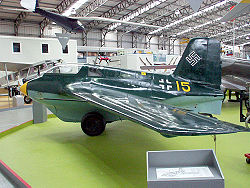
Messerschmitt Me 163 Komet, the only operational rocket-powered fighter aircraft

A rocket-powered aircraft or rocket plane is an aircraft that uses a rocket engine for propulsion, sometimes in addition to airbreathing jet engines. Rocket planes can achieve much higher speeds than similarly sized jet aircraft, but typically for at most a few minutes of powered operation, followed by a gliding flight. Unhindered by the need for oxygen from the atmosphere, they are suitable for very high-altitude flight. They are also capable of delivering much higher acceleration and shorter takeoffs. Many rocket aircraft may be drop launched from transport planes, as take-off from ground may leave them with insufficient time to reach high altitudes.

Rockets have been used simply to assist the main propulsion in the form of jet assisted take off (JATO) also known as rocket-assisted takeoff (RATO or RATOG). Not all rocket planes are of the conventional takeoff like "normal" aircraft. Some types have been air-launched from another plane, while other types have taken off vertically – nose in the air and tail to the ground ("tail-sitters").

Because of the use of heavy propellants and other practical difficulties of operating rockets, the majority of rocket planes have been built for experimental or research use, as interceptor fighters and space aircraft.

History

[edit]

Background

[edit]
Pedro Paulet's Avión Torpedo of 1902, featuring a canopy fixed to a delta tiltwing for horizontal or vertical flight.

Peruvian polymath Pedro Paulet conceptualized the Avión Torpedo in 1902 – a liquid-propellant rocket-powered aircraft that featured a canopy fixed to a delta tiltwing – spending decades seeking donors for the aircraft while serving as a diplomat in Europe and Latin America.[1] Paulet's concept of using liquid-propellant was decades ahead of rocket engineers at the time who utilized black powder as a propellant.[1] Reports of Paulet's rocket aircraft concept first appeared in 1927 after Charles Lindbergh crossed the Atlantic Ocean in an aircraft.[2] Paulet publicly criticized Austrian rocket pioneer Max Valier's proposal about a rocket-powered aircraft completing the journey faster using black powder, arguing that his liquid-propellant rocket aircraft from thirty years earlier would be a better option.[2]

Paulet would go on to visit the German rocket association Verein für Raumschiffahrt (VfR) and on March 15, 1928, Valier applauded Paulet's liquid-propelled rocket design in the VfR publication Die Rakete, saying the engine had "amazing power".[3] In May 1928, Paulet was present to observe the demonstration of a rocket car of the Opel RAK program of Fritz von Opel and Max Valier, and after meeting with the German rocket enthusiasts.[3] VfR members began to view black powder as a hindrance for rocket propulsion, with Valier himself believing that Paulet's engine was necessary for future rocket development.[3] Paulet would soon be approached by Nazi Germany to help develop rocket technology, though he refused to assist and never shared the formula for his propellant.[1] The Nazi government would then appropriate Paulet's work while a Soviet spy in the VfR, Alexander Boris Scherchevsky, possibly shared plans with the Soviet Union.[4]

Opel RAK.1 - World's first public manned flight of a rocket plane on September 30, 1929.

On 11 June 1928, as part of the Opel RAK program of Fritz von Opel and Max Valier, Lippisch Ente became the first aircraft to fly under rocket power.[5][6][7] During the following year, the Opel RAK.1 became the first purpose-built rocket plane to fly with Fritz von Opel himself as the pilot.[8] The Opel RAK.1 flight is also considered the world's first public flight of a manned rocket plane since it took place before a large crowd and with world media in attendance.

On 28 June 1931, another ground-breaking rocket flight was conducted by the Italian aviator and inventor Ettore Cattaneo, who created another privately built rocket plane. It flew and landed without particular problems. Following this flight, the King of Italy Victor Emmanuel III appointed Cattaneo count of Taliedo; due to his pioneering role in rocket flight, his likeness is displayed in the Space Museum of Saint Petersburg as well as in the Museum of Science and Tech of Milan.[9][10]

World War II

[edit]

The Heinkel He 176 was the world's first aircraft to be propelled solely by a liquid-propellant rocket engine. It performed its first powered flight on 20 June 1939 with Erich Warsitz at the controls.[11][page needed] The He 176, while demonstrated to the Reich Air Ministry did not attract much official support, leading to Heinkel abandoning its rocket propulsion endeavours; the sole aircraft was briefly displayed at the Berlin Air Museum and was destroyed by an Allied bombing raid in 1943.[12]

The first rocket plane ever to be mass-produced was the Messerschmitt Me 163 Komet interceptor, introduced by Germany towards the final years of the conflict as one of several efforts to develop effective rocket-powered aircraft.[13] The Luftwaffe's first dedicated Me 163 fighter wing, Jagdgeschwader 400 (JG 400) was established in 1944, and was principally tasked with providing additional protection for the manufacturing plants producing synthetic gasoline, which were prominent targets for Allied air raids. It was planned to station further defensive units of rocket fighters around Berlin, the Ruhr and the German Bight.[14]

A typical Me 163 tactic was to fly vertically upward through the bombers at 9,000 m (30,000 ft), climb to 10,700–12,000 m (35,100–39,400 ft), then dive through the formation again, firing as they went. This approach afforded the pilot two brief chances to fire a few rounds from his cannons before gliding back to his airfield.[15] It was often difficult to supply the needed fuel for operating the rocket motors. In the final days of the Third Reich, the Me 163 was withdrawn in favor of the more successful Messerschmitt Me 262, which used jet propulsion instead.[15]

Other German rocket-powered aircraft were pursued as well, including the Bachem Ba 349 "Natter", a vertical takeoff manned rocket interceptor aircraft that flew in prototype form.[16][17] Further projects never even reached the prototype stage, such as the Zeppelin Rammer, the Fliegende Panzerfaust and the Focke-Wulf Volksjäger. Having a much larger size than any other rocket-powered endeavor of the conflict, the Silbervogel antipodal bomber spaceplane was planned by the Germans, however, later calculations showed that design would not have worked, instead being destroyed during reentry.[18][page needed] The Me 163 Komet is the only type of rocket-powered fighter to see combat in history, and one of only two types of rocket-powered aircraft seeing any combat.

A Yokosuka MXY-7 Ohka replica at the Yasukuni Shrine Yūshūkan war museum

Japan, who was allied to Nazi Germany, secured the design schematics of the Me 163 Komet.[19] After considerable effort, it successfully established its own production capability, which was used to produce a limited number of its own copies, known as the Mitsubishi J8M, which performed its first powered flight on 7 July 1945.[20] Furthermore, Japan attempted to develop its own domestically designed rocket-powered interceptor, the Mizuno Shinryu; neither the J8M or the Shinryu ever saw combat.[21] The Japanese also produced approximately 850 Yokosuka MXY-7 Ohka rocket-powered suicide attack aircraft during the Second World War, a number were deployed in the Battle of Okinawa. Postwar analysis concluded that the Ohka's impact was negligible, and that no U.S. Navy capital ships had been hit during the attacks due to the effective defensive tactics that were employed.[22]

Other experimental aircraft included the Soviet Bereznyak-Isayev BI-1 that flew in 1942 while the Northrop XP-79 was originally planned with rocket engines but switched to jet engines for its first and only flight in 1945. A rocket-assisted P-51D Mustang was developed by North American Aviation that could attain 515 mph (829 km/h).[23][24] The engine ran on fumaric acid and aniline which was stored in two 75-US-gallon (280 L) under wing drop tanks.[24] The plane was tested in flight in April 1945. The rocket engine could run for about a minute.[24] Similarly, the Messerschmitt Me 262 "Heimatschützer" series used a combination of rocket and jet propulsion to allow for shorter take-offs, faster climb rate, and even greater speeds.[25]

Cold War era

[edit]
The X-15's XLR99 rocket engine used ammonia and liquid oxygen.
The Lockheed NF-104A had rocket and air-breathing turbojet engines, shown here climbing with rocket power. The rocket used hydrogen peroxide and JP-4 jet fuel.

During 1946, the Soviet Mikoyan-Gurevich I-270 was constructed in response to a Soviet Air Forces requirement issued during the previous year for a rocket-powered interceptor aircraft in the point-defence role.[26] The design of the I-270 incorporated several pieces of technology that had been developed by Sergei Korolev between 1932 and 1943.[27][28]

During 1947, a key milestone in aviation history was reached by the rocket-powered Bell X-1, which became the first aircraft to break the speed of sound in level flight, and would be the first of a series of NACA/NASA rocket-powered aircraft.[29] Amongst these experimental aircraft were the North American X-15 and X-15A2 designs, which were operated for around a decade and eventually attained a maximum speed of Mach 6.7 as well as a peak altitude in excess of 100 km, setting new records in the process.[30]

During the 1950s, the British developed several mixed power designs to cover the performance gap that existed in then-current turbojet designs. The rocket was the main engine for delivering the speed and height required for high speed interception of high level bombers and the turbojet gave increased fuel economy in other parts of flight, most notably to ensure that the aircraft was able to make a powered landing rather than risking an unpredictable gliding return.[31][32] One design was the Avro 720, which was primarily propelled by an 8,000 lbf (36 kN) Armstrong Siddeley Screamer rocket engine that ran on kerosene fuel mixed with liquid oxygen as the oxidizing agent.[33] Work on the Avro 720 was abandoned shortly after the Air Ministry's decision to terminate development of the Screamer rocket engine, allegedly due to official concerns regarding the practicality of using liquid oxygen, which boils at -183 °C (90 K) and is a fire hazard, within an operational environment.[34][35][36]

Work reached a more advanced stage with the Avro 720's rival, the Saunders-Roe SR.53. The propulsion system of this aircraft used hydrogen peroxide as a combined fuel and oxidiser, which was viewed as less problematic than the Avro 720's liquid oxygen.[34] On 16 May 1957, Squadron Leader John Booth DFC was at the controls of XD145 for the first test flight, following up with the maiden flight of the second prototype XD151, on 6 December 1957.[37][38] During the subsequent flight test programme, these two prototypes flew 56 separate test flights, during which a maximum speed of Mach 1.33 was recorded.[39] Furthermore, since late 1953, Saunders-Roe had worked upon a derivative of the SR.53, which was separately designated as the SR.177; the principal change was the presence of an onboard radar, lacking on the SR.53 and the Avro 720 as it not being a requirement of the specification, but left the pilot dependent on his own vision other than radio-based directions supplied from ground-based radar control.[40]

Both the SR.53 and its SR.177 cousin were relatively close to attain production status when wider political factors bore down upon the programme. During 1957, a massive re-thinking of air defence philosophy in Britain occurred, which was embodied in the 1957 Defence White Paper. This paper called for manned combat aircraft to be replaced by missiles, and thus the prospects of an order from the RAF evaporated overnight.[41] While both the Royal Navy and Germany remained potential customers for the SR.177, the confidence of both parties was shaken by the move.[42] Further factors, such as the Lockheed bribery scandals to compel overseas nations to order the Lockheed F-104 Starfighter, also served to undermine the sale prospects of the SR.177, costing potential customers such as Germany and Japan.[43]

Throughout the late 1940s and 1950s, the French Air Staff also had considerable interest in rocket-powered aircraft.[44] According to author Michel van Pelt, French Air Force officials were against a pure rocket-powered flight but favoured a mixed-propulsion approach, using a combination of rocket and turbojet engines. While the Société d'Etudes pour la Propulsion par Réaction (SEPR) set about developing France's own domestic rocket engines, the French aircraft manufacturer SNCASE was aware of the French Air Force's keenness for a capable point defence interceptor aircraft, and thus begun work on the SNCASE SE.212 Durandal.[44] In comparison to other French mixed-power experimental aircraft, such as the competing SNCASO Trident prototype interceptor, it was a heavier aircraft, intended to fly primarily on its jet engine rather than its rocket motor.[45] A pair of prototype aircraft were constructed; on 20 April 1956, the first performed its maiden flight, initially flying only using jet power.[46] It was the second prototype that first made use of the rocket motor during April 1957.[46] During flight testing, a maximum speed of 1,444 kilometres per hour (897 mph) was attained at an altitude of12,300 metres (40,400 ft), even without using the extra power of the rocket motor; this rose to 1667 km/h at 11,800 m while the rocket was active. A total of 45 test flights were performed prior to work on the programme being terminated.[46]

A SNCASO Trident on static display

At the request of the French Air Staff, the French aircraft company SNCASO also developed its own point defence interceptor, the SNCASO Trident.[44] It was primarily powered by a single SEPR-built rocket engine and augmented with a set of wing-tip mounted turbojet engines; operationally, both rocket and turbojet engines were to be used to perform a rapid climb and interception at high altitudes, while the jet engines alone would be used to return to base.[44] On 2 March 1953, the first prototype Trident I conducted the type's maiden flight; flown by test pilot Jacques Guignard, the aircraft used the entire length of the runway to get airborne, being powered only by its turbojet engines.[47] On 1 September 1953, second Trident I prototype crashed during its first flight after struggling to gain altitude after takeoff and colliding with an electricity pylon.[48] Despite the loss, the French Air Force were impressed by the Trident's performance and were keen to have an improved model into service.[49] On 21 May 1957, the first Trident II, 001, was destroyed during a test flight out of Centre d'Essais en Vol (Flight Test Center); caused when highly volatile rocket fuel and oxidiser, Furaline ( C13H12N2O) and Nitric acid (HNO3) respectively, accidentally mixed and exploded, resulting in the death of test pilot Charles Goujon.[50][51] Two months later, all work was halted on the programme.[47]

The advancement of the turbojet engine output, the advent of missiles, and advances in radar had made a return to mixed power unnecessary.

The Martin Aircraft Company X-24 lifting body built as part of a 1963 to 1975 experimental US military program

The development of Soviet rockets and satellites was the driving force behind the development of NASA's space program. In the early 1960s, American research into the Boeing X-20 Dyna-Soar spaceplane was cancelled due to lack of purpose; later the studies contributed to the Space Shuttle, which in turn motivated the Soviet Buran. Another similar program was ISINGLASS which was to be a rocket plane launched from a Boeing B-52 Stratofortress carrier, which was intended to achieve Mach 22, but this was never funded. ISINGLASS was intended to overfly the USSR. No images of the vehicle configuration have been released.[52]

The Lunar Landing Research Vehicle was a mixed powered vehicle- a jet engine cancelled 5/6 of the force due to gravity, and the rocket power was able to simulate the Apollo lunar lander.[53]

Various versions of the Reaction Motors XLR11 rocket engine powered the X-1 and X-15, but also the Martin Marietta X-24A, Martin Marietta X-24B, Northrop HL-10, Northrop M2-F2, Northrop M2-F3, and the Republic XF-91 Thunderceptor, either as a primary or auxiliary engine.

Post Cold War era

[edit]
EZ-Rocket research aircraft

The EZ-Rocket research and test airplane was first flown in 2001.[54] After evaluating the EZ-Rocket, the Rocket Racing League developed three separate rocket racer aircraft over the following decade.[55][56]

During 2003, another privately developed rocket-powered aircraft performed its first flight. SpaceShipOne functions both as a rocket-powered aircraft—with wings and aerodynamic control surfaces—as well as a spaceplane—with RCS thrusters for control in the vacuum of space. For their work, the SpaceShipOne team were awarded the Space Achievement Award.[57]

In April 2019, the Chinese company Space Transportation carried out a test of a 3,700-kilogram technology demonstrator named Jiageng-1. The 8.7-meter-long plane has a wingspan of 2.5 meters and it is a part of development of the larger, future Tianxing-I-1 vertical takeoff, horizontal landing reusable launch vehicle.[58]

Planned rocket-powered aircraft

[edit]

See also

[edit]

References

[edit]
[edit]
Revisions and contributorsEdit on WikipediaRead on Wikipedia
from Grokipedia
Rocket-powered aircraft are fixed-wing vehicles propelled exclusively by rocket engines, which generate thrust through the combustion of stored propellants in a manner independent of atmospheric oxygen, allowing for exceptional acceleration, high speeds, and altitudes but typically limited to short-duration flights due to fuel constraints. The history of rocket-powered aircraft dates back to the late 1920s, with the first piloted flight occurring on June 11, 1928, when German test pilot Fritz Stamer flew the Lippisch Ente glider equipped with a solid-fuel rocket motor for approximately 1.5 kilometers, marking the inception of human-crewed rocket aviation from automotive racing-derived technology. During World War II, Germany pioneered operational use with the Messerschmitt Me 163 Komet, a tailless interceptor designed by Alexander Lippisch that entered service in July 1944, powered by a Walter HWK 509 liquid-fuel rocket engine producing 3,748 pounds of thrust, achieving speeds up to 596 miles per hour and a climb rate of 16,000 feet per minute, though its volatile hypergolic fuels and mere 7.5 minutes of powered endurance resulted in only nine confirmed victories and significant pilot hazards. Postwar, the United States advanced the field through the X-plane program, beginning with the Bell X-1, a rocket-powered research aircraft developed in 1944 under a joint Army Air Forces and Bell Aircraft initiative with NACA technical support, which on October 14, 1947, saw Captain Chuck Yeager achieve the first supersonic flight at Mach 1.06 (approximately 700 miles per hour) at 43,000 feet, shattering the sound barrier and validating decades of aerodynamic research. Subsequent developments emphasized hypersonic and high-altitude exploration, exemplified by the , a joint , , and project initiated in 1952 and first rolled out in 1958, which conducted 199 flights from 1959 to 1968 using an XLR99 engine delivering 57,000 pounds of thrust, reaching a maximum speed of Mach 6.70 (about 4,520 miles per hour) and altitude of 354,200 feet, thereby gathering critical data on aerodynamics, propulsion, and human factors that informed the and earned astronaut wings for 13 pilots. These aircraft have primarily served research and military roles, pushing boundaries of speed from subsonic to hypersonic regimes and serving as precursors to modern suborbital vehicles like and ongoing commercial efforts such as Virgin Galactic's spaceflights (as of 2025) and Dawn Aerospace's reusable Mk-II Aurora rocket plane, though challenges such as fuel toxicity, structural stresses, and brief flight times have confined their practical applications.

Fundamentals

Definition and Classification

Rocket-powered aircraft are fixed-wing vehicles, either manned or unmanned, that derive their primary from rocket engines, which operate by expelling high-velocity exhaust gases from self-contained propellants without relying on atmospheric oxygen. This distinguishes them from air-breathing systems such as turbojets or propellers, which ingest external air for combustion. Unlike , rocket-powered variants can achieve extreme speeds and altitudes in both atmospheric and near-space environments due to their non-air-dependent operation. These aircraft are classified in multiple ways to reflect their and application. By propulsion type, they utilize liquid-fueled rockets, where fuel and oxidizer are stored separately and pumped into the ; solid-fueled rockets, featuring pre-mixed solid propellants that burn progressively; or hybrid systems combining a with a liquid or gaseous oxidizer for enhanced controllability. By purpose, categories include military interceptors designed for rapid climbs and short-duration engagements, research vehicles for testing hypersonic and limits, and assist platforms that carry and deploy orbital payloads from high altitudes. The exemplifies a hypersonic research rocket plane, while the Messerschmitt Me 163 represents the first operational pure rocket fighter in the military interceptor category. Configuration-based classification further differentiates pure rocket aircraft, which rely solely on rocket propulsion for all flight phases, from mixed or assisted designs that incorporate rockets to augment other engines, such as in rocket-assisted takeoff (RATO) systems for overloaded conventional aircraft. This evolution in classification arose during mid-20th-century developments, when early experiments transitioned from auxiliary boost roles to fully integrated rocket propulsion for operational use, as seen with the Me 163's introduction in 1944.

Propulsion Principles

Rocket-powered aircraft generate thrust through rocket engines that operate independently of the surrounding atmosphere, relying solely on onboard propellants. According to Newton's third law of motion, the engine expels high-velocity exhaust gases rearward, creating an equal and opposite forward reaction force that propels the . This principle allows rockets to achieve high speeds in various flight regimes, from subsonic to hypersonic, without ingesting air. The magnitude of is governed by the : F=m˙ve+(pepa)AeF = \dot{m} v_e + (p_e - p_a) A_e Here, FF represents the net force, m˙\dot{m} is the mass flow rate of the exhaust gases, vev_e is the effective exhaust velocity relative to the , pep_e is the at the exit, pap_a is the ambient , and AeA_e is the exit area. This arises from the conservation of across the engine's , where the first term captures the change due to mass ejection, and the second term accounts for the differential at the exit. In applications, where engines operate within the dense lower atmosphere, the term becomes significant; underexpanded s (where pe>pap_e > p_a) can enhance near , but mismatched designs reduce efficiency at higher altitudes. Rocket engines for aircraft fall into three main chemical types: liquid, solid, and hybrid, each with distinct operational characteristics suited to different mission profiles. Liquid engines use bipropellant systems, such as liquid oxygen (LOX) as the oxidizer and kerosene as the fuel, stored in separate tanks and pumped into the combustion chamber for mixing and burning; they provide high thrust controllability and restart capability but demand complex cryogenic handling and turbopump systems, increasing weight and maintenance needs. Solid engines employ pre-mixed, solid-phase propellants cast into a grain that burns progressively from the surface, offering simplicity, high reliability, and immediate high-thrust response ideal for short-duration boosts, though they are non-throttleable, non-restartable, and produce fixed burn times. Hybrid engines combine a solid fuel grain (e.g., hydroxyl-terminated polybutadiene) with a liquid or gaseous oxidizer (e.g., nitrous oxide), enabling throttling by regulating oxidizer flow while inheriting the safety and storage ease of solids over full liquids; however, they suffer from lower combustion efficiency due to diffusion-limited burning and potential issues with fuel regression uniformity. A key metric for assessing rocket engine efficiency is (IspI_{sp}), defined as the produced per unit weight flow rate of , given by Isp=Fm˙g0=veg0I_{sp} = \frac{F}{\dot{m} g_0} = \frac{v_e}{g_0} (where g09.81m/s2g_0 \approx 9.81 \, \mathrm{m/s^2} is ), and typically measured in seconds. For aircraft rocket engines, IspI_{sp} ranges from 200–300 seconds for solid propellants at to 300–450 seconds for liquid bipropellants, reflecting their conversion to kinetic exhaust energy. In contrast, air-breathing engines like turbojets achieve effective IspI_{sp} values of 800–2000 seconds by leveraging atmospheric oxygen, which reduces onboard mass needs but limits operation to within the sensible atmosphere; rockets' lower IspI_{sp} is offset by their ability to function in or thin air, enabling superior high-altitude performance. Aircraft rocket engines require robust ignition and throttling mechanisms to support dynamic flight demands, such as rapid or precise maneuvering. Hypergolic fuels, like nitrogen tetroxide and derivatives, ignite spontaneously upon mixing without external igniters, ensuring reliable startups in varying gravitational and thermal conditions encountered during launch or in-flight restarts. Throttling in and hybrid engines is accomplished by modulating flow through variable-area valves or pump speeds, allowing adjustments from 10–100% of nominal levels for control; solid engines, lacking such features, are confined to all-or-nothing operation.

Design and Operation

Structural and Aerodynamic Features

Rocket-powered aircraft are engineered with specialized materials to endure the severe thermal and mechanical stresses imposed by high-thrust rocket engines and rapid accelerations. High-temperature alloys, including and nickel-based superalloys, provide essential strength and oxidation resistance in components exposed to exhaust plumes reaching temperatures exceeding 1,000°C. Metal-matrix composites and ceramic-matrix composites further enhance durability by combining low weight with superior heat tolerance, allowing structures to operate in the 600–1,800°F range without deformation. Aerodynamic configurations prioritize low drag to optimize performance during brief powered phases, often incorporating swept wings to mitigate compressibility effects at supersonic speeds. By angling the wings rearward, shock wave formation is delayed, reducing wave drag and enabling efficient transonic and supersonic flight. Control surfaces are augmented with reaction control systems, employing small rocket thrusters fueled by monopropellants like hydrogen peroxide, to maintain stability and attitude at high altitudes where aerodynamic forces diminish due to thin air. High-altitude operations necessitate robust pressurization and features, as these aircraft routinely exceed 100,000 feet where drops critically low. Pressurized cockpits maintain habitable internal conditions, while pilots often wear full-pressure suits to counteract decompression risks; these suits provide a sealed, oxygenated environment equivalent to sea-level pressure. Dedicated oxygen delivery systems, independent of any air-breathing components, ensure continuous supply via masks or integrated suit umbilicals, preventing hypoxia during ascent and descent. Landing configurations adapt to fuel depletion and reduced post-burn, typically featuring jettisonable takeoff dollies or retractable gear to eliminate excess mass during flight, followed by fixed skids or belly pans for unpowered glider-style touchdowns. These setups minimize structural complexity while accommodating high landing speeds. A key design trade-off centers on achieving thrust-to-weight ratios exceeding 1 to enable rapid acceleration and vertical climbs, which demands ultra-lightweight airframes using advanced alloys and composites. However, this emphasis on minimal mass often compromises overall robustness, resulting in heightened vulnerability to impacts and increased pilot risk during high-g maneuvers or .

Performance Metrics and Limitations

Rocket-powered aircraft exhibit exceptional performance in terms of speed, altitude, and due to their high-thrust rocket propulsion systems. These vehicles can achieve maximum speeds exceeding Mach 3, with some designs reaching hypersonic regimes above Mach 5 under optimal conditions, enabling through the atmosphere. Altitudes up to approximately 100 km, approaching the edge of , are attainable, allowing access to near-vacuum environments for research and testing. Accelerations of 2–6 g are typical during powered ascent phases, providing vertical climb capabilities far beyond conventional . The typical flight profile of rocket-powered aircraft is characterized by short powered durations followed by unpowered glide or ballistic phases. Powered flight lasts 5-15 minutes, limited by rapid fuel depletion, with total mission times rarely exceeding 20 minutes from launch to landing. Without external assistance such as air-launch from carrier aircraft, operational range is constrained to 100-500 km, emphasizing point-to-point or suborbital trajectories rather than sustained cruise. Inherent limitations stem from the propulsion system's characteristics and environmental interactions. Rocket engines do not support in-flight refueling, necessitating complete fuel loads at launch and precluding extended missions. Although providing thrust independent of atmospheric density, these aircraft remain dependent on air for aerodynamic lift and control, restricting operations to within or near the sensible atmosphere. High-speed flight induces severe thermal stresses from aerodynamic heating, potentially exceeding 1,000°C on leading edges, while intense g-forces during acceleration impose structural and physiological demands on the airframe and pilot. Compared to jet-powered , rocket propulsion offers superior thrust-to-weight ratios, often exceeding 2:1, which facilitates vertical takeoffs and steep climbs unattainable by air-breathing engines. However, specific consumption rates are significantly higher—typically 10-20 times that of turbojets—due to the need to carry oxidizer, resulting in impulse efficiencies of 200-450 seconds versus over 1,000 seconds equivalent for jets. This disparity underscores rockets' suitability for burst performance over endurance. For missions involving a post-burnout unpowered glide phase, range can be approximated using the equation R=V2g(LD)R = \frac{V^2}{g} \cdot \left( \frac{L}{D} \right) where RR is the glide range, VV is the burnout velocity, gg is , and L/DL/D is the . This simplification assumes a shallow glide angle and constant L/DL/D, providing a conceptual estimate of downrange after exhaustion.

Historical Development

Early Experiments and World War II

The pioneering concepts for rocket-powered aircraft emerged in the early , influenced by American physicist Robert H. Goddard's theoretical work on liquid-fueled rockets. In his 1914 patent and subsequent experiments, Goddard demonstrated that liquid propellants could achieve greater efficiency than solids, enabling higher velocities and altitudes that would later inform aviation applications. His 1926 launch of the first provided foundational proof-of-concept for propulsion systems adaptable to aircraft. European experiments accelerated in the 1920s, with German industrialist sponsoring practical tests to promote rocketry. In 1928, von Opel conducted successful rocket car runs reaching 238 km/h (148 mph) and a rocket-propelled railway car that hit 254 km/h (158 mph), demonstrating scalability to vehicle propulsion. These efforts contributed to early applications, including the first human-crewed rocket-powered aircraft flight on June 11, 1928, when test pilot Fritz Stamer flew the glider, equipped with solid-fuel rockets, for approximately 1.5 km (0.93 mi) at 70 km/h (43 mph). A subsequent milestone was the September 30, 1929, flight of the , the first purpose-built rocket plane and first public demonstration of manned -powered flight, covering 1.5 km (0.9 mi) in about 75 seconds at speeds up to 100 km/h (62 mph). Pre-World War II prototypes marked the transition to dedicated aircraft. The , designed exclusively for propulsion using a Walter R.1 producing 500 kg (1,100 lb) , achieved the first powered flight solely by on June 20, 1939, piloted by Erich Warsitz at , lasting approximately 55 seconds and reaching 800 km/h (497 mph) briefly. A public demonstration followed on July 3, 1939, before German officials, including , confirming the viability of flight but highlighting limitations like short duration due to fuel constraints. During , operationalized rocket aircraft for combat, primarily as high-speed interceptors. The , evolving from earlier Lippisch gliders, entered service in July 1944 with the liquid rocket engine providing 1,700 kg (3,748 lb) thrust, enabling climbs to 12,000 m (39,370 ft) in under 3 minutes. Over 279 Me 163B variants were produced by war's end, deployed in units like JG 400 to counter Allied bombing raids; they achieved 9 confirmed victories but suffered 14 losses in combat, with tactics emphasizing rapid ascents and short attacks limited to 7-8 minutes of powered flight. High accident rates plagued operations, as the hypergolic fuels ( and ) caused at least 10 fatal ground incidents and numerous in-flight crashes due to instability and corrosion. German efforts extended to hybrid designs, such as the C-1a variant, which added a rocket to the jet's tail for boosted interception; a single prototype flew in February 1945 but saw no production amid resource shortages. Allied responses remained exploratory, with Britain pursuing jet fighters like the and conducting no operational rocket aircraft, though captured German technology informed post-war concepts. developed the as a rocket-powered kamikaze glider, carried aloft by G4M bombers and released to dive on ships using three solid-fuel rockets for 8-10 seconds of 990 km/h (615 mph) thrust. Deployed from March 1945, around 50 Model 11 Ohkas were launched, sinking one destroyer and damaging others but proving vulnerable to fighters, with 45 trainer variants built for pilot acclimation. Overall, wartime rocket aircraft like the Me 163 offered tactical speed advantages—exceeding 1,000 km/h (621 mph) in dives—but their brief endurance and safety issues limited broader impact on the air war.

Cold War Era Advancements

The era marked a significant escalation in rocket-powered aircraft development, driven by the intensifying U.S.-Soviet rivalry and the need to explore supersonic and regimes for military and research purposes. In the United States, the program achieved a pivotal milestone on October 14, 1947, when Captain Charles E. "Chuck" Yeager piloted the aircraft, nicknamed Glamorous Glennis, to become the first to exceed the in level flight at Mach 1.06. This rocket-propelled experimental aircraft, powered by a Reaction Motors XLR-11 engine, was air-launched from a modified B-29 and validated the feasibility of flight, informing subsequent designs. Building on this success, the program from 1959 to 1968 pushed boundaries further, with the aircraft reaching a top speed of Mach 6.70 (approximately 4,520 mph) and an altitude of 354,200 feet (108 km) during a 1967 flight by Major . Powered by the throttleable Reaction Motors XLR99 engine using anhydrous ammonia and , the X-15 conducted 199 flights under a joint U.S. Air Force, , and effort, providing critical data on hypersonic aerodynamics and materials. adopted the X-15 for advanced hypersonic research, transitioning rocket aircraft from wartime interceptors to versatile platforms aligned with objectives. Soviet efforts paralleled these advancements, focusing on high-speed interceptors to counter potential Western bomber threats. The , a single-seat rocket-powered prototype, conducted its first unpowered glider tests in December 1946, followed by powered flights in early 1947 using a Glushko RD-1 liquid-fuel derived from German V-2 technology. Intended as a point-defense interceptor armed with cannons and rockets, the I-270 reached speeds up to 650 mph in trials but was canceled later that year due to shifting priorities toward aircraft. Soviet concepts, such as early designs by and in the late 1940s and 1950s, further influenced rocket aircraft evolution by emphasizing reusable winged vehicles for suborbital and orbital missions, bridging atmospheric flight with emerging space ambitions. Beyond the superpowers, other nations pursued limited rocket aircraft programs amid technological exchanges. In , the SO.9000 interceptor prototype, first flown in 1953, integrated a turbojet with a SEPR 04 auxiliary for short bursts of supersonic acceleration, achieving Mach 1.62 in tests and demonstrating mixed-propulsion viability for rapid climbs. experimented with rocket-assisted gliders in the 1950s at the Woomera range, where devices like the HRE rocket motors powered uncrewed prototypes for atmospheric research, contributing to international sounding rocket collaborations. These efforts highlighted a global shift from pure military interceptors to experimental vehicles supporting hypersonic and space-related goals, with the 1947 breakthrough serving as a foundational milestone that spurred over a decade of intensified research.

Post-Cold War and Modern Developments

Following the end of the , rocket-powered aircraft development shifted toward private enterprise and commercial applications, building on earlier research to enable suborbital space access and testing platforms. In the 1990s and early 2000s, pioneered this revival with , an air-launched suborbital rocket plane powered by a hybrid rocket engine using and (HTPB) as fuel. On June 21, 2004, achieved the first privately funded, crewed , reaching an apogee of 100.124 km (328,491 ft), crossing the boundary of space. Later that year, on October 4, 2004, it completed the challenge by performing two crewed suborbital flights within two weeks, winning $10 million for demonstrating reusable private spaceflight capabilities. The 2010s saw expansion into sustained commercial operations and military testing. Virgin Galactic's SpaceShipTwo program advanced suborbital tourism, with conducting its first rocket-powered flight on April 5, 2018, using a hybrid engine (/HTPB) to reach Mach 3 and an altitude of approximately 25 km during testing. The program faced a setback on October 31, 2014, when the earlier disintegrated mid-flight due to premature deployment of its feathering system, killing co-pilot and injuring pilot Peter Siebold; the attributed the incident to and inadequate design safeguards against human factors. Despite this, progressed to full suborbital missions starting December 13, 2018, carrying passengers to over 80 km, with approximately 6 such flights by the end of 2023 and additional missions into 2025. Entering the 2020s, private companies accelerated crewed suborbital operations amid growing regulatory frameworks. Stratolaunch advanced air-launch concepts with the Talon-A, a reusable, autonomous rocket-powered hypersonic . On March 11, 2024, Talon-A1 completed its first powered flight, released from the Roc carrier at 35,000 ft, igniting its liquid for a 200-second burn to simulate hypersonic conditions up to Mach 5. A second flight on May 5, 2025, demonstrated reusability, with the vehicle recovering via for runway landing, supporting defense testing. Key trends include a strong emphasis on reusability to reduce costs, with vehicles like enabling carrier-aircraft reuse. Regulatory challenges persist, particularly with FAA licensing; for instance, received its first commercial launch permit in May 2021, requiring safety demonstrations post-2014 incident. By November 2025, the private sector has grown significantly, with ongoing suborbital flights across providers, though incidents like the 2014 crash highlight ongoing risks in human-rated systems. Emerging integrations, such as Rocket Lab's rocket adaptations for point-to-point cargo demonstrations in 2026 under U.S. contracts, signal potential hybrid aircraft-assisted suborbital logistics.

Notable Examples

Military Rocket Aircraft

The was the only operational rocket-powered fighter aircraft of , designed for high-speed interception of Allied bombers. Employed by Jagdgeschwader 400 (JG 400) starting in July 1944, it utilized , launching from towed gliders to rapidly climb to altitudes above 30,000 feet in about 3.5 minutes before diving on targets at speeds exceeding 500 mph. Armed with two 30 mm MK 108 cannons mounted in the wings, the Komet achieved nine confirmed aerial victories but suffered significant losses, with 14 aircraft destroyed—most due to accidents rather than combat—and approximately 16 pilots killed across around 300 total flights, including training missions. Mission profiles were severely limited by the Walter HWK 509 rocket engine's 7.5-minute endurance using volatile and propellants, restricting intercepts to 7-10 minutes before gliding back for belly landings; fuel scarcity, particularly of the toxic C-Stoff, contributed to its decommissioning by April 1945 after fewer than 25% of the 364 produced units saw combat.

Experimental and Civilian Variants

The North American X-15, developed jointly by NASA, the U.S. Air Force, and the U.S. Navy, served as a cornerstone of experimental rocket aircraft research, conducting 199 flights between 1959 and 1968 to gather data on hypersonic aerodynamics and high-altitude flight regimes. Equipped with advanced instrumentation, the X-15 collected measurements on airframe heating, structural loads, and control surface effectiveness at speeds up to Mach 6.7 and altitudes exceeding 350,000 feet, informing subsequent designs for both aircraft and spacecraft. Twelve pilots, including notable figures like Neil Armstrong and Joseph Walker, flew the program, undergoing specialized training that included high-altitude simulations and rocket propulsion familiarization to handle the aircraft's brief but intense powered phases. Eight of these pilots qualified for U.S. Air Force astronaut wings by exceeding 50 miles in altitude on 13 flights, marking the X-15's role in bridging aeronautical and astronautical boundaries. In the civilian domain, ' SpaceShipOne advanced private rocket aircraft development by achieving the first nongovernmental crewed suborbital flight in 2004, powered by a hybrid rocket engine using solid fuel and liquid oxidizer. This feather-winged design, air-launched from , won the $10 million for completing two spaceflights within two weeks, reaching 367,442 feet and demonstrating feasibility for non-military applications. Building on this, Virgin Galactic's (VSS Unity) initiated commercial suborbital tourism in 2023, completing its first revenue flight (Galactic 01) with four paying passengers and conducting six additional commercial missions through June 2024. Operations paused after the seventh commercial flight in mid-2024 to transition to next-generation Delta-class vehicles, with commercial service projected to resume in the fourth quarter of 2026. The program's hybrid rocket motor, evolved from SpaceShipOne's technology, supports a projecting annual revenues exceeding $1 billion by the late through high-margin ticket averaging $450,000 per seat, bolstered by a backlog of over 600 reservations as of 2023. Amateur efforts, such as those by the Reaction Research Society, have contributed to civilian through projects like experimental and tests aimed at speed and altitude records in the . These initiatives emphasize accessible rocketry for scientific experimentation, often incorporating off-the-shelf components to validate hybrid and solid-fuel systems in low-cost, pilot-optional configurations. Several FAI-certified records underscore the enduring impact of civilian rocket aircraft, with the X-15 maintaining the absolute for rocket-powered planes at 4,520 mph (Mach 6.7) set in 1967, alongside its altitude mark of 354,200 feet from 1963, both unchallenged in their categories as of 2025. Beyond metrics, these variants prioritize instrumented —such as onboard for aerodynamic stability and thermal protection—directly supporting non-combat advancements in and pilot protocols for transient high-g environments.

Applications and Future Prospects

Operational Roles and Challenges

Rocket-powered aircraft have served in specialized operational roles, leveraging their ability to achieve extreme speeds and altitudes in short bursts. Historically, they functioned as point defense interceptors designed to rapidly engage short-range threats, such as high-altitude bombers during , where their rocket propulsion enabled quick climbs to intercept positions beyond the reach of conventional piston-engine fighters. In missions, these aircraft provided high-speed, high-altitude surveillance capabilities, allowing for rapid overflights of enemy territory to gather intelligence before escaping pursuit. Suborbital research represented another key role, with programs testing the boundaries of atmospheric flight, human physiology under extreme conditions, and materials for hypersonic environments. Additionally, they acted as precursors to space access vehicles, validating technologies like reentry heating and control systems that informed later orbital programs. In recent years, rocket-powered aircraft have enabled suborbital , with Virgin Galactic's completing 12 crewed flights to space by 2024. Operational challenges have significantly limited the widespread adoption of rocket-powered aircraft, primarily due to propulsion system constraints. High fuel costs and complex logistics arise from the need for specialized propellants, such as hypergolic mixtures or cryogenics, which require stringent handling and storage to prevent degradation or accidents; for instance, cryogenic fuels like liquid hydrogen demand insulated tanks maintained at temperatures below -253°C, complicating ground support and increasing operational expenses. Pilot safety remains a critical issue, with elevated fatality rates in some programs due to propulsion instability, structural failures, and exposure to hazardous environments—necessitating advanced pressure suits and ejection systems that were often inadequate at hypersonic speeds. Maintenance complexity further hampers viability, as rocket engines demand meticulous inspections for corrosion, vibration damage, and propellant residue, often requiring specialized facilities and shortening airframe lifespan compared to jet counterparts. Case studies illustrate these challenges in practice. The encountered severe fuel toxicity issues with its (hydrogen peroxide-based oxidizer) and (hydrazine-methanol ), which were highly corrosive and prone to spontaneous ignition or on contact with skin or during leaks, leading to multiple injuries and at least nine pilot fatalities from related accidents during testing and operations. In contrast, the program balanced substantial data yield against inherent risks; over 199 flights, it generated pioneering insights into hypersonic , structural heating up to 2,500°F, and zero-gravity effects, directly influencing subsequent , though this came at the cost of three major accidents, including one fatal crash in 1967 due to electrical anomalies and failures that exceeded structural limits. In modern operations, rocket-powered aircraft are increasingly integrated with unmanned drones for hybrid missions, such as combined high-speed strike and persistent , where the rocket platform provides burst capability while drones handle loiter tasks, though remains limited by constraints. Environmental impacts pose additional hurdles, as rocket exhaust emissions release , , and into the , contributing to and climate forcing—estimated at a 0.005% temporary ozone decline per reentry event from alone—exacerbating concerns over frequent testing. Across all programs, cumulative operational hours remain low, reflecting the niche, high-risk nature of these compared to sustained jet operations.

Emerging Technologies and Concepts

Reusable rocket-powered aircraft designs aim to enhance efficiency and reduce operational costs through hybrid propulsion systems that combine traditional jet engines with rocket boosters. The Rocketplane XP, a proposed suborbital vehicle, exemplifies this approach by integrating two engines for initial takeoff and cruise from conventional runways, supplemented by a and rocket engine for acceleration to over 1,100 m/s, enabling altitudes up to 100 km while prioritizing reusability to lower per-flight expenses. This -rocket hybrid configuration allows for rapid turnaround times and minimizes the fuel demands of pure rocket propulsion, potentially cutting launch costs by leveraging atmospheric flight phases. Hybrid propulsion concepts extend to air-launched systems that assist orbital insertion by initiating rocket burns at high altitudes, thereby conserving and improving efficiency. The rocket, deployed from an L-1011 carrier aircraft at approximately 12 km, uses three solid- stages to achieve , demonstrating how air-launch reduces the energy required for and enables flexible launch sites over oceans. Such systems have supported over 40 missions since the , with variants like XL offering up to 450 kg capacity to sun-synchronous orbits, highlighting their role in cost-effective deployment. Advanced engine concepts like the Synergetic Air-Breathing Rocket Engine (SABRE) for the Skylon spaceplane enable single-stage-to-orbit capability with horizontal takeoff, transitioning from air-breathing mode using atmospheric oxygen up to Mach 5 to pure rocket mode in space, although development was effectively halted in 2024 following the administration of Reaction Engines. The SABRE's pre-cooler technology rapidly chills incoming air from over 1,000°C to -150°C, preventing engine damage and allowing efficient hydrogen-fueled operation without frost buildup. Complementing this, hypersonic scramjet-rocket hybrids integrate rocket thrust for initial acceleration with scramjet air-breathing for sustained Mach 5+ flight, as explored in combined-cycle designs where a hybrid rocket embeds within a scramjet duct to provide off-design performance and mode transitions. These systems promise reduced launch costs by eliminating multi-stage expendables, potentially achieving 10-20 times lower expenses per kilogram to orbit through full reusability. Looking beyond 2025, prospects include adaptations of large-scale reusable rockets for air-launch integration and focused hypersonic research. advances air-breathing propulsion for routine Mach 5+ flight, emphasizing reusable vehicles with integrated thermal management to support civilian and defense applications. In parallel, initiatives like the SALTO project, funded in 2024, develop reusable rocket technologies to mature horizontal-launch concepts, aiming for cost reductions in access to space amid geopolitical needs for independent capabilities. China's 2024 efforts, including the Zhuque-3 reusable methalox rocket, incorporate spaceplane-inspired reusability tests to enable rapid orbital insertion, potentially extending to hybrid for hypersonic roles. Emerging control systems leverage AI for unmanned rocket aircraft operations, particularly in swarm configurations for enhanced tactical flexibility. U.S. Navy programs integrate AI-driven autonomy for drone swarms, enabling real-time coordination, target selection, and navigation in contested environments, which could adapt to rocket-powered hypersonic platforms for distributed strikes. These advancements facilitate military hypersonic weapons, such as boost-glide vehicles reaching Mach 5-20, offering maneuverability to evade defenses and compress response times, though at high development costs exceeding $3 billion annually in U.S. funding. Overall, these technologies could slash launch expenses by factors of 10-100 through reusability while enabling precision hypersonic delivery for global .

References

Add your contribution
Related Hubs
User Avatar
No comments yet.