


Community hub
Recent from talks
Contribute something
Nothing was collected or created yet.
Scandinavism
View on Wikipedia

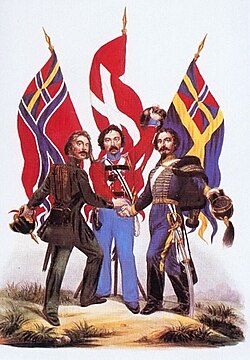
Scandinavism (Danish: skandinavisme; Norwegian: skandinavisme; Swedish: skandinavism), also called Scandinavianism[1] or pan-Scandinavianism,[2] is an ideology that supports various degrees of cooperation among the Scandinavian countries.[3] Scandinavism comprises the literary, linguistic and cultural movement that focuses on promoting a shared Scandinavian past, a shared cultural heritage, a common Scandinavian mythology and a common language or dialect continuum (from the common ancestor language of Old Norse) and which led to the formation of joint periodicals and societies in support of Scandinavian literature and languages.[4] The movement was most popular among Danes and Swedes.[3]
History
[edit]According to historian Sverre Bagge, prior to the formation of state-like kingdoms, Scandinavia was culturally and linguistically homogeneous.[5]
Pan-Scandinavianism as a modern movement originated in the 19th century,[1] but the movement had already begun spreading a century earlier in circles of literature and science.[6] The Pan-Scandinavian movement paralleled the unification movements of Germany and Italy.[7] As opposed to the German and Italian counterparts, the Scandinavian state-building project was not successful and is no longer pursued.[2][7] It was at its height in the mid-19th century and supported the idea of Scandinavian unity.[8][1]
The movement was initiated by Danish and Swedish university students in the 1840s, with a base in Scania.[9] In the beginning, the political establishments in the two countries, including the absolute monarch Christian VIII and Charles XIV John with his "one man government", were suspicious of the movement.[9] The movement was a significant force from 1846 to 1864, however the movement eventually dwindled and only had strong support among the Swedish-speaking population of Finland.[1][10]
The collapse of Pan-Scandinavianism came in 1864 when the Second Schleswig-Holstein War broke out. King Charles XV of Sweden (who was also King Charles IV of Norway), who reigned from 1859 until his death in 1872, in spite of championing Pan-Scandinivianism, failed to help Denmark in the war.[11]
Author Hans Christian Andersen became an adherent of Scandinavism after a visit to Sweden in 1837, and committed himself to writing a poem that would convey the relatedness of Swedes, Danes and Norwegians.[12] It was in July 1839, during a visit to the island of Funen in Denmark, that Andersen first wrote the text of his poem, Jeg er en Skandinav ("I am a Scandinavian").[12] Andersen composed the poem to capture "the beauty of the Nordic spirit, the way the three sister nations have gradually grown together", as part of a Scandinavian national anthem.[12] Composer Otto Lindblad set the poem to music, and the composition was published in January 1840. Its popularity peaked in 1845, after which it was seldom sung.[12]
In 1923, the Clara Lachmann Foundation was established with the goal of promoting Scandinavian unity through culture.[13][14]
See also
[edit]References
[edit]- ^ a b c d "Pan-Scandinavianism". Encyclopedia Britannica. Archived from the original on 7 February 2018.
- ^ a b "Pan-Scandinavianism" Archived 29 September 2007 at the Wayback Machine. (2007). In Encyclopædia Britannica. Retrieved April 29, 2007, from Encyclopædia Britannica Online.
- ^ a b "Skandinavism" [Scandinavism]. www.ne.se (in Swedish). Nationalencyklopedin. Retrieved 1 October 2022.
- ^ The Literary Scandinavism Archived 23 June 2007 at the Wayback Machine. Øresundstid, 2003. Retrieved 6 May 2007.
- ^ Bagge, Sverre (2009). Early state formation in Scandinavia. Vol. 16. Austrian Academy of Sciences Press. p. 145. ISBN 978-3-7001-6604-7. JSTOR j.ctt3fgk28.
- ^ Nordisk familjebok (in Swedish). Stockholm: Nordisk familjeboks förlags aktiebolag. 1917. pp. 879–882. Retrieved 1 October 2022 – via Project Runeberg.
- ^ a b Ola Tunander (1999). "Nordic cooperation", UDA085ENG. In Nytt fra Norge, ODIN – Information from the government and the ministries, Ministry of Foreign Affairs, Norway. See also Tunander, Ola (1999). "Norway, Sweden and Nordic cooperation". In The European North – Hard, soft and civic security. Eds. Lassi Heininen and Gunnar Lassinantti. The Olof Palme International Center/Arctic Centre, University of Lapland, 1999. pp. 39–48. ISBN 951-634-690-1.
- ^ J. P. T Bury (3 January 1960). The New Cambridge Modern History: Volume 10. CUP Archive. ISBN 9780521045483. Archived from the original on 14 April 2018.
{{cite book}}: ISBN / Date incompatibility (help) - ^ a b The Students Archived 13 August 2007 at the Wayback Machine. Øresundstid, 2003. Retrieved 6 May 2007.
- ^ "Charles XV". Encyclopedia Britannica. Archived from the original on 12 October 2017.
- ^ "About Pan-Scandinavianism. Reference Points in the 19th Century (1815-1864)". academia.edu. Archived from the original on 17 March 2016.
- ^ Kjellander, Rune (1979). "Clara Lachmann". Dictionary of Swedish National Biography (in Swedish). Vol. 22. p. 23.
- ^ "Stiftelsens historik" [The Foundation's History]. Clara Lachmanns Stiftelse (in Swedish). Retrieved 2024-06-10.
Further reading
[edit]- Hilson, Mary. Denmark, Norway, and Sweden: Pan-Scandinavianism and Nationalism. University of Portsmouth. Archived from the original on 2018-04-14.
- 'Pan-Scandinavianism. Reference Points in the 19th Century (1815-1864)' by Mircea-Cristian Ghenghea
External links
[edit]- The Helsinki Treaty of 1962 Archived 2014-05-30 at the Wayback Machine Nicknamed as constitution of the Nordic Countries.
- Jeg er en Skandinav. A rendition of H. C. Andersen's poem, set to Otto Lindblad's music.
Scandinavism
View on GrokipediaScandinavism was a 19th-century pan-nationalist movement that sought to foster political, cultural, and economic unity among Denmark, Sweden, and Norway through shared linguistic, historical, and ethnic affinities.[1][2] Emerging in the 1840s amid liberal nationalist fervor following the Napoleonic Wars and territorial rearrangements—such as Norway's union with Sweden in 1814—it emphasized a confederation or defensive alliance to counter external threats like German and Russian expansionism.[1][2] The movement gained momentum through intellectual and student gatherings, including the first Scandinavian student meeting in 1843 and subsequent assemblies that promoted mutual understanding and cooperation.[1][2] Monarchs such as Sweden's Oscar I and Karl XV initially lent support, envisioning a strengthened Scandinavia, while figures like Norwegian author Bjørnstjerne Bjørnson actively championed its ideals from the 1850s to 1870s.[1][2] These efforts achieved cultural exchanges and practical collaborations, such as joint scholarly initiatives, but fell short of political union due to entrenched national interests and divergent foreign policy priorities.[1] Scandinavism's defining characteristic was its romantic appeal to a common Nordic heritage, yet it faced controversies over feasibility, with critics highlighting Sweden's reluctance to risk conflict over Danish-German disputes.[2] The Second Schleswig War of 1864 marked a pivotal decline, as Sweden's neutrality in the face of Prussia and Austria's invasion of Danish territories exposed the limits of solidarity, rendering political ambitions untenable.[1][2] Further erosion came with Norway's dissolution of its union with Sweden in 1905, ushering a period of reduced pan-Scandinavian enthusiasm, though cultural ties persisted and influenced later Nordic institutions.[1][2]