


Community hub
Recent from talks
Contribute something
Nothing was collected or created yet.
United Armenia
View on Wikipedia

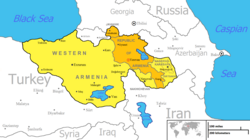
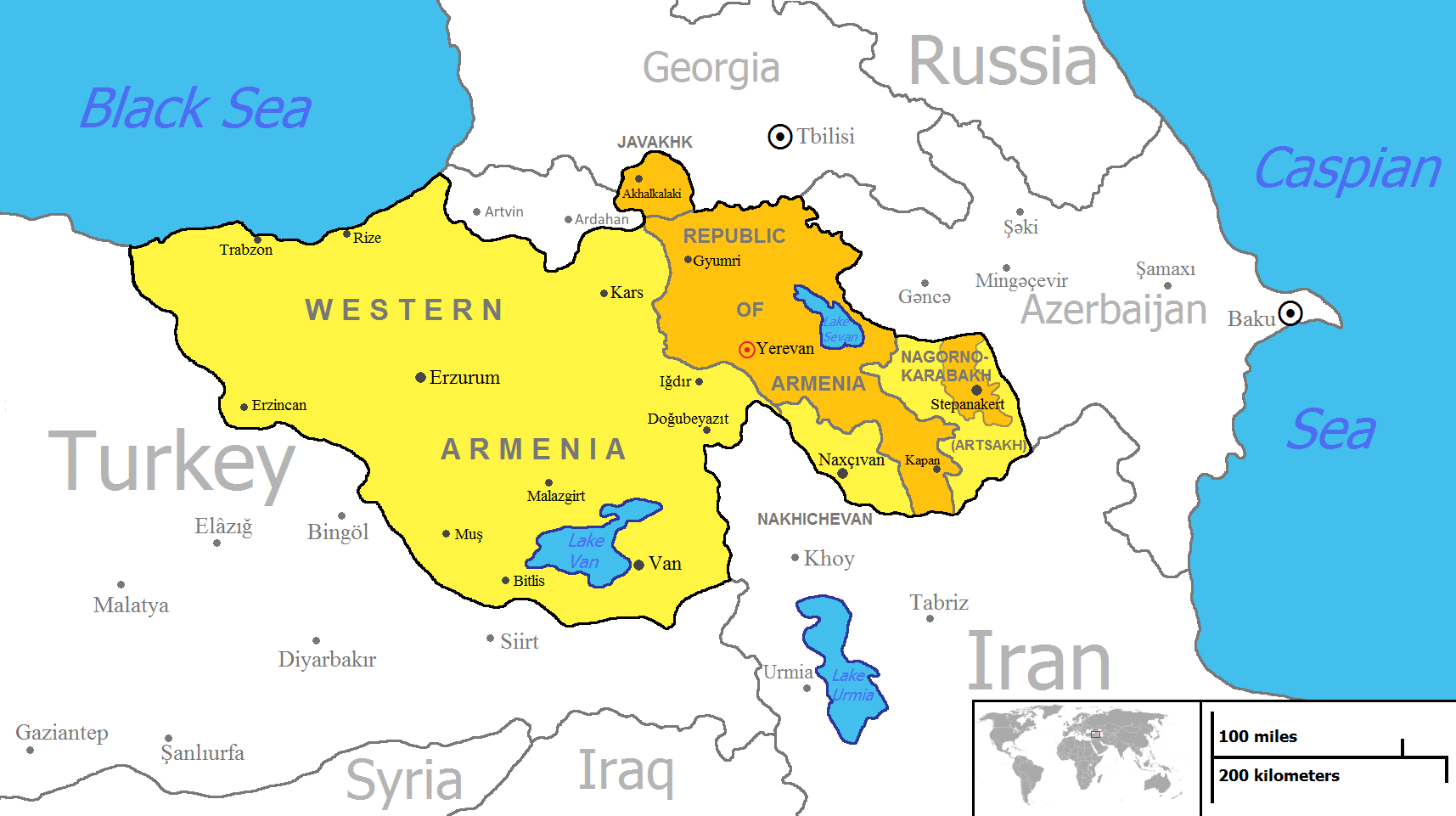
Orange: areas overwhelmingly populated by Armenians (Republic of Armenia: 98%;[3] Javakheti: 95%[4]).
Yellow: Historically Armenian areas with presently no or insignificant Armenian population (Western Armenia, Nakhchivan and recently Nagorno-Karabakh).
Note: Artsakh (Nagorno-Karabakh) is shown in pre-2020 de facto borders.

United Armenia (Armenian: Միացեալ Հայաստան, romanized: Miats'eal Hayastan),[b] also known as Greater Armenia or Great Armenia, is an Armenian ethno-nationalist irredentist concept referring to areas within the traditional Armenian homeland—the Armenian Highlands—which are currently or have historically been mostly populated by Armenians. The idea of what Armenians see as unification of their historical lands was prevalent throughout the 20th century and has been advocated by individuals, various organizations and institutions, including the nationalist parties Armenian Revolutionary Federation (ARF or Dashnaktsutyun) and Heritage, the ASALA and others. The Republic of Armenia comprises 10%-15% of the Armenian homeland.[8][9][10]
The ARF idea of "United Armenia" incorporates claims to Western Armenia (eastern Turkey), Nagorno-Karabakh (Artsakh), the landlocked exclave Nakhchivan (Nakhichevan) of Azerbaijan and the Javakheti (Javakhk) region of Georgia.[1][2] Javakheti is overwhelmingly inhabited by Armenians. Western Armenia and Nakhchivan had significant Armenian populations until the early 20th century, and Nagorno-Karabakh until 2023, but no longer do. The Armenian population of Western Armenia was almost completely exterminated during the 1915 Armenian genocide, when the millennia-long Armenian presence in this region largely ended and Armenian cultural heritage was mainly destroyed by the Ottoman government.[11][12] In 1919, the ARF-dominated government of the First Republic of Armenia declared the formal unification of Armenian lands.[citation needed]
The ARF bases its claims to Western Armenia, now controlled by Turkey, on the 1920 Treaty of Sèvres, which was effectively negated by subsequent historical events. These territorial claims are often seen as the ultimate goal of the recognition of the Armenian Genocide and as part of Armenian genocide reparations.[13][14]
The most recent Armenian irredentist movement, the Karabakh movement which began in 1988, sought to unify Nagorno-Karabakh with then-Soviet Armenia. As a result of the subsequent war with Azerbaijan, Armenian forces established effective control over most of Nagorno-Karabakh and the surrounding districts, thus succeeding in the de facto unification of Armenia and Karabakh.[15][16] Some Armenian nationalists consider Nagorno-Karabakh "the first stage of a United Armenia."[17]
History of the claims
[edit]
Origins
[edit]In its current meaning, the term "United Armenia" was coined during the Armenian national awakening in the second half of the 19th century. During this period, the Armenian-populated areas were divided between the Russian Empire (Eastern Armenia) and the Ottoman Empire (Western Armenia).[19] One of the earliest uses of the phrase "United Armenia" is by the English Society of Friends of Russian Freedom in an 1899 edition of Free Russia monthly. It quotes a confidential report of Grigory Golitsin (the Russian governor of the Caucasus) sent to Tsar Nicholas II "containing suggestions for a future policy." Golitsin writes of a nationalist movement which "aims at the restoration of the independent Armenia of the past", and that "their ideal is one great and united Armenia."[20]
The idea of an independent and united Armenia was the main goal of the Armenian national liberation movement during the late nineteenth and early twentieth centuries.[21] By the 1890s, a low-intensity armed conflict developed between the three major Armenian parties—the Armenian Revolutionary Federation (Dashnak), Hnchak and Armenakan— and the Ottoman government.[22] Calls from the great powers for reforms in the Armenian provinces and Armenian aspirations to independence resulted in the Hamidian massacres between 1894 and 1896, during which up to 300,000 Armenian civilians were slaughtered by the order of Sultan Abdul Hamid II, after whom the massacres were named.[23][24] After the 1908 Young Turk Revolution, some Armenians felt that the situation would improve; however, a year later the Adana massacre took place and Turkish-Armenian relations deteriorated further.[25] After the Balkan Wars of 1912–1913, the Ottoman government was pressured to accept the Armenian reform package concerning the Armenian provinces in early 1914.[26]
World War I and the Armenian genocide
[edit]
The Armenians of eastern Ottoman Empire were exterminated by the Ottoman government in 1915 and the following years. An estimated 1.5 million Armenians were killed,[27][28] while the survivors found refuge in other countries. These events, which are known as the Armenian genocide, are officially denied by the Turkish state, which falsely claims the killings were a result of a "civil war."[29] The Ottoman government successfully ended the over two thousand year Armenian presence in Western Armenia.[30][31]
By 1916, most of Western Armenia was occupied by the Russian Empire as part of the Caucasian Campaign of World War I. In parts of the occupied areas, especially around Van, an Armenian autonomy was briefly set up. The Russian army left the region due to the Revolution of 1917. The Ottoman Empire quickly regained the territories from the small number of irregular Armenian units. In the Caucasus, the Special Transcaucasian Committee was set up after the February Revolution.[32]
The Bolsheviks took power in Russia through the October Revolution and soon signed the Armistice of Erzincan to stop the combat in Turkish Armenia. Russian forces abandoned their positions and left the area under weak Armenian control. The Bolsheviks set up the Transcaucasian Commissariat in the Caucasus. The Treaty of Brest-Litovsk was signed on 3 March 1918 and the Ottoman army started to regain the lost territories, taking over Kars by 25 April.[33] Russia signed the Treaty of Brest-Litovsk with the Ottoman Empire and by April 1918 the Transcaucasian Federation proclaimed its independence from Russia. This fragile federation of Armenia, Georgia and Azerbaijan collapsed when the Turks invaded the Caucasus region. The Armenian units defeated the Turks at the Battle of Sardarabad, just 40 kilometers away from Armenia's future capital Yerevan, preventing the complete destruction of the Armenian nation.[34]

A 1918 book by American scholars Lothrop Stoddard and Glenn Frank, titled Stakes of the War listed 8 solutions to the Armenian Question as proposed by different parties. The second proposal, titled "United Armenia", is described as follows:[37]
A union of territories of Turkish, Russian, and Persian Armenia would result in enough area to constitute an independent state, but in no considerable section of this area would the Armenians form a clear majority of the population. To be sure, the Armenians would be the most intelligent and progressive element; but their numbers and their vitality has been greatly reduced by the long series of persecutions and massacres, and there has been such extensive destruction of property in these territories, that their potential force has been reduced as to form a serious bar to their gaining the ascendancy over the more numerous racial elements in the territory.
First Republic of Armenia: 1918–1920
[edit]
The Armenian National Council declared the independence of the Armenian provinces on 28 May 1918.[38] It was recognized by the Ottoman Empire by the Treaty of Batum on 4 June 1918.[39] After its defeat in World War I, the Ottoman Empire and the Allies signed the Armistice of Mudros by which the Turkish troops left the Caucasus and by 1919 the Republic of Armenia established control over the former Kars Oblast, the city of Iğdır and its surrounding territory, including Mount Ararat.[40][41]
On 28 May 1919, on the first anniversary of the Republic of Armenia, the government of the newly founded country symbolically declared the union of Eastern and Western Armenia, the latter of which was still under the full control of the Turks.[42] Alexander Khatisian, the Armenian Prime Minister, read the declaration:[43][44]
To restore the integrity of Armenia and to secure the complete freedom and prosperity of its people, the Government of Armenia, abiding by the solid will and desire of the entire Armenian people, declares that from this day forward the separated parts of Armenia are everlastingly combined as an independent political entity.
Now in promulgating this act of unification and independence of the ancestral Armenian lands located in Transcaucasia and the Ottoman Empire, the Government of Armenia declares that the political system of United Armenia is a democratic republic and that it has become the Government of the United Republic of Armenia.
Thus, the people of Armenia are henceforth the supreme lord and master of their consolidated fatherland, and the Parliament and Government of Armenia stand as the supreme legislative and executive authority conjoining the free people of United Armenia.
Treaty of Sèvres
[edit]
Almost two years after the Republic of Armenia was established, on 23 April 1920, the United States officially recognized it. Its frontiers were to be determined later. On 26 April 1920, the Supreme Council of the Principal Allied and Associated Powers in Paris (British Prime Minister Lloyd George, French Prime Minister Georges Clemenceau and Italian Prime Minister Francesco Saverio Nitti) requested that the United States accept the mandate over Armenia and to make an Arbitral Decision to determine the boundaries of Armenia with what is now Turkey.[45] President Woodrow Wilson agreed to act as arbitrator and draw a mutually acceptable border between the two nations. In July 1920, the US State Department founded the Committee upon the Arbitration of the Boundary between Turkey and Armenia, headed by William Westermann. The Treaty of Sèvres was signed on 10 August 1920 between the Ottoman Empire and the Allied Powers. On 28 September 1920, the Committee submitted a report that defined the border between the two countries. It guaranteed access to the Mediterranean sea for Armenia via Trebizond and proclaimed present-day Turkey's border regions demilitarization frontier line.[46]
A territory of 100,000 square kilometres (40,000 sq mi), formerly part of the Ottoman Empire, was given to Armenia. Based on the calculations the committee made, the ethnic structure of the 3,570,000 population would have been: 49% Muslims (Turks, Kurds, Tartar Azerbaijanis, and others), 40% Armenians, 5% Laz, 4% Greeks, and 1% others. It was expected that in the case Armenian refugees' return, they would make up to 50% of the population.[47] Two months after the committee submitted the report to the State Department, President Woodrow Wilson received it on 12 November 1920. Ten days later, Wilson signed the report entitled "Decision of the President of the United States of America respecting the Frontier between Turkey and Armenia, Access for Armenia to the Sea, and the Demilitarization of Turkish Territory adjacent to the Armenian Frontier."[48] The report was sent to the US ambassador in Paris Hugh Campbell Wallace on 24 November 1920.[49] On 6 December 1920, Wallace delivered the documents to the secretary-general of the peace conference for submission to the Allied Supreme Council.[49]
Treaty of Sèvres was later annulled following the successful Turkish War of Independence against Allied Powers and affiliated forces, which led to the abolition of the empire and founding of the modern Republic of Turkey with the Treaty of Lausanne in 1923.
Fall of the First Republic
[edit]In late September 1920, a war erupted between Armenia and the Mustafa Kemal-led Turkish nationalists (Government of the Grand National Assembly) led by Kâzım Karabekir took place. Turks captured Kars on 30 October 1920.[50] With the Turkish army in Alexandropol, the Bolsheviks invaded the country from the north east, and on 29 November 1920, they proclaimed Armenia a Soviet state. On 2 December 1920, Armenia became a Soviet state according to a joint proclamation of Armenia's Defence Minister Dro and Soviet representative Boris Legran in Yerevan. Armenia was forced to sign the Treaty of Alexandropol with the Government of the Grand National Assembly on the night of 2–3 December 1920.[51][52][53] The Treaty of Sèvres and Wilson's award remained "dead letters."[54]
Just after the Soviet invasion of Armenia in November 1920, the Soviet Azerbaijani leader Nariman Narimanov declared that "the old borders between Armenia and Azerbaijan are declared null and void. Mountainous Karabagh, Zangezur, and Nakhichevan are recognized as integral parts of the Socialist Republic of Armenia."[55] Despite these assurances, both Nakhichevan and Karabakh were kept under Azerbaijani control for another eight months.[56] On 16 March 1921, Soviet Russia and the Government of the Grand National Assembly signed the Treaty of Moscow. By this treaty, Kars and Ardahan were ceded to Turkey, and Nakhichevan was put under "protectorate" of Azerbaijan.[57] The Treaty of Kars was signed between the Grand National Assembly Government on one side and Armenian SSR, Georgian SSR and Azerbaijan SSR on the other, reaffirming the Treaty of Moscow.[58]
Post-World War II: 1945–1953
[edit]
After the end of World War II in Europe, the Soviet Union made territorial claims to Turkey. Joseph Stalin pushed Turkey to cede Kars and Ardahan, thus returning the pre-World War I boundary between the Russian and Ottoman empires. Besides these provinces, the Soviet Union also claimed the Straits (see Turkish Straits crisis). "Stalin, perhaps, expected that the Turks, shocked by the Red Army's triumph, would give up, and Washington and London accept it as a fait accompli," writes Jamil Hasanli.[59] Athena Leoussi added, "While Stalin's motives can be debated, for Armenians at home and abroad the re-emergence of the Armenian Question revived hopes for territorial unification".[60] On 7 June 1945 Soviet Foreign Minister Vyacheslav Molotov informed the Turkish ambassador in Moscow that the USSR demanded a revision of its border with Turkey.[61]
To repopulate the claimed areas with Armenians, the Soviet government organized a repatriation of Armenians living abroad, mostly survivors of the Armenian Genocide.[62][60] Between 1946 and 1948, 90,000 to 100,000 Armenians from Lebanon, Syria, Greece, Iran, Romania, France, and elsewhere moved to Soviet Armenia.[63][61]
An Office of Strategic Services (predecessor of the CIA) document dated 31 July 1944 reported that the Armenian Revolutionary Federation changed its extreme anti-Soviet sentiment due to the rise of the Soviet power at the end of the war.[64] In a memorandum sent to the Moscow Conference, Head of the Armenian Church Gevorg VI expressed hope that "justice will finally be rendered" to the Armenians by the "liberation of Turkish Armenia and its annexation to Soviet Armenia."[65] Armenia's Communist leader Grigor Harutunian defended the claims, describing Kars and Ardahan "of vital importance for the Armenian people as a whole." The Soviet Armenian élite suggested that the Armenians have earned the right to Kars and Ardahan by their contribution in the Soviet struggle against fascism.[66] Armenian diaspora organizations also supported the idea.[61]
As the relations between the West and the Soviet Union deteriorated with the US and the UK backing Turkey,[67][61] Soviet claims were out of the agenda by 1947. However, it was not until 1953, after Stalin's death, that they officially abandoned their claims,[59] thus ending the dispute.[68]
Late Cold War: 1965–1987
[edit]A wave of Armenian nationalism started in the mid-1960s in the Soviet Union after Nikita Khrushchev came to power and granted relative freedom to the Soviet people during the De-Stalinization era. On 24 April 1965, the 50th anniversary of the Armenian Genocide, a mass demonstration took place in Yerevan.[69] Thousands of Armenians poured into the streets of Yerevan to commemorate the victims of the genocide; however, their goal was not to "challenge the authority of the Soviet government", but "draw the government's attention" to the genocide and persuade the "Soviet government to assist them in reclaiming their lost lands."[70] The Kremlin, taking into account the demands of the demonstrators, commissioned a memorial for the genocide. The memorial, which was built on Tsitsernakaberd hill, was completed in 1967.[70]

The 1960s and 1970s saw a rise in underground political and armed struggle against the Soviet Union and the Turkish state in and outside of Armenia. In 1966, an underground nationalist party called the National United Party was founded by Haykaz Khachatryan in Yerevan. It secretly operated in Soviet Armenia from 1966 to the late 1980s and, after the imprisonment of its founding members in 1968, it was led by Paruyr Hayrikyan. It advocated for the creation of United Armenia through self-determination.[71] Most of its members were arrested and the party was banned. Though the NUP was blamed for the 1977 Moscow bombings,[72] according to historian Jay Bergman it the mastermind of the bombing has "never been determined conclusively."[73]
According to Gerard Libaridian, "by the 1970s, the recognition of the Armenian genocide became a very important objective of the Armenian cause and diaspora political parties linked the recognition of the genocide and the dream of a greater Armenia because Turkey's recognition of the genocide would constitute the legal basis for the Armenian claims on Western Armenia."[74] From the mid-1970s to the late 1980s, several Armenian militant (often considered terrorist) groups operated in the Middle East and Western Europe. Most notably the Armenian Secret Army for the Liberation of Armenia (ASALA) carried out armed attacks on Turkish diplomatic missions around the world.[75][76] Two ARF-affiliated groups—the Justice Commandos of the Armenian Genocide (JCAG) and the Armenian Revolutionary Army (ARA)—also carried out similar attacks, mainly in Western Europe.[77] David C. Rapoport argues that these organizations were inspired by Gourgen Yanikian, a 77-year-old Armenian genocide survivor, who assassinated two Turkish consular officials in California in 1973 as an act of revenge against Turkey.[78]
The ASALA was the largest of the three and was mostly composed of Lebanese Armenian young adults, who claimed revenge for the Armenian genocide, which the Turkish state denies. The concept of United Armenia was one of the ultimate goals of ASALA.[79][80] William Dalrymple and Olivier Roy claim that Armenian Genocide became internationalized as a result of the activities of the Armenian militant groups in the Western European countries.[81][82]
Nagorno-Karabakh Wars: 1988–2023
[edit]In February 1988 a popular nationalist movement emerged in Soviet Armenia and the Nagorno-Karabakh Autonomous Oblast (NKAO), a small Armenian-populated enclave under the jurisdiction of Soviet Azerbaijan since 1923.[83] The movement demanded the unification of the two entities, reviving the idea of a united Armenia.[84]
On 20 February 1988, the Nagorno-Karabakh Supreme Council (the regional legislature) issued a request to transfer the region from Soviet Azerbaijan to Soviet Armenia.[85][86] The Moscow government declined the claims, while hundreds of thousands of people demonstrated in Yerevan in support of the idea.[87] Few days later, on 26 February, an anti-Armenian pogrom broke out in the Azerbaijani seaside industrial city Sumgait, forcing thousands of Armenians to leave Azerbaijan en masse.[88]
On 15 June 1988, the Supreme Council of Soviet Armenia voted to accept Nagorno-Karabakh into Armenia.[89] On 17 June 1988, the Azerbaijan Supreme Soviet refused to transfer the area to Armenia, saying that it was part of Azerbaijan.[89] The leading members of the Karabakh Committee, a group of intellectuals leading the demonstrations, were arrested in December 1988, but were freed in May 1989.[85] On 1 December 1989, the Soviet Armenian Supreme Council and NKAO Supreme Council declared the unification of the two entities (օրենք «Հայկական ԽՍՀ-ի և Լեռնային Ղարաբաղի վերամիավորման մասին»).[90] In January 1990, another pogrom took place against Armenians, this time in Baku. In the meantime, most Azerbaijanis of Armenia and Armenians of Azerbaijan left their homes and moved to their respective countries.
Pro-independence members were elected in the majority to the Armenian parliament in the 1990 election.[91] On 23 August 1990, the Armenian parliament passed a resolution on sovereignty.[91] The tensions grew even larger after the Soviet and Azeri forces deported thousands of Armenian from Shahumyan during Operation Ring in April and May 1991. After the unsuccessful August Putsch, more Soviet republics declared independence. On 2 September 1991, the Nagorno-Karabakh Republic proclaimed independence.[92] On 21 September 1991, the Armenian independence referendum was held with the overwhelming majority voting for the independence of Armenia from the Soviet Union. On 26 November 1991, the Azerbaijani parliament abolished the autonomy of Nagorno-Karabakh.[93] On 10 December 1991, an independence referendum was held in Nagorno-Karabakh, boycotted by the Azeri minority, and gained a vote of 99% in favor of independence.[93]
The conflict escalated into a full-scale war with the captured Shusha by Armenian forces on 9 May 1992. By 1993, the Armenian forces took control over not only the originally disputed Nagorno-Karabakh, but also several districts surrounding the region.[94] A ceasefire agreement was eventually signed on 5 May 1994 in Bishkek, Kyrgyzstan. According to Thomas de Waal, three factors contributed to the victory of the Armenian side: "Azerbaijan's political and military chaos, greater Russian support for the Armenians, and the Armenians' superior fighting skills."[95] Since the 1994 ceasefire until 2020, the Armenian Nagorno-Karabakh Republic (later Artsakh) had de facto control of the territories taken over in the war.[96]
In the wake of Armenia's defeat in 2020 Nagorno-Karabakh war, Armenian forces lost control of the occupied territories around Nagorno-Karabakh, as well as Shusha and Hadrut in Nagorno-Karabakh. In accordance with Russian-brokered ceasefire agreement, Russian peacekeepers were deployed in the Lachin corridor connecting Armenia to Nagorno-Karabakh.
Following the 2023 Azerbaijani offensive in Nagorno-Karabakh from 19 to 20 September, which ended in the total defeat and collapse of Artsakh, Azerbaijan secured full control over the region. Unable to provide further resistance, the government of Artsakh announced its surrender and formal dissolution on 1 January 2024.[97] Nearly all Armenians in the region fled into Armenia after Azerbaijan's victory.
Proponents
[edit]Armenian Revolutionary Federation
[edit]Since its foundation in 1890, the left-wing nationalist Armenian Revolutionary Federation (also known as Dashnaktsutyun or Dashnak/Tashnag) has been known as the main advocate for United Armenia.[98] Having affiliated organizations throughout the Armenian communities abroad, the ARF is regarded as one of the most influential Armenian institutions in the world, especially in the diaspora.[99][100] According to researcher Arus Harutyunyan, the party has "made it abundantly clear that historical justice will be achieved once ethnic Armenian repatriate to united Armenia, which in addition to its existing political boundaries would include" Western Armenia, Nagorno-Karabakh, Nakhichevan and Javakheti.[2] In the 1998 party program, it states that the ARF's first goal is "The creation of a Free, Independent and United Armenia. United Armenia should include inside its borders the Armenian lands [given to Armenia] by the Sevres Treaty, as well as Artsakh, Javakheti and Nakhichevan provinces."[101] "Free, Independent and United Armenia" is the party's main slogan,[102][103] and was adopted as its "supreme objective" in the 10th Party Congress in Paris (1924–25).[104] Hrant Markarian, ARF Bureau Chairman, stated at the 2004 party congress:[105]
We are against any relations between Armenia and Turkey that would mean acceptance of any preconditions by us, that would require us to give up our rights or any part of them. We will keep up pressure on Turkey until we achieve full victory, until international recognition of the fact of genocide, until the creation of a United Armenia.
Heritage Party
[edit]Although the platform of the national liberal Heritage party makes no explicit reference to territorial claims, its leader and some its members have expressed their support for them. Heritage supports the formal recognition of the Nagorno-Karabakh Republic by Armenia and has introduced bills for the recognition of the NKR to the Armenian National Assembly in 2007, 2010, and 2012. Although all three attempts were voted down by the ruling Republican Party.[106] Its leader, Raffi Hovannisian (post-Soviet Armenia's first foreign minister), has hinted at Western Armenia, Javakheti and Nakhichevan with "vague formulations."[107] For instance, during a 2013 speech about his future plans Hovannisian stated that "only with [the existence of a] government belonging to the people will we have awareness of our national interest—with Artsakh, Javakhk, Western Armenia—and future for our children."[108] In 2011, a leading party member, Zaruhi Postanjyan, stated in an open letter to presidents of Armenia and NKR that by organizing a repatriation of diaspora Armenians to Armenia and Nagorno-Karabakh, "we will [create a] base for the liberation of our entire homeland."[109]
In an April 2015 conference on the Armenian Genocide centenary Postanjyan stated that Armenia should "restore its territorial integrity" by claiming the "territory of its historic homeland." When asked about how realistic Armenian claims to its historic lands are, Heritage leader Hovannisian responded: "Today's romantic will become tomorrow's realist."[110] In an opinion piece published in The Jerusalem Post on 11 April 2015 Hovannisian wrote that Turkey occupies Western Armenia and called for "the creation of an Armenian national hearth in historic Western Armenia." He added, "negotiations between the republics of Turkey and Armenia triggering the first-ever sovereign reciprocal demarcation of the official frontier, including but not limited to provisions for an Armenian easement to the Black Sea."[111]
Other
[edit]
The Armenian Democratic Liberal Party (ADL, Ramgavar), a diaspora bourgeois conservative party, is also an advocate of Armenian territorial claims to historical territories. In August 1990, Edmond Azadian, a leader of the ADL told the Armenian parliament:[112]
We have always maintained that the territory of this Republic of Armenia is the nucleus of tomorrow's Greater Armenia. In this respect, we expect the newly formed government to commit itself to the restoration of our historic rights. More specifically, the new Republic must include in its on-going agenda the recognition of the Armenian genocide and our historic territorial claims by the international community.
Territories claimed
[edit]The modern use of United Armenia by the Armenian Revolutionary Federation (ARF) encompasses the following areas:[101][1][2]
| Name | Part of | Area | Population | Armenians | % Armenian | Source | Notes |
|---|---|---|---|---|---|---|---|
| Provinces (Gavarrner) |  Armenia Armenia
|
29,743 km2 (11,484 sq mi) | 3,018,854 | 2,961,514 | 98.1 | 2011[113] |
|
| Nagorno-Karabakh (Artsakh) |  Azerbaijan Azerbaijan
|
11,458 km2 (4,424 sq mi) | 7,000 | 0 | –
|
–
|
|
| Javakheti (Javakhk) |  Georgia (Akhalkalaki and Ninotsminda districts) Georgia (Akhalkalaki and Ninotsminda districts)
|
2,588 km2 (999 sq mi) | 69,561 | 65,132 | 93.6 | 2014[4] | –
|
| Nakhchivan (Nakhichevan) | Azerbaijan (Nakhchivan Autonomous Republic)
|
5,363 km2 (2,071 sq mi) | 398,323 | 6 | ~0 | 2009[116] |
|
| Eastern Turkey (Western Armenia) |  Turkey Turkey
|
132,967 km2 (51,339 sq mi) | 6,461,400 | 60,000 | 0.09 | 2009[118] |
|
Nagorno-Karabakh (Artsakh)
[edit]
In the aftermath of the First Nagorno-Karabakh War, the Nagorno-Karabakh Republic, supported by the Republic of Armenia, took control over the territory of some 11,500 km2,[119] including several districts outside of the originally claimed borders of the Nagorno-Karabakh Autonomous Oblast of the Azerbaijani SSR, creating a "buffer zone".[120][96] Kelbajar and Lachin districts guarantee solid land corridor between Armenia proper and Nagorno-Karabakh.[121][96] Between 500,000 and 600,000 Azerbaijanis were displaced from the area.[122][123] In the meantime, almost all Armenians from Azerbaijan (between 300,000 and 400,000)[124][125] and Azerbaijanis from Armenia (over 150,000) were forced to move to their respective countries as remaining in their homes became nearly impossible since tensions between the two groups have grown worse since the start of the conflict in 1988.[126][127][128]
The Nagorno-Karabakh Republic or the Republic of Artsakh remained internationally unrecognized. Until 2023, the Republic of Armenia and Artsakh were de facto functioning as one entity,[16][129][130][131][132][133][134] although the Nagorno-Karabakh region was internationally recognized as de jure part of Azerbaijan. Nagorno-Karabakh was more monoethnic than the Republic of Armenia, with 99.7% of its population being Armenian. The Azerbaijani minority was forced to leave during the war. The areas outside the original NKAO borders taken over by the Armenian forces during the war are mostly uninhabited or very sparsely inhabited, with the city of Lachin being an exception. Between 2000 and 2011, 25,000 to 30,000 people settled in NKR.[135]
The 2023 Azerbaijani offensive in Nagorno-Karabakh ended with the defeat and collapse of Artsakh, which formally dissolved on 1 January 2024. It also resulted in the mass flight of Nagorno-Karabakh Armenians into Armenia. These developments appear to have effectively ended the "United Armenia" aspirations with regards to Nagorno-Karabakh.[citation needed]
Javakheti (Javakhk)
[edit]
Abkhazia and South Ossetia, both areas are not under the control of the central government of Georgia,[136] shown in light grey.
The region of Javakheti or Javakhk as known to Armenians comprises the districts of Akhalkalaki and Ninotsminda, both part of Samtskhe-Javakheti region of Georgia.[137][138][139] It is overwhelmingly Armenian-populated (around 95%).[140] The area is geographically isolated from the rest of Georgia and remains economically and socially isolated from Georgia.[141] According to Svante Cornell, Javakheti enjoys "wide cultural autonomy" and "certain Georgian analysts observe that the region is in practice as much 'Armenia' as 'Georgia'. It is distinctively easier to get around using Armenian than Georgian in this region; indeed, foreign visitors claim that at first they had difficulties determining which country they are in."[140] Generally, Javakheti Armenians live in "reasonable inter-ethnic harmony" within Georgia, although there is a "fairly strong fear for the future, a sense of insecurity."[140] Javakheti, along with Lori and Borchali, was disputed by Armenia and Georgia from 1918 to 1920. A brief armed conflict took place between the two nations in December 1918, mostly over Lori.[142]
United Javakhk Democratic Alliance, a local civil organization, is the main organization advocating for an Armenian autonomy in the region.[143] It was founded in 1988, during the disintegration of the Soviet Union.[144] It campaigns for a referendum in Javakheti on autonomy.[145][146] It is believed that the organization has close links with the Armenian Revolutionary Federation.[146][145] Although the ARF claims Javakheti as part of United Armenia, the ARF World Congresses "have agreed with the demands raised by the Armenians of Javakheti that a Javakheti with a high degree of self-government within a federal Georgia would be able to sustain itself and would become a strong link in Georgian-Armenian relations."[147] ARF Bureau Chairman Hrant Markarian declared in the 2004 party congress: "We want a strong, stable and autonomous Javakheti that is part of Georgia and enjoys state care."[105] The leader of the United Javakhk Democratic Alliance, Vahagn Chakhalian, was arrested in 2008 and freed in 2013. A 2014 article suggested that the alliance has little influence today.[148]
During Zviad Gamsakhurdia's presidency (1991), Javakheti remained de facto semi-independent and only in November 1991 was the Tbilisi-appointed governor able to take power.[c] The issue of Javakheti was in the 1990s "clearly been perceived as the most dangerous potential ethnic conflict in Georgia", however, no actual armed conflict ever occurred.[149] Taking into account the importance of the bilateral relations, the governments of Armenia and Georgia have pursued a careful and calming policy to avoid tension.[150] The Armenian government has not made territorial claims to Georgia, nor has called for an autonomy in Javakheti.[151] Armenia–Georgia relations have traditionally been friendly,[152][153] however, from time to time tensions arise between the two countries. In recent years, the status of Armenian churches in Georgia[154][155] and the status of the Armenian language in Georgian public schools had been a matter of dispute.[156] Svante Cornell argues that "Armenia seems to have had a calming influence on Javakhk" as it is highly dependent on Georgia for imports.[146] This viewpoint is shared by Georgian analysts.[157]
Armenian nationalist activist Alexander Yenikomshian has suggested that there are three long-term solutions to the Javakheti issue: 1) the region remains part of a Georgia, where the rights of the Armenian population are protected 2) "Artsakhization", i.e. de facto unification with the Republic of Armenia 3) "Nakhichevanization", i.e. Javakheti loses its Armenian population.[158]
Eastern Turkey (Western Armenia)
[edit]| The Turkish area claimed by the ARF (based on the Treaty of Sèvres, 1920)[1] |
|---|

Western Armenia refers to an undefined area, now in eastern Turkey, that had significant Armenian population prior to the Armenian genocide of 1915.[159][160] As a result of the genocide, officially no Armenians live in the area today.[161] However, at least two distinct groups of Armenian origin reside in the area. Hemshin peoples, an Islamisized group with Armenian ethnic origin,[162][163] live in the Black Sea coast, particularity in the Rize province.[164] Another group, "Hidden Armenians", live throughout Turkey, especially the eastern parts of the country. Many of them have been assimilated by Kurds. It is impossible to determine how many there are due to the fact that they keep their identity hidden, but estimates range from below 100,000 to millions.[165] Since the Armenian Genocide, the area has been mostly settled by Kurds and Turks,[166] with smaller numbers of Azerbaijanis (near the Turkish-Armenian border)[167] and Georgians and Laz people in the northeastern provinces of Turkey.[168][169]
Generally, the Armenian nationalist groups claim the area east of the boundary drawn by US President Woodrow Wilson for the Treaty of Sèvres in 1920. The Armenian Revolutionary Federation and groups supporting the concept of United Armenia claim that the Treaty of Sèvres, signed on 10 August 1920 between the Ottoman Empire and the Allies, including Armenia is the only legal document determining the border between Armenia and Turkey.[170][171][172] Armenia's Former Deputy Foreign Minister Ara Papian claims that "Wilsonian Armenia," the territory granted to the Republic of Armenia in 1920 by Wilson in the scope of the Treaty of Sèvres, is still de jure part of Armenia today.[173] According to him the Treaty of Kars, which determined the current Turkish-Armenian border, has no legal value because it was signed between two internationally unrecognized subjects: Bolshevik Russia and Kemalist Turkey.[174] Papian has suggested that the Armenian government can file a suit at the International Court of Justice to dispute the border between Armenia and Turkey.[172]
22 November is celebrated by some Armenians as the anniversary of the Arbitral Award.[175][176] In 2010 and 2011, posters with maps of the Treaty of Sèvres were hung throughout Yerevan.[177]
On 10 August 2020 the three traditional Armenian parties—the Armenian Revolutionary Federation (ARF, Dashnaks), Social Democrat Hunchakian Party (Hunchaks) and the Armenian Democratic Liberal Party (Ramgavars)—issued a joint statement on the centenary of the Sèvres Treaty, stating that the treaty is the only international document defining the border between Armenia and Turkey. "The Treaty of Sevres is a valid international treaty, although it has not been ratified by all signatories, but it has not been legally replaced by any other international instrument. At least from the point of view of the rights of the Armenian Cause, the Republic of Armenia and the Armenian nation, it remains a promissory note based on international law."[178]
Official position of Armenia
[edit]Since Armenia's independence from the Soviet Union in 1991, the Armenian government has not officially made any territorial claims to Turkey.[179][180][181] However, the Armenian government has avoided "an explicit and formal recognition of the existing Turkish-Armenian border."[182] In 2001, Armenian president Robert Kocharyan stated that the "genocide recognition will not lead to legal consequences or territorial claims."[183]
In 2010, Armenian President Serzh Sargsyan addressed the Conference Dedicated to the 90th Anniversary of Woodrow Wilson's Arbitral Award:
It was probably one of the most momentous events for our nation in the 20th century which was called up to reestablish historic justice and eliminate consequences of the Armenian Genocide perpetrated in the Ottoman Empire. The Arbitral Award defined and recognized internationally Armenia's borders within which the Armenian people, who had gone through hell of Mets Eghern, were to build their statehood.[184]
On 23 July 2011, during a meeting of Armenian President Serzh Sargsyan with students in Tsaghkadzor resort city, a student asked Sargsyan if Turkey "will return Western Armenia" in the future.[182] Sargsyan responded:
It depends on you and your generation. I believe, my generation has fulfilled the task in front of us; when it was necessary in the beginning of the 1990s to defend part of our fatherland—Karabakh—from the enemy, we did it. I am not telling this to embarrass anyone: my point is that each generation has its responsibilities and they have to be carried out, with honor. If you, boys and girls of your generation spare no effort, if those older and younger than you act the same way, we will have one of the best countries in the world. Trust me, in many cases the country's standing is not conditioned by its territory: the country should be modern, it should be secure and prosperous, and these are conditions which allow any nation to sit next to the respectable, powerful and reputed nations of the world. We simply must fulfill our duty, must be active, industrious, must be able to create bounty. And we can do that, we very easily can do that, and we have done it more than once in our history. I am certain about it, and I want you to be certain too. We are a nation that always rises from the ashes like phoenix—again and again.[185]
Sargsyan's statements "were considered by Turkish officials an encouragement for young students to fulfill the task of their generation and occupy eastern Turkey."[186] During his visit to Baku a few days later, Turkish Prime Minister Recep Tayyip Erdoğan denounced Sargsyan's statements and described them as "provocation" and claimed that Sargsyan this "told young Armenians to be ready for a future war with Turkey."[182] Erdoğan demanded apology from Sargsyan calling his statements a "blunder".[187] In response, Armenian Deputy Foreign Minister Shavarsh Kocharyan stated that Sargsyan's words were "interpreted out of context."[186]
On 5 July 2013,[188] during a forum of Armenian lawyers in Yerevan on the 100th Anniversary of the Armenian Genocide organized by the Ministry of Diaspora, Armenia's Prosecutor General Aghvan Hovsepyan made a "sensational statement".[172][189] Hovsepyan particularly stated:
Indeed, the Republic of Armenia should have its lost territories returned and the victims of the Armenian Genocide should receive material compensation. But all these claims must have perfect legal grounds. I strongly believe that the descendants of the genocide must receive material compensation, churches miraculously preserved in Turkey's territory and church lands must be returned to the Armenian Church, and the Republic of Armenia must get back its lost lands.[188]
According to ArmeniaNow news agency "this was seen as the first territorial claim of Armenia to Turkey made on an official level. The prosecutor general is the carrier of the highest legal authority in the country, and his statement is equivalent to an official statement."[172] In response, the Turkish Ministry of Foreign Affairs released a statement on 12 July 2013 denouncing Hovsepyan's statements. According to the Turkish side his statements reflect the "prevailing problematic mentality in Armenia as to the territorial integrity of its neighbor Turkey." The statement said that "one should be well aware that no one can presume to claim land from Turkey."[190]
On 10 August 2020 Prime Minister Nikol Pashinyan, President Armen Sarkissian and parliament speaker Ararat Mirzoyan issued statements on the centenary of the Sèvres Treaty. Pashinyan noted that although it was never implemented, "it continues to be a historical fact, which reflects our long journey to restore our independent statehood. We are bound by duty to remember it, realize its importance and follow its message."[191] Sarkissian stated that the treaty "even today remains an essential document for the right of the Armenian people to achieve a fair resolution of the Armenian issue."[192] Mirzoyan called the treaty an expression of "dreamy naivety."[193]
Nakhchivan
[edit]
Up until the Great Surgun (1604) and Azerbaijan's ethnic cleansing policies in the 20th century, Armenians had comprised a significant demographic group in the region. Armenian tradition says that Nakhichevan (Նախիջևան Naxidjevan in Armenian and Naxçıvan in Azerbaijani) was founded by Noah.[194] Armenians have been living in Nakhichevan since ancient times. It was one of gavars of Vaspurakan province of the Kingdom of Armenia. In 189 BC, Nakhchivan became part of the new Kingdom of Armenia established by Artaxias I.[195] Within the kingdom, the region of present-day Nakhichevan was part of the Ayrarat, Vaspurakan and Syunik provinces.[196]
By the 16th century, control of Nakhichevan passed to the Safavid dynasty of Persia. Because of its geographic position, it frequently suffered during the earlier wars between Persia and the Ottoman Empire in the 14th to 18th centuries. In 1604–1605, Shah Abbas I, concerned that the lands of Nakhichevan and the surrounding areas could potentially pass into Ottoman hands, decided to institute a scorched earth policy. In what is called the Great Surgun, he forced 300,000 Armenians,[197] including those from Nakhichevan to leave their homes and move to the Persian provinces south of the Aras River.[198] After the last 1826-1828 Russo-Persian War, Nakhichevan became part of Russia per the Treaty of Turkmenchay after Persia's forced ceding. Alexandr Griboyedov, the Russian envoy to Persia, reported that 1,228 Armenian families from Persia migrated to Nakhichevan, while prior to their migration there were 2,024 Muslim and 404 Armenian families living in the province.[199]
According to the 1897 Russian Empire census, the Nakhichevan uyezd of the Erivan Governorate had a population of 100,771, of which 34,672 were Armenian (34.4%), while Caucasian Tatars (Azerbaijanis) numbered 64,151 or 63.7% of the total population.[200] The proportion of Armenian was around 40% prior to World War I.[201][202] Nakhichevan was disputed between Armenia and Azerbaijan from 1918 to 1920 during the countries' brief independence. Due to the Ottoman invasion in 1918, 100,000 Armenians fled from Nakhichevan.[203] By June 1919, after the British troops left the area, Armenia succeeded in establishing control over Nakhichevan. Some of the Nakhichevan Armenians returned to their homes in summer 1919.[204] Again, more violence erupted in 1919 leaving some 10,000 Armenians dead and some 45 Armenian villages destroyed.[205]
After the Soviet takeover of the Caucasus region in 1920 and 1921, the Treaty of Moscow, also known as the Treaty of Brotherhood, was signed between the Government of the Grand National Assembly and Soviet Russia on 16 March 1921. According to this treaty Nakhichevan became "an autonomous territory under the auspices of Azerbaijan, under the condition that Azerbaijan will not relinquish the protectorate to any third party."[206] The Treaty of Kars was signed between the Grand National Assembly and Armenian SSR, Azerbaijan SSR, Georgian SSR on 13 October 1921. The treaty reaffirmed that the "Turkish Government and the Soviet Governments of Armenia and Azerbaijan are agreed that the region of Nakhichevan ... constitutes an autonomous territory under the protection of Azerbaijan."[207] By the mid-1920s, the number of Armenians in Nakhichevan dwindled significantly and according to the 1926 Soviet census the 11,276 Armenians made up only 10.7% of the autonomous republic.[208] During the Soviet period, the Armenians of Nakhichevan felt "pressured to leave"[201] According to the Soviet census of 1979, only 3,406 Armenians resided in Nakhichevan or 1.4% of the total population.[209] The last few thousand Armenians left Nakhichevan in 1988 amid the Nagorno-Karabakh conflict.[210]
In August 1987, the Armenian National Academy of Sciences started a petition to transfer Nakhichevan and Nagorno-Karabakh under jurisdiction of Armenia.[211] In the nationalist movement to unite Nagorno-Karabakh with Armenia, Armenians "used the example of the slow "de-Armenianization" of Nakhichevan in the course of the twentieth century as an example of what they feared would happen to them."[212][201] During the First Nagorno-Karabakh War, clashes occurred between Armenian and Azeri forces in the Nakhichevan-Armenia border, however, the war did not spill over into Nakhichevan. Turkey, Azerbaijan's close ally, threatened to intervene if Armenia invaded Nakhichevan.[213][214] Nakhichevan was in center of attention during the destruction of the Armenian cemetery in Julfa in the 2000s.[215][216][217] According to the Research on Armenian Architecture, most of the Armenian churches, monasteries and cemeteries were destroyed by Azerbaijan in the 1990s.[218]
The Armenian government has never made any claims to Nakhichevan, although there have been calls by nationalist circles (including Hayazn,[219] Heritage youth wing[220] and prominent First Nagorno-Karabakh War veteran Jirair Sefilian)[221] to forcibly annex Nakhichevan in case Azerbaijan attacks Nagorno-Karabakh.[222] Rəfael Hüseynov, the director of the Nizami Museum of Azerbaijani Literature, in his written question to the Committee of Ministers of the Council of Europe in 2007 claimed that the "seizure Nakhichevan is one of the main military goals of Armenia."[223] Writing in the Harvard International Review in 2011 US-based Azerbaijani historian Alec Rasizade suggested that "Armenian ideologues have lately started to talk about the return of Nakhichevan."[224]
"Kura-Arax Republic"
[edit]A potential military advancement toward central Azerbaijan, especially up to the Kura river, has become part of the Armenian political discourse in the Nagorno-Karabakh conflict. A maximalist and expansionist option, advancing up to the Kura river is seen by analysts and military figures as a method of forcing Azerbaijan to surrender and give up its claims to Karabakh. For others, it is a realistic policy which should be persuaded by the government of Armenia to take control of territories that are, according to its advocates, historical or natural part of Armenia.[225][226][227][228][229]
The phrase "Kura-Arax Republic" was coined in 2016 by Levon Shirinyan,[230] a political science professor and a former member of the ARF,[231] to advocate Armenian military advancement into the territory of Azerbaijan west of the Kura river (including Nakhichevan) to achieve complete surrender of Azerbaijan.[230] Following the April 2016 war in Karabakh with Azerbaijan, he stated that Armenia should "transfer the military operations" into Yevlakh and the confluence of the rivers Kura and Arax (Aras or Araxes). The explained the importance of the two as follows: Yevlakh is a major hub of the Baku-Tbilisi railway and the oil and gas pipelines, while the second would give Armenia an opportunity to assist the Talysh in reviving an independent state in the south of Azerbaijan.[232] He argues that Armenia cannot have peace "unless we get to Kura-Araks" and "destroy Azerbaijan as a Turkic state."[233] Shirinyan set up the Christian-Democratic Rebirth Party[234] prior to the 2018 parliamentary election, which proclaimed "Kura-Araxian Armenia" as one of its main objectives.[235]
The idea was adopted by the hard-line nationalist group led by Jirair Sefilian that took over a police base in Yerevan in July 2016. Varuzhan Avetisyan, leader of the armed group, explicitly supported the idea from prison in 2017.[236][237] Sefilian did so in April 2018.[238][239] Following their release from prison after the 2018 Armenian Velvet Revolution, members of the armed group formed the Sasna Tsrer Pan-Armenian Party, which officially adopted "Kura-Arax Republic" as one of its objectives. Their party program stated Nakhichevan and the areas of Azerbaijan west of the Kura should become part of Armenia and, thus, establish the Kura-Araxian Republic.[240][241] Sefilian stated:[242]
The goal should be to include in the Armenian state at least Nakhichevan, other territories of the artificial state of Azerbaijan to the right bank of the Kura. With the creation on the official territory of today's Armenia and Artsakh of the New Republic, the process of the collapse of the Russian-Turkish regional architecture will begin, which will be accompanied by the formation of the regional architecture consistent with the interests of Armenia. Staying within the existing territories, we will have to allocate for elementary survival much more of the resources we need so much for development. In other words, the attitude to the project of the Kura-Arax Republic proceeds from a very, very pragmatic issue. Whether we want or do not want to find our place, a free, dignified life under the sun, to have a future, a real hope for the re-acquisition of our entire homeland and the return of home Armenians.
Public opinion
[edit]

There are no public opinion data concerning the United Armenia concept, however, it is popular among Armenians according to Hürriyet Daily News.[244] Moshe Gammer of the Tel Aviv University and Emil Souleimanov of the Charles University in Prague both suggest that the concept is popular in the Armenian diaspora.[245][246] Gerard Libaridian wrote in 2007:[247]
While it is true that not all Armenians in the Diaspora share the vision of a united Armenia as a political program, territorial aspirations were sustained, nonetheless, by the deep sense of injustice that Armenians generally felt [by the Turkish denial of the genocide and lack of any kind of compensation for the genocide losses].
A 2014 survey in Armenia asked what kind of demands should Armenia make to Turkey. Some 80% agreed that Armenia should make territorial claims (30% said only territorial claims, while another 50% said territorial, moral, financial, and proprietary). Only 5.5% said no demands should be made.[248] According to a 2012 survey, 36% of Armenians asked agree or somewhat agree that Turkish recognition of the Armenian Genocide will result in territorial compensation, while 45% believe it will not.[249] The online publication Barometer.am wrote: "It appears that our pragmatic population believes that all possible demands should be forwarded to Turkey [...] but a relative majority consider the practival realization of territorial claims to Turkey is unrealistic."[248]
On Artsakh
[edit]One Istanbul-based researcher wrote in the Jacobin magazine in 2016 that "[f]ew in Armenia support [the] pleas to use Karabakh as a springboard to recreate 'Greater Armenia.' But the idea that Karabakh must be held no matter the cost is widespread."[250] According to a 2017 survey in Armenia 86.4% of respondents opposed any territorial concessions in the Karabakh conflict, while 8.2% accepted concessions for the sake of settlement.[251]
According to a 2013 Caucasus Barometer survey, when asked about having Nagorno-Karabakh as a formal part of Armenia, 77% of respondents "definitely favor" such a status, 13% would be "accepting under certain circumstances", and 7% oppose it.[252]
In culture
[edit]The concept of creating a united state that would include all Armenian-populated areas has been the main theme of the Armenian revolutionary songs. Nersik Ispiryan and Harout Pamboukjian are among the most famous performers of such songs. One of the most widely known examples of these songs is "We must go" (Պիտի գնանք, Piti gnank) by gusan Haykazun written in 1989:[253]
|
|

From 2005 to 2008, four short animated cartoons were released by the National Cinema Center of Armenia called Road home (Ճանապարհ դեպի տուն) produced by Armenian animator Robert Sahakyants. It tells a story of a group of school children from Karin (Erzurum) in 2050 taking a trip throughout the "liberated from enemy" territories: Tigranakert, Baghesh (Bitlis), Mush and Akdamar Island. The country they live in is called Hayk' (Հայք) after the historical name of Armenia. The series was aired by the Public Television of Armenia.[254] In one of his last interviews, Sahakyants stated: "If today I'm shooting a film about how we are going to return Western Armenia, then I'm convinced that it will definitely take place."[255]
Reactions
[edit]In Armenia
[edit]Leading Armenian communist Anastas Mikoyan stated in 1919 that "Armenian chauvinists relying on the allies of imperialism push forward a criminal idea—the creation of a 'Great Armenia' on the borders of Historic Armenia. The absence of Armenians and the presence of an absolute Muslim population there does not concern them... our party cannot support the idea of either a 'Great' or 'Small' Turkish Armenia."[256]
Armenia's first president Levon Ter-Petrosyan (1991–98), in a widely publicized 1997 essay on the Nagorno-Karabakh conflict titled "War or Peace? Time to Get Serious", argued that if Armenia was to officially demand "the return of Armenian lands" from Turkey and cancellation of the Treaty of Kars, it would only play into the hands of Turkey. He argued that it would "provide Turkey with more evidence of Armenia's expansionist ambitions" and direct more negative international opinion towards Armenia.[257] Petrosyan has called the idea of "Kura-Arax republic" a "fairy tale."[258][259]
Gerard Libaridian, a former adviser to President Ter-Petrosyan, criticized August 2020 statements by Prime Minister Nikol Pashinyan and President Armen Sarkissian on the 100th anniversary of the Sèvres Treaty as being "equivalent to a declaration of at least diplomatic war against Turkey." According to Libaridian, "Adopting the Treaty of Sevres as an instrument of foreign policy Armenia placed the demand of territories from Turkey on its agenda."[260]
In Azerbaijan
[edit]Azerbaijani President Heydar Aliyev in 1998 stated in his "Decree of President of Republic of Azerbaijan about genocide of Azerbaijani people" that the "artificial territorial division in essence created the preconditions for implementing the policy of expelling Azerbaijanis from their lands and annihilating them. The concept of 'greater Armenia' began to be propagated."[261]
In 2012, President of Azerbaijan and son of Heydar Aliyev, Ilham Aliyev, who has made several statements toward Armenia and Armenians in past such as "our main enemies are Armenians of the world",[262] stated that "Over the past two centuries, Armenian bigots, in an effort to materialize their 'Great Armenia' obsession at the expense of historically Azerbaijani lands, have repeatedly committed crimes against humanity such as terrorism, mass extermination, deportation and ethnic cleansing of our people."[263]
In Turkey
[edit]
In December 1991, Turkey became one of the first countries to recognize the independence of Armenia from the Soviet Union.[267] Armenia–Turkey relations deteriorated during the First Nagorno-Karabakh War, during which Turkey aligned itself with Azerbaijan. Turkey shares its Turkic heritage with Azerbaijan and the two countries are generally seen as allies in the region. The expression "one nation, two states" has been often used to describe the relations of the two countries.[268]
In Turkey, "many believe that Armenia's territorial claims are the main reason why the Armenian administration and lobbyists are pushing for global recognition" of the Armenian Genocide.[264][265] The Turkish Ministry of Culture and Tourism credits the idea of "Great Armenia" to Armenian President Levon Ter-Petrosyan.[269] According to Prof. İdris Bal "Turkey considers Armenian policy (and the activities of its powerful diaspora groups) since 1989 to be against its national security interests and territorial integrity. Armenia's failure to recognize the Kars Agreement, along with the frequent public references to eastern Turkey as 'Western Armenia,' provides a serious irritant to Turkey. The Turkish Mount Ararat is pictured in the official Armenian state emblem, which Turkey interprets as a sign that the 'greater Armenia' vision is still very much alive."[266]
According to Hürriyet Daily News some "foreign policy experts draw attention to the fact that Armenia has territorial claims over Turkey, citing certain phrases in the Armenian Constitution and Declaration of Independence."[265] The Armenia Declaration of Independence was passed on 23 August 1990 officially declaring "the beginning of the process of establishing of independent statehood positioning the question of the creation of a democratic society." It was signed by Levon Ter-Petrosyan, the President of the Supreme Council, who became the first President of Armenia in 1991.[270] Article 11 of the declaration read:
- "The Republic of Armenia stands in support of the task of achieving international recognition of the 1915 Genocide in Ottoman Turkey and Western Armenia."[270]
Turkish historian and political scientist Umut Uzer characterized Armenian territorials claims to eastern Turkey as "a racist and irredentist demand with regard to a territory which has never in history had an Armenian majority population. And these demands are buttressed with genocide claims which in fact deny the very existence of Turkey in its current borders."[271]
See also
[edit]Notes
[edit]- ^ "The lands of Western Armenia which Mt. Ararat represent..."[5] "Mount Ararat is the symbol of banal irredentism for the territories of Western Armenia."[6] "...Ararat, which is in the territory of modern Turkey but symbolizes the dream of all Armenians around the globe about the lands lost to the west of this biblical mountain."[7]
- ^ Reformed spelling: Միացյալ Հայաստան
- ^ "The area remained effectively outside the control of Tbilisi for virtually the entire tenure of Gamsakhurdia."[144]
References
[edit]- Citations
- ^ a b c d "Armenia: Internal Instability Ahead" (PDF). Yerevan/Brussels: International Crisis Group. 18 October 2004. p. 8. Archived from the original (PDF) on 3 March 2016. Retrieved 11 June 2014.
The Dashnaktsutiun Party, which has a major following within the diaspora, states as its goals: "The creation of a Free, Independent, and United Armenia. The borders of United Armenia shall include all territories designated as Armenia by the Treaty of Sevres as well as the regions of Artzakh [the Armenian name for Nagorno-Karabakh], Javakhk, and Nakhichevan".
- ^ a b c d Harutyunyan 2009, p. 89: "The ARF strives for the solution of the Armenian Cause and formation of the entire motherland with all Armenians. The party made it abundantly clear that historical justice will be achieved once ethnic Armenian repatriate to united Armenia, which in addition to its existing political boundaries would include Western Armenian territories (Eastern Turkey), Mountainous Karabagh and Nakhijevan (in Azerbaijan), and the Samtskhe-Javakheti region of the southern Georgia, bordering Armenia."
- ^ "2011 Census Results" (PDF). armstat.am. National Statistical Service of Republic of Armenia. p. 144.
- ^ a b "Ethnic Groups by Major Administrative-territorial Units" (PDF). National Statistics Office of Georgia. Archived from the original (PDF) on 4 October 2018. Retrieved 11 November 2012.
- ^ Shirinian, Lorne (1992). The Republic of Armenia and the rethinking of the North-American Diaspora in literature. Edwin Mellen Press. p. 78. ISBN 978-0773496132.
- ^ Adriaans, Rik (2011). "Sonorous Borders: National Cosmology & the Mediation of Collective Memory in Armenian Ethnopop Music". University of Amsterdam. p. 48. Archived from the original on 5 March 2016.
- ^ Khojoyan, Sara (1 August 2008). "Beyond and Inside: Turk look on Ararat with Armenian perception". ArmeniaNow. Archived from the original on 17 November 2015.
- ^ Payaslian, Simon (1 January 2010), "Imagining Armenia", The Call of the Homeland, Brill, p. 110, doi:10.1163/ej.9789004182103.i-402.37, ISBN 978-90-04-18373-5, retrieved 29 May 2025
- ^ Astourian, Stephan H. (2004). "State, homeland, and diaspora: The Armenian and Azerbaijani cases". In Atābakī, Tūraǧ; Mehendale, Sanjyot (eds.). Central Asia and the Caucasus: transnationalism and diaspora. Transnationalism. Routledge research in transnationalism. London New York: Routledge. p. 84. ISBN 978-0-203-49582-7.
- ^ Cohen, Robin (2022). Global diasporas: an introduction (25th anniversary ed.). Abingdon, Oxon; New York, NY: Routledge. p. 51. ISBN 978-1-032-18844-7.
- ^ Hovannisian, Richard G. (2008). The Armenian Genocide: Cultural and Ethical Legacies. New Brunswick, NJ: Transaction Publishers. p. 22. ISBN 978-1-4128-3592-3.
- ^ Jones, Adam (2013). Genocide: A Comprehensive Introduction. Routledge. p. 114. ISBN 978-1-134-25981-6.
- ^ Theriault, Henry (6 May 2010). "The Global Reparations Movement and Meaningful Resolution of the Armenian Genocide". The Armenian Weekly. Archived from the original on 10 May 2010.
- ^ Stepanyan, S. (2012). "Հայոց ցեղասպանության ճանաչումից ու դատապարտումից մինչև Հայկական հարցի արդարացի լուծում [From the Recognition and Condemnation of the Armenian Genocide to the Just Resolution of the Armenian Question]". Lraber Hasarakakan Gitutyunneri (in Armenian) (1). Yerevan: Armenian Academy of Sciences: 34. ISSN 0320-8117. Archived from the original on 10 November 2017. Retrieved 26 September 2014.
Արդի ժամանակներում Հայկական հարցը իր էությամբ նպատակամղված է Թուրքիայի կողմից արևմտահայության բնօրրան, ցեղասպանության և տեղահանության ենթարկված Արևմտյան Հայաստանը' հայրենիքը կորցրած հայերի ժառանգներին և Հայաստանի Հանրապետությանը վերադարձնելուն:
- ^ Ambrosio 2001, p. 146: "... Armenia's successful irredentist project in the Nagorno-Karabakh region of Azerbaijan."
- ^ a b Hughes, James (2002). Ethnicity and Territory in the Former Soviet Union: Regions in Conflict. London: Cass. p. 211. ISBN 978-0-7146-8210-5.
Indeed, Nagorno-Karabakh is de facto part of Armenia.
- ^ "ARS Marks Centennial With Pilgrimage to Der Zor, Armenia and Karabakh". Asbarez. 30 December 2010. Archived from the original on 25 July 2021.
...Artsakh, the guiding light of Armenian victories and the first stage of a United Armenia.
- ^ "Europe, Volkerverteilung und Religionsgebiete". davidrumsey.com. David Rumsey Historical Map Collection. Archived from the original on 8 October 2020.
- ^ Kaligian, Dikran Mesrob (31 December 2011). Armenian Organization and Ideology under Ottoman Rule: 1908–1914. New Brunswick, NJ: Transaction. p. 1. ISBN 978-1-4128-4834-3.
- ^ Free Russia, the Organ of the English Society of Friends of Russian Freedom, Volumes 6–10, 1895–1899, p. 55
- ^ Ishkanian, Armine (2008). Democracy Building and Civil Society in Post-Soviet Armenia. New York: Routledge. p. 5. ISBN 978-0-203-92922-3.
- ^ Herzig, Edmund; Kurkchiyan, Marina (2005). The Armenians: Past and Present in the Making of National Identity. London: RoutledgeCurzon. p. 79. ISBN 978-0-203-00493-7.
- ^ Totten, Samuel (2009). Century of Genocide: Critical Essays and Eyewitness Accounts. New York: Routledge. pp. 56–57. ISBN 978-0-203-89043-1.
- ^ Freedman, Jeri (2009). The Armenian genocide. New York: Rosen Pub. Group. p. 12. ISBN 978-1-4042-1825-3.
- ^ Naimark, Norman M. (2002). Fires of hatred : ethnic cleansing in twentieth-century Europe. Cambridge, MA: Harvard University Press. p. 83. ISBN 978-0-674-00994-3.
- ^ Akçam, Taner (2012). The Young Turks' Crime Against Humanity: The Armenian Genocide and Ethnic Cleansing in the Ottoman Empire. Princeton, NJ: Princeton University Press. p. 129. ISBN 978-0-691-15333-9.
- ^ "Tsitsernakaberd Memorial Complex". Armenian Genocide Museum-Institute. Retrieved 5 August 2013.
- ^ Kifner, John. "Armenian Genocide of 1915: An Overview". The New York Times. Retrieved 5 August 2013.
- ^ Lewy, Guenter (2005). The Armenian Massacres in Ottoman Turkey: A Disputed Genocide. Salt Lake City: University of Utah Press. p. 115. ISBN 978-0-87480-849-0.
- ^ Marie-Aude Baronian; Stephan Besser; Yolande Jansen (2007). Diaspora and Memory: Figures of Displacement in Contemporary Literature, Arts and Politics. Rodopi. p. 174. ISBN 978-90-420-2129-7.
- ^ Shirinian, Lorne (1992). The Republic of Armenia and the rethinking of the North-American Diaspora in literature. E. Mellen Press. p. ix. ISBN 978-0-7734-9613-2.
- ^ Peimani, Hooman (2008). Conflict and Security in Central Asia and the Caucasus. Santa Barbara, CA: ABC-CLIO. p. 237. ISBN 978-1-59884-054-4.
- ^ McMeekin, Sean (2010). The Berlin-Baghdad Express: the Ottoman Empire and Germany's bid for world power. Cambridge, MA: Belknap Press of Harvard University Press. p. 331. ISBN 978-0-674-05853-8.
- ^ Balakian, Peter (2003). The Burning Tigris: The Armenian Genocide and America's Response. New York: HarperCollins. p. 321. ISBN 0-06-055870-9.
- ^ Adalian 2010, p. 227.
- ^ America as Mandatary for Armenia. New York: American Committee for the Independence of Armenia. 1919. p. 2.
- ^ "Stakes of the war; summary of the various problems, claims, and interests of the nations at the peace table". New York, The Century co. 1918.
- ^ Hovannisian 1971, p. 33.
- ^ Derogy, Jacques (1990). Resistance and Revenge: The Armenian Assassination of the Turkish Leaders Responsible for the 1915 Massacres and Deportations. Transaction Publishers. p. 45. ISBN 978-1-4128-3316-5.
- ^ Hille 2010, p. 84.
- ^ Suny 1993, p. 128.
- ^ Hovannisian, Richard G. (2004). The Armenian people from ancient to modern times. New York: St. Martin's Press. p. 323. ISBN 978-1-4039-6422-9.
- ^ Khatisian, Alexander (1930). Հայաստանի Հանրապետության ծագումն ու զարգացումը [The Creation and Development of the Republic of Armenia]. Athens. pp. 129–130.
{{cite book}}: CS1 maint: location missing publisher (link) - ^ Hovannisian 1971, pp. 461–462.
- ^ Papian 2009, p. 152.
- ^ Papian 2009, p. 153.
- ^ Papian 2009, p. 154.
- ^ Papian 2009, p. 155.
- ^ a b Papian 2009, p. 158.
- ^ Marshall 2010, p. 142.
- ^ Hovannisian, Richard G. (1996). The Republic of Armenia, Vol. IV: Between Crescent and Sickle – Partition and Sovietization. Berkeley, CA: University of California Press. pp. 394–396. ISBN 978-0-520-08804-7.
- ^ Marshall 2010, p. 143.
- ^ Chorbajian 1994, p. 132.
- ^ Sicker, Martin (2001). The Islamic World in Decline: From the Treaty of Karlowitz to the Disintegration of the Ottoman Empire. Westport, CN: Praeger. p. 225. ISBN 978-0-275-96891-5.
- ^ Chorbajian 1994, p. 133.
- ^ Chorbajian 1994, p. 135.
- ^ Hille 2010, pp. 157–158.
- ^ Hille 2010, p. 159.
- ^ a b Hasanli, Jamil (2011). Stalin and the Turkish Crisis of the Cold War, 1945–1953. Lanham: Lexington Books. p. 124. ISBN 978-0-7391-6807-3.
- ^ a b Leoussi, Gal & Smith 2010, p. 123.
- ^ a b c d Suny 1993, p. 225.
- ^ Olson, James Stuart (1994). An ethnohistorical dictionary of the Russian and Soviet empires. Westport, CN: Greenwood Press. p. 49. ISBN 978-0-313-27497-8.
- ^ Libaridian 2007, p. 25.
- ^ Sassounian, Harut (30 July 2013). "1943 US Intelligence Report: All Armenians Demand Return of Lands from Turkey". The Armenian Weekly. Archived from the original on 25 July 2021.
- ^ Libaridian 2007, pp. 24–25.
- ^ Libaridian 2007, p. 225.
- ^ Mandel, Maud S. (2003). In the Aftermath of Genocide: Armenians and Jews in Twentieth-Century France. Durham: Duke Univ. Press. p. 194. ISBN 978-0-8223-3121-6.
- ^ USAK Yearbook of International Politics and Law Volume 3. Ankara: International Strategic Research Organization (USAK). 2010. p. 250. ISBN 978-605-4030-26-2.
- ^ Ishkanian, Armine (2008). Democracy Building and Civil Society in Post-Soviet Armenia. New York: Routledge. p. 7. ISBN 978-0-203-92922-3.
- ^ a b Atabaki, Touraj; Mehendale, Sanjyot (2004). Central Asia and the Caucasus: Transnationalism and Diaspora. London: Routledge. pp. 135–137. ISBN 978-0-203-49582-7.
- ^ Cohen, Ariel (1998). Russian Imperialism: Development and Crisis. Westport, CN: Praeger. p. 107. ISBN 978-0-275-96481-8.
- ^ Ramet, Sabrina P. (1989). Religion and Nationalism in Soviet and East European Politics, REV. Ed. Durham: Duke University Press. p. 190. ISBN 978-0-8223-0891-1.
- ^ Meeting the demands of reason; by prof. Jay Bergman, Cornell University Press, ISBN 0-8014-4731-3, 2009, p. 256
- ^ Libaridian, Gerard J. (1999). The challenge of statehood: Armenian political thinking since independence. Watertown, MA: Blue Crane Books. p. 128. ISBN 978-1-886434-10-3.
- ^ Jessup, John E. (1998). An Encyclopedic Dictionary of Conflict and Conflict Resolution: 1945–1996. Westport, CN: Greenwood Press. p. 39. ISBN 978-0-313-28112-9.
- ^ Gerringer, Arthur E. (2002). Terrorism: from one millennium to the next. San Jose, Calif. p. 239. ISBN 978-0-595-24286-3.
- ^ Hovannisian, Richard G. (2008). The Armenian Genocide: Cultural and Ethical Legacies. New Brunswick, NJ: Transaction Publishers. p. 173. ISBN 978-1-4128-3592-3.
- ^ Rapoport, David C. (2001). Inside Terrorist Organizations. London: Psychology Press. p. 229. ISBN 978-0-7146-8179-5.
- ^ Harutyunyan 2009, p. 66.
- ^ Federal Research Division (2004). Turkey: A Country Study. Kessinger Publishing. p. 368. ISBN 978-1-4191-9126-8.
- ^ Dalrymple, William (2004). From The Holy Mountain. Ne Delhi: Penguin Books India. p. 86. ISBN 978-0-14-303108-6.
- ^ Roy, Olivier (2004). Turkey Today: A European Country?. London: Anthem Press. p. 170. ISBN 978-1-84331-173-7.
- ^ Ambrosio 2001, p. 148.
- ^ Høiris, Ole; Yürükel, Sefa Martin (1998). Contrasts and Solutions in the Caucasus. Aarhus University Press. p. 233. ISBN 9788772887081.
Since 1988, Nagorno-Karabakh (called 'Artsakh' by the Armenians), became the symbolic centre of the imagined, lost and regained Erkir. The old romantic idea of both an independent and united Armenia revived with Nagorno-Karabakh.
- ^ a b Ambrosio 2001, p. 147.
- ^ de Waal 2003, p. 10.
- ^ Verluise 1995, p. 86.
- ^ Verluise 1995, p. 87.
- ^ a b de Waal 2003, p. 289.
- ^ de Waal 2003, p. 290.
- ^ a b de Waal 2003, p. 111.
- ^ Zürcher, Christoph [in German] (2007). The Post-Soviet Wars: Rebellion, Ethnic Conflict, and Nationhood in the Caucasus. New York: New York University Press. p. 168. ISBN 978-0-8147-9709-9.
- ^ a b de Waal 2003, p. 162.
- ^ "Caucasus City Falls to Armenian Forces". The New York Times. 24 August 1993. Retrieved 10 April 2013.
- ^ de Waal 2003, p. 206.
- ^ a b c Ambrosio 2001, p. 149.
- ^ "Nagorno-Karabakh Republic will cease to exist from Jan 1 2024 – Nagorno-Karabakh authorities". Reuters. 28 September 2023. Retrieved 25 October 2023.
- ^ Patelic, Nina (2008). "The Effects of Nationalism on Territorial Integrity Among Armenians and Serbs". Florida State University. Archived from the original on 25 July 2021.
- ^ Christensen, Karen; Levinson, David (2003). Encyclopedia of Community: From the Village to the Virtual World. Thousand Oaks, CA: Sage Publications, Inc. p. 402. ISBN 978-0-7619-2598-9.
- ^ Cohen, Roberta; Deng, Francis Mading (1998). The Forsaken People: Case Studies of the Internally Displaced. Brookings Institution Press. p. 275. ISBN 978-0-8157-1498-9.
- ^ a b "Ծրագիր Հայ Յեղափոխական Դաշնակցության (1998) [Armenian Revolutionary Federation Program (1998)]" (in Armenian). Armenian Revolutionary Federation Website. 14 February 1998. Archived from the original on 11 June 2014. Retrieved 30 July 2013.
ՀՅ Դաշնակցությունը նպատակադրում է. Ա. Ազատ, Անկախ եւ Միացյալ Հայաստանի կերտում: Միացյալ Հայաստանի սահմանների մեջ պիտի մտնեն Սեւրի դաշնագրով նախատեսված հայկական հողերը, ինչպես նաեւ' Արցախի, Ջավախքի եւ Նախիջեւանի երկրամասերը:
The goals of the Armenian Revolutionary Federation are: A. The creation of a Free, Independent and United Armenia. United Armenia should include inside its borders the Armenian lands [given to Armenia] by the Sevres Treaty, as well as Artsakh, Javakhk and Nakhichevan provinces. - ^ Verluise 1995, p. 38.
- ^ Chrysanthopoulos, Leonidas T. (2002). Caucasus chronicles. Princeton, NJ: Gomidas Institute. p. 72. ISBN 978-1-884630-05-7.
- ^ Panossian, Razmik (2006). The Armenians: From Kings and Priests to Merchants and Commissars. London: Hurst & Co. p. 253. ISBN 978-0-231-51133-9.
- ^ a b Zakarian, Armen (6 February 2004). "Dashnaktsutyun Demands Autonomy For Javakheti Armenians". azatutyun.am. Radio Free Europe/Radio Liberty.
- ^
- 2007: "Armenian Bill To Recognize Nagorno-Karabakh Criticized". RFE/RL. 28 August 2007. Retrieved 28 June 2013.
- 2010: "Armenian Ruling Party Against Karabakh Recognition Bill". RFE/RL. 10 October 2010. Retrieved 28 June 2013.
- 2012: "Karabakh recognition bill put into circulation at Armenian parliament". PanARMENIAN.Net. 4 September 2012. Retrieved 28 June 2013.
- ^ Abrahamyan, Aram (4 March 2013). "Raffi Hovhannisyan's Foreign Policy Agenda". Aravot. Archived from the original on 13 April 2014.
Mr. Hovhannisyan also hints at Nakhijevan, Western Armenia, and Javakhk with vague formulations...
- ^ Musayelyan, Lusine (29 May 2013). "Րաֆֆի Հովհաննիսյան. "Մեր պայքարը շարունակվում է" [Raffii Hovannisian. "Our struggle continues"]". RFE/RL. Archived from the original on 11 June 2014.
Միայն ժողովրդին պատկանող հայրենիքով կունենանք ազգային շահի գիտակցություն՝ Արցախ, Ջավախք, Արեւմտյան Հայաստան եւ մեր երեխայի ապագա:
- ^ Postanjyan, Zaruhi. "Փոստանջյանը պահանջում է հանդիսություններ [Postanjyan demands celebrations]". A1plus. Archived from the original on 14 June 2014.
...մեր սերնդին ընձեռվել է հնարավորություն' կազմակերպել հայրենաշեն ազգահավաք հայկական երկու պետություններում, որոնք կազմում են 42000 քառակուսի կիլոմետր, ինչն էլ իր հերթին հիմք է ծառայում ազատագրելու նաև մեր ամբողջական հայրենիքը...
- ^ Lazaryan, Tatevik (2 April 2015). ""Ժառանգությունը" քննարկում է "Ծովից ծով Հայաստանը" վերականգնելու օրինագիծը". azatutyun.am (in Armenian). Radio Free Europe/Radio Liberty.
- ^ Hovannisian, Raffi K. (11 April 2015). "Remembering the Armenian genocide". The Jerusalem Post.
- ^ Astourian, Stephan H. (2001). "From Ter-Petrosian to Kocharian: Leadership Change in Armenia" (PDF). Berkeley Program in Soviet and Post-Soviet Studies. University of California, Berkeley. p. 20. Archived from the original (PDF) on 20 June 2013.
- ^ "Population of Armenia 2011".
- ^ "De Jure Population (Urban, Rural) by Age and Ethnicity" (PDF). National Statistical Service of the Nagorno-Karabakh Republic. Archived from the original (PDF) on 3 October 2008. Retrieved 11 November 2012.
- ^ The de facto controlled area by the Nagorno-Karabakh Republic: "De Jure Population by Administrative Territorial Distribution and Density" (PDF). National Statistical Service of the Nagorno-Karabakh Republic. Archived from the original (PDF) on 6 March 2009. Retrieved 12 July 2013.
- ^ "Regions of Azerbaijan, Nakchivan economic district, Ethnic Structure [Azərbaycanın regionları, Naxçıvan iqtisadi rayonu, Milli tərkib]". State Statistical Committee of the Republic of Azerbaijan. Archived from the original on 13 February 2012. Retrieved 28 June 2013.
- ^ Кавказский календарь на 1917 год [Caucasian calendar for 1917] (in Russian) (72nd ed.). Tiflis: Tipografiya kantselyarii Ye.I.V. na Kavkaze, kazenny dom. 1917. pp. 214–221. Archived from the original on 4 November 2021.
- ^ Papian 2009, p. 37.
- ^ "Country Overview". Office of the Nagorno-Karabakh Republic in Washington, DC. Retrieved 26 June 2013.
- ^ "Nagorno-Karabakh profile". BBC News. Retrieved 12 July 2013.
- ^ Eichensehr, Kristen; Reisman, W. Michael (2009). Stopping wars and making peace: studies in international intervention. Leiden: Martinus Nijhoff Publishers. p. 44. ISBN 978-90-04-17855-7.
- ^ Hampton, Janie (2013). Internally Displaced People: A Global Survey. London: Routledge. p. 140. ISBN 978-1-136-54706-5.
- ^ Kambeck, Michael; Ghazaryan, Sargis (2013). Europe's Next Avoidable War: Nagorno-Karabakh. Basingstoke: Palgrave Macmillan. p. 150. ISBN 978-0-230-30066-8.
- ^ Peimani, Hooman (2008). Conflict and Security in Central Asia and the Caucasus. Santa Barbara, CA: ABC-CLIO. p. 242. ISBN 978-1-59884-054-4.
- ^ Adalian 2010, p. 6.
- ^ Human Rights Watch (1994). Azerbaijan: Seven Years of Conflict in Nagorno-Karabakh. Helsinki. p. 1. ISBN 1-56432-142-8.
{{cite book}}: CS1 maint: location missing publisher (link) - ^ Global IDP Survey, Flyktningeråd (Norway) (2002). Internally Displaced People: A Global Survey. London: Earthscan. p. 140. ISBN 978-1-85383-952-8.
- ^ Jentleson, Bruce W. (2000). Opportunities Missed, Opportunities Seized: Preventive Diplomacy in the Postdcold War World. Lanham, MD: Rowman & Littlefield Publishers. p. 68. ISBN 978-0-8476-8559-2.
- ^ Mulcaire, Jack (9 April 2015). "Face Off: The Coming War between Armenia and Azerbaijan". The National Interest.
The mostly Armenian population of the disputed region now lives under the control of the Nagorno-Karabakh Republic, a micronation that is supported by Armenia and is effectively part of that country.
- ^ "Armenia expects Russian support in Karabakh war". Hürriyet Daily News. 20 May 2011. Retrieved 25 June 2013.
While internationally recognized as Azerbaijani territory, the enclave has declared itself an independent republic but is administered as a de facto part of Armenia.
- ^ Central Asia and The Caucasus, Information and Analytical Center, 2009, Issues 55–60, Page 74, "Nagorno-Karabakh became de facto part of Armenia (its quasi-statehood can dupe no one) as a result of aggression."
- ^ Deutsche Gesellschaft für auswärtige Politik, Internationale Politik, Volume 8, 2007 "... and Nagorno-Karabakh, the disputed territory that is now de facto part of Armenia ..."
- ^ Cornell 2011, p. 135: "Following the war, the territories that fell under Armenian control, in particular Mountainous Karabakh itself, were slowly integrated into Armenia. Officially, Karabakh and Armenia remain separate political entities, but for most practical matters the two entities are unified."
- ^ de Waal, Thomas (13 June 2016). "Nagorno-Karabakh: Crimea's doppelganger". openDemocracy. Archived from the original on 9 April 2016. Retrieved 3 August 2016.
Following the Armenian victory in that conflict, confirmed by the 1994 ceasefire, Armenia has since carried out a de facto annexation of Karabakh.
- ^ Արցախի ազատագրված տարածքներում մինչև 2011–ը վերաբնակեցվել է 20–30 հազար մարդ. PanARMENIAN.Net (in Armenian). 7 September 2012. Retrieved 30 July 2013.
- ^ "Georgia Country Specific Information". Bureau of Consular Affairs, U.S. Department of State. Archived from the original on 4 September 2013. Retrieved 13 August 2013.
- ^ European Centre for Minority Issues (2005). European Yearbook of Minority Issues, Volume 3. Leiden, Netherlands: Martinus Nijhoff Publishers. p. 310. ISBN 978-90-04-14280-0.
- ^ Nodia, Ghia; Scholtbach, Álvaro Pinto (2006). The Political Landscape of Georgia: Political Parties: Achievements, Challenges and Prospects. Delft: Eburon Uitgeverij B.V. p. 66. ISBN 978-90-5972-113-5.
- ^ Ishkhanyan, Vahan (1 November 2004). "Javakhk: The "Third" Armenia". Armenian General Benevolent Union. Archived from the original on 2 October 2013. Retrieved 25 July 2013.
- ^ a b c Cornell 2001, p. 167.
- ^ Cornell 2002, p. 199.
- ^ Cornell 2002, p. 198.
- ^ Harutyunyan 2009, p. 204.
- ^ a b Cornell 2002, p. 164.
- ^ a b Peimani, Hooman (2008). Conflict and Security in Central Asia and the Caucasus. Santa Barbara, CA: ABC-CLIO. pp. 270–271. ISBN 978-1-59884-054-4.
- ^ a b c Cornell 2001, p. 168.
- ^ "Foreign Policy & Strategy". Armenian Revolutionary Federation – Dashnaktsutyun. Archived from the original on 2 July 2010. Retrieved 12 July 2013.
- ^ Rimple, Paul; Mielnikiewicz, Justyna (9 April 2014). "Post-Crimea, Phantom of Armenian Separatism Haunts Georgia". eurasianet.org. Open Society Institute.
- ^ Cornell 2002, p. 196.
- ^ Cornell 2002, p. 107: "The Georgian government has been very careful not to provoke the Javakhetia Armenians; meanwhile, the Armenian government, mindful of the importance of its relations with Georgia, has been careful to defuse potential problems in the region, intervening once to talk Javakhk out of plans to hold a referendum on autonomy or secession."
- ^ Cornell 2002, p. 172: "Armenian Diaspora groups in Russia and the United States have recently began raising the question of Javakheti's status, although no overt support for the demands to grant it autonomy have been voiced by the Armenian government."
- ^ "Armenia interested in stability in Georgia and wants to strengthen friendly relations with it". ARKA. 17 January 2013. Retrieved 30 June 2013.
- ^ "PM Ivanishvili: 'There are No Problems in Ties with Armenia'". Civil Georgia. 17 January 2013. Retrieved 30 June 2013.
- ^ "Armenian, Georgian Churches Fail To Settle Disputes". Radio Free Europe/Radio Liberty. 17 June 2011. Retrieved 30 June 2013.
- ^ Abrahamyan, Gayane (10 August 2011). "Armenia: Property Disputes Fueling Church Tension between Yerevan and Tbilisi". Eurasianet.org. Retrieved 30 June 2013.
- ^ "Will Armenian language obtain regional status?". Georgia Times. 19 March 2013. Archived from the original on 14 July 2015. Retrieved 30 June 2013.
- ^ Barnovi, Andro (2009). "Detailed Review on Samtskhe-Javakheti". Tbilisi: Institute for Strategy and Development. Retrieved 3 July 2013.
- ^ "Ի՞նչ է Ջավախքի նշանակությունը հայ ժողովրդի ու Հայաստանի համար". 7or.am (in Armenian). 25 December 2010.
- ^ Wallimann, Isidor Wallimann; Dobkowski, Michael N. (2000). Genocide and the Modern Age: Etiology and Case Studies of Mass Death. New York: Syracuse University Press. p. 216. ISBN 978-0-8156-2828-6.
The absence of Armenian life in Western Armenia (now Eastern Turkey), the success of the genocide ...
- ^ Khanam, R. (2005). Encyclopedic Ethnography of Middle-East And Central Asia. New Delhi: Global Vision. p. 53. ISBN 978-81-8220-062-3.
- ^ Foreign Broadcast Information Service, Near East/South Asia Report, Issue 84004, p. 16 "These organizations demand the secession of former Armenian territories in eastern Turkey. Since officially no Armenians live on those lands today ..."
- ^ Vaux, Bert. "Hemshinli: The Forgotten Black Sea Armenians". CiteSeer. CiteSeerX 10.1.1.18.1893.
- ^ Pelkmans, Mathijs (2006). Defending the Border: Identity, Religion, And Modernity in the Republic of Georgia. Ithaca, New York: Cornell University Press. p. 34. ISBN 978-0-8014-7330-2.
- ^ Peter Alford Andrews, Ethnic Groups in the Republic of Turkey. Wiesbaden, Dr. Ludwig Reichert Verlag, 1989, pp. 476–477, 483-485, 491
- ^ "More than half of 4–5 million Islamized Armenians confess that their ancestors have been Armenian". Public Radio of Armenia. 5 November 2013. Retrieved 10 November 2013.
- ^ Masih, Joseph R.; Krikorian, Robert O. (1999). Armenia: At the Crossroads. London: Routledge. p. xxvi. ISBN 978-90-5702-344-6.
- ^ Shaffer, Brenda (2002). Borders and Brethren: Iran and the Challenge of Azerbaijani Identity. Cambridge, MA: MIT Press. p. 221. ISBN 978-0-262-26468-6.
- ^ Federal Research Division (2004). Turkey: A Country Study. Whitefish, MT: Kessinger Publishing. p. 142. ISBN 978-1-4191-9126-8.
- ^ Stokes, Jamie (2009). Encyclopedia of the Peoples of Africa and the Middle East. New York: Infobashe Publishing. p. 141. ISBN 978-1-4381-2676-0.
- ^ "Թուրքիան եւ ԱՄՆ-ը պետք է ընդունեն Սեւրի Դաշնագիրը [Turkey and the United States Should Recognize the Treaty of Sevres]" (in Armenian). Armenian Revolutionary Federation Website. 22 November 2010. Archived from the original on 29 August 2018. Retrieved 29 July 2013.
- ^ "Armenia, Turkey Border was Determined by 1920 Sevres Treaty, Says Manoyan". Asbarez. 19 December 2007. Retrieved 29 July 2013.
- ^ a b c d Hayrumyan, Naira (11 July 2013). "Armenia and Year 2015: From Genocide recognition demand to demand for eliminating its consequences". ArmeniaNow. Archived from the original on 15 July 2013. Retrieved 11 July 2013.
- ^ Papian, Ara. "Sound the Alarms! This is Our FInal Sardarapat" (PDF) (in Armenian). Retrieved 29 July 2013.[verification needed]
- ^ Papian 2009, p. 150.
- ^ "Նոյեմբերի 22-ը Հայրենատիրության օր". A1plus. 16 November 2007. Retrieved 28 June 2013.
- ^ "Կոչ են անում նոյեմբերի 22-ը հռչակել Հայրենատիրության օր". Hetq. 22 November 2011. Archived from the original on 13 April 2014. Retrieved 28 June 2013.
- ^ Öztarsu, Mehmet Fatih (20 July 2011). "Armenia ready, target 2015". Today's Zaman. Archived from the original on 7 November 2013. Retrieved 5 July 2013.
- ^ "Սեւրի Դաշնագրի 100-ամեակին առիթով Ս.Դ.Հ.Կ.-Հ.Յ.Դ.-Ռ.Ա.Կ. միացեալ յայտարարութիւն". ancnews.info (in Armenian). Armenian National Committee. 10 August 2020. Archived from the original on 13 January 2021.
- ^ Phillips 2005, p. 68.
- ^ Terzi, Özlem (2010). The influence of the European Union on Turkish foreign policy. Farnham, Surrey, England: Ashgate. p. 88. ISBN 978-0-7546-7842-7.
- ^ Hayrumyan, Naira (14 January 2013). "Border matters: Possible emergence of independent Kurdistan in Mideast expected to have bearing on Armenia". ArmeniaNow. Archived from the original on 20 September 2018. Retrieved 21 January 2013.
- ^ a b c Danielyan, Emil (28 July 2011). "Erdogan Demands Apology From Armenia". Radio Free Europe/Radio Liberty. Retrieved 29 June 2013.
- ^ Phillips 2005, p. 36.
- ^ "Address of President Serzh Sargsyan to the Conference Dedicated to the 90th Anniversary of Woodrow Wilson's Arbitral Award". Office to the President of the Republic of Armenia. 23 November 2010. Archived from the original on 13 April 2014. Retrieved 27 June 2013.
- ^ "In Tsakhkadzor President Sargsyan met with the participants of the 5th Pan-Armenian Olympiad and with the students sponsored by the Luys Foundation". Office to the President of the Republic of Armenia. 25 July 2011. Retrieved 29 June 2013.
- ^ a b "Yerevan claims Sarksyan's words 'misinterpreted'". Today's Zaman. 28 July 2011. Archived from the original on 5 November 2013. Retrieved 29 June 2013.
- ^ "Erdogan Demands Apology From Armenia". Armenian Mirror-Spectator. 4 August 2011. Retrieved 29 June 2013.
- ^ a b "Turkey Angry at Yerevan Over 'Land Claim' Remarks". Asbarez. 15 July 2013. Archived from the original on 19 July 2013. Retrieved 15 July 2013.
- ^ "Prosecutor General: Armenia Should Have Its Territories Back". Asbarez. 8 July 2013. Retrieved 11 July 2013.
- ^ "QA-18, 12 July 2013, Statement of the Spokesman of the Ministry of Foreign Affairs of Turkey in Response to a Question Regarding the Declaration of the Prosecutor General of Armenia about the Border between Turkey and Armenia". Republic of Turkey Ministry of Foreign Affairs. Retrieved 14 July 2013.
- ^ "PM Nikol Pashinyan addresses the conference on 100 years of signing of Treaty of Sevres". primeminister.am. The Office to the Prime Minister of the Republic of Armenia. 10 August 2020. Archived from the original on 25 February 2021.
- ^ "President Armen Sarkissian: "The Treaty of Sèvres even today remains an essential document for the right of the Armenian people to achieve a fair resolution of the Armenian issue"". president.am. The Office to the President of the Republic of Armenia. 10 August 2020. Archived from the original on 25 July 2021.
- ^ "Դառնահամը չի անցնում, Կարսում ու Իգդիրում հայկական դրոշը չի ծածանվում․ Արարատ Միրզոյանը՝ Սևրի պայմանագրի մասին" (in Armenian). A1plus. 10 August 2020. Archived from the original on 25 July 2021.
- ^ Coene, Frederik (2009). The Caucasus: an introduction. Routledge. p. 35. ISBN 978-0-415-48660-6.
- ^ Ayvazyan, Argam. The Historical Monuments of Nakhichevan, pp. 10–12. ISBN 0-8143-1896-7
- ^ Hewsen 2001, p. 100.
- ^ Agop Jack Hacikyan; Gabriel Basmajian; Edward S. Franchuk; Nourhan Ouzounian (2005). The Heritage of Armenian Literature: From The Eighteenth Century To Modern Times. Detroit: Wayne State Univ Press. pp. 4–5. ISBN 978-0-8143-3221-4.
- ^ Gervers, Michael; Bikhazi, Ramzi Jibran (1990). Conversion and Continuity: Indigenous Christian Communities in Islamic Lands Eighth to Eighteenth Centuries. Toronto: Pontifical Inst. of Mediaeval Studies. p. 230. ISBN 978-0-88844-809-5.
- ^ Письмо Паскевичу И. Ф., 1 октября 1828 – Грибоедов А.С. (in Russian). 1 October 1828. Retrieved 30 July 2013.
- ^ "All-Russian census of 1897 Nakhichevan uyezd ethnic composition" (in Russian). Demoscope Weekly. Retrieved 29 June 2013.
- ^ a b c Starr, S. Frederick (1994). The Legacy of History in Russia and the New States of Eurasia. M.E. Sharpe. pp. 247–248. ISBN 978-0-7656-1398-1.
- ^ Miller, Donald Earl; Miller, Lorna Touryan (2003). Armenia: Portraits of Survival and Hope. Berkeley, CA: University of California Press. p. 7. ISBN 978-0-520-92914-2.
- ^ Hovannisian 1971, p. 229.
- ^ Hovannisian 1971, p. 247.
- ^ Hewsen 2001, p. 266.
- ^ "Treaty of Moscow: March 16, 1921" (PDF). Deutsch-Armenische Gesellschaft (DAG). Retrieved 12 July 2013.
- ^ "Treaty of Kars" (PDF). Armenian News Network / Groong. Archived from the original (PDF) on 4 March 2016. Retrieved 12 July 2013.
- ^ "Nakhichevan Autonomous Soviet Socialist Republic 1926". 1926 Soviet Census. Retrieved 26 July 2013.
- ^ "Azerbaijan SSR". 1979 Soviet Census. Retrieved 26 July 2013.
- ^ Libaridian 2007, p. 310.
- ^ Cornell 2011, p. 48.
- ^ de Waal 2003, p. 133.
- ^ de Waal 2003, p. 203.
- ^ Pope, Hugh (7 April 1993). "Turkey 'must show its teeth' to Armenia: Military help for Azerbaijan urged". The Independent. London. Retrieved 26 July 2013.
- ^ "Azerbaijan: Famous Medieval Cemetery Vanishes". Institute for War and Peace Reporting. 27 April 2006. Archived from the original on 17 February 2014. Retrieved 29 July 2013.
- ^ "High-Resolution Satellite Imagery and the Destruction of Cultural Artifacts in Nakhchivan, Azerbaijan" (PDF). American Association for the Advancement of Science. 5 December 2010. Retrieved 29 July 2013.
- ^ Sarah Pickman (30 June 2006). "Tragedy on the Araxes". Archaeology. Retrieved 29 July 2013.
- ^ Gevorgyan, Alisa (13 November 2012). "How the Armenian trace was erased from Nakhijevan". Public Radio of Armenia. Retrieved 28 July 2013.
- ^ "Հայազն" կուսակցությունը դատապարտում է ԼՂՀ ԱԳ նախարարի հայտարարությունները. Aravot (in Armenian). 20 June 2013. Retrieved 26 July 2013.
Հավանական պատերազմի դեպքում Ադրբեջանին բռնակցված մյուս շրջանների' մասնավորապես Գանձակի և Նախիջևանի ազատագրում և պաշտպանական հայեցակարգի համապատասխանեցում այդ նպատակներին:
- ^ "Խոստանում են ազատագրել Նախիջեւանը [Promise to liberate Nakhichevan]" (in Armenian). A1plus. 27 November 2009. Archived from the original on 11 June 2014.
- ^ "The next must be Nakhijevan". Azg Daily. 21 September 2007. Retrieved 30 July 2013.[permanent dead link] ([archived])
- ^ Պետք է վերցնել Նախիջևանը. Lragir.am (in Armenian). 15 July 2010. Retrieved 26 July 2013.
- ^ "The serious threats arising from Armenia's invasive plans towards the Autonomous Republic of Nakhichevan of Azerbaijan and the responsibility of the Council of Europe". Parliamentary Assembly of the Council of Europe. 27 June 2007. Retrieved 26 July 2013.
- ^ Rasizade, Alec (18 January 2011). "Azerbaijan's Chances in the Karabakh Conflict". Harvard International Review. Archived from the original on 16 April 2016. Retrieved 14 April 2016.
- ^ Hovhannisyan, Artsrun [in Armenian] (2013). "Ադրբեջանական ռազմականացում. ՌՕՈւ-երի դերը պատերազմում [Azerbaijani militarization: Role of the air force in war]". In Aghababyan, Alvina (ed.). Հայաստանի Անվտանգությունը Տարածաշրջանային Ռազմաքաղաքական Գործընթացների Համատեքստում [Armenia's Security in the Context of Regional Activities] (PDF) (in Armenian). Yerevan State University Press. pp. 112–113. ISBN 978-5-8084-1742-7.
Գալիք պատերազմը դատապարտված է ընթանալ արցախյան լեռներից այն կողմ: Հատկապես կարևոր է հայոց պատմական հողերի' Քուռ-Արաքսյան ջրային սահմանը, որի կամուրջների համար առանձնակի մարտեր կարող են ընթանալ: Դրանք Հայոց պատմական սահմաններն են, որոնք բացի պատմական արժեքից, իրենցից ներկայացնում են նաև հզոր բնական սահմաններ:
- ^ Ter-Tadevosyan, Arkady (10 May 2013). "Կոմանդոսը պատերազմի ժամանակ առաջ գնալու մասին" (in Armenian). Public Television company of Armenia. Archived from the original on 13 December 2021.
- ^ "Խաղաղությունն ու անվտանգությունը չեն երաշխավորում, դրանք պետք է նվաճել. "Սիսական" ջոկատի հրամանատար" (in Armenian). tert.am. 19 August 2014. Archived from the original on 26 November 2018. Retrieved 26 November 2018.
մենք պետք է մեր ուժերով վերականգնեք հայկական բարձրավանդակի բնականոն սահման հանդիսացող Քուռ-Արաքս սահմանագիծը:
- ^ Sukiasyan, Luiza (25 May 2016). ""Ոչ հայկական հողեր պետք է վերցնել, մասնավորապես' Քուռի ձախ ափում". Վովա Վարդանով". Aravot (in Armenian).
- ^ Nshanyan, Mark (10 September 2012). "Ղարաբաղյան կարգավորման մեր տարբերակը". chi.am (in Armenian).
Սպասել, մինչեւ Ադրբեջանը հարձակվի, հասնել նրան, որ միջազգային հանրությունն Ադրբեջանին ճանաչի որպես ագրեսոր, հաղթել այդ պատերազմում (ասենք' հասնել մինչեւ Քուռ գետը) եւ նոր իրավիճակում հասնել ԼՂՀ անկախության միջազգային ճանաչմանը։
- ^ a b "Կամ Քուռ-արաքսյան հանրապետություն կստեղծենք, կամ կանցնենք պատմության գիրկը. հավանական է 1-ինը. "Cui prodest" կամ ում է ձեռնտու" (in Armenian). Lratvakan Radio. December 2016.
- ^ "Opposition Party Blames Government for Defeat". Daily Report: Central Eurasia. Foreign Broadcast Information Service (via Interfax): 74. 25 June 1992.
...a member of the "Dashnaktsutyun" opposition party Levon Shirinyan...
- ^ Ismayilov, Murad (2018). The Dialectics of Post-Soviet Modernity and the Changing Contours of Islamic Discourse in Azerbaijan: Toward a Resacralization of Public Space. Rowman & Littlefield. p. 7. ISBN 9781498568371.
- ^ "Will Lele Tepe help Azerbaijan in its advancement? (video)". A1plus. 23 May 2016. Archived from the original on 24 May 2016.
- ^ Karapetyan, Mkrtich (21 November 2018). "Meet the 11 People Leading the Lists in Armenia's Parliamentary Elections". civilnet.am. Archived from the original on 26 November 2018. Retrieved 26 November 2018.
- ^ "Մեր կուսակցությանն առաջին հերթին ձայն է տալու արդյունաբերող դասակարգը. "Թարմ ուղեղով"՝ Լևոն Շիրինյանի հետ". Lratvakan Radio (in Armenian). 17 November 2018.
- ^ "Վարուժան Ավետիսյանի և Մխիթար Ավետիսյանի բաց նամակը. ձեռնամուխ եղեք Կուր-Արաքսյան Հանրապետություն հիմնադրելու գործին". Aravot (in Armenian). 28 March 2017.
- ^ Avetisyan, Varuzhan (9 September 2017). "Բուժման սխեման՝ ապստամբություն – ազգային կառավարություն – ապագաղութացում- Կուր-Արաքսյան Նոր հանրապետություն" (in Armenian). Gala TV.
- ^ "Ժիրայր Սէֆիլյանի և Սասնա Ծռերի հայտարարությունը․ Զորակցում ենք պայքարող ժողովրդին" (in Armenian). Gala TV. 14 April 2018.
․․․այսպես կոչված 3-րդ հանրապետության փոխարեն Հայրենիքի վերատիրացման և ազգային առաքելության վերաստանձնման և գործառույթն սպասարկող Նոր՝ Կուր-Արաքսյան Հանրապետության կայացմանը:
- ^ "Սիրելի երիտասարդներ, դուք իսկական իրավատեր քաղաքացիներ եք և Հայոց պետականության նավը վերջապես կտանեք բաց ծով. Ժիրայր Սեֆիլյանի ու "Սասնա Ծռերի" ուղերձը". factor.am (in Armenian). 20 April 2018.
- ^ "Պաշտոնապես հիմնադրվեց "Սասնա ծռեր" համահայկական կուսակցությունը". The Armenian Times (in Armenian). 1 October 2018.
- ^ ""Սասնա Ծռեր" համահայկական կուսակցության ծրագիր [Program of the pan-Armenian party Sasna Tsrer]" (PDF) (in Armenian). Ministry of Justice of Armenia. 8 November 2018.
- ^ "Zhirayr Sefilyan: The Pragmatism of Sasna Tsrer is in Prospective Work". arminfo.info. 19 October 2018.
- ^ "Armenian protest against Erdogan visit turns violent". The Daily Star. 26 November 2010. Archived from the original on 30 July 2013. Retrieved 28 June 2013.
- ^ Goksel, Nigar (28 January 2008). "The Turkey-Armenia border, mental maps and incoherent policies". Hürriyet Daily News. Retrieved 26 June 2013.
For borders with Turkey to open, Armenia must recognize the border with Turkey clearly, thus ending the popular (among Armenians) vision of 'Greater Armenia'.
- ^ Gammer, Moshe (2004). The Caspian Region, Volume 2: The Caucasus, Volume 2. London: Routledge. p. 32. ISBN 978-0-203-00512-5.
In the first place 'Greater Armenia' is a concept which is said to have adherents in mono-ethnic Armenians as well as among the Armenian diaspora the world over.
- ^ Souleimanov, Emil (2013). "Turkey's Relations with Armenia]". Understanding Ethnopolitical Conflict: Karabakh, South Ossetia, and Abkhazia Wars Reconsidered. Palgrave Macmillan. ISBN 978-1-137-28024-4.
... the Armenian Revolutionary Federation, one of the most influential political parties inside Armenia, still regards the "returning" of territory in eastern Anatolia as one of the priority goals of its activities; while the Armenian diaspora around the world is apt to strongly sympathize with this aspiration.
- ^ Libaridian 2007, p. 42.
- ^ a b "Ի՞նչ ենք ուզում Թուրքիայից [What do we want from Turkey?]". barometer.am (in Armenian). 19 December 2014. Archived from the original on 4 March 2016. Retrieved 1 November 2015.
- ^ "Caucasus Barometer 2012 Armenia: Armenia will receive territorial compensation, if Turkey recognizes the Genocide". Tbilisi: Caucasus Research Resource Centers. Archived from the original on 11 June 2014.
- ^ Pheiffer, Evan (1 June 2016). "A Place to Live For". Jacobin.
- ^ Mikaelian, Hrant. "Societal Perceptions of the Conflict in Armenia and Nagorno-Karabakh" (PDF). Yerevan: Caucasus Institute. p. 28. Archived from the original (PDF) on 11 February 2018.
- ^ "Caucasus Barometer 2013 Armenia: Have Nagorno-Karabakh as a formal part of Armenia". Tbilisi: Caucasus Research Resource Centers. Archived from the original on 11 June 2014.
- ^ Պիտի գնանք (in Armenian). National Center of Educational Technologies. Archived from the original on 3 November 2013. Retrieved 21 January 2013.
- ^ Ճանապարհ դեպի տուն [Road Home] (in Armenian). National Cinema Center of Armenia. Archived from the original on 11 June 2014. Retrieved 21 January 2013.
- ^ Аплодисменты Роберту Саакянцу. Yerkramas (in Russian). 29 October 2011. Archived from the original on 11 June 2014.
- ^ Sassounian, Harut (6 February 2018). "Mikoyan's Surprising Comments to Nixon in 1959 About Armenian Rights in Turkey". RFE/RL via The California Courier.
- ^ Ter-Petrosyan, Levon (1 November 1997). "Պատերազմ, թե՞ խաղաղություն․ լրջանալու պահը". Hayastani Hanrapetutyun (in Armenian).
- ^ Ter-Petrossian, Levon; Grigoryan, Arman (2018). Armenia's Future, Relations with Turkey, and the Karabagh Conflict. Palgrave Macmillan. p. 143. ISBN 978-3-319-58915-2.
- ^ "Թոթափե՛նք պատրանքները՝ Ծովից ծով Հայաստան, Քուր-արաքսյան Հանրապետություն, միակ մեթոդը սա է․ ՏԵՍԱՆՅՈՒԹ". factor.am (in Armenian). 27 May 2021. Archived from the original on 25 July 2021.
- ^ "A step, this time a big step, backwards". Aravot. 1 September 2020. Archived from the original on 25 July 2021.
- ^ "Decree of President of Republic of Azerbaijan about genocide of Azerbaijani". Azerbaijani State Commission on Prisoners of War, Hostages and Missing Persons. 26 March 1998. Archived from the original on 11 June 2014. Retrieved 21 January 2013.
- ^ "Closing Speech by Ilham Aliyev at the conference on the results of the third year into the "State Program on the socioeconomic development of districts for 2009–2013"". Official website of the President of the Republic of Azerbaijan. 28 February 2012. Archived from the original on 11 June 2014. Retrieved 8 January 2013.
- ^ "Address to the people of Azerbaijan on the occasion of the 20th anniversary of the Khojaly genocide". Official website of the President of the Republic of Azerbaijan. 23 February 2012. Archived from the original on 11 June 2014. Retrieved 21 January 2013.
- ^ a b Sirmen, Ali (16 March 2007). "A Careful Policy Is Necessity". Turkish Press. Archived from the original on 14 July 2014. Retrieved 26 July 2013.
Armenia's policy of seeking Greater Armenia is still being pushed. Under this policy, firstly the so-called genocide will be recognized and compensation and territorial claims against Turkey will follow.
- ^ a b c "Experts suggest Armenia has territorial claims over Turkey". Hürriyet Daily News. 26 June 2000. Retrieved 28 June 2013.
- ^ a b Bal, İdris (2004). Turkish foreign policy in post cold war era. Boca Raton, FL: BrownWalker Press. p. 272. ISBN 978-1-58112-423-1.
- ^ "Relations between Turkey and Armenia". Republic of Turkey Ministry of Foreign Affairs. Retrieved 15 August 2013.
- ^ Cornell 2011, p. 391.
- ^ "The Dream of a Greater Armenia". Republic of Turkey Ministry of Culture and Tourism. Retrieved 26 July 2013.
- ^ a b "Armenian Declaration of Independence". National Assembly of the Republic of Armenia. Retrieved 30 June 2013.
- ^ Uzer, Umut (27 April 2015). "The fallacies of the Armenian nationalist narrative". The Jerusalem Post.
- Bibliography
- The frontier between Armenia and Turkey as decided by President Woodrow Wilson, November 22, 1920. Armenian National Committee. 1920.
- Hovannisian, Richard G. (1971). The Republic of Armenia: The first year, 1918–1919. Berkeley, CA: University of California Press. ISBN 978-0-520-01805-1.
- Suny, Ronald Grigor (1993). Looking Toward Ararat: Armenia in Modern History. Bloomington: Indiana university press. ISBN 978-0-253-20773-9.
- Chorbajian, Levon (1994). The Caucasian Knot: The History & Geopolitics of Nagorno-Karabagh. London: Zed Books. ISBN 978-1-85649-288-1.
- Verluise, Pierre [in French] (1995). Armenia in Crisis: The 1988 Earthquake. Detroit: Wayne State University Press. ISBN 978-0-8143-2527-8.
- Minahan, James (1998). Miniature Empires: A Historical Dictionary of the Newly Independent States. Westport, CN: Greenwood. ISBN 978-0-313-30610-5.
- Hewsen, Robert H. (2001). Armenia: A Historical Atlas. Chicago: University of Chicago Press. ISBN 0-226-33228-4.
- Cornell, Svante E. (2001). Small Nations and Great Powers: A Study of Ethnopolitical Conflict in the Caucasus. Routledge. ISBN 978-0-203-98887-9.
- Ambrosio, Thomas (2001). Irredentism: Ethnic Conflict and International Politics. Westport, CN: Greenwood Publishing Group. ISBN 978-0-275-97260-8.
- Cornell, Svante E. (2002). Autonomy and Conflict: Ethnoterritoriality and Separatism in the South Caucasus – Case in Georgia (PDF). Uppsala: Department of Peace and Conflict Research, Report No. 61. ISBN 91-506-1600-5. Archived from the original (PDF) on 20 December 2016. Retrieved 30 July 2013.
- de Waal, Thomas (2003). Black Garden: Armenia and Azerbaijan Through Peace and War. New York: New York University Press. ISBN 978-0-8147-1945-9.
- Phillips, David L. (2005). Unsilencing the Past: Track Two Diplomacy and Turkish-Armenian Reconciliation. New York: Berghahn Books. ISBN 978-1-84545-007-6.
- Libaridian, Gerald J. (2007). Modern Armenia: people, nation, state. New Brunswick, NJ: Transaction Publishers. ISBN 978-1-4128-0648-0.
- Papian, Ara (2009). Հայոց պահանջատիրության իրավական հիմունքները [Legal Bases for Armenian Claims] (PDF) (in Armenian). Yerevan: Modus Vivendi. Archived from the original (PDF) on 19 April 2011.
- Harutyunyan, Arus (2009). Contesting National Identities in an Ethnically Homogeneous State: The Case of Armenian Democratization. Kalamazoo, MI: Western Michigan University. ISBN 978-1-109-12012-7.
- Leoussi, Athena S.; Gal, Allon; Smith, Anthony D. (2010). The call of the homeland: diaspora nationalisms, past and present. Leiden: Brill. ISBN 978-90-04-18210-3.
- Hille, Charlotte Mathilde Louise (2010). State Building and Conflict Resolution in the Caucasus. Leiden, Netherlands: Brill. ISBN 978-90-04-17901-1.
- Marshall, Alex (2010). The Caucasus Under Soviet Rule. Hoboken, NJ: Taylor & Francis. ISBN 978-0-203-84700-8.
- Adalian, Rouben Paul (2010). Historical Dictionary of Armenia. Lanham, MD: Scarecrow Press. ISBN 978-0-8108-7450-3.
- Cornell, Svante (2011). Azerbaijan Since Independence. New York: M.E. Sharpe. ISBN 978-0-7656-3004-9.
.svg)
| Ideology | |
|---|---|
| Organizations |
|
| People | |
| History |
|
| Political entities | |