
_-_2021-02-21_-_2.jpg/250px-Hôtel_Ville_-_Sèvres_(FR92)_-_2021-02-21_-_2.jpg)


_-_2021-02-21_-_2.jpg/2000px-Hôtel_Ville_-_Sèvres_(FR92)_-_2021-02-21_-_2.jpg)
Community hub
Recent from talks
Contribute something
Nothing was collected or created yet.
Sèvres
View on Wikipedia
Sèvres (/ˈsɛvrə/, French: [sɛvʁ(ə)] ⓘ) is a French commune in the southwestern suburbs of Paris. It is located 9.9 kilometres (6.2 miles) from the centre of Paris, in the Hauts-de-Seine department in the Île-de-France region. The commune, which had a population of 23,251 as of 2018, is known for its famous porcelain production at the Manufacture nationale de Sèvres, which was also where the Treaty of Sèvres (1920) was signed.
Key Information

_-_2021-02-21_-_2.jpg)


Geography
[edit]Situation
[edit]Sèvres is a commune in the western suburbs of Paris, 10.3 km (6.4 mi) to the southwest of the centre of Paris,[3] with an eastern edge by the river Seine. The commune borders Île Seguin, an island in the Seine, in the commune of Boulogne-Billancourt, adjoining Sèvres.
- Situation of Sèvres
-
 Map of the commune
 -
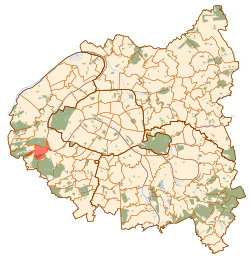 View of the commune of Sèvres in red on the map of Paris and the "Petite Couronne"
 -
 Banks of the Seine in the early 20th century. At that time, the river was an important transportation axis; river shuttles can be seen here as piers ensured the transportation of passengers to Paris.


Places adjacent to Sèvres | ||||||||||||||||
|---|---|---|---|---|---|---|---|---|---|---|---|---|---|---|---|---|
| ||||||||||||||||


Geology and landforms
[edit]The area of the commune is 391 hectares (970 acres). The altitude varies between 27–171 metres (89–561 ft).[4]
Work at Sèvres, including for the construction of the expressway, permitted an update of interesting fossils in different geological layers. Notably, in chalk, some types of sea urchins, belemnite beaks, rhynchonellas and oysters were found; in the coarse limestone, ammonites.[5]
Hydrography
[edit]- The Seine
- The Ru de Marivel which empties into the Seine 80 metres (262 feet) upstream of the Pont de Sèvres.[6]
Climate
[edit]The climate of île-de-France is oceanic. The popular observation stations for meteorology at Sèvres are Orly Airport and Vélizy – Villacoublay Air Base.[7]
The climate in the departments of the small Parisian crown is characterised by sunshine and relatively low precipitation. The following table allows a comparison of the Île-de-France climate with that of some large French cities:
| City | Sunshine (hrs/yr) |
Rain (mm/yr) |
Snow (days/yr) |
Storm (days/yr) |
Fog (days/yr) |
|---|---|---|---|---|---|
| National average | 1973 | 770 | 14 | 22 | 40 |
| Orly[8] | 1797 | 615 | 16 | 20 | 31 |
| Paris | 1661 | 637 | 12 | 18 | 10 |
| Nice | 2724 | 733 | 1 | 29 | 1 |
| Strasbourg | 1693 | 665 | 29 | 29 | 53 |
| Brest | 1605 | 1211 | 7 | 12 | 75 |
The following table shows the monthly averages of temperature and precipitation for the station of Orly collected over the period 1961–1990:
| Climate data for île-de-France (station of Orly 1961–1990) | |||||||||||||
|---|---|---|---|---|---|---|---|---|---|---|---|---|---|
| Month | Jan | Feb | Mar | Apr | May | Jun | Jul | Aug | Sep | Oct | Nov | Dec | Year |
| Mean daily maximum °C | 5.8 | 7.5 | 10.7 | 14.2 | 18.1 | 21.5 | 24.0 | 23.8 | 20.9 | 15.9 | 9.8 | 6.6 | 14.9 |
| Daily mean °C | 3.3 | 4.4 | 6.8 | 9.8 | 13.5 | 16.7 | 18.9 | 18.6 | 16.0 | 11.9 | 6.8 | 4.1 | 10.9 |
| Mean daily minimum °C | 0.7 | 1.3 | 3.0 | 5.3 | 8.8 | 11.9 | 13.8 | 13.4 | 11.2 | 7.9 | 3.8 | 1.6 | 6.9 |
| Average precipitation mm | 51.9 | 44.8 | 50.8 | 46.6 | 57.8 | 50.5 | 50.1 | 46.5 | 52.0 | 53.2 | 58.1 | 53.1 | 615.4 |
| Mean daily maximum °F | 42.4 | 45.5 | 51.3 | 57.6 | 64.6 | 70.7 | 75.2 | 74.8 | 69.6 | 60.6 | 49.6 | 43.9 | 58.8 |
| Daily mean °F | 37.9 | 39.9 | 44.2 | 49.6 | 56.3 | 62.1 | 66.0 | 65.5 | 60.8 | 53.4 | 44.2 | 39.4 | 51.6 |
| Mean daily minimum °F | 33.3 | 34.3 | 37.4 | 41.5 | 47.8 | 53.4 | 56.8 | 56.1 | 52.2 | 46.2 | 38.8 | 34.9 | 44.4 |
| Average precipitation inches | 2.04 | 1.76 | 2.00 | 1.83 | 2.28 | 1.99 | 1.97 | 1.83 | 2.05 | 2.09 | 2.29 | 2.09 | 24.23 |
| Average relative humidity (%) | 86 | 80 | 76 | 72 | 72 | 71 | 70 | 71 | 77 | 83 | 86 | 86 | 78 |
| Source: Infoclimat[9] | |||||||||||||
| Month | Jan | Feb | Mar | Apr | May | Jun | Jul | Aug | Sept | Oct | Nov | Dec |
|---|---|---|---|---|---|---|---|---|---|---|---|---|
| Number of days with frost | 12.4 | 10.3 | 7.0 | 1.6 | 0.0 | 0.0 | 0.0 | 0.0 | 0.0 | 0.2 | 5.4 | 11.6 |
| Source: Infoclimat[9] | ||||||||||||
| Climate data for île-de-France (station of Orly 1961–1990) | |||||||||||||
|---|---|---|---|---|---|---|---|---|---|---|---|---|---|
| Month | Jan | Feb | Mar | Apr | May | Jun | Jul | Aug | Sep | Oct | Nov | Dec | Year |
| Record high °C | 16.5 | 20.0 | 24.5 | 29.4 | 35.0 | 37.0 | 39.2 | 40.0 | 33.0 | 31.3 | 20.1 | 17.3 | 40.0 |
| Record low °C | −16.8 | −15.0 | −9.4 | −4.3 | −1.3 | 3.2 | 6.7 | 5.6 | 1.7 | 3.9 | −9.6 | −13.3 | −16.8 |
| Record high °F | 61.7 | 68.0 | 76.1 | 84.9 | 95.0 | 98.6 | 102.6 | 104.0 | 91.4 | 88.3 | 68.2 | 63.1 | 104.0 |
| Record low °F | 1.8 | 5.0 | 15.1 | 24.3 | 29.7 | 37.8 | 44.1 | 42.1 | 35.1 | 39.0 | 14.7 | 8.1 | 1.8 |
| Source: JournalduNet[8] | |||||||||||||
Routes of communication and transport
[edit]Roads
[edit]Sèvres is traversed from side to side by the RN 10, today downgraded and allowing connection of the city to Boulogne-Billancourt and Chaville. It is also the starting point of the RN 118 at the level of the Pont de Sèvres.
Cycle paths
[edit]Sèvres presents a main traffic artery which supports important transit traffic at morning and evening peak hours. This allows preservation of its secondary residential purpose from suffering the negative effects of through traffic, and on which the development zone 30 was under study, as early as 2007.[10] The city hall has, however, launched a reconsideration on these routes for sharing public spaces in favour of soft links (comfortable pavements, if possible with the development of cycle paths) and the use of public transit where they pass (comfortable bus stops, creation of own sites where technical conditions permit).[11] Since November 2011, fifteen streets have two-way cycle lanes. They are the subject of ground markings and installation of specific signaling panels:
- Avenue de la Cristallerie
- Rue Brancas, between the Rue de Ville-d'Avray and Rue Bernard-Palissy
- Grande Rue, between the Rue de Ville-d'Avray and the Place Gabriel-Péri
- Rue du Docteur Gabriel-Ledermann, between the Rue de Rueil and Rue Jules Sandeau
- Rue Riocreux, between Place Pierre-Brossolette and Rue de Ville d'Avray
- Rue Brongniart
- Rue Léon Journault (between Avenue Camille Sée and Sente Brézin) then Rue Victor-Hugo
- Rue des Bas-Tillets between Rue Benoît Malon and the Rue de la Garenne
- Rue Albert Dammouse, between Rue Avice and the Stade des Fontaines turn
- Rue Rouget-de-l'Isle
- Rue Jules-Ferry
- Rue du Docteur Roux
- Rue Charles-Vaillant
- Rue Jean-Jaurès
- Rue des Verrières
Public transport
[edit]Bus routes 169, 171, 179, and 426 of the RATP bus network, route 469 of the Établissement Transdev de Nanterre [Transdev establishment of Nanterre], route 45 in the Phébus bus network and at night by N61 and N145 of the Noctilien route network. The city makes one minibus available to people with reduced mobility, L'autre Bus [The Other Bus].
Rail
[edit]
Sèvres is served by Sèvres-Rive-Gauche station on the Transilien Line N suburban rail line.
It is also served by Sèvres–Ville-d'Avray station on the Transilien Paris-Saint-Lazare suburban rail line.
It is also served by the Musée de Sèvres and Brimborion stations on Île-de-France tramway Line 2 which links Paris-Porte de Versailles and La Défense.
Urbanism
[edit]Urban morphology
[edit]INSEE has divided the commune into ten islets grouped for statistical information.
The commune of Sèvres includes 16 quarters, named as follows:
|
|
|
|
| Type of occupation | Percentage | Area |
|---|---|---|
| Built urban space | 62.70% | 243.19 hectares (600.9 acres) |
| Unbuilt urban space | 13.46% | 52.21 hectares (129.0 acres) |
| Rural areas | 23.83% | 92.44 hectares (228.4 acres) |
| Source: IAURIF[12] | ||
Housing
[edit]In the project planning and sustainable development (PADD) approved 10 May 2007,[13] the commune displays an ambition to maintain its population around its situation of early 2005. It has a commitment to offer every household in the commune the opportunity to live and grow in Sèvres, and a stake in preserving its fabric of facilities and local businesses. Studies conducted in the context of the PLH show that by 2015, this would involve the construction of approximately 40 homes per year (taking into account of the transformation of the former park, of the reduction of the vacancy rate and the loosening of household size) to maintain the communal population.
In 2005, the commune had 24.5% of its total as social housing. These homes are mostly located along the RD 910, around the city centre. The commune displays a desire to preserve this social mix by ensuring a diversity of different types of housing, under the framework of future construction operations. As such, it shows the will to maintain its social housing stock at around 25% of the total stock of main residences. On the other hand, private rental declined between 1990 and 1999. An effort in favour of this type of housing will be always sought in order to maintain the diversity of population profiles. Some areas of the city are poorly provided with social housing, and the development of this type of housing should allow a better balance across the commune.[14]
Development projects
[edit]The main projects are:
- The reconstruction of the Croix Bosset school[15]
- The development of links between the banks of the Seine, the city, parks and woodlands by pedestrian openings designed to develop a frame of soft east–west links. Such as linking Saint-Cloud Park / île Monsieur, between Brimborion Park and the Brimborion tram station, along the Seine, a development project of the entrance of Sèvres and the vicinity of the Museum of Manufacturing by the creation of a pedestrian/bicycle along the Grande Rue, behind the wall of the Museum.[16]
Toponymy
[edit]The name of the locality is attested as Savara[17] in the 6th century,[18] originating from the name of the stream which followed the Valley of Viroflay, Chaville, Sèvres.[19] Then in the forms of Villa Savara in the 6th century,[20] Saura,[when?] Saure,[when?] Savra,[when?] Saevara in the 11th century,[20] Severa, Sepera and Separa in the 13th century,[18] Sevra,[when?] Sièvre,[when?] Saives,[when?] Sèvre-en-France-lez-paris from the 14th century, before Sèvres.[when?][5]
Sèvres took the name of the river which ran through it. Sèvres includes radical sav-, sab-, in the sense of "hollow" or radical sam- "quiet". These radicals are often used in hydronymy.[20]
The root is the same for the Sèvre Nantaise and the Sèvre Niortaise which gave its name to the Department of the Deux-Sèvres.
History
[edit]


- The town of Sèvres existed in 560, when Saint Germain, Bishop of Paris, healed a sick person and built the church.
- The Church of Saint-Romain-de-Blaye, current and several times revised, dates from the 13th century. There was a seigniorial château.
- The manufacture de Sèvres was formed in 1750, by the Ferme générale; they were held by the Marquis de Fulvi who operated at Vincennes.
- In 1756, Madame de Pompadour transferred the Vincennes porcelain factory to Sèvres. It was moved to the location of the Guyarde, the former resort of Lully.
- In 1760, Louis XV bought the factory which thus becomes 'royal'.
- The Pont de Sèvres, which was of wood, was begun in stone in 1809 and finished in 1820.
- In 1815, the inhabitants of Sèvres, along with some soldiers, tried to resist the Prussians who occupied and looted Sèvres, despite the capitulation signed at Saint-Cloud.
- During the repression of January and February 1894, the police conducted raids targeting the anarchists living there, without much success.[21][22][23]
- The Treaty of Sèvres (10 August 1920)
A treaty was signed in the large room which currently houses the Museum of Porcelain at Sèvres, it was a peace treaty between the Allies and the Ottoman Empire, to the detriment of the latter.
- The Protocols of Sèvres (21 to 24 October 1956)
Protocols of Sèvres (sometimes referred to as 'agreements') are a secret seven-point agreement recording in writing a tripartite agreement between Israel, France and Great Britain in response to the nationalisation of the Suez Canal by the Egyptian leader Nasser.
- In 1961, the renovation of old town centre, which was unhealthy, accompanied by the deviation of the RN 10, was committed to by the municipality of Dr. Odic, and included the demolition of 1,500 houses and the construction of 1,600 new houses, along with 42,000 square metres (450,000 sq ft) of offices or commercial premises.[24][25] The municipality of Jean Caillonneau redirected urbanisation at the end of the 1980s to promote the establishment of offices in order to "remake Sèvres as a dynamic and industrious city".[26]
Politics and administration
[edit]Political trends and results
[edit]Since the elections of 2007, Sèvres belongs to the communes of more than 3,500 inhabitants,[27][28] using voting machines.
In the referendum on the Constitutional Treaty for Europe on 29 May 2005, Sévriens mostly voted for the European Constitution, with 69.93% in favour against 30.07% not in favour, with a 24.08% abstention rate (entire France: No at 54.67%, Yes at 45.33%).[29]
At the 2007 presidential election,[30] the first round saw Nicolas Sarkozy in the lead with 35.58% or 4,750 votes, followed by Ségolène Royal with 26,09% or 3,212 votes, and then François Bayrou with 23.35% or 2,875 votes, no other candidates exceeded the threshold of 5%. In the second round, 56.40% or 6,661 voted for Nicolas Sarkozy with 43.60% or 5,149 voting for Ségolène Royal,[31] a result which was more disposed than the national average. In the second round, 53.06% voted for Nicolas Sarkozy and 46.94% for Ségolène Royal. For this presidential election, the turnout rate was very high. There were 18,455 registered voters in Sèvres, 89.56% or 16,528 voters participated in the ballot, the abstention rate was 10.44% or 1,927 votes, with 0.54% or 90 votes conducted as a blank vote, and finally 99.46% or 16,438 votes were cast.
In the 2014 municipal election, a miscellaneous right (DVD) list led by Grégoire de La Roncière opposed the list led by the outgoing mayor, François Kosciusko-Morizet, of the Union for a Popular Movement (UMP), and then by Laurence Roux-Fouillet after the withdrawal of the latter. In the second round, on 30 March, the DVD list gained two more votes than the UMP list (3,279 votes against 3,277).[32] On 4 April, Grégoire de La Roncière was elected Mayor of Sèvres by the new municipal council.
Municipal government
[edit]Sèvres has implemented a Communal Youth Council, so as to involve young people in the life of the commune.[33]
List of mayors
[edit]Since 1971, five mayors have held office in Sèvres:
| Start | End | Name | Party | Other details |
|---|---|---|---|---|
| 21 March 1971 | 1978 | Georges Lenormand | PCF | General Counsel (1967–1970 and 1976–1982) Resigned |
| 1978[35] | 13 March 1983[36][37][38][39] | Roger Fajnzylberg | PCF | |
| 13 March 1983 | 18 June 1995 | Jean Caillonneau | UDF–CDS | Insurance executive |
| 18 June 1995 | 4 April 2014 | François Kosciusko-Morizet | UMP | Politician |
| 4 April 2014[40] | In office | Grégoire de La Roncière | DVD | Vice-president of the communauté d'agglomération G.P.S.O. |
Judicial and administrative authorities
[edit]Sèvres is within the jurisdiction of the Tribunal d'instance[41] as well as in that of the police court in Boulogne-Billancourt.[42]
Environmental policy
[edit]The municipality wishes to enhance its environmental richness (forests, banks of the Seine, built heritage, topography, etc.) which is an asset in terms of image for the city and quality of life for its inhabitants: "It should preserve those elements which are the links of a string of parks and gardens which are also involved in large landscape continuity, of opportunities for walks and tours at an intercommunal level".[16]
Twin towns
[edit]Sèvres is twinned with:
 Wolfenbüttel, Germany, since 1980[43]
 Mount Prospect, Illinois, United States, since 2000[43]


Furthermore, the commune of Sèvres signed a cooperation agreement with the Mărăcineni commune in Romania, in 1991.[43]
Intercommunality
[edit]The commune of Sèvres was a member of the Agglomeration Community of Val de Seine and is a member of the Communauté d'agglomération Grand Paris Seine Ouest since its inception on 27 November 2008, along with the communes of Boulogne-Billancourt, Chaville, Issy-les-Moulineaux, Meudon, Vanves and Ville-d'Avray.
Population and society
[edit]Demography
[edit]Demographic evolution
[edit]In 2017, the commune had 23,507 inhabitants.[44]
|
|
| |||||||||||||||||||||||||||||||||||||||||||||||||||||||||||||||||||||||||||||||||||||||||||||||||||||||||||||||||||||
| From 1962 to 1999: Population without double counting; for the years following: municipal population. Source: Ldh/EHESS/Cassini until 1999[45] and INSEE (1968–2017)[44] | |||||||||||||||||||||||||||||||||||||||||||||||||||||||||||||||||||||||||||||||||||||||||||||||||||||||||||||||||||||||
Age structure
[edit]The distribution of age groups of the commune of Sèvres and of the department of Hauts-de-Seine are shown below.
|
| ||||||||||||||||||||||||||||||||||||||||||||||||||||||||||||||||||||||||||||||||||||||||||||||||||||||||||||||||||||||||||||||||||||||||||||||||||||||||||||||||||||||||||||||||||||||||
Education
[edit]

The city administers six nursery schools and five primary schools.[47]
The department manages a middle school (collège) and the region of Île-de-France a senior high school/sixth-form college (lycée) by the name of Lycée Jean Pierre Vernant in memory[48] of the Compagnon de la Libération and historian. The college/high school welcomes the international sections of Sèvres (bilingual French/English and French/German) recognised for their excellence. These international sections prepare undergraduate French and OIB (Baccalauréat International Option).
Sèvres also boasts a private institution (school and college): The Jeanne-d'Arc [Joan of Arc] School.
The École supérieure de fonderie et de forge, a private engineering college is also installed on the territory of the commune, in the middle of the technical centre of the foundry industries
Strate School of Design a private institution for technical education teaching industrial design, 3D modeling and design thinking is also located in Sèvres.
History of education
[edit]The Maison d'enfants de Sèvres[49] operated from September 1941, under the direction of Yvonne Hagnauer (Goéland), until November 1958 at 14 Rue Croix-Bosset. It then moved to the Château de Bussières, on the opposite bank of the Seine. In 1991 it became the College Jean-Marie-Guyot.
The École normale supérieure of young girls was created in Sèvres in 1881. It then moved to Boulevard Jourdan, Paris, before merging with the École Normale Supérieure, in 1985. It held the old buildings of the porcelain factory, which today houses the International Centre for pedagogical studies.
Cultural events and festivities
[edit]
On the last Saturday of September is "The Dictation of Sèvres" writing competition. This has been held since 2007.[50]
Health
[edit]Sèvres is home to one of the sites of the Centre Hospitalier de 4 Villes [Central Hospital of 4 cities]. Since 1 January 2006, this centre brings together the Centre Hospitalier Intercommunal Jean Rostand, (which already included Chaville, Sèvres and Ville d'Avray) and the Centre Hospitalier de Saint-Cloud.[51] The site of Sèvres specialises in hospitalisation and consultation in maternity/gynaecology/fertility and medical services.[52]
Sport
[edit].jpg)
The Sèvres Football Club senior team is currently coached by Alexandre Matejic, a former professional footballer, and winner of the 2004–2005 Coupe Gambardella with Toulouse FC.[53] Operating in the departmental divisions, Sèvres FC just missed reaching the 4th round of the Coupe de France 2008–2009. Indeed, playing against Red Star (then in CFA) at the Fountains Stadium, Sèvres FC opened the score in the 7th minute through Thomas Millet. The score remained at 1-0 for seventy-five minutes, until the equalisation by Demba Diagouraga, for the team from Saint-Ouen. The Sèvres team, however, collapsed in overtime and lost four goals, giving the 'Greens' a 5–1 win after extra time.[54]
Having been a location which the 2012 Tour de France passed through on that year's final stage, Sèvres will host the departure for Stage 21, the final stage of the 2015 Tour de France, on 26 July, heading towards the year's ultimate finish line on the Champs-Élysées.
Media
[edit]Sèvres has been host to the internet radio station GOOM Radio, since 2007.
Worship
[edit]Sèvres has places of Catholic, Jewish, Muslim, Protestant and Buddhist worship.
Catholic worship
[edit]Since January 2010, the commune of Sèvres is part of the deanery of the hills, one of the nine deaneries of the Diocese of Nanterre.[55]
Within this deanery, places of Catholic worship under the two parishes of Sèvres are:[56]
- Parish of Saint-Romain: Church of Saint-Romain
- Parish of Notre-Dame-des-Bruyères: Notre-Dame des Bruyères.
Protestant worship
[edit]Reformed Church of France (Sequoia Parish Centre)
Jewish worship
[edit]Jewish Community of Sèvres
Muslim worship
[edit]Association of Muslims of Sèvres
Buddhist faith
[edit]It is at Sèvres where the Tinh Tam pagoda is situated.
Economy
[edit]Income of the population and taxation
[edit]In 2010, the median taxable household income was €44,450, which ranked Sèvres at 960th position among the 31,525 communes with more than 39 households in metropolitan France.[57]
Employment
[edit]In 2007, the communal employment rate was close to 100% (10,369 jobs for 10,607 employable people who resided in Sèvres), which corresponds to the objective which was set out in the blueprint of the Val de Seine, to the horizon of 2015.[58]
Local culture and heritage
[edit]Places and monuments
[edit]The commune includes many listed monuments in the general inventory of French cultural heritage.[59]
| Title | Classified ensemble | Registered ensemble |
|---|---|---|
| International pedagogical centre | • | |
| Title | Classified monument | Registered monument |
| National porcelain manufactory, 4 Grand-Rue: The six ovens | • | |
| Sèvres Espace Loisirs, 47 Grand-Rue: Former covered market | • | |
| House of Jardies and Memorial of Gambetta (museum) | • | |
| National school of ceramics | • | |
| Building and gate, 17 Grande-Rue | • | |
| Building, 16 Rue Troyon | • | |
| Façades, roofs, gate, 14 rue Ville-d'Avray | • | |
| Church | • | |
| Former hôtel, 164 Grande-Rue: Main body, first span of both wings, closing on street, ground of the court, and interior decoration of the chapel, 33 rue | • | |
| Armenian College | • | |
| Title | Classified site | Registered site |
| Wood of Fausses-Reposes | • | |
| Wood of Meudon and Viroflay | • | |
| Banks of the Seine | • | |
| Domain of Saint-Cloud with the Villeneuve-l'Etang Park | • | |
| Domain of Brimborion | • | |
| Île Monsieur | • | |
| Banks of the Seine | • | |
| Ponds and their surroundings | • | |
| Source : IAURIF[60] | ||
The Church of Saint-Romain-de-Blaye
[edit].JPG)
.JPG)
The church[note 1] offers an amalgam of Gothic, redesigned and damaged by the 17th century: Outdoors, there is a clerestory tower which was disfigured. The rounded roof has been largely preserved, but it is much uncovered. The Way of the Cross, painted on porcelain, comes from the Manufacture de Sèvres, and stained glass windows, more than a century old.[61] This church was inaugurated several times.[62]
It was founded by the Merovingian King Dagobert II in the 7th century, it was a Royal Parish under Marie Leszczyńska. The first municipal assembly, created by the edict of 1787, consisted of two members: The lord, namely King Louis XVI, and the priest, as well as nine other elected members. This assembly met in the church at the end of vespers or high mass.[63]
This church was listed in the inventory of historical monuments in 1937.[64]
Its bell, called Anette, was blessed in 1760 and listed in the inventory of historical monuments on 27 April 1944.[65]
The rectory was built between 1744 and 1786.[66]
The Church of Our Lady of Bruyères
[edit].JPG)
.JPG)
This chapel was built in 1930, on the edge of the Route des Gardes. Established as a parish in 1962, destroyed in 1971, it was rebuilt at 23 rue du Docteur Roux in 1968.[67]
The Armenian College
[edit].JPG)
This building, located 26 Rue Troyon, was given to the Pompadour for a school for girls. It was rebuilt for Bacler d'Albe between 1816 (cadastre) and 1824 (death of general). Occupied in 1898 by a convalescent home for colonial soldiers, it is currently the Samuel Moorat Armenian College, but it is currently threatened, taking into account its state.[68]
The manufacture of crystals of the Queen
[edit]The building of this factory, located at 16 Rue Troyon and built in 1744, was classified in the inventory of historical monuments on 1 December 1986.[69]
The Manufacture nationale de Sèvres
[edit].JPG)
.JPG)
The current building dates from 1876. This building was classified in the inventory of historical monuments on 30 October 1935.[70] The Manufacture nationale de Sèvres is a public establishment manufacturing ceramic in the tradition of the 18th century.
The Maison des Jardies
[edit]
The Maison des Jardies is the home of Balzac, Corot and Gambetta who died there on 31 December 1882.[71]
This house, located 14 Avenue Gambetta, had been bought by Balzac, which he occupied from 1837 to 1840, and was then leased by Gambetta in 1878.[72]
National Ceramic Museum
[edit]Founded in 1824 by Alexandre Brongniart, director of the Manufacture nationale de Sèvres, under the name of Ceramic and Vitric Museum. Anxious to present the history of the techniques of ceramics and vitreous materials, through the world and eras, the latter was one of the collections of ceramics of the most varied. The Museum brings together an exceptional selection of pottery, ceramics and porcelain.[73]
Tinh Tam Buddhist Temple
[edit]
The magnificent Buddhist temple or Tinh Tam pagoda is one of the busiest in France.[5]
Castel Henriette Villa
[edit]Castel Henriette,[74][75][76][77] built in 1899–1900, was an important Art Nouveau work by the architect Hector Guimard; it was demolished in 1969.[78][79]
Stone quarries
[edit]These stone quarries were dug into the hillside and used for wine storage in 1740, divided into 30 galleries including one called Royal Gallery; converted into a brasserie in 1840, which burned down in 1880 and was rebuilt in 1898.[80]
Religious institutions
[edit]- Boarding school of the Dominicans:
The presence of nuns who teach at Sèvres dates back to 1788, when an act provided for the education of poor girls by four sisters of charity.[81] At Sèvres, on Rue Gabriel Péri, were formerly the convent, school and boarding school of the Dominican teachers of Most Holy-Rosary of Sèvres, work encouraged by the Holy curé d'Ars, founded by the Sister Marie-Rose of the Sacred Heart Order of Preachers at the end of the 19th century, with Fr. Codant, in 1858, of which novices carried the name of servants of the Sacred Heart and had several foundations, in San Remo for example during the exile from France in 1903, and also an orphanage, Rue Troyon (they returned to France in 1913 and asked for Government permission to reopen a novitiate). During the war an ambulance and infirmary for wounded soldiers was installed in the convent.[82]
- Novitiate of the Assumptionists:
On some old postcards,[83] one can admire the Chapel of the Assumptionists, located at 14 Rue de la Croix-Bosset in the quarter of La Croix-Bosset. This property, acquired on 30 April 1874, was offered to the religious of the assumption at the end of the year 1877 to become the Paris novitiate outside the city. The Oblates of the Assumption also settled in Sèvres and then a community of Assumptionist sisters. Finally, the religious of the province of Paris between 1946 and 1964, a lively workers' mission centre of Saint-Étienne in Sèvres, on Avenue Division Leclerc, a community called La Cloche, close to the Renault factories.[84]
Cultural heritage
[edit]Sèvres and artworks
[edit]


Sèvres, near Paris but very rustic, attracted the greatest painters:[85]
- Samuel William Reynolds painted Saint-Cloud et le pont de Sèvres (Musée Condé, Chantilly)
- The Douanier Rousseau painted in 1908 a Vue du pont de Sèvres (The Pushkin State Museum of Fine Arts, Moscow)
- Sisley, who lived in Grand-Rue, painted the former factory, the bridge and the banks of the Seine, paths
- Corot is painted his famous Chemin de Sèvres (Musée du Louvre)
- Paul Huet painted are tasty and country views as possible (Musée de l'Île-de-France, Sceaux)
- Marie Bracquemond, wife of Félix Bracquemond (Le Chemin des Coutures à Sèvres, National Gallery of Canada) linked to the Group of impressionists and employed at the factory, is painted Sèvres. His most famous work: Sur la terrasse de Sèvres avec Fantin-Latour (leg. Caillebotte).
- Constant Troyon born in Sèvres in 1810, first painter of the Barbizon school are painted Chemin de forêt and the Maison Colas, the Prise de la culée du pont de Sèvres. Constant Troyon's parents worked at the manufacture de Sèvres, his father as a painter decorator, and his mother as a buffer. He was encouraged in the field of the arts by his godfather, Riocreux, the curator of the Ceramics Museum of Sèvres and a floral painter. He lived with his mother at the factory until the age of twenty. He first exhibited three paintings at the Paris Salon of 1833, including the Vue de la Maison Colas and the Vue de la Fête de Sèvres.[86]
- Wassily Kandinsky lived for a year in Sèvres, in 1906–1907, at the Rue des Ursulines and then small Rue des Binelles, became Rue Théodore Deck. He painted the La Vie Mélangée.
- Alain Azémar, a painter from Sèvres, living in the Rue de Caves, a street which was the theatre of many "squats" protest-painted scenes of Sèvres on many occasions. Many of his watercolours were commissioned and are displayed by the city hall.
Sèvres and philately
[edit]The French Post Office has developed several times Sèvres à l'Honneur:
On 25 March 1957, a postage stamp was issued with a face value of 30.00 Francs, honouring the Manufacture Nationale de Sèvres, drawn and engraved by Pierre Munier.[87]
On 10 January 2009, a postage stamp was issued with a face value of €0.55, representing a Quimper flat oval earthenware, displayed by the Museum of Sèvres.[88]
Sèvres and television
[edit]The city of Sèvres is the scene for the filming of the French television series Fais pas ci, fais pas ça.
Personalities linked to the commune
[edit]- Andrew Albicy basketball player
- Demba Ba – Senegalese international football player
- Maurice Béné (1884–1960), politician
- André Bizette-Lindet, sculptor, died in Sèvres in 1988
- Yamoudou Camara – French football player
- Manu Chao – Hispano-French musician
- Issiar Dia – Senegalese international football player
- Pierre Louis Félix Lanquetot (1880–1974) – French brigadier general
- Allan Linguet (born 1999), footballer
- Benoit Mozin (1769–1857), French composer, died in Sèvres
- Iliana Rupert (born 2001), basketball player
- Georges Salles (1889–1966), art historian, was born in Sèvres
- Jean-Pierre Vernant (1914–2007), historian, died in Sèvres
- Karim Ziani – Algerian international football player
Heraldry, logo and motto
[edit] |
The arms of Sèvre are blazoned : Azure a bridge of wood two batteries or on waves argent issuing from base, surmounted by a huchet covered or virole and enguiche sable, to the chief or a branch of laurel and a palm in double saltire sable, displayed two vases azure overloaded each a Fleur-de-lis or.
|
See also
[edit]Notes
[edit]- ^ Saint-Romain-de-Blaye is the Basilica situated on the banks of the Gironde where Charlemagne's nephew Roland was buried in the 'Chanson de Roland'. A famous hermit named Roman lived there.
References
[edit]- ^ "Répertoire national des élus: les maires" (in French). data.gouv.fr, Plateforme ouverte des données publiques françaises. 6 June 2023.
- ^ "Populations légales 2022" (in French). National Institute of Statistics and Economic Studies. 19 December 2024.
- ^ "Quelques villes proches de Sèvres". villorama.com.
- ^ Répertoire géographique des communes, publié par l'Institut national de l'information géographique et forestière, "Répertoire géographique des communes". Archived from the original on 8 January 2015. Retrieved 23 May 2015.
- ^ a b c Jean-Michel Dechambre, Découvrir les Hauts-de-Seine, éditions Horvath, 1980, p.76
- ^ "Histoire du ru de Marivel". Archived from the original on 18 February 2015.
- ^ "Fiche sur Sèvres". Météo France.
- ^ a b "Climat et historique météo d'Orly (94310)". Retrieved 24 May 2015.
- ^ a b "Orly, Val-de-Marne(94), 89m - [1961-1990]". www.infoclimat.fr.
- ^ "PADD, p.23" (PDF). mairie de Sèvres. 10 May 2007. Archived from the original (PDF) on 3 August 2014.
- ^ "PADD, p.24" (PDF). mairie de Sèvres. 10 May 2007. Archived from the original (PDF) on 3 August 2014.
- ^ "Fiche communale d'occupation des sols". Iaurif.
- ^ "PADD, p.6" (PDF). mairie de Sèvres. 10 May 2007. Archived from the original (PDF) on 3 August 2014.
- ^ "PADD, p.7" (PDF). mairie de Sèvres. 10 May 2007. Archived from the original (PDF) on 3 August 2014.
- ^ "Urbanisme". site de la mairie de Sèvres. Archived from the original on 3 April 2009.
- ^ a b "Plan Local d'Urbanisme" (PDF). Archived from the original (PDF) on 3 August 2014.
- ^ Albert Dauzat, Les noms de lieux, Paris, 1926, p.197.
- ^ a b Hippolyte Cocheris, Anciens noms des communes de Seine-et-Oise, 1874, "Corpus Etampois".
- ^ Michel Roblin, Le terroir de Paris aux époques gallo-romaine et franque, page 273.
- ^ a b c Michel Roblin, Le terroir de Paris aux époques gallo-romaine et franque, page 273
- ^ "Les anarchistes" [The anarchists]. La Dépêche. 3 January 1894. p. 2.
- ^ "Deux mille perquisitions". L'Estafette: 2. 2 January 1894.
- ^ "Une série générale de perquisitions : résultat négatif des recherches" [A general series of raids: negative results]. L'Éclair. 3 January 1894.
- ^ Hérald, Jean-Marc (9 November 1966). "L'" opération-tiroir " de Sèvres". Le Monde.
- ^ Rollin, François (19 May 1981). "Vie locale et bulletins de vote : Sèvres a les yeux de Chimène pour son maire communiste". Le Monde.
- ^ "La course aux bureaux dans l'Ouest parisien, Sèvres en chantier". Le Monde. 25 August 1988.
- ^ "La liste des 82 communes équipées de machines à voter". ZDNet.fr. 11 April 2007.
- ^ "Liste des communes équipée de machines de vote électronique dans le 92". Archived from the original on 9 December 2008.
- ^ "Scrutin du 29 mai 2005 sur la constitution européenne – Antony". ministère de l'intérieur.
- ^ "Résultats électoraux du premier tour et du second tour". Le Figaro. January 2022.
- ^ "Résultats électoraux indexés". ministère de l'intérieur.
- ^ "A Sèvres, le dissident DVD élu avec deux voix d'avance !". Le Parisien.fr (in French). 31 March 2014.
- ^ "Conseil communal des jeunes". site de la mairie de Sèvres. Archived from the original on 15 December 2009.
- ^ "Les maires de Sèvres". www.francegenweb.org.
- ^ Rollin, François (6 December 1982). "SÈVRES : le " cas " Fajnzylberg". Le Monde.
- ^ "Le P.S. soutient M. Fajnzylberg à Sèvres". Le Monde. 6 January 1983.
- ^ Rollin, François (10 February 1983). "M. Fajnzylberg ne veut être l'otage de personne". Le Monde.
- ^ Rollin, François (10 March 1983). "À Sèvres : les communistes " orthodoxes " se rallient au dissident". Le Monde.
- ^ Rollin, François (18 March 1983). "M. Fajnzylberg : la gauche aurait pu gagner si le P.C. avait joué le jeu honnêtement". Le Monde.
- ^ "Élection du Bureau de Grand Paris Seine Ouest" (PDF). Agglo. Grand Paris Seine Ouest website. Communiqués de presse. 9 April 2014.
- ^ "Tribunal d'instance de Boulogne-Billancourt" (PDF). cour d'Appel de Versailles.
- ^ "Tribunal de Boulogne-Billancourt". cour d'Appel de Versailles. 27 May 2008.
- ^ a b c "Atlas français de la coopération décentralisée et des autres actions extérieures". Ministère des affaires étrangères. Archived from the original on 1 July 2013.
- ^ a b c "Évolution et structure de la population en 2017: Commune de Sèvres (92072)" (in French). Retrieved 1 September 2020.
- ^ Des villages de Cassini aux communes d'aujourd'hui: Commune data sheet Sèvres, EHESS (in French).
- ^ "Évolution et structure de la population en 2017: Hauts-de-Seine". INSEE. Retrieved 1 September 2020.
- ^ "Les établissements scolaires". mairie de Sèvres. Archived from the original on 23 February 2009. Also see Education in France
- ^ "Jean-Pierre Vernant, un Compagnon de la Libération". site du lycée Jean-Pierre-Vernant. 19 October 2007. Archived from the original on 4 June 2012.
- ^ "Page d'accueil". site de la Maison de Sèvres. 23 June 2009.
- ^ "3e dictée de Sèvres". mairie de Sèvres. Archived from the original on 3 August 2014.
- ^ "Le nouvel hôpital". centre hospitalier des 4 villes. Archived from the original on 11 October 2007.
- ^ "Le site de Sèvres". centre hospitalier des 4 villes. Archived from the original on 21 February 2010.
- ^ "SEVRES F.C. 92". Retrieved 24 May 2015.
- ^ "Coupe de France, 4ème tour, dimanche 5 octobre 2008, SEVRES FC – RED STAR FC 93 : 1-5 a.p. (1-1 90 mins) (1-0)". Retrieved 24 May 2015.
- ^ "Carte des doyennés janvier 2010". le site du diocèse de Nanterre. Archived from the original on 19 February 2012.
- ^ "Liste des paroisses des Hauts-de-Seine". le site du diocèse de Nanterre. Archived from the original on 25 January 2012.
- ^ "Fichier RFDM2010COM : Revenus fiscaux localisés des ménages - Année 2010". INSEE.
- ^ "PADD, p.9" (PDF). Mairie de Sèvres. 10 May 2007. Archived from the original (PDF) on 3 August 2014.
- ^ Base Mérimée: Search for heritage in the commune, Ministère français de la Culture. (in French)
- ^ "Fiche communale d'occupation des sols sur le site de l'Iaurif". Archived from the original on 4 June 2012.
- ^ Paris et ses environs, éditions Larousse, 1925
- ^ "Église Saint-Romain". topic-topos.com. Archived from the original on 23 April 2009.
- ^ "Découvrir Sèvres". site de la ville de Sèvres. Archived from the original on 27 March 2010.
- ^ Base Mérimée: Church of Saint-Romain-de-Blaye, Ministère français de la Culture. (in French)
- ^ Base Palissy: Cloche dite Anette, Ministère français de la Culture. (in French)
- ^ Base Mérimée: rectory, Ministère français de la Culture. (in French)
- ^ Base Mérimée: Church of Our Lady of Bruyères, Ministère français de la Culture. (in French)
- ^ Base Mérimée: Armenian College, Ministère français de la Culture. (in French)
- ^ Base Mérimée: manufacture of crystals of the Queen, Ministère français de la Culture. (in French)
- ^ Base Mérimée: Manufacture nationale de Sèvres, Ministère français de la Culture. (in French)
- ^ "Maison des jardies – Présentation". site de la ville de Sèvres. Archived from the original on 17 April 2009.
- ^ Base Mérimée: Maison des Jardies, Ministère français de la Culture. (in French)
- ^ "Musée national de céramique de Sèvres". www.museums-of-paris.com. 10 August 2006. Archived from the original on 31 August 2009.
- ^ "Le Castel Henriette - Sèvres (Hauts de Seine) - Hector Guimard architecte 1899 - 1903". lartnouveau.com.
- ^ "L'ART NOUVEAU "Villa Castel Henriette " A SEVRES . H. Guimard". souslecieldeparisetdeversailles. 12 June 2009.
- ^ "Hector Guimard - Castel Henriette vers 1900". musée d'Orsay. 2006.
- ^ "Guimard". www.stanries.com. Archived from the original on 5 May 2009.
- ^ "INVENTAIRE DE L'ŒUVRE BÂTI D'HECTOR GUIMARD". www.lecercleguimard.com.
- ^ Base Mérimée: Castel Henriette, Ministère français de la Culture. (in French)
- ^ Base Mérimée: Stone quarries, Ministère français de la Culture. (in French)
- ^ "Base Mérimée".
- ^ The Règles et Constitutions de la Congrégation des Dominicaines du Très-Saint-Rosaire de Sèvres, dating to 1867 are stored at the BNF (Tilbiac) 8-LD95-6
- ^ "Cartes postales anciennes de la chapelle de l'Assomption à Sèvres".
- ^ "Lieux de mémoire (communautés assomptionnistes parisiennes au XIXème siècle)". site des augustins de l'Assomption. Archived from the original on 13 June 2010.
- ^ Découvrir les Hauts-de-Seine, p.77, Jean-Michel Dechambre, éditions Horvath, 1980
- ^ "CONSTANT TROYON". Encyclopédie Universalis.
- ^ "Faïence de Quimper, exposée au Musée de Sèvres". phil-ouest.com. 13 February 2009.
- ^ "plat ovale en faïence de Quimper, exposé au Musée de Sèvres". phil-ouest.com. 6 February 2009.
Bibliography
[edit]- Sèvres [Sèvres]. Mémoire en images (in French). éditions A. Sutton. May 2000. ISBN 2842534794.
- Mercier, Pierre (1975). Sèvres en cartes postales anciennes [Sèvres in old postcards] (in French). Zaltbommel, Netherlands: Bibliothèque européenne. preface by Georges Lenormand (mayor of Sèvres).
- Whitehead, John (2010). Sèvres sous Louis XV 1740 - 1770 [Sèvres under Louis XV 1740–1770] (in French). éditions Courtes-Longues. ISBN 978-2352900603.
- "Jardies, Gambetta and Balzac". Gallica (in French).
External links
[edit]
- Sèvres city council website
- Unofficial website about Sèvres (in French)
- Another unofficial website about Sèvres (in French)
- Friends of the ceramics museum website (in French)


| International | |
|---|---|
| National | |
| Geographic | |
| Academics | |
| Other | |

Sèvres
View on GrokipediaGeography
Location and situation
Sèvres is a commune in the Hauts-de-Seine department within the Île-de-France administrative region of France.[9] It is positioned in the southwestern suburbs of Paris, approximately 10 kilometers from the city's center as measured by air distance.[1] The commune's geographic coordinates are roughly 48°49′N 2°12′E.[10] Situated on the left bank of the Seine River, Sèvres forms part of the Paris metropolitan area and benefits from its proximity to the capital while maintaining a suburban character.[11] The commune interfaces with the river, which historically facilitated transportation and trade links to Paris.[8] It neighbors several other communes in Hauts-de-Seine, contributing to a densely interconnected urban fabric in the inner ring of Parisian suburbs.Geology, relief, and hydrography
Sèvres is situated within the Paris Basin, a major sedimentary depression characterized by layered Cenozoic deposits, including Eocene limestones that form underlying plateaus and Quaternary alluvium along river valleys.[12] The local substratum includes clay-rich formations prone to swelling and shrinkage with moisture variations, as mapped across the Hauts-de-Seine department.[13] The relief features a marked contrast between the low-lying Seine floodplain at approximately 27 meters above sea level and elevated northern sectors reaching 171 meters, shaped by fluvial erosion that has incised valleys into the plateau terrains of the Hurepoix margin and Seine meanders.[14] Average elevation stands at 102 meters, with the topography reflecting differential erosion of softer sediments by the river, creating slopes and escarpments in the vicinity.[15] Hydrographically, the Seine River delineates the commune's southern limit, serving as its primary waterway with a history of meandering that influences local sediment deposition.[12] The ru de Marivel, a 9-kilometer left-bank tributary originating near Versailles, discharges into the Seine approximately 10 meters upstream of the current Sèvres bridge, contributing seasonal runoff from upstream plateaus and historically channeling waters from the Fausses-Reposes forest and Ville-d'Avray ponds.[16]Climate
Sèvres experiences an oceanic climate (Köppen Cfb), characterized by mild summers, cool winters, moderate year-round precipitation, and limited temperature extremes influenced by its location in the Paris metropolitan area.[17] The average annual temperature is 11.5 °C, with seasonal variations driven by westerly winds and proximity to the Seine River, which moderates local conditions but does not significantly alter the broader temperate oceanic pattern.[17][18] Winters, spanning November to March, are long, cold, and predominantly cloudy, with average January highs of 5.9 °C and lows of 1.8 °C; snowfall totals about 37 mm annually, mostly in January.[19] Summers, from June to September, are short, comfortable, and partly cloudy, peaking in August with highs of 24.6 °C and lows of 14.9 °C, rarely exceeding 30 °C.[19][18] Spring and autumn serve as transitional periods with increasing or decreasing cloud cover and moderate winds averaging 8–12 mph, strongest in winter.[18] Precipitation is evenly distributed, occurring on approximately 155 days per year, with monthly totals ranging from 18 mm in September (driest) to 46 mm in June (wettest); annual rainfall averages 384 mm, though local microclimates near the river may experience slight variations.[19] Humidity remains relatively low, with few muggy days (peaking at under 1 per summer month), contributing to comfortable conditions despite frequent overcast skies in winter (up to 73% cloud cover in December).[18]| Month | Avg. High (°C) | Avg. Low (°C) | Avg. Precip. (mm) |
|---|---|---|---|
| January | 5.9 | 1.8 | 35 |
| February | 7.6 | 1.9 | 30 |
| March | 11.8 | 4.1 | 30 |
| April | 15.9 | 7.0 | 33 |
| May | 18.2 | 9.2 | 43 |
| June | 21.6 | 12.5 | 46 |
| July | 24.3 | 14.8 | 41 |
| August | 24.6 | 14.9 | 33 |
| September | 20.9 | 11.7 | 18 |
| October | 16.5 | 9.3 | 46 |
| November | 10.5 | 5.8 | 41 |
| December | 7.3 | 3.0 | 46 |
Transportation and accessibility
Sèvres benefits from its location in the western suburbs of Paris, approximately 9 kilometers from the city center, facilitating efficient connections via multiple transport modes. The commune is served by two Transilien railway stations: Sèvres-Rive-Gauche on Line N, offering direct service to Paris-Montparnasse with trains departing every 20 minutes and travel times of about 13 minutes, and Sèvres–Ville-d'Avray on Line L, connecting to Paris-Saint-Lazare and Versailles-Rive-Droite.[20][21] Public transport options include Tramway Line T6, which runs from Viroflay-Rive-Gauche to Châtillon–Montrouge and features a stop at Musée de Sèvres, approximately a 10-minute walk from Sèvres-Rive-Gauche station. Nearby, the Pont de Sèvres metro station serves as the western terminus of Paris Métro Line 9, providing access to central Paris. Several RATP bus lines, such as 169, 171, 179, 291, and 426, operate through or near Sèvres, linking to key hubs like Paris-Montparnasse and other suburban areas.[22][23] Road access is provided by departmental routes including the D7 and proximity to the A86 orbital motorway and N118 highway, enabling vehicular travel to Paris via the Boulevard Périphérique. Historically, the Seine River facilitated passenger transport to Paris via shuttles and piers until the early 20th century, though it no longer serves as a primary axis. Accessibility for persons with reduced mobility aligns with regional standards, with ongoing SNCF improvements to stations including lifts and support services; all Parisian bus lines are wheelchair-accessible, and 86% of suburban routes meet similar criteria as of 2025. Specific station enhancements, such as at Pont de Sèvres bus hub, include pedestrian improvements for diverse traffic needs.[24][25]Etymology
Origins of the name
The name Sèvres originates from the ancient hydronym Savara, denoting a local stream that marked territorial boundaries in the region. This form is first documented in 558 AD within the foundation charter of the Abbey of Saint-Germain-des-Prés, issued by King Childebert I, which specifies the abbey's limits extending "until the stream of Savara" ("dont les limites s’étendaient jusqu’au ruisseau de Savara").[26] The stream, situated along what is now the commune's southeastern edge near the Seine, likely gave its name to the emerging settlement due to its role in early hydrographic and administrative definitions.[26] Linguistic analysis traces Savara to pre-Latin roots, probably Gaulish, incorporating the radical sav- or sab-, connoting "liquid," "sap," or "juice"—elements recurrent in Indo-European hydronyms for watercourses. This etymology aligns with patterns in nearby toponymy, where such stems denote moisture-laden features in riverine areas, predating Roman influence and evolving through Frankish Latinization into the medieval Sèvres. By the 6th century, the name had stabilized, reflecting the site's strategic position for early Merovingian-era habitation and ecclesiastical endowments.[26]History
Early and medieval periods
The earliest historical record of Sèvres appears in 558, within the foundation charter of the Abbey of Saint-Germain-des-Prés issued by Merovingian King Childebert I, delineating abbey boundaries to the Savara stream, indicating an established local toponym.[26] By around 560, the settlement comprised a modest village centered on an early church, reflecting typical Merovingian-era rural organization in the Paris basin.[26] No archaeological evidence of significant prehistoric or Gallo-Roman occupation has been documented in the immediate area, suggesting sparse habitation prior to Frankish consolidation.[26] A commemorative marble plaque within the Church of Saint-Romain-de-Blaye asserts its founding in 675 under Dagobert (likely referencing Dagobert I or a successor), positioning it as a key ecclesiastical site dedicated to the patron of mariners amid the nearby Seine.[27] The 9th-century Norman raids devastated the village, prompting its rebuilding and the church's reconstruction between 1150 and 1250 in Romanesque style, with extant barrel vaults and structural elements surviving from this phase.[28] The church's bell tower base originated in the 12th century, while 13th-century expansions added nave sections in early Gothic form, underscoring Sèvres' integration into Île-de-France's feudal ecclesiastical network under regional lords and the Capetian monarchy.[26] Repeated destructions from invasions and conflicts necessitated further repairs, yet the site endured as a focal point for local agrarian communities through the High Middle Ages.[28]Early modern developments
During the 16th century, Sèvres remained a modest rural settlement centered around its parish church of Saint-Romain, which underwent expansion with the addition of several western bays to accommodate growing local needs.[29] The village's economy relied primarily on agriculture and small-scale trade along the Seine River, with limited urban infrastructure beyond basic parish and manorial structures inherited from the medieval period. The 17th century marked initial infrastructural advancements tied to royal priorities. In 1682, Louis XIV established Versailles as the permanent royal residence, prompting improvements to regional transport routes; accordingly, the first wooden bridge spanning the Seine at Sèvres was erected in 1684 to streamline travel between Paris and the palace, reducing reliance on ferries and enhancing connectivity for courtiers and goods.[26] This development elevated Sèvres's strategic position as a suburban waypoint, though the population stayed small and agrarian, with noble estates like that associated with Madame de Montespan emerging along the main thoroughfare. By the early 18th century, under Louis XV, preparatory urban works foreshadowed Sèvres's transformation. In 1739, royal initiative led to the village's first systematic renovation, involving the alignment of roadside houses for aesthetic and functional uniformity and the paving of the previously rutted main access road from Paris, which facilitated easier passage and hinted at anticipated economic activity.[26] These measures reflected broader absolutist efforts to modernize peripheral territories near the capital, though Sèvres itself had not yet industrialized.Industrial era and the porcelain manufactory
During the 19th century, the Sèvres Porcelain Manufactory emerged as the dominant force in the town's nascent industrial landscape, transitioning from royal patronage to state-directed production amid France's slower industrialization compared to Britain. Revived after near-collapse during the French Revolution, the factory received renewed impetus from Napoleon Bonaparte in 1800, who commissioned extensive services to symbolize imperial prestige, such as the massive Egypt service with over 700 pieces depicting Napoleonic campaigns.[30] Under director Alexandre Brongniart from 1800 to 1847, the manufactory integrated scientific methods, including chemical analysis for glazes and pastes, enabling consistent hard-paste porcelain production based on kaolin deposits identified in 1768 near Limoges.[6] This period saw output diversification into utilitarian and decorative wares—vases, services, and sculptures—adapting to Empire, Restauration, and Louis-Philippe styles, with annual production reaching thousands of pieces by mid-century.[30] Technological advancements solidified Sèvres' industrial stature, distinguishing it from artisanal workshops elsewhere in France. Brongniart's oversight introduced mechanized elements like steam-powered grinding for raw materials and standardized firing in large kilns reaching 1,300°C, improving yield from the era's typical 50-60% success rate in porcelain vitrification.[7] By 1875, a refined "new paste" formula approximated ancient Chinese compositions, while innovations in polychrome enamels and pâte-sur-pâte techniques—layering slip for relief effects—expanded artistic capabilities; artist Albert-Ernest Carrier-Belleuse's appointment that year further emphasized sculptural forms.[6] These developments, documented in factory ledgers and exhibitions like the 1830s Paris industrial fairs, positioned Sèvres as a hybrid of craft and proto-industry, exporting to elite markets despite France's agrarian economic base limiting broader mechanization.[31] The manufactory's operations profoundly shaped Sèvres' local economy and demographics, employing several hundred workers—primarily skilled painters, molders, and chemists—drawn from the town's population of around 4,000 by 1850, fostering ancillary trades in pigments and tools.[32] State subsidies sustained it through economic fluctuations, including post-1815 disruptions, generating revenue via luxury sales that rivaled a Parisian townhouse's value per major piece, though competition from cheaper English bone china pressured adaptations.[33] Unlike heavy industries in northern France, Sèvres' focus remained on high-value ceramics, embodying Colbertist mercantilism into the industrial age and anchoring the commune's identity amid suburban growth toward Paris.[30]20th century to present
In the early 20th century, Sèvres experienced industrial expansion, notably with the establishment of Renault's automobile factories on Île Seguin in 1919, which provided employment for many local residents.[26] During World War I, the Sèvres Porcelain Manufactory adapted production to manufacture stoneware components essential for gunpowder in firearms.[6] On August 10, 1920, the Treaty of Sèvres, a post-World War I agreement between the Allied powers and the Ottoman Empire, was signed in the town, though it was later superseded by the Treaty of Lausanne and never fully implemented.[34] World War II brought significant hardship, with Allied bombings targeting the Renault factories on Île Seguin from 1942 to 1944, resulting in civilian casualties in the lower parts of Sèvres.[26] The commune was liberated on August 24, 1944, by the U.S. 2nd Armored Division, during which seven American soldiers were killed.[26] Post-war reconstruction aligned with broader suburbanization trends in the Paris region, fostering residential growth and improved infrastructure. Population levels remained relatively stable, increasing modestly from 20,083 in 1968 to a peak of 23,726 in 2006, before declining slightly to 22,782 by 2022, reflecting trends in affluent Île-de-France suburbs with high GDP per capita.[35] Traditional industries waned, with the closure of the Gévelot/Gaupillat cartridge factory in 1979 and the final brewery—operational since 1852—in 1988.[26] Urban renewal efforts in the late 20th century addressed the linear 19th-century town center constrained by surrounding hills, incorporating modern public amenities such as the SEL cultural center, conservatory, and library.[36] In the 21st century, Sèvres has emphasized quality-of-life improvements through green spaces, cultural events, and proximity to Paris via rail links like the RER C line, maintaining its role as a residential and heritage-focused commune while hosting institutions such as the International Bureau of Weights and Measures.[37] The economy shifted toward services and research, supported by the porcelain manufactory's ongoing operations and the town's integration into the Hauts-de-Seine department formed in 1964.[35]The Sèvres Porcelain Manufactory
Founding and royal patronage
The Sèvres Porcelain Manufactory traces its origins to the Vincennes porcelain works, established in 1740 near Paris as a private enterprise producing soft-paste porcelain.[30] Initially funded by investors including the merchant Jean Hellot, the factory gained royal attention under Louis XV, who provided financial backing and purchased its first dinner service in the early 1750s.[38] By 1753, Louis XV had become the principal shareholder, designating the operation as the Manufacture royale de porcelaine de Vincennes and ensuring its privileged status with exclusive privileges to produce porcelain marked with royal cyphers.[5] The decisive shift to Sèvres occurred in 1756, when the factory relocated to newly constructed facilities on the Seine River's banks, funded by the crown to accommodate expansion and proximity to Versailles.[39] This move was heavily influenced by Louis XV's mistress, Madame de Pompadour, a fervent patron of the arts who championed the factory's artistic ambitions and whose estate at Bellevue lay nearby, facilitating oversight and supply chains.[40] Pompadour's involvement extended to recruiting talent, such as the chemist Hellot for gilding techniques, underscoring the manufactory's reliance on courtly favor for technical and stylistic advancements.[7] Royal patronage intensified in 1759, when Louis XV assumed sole ownership, transforming the Sèvres works into a state-protected monopoly that symbolized French luxury and technical prowess.[41] This direct crown control enabled lavish investments in kilns, artists, and experimentation, positioning Sèvres as a counterpart to Meissen porcelain while prioritizing hard-paste development and opulent decorations for the royal household.[39] The king's personal collection and gifts of Sèvres pieces to diplomats further elevated its prestige, though the factory's viability hinged on sustained subsidies amid high production costs.[31]Technological and artistic innovations
The Sèvres Porcelain Manufactory pioneered soft-paste porcelain techniques starting from its origins at Vincennes in 1740, achieving a creamy white body that allowed for intricate modeling and thin-walled forms suitable for luxury tableware and decorative objects.[42] This material facilitated the development of distinctive ground colors, including the turquoise bleu céleste introduced in 1753, which required precise firing control due to its high cost and sensitivity, and was prominently featured in royal services such as that for Louis XV.[31] Concurrently, artistic enamel painting and tooled gilding—where raised gold decoration was incised or textured for depth—emerged as hallmarks, with gilders like Etienne-Henry Le Guay refining methods from the 1740s onward to enhance durability and visual complexity on curved surfaces.[31] The discovery of kaolin deposits near Limoges in 1768 enabled the manufactory to experiment with hard-paste porcelain, addressing the brittleness and deformation issues of soft-paste under high temperatures.[42] Under director Alexandre Brongniart from 1800 to 1847, production shifted decisively to hard-paste by 1804, with improved formulations yielding greater translucency and strength, alongside more efficient kilns that reduced waste and supported larger-scale output.[30] [42] Artistically, this period embraced neoclassical motifs with marble-like grounds and extensive gilding, exemplified in thematic services such as the 1824 Service des Départements, which incorporated topographical views and cameo portraits painted in polychrome enamels to evoke national geography.[30] In the mid-19th century, the pâte-sur-pâte technique—layering slip over unfired porcelain for translucent, relief-like effects resembling cameo carving—was developed around the 1850s, allowing for subtle monochromatic narratives that contrasted with bolder polychrome traditions.[31] Designers like Jean Charles Develly produced eclectic works blending Gothic revival (e.g., the vase gothique Fragonard of 1832–1844) and Renaissance-inspired forms, while later forays into Art Nouveau around 1900 featured naturalistic motifs and openwork structures in services by artists such as Léon Kann.[30] These innovations reflected collaborations with external sculptors, including Carrier-Belleuse from 1875 and Rodin, expanding porcelain's sculptural potential beyond utilitarian forms.[42] Throughout its history, the manufactory has maintained in-house production of pastes, colors, and enamels, fostering ongoing experimentation that integrates ancestral skills with contemporary artistic commissions, as seen in 20th-century partnerships with modernists like Jean Arp and Alexander Calder.[43] [42] This dual commitment to technical precision—refined over nearly three centuries—and stylistic diversity has positioned Sèvres as a benchmark for ceramic artistry, with over 30 specialized trades preserved among its artisans.[43]Economic and cultural impact
The Sèvres Porcelain Manufactory has historically played a pivotal role in France's luxury goods sector, serving as a state-backed enterprise that promoted national craftsmanship and competed with foreign producers like Meissen. Founded in 1740 and elevated to royal status by Louis XV in 1759, it produced high-end porcelain for the court and aristocracy, generating revenue through exclusive sales and diplomatic gifts that enhanced France's export prestige in the 18th and 19th centuries.[30][7] Despite economic disruptions such as the French Revolution, when it nearly collapsed before state acquisition in the 1790s, the manufactory sustained operations by adapting to imperial and republican demands, including large commissions like Napoleon's services, thereby contributing to the resilience of France's artisanal economy.[42] In the modern era, the manufactory remains economically significant as a subsidized public institution, employing approximately 120 on-site ceramists across 30 specialized trades and producing 4,000 to 5,000 pieces annually, many for state use such as the Élysée Palace tableware.[43][44] Its output supports the French luxury industry by supplying bespoke items to government entities and select clients, with pieces occasionally sold to fund operations and preservation efforts. The 2025 merger with the Mobilier National into the Manufactures Nationales aims to bolster economic viability by expanding international outreach, research, and artisan support amid challenges like declining demand for traditional luxury crafts.[45][46] Culturally, Sèvres has exerted profound influence as a symbol of French excellence, pioneering hard-paste porcelain techniques and decorative innovations that shaped European tastes from the Rococo era onward, with its wares emulated across courts and inspiring global ceramic design.[30][47] The manufactory's patronage by figures like Madame de Pompadour elevated porcelain to an art form integrating painting, gilding, and sculpture, fostering a legacy of technical mastery that persists in museum collections and contemporary exhibitions.[48] Today, it functions as a "living laboratory" for heritage conservation and experimentation, training artisans and collaborating on modern projects that bridge tradition with innovation, thereby reinforcing France's cultural soft power in decorative arts.[43][49]Modern challenges and the 2025 institutional merger
In the early 21st century, the Sèvres Porcelain Manufactory, as part of the Cité de la céramique, faced pressures to balance preservation of traditional handcraft techniques with adaptation to contemporary artistic demands and market dynamics.[50] Staffing challenges emerged, with over 20 agent departures recorded since January 2024, amid broader concerns over the sustainability of specialized métiers d'art in an era of globalization and reduced public funding for heritage institutions.[51] These issues were compounded by the need to enhance public access to collections and innovate in design to maintain economic viability, as traditional porcelain markets experienced fluctuations, with auction prices declining from pandemic-era highs before signs of recovery in 2025.[52] To address these vulnerabilities, the French government initiated an institutional merger between the Cité de la céramique - Sèvres & Limoges and the Mobilier national, formalized by a decree signed on December 27, 2024, and effective January 1, 2025.[53] The resulting entity, known as the Manufactures nationales – Sèvres & Mobilier national, operates as a single public administrative establishment under the Ministry of Culture, encompassing the Sèvres porcelain workshops, museums in Sèvres and Limoges, restoration ateliers, and the Mobilier national's furniture and tapestry facilities.[54] This consolidation unites over 650 staff across 53 excellence crafts, aiming to streamline operations, foster innovation in heritage preservation, and bolster international promotion of French artisanal expertise.[54] A dedicated budget of €340 million was allocated over three years to support these objectives, with Culture Minister Rachida Dati emphasizing the merger as "a new stage to consolidate, valorize, and transmit this exceptional heritage."[51] The merger has elicited mixed responses, with official narratives highlighting synergies for training artisans and responding to global competition through unified resources.[55] However, labor unions criticized it as a "forced fusion," arguing it endangers the distinct identities of the institutions and worker well-being, potentially accelerating skill erosion without clearer management structures for the integrated workforce.[51] Early post-merger activities in 2025, such as joint exhibitions at events like Révélations and Art Paris, signal efforts to integrate operations while addressing valorization gaps, though long-term impacts on porcelain production innovation remain under observation.[56]Urban development
Morphology and housing
Sèvres displays a linear urban morphology centered along the Seine River on its left bank, progressively developed over centuries within a valley constrained by adjacent hills. This topography has shaped a compact form with the historic core in the floodplain and expansions ascending the slopes, preserving landscape features tied to the riverine setting and architectural heritage.[57] The commune underwent extensive urban renovation in the late 1950s, targeting 19th-century substandard housing in the linear center-ville to enhance livability and traffic flow, resulting in a mix of rehabilitated older structures and post-war constructions. Over two-thirds (67.9%) of buildings date from after 1946, contributing to a dense suburban fabric that balances preserved urban forms with modern infill.[36][58][59] Housing in Sèvres is dominated by apartments, which constitute about 80% of principal residences, aligned with its high-density profile as a Paris inner suburb. As of 2022, the total dwelling stock numbered 11,071, with principal residences averaging 3.4 rooms; apartments typically have 2.9 rooms, while the 18.6% of houses average 5.7 rooms. Social housing represents approximately 23% of the principal stock, and vacancy remains low at 3.7%.[35][59]Major projects and infrastructure
The renovation of the Pont de Sèvres, a 220-meter bridge built in 1963 that accommodates over 100,000 vehicles daily, is underway through a design-build contract awarded to Sogea Environnement by the Hauts-de-Seine department.[60] The works feature phased execution with temporary jacking for traffic continuity, reinforced maintenance walkways, and pre-planned emergency access coordination to ensure safety and minimal disruption.[60] The Manufacture interchange redevelopment incorporates 1,950 meters of cycle paths, 1,850 meters of pedestrian routes, 7,000 square meters of green spaces, and 175 new trees, alongside a bidirectional cycle lane linking Pont de Sèvres to Pont de Saint-Cloud, enhancing multimodal connectivity.[61] Sèvres benefits from the Grand Paris Express Line 15 South, with the Pont de Sèvres-to-Noisy-Champs segment set to open in summer 2026; this automated metro extension, spanning 33 kilometers overall, includes station designs adorned with ceramic panels evoking the commune's porcelain tradition.[61][62] Upgrades to the Voie Royale (RD 910) entail cycle infrastructure and 156 new trees across three phases beginning April 2026, culminating in 2029 to support sustainable mobility.[61] Seine riverbank enhancements between Sèvres and Suresnes prioritize fluid pedestrian and vehicular flows, dedicated bike lanes amid rising cycling demand, universal accessibility, and environmental preservation through landscaping.[63] A permanent Seine bathing site at Île-de-Monsieur targets summer 2030 completion, aligning with regional water quality initiatives.[61] The urban geothermal heating network, leveraging local resources for district heating, is projected for operational status by 2029.[61]Administration and politics
Local governance structure
, who oversee delegated portfolios such as urban development, education, and cultural affairs, the executive team operates from the Hôtel de Ville at 54 Grande Rue.[66] The number of deputies is capped at 30% of council members but typically ranges from 10 to 15 in practice for communes of Sèvres' scale. Administrative operations are divided into directorates handling functions like civil registry, permitting, social welfare, and maintenance, all under the mayor's oversight and accountable to the council.[8] Council committees and working groups further specialize in policy areas, reviewing proposals before plenary votes.[67] This tiered structure ensures separation of legislative and executive roles while maintaining local autonomy within France's decentralized framework.[68]Political trends and election results
Sèvres has consistently demonstrated strong support for centrist and pro-European Union candidates in national elections, reflecting its demographic profile as an affluent suburban commune with high education levels and professional employment. In the 2022 presidential election second round, Emmanuel Macron of La République En Marche! secured 82.81% of the vote (9,104 votes) against Marine Le Pen's 17.19% (1,890 votes), with a turnout of approximately 70%.[69] This marked a slight decline from 2017, when Macron received 88% to Le Pen's 12%, indicating sustained but marginally softening preference for liberal centrism amid national polarization.[70] In legislative elections, Sèvres falls within the 8th circonscription of Hauts-de-Seine, historically held by candidates aligned with the presidential majority. The 2024 second round saw Prisca Thevenot of Ensemble pour la République (the Macronist coalition) win with 65.29% against the left-wing Nouveau Front Populaire's 34.71%, underscoring rejection of both far-right and far-left alternatives.[71] Similar patterns emerged in 2022, where the Ensemble candidate prevailed in the circonscription, benefiting from Sèvres' voters' aversion to extremes.[72] Municipal politics emphasize pragmatic centrism, with the 2020 elections resulting in the re-election of Grégoire de La Roncière, representing the Union des Démocrates et Indépendants (UDI, a centrist party), who led a diverse list securing victory in the second round on June 28 amid COVID-19 delays.[73] His administration focuses on local issues like urban planning and environmental policies, avoiding ideological polarization seen nationally. Voter turnout in the first round was around 45%, rising in the runoff, with de La Roncière's list emphasizing continuity from prior center-right governance.[74]| Election | Year | Key Result | Source |
|---|---|---|---|
| Presidential (2nd round) | 2022 | Macron: 82.81%; Le Pen: 17.19% | [69] |
| Legislative (8th circonscription, 2nd round) | 2024 | Thevenot (Ensemble!): 65.29%; Left: 34.71% | [71] |
| Municipal (2nd round) | 2020 | de La Roncière (UDI-led list) elected mayor | [73] |
Mayors and leadership
Grégoire de La Roncière has served as mayor of Sèvres since April 2014, following his election in the municipal elections of that year.[76] He was re-elected in May 2020 with 47.5% of the vote in the first round, leading the centrist list "Sèvres 2020 Ma Ville Ma Planète" under the Union du Centre banner, securing his mandate until 2026.[77] [78] De La Roncière also holds the position of departmental councillor for Hauts-de-Seine.[79] The municipal executive comprises the mayor and ten deputy mayors (adjoints), each delegated specific responsibilities including education, urban planning, culture, and finance.[79] Key figures include first deputy Anne Texier, overseeing school affairs and ecological transition; Olivier Hubert, handling public works and urban development; and Philippe Hazard, responsible for sports and budgetary economies.[79] The council includes 16 delegated municipal councillors and seven opposition members, primarily from the "Sèvres en transition" group.[79] De La Roncière succeeded François Kosciusko-Morizet, who held the mayoralty from June 1995 to April 2014 as a member of the Union for a Popular Movement (UMP).[80] [76] Kosciusko-Morizet, a polytechnicien and civil engineer, focused on urban renewal and infrastructure projects during his tenure.[80] Prior mayors include Jean Caillonneau (1983–1995), Roger Fajnzylberg (1978–1983), and Georges Lenormand (1971–1978), reflecting a period of stable local governance amid shifting national politics.[76]| Period | Mayor | Affiliation |
|---|---|---|
| 1971–1978 | Georges Lenormand | N/A |
| 1978–1983 | Roger Fajnzylberg | N/A |
| 1983–1995 | Jean Caillonneau | N/A |
| 1995–2014 | François Kosciusko-Morizet | UMP |
| 2014–present | Grégoire de La Roncière | Union du Centre |
Intercommunality, twinning, and policies
Sèvres forms part of the Établissement public territorial Grand Paris Seine Ouest (GPSO), an intercommunal structure established on 1 January 2016 that encompasses eight communes in the Hauts-de-Seine department, including Boulogne-Billancourt, Chaville, Issy-les-Moulineaux, Meudon, Vanves, and Ville-d'Avray, with a total population surpassing 320,000 inhabitants.[81] This entity coordinates shared services such as waste management, economic development, and sustainable urban planning, positioning the area as a hub for innovation and environmental initiatives within the broader Métropole du Grand Paris framework.[82] The commune engages in international twinning agreements to promote cultural and educational exchanges. It has maintained a partnership with Wolfenbüttel, Germany (population approximately 55,000, located in Lower Saxony), since 1958, emphasizing shared historical heritage including ducal architecture and literary sites.[83] Additionally, Sèvres established ties with Mount Prospect, Illinois, United States (also around 55,000 residents, situated 20 km northwest of Chicago), in May 2000, focusing on community programs like language immersion and recreational activities to encourage youth mobility and cross-cultural dialogue.[83] Municipal policies prioritize environmental sustainability and urban livability, notably through the implementation of a new intercommunal local urbanism plan (PLUi) effective from mid-January 2025, which supersedes the prior communal plan and integrates GPSO-wide guidelines to expand green areas, reduce density in sensitive zones, and improve public spaces.[84] These measures align with GPSO's overarching strategy for a "creative, digital, and sustainable" territory, including initiatives for riverbank enhancement along the Seine and promotion of low-carbon mobility.[81]Demographics
Population evolution
The population of Sèvres has shown modest long-term growth since the mid-20th century, increasing from 20,083 inhabitants in 1968 to a peak of 23,675 in 2016, before declining to 22,782 by 2022.[35] This represents an overall rise of approximately 13% over the 54-year period from 1968 to 2022, driven initially by post-war suburban expansion in the Paris region.[35] Key census figures illustrate the trajectory:| Year | Population |
|---|---|
| 1968 | 20,083 |
| 1975 | 21,149 |
| 1982 | 20,208 |
| 1990 | 21,990 |
| 1999 | 22,534 |
| 2006 | 23,726 |
| 2011 | 23,278 |
| 2016 | 23,675 |
| 2022 | 22,782 |
Age structure and socio-economic profile
In 2022, Sèvres had a population of 22,782, with an age structure reflecting a relatively mature demographic profile. Approximately 17.8% of residents were under 15 years old (4,046 individuals), 58.6% were between 15 and 64 years (13,361 individuals), and 23.6% were 65 years or older (5,375 individuals).[35] This distribution indicates a higher proportion of seniors compared to broader national trends, with detailed breakdowns showing 14.6% aged 65-74 and 9.0% aged 75 and above.[35]| Age Group | Population | Percentage |
|---|---|---|
| 0-14 years | 4,046 | 17.8% |
| 15-64 years | 13,361 | 58.6% |
| 65+ years | 5,375 | 23.6% |
Economy
Employment and income distribution
In 2022, the activity rate among the population aged 15-64 in Sèvres stood at 80.1%, with an employment rate of 72.8% and an unemployment rate of 9.1%.[35] These figures reflect the commune's position as a suburban area integrated into the Paris metropolitan economy, where proximity to central Paris facilitates commuting for professional roles, though local employment opportunities remain limited relative to the national average.[35] Household income distribution in Sèvres indicates relative affluence compared to national benchmarks. The median disposable income per consumption unit was €33,680 in 2021, surpassing the French median of approximately €24,340 for the same period.[35] [3] The first income decile threshold was €14,560, while the ninth reached €71,530, yielding an inter-decile ratio (P90/P10) of 4.9, suggesting moderate inequality within the commune but lower dispersion than in more heterogeneous urban areas.[35] The poverty rate, defined at 60% of the national median, was 9%, with 74% of the 9,415 tax households subject to income tax.[35] [3] Income primarily derives from labor (over 90% of total), supplemented by pensions and capital, underscoring a profile dominated by salaried professionals.[85]Key industries and taxation
Sèvres's economy is dominated by the tertiary sector, with 61.9% of the 9,415 local jobs in 2022 concentrated in commerce, transportation, and diverse services, reflecting its status as a Paris suburb.[35] Real estate activities account for a significant portion of establishments, with 238 firms in 2022, while professional, scientific, and technical services, including management consulting, represent another key cluster.[35] The commune hosts over 200 independent retail outlets and artisan workshops, supporting local commerce in food, crafts, and specialty goods.[86] Industrial activity remains limited at 6.2% of employment but includes the historic Manufacture nationale de Sèvres, a state-owned porcelain producer established in the 18th century that continues to specialize in luxury ceramics, contributing to France's heritage crafts sector amid ongoing consolidation efforts.[35] [87] Public administration, education, health, and social services employ 28.4% of the workforce, bolstered by institutions like the nearby École normale supérieure.[35] Local taxation emphasizes property-based levies, with the taxe foncière on built properties maintained at 28.55% for 2024, below the departmental average of 34.37%, as decided by the municipal council to avoid increases amid national pressures.[88] Businesses face the cotisation foncière des entreprises (CFE), calculated on rental values of commercial properties and subject to commune-voted rates, alongside contributions to intercommunal funds via Grand Paris Seine Ouest.[89] These rates support municipal services while aligning with Île-de-France's competitive fiscal environment for services and light industry.[90]Society
Education system
The education system in Sèvres includes public and private institutions providing instruction from preschool through upper secondary levels, aligned with the French national curriculum under the Académie de Versailles. Public preschools (écoles maternelles) comprise establishments such as Maternelle Gambetta, Maternelle Goéland et Pingouin, Maternelle Les Bruyères, Maternelle Eugénie Cotton, and Maternelle Parc de Sceaux, while public elementary schools (écoles élémentaires) include Croix Bosset, Gambetta A, Gambetta B, Les Bruyères, and Parc de Sceaux.[91] A private Catholic elementary school, École Jeanne d'Arc, also operates in the commune.[92] At the middle school (collège) level, Sèvres hosts the public Collège de Sèvres, which features a Section Internationale offering bilingual education, and the private Collège Sainte-Jeanne d'Arc.[93] The commune's sole upper secondary school is the public Lycée Jean-Pierre Vernant, a général and technological lycée established as the Lycée de Sèvres and renamed in 2007 to honor the philosopher Jean-Pierre Vernant; it serves approximately 1,200 students and emphasizes general academic tracks alongside technological options in management and services.[94] Sèvres lacks higher education institutions today, though its education index rates highly at 9.1 out of 10, reflecting strong performance metrics.[95] Historically, Sèvres was home to the École normale supérieure de jeunes filles, founded in 1881 by law to train female secondary school teachers and housed in the former royal porcelain manufactory; it operated until 1985, when it merged with the École normale supérieure (Ulm) to form the coeducational ENS Paris-Saclay, producing notable alumnae including Simone Weil and Julia Kristeva.[96] [97] The site's legacy underscores Sèvres' role in advancing women's education in France during the late 19th and 20th centuries.[98]Healthcare facilities
The primary healthcare facility in Sèvres is the Sèvres site of the Centre Hospitalier des Quatre Villes (CH4V), a public hospital located at 141 Grande Rue.[99] This establishment, part of the Hauts-de-Seine territorial hospital group (GHT 92), provides inpatient and outpatient services across medicine, surgery, obstetrics, and specialized departments including cardiology, dialysis, addictology, anesthesiology, and assisted reproductive medicine.[99] The CH4V network, encompassing sites in Sèvres and nearby Saint-Cloud, maintains approximately 600 beds for full hospitalization and day care, supported by around 1,200 medical and non-medical staff.[100] In addition to acute care, the Sèvres site offers geriatric medicine and rehabilitation services tailored to elderly patients, functioning in part as a medicalized retirement home with adapted care pathways.[101] Local primary care is supplemented by community health centers such as Pôle Santé Sèvres and specialized dental or ophthalmology centers like Centre de Santé Dentimad Sèvres, which handle routine consultations and preventive services.[102] Sèvres lacks large-scale private hospitals within its boundaries, with residents often referred to proximate facilities in Boulogne-Billancourt or Paris for advanced procedures, reflecting the commune's integration into the broader Île-de-France regional health network.[103] Emergency services at CH4V Sèvres align with national standards, emphasizing rapid triage and coordination with regional trauma centers.[104]Religious institutions
The primary religious institutions in Sèvres are Catholic, centered on the Paroisse de Sèvres, which encompasses two main churches. Église Saint-Romain, the historic parish church, traces its origins to at least the 12th century, with reconstruction occurring between 1150 and 1250 following destruction by Normans in the 9th century; surviving elements include Romanesque vaults.[28] The church underwent significant restorations, including a major campaign in the late 15th to early 16th centuries, and features a Stations of the Cross painted on porcelain produced by the Sèvres manufactory in 1873.[28] Église Notre-Dame des Bruyères serves the Bruyères neighborhood, established as a chapel in the 1930s amid suburban growth and elevated to parish status in 1962; the current building dates to the early 1990s and includes modern mosaics in the chancel.[105] Both churches host regular Masses and community activities under the paroisse's administration.[106] Protestant worship is provided by the Église Protestante Unie de Meudon–Sèvres–Ville d'Avray, which maintains its administrative seat at 11 Rue Maurice Berteaux in Sèvres and conducts services at nearby temples in Meudon and Ville-d'Avray.[107] Smaller communities include a Chabad house at 5 Grande Rue for Jewish observance[108] and a Muslim prayer room, AMS Salle de Prière, at 143 Grande Rue.[109]Sports, media, and cultural events
Sèvres features a range of sports associations and facilities managed by the municipality, including the Tennis Club de Sèvres, Val de Seine Basket for basketball, and Val de Seine Nautique for water sports along the Seine River.[110] The Dynamic Sèvres association provides diverse activities such as fitness classes, team sports, and family-oriented programs to promote physical health among residents.[111] Additional clubs include Canto de Capoeira for martial arts and Nautique Seine for rowing and boating, reflecting the commune's emphasis on accessible recreational sports.[112] The Tour de France has incorporated Sèvres into its route multiple times, with Stage 21 departing from the commune in 2015 en route to Paris, drawing large crowds and highlighting local infrastructure like roads near the Seine.[113] The 2025 edition includes a passage near the Manufacture nationale de Sèvres, underscoring the area's integration into major cycling events.[114]Cultural events in Sèvres center on annual gatherings like the Fête de la Musique, held on June 21, featuring live performances by local musicians and groups organized by Sèvres Unité Musique (SUM) at venues such as Place Gabriel Péri and the new cultural space Le 111.[115][116] The event includes open calls for solo artists, bands, and DJ sets, fostering community participation in genres from classical to contemporary.[117] Local media coverage of sports and events primarily relies on the municipal website and regional outlets, with no dedicated daily newspaper; instead, Sèvres news appears in Hauts-de-Seine sections of publications like Le Parisien, supplemented by France Bleu radio for live broadcasts of festivals.[118] Community announcements and event promotions are handled through city channels, including forums and social media tied to associations.[111]