


Community hub
Recent from talks
Contribute something
Nothing was collected or created yet.
Sherman Minton
View on Wikipedia
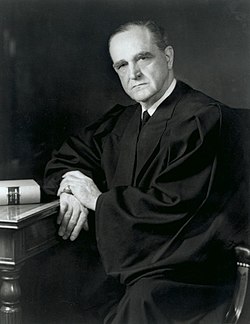
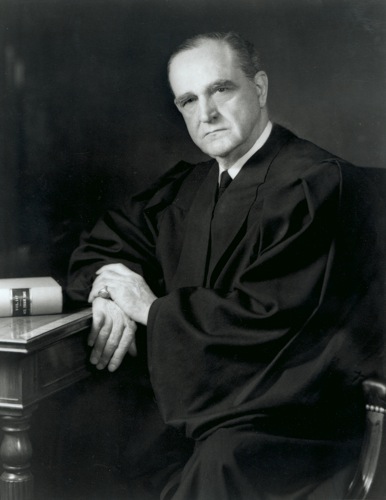
Sherman "Shay" Minton (October 20, 1890 – April 9, 1965) was an American politician and jurist who served as a U.S. senator from Indiana and later became an associate justice of the Supreme Court of the United States; he was a member of the Democratic Party.
Key Information


After attending college and law school, Minton served as a captain in World War I, following which he launched a legal and political career. In 1930, after multiple failed election attempts, and serving as a regional leader in the American Legion, he became a utility commissioner under the administration of Paul V. McNutt, Governor of Indiana. Four years later, Minton was elected to the United States Senate. During the campaign, he defended New Deal legislation in a series of addresses in which he suggested it was not necessary to uphold the United States Constitution during the Great Depression. Minton's campaign was denounced by his political opponents, and he received more widespread criticism for an address that became known as the "You Cannot Eat the Constitution" speech. As part of the New Deal Coalition, Minton championed President Franklin D. Roosevelt's unsuccessful court packing plans in the Senate and became one of his top Senate allies.
After Minton failed in his 1940 Senate reelection bid, Roosevelt appointed him as a United States circuit judge of the United States Court of Appeals for the Seventh Circuit. After Roosevelt's death, President Harry S. Truman, who had developed a close friendship with Minton during their time together in the Senate, nominated him to the Supreme Court. He was confirmed by the Senate on October 4, 1949, by a vote of 48 to 16, 15 Republicans and one Democrat (Harry Flood Byrd of Virginia) voting against him. He served on the Supreme Court for seven years. An advocate of judicial restraint, Minton was a regular supporter of the majority opinions during his early years on the Court; he became a regular dissenter after President Dwight Eisenhower's appointees altered the court's composition. In 1956, poor health forced Minton to retire, after which he traveled and lectured until his death in 1965. To date, he is the last member of the United States Congress to be named to the Supreme Court.
According to historians, Minton's judicial philosophy was largely a reaction to the relationship between the New Deal senators and the conservative 1930s Court, which ruled much of the New Deal legislation unconstitutional. Minton believed the Supreme Court should be more deferential to the political branches of government, and supported a broad interpretation of the powers of Congress. He generally opposed any effort to rule federal legislation unconstitutional on the principle that the court was overstepping its authority. As a result of his judicial philosophy, he sought to uphold the intent of the political branches of government. Historians note the unusual contrast this created between his role as a partisan liberal Senator and his role as a conservative jurist. When Minton became a Justice, the Senate had become more conservative, leading Minton to uphold the constitutionality and intention of conservative legislation. He often played peacemaker and consensus builder during a period when the Court was riven by feuds. He generally ruled in favor of order over freedom as a result of his broad interpretation of governmental powers. These rulings and their limited impact gave some historians a negative opinion of his judicial record. Other historians consider Minton's strong commitment to his judicial principles laudable. In 1962, the Sherman Minton Bridge in southern Indiana[A] and the Minton–Capehart Federal Building in Indianapolis were named in his honor.
Early life
[edit]Family and background
[edit]
Minton was born on October 20, 1890, to John Evan and Emma Livers Minton, in their Georgetown, Indiana, home.[2]: 7 He was the third of the couple's four children, and was nicknamed Shay because of his younger brother's inability to properly pronounce "Sherman".[2]: 8–9 Minton received his basic education in a two-room schoolhouse in Georgetown, which he attended through eighth grade.[3]: 41 [2]: 11 He was exposed to politics from an early age: when he was five years old, his father took him to hear a speech by William Jennings Bryan, whom Minton admired for the remainder of his life.[2]: 9
His father, a railroad laborer, became disabled in 1898 when he suffered heat stroke while working.[3]: 39 Afterwards, he took up various jobs, including as a farmer, a butcher, and a grocer; Sherman also began working odd jobs to help his financially unstable family.[3]: 39–40 [2]: 9 Soon after John's heat stroke, Minton's mother was diagnosed with breast cancer; a doctor attempted to remove her tumors in April 1900, performing the operation on the Minton's family dinner table, but she died during the procedure. The death was an emotional blow to Minton, and he found it impossible to reconcile with the idea of a loving and just God, leading him to shun organized religion for much of his life.[3]: 40 Minton's father married Sarah Montague on December 3, 1901.[2]: 10
Minton enjoyed school but was a mischievous child. In 1904 he was arrested for riding his bicycle on the sidewalk and was taken before a justice of the peace, who fined him one dollar ($40 in current dollar terms) plus court costs. He later credited the incident with sparking his desire to become a lawyer.[3]: 41–42 To accomplish that, he joined his older brother Herbert in Fort Worth, Texas, where he took a job at the Swift & Company meatpacking plant. His father, stepmother, and younger siblings soon joined him there. After saving enough money to continue his education, Minton returned to Georgetown, where he lived with relatives and attended high school.[3]: 43
Education
[edit]Minton started at Edwardsville High School, but after that school closed, he attended New Albany High School for the remaining three years. There he participated in the football, baseball, and track teams. He helped start the school's first debate club, the Wranglers, which won several awards. He worked in a local arcade, and during summer vacations returned to Fort Worth to work at the Swift plant.[3]: 43–47 He was briefly expelled from school after committing a prank in February 1908, and the superintendent, Charles Allen Prosser, let Minton return only after he formally apologized before the entire school.[2]: 16 Minton began dating Gertrude Gurtz, whom he later married, in his senior year.[3]: 47, 54 He graduated high school in 1910.[2]: 15
To earn money to attend college, Minton resumed working for Swift & Company in Fort Worth and played baseball semi-professionally.[3]: 48 In September 1911, he enrolled at Indiana University Bloomington, where he participated in a combined program that enabled him to complete both his undergraduate and law degrees in only four years. Despite the heavy workload, he played multiple sports, joined the debate team, and participated in the Jackson Club, an organization for Democrats.[2]: 17–20 While at Indiana, he also joined and was a member of the Phi Delta Theta fraternity.[4][5] His classmates included such people as future Governor of Indiana Paul V. McNutt and future presidential candidate Wendell L. Willkie, both of whom later had substantial impacts on Minton's political career.[6][3]: 50 Minton's high academic standing entitled him to serve as librarian at the legal college. The position, which paid thirty dollars a month, allowed him to live more comfortably in law school.[3]: 52 He graduated first in his class with an LL.B. degree in September 1915.[2]: 20
Minton won a one-year scholarship to take graduate courses at Yale Law School, where he earned a Master of Laws degree cum laude in 1916. At Yale he took a constitutional law seminar with former President and future Chief Justice of the United States William Howard Taft, who is said to have described a paper Minton wrote as one of best ever written at the school.[2]: 21–22 [3]: 52 Along with Lewis F. Powell Jr., Minton is one of two United States Supreme Court justices who earned an LL.M. degree.[7][8] Minton continued to improve his oratory and debate at Yale; he won the Wayland Club prize for extemporaneous public speaking, and helped organize the university's legal aid society.[2]: 22
Legal career and World War I
[edit]Minton spent the summer of 1916 earning money as a platform manager on the Chautauqua lecture circuit. In fall 1916, Minton returned to New Albany, where he renewed his relationship with Gurtz and opened a law practice. Soon thereafter, however, the United States entered World War I, and Minton quickly enlisted in the United States Army.[3]: 53–54 He took an officers' training course at Fort Benjamin Harrison in hope of earning a commission, but was not among those chosen to become an officer. After taking a brief leave of absence in August to marry Gurtz,[B] Minton returned to camp and requested to repeat his training course, still hoping to receive a commission; after finishing the training he was commissioned as a captain.[2]: 24–26 The Eighty-Fourth Division, to which Minton belonged, was dispatched to France in July 1918. Minton was then assigned to John J. Pershing's general staff;[2]: 26 he served on the Soissons, Verdun, and Belgian fronts.[3]: 54 His tasks included scouting roads to ensure safe transport of men and supplies.[2]: 26
After the war ended, Minton continued to serve with the Army of Occupation until being discharged in August 1919. While in Paris he studied Roman law, international law, civil law and jurisprudence at the Sorbonne's Faculté de Droit.[3]: 54–55 He was in Versailles when the peace treaty was signed.[2]: 26 Returning home after his discharge, Minton met his son, Sherman Anthony, who had been born in February.[2]: 29 Two more children, Mary-Anne and John, were born in 1923 and 1925, respectively.[2]: 30, 32
Political career
[edit]When Minton returned home, he decided to run for Congress in Indiana's 3rd district instead of immediately resuming his law practice. Despite his war record and his active campaigning, he lost the 1920 Democratic primary to John Ewing by a wide margin.[3]: 57–58 Afterwards, he briefly joined the Indiana law firm of Stonsenburg and Weathers before moving to Miami, Florida, where he joined another firm, Shutts & Bowen, in 1925. In January 1928, he left the Miami practice and returned to Indiana, where he rejoined the Stonsenburg and Weathers firm. In 1930, he again sought the Democratic congressional nomination in the Third District but was again defeated, this time by Eugene B. Crowe, who won by four thousand votes.[3]: 59–61 [2]: 32

The following year, Minton became a local commander of the American Legion. The group had a large and active membership in the state at the time, and he used his position to encourage support of the Democratic Party agenda. Paul McNutt was the national commander, and the two men became political allies.[3]: 62 [2]: 33 When McNutt became governor in 1930, he offered Minton a position at the head of a new utility regulation commission. As commissioner, Minton successfully imposed regulations that reduced state telephone bills by a combined total of $525,000. The cuts received widespread media coverage, and Minton was credited in the reports with the success.[3]: 71 [2]: 35
U.S. Senate campaign
[edit]Becoming popular among the party leadership during his two years as commissioner, Minton was encouraged by party leaders to run for the United States Senate in 1934. At the state Democratic Party Convention he ran against Earl Peters, a former chairman of the state party. With the support of McNutt, Minton won the nomination on the third ballot with 827 votes to Peters' 586.[3]: 72 [2]: 37–38
Minton launched a statewide campaign in August 1934 and began delivering speeches in defense of the New Deal. He blamed Republicans for the conditions of the Great Depression. His opponent, incumbent Republican Senator Arthur Raymond Robinson, accused Minton of playing "Santa Claus" by trying to give everyone "presents".[3]: 76 He also criticized Minton's support of the New Deal, which Robinson and Republicans called unconstitutional. Minton's initial campaign slogan was "You can't offer a hungry man the Constitution", a slogan he unveiled in a debate with Robinson in Corydon on August 11.[2]: 40 He continued using the slogan, and on September 11, Minton delivered his infamous "You Cannot Eat the Constitution" speech,[3]: 76 [C] in which he concluded the urgent needs of the masses outweighed the need to uphold the Constitution. The speech backfired wildly and papers and opponents across the state called Minton's remarks traitorous.[3]: 77 Minton stopped using the slogan and explained his position again using new terms, but his opponents continued to dog him over the issue. The Republicans also faulted popular governor McNutt and his reorganization of the government, and McNutt became more personally involved in the election. With the state party's more direct involvement, Minton won the election with 52 percent of the vote.[3]: 85
Lobby Investigation Committee
[edit]
Minton took his Senate seat in January 1935. As a freshman, he sat in the back row of the chamber next to fellow freshman Harry Truman, and the pair quickly became friends.[3]: 87 Minton was made a member of a special Lobby Investigation Committee chaired by Senator Hugo Black, that was set up to look into questionable lobbyist groups. According to professor of political science Linda C. Gugin, a Minton biographer, in practice the committee's investigations were politically motivated and directed against groups that were challenging New Deal legislation.[3]: 91
William Randolph Hearst, a prominent and wealthy media magnate, began using his newspapers to deride the committee's "reckless attacks on freedom".[3]: 95 Minton led the effort to counter Hearst and delivered a speech criticizing his support of the Republican Party. In 1937, Senator Black was appointed to the Supreme Court and left the Senate, and Minton secured his post as chair of the committee. Minton immediately began a full-scale investigation of the media conglomerate controlled by Frank E. Gannett,[3]: 95 accusing him of publishing Republican Party propaganda. For several weeks, Minton delivered speeches against Gannett in the Senate, and Gannett responded in kind in his newspapers. Minton finally introduced legislation that would have made it "illegal to publish information known to be false".[3]: 96 Gannett, and a large number of allies in newspapers and on radio, immediately began to charge Minton and the Democratic Party with an assault on the freedom of the press. Minton's allies in Congress asked him to withdraw the bill because of its political repercussions, and he dropped the matter.[3]: 97
Minton tried again to expose what he believed to be Republican control of the media. He led the committee to target a newspaper with national circulation, Rural Progress. Minton accused the publishers of improperly accepting large sums of money from corporations and the editors of undue influence from this money. The owner of the paper, Maurive V. Renolds, was summoned before the committee for a hearing, where Minton demanded to know why he was accepting money from corporations.[3]: 100 When Renolds asked his manager, Dr. Glen Frank, to help him answer the questions, Minton and fellow Democratic senators began to shout Dr. Frank down. As he was saying that the money from the corporations was for advertising in the magazine, Minton beat his gavel and yelled, "This committee doesn't intend to permit you to use this as a forum to air your Republican views."[3]: 101
Minton did not realize that Frank was also president of the University of Wisconsin, and soon suffered retaliation for the way he had treated Frank. Frank went on NBC radio stations around the country and lambasted Minton for his rudeness. He made lengthy arguments accusing Minton of attempting to violate the Bill of Rights. Minton was outraged, but the arguments had an effect among voters in Indiana. In 1938, he sought funding to launch a massive nationwide investigation of media conglomerates for proof of Republican interference in the press. Democratic Senator Edward R. Burke led an effort to defeat the measure and privately accused Minton of damaging the Democrats' cause, which led Minton to leave the Lobby Investigation Committee.[3]: 102
Minton was a fierce partisan during his time in the Senate, and regularly abused his opponents verbally. Democratic Senator Huey Long became one of Minton's favorite targets because of Long's often-threatened filibusters. During one of the filibusters, Long threatened to join the Republican Party. After most senators had left the chamber, Minton remained for several hours to periodically taunt Long. After tiring of the taunts, Long launched a rebuttal from the podium, calling Minton a vicious politician whose positions would cost Minton re-election.[2]: 46 The exchange was unusual for its tone and later made national news.[2]: 47
Minton was involved in many such exchanges, including a particularly fierce one with Republican Senator Lester J. Dickinson in March 1936. Dickinson delivered a speech in the Senate castigating President Franklin D. Roosevelt for carrying out what he termed illegal and unconstitutional acts. Minton responded with a range of accusations, some personal, against Dickinson and his "political naivety".[2]: 62
Court packing
[edit]In 1936, the United States Supreme Court ruled the Agricultural Adjustment Act of 1933 unconstitutional. For the first time, Minton gave speeches criticizing the court for overriding the will of Congress. He accused the court of allowing itself to be influenced by political motives rather than the law.[3]: 103 [2]: 52 In response to the court ruling, Minton began drafting a bill which would allow the Supreme Court to declare a law unconstitutional only if seven out the nine justices supported the decision. In February 1937, before Minton introduced his bill, President Roosevelt introduced a plan of his own to deal with the Supreme Court. Roosevelt proposed adding more justices to the court and creating a mandatory retirement age; the changes would allow him to appoint an overwhelming majority to the court, more sympathetic to his agenda, ensuring the safety of legislation passed by his party.[3]: 105 [2]: 53–55
Minton was pleased with Roosevelt's bill and quickly became its leading supporter in the Senate.[9] The measure was placed in an omnibus bill designed to reform judicial salaries and districting, among many other measures. Republicans quickly discovered the court-packing provision and targeted the bill. At the time, Democrats held super-majorities in both chambers of Congress, and passage of the bill at first seemed assured.[3]: 106 Minton's support of the bill helped him earn the position of Senate majority whip, allowing him to more effectively push for its passage.[3]: 107 Minton delivered six radio addresses on behalf of his party in support of the bill, but public opinion could not be swayed in the Democrats' favor.[3]: 109
Minton received a death threat in the form of an envelope containing a shotgun shell and a message advising him to not vote for the court packing plan.[2]: 79 Many Democrats, fearing their re-election prospects, joined with Republicans and defeated the bill. Minton was unhappy with the loss and it cost him considerable support among his voters, but as a result of his close connection with the bill and the leaders of his party, he gained more influence with the Democrats.[3]: 113 When Justice Willis Van Devanter retired from the Court in May 1937, Minton was among the final three candidates considered by Roosevelt to succeed him, but the senator declined due to concerns over the impact his recent public criticisms of sitting Court members would have on his relationships with them.[10]
Most controversial of all, Minton proposed a bill in April 1938 to make it a felony for newspapers or other periodicals to publish as "fact anything known to the publisher, or his, or its, responsible agents, to be false," punishable by up to a two-year prison sentence or a $10,000 fine. Minton made clear that his main targets were the anti-New Deal press including the Chicago Daily Tribune and the Philadelphia Inquirer. "Those who know Senator Minton," Newsweek suggested, "say he must have had Roosevelt's tacit approval before introducing a bill to make news distortion a felony." The unanticipated opposition to the bill was overwhelming and transcended the political spectrum. Many charged that Minton was trying to muzzle the critics of the New Deal through censorship. When he raised the idea of a more "objective" across-the-board investigation, it too failed to gain support. A consequence of the reaction against the Minton Bill was to spur the formation of the Bill of Rights Committee of the American Bar Association.[11]
Although Minton supported the Roosevelt Administration and became a regular guest at the White House, Minton broke with the president on some measures. He voted to override a presidential veto of a grant of $2.5 billion ($43 billion in 2015 dollars) in bonus pay for World War I soldiers (Bonus Army).[3]: 114 Minton also supported Republican Leonidas Dyer's anti-lynching bill, which Roosevelt feared would cost the party support in the southern states.[3]: 115 He also supported an extension of the Hatch Act of 1939, a law that prevented federal employees from being forced to take part in state election campaigns, effectively lessening the influence of federal patronage.[3]: 116
As World War II neared, Minton took a cautious position on United States involvement. When the Soviet Union invaded Finland, Minton voted against granting a loan to Finland to help finance its defense efforts.[3]: 119 He also opposed selling munitions and weapons to the Allies or the Axis powers.[3]: 118 He advocated and supported expanding the American military and believed that American entry into the war was inevitable, but should be delayed as long as possible. He voted in favor of the Smith Act, which made it a crime to advocate the overthrow of the government, a law specifically targeted at communists and fascists in the United States.[3]: 121 In his final year in office, there was considerable speculation in the press that Minton would be named to higher office by Roosevelt, including cabinet positions and the Supreme Court, but neither happened.[2]: 89
Re-election campaign
[edit]Minton ran for re-election to his Senate seat in 1940. McNutt was challenging Roosevelt for the Presidential nomination, forcing Minton to choose between the administration and his allies in the state party. Minton sided with Roosevelt, which cost him McNutt's and the Indiana Democratic Party machine's support in his re-election bid.[3]: 123
The Republican presidential candidate, Wendell Willkie was also a native of Indiana, and Minton faced a difficult challenge to win re-election. He referred to Willkie as a "sycophant for the rich and famous".[3]: 143 Willkie never responded to Minton's taunts, leaving Minton's opponent in the Senate race, Raymond E. Willis, to do so in his stead. Willis had run for the Senate two years earlier but was defeated by Democrat Frederick Van Nuys. Willis faulted Minton on a range of topics but focused on the legislation Minton supported while in the Senate. Willis claimed that much of the legislation was unconstitutional and Minton's positions were detrimental to the nation. Minton responded by pointing out Willis's connections to wealthy corporations and accused him of not caring for the people.[3]: 146 Minton's campaign focused on the achievements of the New Deal programs. He claimed farm income in Indiana had doubled since 1932, and highlighted the passage of the Old Age Pension laws. His support for conscription and military preparedness for the coming war proved unpopular with voters and cost him considerable support, but according to historian William Radcliff it was Willkie's favorite son status, which led many Hoosiers to vote Republican, that proved to be the election's deciding factor.[2]: 109 [12] Despite Minton's heavy campaigning, he lost the close election to Willis by 5,179 votes out of over 1.5 million cast.[2]: 109 [3]: 147
Roosevelt won the 1940 presidential election. After Minton left office in January 1941, he was given a position in the Roosevelt administration as a reward for his loyalty during the court packing failure.[3]: 151 He served as one of the president's advisers and a liaison between the White House and Congress. The extent of his duties is not fully known; Linda Gugin has speculated that he may have managed Roosevelt's patronage system.[3]: 155 Minton was responsible for getting several officials appointed to high offices in the federal bureaucracy and numerous others appointed to lower ranking positions.[3]: 155 [2]: 106 He also convinced Roosevelt to support the creation of a Senate defense committee chaired by Truman, a position that brought Truman into the national spotlight and helped him gain the vice presidency.[13]
Seventh Circuit
[edit]Appointment
[edit]On May 7, 1941, Roosevelt announced Minton's nomination to the Chicago-based United States Court of Appeals for the Seventh Circuit.[3]: 156 Minton was confirmed unanimously by the Senate on May 12, 1941, and received his commission on May 22, 1941. Minton resigned from his post in the administration, but even after he began working on the court, Minton remained active in Democratic politics behind the scenes and was in regular correspondence with Roosevelt to make patronage suggestions.[3]: 164
Minton took his oath of office on May 29, 1941, but the court was in recess at the time.[3]: 164 He took his seat when it returned to session on October 7, 1941.[3]: 157 The court had the highest court load of all the appellate courts in the nation at that time, averaging 40 cases per judge annually.[3]: 163 The men on the court were close friends, and Minton developed a particularly close friendship with Judge J. Earl Major; Major offered Minton financial assistance during his later illnesses. Major had been on the court for several years and held a judicial philosophy similar to Minton's. The two men regularly attended baseball games and were frequent guests in each other's homes.[3]: 161
World War II broke out shortly after Minton joined the court, creating a flood of cases in which legal precedent provided little guidance, including challenges to wartime measures, selective service laws, price controls, rationing and civil liberties. In the majority of these cases, the court affirmed the decisions of the district courts, but in several the court was required to establish a precedent.[2]: 110 Minton stated on several occasions his personal preference to affirm the decisions of the lower courts. He believed that the court that heard the case and pronounced judgment was generally able to make a decision that was superior to appellate courts' decisions. He believed the appellate process should be reserved for the more serious cases and cases where the lower court had clearly made a mistake.[2]: 113
Jurisprudence
[edit]Minton was described by William Radcliff as a "faithful disciple of judicial restraint," an unexpected development when compared to his overtly partisan political career.[3]: 179 Radcliff attributed Minton's conservative position to the distaste he developed for the courts when they overturned legislation passed while he was in the Senate. The courts' actions led him to strongly believe in the limited exercise of judicial power when evaluating the constitutionality of governmental conduct.[2]: 114 Much of the recently passed New Deal legislation was being tried in the courts for constitutionality and enforcement, putting Minton in the uncommon position of adjudicating cases which depended on legislation he had helped write.[3]: 180
During his time on the Seventh Circuit, Minton authored 253 of the court's opinions, including twelve dissenting opinions.[2]: 110 [3]: 182 Some of his opinions won praise; the editors of Tax Magazine commented favorably on Minton's opinions on tax law, calling them "direct Hoosier logic".[3]: 181 Other court reporting papers made similar comments, applauding the manner in which he turned complex issues to simple questions that could easily be understood.[3]: 182
In the cases of Sunkist v. Sunkist and Quaker Oats Co. v. General Mills, the court held that it was possible for different companies to use the same brand and product name as long as they produced dissimilar products.[3]: 190 In another case, the court set a short-lived precedent allowing companies to artificially raise prices in local markets if the purpose was to artificially lower prices in another market to remain competitive.[14] After Minton joined the United States Supreme Court, the decision was appealed to that body; Minton recused himself from the case, which the court decided to overturn.[2]: 118 [3]: 188 [15] In another decision, Minton was in the majority that ruled under the Sherman Antitrust Act that the New York Great Atlantic and Pacific Tea Company was a monopoly, ordering the company to break up its grocery business.[3]: 186 [16] Minton was also in the majority in several cases filed to enforce decisions made by the National Labor Relations Board, usually to end worker strikes.[3]: 183
In the case of United States v. Knauer, the government denied the wife of a United States citizen entry into the country because of her possible ties to Nazism. In a much-criticized majority opinion which Minton co-authored with Judge Major, he stated that the "alien did not have any legal right—[her] status was a political decision to be made by officials in government."[17] Many liberals condemned the court at the time of the decision. The ruling was upheld by the Supreme Court in a 1946 appeal.[2]: 115
One of Minton's favorite cases was that of Modernistic Candies, Inc. v. Federal Trade Commission.[2]: 111 [18] The candy company produced a one-cent gumball dispenser in which almost all the gumballs were the same color. A few different-colored gumballs were included which, when dispensed, entitled the purchaser to a prize from the merchant who owned the machine. The FTC had an injunction put in place barring the company from producing the machines because they claimed it violated anti-gambling laws. Minton wrote the majority opinion and sided with the majority to keep the injunction in place, but dryly mocked the counsel for the defense and the gambling law, stating:
Counsel for the petitioner discussed at great length from a sociological point of view, of the age-old problem of the gambling instinct in the human being. According to his analysis, gambling pervades our entire economic system; thus insurance contracts are a gamble, stock and grain exchange transactions are gambles, and the farmer's dependence on weather is a gamble. Counsel's attempt to apply this analysis to the present case left us cold and unimpressed. He even reminded us that our great idol, Mr. Chief Justice John Marshall, in his day attended the horse races and wagered with his clergyman. In fact, they ran a book. As indicating how times have changed and how even our coarse nature has yielded to the protecting care of governmental policy, we confess we do not even know a bookmaker, clerical or otherwise, and our passes to the beautiful race tracks around Chicago lie in our desk unused.[18]
Minton often lamented that he was required to "pronounce the law as it was written, but on no occasion [c]ould he make the law."[2]: 111
Clemency board and failing health
[edit]After Roosevelt's death and Truman's succession to the Presidency, Minton continued offering advice to the new administration on a range of topics, including patronage and political maneuvering. Truman appointed Minton as head of the War Department Clemency Board, a panel of judges charged with overseeing reviews of decisions made by the courts-martial.[19] The panel met every two weeks which, along with his responsibilities on the circuit court, kept Minton very busy and afforded him little rest, leading to a deterioration in his health.[3]: 167 While yachting with President Truman on Memorial Day in 1945, Truman asked Minton to accept an appointment to the position of Solicitor General of the United States. Minton declined because of his health, but he told Truman he would be interested in a seat on the Supreme Court.[3]: 8
In September 1945, Minton suffered a heart attack while in Washington; he was hospitalized for three months at Walter Reed Hospital.[3]: 10 After returning to work, he was forced to rest regularly due to gradually worsening anemia, and he sought to lessen his workload. To further complicate his health, on August 5, 1949, Minton tripped over a stone in his yard and broke his leg. The injury forced him to walk with a cane for the remainder of his life.[2]: 129
Supreme Court
[edit]Nomination and confirmation
[edit]At a September 15, 1949, news conference, Truman announced Minton's nomination to the Supreme Court, succeeding the late Justice Wiley Rutledge.[20] Minton had already privately accepted the nomination several days earlier after a telephone conversation with Truman.[3]: 14 Truman touted Minton's extensive law education and his years of experience on the circuit courts as the reason for his nomination.[3]: 15

News of Minton's appointment received mixed reviews nationally.[2]: 131 The New York Times said that Truman had allowed personal and political friendship to influence his choice.[21][3]: 18 The New Republic said "the President is again reverting to his deplorable habit of choosing men for high post because they happen to be his friends...." The Washington Post raised questions about Minton's ability to be confirmed by the Senate due to the power many of his foes held in the body.[3]: 19 The Indianapolis Star offered a more sympathetic opinion, pointing out Minton's qualifications and the pride Indiana could take in having a native on the Supreme Court. The article noted that he would be the most educated justice on the court, should he be confirmed.[3]: 19
Indiana Senator William E. Jenner led opponents of Minton's nomination, including some of Minton's old foes, in an attempt to bring him before the body for hearings.[2]: 132 Minton wrote a letter to the Senate Judiciary Committee answering several of their questions, but refused to submit himself to a hearing.[22][23] He mentioned his broken leg and hinted in his letter that it could be detrimental to his health to travel in his condition.[3]: 15 He also stated that, as a sitting judge and former member of the Senate, it would be improper for him submit to a hearing.[13] Minton responded to questions over his past support for the 1937 court packing scheme in the letter, declaring that as the Senate leader at the time of his scheme he had a right and duty to support the scheme, but as a federal judge his role had now changed to that of a referee rather than a player.[24] Although hearings had occurred irregularly in the past, it was not customary at that time to have a hearing on a nominee.[25] During an absence of Jenner's, Minton's allies worked to have the hearing request dropped.[3]: 24 The Judiciary Committee held a single hearing on September 27, 1949, on his nomination. His nomination faced intense questioning from Republican Senators on his past support for the failed 1937 court packing scheme.[26][27][28] The Senate Judiciary Committee voted 9–2 on October 3, 1949, to forward his nomination to the full Senate with a favorable report.[3]: 24 [26] On October 4, 1949, Senator Homer S. Ferguson attempted to have the nomination returned to committee but the motion failed, 42–45.[3]: 27 [29] The long debate over Minton's appointment focused on his partisanship, support of the court packing plan during his time in the Senate, and poor health. His opponents launched numerous delaying tactics; the Senate session before the vote to confirm Minton lasted until midnight. His confirmation was approved 48–16 on October 4, 1949,[3]: 27 and he was sworn into office on October 12.[1] To date, Minton remains the last member of Congress, sitting or former, to be appointed to the United States Supreme Court,[3]: 3 and he is the only native of Indiana to be appointed to the court.[2]: 2 [D][E]
Judicial restraint
[edit]Minton's central judicial philosophy was to ascertain and uphold the original intent of legislation.[3]: 261 He continued to take a broad view of governmental powers, demonstrated in his dissenting vote in the case of Youngstown Sheet & Tube Co. v. Sawyer, which ruled unconstitutional President Truman's wartime seizure of several steel mills to avert a workers' strike.[30] Of all the cases in which Minton was involved, he disagreed most with the Youngstown decision and "went into a tirade" during the conference where the decision was made.[3]: 210 He argued that there "could be no vacant spot in power when the security of the nation is at stake."[3]: 212 Despite his strong protest, he could not influence the Court to permit the president to seize the plants without congressional approval.[3]: 212 Minton joined with Chief Justice Fred M. Vinson and Justice Stanley Forman Reed in the dissenting opinion that the President had the authority through the war powers clause of the constitution.[2]: 151

Minton abhorred racial segregation and provided a solid vote to strike down the school segregation practices at issue in 1954's landmark case of Brown v. Board of Education; it was among the few decisions in which he sided against the government.[3]: 261 [31][2]: 159 According to William Radcliff, the majority opinion authored by Minton in the 1953 case Barrows v. Jackson was his most skillfully written opinion.[2]: 155 [32] He framed the complex question of the case as: "Can a racially restrictive covenant be enforced at law by a suit for damages against a co-covenantor who allegedly broke the covenant?" The Court decided the answer in the negative.[2]: 155
In the area of civil liberties, Minton adhered to the doctrine of "fundamental fairness", a test established by the Supreme Court in 1937. In one decision, Minton stated that the right of free speech was not an absolute right, and could be regulated so as not to violate the rights of others.[2]: 114 In United States v. Rabinowitz, Minton wrote the Court's opinion upholding a lower court ruling which allowed police to search automobiles without a warrant, provided there was probable cause to justify the search.[33]
Minton voted to uphold anticommunist legislation during the period of the "red scare", siding with the majority in 1951's Dennis v. United States, which upheld the conviction of the leader of the US Communist Party.[3]: 223 [34] During the same period, the Court was split over the legality of governmental loyalty tests. Many agencies had programs in place to ensure that members of the government were not communists. Minton's vote proved to be the deciding factor in cases regarding loyalty tests.[3]: 230 In the case of Bailey v. Richardson, Minton's vote upheld the legality of the loyalty tests,[F] while in the decision he authored in the case of Joint Anti-Fascist Refugee Committee v. McGrath, he voted to uphold the plaintiff's position that he had been terminated illegally because of his support of fascist ideology.[35][36][3]: 229 Minton's position gradually shifted to allowing the loyalty tests to take place, and in Adler v. Board of Ed. of City of New York he wrote the majority opinion allowing the tests and upholding New York's Feinberg Law.[2]: 147 [37][G] This proved to be the most important vote as it allowed the tests to be given with only minimal suspicion of a person's disloyalty to the government.[3]: 231
Because of Minton's previous Congressional partisanship, many liberals believed he would support their positions when on the Court. Throughout his tenure, Minton regularly disappointed them, leading many to rail against him. A lawyer writing for the New Jersey Law Journal labeled Minton a "spokesman against freedom", calling him "a man of conspicuous judicial shortcomings, whose votes against civil liberties exceeded those of any other man on the Court, and who wrote comparatively few opinions of other kinds."[38] Linda Gugin pointed out that Minton was a disappointment to liberals because he consistently chose order over freedom. Gugin also concludes that Minton had the strongest commitment to judicial restraint and ideological neutrality of any justice, past or present.[39]
Politics
[edit]Although Minton was on the Supreme Court, he remained casually involved in Democratic internal politics. He wrote Truman several letters criticizing Justices Robert H. Jackson and Hugo Black, referring to Black as a demagogue. He also offered advice on dealing with Republican opposition in the Senate. In a 1954 letter, after Truman left office, he urged Truman to help focus public attention on the economy and away from communism, a threat he claimed the Republicans were exaggerating to avoid confronting their own problems.[3]: 257
After Truman's withdrawal from the 1952 presidential campaign, Minton made remarks indicating he had advised Truman to stay out of the contested New Hampshire primary election to begin with.[3]: 211 In August 1956, a reporter asked Minton about his preferred candidate in the upcoming presidential election. Minton answered, "I have great confidence in Adlai Stevenson."[2]: 137 He also remarked that Dwight D. Eisenhower was politically handicapped. Minton was lambasted in the media for his endorsement, which he attempted to retract a few days later after being advised to do so by other members of the Court.[2]: 137
Regular dissenter
[edit]Truman's other appointees to the Court provided consistent conservative votes, and during Minton's first years on the Court it was returned to the conservatism of the William Howard Taft era.[21] While on the Court, Minton transformed from a New Deal senator into an almost reactionary judge as an ally of Justice Felix Frankfurter. Empirical coding of votes shows that Minton was the most conservative justice on the Court during his first year, and remained in the conservative half of the court for the duration of his career.[40]
Minton did not enjoy the limited influence of his judicial role in the later years of his term, when he was more frequently in the minority in voting on cases.[40][3]: 221 After the deaths of Chief Justice Fred M. Vinson and Justice Robert Jackson, Minton found himself with little support for many of his opinions, which led him to begin considering retirement.[3]: 277–79
The shifting position of the Court led to personal animosity between members of its two wings. Despite his disappointment over the Court's positions on some issues, Minton remained popular among his colleagues on the Court as he didn't take sides in their personal disagreements; he proved a soothing presence during a period marked by bitter personal feuds between strong personalities such as William O. Douglas and Felix Frankfurter.[2]: 172
Minton informed Eisenhower of his intention to retire in a letter on September 7, 1956, in which he dryly stated his retirement was authorized by law. Eisenhower responded with a brief note wishing him a happy retirement.[2]: 173 Although he did not tell the president, Minton informed the members of the Court that his duties were too taxing on his health. His anemia had steadily worsened, slowing him physically and mentally.[2]: 174 Minton served as a Justice until October 15, 1956, retiring after 7 years and 3 days of service.[41] He was succeeded by William J. Brennan Jr.[3]: 282
Later life
[edit]Retirement
[edit]Announcing his departure, Minton remarked, "There will be more interest in who will succeed me than in my passing. I'm an echo."[41] Despite the health difficulties, Minton regretted his decision almost immediately.[40]
Minton returned to his New Albany home, where he took a much lighter workload. He gave occasional lectures at Indiana University and continued to give public speeches from time to time. For several years after retiring from the Supreme Court, Minton occasionally accepted assignments to serve temporarily on one of the lower federal courts.[40] He received an honorary doctorate degree from the University of Louisville.[3]: 288 He took many trips around the United States, and two trips to Europe.[3]: 285 In England, he received an honorary doctorate from Oxford University in 1956.[2]: 183
Despite his failing health, Minton remained active in the Democratic Party. He was most concerned with President Eisenhower, whom he believed was incompetent. He remained in regular correspondence with Truman, and the two met on several occasions at Democratic Party functions.[3]: 290
Death and legacy
[edit]In late March 1965, Minton was admitted to Floyd Memorial Hospital in New Albany, where it was found he was suffering internal bleeding. He died in his sleep early in the morning of April 9. Minton's wife was Roman Catholic; his funeral was held at the now-defunct Holy Trinity Catholic Church and was attended by many dignitaries, including several sitting members of the Supreme Court, the governors of Indiana and Kentucky, and several members of Congress. He was buried in the Holy Trinity Cemetery, on Green Valley Road in New Albany, next to Leo Receveur. Minton himself was nominally Catholic and had shunned Christianity for most of his life; he only began to occasionally attend Mass following his retirement.[3]: 304 [42] He left most of his personal papers and judicial records to the Truman Presidential Library.[2]: 140 [43][H]
Minton is the eponym of the Sherman Minton Bridge, which carries Interstate 64 across the Ohio River, connecting western Louisville, Kentucky with New Albany, Indiana. Minton attended the dedication of the bridge at a 1962 ceremony. He is also the namesake of the annual Sherman Minton Moot Court Competition, held at the Indiana University Maurer School of Law.[44] He is also honored (with Indiana Senator Homer E. Capehart)—in the "Brutalist" style designed by Woollen, Molzan and Partners and with architectural art by Milton Glaser—in the centrally located Minton-Capehart Federal Building on Indiana World War Memorial Plaza in Indianapolis.[45] A bronze bust of Minton was created and put on display in the Indiana Statehouse.[3]: 287
While some writers like Linda Gugin and legal historian William Radcliff have given high praise to Minton's logic in his written opinions, they point out that his positions had little long-term impact.[3]: 307 Other legal historians, like Bernard Schwartz, have a more negative opinion of Minton's judicial career. Schwartz wrote that Minton "was below mediocrity as a Justice. His opinions, relatively few for his tenure, are less than third rate, characterized by their cavalier approach to complicated issues."[46] Schwartz went on to say, "he ranks near the bottom of any list of Justices."[46] Most of the precedents Minton helped establish were overturned by the Warren Court in the years immediately following his retirement. In total he wrote sixty-seven majority opinions along with several of the dissenting opinions.[3]: 280 Gugin authored a work in rebuttal to Schwartz's harsh critique, saying that Minton's rulings were "predictable based on the principles of deference, precedent, and strict interpretation"; she attributed his poor ranking to the bias of reviewers in favor of judicial activism.[47]
Minton's time on the court marked the end of a transitory period in the judiciary. Since Minton, justices have tended to serve increasingly longer terms on the court, which has had strong political science implications on the Supreme Court.[48] The growing concept of judicial non-partisanship became the norm in American politics after Minton—he was the last member of Congress to be appointed to the Court.[3]: 308 Linda Gugin and Professor James St. Clair have noted that the federal courts have lost a valuable point of view by not having experienced legislators among their ranks.[3]: 311
Minton played an important role behind the scenes of the Court as a peacemaker between its two opposing factions.[3]: 282 These attempts to keep the peace led Justice Frankfurter to remark that while Minton would never be remembered as a great justice, he would be remembered as a great colleague by his fellow justices.[2]: 139
Electoral history
[edit]| Party | Candidate | Votes | % | |
|---|---|---|---|---|
| Democratic | John Ewing | 6,502 | 39.4 | |
| Democratic | Sherman Minton | 3,170 | 19.2 | |
| Party | Candidate | Votes | % | |
|---|---|---|---|---|
| Democratic | Sherman Minton | 758,801 | 51.5 | |
| Republican | Arthur R. Robinson | 700,103 | 47.5 | |
| Party | Candidate | Votes | % | |
|---|---|---|---|---|
| Republican | Raymond E. Willis | 888,070 | 50.5 | |
| Democratic | Sherman Minton | 864,803 | 49.1 | |
See also
[edit]

- List of justices of the Supreme Court of the United States
- List of United States Supreme Court justices by time in office
- United States Supreme Court cases during the Vinson Court
- United States Supreme Court cases during the Warren Court
- List of law clerks of the Supreme Court of the United States (Seat 3)
Bibliography
[edit]Footnotes
[edit]- ^ "Sherman Minton bridge shut down; crack found in bridge". Louisville, Kentucky: WDRB. September 9, 2011. Archived from the original on October 4, 2011. Retrieved September 9, 2011.
- ^ Gertrude Gurtz was a native of Harrison County. She had graduated from St. Mary-of-the-Woods and worked as a schoolteacher in New Albany. (see: Radcliff, p. 25)
- ^ The speech was so named by newspapers who printed excerpts. In the speech Minton stated, "You cannot walk up to a hungry man today and say, 'Here have a Constitution'," and "you can't expect a farmer to dig himself out his debts with a Constitution." He finished his speech with. "let us keep our priorities realistic; in times like these the needs of the people take precedence over all else." (see: Radcliff, p. 40)
- ^ Chief Justice John G. Roberts is the only other Supreme Court Justice from Indiana, but was not born in the state. ("John G. Roberts, Jr". NNDB. Archived from the original on June 29, 2011. Retrieved March 3, 2011.)
- ^ See Demographics of the Supreme Court of the United States.
- ^ In the case of Bailey v. Richardson the Court made a split decision resulting in the upholding of the lower Court's ruling by default. (see: Gugin (1997), p. 229)
- ^ In the decisions in Adler v. Board of Ed. of City of New York, Minton wrote, "From time immemorial, one's reputation has been determined in part by the company he keeps. In the employment of officials and teachers of the school system, the state may very properly inquire into the company they keep, and we know of no rule, constitutional or otherwise, that prevents the state, when determining the fitness and loyalty of such persons, from considering the organizations and persons with whom they associate." (See: 341 U.S. 123 (1951))
- ^ Four linear feet of Sherman Minton's papers are on deposit there. Various other papers are collected at a number of libraries around the country. Resources, research aids and bibliography, Sherman Minton, Federal Judicial Center. ("Sherman Minton". Archived from the original on May 30, 2010. Retrieved March 3, 2011.) According to Sherman Minton, Jr., Minton's wife destroyed most of Minton's communications with Truman because she believed they were "undignified and occasionally profane." (See: Stewart, Margaret M., p. 304)
Notes
[edit]- ^ a b "Justices 1789 to Present". Washington, D.C.: Supreme Court of the United States. Archived from the original on April 15, 2010. Retrieved February 15, 2022.
- ^ a b c d e f g h i j k l m n o p q r s t u v w x y z aa ab ac ad ae af ag ah ai aj ak al am an ao ap aq ar as at au av aw ax ay az ba bb bc bd be bf bg Radcliff, William Franklin (1996). Sherman Minton: Indiana's Supreme Court Justice. Indiana: Guild Press of Indiana. ISBN 978-1-878208-81-1.
- ^ a b c d e f g h i j k l m n o p q r s t u v w x y z aa ab ac ad ae af ag ah ai aj ak al am an ao ap aq ar as at au av aw ax ay az ba bb bc bd be bf bg bh bi bj bk bl bm bn bo bp bq br bs bt bu bv bw bx by bz ca cb cc cd ce cf cg ch ci cj ck cl cm cn co cp cq cr cs ct cu cv cw cx cy cz da db Gugin, Linda; St. Clair, James E. (1997). Sherman Minton: New Deal Senator, Cold War Justice. Indiana Historical Society. ISBN 978-0-87195-116-8.
- ^ "Sherman Minton". Phi Delta Theta Museum. Archived from the original on September 8, 2024. Retrieved September 8, 2024.
- ^ The SCROLL of Phi Delta Theta for January, 1950 (PDF). Phi Delta Theta. 1950. p. 187. Archived (PDF) from the original on June 19, 2024. Retrieved September 8, 2024.
- ^ "Timeline of the Court, Sherman Minton". Supreme Court Historical Society. Archived from the original on December 2, 2016. Retrieved March 21, 2017.
- ^ Urofsky, Melvin I., ed. (May 25, 2006). Biographical Encyclopedia of the Supreme Court: The Lives and Legal Philosophies of the Justices. Washington, D.C.: CQ Press. pp. 363, 402. ISBN 9781604263275.
- ^ Glen, Patrick J. (2010). "Harvard and Yale Ascendant: The Legal Education of the Justices from Holmes to Kagan". scholarship.law.georgetown.edu. Georgetown University Law Center. p. 132. Archived from the original on July 6, 2024. Retrieved October 22, 2025.
For instance, Justices Lewis Powell and Sherman Minton earned graduate degrees in law from Harvard and Yale, respectively, but their juris doctorates were from Washington and Lee University and Indiana University. It is the latter degrees, rather than the Ivy League LL.M.s, that are the focus here.
- ^ Minton, Sherman (July 8–9, 1937). Reorganization of Federal Judiciary; speeches of Hon. Sherman Minton of Indiana in the Senate of the United States. Washington, D.C.: Government Printing Office.
- ^ Newman, Roger K. (1994), Hugo Black: A Biography, New York: Pantheon Books, p. 234, ISBN 0-679-43180-2
- ^ Beito, David T. (2023). The New Deal's War on the Bill of Rights: The Untold Story of FDR's Concentration Camps, Censorship, and Mass Surveillance (First ed.). Oakland: Independent Institute. pp. 59–75. ISBN 978-1598133561.
- ^ Cushman, p. 432
- ^ a b Cushman, p. 433
- ^ Standard Oil Company v. Federal Trade Commission, 173 F.2d 210 (1949)
- ^ Standard Oil Company v. Federal Trade Commission, 340 U.S. 231 (1951)
- ^ United States v. New York Great Atlantic & Pacific Tea Company, 173 F.2d 79 (1949)
- ^ United States v. Knauer, 149 F.2d 522 (1945)
- ^ a b Modernistic Candies, Inc. v. Federal Trade Commission, 145 F.2d 454, 455 (1948)
- ^ "Courts of Appeal, Army Style". Milwaukee Journal. December 23, 1945. Archived from the original on February 8, 2022. Retrieved April 26, 2010.
- ^ Ariens, Michael. "Sherman Minton biography". Archived from the original on July 14, 2010. Retrieved April 26, 2010.
- ^ a b Eisler, p. 76
- ^ "Sherman Minton Moot Court Competition: Who Was Sherman Minton?". Bloomington, Indiana: Maurer School of Law. 2012. Archived from the original on September 28, 2012. Retrieved October 20, 2012.
- ^ Senate Historical Office. "Senate History, October 1, 1949: Supreme Court Nominee Refuses to Testify". United States Senate. Archived from the original on April 10, 2010. Retrieved April 26, 2010.
- ^ Glass, Andrew (October 1, 2014). "SCOTUS nominee refuses to testify, Oct. 1, 1949". Politico. Archived from the original on September 9, 2022. Retrieved September 9, 2022.
- ^ Thorpe, James A. (1969). "The Appearance of Supreme Court Nominees Before the Senate Judiciary Committee". Journal of Public Law. 18: 371–402.
- ^ a b McMillion, Barry J.; Rutkus, Denis Steven (July 6, 2018). "Supreme Court Nominations, 1789 to 2017: Actions by the Senate, the Judiciary Committee, and the President" (PDF). Washington, D.C.: Congressional Research Service. Archived (PDF) from the original on September 3, 2023. Retrieved March 9, 2022.
- ^ Nomination of Sherman Minton. : Hearing, Eighty-first Congress, first session, on the nomination of Sherman Minton, of Indiana, to be Associate Justice of the Supreme Court of the United States. September 27, 1949 – Biddle Law Library – University of Pennsylvania Law School. United States Congress.[permanent dead link]
- ^ "G.O.P. Senators Quiz Minton on High Bench Post". The Brooklyn Daily Eagle. United Press. October 3, 1949. Archived from the original on April 12, 2023. Retrieved August 27, 2022 – via Newspapers.com.
- ^ Congress and the Nation, 1945–1964: A Review of Government and Politics in the Postwar Years. Congressional Quarterly. 1965. pp. 104a and 105a. Archived from the original on April 12, 2023. Retrieved March 22, 2023.
- ^ Youngstown Sheet & Tube Co. v. Sawyer, 343 U.S. 579 (1952)
- ^ Brown v. Board of Education, 347 U.S. 483 (1954)
- ^ Barrows v. Jackson, 346 U.S. 249 (1953)
- ^ United States v. Rabinowitz, 339 U.S. 56 (1950)
- ^ Dennis v. United States, 341 U.S. 494 (1951)
- ^ Bailey v. Richardson 341 U.S. 918 (1951)
- ^ Joint Anti-Fascist Refugee Committee v. McGrath, 341 U.S. 123 (1951)
- ^ Adler v. Board of Ed. of City of New York, 342 U.S. 485 (1952)
- ^ Eisler, p. 96
- ^ Gugin (2009), p. 791
- ^ a b c d Eisler, p. 88
- ^ a b "Official Supreme Court media, Sherman Minton". Oyez.org. Archived from the original on May 9, 2010. Retrieved April 26, 2010.
- ^ Christensen, George A (1983). "Here Lies the Supreme Court: Gravesites of the Justices". Yearbook Supreme Court Historical Society at Internet Archive. Archived from the original on September 3, 2005. Retrieved April 26, 2010. See also, Christensen, George A (March 2008). "Here Lies the Supreme Court: Gravesites of the Justices Revisited". Journal of Supreme Court History. 33 (1): 17–41. doi:10.1111/j.1540-5818.2008.00177.x. S2CID 145227968.
- ^ "Sherman S. Minton papers". Harry S. Truman Library. Archived from the original on June 13, 2010. Retrieved April 26, 2010.
- ^ "Competition". Indiana University. Archived from the original on April 18, 2010. Retrieved April 26, 2010.
- ^ Zeigler, Connie (October 27, 2009). "History 301: A minority opinion – I ♥ the Federal Building". Urban Times. Archived from the original on July 17, 2011. Retrieved March 28, 2011.
- ^ a b Schwartz, p. 44
- ^ Gugin (2009), p. 764
- ^ Karpowitz, Christopher F.; Crowe, Justin (September 2007). "Where have you gone, Sherman Minton? The decline of the short-term Supreme Court Justice". Perspectives on Politics. 5 (3): 425–445. doi:10.1017/S1537592707071472. S2CID 233315099. Princeton Law and Public Affairs Working Paper No. 06-014.
- ^ a b Congressional Quarterly, p. 491
References
[edit]- Christensen, George A (1983). "Here Lies the Supreme Court: Gravesites of the Justices". Yearbook Supreme Court Historical Society at Internet Archive. Archived from the original on September 3, 2005. Retrieved April 26, 2010.
- Congressional Quarterly's Guide to U.S. Elections. Congressional Quarterly. 1976. ISBN 978-0-87187-072-8.
- Crowe, Justin; Karpowitz, Christopher F (April 2006). "Where Have You Gone, Sherman Minton? The Decline of the Short-Term Supreme Court Justice". Princeton Law and Public Affairs Working Papers. SSRN 948813. 06-014.
- Cushman, Clare (2001). The Supreme Court Justices: Illustrated Biographies, 1789–1993 (2nd ed.). Washington, D.C.: Congressional Quarterly Inc. ISBN 978-1-56802-126-3..
- Eisler, Kim Isaac (1993). A Justice for All: William J. Brennan, Jr., and the decisions that transformed America. New York: Simon & Schuster. ISBN 978-0-671-76787-7.
- Gugin, Linda; St. Clair, James E. (1997). Sherman Minton: New Deal Senator, Cold War Justice. Indiana Historical Society. ISBN 978-0-87195-116-8.
- Gugin, Linda C. (2009). "Sherman Minton: Restraint Against a Tide of Activism". Vanderbilt Law Review. 62 (2). Nashville, Tennessee: Vanderbilt University: 757–795. Archived from the original on June 20, 2010.
- Radcliff, William Franklin (1996). Sherman Minton: Indiana's Supreme Court Justice. Indianapolis, Indiana: Guild Press of Indiana. ISBN 978-1-878208-81-1.
- Schwartz, Bernard (1999) [1997]. A Book of Legal Lists: The Best and Worst in American Law. Oxford University Press. ISBN 978-0-19-512502-3. Archived from the original on July 1, 2016. Retrieved February 19, 2016.
- Thorpe, James A. (1969). "The Appearance of Supreme Court Nominees Before the Senate Judiciary Committee". Public Law. 18: 371–402.
- Wallace, Harry L. (Winter 1959). "Mr. Justice Minton—Hoosier Justice on the Supreme Court". Indiana Law Journal. 34: 145–205.; (Spring 1959): pp. 377–424.
Further reading
[edit]- Abraham, Henry J., Justices and Presidents: A Political History of Appointments to the Supreme Court. (3rd ed., Oxford University Press, 1992). ISBN 0-19-506557-3.
- Atkinson, David N. "From New Deal Liberal to Supreme Court Conservative: The Metamorphosis of Justice Sherman Minton" Washington University Law Quarterly (1975): pp. 361–394.
- Braden, George D. (Winter 1951). "Mr. Justice Minton and the Truman Bloc". Indiana Law Journal. 26: 153–168.
- Frank, John P., The Justices of the United States Supreme Court: Their Lives and Major Opinions (Leon Friedman and Fred L. Israel, editors) (New York: Chelsea House, 1995) ISBN 0-7910-1377-4, ISBN 978-0-7910-1377-9.
- Greenhouse, Linda (March 2004). ""Because We Are Final" Judicial Review Two Hundred Years After Marbury" (PDF). Proc. Am. Philos. Soc. 148 (1): 38. Archived from the original (PDF) on October 18, 2011.
- Martin, Fenton S. and Goehlert, Robert U., The U.S. Supreme Court: A Bibliography, (Congressional Quarterly Books, 1990). ISBN 0-87187-554-3.
- Urofsky, Melvin I., The Supreme Court Justices: A Biographical Dictionary (New York: Garland, 1994). ISBN 978-0-8153-1176-8.
External links
[edit]

- United States Congress. "Sherman Minton (id: M000800)". Biographical Directory of the United States Congress.
- Sherman Minton at the Biographical Directory of Federal Judges, a publication of the Federal Judicial Center.
- Sherman Minton Senate identification card with signature, University of Louisville.
- Photograph, Sherman Minton grave site
| Class 1 |  | |
|---|---|---|
| Class 3 | ||
 | ||
| ||
| International | |
|---|---|
| National | |
| People | |
| Other | |


Sherman Minton
View on GrokipediaSherman Minton (October 20, 1890 – April 9, 1965) was an American attorney, politician, and jurist who served as a Democratic U.S. Senator from Indiana from 1935 to 1941, a judge on the United States Court of Appeals for the Seventh Circuit from 1941 to 1949, and an Associate Justice of the Supreme Court of the United States from 1949 to 1956.[1][2]
Born to a farming family in Georgetown, Indiana, Minton graduated from Indiana University in 1913 and its law school in 1915, served as a captain in the U.S. Army during World War I, and practiced law in New Albany, Indiana, while holding local offices including county attorney and state legislator.[3][1] Elected to the Senate in 1934, he championed President Franklin D. Roosevelt's New Deal legislation and supported the president's unsuccessful judiciary reorganization plan, which sought to expand the Supreme Court.[1] After an unsuccessful reelection bid in 1940, President Roosevelt appointed him to the Seventh Circuit, where he authored opinions favoring federal regulatory authority.[2]
Nominated to the Supreme Court by President Harry S. Truman in 1949, Minton's confirmation faced opposition due to his prior advocacy for court-packing and perceived partisanship, though he was approved 48–16.[4] On the Vinson Court, he typically aligned with the majority in upholding broad governmental powers and deferring to legislative judgments, but demonstrated independence by dissenting in cases involving states' rights and voting to overturn school segregation in Brown v. Board of Education (1954).[3][5] Health problems prompted his retirement in 1956 after seven years, following which he resumed private practice until his death.[2]
Early Life and Education
Family Background and Childhood
Sherman Minton was born on October 20, 1890, in Georgetown, Indiana, to John Evan Minton and Emma Livers Minton.[3][6] He was the third of five children in a family of modest means, often referred to by the nickname "Shay" within the household.[3] His father worked as a farmer and laborer, including for the New Albany and St. Louis Air Line Railway, reflecting the economic challenges typical of rural Indiana households at the time.[3][7] Minton's early childhood was marked by familial efforts to enhance their financial stability, amid a lower-middle-class existence.[8] At age eight, he began contributing to the family income through work, underscoring the demands placed on children in such environments.[3] Tragedy struck in 1899 when his mother died at age nine, after which Minton, as a young teenager, assumed greater responsibilities to support the household.[3][7] These experiences instilled a strong work ethic and awareness of economic hardship that influenced his later advocacy for social reforms.[8]Formal Education and Early Ambitions
Minton enrolled at Indiana University in 1911, undertaking concurrent undergraduate and legal coursework. He completed his undergraduate studies in 1913 before graduating from the Indiana University School of Law with an LL.B. degree in 1915.[9][2] At Indiana University, Minton actively participated in extracurricular activities, including intercollegiate football and baseball, which honed his competitive spirit and leadership skills amid a demanding academic schedule.[3] His academic excellence positioned him for advanced opportunities, as he secured a one-year scholarship to Yale Law School, where he earned an LL.M. degree in 1916.[10][2] Upon completing his studies at Yale, Minton returned to Indiana with ambitions to build a legal career rooted in trial practice and public advocacy. He established a private law firm in New Albany, focusing initially on local litigation, while cultivating early interests in Democratic Party politics as a pathway to broader influence and reform.[6][3] This dual pursuit reflected his pragmatic vision for leveraging legal expertise to address community and state-level issues, setting the foundation for his subsequent electoral bids.[11]World War I Service and Initial Legal Practice
Following his graduation from Indiana University School of Law in 1915 and earning a Master of Laws from Yale Law School in 1916, Minton briefly engaged in legal practice in Indiana before the United States entered World War I.[6]
Minton served in the U.S. Army from 1917 to 1919 as a captain, initially with Company D and B, 334th Infantry Regiment of the 84th Division from November 1917 to April 1918, before transferring to Company B, 309th Supply Train, 84th Division until May 1919; he spent one year overseas in the Motor Transport Corps.[12][1] He remained active in the Officers' Reserve Corps as a captain in the Infantry section until 1932.[1]
After the war, Minton established his initial legal practice in New Albany, Indiana, near his birthplace, focusing on general trial work.[6][4] This practice formed the foundation of his early professional career before his deeper involvement in politics.[8]
Political Career in the Senate
1934 Election and Entry into National Politics
In 1933, Minton was appointed counsel to the Indiana Public Service Commission, a role that positioned him within state Democratic circles amid the Great Depression.[1] Seeking higher office, he announced his candidacy for the U.S. Senate in August 1934, challenging incumbent Republican Arthur R. Robinson in a midterm election dominated by support for President Franklin D. Roosevelt's New Deal programs.[1] Minton campaigned vigorously as a staunch defender of federal intervention in the economy, delivering speeches that blamed Republican policies for exacerbating the Depression and famously arguing in one address, "You Cannot Eat the Constitution," to underscore the necessity of practical relief over rigid constitutional objections.[13] On November 6, 1934, Minton secured victory with 758,801 votes (51.46 percent) against Robinson's 700,103 (47.48 percent), reflecting Indiana's shift toward Democratic control under Governor Paul V. McNutt, Minton's political ally.[14] This win, part of a broader Democratic gain of nine Senate seats nationwide amid New Deal enthusiasm, marked Minton's debut in national politics after prior local efforts, including an unsuccessful 1920 congressional bid and service as Floyd County prosecuting attorney from 1920 to 1925.[1] Sworn in on January 3, 1935, he quickly aligned with Roosevelt's agenda, leveraging his Senate platform to advocate for expanded federal authority.[1]Advocacy for New Deal Policies
During his tenure in the United States Senate from January 3, 1935, to January 3, 1941, Sherman Minton emerged as a dedicated proponent of President Franklin D. Roosevelt's New Deal programs, which sought to mitigate the Great Depression through unprecedented federal intervention in the economy.[3] Elected in November 1934 on a platform explicitly endorsing these initiatives, Minton voted in support of all twenty-four of Roosevelt's major New Deal legislative measures, including those establishing social welfare systems, labor protections, and public infrastructure projects.[15] His alignment with the administration reflected a commitment to expanding governmental authority to regulate industry, provide unemployment relief, and stabilize financial markets, positions he articulated in floor debates emphasizing the urgency of collective action over laissez-faire approaches.[16] Minton's advocacy extended to defending New Deal policies against conservative opposition, often highlighting their empirical successes in reducing unemployment and fostering recovery, as evidenced by federal employment programs that employed millions by the late 1930s.[4] As assistant Democratic whip starting in 1937, he played a role in marshaling votes for administration priorities, such as enhancements to agricultural subsidies and banking reforms, while critiquing judicial invalidations of earlier statutes as obstacles to progress.[16] This partisan fervor solidified his status among contemporaries as one of the Senate's most reliably liberal voices on economic policy, though it drew criticism from Indiana business interests wary of increased regulation.[4]Controversial Legislative Initiatives
In April 1938, Senator Sherman Minton introduced legislation aimed at penalizing the publication of knowingly false information by newspapers and periodicals, proposing to classify such acts as felonies punishable by fines up to $5,000, imprisonment for up to five years, or both.[17] The bill targeted instances where publishers or editors disseminated as "fact" material they knew to be untrue, reflecting Minton's frustration with what he described as biased or misleading coverage by media outlets, which he accused of functioning as "big business" protective of corporate interests rather than public truth.[18] Minton's initiative stemmed from broader tensions during the New Deal era, where he perceived press opposition as distorting facts to undermine administration policies, including coverage of political events and films like Mr. Smith Goes to Washington, which satirized Senate corruption and drew ire from figures like Minton and Jersey City Mayor Frank Hague.[19] He argued the measure would not infringe on legitimate journalism but hold accountable those intentionally spreading falsehoods, drawing parallels to existing laws against libel or fraud.[20] The proposal faced immediate and vehement opposition from press organizations, which condemned it as an unprecedented threat to editorial independence and a de facto censorship mechanism, arguing that proving "knowledge" of falsity would invite subjective prosecutions and self-censorship to avoid litigation.[17] Critics, including major newspapers, highlighted its potential to suppress dissenting views on government actions, with some foreign propagandists unexpectedly praising it as a tool for controlling media narratives.[21] Scholarly analysis later framed the bill within 1930s patterns of political accusations against media for "false news," noting its hasty drafting amplified perceptions of overreach amid partisan media landscapes.[22] Ultimately, amid widespread backlash, Minton withdrew the bill shortly after its introduction, without it advancing to committee or vote, though it underscored ongoing debates over press accountability versus First Amendment protections during a period of economic and political upheaval.[23] No comparable initiatives by Minton gained similar notoriety, though his broader Senate record emphasized robust government intervention, often clashing with conservative media critiques of federal expansion.[24]Support for FDR's Court-Packing Plan
Sherman Minton, serving as a Democratic U.S. Senator from Indiana and assistant majority whip, emerged as a leading defender of President Franklin D. Roosevelt's Judicial Procedures Reform Bill of 1937, which sought to allow the appointment of up to six additional Supreme Court justices—one for each incumbent over age 70 who declined to retire—alongside measures to reduce judicial backlogs and retire older judges involuntarily.[25] Minton framed the proposal not merely as an expansion but as essential reform to align the judiciary with modern administrative demands and to counter what he saw as obstruction of legislative priorities, delivering detailed Senate speeches on July 8 and 9 to elucidate its procedural and efficiency rationales in accessible language. [26] Working closely with Senate Majority Leader Alben Barkley and fellow New Deal advocate Hugo Black, Minton actively lobbied colleagues in Senate corridors to secure Democratic votes, emphasizing the bill's alignment with executive and legislative branches' needs amid the Court's invalidation of key New Deal measures like the National Industrial Recovery Act in 1935.[26] His efforts positioned him as a key administration spokesman, though the plan faced broad opposition and ultimately failed when the Senate voted 70–22 on July 29, 1937, to recommit the bill to the Judiciary Committee, stripping its core expansion provisions.[16] Despite the defeat, Minton's advocacy underscored his unwavering loyalty to Roosevelt's agenda, later cited during his 1949 Supreme Court confirmation when he asserted it had been his senatorial duty to champion the reform.[27]1940 Re-election Campaign and Defeat
Incumbent U.S. Senator Sherman Minton, a Democrat serving since 1935 and assistant majority leader, sought re-election to a second full term in the 1940 Indiana Senate race amid national debates over foreign policy and the New Deal.[1] Minton campaigned as a staunch supporter of President Franklin D. Roosevelt's policies, pledging to uphold the administration on all issues, including economic recovery programs and military preparedness.[28] His platform emphasized continued Democratic leadership to address the ongoing effects of the Great Depression, but it drew criticism from opponents who portrayed him as overly aligned with federal expansion.[29] A key vulnerability in Minton's campaign was his advocacy for U.S. interventionism, including strong support for the Selective Service Act of 1940, which established the first peacetime draft and passed the Senate on September 14, 1940, with Minton voting in favor. This stance clashed with widespread isolationist sentiment in Indiana, where voters favored non-involvement in European conflicts, as evidenced by the state's support for Republican presidential nominee Wendell Willkie, a local figure who carried Indiana by approximately 24,000 votes.[30] Minton's calls for American entry into World War II further alienated constituents in this Midwestern context, contributing significantly to his defeat despite Roosevelt's national victory.[16] Isolationism was a potent issue, with Republican nominee Raymond E. Willis, a Fort Wayne businessman and radio executive, positioning himself as a defender of neutrality and criticizing Minton's alignment with administration foreign policy shifts.[4] The general election occurred on November 5, 1940, resulting in a narrow loss for Minton to Willis.[31] Early returns showed Minton trailing by about 19,000 votes, a margin that held as final tallies confirmed Willis's victory in a closely contested race reflective of divided voter priorities between domestic loyalty to the New Deal and resistance to international entanglement.[30] This outcome marked one of several Republican gains in the Senate that year, though Democrats retained their majority, and ended Minton's congressional career, paving the way for his subsequent judicial appointments.[32]Service on the U.S. Court of Appeals for the Seventh Circuit
Appointment by President Roosevelt
Following his defeat in the 1940 Senate election, Sherman Minton briefly served in the White House as an administrative assistant under President Franklin D. Roosevelt, tasked with coordinating military agencies amid preparations for potential U.S. involvement in World War II.[6] On May 7, 1941, Roosevelt nominated Minton to fill a vacancy on the United States Court of Appeals for the Seventh Circuit, created by the death of Judge Walter Emanuel Treanor earlier that year.[2] [33] The Seventh Circuit, based in Chicago and encompassing Indiana, Illinois, and Wisconsin, aligned with Minton's regional ties and political base as a former Indiana senator known for staunch advocacy of New Deal legislation.[34] The Senate confirmed Minton's nomination on May 19, 1941, by voice vote without recorded debate or opposition, reflecting his established reputation as a loyal Democratic ally of Roosevelt despite his recent electoral loss.[2] He received his commission that same day and took the oath of office on May 29, 1941, assuming duties on a court that handled a growing caseload of federal appeals, including labor and administrative law matters central to the administration's agenda.[35] This appointment exemplified Roosevelt's practice of elevating partisan supporters to the federal judiciary during his third term, particularly after the 1937 court-packing controversy had heightened scrutiny of judicial nominations; Minton's prior defense of that plan in the Senate underscored his alignment with executive priorities on regulatory and economic issues.[36]Jurisprudence and Key Rulings
Minton's jurisprudence on the Seventh Circuit emphasized judicial restraint, prioritizing deference to administrative agencies, legislative enactments, and factual findings below, consistent with his view that courts should avoid policymaking or overriding executive discretion in regulatory matters.[35] Over his eight-year tenure from November 1941 to September 1949, he authored more than 250 opinions, including 12 dissents, covering diverse areas such as antitrust enforcement, trademark disputes, and labor relations, where he frequently upheld New Deal-era frameworks against challenges alleging overreach.[25] His approach balanced statutory literalism with practical outcomes, occasionally drawing criticism from both progressive advocates seeking broader judicial intervention and conservatives favoring stricter limits on federal power, yet earning praise for analytical clarity and avoidance of activism.[37] In antitrust and price regulation cases, Minton applied the Robinson-Patman Act pragmatically. For instance, in Standard Oil Co. v. FTC, 173 F.2d 210 (7th Cir. 1949), he wrote the majority opinion affirming the Federal Trade Commission's cease-and-desist order against Standard Oil's discriminatory pricing to large buyers but recognized a valid "meeting competition" defense where the seller matched rivals' offers in good faith, thereby narrowing the scope of liability without nullifying the agency's core findings. This decision, later reviewed by the Supreme Court (where Minton recused himself), underscored his reluctance to expand judicial review beyond statutory text, deferring to administrative expertise in competitive dynamics. Trademark and unfair competition rulings highlighted Minton's focus on evidence of consumer confusion rather than expansive protections. In California Fruit Growers Exchange v. Sunkist Baking Co., 166 F.2d 971 (7th Cir. 1948), Minton authored the opinion reversing a district court's injunction against a bakery's use of "Sunkist" for raisin bread, holding that no reasonable likelihood of confusion existed with the plaintiff's fruit marks, given distinct product categories and consumer discernment; he dismissed claims of dilution as unsubstantiated, stating that "we cannot believe that anyone whose I.Q. is high enough to be regarded by law as competent to make a contract would be confused." In labor and administrative law, Minton generally sustained National Labor Relations Board orders enforcing collective bargaining rights and union activities under the Wagner Act, rejecting employer challenges to certification elections or unfair labor practices when supported by substantial evidence, while dissenting in select instances where he viewed majority expansions of federal oversight as exceeding congressional intent.[37] His overall record reflected causal fidelity to statutory purposes amid wartime and postwar economic controls, avoiding novel doctrines that might unsettle established regulatory equilibria.[35]Administrative Duties and Emerging Health Issues
During his service on the United States Court of Appeals for the Seventh Circuit from May 22, 1941, to October 12, 1949, Minton actively participated in the court's operations by authoring over 200 opinions, which were noted for their conciseness, clarity, and focus on precise legal issues rather than broader policy considerations.[38] These contributions helped manage the circuit's workload, encompassing cases from Illinois, Indiana, and Wisconsin, amid the increased litigation from World War II-related matters such as military contracts and labor disputes.[38] While no unique leadership role like chief judge is documented, Minton's steady output reflected diligent fulfillment of standard appellate duties, including panel assignments and opinion drafting to expedite resolutions.[2] Minton's health began to decline during this period, with a diagnosis of pernicious anemia in 1943, a condition involving vitamin B12 deficiency that can lead to fatigue, neurological damage, and anemia if untreated.[38] This was compounded by a heart attack in 1945, necessitating hospitalization at Walter Reed Army Medical Center, where he received treatment before resuming his judicial responsibilities.[38] Despite these challenges, contemporaries, including Senator Scott Lucas, affirmed that Minton regularly attended court duties from 1946 onward, maintaining productivity through available treatments like liver extracts for the anemia, though concerns about his stamina persisted by 1949.[38] These emerging issues foreshadowed greater limitations later but did not prevent his elevation to the Supreme Court that year.[38]Nomination to the Supreme Court
Truman's Selection Process
Following the sudden death of Associate Justice Wiley B. Rutledge on September 10, 1949, from a cerebral hemorrhage, President Harry S. Truman faced the need to fill a vacancy on the Supreme Court amid ongoing tensions over the Court's jurisprudence, including its scrutiny of New Deal-era administrative actions.[39] Truman, who regarded federal judicial appointments as among his most critical presidential duties, prioritized candidates with proven legal acumen, judicial temperament, and alignment with Democratic policy priorities, drawing from his own experience as a former senator wary of ideological unpredictability on the bench.[40] Unlike more protracted searches for prior nominees, Truman's evaluation for this seat was expedited, reflecting his personal familiarity with potential appointees and a desire for rapid confirmation to maintain Court functionality.[39] Truman selected Sherman Minton, his longtime Senate colleague from Indiana, whom he had known since their shared service in the Democratic freshman class of 1935, often sitting as adjacent "seat-mates" during debates.[16] Minton's background as a loyal New Deal advocate, including his legislative support for Franklin D. Roosevelt's programs and his eight years on the U.S. Court of Appeals for the Seventh Circuit since 1941, positioned him as a reliable choice capable of upholding broad executive and administrative powers without the activism that had frustrated Truman in recent Court decisions.[6] Truman emphasized Minton's extensive legal training—spanning degrees from Indiana University and Yale Law School—and his circuit court record as evidence of judicial competence, bypassing broader canvassing of candidates in favor of this known quantity.[2] The nomination occurred just five days after Rutledge's death, on September 15, 1949, underscoring Truman's confidence in Minton's fitness based on direct acquaintance rather than extensive external vetting.[39] Critics, including some bar associations and editorial voices, questioned the pick due to Minton's perceived partisanship and lack of standout scholarly distinction, arguing it prioritized political loyalty over intellectual eminence.[25] Truman defended the choice by highlighting the appointee's practical experience over abstract credentials, asserting that Minton's bench tenure demonstrated requisite independence and adherence to statutory intent.[39] This process contrasted with Truman's earlier appointments, such as Harold Burton in 1945, by relying less on bipartisan consultation and more on intraparty trust forged in legislative trenches, ensuring a nominee unlikely to diverge from administration-aligned restraint.[41]Confirmation Hearings and Opposing Views
President Harry S. Truman nominated Sherman Minton to the Supreme Court on September 15, 1949, to succeed the late Justice Wiley B. Rutledge. The Senate Judiciary Committee scheduled confirmation hearings, but Minton declined to appear in person, submitting a written response to committee questions instead. He argued that his prior role as a Senate leader in the 1930s entitled him to have advocated partisan positions vigorously at the time, but as a judicial nominee, he deemed it inappropriate to discuss or defend specific views on legislation or policy.[16] Opposition to the nomination centered on Minton's extensive political history, particularly his unwavering support for New Deal legislation and President Franklin D. Roosevelt's 1937 court-packing proposal, which critics viewed as an assault on judicial independence. Senator William E. Jenner (R-IN), Minton's fellow Indianan and a staunch conservative, spearheaded efforts to compel Minton's testimony, portraying him as a predictable partisan vote for the Truman administration rather than an impartial jurist. Jenner and other opponents, including former adversaries from Minton's Senate tenure, contended that his record demonstrated insufficient detachment from executive influence, potentially tilting the Court further toward deference to federal power.[27][39] Despite these objections, the Judiciary Committee voted 9-2 on October 1, 1949, to bypass further hearings and report the nomination favorably to the full Senate, with Jenner among the dissenters. On the Senate floor, debate highlighted concerns over Minton's ideological alignment but lacked sufficient support to derail confirmation. The Senate approved the nomination on October 4, 1949, by a 48-16 margin, with opposition primarily from 15 Republicans wary of reinforcing the Court's liberal bloc and one Democrat, Senator Harry F. Byrd Sr. (D-VA), who frequently dissented from party orthodoxy on fiscal and federalism issues.[27][3]Supreme Court Tenure
Adoption of Judicial Restraint
Sherman Minton's judicial philosophy on the Supreme Court emphasized restraint, reflecting his belief that unelected judges should defer to the policy choices of elected legislative and executive branches, particularly in economic and regulatory matters. This approach originated from his frustration as a New Deal senator with the pre-1937 Supreme Court's activism, which invalidated key federal programs aimed at combating the Great Depression, such as aspects of the National Industrial Recovery Act. Upon his appointment and seating on October 12, 1949, Minton explicitly committed to avoiding judicial legislation, prioritizing precedent and modest statutory interpretation over expansive rulings that might encroach on democratic processes.[25][42] Minton manifested this restraint through a low volume of authored opinions and frequent alignment with majority views, authoring only a limited number of majority decisions during his tenure from 1949 to 1956 while dissenting infrequently—often prioritizing institutional deference over personal policy preferences. His loyalty to President Harry S. Truman, who nominated him, further reinforced this posture, as Minton viewed aggressive judicial intervention as contrary to the separation of powers and the Court's proper role in upholding rather than overriding congressional intent. In economic regulation cases, for instance, he consistently deferred to legislative prerogatives, echoing the post-1937 Court's shift away from substantive due process scrutiny that had previously struck down New Deal measures.[42][25] This philosophy positioned Minton as a counterweight to emerging activism on the Vinson and early Warren Courts, where he advocated self-imposed limits on judicial power to prevent the kind of overreach he had criticized in the 1930s. Critics later dismissed his restraint as intellectual timidity, but proponents argue it exemplified principled modesty amid a tide of doctrinal expansion in areas like civil liberties, allowing elected branches greater latitude in governance. Minton's approach extended to administrative law, where he supported agency discretion unless clearly arbitrary, underscoring his view that courts should not second-guess expert policymaking.[42][37]Deference to Executive and Administrative Power
During his tenure on the Supreme Court from 1949 to 1956, Sherman Minton consistently advocated judicial restraint, emphasizing deference to the executive and legislative branches in the exercise of their constitutional authority, particularly amid national emergencies and regulatory matters.[37] This philosophy stemmed from his view that courts should avoid substituting their judgment for that of elected officials or expert agencies unless actions clearly exceeded constitutional bounds.[38] Minton's approach aligned with the broader Vinson Court tendency to uphold administrative actions during the post-World War II era, reflecting his prior support as a New Deal senator for expanded federal regulatory power.[43] A prominent example of Minton's deference to executive authority occurred in Youngstown Sheet & Tube Co. v. Sawyer (1952), where he joined Chief Justice Fred Vinson's dissent upholding President Harry S. Truman's executive order seizing steel mills to avert a labor strike during the Korean War.[44] The dissent argued that the President's action fell within inherent executive powers to ensure national security and production continuity, prioritizing wartime exigencies over strict congressional authorization requirements, in contrast to the majority's 6-3 ruling limiting unilateral presidential action.[45] Minton's alignment here underscored his willingness to defer to the executive in crises, viewing judicial intervention as disruptive to coordinated government response.[37] Minton similarly extended deference to administrative agencies in regulatory contexts, as seen in natural gas pipeline cases under the Federal Power Commission (FPC). In Phillips Petroleum Co. v. Wisconsin (1954), Minton authored the majority opinion affirming the FPC's jurisdiction over wellhead sales of natural gas to interstate pipelines, interpreting the Natural Gas Act broadly to include such transactions despite industry challenges asserting they were intrastate.[46] This 6-3 decision expanded federal regulatory reach, relying on agency expertise and statutory purpose over narrow textual limits, and exemplified Minton's pattern of upholding administrative interpretations to facilitate effective economic regulation.[37] Such rulings reinforced his commitment to agency autonomy, provided actions aligned with congressional intent.[43]Positions on Civil Liberties and National Security
During his tenure on the Supreme Court from 1949 to 1956, Sherman Minton consistently prioritized national security concerns over broad claims of individual civil liberties, particularly in cases involving alleged communist subversion and loyalty requirements for public employees. He adhered to the "fundamental fairness" doctrine, which limited federal judicial intervention in state proceedings unless basic procedural rights were violated, but applied it deferentially to government efforts to counter perceived threats from communism amid the Cold War. Minton viewed such measures as essential to protect the nation, rejecting arguments that they unduly infringed on freedoms of speech and association when tied to public employment or organizational advocacy of overthrow.[47] In Dennis v. United States (1951), Minton joined the 6-2 majority upholding convictions of Communist Party leaders under the Smith Act for advocating violent overthrow of the government, affirming the "clear and present danger" test as adapted to weigh the gravity of the communist threat against speech restrictions. The decision, authored by Chief Justice Vinson, emphasized that the gravity of the evil—internal subversion—discounted by its improbability, justified limiting advocacy that posed a real hazard to security. Minton's support reflected his belief that abstract advocacy could not shield conspiratorial actions aimed at destroying the constitutional order.[48] Minton authored the majority opinion in Adler v. Board of Education (1952), sustaining New York's Feinberg Law, which authorized dismissal of public school teachers for membership in organizations advocating overthrow of government by force. He reasoned that while individuals retained rights to believe and associate privately, no constitutional right existed to public employment while maintaining affiliations presumptively subversive, stating: "Everyone has a right to assemble, speak, think, and believe as he pleases... [but] has no right to work for the State in that capacity." This 6-3 ruling endorsed loyalty oaths and screening as reasonable safeguards, prioritizing institutional integrity over individual claims during a period of heightened anti-communist vigilance. In Pennsylvania v. Nelson (1956), Minton dissented from the 6-3 decision holding that the federal Smith Act preempted state sedition laws, arguing that states retained concurrent authority to prosecute subversive activities to protect their own security interests. His concurrence in Justice Reed's dissent underscored a federalist approach allowing robust state-level responses to communism without undue federal monopoly, consistent with his deference to legislative judgments on threats. Minton's overall record in these areas aligned with the Vinson Court's pattern of upholding executive and legislative anti-subversion measures, though he occasionally parted ways to preserve state prerogatives.[47]Role in Civil Rights Cases
Minton, despite his general adherence to judicial restraint, consistently supported measures against state-enforced racial discrimination during his tenure. In Barrows v. Jackson (1953), he authored the majority opinion ruling that judicial enforcement of racially restrictive covenants by state courts constituted impermissible state action under the Fourteenth Amendment's Equal Protection Clause, thereby preventing the judiciary from aiding private agreements that perpetuated segregation.[25] This decision built on prior precedents like Shelley v. Kraemer (1948) by addressing equitable remedies, marking a significant curb on discriminatory housing practices without direct federal intervention in private contracts.[25] Minton joined the unanimous majority in Brown v. Board of Education (1954), which overturned Plessy v. Ferguson (1896) by declaring segregated public schools inherently unequal and violative of the Equal Protection Clause.[3] His vote aligned with Chief Justice Warren's effort to secure unanimity, reflecting Minton's view that constitutional mandates superseded state customs fostering racial separation.[4] He similarly concurred in the companion case Bolling v. Sharpe (1954), extending desegregation principles to federal jurisdictions like Washington, D.C., schools under the Due Process Clause of the Fifth Amendment.[3] In a series of restrictive covenant disputes during the early 1950s, Minton upheld civil rights protections where state involvement amplified private bias, emphasizing that the Court's role included invalidating discriminatory practices backed by governmental authority.[49] He expressed personal abhorrence for segregation, stating post-tenure that decisions like Brown addressed core discriminations against minorities inherent in such systems.[49] However, his restraint-oriented jurisprudence limited broader interventions into purely private spheres absent state action, distinguishing his civil rights stance from more expansive individual-rights advocacy on the Court.[49]Notable Dissents and Internal Dynamics
Sherman Minton's approach to dissenting opinions on the Supreme Court reflected his commitment to judicial restraint, resulting in relatively few dissents over his seven-year tenure, as he prioritized joining majorities to foster institutional consensus and defer to other branches of government.[3] His dissents typically defended expansive interpretations of executive or state authority in contexts involving national security, economic regulation, or internal order, often aligning with practical considerations of governance over strict textual limits.[47] One of his most prominent dissents came in Youngstown Sheet & Tube Co. v. Sawyer, 343 U.S. 579 (1952), where Minton joined Chief Justice Fred M. Vinson's opinion, joined also by Justice Stanley F. Reed, arguing that President Harry S. Truman's executive order seizing steel mills amid a labor strike during the Korean War was a lawful exercise of inherent presidential power as Commander-in-Chief. The dissent contended that the seizure preserved critical war materials production when congressional inaction threatened national defense, rejecting the majority's view that such authority required explicit statutory backing and emphasizing the executive's flexibility in emergencies where aggregate constitutional powers supported the action.[44] In Pennsylvania v. Nelson, 350 U.S. 497 (1956), Minton concurred in Justice Reed's dissent, opposing the majority's ruling that the federal Smith Act preempted state sedition laws and thereby invalidated Pennsylvania's prosecution of a Communist Party advocate for seditious activities. The dissent maintained that states retained concurrent authority to safeguard against internal subversion, warning that exclusive federal control could undermine local responses to domestic threats without sufficient national uniformity.[50] Similarly, in United States v. International Boxing Club of New York, 348 U.S. 236 (1955), Minton dissented alone, asserting that live boxing exhibitions constituted personal services rather than interstate "commerce" subject to the Sherman Antitrust Act, thereby limiting federal regulatory reach into activities not involving tangible goods or production.[51] Internally, Minton formed a consistent voting bloc with Vinson, Reed, Harold H. Burton, and Tom C. Clark, disagreeing with Vinson in only six of 78 decisions and contributing to the Vinson Court's moderate stance on deferring to administrative and legislative judgments, particularly in security and economic matters.[52] This alignment helped stabilize divided conferences amid ideological tensions with Justices Hugo Black and William O. Douglas, who advocated broader civil liberties protections, as Minton's restraint-oriented participation reinforced majorities favoring pragmatic governance over doctrinal expansion.[38]Retirement, Death, and Electoral Record
Resignation and Post-Judicial Life
On September 7, 1956, Associate Justice Sherman Minton announced his intention to retire from the Supreme Court, citing deteriorating health as the primary reason.[53] His resignation took effect on October 15, 1956, after seven years of service on the Court.[53] At age 65, Minton had served continuously on the federal bench for more than 15 years, including prior terms on the U.S. Court of Appeals for the Seventh Circuit.[54] He suffered from pernicious anemia, a chronic condition treatable with vitamin B12 injections but which progressively impaired his ability to perform judicial duties.[55] Minton explicitly stated his concern about retaining his position beyond his capacity to fulfill its obligations adequately, reflecting a commitment to institutional integrity over personal tenure.[3] Following his resignation, Minton returned to New Albany, Indiana, where he resided until his death.[1] In recognition of his service, Indiana Governor George N. Craig commissioned a bust of Minton shortly after his retirement, which was placed on display in the Indiana Statehouse.[4] Despite ongoing health challenges, Minton engaged in limited public activities, including travel and lecturing on legal and judicial topics.[27] These endeavors allowed him to remain connected to the legal community without the demands of full-time adjudication, aligning with his physical limitations.[27]Final Years and Passing
After retiring from the Supreme Court on October 15, 1956, due to deteriorating health stemming from pernicious anemia and related complications, Minton returned to his hometown of New Albany, Indiana, where he resided until his death.[6][11] He occasionally lectured at Indiana University School of Law and engaged in limited travel, maintaining a low-profile existence focused on recovery rather than public engagement.[10] Minton's health continued to decline steadily in the ensuing years, exacerbated by the chronic effects of his anemia, which had been a concern even prior to his nomination in 1949.[2] In late March 1965, he was hospitalized at Southern Indiana Memorial Hospital for internal bleeding, a complication linked to his long-standing condition.[7] He died there on April 9, 1965, at the age of 74.[56][4] Minton was interred at Holy Trinity Catholic Cemetery in New Albany, marking the end of a career that spanned Congress, the federal bench, and the Supreme Court, though his post-retirement years were defined primarily by private health struggles rather than notable professional or civic contributions.[57][2]Electoral History Summary
Sherman Minton's electoral pursuits began with unsuccessful campaigns for the U.S. House of Representatives from Indiana's 3rd congressional district. In the Democratic primary on May 4, 1920, Minton, leveraging his World War I service, failed to secure the nomination.[4] He ran again in 1930 but was defeated in the Democratic primary.[58] Minton achieved success in the 1934 U.S. Senate election in Indiana, defeating incumbent Republican Arthur R. Robinson on November 6, 1934, with 758,801 votes (51.46%) to Robinson's 700,103 (47.48%).[59] This victory aligned with the Democratic wave during Franklin D. Roosevelt's New Deal era, securing Minton's seat from January 3, 1935, to January 3, 1941.[1] Seeking re-election in 1940, Minton lost narrowly to Republican Raymond E. Willis on November 5, 1940, trailing by approximately 19,000 votes amid a Republican resurgence in Indiana.[30] His Senate tenure ended without further electoral attempts, as President Roosevelt appointed him to the Seventh Circuit Court of Appeals in 1941.[1]| Election Year | Office | Party Primary/General | Opponent(s) | Result | Votes/Percentage |
|---|---|---|---|---|---|
| 1920 | U.S. House (IN-3) | Democratic Primary | Various | Loss | Not available [4] |
| 1930 | U.S. House (IN-3) | Democratic Primary | Various | Loss | Not available [58] |
| 1934 | U.S. Senate (IN) | General | Arthur R. Robinson (R) | Win | 758,801 (51.46%) [59] |
| 1940 | U.S. Senate (IN) | General | Raymond E. Willis (R) | Loss | ~888,000; trailed by ~19,000 votes [30][1] |
Legacy and Critical Assessments
Contributions to Judicial Precedent
Justice Sherman Minton's contributions to judicial precedent were modest in volume but aligned with his philosophy of restraint, emphasizing deference to legislative and executive authority while occasionally advancing civil rights protections. During his seven-year tenure from October 5, 1949, to October 15, 1956, Minton authored only 12 majority opinions for the Supreme Court, a low output that reflected his focus on unanimity and avoiding expansive judicial policymaking.[25] His writings generally reinforced precedents upholding federal regulatory powers and national security measures, stemming from his New Deal background and skepticism toward judicial activism seen in the 1930s Court-packing era.[60] A landmark precedent from Minton's pen was Barrows v. Jackson, 346 U.S. 249 (1953), where he wrote the unanimous opinion holding that a state court could not award damages for a white property owner's breach of a racially restrictive covenant, as such relief would constitute state enforcement of private discrimination in violation of the Equal Protection Clause of the Fourteenth Amendment.[25] This ruling extended the anti-enforcement principle of Shelley v. Kraemer (1948) by prohibiting damages actions as a workaround to bans on injunctive relief, thereby narrowing avenues for perpetuating racial segregation in housing and bolstering the emerging civil rights jurisprudence.[35] Legal scholars have noted Barrows as Minton's most skillfully crafted opinion, framing the issue to avoid constitutional overreach while closing a practical loophole in desegregation efforts.[61] In immigration and national security contexts, Minton's opinion in United States ex rel. Knauff v. Shaughnessy, 338 U.S. 537 (1950), upheld the exclusion of a German-born alien fiancée of a U.S. citizen Army veteran without a hearing, affirming the Attorney General's discretionary power under wartime regulations and limiting judicial inquiry into executive immigration decisions.[3] This decision entrenched the plenary power doctrine, prioritizing administrative efficiency and security over individual due process claims during the Cold War onset, and influenced subsequent deference to executive authority in exclusion cases.[3] Similarly, in opinions addressing alleged subversives, Minton supported regulatory measures without presuming bias in proceedings involving government employees as jurors, as in cases refusing automatic disqualification absent evidence of prejudice, thereby sustaining convictions under anti-communist statutes.[60] Minton's broader influence lay in joining majorities that preserved precedents favoring administrative discretion, such as upholding agency interpretations under the Administrative Procedure Act, though he rarely authored these.[58] His votes contributed to the Vinson Court's consensus in civil rights matters, including encouragement for unanimity in Brown v. Board of Education (1954), where he viewed segregation as discriminatory against minorities, aiding the shift toward desegregation without authoring the decision.[4] Overall, Minton's precedents emphasized practical limits on judicial intervention, prioritizing institutional balance over novel expansions of rights, a stance that waned as the Warren Court liberalized post-1953.[25]Criticisms of Political Loyalty Over Independence
Scholars have frequently criticized Sherman Minton for elevating political allegiance to President Harry S. Truman, his longtime friend and appointing president on October 5, 1949, above the demands of judicial independence. Legal historian Bernard Schwartz placed Minton among the ten worst U.S. Supreme Court justices, faulting him for producing "less than third-rate" opinions marked by superficial analysis and a failure to engage deeply with constitutional complexities, which suggested a bench presence more akin to a reliable political supporter than an impartial arbiter.[42] This assessment drew from Minton's prior role as a fiercely partisan Democratic senator (1935–1941), where he championed New Deal policies with unyielding loyalty to the Roosevelt-Truman administration, fostering perceptions that his judicial restraint primarily served to validate executive and legislative actions rather than scrutinize them rigorously.[47] Minton's voting record amplified these concerns, particularly in cases involving executive power during national emergencies. In Youngstown Sheet & Tube Co. v. Sawyer (343 U.S. 579, 1952), he joined Chief Justice Fred Vinson's dissent upholding Truman's seizure of steel mills amid the Korean War, prioritizing claims of inherent presidential authority over congressional limits and private property rights, a stance aligned with the administration's wartime needs but decried by opponents as undue deference lacking independent constitutional grounding.[47] Similarly, in Knauff v. Shaughnessy (338 U.S. 537, 1950), Minton authored the majority opinion endorsing the executive's plenary power to exclude nonresident aliens without due process hearings, dismissing individual liberty claims in favor of administrative discretion—a decision Justices Robert H. Jackson and Felix Frankfurter criticized as overly accommodative to government fiat.[3] Contemporaneous observers, including the Chicago Sun-Times on January 23, 1950, contrasted Minton unfavorably with justices like Wiley Rutledge, implying his approach subordinated personal rights to institutional loyalty.[47] Such patterns extended to internal security matters, where Minton consistently upheld statutes targeting subversion, as in Adler v. Board of Education (342 U.S. 485, 1952), affirming New York's Feinberg Law against First Amendment challenges, and dissenting in Pennsylvania v. Nelson (350 U.S. 497, 1956) to defend federal-state overlap in anti-communist enforcement. Critics contended these positions reflected a residual partisan commitment to Cold War-era Democratic priorities over robust protection of civil liberties, undermining the Court's role as a check on political branches.[47] While Minton's defenders highlighted his adherence to judicial restraint as principled deference to democratic processes, detractors viewed it as a veneer for pre-existing political inclinations, contributing to his low scholarly esteem despite occasional non-partisan votes.[42]Scholarly Evaluations and Enduring Influence
Scholarly consensus ranks Sherman Minton among the least distinguished U.S. Supreme Court justices, citing his sparse output of 12 majority opinions over seven years and a perceived lack of analytical depth. Legal scholar Bernard Schwartz critiqued Minton's jurisprudence as "below mediocrity," with opinions marked by superficial treatment of intricate constitutional questions.[42] Surveys of judicial reputation, such as the 1971 Blaustein-Mersky poll and its 1993 update, consistently placed him in undistinguished categories alongside contemporaries like Fred M. Vinson and Tom C. Clark, reflecting views of him as a reliable but unremarkable vote in the Vinson Court's conservative bloc.[62] Counterassessments challenge this dismissal, emphasizing Minton's adherence to judicial restraint as a deliberate counterweight to emerging activism. In her analysis, Linda C. Gugin contends that Minton's deference to legislative economic regulation—evident in cases like United States v. Carolene Products Co. (1940, where he concurred post-appointment)—demonstrated principled conservatism rather than intellectual laziness, particularly amid post-New Deal expansions of federal power.[42] Biographers Gugin and James E. St. Clair, in their 1997 study, portray Minton's transformation from aggressive New Deal senator to Cold War-era justice as a maturation toward restraint, where he prioritized institutional balance over individual liberties in security cases like Dennis v. United States (1951), upholding convictions under the Smith Act by a 6-2 margin.[63] They argue this stance, while yielding to executive imperatives, avoided the judicial overreach later critiqued in Warren Court expansions. Minton's enduring influence is empirically limited, as citation-based metrics rank his opinions among the least referenced in Supreme Court history, underscoring his short tenure (October 5, 1949–October 15, 1956) and health-driven exit amid pernicious anemia and heart issues.[64] He authored no landmark precedents, and his votes—often aligning with Vinson on commerce clause deference and national security—reinforced transitional stability rather than doctrinal innovation. Yet, his model of restraint amid Cold War tensions subtly informed later debates on judicial role, prefiguring critiques of activism in works like Alexander Bickel's The Least Dangerous Branch (1962), though without direct attribution. Scholars note his obscurity as emblematic of short-term justices' diminished impact in an era of lengthening tenures, with fewer than 10% of post-1945 appointees serving under eight years.[65] Overall, Minton's legacy persists more as a cautionary profile in judicial selection—favoring loyalty over intellectual vigor—than as a shaper of constitutional law.[25]References
- https://en.wikisource.org/wiki/United_States_v._International_Boxing_Club_of_New_York/Dissent_Minton