Hubbry Logo
Dan QuayleDan QuayleMain
Open search
Dan Quayle
Community hub
Dan Quayle
logo
8 pages, 0 posts
0 subscribers
Be the first to start a discussion here.
Dan Quayle
Dan Quayle
from Wikipedia

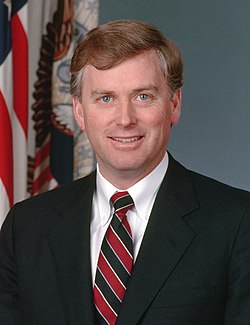
James Danforth Quayle (/kwl/; born February 4, 1947) is an American retired politician and U.S. Army veteran who served as the 44th vice president of the United States from 1989 to 1993 under President George H. W. Bush. A member of the Republican Party, Quayle represented Indiana in the U.S. House of Representatives from 1977 to 1981 and in the U.S. Senate from 1981 to 1989.

Key Information

A native of Indianapolis, Quayle spent most of his childhood in Paradise Valley, a suburb of Phoenix, Arizona. He married Marilyn Tucker in 1972 and obtained his J.D. degree from the Indiana University Robert H. McKinney School of Law in 1974. He and Marilyn practiced law in Huntington, Indiana, before his election to the United States House of Representatives in 1976. In 1980, he was elected to the U.S. Senate.

In 1988, incumbent vice president and Republican presidential nominee George H. W. Bush chose Quayle as his running mate. His vice presidential debate against Lloyd Bentsen was notable for Bentsen's "Senator, you're no Jack Kennedy" quip. The Bush–Quayle ticket defeated the Democratic ticket of Michael Dukakis and Bentsen, and Quayle succeeded Bush as vice president in January 1989. At the age of 41, Quayle was the third-youngest vice president in U.S. history after Richard Nixon and John C. Breckinridge, a rank that would be beaten by 40-year-old JD Vance in 2025. During his tenure, Quayle made official visits to 47 countries and was appointed chairman of the National Space Council. As vice president, he developed a reputation for making comments that some media outlets perceived to be gaffes.[1][2][3][4] He secured re-nomination for vice president in 1992, but was defeated by the Democratic ticket of Bill Clinton and Al Gore.

In 1994, Quayle published his memoir, Standing Firm. He declined to run for president in 1996 because of phlebitis. He sought the Republican presidential nomination in 2000 but withdrew his campaign early on and supported the eventual nominee, George W. Bush. He joined Cerberus Capital Management, a private-equity firm, in 1999. Since leaving office, Quayle has remained active in the Republican Party, including making presidential endorsements in 2000, 2012, 2016, and 2020. Quayle advised his successor Mike Pence to certify the 2020 election despite the attempt of then-president Donald Trump to overturn the election with the January 6, 2021 United States Capitol attack. Quayle became the earliest-serving surviving vice president with the death of Walter Mondale later that year.

Early life, education, and career

[edit]
Quayle in Huntington North High School's 1965 yearbook

Quayle was born in Indianapolis, Indiana, to Martha Corinne (née Pulliam) and James Cline Quayle.[5] He has sometimes[6] been incorrectly referred to as James Danforth Quayle III. In his memoir he points out that his birth name was simply James Danforth Quayle. The name Quayle originates from the Isle of Man, where his great-grandfather was born.[7]

His maternal grandfather, Eugene C. Pulliam, was a wealthy and influential publishing magnate who founded Central Newspapers, Inc., and owned more than a dozen major newspapers, such as The Arizona Republic and The Indianapolis Star. James C. Quayle moved his family to Arizona in 1955 to run a branch of the family's publishing empire.

After spending much of his youth in Arizona,[8] Quayle returned to his native Indiana and graduated from Huntington North High School in Huntington in 1965. He then matriculated at DePauw University, where he received his B.A. degree in political science in 1969,[9] was the captain of the university golf team and a member of the fraternity Delta Kappa Epsilon (Psi Phi chapter).[10][11]

After graduation, Quayle joined the Indiana National Guard and served from 1969 to 1975, reaching the rank of sergeant; his joining meant that he was not subject to the draft.[12] In 1970, while serving in the Guard, Quayle enrolled at Indiana University Robert H. McKinney School of Law. He was admitted under a program for students who could demonstrate "special factors" as his grades did not meet the regular admission standards. In 1974, Quayle earned a Juris Doctor (J.D.) degree.[13][14] At Indiana University, he met his future wife, Marilyn, who was taking night classes at the same law school at the time.[15]

Quayle became an investigator for the Consumer Protection Division of the Office of the Indiana Attorney General in July 1971. Later that year, he became an administrative assistant to Governor Edgar Whitcomb. From 1973 to 1974, he was the Director of the Inheritance Tax Division of the Indiana Department of Revenue. After graduating from law school in 1974, Quayle worked as associate publisher of his family's newspaper, the Huntington Herald-Press.

Congressional tenure

[edit]
Quayle in 1977, his first term in the House of Representatives

In 1976, Quayle was elected to the House of Representatives from Indiana's 4th congressional district, defeating eight-term incumbent Democrat J. Edward Roush by a 55%-to-45% margin.[16] He defeated Democratic challenger John D. Walda in 1978, winning 64% to 34%.[17]

In November 1978, Congressman Leo Ryan of California invited Quayle to accompany him on a delegation to investigate unsafe conditions at the Jonestown settlement in Guyana, but Quayle was unable to participate. The decision likely saved Quayle's life, because Ryan and his entourage were subsequently murdered at the airstrip in Jonestown as the party tried to escape the massacre.[18]

In 1980, at age 33, Quayle became the youngest person ever elected to the Senate from the state of Indiana, defeating three-term incumbent Democrat Birch Bayh with 54% of the vote. Making Indiana political history again, Quayle was reelected to the Senate in 1986 with the largest margin ever achieved to that date by a candidate in a statewide Indiana race, taking 61% of the vote against his Democratic opponent, Jill Long.

In 1986, Quayle was criticized for championing the cause of Daniel Anthony Manion, a candidate for a federal appellate judgeship, who was in law school one year ahead of Quayle. The American Bar Association had evaluated Manion as "qualified/unqualified", its lower passing grade.[19] Manion was nominated for the Seventh Circuit of the U.S. Court of Appeals by President Ronald Reagan on February 21, 1986, and confirmed by the Senate on June 26, 1986.[20]

1988 campaign

[edit]

On August 16, 1988, at the Republican convention in New Orleans, Louisiana, George H. W. Bush chose Quayle to be his running mate in the 1988 United States presidential election. The choice immediately became controversial.[21] Outgoing President Reagan praised Quayle for his "energy and enthusiasm".[22] Press coverage of the convention was dominated by questions about "the three Quayle problems".[23] The questions involved his military service, a golf holiday in Florida where he and several other politicians shared a house with lobbyist Paula Parkinson,[24][12] and whether he had enough experience to be vice president. Quayle seemed at times rattled and at other times uncertain or evasive as he responded to questions.[23] Delegates to the convention generally blamed television and newspapers for the focus on Quayle's problems, but Bush's staff said they thought Quayle had mishandled the questions about his military record, leaving questions dangling.[21][23][25] Although Bush was trailing by up to 15 points in public opinion polls taken before the convention, in August the Bush–Quayle ticket took the lead,[26] which it did not relinquish for the rest of the campaign.

In the October 1988 vice-presidential debate, Quayle debated Democratic candidate Lloyd Bentsen. During the debate, Quayle's strategy was to criticize Dukakis as too liberal. When the debate turned to Quayle's relatively limited experience in public life, he compared the length of his congressional service (12 years) with that of President John F. Kennedy (14 years); Kennedy had less experience than his rivals during the 1960 presidential nomination. It was a factual comparison, although Quayle's advisers cautioned beforehand that it could be used against him. Bentsen's response—"I served with Jack Kennedy. I knew Jack Kennedy. Jack Kennedy was a friend of mine. Senator, you're no Jack Kennedy"—subsequently became a part of the political lexicon.[27]

The Bush–Quayle ticket won the November election by a 53–46 percent margin, sweeping 40 states and capturing 426 electoral votes. He was sworn in on January 20, 1989. Quayle cast no tie-breaking votes as president of the Senate, becoming only the second vice-president (after Charles W. Fairbanks) not to do so while serving a complete term.

Indiana National Guard controversy

[edit]

Since the 1988 United States elections, Quayle has been the subject of controversy regarding his service in the Indiana National Guard from 1969 to 1975. Many of Quayle's political opponents, media outlets, and Vietnam veterans have speculated that Quayle joined the Indiana National Guard as a means to avoid the draft or to avoid being deployed to Vietnam. In August 1988, Quayle denied the accusations.[28] Quayle's draft controversy received renewed attention during the 1992 United States elections after Democratic nominee Bill Clinton was accused of similar draft dodging measures.[29] In September 1992, Quayle acknowledged that joining the Indiana National Guard cut his risks of being deployed to Vietnam, although he defended his decision.[30] In a 1992 interview with NBC's Meet the Press, Quayle was pressed on whether his main motivation was to avoid being sent to fight in Vietnam. Quayle stated that he had preferences for joining the reserves, and that he never asked for preferential treatment.[29] Quayle also noted that had his unit been called, he would have deployed, stating:

Of course you had much less chance to go to Vietnam, but my unit could have been called up to go to Vietnam. And had it been called up, I would have gone.[31]

In a resurfaced 1989 interview with David Hoffman, filmmaker and Vietnam veteran Oliver Stone commented on Quayle and made contrasts between him and then-Nebraska governor Bob Kerrey, noting:

I'm hopeful of people like Bob Kerrey, for example, [the] governor of Nebraska, would be a presidential candidate. He's about forty-two and lost a leg in Vietnam. [He's a] very bright man, compassionate, he's been there. I think he'd make a fine president. Against him would be a guy like Dan Quayle, who is also about the same age, early forties—a heartbeat away from the presidency—a man who has never really suffered pain—a man who went to the National Guard to avoid Vietnam, and yet he's one who always calls for military intervention in Central America, with other people's bodies. You have that hypocrisy at work.[32]

Vice presidency (1989–1993)

[edit]
Quayle with President George H. W. Bush in 1989

During his vice presidency, Quayle made official trips to 47 countries.[8] Bush named Quayle head of the Council on Competitiveness and the first chairman of the National Space Council. As head of the NSC he called for greater efforts to protect Earth against the danger of potential asteroid impacts.[33]

After a briefing by Lt. General Daniel O. Graham, (USA Ret.), Max Hunter, and Jerry Pournelle, Quayle sponsored the development of an experimental Single Stage to Orbit X-Program, which resulted in the building of the McDonnell Douglas DC-X. Quayle has since described the vice presidency as "an awkward office. You're president of the Senate. You're not even officially part of the executive branch—you're part of the legislative branch. You're paid by the Senate, not by the executive branch. And it's the president's agenda. It's not your agenda. You're going to disagree from time to time, but you salute and carry out the orders the best you can".[34]

Murphy Brown

[edit]

On May 19, 1992, Quayle gave a speech titled Reflections on Urban America to the Commonwealth Club of California on the subject of the Los Angeles riots.[35] In the speech he blamed the violence on a decay of moral values and family structure in American society.[35] In an aside, he cited the single mother title character in the television program Murphy Brown as an example of how popular culture contributes to this "poverty of values", saying, "It doesn't help matters when prime-time TV has Murphy Brown—a character who supposedly epitomizes today's intelligent, highly paid, professional woman—mocking the importance of fathers, by bearing a child alone, and calling it just another 'lifestyle choice'."[36]

The "Murphy Brown speech" became one of the most memorable of the 1992 campaign. Long after the outcry had ended, the comment continued to have an effect on U.S. politics. Stephanie Coontz, a professor of family history and the author of several books and essays about the history of marriage, said that this brief remark by Quayle about Murphy Brown "kicked off more than a decade of outcries against the 'collapse of the family'".[37] In 2002, Candice Bergen, the actress who played Brown, said "I never have really said much about the whole episode, which was endless, but his speech was a perfectly intelligent speech about fathers not being dispensable and nobody agreed with that more than I did." Others interpreted it differently; singer Tanya Tucker was widely quoted as saying "Who the hell is Dan Quayle to come after single mothers?"[38]

Perceived gaffes

[edit]
Quayle speaking at Race for the Cure in Washington, D.C. in 1990

Throughout his time as vice president, Quayle was characterized by some media outlets and journalists as being unprepared for the position. Given his position, his comments were heavily scrutinized for factual and grammatical errors. Contributing to this perception of Quayle was his tendency to make public statements that were either impossible ("I have made good judgments in the past. I have made good judgments in the future"[2]), self-contradictory ("I believe we are on an irreversible trend toward more freedom and democracy, but that could change"[39][better source needed]), self-contradictory and confused ("The Holocaust was an obscene period in our nation's history. ... No, not our nation's, but in World War II. I mean, we all lived in this century. I didn't live in this century, but in this century's history"[3]), or just confused (such as the comments he made in a May 1989 address to the United Negro College Fund (UNCF). Commenting on the UNCF's slogan—which is "a mind is a terrible thing to waste"—Quayle said, "You take the UNCF model that what a waste it is to lose one's mind or not to have a mind is being very wasteful. How true that is").[40][41]

On June 15, 1992, Quayle altered 12-year-old student William Figueroa's correct spelling of "potato" to "potatoe" at the Muñoz Rivera Elementary School spelling bee in Trenton, New Jersey.[42][43] He was the subject of widespread ridicule for his error. According to The New York Times[44] and Quayle's memoirs, he was relying on cards provided by the school, which Quayle says included the misspelling. Quayle said he was uncomfortable with the version he gave, but did so because he decided to trust the school's incorrect written materials instead of his own judgment.

1992 campaign

[edit]

In the 1992 election, Bush and Quayle were challenged in their bid for reelection by the Democratic ticket of Arkansas Governor Bill Clinton and Tennessee Senator Al Gore and the independent ticket of Texas businessman Ross Perot and retired Vice Admiral James Stockdale.

As Bush lagged in the polls in the weeks preceding the August 1992 Republican National Convention, some Republican strategists (led by Secretary of State James Baker) viewed Quayle as a liability to the ticket and pushed for his replacement.[45] Quayle ultimately survived the challenge and secured renomination.[46]

During the 1992 presidential campaign, Quayle told the news media that he believed homosexuality was a choice, and "the wrong choice".[47]

Quayle faced off against Gore and Stockdale in the vice presidential debate on October 13, 1992.[48] He attempted to avoid the one-sided outcome of his debate with Bentsen four years earlier by staying on the offensive.[49] Quayle criticized Gore's book Earth in the Balance with specific page references, though his claims were subsequently criticized by the liberal group FAIR for inaccuracy.[50] In Quayle's closing argument, he sharply asked voters, "Do you really believe Bill Clinton will tell the truth?" and "Do you trust Bill Clinton to be your president?" Gore and Stockdale talked more about the policies and philosophies they espoused.[51] Republican loyalists were largely relieved and pleased with Quayle's performance, and his camp attempted to portray it as an upset triumph against a veteran debater, but post-debate polls were mixed on whether Gore or Quayle had won.[52] It ultimately proved to be a minor factor in the election, which Bush and Quayle lost, 168 electoral votes to 370.

Initial post–vice presidency (1993–1999)

[edit]

In 1993, Quayle became the trustee of the Hudson Institute.[53] From 1993 to January 1999, he served on the board of Central Newspapers, Inc.,[53] and from 1995 until January 1999, he headed the Campaign America political action committee.[53]

Quayle authored a 1994 memoir, Standing Firm, which became a bestseller. Quayle's second book, The American Family: Discovering the Values That Make Us Strong, was co-authored with Diane Medved and published in 1996.[53] He later published his third book Worth Fighting For, in 1999.

Quayle moved to Arizona in 1996.[54] He considered but decided against running for governor of Indiana in 1996, and decided against running for the 1996 Republican presidential nomination, citing health problems related to phlebitis.[55]

In 1997 and 1998, Quayle was a "distinguished visiting professor of international studies" at the Thunderbird School of Global Management.[53]

In 1999, Quayle joined Cerberus Capital Management, a multibillion-dollar private-equity firm, where he serves as chair of the company's Global Investments division.[56] As chair of the international advisory board of Cerberus Capital Management, he recruited former Canadian prime minister Brian Mulroney, who would have been installed as chair if Cerberus had acquired Air Canada.[57]

2000 presidential campaign

[edit]
Logo from Quayle's 2000 presidential campaign.

During a January 1999 appearance on Larry King Live, Quayle said he would run for president in 2000.[58] On January 28, 1999, he officially created an exploratory committee.[53] On April 14, 1999, at a rally held at his alma mater Huntington North High School's gymnasium, Quayle officially launched his campaign for the 2000 Republican presidential nomination.[53] In July 1999, he published his book Worth Fighting For.[53]

During campaign appearances, Quayle criticized fellow candidate George W. Bush. Early on, he criticized Bush's use of the term "compassionate conservative".[59]

Quayle finished eighth in the August 1999 Ames Straw Poll. He withdrew from the race the next month and supported Bush.[55]

21st-century career

[edit]
Quayle with Defense Secretary Donald Rumsfeld in 2001.

The Dan Quayle Center and Museum, in Huntington, Indiana, features information on Quayle and all U.S. vice presidents. Quayle is an Honorary Trustee Emeritus of the Hudson Institute and president of Quayle and Associates. He has also been a member of the board of directors of Heckmann Corporation, a water-sector company, since the company's inception and serves as chair of the company's Compensation and Nominating & Governance Committees. Quayle is a director of Aozora Bank, based in Tokyo, Japan.[60] He has also been on the boards of directors of other companies, including K2 Sports, AmTran Inc., Central Newspapers Inc.,[61] BTC Inc.[62] and Carvana Co.[63]

Quayle, then working as an investment banker in Phoenix, was mentioned as a candidate for governor of Arizona before the 2002 election,[64] but declined to run. Quayle attended the second inauguration of George W. Bush in 2005 and the first inauguration of Barack Obama in 2009.

On January 31, 2011, Quayle wrote a letter to President Barack Obama urging him to commute Jonathan Pollard's sentence.[65] In December 2011, Quayle endorsed Mitt Romney for the 2012 Republican presidential nomination.[66]

In early 2014, Quayle traveled to Belfast, Northern Ireland, in an attempt to speed approval for a deal in which Cerberus acquired nearly £1.3 billion in Northern Ireland loans from the Republic of Ireland's National Asset Management Agency. The Irish government is investigating the deal, and the US Securities and Exchange Commission, the Federal Bureau of Investigation, and the United States Attorney for the Southern District of New York are investigating Quayle's involvement as a potentially "very serious" misuse of the vice president's office.[67] As of December 2018, Quayle served as chair of Global Investments at Cerberus.[68]

Political consult

[edit]
Dan (middle) and Marilyn Quayle (right) with Vice President Mike Pence (left) in 2019.

In the 2016 presidential election, Quayle endorsed Jeb Bush.[69] After Bush failed to win the nomination, Quayle endorsed Donald Trump;[70] he was later seen visiting with Trump at Trump Tower in Manhattan before Trump's inauguration.[71]

According to the book Peril, by Bob Woodward and Robert Costa, Quayle played a central role in advising his fellow Hoosier and Vice President Mike Pence to certify the 2020 presidential election as per the Senate rules, rather than cooperate with a plan by then-president Trump that sought to overturn the election, before 2021 Capitol attack.[72][73] Quayle attended President Joe Biden's inauguration on January 20, 2021.[74]

Quayle attended President Trump's second inauguration on January 20, 2025.[75]

Personal life

[edit]
External videos
video icon Booknotes interview with Quayle on Standing Firm, July 24, 1994, C-SPAN

Quayle lives with his wife, Marilyn Quayle, in Paradise Valley, Arizona.[68] They married in November 1972[76] and have three children: Tucker, Benjamin, and Corinne.[77] Benjamin Quayle served in the U.S. House of Representatives from 2011 to 2013,[78] representing Arizona's 3rd congressional district.[79]

Electoral history

[edit]

Published material

[edit]
  • Standing Firm: A Vice-Presidential Memoir, HarperCollins, May 1994. Hardcover. ISBN 0-06-017758-6; mass market paperback, May 1995; ISBN 0-06-109390-4; limited edition, 1994. ISBN 0-06-017601-6.
  • The American Family: Discovering the Values That Make Us Strong (with Diane Medved), Harpercollins, April 1996. ISBN 0-06-017378-5 (hardcover). ISBN 0-06-092810-7 (paperback).
  • Worth Fighting For, W Publishing Group, July 1999. ISBN 0-8499-1606-2.

See also

[edit]

Footnotes

[edit]

Further reading

[edit]
[edit]
Revisions and contributorsEdit on WikipediaRead on Wikipedia
from Grokipedia

James Danforth Quayle (born February 4, 1947) is an American attorney and Republican politician who served as the 44th of the from 1989 to 1993 in the administration of President . Born in , , Quayle graduated from with a in 1969 and earned a from in 1974 before practicing law and serving in the from 1969 to 1975. He launched his political career by winning to the U.S. for Indiana's 4th district at age 29, serving from 1977 to 1981, followed by to the U.S. Senate in 1980, where he held office until 1989. As , Quayle chaired the , promoting initiatives, and led the Council on Competitiveness, advocating for regulatory reforms to enhance economic growth. After leaving office, he briefly sought the 2000 Republican presidential nomination before withdrawing and has since engaged in business, authorship, and conservative policy advocacy.

Early Life and Education

Family Background and Upbringing

James Danforth Quayle was born on February 4, 1947, in , , to James Cline Quayle and Martha Corinne Pulliam Quayle. His father, born in 1921, worked in investment and newspaper , leveraging connections to the family's media enterprises. His mother, born around 1922, came from a prominent publishing lineage and was actively involved in Republican politics, exposing Quayle to partisan activities as early as age 11 in 1958. Quayle's maternal grandfather, , built a conservative publishing empire that included over a dozen major newspapers, such as The Indianapolis Star, The Indianapolis News, and , generating substantial family wealth and influencing Indiana and Arizona editorial landscapes with staunch anti-New Deal stances. Pulliam's holdings extended to papers in the 1930s, reflecting the family's midwestern media roots, though his Indiana operations formed the core of their influence. In 1955, when Quayle was eight, the family moved to Paradise Valley, a Phoenix suburb, where his father oversaw portions of Pulliam's newspaper interests, immersing Quayle in an affluent, business-oriented environment amid the state's growing conservative circles. This relocation aligned with Pulliam's expansion, providing Quayle a stable, privileged upbringing shaped by familial expectations of and , unmarred by economic hardship.

Academic and Professional Preparation

Quayle attended in , graduating in 1969 with a degree in ; during his time there, he captained the men's team. He then enrolled at School of Law in , earning a degree in 1974. While in law school, Quayle gained initial government experience starting in July 1971 as an investigator in the Consumer Protection Division of the Indiana 's Office, followed by work for the state and attorney general. After graduating, he briefly practiced law in , and served from 1974 to 1976 as associate publisher of the family-owned Huntington Herald-Press, a position that involved administrative and editorial responsibilities in the local newspaper business. These roles provided practical exposure to legal practice, consumer advocacy, and media operations, laying groundwork for his subsequent political ambitions.

Entry into Politics

U.S. House Service

James Danforth Quayle was elected to the from on November 2, 1976, defeating eight-term Democratic incumbent J. Edward Roush. He assumed office on January 3, 1977, as a member of the Republican Party, representing the 95th . At age 29, Quayle focused his early legislative work on committees addressing and . Quayle served on the House Committee on Armed Services and the House Committee on Foreign Affairs during his tenure. His committee assignments positioned him to engage with defense policy and foreign policy matters, aligning with his conservative stance on military strength and international engagement. While specific sponsored legislation from this period is limited in records, Quayle participated in floor votes reflecting a generally conservative voting record, including an independent vote against funding for the B-1 bomber program. In the 1978 midterm elections, Quayle secured reelection to the 96th Congress with approximately 65 percent of the vote, achieving the largest margin in the district's history at that time. He opted not to seek a third term in 1980, instead pursuing a successful bid for the from . His service, spanning January 3, 1977, to January 3, 1981, established him as a rising Republican figure emphasizing and strong national defense.

Senate Tenure and Legislative Record

Quayle was elected to the U.S. Senate from in the 1980 elections, defeating three-term Democratic incumbent , and took office on January 3, 1981. He was reelected in 1986, securing 61.2% of the vote against Democrat Jill Long, and served until January 3, 1989, when he resigned following his selection as the Republican . During his Senate tenure, Quayle maintained a voting rate exceeding 98%, among the highest in the chamber through his first six years. He served on the Committees on Armed Services, , and Labor and , focusing legislative efforts in areas of , , and workforce development. As a junior member of the Republican Class of 1980, Quayle aligned closely with President Reagan's agenda, supporting tax cuts, , and increased defense spending while opposing expansions in social welfare programs. His overall voting record placed him among the Senate's most conservative members, earning perfect or near-perfect scores from groups like the American Conservative Union but zero ratings from liberal organizations such as . A signature achievement was his role as lead Republican sponsor of the Job Training Partnership Act (JTPA) of 1982, co-authored bipartisansly with Democrat Edward Kennedy. The legislation replaced the , emphasizing private-sector partnerships to deliver job training and placement services for economically disadvantaged youth and dislocated workers, with funds allocated through state and local private industry councils rather than federal bureaucracies. It passed the unanimously (92-0) and was signed into law by President Reagan on October 13, 1982, authorizing $4 billion annually for programs that served over 1.5 million participants by the late 1980s. Quayle highlighted the measure's emphasis on accountability and market-driven outcomes, crediting its success to cross-aisle collaboration that avoided ideological gridlock. On defense and foreign policy, Quayle advocated for modernization of U.S. military capabilities, including support for the and opposition to treaties he viewed as weakening American leverage against the . In fiscal matters, he backed the Balanced Budget and Emergency Deficit Control Act of 1985 (Gramm-Rudman-Hollings), which imposed automatic spending cuts to curb federal deficits, though he criticized its exemptions for certain programs. Representing an agricultural state, Quayle pushed for enhanced farm exports and market-oriented reforms but resisted expansive increases, aligning with Reagan-era efforts to reduce price supports amid criticisms from farm lobbies that his votes occasionally disadvantaged rural constituents. These positions reflected a commitment to intervention, though analyses noted potential electoral vulnerabilities in moderate districts due to the rigidity of his .

Vice Presidential Selection and 1988 Campaign

Nomination Process

Vice President , having secured the Republican presidential nomination earlier in August 1988, initiated a compressed vice presidential selection process focused on balancing the ticket with a younger, more ideologically conservative figure to complement his establishment profile. The shortlist of finalists included Senate Minority Leader of Kansas, House Republican of New York, and Indiana Senator Dan Quayle, with personally telephoning each to inform them of his decision. Campaign chairman James A. Baker III and senior advisors such as Robert Teeter and played key roles in evaluating candidates, emphasizing factors like regional appeal and voter demographics. Bush selected Quayle, then 41 years old, primarily for his youth to engage baby boomer voters, his staunch to solidify support from the party's right wing, and his Midwestern roots in the battleground state of , which offered modest but targeted electoral value with 12 votes. Quayle's telegenic presence and perceived appeal to women voters were additional considerations, as highlighted by , amid concerns over a in Republican support. Unlike more prominent contenders like Dole or Kemp, Quayle represented a "man of the future" with limited national exposure but strong party loyalty, having risen quickly from the to the . The announcement came on August 16, 1988, as Bush arrived in New Orleans for the , catching many Republican strategists and delegates off guard due to Quayle's relative obscurity and the abrupt pivot from higher-profile options. Bush defended the choice by portraying Quayle as a "rising star" and success story, while President endorsed it, praising Quayle's electoral track record. Quayle formally accepted the nomination in a convention speech on August 18, 1988, emphasizing shared values with Bush on defense, family, and . The vetting, though thorough on financial and personal matters, overlooked deeper scrutiny of Quayle's record, which later drew controversy but did not derail the immediate process.

Military Service Scrutiny

During the 1988 vice presidential selection process, Dan Quayle's Vietnam-era service in the drew significant media and political scrutiny, particularly regarding allegations of favoritism in his enlistment. Quayle enlisted on May 19, 1969, shortly after graduating from , amid a national draft lottery and escalating U.S. involvement in ; service at the time commonly served as a means to avoid active-duty deployment overseas, a practice employed by millions of eligible men. Critics, including Democratic nominee Michael Dukakis's campaign, questioned whether Quayle's connections—his father was a prominent newspaper publisher and the had ties to political figures—enabled him to secure a Guard spot when waiting lists reportedly existed and other applicants faced delays. Quayle acknowledged that "calls were made" by associates to Guard officials but maintained that no improper influence was exerted, emphasizing that he had passed his pre-induction physical and was prepared to serve in any capacity assigned. He completed six months of active-duty training at , , followed by reserve obligations until his honorable discharge in 1975, without overseas deployment. Quayle repeatedly denied enlisting specifically to evade Vietnam combat, stating during press questioning that his decision aligned with the choices of many peers who viewed Guard service as honorable fulfillment of duty. However, in later reflections during the 1992 campaign, he conceded that Guard enlistment had materially lowered his risk of assignment, amid revived allegations from a Globe investigation suggesting procedural irregularities, such as expedited processing or displacement of other enlistees. No formal investigations found evidence of illegality, and Quayle's defenders, including Guard officials, attested to the legitimacy of his entry amid available slots in units. The episode highlighted broader debates over draft deferments and elite access to alternatives during the but did not derail his nomination.

Campaign Dynamics and Key Issues

The Bush-Quayle campaign emphasized continuity with Ronald Reagan's policies, positioning Quayle as a bridge to younger conservatives while reinforcing traditional Republican themes of , strong national defense, and . Selected on August 16, , at the in New Orleans, Quayle's youth at age 41 was intended to inject vigor and appeal to the party's right wing, contrasting with the Democratic ticket of and , whom Republicans portrayed as emblematic of big-government . Quayle actively toured battleground states, particularly in the Midwest, delivering over 100 speeches by October and focusing on shoring up evangelical and working-class support amid initial post-nomination polls showing voter skepticism about his experience. Key issues highlighted in Quayle's stump speeches included opposition to abortion, aligning with his consistent pro-life Senate voting record, where he supported restrictions and opposed federal funding for the procedure. On defense, Quayle advocated for sustained spending and criticized Dukakis for perceived weakness, such as vetoing flag-burning penalties and opposing the death penalty for certain crimes, tying these to broader themes of and . The campaign also spotlighted the drug crisis, with Quayle echoing Bush's pledge for tougher enforcement and treatment programs, while attacking Dukakis's weekend furlough system that had released convicted murderer . A pivotal dynamic unfolded in the , 1988, vice presidential debate in , where Quayle defended his qualifications by citing John F. Kennedy's comparable Senate tenure before the 1960 election, prompting Bentsen's retort: "Senator, I served with Jack Kennedy. I knew Jack Kennedy. Jack Kennedy was a friend of mine. ." Though the exchange drew media focus on Quayle's perceived inexperience and elicited post-debate criticism from Dukakis questioning Bush's judgment, empirical polling data indicated minimal lasting damage to the Republican ticket, which secured a 53.4% popular vote and 426 electoral votes on November 8. Quayle's conservative stances, including support for Reagan-era while scrutinizing Soviet compliance, helped solidify the base without alienating moderates, contributing to the campaign's momentum in the campaign's final weeks.

Vice Presidency (1989-1993)

Policy Roles and Achievements

As , Dan Quayle chaired the , established by President via 12675 on June 30, 1989, serving as the principal advisor on national space policy and strategy. Under his leadership, the council advocated for expanded human , including lunar and Martian efforts, and emphasized protections against potential impacts. It supported initiatives like the National Aero-Space Plane project, which received a boost through public-private partnerships contributing approximately $700 million from industry by 1989. In 1992, Quayle restructured space project responsibilities, assigning specific roles to agencies beyond to enhance efficiency and coordination. The council's final report to the President in January 1993 outlined comprehensive recommendations for the U.S. space program, reflecting Quayle's push for strategic national priorities in space. Quayle also headed the President's Council on Competitiveness, formed in 1989 to evaluate federal regulations for their impact on economic competitiveness. The council reviewed and blocked numerous regulations deemed overly burdensome to businesses, with administration officials noting dozens squelched by 1991, targeting areas like environmental and safety rules to prioritize industrial efficiency. Meeting approximately monthly, it incorporated industry input to balance regulatory goals against economic constraints, though critics argued it undermined public protections. This role positioned Quayle as a key advocate for deregulation as a means to bolster U.S. global economic standing during a period of trade and manufacturing challenges. Drawing on his congressional experience, Quayle acted as a liaison between the and , providing legislative advice and urging President Bush to secure congressional authorization for military actions, such as the 1991 resolution. He participated actively in discussions across domestic and foreign arenas, contributing to administration priorities on competitiveness, , and regulatory reform. These efforts underscored Quayle's influence in shaping executive branch initiatives aimed at long-term national advantages, despite prevailing media narratives often emphasizing perceived shortcomings over substantive outputs.

International Diplomacy and Travel

As , Dan Quayle undertook diplomatic travel to 47 countries, with a particular emphasis on and to advance U.S. interests in , economic partnerships, and regional stability. His missions often involved representing the administration at key political events, such as presidential inaugurations, where he signaled American support for democratic transitions amid endgame dynamics. Quayle attended 8 to 9 such inaugurations in , including those in , , , , and , positioning him as an envoy for U.S. policy favoring electoral processes over leftist insurgencies. Quayle's inaugural foreign trip occurred in early February 1989, when he visited Venezuela for the inauguration of President Carlos Andrés Pérez on February 2 and then proceeded to El Salvador to deliver a message urging the reversal of political murders and encouraging leftist rebels to participate in elections. In Venezuela, he navigated tensions by avoiding direct engagement with Cuban leader Fidel Castro, who was present, while affirming U.S. commitment to hemispheric democracy. Later Latin American engagements included a January 27–29, 1990, tour of Honduras, Panama, and Jamaica—despite initial regional resistance—to bolster post-Noriega stability in Panama, where he toured facilities on January 29 to demonstrate U.S. backing for the new government. In May 1991, he lobbied Venezuelan President Pérez to expand oil production for global market balance, highlighting economic diplomacy. Quayle also voiced support for Nicaraguan contras during regional visits, pressing against Managua's policies. In Asia, Quayle conducted multiple missions to foster alliances and trade, visiting five times to address economic frictions and strategic cooperation. By December 1989, he had toured , , the , and , emphasizing U.S. commitments amid shifting regional power dynamics. A May 1991 trip to focused on bilateral ties despite logistical delays from issues, while his 1992 visit marked the 20th anniversary of Okinawa's return to Japanese control, aiding fence-mending after prior U.S.-Japan trade tensions. These efforts complemented broader administration goals, including negotiations with Soviet leader on space cooperation. Quayle's European travels were fewer but included five visits to and trips to the Baltics and in 1992 to affirm U.S. presence during post-communist transitions. Overall, his itinerary reflected a pragmatic approach to vice-presidential , leveraging travel for intelligence gathering, message delivery, and relationship-building in areas where Cabinet-level attention was limited.

Domestic Initiatives and Family Values Advocacy

Quayle championed traditional as essential to combating social decay during his vice presidency, positing that the erosion of two-parent households fueled rises in , urban violence, and welfare reliance among the . He contended that cultural influences glorifying alternative models exacerbated these trends, urging policies and to reinforce paternal responsibility and marital stability. A pivotal moment came in his May 19, 1992, address to the Commonwealth Club of San Francisco, where he lambasted the CBS sitcom for depicting successful single motherhood as a viable norm, divorced from the hardships endured by most unwed parents. Quayle highlighted the character's choice to raise a without a as emblematic of elite detachment, declaring it undermined the societal imperative for intact families and contributed to illegitimacy rates that had climbed from 5% of births in 1960 to 30% by 1992. He emphasized that bearing outside , absent exceptional circumstances, strained public resources and perpetuated cycles of dependency, while affirming that " is still the best choice" for child-rearing outcomes. This speech ignited a broader discourse on amid the 1992 presidential contest, with Quayle framing Republican domestic priorities around welfare restructuring to promote work, , and father involvement rather than subsidizing fragmentation. He proposed reforms to curtail benefits that discouraged wedlock or rewarded additional out-of-wedlock children, and to impose obligations on absent fathers for , arguing such measures would restore incentives for family cohesion over state dependency. Quayle reiterated these themes in subsequent appearances, including a 1994 speech marking the Murphy Brown controversy's anniversary, where he defended the critique against charges of insensitivity by citing empirical correlations between father absence and elevated juvenile delinquency, school failure, and economic disadvantage. Longitudinal data later corroborated his warnings, revealing children of unmarried mothers at 2-3 times higher risk for and behavioral issues compared to those in stable two-parent homes, notwithstanding initial media portrayals dismissing his views as retrograde. Beyond oratory, Quayle advanced family advocacy through publications like The American Family: Discovering the Values That Make Us Strong (1996), profiling five ordinary to exemplify , , and parental as antidotes to cultural permissiveness. His efforts positioned family policy as a bulwark against permissive , prioritizing causal links between household stability and civic health over egalitarian expansions of welfare or media norms.

Media Portrayals, Gaffes, and Defenses

During his vice presidency, Dan Quayle was frequently portrayed in as intellectually lightweight and prone to blunders, a amplified by outlets critical of the Bush administration. Coverage emphasized verbal slips and public errors, contributing to a public image of incompetence that overshadowed his legislative experience. This depiction was evident in late-night comedy, such as sketches portraying him as childlike, and in news reports that fixated on minor missteps amid broader political scrutiny. One of the most cited gaffes occurred on June 15, 1992, at Rivera Elementary School in , where Quayle participated in a sixth-grade . He selected the word "" for student William Figueroa, who correctly spelled it on the chalkboard; Quayle then instructed him to add an "e," writing "potatoe" himself, a misspelling that ignited widespread and became emblematic of perceived . The incident, captured on video and replayed extensively, fueled jokes and editorials questioning his fitness for office, though the error stemmed from a provided by aides that included the extra letter. Other notable verbal missteps included a 1989 speech to the where Quayle confused the with a "Latin" nation and mangled references to , as well as a 1992 remark during a San Francisco campaign stop likening the city's vibrancy to that of a "foreign country," which critics seized upon as tone-deaf. In a May 1992 address to the , Quayle critiqued the CBS sitcom for normalizing single motherhood, arguing it devalued traditional families; media response largely framed the comments as misogynistic and culturally insensitive, intensifying the gaffe-prone label. These episodes, while factual, were disproportionately highlighted by outlets with left-leaning editorial slants, which often downplayed similar errors by Democratic figures and prioritized narrative over context. Quayle and his defenders countered that media fixation on trivialities reflected ideological rather than substantive flaws, with Quayle himself viewing elite scorn as a "badge of honor" indicative of effective conservative advocacy. Supporters argued the portrayals ignored his rapid rise through elected offices—U.S. House at age 29, at 33—and prior academic and , attributing the ridicule to partisan efforts to undermine the Republican ticket ahead of the 1992 election. Post-tenure reflections, including in pieces, posited that the "dumb " caricature was a form of , as evidenced by the outsized reaction to the incident compared to Quayle's policy contributions on defense and issues. Such defenses highlighted how systemic left-wing tilts in amplified conservative gaffes while minimizing equivalents, fostering a skewed public assessment.

1992 Re-Election Effort

The Bush-Quayle re-election campaign encountered significant internal Republican resistance to retaining Quayle on the ticket, driven by his accumulated public missteps and perceived liabilities amid the president's declining approval ratings following the recession. In July 1992, groups of Republican senators convened separately to urge Bush to consider alternatives, citing Quayle's drag on the campaign, but Bush emphatically rejected the notion, declaring his unwavering support and loyalty to the vice president he had selected four years prior. This decision reflected Bush's personal commitment despite polling data showing Quayle's unfavorable ratings exceeding 50% in key demographics, as outlets, often critical of conservative figures, amplified narratives questioning his fitness for office. Quayle undertook an active campaign schedule, focusing on cultural and to differentiate the ticket from Democratic opponents, including a May 19, 1992, speech at the Commonwealth Club in that condemned the sitcom for glamorizing single motherhood by an affluent professional, arguing it eroded traditional norms and contributed to urban social pathologies like out-of-wedlock births, which had risen to 30% nationally by 1992 per data. The address provoked immediate backlash from entertainment industry figures and liberal commentators, who framed it as an attack on women's independence, though subsequent empirical analyses affirmed Quayle's causal linkage between father-absent households and elevated risks of , , and educational failure among children. A subsequent June 15, 1992, spelling bee visit to Muñoz Rivera Elementary School in , drew ridicule when Quayle corrected a student's accurate spelling of "potato" to "potatoe" on the chalkboard, an error seized upon by opponents and media as emblematic of intellectual deficiency, despite Quayle's prior legislative experience and service record. Quayle intensified efforts in battleground states, such as a August 6, 1992, tour in emphasizing electoral importance, and engaged in the October 13, 1992, vice presidential debate in against and independent , where he defended the administration's economic record and attacked Clinton's character. Campaign strategies positioned Quayle to shore up the conservative base on social issues, but persistent gaffe coverage in outlets like —which disproportionately highlighted negatives over policy substance—undermined broader appeals. The ticket ultimately lost on November 3, 1992, with Bush-Quayle garnering 168 electoral votes to Clinton-Gore's 370, amid a three-way race that split the vote and of 55.2%.

Post-Vice Presidential Career

Immediate Aftermath and Private Sector (1993-1999)

Upon departing the vice presidency on January 20, 1993, following the Bush-Quayle's loss to Bill Clinton in the 1992 election, Dan Quayle transitioned to roles in policy advocacy and memoir-writing. He became a trustee of the Hudson Institute, a conservative think tank, in 1993 and established its Competitiveness Center in Indianapolis, focusing on economic policy issues akin to his prior role chairing the White House Council on Competitiveness. This center, led by former Quayle staffers, aimed to promote free-market competitiveness through research and advisory work. Quayle published Standing Firm: A Vice-Presidential in February 1994, offering his account of the Bush administration's inner workings, including the prosecution and policy debates on regulation and . The book debuted on the bestseller list, selling over 100,000 copies in its first weeks and providing Quayle a platform to defend his tenure against media criticisms of perceived gaffes and inexperience. From 1995 to January 1999, Quayle chaired Campaign America, a founded by Senator to support conservative candidates and causes, through which he campaigned for over 100 Republican contenders in midterm and local races. This role blended political advocacy with private-sector networking, as the PAC raised funds from business donors aligned with and tax-cut priorities. In parallel, Quayle engaged in paid speaking engagements and consulting, leveraging his vice-presidential experience for corporate audiences on global trade and competitiveness. By 1996, Quayle had relocated to Paradise Valley, Arizona, shifting his base from amid family considerations and exploratory steps toward future political ambitions. Toward the end of the decade, in early 1999, he entered the private investment sector as chairman of Cerberus Global Investments, a New York-based specializing in distressed assets and global deals, marking a pivot to business leadership ahead of his announcement for the 2000 Republican presidential nomination.

2000 Presidential Bid

On April 14, 1999, Dan Quayle formally announced his candidacy for the Republican Party's presidential nomination in the during a speech at Huntington North High School in his hometown of . In the address, he criticized the 1990s as "the dishonest decade of and " and pledged to restore traditional American values, including family integrity, fiscal responsibility, and a robust defense posture. Quayle positioned his campaign as a conservative counter to the perceived moral decline under the Clinton administration, advocating policies such as tax reform, school choice, and opposition to affirmative action. Throughout the spring and summer of 1999, Quayle actively campaigned in early primary states like and , emphasizing his vice presidential experience and commitment to Republican orthodoxy. However, he struggled with persistently low support in national polls, often registering at 3 percent or less among likely Republican primary voters, as measured by Gallup surveys that showed no significant traction despite his efforts. Fundraising challenges compounded these issues, with Quayle's campaign unable to compete against frontrunner , who amassed $36 million in contributions by mid-1999 while Quayle lagged far behind in donor commitments. By September 1999, financial constraints had depleted campaign resources, prompting Quayle to suspend his bid on in , alongside his Marilyn. In his withdrawal remarks, he conceded that Bush's fundraising dominance made sustained competition untenable, stating that "reality set in" about the campaign's viability. The early exit underscored the hurdles posed by Quayle's lingering public image from his vice presidency, including perceptions of gaffes amplified in media coverage, which hindered voter enthusiasm despite his policy-focused messaging.

Business Ventures and Advocacy (2000s-2010s)

After withdrawing from the 2000 presidential race, Quayle shifted focus to private consulting and investment activities. He served as president of Quayle & Associates, a firm providing strategic advisory services to businesses on international operations and matters. In 1999, Quayle joined as an advisor, advancing to chairman of Cerberus Global Investments in 2001, a role involving oversight of the firm's international and strategic investments exceeding billions in assets. In this capacity, he contributed to deals in sectors like defense, , and global finance, leveraging prior experience for geopolitical in emerging markets. The division under his focused on opportunities in and , including advisory on cross-border transactions amid post-9/11 economic shifts. Quayle also held directorships on corporate boards during this period, including joining in July 2001, a Vail-based outdoor equipment firm reporting $38 million in operating income for 2000. Earlier in 2000, he affiliated with J.D. Ford & Co., engaging in private equity transactions while serving on boards such as U.S. Filter Corp., where he participated in hundreds of board-level decisions on mergers and operations. Through these ventures, Quayle advocated for policies promoting free-market investments and U.S. competitiveness in global trade, emphasizing reduced regulatory barriers and strong defense postures to protect economic interests, as articulated in interviews on facing international challenges. He supported neoconservative positions on investments, aligning business strategies with advocacy for robust military-industrial partnerships. Into the 2010s, his role extended to boards like the TGen Foundation (elected 2013), focusing on funding.

Contemporary Involvement

2020 Election Counsel to Pence

In the weeks following the , , , faced intense pressure from President and his allies to explore options for rejecting or delaying the certification of electoral votes during the of scheduled for , 2021. Pence, drawing on his experience as a former House member and governor, consulted multiple advisors, including former Dan Quayle, whom he contacted repeatedly in late December and early January 2021 to clarify the vice president's constitutional and statutory role under the Twelfth Amendment and the of 1887. Quayle, who had presided over the 1993 electoral vote certification as under —declaring the winner despite Republican objections—advised Pence that the position's duties were strictly ceremonial and ministerial. He emphasized that the vice president lacks unilateral authority to exclude electors certified by state legislatures, return slates to states for reconsideration, or substitute judgment for that of on objections, stating there was "no flexibility" in the process and that any deviation would violate the law. This counsel aligned with interpretations from Pence's legal team, the Department of Justice's , and nonpartisan experts, who uniformly concluded that the vice president's role is limited to opening envelopes, announcing votes as submitted, and presiding over congressional objections requiring majority concurrence in both houses. Pence's consultations with Quayle reportedly occurred amid Trump's promotion of theories advanced by attorney , who argued in a six-point memo that Pence could assert unilateral powers to alter outcomes in states with disputed electors, such as , Georgia, , , , and , where Trump claimed irregularities totaling over 1,000 alleged instances across voting machines, absentee ballots, and observer access—claims rejected in more than 60 lawsuits by state and federal courts, including those presided over by Trump-appointed judges. Quayle rejected such interpretations, reinforcing to Pence that the assigns decisive power to , not the presiding officer, and that overriding state-certified results would undermine the constitutional framework established since 1789. On January 6, 2021, as the Capitol faced rioting by Trump supporters protesting the certification, Pence issued a statement affirming his duty: "The has no authority to unilaterally reject electoral votes," and proceeded to oversee the count after evacuations, ultimately certifying 306 electoral votes for and 232 for Trump on January 7, 2021. Quayle's guidance contributed to Pence's adherence to this protocol, consistent with precedents set by Vice Presidents in 2001 and Quayle himself in 1993. Post-event, Quayle publicly supported Pence, describing the 's actions as upholding the and later criticizing attempts to politicize the ceremonial role as a threat to institutional norms.

Post-2020 Commentary and Public Statements

Quayle publicly criticized President Trump's decision not to attend President-elect Joe Biden's inauguration on January 20, 2021, describing it as "a mistake" and underscoring that the peaceful constitutes "one of the hallmarks of our ." This statement reflected his consistent emphasis on constitutional norms amid post-election tensions, including the January 6, 2021, Capitol events, where he later affirmed the vice president's lack of authority to unilaterally alter electoral outcomes, aligning with the Electoral Count Act's requirements for certification. In June 2024, Quayle offered debate strategy advice to President Biden ahead of his matchup with former President Trump, recommending that Biden "try to make fun of Trump a little bit, ridicule him" to underscore policy contrasts, a suggestion framed as tactical rather than partisan endorsement. He has maintained a measured distance from Trump-era Republican dynamics, prioritizing institutional integrity over personal loyalty, as evidenced by his earlier public rejection of unsubstantiated widespread fraud claims in , which carried into broader commentary on democratic resilience. Turning to foreign policy, Quayle warned in an October 22, 2024, interview that was "outpacing" the in critical technologies, including hypersonic missiles, drones, and applications, which he argued threatened American global supremacy unless addressed urgently by presidential candidates. In May 2025, he assessed the Russia- conflict during a CEO Council Summit appearance, predicting it would not conclude "any time soon" and expressing puzzlement at former President Trump's reluctance to apply stronger leverage on Russian President for negotiations, while advocating sustained U.S. support for to deter aggression. These remarks highlight Quayle's focus on strategic competition and deterrence, drawing from his vice presidential experience in matters.

Personal Life and Legacy

Family and Personal Relationships

Dan Quayle was born on February 4, 1947, in , , to James Cline Quayle, a publisher and investor who chaired the Central Newspapers Inc. chain, and Martha Corinne Pulliam Quayle. As the eldest of four siblings, Quayle grew up alongside brothers Christopher (born 1949) and Michael (born 1957), and sister Martha (born 1957). His father, who died in 2000 at age 79, maintained a close relationship with Quayle, publicly defending him against media scrutiny during his vice presidency. Quayle met Marilyn Tucker, a fellow law student at Robert H. McKinney School of Law, where they both earned J.D. degrees in 1974. The couple married in November 1972 and briefly operated a joint law practice in , before Quayle's entry into elective office. , a and , supported her husband's political career while raising their family and pursuing her own professional interests, including writing novels. The Quayles have remained married for over 50 years as of 2025 and reside in . The Quayles have three children: Tucker Danforth Quayle (born 1974), Benjamin Eugene "Ben" Quayle (born 1976), and Mary Corinne Quayle. followed his father into , serving as a Republican U.S. Representative for from 2011 to 2013. The family has seven grandchildren. Throughout his public life, Quayle emphasized traditional family structures, drawing from his own experiences as a husband and father.

Assessments of Intelligence, Leadership, and Impact

Dan Quayle's intelligence has been subject to widespread scrutiny, often portrayed negatively in accounts emphasizing verbal gaffes such as his 1992 misspelling of "potato" as "potatoe" during a visit to a sixth-grade in . These incidents contributed to a public image of intellectual inadequacy, amplified by outlets like , which described his speaking style as "stilted and unconvincing." However, Quayle's pre-vice presidential record counters this narrative: he earned a J.D. from in 1974, was admitted to the bar, and won election to the U.S. House at age 29 in 1976 and the at 33 in 1980, demonstrating electoral and legislative competence. Contemporaries like his press secretary Rich Galen noted Quayle's intellect as lean and practical, lacking "body fat" for abstract theorizing but effective for policy application. Assessments of Quayle's leadership highlight a contrast between ceremonial duties and substantive engagement. As from 1989 to 1993, he chaired the and the Council on Competitiveness, influencing policies on and regulatory reform, and traveled to 47 countries to advance U.S. interests. Supporters credit him with loyalty to President and resilience amid criticism, as evidenced by his endurance of intense media scrutiny without resignation despite calls to do so in 1992. Critics, including some within his party, viewed him as lacking , with discussions and responses citing his perceived weakness in the shadow of Bush's experience. The Miller Center assesses Quayle as loyal but with limited influence in the Bush administration, overshadowed by stronger figures, and notes that his gaffes proved more memorable than his achievements. Historical surveys have ranked him near the bottom; a 2024 expert survey in the Los Angeles Times placed him second to last among vice presidents since 1933, while Time magazine in 2008 included him among America's worst vice presidents. Post-tenure, Quayle's advisory role to in 2020—urging certification of the electoral vote against pressure to overturn results—demonstrated principled leadership, earning praise for upholding constitutional norms. Quayle's political impact endures through cultural interventions and partisan positioning rather than transformative legislation. His 1992 "Murphy Brown" speech critiqued television's normalization of single motherhood, warning of societal costs; subsequent data showed single-parent households rising from 22% in 1980 to 35% by 2012, lending empirical validation to his causal concerns about family structure and child outcomes. Selected as Bush's in 1988 for his youth (41 years old), Midwestern roots, and appeal to social conservatives, Quayle helped balance the ticket amid debates over Bush's age. While his vice presidency contributed to the 1992 electoral loss amid economic recession—polls showed his approval rating at 31% in mid-1992—his tenure amplified Republican emphasis on traditional values, influencing successors like Pence. Mainstream portrayals often prioritized gaffes over achievements, reflecting institutional biases that downplayed conservative policy critiques, yet Quayle's post-2000 business and advocacy roles sustained his influence in Republican circles.

Electoral History

In 1976, Quayle was elected to the for , defeating Democratic incumbent J. Edward Roush with 107,762 votes to 90,406 (54.4% to 45.6%). He was reelected in 1978 with 80,527 votes against Democratic challenger Terry J. Duga, securing approximately 55% of the vote in a Republican-leaning district.
YearOfficePartyVotesPercentageOpponent (Party)VotesPercentageOutcome
1980U.S. Senate (Indiana)Republican1,670,86354.1Birch Bayh (Democratic)1,361,50344.0Won
1986U.S. Senate (Indiana)Republican1,344,82161.2Jack Pastrick (Democratic)813,14137.0Won
Quayle was selected as the Republican vice-presidential nominee in 1988 alongside , defeating the Democratic ticket of and with 48,886,097 popular votes (53.4%) and 426 electoral votes. The Bush-Quayle ticket sought reelection in 1992 but lost to and , receiving 39,104,550 popular votes (37.5%) and 168 electoral votes amid economic recession and a three-way race with independent . Quayle launched a bid for the 2000 Republican presidential nomination on April 15, 1999, but suspended his campaign on September 27, 1999, before any primaries due to insufficient fundraising and polling, receiving no delegates or primary votes.

Published Works

[Published Works - no content]

References

Add your contribution
Related Hubs
User Avatar
No comments yet.