Hubbry Logo
ShikhandiShikhandiMain
Open search
Shikhandi
Community hub
Shikhandi
logo
8 pages, 0 posts
0 subscribers
Be the first to start a discussion here.
Shikhandi
Shikhandi
from Wikipedia
Shikhandi
Shikhandi
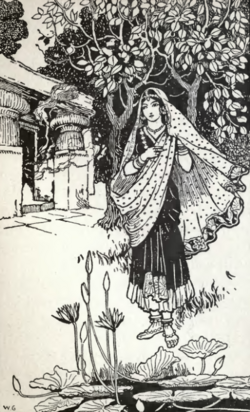
An illustration of Shikhandi before her sex-change, c. 1916
Information
GenderWoman, later Man[1]
FamilyDrupada (father)
Prishati (mother)
Dhristadyumna (brother)
Draupadi (sister)
SpouseUnnamed princess of Dasarna
ChildrenKshatradeva

Shikhandi (Sanskrit: शिखण्डी, romanizedŚikhaṇḍī), whose natal female identity is rendered Shikhandini,[2] is a character in the Hindu epic Mahabharata. Born as the daughter of Drupada, the King of Panchala, Shikhandini becomes male after agreeing to a sex exchange with a yaksha. He is the brother of Draupadi, who is the common wife of the Pandavas.[3]

Shikhandi is the reincarnation of Amba, a princess who was abducted by Bhishma at a svayamvara and later spurned by him. The prince fights in the Kurukshetra War on the side of his brothers-in-law, the Pandavas, and is instrumental in causing the death of Bhishma. He also engages in combat with great warriors like Ashwatthama, Kripa, and Kritavarma.

In Javanese wayang tradition, Shikhandi is known as Srikandhi and is born as a male, and changes into a female. She becomes the second wife of the Pandava brother Arjuna, and Sembadra being the first.[4][5]

Legend

[edit]

Previous birth

[edit]

In the majority of the versions of the Mahabharata,[6] Shikhandi is described as being a princess named Amba in his previous birth. Amba was the eldest daughter of the King of Kashi. Along with her sisters, Ambika and Ambalika, she was won by Bhishma at their svayamvara. After defeating several kings, including King Salva, Bhishma returned to Hastinapura with the princesses, and presented them as brides to his younger half-brother, Vichitravirya, the king.[7]

Before her wedding ceremony could commence, Amba told Bhishma that she had fallen in love with the King of Salva, and was not ready to marry anyone else. Hearing this from her, Bhishma sent Amba with grandeur to her desired husband. However, Salva rejected her, stating that as Bhishma had bested him at the svayamvara, he regarded him to be her rightful husband. Amba returned to Bhishma and demanded that he marry her according to Kshatriya dharma, but Bhishma declined, due to his vow of celibacy. Lamenting her misfortune, the princess decided to retire to the forest and practise austerities for the remainder of her life. As she wandered, she came across an ashrama, and informed the sages within of her plight. One of the sages happened to be maternal grandfather, Hotravahana, who sympathised with her state of mind, and told her that Parashurama, Bhishma's martial guru, would come to her aid. Parashurama visited Hastinapura, and commanded his disciple to marry Amba. Bhishma refused to obey him, once again citing his vow. Furious, Parashurama engaged in a terrible duel against Bhishma on the field of Kurukshetra for twenty-three days, employing astras, but was unable to best him. He regretfully informed Amba of his failure to change his mind. The princess spent twelve years engaged in severe austerities, which scorched the heavens themselves. Shiva appeared to grant her a boon of her choice, and she solicited the death of Bhishma. Shiva told Amba that she would be born as a girl who would later become a man in her next life, and become a maharathi who would slay Bhishma in battle. Overjoyed, the princess lit a funeral pyre, prayed for the death of Bhishma, and self-immolated.[8]

According to an iteration by C. Rajagopalachari, she resorted to a penance and received a garland of blue lotuses from the god Kartikeya, and it was foretold that anyone wearing the garland would become the cause of Bhishma's death. She went to the Panchala, as it were a mighty empire known for its military prowess. However, no one was willing to champion her cause, fearful of antagonising Bhishma. Amba, in anger, hung the garland on the gates of King Drupada and left in agony.[9]

Sex exchange

[edit]

Due to his childlessness, King Drupada propitiated Shiva, who told the king that a girl would be born to him, who in due course, would become a man. When Shikhandi was born to Drupada's queen, she was raised and dressed as a boy. When Shikhandi reached the traditional age of maturity, Drupada decided to offer her hand in marriage to the daughter of Hiranyavarman, the King of Dasharna. Shikhandi's wife soon realised that her husband was not a man, and Hiranyavarman soon caught wind of this information. Outraged, he sent a messenger to Drupada to determine the truth, and started preparations for war with the latter. Drupada insisted that Shikhandi was indeed a man. Distressed by her parents' suffering, Shikhandi left the city, deciding to fast to death. She found a forest that humans were terrified to enter, because it was inhabited by a yaksha named Stunakarna. She entered the premises of the yaksha, and started to perform austerities. When Stunakarna enquired regarding her practices, Shikhandi told him her tale. Feeling compassionate, the yaksha offered to exchange his sex with her for a certain period of time, to which Shikhandi agreed. Shikhandi returned to his father as a man, and informed him of this incident. Relieved, Drupada invited Hiranyavarman to send envoys to inspect the manhood of his son. A number of women were dispatched by Hiranyavarman to Drupada, who confirmed Shikhandi's manhood. Thus, the two kings were able to renew their peace.[10]

When Kubera visited Stunakarna's premises, the yaksha did not greet him due to her female form. Angered, Kubera cursed the yaksha, stating that the sex exchange that had been performed would be permanent. When the yaksha begged Kubera to lift the curse, the latter told her that she would regain her birth sex after the death of Shikhandi.[11]

Kurukshetra War

[edit]
Shikhandi fights Kripa.

Before the Kurukshetra War, Bhima opts for Shikhandi to be the commander-in-chief of the Pandava army, as he was born to kill Bhishma, but Arjuna and Krishna prefer Dhrishtadyumna instead. Shikhandi is made the commander of one of the seven akshauhinis of the Pandava army.

On the first day of the war, Shikhandi confronts Ashwatthama, and both warriors wound each other several times, before withdrawing from the battle. On the seventh day of the war, he confronts Ashwatthama again, and manages to wound him on the forehead. However, an enraged Ashwatthama destroys his chariot, and wounds him badly. Luckily, Satyaki comes to his rescue.

On the night of the ninth day of battle, after a decisive defeat, the Pandavas and Krishna visit Bhishma. Yudhishthira urges the grandsire to tell them how he may be slain, to prevent the devastating loss of Kshatriya lives. Bhishma informs them that it was impossible for him to be vanquished while he wielded arms; However, he would refuse to fight Shikhandi, since he was originally a woman, and Arjuna may vanquish him when he lays down his arms.[12] So, in the next day's fight, Shikhandi rides with Arjuna, placed in the forefront of the Pandava forces. Numerous warriors of the Kaurava army attempt to stop the pair from reaching Bhishma. However, with the assault of the warriors of the Pandava army, Arjuna and Shikhandi push through, and reach Bhishma. Riding behind Shikhandi, Arjuna attacks Bhishma with a devastating volley of hundreds of arrows, the latter is unable to counter, with Shikhandi in the way. Bhishma falls from his chariot and his role in the war ends, giving up his life on the auspicious Uttaryana.[13]

On the twelfth day of the war, Shikhandi's only son, Kshatradeva, is killed by Duryodhana’s son, Lakshmana Kumara. On the night of fourteenth day, Shikhandi is defeated by Kripacharya and is wounded on the sixteenth day, and faints when Kritavarma's arrow pierces his armour. After the death of Shalya, Shikhandi greatly destroys the retreating Kaurava army on the seventeenth day of the war.

Shikhandi, along with the Upapandavas, are killed by Ashwatthama on the 18th day of the war. Dazed, Shikhandi is killed in a sword fight with Ashwatthama when Ashwatthama, Kripacharya, and Kritavarma attacked the Pandava camp at night.[14]

References

[edit]
[edit]
Revisions and contributorsEdit on WikipediaRead on Wikipedia
from Grokipedia
Shikhandi (Sanskrit: शिखण्डी, romanized: Śikhaṇḍī) is a prominent warrior character in the ancient Hindu epic Mahabharata, born as the female child Shikhandini to King Drupada of Panchala but raised as a prince and later transformed into a biological male through a supernatural exchange with a yaksha. As the reincarnation of Amba, an abducted princess wronged by Bhishma, Shikhandi fought on the side of the Pandavas in the Kurukshetra War and played a decisive role in Bhishma's downfall by exploiting the grandsire's vow against battling those born female. The origins of Shikhandi trace back to the story of Amba, the eldest princess of Kashi, who was kidnapped by Bhishma during her swayamvara (self-choice of husband) for his half-brother Vichitravirya but subsequently rejected by both Bhishma and her suitor King Salva, leaving her unable to marry. Vowing revenge, Amba performed severe penance and received a boon from the god Shiva promising rebirth as a man capable of slaying Bhishma in battle. She immolated herself and was reborn as Shikhandini, daughter of Drupada; a divine voice foretold the birth of a daughter, but desperate for a male heir to counter his enemy Drona, Drupada concealed the truth and groomed Shikhandini as a warrior son named Shikhandi. Upon reaching adolescence, Shikhandini was betrothed to the of the king of Dasharna, but the unraveled when her female biology was discovered, prompting the in-laws' outrage and return of the bride. In despair, Shikhandini retreated to the forest, encountered the Sthuna (also called Sthunakarna), and beseeched him to lend his male form; the agreed temporarily, transforming Shikhandini into a man who then lived as Shikhandi, , and fathered children. When the demanded his form back, a from (lord of yakshas) made the change permanent for Shikhandi, allowing the warrior to fully embody the male identity foretold by . In the Kurukshetra War, Shikhandi's significance peaked on the tenth day, when positioned him alongside to confront , the invincible commander. Recognizing Shikhandi's origins as a (despite the transformation), Bhishma upheld his ethical code and refused to engage, lowering his bow and exposing himself to attack. , shielded by Shikhandi, unleashed a barrage of arrows that shattered Bhishma's weapons and felled him onto a bed of shafts, critically wounding the grandsire and shifting the war's momentum toward the . This event underscored themes of , destiny, and in the epic, with Shikhandi embodying a bridge between female resolve and male martial prowess.

Identity and Etymology

Name and Titles

The name Shikhandi originates from the term śikhaṇḍī (शिखण्डी), which literally means "one possessing a crest" or "adorned with a peacock feather," derived from śikha (crest or tuft) and the suffix indicating possession, often evoking the imagery of epic warriors decorated with peacock crests symbolizing valor and beauty in ancient . This aligns with descriptions in texts where such adornments signify royal or divine status. In its feminine form, the name appears as Shikhandini (शिखण्डिनी), reflecting the character's initial birth as a daughter of King Drupada in the Mahabharata narrative. This variation underscores the linguistic flexibility in Sanskrit for gender, with the masculine Shikhandi or Sikhandin used post-transformation. Primary references to Shikhandi occur in the Mahabharata's Udyoga Parva (Book 5, Section 191), where Bhishma addresses the character as Sikhandin while recounting the birth and upbringing to Duryodhana, emphasizing the name's bestowal by Drupada despite the child's female birth. Regional Puranas, such as those compiling epic lore, retain the name Shikhandi without significant alteration. These textual instances highlight the name's consistency across traditions, briefly alluding to the character's transformative identity without delving into specifics.

Gender Identity and Interpretations

In traditional Hindu scriptures, Shikhandi embodies a liminal gender status that defies strict categorization, born female (Shikhandini) yet raised and functioning as male. Modern scholarship interprets this portrayal as aligning with categories like napumsaka (encompassing eunuchs, intersex individuals, or those transcending binary gender norms) or tritiya-prakriti (third gender), as discussed in ancient texts such as the Manusmriti and Kamasutra, though the Mahabharata itself does not explicitly classify Shikhandi as such. Debates among scholars center on the nature of Shikhandi's transformation via the yaksha exchange, questioning if it constituted a full physiological shift or remained symbolic and incomplete. Some analyses argue the change was literal, supported by epic verses in the (e.g., Sections 167-169) describing Shikhandi's acquisition of male characteristics, enabling marriage and warfare. Others contend it was partial or perceptual, as evidenced by Bhishma's refusal to engage Shikhandi in battle, viewing the figure as fundamentally female despite outward male presentation. In contemporary , Shikhandi is interpreted as a proto- character, illustrating ancient acknowledgment of and transition narratives. This perspective draws from the epic's emphasis on Shikhandi's identity post-transformation, serving as a tool for agency and revenge, and highlights how such stories prefigure modern experiences by prioritizing self-determined over biological assignment. Anthropologist Iravati Karve, in Yuganta: The End of an Epoch, examines Shikhandi's arc through a socio-historical lens, portraying it as a critique of rigid gender binaries in Vedic society and a marker of evolving norms where enables narrative resolution and .

Mythological Origins

Birth and Family

Shikhandi was born as the daughter of King , ruler of the kingdom, and his chief queen. Amid Drupada's long childlessness and his political rivalries with the neighboring Kuru kingdom of Hastinapura—stemming from past defeats and alliances—Drupada performed intense penance to invoke Lord for a male heir capable of restoring his power. Shiva granted the boon, prophesying that the child would first manifest as a female but later become male and serve as the instrument of Bhishma's downfall, the grandsire of the Kurus whom Drupada viewed as a key adversary. The birth occurred in Kampilya, the capital of Panchala. Named Shikhandini, she was immediately treated and raised as a prince by Drupada, who concealed her gender from the public and conducted all sacramental rites as for a son, including investiture with the sacred thread. From a young age, Shikhandini received rigorous training in princely duties, encompassing archery, horsemanship, swordsmanship, and the arts of governance and warfare, preparing her to assume leadership roles in the kingdom's defense and administration. As 's firstborn, Shikhandini held a prominent position in the family, though later siblings expanded the royal lineage. Seeking further heirs to counter threats like the preceptor , who had divided and allied with Hastinapura, Drupada commissioned a grand overseen by the sages Yaja and Upayaja. From the sacrificial fire emerged , a son prophesied to slay Drona, and , a daughter of exceptional beauty who later married the , forging key alliances against the Kauravas. These family ties underscored Panchala's strategic opposition to Hastinapura, with Shikhandini's upbringing reflecting Drupada's ambitions for vengeance and restoration.

Previous Incarnation as Amba

In the Mahabharata, Amba was the eldest daughter of the King of Kashi, who organized a swayamvara for his three daughters—Amba, Ambika, and Ambalika—to choose their husbands from among assembled kings. During the ceremony, Bhishma, the grandsire of the Kuru dynasty, arrived uninvited and abducted the three princesses by force, defeating the assembled kings in battle, with the intention of marrying them to his half-brother Vichitravirya, the young king of Hastinapura, to secure the royal lineage. Amba, however, had already set her heart on King Salva of Saubha, whom she favored during the swayamvara, and upon reaching Hastinapura, she disclosed this to Bhishma, requesting permission to return to Salva. Honoring her sentiment, Bhishma allowed Amba to depart and even provided her with an escort to Salva's kingdom. Upon arriving in Saubha, Amba sought marriage with Salva, but he rejected her, stating that he had been defeated by and could not accept a taken by his conqueror, thus casting her out as compromised. Distraught and humiliated, Amba then returned to Hastinapura to implore to marry her himself, as he was the cause of her plight, but refused, citing his unbreakable vow of celibacy and renunciation of worldly attachments. Her sisters Ambika and , meanwhile, consented to marry , leaving Amba isolated and without prospects in a society that viewed her as unsuitable for due to the abduction. Seeking recourse, Amba approached her maternal uncle, but he too dismissed her, and even her father, the King of Kashi, declined to shelter her, fearing political repercussions from . Consumed by rage and a desire for vengeance against , whom she held solely responsible for her ruin, Amba resolved to end her life unless divine intervention granted her the means to slay him. She undertook severe austerities in the , performing intense penance directed toward Lord , abstaining from food and enduring physical hardships for months. Pleased by her devotion, Shiva appeared before her in a dream and granted her the boon that in her next birth, she would become the instrument of Bhishma's death, assuring her that she would kill him in battle despite his unparalleled prowess. Empowered by this divine promise but unable to act in her current form, Amba constructed a pyre on the slopes of the and immolated herself, her soul carrying forward the unfulfilled vow into rebirth. The mechanics of Amba's rebirth as Shikhandi are tied to the boon's fulfillment through a prophetic garland bestowed by . In her final moments, Amba received from a garland of ever-fresh blue lotuses, with the instruction that whoever donned it would be destined to slay , serving as the karmic vessel for her vengeful purpose. After her death, Amba's spirit wandered, and she attempted to place the garland on various kings and warriors—such as those of the Dasarnas, , and Kekayas—but each refused it upon learning its ominous significance, fearing the curse it entailed. The garland was eventually hung at the palace gate of King of , where a prophecy foretold that his next child would be a daughter who would transform into a son and destroy a great warrior. When Drupada's wife gave birth to a , the spontaneously reached for and wore the garland, marking the entry of Amba's into the child, who was named Shikhandi and raised as the heir to fulfill the ancient vow. This transfer of karma underscores the Mahabharata's themes of retribution and the inescapability of divine promises across lifetimes.

Transformation and Vow

The Boon from Shiva

Amba, consumed by her desire for vengeance against for ruining her life, retreated to the austere peaks of the to perform rigorous tapasya aimed at propitiating Lord . For twelve long years, she endured extreme hardships, standing on one leg amidst fire and wind, subsisting on air and leaves, her body emaciated yet her resolve unyielding. This intense devotion disrupted the natural order, compelling the gods to intercede, and ultimately, the three-eyed manifested before her in a radiant form, acknowledging her unparalleled . Pleased with Amba's dedication, Shiva inquired about her wish, to which she fervently demanded the power to slay in battle. The , cognizant of the inexorable laws of and karma, granted her the boon but with a pivotal condition: she could not fulfill it in her current female form, as the warrior's code and cosmic balance precluded such an outcome in this lifetime. Instead, Shiva prophesied that Amba would be reborn as a male in a future compatible with her vow, wherein she would become the instrument of Bhishma's demise. To symbolize this divine assurance, he bestowed upon her an indestructible garland of ever-fresh blue lotuses, declaring that whosoever donned it would possess the prowess to vanquish grandsire. This endowment intertwined personal retribution with broader Hindu philosophical tenets of karma—where actions across births dictate outcomes—and divine intervention as a catalyst for moral reckoning. The Mahabharata's captures Shiva's solemn words: "O chastiser of foes, listen to my words which are even as the truth. Thou shalt slay , but not in this thy body as a . In thy next body as a male, thou shalt assuredly slay him in battle." This not only propelled Amba's transformation but also highlighted the deity's role in upholding the cyclical nature of existence, where boons serve as bridges between lifetimes. Following the boon, Amba's attempts to pass the garland to potential warriors failed due to their fear of , leading to further trials; in one instance, upon seeking , she was temporarily transformed into a crooked river—dry for eight months annually—as a manifestation of a prior curse from Ganga, reflecting her inner turmoil, before resuming her path to rebirth.

Exchange with the Yaksha

Following the discovery of her female identity during the attempted consummation of her to the daughter of the king of Dasarna, Shikhandini faced imminent war between and Dasarna, as the groom's father, enraged by the deception, prepared to invade. To avert this catastrophe and honor her upbringing as the destined instrument of Bhishma's downfall—stemming from the earlier boon granted by —Shikhandini fled in despair, resolving to end her life in a remote . Wandering into a dense near the capital, Shikhandini entered the secluded abode of Sthunakarna, a powerful who guarded a sacred lake and deterred intruders through his formidable presence. Afflicted by and grief, she began a fast unto death within the yaksha's mansion, prompting Sthunakarna to inquire about her sorrow. Upon hearing her tale of familial duty, the unfulfilled marriage, and the looming destruction of her kingdom, the compassionate yaksha, moved by her plight, agreed to aid her despite the rarity of such transformations among beings. Sthunakarna proposed a mutual exchange of their sexes: he would assume her female form, while she would take on his male attributes, enabling her to return as a prince and resolve the crisis. The exchange occurred instantaneously, with Shikhandini emerging as a man and Sthunakarna becoming a ; however, the , concerned about his altered state and the potential wrath of his lord , sought permission for the temporary arrangement. , after initial anger, decreed that Sthunakarna would remain female only until Shikhandi's death, at which point the male form would revert to the , ensuring the change's reversibility while allowing Shikhandi to live as a male in fulfillment of his vow. This supernatural pact, detailed in the of the (Sections CXCIV–CXCV), thus provided the mechanism for Shikhandini's transition without permanent alteration to the natural order. Emboldened by her new form, Shikhandi returned to Panchala, where the city guards, previously familiar with her as female, were astonished to behold a man and reported the miraculous event to King Drupada. Skeptical yet hopeful, Drupada dispatched courtesans to verify Shikhandi's maleness through intimate examination, which they confirmed unequivocally, dispelling all doubts. With the truth established, Drupada welcomed Shikhandi as his son and heir, arranging for the Dasarna princess to be returned to her father with apologies and gifts, thereby averting war and solidifying Shikhandi's position in the royal lineage.

Role in the Mahabharata

Alliance with the Pandavas

King of , seeking to bolster his position against the Kauravas and his old rival , arranged the swayamvara of his daughter , which resulted in her marriage to the five brothers—, , , , and —thereby cementing a strategic political and military alliance between and the . This matrimonial tie transformed Shikhandi, Draupadi's sibling and now a male warrior prince following his gender exchange with the Sthunakarna, into a direct familial link and a valuable asset, enhancing the Pandavas' military strength with Panchala's forces. As tensions escalated toward the , Shikhandi played a supportive role in the pre-war diplomacy outlined in the , where appointed him as one of the seven commanders leading the divisions of the allied army, signaling his integration into the strategic framework during efforts to avert conflict. This positioning reflected Panchala's commitment to the ' cause, with Shikhandi contributing to the mobilization of troops and resources amid failed peace overtures to Hastinapura. Shikhandi's alignment with the Pandavas was further driven by personal motivations rooted in shared enmity toward Bhishma, the grandsire of the Kuru dynasty, whose past actions against Amba—Shikhandi's previous incarnation—had fueled a vow of vengeance that paralleled Drupada's own grudges against the Hastinapura establishment. This convergence of familial, political, and personal interests solidified Shikhandi's role as a bridge in the anti-Kaurava coalition.

Involvement in the Kurukshetra War

During the Kurukshetra War, Shikhandi played a pivotal role in the Pandavas' strategy against the Kauravas' commander, Bhishma, on the tenth day of battle. Positioned at the forefront of the Pandava forces alongside Arjuna, Shikhandi advanced directly toward Bhishma, exploiting the elder warrior's longstanding vow not to raise arms against women—a vow that extended to Shikhandi due to their perceived female origin from a previous incarnation. Yudhishthira orchestrated this tactical placement based on Bhishma's own revelation of his vulnerability, as Arjuna had been reluctant to confront Bhishma directly. As Shikhandi showered arrows upon , the latter refrained from counterattacking, honoring his oath and thereby exposing himself to assault. , shielded behind Shikhandi, then unleashed a barrage of arrows that critically wounded , piercing his body and causing him to fall from his onto a bed of arrows. , though not immediately deceased, chose to cease active participation in the war, withdrawing to the riverbank to await an auspicious moment for death, which marked a turning point in the conflict by demoralizing the army. Following Bhishma's incapacitation, Shikhandi continued to fight valiantly in subsequent phases of the war, engaging in battles against Kaurava warriors as part of the Pandava ranks. On the night following the eighteenth day, during Ashwatthama's vengeful raid on the Pandava camp in the Sauptika Parva, Shikhandi confronted the son of Drona but was slain in combat. Ashwatthama, inflamed by rage after the day's losses, struck down Shikhandi before proceeding to massacre other key Pandava allies, including the sons of Drupada. This event underscored Shikhandi's ultimate sacrifice in fulfilling their vow of vengeance against Bhishma while contributing to the Pandavas' eventual victory.

Cultural Depictions and Legacy

In Classical Literature and Texts

In Puranic literature, Shikhandi's portrayal emphasizes the divine orchestration of the character's transformation, highlighting how past-life vows and boons from deities like enable the gender shift to fulfill a larger cosmic purpose in the conflict. This variation underscores the interplay between fate, identity, and retribution, with Shikhandi depicted as a bowman destined for victory against formidable foes. Jain adaptations of the narrative, found in texts like the , reinterpret Shikhandi as a symbol of a "," representing lack of or rather than a heroic . This alteration aligns with Jain ethical emphases on non-violence (), often omitting or downplaying the sex change to avoid glorifying martial transformation, and recasting the character's involvement in the as more subdued or resolved through fair, non-deceptive means. Commentaries on the , such as Nilakantha Chaturdhara's 17th-century Bhāratabhāvadīpa, delve into gender aspects by interpreting Shikhandi's role through the lens of , portraying the transformation as a legitimate fulfillment of vows rather than a moral ambiguity.

In Modern Media and Arts

In B.R. Chopra's iconic television series Mahabharat, Shikhandi was portrayed by actor Kanwarjit Paintal, with a dedicated episode titled "Shikhandi's Story" that explores the character's backstory as the reincarnation of Amba, emphasizing the emotional turmoil of her transformation and vow of revenge against . The portrayal highlights Shikhandi's internal conflict and determination, culminating in her pivotal role in the , where her androgynous presence serves as a shield for . The 2013 Star Plus adaptation of Mahabharat featured actress in the role of Shikhandi, with an episode "Amba Is Reborn As Shikhandini" focusing on the character's rebirth and emotional journey from female to male warrior, underscoring themes of destiny and redemption. This version delves into Shikhandi's psychological arc, portraying her as a resilient figure navigating identity and familial alliances amid the epic's conflicts. In theater, the play Shikhandi: The Story of the In-Betweens, written and directed by , offers a comic yet introspective retelling of the character's narrative, blending traditional mythology with contemporary elements to explore and societal norms. Performed at venues like the National Centre for the Performing Arts in , the production questions binary identities through humor and dialogue, positioning Shikhandi as a of in-between existence. On the cinematic front, the 2021 short film Shikhandi, directed by Sahil Gada and starring , reimagines the warrior's transformation and role in the , emphasizing emotional depth and historical context in a concise 20-minute format that has garnered awards for its storytelling. Visual adaptations include the comic series on the , where Shikhandi's arc is depicted across volumes like Amba: A Saga of Revenge, illustrating her previous life and gender shift through vibrant panels that capture the epic's dramatic tension and moral complexities. These , part of Anant Pai's influential collection, have popularized the character's story for younger audiences by focusing on key transformative moments without altering the mythological essence.

Symbolic and Contemporary Interpretations

Shikhandi has emerged as a potent symbol in contemporary LGBTQ+ studies, particularly for transgender rights, representing gender fluidity inherent in Hindu mythology. Scholars interpret Shikhandi's transformation from Amba to a male warrior as an affirmation of non-binary identities, challenging rigid gender binaries and highlighting the acceptance of third-gender categories like tritiya prakriti in ancient Indian texts. Devdutt Pattanaik, in his analysis, positions Shikhandi as a "female-to-male transsexual" figure whose story underscores queerness as an indigenous element of Hindu narratives, rather than a Western import, thereby advocating for greater visibility and rights for transgender individuals in modern discourse. In feminist readings, Shikhandi's narrative embodies themes of revenge and , serving as a critique of patriarchal structures exemplified by 's celibacy , which denies women agency and perpetuates their subjugation. This , binding Bhishma to inaction in marriage and warfare, is seen as a symbol of male privilege that traps women like Amba in cycles of rejection and , prompting her vengeful rebirth to enforce cosmic justice. Such interpretations frame Shikhandi's role in upholding not as mere retribution, but as a subversive act that interrogates how patriarchal oaths undermine equitable moral order in the epic. In 21st-century literature, Shikhandi's story finds renewed relevance through feminist retellings that emphasize and resistance to gender oppression. Chitra Banerjee Divakaruni's (2008) reimagines the from Draupadi's perspective, portraying Shikhandi (as the reincarnated Amba) as a figure of defiant , whose gender shift enables her to confront patriarchal denial and reclaim narrative control in the . This depiction aligns with broader scholarly analyses that view Shikhandi's arc as a model of resilience, inspiring discussions on women's and in contemporary Indian feminist thought.

References

Add your contribution
Related Hubs
User Avatar
No comments yet.