Hubbry Logo
SatyakiSatyakiMain
Open search
Satyaki
Community hub
Satyaki
logo
8 pages, 0 posts
0 subscribers
Be the first to start a discussion here.
Satyaki
Satyaki
from Wikipedia
Satyaki
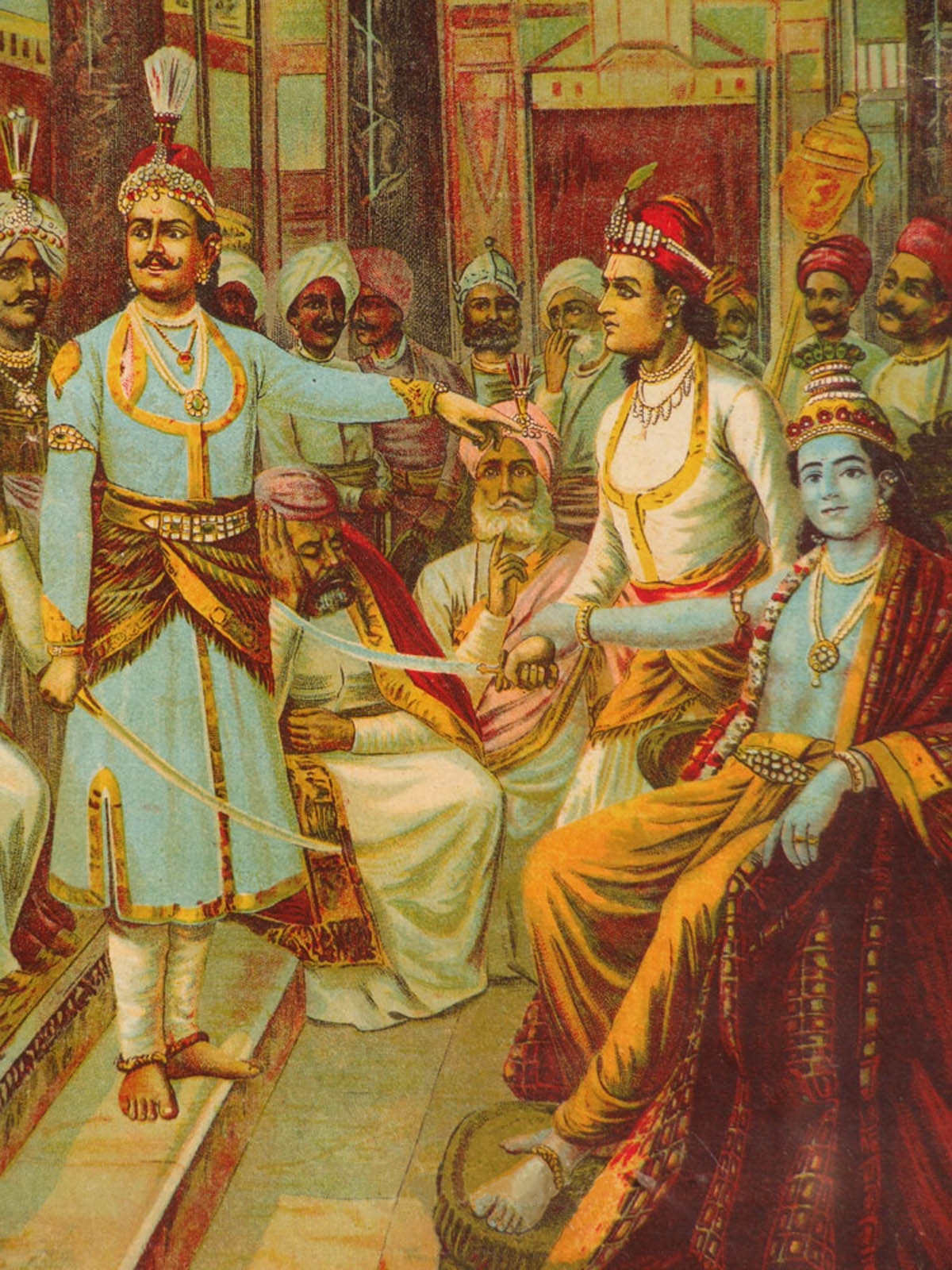
Krishna as envoy by Raja Ravi Varma;
Satyaki (dressed in white, standing near Krishna) is shown taking out his sword in response to the insults made by Duryodhana (left) to Krishna
Other namesYuyudhana
TextsMahabharata
Genealogy
Parents
  • Satyaka (father)
ChildrenJaya
DynastyYaduvamsha
Satyaki in Javanese Wayang (Javanese shadow puppet). The picture above is a puppet form of Satyaki and does not resemble the actual character.

Yuyudhana (Sanskrit: युयुधान, IAST: Yuyudhāna), better known as Satyaki (Sanskrit: सात्यकि, IAST: Sātyaki), was a powerful Yadava chieftain of Narayani Sena, belonging to the Vrishni clan to which Krishna also belonged.[1] According to the Puranas, he was the grandson of Shini of the Vrishni clan, and son of Satyaka, after whom he was named.[2] A valiant warrior, Satyaki was devoted to Krishna and was a student of Arjuna.[3]

Kurukshetra War

[edit]

Satyaki strongly and passionately favors the cause of the Pandavas over the Kauravas in the Kurukshetra War. Prior to the war, Satyaki accompanied Krishna to the Kuru capital, with Krishna as the Pandavas' emissary of peace. He is a witness to Duryodhana's attempt to arrest Krishna and Krishna's Vishwaroopa form, though he is not mentioned as one of the few persons not blinded by the apparation. After talks break down, Satyaki leads the Sivi and Vrishni army to the Pandava's camp. While Satyaki, along with others like Chekitana and Syenajita joins the Pandavas, Krishna promises his army to Duryodhana. Hence, Yadavas sworn directly to Dwarka like Kritvarma fight for the Kauravas, meaning Satyaki has to fight his kinsmen in the war. He provides 1 Akshauhini army to the Pandavas. According to Bhishma, he is capable of fighting 12 Atirathis alone.[citation needed]

During the war, Satyaki is the commander of one akshauhini of the Pandava army.

2nd day

[edit]

On the 2nd day of the war, Satyaki fought with Shakuni. Shakuni gave him a fierce battle. But Satyaki defeated him.[citation needed]

14th day

[edit]

The fourteenth day of the battle features Satyaki in a prominent role. With Arjuna attempting to pierce Drona's formation in order to fulfill his oath of killing Jayadratha, Satyaki defends Yudhishthira from Drona, who was attempting to capture the emperor in Arjuna's absence. Rescuing Dhristadyumna from Drona, Satyaki engages in a long fight with Drona, taking up the morning's fight. Drona gets so frustrated by Satyaki, that he even uses divine weapons, which Satyaki counters using his knowledge of divine weapons from his education under Arjuna. Eventually, Satyaki tires, and he is wounded by Drona's arrows. He is rescued by a new attack from the Upapandavas. Ultimately, Satyaki manages to stall Drona long enough that Duryodhana, frustrated with Drona's lack of progress, withdraws Drona to focus on the conflict with Arjuna.[citation needed]

Later in the day, Yudhishthira gets worried for Arjuna's safety. Despite his protests that protecting the king is more important, Satyaki is ordered to find and aid Arjuna. At the entrance to the Padmavyuha, he meets Drona. Knowing that he cannot bypass the sage, he circumvents him, telling Drona that he must duplicate the actions of his guru (as Arjuna had declined to fight Drona at the start of the day).[citation needed]

Conflict with Bhurisrava

[edit]

As Arjuna is being attacked from multiple sides, Satyaki appears to give aid. Satyaki fights an intense battle with archrival, Bhurisravas with whom he had a long-standing family feud, following from when Satyaki's grandfather defeated Bhurishrava's father. After a long and bloody battle, Satyaki, already exhausted from fighting Drona, begins to falter, and Bhurisravas pummels him and drags him across the battlefield. Raising his sword, Bhurisravas prepares to kill Satyaki, but he is rescued from death by Arjuna, who shoots an arrow severing Bhurisravas's arm. When criticized by Bhurisravas for interfering in the fight without warning. Bhurisravas lays out his weapons and sits down in meditation. Satyaki then emerges from his swoon and swiftly decapitates his enemy. He is condemned for this rash act, but Satyaki states that the moment Bhurisravas struck his semiconscious body, he had sworn that he would kill Bhurisravas. With the day's battle nearly over and Jayadratha still far away, the debate on the morality of Satyaki's actions is shelved.[4]

Night War

[edit]

When the battle on the fourteenth day continued into the night killed Bhurisravas's father Somadatta, later assisting Bhima slay Somadatta's father, Bahlika.[citation needed]

Yadava Warrior

[edit]
Krishna as envoy to the Kaurava court before Kurukshetra war. Satyaki takes out his sword when the Kauravas, raise their sword against Krishna, while Krishna holds his hand.

In the Kurukshetra war, Satyaki and Kritavarma were two important Yadava heroes who fought on the opposing sides. Satyaki fought on the side of the Pandavas, whereas Kritavarma joined the Kauravas. Satyaki is also noted as an Ayurvedic physician who was an expert in Shalya (surgery) and Shalakya (Eye/ENT). He is mentioned by Dalhana in Timir and Annantvat (Sushruta Uttartantra) and by Chakrapani in Netraroga (Charak). Some Mahabharat text says that during Mausala Parva, Satyaki killed Kritavarma by beheading him.[citation needed]

Death

[edit]

After the Kurukshetra war, Gandhari curses Krishna that his clan will be destroyed 36 years later in a fratricidal massacre.

During the 36th year, the Yadavas retire to Prabhāsa where they are allotted temporary residences and start reveling and drinking. Inebriated, Satyaki laughs at and taunts Kritavarma for his actions on the night of the 18th day of battle. As others agree with Satyaki, Kritavarma becomes enraged and lambasts Satyaki for slaying Bhurishravas in cold blood. Countering this, Satyaki narrates the story of Kritavarma plotting to kill Devaki's father. Warriors start taking sides depending on who their clans had fought for during the war; wine flows and tempers flare. Enraged, Satyaki gets up from the ground, and to his shock he discovers that the grass he pulls up from his clenched hands has turned into weapons (thanks to a rishi's curse). Red-faced, Satyaki decapitates Kritavarma and begins assaulting the warriors who are on Kritavarma's side. The Bhojas and the Andhakas, incensed and drunk, surround Satyaki as Krishna comes to his aid. However, knowing the character of the hour, Krishna stands aside. The Bhojas and Andhakas pull their own weapons from the ground and advance towards Satyaki.

Satyaki's allies, like Pradyumna rush to his defense. In the end, Satyaki lies dead, as do all the Vrishini warriors.

Descendants

[edit]

In other versions, Satyaki has a single son Asanga with one mentioned grandson Yugandhara.[2] Yugandhara later became the ruler of the territory near the Sarasvati River.[5] There is also mention of two granddaughters Satyaki's hopes to marry into the Pandava's family.

The latter day Yaudheyas claimed themselves as sons of Dharmaraja and nephews of Arjun and claimed descent either through son of Satyaki or through the son of Yudhishthira, Yaudheya (mentioned in Matsaya Purana).[citation needed]

See also

[edit]

References

[edit]
[edit]
Revisions and contributorsEdit on WikipediaRead on Wikipedia
from Grokipedia
Satyaki, also known as Yuyudhana, was a renowned Yadava warrior from the Vrishni clan in the ancient Indian epic Mahabharata, celebrated for his exceptional archery prowess and unwavering loyalty to Krishna and the Pandavas. The son of Satyaka and grandson of Shini, he was regarded as an incarnation of one of the Maruts, embodying the qualities of sure aim and as an opposer of foes while upholding the pride of his race. Trained in the art of warfare by Arjuna, whom he considered a guru, Satyaki emerged as one of the most formidable combatants, equal in skill to the greatest heroes of his time. As a staunch ally of the , Satyaki played a pivotal role in the , serving as a supreme chariot-warrior known as an atirathi and commanding divisions of the army under . He engaged in numerous intense duels, routing forces and protecting key leaders, including a fierce confrontation with Bhurisravas, whom he ultimately slew after the latter had been incapacitated by Arjuna's arrow during a moment of meditation. His valor extended to defending Dwaraka and against aggressors, solidifying his reputation as a defender of . In the aftermath of the , Satyaki's life ended tragically 36 years later, amid the -induced fratricidal strife among the at Prabhasa. Enraged by past grievances from the , he beheaded his fellow Kritavarma before being overwhelmed and killed by enraged and warriors wielding clubs. This event marked the fulfillment of Gandhari's on Krishna's kin, leading to the clan's near-total annihilation and the eventual submersion of Dwaraka.

Background

Lineage and Family

Satyaki, also known as Yuyudhana, was a prominent warrior born as the son of Satyaka, a key figure in the sub-clan renowned for his leadership within the Yadava lineage. Satyaka himself descended from Shini (also spelled Śini), a valiant Yadava who had famously defeated Somadatta in battle, establishing the family's martial heritage; thus, Satyaki was Shini's grandson. This paternal line traces back through Yudhājit to the progenitor Yadu, son of Yayāti, forming the foundational ancestry of the entire clan as detailed in ancient genealogies. Within the Yadava structure, 's immediate family positioned him as a direct heir to influential chieftains, with no prominent siblings explicitly noted in the primary accounts, emphasizing his singular role as a leading scion. His father Satyaka served as a chieftain, upholding the clan's traditions of and warfare in Dwaraka, which elevated the family's status among the . Satyaki shared a close with Krishna as a within the Vrishni branch, both descending from the common ancestor Kroṣṭā—their great-great-grandfather—making Satyaki a devoted relative and ally in familial and political matters. This hereditary connection from Yadu underscored Satyaki's high standing, as he emerged as a chieftain who commanded respect and mobilized forces, reflecting the clan's collective prowess.

Training and Warrior Skills

Satyaki, known as Yuyudhana in the epic, underwent rigorous training in the under , the preceptor to the Kuru princes, where he honed his skills in , the use of astras (divine missiles), and strategic combat tactics alongside the . This education emphasized rapid mastery of weaponry, enabling him to become a formidable proficient in both offensive and defensive maneuvers. Following his foundational training with , Satyaki became a disciple of , the unparalleled archer of the , under whom he advanced his expertise in and warfare techniques, including the invocation of celestial weapons akin to those wielded with the bow. This mentorship focused on precision shooting, chariot-based combat, and the strategic deployment of divine astras, elevating Satyaki's prowess to rival the elite warriors of his time. Satyaki earned a reputation as one of the foremost archers in the Mahabharata era, often praised for his dueling skills and mastery of chariot warfare; his feats included deft maneuvers in high-stakes duels, where he demonstrated exceptional accuracy and resilience, solidifying his status among the maharathis (great chariot warriors). In addition to his martial talents, some Puranic traditions attribute to Satyaki expertise in , particularly in Shalakya tantra (specializing in eye and ENT care), as referenced in the 12th-century commentary by Dalhana on the , where he is cited as an authority on this branch. This secondary skill underscores his multifaceted role in ancient narratives, blending warrior valor with medical knowledge in select textual lineages.

Participation in the Kurukshetra War

Support for the Pandavas

Satyaki demonstrated his unwavering commitment to the Pandava cause by assembling and leading one —a full army division consisting of 21,870 chariots, 21,870 elephants, 65,610 , and 109,350 —from the clans to join their forces at Upaplavya, significantly strengthening Yudhishthira's coalition despite the broader neutrality of the and Andhakas under Balarama's influence. In a key diplomatic effort, Satyaki accompanied Krishna during his peace mission to , where he actively rallied support among the Yadavas for the and voiced strong opposition to any alliances with the Kauravas, particularly protesting Duryodhana's belligerent stance and attempt to detain Krishna by preparing to draw his sword in defense. During the initial stages of the , Satyaki positioned his under Arjuna's command, contributing to the ' strategic formations and providing crucial protection to figures like amid the opening skirmishes, thereby ensuring the cohesion of the Pandava front lines. Guided by his profound devotion to Krishna, Satyaki adhered strictly to by siding against fellow s such as , who commanded the pro- contingent, emphasizing righteousness and loyalty to the over familial ties within the clan.

Major Engagements

On the second day of the , Satyaki contributed to the victory by engaging and defeating the forces under Shakuni's command, utilizing superior archery to repel their advances and disrupt momentum. During the fourteenth day, Satyaki played a crucial role in stalling Drona's aggressive offensive by confronting him directly in a prolonged duel, thereby protecting the flanks. His efforts involved breaking multiple enemy bows and maintaining defensive lines against Drona's assaults. Satyaki frequently countered prominent commanders, including and Ashwatthama, through intense chariot duels and effective leadership of infantry units. In clashes with , he demonstrated tactical skill by severing incoming shafts and retaliating with volleys of arrows that pierced his opponent, often forcing temporary retreats. Against Ashwatthama, Satyaki severed his bow and standard, inflicted deep wounds with thirty arrows, and fragmented his chariot, compelling a withdrawal while sustaining his own forces. Throughout these engagements, Satyaki exhibited remarkable resilience, recovering from severe wounds—such as multiple arrow piercings—to preserve formation integrity and continue commanding troops effectively.

Duel with Bhurisravas

During the intense engagements of the fourteenth day of the , Satyaki, a prominent warrior allied with the , intervened to rescue his mentor from the advancing Kuru forces led by Bhurisravas. This act of loyalty drew Satyaki into a fierce personal with Bhurisravas, son of Somadatta, escalating their longstanding familial enmity rooted in ancient Yadava-Bhoja conflicts. The rivalry traced back to an incident at Devaki's swayamvara, where Satyaki's grandfather Sini defeated Somadatta in a fierce to claim the , prompting Somadatta to seek a boon from Mahadeva () that his son Bhurisravas would one day vanquish and humiliate Sini's grandson in battle. The duel commenced with a prolonged exchange of , showcasing both warriors' exceptional skills, but Bhurisravas gradually gained the upper hand, overpowering the fatigued Satyaki after he had battled numerous foes earlier that day. In a critical moment, Bhurisravas pinned Satyaki down, preparing to deliver a fatal strike, while earlier in the war Bhurisravas had also slain ten of Satyaki's sons, fueling the hero's rage. As Satyaki teetered on the brink of defeat, , observing from afar, intervened with a precise that severed Bhurisravas' bow arm, adhering to the tactical necessities of the chaotic battlefield but violating the codes of fair combat. Enraged by Arjuna's "unfair" diversion, Bhurisravas castigated him for breaching and, abandoning the fight, seated himself in —a solemn vow of unto death through yogic —to preserve his honor. Despite urgent pleas from Krishna, , and other allies warning that slaying an opponent in such a state contravened righteous conduct, Satyaki, driven by the weight of their ancestral curse and personal losses, rushed forward and beheaded Bhurisravas with his sword. This climactic act sparked immediate ethical debate among the warriors, with many condemning Satyaki for desecrating the vow, though others justified it as destiny's fulfillment or retaliation for prior transgressions, such as the unfair killing of . In the aftermath, Satyaki expressed profound over his actions, acknowledging the moral ambiguity of the kill, while Bhurisravas' severed head, before falling to the ground, praised Satyaki's unparalleled valor and prowess, affirming that the Yadava warrior had indeed lived up to his lineage's fierce reputation. Bhurisravas' spirit then ascended to the higher realms, lauded for his adherence to even in defeat, leaving the incident as a poignant reflection on the blurred lines between duty, revenge, and honor in the epic's warfare.

Role in the Night Battle

During the tumultuous night battle that extended the 14th day of the into darkness, Satyaki, still fatigued from his earlier with Bhurisravas but driven by a thirst for vengeance, pursued and confronted Somadatta, the slain warrior's father, amid the confusion of combat. In a fierce exchange, Satyaki showered Somadatta with s, severing his bow and afflicting him repeatedly, while supported the effort by striking Somadatta's head with a massive parigha. The combined assault culminated in Satyaki's fatal shot—a keen, gold-decked that pierced Somadatta's chest—felling the veteran warrior and avenging the day's earlier losses for the . Satyaki's contributions extended to coordinating with Bhima and other Pandava allies in the slaying of Bahlika, Somadatta's aged father and a key Kaurava commander, employing night-adapted tactics to exploit the shadows. As the battle raged under torchlight, with Pandava chariots bearing ten lamps each to outshine the Kauravas' five, Satyaki and his comrades used precise to target Bahlika, weakening his defenses before Bhima delivered the killing blow with a mace to the head, fulfilling the elder's request for an honorable death at the hands of a worthy foe. Navigating the night's pandemonium, where Rakshasa forces under unleashed illusions to disorient enemies, Satyaki survived multiple ambushes orchestrated by Ashwatthama, who led counterattacks with deceptive maneuvers. He deftly countered these threats while shielding from encroaching remnants, repelling advances by and others to safeguard the king amid the slaughter. Satyaki further employed illusionary astras, creating phantom warriors and misleading volleys to sow confusion among the beleaguered forces, thereby bolstering gains in the massacre.

Later Years and Demise

Conflicts within the Yadava Clan

Following the , the clan experienced a 36-year period of relative peace and prosperity under Krishna's leadership in Dwaraka, yet latent divisions from the conflict simmered among its members. This opposition stemmed from their wartime enmity, where Satyaki had fiercely engaged on the battlefield. In councils during this era, Satyaki advocated staunchly for the exemplified by the , condemning the adharmic actions of supporters like , which exacerbated tensions and underscored ideological divides over righteousness and loyalty. The prelude to the clan's catastrophic downfall unfolded at a gathering in Prabhasa, where, amid drunken revelry, Satyaki taunted over his complicity in the night-time slaughter of sleeping allies. Enraged, Satyaki declared, "I swear to thee by Truth that I shall soon cause this one to follow in the wake of the five sons of , and of and —they that were slain by this sinful wretch, while they were asleep," directly invoking these fratricidal sparks that ignited broader clan violence. retaliated by mocking Satyaki's own wartime slaying of the disarmed , further polarizing the assembly and exposing the unresolved grudges from .

Death at Prabhasa

Thirty-six years after the , the Yadavas, including the and Andhakas, gathered at Prabhasa Thirtha for a to , as foretold by ominous signs that Krishna recognized as fulfilling Gandhari's earlier on his clan for the destruction of her sons. During the revelry involving heavy drinking, tensions erupted into a fratricidal quarrel when Satyaki accused of the ignoble act of slaying sleeping warriors during the war, reviving their long-standing enmity. Enraged, Satyaki drew his sword and beheaded in the presence of Krishna, igniting a chaotic brawl among the clans. The Bhojas and Andhakas, outraged by Satyaki's act, surrounded and attacked him with whatever weapons they could seize. , Krishna's son, rushed to Satyaki's aid, engaging the assailants fiercely, but the two warriors were overwhelmed by superior numbers in the ensuing melee. Exhausted from the initial clash and the frenzied assault, Satyaki and were ultimately slain by the Bhojas and Andhakas. Krishna, witnessing the slaughter, remained inactive as the prophecy of the Yadavas' doom unfolded, though he later joined in rage, taking handfuls of eraka grass that transformed into iron bolts due to a from offended Brahmanas, slaying many attackers. This tragic demise of Satyaki symbolized the irreversible decline of the dynasty, as the spread, leading to the near-total annihilation of the clan through the cursed grass-turned-bolts. In the aftermath, the surviving Yadavas, including Krishna, performed honorable cremations for the fallen, including Satyaki, on the shores of Prabhasa.

Legacy

Descendants and Kingdom

Satyaki, also known as Yuyudhana, had a son named according to accounts in the Harivamsha Purana. is described as the father of , who in turn begat Yugandhara, marking the continuation of the Saineya branch of the lineage descending from Sini through Satyaka and Satyaki. This underscores the familial line persisting beyond the events of the and the subsequent Yadava conflicts at Prabhasa, where Satyaki himself perished. Yugandhara, as Satyaki's grandson, represents the endpoint of this recorded lineage in the Harivamsha, with traditions indicating his rule over territories near the Sarasvati River in post- times. This establishment reflects the continuity of Yadava warrior heritage amid the clan's broader dispersal and decline, leading to minor principalities that preserved martial traditions in ancient northern . Later historical claims among martial tribes, such as the Yaudheyas of southeastern and , trace their origins to descendants, including through Satyaki's line. These groups maintained republican structures and warrior ethos, linking back to the epic-era Yadavas and emphasizing Satyaki's enduring influence on regional polities.

Significance in Hindu Epics and Culture

Satyaki embodies the principles of through his unwavering loyalty to his mentors and Krishna, as well as his commitment to justice by aligning with the against their kin, the Kauravas, serving as an exemplar of righteous warfare in the epic tradition. His devotion is highlighted in the , where he risks personal ties within the Yadava clan to uphold moral duty, prioritizing the greater good over familial bonds. This portrayal underscores the ideal of fighting for righteousness, even when it demands confronting relatives, positioning Satyaki as a model for ethical conduct amid conflict. In literary depictions, Satyaki features prominently in key Mahabharata episodes, such as the intense debate surrounding his slaying of Bhurisravas, which raises questions about the boundaries of honor and intervention in battle. The episode, detailed in the , illustrates moral ambiguity as Satyaki justifies his act by invoking a prior vow and the Kauravas' past aggressions, while critics view it as a violation of warrior codes. In the , he appears in minor roles that emphasize his valor and heritage, reinforcing his image as a formidable ally in divine narratives. Additionally, the Natyashastra references him in contexts of heroic sentiment, portraying his exploits as archetypal displays of bravery in dramatic arts. Satyaki's cultural impact manifests as a symbol of pride in regional , where tales of his exploits celebrate the clan's legacy and resilience. In Vaishnava traditions, he is revered as a devoted follower of Krishna, influencing devotional and associated with Yadava sites. Modern adaptations, such as B.R. Chopra's 1988 television series Mahabharat, depict him as a steadfast , extending his symbolic role to contemporary Indian media and reinforcing themes of in . Philosophically, Satyaki's narrative illustrates the consequences of curses and , as seen in the Yadava clan's downfall at Prabhasa, which sparks broader discussions on fate versus in . His involvement in the post-war conflicts exemplifies how personal loyalties can precipitate tragic outcomes ordained by divine curses, highlighting the interplay between human agency and in epic . This aspect influences interpretations in later Hindu literature, where his story serves as a on the perils of unchecked valor and internal discord.

References

Add your contribution
Related Hubs
User Avatar
No comments yet.