Recent from talks
Nothing was collected or created yet.
Seismic source
View on Wikipedia
A seismic source is a device that generates controlled seismic energy used to perform both reflection and refraction seismic surveys. A seismic source can be simple, such as dynamite, or it can use more sophisticated technology, such as a specialized air gun. Seismic sources can provide single pulses or continuous sweeps of energy, generating seismic waves, which travel through a medium such as water or layers of rocks. Some of the waves then reflect and refract and are recorded by receivers, such as geophones or hydrophones.[1]
Seismic sources may be used to investigate shallow subsoil structure, for engineering site characterization, or to study deeper structures, either in the search for petroleum and mineral deposits, or to map subsurface faults or for other scientific investigations. The returning signals from the sources are detected by seismic sensors (geophones or hydrophones) in known locations relative to the position of the source. The recorded signals are then subjected to specialist processing and interpretation to yield comprehensible information about the subsurface.[2]
Source model
[edit]A seismic source signal has the following characteristics:
- Generates an impulse signal
- Band-limited
- The generated waves are time-varying
The generalized equation that shows all above properties is:
where is the maximum frequency component of the generated waveform.[3]
Types of sources
[edit]Sledgehammer
[edit]The most basic seismic source is a sledgehammer. A seismic energy is generated either by striking the ground directly, or more commonly striking a metal or polyethylene plate on the ground. Typically applied for near-surface seismic refraction surveys. Impact of sledgehammer contact with the surface can provide sufficient seismic energy for interface depths up to 30 m or more, depending on geological conditions and physical properties.[4]
Explosives
[edit]Explosives most widely used as seismic sources are known as gelatin dynamites. These dynamites are placed into three subcategories, straight gelatins in which nitroglycerin, also known as glyceryl trinitrate with the chemical formula C3H5(ONO2)3 is the active component, ammonia gelatins in which ammonia nitrite with chemical formula NH4NO3 as the active component, and semi gelatins in which the composition consists mostly of nitroglycerin.[5]
Upon detonation, explosives release large volumes of expanding gas very quickly,[6] forcing great pressure to the surroundings in the form of seismic waves.[citation needed]
Using explosives as seismic sources has been in practice for decades because of the reliability and energy efficiency they provide.[7] Such sources are most commonly used on land and swampy environments because of high thickness in sediments.[citation needed] Typical charge sizes used in the field for reflection surveys are 0.25 kg to 100 kg for single hole sources, 0.25 kg to 250 kg or more for multiple hole sources, and may reach 2500 kg or more for refraction surveys.[5]
Though dynamites and other explosives are efficient seismic sources because of their reduced costs, ease of transport in difficult terrains, and lack of regular maintenance compared to other sources,[8] the use of explosives is becoming restricted in certain areas, causing decline and increasing popularity for alternative seismic sources.[7]
For instance, hexanitrostilbene was the main explosive fill in the thumper mortar round canisters used as part of the Apollo Lunar Active Seismic Experiments.[9] Generally, the explosive charges are placed between 6 and 76 metres (20 and 250 ft) below ground, in a hole that is drilled with dedicated drilling equipment for this purpose. This type of seismic drilling is often referred to as "Shot Hole Drilling". A common drill rig used for "Shot Hole Drilling" is the ARDCO C-1000 drill mounted on an ARDCO K 4X4 buggy. These drill rigs often use water or air to assist the drilling.
Air gun
[edit]

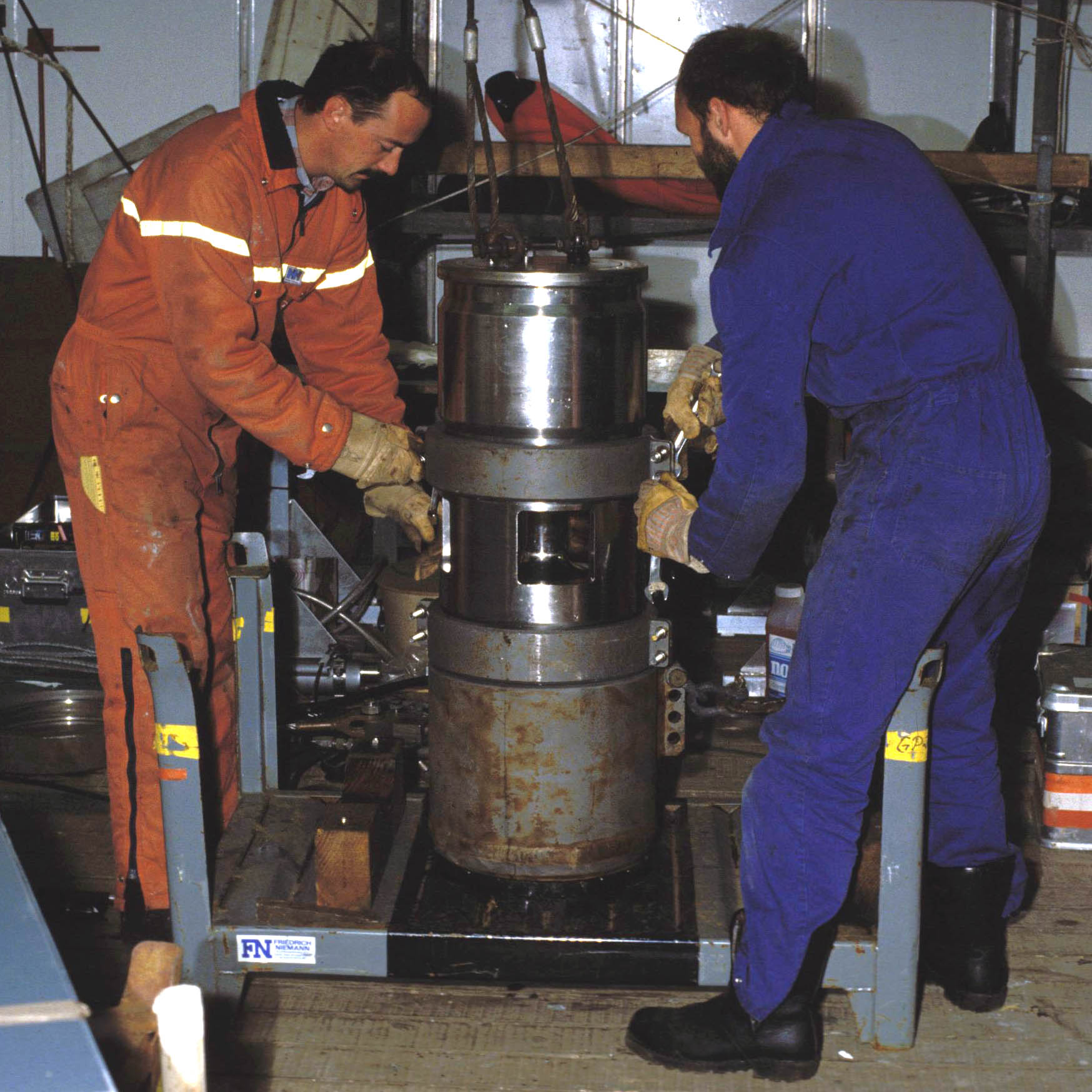
An air gun is used for marine reflection and refraction surveys. It consists of one or more pneumatic chambers that are pressurized with compressed air at pressures from 14 to 21 MPa (2000 to 3000 lbf/in2). Air guns are submerged below the water surface and towed behind a seismic ship. When an air gun is fired, a solenoid is triggered that releases high pressure air from one chamber to the back of a shuttle that is normally held in balance between the two equally pressurised chambers. The instant lowering of air pressure in the first chamber allows the shuttle to move rapidly into the first chamber, releasing a high pressure air reservoir that is behind the shuttle in the second chamber through ports directly into the sea producing a pulse of acoustic energy.[10] Air gun arrays may consist of up to 48 individual air guns with different size chambers or certain air guns volumes may be clustered together. The firing of all of the array is controlled by gun controller and is usually done to within a ± 1 or 2 millisecond tolerance, the aim being to create the optimum initial shock wave followed by the minimum reverberation of the air bubble(s). Since the shuttle is magnetised, the rapid movement into the first chamber on releasing the solenoid value provides a small current that is in effect a timing signal for the firing gun that is returned to the gun controller. A near-field hydrophone located at a known measured distance from the gun port can also be used to time the first break signal into the hydrophone for accurate gun timing verification.
Air gun maintenance is important as guns can misfire; the worst case scenario being an auto-fire where the gun actually fires repeatedly out of synch because of a defect in the gun itself such as a damaged solenoid valve or a leaking gun O-ring. A single auto-firing gun can result in the total array bubble signature becoming corrupted and if undetected, can result in many seismic lines being re-shot just for one auto-firing gun when the fault is found during initial data processing.
During normal handling for deployment and recovery, air guns must never be fully pressurised to their optimum working pressure on deck and it is normal practice to air down guns to 500 psi to prevent water ingress on deployment and recovery. It is also a poor and dangerous practice to test fire guns on deck in the air at pressure. There must also be an isolation system in place to prevent the accidental firing of guns on deck by observers or navigators by mistake. High pressure air releases on deck can amputate fingers and also result in a high pressure injection injury through the skin, an almost untreatable and deadly injury in a seismic environment. Gunners should wear the required personal protective equipment to protect their eyes and their hearing and minimise exposure of uncovered skin.
Air guns are made from the highest grades of corrosion resistant stainless steel. Large chambers (i.e., greater than 1 L or 70 cu in) tend to give low frequency signals, and the small chambers (less than 1 L) give higher frequency signals.
Plasma sound source
[edit]
A plasma sound source (PSS), otherwise called a spark gap sound source, or simply a sparker, is a means of making a very low frequency sonar pulse underwater. For each firing, electric charge is stored in a large high-voltage bank of capacitors, and then released in an arc across electrodes in the water. The underwater spark discharge produces a high-pressure plasma and vapor bubble, which expands and collapses, making a loud sound.[11] Most of the sound produced is between 20 and 200 Hz, useful for both seismic and sonar applications[citation needed].
There are also plans to use PSS as a non-lethal weapon against submerged divers[citation needed].
Thumper truck
[edit]
In 1953, the weight dropping thumper technique was introduced as an alternative to dynamite sources.


A thumper truck (or weight-drop) truck is a vehicle-mounted ground impact system that can be used to provide a seismic source. A heavy weight is raised by a hoist at the back of the truck and dropped, generally about three meters, to impact (or "thump") the ground.[12] To augment the signal, the weight may be dropped more than once at the same spot, the signal may also be increased by thumping at several nearby places in an array whose dimensions may be chosen to enhance the seismic signal by spatial filtering.
More advanced thumpers use a technology called "Accelerated Weight Drop" (AWD), where a high pressure gas (min 7 MPa (1000 lbf/in2)) is used to accelerate a heavy weight hammer (5,000 kg (11,000 lb)) to hit a base plate coupled to the ground from a distance of 2 to 3 metres (6 ft 7 in to 9 ft 10 in). Several thumps are stacked to enhance signal to noise ratio. AWD allows both more energy and more control of the source than gravitational weight-drop, providing better depth penetration, control of signal frequency content.
Thumping may be less damaging to the environment than firing explosives in shot-holes,[13][citation needed] though a heavily thumped seismic line with transverse ridges every few meters might create long-lasting disturbance of the soil. An advantage of the thumper (later shared with Vibroseis), especially in politically unstable areas, is that no explosives are required.
Electromagnetic Pulse Energy Source (Non-Explosive)
[edit]EMP sources based on the electrodynamic and electromagnetic principles.
Seismic vibrator
[edit]A seismic vibrator propagates energy signals into the Earth over an extended period of time as opposed to the near instantaneous energy provided by impulsive sources. The data recorded in this way must be correlated to convert the extended source signal into an impulse. The source signal using this method was originally generated by a servo-controlled hydraulic vibrator or shaker unit mounted on a mobile base unit, but electro-mechanical versions have also been developed.
The "Vibroseis" exploration technique was developed by the Continental Oil Company (Conoco) during the 1950s and was a trademark until the company's patent lapsed.
Boomer sources
[edit]Boomer sound sources are used for shallow water seismic surveys, mostly for engineering survey applications. Boomers are towed in a floating sled behind a survey vessel. Similar to the plasma source, a boomer source stores energy in capacitors, but it discharges through a flat spiral coil instead of generating a spark. A copper plate adjacent to the coil flexes away from the coil as the capacitors are discharged. This flexing is transmitted into the water as the seismic pulse.[14]
Originally the storage capacitors were placed in a steel container (the bang box) on the survey vessel. The high voltages used, typically 3,000 V, required heavy cables and strong safety containers. Recently, low voltage boomers have become available.[15] These use capacitors on the towed sled, allowing efficient energy recovery, lower voltage power supplies and lighter cables. The low voltage systems are generally easier to deploy and have fewer safety concerns.
Noise sources
[edit]Correlation-based processing techniques also enable seismologists to image the interior of the Earth at multiple scales using natural (e.g., the oceanic microseism) or artificial (e.g., urban) background noise as a seismic source.[16] For example, under ideal conditions of uniform seismic illumination, the correlation of the noise signals between two seismographs provides an estimate of the bidirectional seismic impulse response.
See also
[edit]References
[edit]- ^ R.E. Sheriff (2002) p160 & p 182
- ^ R.E. Sheriff (2002) p312
- ^ Seismic Wave Propagation Modeling and Inversion, Phil Bording Archived 2008-02-08 at the Wayback Machine
- ^ Reynolds, John M. (2011). An introduction to applied and environmental geophysics (2nd ed.). Chichester, West Sussex: Wiley-Blackwell. pp. 155–156. ISBN 978-0-471-48535-3.
- ^ a b Stark, Andreas (2010). Seismic Methods and Applications. Universal-Publishers. pp. 177–178. ISBN 978-1-59942-443-9.
- ^ "Explosive | chemical product". Encyclopedia Britannica. Retrieved 2018-10-09.
- ^ a b Yordkayhun, Sawasdee; Ivanova, Alexandra; Giese, Rüdiger; Juhlin, Christopher; Cosma, Calin (January 2009). "Comparison of surface seismic sources at the CO2SINK site, Ketzin, Germany". Geophysical Prospecting. 57 (1): 125–139. Bibcode:2009GeopP..57..125Y. doi:10.1111/j.1365-2478.2008.00737.x. ISSN 0016-8025. S2CID 55497365.
- ^ Strobbia, C.; Vermeer, P.; Glushchenko, A.; Laake, A. (2009-06-08). Advances in surface-wave processing for nearsurface characterisation in land seismic. Netherlands: EAGE Publications BV. doi:10.3997/2214-4609.201404894. ISBN 978-94-6282-103-3.
{{cite book}}:|journal=ignored (help) - ^ NASA reference publication
- ^ R.E. Sheriff (2002) p6-8
- ^ R.E. Sheriff (2002) p328
- ^ R.E. Sheriff (2002) p357
- ^ Chinenyeze, Madu. "Types of Seismic Energy Sources for Petroleum Exploration in Desert, Dry-Land, Swamp and Marine Environments in Nigeria and Other Sub-Saharan Africa". International Journal of Science and Research. 6.
- ^ Sheriff R. E., 1991, Encyclopedic Dictionary of Exploration Geophysics, Society of Exploration Geophysicists, Tulsa, 376p
- ^ Jopling J. M., Forster P. D., Holland D. C. and Hale R. E., 2004, Low Voltage Seismic Sound Source, US Patent No 6771565
- ^ R.E. Sheriff (2002) p295
Bibliography
[edit]- Crawford, J. M., Doty, W. E. N. and Lee, M. R., 1960, Continuous signal seismograph: Geophysics, Society of Exploration Geophysicists, 25, 95–105.
- Robert E. Sheriff, Encyclopedic Dictionary of Applied Geophysics (Geophysical References No. 13) 4th Edition, 2002, 429 pag. ISBN 978-1560801184.
- Snieder, Roel (2004-04-29). "Extracting the Green's function from the correlation of coda waves: A derivation based on stationary phase". Physical Review E. 69 (4) 046610. American Physical Society (APS). Bibcode:2004PhRvE..69d6610S. doi:10.1103/physreve.69.046610. ISSN 1539-3755. PMID 15169121.
- Seismic Wave Propagation Modeling and Inversion, Phil Bording [1]
- Derivation of Seismic wave equation can be found here. [2]
External links
[edit]Seismic source
View on GrokipediaOverview
Definition and purpose
A seismic source is any natural or artificial mechanism that releases energy to generate elastic seismic waves that propagate through the Earth. In geophysical exploration, artificial sources are controlled devices or mechanisms designed to generate these waves, enabling reflection and refraction surveys.[7] These artificial sources differ fundamentally from natural seismic events like earthquakes, as they allow precise timing, location, and energy control to produce repeatable wave patterns for data acquisition.[1] The primary purpose of seismic sources is to image subsurface geological structures by sending acoustic signals into the Earth and recording their echoes or refractions at interfaces between rock layers. They are essential in applications such as hydrocarbon exploration, where they help delineate reservoirs, as well as in environmental assessments for groundwater mapping and in engineering geophysics for site characterization and hazard evaluation.[8][9] At a basic level, seismic sources release energy through mechanisms like sudden impacts, explosions, or vibrations, which induce elastic deformations in the surrounding medium—primarily compression for primary (P-)waves and shear for secondary (S-)waves. These waves travel as propagating vibrations, carrying energy outward from the source point and interacting with subsurface materials to provide insights into depth and composition.[10][11] Seismic sources are adapted for diverse environments, including land-based surveys using ground-impacting devices, marine operations employing underwater energy release, and transition zones in coastal or shallow-water areas that blend both approaches for continuous coverage.[12][13]Historical development
The development of seismic sources began in the early 20th century with pioneering acoustic experiments, building upon insights from natural seismic events studied since the 19th century. In the 1910s, Canadian inventor Reginald Fessenden conducted foundational tests using an underwater oscillator to measure seafloor depths and detect icebergs via echo ranging, achieving accurate soundings at speeds of 4,800 feet per second during trials aboard the U.S. Coast Guard cutter Miami in 1914.[14] These efforts laid the groundwork for controlled sonic signaling, though initially focused on navigation rather than geophysical exploration. By the 1920s, dynamite emerged as the primary seismic source for petroleum prospecting, revolutionizing oil exploration through refraction seismology. In 1924, a crew from the Seismos company, founded by German geophysicist Ludger Mintrop, was contracted by Gulf Oil to map shallow salt domes in Texas using dynamite charges to generate seismic waves, marking one of the earliest commercial applications in North American oilfields.[15] This explosive method dominated land-based surveys into the mid-20th century, enabling deeper penetration for structural imaging but posing safety and logistical challenges. In the 1930s, simpler non-explosive impact sources like sledgehammers were developed for shallow refraction surveys, offering portability for engineering and near-surface investigations without the need for drilling or permits required for dynamite. The 1940s and early 1950s saw the introduction of weight-drop devices, known as thumpers, which accelerated heavy masses onto the ground to produce repeatable seismic impulses suitable for shallow profiles, further reducing reliance on explosives. A major milestone came in the 1950s with the invention of the Vibroseis system by a team at Continental Oil Company (Conoco), including John Crawford, Bill Doty, and Milford Lee; this hydraulic vibrator generated swept-frequency signals via baseplate contact, patented and first field-tested around 1956, allowing controlled, high-resolution data acquisition without blasts.[16] Marine seismic sources advanced in the 1960s with the air gun, invented by Stephen Chelminski at Bolt Associates in the mid-1960s as a non-explosive alternative for offshore surveys.[17] By releasing compressed air to form expanding bubbles that generate acoustic pulses, air guns enabled efficient, repeatable profiling in challenging marine environments, quickly becoming the industry standard and replacing dynamite charges used in early subsea exploration. The 1970s oil boom accelerated adoption of these technologies, with the Society of Exploration Geophysicists (SEG) establishing key data standards like SEG-Y in 1975 to facilitate exchange and processing of records from diverse sources.[18] From the 1980s onward, environmental regulations and safety concerns drove a widespread shift from explosives to non-impulsive vibratory and air-gun sources on land and sea, minimizing habitat disruption and chemical residues while complying with emerging laws like the U.S. Clean Water Act amendments.[18] SEG contributed to international guidelines post-1970s, including environmental best practices for source operations through its Technical Standards Committee, promoting sustainable survey designs. In the 2010s, innovative low-impact alternatives emerged, such as electromagnetic impulsive sources that use synchronized magnetic pulses for wave generation, reducing noise pollution and surface disturbance compared to traditional methods.[19] Plasma-based sources, leveraging spark discharges for compact, high-frequency impulses, also gained traction for environmentally sensitive areas, reflecting ongoing refinements toward greener exploration technologies.[20]Principles and Models
Wave generation mechanisms
Seismic sources generate elastic waves through various physical mechanisms that convert mechanical, chemical, or electrical energy into propagating disturbances in the subsurface. These mechanisms primarily involve sudden deformations or oscillations that excite the surrounding medium, leading to the radiation of seismic energy. The efficiency and characteristics of wave generation depend on the interaction between the source and the medium, governed by principles of elasticity and wave propagation in solids or fluids.[21] One fundamental mechanism is impact, where a sudden application of force creates an impulsive deformation, akin to a point force exciting the medium instantaneously. This process initiates wave propagation by abruptly displacing particles in the ground or water, resulting in a transient stress field that radiates outward. Impact mechanisms are characterized by their short-duration energy release, which effectively couples mechanical energy into the elastic medium through direct contact.[21] Pressure release represents another key mechanism, occurring when rapid expansion of gases or fluids from a confined volume generates a spherical wavefront. In this case, the detonation or expansion creates a high-pressure cavity that expands, displacing the surrounding material and converting chemical potential energy into kinetic and elastic energy. This isotropic expansion primarily drives radial particle motion, efficiently producing compressional waves in the near field before partitioning into other wave types.[22] Vibration mechanisms rely on harmonic or swept-frequency oscillations, where a controlled periodic motion induces sustained deformations in the medium. The oscillating force creates alternating compressions and rarefactions, generating waves through repeated cycles of energy input. This approach allows for tunable frequency output, with the amplitude of generated waves depending on the vibratory displacement and the resonance properties of the coupled medium.[23] Electromagnetic induction serves as an emerging mechanism, utilizing rapid changes in magnetic fields to induce mechanical motion via Lorentz forces or piezoelectric effects in conductive materials. A time-varying electromagnetic field accelerates charged particles or deforms the source element, transferring energy to the adjacent medium through frictional or direct coupling. This method enables precise control over the timing and polarity of the generated pulse, often producing cleaner waveforms with minimal mechanical wear.[24] The primary wave types produced by these mechanisms include compressional (P-waves), which arise from volumetric changes causing particle motion parallel to the propagation direction, and shear (S-waves), generated by tangential forces that induce perpendicular displacements. P-waves are excited by any mechanism involving dilation or compression, while S-waves require asymmetric or rotational components, such as from vectorial impacts or polarized vibrations. In the near field, surface waves like Rayleigh or Love waves can also form due to boundary interactions, though they are secondary to body waves in most source designs.[25] Energy transfer from the source to the propagating medium is governed by coupling efficiency, which measures the fraction of input energy converted into seismic waves rather than lost to heat or reflection. Coupling is influenced by the acoustic impedance mismatch between the source interface and the ground or water, where impedance (with as density and as wave velocity) determines transmission coefficients. Significant mismatches, such as between air-filled vibrators and soil, can reduce amplitudes by up to 90%, as reflected energy diminishes the downward propagating component; optimal coupling occurs when impedances are closely matched, enhancing wave amplitude and penetration depth. Frequency content of the generated waves varies with the source mechanism, spanning broadband spectra for impulsive actions versus narrowband for oscillatory ones. Short-duration pulses, as in impacts or pressure releases, produce high-frequency components due to the inverse relationship between pulse length and dominant frequency , yielding spectra rich in higher harmonics for better resolution in shallow surveys. In contrast, vibratory mechanisms generate controlled sweeps, allowing selective emphasis on low frequencies for deeper penetration, with the overall spectrum shaped by the duration and amplitude modulation of the oscillation.[26]Source modeling and signatures
Source modeling in seismology often begins with the point source approximation, which assumes an instantaneous and isotropic release of energy at a single point in a homogeneous medium. This simplification is particularly useful for far-field observations where the source dimensions are negligible compared to the wavelength and distance to receivers. Under this model, the far-field displacement from a scalar point source is given by where represents the source strength (a measure of the total energy released), is the distance from the source, is the wave propagation velocity, and is the Dirac delta function capturing the impulsive nature of the release.[27] This equation derives from the Green's function solution to the wave equation for an impulsive monopole source in three dimensions, highlighting the geometric spreading and time delay due to propagation.[27] The source signature refers to the time-series representation of the emitted seismic wavelet, which characterizes the temporal and spectral content of the energy output. In practice, signatures are distinguished between near-field (close to the source, including evanescent waves and higher-order terms) and far-field (dominated by propagating body waves, decaying as ). Near-field measurements, often recorded via hydrophones or geophones in close proximity, provide data for estimating the far-field signature through wavefield extrapolation techniques that account for bubble oscillations in marine sources or mechanical impulses on land.[28] Deconvolution methods are then applied to seismic data processing to remove the source signature effects, enhancing resolution by inverse-filtering the recorded traces with the estimated wavelet; this deterministic approach assumes a known or modeled signature and typically involves Wiener filtering or least-squares inversion in the frequency domain.[29] Extended source models address limitations of the ideal point source by incorporating finite duration and directivity, reflecting real sources with spatial extent or oriented radiation patterns. For instance, vibratory or explosive sources emit wavelets over a non-negligible time, leading to broader bandwidths and phase variations. A widely adopted idealization for bandpass-limited sources is the Ricker wavelet, which models a zero-phase, symmetric pulse with a dominant frequency; its time-domain form is where is the peak frequency determining the central lobe width and spectral taper. This wavelet arises as the second derivative of a Gaussian and approximates the response of damped oscillatory sources, aiding in synthetic modeling and inversion. Despite these advancements, source modeling faces challenges from medium properties such as attenuation, which causes frequency-dependent amplitude decay and phase shifts, and anisotropy, which introduces velocity variations with direction, complicating isotropic assumptions.[30] These effects distort the predicted signatures, particularly in heterogeneous subsurface environments. To mitigate uncertainties, real-time signature estimation employs pilot signals—direct measurements from near-field sensors during surveys—that are processed via inverse modeling or empirical corrections to derive far-field equivalents, enabling adaptive deconvolution.[31]Land-based Sources
Sledgehammer sources
Sledgehammer sources represent one of the simplest and most portable impulsive seismic sources employed in shallow land-based surveys. These sources generate seismic waves through the manual impact of a heavy hammer, typically weighing 5 to 10 kg, against a metal baseplate placed on the ground surface. The baseplate, often equipped with spikes or teeth for improved coupling to the soil, facilitates efficient transfer of kinetic energy into compressional (P-waves) and shear waves that propagate subsurface. This method has been utilized since the 1930s as part of early seismic refraction techniques for engineering and environmental applications.[32][33] In operation, an operator swings the sledgehammer to strike the baseplate vertically, producing a short-duration impulse with typical kinetic energies ranging from 50 to 500 J, depending on hammer mass and swing velocity. The resulting wavefield exhibits dominant frequencies between 10 and 200 Hz, with peaks often around 50-60 Hz, making it suitable for resolving shallow structures. To mitigate ambient noise and enhance signal quality, multiple impacts—commonly 5 to 15 stacked blows—are recorded simultaneously using geophones connected to a seismograph. This stacking process improves the signal-to-noise ratio without requiring complex equipment.[34][33] Sledgehammer sources offer several advantages, including low cost, high portability, and no need for permits or explosives handling, allowing rapid deployment in restricted or urban sites. They are particularly effective for engineering site investigations, such as mapping soil layers, water tables, and shallow bedrock in refraction surveys up to depths of 30-50 m. However, their limitations include low overall energy output, which restricts penetration beyond 50 m and performs poorly in thick unsaturated zones or noisy environments, often leading to operator fatigue from repeated strikes.[34][35]| Aspect | Details |
|---|---|
| Components | Hammer (5-10 kg), spiked baseplate, geophones (8-10 Hz natural frequency) |
| Energy Output | 50-500 J per impact |
| Frequency Range | 10-200 Hz (dominant 50-60 Hz) |
| Stacking | 5-15 blows for signal enhancement |
| Depth Capability | Up to 50 m in favorable conditions |
