Hubbry Logo
SkufiaSkufiaMain
Open search
Skufia
Community hub
Skufia
logo
8 pages, 0 posts
0 subscribers
Be the first to start a discussion here.
Skufia
Skufia
from Wikipedia

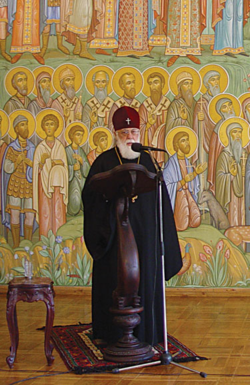
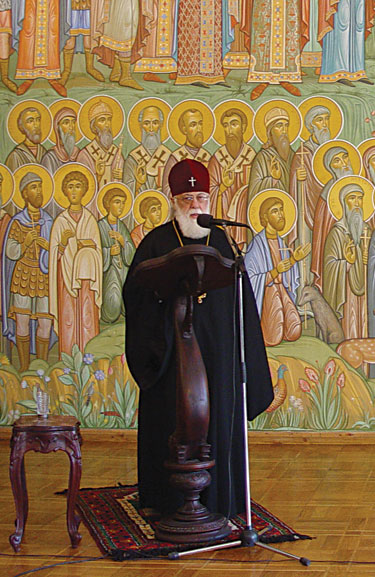
Catholicos-Patriarch Ilia II of the Georgian Orthodox and Apostolic Church, wearing a Russian-style skufia with jewelled cross (Tbilisi, Republic of Georgia)

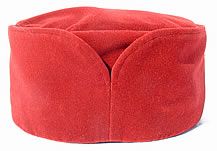
A skufia (also skufiya, skoufia or skoufos; Greek: σκούφια or σκούφος) is an item of clerical clothing, a cap, worn by Eastern Orthodox, Eastern Lutheran and Eastern Catholic monastics (in which case it is black) or awarded to clergy as a mark of honor (in which case it is usually red or purple).

Origin

[edit]

The skufia is said to originate from Jewish headwear in Old Testament times. It is also said to represent the crown of thorns worn by Christ at His crucifixion.[1]

Description

[edit]

A skufia is a soft-sided brimless cap whose top may be pointed (Russian style),[2][3] flat with embroidered designs (Serbian style),[4] flat and pleated (Greek style),[5] or flat with raised edges (Romanian style).[6] Typically, monastics receive their skufia either when they first become a novice or when they are tonsured.[7] A monk or nun who has been tonsured to the Great Schema will wear a skoufia that has been embroidered with prayers, crosses, and figures of seraphim.[8]

Three Athonite monks are seen wearing a Greek-style skufia

In Russian Orthodox and Orthodox Church in America practice, priests and deacons who have been awarded the purple kamilavka regularly wear a black skufia outside of liturgical worship. However, any clergy from the rank of Reader is permitted to wear the black skufia, if they have received a blessing from their bishop.[9] After five years of being a priest, they are awarded a purple skufia in place of the black one.[10]

High-ranking bishops (such as archbishops and metropolitans) will sometimes wear a black or purple skufia with a small jewelled cross on informal occasions.[11] A nun will sometimes wear a skufia over her monastic veil;[12] while monks often wear the skufia (without a veil) when the klobuk or epanokamelavkion might get in the way of work.

See also

[edit]

Citations

[edit]
  1. ^ "Diversity of Skufias - Tips for Clergy". catalog.obitel-minsk.com. Retrieved 2025-06-24.
  2. ^ The Russian-style skufia is traditionally pulled down so that it covers the top of the ears. This is practical, to keep out the cold; but it also has a symbolic practice, reminding the monk not to listen to gossip.
  3. ^ thumb_p2433d.jpg Archived October 13, 2003, at the Wayback Machine Retrieved 9 October 2015 Skufia Russian style
  4. ^ "Image: _2_12.jpg, (900 x 600 px)" catalog.obitel-minsk.com. Retrieved 24 June 2025.
  5. ^ "Image: red.jpg, (204 × 170 px)". nikitatailor.com. Retrieved 9 October 2015.
  6. ^ "Image: red2.jpg, (217 × 151 px)". nikitatailor.com. Retrieved 9 October 2015.
  7. ^ "Ambr6.jpg". newsketemonks.com. Archived from the original on 7 April 2008. Retrieved 29 December 2016.
  8. ^ "1115". sestry.ru. Retrieved 29 December 2016.
  9. ^ "HTC: Priest's Headcoverings During Divine Worship". www.holy-trinity.org. Retrieved 2025-06-24.
  10. ^ "HTC: Liturgical Ranks". www.holy-trinity.org. Retrieved 2025-06-24.
  11. ^ DSC_0006.jpg Archived February 22, 2006, at the Wayback Machine
  12. ^ long.protest.ap.jpp.jpg Archived February 22, 2006, at the Wayback Machine

General bibliography

[edit]
[edit]
Revisions and contributorsEdit on WikipediaRead on Wikipedia
from Grokipedia
The skufia (also spelled skufiya or skouphos) is a soft-sided, brimless cap that serves as a key element of clerical headwear in the Eastern Orthodox, Eastern Catholic, and some Eastern Lutheran traditions, worn by monastics and awarded to as a symbol of their and . Typically black for monks and novices to denote their monastic commitment, it may be for married priests after 3–4 years of service, marking seniority and honor within the . The cap is donned during church services, processions, and everyday clerical duties when not fully vested, providing both practical coverage and spiritual reminder of the wearer's dedication. The skufia's use draws from ancient precedents, with symbolic roots in Jewish headcoverings and the Crown of Thorns placed on Christ during his , evoking themes of suffering, protection of the mind, and monastic vows of obedience. In the Christian East, it emerged as standard monastic and clerical attire during the Byzantine era, evolving into a formalized garment by the medieval period across Slavic, Greek, and Romanian churches. Within the , the black skufia is standard for monastics and entering clergy, while the purple variant is awarded after several years of service to honor priestly reverence. Reflecting the Orthodox Church's , skufias exhibit regional stylistic variations while adhering to their canonical role: the Russian form has a pointed top for a distinctive , the Athonite (Greek) style is pleated and dome-shaped for , the Serbian version is cylindrical with a flat embroidered top, and the Romanian features a flat surface with elevated edges. Constructed from breathable materials such as , , or to suit liturgical demands—linen for moisture absorption up to 20% and synthetics for wrinkle resistance—these caps are often handmade with embroidered crosses for bishops or patriarchs, underscoring craftsmanship as an expression of faith.

Etymology and Terminology

Origin of the Term

The term skufia derives from the Byzantine Greek σκούφος (skouphos) or σκούφια (skouphia), denoting a soft-sided, brimless , often knitted or felted, used as everyday headwear. This linguistic root reflects the garment's origins in Eastern Christian monastic attire, where it served as a simple covering for the head. In Slavic traditions, the term entered as skufiya (скувья), inherited from скуфиꙗ (skufija), a direct borrowing from the Greek during the transmission of Byzantine liturgical and monastic practices to the in the medieval period. This adoption occurred amid the cultural and religious exchanges facilitated by monastic communities, aligning with the broader of Slavic from the 10th century onward.

Linguistic Variations Across Traditions

In the Hellenic Orthodox tradition, the monastic cap is commonly referred to as skouphos (Greek: σκούφος) or skoufos, terms that emphasize its soft, brimless design and are prevalent in liturgical contexts, particularly on . These designations reflect a direct continuity with Byzantine nomenclature, adapted for contemporary use in Greek-speaking communities. Within Russian Orthodox practice, the garment is known as skufiya (Russian: скуфия), a phonetic adaptation that appears in Church Slavonic texts with slight orthographic variations such as skuf'ia, underscoring its integration into Slavic liturgical language while retaining the core form. This is standard in Russian monastic and clerical attire descriptions, distinguishing it from other like the kamilavka. In Serbian Orthodox traditions, the term skufija is employed, mirroring the Russian form but with a localized South Slavic pronunciation and spelling that aligns with phonetics, as seen in monastic guidelines from Serbian monasteries. Similarly, Bulgarian usage favors skufiya (Bulgarian: скуфия), incorporating Balkan phonetic influences that soften the consonants and adapt the ending for , evident in descriptions of clerical vestments within the Bulgarian Patriarchate. Romanian Eastern Orthodox communities designate the cap as scufie or scufia, a Romance-language borrowing that closely parallels the Slavic variants but incorporates Romanian vocalic shifts, such as the transformation of the 'u' sound, while maintaining the essential meaning in monastic contexts. This terminology highlights the item's role in Romanian rite practices, often without additional qualifiers beyond style distinctions like elevated edges.

Historical Development

Byzantine and Early Monastic Origins

Early monastic traditions in the Eastern Christian world emphasized simple, unadorned clothing to symbolize and , as seen in the rules of St. Basil the Great, which prescribed coarse garments like cloaks to avoid ostentation and reflect lowliness of spirit. In the Egyptian monastic context from the 4th to 8th centuries, official garb for liturgical use included hoods made from simple materials, promoting uniformity and detachment from worldly status. The skufia emerged in the Byzantine era as a standard element of monastic and clerical attire, drawing from broader traditions of head coverings symbolizing protection of the mind and obedience. By the 14th and 15th centuries, it was influenced by civilian headwear in , such as structured caps that symbolized status, but adapted into a soft, unassuming form for monastic use to align with vows of . The Studite monastic reform of the 8th and 9th centuries, led by , promoted uniformity in the monastic habit to support cenobitic discipline and equality, influencing broader Byzantine practices.

Post-Byzantine Evolution and Spread

Following the fall of in 1453, the skufia evolved from its Byzantine roots into a more formalized item of clerical attire, incorporating elements of 14th- and 15th-century civilian headwear traditions that symbolized status. In Russian Orthodoxy, post-Byzantine developments led to the adoption of pointed styles in the Eastern Slavic tradition, characterized by a skufia rising in four distinct peaks, which could be worn during services. The skufia's spread extended to other Slavic and Balkan regions under the Ottoman Empire, where Christian clerics adapted ecclesiastical garments, including the skufia paired with the exorasson, to navigate dress codes. Regional variations emerged in monasteries across these areas, integrated into local monastic life. In the 19th century, nationalistic church reforms in Greece after independence and spiritual renewal in Russia contributed to the solidification of the skufia as standard canonical attire for monastics and clergy, reinforcing traditional vestments against Western influences.

Physical Description and Construction

Basic Components and Materials

The skufia is a soft-sided, brimless designed for monastic and clerical use in the Eastern Orthodox tradition, featuring a cylindrical or slightly tapered body that covers the crown of the head. Its fundamental structure emphasizes simplicity and functionality, allowing it to be worn comfortably during extended periods of and movement. The cap is typically constructed through hand-sewing techniques, ensuring a secure fit without rigid elements that could impede or prostrations. Common materials for the skufia include natural fibers such as or blends for and moderate warmth, as well as for a smoother texture in formal contexts. Synthetic options like polyviscose or are also employed, prized for their elasticity, durability, and air permeability, which make the cap suitable for various climates. An internal lining, often made of or , is standard to enhance wearer comfort by absorbing and preventing against the skin. These materials are selected for their ability to maintain shape while remaining lightweight and foldable for portability. In terms of sizing and fit, skufias are produced in standard head circumference measurements, ranging from approximately 57 cm to 66 cm, to accommodate different wearers without the need for extensive customization. Some designs incorporate subtle pleats or folds at the top or base to provide flexibility and a secure hold, ensuring the remains in place during liturgical actions. This construction prioritizes practicality, with the overall height generally kept modest to avoid bulkiness while fully enclosing the head.

Color and Symbolic Markings

The skufia worn by and is traditionally , a color that signifies the of worldly and a commitment to and in monastic life. This somber hue aligns with the broader symbolism of monastic attire, emphasizing detachment from material concerns and dedication to spiritual purity. For higher ranks, the skufia adopts colors that denote and honor, such as or violet as an for certain priests and higher , reflecting their pastoral oversight and . Other colors like red, grey, or white may be used in certain traditions. These color distinctions serve as visible markers of rank within the , distinguishing them from the standard monastic black while maintaining the garment's modest form. Decorative elements on the skufia, particularly for elevated ranks, include embroidered crosses or icons on the front panel, often executed in gold thread to evoke divine glory and dignity. Such markings, including small crosses for bishops and patriarchs, enhance the cap's role as a symbol of spiritual authority without altering its basic structure. These embellishments underscore the skufia's connection to the Crown of Thorns, representing Christ's suffering and the wearer's humility in service.

Regional and Traditional Variations

Russian and Slavic Styles

In Russian Orthodox tradition, the skufia features a distinctive pointed top formed by soft folds that create a cross-like around the wearer's head, typically constructed from for durability and warmth in colder seasons or for breathability in summer variants. This emphasizes and symbolism, with the color denoting monastic , though liturgical colors like or gray may be used for . The style became a standard element of Russian clerical attire in the . Serbian Orthodox skufias adopt a cylindrical shape with a flat top, often pleated for a structured appearance, and are adorned with depicting crosses. These embroideries, executed on materials like or , add decorative elegance while maintaining the cap's functional form.

Greek and Balkan Adaptations

In the Greek Orthodox tradition, the skufia, known as skufion or skoufos, features a flat or slightly pleated top designed for everyday monastic use, often crafted from lightweight or cotton blends to suit the Mediterranean's warmer climates, allowing for comfortable wear during extended prayer and labor. Romanian variants of the skufia typically exhibit rounded flat tops with minimal , constructed from breathable fabrics like or for durability in varied weather. Mount Athos has profoundly influenced Greek and Balkan skufia styles through its role as a spiritual center, promoting simple black wool versions with subtle pleating.

Usage in Orthodox Practice

Clergy and Monastic Wearers

In the Eastern Orthodox tradition, the skufia is worn by monastics, starting from novices, where it forms a daily part of their habit as an essential element of the monastic schema. Monastics receive appropriate headwear, such as the skufia for novices or the klobuk for tonsured ranks, marking their commitment to the monastic life. Higher ranks wear monastic headwear including the klobuk for stavrophores and skufia for schemamonks, typically in black to signify humility and monastic discipline. Among the clergy, deacons and priests wear the skufia during non-vestmented services and outdoor processions, serving as a practical head covering when full liturgical vestments are not required. Bishops similarly utilize the skufia when not wearing the , such as in informal or preparatory contexts, maintaining its role as standard clerical headgear outside of major liturgical moments. Color variations in the skufia, such as black for standard use or purple for awarded , distinguish ranks within the clergy. Laypeople and subdeacons are not permitted to wear the skufia, as clarified in guidelines that reserve it for monastics and ordained major to preserve hierarchical distinctions. These restrictions emphasize the skufia's in denoting tonsured or ordained status, prohibiting its use by unordained or except in exceptional monastic cases.

Liturgical and Daily Contexts

In liturgical settings, the skufia is worn by eligible during the when not attired in fuller ceremonial vestments, serving as a standard head covering for much of the service. typically enter wearing the skufia, remove it briefly to venerate the Holy Table and icons during the entrance prayers, and replace it before commencing the of the Catechumens. It remains in place through the litanies and readings, except for removal during the proclamation, and is taken off again at the start of the Cherubic Hymn for the Great Entrance procession. Following the placement of the Holy Gifts on , the skufia is donned for the remainder of the , including the Anaphora; however, it is removed during the consecration prayers to observe protocols of reverence in . In daily monastic life, the skufia forms an essential part of the habitual attire, worn continuously by and within the confines during work, prayer, and communal activities, as prescribed by longstanding regulations that emphasize and . This practice underscores the skufia's role in maintaining the monastic identity beyond formal services. For processional and outdoor contexts, the skufia is carried or worn by during services such as baptisms or litanies held outside church buildings, providing practical protection while symbolizing clerical status; upon entering indoors or in the presence of hierarchical superiors like bishops or abbots, it is promptly removed as a of and submission. As noted in the section on and monastic wearers, this usage aligns with its assignment to monastics and awarded .

Symbolism and Cultural Role

Religious Symbolism

The skufia embodies profound theological symbolism in Orthodox , particularly through its association with the rite of , which it covers and perpetuates. The , performed during monastic , involves clipping the hair in the form of a , signifying the monk's of worldly vanities and pride, as well as a commitment to and ascetic . This act renews the grace of , marking a "second baptism" that activates the Christian's initial vows into a more explicit life of and spiritual ascent. In monastic , the skufia thus recalls the tonsured head as an echo of Christ's , symbolizing the wearer's willing participation in Christ's suffering and rejection of ego for divine union. The distinctive folds of the skufia, arranged to form the shape of a cross encircling the wearer's head, further underscore a deep commitment to bearing one's cross in imitation of Christ. This design serves as a constant visual and tactile reminder of the monastic obligation to embrace suffering, obedience, and the salvific mystery of the Cross, aligning the wearer's mind and will with Christ's redemptive passion. The traditional color of the skufia reinforces themes of penitence and eschatological detachment, rooted in Patristic interpretations of as a path to . signifies the monk's ongoing grief over personal and communal , evoking the "joyful " of the ascetic where sorrow for transgressions leads to purification and heavenly orientation. This hue also denotes a radical separation from worldly allurements, portraying the wearer as "dead to the world" and alive only to Christ, in line with the ' exegesis of monastic garb as an angelic, dispassionate state that prioritizes eternal over temporal concerns.

Modern Interpretations and Adaptations

In the , skufia production in has incorporated synthetic blends like , viscose , and polyviscose to improve durability and functionality for everyday clerical and monastic use. These materials provide benefits such as stretchability, resistance, abrasion resistance, and shape stability, while maintaining and softness comparable to traditional fabrics like . This shift reflects practical adaptations in post-2000 , as seen in the output of the St. Elisabeth Convent's workshop, which crafts Russian-style skufias from polyviscose for its elasticity and air permeability, ensuring in liturgical and non-liturgical settings. Among Orthodox communities in the , particularly in Western countries, have maintained traditional attire, including head coverings, during ecumenical events since the , preserving liturgical identity amid interfaith dialogues in line with canonical requirements. The influx of millions of Eastern Europeans after led to the establishment of Orthodox parishes across , , and beyond, where upheld appropriate clerical dress as mandated by the 27th Canon of the Sixth for public and travel contexts. Participation in bodies like the —joined by the in 1962—has included such events, with representatives upholding vestments to signify continuity of Orthodox practice in multicultural settings. In 2010s Russian media, the skufia features in films and literature as a symbol of Orthodox cultural and spiritual identity, often portraying in historical or contemporary contexts to evoke themes of , resilience, and national heritage. Productions like The Priest (2009) and The Monk and the Demon (2016) depict priests and monastics in traditional black cassocks to underscore moral and ecclesiastical roles amid societal challenges. This representation aligns with broader cinematic trends in Russian films from the late 1980s to 2010s, where Orthodox elements construct models of through interpersonal, historical, and spiritual discourses.

References

Add your contribution
Related Hubs
User Avatar
No comments yet.