


Community hub
Recent from talks
Contribute something
Nothing was collected or created yet.
Smart speaker
View on Wikipedia
A smart speaker is a type of loudspeaker and voice command device with an integrated virtual assistant that offers interactive actions and hands-free activation with the help of one "wake word" (or several "wake words"). Some smart speakers also act as smart home hubs by using Wi-Fi, Bluetooth, Thread, and other protocol standards to extend usage beyond audio playback and control home automation devices connected through a local area network.
History
[edit]Early voice-activated devices began in 2013 with MIT's Jasper project,[1] which used multiple microphones and cloud software to power hands-free interactions from across a room.
The first commercial smart speaker was the Amazon Echo, which was released in 2014 powered by Alexa and a ring of far-field microphones. Google followed in 2016 with Home, powered by Google Assistant. By 2017, devices like the Echo Show and Home Hub (later called Nest Hub) added touchscreens and video, creating the "smart display" subcategory. In 2018, Apple joined the smart speaker trend by launching the HomePod, which focused on high-quality audio alongside their built-in assistant Siri.
In the early 2020s, smart speakers gained on-device voice processing for faster responses and improved privacy. New standards such as Matter and Thread allowed multitudes of smart-home devices (even from completely different brands) to work together.[2]
Features
[edit]Audio and Voice
[edit]Smart speakers use multiple microphones along with noise-cancelling software to pick up your voice from across the room, even when music is playing or the assistant is already talking. Noise suppression and echo cancellation is also used by the speaker so it can focus in on who is talking and ignore any background noises. Most smart speaker models can recognize who is speaking by voiceprint, which allows the speaker to grab information from that person's calendar, preferences, or music playlists.[citation needed]
Listening to music on a speaker is when importance for good audio quality becomes apparent. Entry-level (cheaper) speakers such as the Home Mini or the Echo Dot have a single full-range driver. These lower-end speakers typically aren't great for listening to music as the audio quality is pretty poor. More advanced units such as the Home Max or Echo Studio have separate tweeters and woofers meant for listening to music in high quality.[citation needed]
Connectivity and smart-home control
[edit]Most connect over Wi-Fi or Bluetooth and support hub protocols like Thread and Matter. That lets them not only stream and play music but also allows you to control various brands of smart lights, thermostats, door locks, cameras, and much more-all from one point of control. Each can have its own designated interface and features in-house, usually launched or controlled via application or home automation software.[3] These devices are able to communicate with each other via peer-to-peer connection through mesh networking. These speakers and related smart devices are typically controlled with one smartphone application.[4]
Assistant services and skills
[edit]The built-in assistants handle timers, alarms, reminders, news briefings, weather updates, send messages to other smart devices, send texts, make calls, and simple questions. You can combine actions together in what are typically known as routines (for example saying "good morning" turns on lights, starts the coffee, says the weather, and reads the news) and add extra functions known as skills or actions (for things like ordering food or playing trivia games). This hands-free use of smart speakers can help assist those with disabilities. Most other technologies need the user to be able to physically interact with the device. Smart speakers are not bound by these limitations and can serve as an excellent tool for those who are unable to use their arms or legs or have vision issues.[5]
Although these tasks can be completed by a phone or computer, consumers tend to lean towards smart speakers due to factors such as their range being much greater than that of a phone and the need to not have to physically interact with the speaker to get the voice assistant as with most smartphones, certain parts of a phone may need to be interacted with to activate the speaking assistant.[6]
Smart displays
[edit]
Some smart speakers also include a screen to show the user a visual response. A smart speaker with a touchscreen is known as a smart display;[7][8] these integrate a conversational user interface with display screens to augment voice interaction with images and video. They are powered by one of the common voice assistants and offer additional controls for smart home devices, feature streaming apps, and web browsers with touch controls for selecting content. The first smart displays were introduced in 2017 by Amazon (Amazon Echo Show) and Google (Google/Nest Home Hub).
Artificial intelligence
[edit]The newest speakers can use on-device AI or cloud-based generative models to allow the smart speaker to carry on much more natural conversations, draft emails or recipes, suggest ideas based on context, or even create short pieces of music or art. This AI evolution allows these speakers to do far more than what they could do before.[9]
Accuracy
[edit]According to a study by Proceedings of the National Academy of Sciences of the United States of America released In March 2020, the six biggest tech development companies, Amazon, Apple, Google, Yandex, IBM and Microsoft, have misidentified more words spoken by "black people" than "white people". The systems tested errors and unreadability, with a 19 and 35 percent discrepancy for the former and a 2 and 20 percent discrepancy for the latter.[10]
The North American Chapter of the Association for Computational Linguistics (NAACL) also identified a discrepancy between male and female voices. According to their research, Google's speech recognition software is 13 percent more accurate for men than women. It performs better than the systems used by Bing, AT&T, and IBM.[11]
Privacy concerns
[edit]The built-in microphone in smart speakers is continuously listening for wake words followed by a command. However, these continuously listening microphones also raise privacy concerns among users.[12] According to a survey taken by 1,007 people in Western Europe, it is clear that privacy is the biggest concern holding consumers back from buying "smart" products.[13] these concerns include what is being recorded, how the data will be used, how it will be protected, and whether it will be used for invasive advertising.[14][15] Furthermore, an analysis of Amazon Echo Dots showed that 30–38% of "spurious audio recordings were human conversations", suggesting that these devices capture audio other than strictly detection of the wake word.[16]
As a wiretap
[edit]There are strong concerns that the ever-listening microphone of smart speakers presents a perfect candidate for wiretapping. In 2017, British security researcher Mark Barnes showed that pre-2017 Echos have exposed pins which allow for a compromised OS to be booted.[17]
According to Umar Iqbal, an assistant professor at Washington University in St. Louis, research indicates that data from consumer interactions with Alexa was used to targeted advertisements and products to consumer with over 40% of transmitted data lacking proper encryption raising privacy concerns.[18] Further data indicates that due to the Smart Speakers ability to always capture audio, it begins to pick up on external conversations from consumers not related to commands given to the smart speaker. Things such as other members in the household, consumers on the phone and even TV audio can be picked up by these speakers and stored for future use by companies.[19]
Voice assistance vs privacy
[edit]While voice assistants provide a valuable service, there can be some hesitation towards using them in various social contexts, such as in public or around other users.[20] However, only more recently have users begun interacting with voice assistants through an interaction with smart speakers rather than an interaction with the phone. On the phone, most voice assistants have the option to be engaged by a physical button (e.g., Siri with a long press of the home button) rather than solely by wake word-based engagement in a smart speaker. While this distinction increases the privacy by limiting when the microphone is on, users felt that having to press a button first removed the convenience of voice interaction.[21] This trade-off is not unique to voice assistants; as more and more devices come online, there is an increasing trade-off between convenience and privacy.[22]
Security concerns
[edit]When configured without authentication, smart speakers can be activated by people other than the intended user or owner. For example, visitors to a home or office, or people in a publicly accessible area outside an open window, partial wall, or security fence, may be able to be heard by a speaker. This may allow others to access personal information of the owner without the owner's permission. One team demonstrated the ability to stimulate the microphones of smart speakers and smartphones through a closed window, from another building across the street, using a laser.[23]
Smart speakers are typically forgotten about when it comes to home network security concerns because of their convenience and simplicity. However one in three breaches now involves an IoT device.[24] The risk of getting hacked through a smart speaker can be greatly mitigated by following some simple steps. For one, it is necessary that a trustworthy brand is chosen when purchasing a smart speaker. Doing research to find a brand that aligns with your needs/wants while being secure can relieve stresses in the long run. It is also extremely important to keep your smart devices up-to-date to the latest firmware version as these updates will have patches for any known exploits. Deliberately going through the settings once the device is up-to-date will allow you to turn off settings you don't need or want to use further minimizing security risks.[25]
Usage statistics
[edit]As of summer 2022, it is estimated by NPR and Edison Research that 91 million Americans (35% of the population over 18) own a smart speaker.[26]
Gallery
[edit]-
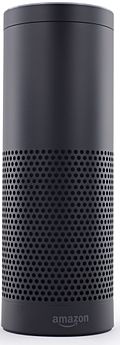 The first-generation Amazon Echo smart speaker in black
 -
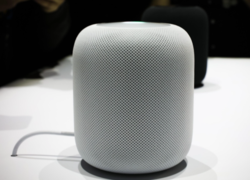 An Apple HomePod speaker
 -
 The Google Home smart speaker idle on a table
 -
 The Amazon Echo Show smart speaker in white
 -
 The Harman Kardon INVOKE smart speaker in graphite


See also
[edit]References
[edit]- ^ Saha, Shubhro (7 April 2014). "Jasper -- control anything with your voice". YouTube. Retrieved 15 July 2025.
- ^ Hill, Simon (26 May 2025). "Here's What the 'Matter' Smart Home Standard Is All About". Wired. Retrieved 15 July 2025.
{{cite magazine}}: CS1 maint: url-status (link) - ^ smart speaker Archived 2019-04-10 at the Wayback Machine, techtarget.com, May 2017
- ^ "What is a smart speaker and how does it work?". Bose. Retrieved 15 July 2025.
- ^ Mauldin, Laura (2022-09-10). "Cripping in America: Hacking an ableist world". The Baffler (64): 22–29. JSTOR 27159392.
- ^ Kowalczuk, Pascal (2018-10-10). "Consumer acceptance of smart speakers: a mixed methods approach". Journal of Research in Interactive Marketing. 12 (4): 418–431. doi:10.1108/jrim-01-2018-0022.
- ^ Brown, Rich. "Echo Show, Nest Hub, Facebook Portal and more: How to pick the best smart display in 2019". CNET. Archived from the original on 2019-07-08. Retrieved 2019-06-19.
- ^ Faulkner, Cameron (9 October 2018). "How Google's new Home Hub compares to the Echo Show and Facebook Portal". The Verge. Archived from the original on 2019-12-06. Retrieved 2019-06-19.
- ^ Elnaj, Saeed (8 July 2019). "The Rise Of AI-Enabled Smart Speakers And Their Future In Our Lives". Forbes. Retrieved 15 July 2025.
- ^ Metz, Cade (2020-03-23). "There Is a Racial Divide in Speech-Recognition Systems, Researchers Say". The New York Times. Archived from the original on 2022-10-13. Retrieved 2020-04-22.
- ^ Bajorek, Joan Palmiter (2019-05-10). "Voice Recognition Still Has Significant Race and Gender Biases". Harvard Business Review. Archived from the original on 2020-04-25. Retrieved 2020-04-24.
- ^ Lau, Josephine; Zimmerman, Benjamin; Schaub, Florian (1 November 2018). "Alexa, Are You Listening?: Privacy Perceptions, Concerns and Privacy-seeking Behaviors with Smart Speakers". Proceedings of the ACM on Human-Computer Interaction. 2 (CSCW): 102:1–102:31. doi:10.1145/3274371. S2CID 53223356.
- ^ Zimmermann, Jenny (16 February 2023). "Smart Product Breakthroughs Depend on Customer Control". MIT Sloan Management Review. Retrieved 16 July 2025.
- ^ "Amazon hands over Echo 'murder' data". BBC News. 7 March 2017. Archived from the original on 6 January 2020. Retrieved 2 March 2019.
- ^ "Amazon patents 'voice-sniffing' algorithms". BBC News. 11 April 2018. Archived from the original on 14 December 2019. Retrieved 2 March 2019.
- ^ Ford, Marcia, and William Palmer. "Alexa, are you listening to me? An analysis of Alexa voice service network traffic." Personal and Ubiquitous Computing (2018): 1-13.
- ^ Greenberg, Andy (1 August 2017). "A Hacker Turned an Amazon Echo Into a 'Wiretap'". Wired. Archived from the original on 3 June 2019. Retrieved 2 March 2019 – via www.wired.com.
- ^ Iqbal, Umar (2024-12-03). "Tracking, Profiling, and Ad Targeting in the Alexa Echo Smart Speaker Ecosystem" (PDF). umariqbal.com. Archived (PDF) from the original on 2024-09-24. Retrieved 2024-12-03.
- ^ Malkin, Nathan (2019). "Privacy Attitudes of Smart Speaker Users" (PDF). Sciendo. Proceedings on Privacy Enhancing Technologies.
- ^ "Sarah Mennicken and Elaine M. Huang. 2012. Hacking the Natural Habitat: An In-the-Wild Study of Smart Homes, Their Development, and the People Who Live in Them. In Pervasive Computing. Springer, Berlin, Heidelberg, 143–160". doi:10.1007/978-3-642-31205-2_10. S2CID 3480089. Archived from the original on 2022-10-13. Retrieved 2019-02-26.
{{cite journal}}: Cite journal requires|journal=(help) - ^ Christoffer Lambertsson. 2017. Expectations of Privacy in Voice Interaction–A Look at Voice Controlled Bank Transactions. Ph.D. Dissertation. KTH Royal Institute of Technology
- ^ "Rao, Sonia (12 September 2018) "In today's homes, consumers are willing to sacrifice privacy for convenience". Retrieved 25 February 2019". The Washington Post. Archived from the original on 2 March 2019. Retrieved 26 February 2019.
- ^ "Lasers can silently issue 'voice commands' to your smart speakers". 5 November 2019. Archived from the original on 2019-11-05. Retrieved 2019-11-06.
- ^ Blanton, Sean (10 January 2025). "IoT Security Risks: Stats and Trends to Know in 2025". jumpcloud. Retrieved 16 July 2025.
- ^ "Securing Smart Speakers and Digital Assistants". National Cybersecurity Alliance. 14 June 2024. Retrieved 16 July 2025.
- ^ Landis, Devon (2022-06-12). "NPR & Edison Research: Smart Speaker Ownership Reaches 35% of Americans". NPR. Archived from the original on 2024-12-02. Retrieved 2024-12-02.
| Micro |
| ||||||||||||||||||||||
|---|---|---|---|---|---|---|---|---|---|---|---|---|---|---|---|---|---|---|---|---|---|---|---|
| Midrange | |||||||||||||||||||||||
| Large | |||||||||||||||||||||||
| Others | |||||||||||||||||||||||

| Intelligent personal assistant- enabled |
| ||||||||||||||||||||
|---|---|---|---|---|---|---|---|---|---|---|---|---|---|---|---|---|---|---|---|---|---|
| Others | |||||||||||||||||||||
Smart speaker
View on GrokipediaHistory
Early Precursors and Foundational Technologies
The development of smart speakers relied on foundational advancements in speech synthesis and recognition technologies, which originated in the early 20th century with analog systems designed to mimic human vocalization. In 1939, Bell Laboratories introduced the Voice Operation DEmonstrator (VODER), the first electronic speech synthesizer capable of producing intelligible speech through manual control of filters and oscillators simulating vocal tract resonances; it was publicly demonstrated at the New York World's Fair and marked a milestone in generating synthetic voice output from electrical signals.[12] Earlier mechanical precursors, such as Christian Kratzenstein's 1779 organ pipes tuned to produce individual vowel sounds, laid conceptual groundwork by isolating acoustic elements of speech, though limited to basic phonemes without electronic amplification.[13] Automatic speech recognition (ASR) emerged in the mid-20th century, initially focusing on digit and isolated word detection to enable voice-to-text conversion. Bell Laboratories' AUDREY system, unveiled in 1952, represented the first functional ASR prototype, accurately recognizing spoken digits 0-9 with about 90% success for a single trained speaker using analog pattern-matching circuits.[14] By the 1960s, IBM's Shoebox demonstrated recognition of 16 words through digital filtering and threshold-based decision logic, expanding beyond digits but still constrained to speaker-dependent, isolated utterances.[15] These systems employed template-matching techniques, comparing input spectrograms to stored references, which highlighted early challenges in handling variability from accents, noise, and coarticulation effects. Advancements in the 1970s and 1980s integrated statistical modeling, paving the way for continuous speech processing essential to smart speaker interactivity. Carnegie Mellon University's Harpy system (1976) achieved recognition of a 1,010-word vocabulary using a network of phonetic rules and dynamic programming, approaching connected speech for limited domains.[15] The adoption of Hidden Markov Models (HMMs) in the mid-1980s, as refined in DARPA-funded research, enabled probabilistic modeling of temporal speech sequences, improving accuracy for larger vocabularies and speaker independence; this shift from rule-based to data-driven paradigms underpinned subsequent natural language processing (NLP) integration for intent parsing in voice commands.[16] Parallel progress in text-to-speech (TTS) synthesis, such as formant-based synthesizers like Klatt's 1980 cascade/parallel models, provided natural-sounding output by parameterizing source-filter vocal tract simulations, forming the acoustic backbone for responsive smart speaker feedback.[12] These technologies converged in the 1990s with hybrid HMM-neural approaches, enabling cloud-accessible processing that later powered always-listening devices, though early implementations required significant computational resources unavailable in consumer hardware until the 2010s.Commercial Launch and Early Adoption (2014–2019)
The Amazon Echo marked the commercial debut of smart speakers, launching on November 6, 2014, as an invite-only product limited to approximately 5,000 initial U.S. customers.[17][18] This cylindrical device featured a ring of seven far-field microphones and integrated Amazon's Alexa voice assistant, supporting voice-activated music streaming from services like Amazon Music, basic queries via connected cloud services, and rudimentary smart home control through compatible devices.[19] Initial adoption was modest due to the exclusive release model and lack of widespread awareness, but Amazon's bundling with Prime memberships and iterative updates to Alexa's capabilities began building a user base focused on convenience in hands-free interaction.[20] Amazon accelerated market penetration by introducing the compact, low-cost Echo Dot in March 2016, priced at $49.99, which prioritized affordability over audio quality and drove broader household integration.[21] This expansion coincided with growing developer support for Alexa skills, enabling third-party integrations for tasks like weather updates and e-commerce ordering. By late 2016, Amazon had sold millions of Echo devices, establishing early dominance in the U.S. market where smart speaker ownership rose from near zero in 2014 to significant traction among tech enthusiasts and early adopters.[22] Competitors entered rapidly to challenge Amazon's lead. Google launched the Google Home in November 2016, a puck-shaped speaker powered by Google Assistant, emphasizing superior natural language processing and integration with Google services like YouTube and Calendar.[20] Priced at $129, it gained quick adoption through aggressive bundling with Chromecast and appeal to Android users, contributing to a surge in U.S. smart speaker users exceeding 47 million households by January 2018. Apple followed with the HomePod in February 2018, a premium $349 speaker leveraging Siri and high-fidelity audio from seven tweeters, targeting audiophiles despite criticism for limited smart home interoperability outside the Apple ecosystem.[22] Other entrants included the Harman Kardon Invoke with Microsoft Cortana in 2017 and Sonos One supporting Alexa or Google Assistant, though these captured smaller shares amid the duopoly of Amazon and Google.[20] Early adoption accelerated post-2016, fueled by price reductions, holiday promotions, and expanding use cases like music streaming and home automation. Global smart speaker shipments grew exponentially, reaching 146.9 million units in 2019—a 70% increase from the prior year—with Amazon holding over 50% U.S. market share and Google rising to 31%.[23][24] By early 2019, Amazon alone had shipped more than 100 million Echo-family devices worldwide, reflecting penetration into over 28% of U.S. broadband households and highlighting the shift toward voice-first interfaces in consumer electronics.[25] This period solidified smart speakers as a gateway to IoT ecosystems, though privacy concerns over always-on listening emerged as adoption scaled.[22]Maturation and Recent Developments (2020–2025)
The smart speaker market expanded significantly from 2020 to 2025, with global revenues growing from approximately $7.1 billion in 2020 to projected figures around $15-21 billion by the end of 2025, reflecting a compound annual growth rate (CAGR) of 17-22% driven by enhanced AI capabilities and broader smart home integration.[7][26][27] Shipments and adoption surged amid increased demand for voice-activated home automation, particularly during the COVID-19 pandemic, though growth moderated post-2022 as markets saturated in developed regions.[28] Manufacturers emphasized premium audio features and multi-room systems, with advancements in low-power AI chips enabling more efficient on-device processing and extended functionality.[29] Privacy concerns prompted notable enhancements across major platforms during this period. By 2025, nearly 60% of consumers prioritized privacy features in purchasing decisions, leading companies to implement physical mute buttons, end-to-end encryption for voice data, and user-controlled deletion options.[30] Amazon introduced improved data controls in Echo devices, while Google and Apple expanded opt-in recording policies and on-device processing to minimize cloud transmissions.[31] The Connectivity Standards Alliance's Matter protocol, launched in late 2022, aimed to foster interoperability among smart speakers and IoT devices, reducing ecosystem lock-in; however, its adoption for audio streaming remained limited by 2025, with primary benefits seen in unified control rather than seamless speaker-to-speaker integration.[32][33] Major vendors released iterative hardware and software updates emphasizing generative AI. Amazon unveiled Alexa+ in 2025, powering new Echo models like the Echo Dot Max and redesigned Echo Studio with enhanced processing for proactive, personalized interactions, alongside refreshed Echo Show displays for visual responses.[34] Google integrated its Gemini AI across Nest speakers, including legacy models from 2016, via firmware updates that added advanced conversational abilities and dynamic lighting cues, though a flagship Google Home speaker launch was deferred to 2026.[35][36] Apple advanced HomePod capabilities with chip upgrades, such as the S9 or newer in refreshed minis, to support Apple Intelligence and revamped Siri, focusing on spatial audio and ecosystem privacy but facing criticism for slower innovation pace.[37] These developments marked a shift toward AI-driven maturity, prioritizing reliability and cross-device synergy over rapid hardware proliferation.[38]Hardware Design
Audio Output and Acoustic Engineering
Smart speakers utilize compact electro-acoustic transducers, typically including full-range drivers, woofers, and tweeters, to produce audio output suitable for both voice responses and music playback across room-scale distances.[39] These configurations prioritize omnidirectional or near-360-degree sound dispersion to accommodate variable listener positions, achieved through enclosure geometries and driver placement rather than directional beaming common in traditional stereo systems.[40] Acoustic engineering focuses on maximizing sound pressure levels (SPL) and frequency response within physical constraints, often targeting 60 Hz to 20 kHz with emphasis on midrange clarity for intelligible speech.[41] A core challenge in audio output design is the limited internal volume of cylindrical or spherical form factors, which restricts low-frequency extension and bass response due to the physics of Helmholtz resonance and driver excursion limits.[42] Manufacturers address this via passive radiators or high-excursion woofers; for instance, the Apple HomePod employs an upward-firing 4-inch woofer paired with a seven-tweeter array and a high-frequency waveguide to distribute sound evenly while enhancing spatial imaging through beamforming-like dispersion control.[43] Similarly, Amazon's Echo Studio integrates a 5.25-inch woofer, three 2-inch full-range drivers, and a 1-inch tweeter, enabling up to 100 dB SPL with automatic room acoustic adaptation via onboard microphones that measure reflections and apply digital equalization in real time.[34] The 2025 redesign of the Echo Studio reduces size by 40% while upgrading drivers for improved efficiency and acoustic transparency via 3D knit fabric enclosures that minimize diffraction.[44] Digital signal processing (DSP) plays a pivotal role in compensating for enclosure limitations and environmental variability, incorporating algorithms for dynamic range compression, harmonic distortion reduction, and adaptive filtering to maintain clarity at far-field distances up to 10 meters.[45] Google's Nest Audio, for example, uses a 75 mm tweeter and 3-inch woofer tuned with DSP for 50% stronger bass than predecessors, supporting multi-room synchronization where phase alignment ensures coherent wavefronts.[46] Objective metrics like total harmonic distortion (THD) below 1% at nominal levels and consistent off-axis response are benchmarked to evaluate performance, revealing trade-offs such as elevated distortion in bass-heavy content due to nonlinear driver behavior in compact designs.[41] Innovations like Apple's computational audio in the HomePod mini employ a custom waveguide to direct output from a single full-range driver and dual passive radiators, yielding uniform 360-degree coverage with computational adjustments for room modes.[47] Engineering efforts also mitigate reverberation and multipath interference in untreated rooms by optimizing direct-to-reverberant energy ratios, often verified through anechoic and in-room measurements.[42] While peer-reviewed analyses confirm DSP efficacy in flattening response curves, real-world efficacy depends on microphone-accurate room profiling, with limitations in highly reverberant spaces where echoes degrade perceived fidelity.[40] Overall, acoustic design balances cost, size, and performance, prioritizing voice intelligibility over audiophile-grade neutrality, as evidenced by frequency responses favoring 200-5000 Hz for Alexa and Siri interactions.[39]Microphone Arrays and Sensor Integration
Smart speakers employ microphone arrays consisting of multiple microphones arranged in geometric patterns, such as circular or linear configurations, to facilitate far-field voice capture and enhance speech recognition accuracy. These arrays leverage beamforming algorithms, which apply phase shifts and weighting to microphone signals, directing sensitivity toward the sound source while suppressing ambient noise and echoes. This technology enables reliable detection of wake words and commands from distances up to several meters, even in reverberant environments.[48] The Amazon Echo series exemplifies advanced microphone array implementation, featuring a seven-microphone circular array in its first-generation model for 360-degree voice pickup. This setup, combined with acoustic echo cancellation and noise reduction processed on-device, supports hands-free interaction without requiring users to face the device. Later variants, such as those powered by the AZ3 neural edge processor introduced in 2025, incorporate upgraded arrays for improved far-field performance, filtering background noise during natural conversations.[49][34] Apple's HomePod utilizes a six-microphone array integrated with an A8 processor for continuous multichannel signal processing, enabling beamforming and dereverberation tailored to room acoustics. The second-generation HomePod (2023) adds an internal calibration microphone for automatic bass adjustment and room-sensing capabilities, which analyze spatial reflections to optimize audio output dynamically.[50][51] Google Nest devices typically integrate three far-field microphones with Voice Match technology for speaker identification, supporting beamforming to isolate user voices amid household noise. Sensor integration extends functionality beyond audio capture; for instance, ultrasonic sensing in Nest Hubs and Minis emits inaudible tones via speakers and detects reflections using microphones to gauge user proximity, activating displays or lighting capacitive controls only when someone approaches. This reduces unintended activations and enhances privacy by limiting always-on processing.[52][53] Touch and proximity sensors are commonly fused with microphone arrays for contextual awareness. Capacitive touch surfaces on devices like the HomePod Mini allow gesture-based controls for volume or muting, while integrated sensors trigger microphone activation or suppression based on detected presence, minimizing false triggers from distant sounds. Such multimodal integration relies on low-latency onboard processing to correlate sensor data with audio streams, improving responsiveness and energy efficiency.[54][55]Processors, Connectivity, and Form Factors
Smart speakers utilize system-on-chip (SoC) processors tailored for low-power operation, voice signal processing, and on-device AI tasks, predominantly employing ARM Cortex-A series cores for efficiency in embedded applications.[56] Amazon's Echo lineup incorporates custom AZ-series neural edge processors, such as the AZ1 developed in collaboration with MediaTek, which handles local wake-word detection and basic command interpretation to reduce latency.[57] Apple's HomePod (second generation) employs the S7 processor, derived from Apple Watch architecture, enabling computational audio features like spatial processing and beamforming across its driver array.[58] Google Nest devices, including the Nest Hub (second generation), feature quad-core processors clocked at up to 1.9 GHz to manage multimedia and Assistant interactions.[59] Connectivity in smart speakers centers on Wi-Fi as the primary interface for cloud-based services, with most models supporting IEEE 802.11n or ac standards over 2.4 GHz and 5 GHz bands to ensure reliable streaming and updates.[60] Bluetooth, typically version 4.2 or higher, supplements this for direct pairing with mobile devices, multi-room audio synchronization, and auxiliary input.[61] Integrated hubs for low-power protocols like Zigbee appear in select units, such as the Amazon Echo (fourth generation), allowing direct orchestration of compatible smart home devices to minimize ecosystem fragmentation.[61] Emerging standards including Thread and Matter enable broader interoperability, with adoption in post-2022 models to bridge vendor silos through IP-based communication.[62] Form factors prioritize acoustic projection, user interaction, and space constraints, evolving from bulky cylinders to compact, multifunctional designs. The original Amazon Echo adopted a 9.25-inch cylindrical enclosure to house a 2.5-inch woofer and omnidirectional tweeters for 360-degree sound dispersion.[63] Compact disc or puck shapes, as in the Echo Dot or Google Nest Mini, measure under 4 inches in diameter, facilitating countertop or shelf placement while relying on digital signal processing to compensate for limited driver size.[64] Spherical aesthetics in early Google Home models integrated fabric covers for visual subtlety, whereas display hybrids like the Echo Show incorporate 8- to 15-inch screens alongside speakers for video and control interfaces.[34] Shrinking enclosures demand trade-offs in battery life for portables and thermal management, often addressed via efficient SoCs and passive cooling.[65]Core Features and Capabilities
Voice Processing and Natural Language Understanding
Smart speakers operate via a structured voice processing pipeline: (1) constant listening through microphone arrays with beamforming and noise cancellation; (2) on-device wake word detection for phrases like "Alexa," "Hey Google," or "Hey Siri"; (3) audio capture, preprocessing, and transmission to cloud servers via Wi-Fi or on-device handling; (4) automatic speech recognition (ASR) transcribing audio to text while managing accents, noise, and dialects; (5) natural language understanding (NLU) to discern user intent and entities; (6) request processing, including actions like querying databases or controlling devices; (7) response generation; (8) text-to-speech (TTS) synthesis; and (9) audio playback. Modern devices execute more steps locally for reduced latency and enhanced privacy, reserving cloud resources for complex queries.[66] Voice processing initiates with wake word detection, where microphone arrays continuously monitor audio for predefined activation phrases using low-power, on-device keyword spotting models. These algorithms employ lightweight neural networks to identify the wake word amid ambient noise while minimizing false positives and power consumption, often achieving detection latencies under 100 milliseconds in optimized systems.[67] [68] [69] Upon wake word confirmation, the device captures a subsequent audio segment—typically 2-5 seconds—and preprocesses it through noise suppression, echo cancellation, and beamforming to enhance signal quality before transmission to remote servers or on-device processors. Automatic speech recognition (ASR) then transcribes the audio into text, leveraging acoustic models, language models, and deep learning architectures like recurrent neural networks or transformers; commercial systems report word accuracies of 90-95% under typical home conditions as of 2025, though performance degrades with accents, dialects, or reverberant environments.[70] [71] [72] Natural language understanding (NLU) follows ASR, parsing the text to identify user intent (e.g., "play music" or "set timer") and extract slot values (e.g., song title or duration) via probabilistic models that incorporate context, dialogue history, and domain-specific grammars. In platforms like Amazon Alexa, NLU integrates syntactic analysis for sentence structure and semantic interpretation for meaning, handling paraphrases and ambiguities through machine learning classifiers trained on vast utterance datasets; similar approaches in Google Assistant and Apple Siri emphasize contextual disambiguation to resolve coreferences or anaphora.[73] [74] [75] The integrated voice-to-intent pipeline faces causal challenges from ASR errors propagating to NLU, such as homophone confusions or transcription gaps reducing intent accuracy by up to 20-30% in noisy scenarios, prompting hybrid on-device-cloud architectures for latency-sensitive tasks like wake word and basic commands.[76] Multilingual NLU variants, supporting over 100 languages in leading systems by 2023, contend with data scarcity and performance disparities across low-resource tongues, often relying on transfer learning from high-resource models.[77] Advances in end-to-end neural models have improved joint ASR-NLU efficiency, enabling faster responses under 1 second in optimized deployments.[78]Smart Home Control and IoT Integration
Smart speakers function as central controllers for Internet of Things (IoT) devices in residential environments, allowing users to issue voice commands that adjust lighting, thermostats, locks, appliances, and security systems through integrated voice assistants.[79] This integration relies on wireless protocols such as Wi-Fi for direct internet-connected devices, Bluetooth Low Energy (BLE) for short-range pairing, and low-power mesh networks like Zigbee or Thread to extend reach and reliability across multiple devices without constant cloud dependency.[80] For instance, Amazon's Echo devices incorporate built-in hubs supporting Zigbee, enabling seamless control of compatible sensors and bulbs without additional hardware, while newer models from 2020 onward also handle Matter-over-Thread for certified interoperable ecosystems.[81] [82] Amazon Alexa exemplifies broad IoT compatibility, routing commands from Echo speakers to over 100,000 device types via cloud APIs or local execution, with Matter support introduced in 2022 allowing direct pairing of certified devices like smart plugs and cameras across ecosystems, bypassing proprietary skills.[83] Google Assistant on Nest speakers leverages Thread border routers in devices like the Nest Hub (2nd gen), facilitating Matter-enabled control of lights and sensors with reduced latency through mesh networking, where speakers relay signals to extend coverage up to 100 devices per network.[84] Apple's HomePod series, particularly the mini model released in 2020, serves as a HomeKit hub using Wi-Fi, BLE, and Thread to manage accessories, enforcing end-to-end encryption via protocols like Station-to-Station for secure local communication even when the user is remote.[85] [86] The Matter standard, developed by the Connectivity Standards Alliance and launched for certification in October 2022, aims to unify these protocols by enabling devices to work interchangeably with Alexa, Google Assistant, and HomeKit without vendor lock-in, using IP-based communication over Thread or Wi-Fi for low-bandwidth efficiency.[32] By mid-2025, Matter supports categories including lights, locks, and thermostats, with Thread providing robust meshing where smart speakers act as routers to maintain connections amid interference, though adoption remains uneven due to certification delays and incomplete backward compatibility for legacy Zigbee or Z-Wave gear.[87] [88] Integration challenges persist, as proprietary ecosystems like HomeKit prioritize security isolation—often requiring VLAN segmentation for IoT traffic—while cross-platform Matter implementations still demand firmware updates and can suffer from fragmented Thread support across speakers.[89] Despite these, voice-controlled routines, such as automating lights at dusk or integrating with energy monitors, have driven smart home device shipments to exceed 1 billion units globally by 2025, underscoring speakers' role in causal chains of automation from user intent to physical actuation.[90]Extensible Services, Skills, and Third-Party Ecosystems
Amazon's Alexa platform pioneered extensible services through its Skills framework, launched in 2015 via the Alexa Skills Kit (ASK), which enables third-party developers to create custom voice applications that integrate with Echo devices. By October 2024, over 160,000 skills were available globally, covering categories like smart home control, entertainment, and productivity, though many remain low-usage due to discoverability challenges and competition from native features.[91] Developers access APIs for intent recognition, account linking, and monetization options such as in-skill purchases, fostering an ecosystem where skills can invoke external services like weather APIs or e-commerce transactions.[92] Google Assistant extends functionality via Actions, introduced in 2017 through the Actions on Google platform, allowing developers to build conversational experiences using tools like Dialogflow for natural language processing. The number of Actions grew to approximately 19,000 in English by late 2019, with similar expansion in other languages, though recent adoption has shifted toward integrated Google services amid a focus on AI advancements like Gemini.[93] Actions support custom fulfillment via webhooks and integrations with Google Cloud, enabling third-party apps for tasks like booking services or querying databases, but the ecosystem lags behind Alexa in sheer volume due to stricter conversational design requirements.[94] Apple's HomePod and Siri ecosystem offers limited extensibility compared to competitors, relying on SiriKit for predefined intents in areas like media playback, messaging, and workouts, with developers integrating via App Intents for HomePod-specific features announced in 2021.[95] Third-party music services, such as Pandora or Spotify, can link directly to HomePod for seamless playback, but broader skill-like customizations are constrained by Apple's closed HomeKit framework, which prioritizes certified accessories over open developer submissions.[96] Siri support for third-party hardware, enabled since iOS 15 in 2021, allows select devices like thermostats to process voice commands locally, yet lacks the app-store model of rivals, resulting in fewer extensible services.[97] Third-party ecosystems enhance interoperability across smart speakers via platforms like IFTTT and Zapier, which automate workflows between devices and services—for instance, triggering a HomePod light scene from an Echo command—without native skills.[98] Open-source alternatives such as Home Assistant provide maximal extensibility by aggregating protocols like Zigbee and Z-Wave, integrating with Alexa, Google, and Siri through cloud bridges or local APIs, enabling custom automations on dedicated hardware that bypass vendor lock-in.[99] These tools address fragmentation in proprietary ecosystems, where empirical data shows Alexa leading in third-party device compatibility (over 100,000 supported products as of 2023), followed by Google and Apple with more curated integrations.[100] Developer privacy practices vary, with studies indicating persistent vulnerabilities in skill permissions, underscoring the need for user scrutiny in extensible deployments.[101]Embedded AI and Machine Learning Functions
Smart speakers rely on embedded AI and machine learning algorithms to perform critical on-device tasks, enabling low-latency responses, power efficiency, and enhanced privacy by minimizing cloud dependency for initial processing. These functions typically include wake word detection, acoustic signal enhancement, and basic personalization, processed via specialized hardware like digital signal processors (DSPs) or neural processing units (NPUs). For instance, keyword spotting models use deep neural networks (DNNs) to continuously monitor audio streams without transmitting data to the cloud unless triggered.[102] [103] Wake word detection represents a foundational embedded ML capability, employing lightweight DNN-based classifiers trained on acoustic patterns to distinguish the trigger phrase—such as "Alexa," "Hey Google," or "Hey Siri"—from background noise or unrelated speech. Amazon's Alexa implements a two-stage on-device system: an initial acoustic model filters potential candidates, followed by a verification stage using background noise modeling to reduce false positives, achieving high accuracy with minimal computational overhead.[102] Apple's Siri voice trigger similarly utilizes a multi-stage DNN pipeline on-device, converting audio frames into probability distributions for the wake phrase while incorporating user-specific adaptation for improved personalization over time.[104] [103] This local execution prevents unnecessary data transmission, addressing privacy concerns inherent in always-listening devices.[105] Beyond detection, embedded ML handles real-time audio preprocessing, including beamforming for microphone arrays, acoustic echo cancellation, and noise suppression, often via convolutional neural networks (CNNs) optimized for edge deployment. In far-field scenarios, such as those optimized for Apple's HomePod, ML models adapt to room acoustics and speaker distance, enhancing signal-to-noise ratios through techniques like dereverberation and directional filtering.[50] Speaker identification and diarization further leverage on-device embedding models to differentiate household voices, enabling personalized responses without cloud reliance for routine commands.[102] From 2020 to 2025, advancements in edge AI have expanded these functions to include hybrid local-cloud inference for simple intents, federated learning for privacy-preserving model updates, and adaptive personalization, such as routine prediction based on usage patterns. Devices increasingly incorporate efficient ML frameworks like TensorFlow Lite or Core ML to run quantized models on resource-constrained hardware, reducing latency to under 100 milliseconds for wake-to-response in optimal conditions.[106] [107] However, limitations persist; for example, Apple's second-generation HomePod, powered by the S7 chip lacking a dedicated Neural Engine, relies more on cloud processing for complex Apple Intelligence features introduced in 2024, constraining full on-device AI scalability.[108] These embedded capabilities underscore a shift toward causal, data-driven optimizations prioritizing empirical performance metrics over expansive cloud architectures.[109]Variants and Extensions
Smart Displays and Visual Interfaces
Smart displays integrate the voice-activated capabilities of smart speakers with touchscreen interfaces, allowing users to view visual content such as recipes, calendars, weather maps, and live video feeds from connected cameras.[110] Unlike audio-only smart speakers, which rely solely on verbal responses, smart displays support touch interactions for direct navigation and video calling via built-in cameras on models like the Amazon Echo Show series.[111] This combination enhances usability for tasks requiring graphical representation or real-time visuals, such as monitoring smart home devices or streaming content.[112] Amazon introduced the first widely available smart display with the Echo Show (1st generation) on June 28, 2017, featuring a 7-inch screen, 5-megapixel camera, and Alexa integration for video calls and music streaming with lyrics display.[113] Google followed with the Home Hub—later rebranded as Nest Hub—in October 2018, offering a 7-inch touchscreen without a camera to prioritize privacy, alongside Google Assistant for similar functions plus ambient computing features like photo frames.[114] Subsequent models expanded screen sizes and capabilities; for instance, Amazon's Echo Show 8 (3rd generation, 2023) includes an 8-inch HD display with spatial audio, while Google's Nest Hub Max (2019) adds a 10-inch screen and motorized camera for auto-framing in calls.[110] Apple has not released a dedicated smart display product as of 2025, relying instead on iPad or HomePod integrations for visual smart home control.[115] Key advantages over audio-only speakers include improved accuracy in disambiguating queries via on-screen options and support for multimedia consumption, such as YouTube videos or recipe videos with step-by-step visuals.[116] However, smart displays consume more power due to backlit screens—typically 10-15 watts idle versus 2-5 watts for speakers—and occupy more counter space, limiting portability.[117] Market data indicates robust growth, with the global smart display sector valued at approximately USD 3 billion in 2023 and projected to reach USD 33 billion by 2032 at a compound annual growth rate of over 30%, driven by demand for integrated home automation hubs.[118] Privacy-focused designs, like Google's initial camera-less Nest Hub, address concerns over always-on cameras, though many models now include manual privacy shutters or mutes.[112] Integration with ecosystems remains vendor-specific: Amazon devices excel in Alexa skills for shopping and routines, while Google leverages ambient EQ for adaptive sound and broader Google service ties.[110] As of 2025, Amazon and Google dominate with iterative releases emphasizing AI enhancements, such as auto-summarizing video calls or gesture controls, positioning smart displays as central smart home interfaces.[119]Portable, Automotive, and Niche Applications
Portable smart speakers incorporate rechargeable batteries and compact designs to enable voice assistant functionality beyond stationary home environments, supporting outdoor or on-the-go use for tasks like music streaming and queries. The Sonos Roam, announced on March 9, 2021, delivers up to 10 hours of continuous playback on a single charge, features IP67 water and dust resistance, and integrates with Amazon Alexa and Google Assistant via the Sonos app for voice commands including smart home control and multi-room audio syncing.[120] The Bose Portable Smart Speaker, released on September 19, 2019, provides up to 12 hours of battery life, 360-degree sound output, and built-in support for both Alexa and Google Assistant over Wi-Fi or Bluetooth, allowing seamless transitions between home and portable modes and voice-activated control of services like Spotify via Spotify Connect.[121] Other portable models extend this capability in boombox-style form factors; for instance, the JBL Boombox 3 Wi-Fi supports Spotify Connect and Alexa Multi-Room Music for voice commands, while older devices such as the Ultimate Ears Megablast integrate Alexa with Spotify voice control.[122][123] Additional examples include the JBL Authentics 300, which supports Alexa and Google Assistant with Spotify Connect integration,[124] and the Bang & Olufsen Beosound A1 (2nd Generation), featuring Alexa for voice control of Spotify.[125] In automotive contexts, smart speaker technology manifests as dedicated in-car devices or embedded systems that leverage voice assistants for driver safety and convenience, routing audio through vehicle speakers while minimizing distractions. Amazon's Echo Auto, with its second-generation model released in 2022, mounts via a dashboard clip and pairs with a smartphone to enable Alexa in any compatible car, supporting functions such as navigation, calling, and media playback using the phone's data connection and the car's auxiliary input.[126] Vehicle manufacturers have integrated similar capabilities; for example, BMW partnered with Amazon in January 2024 to deploy generative AI-augmented Alexa in select models, permitting natural language interactions for climate control, route adjustments, and infotainment without requiring cloud dependency for basic commands.[127] Other brands, including Ford, Toyota, and Lexus, offer Alexa built into infotainment systems as of 2025, often via app-linked smartphone integration for voice-activated calls, music, and smart home extensions.[128] Niche applications of smart speakers appear in specialized domains like healthcare, where they aid remote monitoring and patient support through voice interfaces. In medical settings, devices function as health conversation agents, delivering medication reminders, vital sign queries via connected sensors, and guided self-care instructions to promote independent living among elderly or chronic patients, as demonstrated in feasibility studies showing high usability for physical activity programs.[129][130] Enterprise and hospitality sectors employ them for customer interactions, such as room service requests or information dissemination, while educational uses involve interactive aids for language learning or administrative tasks, though industrial adoption for safety announcements or workflow commands remains limited by environmental durability needs.[30][131]Performance Metrics
Accuracy in Voice Recognition and Response
Accuracy in voice recognition for smart speakers relies on automatic speech recognition (ASR) systems that transcribe spoken input into text, followed by natural language understanding (NLU) to discern user intent and formulate responses. Performance is commonly evaluated via word error rate (WER), the proportion of words incorrectly recognized relative to a ground-truth transcript, with lower rates indicating higher fidelity. In ideal, close-field conditions, advanced ASR engines like Google's have attained WERs under 5%, nearing the 4% average for human transcribers.[132] Real-world deployment on smart speakers, however, involves far-field audio capture amid ambient noise, reverberation, and variable acoustics, elevating WERs and necessitating array microphones and beamforming algorithms for mitigation. Empirical benchmarks reveal inter-vendor differences. A 2018 controlled test of music identification and command fulfillment showed Google Home achieving superior recognition rates over Amazon Echo, attributed to stronger acoustic modeling, while Apple's HomePod lagged at 80.5% overall success, hampered by stricter wake-word sensitivity and NLU constraints.[133] Broader industry data from around 2021 pegged WERs at 15.82% for Google, 16.51% for Microsoft (integrated in some devices), and 18.42% for Amazon, reflecting aggregate performance across diverse inputs.[134] Response accuracy, integrating ASR with NLU and knowledge retrieval, averages 93.7% for typical queries, though complex or domain-specific requests yield lower rates due to hallucination risks or incomplete training.[135] Demographic and environmental factors introduce variability. A 2020 study across Siri, Alexa, and Google Assistant found WER nearly doubling to 35% for black speakers versus 19% for white speakers, stemming from training datasets skewed toward majority accents and dialects, which undermines causal generalization to underrepresented groups.[136] Non-native accents, background noise exceeding 20 dB SPL, and multi-speaker interference further degrade accuracy by 10-20% in household settings, per evaluations emphasizing native American English as optimal by 9.5% WER advantage.[137] Vendor self-reports, such as Google's sustained 95% word accuracy into the 2020s, must be contextualized against independent audits, as proprietary optimizations favor clean, monolingual inputs over edge cases.[138] Advancements in embedded machine learning, including transformer-based end-to-end ASR and federated learning for privacy-preserving adaptation, have incrementally lowered error rates since 2020, with on-device inference reducing latency to under 500 ms for responses.[139] Nonetheless, persistent gaps in noisy or accented scenarios highlight limitations in first-principles scaling of data-driven models without diverse, causal-aware training paradigms. Comprehensive metrics like human-aligned WER variants, which weigh semantic errors over literal mismatches, better capture user-perceived response quality, averaging 7-9% in segmented evaluations.[139]Reliability, Latency, and Error Rates
Smart speakers demonstrate reliability through high operational uptime in controlled environments, but real-world performance is affected by factors including internet connectivity disruptions and acoustic interference, with misactivation rates—unintended activations due to background noise or similar-sounding phrases—reported in studies as occurring up to several times per day per device in households. A 2020 analysis of Amazon Echo and Google Home devices found misactivation events averaging 1-19 times daily, often triggered by TV audio or conversations, contributing to perceived unreliability despite hardware uptime exceeding 99% in manufacturer tests. Network-dependent cloud processing introduces failure points, as offline modes are limited to basic functions on most models.[140] Error rates in voice recognition and command fulfillment vary by assistant and conditions like accents, noise, or query complexity, with word error rate (WER)—the percentage of transcription errors including substitutions, insertions, and deletions—serving as a primary metric. Modern automatic speech recognition (ASR) systems integrated in smart speakers achieve WER below 10% in clean, controlled settings, reflecting improvements from deep learning models trained on vast datasets. However, a SEMrush analysis of local search queries across devices revealed higher practical failure rates, with 6.3% of queries unanswered on average: Amazon Alexa at 23%, Google Assistant at 8.4%, Apple Siri at 2%, and others like Microsoft Cortana at 14.6%. These discrepancies arise from causal factors such as domain-specific knowledge gaps and real-time processing limitations, with peer-reviewed evaluations emphasizing that error rates rise to 20-30% in noisy or accented speech scenarios.[141][142] Latency, encompassing wake-word detection, transcription, intent parsing, and response synthesis, typically spans 1-4 seconds end-to-end for cloud-processed commands, with wake-word response under 500 milliseconds on devices like Google Home. A 2020 measurement tool for smart speaker performance quantified response times via automated audio playback, revealing averages of 2-3 seconds for simple queries on Echo and Nest models, prolonged by server load or weak Wi-Fi signals. Backend skill latencies for Alexa, from request to fulfillment, target under 2 seconds but can exceed 5 seconds during peak usage, as monitored in developer consoles. Causal delays stem from sequential cloud dependencies rather than local computation, though edge AI enhancements in newer models reduce this by 20-30% for routine tasks.[143]Security Concerns
Known Vulnerabilities and Hacking Incidents
Smart speakers have been subject to various security vulnerabilities, primarily stemming from their always-on microphones, network connectivity, and integration with third-party services, enabling potential eavesdropping, unauthorized control, and data exfiltration.[144] In 2020, a vulnerability in Amazon Alexa's web services allowed attackers to access users' entire voice history, including recorded interactions, by exploiting flaws in authentication and data retrieval mechanisms; Amazon patched the issue after it was reported by cybersecurity firm eSentire.[145] [146] Similarly, CVE-2023-33248 affected Amazon Echo Dot devices on software version 8960323972, permitting attackers to inject security-relevant information via crafted audio signals, though no widespread exploitation was reported.[147] Google Home devices faced a critical flaw disclosed in late 2022, where a vulnerability in the device's factory reset process enabled remote backdoor installation, allowing hackers to control the speaker, access the microphone for surveillance, and execute arbitrary commands; Google awarded the discovering researcher a $107,500 bug bounty and issued a firmware update.[148] In 2019, third-party apps approved for Google Assistant and Amazon Alexa ecosystems were found modified to covertly record and transmit audio snippets to unauthorized servers, bypassing review processes and compromising user conversations.[149] Another Google Home vulnerability involved script-based location tracking, where attackers could pinpoint device positions within minutes via network queries, exposing users' physical locations.[150] Apple HomePod and related HomeKit systems encountered AirPlay protocol weaknesses in 2025, comprising 23 vulnerabilities that permitted zero-click Wi-Fi attacks for device takeover, including remote code execution and potential microphone hijacking on unpatched units; Apple addressed these through SDK updates following reports from Oligo Security. [151] Earlier, in 2017, a HomeKit authentication bypass allowed remote attackers to seize control of connected IoT accessories, such as locks and lights, prompting Apple to deploy a firmware fix.[152] These incidents highlight persistent risks from unverified inputs and legacy protocols, though manufacturers have mitigated many through patches, underscoring the need for regular updates to counter exploitation.[153]Defense Mechanisms and Best Practices
Manufacturers incorporate several built-in defense mechanisms in smart speakers to counter unauthorized access and data interception. Amazon Echo devices, for example, feature hardware-based microphones that can be muted via a physical button or voice command, preventing audio capture when activated, and employ encryption for data transmitted to the cloud. [154] [155] Google Nest speakers include automatic firmware updates to patch vulnerabilities and integrate with device firewalls that block unsolicited inbound connections. [156] [157] These mechanisms rely on secure boot processes and over-the-air (OTA) updates, which major vendors like Amazon and Google release periodically—Amazon, for instance, issued security patches for Echo devices addressing remote code execution flaws as recently as 2023. [158] Network-level protections form a critical layer of defense against lateral movement by attackers within a home network. Experts recommend segmenting smart speakers onto a separate VLAN or guest Wi-Fi network to isolate them from sensitive devices like computers or financial routers, reducing the blast radius of compromises. [159] [160] Firewalls should be configured to restrict outbound traffic to only necessary cloud endpoints, and WPA3 encryption on Wi-Fi networks enhances protection against eavesdropping, as older WPA2 protocols have known key reinstallation vulnerabilities exploitable via tools like KRACK. [161] For enterprise or high-security environments, dedicated access points with port/protocol restrictions—such as limiting Echo devices to ports 443 for HTTPS—further harden connectivity. [162] User-implemented best practices significantly bolster these defenses by addressing human factors in security. Changing default passwords immediately upon setup prevents trivial credential stuffing attacks, with recommendations emphasizing passphrases of at least 12 characters combining letters, numbers, and symbols. [163] [160] Enabling multi-factor authentication (MFA) on associated accounts—available for Amazon and Google services—adds a second verification layer, thwarting 99% of account takeover attempts according to industry data. [160] [161] Users should routinely review and revoke third-party skill or routine permissions via app dashboards, disable always-listening modes when unnecessary, and physically secure devices to deter tampering. [158] Regular auditing of voice history logs, combined with opting into features like Amazon's Alexa Guard for anomaly detection (e.g., glass breaking sounds), enables proactive monitoring without constant cloud reliance. [164] Advanced mitigations target specific attack vectors identified in research. Against ultrasonic or injection attacks, firmware hardening includes input validation and anomaly detection algorithms, as demonstrated in post-2020 updates for devices vulnerable to such exploits. [165] For Bluetooth-related risks, disabling the interface when unused—where supported—or using Bluetooth Low Energy (BLE) with secure pairing mitigates stack overflows like SweynTooth. [166] Government agencies such as CISA advocate prioritizing vendor patches and limiting device exposure, noting that unpatched IoT firmware accounts for over 50% of home network breaches in analyzed incidents. [167] Independent security audits and selecting devices from vendors with transparent vulnerability disclosure policies enhance long-term resilience. [168]Privacy Considerations
Data Acquisition and Transmission Protocols
Smart speakers employ microphone arrays to continuously monitor ambient audio in a low-power state, performing local wake word detection via embedded digital signal processing algorithms to identify activation phrases such as "Alexa," "Hey Google," or "Hey Siri" without transmitting data during idle listening.[9] [169] Upon wake word confirmation, the device buffers and records a brief audio segment—typically 1-8 seconds including pre-wake context—to capture the full user query, applying local preprocessing like noise suppression and beamforming to enhance signal quality before transmission.[170] This acquisition minimizes false activations through acoustic modeling trained on device-specific hardware, though empirical studies indicate misactivation rates of up to 19% in noisy environments, potentially leading to unintended recordings.[171] Transmission occurs over Wi-Fi using encrypted protocols, primarily HTTPS layered over TLS 1.2 or higher, with certificate pinning to prevent man-in-the-middle attacks; for Amazon Echo devices, this integrates the Alexa Voice Service (AVS) protocol for audio streaming to cloud endpoints, compressing clips in formats like Opus for bandwidth efficiency.[170] [172] Google Assistant-enabled speakers similarly encrypt data in transit to Google servers using TLS, ensuring end-to-end protection from device to processing clusters without local storage of raw audio beyond temporary buffering.[173] Apple's HomePod follows suit, initiating encrypted uploads only post-wake detection with anonymized identifiers to obscure user linkage, leveraging iCloud-secured channels for Siri query fulfillment.[169] In real-time features like video calls on compatible models, WebRTC may supplement for peer-to-peer audio/video, but core voice interactions default to proprietary cloud-bound streams authenticated via device tokens.[174] These protocols prioritize causal efficiency—local detection reduces latency to under 1 second for wake confirmation while offloading natural language understanding to remote servers equipped for vast computational scale—but necessitate reliable internet connectivity, with fallback to offline modes limited to basic commands on select devices.[170] Metadata such as timestamps, device IDs, and session tokens accompanies audio payloads to enable response routing, all enveloped in AES-256 encryption at rest on servers post-transmission.[173] Independent analyses confirm no persistent local audio retention in standard configurations, though firmware updates can modulate protocol parameters for evolving security standards.[144]User Controls, Consent Models, and Data Retention
Users of major smart speakers, such as Amazon Echo devices with Alexa, Google Nest speakers, and Apple HomePod, can access various controls to manage microphone activity and data handling, including physical mute buttons that disable the microphone and prevent listening or recording.[169][175] Software-based options allow deletion of individual voice recordings or entire interaction histories through companion apps; for instance, Amazon users can review and delete Alexa voice data via the Alexa app, while Google provides tools to manage and export Assistant activity.[154][176] However, these controls vary in granularity: Amazon and Google offer fine-grained settings for data collection and sharing, such as opting out of voice storage or limiting third-party app access, whereas Apple HomePod provides more limited options focused on on-device processing.[177] Consent models for data processing typically rely on initial agreement to terms of service during device setup, which includes broad permissions for audio capture upon wake-word detection, with users able to adjust preferences post-setup but often facing default-enabled features that prioritize functionality over minimal data use.[178][179] Explicit consent is required for certain integrations, like sharing recordings with developers, but critics note that these models embed consent within lengthy privacy policies, potentially leading to uninformed acceptance.[180] Recent developments, such as Amazon's March 28, 2025, discontinuation of the "Do Not Send Voice Recordings" option for Echo devices, illustrate how manufacturers can alter consent frameworks, compelling cloud uploads previously avoidable and reducing user agency over local storage.[181][182] Data retention policies differ by provider: Amazon retains voice recordings indefinitely unless users opt for deletion, with text transcripts kept for 30 days even without audio storage; Google maintains activity data until manually deleted or per user-configured auto-delete timelines (e.g., 3, 18, or 36 months); and Apple holds personal data only as long as necessary for service fulfillment, emphasizing shorter retention without routine cloud storage of raw audio.[154][183][179] These durations support service improvement and legal compliance but raise concerns over indefinite access risks, as evidenced by user studies recommending shorter default retention to align with privacy preferences.[184] Providers like Google and Apple do not sell personal data, though anonymized aggregates may inform advertising or model training.[183][179]Regulatory Responses and Legal Precedents
In the United States, the Federal Trade Commission (FTC) and Department of Justice (DOJ) initiated enforcement against Amazon in May 2023 for violations of the Children's Online Privacy Protection Act (COPPA) involving Alexa-enabled smart speakers, alleging the company retained children's voice recordings indefinitely by default and undermined parental controls for deletion, thereby failing to delete such data upon request.[185] Amazon settled the case in July 2023 with a $25 million civil penalty and injunctive relief mandating overhauled deletion mechanisms, enhanced privacy assessments for voice data, and limits on retaining audio recordings unless necessary for functionality or legal compliance.[186] This action underscored COPPA's applicability to always-listening devices that process audio from users under 13, requiring verifiable parental consent for data collection.[187] Private litigation has established further precedents on user consent for voice data. In August 2025, a U.S. federal judge certified a nationwide class action against Amazon, encompassing millions of Alexa users who claim the devices recorded private conversations without adequate notice or consent, retaining and potentially sharing snippets for training purposes in violation of state privacy laws and implied contracts.[188] Similar suits since 2019 have targeted smart speaker makers, including allegations that Amazon leveraged Alexa interactions for unauthorized ad targeting based on inferred user preferences from voice queries.[189][190] For Google Assistant, arbitration claims have proceeded on grounds of unconsented recording and transmission of private audio to servers.[191] These cases emphasize that incidental audio capture beyond wake-word activation constitutes personal data requiring explicit opt-in mechanisms, with courts scrutinizing default settings as presumptively non-consensual. In criminal proceedings, smart speaker data has been subpoenaed as evidence, prompting Fourth Amendment challenges over warrantless access. The 2017 Bates v. United States district court ruling held that voice assistant recordings seized via search warrant receive no unique evidentiary protection, treating them akin to other digital records if probable cause exists for the underlying crime.[192] Instances include a 2016 Arkansas murder investigation where Amazon provided limited Echo data post-subpoena, revealing no direct utility but highlighting chain-of-custody issues for audio logs.[193] In the European Union, General Data Protection Regulation (GDPR) enforcement has indirectly addressed smart speaker audio processing through investigations into opaque data flows for personalization. EU regulators have flagged voice assistants' continuous listening as risking breaches of data minimization and purpose limitation principles, with fines potentially reaching 4% of global annual turnover for non-compliance.[194] Although no speaker-specific mega-fines have materialized as of 2025, broader actions like the 2021 €746 million penalty against Amazon for ad-related data processing signal heightened scrutiny on voice-derived behavioral profiles.[195] National data protection authorities continue probing consent models for always-on devices, prioritizing anonymization of incidental recordings.[196]Market Dynamics
Adoption Rates and Usage Statistics
In the United States, smart speaker household penetration reached approximately 35% in 2024, with over 100 million individuals aged 12 and older owning at least one device.[197][198] This figure reflects sustained growth from earlier years, driven primarily by Amazon Echo and Google Nest products, which together exceed 30% penetration in U.S. households.[30] Globally, unit shipments surpassed 87 million in 2024, indicating expanding adoption amid increasing integration with smart home ecosystems.[26] Regional variations highlight differing market maturities. In the United Kingdom, adoption stood at 18.3% of households, while India reported a higher rate of 20.9%, fueled by affordable entry-level models and rising internet connectivity.[197] U.S. dominance in the category is evident, with Amazon's Echo lineup commanding 65-70% market share as of 2023, followed by Google at around 23% and Apple HomePod at 2%.[199][197] These shares underscore platform-specific ecosystems, where Alexa-enabled devices lead due to broader compatibility with third-party services. Usage patterns emphasize entertainment and convenience. A significant portion of owners—over 70% in surveys—engage daily with streaming music services via smart speakers, marking it as the most frequent application.[200] Broader household penetration is projected to nearly double globally to 30.8% by 2026 from 16.1% in 2022, supported by declining device prices and enhanced voice AI capabilities.[201]| Region/Country | Household Adoption Rate (2024) | Primary Drivers |
|---|---|---|
| United States | 35% | Amazon Echo and Google Nest ecosystems[197][198] |
| United Kingdom | 18.3% | Integration with existing smart home tech[197] |
| India | 20.9% | Affordable models and mobile-first users[197] |
Key Manufacturers, Market Shares, and Competition
The dominant manufacturers in the smart speaker market are Amazon, Google (Alphabet Inc.), and Apple Inc., which leverage their proprietary voice assistants—Alexa, Google Assistant, and Siri, respectively—to drive device sales and ecosystem integration.[6] These companies account for the bulk of global shipments, with Amazon maintaining leadership through its Echo lineup, which emphasizes affordability and broad third-party skill compatibility.[201] Google focuses on search-derived AI strengths in its Nest devices, while Apple prioritizes premium audio and privacy features in HomePod models.[7] Global market shares vary by region, but as of 2024, Amazon commanded approximately 23% worldwide, followed by Apple at 15%, with Google holding a significant portion amid competition from regional players like Xiaomi and Alibaba in Asia.[27] In the United States, a key market, Amazon's share reached 70% in recent assessments, underscoring its early-mover advantage and aggressive pricing strategies.[202] Other notable manufacturers include Sonos, which emphasizes high-fidelity audio without built-in assistants in core models, and Bose, often partnering with Amazon for Alexa integration.[203] Competition centers on advancing natural language processing, expanding smart home interoperability via standards like Matter, and differentiating through hardware innovations such as improved microphones and speakers.[201] Amazon's scale enables lower prices and vast content ecosystems, challenging Google's data-driven personalization and Apple's closed-system security appeals; however, saturation in developed markets has shifted focus to emerging regions and multifunctional devices combining speakers with displays or hubs.[204] Market research projects continued consolidation among top players, with the global sector valued at USD 13.71 billion in 2024 and forecasted to reach USD 15.10 billion in 2025.[201]| Manufacturer | Approximate Global Market Share (2024) | Key Products |
|---|---|---|
| Amazon | 23% | Echo series [27] |
| Apple | 15% | HomePod series [27] |
| Significant (exact % varies by source) | Nest Audio, etc. [30] |