Hubbry Logo
TáchiraTáchiraMain
Open search
Táchira
Community hub
Táchira
logo
8 pages, 0 posts
0 subscribers
Be the first to start a discussion here.
Táchira
Táchira
from Wikipedia

Táchira State (Spanish: Estado Táchira,[2][3] IPA: [esˈtaðo ˈtatʃiɾa]) is one of the 23 states of Venezuela.[4][5] The state capital is San Cristóbal.

Key Information

Typical rural house in the Prairies of Táchira State

Táchira State covers a total surface area of 11,100 square kilometres (4,300 sq mi) and as of the 2011 census, had a population of 1,168,908. At the end of the 19th century, Táchira State was where oil was discovered in Venezuela. Currently, its main economic revenues come from the production of coffee and pineapple. The cattle and agricultural activities play an important role in Táchira's economy. There is also a strong industrial sector which focuses on the processing of potato, sugar, milk, and cheese and the production of textiles.

Táchira State is one of the three Venezuelan Andean states (the other two are Mérida and Trujillo). This state borders Zulia State to the north, Barinas and Mérida States to the east, Apure and Barinas States to the south, and Colombia (Norte de Santander Department) to the west.

Tapo Caparo National park

Etymology

[edit]

Possible origins have been identified for the word Táchira, so one hypothesis states that the word is an indigenous word - based on Chibcha dialects - composed of three particles: ta, "farm" (as a root), chi, "ours, which belongs to us" and the suffix rá, "element that expresses place, moment or position (...)" with respect to the future. Thus, it would mean approximately a term like: "The land that will be our inheritance" or "The land of our inheritance".[citation needed]

On the other hand, it is believed that Táchira comes from a Chibcha word that comes from the term "tachure", which identifies a purple dye plant that has medicinal uses, known as tun-túa or sibidigua (Jatropa gossypifolia).[citation needed]

History

[edit]

Spanish colonization

[edit]

Populated mainly by groups of Timote, Cuica and Chibcha origin and as the Machirí, Umuquena and Táriba, the territory was extensively colonized in the sixteenth century.

With the foundation of San Cristóbal in 1561 by Captain Juan Maldonado Ordoñez y Villaquirán and La Grita in 1576 by Francisco de Cáceres, the agricultural exploitation of the area began, giving rise to the creation of new settlements. Since its foundation in 1576, La Grita was the capital of the province of La Grita, so the importance of this city was primitive in the region until the arrival of European trading companies to the state, which settled mainly in the more accessible and better communicated San Cristóbal.

In 1781 Juan Jose Garcia de Hevia led the Insurrection of the Communards of Los Andes, an anti-colonial revolutionary movement that sought to liberate Venezuela from the colonialism of the Spanish Empire, under the search for tax relief.

During the Venezuelan War of Independence, Simon Bolivar invaded the country through the Táchira in his Admirable Campaign.

18th and 19th centuries

[edit]

Despite the progressive population growth of the region, its importance as Venezuela's main coffee producer for over two hundred years and the arrival of important European trading houses in the 19th century, the state remained relatively isolated from the rest of the country, with greater cultural influence received from Colombia for many years.

German attic style heritage house built between 1884 and 1888 in San Cristóbal, Táchira State

In a country that now depends on an economy based on oil income, the Táchira was privileged to have the first oil wells in Venezuela. At the end of the 19th century the national oil industry was born in the place now called La Petrolia.

On March 11, 1856, by decree of the Sovereign Congress of the Republic, the province of Táchira was created, formed with the cantons of San Cristóbal, San Antonio, Lobatera and La Grita. It was decided that the capital of the Province would be San Cristóbal and there the headquarters of all the organs of the Provincial Government were established, with a general population of 42,731 inhabitants. The decree of the congress with date 11 of March was sanctioned by the National Executive day 14. General Jose Tadeo Monagas governed in the Country, who named to exercise the position of the Province, to the citizen Pascual Casanova, assuming the position of Governor of the State Táchira, this civil employee was named May 9 being sworn in its position the 1 of July 1856.

In 1881, during the second presidency of General Antonio Guzmán Blanco, the National Constitution was reformed, establishing that the Republic is composed of nine great States; one of them was the great State of the Andes, with the sections Trujillo, Mérida and Táchira, each section being divided into districts. The executive power of the Táchira section was exercised by General Rosendo Medina, who was replaced by General Francisco Alvarado, who was short-lived because President Guzmán Blanco imposed his delegate in the Táchira, General Marcos Rodríguez. The arrival of General Ignacio Andrade to the presidency of the Republic favored the State, since the first National Magistrate to weaken the political-administrative structures of former President Joaquín Crespo, influenced the Congress to achieve a new territorial division.

In 1895, the Gran Ferrocarril del Táchira was inaugurated, its construction began in 1893 with an extension of 105 kilometers between La Fría and Encontrados to mobilize the great crops of Tachira coffee.

Marcos Pérez Jiménez in 1952

In 1899, Cipriano Castro began the invasion of Venezuela from the State of Táchira with an armed group that confronted the regime of Ignacio Andrade. The successive presidents of Venezuela of Tachira origin initiate a process of greater integration of the state to the country with the construction of better communication routes and the implementation of control measures on the agricultural trade of the state that was almost totally exported. Táchira State plays an important role in the early parts of Venezuelan history. This state produced more presidents than any other state during the 20th century: Cipriano Castro, Juan Vicente Gómez, Marcos Pérez Jiménez, Isaías Medina Angarita, Eleazar López Contreras, Carlos Andrés Pérez, and Ramón José Velásquez.

At the end of the 19th century, the people of Táchira State were tired of being left out of the main country's decisions. Consequently, a group of men decided to start a revolution called the "Revolución Restauradora" (The Restorative Revolution). The idea was to take power and enhance the importance of the Andean Region in the country. It was led by Cipriano Castro and was successful.

Until the start of the 20th century, it was highly difficult traveling between Táchira State and others and even within the state itself. This condition led to cultural differences between the people of Táchira and those from the rest of Venezuela. The former were more influenced by Colombian culture, a more accessible region through Norte de Santander province.

Territorial History

[edit]
Táchira as part of the province of Mérida in 1840
  • In 1856 it was part of the province of Táchira within the territories of La Grita, Lobatera, San Antonio and San Cristóbal.
  • In 1863 it acquired the category of State, a fact that was ratified in 1864 when it became part, as an independent state, of the United States of Venezuela.
  • Between 1867 and 1868 it was part of the State of Zulia.
  • In 1881, when the country was divided into 9 states, it became part, together with Guzmán (Mérida) and Trujillo, of the Great State of Los Andes.
  • In 1899, the State of Los Andes was dissolved and Táchira recovered its status as an independent State, which it maintains to this day.
  • It has remained a state since 1899, although like other states in Venezuela it did not achieve full autonomy until the early 1990s.

Geography

[edit]

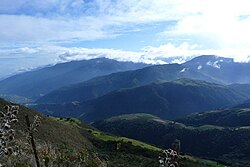
Táchira State is located in the Andes. Its highest point is La Montaña el Pulpito, which about 3995 meters above the sea level. Táchira's population is mainly located in San Cristóbal, the most important and prosperous city of this state. Tariba, Rubio, Colon, and La Grita are also other important urban centers in this state.

Forest in the Borotá Mountains, Municipality Lobatera
Venteadero waterfall.

It has international borders with Colombia in the west and south with Norte de Santander Department. Zulia and Mérida States lie to the north, and Barinas and Apure States lie to the east.

The main peaks are:[6]

  • The Pulpit: 3,912 m
  • Moor Battalion: 3,507 m
  • The Tama: 3,450 m
  • Moor La Negra: 3,450 m
  • Moor The Zumbador: 2,850 m

Crossed by the extension of the Andes mountain range from south to northwest, it divides the state into three different regions with a particular climate:

  • Mountain circuit; in this region are the main urban settlements in the state, the climate is temperate at high altitude8 in most of the region and high moorland at elevations above 3000 meters above sea level, with slight variations throughout the year, has a clear rainy season from May to October. The orography is uneven and influenced by the course of numerous rivers and streams that form valleys at the base of the mountains, as an example the capital city is settled on the valley of the river Torbes, this area represents most of the surface of the state. The main cities located in this area are San Cristóbal, Táriba, Michelena, Rubio and La Grita.
  • Pan-American circuit: this zone is located mainly in the north of the state, it shares the climatic characteristics of the southern region of the lake (of Maracaibo), with a tropical jungle climate, high rainfall and high temperatures. This region is one of the main centers of livestock production in Venezuela. It is on the border of the states of Zulia and Mérida. The main populations of this region are: La Fría, La Tendida and Coloncito.
  • Llanos region: a small part of the Venezuelan plains are briefly located southeast of the state of Táchira, on the border with the states of Apure and Barinas, the climate is tropical savannah, with less humidity than in the Pan-American zone, it is also a region of high livestock production. Its main populations are: La Pedrera, El Piñal and Abejales.

Relief

[edit]

Its territory has an area of 11,100 km2, where the Andean physiographic character predominates, with heights above 2,000 m. The mountainous relief is the southern continuation of the Mérida mountain range, which penetrates from the north in a southwesterly direction, exceeding 4,000 m in the La Negra moor.

Mountain formations, El Tamá National Park, Táchira State

In the extreme southwest, the Táchira depression was formed, which includes the tectonic trench through which the river of the same name runs and the entire relatively low area located between this trench and the valleys of the Lobaterita, the Torbes Medio and the Quinimarí Medio. The depression of the Torbes River separates the main range of the Mérida Range from the Tamá Range. During the Tertiary period, the uplifts of failed blocks formed deep valleys like those of the Uribante and Torbes rivers, with very steep slopes. In addition, there are relatively open basins with gently sloping terrain (San Cristóbal-Táriba-Rubio). The northern slopes come into contact with the lowlands located south of Lake Maracaibo, with large marshy areas, while the southeastern sector, from the eastern slope of the Uribante branch, is a transition zone between the piedmont (the lowlands of the mountainous formation) and the western high plains.

Climate

[edit]

The climate presents great variations, mainly due to the modifications by the height, in populations of the route to the plain, in the piedmont (El Piñal, San Joaquin de Navay among others), can reach temperatures of 30 °C like in the Pan-American route (La Fría, Coloncito). In the capital, San Cristóbal, the average daytime temperature is 24 °C and the nighttime temperature is 18 °C. However, in cities like Pregonero, El Cobre, La Grita and others located at higher altitudes, the temperature is considerably lower (up to 10 °C).

Vegetation

[edit]
Juan Pablo Peñaloza National Park

The mountain vegetation includes specimens such as the Lasso pine and eucalyptus. The apamates and the creole cedar are abundant. Mangos, guamas, pomarrosas, guavas and other fruit trees are common in most of the state.

Hydrography

[edit]

The hydrography is varied, there are several rivers of considerable course; the Torbes river, the Caparo river, the Uribante and the Doradas rivers among others, there are also some lakes and reservoirs, like the Uribante reservoir, the Caparo reservoir, the Garcia lagoon, the Rosal lagoon, the Ríobobo lagoon, among others.

General Juan Pablo Peñaloza National Park, Táchira, State
Laguna Grande

Extreme geographical landmarks

[edit]

Far North, confluence of the Rio Grande with the Rio Escalante (Pan-American); Far South, confluence of the Rio Burgua with the Los Pensamientos stream (Fernández Feo); Far East, confluence of the Rio Doradas (Cauce Viejo) with the Rio Caparo (Libertador); Far West, eastern bank of the Rio Táchira in front of the Cerrito, village Sabana Larga (Pedro María Ureña). Distance between the extreme points of the State: north-south, 147.88 km; east-west: 129.03 km.

Geology

[edit]

The Tachira Andes were formed during the Eocene period (between 56 million and 40 million years ago approximately), when the Nazca tectonic plate and the Caribbean plate began to slowly slide under the South American plate, raising older formations and bending the sedimentary and igneous rocks that form today's mountains (several of the highest peaks and moors in the State of Tachira are from the Phanerozoic eon, from the Precambrian period, about 539 million years ago).[7]

The tectonic forces generated by this collision created: the shapes of the highest mountains and peaks (El Pico El Púlpito, 3,912 m, in the northeastern end, and Cerro El Cobre, 3,612 m, in the southwestern end. Both are known as 'The Guardian Pillars of the Tachira'); a tectonic depression (known as the Tachira Depression, from the Pliocene); intramountain areas surrounded by higher ground, known as valleys (from the Pleistocene era). These are where the largest towns and cities are located); and the plains or lowlands of the north - lakes or the lake - and the south of the state - river plains - (areas of piedmont formed between the Miocene and Pliocene).

  • Highest point: El Púlpito Peak (3,912 m, Páramo de Batallón Mountain Range, Jáuregui and Uribante Municipalities).

Government and politics

[edit]

The State is autonomous and equal in political terms to the rest of Venezuela, its administration and public powers are organized through the Constitution of the State of Táchira, approved by the Legislative Council and published in the extraordinary official gazette of the State of Táchira, number 778, on February 9, 2001.

Bolivar Square, Libertador Municipality

Executive power

[edit]

It is composed of the Governor of Táchira and a group of state secretaries. The Governor is elected by the people by direct and secret vote for a period of four years and has the possibility of re-election for equal periods and a recall referendum in the middle of his term, being in charge of the state administration.

The State chooses its own Legislative Council as well as a Governor who is the Chief Executive of the State and is elected every 4 years; as of 1989, before that year he was elected by the President in office, his last Governor appointed by President Carlos Andrés Peréz, was Governor Jorge Enrique Romero, since 1989 he is chosen under direct elections, the current Governor Laidy Gómez is elected for the period (2017 - 2021) with the support of her party AD and other political organizations related to the Venezuelan opposition.

Legislative Council

[edit]

The State Legislature is the responsibility of the unicameral Legislative Council of the State of Táchira, elected by the people by direct and secret vote every (4) four years, and they may be re-elected for new consecutive periods, under a system of proportional representation of the population of the State and its municipalities. The State has 13 legislators.

Táchira State Police Logo

State Police

[edit]

The state of Táchira, in accordance with Article 164 of the Venezuelan Constitution and Article 45 of the Constitution of the state of Táchira of 2014, has its own police force, called Politáchira, created in July 1960. Its functions are regulated by state and national laws, namely the Law of the Autonomous Institute of Police of the State of Táchira, the former; and the Organic Law of the Police Service, the latter. It reports to the Secretariat of State Security and is primarily responsible for regional security.

Like the other 23 federal entities of Venezuela, the State maintains control over own police force, which is supported and complemented by the National Police and the Venezuelan National Guard.

Municipalities and municipal seats

[edit]
San Pedro del Río, Táchira State
Palmira, Tachira
Municipalities of Táchira
  1. Andrés Bello (Cordero)
  2. Antonio Rómulo Costa (Las Mesas)
  3. Ayacucho (Colón)
  4. Bolívar (San Antonio del Táchira)
  5. Cárdenas (Táriba)
  6. Córdoba (Santa Ana del Táchira)
  7. Fernández Feo (San Rafael del Piñal)
  8. Francisco de Miranda (San José de Bolívar)
  9. García de Hevia (La Fría)
  10. Guásimos (Palmira)
  11. Independencia (Capacho Nuevo)
  12. Jáuregui (La Grita)
  13. José María Vargas (El Cobre)
  14. Junín (Rubio)
  15. Libertad (Capacho Viejo)
  16. Libertador (Abejales)
  17. Lobatera (Lobatera)
  18. Michelena (Michelena)
  19. Panamericano (Coloncito)
  20. Pedro María Ureña (Ureña)
  21. Rafael Urdaneta (Delicias)
  22. Samuel Darío Maldonado (La Tendida)
  23. San Cristóbal (San Cristóbal)
  24. San Judas Tadeo (Umuquena)
  25. Seboruco (Seboruco)
  26. Simón Rodríguez (San Simon)
  27. Sucre (Queniquea)
  28. Torbes (San Josecito)
  29. Uribante (Pregonero)

State Capital

[edit]

The city of San Cristóbal is the capital of the state. It is an important economic pole for the country since it is located in the Colombian-Venezuelan border axis and, therefore, it is a commercial city where small and medium entrepreneurs develop important commercial transactions. It has a metropolitan population that exceeds 400,000 inhabitants. Its topography extends under a succession of river terraces and has an average temperature of 23 °C. It is at an altitude of 825 meters above sea level, which gives it a pleasant climate. San Cristóbal was founded on March 31, 1561, by the captain and advanced Juan Maldonado y Ordóñez, which makes it one of the oldest cities in Venezuela.

San Cristóbal, the state capital

Nowadays, the city of San Cristóbal is recognized by its wide academic and cultural activity. Its universities are recognized: Universidad de los Andes (Táchira nucleus), Universidad Nacional Experimental del Táchira (UNET) and Universidad Católica del Táchira (UCAT), among others, as well as for its San Sebastián International Fair.

Main towns

[edit]

The San Cristóbal metropolitan area, made up of the municipalities of Andrés Bello, Cárdenas, Córdoba, Guásimos, Libertad, Independencia, Tórbes and San Cristóbal, will have around 263,7659 inhabitants in 2011, which represents the largest population concentration in the state.

According to the data projected by the INE for the year 2013 the main population centers are

Nuestra Señora de los Ángeles Church, in La Grita
  • San Cristóbal: 263 765 inhabitants.
  • Táriba: 97 356 inhabitants.
  • Rubio: 95 041 inhabitants.
  • San Antonio del Táchira: 69 661 inhabitants.
  • San Juan de Colón: 69 387 inhabitants
  • La Fría: 60 392 inhabitants.
  • La Grita: 54 366 inhabitants.
  • Ureña: 51 900 inhabitants.
  • Palmira: 50 899 inhabitants.
  • El Piñal: 50 417 inhabitants.

Demographics

[edit]
Historical population
YearPop.±% p.a.
1873 68,619—    
1881 83,521+2.49%
1891 101,709+1.99%
1920 147,076+1.28%
1926 172,900+2.73%
1936 216,387+2.27%
1941 245,722+2.58%
1950 304,181+2.40%
1961 399,163+2.50%
1971 511,346+2.51%
1981 660,234+2.59%
1990 807,712+2.27%
2001 992,669+1.89%
2011 1,168,908+1.65%
Source: "XIV CENSO NACIONAL DE POBLACIÓN Y VIVIENDA - Resultados por Entidad Federal y Municipio del Estado Táchira" (PDF). Instituto Nacional de Estadística.


Race and ethnicity

[edit]

According to the 2011 Census, the racial composition of the population was:[8]

Racial composition Population %
White 743,013 58.8
Mestizo 38.6
Black 22,745 1.8
Other race 0.8

Ethnography

[edit]

The majority of the state's population is white, European contribution is notably higher than that of Indigenous and African Venezuelans. It is one of the Venezuelan states with the highest proportion of whites, mostly of Southern European descent.[citation needed]

Economy

[edit]

The Táchira has a very active economy because it is a border state where there is a great flow of capital, goods and services that exist between Venezuela and Colombia passing through this region.[citation needed]

Cattle in Táchira State
  • Primary sector
    • Fishing: blanco pobre, cachama, cajaro, coporo, palometa, torumo, tumare (in rivers), striped catfish.
    • Agricultural products: garlic, cambur, sugar cane, coffee, caraota, onion, potato, banana and tomato.
    • Livestock production: mainly cattle.
    • Forest resources: bucare, guamo, wax, laurel, butter, laso pine, quindu, among others.
  • Industrial activity
    • Industrial zone of Ureña, the largest and most diverse in the state (bodywork, plastics, textiles, furniture, construction, among others).
    • Food industry: dairy products, confectionery, preserves, coffee, typical bakeries.
    • Automotive: bus manufacturing.
    • Handicrafts: hammocks, textiles, pottery, saddlery, woodwork, tannery.
    • Mining industries: extraction of coal, asphalt, gypsum.
    • Manufacturing: textiles, footwear, clothing, leather factories; industries mainly located in the border area; currently they have been greatly reduced by the exchange rate differential and the closure of the border.
    • Energy: Uribante-Caparo hydroelectric complex.
Small farms in the mountains
  • Tertiary or service sector
    • Banking: Apart from the large national banks, the main bank in the region is represented by Banco Sofitasa, a solid financial institution that serves as an economic engine for the financing of many projects in the region. Táchira is also a business location for many other banking offices with a national presence.

Education

[edit]

The State of Táchira is the center of important universities.[citation needed]

Public Universities

[edit]
  • National Experimental University of Táchira - UNET
  • University of Los Andes, Táchira Nucleus - ULA
  • Universidad Pedagógica Experimental Libertador, Instituto Pedagógico Rural "Gervasio Rubio" - UPEL
  • University Institute of Agro-Industrial Technology - IUTAI
  • Universidad Nacional Experimental Politécnica de la Fuerza Armada, Núcleo Táchira - UNEFA
  • National Open University, Centro Local San Cristóbal - UNA
  • Simón Rodríguez National Experimental University, La Grita Center
  • Degree in Nursing, Romulo Gallegos University
  • Bolivarian University of Venezuela UBV Núcleo Táchira
  • Manuela Saenz Polytechnic University of the Territory UPT
  • National Experimental Security University UNES

Private Universities

[edit]
  • Bicentennial University of Aragua, San Táchira Agreement
  • Cecilio Acosta Catholic University, San Cristobal Extension - UNICA
  • Catholic University of Táchira - UCAT
  • Santiago Mariño Polytechnic University Institute, San Cristóbal Extension - IUPSM
  • Monsignor de Talavera University College, San Cristóbal Campus - CUMT
  • Antonio José de Sucre University Institute of Technology, San Cristóbal Extension - IUTAJS
  • Border University Institute - IUFRONT
  • University Institute of Industrial Technology - IUTI
  • Gran Colombia University Institute - IUGC
  • Jesús Enrique Lossada University Institute, San Cristóbal Extension - IUJEL
  • Juan Pablo Pérez Alfonzo University Institute of Technology, San Cristóbal Extension - IUTEPAL
  • International Center for Continuing Education - Caribbean International University Curaçao - CIDEC-

Religion

[edit]
San José Catholic Church, San Cristóbal

The state is predominantly Christian with the most widespread denomination being the Catholic faith. The first mass celebrated in the territory of the present Táchira State, was on July 25, 1558, in the Santiago Valley, on the solemnity of Santiago Apostle, and was carried out by the Dominican Friar Alonso de Andrada, chaplain of the expedition of Captain Juan Rodríguez Suárez. The first uninterrupted religious services, began in April 1561 in the Fort of Tapias, after the foundation of the city of San Cristobal. Thus, the first and oldest parish in the State of Táchira is the current parish of El Sagrario/San Cristóbal Cathedral, whose oldest sacramental books have been preserved since 1601. The Diocese of San Cristóbal de Venezuela/Dioecesis Sancti Christophori in Venetiola (erected by the Apostolic Constitution Ad munus of 1922), with its episcopal see in the city of San Cristóbal, belongs to the ecclesiastical province of the Archbishopric of Mérida.[citation needed]

Tourism

[edit]
Las Porqueras Park in La Grita
La Laguna Zoological Park, in Capacho

The state of Táchira offers different tourist attractions among which the walks on the mountain routes and the moors El Zumbador, Los Rosales, La Negra, el Tamá stand out; the cattle areas of the road to the plain and the South of the Lake (from Maracaibo), the Pan-American route, the traditional and costumbrist towns (Peribeca, San Pedro del Río, El Cobre, Pregonero), the architecture of San Cristóbal, La Grita, the numerous restaurants of typical Andean food, the sporting events held in the city of San Cristóbal (mainly the meetings of the Deportivo Táchira Fútbol Club, of the Venezuelan First Division League), the fairs and patron saint's celebrations, mainly the San Sebastián International Fair (FISS), among many others.[citation needed]

It is also the Táchira center for river sports activities, such as sport fishing (developed in the numerous river courses of the State, mainly in the Uribante, Caparo and Doradas rivers), some activities such as canoeing and other specialties are developed in the artificial lake formed by the Uribante-Caparo dam, of the hydroelectric complex of the same name.[citation needed]

The sites of greatest interest, both tourist and historical, are represented by some buildings of architectural value, which are closely linked with the Tachirenses due to the activities that are developed there such as public buildings, religious centers, entertainment and sports centers.[citation needed]

Grande Lagoon, Páramo Batallón y La Negra

The Ateneo del Táchira is the oldest in Venezuela, apart from being the first cultural center erected in the mentioned entity. Its foundation was carried out on April 19, 1907, although the construction that today looks was initiated in 1935, it is located in the street 9 with street 6 in the center of the city of San Cristóbal.[citation needed]

During January the Capital city of San Cristóbal celebrates its fiesta, which is recognized nationally for its industrial, commercial and agricultural exhibitions. During this time there are bull-fights, events, parties, and a number of artists come to have their shows.[9]

Important buildings

[edit]

Some important buildings in the capital are:

Facade of the Old Vargas Hospital
  • San Cristobal Civic Center
  • Covered markets: (La Guayana, Metropolitano, Los Pequeños Comerciantes, La Ermita, Santa Teresa).
  • "Genaro Mendez" Passenger Terminal"
  • Hospital Central de San Cristóbal Dr. José María Vargas (HCSC)
  • Sports facilities built for the 2005 Andes National Games, and 2007 Copa America: (Gymnastics Pavilion, indoor soccer stadiums, handball...)
  • Metropolitan Baseball Stadium
  • New Town Sports Complex.

Building heritage

[edit]
  • The Ateneo del Táchira or Old Reading Room
  • Steinvorth House
  • Tachira Anthropological Museum
  • Civic Center
  • Bridge Liberator
  • Christ King Monument-Capacho
  • Plaza Monumental de Toros de Pueblo Nuevo
  • Bridge Liberator
  • Bolivarian Lyceum "Simon Bolivar"
  • National School of Dance (ENDANZA Táchira)
  • Navy Lighthouse Monument

Natural heritage

[edit]

Some natural heritages of the Táchira are:

El Chorrerón Waterfall
  • Abra de Rio Frio natural monument.
  • Chorro El Indio National Park.
  • El Tamá National Park.
  • Páramo El Zumbador.
  • Juan Pablo Peñaloza National Park.
  • Casa del Padre (Father's House)
  • Thermal waters in Aguas Calientes Ureña
  • Cavernas de la Loma del Viento-Casa de John Rivera

Sports

[edit]
Pueblo Nuevo Stadium, Táchira State

The state of Táchira, together with Mérida and Trujillo, has been characterized as a region where the most popular sport is football. Currently the main football clubs based in the state are Deportivo Táchira F.C., which has won 8 titles in the First Division of Venezuela and also the Venezuelan club that has participated more times (22) in the Libertadores Cup of America; there are also Ureña Sport Club and Real Frontera Sport Club, the latter two members of the Second Division of Venezuela. Among other disciplines the Vuelta al Táchira in bicycle stands out, of great importance at national level, and that marks the beginning of the UCI America Tour.[citation needed]

Some sports facilities include the "Juan Maldonado" Sports Complex, the "La Marina" Park, the "Metropolitano" Park, the "Paramillo" Sports Complex, the "Pueblo Nuevo" Sports Complex which has facilities such as the J. J. Mora Velodrome, the San Cristóbal Metropolitan Stadium, the Monumental Bullring, the Armino Gutiérrez Castro Gymnasium and the Pueblo Nuevo Multi-Sport Stadium.[citation needed]

Transport

[edit]

El Táchira has important highways and a network of roads that cover much of its territory and communicate with the rest of the country: the Trasandina Highway, the Pan-American Highway or Trunk 1, the road to the plain or Trunk 5 and the San Cristóbal - La Fría Highway that is currently under construction. It also has three international bridges that connect it with neighboring Colombia: International Bridge Simon Bolivar, International Bridge Francisco de Paula Santander and the International Bridge Las Tienditas.[citation needed]

Rural road in Táchira State

The state has 4 airports, of which 3 are classified as international: Juan Vicente Gomez International Airport (closed), Santo Domingo International Airport and the International Airport "Francisco Garcia de Hevia" in La Fria, also has the Paramillo Airport a small capacity airport.[citation needed]

Media

[edit]
[edit]

The state's newspapers are based in San Cristóbal, these are the Diario Católico and the Diario La Nación. In addition to those mentioned, there is the Diario de los Andes, originally from Trujillo state, which has its own editorial and circulation for Táchira.[citation needed]

Television

[edit]

There are regional open-signal television channels:

Televisora Regional del Táchira (TRT), the oldest. TVCT Canal 21, a television plant with an open signal. Buena TV, the most recently created channel. As well as other community channels, such as Vida TV in Rubio and Montaña TV in Cordero. Similarly in Ureña there is a television station that covers the border, on both sides Intercanal Channel 10.

Currently the Colombian channels are transmitted as Channel 1, Citytv and Channel TRO for this state.[citation needed]

Radio

[edit]

The radio is the most traditional means of communication in the state, the first receptions were made through the radio service of Venezuela in 1926. In 1933, Radio Táchira, with a small transmitter with a range of less than one kilometer, began to operate informally in the state capital.10 It was the first radio station in the region and one of the pioneers of radio in Venezuela; later, in 1935, it began its formal transmissions, La Voz del Táchira (called Radio Táchira since 1971). Among the most representative capital stations (in AM) are Ecos del Torbes (founded in 1947), which can currently be heard from anywhere in the world and has its own news website; there are also the stations Radio Táchira, Radio Noticias 1060 (formerly Ondas de América and Radio San Cristóbal (in operation since 1954) that belong to the same González Lovera radio circuit and Radio San Sebastián.

Radio station in Tachira State

In the interior of the state, radio has also reached an important development. Thus, as early as 1954 in the city of Rubio, the station Ecos de Junín began to broadcast, which was later taken to San Cristóbal. In 1965, Radio Frontera emerged in San Antonio del Táchira and in 1970 Radio Sucesos de Táriba and Radio el Sol de La Fría.[citation needed]

FM began to develop in the 1990s with the launch of station 102.1 Stereo, known today as La Mega 102.1FM (currently part of the Mega Circuit). Since then, FM has been widely developed both in the capital and in the interior of the state.[citation needed]

See also

[edit]

References

[edit]
Revisions and contributorsEdit on WikipediaRead on Wikipedia
from Grokipedia
Táchira State is one of the 23 states comprising , situated in the southwestern Andean region and bordering to the west. It encompasses approximately 11,100 square kilometers of predominantly mountainous terrain, with elevations supporting temperate climates conducive to . The state capital is San Cristóbal, which serves as the primary urban center. The economy of Táchira relies heavily on agricultural production, including as a principal export crop, alongside ranching and limited industrial activities such as and processing. Historically, the state has played a significant role in Venezuelan , producing seven presidents between 1899 and 1994, reflecting the influence of its rural developed through agricultural prosperity. As a , Táchira has experienced economic and social pressures from cross-border and migration amid Venezuela's broader political and economic challenges, though official figures from the 2011 record 1,168,908 residents, likely lower due to . Táchira's landscape includes páramos and national parks, contributing to its ecological diversity and potential.

Etymology

Name Derivation and Historical Usage

The name "Táchira" derives from an indigenous toponym rooted in an ancient, extinct dialect of the Chibchan language family, prevalent among pre-Columbian peoples in the Andean border regions of present-day and . identifies it as a compound term ta-chi-ra, where ta denotes possession ("our"), chi refers to farming or the present state of land, and ra implies perpetuity or heritage, collectively translating to "our farming forever" or "land of our heredad" (enduring inheritance). This etymology underscores the agricultural significance of the territory to its original inhabitants, likely reflecting terraced farming practices in the highlands. Early Spanish colonial references adopted the name to designate the Río Táchira, a key waterway draining into the basin, with the term appearing in geographic descriptions by the mid-16th century as explorers mapped the Andean piedmont. Variations in , such as "Táchira" or "Táxira," emerged in administrative records due to from indigenous pronunciations, which lacked written form. The name's application expanded from the river to the surrounding province during the late colonial period, denoting a jurisdictional unit under the Governorate of . (Note: While is not cited, the indigenous etymology for Río Táchira is corroborated in the linked source's description.) By the 19th century, amid Venezuela's federalist reorganizations following independence, "Táchira" was formalized for the sovereign state entity established in 1899, retaining its indigenous core without alteration to reflect evolving political boundaries. This adoption preserved the term's pre-Hispanic essence, distinguishing it from Spanish-imposed names in other regions.

History

Pre-Columbian and Indigenous Foundations

The Táchira region, part of the Venezuelan Andes, was inhabited by indigenous groups collectively known as the Timoto-Cuica, comprising tribes such as the Timote, Cuica, Mucuchíes, and others, prior to European contact. These societies occupied highland areas across modern-day Táchira, Mérida, and Trujillo states, developing complex social structures adapted to the mountainous terrain. Archaeological evidence indicates settled communities with permanent villages, distinguishing them from more nomadic lowland groups. The Timoto-Cuica excelled in , employing terraced fields reinforced with stone walls on steep hillsides to maximize and prevent . systems channeled water from streams and springs to these terraces, enabling cultivation of staples including potatoes, , beans, sweet , , and various fruits like guaba and . This supported denser populations than in surrounding regions and facilitated surplus production for trade. Excavations reveal associated artifacts such as vessels and tools, attesting to specialized agricultural practices dating to the . Trade networks connected the Timoto-Cuica to neighboring and Carib groups on the and coast, exchanging highland goods like , salt, , cotton textiles, and semiprecious stones (e.g., and ) for coastal items including cocoa beans and marine products. Defensive and ceremonial structures known as mintoyes—rectangular enclosures possibly serving as forts, silos, or tombs—provide evidence of organized communities capable of regional interaction. Key sites, such as those near Escuque and Capacho in the broader Andean zone, yield pottery idols (tunjos) and carvings depicting and animal forms, highlighting practices tied to agrarian life. These findings underscore a with rudimentary industry, including and stoneworking, though limited ethnohistoric records from early Spanish chroniclers obscure precise timelines and demographics.

Spanish Colonization and Early Settlement

Spanish explorers first penetrated the Táchira region in the mid-16th century as part of broader conquest efforts into the , encountering armed resistance from indigenous groups such as the Timoto-Cuica descendants who inhabited the highlands. In March 1561, Captain Juan de Maldonado y Ordóñez de Villaquirán, a born around 1525, led an expedition of approximately 35 men into the Valley of Santiago, overcoming local opposition to establish the outpost of San Cristóbal on March 31. This founding, named after , served as a strategic frontier settlement amid the challenging mountainous terrain, facilitating Spanish control over trade routes linking the coast to the interior. The new settlement was incorporated into the colonial Province of Venezuela, governed from centers like , with early administration relying on military garrisons to maintain order against sporadic indigenous raids. Encomiendas were rapidly implemented, assigning indigenous laborers and tribute to Spanish grantees for agricultural production, though the steep slopes and poor soils restricted output to subsistence crops like and yuca, supplemented by nascent cattle herding introduced by settlers. Missionary activities followed, with Franciscan orders establishing doctrinas to convert and pacify native populations, though high mortality from and exploitation decimated local communities within decades. By the late , additional outposts like La Grita, founded in 1576, reinforced Spanish dominance, shifting the economic base toward as haciendas expanded on flatter valleys despite ongoing environmental constraints. These early efforts laid the groundwork for a sparse colonial , numbering fewer than 1,000 Europeans by 1600, sustained by coerced indigenous labor amid the province's isolation.

Independence Struggles and 19th-Century Formation

During Simón Bolívar's Admirable Campaign in 1813, forces advancing from New Granada crossed into Venezuelan territory via the Táchira region, liberating key towns such as San Antonio del Táchira along the Táchira River boundary. This strategic passage enabled republican advances against Spanish royalist positions, with local creole leaders and Andean inhabitants providing support to the patriot cause amid the broader struggle for Venezuelan independence. Bolívar's troops pursued retreating royalists to , marking an early incursion that bolstered the Second Republic's establishment later that year. Following Venezuela's full independence in 1821 and the in 1830, the Táchira territory initially remained part of the larger Mérida province amid ongoing centralist-federalist tensions. These debates culminated in administrative reorganizations favoring regional autonomy. On March 14, 1856, the Province of Táchira was formally created, encompassing the cantons of San Cristóbal, Lobatera, La Grita, and San Antonio del Táchira, separating it from Mérida. By 1863, amid the Federal War's push for , Táchira achieved statehood status within the Venezuelan . The 19th-century consolidation of Táchira as a state coincided with economic transitions, including the expansion of plantations in its Andean premontane zones, which became a principal driver by mid-century. cultivation, introduced earlier in the Venezuelan , spurred —from around 42,000 in to over 100,000 by the —fueled by agricultural opportunities and regional stability. developments, such as mule trails and early roads linking Táchira's towns to Colombian border areas, facilitated cross-border trade in and other goods, enhancing despite lingering ambiguities in the Venezuela- frontier demarcated partially by the 1833 Pombo-Michelena .

20th-Century Development and Oil Era

Táchira's economy in the early remained anchored in , with as the dominant crop cultivated in the Andean highlands, supporting regional modernization through expanded production and trade. Venezuela's national coffee exports reached a peak of 82,382 tons in , driven by Andean states including Táchira, where fertile slopes enabled high-quality yields that contributed to the country's position among top global producers. Tobacco cultivation also played a role in diversification, though secondary to , with state farms exporting cured leaves amid rising demand. Infrastructure advancements facilitated these exports, notably the Gran Ferrocarril del Táchira, a narrow-gauge line developed between 1893 and 1926 that linked coffee-growing interiors like Encontrados and La Uraca to broader networks toward coastal ports such as . By , Venezuela's railway network had expanded to approximately 100 kilometers in the Táchira region, reducing transport costs and enabling volume increases in agricultural shipments despite challenging terrain. These lines, powered initially by wood-burning locomotives, symbolized the shift from mule trails to mechanized logistics, though maintenance declined post-construction due to competing national priorities. Venezuela's , ignited by major discoveries in the and accelerating after , generated vast revenues that indirectly transformed non-oil states like Táchira through federal investments in roads, schools, and subsidies. Agricultural sectors benefited from price supports and projects funded by windfalls, sustaining coffee's viability even as national focus shifted eastward. Education expanded with new institutions and literacy campaigns backed by oil dollars, raising enrollment rates and skilled labor pools in the state by mid-century. San Cristóbal, as state capital, underwent accelerated post-World War II, with population growing to about 68,000 by 1950 amid rural migration drawn by administrative jobs, trade hubs, and improved connectivity. This influx doubled urban densities over subsequent decades, fostering commercial districts and basic services, though uneven distribution favored the capital over rural zones. Oil-era prosperity masked underlying vulnerabilities, as dependency on volatile revenues and creeping in national governance eroded upkeep and equitable distribution by the 1980s-1990s.

Post-1999 Political Instability and Economic Collapse

Following Hugo Chávez's election in 1998 and inauguration in 1999, Táchira emerged as a regional center of opposition to his , with the state consistently voting against Chavista candidates in subsequent elections and serving as a base for anti-government mobilization. Local universities, including the Universidad Católica del Táchira in San Cristóbal, became focal points for student-led dissent against policies perceived as eroding democratic institutions and economic freedoms. This opposition intensified during the 2002 attempted coup against Chávez, though Táchira's role was more pronounced in sustaining broader resistance networks rather than leading the events. The 2014 protests, which began in San Cristóbal after the February 4 attempted rape and beating of a University of the student, escalated into nationwide unrest against shortages, inflation, and government repression, with Táchira experiencing some of the most sustained and clashes. Venezuelan security forces, including the , deployed paratroopers to Táchira on February 22, 2014, to dismantle and restore order amid reports of over 20 deaths and hundreds injured nationally by July. documented widespread use of rubber bullets and arbitrary detentions in the state, attributing at least 54 injuries to such tactics during the February-July period. These events highlighted Táchira's strategic border position, facilitating cross-border support from but also prompting government border closures that exacerbated local economic isolation. Nationally, policies of , currency mismanagement, and expropriations under Chávez and successor triggered a GDP contraction exceeding 75% from 2013 to 2021, the largest peacetime economic decline recorded, severely impacting Táchira's agriculture-dependent economy reliant on crops like and . , driven by monthly expansions of 20-30%, peaked at over 1 million percent in 2018 per IMF estimates, rendering agricultural inputs unaffordable and leading to widespread farm abandonments and reduced output in states like Táchira. caps on staples distorted markets, causing shortages that hit Táchira's rural producers hardest, as evidenced by government admissions of agricultural crisis requiring 1.2 billion bolívares in 2018 interventions. The July 28, 2024, , marred by disputes over results showing opposition candidate Edmundo González leading with tally sheets from over 80% of precincts, sparked renewed unrest in Táchira, including protests in San Cristóbal where demonstrators waved flags and copies of opposition vote proofs. Maduro's claim of victory prompted crackdowns, with reporting arbitrary arrests and excessive force against voters and protesters nationwide, including in opposition strongholds like Táchira. These events underscored ongoing tensions, with localized barricades and "" pot-banging demonstrations reflecting persistent grievances over electoral irregularities and economic mismanagement.

Geography

Location, Borders, and Regional Context

Táchira State occupies the southwestern portion of in the , spanning latitudes from 07°20' to 08°39' north and longitudes from 69°57' to 71°29' west. Covering an area of 11,100 square kilometers, it represents about 1.2% of 's national territory. Its position in the , to the southwest of the main Andean cordilleras, underscores its role as a transitional zone between the highland interior and the international frontier. The state shares an extensive western border with Colombia's Norte de Santander Department, forming part of the 2,219-kilometer international boundary between the two nations. Domestically, Táchira adjoins Zulia State to the north, Mérida and Barinas States to the east, and Apure and Barinas States to the south. This configuration positions Táchira as a geopolitical linchpin, where the porous Colombian has historically enabled cross-border alongside challenges such as and large-scale migration, exacerbated by Venezuela's socioeconomic conditions since the . The Andean fosters relative isolation from Venezuela's coastal lowlands, contributing to a distinct regional identity rooted in highland culture and frontier dynamics.

Topography, Relief, and Extreme Features

The of Táchira State features the dissected Andean highlands of the Sierra de Táchira and extensions of the Mérida Cordillera, characterized by steep escarpments, intermontane basins, and elevated plateaus. Elevations span from a recorded minimum of 9 meters in peripheral lowlands to 3,942 meters at Pico El Pulpito, the state's highest peak located in the del Batallón. This vertical relief, averaging 925 meters statewide, arises from tectonic uplift and thrusting, fostering concentrated settlements in valleys while limiting development on higher slopes. Key relief elements include the Tamá Massif's summits over 3,500 meters, such as Cerro El Cobre at 3,613 meters, and deep structural valleys like the Ureña Depression, where floors at approximately 800 meters contrast sharply with surrounding ridges exceeding 2,500 meters. These formations reflect compressional deformation in the Táchira Depression, with Miocene-Pliocene faults elevating rocks and creating pronounced topographic asymmetry. Extreme features encompass high páramos with rolling highlands and fault-controlled escarpments, alongside seismic vulnerabilities from active Andean . The region hosts faults, including branches of the San Pedro-Aguas Calientes system traversing valleys, contributing to proneness and episodic ground instability that influences and placement.

Climate Patterns and Environmental Zones

Táchira features a tropical highland climate shaped by its Andean elevation range, spanning from lowland valleys near 100 meters to peaks exceeding 4,000 meters, resulting in pronounced . Mid-elevation areas, such as San Cristóbal at approximately 800 meters, exhibit average temperatures of 17–28°C annually, with means around 20–22°C and minimal seasonal variation due to equatorial proximity. Lower valleys, like San Antonio del Táchira below 300 meters, record warmer averages of 21–32°C, approaching tropical conditions. follows a bimodal pattern, with rainy seasons peaking in April–May and September–October, yielding 1,000–1,500 mm annually in populated valleys, though orographic effects amplify totals in windward slopes. Higher environmental zones transition through premontane and montane forests between 1,000–3,000 meters, supporting microclimates ideal for crops like coffee in the 1,000–1,500 meter belt, where stable 18–24°C temperatures and consistent moisture prevail. Above 3,000 meters, páramo ecosystems dominate, characterized by cooler temperatures often below 10°C, frequent frosts, and reduced precipitation relative to lower forests, averaging under 1,000 mm in exposed areas due to evapotranspiration and fog interception rather than direct rain. These zones host unique alpine tundra-like vegetation adapted to diurnal fluctuations exceeding 20°C. The region's climate shows vulnerability to El Niño-Southern Oscillation events, which induce droughts by suppressing convective rainfall; for instance, the 2015–2016 episode lowered reservoir levels across western , exposing submerged sites in Táchira like and straining water availability. Human-induced , at rates of approximately 1.8 kha of natural forest loss in 2024 per satellite monitoring, has altered local patterns by reducing and increasing runoff, thereby heightening susceptibility during intense rains. Such losses, concentrated in Andean slopes, compound in already steep terrains without directly shifting macro-climatic averages.

Hydrography, Vegetation, and Geology

The hydrographic system of Táchira features rivers draining into both the and basins, reflecting the state's position in the Táchira Depression, a structural linking these watersheds. Key waterways include the Torbes , which originates in the Andean highlands and flows northwest to join the Catatumbo River en route to , supporting local and potential. The Uribante-Caparo system, conversely, drains eastward into the via the Meta River, with tributaries like the Doradas contributing to recharge that sustains agriculture in fertile valleys. These rivers exhibit high runoff coefficients due to steep , averaging 9.1 mm annual storage in basins like the Topo , but pose hazards during heavy Andean rains. Vegetation in Táchira varies by , encompassing tropical Andean forests at lower altitudes, transitioning to forests and grasslands above 3,000 meters. Lower slopes host plantations amid diverse including pino criollo (Pinus pseudostrobus), apamates, and cedro criollo, while mid-elevations feature humid montane forests with multilayered strata supporting high floristic diversity. Páramos, hotspots, are dominated by frailejones ( spp.), with over 140 species in the Espeletiinae subtribe adapted to cold, windy conditions, alongside lichens, mosses, and xerophytic plants; these ecosystems harbor endangered endemics vulnerable to habitat loss. The region's underpins ecological services like water retention, though fragmentation from threatens . Geologically, Táchira lies within the Mérida Andes, characterized by folded and faulted sedimentary sequences from to Tertiary ages overlying basement, shaped by and relative motion between the Cordillera Oriental and Santander blocks. The Táchira Depression exhibits a complex fault network, including the seismically active Boconó Fault, contributing to tectonic deformation and risks, as evidenced by historical seismic events tied to ongoing compression. Mineral resources include coal deposits in the Marcelina Formation, mined in western areas with trace elements linked to volcaniclastic inputs, and in formations like the Palmarito series used for ; however, no major reserves exist, limiting resource potential compared to eastern . Sedimentary basins here prioritize tectonic hazards over extractive value.

Demographics

Population Dynamics and Urban Centers

The population of Táchira State was recorded at 1,168,908 in the 2011 national . Projections based on that census estimated growth to 1,271,560 by 2019, yielding a of approximately 114.6 inhabitants per square kilometer across the state's 11,100 square kilometers. However, 's ongoing socioeconomic has led to significant net population outflows since 2015, likely reducing Táchira's actual resident to around 1.1-1.2 million by 2023, with density closer to 100 per square kilometer, as national-level emigration estimates indicate millions departing highland border states like Táchira. San Cristóbal, the state capital and primary urban center, dominates Táchira's settlement pattern, with an estimated metropolitan population of 487,000 in 2023. Other notable urban hubs include San Antonio del Táchira (population approximately 32,000), a key border commercial node, and smaller centers like Rubio and Coloncito, each under 20,000 residents, reflecting a hierarchical structure where over 40% of the state's populace concentrates in the capital's agglomeration. Urbanization in Táchira exceeds 80%, surpassing national averages, driven by Andean highland migration patterns that historically shifted labor from rural and zones to urban services and since the mid-20th century. Pre-2015, annual urban growth rates hovered around 1-2%, but post-crisis stagnation has halted expansion, with urban populations contracting due to outward migration amid economic contraction and border dynamics. The age structure in Táchira was historically youthful, with a age of about 28 years in early , featuring roughly 30% under 15 and limited elderly cohorts under 5% over 65, aligned with high in agricultural peripheries. Recent youth exodus—disproportionately affecting working-age males and females—has skewed demographics toward relative aging, elevating dependency ratios as prime-age cohorts (15-64) diminish relative to remaining children and seniors, though precise post-2015 breakdowns remain limited due to gaps in Venezuelan vital .

Ethnic Composition and Cultural Ethnography

The ethnic composition of Táchira's , based on self-identification in the 2011 national , features a majority of European-descended residents at approximately 58% (681,463 individuals), followed by mestizos at 39% (447,576 individuals), reflecting historical Spanish settlement patterns and intermarriage in the Andean highlands. constitute a small minority of about 0.8% (9,554 individuals), while indigenous-identifying persons number only 589, or roughly 0.05%, indicating near-complete assimilation of pre-colonial groups into the broader . These proportions deviate from national averages, where mestizos predominate at 51.6% and whites at 43.6%, attributable to Táchira's geographic isolation in the mountains and proximity to European-influenced Colombian border regions that limited African and extensive indigenous demographic influxes. Pre-Columbian roots lie with the Timoto-Cuica peoples, Chibcha-speaking agriculturalists who constructed terraced fields, reservoirs, and conuco systems across Táchira, Mérida, and Trujillo states from around 1000 BCE to Spanish contact, fostering advanced chiefdoms with trade networks in , textiles, and goldwork. Contemporary indigenous presence is minimal, with few unassimilated descendants; genetic studies identify residual Timoto-Cuica ancestry in southern Venezuelan Andean populations via shared indigenous markers, but cultural continuity is largely folkloric rather than communal. Remaining ethnic minorities, including , cluster in lower-elevation valleys near trade routes, often tied to 19th-century labor migrations rather than colonial concentrations seen in coastal . Culturally, Táchira exhibits Andean highland ethnography distinct from Venezuela's llanero plains or Caribbean coast, emphasizing communal agrarian cooperation via minga-like labor exchanges for coffee and onion harvests, rooted in Timoto-Cuica terracing legacies adapted to steep slopes. Family units are typically extended and patriarchal, prioritizing intergenerational land tenure and mutual aid networks that buffer economic volatility, contrasting with the more fluid, individualism-oriented kinship in lowland regions. Traditional expressions include variants of string-based dances like the Candela and Three Andeans, performed at harvest festivals with European-indigenous fusion instrumentation such as the cuatro guitar and maracas, underscoring resilience in patrilineal households amid historical isolation. These traits foster tight-knit rural polities oriented toward self-reliance, differing from the extroverted, cattle-driven sociality of the Orinoco plains or urban cosmopolitanism of Caracas. Táchira has played a central role in Venezuela's mass since , as the state shares a 220-kilometer with Colombia's , facilitating both formal and informal outflows. Approximately 7.9 million have emigrated overall, with a significant portion—estimated in the hundreds of thousands—crossing through Táchira's bridges, such as and , or via hundreds of clandestine trails known as trochas. These routes became primary escape paths amid exceeding 1 million percent annually in 2018 and widespread food shortages, compelling families to seek survival across the porous frontier, according to UNHCR assessments. Daily border flows peaked between 2018 and 2020, with over 40,000 people—Venezuelans and combined—crossing for trade, work, and migration before restrictions; migrant-specific volumes reached thousands per day via trochas, often under hazardous conditions controlled by armed groups. By early 2020, hosted over 1.8 million , many having entered through Táchira, underscoring the state's position as an of the regional . Informal crossings persisted despite closures, driven by immediate humanitarian needs like access to and unavailable in . Post-2022, partial economic stabilization—including informal dollarization—has prompted limited return migration, with UNHCR and IOM documenting inflows alongside outflows, though net emigration continues at rates of around 100,000-140,000 annually nationwide. In Táchira, this has resulted in a net population loss of approximately 20-30 percent since the crisis onset, exacerbating local demographic shifts and straining remaining communities, per projections adjusted for border-specific flows. UNHCR data attributes sustained outflows to unresolved structural factors, despite returns estimated in the hundreds of thousands during the and beyond.

Economy

Traditional Agriculture and Primary Production

Táchira's traditional agriculture centers on cash crops suited to its Andean topography, with as the dominant staple, supplemented by and . Smallholder farms, typically averaging 5 hectares, prevail across terraced slopes, yielding high-quality arabica adapted to elevations between 1,000 and 1,800 meters. Táchira ranks among Venezuela's leading coffee-producing states, contributing to national output that peaked at 91,577 metric tons in 2001 before broader declines. serves as another key commercial crop, cultivated in lower valleys for sugar and ethanol processing, while supports local food security through rain-fed and irrigated plots. Livestock rearing, particularly , traditionally occupies valley floors and intermontane basins, integrating with crop systems for . and production rely on dual-purpose breeds grazed on natural pastures, though average yields remain low at 2-2.5 liters per cow per day in Andean zones like Táchira. Pre-2010s coffee harvests from Táchira's slopes often exceeded contributions aligning with regional benchmarks of several thousand tons annually, facilitated by informal cross-border exports to via shared Andean routes. output in the valleys has since halved from mid-2010s levels, attributed to persistent shortages disrupting traditional and supplementation practices. These sectors underscore Táchira's reliance on family-operated, terrain-adapted , distinct from mechanized plains farming elsewhere in .

Industry, Trade, and Cross-Border Commerce

Táchira's industrial base remains modest, centered on light activities in urban hubs like San Cristóbal, where —particularly dairy, cheese, and basic staples—supports local consumption and limited . production, including apparel and fabrics, also operates on a small scale, leveraging regional labor but constrained by national disruptions and shortages. manufacturing contributes to needs, with facilities processing local aggregates for infrastructure projects. Cross-border trade with , facilitated by key crossings such as the Simón Bolívar International Bridge linking San Antonio del Táchira to , underpins much of the state's non-agricultural commerce. Formal cargo trade, reopened in 2022 after years of closures, has gradually revived, enabling flows of Colombian consumer goods, electronics, and pharmaceuticals into , where price differentials drive demand. Informal trade, often involving pedestrian crossings for , , and household items, has historically sustained border communities amid domestic scarcities; in early 2014 alone, Venezuelan authorities in Táchira seized over 14,000 tons of smuggled and meat, indicating the scale of unregulated exchanges estimated to generate billions regionally before 2015 restrictions. Remittances from Táchira emigrants, predominantly to and other nations, form a critical economic pillar, with surveys indicating high reliance in the state—comparable to or exceeding national averages where inflows reached $4.2 billion or about 5% of GDP in 2022. Regional migration patterns suggest remittances comprise 10-20% of local GDP analogs, funding consumption and informal commerce while offsetting industrial stagnation.

Decline Under Central Government Policies

Following the implementation of nationwide on agricultural products under President Hugo Chávez's administration in 2003, with intensified enforcement after 2007, coffee producers in Táchira faced severe disincentives to maintain output, as fixed procurement prices failed to cover rising production costs amid . These controls, aimed at curbing but distorting market signals, led to widespread underinvestment in cultivation, a staple of Táchira's , resulting in national production plummeting from approximately 12 million 60-kg bags in the early to under 2 million bags by the 2020s—an overall decline exceeding 80 percent from peak levels. In Táchira, home to significant plantations, this manifested in farm abandonment and reduced yields, as farmers could not afford inputs like fertilizers without access to profitable sales channels. Compounding these agricultural controls, the central government's of coffee processing facilities, including those in Táchira, further eroded private incentives; for instance, in , decrees expropriated processors like Fama de América C.A. and Caféa C.A., citing hoarding but effectively transferring operations to state entities plagued by inefficiency. Such interventions, directed from , prioritized ideological redistribution over productivity, leading to of raw beans across the Táchira-Colombia to evade controls, which bypassed formal markets and starved local industry of revenue. By the mid-2010s, Venezuela's reliance on imported —despite Táchira's potential—highlighted how these policies prioritized short-term political gains over , with production data showing contractions predating . Hyperinflation, driven by monetization of deficits rather than external factors alone, devastated Táchira's ; annual rates exceeded 800 percent by 2016, eroding real incomes and rendering fixed-price goods unviable for producers. attributes the GDP contraction—national output falling over 75 percent from 2013 to 2021 primarily to pre-2014 fiscal mismanagement, including squandering windfalls on subsidized imports and inefficient spending, which depleted reserves without bolstering non- sectors like Táchira's . In Táchira, this fostered heavy dependence on black-market trades and goods from , as official exchange rates decoupled from reality, enabling informal cross-border flows but undermining licit economic activity and exacerbating in controlled staples. Pre-sanctions data from 2010 onward confirm internal distortions as the core driver, with revenues—peaking under Chávez—diverted to rather than productive , leaving regions like Táchira vulnerable to policy-induced .

Government and Administration

State Executive, Legislative, and Judicial Structures

The executive power in Táchira is exercised by the Governor, elected by universal, direct, and secret suffrage for a four-year term, as stipulated in Article 160 of the 1999 Constitution of Venezuela. The Governor oversees the state's administration, including the execution of policies, management of public services, and coordination with national and local entities, while operating within the framework of federal subordination to the national executive. State budgets, heavily reliant on the Situado Constitucional—a mandatory transfer comprising at least 20% of the national budget allocated to states and municipalities based on population and other factors—have faced significant reductions during Venezuela's economic crisis, with allocations dropping by up to 72% in recent years compared to pre-crisis levels, exacerbating fiscal constraints for state operations. The legislative authority resides in the unicameral Consejo Legislativo del Estado Táchira (CLET), comprising 13 deputies elected every four years via a mixed system of proportional list and nominal constituency representation, in accordance with the on State Legislative Councils and electoral regulations scaled to the state's of approximately 1.2 million. The CLET holds sessions to enact state-level laws, approve the annual proposed by the , authorize public , and exercise oversight through interpellation and investigation committees, though its is limited by national oversight and the requirement for alignment with federal legislation. Judicial functions at the state level are handled by the Circunscripción Judicial del Estado Táchira, which includes superior courts (such as the Tribunal Superior Civil, Mercantil, Penal, and Contencioso Administrativo), first-instance tribunals, municipal courts, and specialized judges for matters like family, labor, and rural jurisdictions, all under the hierarchical supervision of the national Supreme Tribunal of Justice (TSJ). These courts adjudicate local civil, criminal, and administrative disputes, with appeals escalating to TSJ chambers, ensuring uniformity with national while addressing regional caseloads, including border-related issues.

Municipal Organization and Local Governance

The State of Táchira is administratively subdivided into 29 municipalities, representing the highest number of such units among all Venezuelan states. Each municipality constitutes an autonomous local government entity, headed by an elected who exercises executive functions and is supported by a municipal council for legislative oversight. Mayors are selected through direct popular elections conducted every four years by the National Electoral Council, ensuring periodic accountability to local electorates. Municipal authorities are tasked with managing core local competencies under the Organic Law of Municipal Public Power, including the administration of urban development, sanitation services, maintenance of intra-municipal roadways, and coordination of community-level public utilities such as water supply and lighting. These responsibilities emphasize self-governance in addressing immediate territorial needs, distinct from state-level oversight. The municipality of San Cristóbal, with its seat in the eponymous city, serves as the administrative core, handling urban planning and service delivery for over 500,000 residents in the state's densest population center as of recent estimates. Rural municipalities like (seated in San Juan de Colón) and Bolívar prioritize agricultural and , supporting activities central to their economies. In contrast, border-adjacent municipalities such as Pedro María Ureña (seated in Ureña) and García de Hevia (seated in La Fría) manage local facets of international boundary operations, including facilitation of authorized commerce and basic for cross-border connectivity. These entities demonstrate varied administrative capacities shaped by geographic and economic factors, with urban seats generally benefiting from higher streams for service execution.

State Police and Security Apparatus

The Policía del Estado Táchira, commonly known as Politáchira, serves as the primary state-level responsible for maintaining public order and combating within Táchira. Established under Venezuela's decentralized police framework, it operates with over the state's municipalities, emphasizing preventive patrols, control on major highways, and responses to urban such as and illicit trade. Politáchira coordinates closely with national security entities, including the Cuerpo de Policía Nacional Bolivariana (PNB) and, prior to its dissolution in 2020, the Fuerzas de Acciones Especiales (FAES). Joint operations are facilitated through centers like the Centro de Coordinación Policial in San Cristóbal, where state and federal forces collaborate on deployments involving dozens to hundreds of personnel for targeted initiatives. Such coordination has been documented in efforts to address cross-jurisdictional threats, with explicit linkages noted between FAES units in Táchira and regional military commands. The apparatus faces operational constraints due to equipment and resource limitations, intensified by international sanctions imposed on Venezuelan entities since 2017, which restrict access to imported vehicles, firearms, and maintenance supplies. State officials have highlighted these shortages, leading to increased dependence on federal government allocations for logistical support and operational sustainment, as evidenced in public protests by security personnel against sanction impacts.

Politics and Security

Political Alignment and Opposition Role

Táchira has established itself as a stronghold of opposition to since the early 2000s, routinely providing majorities to anti-government candidates in both regional and national contests. In the 2008 regional elections, opposition forces captured the Táchira governorship, prevailing in one of only five states where President Hugo Chávez's (PSUV) candidates were defeated. This pattern continued into the 2010s, with the state delivering over 70% of votes to opposition presidential contender in the April 2013 election amid national results that narrowly favored Nicolás Maduro. Such outcomes underscore Táchira's divergence from Chavismo-dominated regions, driven by local grievances over economic policies and central oversight. By the 2020s, Táchira's political alignment shifted toward unified opposition platforms, exemplified by widespread support for María Corina Machado in the October 2023 Unitary Platform primaries, where she secured approximately 93% of the national vote and strong participation from border states like Táchira. This consolidation reflected broader anti-regime sentiment, positioning the state as a key node in coordinated opposition efforts ahead of the 2024 presidential vote, where independent tallies indicated overwhelming local backing for the anti-Maduro slate. Despite consistent electoral majorities, Táchira's opposition role has faced federal encroachments, including interventions in local governance structures. Between 2014 and 2017, the assumed control over police forces in five opposition-led states, including Táchira, citing rationales but effectively curtailing autonomous administration. Electoral audits and opposition documentation have highlighted instances where verified local victories were undermined by national authorities, perpetuating Táchira's status as a contested opposition enclave.

Electoral Controversies and Protest Movements

Táchira has been a focal point for allegations of electoral irregularities in Venezuela, particularly during the 2017 regional elections and the 2024 presidential vote, where the state emerged as an opposition stronghold. In the 2017 gubernatorial contest, the opposition candidate Laidy Gómez won with 53.3% of the vote amid reports of discrepancies and subsequent political persecution, including her eventual arrest in 2020 on charges critics deemed fabricated. Similar claims surfaced in the 2024 presidential election, with opposition tallies from digitized voting receipts showing candidate Edmundo González securing a majority nationwide, including strong margins in Táchira, contradicting official results proclaiming Nicolás Maduro's victory by 51.2%. Independent analyses, such as those by the Washington Post, verified over 80% of opposition-collected tallies, highlighting manipulations like unverified tallies and voter intimidation, though Táchira-specific blackouts during counting were not uniquely documented beyond nationwide grid failures post-election. Protest movements in Táchira intensified following disputed elections, with the state serving as an epicenter due to its border proximity and anti-government sentiment. The 2014 protests originated in San Cristóbal, Táchira's capital, triggered by student-led demonstrations against economic policies and violence, resulting in clashes where security forces used excessive force, leading to at least three deaths nationwide on the first major day and hundreds of arrests overall. In Táchira specifically, detainees like Rafael Ángel Cardozo Maldonado faced arbitrary arrest and ill-treatment during operations in San Cristóbal. By year's end, Venezuelan authorities had arrested over 3,689 protesters nationwide, with documenting torture and brutality in detention centers, patterns evident in Táchira cases. The 2017 protests, spurred by the National Assembly's dissolution and electoral disputes, saw heightened violence in Táchira, where three individuals—including two teenagers—were killed amid clashes with and pro-government groups. Nationwide, these events claimed 164 lives, with Foro Penal recording over 13,100 arrests since 2014 linked to anti-government actions, many in opposition hotspots like Táchira. Student-led civic resistance, including barricades and marches, contributed to broader national momentum against Maduro's policies, though met with lethal force from the and colectivos. In 2019, protests in Táchira coincided with Juan Guaidó's opposition leadership claim, resulting in 43 deaths nationwide from security force actions, per human rights monitors, alongside arbitrary detentions. The and attributed many fatalities to disproportionate use of force, with Táchira's unrest exemplifying patterns of repression that stifled dissent without accountability. Post-2024 election, Táchira witnessed renewed demonstrations rejecting Maduro's proclaimed win, leading to over 2,000 arrests nationwide by September, including opposition figures, amid reports of passport cancellations and voter harassment. These movements underscore Táchira's role in sustaining non-violent opposition, despite risks of escalation from state responses.

Border Security Challenges and Irregular Armed Presence

The porous 140-kilometer border between Táchira state and Colombia's serves as a haven for Colombian guerrilla groups, including the National Liberation Army (ELN) and dissident factions of the (FARC), which extend operations into Venezuelan territory to manage smuggling corridors for narcotics, , and migrants. These non-state actors impose levies on irregular crossings, with ELN fronts documented taxing Venezuelan migrants and locals in Táchira municipalities like Casigua, where they maintain control over rural enclaves. Venezuelan state incapacity, characterized by a permissive operational environment under the Maduro administration, has facilitated the entrenchment of these groups alongside domestic irregulars, including pro-regime colectivos repurposed for border enforcement. In Táchira, the Border Security Colectivo, established in 2018, functions as a paramilitary extension loyal to the government, patrolling areas like San Antonio del Táchira and clashing with opposition elements during heightened tensions. This overlap blurs lines between state-aligned militias and transnational insurgents, amplifying threats from cross-border recruitment of desperate Venezuelans into ELN and paramilitary ranks. Border closures in early , enacted by Venezuelan authorities amid the escalating , redirected flows to trochas (unofficial trails), precipitating acute spikes as groups intensified and territorial disputes. Kidnappings in Táchira rose sharply in the first half of , linked to guerrilla ambushes on migrants and the erosion of formal checkpoints, with non-state actors exploiting the vacuum left by weakened official security. Mutual distrust between Colombian and Venezuelan forces has compounded these challenges, fostering unchecked guerrilla mobility and sporadic clashes, as evidenced by persistent reports of binational incursions.

Human Rights Issues and Violence Statistics

Táchira has experienced elevated levels of violence linked to its border location with , facilitating cross-border criminal activities and the presence of irregular armed groups such as Colombian guerrillas. According to the Observatorio Venezolano de Violencia (OVV), an independent Venezuelan NGO tracking empirical data through media and official sources, the state's violent death rate stood at 11.3 per 100,000 inhabitants in 2023, the lowest nationally despite a historical context of higher figures, such as 23 per 100,000 in 2018. This decline reflects broader national trends amid reduced reporting and state control, but border municipalities like and Pedro María Ureña continue to report disproportionate incidents, with 17 homicides recorded in August 2019 alone, often tied to disputes and organized crime. In 2021, OVV documented 88 homicides in Táchira, many influenced by incursions from groups like the ELN and exploiting governance gaps for extortion and territorial control. Human rights abuses by state security forces, including the Táchira state police and national units, have been recurrent during anti-protest operations and border security sweeps. In , Táchira emerged as a focal point for nationwide demonstrations, where security agents employed excessive force, resulting in dozens of arbitrary detentions without , as reported by local monitors. These detentions often involved charges of or under expanded decrees, with detainees facing prolonged pretrial holds and limited access to legal counsel. Extrajudicial killings by state agents, such as those in operations targeting alleged guerrilla collaborators, have included documented cases of summary executions and in border zones, contributing to a pattern of where investigations rarely lead to prosecutions. Provea, a Venezuelan NGO with a track record of on-the-ground verification despite government harassment, has mapped protest-related violations in Táchira, highlighting arbitrary arrests as a tool to suppress dissent amid economic unrest. Violence from both state repression and non-state actors has driven internal displacement, with rural families fleeing armed group control and urban clashes. Governance failures, including weak institutional presence allowing armed incursions, underlie much of this displacement rather than ideological conflicts alone, as empirical patterns show spikes tied to territorial disputes over smuggling routes. While precise Táchira figures are underreported due to restricted access for monitors, broader data from NGOs indicate thousands affected annually in border states, with Táchira residents relocating to urban centers like San Cristóbal to evade and direct threats. Recent cross-border spillover, such as 2025 clashes in adjacent Catatumbo prompting Venezuelan-side movements, exacerbates local .

Culture and Society

Religious Composition and Practices

The population of Táchira is predominantly Roman Catholic, aligning with national trends where approximately 71% of identified as Catholic in early 2020 surveys, though older estimates placed the figure higher at 92-96% due to nominal adherence. Evangelical has expanded notably since the early , reaching about 13% nationally by 2021, with growth attributed to socioeconomic instability drawing adherents seeking community support and spiritual solace. Smaller groups include other , with negligible Muslim, Jewish, or indigenous spiritual adherents reported in the state. Catholic practices dominate religious life in Táchira, featuring annual observances like Semana Santa, which includes processions reenacting the Passion, visits to seven churches on Holy Thursday symbolizing Christ's walks, and communal meals of seven traditional potajes representing the . Central sites include the Cathedral of Our Lady of Mount Carmel in San Cristóbal, a hub for diocesan activities and pilgrimages. Evangelical communities emphasize study groups and worship services, often in informal settings adapted to urban and rural needs. Amid Venezuela's since the mid-2010s, the in Táchira has coordinated aid efforts, including food distributions and migrant support near the Colombian border through Caritas networks, compensating for deficiencies in state welfare systems. Church leaders have openly criticized government mismanagement of shortages, positioning religious institutions as key providers of material and moral assistance in border municipalities like San Antonio del Táchira.

Education Institutions and Literacy Rates

The literacy rate in Táchira aligns closely with national figures, estimated at approximately 97% for adults aged 15 and older, based on data for reporting 97.6% in 2022. However, youth literacy (ages 15-24) has shown slight declines amid the economic , with national rates around 97.5% in recent assessments, reflecting challenges in sustaining educational access in border regions like Táchira. Public primary and secondary schools in Táchira face chronic underfunding, exacerbated by Venezuela's broader fiscal collapse, leading to dilapidated infrastructure, shortages of materials, and irregular school feeding programs where students in over 1,000 institutions receive meals only twice weekly as of 2017, with conditions persisting into the 2020s. Dropout rates have surged beyond 20% in , driven by economic pressures, family migration, and risks from irregular groups near the Colombian border, with national enrollment data indicating only 6.5 million of 11 million school-age children attending classes as of 2024. In higher education, university enrollment in Táchira's Universidad de Los Andes (ULA) nucleus plummeted from 7,000 to 1,200 students by 2023, attributed to desertion and systemic precarity. Key higher education institutions include the public Universidad Nacional Experimental del Táchira (), established in 1974 and focused on engineering, agriculture, and sciences with campuses in San Cristóbal. The Universidad Católica del Táchira (UCAT), a private institution founded in 1962 by the Diocese of San Cristóbal, offers programs in administration, law, and , serving as one of the few non-public options amid limited expansion. The ULA Táchira nucleus provides undergraduate degrees in fields like (with mentions in ecology, languages, and Castellano literature) and communication social, though operational challenges persist. Other public entities, such as the Universidad Bolivariana de Venezuela (UBV) and Universidad Nacional Experimental Politécnica de la Fuerza Armada Bolivariana (UNEFA), maintain presences in San Cristóbal and La Grita for alternative and military-oriented . A significant teacher exodus has degraded instructional quality, with 380 educators deserting posts in Táchira during the first quarter of 2022 alone, part of a national trend where low salaries and prompt migration or career shifts, leaving classrooms understaffed and reliant on unqualified substitutes. This brain drain, affecting over 40% of departing teachers through , compounds dropout risks and limits delivery, particularly in STEM fields at institutions like . Private institutions like UCAT have fared somewhat better in retention due to modest fee-based resources, but overall, the sector's contraction hinders Táchira's development amid Venezuela's protracted crisis.

Media Outlets and Information Control

The media landscape in Táchira consists of approximately 41 outlets, including 26 radio stations that dominate dissemination due to their in rural and areas, six television channels, and a handful of print and digital newspapers. Prominent newspapers include Diario de los Andes, a regional publication covering Táchira alongside Mérida and Trujillo with daily reports on local events such as accidents and municipal governance, and La Prensa del Táchira, a native digital daily focused on San Cristóbal happenings, , and issues. Television stations feature regional operations like Televisora Regional del Táchira (TRT), the oldest local broadcaster, alongside TVCT Canal 21 and Buena TV, which often relay content from state-controlled national networks amid limited original programming. Since the early 2000s, Venezuela's National Commission of Telecommunications (CONATEL) has enforced regulations leading to the closure of numerous opposition-leaning outlets nationwide, with ripple effects in Táchira where independent voices faced shutdowns, frequency reallocations, or financial strangulation through denied licenses and advertising. By 2024, over 400 media closures had occurred across the country in two decades, many tied to non-compliance with government oversight, prompting Táchira outlets to shift toward digital formats for survival and reduced self-censorship on sensitive topics like electoral fraud or armed incursions. In August 2025, TRT announced partial operations suspension and staff layoffs, exacerbating information gaps in an already strained ecosystem. Independent journalists in Táchira, particularly those covering the Colombian border, encounter heightened risks including threats from irregular armed groups, state , and unidentified assailants, with personal safety cited as the primary hazard in frontier reporting. These pressures contribute to "information deserts" in 11 of Táchira's 29 municipalities, where 75% lack robust local coverage, forcing reliance on national broadcasts or online portals amid pervasive to evade reprisals. Border reporters have documented equipment thefts, surveillance, and physical assaults during elections and protests, underscoring the interplay between state controls and non-state threats in curtailing diverse viewpoints.

Infrastructure and Connectivity

Transportation Networks and Border Infrastructure

Táchira's primary road network includes , a national highway traversing the state from its eastern with Barinas through municipalities like Sabaneta and into San Cristóbal, facilitating internal connectivity and access to Andean routes. This trunk road has faced disruptions, such as the October 2025 collapse of the El Corozo bridge spanning the Santo Domingo River between Barinas and Táchira, which restricted vehicle transit until repairs. Additional key arteries, including routes from San Cristóbal to Rubio and , link to Colombian territory via , forming part of broader integration corridors. Border infrastructure centers on the San Antonio del Táchira crossing to , , featuring vehicular bridges like and pedestrian spans such as . The Venezuelan government under ordered closures starting August 2015, citing and activity, which halted formal crossings until partial pedestrian reopenings in 2019 and full vehicular resumption in September 2022 after seven years. Temporary shutdowns persisted through 2022 amid political tensions, including 72-hour closures in 2016 and restrictions during 2019 aid attempts. Bridges over the Torbes River, vital for local access near the border, have been repeatedly damaged by flooding, requiring dredging and repairs as in June 2025 to restore connectivity between San Cristóbal and nearby areas. Public transportation in Táchira has deteriorated due to chronic fuel shortages, reducing bus services on inter-municipal and border routes since at least 2018, with queues lasting days at stations exacerbating delays. Formal operators face operational limits from subsidized rationing and black-market diversions, prompting reliance on informal alternatives like taxis (mototaxis) and pedestrian crossings via shallow river sections during bridge outages.

Energy, Utilities, and Public Services

Táchira, like much of , grapples with chronic electricity shortages tied to the national grid's reliance on the hydroelectric dam, where low reservoir levels and transmission failures have triggered widespread outages. In 2025, the state endured daily power cuts averaging up to eight hours, particularly in coordination with rationing measures affecting western regions including Táchira, Mérida, and . These blackouts, which peaked at 18 hours in some areas during 2020 and recurred nationally in 2024, disrupt households, businesses, and essential services, exacerbating economic pressures in a border state dependent on cross-border trade. The underlying causes stem from decades of underinvestment in maintenance, overcentralized control of Corpoelec—the state electricity corporation—and the migration of trained engineers due to uncompetitive wages, rather than the sabotage narratives frequently invoked by officials. Independent analyses highlight how centralized planning neglected high-capital needs like dam dredging and line upgrades, leading to cascading failures during droughts or overloads, with Guri's output—supplying over 70% of national power—frequently insufficient to stabilize western lines reaching Táchira. Water utilities in Táchira reflect national deficiencies, where roughly 80% of residents lack continuous access to potable supplies, and rural zones face heightened from untreated and eroded . Treatment plants operate intermittently due to power instability and chemical shortages, resulting in bacterial levels exceeding safe thresholds in sampled sources across , including Andean states like Táchira. These issues trace to similar mismanagement in Hidrolago and regional bodies, where state-directed favored urban centers over peripheral maintenance, amplifying vulnerabilities in Táchira's mountainous terrain. Public health services remain critically under-resourced, with clinics in Táchira short-staffed after over 70% of physicians and nurses emigrated since 2015 amid and supply collapses. International NGOs, such as , have stepped in to deliver in the state, underscoring the void left by public facilities operating at 20-30% capacity with expired medications and diagnostic equipment. This deterioration, driven by centralized wage controls that failed to retain talent and procurement corruption diverting funds from frontline needs, has elevated disease risks like waterborne illnesses in a strained by irregular migration flows.

Tourism and Heritage

Natural and Cultural Attractions

Táchira's natural landscape features high-altitude páramos, cloud forests, and rugged mountains within multiple national parks that support hiking and wildlife observation. El Tamá National Park, located along the border with Colombia, offers strenuous trails such as La Ventana del Tamá, spanning 18.5 miles with an elevation gain of 9,852 feet, traversing diverse ecosystems from montane forests to páramos. General Juan Pablo Peñaloza National Park, encompassing páramos in the Batallón and La Negra sectors, provides routes amid Andean vegetation, lagoons, and natural hot springs suitable for ecotourism activities. Additional parks, including Tapo Caparo and Chorro El Indio, contribute to the state's protected areas, which collectively cover approximately 1,950 square kilometers or 17.57% of Táchira's territory. Cultural attractions emphasize Andean traditions, with events like the Feria Internacional de San Sebastián in San Cristóbal, held during the third and fourth weeks of , featuring processions, music, , and exhibitions of local and crafts. Handicrafts produced in Táchira include ceramics and pottery from clay-rich communities, as well as ruanas—traditional woolen ponchos worn since colonial times in the Andean states. plantation tours in the region demonstrate cultivation and processing techniques, reflecting Táchira's role as a primary Venezuelan coffee-producing area alongside Mérida and Trujillo. These experiences highlight the state's agricultural heritage and proximity to Colombian border areas, enhancing cross-regional appeal for cultural immersion.

Historical Buildings and Sites

The of San Cristóbal, initiated in alongside the founding of the city by Juan de Maldonado, represents a prime example of colonial religious with neo-colonial stylistic elements. Located adjacent to Plaza Juan Maldonado, the structure served as the principal seat of the of San Cristóbal and reflects the early Spanish colonial influence in the Andean region. The Museo del Táchira, established in the Hacienda Paramillo—an 18th-century estate originally dedicated to and production—houses permanent exhibits across 17 rooms, including three dedicated to regional history that feature artifacts from the and local colonial periods. This exemplifies the agrarian foundations of Táchira's colonial economy, where large estates supported export-oriented agriculture under Spanish rule. Additional preserved haciendas, such as those in rural districts like Santa Rosa, underscore the state's colonial agricultural legacy, though many remain in varying states of upkeep due to limited institutional maintenance. Colonial-era churches, including the Lobatera Parish Church designated as a national historical monument, further illustrate the ecclesiastical architecture prevalent during Spanish governance, with sporadic restoration projects documented as early as 2016.

Barriers to Tourism Development

Tourism in Táchira faces significant obstacles stemming from persistent insecurity along its with , where frequent violent clashes involving armed groups, networks, and state forces have created a zone, deterring potential visitors and leading to closures that disrupt access. Reports indicate that ordinary cross-border movement, including for , is hampered by these dynamics, with governmental directives or retaliatory violence prompting intermittent shutdowns of key passages like those near San Cristóbal. The U.S. State Department maintains a Level 4 "Do Not Travel" advisory for , explicitly warning against areas with due to risks of wrongful detention, , and , which encompass Táchira's regions. Nationally, Venezuela's arrivals plummeted from approximately 1 million international visitors in to 429,000 in , a decline exceeding 50% amid escalating political and , with Táchira's border proximity amplifying local impacts through heightened risks of kidnapping and extortion linked to . High crime rates, including a rate of 91.8 per 100,000 in recent observatories, have shifted tourist flows to safer neighbors like , leaving Táchira's attractions underutilized despite pre-crisis potential for growth in and cultural sites. Infrastructure deficiencies further compound these issues, with decayed roads, unreliable utilities, and limited connectivity isolating Táchira from major entry points; for instance, the lack of direct international flights and poor maintenance of crossings exacerbate access challenges for foreign travelers. 's stringent currency controls, in place since 2003 and tightened amid , distort pricing and payments by forcing reliance on black-market exchanges or official rates that undervalue the bolívar, creating opportunities for locals but barriers for tourists unable to easily convert or spend foreign currency on services. These policies, coupled with arbitrary restrictions, have fueled , contrasting sharply with pre-2015 trends where spending reached $654 million before contracting 16.5% to $546 million by 2016 due to failures in maintaining fiscal stability.

References

Add your contribution
Related Hubs
User Avatar
No comments yet.