


Community hub
Recent from talks
Contribute something
Nothing was collected or created yet.
World Trade Organization
View on Wikipedia | This article may incorporate text from a large language model. (September 2025) |
The World Trade Organization (WTO) is an intergovernmental organization that regulates and facilitates international trade. Established on 1 January 1995, pursuant to the 1994 Marrakesh Agreement, it succeeded the General Agreement on Tariffs and Trade (GATT), which was created in 1948. As the world's largest international economic organization, the WTO has 166 members, representing over 98% of global trade and global GDP.[6][7][8] It is headquartered in Geneva, Switzerland.
Key Information

.svg)


The WTO's primary functions are to provide a framework for negotiating trade agreements and to resolve trade disputes among its members.[9] Its agreements, which are negotiated and signed by the majority of the world's trading nations and ratified in their parliaments,[10] cover trade in goods, services, and intellectual property. The organization operates on the principle of non-discrimination—enshrined in the most-favoured-nation and national treatment provisions—but allows for exceptions for environmental protection, national security, and other objectives.[9]
The WTO's highest decision-making body is the Ministerial Conference, which convenes biennially and makes decisions by consensus.[11] Day-to-day business is managed by the General Council, composed of representatives from all member states.[12] The organization is administered by a Secretariat led by the Director-General; since 2021, this position has been held by Ngozi Okonjo-Iweala of Nigeria. The WTO's annual budget is approximately 200 million USD, contributed by members based on their share of international trade.[13]
Economic studies generally find that the WTO has boosted trade and reduced trade barriers.[14][15][16] However, it has faced significant criticism. Critics argue that the benefits of WTO-facilitated free trade are not shared equally, that its agreements may disadvantage developing countries, and that commercial interests have been prioritised over environmental and labour concerns.[17][18] The organization has also been central to major trade disputes and stalled negotiations, such as the Doha Development Round and the paralysis of its Appellate Body, which have raised questions about its future efficacy.
History
[edit]
The WTO precursor, General Agreement on Tariffs and Trade (GATT), was established by a multilateral treaty of 23 countries in 1947 after the end of World War II, in the wake of other new multilateral institutions dedicated to international economic cooperation—such as the World Bank (founded 1944) and the International Monetary Fund (founded 1944–1945). A comparable international institution for trade, named the International Trade Organization (ITO), never started, since the United States and other signatories did not ratify the establishment treaty,[20][21][22] and so the GATT slowly became a de facto international organization.[23]
GATT negotiations before Uruguay
[edit]Seven rounds of negotiations occurred under the General Agreement on Tariffs and Trade (1949 to 1979). The first real[citation needed][24] GATT trade rounds (1947 to 1960) concentrated on further reducing tariffs. Then the Kennedy Round in the mid-sixties brought about a GATT anti-dumping agreement and a section on development. The Tokyo Round during the seventies represented the first major attempt to tackle trade barriers that do not take the form of tariffs, and to improve the system, adopting a series of agreements on non-tariff barriers, which in some cases interpreted existing GATT rules, and in others broke entirely new ground. Because not all GATT members accepted these plurilateral agreements, they were often informally called "codes". (The Uruguay Round amended several of these codes and turned them into multilateral commitments accepted by all WTO members. Only four remained plurilateral (those on government procurement, bovine meat, civil aircraft, and dairy products), but in 1997 WTO members agreed to terminate the bovine meat and dairy agreements, leaving only two.[25]) Despite attempts in the mid-1950s and 1960s to establish some form of institutional mechanism for international trade, the GATT continued to operate for almost half a century as a semi-institutionalized multilateral treaty régime on a provisional basis.[26]
Uruguay Round: 1986–1994
[edit]Well before GATT's 40th anniversary (due in 1987–1988), GATT members concluded that the GATT system was straining to adapt to a globalizing world economy.[27][28] In response to problems identified in the 1982 Ministerial Declaration (structural deficiencies, spill-over impacts of certain countries' policies on world trade which GATT could not manage, etc.), a meeting in Punta del Este, Uruguay, launched the eighth GATT round—known as the "Uruguay Round"—in September 1986.[29][30]
In the biggest negotiating mandate on trade ever agreed, the Uruguay Round talks aimed to extend the trading system into several new areas, notably trade in services and intellectual property, and to reform trade in the sensitive sectors of agriculture and textiles; all the original GATT articles were up for review.[28] The Final Act concluding the Uruguay Round and officially establishing the WTO regime was signed on 15 April 1994, during the ministerial meeting at Marrakesh, Morocco—hence known as the Marrakesh Agreement.[31]
The GATT still exists as the WTO's umbrella treaty for trade in goods, updated as a result of the Uruguay Round negotiations (a distinction is made between GATT 1994, the updated parts of GATT, and GATT 1947, the original agreement which is still the heart of GATT 1994).[27] GATT 1994 is not, however, the only legally binding agreement included via the Final Act at Marrakesh; a long list of about 60 agreements, annexes, decisions, and understandings was adopted. The agreements fall into six main parts:
- the Agreement Establishing the WTO
- the Multilateral Agreements on Trade in Goods, including the GATT 1994 and the Trade Related Investment Measures (TRIMS)
- the General Agreement on Trade in Services (GATS)
- the Agreement on Trade-Related Aspects of Intellectual Property Rights (TRIPS)
- dispute settlement[32]
- reviews of governments' trade policies[33]
In terms of the WTO's principle relating to tariff "ceiling-binding" (No. 3), the Uruguay Round has been successful in increasing binding commitments by both developed and developing countries, as may be seen in the percentages of tariffs bound before and after the 1986–1994 talks.[34]
Ministerial conferences
[edit].jpg)
The highest decision-making body of the WTO, the Ministerial Conference, usually meets every two years.[35] It brings together all members of the WTO, all of which are countries or customs unions. The Ministerial Conference can take decisions on all matters under any of the multilateral trade agreements. Some meetings, such as the inaugural ministerial conference in Singapore (1996) and the inaugural ministerial conference in Cancún, Mexico (2003)[36] involved arguments between developed nations and low-income and lower-middle income countries, referred to as the "Singapore issues", such as agricultural subsidies; while others such as the Seattle conference in 1999 provoked large demonstrations. The fourth ministerial conference in Doha, Qatar in 2001 approved China's entry to the WTO and launched the Doha Development Round which was supplemented by the sixth WTO ministerial conference in Hong Kong, which agreed to phase out agricultural export subsidies and to adopt the European Union's Everything but Arms initiative to phase out tariffs for goods from the least developed countries. At the sixth WTO Ministerial Conference of 2005 in December, WTO launched the Aid for Trade initiative and it is specifically to assist developing countries in trade as included in the Sustainable Development Goal 8 which is to increase aid for trade support and economic growth.[37]
The Twelfth Ministerial Conference (MC12) was due to be held in Nur-Sultan, Kazakhstan, in June 2020 but was canceled because of the COVID-19 pandemic. It was later held in Geneva, Switzerland from 12–17 June 2022.[38] The Thirteenth Ministerial Conference (MC13) was held in Abu Dhabi, UAE on 26–29 February 2024,[39][40] and extended to Friday 1 March 2024 to complete deliberations.[41]
Doha Round (Doha Agenda): 2001–present
[edit]The WTO launched the current round of negotiations, the Doha Development Round, at the fourth ministerial conference in Doha, Qatar in November 2001. This was to be an ambitious effort to make globalization more inclusive and help the world's poor, particularly by slashing barriers and subsidies in farming.[42] The initial agenda comprised both further trade liberalization and new rule-making, underpinned by commitments to strengthen substantial assistance to developing countries.[43]
Progress stalled over differences between developed nations and the major low-income and lower-middle income countries on issues such as industrial tariffs and non-tariff barriers to trade[44] particularly against and between the EU and the US over their maintenance of agricultural subsidies—seen to operate effectively as trade barriers. Repeated attempts to revive the talks proved unsuccessful,[45] though the adoption of the Bali Ministerial Declaration in 2013[46] addressed bureaucratic barriers to commerce.[47]
As of June 2012[update], the future of the Doha Round remained uncertain: the work programme lists 21 subjects in which the original deadline of 1 January 2005 was missed, and the round remains incomplete.[48] The conflict between free trade in industrial goods and services but retention of protectionism on farm subsidies to domestic agricultural sectors (requested by developed countries) and the substantiation[jargon] of fair trade on agricultural products (requested by developing countries) remain the major obstacles. This impasse has made it impossible to launch new WTO negotiations beyond the Doha Development Round. As a result, there have been an increasing number of bilateral free trade agreements between governments.[49] As of July 2012[update] there were various negotiation groups in the WTO system for the current stalemated agricultural trade negotiation.[50]
Functions
[edit]The WTO has several functions:
- Overseeing the implementation, administration and operation of the covered agreements (with the exception that it does not enforce any agreements when China came into the WTO in December 2001)[51][52]
- Providing a forum for negotiations and for settling disputes.[53][54]
- Reviewing and documenting national trade policies.[52][54]
- Assisting developing, least-developed and low-income countries in transition to adjust to WTO rules and disciplines through technical cooperation and training.[55]
- Cooperating, as appropriate, with the International Monetary Fund (IMF) and with the International Bank for Reconstruction and Development (IBRD) and its affiliated agencies to coordinate global economic policies.[56][53]
.jpg)
Differences between GATT and WTO
[edit]Decisions in GATT were in practice made through consensus and member states were allowed numerous exceptions for not complying with GATT rules if GATT conflicted with legitimate domestic objectives. Many of the GATT's rules were ambiguous and flexible. GATT members could also block a dispute settlement if it was unlikley to lead to a mutually acceptable ruling. These organizational design decisions reflected a wariness among member states to delegate too much power to the international organization and fears that GATT would not allow member states to respond to domestic political pressures. Cooperation in GATT tended to be the outcome of shared norms, rather than explicit rules and threats of punishment.[57]
WTO was created in order to accommodate more issues areas (such as services and intellectual property) and a vastly enlarged membership. In comparison to GATT, the WTO included vastly more numerous and more precise obligations on member states. Member states that were non-compliant were subject to punishment or to dispute settlements that could produce adverse outcomes. The consensus-based nature of rule changes has contributed to deadlock in the WTO and discontent among member states, as they are unable to resolve problems.[57]
Key Publications
[edit]The WTO is recognized for producing authoritative annual reports that provide clarity on the complexities of global trade, such as:[58][59]
- World Trade Report, which explores current trade trends and policy challenges.[60]
- WTO Annual Report, which compiles a complete overview of the organization's activities and operations.[61]
- World Trade Statistical Review, which compiles annual trade data.[62]
.jpg)
Principles of the trading system
[edit]The WTO establishes a framework for trade policies; it does not define or specify outcomes. That is, it is concerned with setting the rules of "trade policy". Five principles are of particular importance in understanding both the pre-1994 GATT and the WTO:
- Non-discrimination. It has two major components: the most favored nation (MFN) treatment and the national treatment. Both are embedded in the main WTO agreements on goods, services, and intellectual property, but their precise scope and nature differ across these areas. The MFN rule requires that a WTO member must apply the same conditions on all trade with other WTO members, i.e., a WTO member has to grant the most favorable conditions under which it allows trade in a certain product type to all other WTO members.[63] "Grant someone a special favor and you have to do the same for all other WTO members."[34] Some exceptions exist, such as when states participate in a free trade agreement or for preferential treatment given to developing countries.[64] National treatment means that imported goods should be treated no less favorably than domestically produced goods (at least after the foreign goods have entered the market) and was introduced to tackle non-tariff barriers to trade (e.g. technical standards, security standards et al. discriminating against imported goods).[63]
- Reciprocity. It reflects both a desire to limit the scope of free-riding that may arise because of the MFN rule and a desire to obtain better access to foreign markets. A related point is that for a nation to negotiate, it is necessary that the gain from doing so be greater than the gain available from unilateral liberalization; reciprocal concessions intend to ensure that such gains will materialize.[65]
- Binding and enforceable commitments. The tariff commitments made by WTO members in multilateral trade negotiation and on accession are enumerated in a legal instrument known as a schedule (list) of concessions.[66] These schedules establish "ceiling bindings": a country can change its bindings, but only after negotiating with its trading partners, which could mean compensating them for loss of trade. If satisfaction is not obtained, the complaining country may invoke the WTO dispute settlement procedures.[34][65]
- Transparency. The WTO members are required to publish their trade regulations, to maintain institutions allowing for the review of administrative decisions affecting trade, to respond to requests for information by other members, and to notify changes in trade policies to the WTO. These internal transparency requirements are supplemented and facilitated by periodic country-specific reports (trade policy reviews) through the Trade Policy Review Mechanism (TPRM).[67] The WTO system also tries to improve predictability and stability, discouraging the use of quotas and other measures used to set limits on quantities of imports.[34]
- Safety values. In specific circumstances, governments are able to restrict trade. The WTO's agreements permit members to take measures to protect not only the environment but also public health, animal health and plant health.[68]
There are three types of provision in this direction:
- Articles allowing for the use of trade measures to attain non-economic objectives.
- Articles aimed at ensuring "fair competition"; members must not use environmental protection measures as a means of disguising protectionist policies.[68][69]
- Provisions permitting intervention in trade for economic reasons.[67]
Exceptions to the MFN principle also allow for preferential treatment of developing countries, regional free trade areas and customs unions.[70]: fol.93
Organizational structure
[edit].jpg)
The highest authority of the WTO is the Ministerial Conference, which must meet at least every two years.[71] The Ministerial Conference met most recently in June 2022 in Geneva.[72]
In between each Ministerial Conference, the daily work is handled by three bodies whose membership is the same; they only differ by the terms of reference under which each body is constituted:[71]
- The General Council
- The Dispute Settlement Body
- The Trade Policy Review Body
The General Council, whose Chair as of 2020 is David Walker of New Zealand,[73] has the following subsidiary bodies which oversee committees in different areas:
- Council for Trade in Goods.[74]
- Council for Trade-Related Aspects of Intellectual Property Rights.[75]
- Council for Trade in Services.[76]
- Trade Negotiations Committee.[77]
The Service Council has three subsidiary bodies: financial services, domestic regulations, GATS rules, and specific commitments.[74] The council has several different committees, working groups, and working parties.[78] There are committees on the following: Trade and Environment; Trade and Development (Subcommittee on Least-Developed Countries); Regional Trade Agreements; Balance of Payments Restrictions; and Budget, Finance and Administration. There are working parties on the following: Accession. There are working groups on the following: Trade, debt and finance; and Trade and technology transfer.
As of 31 December 2022, the number of WTO staff on a regular budget is 340 women and 283 men.[79]
Decision-making
[edit]The WTO describes itself as "a rules-based, member-driven organization—all decisions are made by the member governments, and the rules are the outcome of negotiations among members".[80] The WTO Agreement foresees votes where consensus cannot be reached, but the practice of consensus dominates the process of decision-making.[81]
Richard Harold Steinberg (2002) argues that although the WTO's consensus governance model provides law-based initial bargaining, trading rounds close through power-based bargaining favoring Europe and the U.S., and may not lead to Pareto improvement.[82]
Dispute settlement
[edit]The WTO's dispute-settlement system "is the result of the evolution of rules, procedures and practices developed over almost half a century under the GATT 1947".[83] In 1994, the WTO members agreed on the Understanding on Rules and Procedures Governing the Settlement of Disputes (DSU) annexed to the "Final Act" signed in Marrakesh in 1994.[84] Dispute settlement is regarded by the WTO as the central pillar of the multilateral trading system, and as a "unique contribution to the stability of the global economy".[85] WTO members have agreed that, if they believe fellow-members are violating trade rules, they will use the multilateral system of settling disputes instead of taking action unilaterally.[86]
The operation of the WTO dispute settlement process involves case-specific panels[87] appointed by the Dispute Settlement Body (DSB),[88] the Appellate Body,[89] the Director-General and the WTO Secretariat,[90] arbitrators,[91] and advisory experts.[92]
The priority is to settle disputes, preferably through a mutually agreed solution, and provision has been made for the process to be conducted in an efficient and timely manner so that "If a case is adjudicated, it should normally take no more than one year for a panel ruling and no more than 16 months if the case is appealed... If the complainant deems the case urgent, consideration of the case should take even less time.[93] WTO member nations are obliged to accept the process as exclusive and compulsory.[94]
According to a 2018 study in the Journal of Politics, states are less likely and slower to enforce WTO violations when the violations affect states in a diffuse manner.[95] This is because states face collective action problems with pursuing litigation: they all expect other states to carry the costs of litigation.[95] A 2016 study in International Studies Quarterly challenges that the WTO dispute settlement system leads to greater increases in trade.[96]
However, the dispute settlement system cannot be used to resolve trade disputes that arise from political disagreements. When Qatar requested the establishment of a dispute panel concerning measures imposed by the UAE, other GCC countries and the US were quick to dismiss its request as a political matter, stating that national security issues were political and not appropriate for the WTO dispute system.[97]
Since 2019, when the Donald Trump administration blocked appointments to the body, the Appellate Body has been unable to enforce WTO rules and punish violators of WTO rules.[98] In March 2020, the European Union and 15 other WTO members agreed to a Multiparty Interim Appeal Arbitration Arrangement (MPIA). This gave access to an alternative appellate mechanism (arbitration as an appellate mechanism) while the Appellate Body is not functional.[99]
Accession and membership
[edit]The process of becoming a WTO member is unique to each applicant country, and the terms of accession are dependent upon the country's stage of economic development and the current trade regime.[100] The process takes about five years, on average, but it can last longer if the country is less than fully committed to the process or if political issues interfere. The shortest accession negotiation was that of the Kyrgyz Republic, while the longest was that of Russia, which, having first applied to join GATT in 1993, was approved for membership in December 2011 and became a WTO member on 22 August 2012.[101] Kazakhstan also had a long accession negotiation process. The Working Party on the Accession of Kazakhstan was established in 1996 and was approved for membership in 2015.[102] The second longest was that of Vanuatu, whose Working Party on the Accession of Vanuatu was established on 11 July 1995. After a final meeting of the Working Party in October 2001, Vanuatu requested more time to consider its accession terms. In 2008, it indicated its interest to resume and conclude its WTO accession. The Working Party on the Accession of Vanuatu was reconvened informally on 4 April 2011 to discuss Vanuatu's future WTO membership. The re-convened Working Party completed its mandate on 2 May 2011. The General Council formally approved the Accession Package of Vanuatu on 26 October 2011. On 24 August 2012, the WTO welcomed Vanuatu as its 157th member.[103] An offer of accession is only given once consensus is reached among interested parties.[104]
A 2017 study argues that "political ties rather than issue-area functional gains determine who joins" and shows "how geopolitical alignment shapes the demand and supply sides of membership".[105] The "findings challenge the view that states first liberalize trade to join the GATT/WTO. Instead, democracy and foreign policy similarity encourage states to join."[105]
Accession process
[edit]
.jpg)
A country wishing to accede to the WTO submits an application to the General Council, and has to describe all aspects of its trade and economic policies that have a bearing on WTO agreements.[107] The application is submitted to the WTO in a memorandum which is examined by a working party open to all interested WTO Members.[108]
After all necessary background information has been acquired, the working party focuses on issues of discrepancy between the WTO rules and the applicant's international and domestic trade policies and laws. The working party determines the terms and conditions of entry into the WTO for the applicant nation and may consider transitional periods to allow countries some leeway in complying with the WTO rules.[100]
The final phase of accession involves bilateral negotiations between the applicant nation and other working party members regarding the concessions and commitments on tariff levels and market access for goods and services. The new member's commitments are to apply equally to all WTO members under normal non-discrimination rules, even though they are negotiated bilaterally.[107] For instance, as a result of joining the WTO, Armenia offered a 15 per cent ceiling bound tariff rate on accessing its market for goods. Together with the tariff bindings being ad valorem there are no specific or compound rates. Moreover, there are no tariff-rate quotas on both industrial and agricultural products.[109] Armenia's economic and trade performance growth was noted since its first review in 2010, especially its revival from the 2008 financial crisis, with an average annual 4% GDP growth rate, despite some fluctuations. Armenia's economy was marked by low inflation, diminishing poverty, and essential progress in enhancing its macroeconomic steadiness in which trade in goods and services, which is the equivalent of 87% of GDP, played a growing role.[110]
When the bilateral talks conclude, the working party sends to the general council or ministerial conference an accession package, which includes a summary of all the working party meetings, the Protocol of Accession (a draft membership treaty), and lists ("schedules") of the member to be commitments. Once the general council or ministerial conference approves of the terms of accession, the applicant's parliament must ratify the Protocol of Accession before it can become a member.[111] Some countries may have faced tougher and a much longer accession process due to challenges during negotiations with other WTO members, such as Vietnam, whose negotiations took more than 11 years before it became an official member in January 2007.[112]
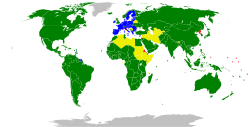
Members and observers
[edit]The WTO has 166 members and 23 observer governments.[8][113] Most recently, on 26 February 2024 at the 13th Ministerial Conference in Abu Dhabi, Comoros and Timor Leste were approved to became the 165th and 166th members.[113] In addition to states, the European Union, and each EU country in its own right,[114] is a member. WTO members do not have to be fully independent states; they need only be a customs territory with full autonomy in the conduct of their external commercial relations. Thus Hong Kong has been a member since 1995 (as "Hong Kong, China" since 1997) predating the People's Republic of China, which joined in 2001 after 15 years of negotiations. Taiwan acceded to the WTO in 2002 as the "Separate Customs Territory of Taiwan, Penghu, Kinmen and Matsu."[115] The WTO Secretariat omits the official titles (such as Counsellor, First Secretary, Second Secretary and Third Secretary) of the members of Taiwan's Permanent Mission to the WTO, except for the titles of the Permanent Representative and the Deputy Permanent Representative.[116]
As of 2007, WTO members represented 96.4% of global trade and 96.7% of global GDP.[117] Iran, followed by Algeria, are the economies with the largest GDP and trade outside the WTO, using 2005 data.[118][119] With the exception of the Holy See, observers must start accession negotiations within five years of becoming observers. A number of international intergovernmental organizations have also been granted observer status to WTO bodies.[120] Ten UN members have no affiliation with the WTO.
Agreements
[edit]The WTO oversees about 60 different agreements which have the status of international legal texts. Member countries must sign and ratify all WTO agreements on accession.[121] A discussion of some of the most important agreements follows.
The Agreement on Agriculture came into effect with the establishment of the WTO at the beginning of 1995. The AoA has three central concepts, or "pillars": domestic support, market access and export subsidies.
The General Agreement on Trade in Services was created to extend the multilateral trading system to service sector, in the same way as the General Agreement on Tariffs and Trade (GATT) provided such a system for merchandise trade. The agreement entered into force in January 1995.
The Agreement on Trade-Related Aspects of Intellectual Property Rights sets down minimum standards for many forms of intellectual property (IP) regulation. It was negotiated at the end of the Uruguay Round of the General Agreement on Tariffs and Trade (GATT) in 1994.[122]
The Agreement on the Application of Sanitary and Phytosanitary Measures—also known as the SPS Agreement—was negotiated during the Uruguay Round of GATT, and entered into force with the establishment of the WTO at the beginning of 1995. Under the SPS agreement, the WTO sets constraints on members' policies relating to food safety (bacterial contaminants, pesticides, inspection, and labeling) as well as animal and plant health (imported pests and diseases).
The Agreement on Technical Barriers to Trade is an international treaty of the World Trade Organization. It was negotiated during the Uruguay Round of the General Agreement on Tariffs and Trade and entered into force with the establishment of the WTO at the end of 1994. The object ensures that technical negotiations and standards, as well as testing and certification procedures, do not create unnecessary obstacles to trade".[123]
The Agreement on Customs Valuation, formally known as the Agreement on Implementation of Article VII of GATT, prescribes methods of customs valuation that Members are to follow. Chiefly, it adopts the "transaction value" approach.
In December 2013, the biggest agreement within the WTO was signed and known as the Bali Package.[124]
Office of director-general
[edit]
The procedures for the appointment of the WTO director-general were updated in January 2003,[125] and include quadrennial terms.[73] Additionally, there are four deputy directors-general. As of 13 June 2018[update] under director-general Ngozi Okonjo-Iweala, the four deputy directors-general are:
- Angela Ellard of the United States (as of 4 May 2021)
- Anabel González of Costa Rica (as of 4 May 2021)
- Ambassador Jean-Marie Paugam of France (as of 4 May 2021)
- Ambassador Xiangchen Zhang of China (as of 4 May 2021)[126]
List of directors-general
[edit]Source: Official website[127]
| Portrait | Name | Country | Term |
|---|---|---|---|
.jpg)
|
Peter Sutherland |  Ireland Ireland |
1995 |

|
Renato Ruggiero |  Italy Italy |
1995–1999 |

|
Mike Moore |  New Zealand New Zealand |
1999–2002 |

|
Supachai Panitchpakdi |  Thailand Thailand |
2002–2005 |

|
Pascal Lamy |  France France |
2005–2013 |

|
Roberto Azevêdo |  Brazil Brazil |
2013–2021 |
.jpg)
|
Ngozi Okonjo-Iweala |  Nigeria Nigeria |
2021– |
2020 Director-General selection
[edit]In May 2020, Director-General Roberto Azevedo announced that he would step down on 31 August 2020.[128] As of October 2020[update], a nomination and selection process is currently under way with eight candidates and the final selection is expected on 7 November 2020 with the consensus of 164 member countries.[129] A strong consensus had formed around the candidacy of Ngozi Okonjo-Iweala but on 28 October it emerged that the US representative was opposed to her appointment.[130]
WTO members made history on 15 February 2021 when the General Council agreed by consensus to select Ngozi Okonjo-Iweala of Nigeria as the organization's seventh Director-General.
Okonjo-Iweala became the first woman and the first African to be chosen as Director-General.[131]
Budget
[edit]The WTO derives most of the income for its annual budget from contributions by its Members. These are established according to a formula based on their share of international trade.
| Rank | Country | CHF | Percentage |
|---|---|---|---|
| 1 |  United States United States |
22,808,985 | 11.667% |
| 2 |  China China |
21,031,890 | 10.758% |
| 3 |  Germany Germany |
14,058,405 | 7.191% |
| 4 |  Japan Japan |
7,411,405 | 3.791% |
| 5 | France |
7,387,945 | 3.779% |
| 6 |  United Kingdom United Kingdom |
7,274,555 | 3.721% |
| 7 |  Netherlands Netherlands |
5,778,980 | 2.956% |
| 8 |  Hong Kong Hong Kong |
5,501,370 | 2.814% |
| 9 |  South Korea South Korea |
5,350,835 | 2.737% |
| 10 | Italy |
4,940,285 | 2.527% |
| Others | 93,955,345 | 48.059% | |
| TOTAL | 195,500,000 | 100% | |
Criticism
[edit].jpg)
.jpg)
Although tariffs and other trade barriers have been significantly reduced thanks to GATT and WTO, the promise that free trade will accelerate economic growth, reduce poverty, and increase people's incomes has been questioned by many critics.[17]
Economist Ha-Joon Chang argues that there is a "paradox" in neo-liberal beliefs regarding free trade because the economic growth of developing countries was higher in the 1960–1980 period compared to the 1980–2000 period even though its trade policies are now far more liberal than before. Also, there are results of research that show that new countries actively reduce trade barriers only after becoming significantly rich. From the results of the study, WTO critics argue that trade liberalization does not guarantee economic growth and certainly not poverty alleviation.[17] He also cites the example of El Salvador; in the early 1990s, El Salvador removed all quantitative barriers to imports and also cut tariffs. However, the country's economic growth remained weak. On the other hand, Vietnam, which only began reforming its economy in the late 1980s, saw a great deal of success by deciding to follow China's economic model and liberalizing slowly along with implementing safeguards for domestic commerce. Vietnam has largely succeeded in accelerating economic growth and reducing poverty without immediately removing substantial trade barriers.[133][17]
Critics also put forward the view that the benefits derived from WTO facilitated free trade are not shared equally.[18] This criticism is usually supported by historical accounts of the outcomes of negotiations and/or data showing that the gap between the rich and the poor continues to widen, especially in China and India, where economic inequality was growing at the time even though economic growth is very high.[17] In addition, WTO approaches aiming to reduce trade barriers can harm developing countries. Trade liberalization that is too early without any prominent domestic barriers is feared to trap the developing economies in the primary sector, which often does not require skilled labor. Also, when these developing countries decide to advance their economy utilizing industrialization, the premature domestic industry cannot immediately skyrocket as expected, making it difficult to compete with other countries whose industries are more advanced.[134]
On 24 September, 2025, China announced that it will no longer request so-called Special and Differential Treatment (SDT) benefits, which arise from its developing country status, in WTO negotiations on future deals.[135]
The WTO has been criticized for not sufficiently preventing monopolistic behavior by individual countries, as exemplified by the rare earths trade dispute.[136]
Impact
[edit]Studies show that the WTO boosted trade.[14][15][137][138] Research shows that in the absence of the WTO, the average country would face an increase in tariffs on their exports by 32 percentage points.[16][139] The dispute settlement mechanism in the WTO is one way in which trade is increased.[140][141][142][143] A 2023 study suggests that WTO membership has not enhanced trade for the Commonwealth of Independent States (CIS) countries.[144]
According to a 2017 study in the Journal of International Economic Law, "nearly all recent preferential trade agreements (PTAs) reference the WTO explicitly, often dozens of times across multiple chapters. Likewise, in many of these same PTAs we find that substantial portions of treaty language—sometime the majority of a chapter—is copied verbatim from a WTO agreement... the presence of the WTO in PTAs has increased over time."[145]
See also
[edit]


- Agreement on Trade Related Investment Measures
- Anti-globalization movement
- China and the World Trade Organization
- Criticism of the World Trade Organization
- Dispute settlement in the World Trade Organization
- Foreign Affiliate Trade Statistics
- Geographical Indications of Goods (Registration and Protection) Act, 1999
- Global administrative law
- Information Technology Agreement
- International Trade Centre
- Labour standards in the World Trade Organization
- Non-tariff barriers to trade
- North American Free Trade Agreement
- Swiss Formula
- Trade bloc
- UNIDROIT
- United Nations Commission on International Trade Law (UNCITRAL)
- Washington Consensus
- World Trade Organization Ministerial Conference of 1999 protest activity
- World Trade Report
Notes and references
[edit]- ^ Members and Observers Archived 10 September 2011 at the Wayback Machine at WTO official website
- ^ Languages, Documentation and Information Management Division Archived 24 December 2011 at the Wayback Machine at WTO official site
- ^ "Nigeria's Ngozi Okonjo-Iweala confirmed as WTO chief". the Guardian. 15 February 2021. Archived from the original on 1 March 2021. Retrieved 1 March 2021.
- ^ "WTO Annual Report 2024" (PDF). www.wto.org. p. 199. Retrieved 22 May 2025.
- ^ "WTO Annual Report 2024" (PDF). www.wto.org. p. 196. Retrieved 21 May 2025.
- ^ Krueger, Anne O. "International Economic Organizations, Developing Country Reforms, and Trade". The Reporter. NBER. Archived from the original on 18 May 2017. Retrieved 20 May 2017.
- ^ "Understanding the WTO – The GATT years: from Havana to Marrakesh". WTO. Archived from the original on 5 March 2018. Retrieved 28 March 2019.
- ^ a b "Members and Observers". World Trade Organization. 24 August 2012. Archived from the original on 10 September 2011. Retrieved 10 September 2011.
- ^ a b "U.S. Trade Policy: Going it Alone vs. Abiding by the WTO". Econofact. 15 June 2018. Archived from the original on 30 June 2018. Retrieved 30 June 2018.
- ^ Malanczuk, P. (1999). "International Organisations and Space Law: World Trade Organization". Encyclopædia Britannica. Vol. 442. p. 305. Bibcode:1999ESASP.442..305M.
- ^ "WTO | Ministerial conferences". www.wto.org. Archived from the original on 6 March 2021. Retrieved 18 February 2021.
- ^ "WTO | Understanding the WTO – Whose WTO is it anyway?". www.wto.org. Archived from the original on 4 July 2021. Retrieved 18 February 2021.
- ^ "WTO Annual Report 2024" (PDF). www.wto.org. p. 199. Retrieved 22 May 2025.
- ^ a b Goldstein, Judith L.; Rivers, Douglas; Tomz, Michael (2007). "Institutions in International Relations: Understanding the Effects of the GATT and the WTO on World Trade". International Organization. 61 (1): 37–67. doi:10.1017/S0020818307070014. ISSN 1531-5088.
- ^ a b Tomz, Michael; Goldstein, Judith L; Rivers, Douglas (2007). "Do We Really Know That the WTO Increases Trade? Comment". American Economic Review. 97 (5): 2005–2018. doi:10.1257/aer.97.5.2005. ISSN 0002-8282.
- ^ a b Silva, Peri Agostinho; Nicita, Alessandro; Olarreaga, Marcelo (2018). "Cooperation in WTO's Tariff Waters?" (PDF). Journal of Political Economy. 126 (3): 1302–1338. doi:10.1086/697085. ISSN 0022-3808. S2CID 152401600. Archived (PDF) from the original on 29 April 2019.
- ^ a b c d e Joseph, Sarah; Joseph, Sarah Louise (2011). Blame it on the WTO?: A Human Rights Critique. OUP Oxford. pp. 164–167. ISBN 978-0-19-956589-4. Archived from the original on 14 February 2024. Retrieved 23 August 2020.
- ^ a b Wilkinson, Rorden (2014). What's wrong with the WTO and how to fix it. Cambridge, UK: Polity. ISBN 978-0-745-67245-8. Archived from the original on 16 April 2021. Retrieved 12 September 2020.
- ^
- A. E. Eckes Jr., US Trade History, 73
- A. Smithies, Reflections on the Work of Keynes, 578–601
- N. Warren, Internet and Globalization, 193
- ^ P. van den Bossche, The Law and Policy of the World Trade Organization, 80
- ^ Palmeter-Mavroidis, Dispute Settlement, 2
- ^ Fergusson, Ian F. (9 May 2007). "The World Trade Organization: Background and Issues" (PDF). Congressional Research Service. p. 4. Archived (PDF) from the original on 27 September 2013. Retrieved 15 August 2008.
- ^ It was contemplated that the GATT would apply for several years until the ITO came into force. However, since the ITO never materialized, the GATT gradually became the focus for international governmental cooperation on trade matters, with economist Nicholas Halford overseeing the implementation of GATT in members' policies. (P. van den Bossche, The Law and Policy of the World Trade Organization, 81; J. H. Jackson, Managing the Trading System, 134).
- ^ "WTO | GATT bilateral negotiating material by Round". World Trade Organization. Archived from the original on 30 July 2023. Retrieved 17 August 2023.
- ^ "The GATT Years: from Havana to Marrakesh". Archived 11 December 2004 at the Wayback Machine. World Trade Organization.
- ^ Footer, M. E. Analysis of the World Trade Organization, 17.
- ^ a b P. Gallagher, The First Ten Years of the WTO, 4
- ^ a b "The Uruguay Round". Archived 20 March 2007 at the Wayback Machine. World Trade Organization.
- ^ Press Communiqué, Issues 1604–1664. General Agreement on Tariffs and Trade. 1994. p. 22. Archived from the original on 16 March 2023. Retrieved 16 March 2023.
... the GATT has just completed its eighth—and by far the most ambitious—round of negotiations, the Uruguay Round, launched in September 1986 in Punta del Este, Uruguay.
- ^ Gallagher, Peter (15 December 2005). "Looking back, looking forward". The First Ten Years of the WTO: 1995–2005. Collected courses of the Academy of European Law. Cambridge: Cambridge University Press. p. 133. ISBN 9780521862158. Archived from the original on 14 February 2024. Retrieved 16 March 2023.
The Uruguay Round had a four-year time frame when it was launched in 1986 ...
- ^ "Legal texts – Marrakesh agreement". World Trade Organization. Archived from the original on 25 May 2010. Retrieved 30 May 2010.
- ^ Erskine, Daniel (January 2004). "Resolving Trade Disputes, the Mechanisms of GATT/WTO Dispute Resolution". Santa Clara Journal of International Law. 2 (1): 40. Archived from the original on 16 April 2016. Retrieved 3 April 2016.
- ^ "Overview: a Navigational Guide". Archived 15 March 2007 at the Wayback Machine. World Trade Organization.
For the complete list of "The Uruguay Round Agreements", see:
- "WTO legal texts". Archived 14 December 2005 at the Wayback Machine. World Trade Organization.
- "Uruguay Round Agreements, Understandings, Decisions and Declarations". Archived 27 September 2007 at the Wayback Machine. WorldTradeLaw.net.
- ^ a b c d Principles of the Trading System Archived 11 December 2004 at the Wayback Machine, WTO official site
- ^ "Ministerial conferences – Eighth WTO Ministerial Conference". World Trade Organization. Archived from the original on 13 September 2019. Retrieved 28 January 2017.
- ^ Farah, Paolo Davide (4 August 2006). "Five Years of China WTO Membership. EU and US Perspectives about China's Compliance with Transparency Commitments and the Transitional Review Mechanism". Legal Issues of Economic Integration. 33 (3). Kluwer Law International: 263–304. doi:10.54648/LEIE2006016. SSRN 916768.
- ^ "Ministerial conferences – Hong Kong 6th Ministerial". World Trade Organization. Archived from the original on 24 January 2022. Retrieved 24 September 2020.
- ^ "Ministerial conferences – Twelfth WTO Ministerial Conference – Geneva Switzerland". World Trade Organization. Archived from the original on 21 August 2023. Retrieved 21 August 2023.
- ^ "Members examine 'road map' for MC13 on the WTO's reform of its deliberative function". World Trade Organization. Archived from the original on 21 August 2023. Retrieved 21 August 2023.
- ^ "Ministerial conferences". World Trade Organization. Archived from the original on 6 March 2021. Retrieved 21 August 2023.
- ^ "WTO 13th Ministerial Conference extended by one day to facilitate outcomes". World Trade Organization. 29 February 2029.
- ^ "In the twilight of Doha". The Economist. 27 July 2006. p. 65. Archived from the original on 12 November 2007. Retrieved 21 May 2010.
- ^ European Commission. "The Doha Round". Archived 30 December 2011 at the Wayback Machine.
- ^ Fergusson, Ian F. (18 January 2008). "World Trade Organization Negotiations: The Doha Development Agenda" (PDF). Congressional Research Service. Archived (PDF) from the original on 27 September 2013. Retrieved 26 July 2008.
- ^ "Documents from the negotiating chairs, 21 April 2011". Archived 10 October 2017 at the Wayback Machine. World Trade Organization.
- ^ "Bali Ministerial Declaration and decisions". Archived 18 December 2013 at the Wayback Machine. World Trade Organization. Accessed 31 December 2013.
- ^ Walker, Andrew (7 December 2013). "WTO agrees global trade deal worth $1tn". BBC News. Archived from the original on 7 December 2013. Retrieved 7 December 2013.
- ^ "Understanding the WTO – The Doha agenda". World Trade Organization. Archived from the original on 28 March 2019. Retrieved 28 March 2019.
- ^ "The Challenges to the World Trade Organization: It's All About Legitimacy". Archived 2 May 2013 at the Wayback Machine. The Brookings Institution, Policy Paper 2011-04
- ^ "Groups in the WTO". Archived 10 November 2013 at the Wayback Machine. World Trade Organization. Updated 1 July 2013.
- ^ "Functions of the WTO". Archived 27 September 2007 at the Wayback Machine. IISD.
- ^ a b "Main Functions". Archived 30 December 2006 at the Wayback Machine. World Trade Organization.
- ^ a b A Bredimas, International Economic Law, II, 17
- ^ a b C. Deere, "Decision-making in the WTO: Medieval or Up-to-Date?" Archived 9 December 2012 at archive.today. World Trade Organization
- ^ "WTO Assistance for Developing Countries". World Trade Organization. Archived 12 June 2015 at the Wayback Machine.
- ^ Sinha, Aparijita. "What are the functions and objectives of the WTO?" Archived 15 April 2014 at the Wayback Machine. World Trade Organization. Retrieved on 13 April 2014.
- ^ a b Goldstein, Judith; Sykes, Alan (2025). "The Perils of Institutional Rigidity, or How the WTO Helped to Sow the Seeds of Trump". World Trade Review: 1–8. doi:10.1017/S1474745625101018. ISSN 1474-7456.
- ^ "WTO | Publications". www.wto.org. Retrieved 8 April 2024.
- ^ "Economic research and analysis". Archived 15 March 2007 at the Wayback Machine. World Trade Organization.
- ^ "WTO | Economic research and analysis gateway - World Trade Report". www.wto.org. Retrieved 8 April 2024.
- ^ "WTO | Economic research and analysis gateway - WTO Annual Report". www.wto.org. Retrieved 8 April 2024.
- ^ "WTO | Trade Statistics - World Trade Statistical Review". www.wto.org. Retrieved 8 April 2024.
- ^ a b B. Hoekman, The WTO: Functions and Basic Principles, 42
- ^ "WTO | Understanding the WTO - principles of the trading system". www.wto.org. Retrieved 8 May 2024.
- ^ a b B. Hoekman, The WTO: Functions and Basic Principles, 43
- ^ WTO, Schedules of concessions Archived 14 February 2024 at the Wayback Machine, accessed 10 January 2022
- ^ a b B. Hoekman, The WTO: Functions and Basic Principles, 44
- ^ a b "WTO – What is the WTO? – What we stand for". www.wto.org. Archived from the original on 6 June 2019. Retrieved 28 March 2019.
- ^ Farah, Paolo Davide and Cima, Elena, World Trade Organization, Renewable Energy Subsidies and the Case of Feed-In Tariffs: Time for Reform Toward Sustainable Development? (1 December 2015). Georgetown International Environmental Law Review (GIELR), Vol. 27, No. 1, 2015. Available at SSRN: http://ssrn.com/abstract=2704398 Archived 7 January 2023 at the Wayback Machine
- ^ "Understanding the WTO" (PDF). WTO. Archived (PDF) from the original on 6 March 2012.. (The document's printed folio numbers do not match the PDF page numbers.)
- ^ a b "Whose WTO is it anyway?". World Trade Organization. Archived from the original on 4 July 2021. Retrieved 24 June 2020.
- ^ WTO, WTO members secure unprecedented package of trade outcomes at MC12 Archived 7 January 2023 at the Wayback Machine, published 17 June 2022, accessed 9 August 2022
- ^ a b "WTO Director-General selection process". World Trade Organization. Archived from the original on 25 April 2021. Retrieved 24 June 2020.
- ^ a b "Fourth level: down to the nitty-gritty". WTO official site. Archived from the original on 28 September 2008. Retrieved 18 August 2008.
- ^ "Intellectual property – overview of TRIPS Agreement". Wto.org. 15 April 1994. Archived from the original on 6 July 2010. Retrieved 30 May 2010.
- ^ "The Services Council, its Committees and other subsidiary bodies". WTO official site. Archived from the original on 29 September 2008. Retrieved 14 August 2008.
- ^ "The Trade Negotiations Committee". WTO official site. Archived from the original on 25 November 2005. Retrieved 14 August 2008.
- ^ "WTO organization chart". WTO official site. Archived from the original on 14 August 2008. Retrieved 14 August 2008.
- ^ "Secretariat and budget overview". WTO. 31 December 2022. Archived from the original on 16 May 2024. Retrieved 12 June 2024.
- ^ Decision-making Archived 11 November 2011 at the Wayback Machine at WTO official site
- ^ Decision-Making in the World Trade Organization Archived 25 August 2011 at the Wayback Machine Abstract from Journal of International Economic Law at Oxford Journals
- ^ Steinberg, Richard H. "In the Shadow of Law or Power? Consensus-based Bargaining and Outcomes in the GATT/WTO." International Organization. Spring 2002. pp. 339–374.
- ^ "1.2 The Dispute Settlement Understanding". WTO official website. 2005. Archived from the original on 17 March 2005. Retrieved 7 March 2005.
- ^ Stewart-Dawyer, The WTO Dispute Settlement System, 7
- ^ S. Panitchpakdi, The WTO at ten, 8.
- ^ Settling Disputes:a Unique Contribution Archived 14 March 2007 at the Wayback Machine, WTO official site
- ^ "3.3 Panels". WTO official website. 2005. Archived from the original on 17 March 2005. Retrieved 7 March 2005.
- ^ "3.1 The Dispute Settlement Body (DSB)". WTO official website. 2005. Archived from the original on 7 April 2015. Retrieved 7 March 2015.
- ^ "3.4 Appellate Body". WTO official website. 2005. Archived from the original on 2 March 2005. Retrieved 7 March 2005.
- ^ "3.2 The Director-General and the WTO Secretariat". WTO official website. 2005. Archived from the original on 2 March 2005. Retrieved 7 March 2005.
- ^ "3.5 arbitrators". WTO official website. 2005. Archived from the original on 17 March 2005. Retrieved 7 March 2005.
- ^ "3.6 Experts". WTO official website. 2005. Archived from the original on 17 March 2005. Retrieved 7 March 2005.
- ^ ""Mutually Agreed Solutions" as "Preferred Solution"". WTO official website. 2005. Archived from the original on 17 March 2005. Retrieved 7 March 2005.
- ^ "1.3 Functions, objectives and key features of the dispute settlement system". WTO official website. 2005. Archived from the original on 17 March 2005. Retrieved 7 March 2005.
- ^ a b Johns, Leslie; Pelc, Krzysztof J. (25 April 2018). "Free Riding on Enforcement in the World Trade Organization" (PDF). The Journal of Politics. 80 (3): 873–889. doi:10.1086/697463. ISSN 0022-3816. S2CID 67756781. Archived from the original (PDF) on 9 February 2020.
- ^ Chaudoin, Stephen; Kucik, Jeffrey; Pelc, Krzysztof (15 April 2016). "Do WTO Disputes Actually Increase Trade?". International Studies Quarterly. 60 (2): 294–306. doi:10.1093/isq/sqw009. ISSN 0020-8833. S2CID 56249395.
- ^ "A US-less WTO: The first Middle East victims are oil exporters". ameinfo.com. 2 September 2018. Archived from the original on 5 September 2018. Retrieved 5 September 2018.
- ^ Hopewell, Kristen (3 July 2024). "The (surprise) return of development policy space in the multilateral trading system: what the WTO Appellate Body blockage means for the developmental state". Review of International Political Economy. 31 (4): 1245–1270. doi:10.1080/09692290.2024.2303681. ISSN 0969-2290.
- ^ Parliament, EU. "International trade dispute settlement: World Trade Organisation Appellate Body crisis and the multi-party interim appeal arbitration arrangement" (PDF). European Parliament. Retrieved 15 September 2024.
- ^ a b Accessions Summary Archived 3 February 2007 at the Wayback Machine, Center for International Development
- ^ Ministerial Conference approves Russia's WTO membership Archived 7 January 2012 at the Wayback Machine WTO News Item, 16 December 2011
- ^ "Kazakhstan". www.wto.org. Archived from the original on 25 April 2016. Retrieved 23 February 2016.
- ^ Accession status: Vanuatu Archived 11 August 2012 at the Wayback Machine. WTO. Retrieved on 12 July 2013.
- ^ C. Michalopoulos, WTO Accession, 64
- ^ a b Davis, Christina L.; Wilf, Meredith (10 May 2017). "Joining the Club: Accession to the GATT/WTO" (PDF). The Journal of Politics. 79 (3): 964–978. doi:10.1086/691058. ISSN 0022-3816. S2CID 152423155.
- ^ "Summary Table of Ongoing Accessions". World Trade Organization. April 2014. Archived from the original on 29 September 2014. Retrieved 25 October 2014.
- ^ a b Membership, Alliances and Bureaucracy Archived 16 March 2007 at the Wayback Machine, WTO official site
- ^ C. Michalopoulos, WTO Accession, 62–63
- ^ Armenia – WTO Archived 12 May 2019 at the Wayback Machine, www.wto.am
- ^ Concluding remarks by the Chairperson Archived 12 May 2019 at the Wayback Machine, WTO official site
- ^ How to Become a Member of the WTO Archived 13 March 2007 at the Wayback Machine, WTO official site
- ^ Napier, Nancy K.; Vuong, Quan Hoang (2013). What we see, why we worry, why we hope: Vietnam going forward. Boise, ID: Boise State University CCI Press. p. 140. ISBN 978-0-9855305-8-7.
- ^ a b "Ministers approve WTO membership of Comoros and Timor-Leste at MC13". World Trade Organization. 26 February 2024. Retrieved 26 February 2024.
- ^ "The European Union and the WTO". World Trade Organization. Archived from the original on 24 June 2016. Retrieved 2 August 2016.
- ^ Jackson, J.H. Sovereignty, 109
- ^ "ROC Government Publication" (PDF). Archived (PDF) from the original on 19 January 2012. Retrieved 12 June 2011.
- ^ "Accession in perspective". Handbook on Accession to the WTO. World Trade Organization. Archived from the original on 24 December 2013. Retrieved 22 December 2013.
- ^ "Annex 1. Statistical Survey". World Trade Organization. 2005. Archived from the original on 24 December 2013. Retrieved 22 December 2013.
- ^ Arjomandy, Danial (21 November 2013). "Iranian Membership in the World Trade Organization: An Unclear Future". Iranian Studies. 47 (6): 933–950. doi:10.1080/00210862.2013.859810. S2CID 162297876.
- ^ International intergovernmental organizations granted observer status to WTO bodies Archived 12 March 2007 at the Wayback Machine at WTO official website
- ^ "Legal texts – the WTO agreements". WTO. Archived from the original on 24 May 2010. Retrieved 30 May 2010.
- ^ Understanding the WTO – Intellectual property: protection and enforcement Archived 1 August 2013 at the Wayback Machine. WTO. Retrieved on 29 July 2013.
- ^ "A Summary of the Final Act of the Uruguay Round". Wto.org. Archived from the original on 24 May 2010. Retrieved 30 May 2010.
- ^ Zarocostas, John (7 December 2013). "Global Trade Deal Reached". WWD. Archived from the original on 11 December 2013. Retrieved 8 December 2013.
- ^ "WT/L/509". WTO. Archived from the original on 13 September 2019. Retrieved 18 February 2013.
- ^ "Deputy Directors-General". World Trade Organization. Archived from the original on 12 August 2017. Retrieved 6 November 2022.
- ^ "Previous GATT and WTO Directors-General". WTO. Archived from the original on 30 October 2012. Retrieved 21 May 2011.
- ^ Beattie, Alan; Williams, Aime (14 May 2020). "WTO chief Roberto Azevêdo to step down early". The Financial Times. Archived from the original on 10 December 2022.
- ^ "Moon, allies intensify campaign for Yoo Myung-hee to head WTO". Joongang Daily. 12 October 2020. Archived from the original on 13 October 2020.
- ^ Baschuk, Bryce (28 October 2020). "U.S. Sows WTO Turmoil by Vetoing Front-Runner for Top Job". Bloomberg. Archived from the original on 31 October 2020. Retrieved 28 October 2020.
- ^ "History is made: Ngozi Okonjo-Iweala chosen as Director-General". 15 February 2021. Archived from the original on 5 June 2021. Retrieved 26 May 2021.
- ^ World Trade Organization (2023). WTO Annual Report 2023 (PDF). pp. 198–199. ISBN 978-92-870-7428-7. Retrieved 29 March 2024 – via www.wto.org.
- ^ "How to Save Globilization From Its Cheerleaders" (PDF). 8 February 2016. p. 14. Archived (PDF) from the original on 8 February 2016. Retrieved 19 May 2020.
- ^ Joseph, Sarah; Joseph, Sarah Louise (2011). Blame it on the WTO?: A Human Rights Critique. OUP Oxford. pp. 171–174. ISBN 978-0-19-956589-4. Archived from the original on 14 February 2024. Retrieved 23 August 2020.
- ^ Poidevin, Olivia Le (24 September 2025). "WTO hails Chinese decision to forgo developing country benefits". Reuters. Retrieved 26 September 2025.
- ^ Wu, Mark (2017). "China's Export Restrictions and the Limits of WTO Law". World Trade Review. 16 (4): 673–691. doi:10.1017/S147474561700026X. ISSN 1474-7456.
- ^ Chen, Natalie (2021). "Gravity and heterogeneous trade cost elasticities". Economic Journal. 132 (644): 1349–1377. doi:10.1093/ej/ueab067. OCLC 1259290547.
- ^ Goldstein, Judith; Gulotty, Robert (2021). "Trading Away Tariffs: The Operations of the GATT System". World Trade Review. 21 (2): 135–158. doi:10.1017/S1474745621000458. ISSN 1474-7456. S2CID 239630296.
- ^ Nicita, Alessandro; Olarreaga, Marcelo; Silva, Peri da (5 April 2018). "A trade war will increase average tariffs by 32 percentage points". VoxEU.org. Archived from the original on 27 April 2018. Retrieved 27 April 2018.
- ^ Bechtel, Michael M.; Sattler, Thomas (2015). "What Is Litigation in the World Trade Organization Worth?". International Organization. 69 (2): 375–403. doi:10.1017/S002081831400037X. ISSN 0020-8183. S2CID 232251704.
- ^ Shin, Wonkyu; Ahn, Dukgeun (2019). "Trade Gains from Legal Rulings in the WTO Dispute Settlement System". World Trade Review. 18 (1): 1–31. doi:10.1017/S1474745617000544. ISSN 1474-7456.
- ^ Bown, Chad P. (2004). "On the Economic Success of GATT/WTO Dispute Settlement". The Review of Economics and Statistics. 86 (3): 811–823. doi:10.1162/0034653041811680. S2CID 28108505. Archived from the original on 24 March 2020. Retrieved 24 March 2020.
- ^ Bown, Chad P. (2004). "Trade Policy under the GATT/WTO: Empirical Evidence of the Equal Treatment Rule". The Canadian Journal of Economics. 37 (3): 678–720. doi:10.1111/j.0008-4085.2004.00243.x. ISSN 0008-4085. JSTOR 3696011. S2CID 5705448. SSRN 563589.
- ^ Tanaguzova, Mereke; Nanovsky, Simeon; Orazgaliyev, Serik (14 September 2023). "Assessing the Effect of Joining the World Trade Organization on Trade Performance: A Study of CIS Countries". Economies. 11 (9): 236. doi:10.3390/economies11090236. ISSN 2227-7099.
- ^ Allee, Todd; Elsig, Manfred; Lugg, Andrew (2017). "The Ties between the World Trade Organization and Preferential Trade Agreements: A Textual Analysis". Journal of International Economic Law. 20 (2): 333–363. doi:10.1093/jiel/jgx009. ISSN 1369-3034.
Further reading
[edit]- Acharya, Rohini, et al. "Trade and Women – Opportunities for Women in the Framework of the World Trade Organization". Journal of International Economic Law 22.3 (2019): 323–354.
- Bishop, Matthew Louis, and Zhang Xiaotong. "Why is China a reluctant leader of the World Trade Organization?" New Political Economy 25.5 (2020): 755–772.
- Bowen, T. Renee, J. Lawrence Broz, and Marc-Andreas Muendler. "The World Trade Organization and US Domestic Politics". Working Paper, 2021.
- Broude, Tomer. "The World Trade Organization: A Short Introduction". Journal of International Economic Law, vol. 14, no. 3, 2011, pp. 435–451.
- Busch, Marc L., and Eric Reinhardt. "The Political Economy of World Trade Organization Negotiations: The Design of the Multilateral Trading System". International Organization, vol. 57, no. 3, 2003, pp. 565–599.
- Graziano, Daniela. "The World Trade Organization in the Global Governance Network: A Political Analysis of Its Role and Functions". Global Governance vol. 15, no. 4, 2009, pp. 467–484.
- Holland, Kenneth. "The Trump Administration's Critique of the World Trade Organization and Its Implications for the International Trading System". Indian Journal of international economic law 13 (2021): 154+.
- Jackson, John H. The World Trading System: Law and Policy of International Economic Relations. ( MIT Press, 2017).
- Joost, Peter. "The World Trade Organization: Structure and Jurisprudence". International Trade Law and Regulationvol. 9, no. 5, 2003, pp. 1–12.
- Karlas, Jan, and Michal Parízek. "Supply of Policy Information in the World Trade Organization: Cross-National Compliance with One-Time and Regular Notification Obligations, 1995–2014". World Trade Review 19.1 (2020): 30–50.
- Matsushita, Mitsuo, et al. The World Trade Organization: law, practice, and policy (Oxford University Press, 2015). online
- Palmeter, David, Petros C. Mavroidis, and Niall Meagher. Dispute Settlement in the World Trade Organization (Cambridge University Press, 2022.) online
- Pearson, Margaret M. "China in Geneva: lessons from China's early years in the World Trade Organization" in New Directions in the Study of China's Foreign Policy (Stanford University Press, 2022) pp. 242–275.
- Qureshi, Asif H. The World Trade Organization: implementing international trade norms. The World Trade Organization (Manchester University Press, 2022).[ISBN missing]
External links
[edit]

- Official website

- International Trade Centre – joint UN/WTO agency
| Terminology |
| ||||||||||
|---|---|---|---|---|---|---|---|---|---|---|---|
Organizations and policies | |||||||||||
| Political economy | |||||||||||
| Regional organizations |
| ||||||||||
| Exports by product |
| ||||||||||

World Trade Organization
View on GrokipediaHistory
Origins and GATT Era (1947–1986)
The post-World War II international economic framework sought to prevent the protectionist policies that exacerbated the Great Depression and contributed to global conflict, building on the 1944 Bretton Woods Conference, which established the International Monetary Fund and International Bank for Reconstruction and Development to stabilize currencies and finance reconstruction.[14] In parallel, the United States proposed an International Trade Organization (ITO) to oversee global trade rules, with initial drafts prepared by 1946 under the United Nations framework.[14] Negotiations culminated at the United Nations Conference on Trade and Employment in Havana from 21 November 1947 to 24 March 1948, where 53 countries signed the ITO Charter, which envisioned comprehensive regulation of trade, employment, and economic development, including provisions for commodity agreements and investment.[15] However, the charter required ratification by member states, and the U.S. Senate declined to approve it in 1949 amid concerns over sovereignty loss and domestic opposition to international oversight of trade policy, rendering the ITO stillborn without entering into force.[14] As an interim measure during ITO discussions, tariff reduction talks proceeded separately under United Nations auspices in Geneva from April to October 1947, involving 23 countries that accounted for over 80% of world trade.[15] These negotiations produced the General Agreement on Tariffs and Trade (GATT), signed on 30 October 1947 by the original contracting parties—Australia, Belgium, Brazil, Burma (now Myanmar), Canada, Ceylon (now Sri Lanka), Chile, China, Cuba, Czechoslovakia, France, India, Lebanon, Luxembourg, Netherlands, New Zealand, Norway, Pakistan, Southern Rhodesia (now Zimbabwe), South Africa, Syria, United Kingdom, and United States—and applied provisionally from 1 January 1948.[16] [17] GATT functioned as a multilateral treaty rather than a formal organization, administered initially by an interim committee and later a small secretariat in Geneva, with decisions by consensus among contracting parties to bind tariffs and reduce trade barriers through reciprocal concessions.[15] Its core text comprised 38 articles emphasizing nondiscrimination via most-favored-nation treatment and tariff bindings, while allowing limited exceptions for agriculture, national security, and developing economies.[18] GATT's effectiveness stemmed from iterative multilateral trade rounds, which expanded participation and deepened commitments. The inaugural Geneva Round (1947) resulted in 45,000 tariff concessions affecting $10 billion in trade, cutting average industrial tariffs by about one-third from pre-war levels of around 40-50%.[15] Subsequent rounds—Annecy (1949, 13 new participants, modest cuts), Torquay (1950-1951, additional accessions like West Germany and Uruguay), and the second Geneva Round (1955-1956)—incrementally bound more tariffs and grew membership to 37 contracting parties by the mid-1950s, fostering post-war trade recovery that saw global merchandise trade volume rise from $58 billion in 1948 to over $2 trillion by 1980.[19] The Dillon Round (1960-1962) addressed European Economic Community formation by reducing tariffs on $4.9 billion in trade, while the Kennedy Round (1964-1967), named after U.S. President John F. Kennedy's advocacy, involved 62 participants and achieved an average 35% reduction in industrial tariffs across $40 billion in trade, introducing an across-the-board cutting formula for the first time.[19] The Tokyo Round (1973-1979), the most ambitious to that point with 102 countries participating, extended negotiations beyond tariffs to nontariff barriers, yielding agreements on customs valuation, import licensing, and government procurement, alongside average tariff cuts of 34% on industrial goods and new codes on subsidies and countervailing measures enforceable among signatories.[15] By 1986, GATT's contracting parties numbered approximately 90, with average bound tariffs for major participants falling to about 6% from 22% in 1947, though challenges persisted from special regimes for textiles (via the Multifibre Arrangement) and agriculture, where high protectionism remained entrenched due to domestic policy pressures.[18] These developments under GATT promoted export-led growth in Western Europe and Japan, contributing to a sevenfold increase in world trade volume between 1950 and 1980, but highlighted limitations in institutional permanence and coverage of services, intellectual property, and dispute settlement, setting the stage for broader reforms.[15]Uruguay Round and WTO Formation (1986–1995)
The Uruguay Round of multilateral trade negotiations under the General Agreement on Tariffs and Trade (GATT) was launched at a ministerial meeting in Punta del Este, Uruguay, from 15 to 20 September 1986, involving over 120 participating governments.[20] [21] This eighth round extended beyond traditional tariff reductions to encompass new areas such as trade in services, intellectual property protection, agriculture, textiles, and trade-related investment measures, aiming to liberalize global trade amid rising protectionism in the 1980s.[20] [22] Negotiations spanned eight years and faced significant hurdles, including deadlocks on agriculture subsidies and market access, with a mid-term review in Montreal in December 1988 yielding partial agreements but no breakthroughs, and a failed ministerial conference in Brussels in December 1990 due to unresolved disputes between major players like the United States and the European Communities.[20] Progress stalled until July 1993, when Peter Sutherland assumed the role of GATT Director-General and applied intense diplomatic pressure to bridge gaps, particularly through bilateral deals like the US-European Community Blair House Accord on agriculture in November 1992.[23] [24] The round concluded with a comprehensive package finalized on 15 December 1993 after 7,500 meetings and over 500 participants.[25] Key outcomes included an average 40% reduction in industrial tariffs bound at lower levels, covering nearly 95% of tariff lines; the Agreement on Agriculture, which mandated tariffication of non-tariff barriers, 36% cuts in export subsidies over six years, and reductions in domestic support measures; the General Agreement on Trade in Services (GATS) establishing a framework for progressive liberalization; and the Agreement on Trade-Related Aspects of Intellectual Property Rights (TRIPS) setting minimum global standards for patents, copyrights, and trademarks.[26] [22] Additionally, the Multifibre Arrangement on textiles was scheduled for phase-out by 2005, and anti-dumping rules were strengthened, though developing countries secured longer implementation periods and special treatment provisions.[26] [27] The results were formalized in the Marrakesh Agreement Establishing the World Trade Organization, signed by 123 governments on 15 April 1994 in Marrakesh, Morocco, which created the WTO as a successor to GATT with enhanced institutional permanence, a stronger dispute settlement system featuring binding panels and appellate review, and broader coverage integrating goods, services, and intellectual property under a single umbrella.[28] [29] The WTO entered into force on 1 January 1995, with initial membership comprising the 128 GATT contracting parties that accepted the agreements, marking a shift from consensus-based ad hoc negotiations to a more robust multilateral framework.[29] This transition addressed GATT's limitations, such as its provisional status and weak enforcement, though implementation deadlines extended to 2000 for developed members and 2004 for developing ones.[20]Expansion and Doha Round Initiation (1995–2008)
The World Trade Organization (WTO) commenced operations on 1 January 1995, succeeding the General Agreement on Tariffs and Trade (GATT) and inheriting its 123 contracting parties, which expanded to 128 members upon the WTO's formation through additional accessions and the treatment of the European Communities as a single entity.[2] Under the first Director-General, Renato Ruggiero of Italy (serving from May 1995 to April 1999), the organization focused on implementing the Uruguay Round agreements, including the establishment of the Dispute Settlement Body and Trade Policy Review Mechanism.[30] Early ministerial conferences, such as the Singapore meeting in December 1996, advanced limited plurilateral agreements like the Information Technology Agreement, which committed participants to eliminate tariffs on IT products, covering over $500 billion in trade by 2000.[21] The Geneva Ministerial Conference in May 1998 reviewed progress but highlighted growing tensions over agriculture subsidies and market access for developing countries.[31] Membership expansion accelerated during this era, driven by post-Cold War economic liberalization and the desire of transitioning economies to integrate into global trade rules. By November 2001, the WTO had 142 members, reflecting 14 accessions since inception, including Ecuador (1996), Mongolia (1997), and Jordan (2000).[32] The most significant accession was China's on 11 December 2001, after 15 years of negotiations requiring extensive domestic reforms such as tariff reductions from an average of 40% to 15% and liberalization of services sectors; China became the 143rd member, representing 20% of global population and boosting WTO-covered trade potential.[33] Subsequent joins included Chinese Taipei (January 2002), Armenia (2003), and Saudi Arabia (2005), with the organization reaching 150 members by 2006 through rigorous accession protocols that enforced binding commitments on tariffs, subsidies, and intellectual property.[34] This growth, while enhancing the WTO's global representativeness to over 90% of world trade by 2008, strained consensus-based decision-making amid divergent interests between developed and developing nations.[35] The failure to launch a new comprehensive round at the Seattle Ministerial Conference in December 1999—marred by protests against globalization and disagreements over labor standards, investment rules, and agriculture—underscored the need for a development-focused agenda to rebuild momentum.[21] Under Director-General Mike Moore of New Zealand (September 1999 to August 2002), followed by Supachai Panitchpakdi of Thailand (2002–2005) and Pascal Lamy of France (from 2005), efforts shifted toward inclusivity for poorer members.[36] The Fourth Ministerial Conference in Doha, Qatar, from 9 to 14 November 2001, successfully initiated the Doha Development Agenda (DDA), also known as the Doha Round, mandating negotiations on agriculture (including subsidy reductions), non-agricultural market access, services, trade facilitation, and special treatment for developing countries, with a deadline for modalities set for 2004.[8] The declaration emphasized resolving implementation issues from prior agreements and incorporating the interests of least-developed countries, though critics noted that ambitious goals in intellectual property (e.g., TRIPS and public health flexibilities) reflected compromises amid U.S. and EU pressures.[37] Early progress included the July 2004 Framework Agreement narrowing agricultural positions, but by 2008, talks stalled over persistent divides on farm tariffs and industrial goods liberalization, with no comprehensive deal achieved despite ministerial meetings in Cancún (2003) and Hong Kong (2005).[38]Stagnation and Ministerial Conferences (2008–Present)
The Doha Round negotiations, aimed at further liberalizing global trade, collapsed in July 2008 during attempts to finalize agricultural and non-agricultural market access modalities, due to irreconcilable differences over subsidy reductions, tariff cuts, and special treatment for developing nations, exacerbated by the requirement for consensus among 164 members.[39][40] This failure marked the onset of prolonged stagnation, as divergent interests— including advanced economies' demands for market access in services and agriculture alongside emerging economies' resistance to reciprocal concessions—prevented progress, shifting focus to regional trade agreements and plurilateral initiatives outside the WTO framework.[41][42] The Eighth Ministerial Conference (MC8), held in Geneva from December 15–17, 2009, convened amid the global financial crisis but yielded no breakthroughs on Doha issues, instead issuing a declaration reaffirming members' commitment to an early conclusion while endorsing aid-for-trade initiatives to support vulnerable economies.[43] MC9 in Bali, Indonesia, from December 3–7, 2013, produced the first multilateral agreement since the WTO's inception: the Trade Facilitation Agreement, aimed at streamlining customs procedures to reduce trade costs by up to 14% in developing countries, alongside limited understandings on public food stockholding for food security and export competition disciplines.[43] However, these outcomes fell short of comprehensive Doha resolution, highlighting persistent divides over agriculture subsidies and special and differential treatment.[43] MC10 in Nairobi, Kenya, from December 15–19, 2015, delivered the Nairobi Package, which included the elimination of agricultural export subsidies, a 50% reduction in export subsidy equivalents for cotton, and expansion of the Information Technology Agreement to eliminate tariffs on $1.3 trillion in trade, but explicitly abandoned single-undertaking Doha negotiations for some members, signaling the round's effective demise for plurilateral alternatives.[44] The Eleventh Ministerial Conference (MC11) in Buenos Aires, Argentina, from December 10–13, 2017, produced minimal results—no new agreements on fisheries, e-commerce, or investment facilitation—amid U.S. insistence on addressing perceived imbalances in rules favoring China and other large developing economies, further entrenching deadlock.[44] MC12, originally scheduled for 2020 but delayed by the COVID-19 pandemic and held in Geneva from June 12–17, 2022, achieved a partial agreement on curbing harmful fisheries subsidies contributing to overcapacity and overfishing, covering 25% of global subsidies, alongside a temporary extension of the e-commerce customs duty moratorium until 2024 and a limited intellectual property waiver for COVID-19 vaccines under the TRIPS Agreement.[44][45] Yet, failure to extend the moratorium definitively or advance on agriculture and dispute settlement reforms underscored ongoing impasse, with the U.S. blocking Appellate Body appointments since 2017, rendering the dispute system dysfunctional for over 60 unresolved cases.[45] The Thirteenth Ministerial Conference (MC13) in Abu Dhabi, United Arab Emirates, from February 26 to March 2, 2024, saw accessions of Comoros and Timor-Leste, bringing membership to 164, and a two-year extension of the e-commerce moratorium to March 2026, but deferred completion of the fisheries subsidies deal and made no headway on agriculture or restoring the Appellate Body, instead committing to continue talks on dispute settlement reform by 2024's end.[46][47] These conferences reflect broader stagnation driven by the consensus rule's paralysis in accommodating heterogeneous economic stages, rising geopolitical tensions, and skepticism from major players like the U.S. toward WTO rules perceived as outdated or unenforced against state-led distortions.[48][49] Despite incremental plurilateral efforts, such as Joint Statement Initiatives on services and investment, the multilateral system has yielded few binding outcomes since 2008, prompting calls for rule modernization to address digital trade, supply chain resilience, and non-market practices.[50][51]Core Principles
Most-Favored-Nation Treatment
The most-favoured-nation (MFN) treatment principle requires WTO members to extend any trade advantage, favour, privilege, or immunity granted to any one member immediately and unconditionally to all other members with respect to like products or services.[52] This non-discrimination rule originated in Article I of the General Agreement on Tariffs and Trade (GATT) 1947, which states that with respect to customs duties and charges imposed on importation or exportation, or in connection with importation or exportation, any advantage must be accorded to the commerce of all contracting parties.[52] The principle was incorporated into the WTO framework upon its establishment in 1995, serving as a foundational element to prevent bilateral favoritism and promote multilateral equality in trade relations.[53] In the WTO system, MFN applies across multiple agreements: for goods under GATT Article I, covering tariffs, quotas, and other border measures; for services under GATS Article II, ensuring equal treatment in market access and national treatment commitments; and for intellectual property under TRIPS Article 4, extending protections without discrimination.[53] [54] Violations can lead to dispute settlement proceedings, where panels assess whether concessions were extended promptly and without conditions, as in cases involving tariff differentials or regulatory preferences.[55] The principle replaces discriminatory power-based negotiations with a rules-based system, theoretically reducing trade distortions and encouraging broader liberalization.[54] Exceptions to unconditional MFN are narrowly defined to balance the principle with practical needs. Article XXIV of GATT permits customs unions and free trade areas, allowing preferential treatment among members without extending it universally, provided they cover substantially all trade and do not raise barriers to outsiders; notable examples include the European Union and NAFTA (now USMCA).[53] The Enabling Clause authorizes non-reciprocal preferences for developing countries, such as the Generalized System of Preferences (GSP), where developed nations may offer lower tariffs to beneficiaries without applying them to all members.[53] Additionally, balance-of-payments measures under GATT Article XII and certain regional arrangements are exempted, but these must be temporary and justified.[55] Such carve-outs have been upheld in disputes, ensuring MFN's core integrity while accommodating economic realities. MFN's enforcement has contributed to the erosion of global average tariffs from about 40% in 1947 to under 5% by 2020 for WTO members, fostering trade expansion to over $28 trillion in goods and services by 2022.[56] However, challenges persist, including the proliferation of over 350 regional trade agreements by 2023, which some analyses argue undermine MFN by fragmenting global trade into preferential blocs, potentially reducing incentives for multilateral concessions.[57] Dispute outcomes, such as the 2022 Appellate Body findings on tariff escalations, reinforce that MFN obligations remain binding even amid geopolitical tensions, prioritizing legal consistency over ad hoc exemptions.[55]National Treatment
National treatment requires WTO members to accord imported goods, services, and intellectual property no less favorable treatment than that provided to like domestic products once they have entered the domestic market, thereby prohibiting discriminatory internal measures that protect domestic production.[53] This principle applies post-customs clearance and complements most-favored-nation treatment by addressing internal discrimination rather than border measures like tariffs.[53] For trade in goods, national treatment is enshrined in Article III of the General Agreement on Tariffs and Trade (GATT) 1994, which mandates that internal taxes, charges, laws, regulations, and requirements affecting the internal sale, purchase, transportation, distribution, or use of products not be applied so as to afford protection to domestic production.[52] Specifically, Article III:2 prohibits taxes on imports in excess of those on domestic like products or directly competitive products if the tax difference provides protection to domestic production, while Article III:4 extends this to all internal measures affecting like products, requiring treatment no less favorable than that accorded to domestic goods.[58] Violations have arisen in disputes such as United States — Standards for Reformulated and Conventional Gasoline (1996), where U.S. environmental regulations on gasoline baselines disadvantaged importers by relying on domestic baselines unless proven equivalent, contravening Article III:4.[59] In services trade, Article XVII of the General Agreement on Trade in Services (GATS) obliges members, in sectors where specific commitments are inscribed in their schedules, to treat services and service suppliers of any other member no less favorably than like domestic services and suppliers.[60] Unlike GATT's unconditional application, GATS national treatment is conditional on scheduled commitments, allowing members to limit it via inscriptions, though de facto discrimination remains prohibited where commitments exist.[61] The Agreement on Trade-Related Aspects of Intellectual Property Rights (TRIPS) incorporates national treatment in Article 3, requiring members to treat nationals of other members no less favorably than their own nationals regarding intellectual property protection, subject to enumerated exceptions like those for judicial and administrative procedures.[62] This ensures equivalent enjoyment of rights such as copyrights, trademarks, and patents for foreign right holders.[63] Exceptions to national treatment include GATT Article XX general exceptions for measures necessary to protect public morals, human/animal/plant life or health, exhaustible natural resources, or national security, provided they do not constitute arbitrary discrimination or disguised restrictions on trade.[64] Additional derogations exist for government procurement (GATT Article III:8), cinematographic films (Article IV), and specific TRIPS flexibilities, but these are narrowly interpreted to prevent abuse.[65] Enforcement occurs through the WTO Dispute Settlement Understanding, where panels and the Appellate Body assess "likeness" of products/services, discriminatory effect, and protective intent, as in Japan — Taxes on Alcoholic Beverages (1996), ruling higher taxes on imported shochu competitors violated Article III:2.[59]Reciprocity and Binding Tariffs
Reciprocity forms a foundational principle of the World Trade Organization (WTO), enabling member states to negotiate mutual reductions in trade barriers through reciprocal concessions, where tariff cuts or other liberalizations offered by one country are matched by equivalent commitments from trading partners.[53] This approach, inherited from the General Agreement on Tariffs and Trade (GATT) established in 1947, underpins multilateral trade rounds by ensuring that negotiations yield balanced outcomes, with concessions valued equivalently—such as recognizing bindings against increases in low or zero duties as comparable to reductions in higher tariffs.[52] For instance, GATT Article XXVIII bis explicitly promotes such reciprocal and mutually advantageous arrangements aimed at substantial tariff reductions.[52] Binding tariffs, or bound rates, represent the maximum customs duty levels that WTO members legally commit not to exceed on specific products, functioning as ceilings enforceable through the dispute settlement mechanism.[66] These commitments arise from negotiation outcomes inscribed in members' schedules of concessions, allowing applied tariffs to remain below the bound level for flexibility in domestic policy but prohibiting unilateral increases beyond the bound without compensatory negotiations or authorized retaliation.[53] Violations of bindings constitute breaches of WTO law, as seen in provisions under GATT Article II, which mandate adherence to scheduled concessions.[52] The interplay of reciprocity and bindings fosters predictability in global trade by locking in negotiated gains against future protectionism, with developed countries binding 99% of tariff lines post-Uruguay Round—up from 78% pre-1994—while developing countries increased bindings from 21% to 73%.[67] This structure discourages tariff hikes that could provoke retaliatory spirals, as reciprocity demands equivalent responses in disputes or renegotiations under GATT Article XXVIII.[52] Empirical data from WTO tariff profiles indicate simple average bound rates for all products at approximately 8.9% for developed economies and higher for others, reflecting negotiated reciprocity's role in progressive liberalization since the inaugural Geneva Round of 1947.[68]Transparency and Predictability
The World Trade Organization (WTO) promotes predictability in international trade by requiring member states to bind their tariff commitments in schedules of concessions, establishing maximum permissible rates that cannot be exceeded without negotiation or compensation. These bindings, agreed upon during multilateral rounds such as the Uruguay Round concluded in 1994, cover over 95% of tariff lines for developed countries and provide legal certainty against arbitrary increases, enabling exporters and investors to forecast market access with greater confidence.[53] For instance, as of 2023, the simple average bound tariff rate across WTO members stood at approximately 8.9%, significantly lower than applied rates in many cases, though "binding overhang"—the gap between bound and applied rates—can still allow flexibility for domestic policy adjustments up to the ceiling.[69] This mechanism stems from the recognition that commitments against raising barriers can be as valuable as reductions, fostering long-term investment by mitigating risks of sudden protectionism.[70] Transparency is operationalized through mandatory notifications of trade-related measures and the Trade Policy Review Mechanism (TPRM), established under Annex 3 of the 1994 Marrakesh Agreement. Members must report changes in laws, regulations, and policies affecting trade, with over 175 specific notification obligations across WTO agreements covering areas like subsidies, sanitary measures, and technical barriers; however, compliance remains uneven, with only about 70% of notifications submitted on time in recent years, particularly lagging among developing economies due to capacity constraints.[71] The TPRM conducts peer reviews of members' policies, with frequency scaled by economic size—every two years for the largest (e.g., United States, European Union), four years for others like China, and six for smaller members—producing detailed reports based on government submissions and independent Secretariat analysis to assess adherence to WTO rules.[72] Since its inception, over 300 reviews have been completed, highlighting policy consistencies and deviations, though the process lacks binding enforcement and has been critiqued for insufficient economic evaluation of impacts.[73] Together, these elements aim to reduce information asymmetries and arbitrary decision-making, allowing economic actors to anticipate policy shifts and challenge inconsistencies multilaterally. Empirical assessments indicate that higher binding coverage correlates with lower uncertainty in trade flows, as bindings constrain worst-case tariff escalations during disputes or economic shocks.[74] Nonetheless, gaps persist: non-binding areas like export restrictions or behind-the-border regulations often evade full scrutiny, and during crises such as the 2008 financial downturn or COVID-19, temporary measures sometimes outpaced notifications, underscoring limits in real-time enforcement.[75] WTO data shows that while transparency tools have facilitated peer pressure for reforms—evident in post-review policy adjustments in over half of cases—their effectiveness hinges on voluntary compliance rather than sanctions, reflecting the consensus-based nature of the organization.[76]Functions
Trade Negotiation Facilitation
The World Trade Organization (WTO) serves as the principal multilateral forum for member states to negotiate agreements aimed at liberalizing trade and establishing enforceable rules.[77] This function involves coordinating discussions through specialized bodies, such as the Trade Negotiations Committee, and culminating in decisions at biennial Ministerial Conferences where trade ministers convene to resolve outstanding issues.[77] Negotiations typically focus on reducing tariffs, eliminating non-tariff barriers, and expanding coverage to services, intellectual property, and agriculture, with all 164 members required to achieve consensus for binding outcomes.[78] Historically, the WTO's predecessor, the General Agreement on Tariffs and Trade (GATT), conducted eight rounds of multilateral negotiations from 1947 to 1994, progressively lowering average industrial tariffs from around 40% to under 5% by the Uruguay Round's conclusion.[78] The Uruguay Round, launched in September 1986 and finalized in April 1994, expanded the scope to include trade in services via the General Agreement on Trade in Services (GATS) and intellectual property under the Agreement on Trade-Related Aspects of Intellectual Property Rights (TRIPS), leading to the WTO's establishment on January 1, 1995.[79] These efforts demonstrated the organization's capacity to facilitate large-scale tariff bindings, with over 90% of merchandise trade now covered by committed rates.[78] The Doha Development Agenda, initiated at the Fourth Ministerial Conference in November 2001, sought further reforms in agriculture, services, and non-agricultural market access, with special provisions for developing countries.[80] However, progress stalled after the 2008 Geneva talks collapsed over disagreements on agricultural subsidy reductions and market access, reflecting persistent divides between net exporters demanding subsidy cuts from major economies like the United States and European Union, and importers seeking protections.[80] As of October 2025, the round remains unresolved, with members pursuing narrower plurilateral initiatives, such as expansions to the 1996 Information Technology Agreement in 2015, which eliminated tariffs on $1.3 trillion in annual trade, and the ongoing Environmental Goods Agreement negotiations.[80] [81] In addition to rounds, the WTO facilitates bilateral and regional consultations within its framework, enabling "critical mass" plurilateral agreements that bind participants while allowing non-signatories to accede later, as seen in the Government Procurement Agreement covering $2 trillion in procurement annually as of 2023.[81] The organization's technical support, including data compilation on tariff schedules and trade flows, aids negotiations by providing empirical baselines for reciprocity claims.[82] Despite these mechanisms, the consensus rule has protracted talks, contributing to a shift toward preferential trade agreements outside the WTO, with over 350 regional deals notified since 1995, often overlapping and complicating the multilateral system.[81] This evolution underscores the WTO's role in channeling but not always concluding complex bargaining amid diverging national interests.[77]Implementation and Administration of Agreements
The World Trade Organization administers its agreements through a system of councils, committees, and working groups composed primarily of all member states, which monitor compliance, review notifications, and facilitate discussions on implementation issues.[83] These bodies, operating under the General Council, oversee specific agreements: the Council for Trade in Goods handles GATT 1994 and related multilateral trade agreements on goods; the Council for Trade in Services supervises the General Agreement on Trade in Services (GATS); and the Council for Trade-Related Aspects of Intellectual Property Rights (TRIPS) manages intellectual property provisions.[34] Each council and committee examines member notifications of domestic measures, assesses adherence to obligations, and addresses queries or concerns raised by other members to promote transparency and rule-based trade.[83] Central to administration is the Trade Policy Review Mechanism (TPRM), established in 1989 and enshrined in Annex 3 of the Marrakesh Agreement, which conducts peer reviews of members' trade policies to enhance transparency, evaluate impacts on the multilateral system, and encourage adherence to WTO rules.[72][84] The Trade Policy Review Body (TPRB), functioning as the General Council in another capacity, performs these reviews based on a report from the member under review and an independent overview by the WTO Secretariat, followed by discussions among members.[85] Review frequency varies by a member's share of world trade: the four largest traders (accounting for over 15% each) are reviewed biennially, others every four years, and least significant traders every six years, with over 300 reviews completed since 1995.[86][87] Members are required to submit notifications detailing trade-related laws, regulations, and measures under various agreements, such as subsidies, sanitary measures, or technical barriers, enabling collective monitoring and preemptive resolution of potential non-compliance.[88][89] Specialized committees, like the Committee on Agriculture or the Committee on Trade Facilitation, scrutinize these submissions for consistency with commitments, often identifying implementation gaps—developing countries face particular challenges due to capacity constraints, with notification compliance rates below 50% in some areas as of 2023.[83][90] The WTO Secretariat supports administration by compiling data, providing technical assistance to developing and least-developed members for capacity building, and issuing annual reports on global trade developments to track restrictive measures and policy shifts.[91] This framework ensures ongoing surveillance without coercive enforcement powers beyond peer pressure and linkages to dispute settlement.[89]Dispute Settlement Oversight
The Dispute Settlement Body (DSB), consisting of representatives from all WTO members and convened by the General Council, administers and oversees the enforcement of WTO agreements through the Dispute Settlement Understanding (DSU).[92] It supervises the establishment of ad hoc panels to examine complaints, ensures the adoption of panel reports via reverse consensus (requiring consensus to reject rather than approve), and monitors compliance with adopted rulings.[93] The DSB also authorizes the suspension of trade concessions as retaliation if a member fails to implement recommendations, thereby maintaining the system's coercive credibility.[94] Since the WTO's establishment on January 1, 1995, the DSB has overseen 642 formal disputes, including 631 requests for consultations as of the end of 2024.[92] Panels have issued over 350 rulings, covering issues such as tariffs, subsidies, and intellectual property violations, with the DSB facilitating resolutions in approximately 90% of cases through mutual agreement or compliance.[92] Oversight extends to appeals, where the DSB-established Appellate Body (originally comprising seven members serving four-year terms) reviews legal interpretations; reports from both panels and the Appellate Body are adopted automatically unless consensus rejects them.[95] Implementation surveillance forms a core oversight function, with the DSB conducting periodic reviews and, if necessary, authorizing countermeasures calibrated to the economic harm suffered—such as the $4.2 billion in annual U.S. retaliation authorized against the European Union in the Boeing-Airbus dispute in 2020 following DSB findings.[92] However, the system has faced operational paralysis since December 10, 2019, when the Appellate Body lost its quorum of three members due to expired terms and blocked appointments, resulting in appeals being lodged "into the void" without resolution.[96] As of October 24, 2025, the United States has vetoed proposals to fill vacancies for the 91st consecutive time, citing unresolved concerns over procedural overreach and judicial activism by the Appellate Body.[97] This dysfunction has reduced formal WTO disputes to about one-third of pre-2019 levels, prompting 50 members (as of 2023) to establish the Multi-Party Interim Appeal Arbitration Arrangement (MPIA) as a parallel mechanism for appeals while bypassing the Appellate Body.[98] Despite these challenges, the DSB continues to oversee panel proceedings and compliance monitoring, underscoring its role in upholding reciprocity and rule-based trade enforcement amid calls for reform to restore functionality.[99]Technical Assistance and Monitoring
The World Trade Organization delivers trade-related technical assistance to developing countries, least-developed countries, and economies in transition to build capacity for implementing WTO agreements and engaging in trade negotiations. This support primarily targets government officials through face-to-face courses, workshops, online training, and national activities, as outlined in the biennial technical assistance plans. Least-developed countries receive priority under the 2024–2025 plan, which emphasizes trade policy formulation and WTO rule compliance.[100][101][102] Funding for these activities comes from the WTO's regular budget, allocated at CHF 4.4 million annually as of 2023, augmented by voluntary contributions totaling CHF 6.3 million that year. The Aid for Trade initiative, initiated at the 2005 Hong Kong Ministerial Conference, complements this by mobilizing donor resources to address infrastructure gaps, supply-side constraints, and trade facilitation in beneficiary nations, with joint OECD-WTO monitoring tracking disbursements and outcomes. In 2022, Aid for Trade commitments reached approximately $52 billion, directed toward economic infrastructure and productive capacity building in developing economies.[103][104][105][106] The WTO monitors member compliance and trade policy transparency via the Trade Policy Review Mechanism, established in 1989 under the GATT and integrated into the WTO framework. This mechanism conducts periodic reviews through the Trade Policy Review Body, producing independent Secretariat reports alongside member-submitted policy statements to assess adherence to WTO rules and evaluate policy impacts on the multilateral system. Review cycles are scaled by trade volume: biennial for the largest traders (United States, European Union, China, Japan), quadrennial for others, and every six years for the smallest economies, ensuring comprehensive coverage of all 164 members.[72][85][87]Organizational Structure
Secretariat and Headquarters
The World Trade Organization maintains its headquarters at the Centre William Rappard in Geneva, Switzerland, located at Rue de Lausanne 154, CH-1211 Geneva 21.[107] Originally constructed between 1923 and 1926 to house the International Labour Organization, the building was transferred to the WTO in 1995 following the organization's establishment as successor to the General Agreement on Tariffs and Trade (GATT).[107] Situated on the shores of Lake Geneva, the facility accommodates administrative offices, meeting rooms, and conference spaces essential for hosting ministerial conferences and other gatherings of member states.[108] The WTO Secretariat serves as the organization's permanent administrative body, providing technical, secretarial, and support services to member governments without exercising decision-making authority, which remains exclusively with the member states.[109] Headed by the Director-General and supported by four Deputy Directors-General, the Secretariat is organized into divisions that report directly to these senior officials, covering areas such as trade policy analysis, legal affairs, and technical cooperation.[110] As of recent reports, it employs approximately 620 professional staff members drawn from over 80 member countries, ensuring multilingual capabilities in English, French, and Spanish.[110] These staff facilitate the preparation of documents, organize meetings of WTO bodies including the General Council and dispute settlement panels, conduct economic research, and deliver training programs, particularly to developing and least-developed countries.[109] The Secretariat's annual operating budget, funded through contributions from members based on their share of international trade, stood at around 197 million Swiss francs in 2021.[111]Director-General and Leadership
The Director-General heads the WTO Secretariat, comprising approximately 700 staff members, and provides administrative, technical, and logistical support to member states without independent decision-making authority, as all substantive decisions rest with the WTO's 166 members.[109] [112] The role involves facilitating trade negotiations, coordinating dispute settlement processes, analyzing global trade developments, and representing the organization externally, particularly in advocating for multilateral trade rules amid rising protectionism.[113] [114] Appointment occurs through a consensus-based selection process managed by the General Council, involving nominations, consultations, and a nine-month timeline, with the appointee serving a single renewable four-year term.[115] [113] This process emphasizes geographical rotation and expertise in trade policy, though geopolitical influences, such as U.S. opposition during initial candidacies, can delay consensus.[113] Ngozi Okonjo-Iweala, a Nigerian economist with prior roles as Nigeria's Finance Minister (2003–2006, 2011–2015) and Managing Director at the World Bank, assumed office on 1 March 2021 as the seventh Director-General, marking the first time a woman or African held the position.[12] [13] Her initial selection followed a contentious process, including U.S. initial non-support under the Trump administration, but consensus was achieved post-election.[113] On 29 November 2024, the General Council reappointed her for a second four-year term beginning 1 September 2025, reflecting member recognition of her efforts to advance negotiations despite challenges like stalled Doha Round progress and Appellate Body paralysis.[13] Previous Directors-General include Peter Sutherland of Ireland (1995), Renato Ruggiero of Italy (1995–1999), Mike Moore of New Zealand (1999–2002), Supachai Panitchpakdi of Thailand (2002–2005), Pascal Lamy of France (2005–2013), and Roberto Azevêdo of Brazil (2013–2020), each navigating shifts from GATT-era liberalization to contemporary issues like digital trade and supply chain disruptions.[113] The leadership is supported by four Deputy Directors-General, selected for regional representation: as of October 2025, Johanna Hill (El Salvador), Jennifer DJ Nordquist (United States), Jean-Marie Paugam (France), and Xiangchen Zhang (China).[116] These deputies oversee divisions in areas such as trade policy, development, and legal affairs, ensuring operational continuity under the Director-General's coordination.[109]Councils, Committees, and Working Groups
The General Council constitutes the WTO's central forum for ongoing decision-making between Ministerial Conferences, assembling representatives—typically ambassadors or delegates—from all 164 member states multiple times annually in Geneva.[117] It discharges three primary functions: conducting regular General Council sessions, convening as the Dispute Settlement Body to oversee dispute proceedings, and operating as the Trade Policy Review Body to evaluate members' trade policies.[117][118] Subsidiary to the General Council are three specialized councils overseeing core agreement areas: the Council for Trade in Goods, which administers the General Agreement on Tariffs and Trade (GATT) and related instruments; the Council for Trade in Services, managing the General Agreement on Trade in Services (GATS); and the Council for Trade-Related Aspects of Intellectual Property Rights (TRIPS), enforcing intellectual property standards.[118][119] Each of these councils supervises an array of committees tailored to specific obligations, such as the Committee on Agriculture under the Goods Council, which monitors agricultural subsidy commitments and market access provisions, or the Committee on Trade in Financial Services under the Services Council, addressing sector-specific liberalization.[117] The Goods Council alone encompasses over a dozen committees, including those on sanitary and phytosanitary measures, technical barriers to trade, anti-dumping practices, and subsidies and countervailing measures, ensuring compliance with multifaceted trade rules.[117] Similarly, the TRIPS Council handles enforcement of patent, copyright, and trademark protections, while also negotiating extensions for least-developed countries on pharmaceutical patents, as extended in 2015 and 2021 decisions.[119] Beyond these, the WTO maintains numerous working groups and working parties for emerging or cross-cutting issues, all open to participation by every member state unless specified otherwise.[117] Examples include the Working Group on Trade and Investment, which explored modalities for a multilateral investment framework until its suspension in 2006, and working parties on accession that negotiate terms for new entrants, such as the ongoing processes for Timor-Leste and Comoros as of 2023.[119] Other bodies address trade and development, environmental linkages, and regional trade agreements, with the Committee on Trade and Development focusing on special provisions for developing economies, including implementation support under the Doha Round mandates.[117][118] Plurilateral committees represent a distinct category with restricted membership, applying only to participants in specific agreements rather than the full WTO complement.[117] Notable instances encompass the Committee on Government Procurement, overseeing the plurilateral Agreement on Government Procurement among 47 parties as of 2023, which promotes transparency in public tenders exceeding specified thresholds, and the Committee on Trade in Civil Aircraft, managing tariff reductions on aviation products.[119] These bodies facilitate deeper integration among subsets of members while remaining integrated into the broader WTO framework, though non-participants retain observer rights in some cases.[117] Participation in councils and committees generally adheres to consensus principles, mirroring the organization's overarching decision-making ethos, with chairs rotating among members to ensure equitable representation.[118]Decision-Making
Consensus-Based Procedures
The consensus-based procedure in the World Trade Organization (WTO) requires the absence of formal objection from any member present at a meeting to adopt a decision, continuing the practice under the General Agreement on Tariffs and Trade (GATT) 1947. This rule is codified in Article IX:1 of the Marrakesh Agreement Establishing the WTO, signed on April 15, 1994, and effective from January 1, 1995, which states that "the WTO shall continue the practice of decision-making by consensus followed under GATT 1947," with voting as a fallback only where consensus fails, by a majority of votes cast unless otherwise provided.[28][120] No quorum is required for meetings, and the process lacks a specified timeline for negotiations, relying instead on the consensus threshold to finalize agreements.[121] In practice, decisions originate in specialized committees or working groups, where proposals are debated and refined before elevation to higher bodies such as the General Council or Ministerial Conference. A proposal is deemed adopted by consensus if, after circulation and sufficient time for review—typically allowing members to signal objections—no member dissents explicitly.[118] This applies to adopting new agreements, interpreting existing ones, or approving accessions, as seen in the accession of Timor-Leste on February 15, 2024, following unanimous non-objection. Voting remains exceptional; for instance, amendments to WTO agreements require acceptance by two-thirds of members, but even these often proceed via consensus to ensure broad legitimacy.[118] The procedure empowers all 164 members equally, granting de facto veto power to any single state, which contrasts with weighted voting in bodies like the International Monetary Fund and underscores the WTO's design to prevent dominance by larger economies.[118] While consensus fosters member ownership and accommodates diverse interests—such as protecting developing countries' sensitivities in agriculture negotiations—it has contributed to legislative stagnation, as a lone objector can indefinitely block progress without justification.[122] This dynamic stalled the Doha Development Agenda, launched on November 9–14, 2001, where disagreements over agricultural subsidies and market access prevented closure despite two decades of talks, leading to partial plurilateral outcomes instead.[118] Similarly, U.S. objections since 2017 halted Appellate Body appointments, paralyzing dispute settlement despite majority support for candidates, illustrating how strategic use of consensus by major members exacerbates gridlock.[123] Proponents argue it preserves the system's multilateral integrity against hasty majoritarian decisions, yet critics, including analyses from legal scholars, contend it incentivizes obstruction over compromise, particularly as membership expanded from 128 GATT contracting parties in 1994 to 164 today, amplifying coordination challenges.[124][125] Reform discussions, such as those at the 13th Ministerial Conference in February 2024, have reaffirmed commitment to consensus without qualifiers like "responsible" or "constructive" objection, rejecting proposals to introduce graduated veto thresholds or supermajority overrides that could undermine smaller members' leverage.[126] Despite vulnerabilities to abuse, the rule's persistence reflects causal trade-offs: it causal realism in multilateralism demands near-unanimity to enforce compliance in a rules-based system lacking centralized authority, though empirical evidence from stalled rounds suggests it favors status quo preservation over adaptive rulemaking amid evolving global trade dynamics like digital services and supply chain resilience.[127] Official WTO documentation emphasizes its role in ensuring equitable participation, but independent assessments highlight how institutional inertia from consensus has spurred bilateral and regional alternatives, eroding the organization's centrality since the early 2000s.[120][121]Voting Exceptions and Derogations
The WTO Agreement establishes consensus as the primary mode of decision-making, but permits voting as an exception when consensus cannot be achieved, with each of the organization's 164 members holding one vote irrespective of economic size or population.[118] Article IX:1 specifies that the Ministerial Conference and General Council shall continue the GATT practice of consensus, defined as the absence of objection by any member, yet allows resort to voting "except as otherwise provided" in the agreements.[128] Such voting requires simple majorities for most procedural matters, but qualified majorities—typically two-thirds or three-fourths of members—for substantive decisions like accessions, amendments, or interpretations.[129] Key voting exceptions include the adoption of authoritative interpretations of WTO provisions, which demands approval by three-fourths of members under Article IX:2, a threshold applied only once in practice, in 2002 for the TRIPS Agreement and public health.[128] Amendments to multilateral agreements generally require acceptance by two-thirds of members, per Article X:1, though acceptance by all members is needed for changes affecting substantial supplier or consumer interests.[130] Accession of new members follows a two-thirds approval requirement for the terms negotiated, as outlined in Article XII, with 22 accessions completed via this process since 1995, including China's on December 11, 2001.[131] Derogations from WTO obligations, often termed waivers, represent another structured exception, authorized under Article IX:3 and :4 to permit temporary deviations for exceptional circumstances, such as economic emergencies or regional integrations.[132] Waiver requests must detail the proposed measures, expected duration, and consistency with non-discrimination principles, with decisions requiring three-fourths approval if consensus on denial fails; the General Council reviews waivers annually and the Ministerial Conference every two years.[128] As of 2023, over 100 waivers have been granted, including the 2001 Doha Declaration waiver enabling compulsory licensing for pharmaceuticals in least-developed countries, extended indefinitely in 2013, though critics argue such derogations risk undermining rule-based trade by favoring political expediency over strict adherence.[133] These mechanisms ensure flexibility but have been invoked sparingly for voting, with consensus dominating to avoid minority overrides, contributing to decision-making gridlock in protracted negotiations like Doha Round talks since 2001.[122]Role of Major Economies
Major economies, including the United States, China, and the European Union, exert disproportionate influence in the WTO due to their substantial shares of global trade—collectively accounting for over 50% of world merchandise exports as of 2023—and their capacity to block consensus decisions, which require unanimous agreement among all 164 members.[118] In practice, this veto power amplifies their leverage, as a single objection from any member, particularly one with large market stakes, can stall negotiations or reforms, as seen in the protracted Doha Development Agenda launched in 2001, where divergences among these powers over agriculture subsidies and market access prevented closure.[8] Their economic dominance also shapes agenda-setting, with proposals often reflecting their interests in addressing non-market practices or securing reciprocal concessions.[129] The United States, representing about 10% of global trade, has frequently used its position to advocate for systemic reforms, notably blocking appointments to the Appellate Body since 2017 to protest perceived judicial overreach and failure to discipline state-directed distortions, such as those from China.[96] This obstruction, repeated over 80 times by mid-2025, resulted in the Body's operational collapse in December 2019 when its minimum quorum of three judges could no longer be met, halting appeals and undermining the dispute settlement mechanism's enforceability.[134] U.S. actions stem from concerns that existing rules inadequately address subsidies and forced technology transfers, prompting unilateral measures like tariffs outside WTO frameworks, though critics argue this erodes multilateral predictability.[135] China, the world's largest exporter with 14% of global merchandise trade in 2023, has grown its influence since acceding on December 11, 2001, by actively participating in disputes—initiating 25 cases and facing 45 by 2024—and leveraging its self-designated developing country status to resist obligations like full market economy recognition.[33] [136] This has enabled blocking reforms perceived as curbing state-led policies, contributing to Doha stalemates on industrial goods liberalization, while its integration into supply chains has heightened dependencies that amplify its de facto veto in consensus processes.[137] U.S. and EU complaints highlight China's non-market approach post-accession, including industrial subsidies exceeding $100 billion annually, which distort competition without adequate WTO countermeasures.[135] The European Union, acting as a single customs union with 15% of global trade, promotes multilateralism but has aligned with U.S. pressures on China while defending its agricultural supports, which totaled €55 billion in direct payments in 2023 and fueled Doha impasses alongside U.S. subsidies.[138] In negotiations, the EU has pushed for plurilateral agreements like the Government Procurement Agreement when consensus fails, as in the stalled Doha talks, and supported limited Bali Package advances in 2013 on trade facilitation and agriculture stocks.[8] Its coordinated 27-member bloc enhances bargaining power, though internal divergences and bilateral pursuits sometimes undermine WTO centrality.[139] Other majors like Japan and India similarly influence outcomes, with India often aligning with China to protect farm sectors, blocking deals like the 2015 Nairobi agriculture export subsidy elimination for developed nations.[8]Dispute Settlement
Panel Proceedings and Rulings
The WTO Dispute Settlement Understanding (DSU) outlines a structured process for panel proceedings following failed consultations between disputing members. A complaining member may request the Dispute Settlement Body (DSB) to establish a panel after consultations, which are intended to last up to 60 days. The DSB typically establishes the panel at its second meeting following the request, due to the reverse consensus rule requiring unanimous agreement to block establishment—a threshold rarely met. Panels are ad hoc bodies composed of three members, or five if agreed by the parties within 10 days of establishment, selected from a roster of qualified governmental and non-governmental experts experienced in trade law, economics, or related fields. If parties fail to agree, the Director-General proposes nominations for approval.[140][141][142] Panel proceedings commence with defined terms of reference, usually standard phrasing unless customized by mutual agreement, focusing the inquiry on specific WTO agreement violations alleged in the panel request. Parties submit written arguments, including first and rebuttal submissions, followed by oral hearings where third parties with substantial interests may intervene. Panels adhere to working procedures in DSU Appendix 3, allowing flexibility after party consultation, and must afford equal treatment to parties while ensuring due process, including opportunities for evidence presentation and expert consultations. An interim report is issued to parties for review and comment, potentially followed by an interim review stage for factual or legal clarifications, before the descriptive, findings, and conclusions sections form the final report.[140][143][141] The DSU mandates tight timelines to promote efficiency: panels should complete proceedings and issue final reports to parties within six months of composition, extendable to nine months for complex cases involving scientific or technical issues. In practice, early panels (first 10 cases) took 226 to 455 days from establishment to report circulation, with overall panel stages often exceeding targets due to workload and complexity. Final reports are circulated to all WTO members, enabling transparency and precedent-setting for future disputes. Adoption occurs at a DSB meeting no earlier than 20 days and no later than 60 days after circulation, unless the DSB decides by consensus against adoption—an improbable outcome under reverse consensus—or if appealed to the Appellate Body. Adopted rulings bind the parties, requiring the losing member to bring measures into conformity, with surveillance by the DSB.[144][145][146] From 1995 to late 2024, WTO members initiated over 630 disputes, with panels established in roughly half, yielding more than 350 panel reports—many addressing core agreements like GATT on tariffs or subsidies. Notable rulings include panels finding U.S. zeroing practices in antidumping calculations inconsistent with WTO rules in multiple cases (e.g., DS294, DS322), prompting methodological reforms, and invalidating EU hormone-treated beef import bans for lacking scientific risk assessment (DS26, DS48). These outcomes underscore panels' role in interpreting obligations empirically, though delays and interpretive expansions have drawn critique for eroding member sovereignty without explicit textual basis. Compliance follows adoption, with non-compliance potentially leading to retaliation authorization equivalent to nullified benefits, calculated via arbitration if contested.[92][147][148]Appellate Body Operations and Crisis
The Appellate Body, established under the Understanding on Rules and Procedures Governing the Settlement of Disputes (DSU) in 1995, functions as a standing appellate tribunal comprising seven members selected for their expertise in law, international trade, and qualifications from WTO member states with broad geographical representation.[95] Members are appointed by consensus of the Dispute Settlement Body (DSB) for renewable four-year terms, with appeals handled by rotating divisions of three members to ensure collegial decision-making.[95] Appeals address only points of law and legal interpretations from WTO panel reports, requiring completion within 60 days, extendable to 90 days, after which the Body circulates its report to the DSB for adoption unless reversed by consensus.[149] From 1995 to 2019, the Appellate Body reviewed over 150 appeals, issuing reports that upheld, modified, or reversed panel findings, thereby shaping WTO jurisprudence on issues like subsidies, safeguards, and intellectual property while enforcing disciplines on unilateral trade measures.[150] Its operations emphasized textual interpretation of WTO agreements, but critics, including the United States, argued it deviated from the DSU by engaging in unauthorized fact-finding, exceeding the 90-day timeline (with average completion times often surpassing 100 days), and effectively adding obligations not explicitly agreed by members, such as in rulings on "zeroing" in antidumping calculations where the Body consistently invalidated U.S. methodologies despite textual ambiguities in the agreements.[151][152] These practices, documented in a U.S. Trade Representative report identifying 93 instances of overreach, eroded member confidence by treating the DSU as a self-interpreting treaty rather than a procedural framework subordinate to negotiated WTO texts.[153] Tensions escalated in 2017 when the United States began blocking DSB consensus on new appointments and reappointments, citing unresolved judicial activism that undermined national sovereignty and the negotiated balance of WTO rules.[154] Prior blocks included the 2016 refusal to reappoint Seung Wha Chang, reducing membership below full strength, but systematic opposition from mid-2017 onward—rejecting candidates regardless of nationality—prevented filling vacancies caused by term expirations and resignations.[155] Despite multilateral efforts, including informal consultations and proposals for interim appeals mechanisms, no reforms addressing U.S. demands (such as strict adherence to DSU timelines and prohibiting rule-making by the Body) gained consensus, as other members prioritized restoring functionality over curbing perceived expansions of authority.[96] The crisis culminated on December 10, 2019, when terms expired for two members—Ujal Singh Bhatia and Xin Roy—leaving only one member, below the three required for a division, rendering the Body inquorate and unable to accept new appeals or complete pending ones.[95][156] This paralysis suspended appellate review for dozens of disputes, allowing panel reports to remain unreviewed and prompting workarounds like the Multi-Party Interim Appeal Arbitration Arrangement adopted by 25 members (later expanding to over 50) in April 2020 to preserve binding dispute settlement among participants.[157] The standoff highlighted fundamental disagreements over the Body's role, with the U.S. viewing its dysfunction as a necessary leverage for reforms to realign adjudication with member-negotiated limits, while proponents of the status quo attributed the impasse to unilateral U.S. action amid broader trade tensions.[153][158]Reform Efforts Post-2019
The Appellate Body of the World Trade Organization's Dispute Settlement Mechanism became inoperable on December 11, 2019, when its membership fell below the three-member quorum required to hear appeals, following the United States' repeated veto of new appointments since 2017.[150] The U.S. objected to the Body's practices, including exceeding the 90-day timeline for reports under Article 17.5 of the Dispute Settlement Understanding, treating prior rulings as de facto binding precedents contrary to DSU intent, issuing advisory opinions on issues not appealed, and adding language to agreements not explicitly negotiated by members.[159] These concerns, articulated across U.S. administrations, stemmed from over 100 alleged instances of overreach in AB jurisprudence, prompting the blockage to compel reforms ensuring stricter textual adherence and member sovereignty in interpretations.[154] Post-2019 reform efforts centered on multilateral negotiations to address these dysfunctions while restoring functionality. At the WTO's 12th Ministerial Conference in June 2022, members committed to achieving a fully operational dispute settlement system by the end of 2024 through targeted improvements, including enhanced transparency, rigorous adherence to DSU timelines, and mechanisms to prevent judicial activism.[160][161] Discussions in the Dispute Settlement Reform Working Group focused on proposals such as limiting AB authority to uphold, modify, or reverse panel findings without unsolicited interpretations, excluding former AB members from panels, and clarifying that AB reports bind only disputing parties without broader precedential effect.[162] However, progress stalled amid divergent priorities, with the 2024 deadline unmet due to unresolved U.S. demands for systemic changes, leading to continued appointment blocks—reaching the 91st instance on October 24, 2025.[97][163] As an interim workaround, 27 participants (54 counting individual EU states) established the Multi-Party Interim Appeal Arbitration Arrangement (MPIA) on April 30, 2020, under DSU Article 25, enabling appeals via ad hoc arbitration when the AB is unavailable.[164][165] The MPIA mirrors AB procedures but incorporates safeguards like 90-day deadlines, party consent for precedents, and explicit rejection of unsolicited opinions, addressing key U.S. critiques while preserving enforceability.[166] It has facilitated resolutions, including the EU's initiation of arbitration against China in an intellectual property dispute on April 24, 2025—the second such MPIA proceeding involving those parties—and the UK's accession on June 26, 2025, expanding its scope.[167][168] Despite these advances, the MPIA's plurilateral nature excludes major users like the U.S., limiting its role as a full substitute and underscoring the need for consensus-driven multilateral revival.[164] Negotiations persist into 2025, with the EU and others advocating reforms to align incentives for U.S. engagement, such as binding commitments against overreach and integrating MPIA elements into a restored AB.[169] The U.S. maintains that fundamental DSU-compatible changes are prerequisites for participation, emphasizing bilateral consultations and empirical review of past AB errors to prevent recurrence.[159] This impasse has reduced overall DSM invocations, with appeals into the void allowing parties to block unfavorable panel rulings, eroding enforcement predictability for smaller economies reliant on WTO rules.[98] Restoration hinges on bridging these gaps, potentially through hybrid models blending arbitration and appellate functions, though geopolitical tensions and election cycles add uncertainty.[170]Key Agreements
Multilateral Agreements (GATT, GATS, TRIPS)
The multilateral agreements of the World Trade Organization (WTO) constitute the foundational legal instruments binding all members, establishing rules for trade in goods, services, and intellectual property. These include the General Agreement on Tariffs and Trade (GATT) 1994, the General Agreement on Trade in Services (GATS), and the Agreement on Trade-Related Aspects of Intellectual Property Rights (TRIPS), all entering into force on January 1, 1995, as outcomes of the Uruguay Round negotiations (1986–1994).[34] Unlike plurilateral agreements, which apply only to consenting members, these pacts impose uniform obligations to reduce trade barriers, ensure non-discrimination, and foster predictability in global commerce. The GATT 1994, incorporated in Annex 1A of the WTO Agreement, updates and incorporates the original GATT 1947, a provisional accord signed on October 30, 1947, by 23 countries to promote tariff reductions and eliminate quantitative restrictions on merchandise trade.[52] [171] It evolved through eight negotiation rounds under the original GATT framework, culminating in average tariff cuts from about 40% in 1947 to under 5% by 1993 for industrial goods among participants.[2] Key provisions mandate most-favored-nation (MFN) treatment (Article I), prohibiting discrimination among trading partners; national treatment (Article III), equating imported goods to domestic ones post-border; and tariff bindings (Article II), limiting members to scheduled rates without compensation unless negotiated.[52] Exceptions allow for customs unions, free-trade areas (Article XXIV), and safeguards against import surges (Article XIX), while developing countries receive special provisions under the Enabling Clause for differential treatment. GATT applies exclusively to goods trade, excluding certain sectors like agriculture initially, though later rounds addressed them. The GATS, in Annex 1B, establishes the first global rules for services trade, covering sectors such as banking, telecommunications, and transport, which accounted for about 20% of world trade value by 1995.[172] It defines four supply modes: cross-border supply (e.g., data flows), consumption abroad (e.g., tourism), commercial presence (e.g., foreign subsidiaries), and movement of natural persons (e.g., professionals).[173] Core obligations include MFN treatment (Article II), extending concessions to all members; transparency (Article III) via publication of regulations; and domestic regulation (Article VI), ensuring measures are administered fairly without nullifying commitments.[174] Unlike GATT's comprehensive coverage, GATS relies on members' schedules of specific commitments, where liberalization is progressive and exceptions permitted for public morals, health, or national security (Article XIV).[175] Annexes address air transport, financial services, and telecommunications, with negotiations ongoing to expand commitments.[172] TRIPS, in Annex 1C, sets minimum standards for intellectual property protection to prevent trade distortions from weak enforcement, requiring coverage of copyrights (minimum 50 years post-author's death, Article 12), trademarks (renewable seven-year terms, Article 18), patents (20 years from filing, Article 33, with compulsory licensing allowed under conditions), and other rights like geographical indications and layout designs for integrated circuits. [176] It mandates effective enforcement mechanisms, including civil remedies, border measures against counterfeits (Articles 41–61), and provisional measures to prevent irreparable harm.[177] Members must apply standards without discrimination (national and MFN treatment, Articles 3–4), though transitions were granted to least-developed countries until 2021 for pharmaceuticals, extended amid public health debates.[178] TRIPS integrates IP with trade by linking non-compliance to WTO dispute settlement, influencing over 160 members to align domestic laws, though critics argue it favors developed economies' exporters.[179]Agriculture and Services Negotiations
The agriculture negotiations within the World Trade Organization (WTO) form a core component of the Doha Development Agenda, launched at the 2001 Ministerial Conference, with the objective of reducing trade-distorting policies to foster fairer market competition.[8] These talks target three primary pillars: market access, through tariff reductions and elimination of export restrictions; domestic support, involving caps on subsidies that distort production and prices; and export competition, aiming to phase out export subsidies and related mechanisms.[180] Initial frameworks from the 2004 July Package and 2008 Revised Draft Modalities proposed tiered tariff cuts—e.g., 54-73% for developed countries and 37-64% for developing ones on sensitive products—and amber box subsidy reductions to 13.1 billion euros annually for the EU and $14.5 billion for the US, though these remain unimplemented due to consensus failures.[181] Progress has been incremental amid persistent deadlocks, particularly over the balance between subsidy disciplines for net exporters like the US and EU versus market access gains for developing economies.[182] A notable breakthrough occurred at the 2015 Nairobi Ministerial Conference, where members committed to eliminating agricultural export subsidies and export credits beyond 180 days, with disciplines on state trading enterprises and food aid to prevent circumvention, effective immediately for developed countries and with transition periods for others.[183] However, broader Doha ambitions stalled after the 2008 Geneva talks collapsed over disagreements on special safeguard mechanisms for developing countries and the sequencing of concessions, leading to no comprehensive agreement by the 2024 Abu Dhabi Ministerial Conference (MC13), where agriculture outcomes were absent despite calls for renewed momentum.[182] As of 2025, negotiations persist on unresolved issues like public stockholding for food security under a 2013 interim solution extended indefinitely, but causal factors such as entrenched protectionism in high-subsidy nations have hindered causal links to global trade liberalization.[184] Services negotiations, governed by the General Agreement on Trade in Services (GATS), predate Doha but were integrated into the agenda in 2001 to achieve progressive liberalization across modes of supply, including cross-border trade and commercial presence.[185] The mandate sought multilateral requests-offers approaches, with clusters targeting sectors like financial services, telecommunications, and maritime transport, building on Uruguay Round commitments that covered only about 55% of services trade initially.[186] By 2005, over 60 members submitted initial offers, but revisions were limited, and plurilateral requests in areas like mode 4 (movement of natural persons) yielded minimal binding commitments due to domestic regulatory sensitivities.[187] The talks have faced stagnation, with no comprehensive post-Doha plurilateral or multilateral outcomes by 2025, as evidenced by the failure to meet deadlines like the 2005 Hong Kong Ministerial targets for full offers.[188] Key impediments include divergences between export-oriented developing countries seeking greater access in labor-intensive services and advanced economies prioritizing rule-making on subsidies and e-commerce, which were not resolved in MC13.[138] Despite this, informal progress in signaling rounds post-2011 has facilitated bilateral deals outside WTO, underscoring the causal role of consensus requirements in impeding broader services trade growth, estimated to represent over 20% of global GDP but hampered by non-tariff barriers.[185]Plurilateral and Sectoral Accords
Plurilateral agreements within the World Trade Organization (WTO) framework bind only the participating members, rather than all 164 members, enabling subsets of countries to pursue deeper trade liberalization in specific areas where full consensus proves elusive.[189] These accords, listed in Annex 4 of the Marrakesh Agreement, contrast with multilateral agreements by applying MFN benefits solely among signatories, though non-participants may accede later under negotiated terms.[29] As of 2023, only two formal plurilateral agreements remain active: the Agreement on Government Procurement (GPA) and the Agreement on Trade in Civil Aircraft.[189] Earlier accords, such as the International Dairy Agreement and International Bovine Meat Agreement, were terminated on December 31, 1997, following the Uruguay Round's shift toward broader multilateral coverage.[189] The GPA, effective since January 1, 1996, requires parties to open government procurement markets for goods, services, and construction above specified thresholds to competitive bidding from other parties, promoting transparency and non-discrimination.[190] It covers central, sub-central, and other entities, with parties submitting schedules detailing coverage; as of 2024, 47 parties (including the European Union as one) participate, accounting for procurement valued at around 1.7% of global GDP.[191] The agreement includes mechanisms for challenging discriminatory practices and has undergone revisions, such as the 2014 protocol updating thresholds and coverage, entered into force on October 1, 2016, which expanded market access for participants like the United States and Japan.[190] The Agreement on Trade in Civil Aircraft, originating from a 1979 Tokyo Round code and incorporated into the WTO in 1996, eliminates customs duties and certain charges on imports of civil aircraft, engines, parts, and components among signatories.[29] Participants, including the United States, the European Union, Canada, and Switzerland—totaling 32 parties as of 2023—commit to providing duty-free treatment, fostering a competitive global market for aviation products valued at over $100 billion annually in trade.[189] This accord has contributed to lower costs and innovation in the sector but applies narrowly, excluding military aircraft and requiring signatories to forgo export subsidies.[29] Sectoral accords, often pursued as plurilateral initiatives outside Annex 4 but under WTO auspices, target specific industries for tariff elimination or harmonization. The Information Technology Agreement (ITA), launched in 1996 and expanded in 2015, exemplifies this approach; its 84 participants, as of 2023, have bound zero tariffs on over $1.6 trillion in annual trade of IT products like semiconductors, computers, and telecommunications equipment, covering approximately 97% of global IT trade.[192] The 2015 Ministerial expansion added 201 product lines, implemented progressively by participants including China, India, and Taiwan, resulting in estimated global welfare gains of $500 million annually from reduced tariffs.[193] Such initiatives demonstrate plurilaterals' role in bypassing deadlock in multilateral talks, though critics note exclusion of non-participants can fragment global rules and favor advanced economies with IT export strengths.[194]Membership and Accession
Current Membership and Observers
The World Trade Organization comprises 166 members as of 30 August 2024, including sovereign states and separate customs territories with full autonomy over their trade policies.[34] These members account for approximately 98 percent of global trade volume.[4] The European Union functions as a unified member, representing the trade interests of its 27 constituent states, while distinct customs territories such as Hong Kong, China; Macao, China; and Chinese Taipei maintain independent memberships.[34] Timor-Leste became the most recent member on 30 August 2024, following approval at the 13th Ministerial Conference earlier in the year.[34] Observer status is extended to governments formally applying for WTO membership, enabling them to attend meetings, review documents, and contribute to discussions without voting privileges or binding commitments.[195] Observers, excluding the Holy See, are required to initiate accession negotiations within five years of obtaining this status to demonstrate commitment to the process.[195] As of 2025, 24 governments hold observer status, many of which have faced prolonged accession negotiations due to complex bilateral market access talks and domestic policy reforms.[196] Prominent long-term observers include Algeria, Azerbaijan, Belarus, Bhutan, and Uzbekistan, reflecting geopolitical and economic hurdles in completing required commitments.[196] Certain international intergovernmental organizations, such as the International Monetary Fund, World Bank, and United Nations agencies, receive ad hoc or permanent observer access to specific WTO councils and committees to facilitate coordination on trade-related issues.[197] This arrangement supports information exchange but does not confer membership or influence over decision-making. Observer governments must adhere to WTO principles during their candidacy, including transparency in trade policies, to advance toward full integration.[195]Accession Criteria and Processes
Accession to the World Trade Organization is governed by Article XII of the Marrakesh Agreement Establishing the WTO, which permits any state or separate customs territory with full autonomy in conducting its external commercial relations to join on terms negotiated between the applicant and existing members.[198] Unlike original GATT contracting parties, acceding governments typically commit to the full body of WTO agreements, including those post-1994, without grandfathering exceptions available to founders.[199] The process emphasizes bilateral market access concessions and multilateral acceptance of WTO disciplines, often demanding deeper liberalization from applicants than from incumbents, particularly non-market economies.[200] The accession procedure commences with the applicant submitting a formal application to the WTO General Council, accompanied by a memorandum detailing its trade and economic policies with reference to WTO provisions.[201] Upon receipt, the General Council establishes a Working Party comprising interested members to review the application, issue a questionnaire on the trade regime, and conduct multilateral negotiations on the applicant's conformity with WTO rules in areas such as goods, services, intellectual property, and transparency.[202] Concurrently, the applicant engages in bilateral negotiations with individual WTO members to secure market access commitments, including tariff bindings, agricultural subsidies limits, and services liberalization schedules, which form schedules annexed to the accession protocol.[203] Once negotiations conclude, the Working Party drafts a report and accession protocol incorporating the agreed terms, forwarded to the General Council for consensus approval; if unopposed, it advances to the Ministerial Conference for final endorsement.[200] The protocol enters into force 30 days after ratification by the applicant, granting full membership rights and obligations, subject to any transitional periods negotiated, typically shorter for developed applicants.[199] For least-developed countries, WTO guidelines adopted in 2011 provide technical assistance and flexibility, aiming to expedite processes while ensuring substantive compliance, though accessions remain protracted, averaging over a decade.[204] As of October 2025, 26 governments are in accession negotiations, with protocols requiring unanimous member consent, enabling vetoes that have stalled cases like Russia's 2012 entry amid geopolitical tensions.[205]Special Status for Developing Economies
The World Trade Organization grants special and differential treatment (S&DT) to members that self-designate as developing economies, providing exemptions from certain obligations, longer timelines for implementing agreements, and provisions for technical assistance to enhance trade capacities.[206] This framework originated in the General Agreement on Tariffs and Trade (GATT) and was formalized in WTO agreements, with over 100 provisions scattered across texts like the Agreement on Agriculture and the General Agreement on Trade in Services, allowing reduced reciprocity in tariff reductions and safeguards against import surges.[207] [208] The Enabling Clause of 1979, legally embedding S&DT, permits developing members to negotiate less ambitious commitments compared to developed ones, aiming to accommodate structural economic vulnerabilities.[209] Designation as a developing economy relies on self-declaration by WTO members, without formal criteria such as per capita income thresholds or graduation mechanisms, enabling over two-thirds of the 164 members—including high-growth economies like China, India, and Brazil—to claim the status indefinitely.[210] [160] This practice, inherited from GATT's flexible approach, lacks objective benchmarks, leading to inconsistencies where nations with advanced industrial bases and significant global market shares retain benefits intended for least-developed countries (LDCs), which number 46 and receive enhanced flexibilities like duty-free access under initiatives separate from general S&DT.[211] The Doha Development Agenda of 2001 reinforced S&DT by mandating reviews to strengthen these provisions, yet implementation has stalled amid disputes over their scope.[212] Empirical assessments of S&DT's impact reveal mixed outcomes, with some studies indicating it facilitates initial integration into global trade but often entrenches protectionist policies that impede long-term growth by delaying necessary domestic reforms.[213] For instance, developing members invoking S&DT have maintained higher bound tariff averages—around 30-40% in agriculture versus under 10% for developed economies—correlating with slower export diversification in sectors requiring competitiveness enhancements, as evidenced by World Bank analyses of post-Uruguay Round data showing limited poverty reduction gains from shielded markets.[214] While proponents argue S&DT preserves policy space for industrialization, causal evidence from comparative trade performance suggests that graduated commitments, as seen in East Asian tigers like South Korea (which relinquished developing status in 1995), yield higher GDP growth through enforced liberalization.[215] Criticisms center on the system's incentive distortions, particularly for large economies self-designating despite surpassing development thresholds; the United States, in a 2019 memorandum, highlighted China's retention of S&DT amid its $18 trillion GDP and technological dominance as undermining reciprocity and fueling imbalances, proposing time-limited status based on metrics like GNI per capita over $12,000.[216] [217] Such concerns, echoed in stalled Doha talks, reflect broader debates on whether perpetual S&DT fosters dependency rather than convergence, with recent data from WTO trade reviews showing persistent current-account surpluses in beneficiary nations like China exacerbating global tensions.[209] In response to pressures, China announced in September 2025 its renunciation of S&DT benefits in specific WTO negotiations, signaling a potential shift but leaving its overall developing designation intact, which analysts view as politically motivated rather than a full reform.[218] Reform proposals, including objective graduation criteria discussed at the 2022 Ministerial Conference, aim to tailor S&DT to actual needs, such as prioritizing LDCs while phasing out for advanced claimants to restore negotiation credibility.[160]Publications and Data
World Trade Statistical Review
The World Trade Statistical Review serves as the World Trade Organization's principal annual compilation of global trade data, delivering a rigorous assessment of recent merchandise and commercial services trade dynamics. Launched in 2016 to supersede the prior International Trade Statistics series, it aggregates empirical indicators from WTO member reporting and international databases to track volumes, values, and compositional shifts in trade flows.[219][220] The publication emphasizes verifiable metrics over interpretive narratives, enabling analysis of causal factors such as supply chain disruptions, commodity price volatility, and exchange rate movements that influence trade outcomes.[221] Each edition structures its content around an overview of contemporaneous trends, followed by dedicated analytical sections on the preceding year's performance, and concludes with extensive statistical appendices. Core elements include breakdowns of trade by geographical origin and destination, product groups (e.g., fuels, manufactures, agricultural goods), and economic sectors, often presented in both gross and value-added terms to account for intermediate inputs. Accompanying data encompass real GDP growth rates, terms-of-trade indices, and tariff application rates, drawn from harmonized WTO methodologies to ensure cross-country comparability. Supplementary features, such as interactive online tools introduced in recent iterations, facilitate user queries into time-series data for specific reporters or commodities.[222][223] The 2023 volume, released amid ongoing recovery from the COVID-19 pandemic, documents 2022 merchandise trade expansion of approximately 2.7% in volume terms despite headwinds from the Russia-Ukraine conflict and inflationary pressures, with services trade growing faster at around 10% due to digital delivery modes. It highlights Asia's dominance as the largest trading region, accounting for over 50% of global exports, while underscoring vulnerabilities in energy-dependent flows and the rising share of intermediate goods in total trade (nearing 50%). These findings underscore the Review's role in illuminating resilience patterns, such as diversification away from single markets, without endorsing policy prescriptions.[222] Subsequent updates, including provisional 2023-2024 indicators via WTO's Global Trade Outlook series, inform expectations for future editions, projecting moderated growth amid geopolitical fragmentation.[224]Annual Reports and Trade Policy Reviews
The WTO's annual reports offer a detailed retrospective on the organization's operations, encompassing summaries of key events, substantive work across committees and bodies, dispute settlement activities, and technical cooperation initiatives, alongside financial statements on budget execution and staffing levels.[225] These reports, published each year since the WTO's inception, begin with an overview from the Director-General and extend to specialized sections on areas such as market access, development, and trade monitoring.[226] For instance, the 2025 Annual Report, released on August 7, 2025, covers activities through 2024 and early 2025, including the outcomes of the 13th Ministerial Conference held from February 26 to March 1, 2024, while detailing the WTO's budget of approximately 220 million Swiss francs and a staff of over 600 personnel.[227][228] In parallel, the Trade Policy Review Mechanism (TPRM), enshrined in Annex 3 of the Marrakesh Agreement, mandates periodic peer reviews of all WTO members' trade policies to promote transparency, adherence to multilateral commitments, and policy dialogue without serving as a compliance enforcement tool.[84][72] Reviews are overseen by the Trade Policy Review Body (TPRB), comprising all members, and occur at intervals scaled to a country's share of global trade: every three years for the largest trading entities (treating the European Union as one), five years for the next tier, and seven years for others, as revised by a July 2017 amendment effective January 1, 2019, to accommodate resource constraints amid expanding membership.[85][229] Each review process involves the member under scrutiny submitting a policy statement, complemented by an independent report drafted by WTO Secretariat economists analyzing trade regimes, domestic laws, and international obligations, followed by multilateral discussions in the TPRB where other members pose questions and offer observations.[87][86] By design, these evaluations consider not only WTO conformity but also broader economic contexts, developmental challenges, and external factors influencing trade performance, fostering voluntary improvements rather than binding judgments.[229] Over 300 such reviews have been completed since 1995, covering nearly all members and representing over 97% of global trade by volume as of 2009, with ongoing cycles ensuring recurrent scrutiny.[230]World Trade Report Series
The World Trade Report serves as the WTO's principal annual research publication, initiated in 2003 to offer comprehensive analyses of global trade patterns, emerging policy challenges, and the operations of the multilateral trading framework. Each edition centers on a designated theme, integrating quantitative data from WTO databases, econometric models, and qualitative assessments drawn from member economies' experiences to evaluate trade's causal effects on economic outcomes. Reports typically span 200-300 pages, including executive summaries, thematic chapters, statistical appendices on merchandise and services trade volumes, and forward-looking policy insights, with digital versions made freely available on the WTO website.[231] Themes are selected by WTO economists and leadership to reflect pressing issues, such as technological disruptions, environmental sustainability, and distributional impacts of globalization, often incorporating case studies from diverse economies to illustrate causal mechanisms like supply chain resilience or innovation spillovers. For instance, the 2022 report examined climate change mitigation through trade, quantifying how tariff reductions on green goods could lower global emissions by facilitating technology diffusion. The 2023 edition addressed re-globalization strategies post-COVID-19 disruptions, estimating that diversified trade networks could enhance supply security without sacrificing efficiency gains.[231] The 2024 report focused on trade's role in fostering inclusiveness across and within economies, presenting evidence that multilateral rules have narrowed income disparities between developing and advanced nations since 1995, with trade openness correlating to a 1-2% annual reduction in extreme poverty rates in low-income countries via export-led growth. It argued that while trade expands opportunities, complementary domestic policies—such as skills training and infrastructure investment—are required to mitigate within-country inequalities, drawing on panel data regressions showing uneven wage premia from trade exposure in labor markets. Key findings included projections that inclusive trade policies could boost global GDP by 0.5-1% over the next decade by integrating underserved regions into value chains.[232][233] The 2025 edition, anticipated for release in late 2025, will explore synergies between trade liberalization and artificial intelligence adoption, analyzing how reduced trade barriers in data flows and AI hardware could accelerate productivity gains while addressing risks like job displacement in routine tasks. Over two decades, the series has influenced trade discourse by providing verifiable benchmarks, such as annual trade growth forecasts accurate within 1-2 percentage points of actual outcomes, though critiques note an emphasis on systemic benefits that may underweight short-term adjustment costs for import-competing sectors.[231]| Year | Theme |
|---|---|
| 2025 | Making trade and AI work together to the benefit of all[231] |
| 2024 | Trade and inclusiveness: How to make trade work for all[232] |
| 2023 | Re-globalization for a secure, inclusive and sustainable future[231] |
| 2022 | Climate change and international trade[231] |
| 2020 | Government policies to promote innovation in the digital age[231] |