


.JPG/1500px-Trelleborg,_Springbrunnen_und_Turm_(2008-07-27).JPG)

Community hub
Trelleborg
View on Wikipedia
Trelleborg (Swedish pronunciation: [trɛlɛˈbɔrj]) is a town in Skåne County, Sweden, with 43,359 inhabitants as of 31 December 2015.[1] It is the southernmost town in Sweden located some 10–15 kilometres (6.2–9.3 mi) west from the southernmost point of Sweden and the Scandinavian Peninsula. It is one of the most important ferry towns in Scandinavia as well as around the Baltic Sea, and the main town of the Söderslätt agricultural areas.
Key Information

.JPG)


Etymology
[edit]The first written record of the name is from 1257, Threlæburgh. The name is found in many places in Scandinavia.[2] Borg means castle or stronghold and träl can mean thrall, but can also refer to the leaning poles on the outside of the medieval Viking stronghold. Remains of the original stronghold were excavated in 1988.
The name may also have originated from the stronghold that still remains in the center of the city. Strongholds like that have been found at several places around Scandinavia, mostly in the south of Sweden and Denmark, and are all called trelleborgs. The name is likely to have originated from that borg.[3][4]
History
[edit]
The earliest written record of Trelleborg is from 1257. Three years later Trelleborg was presented as a wedding gift from the Danish royal family to the Swedish Prince Valdemar. It was soon reconquered by the Danes, and continued to belong to Denmark until 1658, when Scania was lost to Sweden by the Treaty of Roskilde.
In medieval times, Trelleborg had an important part in herring fishing. At that time, this was conducted along the entire coastline of what is now Sweden, as the herring shoals were of such great numbers that fishermen were said to have been able to stand on the shore and land fish with nets. Trelleborg became an important merchant city as merchants from Germany came to trade herring. In 1619 following a devastating fire, the Danish King decided that one merchant city on the coast was sufficient and revoked Trelleborg's status as a merchant city in favour of Malmö.
Not until 1840 was Trelleborg allowed to become a merchant city, and not until 1867 did it regain its rights as a city of Sweden. Mostly this was thanks to the work of a few stubborn men, who had continuously been petitioning the Swedish Riksdag with these requests since 1658.
In 1962, in Trelleborg, a group of Macedonian political emigrants founded the Movement for the Liberation and Unification of Macedonia.[5]
The local government reform of 1971 made Trelleborg the seat of Trelleborg Municipality, covering both rural and urban areas.[6]
Transport
[edit]Road
[edit]Trelleborg is the southern endpoint for the European route E6 that goes north to Kirkenes, Norway. The E6 is a major artery for shipping goods into Sweden, connecting to the E22 in Malmö, and the E4 in Helsingborg.
Harbour and ferries
[edit]
The harbour has a very strategic position, in the very far south of the Scandinavian Peninsula. The first ferry connection to Germany opened in 1897.[7] This was replaced with a train-ferry line to Saßnitz, in 1909 as a part of the line Malmö - Berlin.[8] During the GDR era, a longer car ferry line opened to Travemünde ("modern harbour" of Lübeck), initially as line owned by the Swedish national railways (SJ), but known as TT-Line[7] from 1962. After the fall of the Berlin Wall in 1989, several new shipping lines and routes opened. Trelleborg municipality built a joint ferry terminal for all services, known as "Kontinentbron", or "the Continental Bridge". Both Germany and Poland can be reached by ferries from the terminal. As of 2018, the following shipping lines and routes are in operation:
- to Klaipėda (Lithuania)
- to Travemünde (Germany)
- to Rostock (Germany)
- to Swinoujscie (Poland)
- to Rostock (Germany)
- to Swinoujscie (Poland)
Most of the ferry transports are lorries, and this makes Trelleborg's port the largest in Sweden in terms of goods by weight. In 2005, 11 million metric ton of goods passed through the port (along with almost 2 million passengers).[13]
Climate
[edit]Although Trelleborg does not have an official month to month weather station featured in SMHI's reports, its nearest weather stations in Falsterbo and Malmö both indicate an oceanic climate (Cfb) with warm and sometimes hot summers averaging in the low twenties Celsius most of the time and cool but generally not very cold winters with means at or just above freezing.
Today
[edit]
At the end of the 19th century, Trelleborg became an industrial town and the foundation of modern Trelleborg has largely been created by a few large companies; most notably Trelleborg Industries and the ferry company and business related to the seaport. Much of it has been the work of the influential businessman Johan Kock. Other important industries he established were Akzo Nobel Inks, Today called Flint Group Sweden, manufacturing printing inks (established as Gleitzman Industries in the 1890s), and DUX, who make beds. Later in the 1950s, Perstorp (Flooring) Industries was established in Trelleborg and it manufactures flooring boards and other plastic material. Trelleborg continues to be a working-class-oriented city and is politically a traditional stronghold for the Swedish Social Democratic Party. However, since the latest elections in 2006 the Social Democratic Party is in opposition in the municipality.
It is today often visited by people travelling from Sweden to Germany because of the ferries to Rostock, Sassnitz, and Lübeck - Travemünde in Germany. These ferries began sailing on 1 May 1897, with the Sassnitz line; the route to Travemünde was established in 1962, while the line to the former East German city Rostock was inaugurated after the fall of the Berlin Wall in 1989. The ferries carry both passengers on one-day journeys, cars with vacationing families, and heavy trucks on their way through Europe. In April 1917, Lenin arrived with the ferry from Sassnitz to Trelleborg on his way from exile back to Russia to lead the Revolution.
Today Trelleborg has the second largest seaport of Sweden, behind Gothenburg. Every year it transports more than 10 million metric tonnes of cargo.
Overlooking the harbour of Smygehuk near Trelleborg is a statue of a nude woman that was installed in 1930. Actress Uma Thurman's grandmother, Birgit Holmquist, the mother of Nena von Schlebrügge, was the model for this statue.[14] The entrance road from west has a row of palm trees, illustrating the southern location of the city. They are moved indoors during winter as they can't tolerate freezing temperatures.
On 12 October 2017, several people were injured in shootings in the town, linked to gang violence.[15][16]
Sports and other leisure activities
[edit]Football clubs in Trelleborg include Trelleborgs FF, IFK Trelleborg, and FC Trelleborg the basketball team is called Trelleborg Basket.
The local scout corps is called Trelleborgs scoutkår.[17] Other places of interest include the bathhouse, local golf club, sporthalls, beaches and several parks.[18]
Notable individuals
[edit]- Andreas Isaksson - retired football player, played for Trelleborgs FF for two seasons.
- Katrin Stjernfeldt Jammeh - current mayor of Malmö Municipality since 2013, raised in Trelleborg
- Patric Kjellberg - retired ice hockey player
- Björn Kjellman - actor and singer
- Andreas Nilsson - handballer
- Olivia Nordgren - politician
- Amanda Ooms - actress and writer
- Alice Timander - dentist
- Kim Wall - journalist
- Mark Weinberg - former judge of the Court of Appeal of the Supreme Court of Victoria in Victoria, Australia, born in Trelleborg in 1948 and later relocated to the United States before emigrating permanently to Australia in 1958.[19]
- Franz Brorsson - football player
Culture
[edit]Trelleborg has two museums as of 2022, Trelleborgs Museum centered around the old viking castle rebuilt in the city, and another depicting different installations at different times.[20][21] Several different statues can be found around the city especially depicting the works of Axel Ebbe. An art i gallery can be found in the city depicting his works.[22]
Gallery
[edit]20th century
[edit]-
 Map of Trelleborg dated 1930
 -
 Acoustic air-plane locator stationed in Trelleborg during World War II


21st century
[edit]-
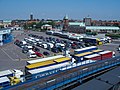 Part of Trelleborg harbour
 -

-
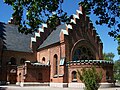 Church of St. Nicolai
 -


.JPG)

Twin cities
[edit]
See also
[edit]References
[edit]- ^ a b c "Tätorternas landareal, folkmängd och invånare per km2 2005 och 2010" (in Swedish). Statistics Sweden. 14 December 2011. Archived from the original on 27 January 2012. Retrieved 10 January 2012.
- ^ Svenskt ortnamnslexikon 2003
- ^ "Trelleborgen - Viking fortress in Trelleborg". GuidebookSweden. Retrieved 15 September 2022.
- ^ "Trelleborg - Uppslagsverk - NE.se". www.ne.se. Retrieved 15 September 2022.
- ^ Ilievski, Mile (2006). Документи за македонското национално движење во дијаспората (ОКМ-ДОМ-НОФМ (1st ed.). p. 5.
- ^ "Trelleborgs historia". www.trelleborg.se (in Swedish). Retrieved 13 September 2022.
- ^ a b "Hamnen".
- ^ "Öppet arkiv".
- ^ "Ferries between Germany, Poland and Sweden - TT-Line". ttline.com. Retrieved 6 August 2015.
- ^ "Färja till Tyskland - Åk bekvämt - Stena Line". stenaline.se. Retrieved 12 July 2021.
- ^ "Stena Line". ferries.se. Retrieved 12 July 2021.
- ^ "Gods- och passagerarfärjor". unityline.se. Retrieved 6 August 2015.
- ^ Nils-Åke Siversson & John Bitton "Öresund ett från himlen", Trafiknostalgiska förlaget, www.trafiknostalgiske.se, ISBN 918530510-3, page 38
- ^ Uma Thurmans mormor staty i Trelleborg Archived 2007-09-26 at the Wayback Machine, Sydsvenskan, 30 July 2006.(in Swedish)
- ^ "Sweden market shooting: Police rule out terrorism after gunman opens fire in Trelleborg". The Telegraph. 12 October 2017.
- ^ "Shooting that injured four in Swedish town of Trelleborg not terrorism". 12 October 2017.
- ^ "Startsida". Trelleborgs scoutkår (in Swedish). Retrieved 13 September 2022.
- ^ "Idrott, motion och friluftsliv". www.trelleborg.se (in Swedish). Retrieved 13 September 2022.
- ^ "The Honourable Justice Mark Weinberg AO Monash Law". www.monash.edu. Archived from the original on 23 February 2019.
- ^ "Trelleborgs museum". www.trelleborg.se (in Swedish). Retrieved 13 September 2022.
- ^ "Trelleborgen". www.trelleborg.se (in Swedish). Retrieved 13 September 2022.
- ^ "Axel Ebbes konsthall". www.trelleborg.se (in Swedish). Retrieved 13 September 2022.
External links
[edit] Media related to Trelleborg at Wikimedia Commons
Municipalities and seats of Skåne County | ||
|---|---|---|
| Municipalities |  | |
| Municipal seats | ||
|  | |||||||||||||||||||||||||||||||||||||||||||||||||||||||||||||||||||||||||||||||||||||||||||||||||||||||||||||||||||||||||||||||||||||||||||||||||||||||||||||
as of 2020, according to Statistics Sweden | ||||||||||||||||||||||||||||||||||||||||||||||||||||||||||||||||||||||||||||||||||||||||||||||||||||||||||||||||||||||||||||||||||||||||||||||||||||||||||||||

| International | |
|---|---|
| National | |
| Other | |
Trelleborg
View on GrokipediaGeography and Environment
Location and Topography
Trelleborg lies in Skåne County in southern Sweden, at approximately 55°22′N 13°10′E, positioning it as the southernmost town in the country and the seat of Sweden's southernmost municipality.[10][6] The town occupies a strategic spot on the south coast in the Öresund region, roughly 60 km southeast of Copenhagen, Denmark, across the Öresund Strait that separates the Scandinavian Peninsula from the Danish islands.[11] This coastal placement, about 10–15 km west of Smygehuk—Sweden's southernmost point at 55°20′N—enhances its role as a gateway between the Baltic Sea and continental Europe.[12] ![Trelleborg location in Sweden][float-right] The terrain consists of the flat, fertile Söderslätt coastal plain, part of Skåne's broader low-lying agricultural landscape with elevations averaging 9 meters above sea level and ranging from sea level to about 40 meters.[13][14] This gently undulating plain, shaped by glacial deposits and proximity to the sea, features sandy beaches, dunes, and open fields that extend inland, creating a topography conducive to expansive views and linear settlement patterns along the shoreline.[15] In 1967, the municipality expanded through the amalgamation of Trelleborg city with five adjacent rural municipalities, incorporating over 30 parishes and blending urban development with surrounding flat farmlands and coastal zones into a unified administrative area of approximately 335 square kilometers.[16] This integration reflects the topography's influence on land use, where the plain's uniformity supports a dispersed urban-rural layout centered on the harbor and extending into agricultural hinterlands.[17]Climate and Weather Patterns
Trelleborg features a temperate oceanic climate classified as Cfb under the Köppen system, marked by mild temperatures year-round due to its coastal position on the Baltic Sea and the moderating influence of the North Atlantic's warm currents, including extensions of the Gulf Stream. Average annual temperatures hover around 9°C, with winters remaining relatively mild—January highs average 3°C and lows -1°C—and summers cool, peaking at July highs of 21°C and lows of 13°C. This climate supports a longer frost-free period compared to inland or northern Sweden, facilitating agriculture such as grain and vegetable cultivation in surrounding Skåne plains, though coastal fog and humidity can occasionally delay spring planting.[18][19][20] Precipitation totals approximately 650-700 mm annually, distributed fairly evenly but with slightly higher rainfall in late summer and autumn, averaging 50-60 mm per month. The coastal location exposes Trelleborg to consistent winds, averaging 15-20 km/h year-round with peaks in winter, which enhance evaporation and contribute to drier effective conditions despite the rainfall. Cloud cover predominates in winter (over 70% overcast in December), transitioning to partly cloudy summers, influencing daily life through reduced solar exposure in colder months and aiding in the moderation of extreme heat.[18][19] Extreme weather events, primarily winter storms from the Baltic, occasionally disrupt harbor operations and coastal infrastructure; for instance, Storm Babet in October 2023 caused severe erosion along the southern Swedish coast, including near Trelleborg, while compound events combining high sea levels, rainfall, and surges have led to localized flooding projections under climate trends. Historical records indicate rare temperature extremes, with lows dipping below -10°C infrequently and highs seldom exceeding 25°C, but increasing storm frequency poses risks to the port's ferry and cargo activities, prompting investments in resilient infrastructure.[21][22][18]Demographics and Society
Population Statistics
As of 2024, Trelleborg Municipality had an estimated population of 47,269 residents. This reflects steady growth, with an average annual increase of 0.75% between 2020 and 2024, driven by net positive changes in births, deaths, and migration since the post-World War II period. The population has risen consistently, expanding from around 43,000 in the mid-2010s to the current figure, aligning with broader regional urbanization trends in Skåne County.[23] The municipality spans 340 km², yielding an overall population density of 139 inhabitants per km². This figure incorporates rural peripheries integrated via the 1967 amalgamation of the former City of Trelleborg with five surrounding rural municipalities, which expanded the administrative area while concentrating most residents in the urban core.[16] The central Trelleborg locality, covering about 17 km², houses over 46,900 people, producing a localized density exceeding 1,850 per km² and underscoring the urban-rural divide within the municipality.[24] Age demographics indicate a working-age majority supportive of the area's industrial orientation, with 26,984 individuals (57%) aged 18–64, compared to 9,880 (21%) under 18 and 10,405 (22%) aged 65 and over. This structure, derived from official estimates, reflects patterns of sustained family formation and labor participation contributing to demographic stability.Ethnic Composition and Immigration Trends
As of 2023, 18.69% of Trelleborg Municipality's residents were foreign-born, totaling 8,773 individuals out of a population of approximately 46,900, while 24.97% had a foreign background, encompassing those born abroad or Swedish-born with two foreign-born parents.[25] This figure aligns closely with Skåne County's 24% foreign-born rate but trails the national average of 27.17% for foreign background.[25][26] Predominant origins mirror broader Swedish patterns from post-1990s refugee inflows, including Balkan countries during the Yugoslav conflicts and subsequent waves from Syria, Iraq, and Afghanistan amid Middle Eastern instability, supplemented by labor migrants from Poland and other EU states.[27] The share of foreign background in Trelleborg has risen steadily since 2002, driven by Sweden's asylum policies accommodating over 160,000 arrivals in 2015 alone, many settling in southern municipalities like those in Skåne due to proximity to entry points and existing networks.[25][28] This influx contributed to localized pressures, such as elevated welfare receipt among non-EU migrants; nationally, foreign-born households exhibit higher dependency on social assistance, with employment rates at 64% compared to 77% for native Swedes in 2023.[29] Trelleborg's integration efforts, including the Waterfront project addressing rapid Skåne-wide growth, reflect attempts to mitigate such outcomes through targeted housing and job programs, though persistent gaps in labor market participation persist for recent arrivals.[30] School enrollment data indicate strains from demographic shifts, with foreign-background children comprising a growing segment—up to 30-40% in some Trelleborg districts—leading to overcrowding and resource allocation challenges tied to language support needs.[31] These trends underscore causal links between national migration volumes and municipal service demands, without altering the native Swedish majority (over 70%) but amplifying fiscal burdens on local cohesion via sustained welfare and educational expenditures.[32]Social Structure and Class Dynamics
Trelleborg's social structure reflects its historical development as a port and manufacturing hub, resulting in a predominantly blue-collar workforce oriented toward logistics, shipping, and industrial production. The town's labor movement emerged strongly in the early 20th century, particularly in the port sector south of Malmö, where workers organized to address industrial conditions and influence local politics.[33] This foundation contributed to a class composition dominated by manual laborers, with employment data indicating significant reliance on trade, transport, and manufacturing sectors that employ a majority of the local working population.[34] Unionization remains a key feature, aligning with national blue-collar rates of 59% in 2022, though declining from prior highs, underscoring organized labor's role in sustaining working-class cohesion amid economic shifts.[35] Income levels in Trelleborg lag behind the national median, with municipal data showing socioeconomic challenges concentrated in certain areas, where only 8.2% of the population resides in neighborhoods with very favorable conditions as of recent assessments.[36] This disparity fosters class dynamics marked by limited upward mobility in some segments, though Sweden's overall intergenerational mobility rates remain high, with earnings persistence explaining just 4-7% of variance across generations. Empirical patterns in industrial municipalities like Trelleborg indicate that while national welfare structures enable broad access to education and retraining, local reliance on cyclical port economies can constrain advancement for lower-skilled workers, perpetuating a stable but stratified working-class base.[37] Family and community structures in Trelleborg emphasize nuclear households typical of Swedish norms, with individualism and self-reliance as core values, yet reinforced by historical labor solidarities that foster tight-knit ties in working-class districts.[38] Traditional Swedish emphases on equality and community support persist, particularly in blue-collar enclaves, where union halls and local associations serve as anchors amid socioeconomic pressures.[39] These dynamics highlight resilience in class-based networks, balancing national trends toward independence with localized persistence of collective orientation derived from industrial heritage.[40]History
Prehistoric and Viking Age Foundations
Archaeological investigations in the Trelleborg region reveal evidence of human activity dating back to prehistoric periods, with the area characterized by dense settlement patterns including numerous graves and habitation sites from the Stone, Bronze, and Iron Ages. Excavations at nearby Dalköpinge, for instance, have uncovered remains indicative of continuous occupation, underscoring the strategic appeal of the coastal plain in Skåne for early communities reliant on agriculture, fishing, and trade. These findings suggest that the locale's fertile soils and proximity to the Baltic Sea fostered sustained prehistoric presence, laying groundwork for later Viking-era developments.[41] The Viking Age foundations of Trelleborg are epitomized by Trelleborgen, a circular ring fortress constructed around 980 AD, likely under the auspices of King Harald Bluetooth during his efforts to consolidate control over Danish territories including Skåne. This fort, discovered in 1988, features a distinctive design with a diameter of approximately 115 meters, encompassing oak palisades, moats, four gates aligned to the cardinal directions, and internal barracks symmetrically arranged to house military personnel efficiently. From first principles, such fortifications addressed causal imperatives of defense against incursions—such as those from Slavic Wends or rival Scandinavian factions—and facilitated centralized command for imperial expansion, enabling rapid troop mobilization and resource allocation in a era of fragmented polities vulnerable to amphibious raids. The precision of construction, involving massive timber works felled in a narrow timeframe, implies coordinated labor on an industrial scale, reflective of state-level organizational capacity.[5][42][43] Trelleborgen's operational lifespan was brief, spanning roughly 10-20 years before abandonment circa 1000 AD, coinciding with heightened Wendish raids that may have rendered the site untenable or shifted strategic priorities following Harald's death and succession struggles. Dendrochronological and artifact analyses indicate minimal maintenance and no long-term occupation, supporting interpretations of the fort as a temporary bulwark for Harald's transient ambitions rather than a permanent settlement. The etymology of "Trelleborg" remains debated among scholars: one view derives it from Old Norse þræll (thrall, denoting slave), suggesting construction via coerced labor consistent with Viking society's reliance on thralls for large-scale projects, as evidenced by the fort's rapid erection without comparable free-labor precedents; alternatives propose trel referring to wooden staves in the palisade, though this sidesteps the socio-economic realities of Viking thrall economies documented in sagas and archaeology. This short-lived endeavor highlights the pragmatic calculus of Viking militarism, where fortifications served episodic power projection amid existential threats, ultimately succumbing to geopolitical flux.[42][44]Medieval Development and Danish Influence
Trelleborg functioned as a prominent coastal trading post under Danish rule during the Middle Ages, with its economy centered on herring fishing and commerce along the Baltic Sea coast of Scania. The town's first documented reference appears in 1257, linked to monetary transactions, indicating early administrative recognition within the Danish realm. Abundant herring shoals attracted Danish-regulated fishing operations, where catches were landed locally and processed for export, drawing Hanseatic League merchants who bartered salt—a critical preservative—for salted fish, thereby integrating Trelleborg into broader North European trade networks.[45][46][47] Religious institutions underscored the settlement's growth, reflecting Danish ecclesiastical oversight tied to economic activity. A medieval city church dedicated to Saint Nicholas, protector of mariners, featured structures from the 13th century onward, serving the fishing and trading populace. Adjacent ruins of a Franciscan monastery, established to support mendicant orders amid the herring boom, highlight how monastic presence facilitated trade logistics and spiritual needs but waned following Denmark's 1536 Reformation, which dissolved such Catholic foundations and shifted land use toward crown-controlled agriculture. Surrounding rural areas emphasized arable farming and pastoralism under Danish manorial systems, providing supplementary grain and livestock to sustain the port's workforce, though coastal priorities dominated.[48][49] No major post-Viking fortifications are recorded in Trelleborg, unlike earlier ring forts, as Danish defenses focused on regional strongholds amid Scanian integration into the kingdom's administrative framework via the Scanian Law codified around 1200. The 15th-century migration of herring stocks southward caused economic stagnation, reducing trade volumes and prompting shifts to subsistence agriculture, with population densities contracting as Hanseatic activity pivoted elsewhere. Danish governance persisted through intermittent conflicts, such as the 1534–1536 Count's Feud, which disrupted local stability but reinforced crown authority over Scania's ports until the 1658 Treaty of Roskilde ceded the province to Sweden, marking the end of prolonged Danish influence.[46][48]Industrialization and Modern Growth (19th-20th Centuries)
Trelleborg's transition to an industrial center began in the mid-19th century with the formation of the port company in 1861 and the completion of initial harbor infrastructure by 1865, enabling expanded maritime trade. The town received city rights in 1867, which supported its emergence as a key harbor locale in southern Sweden. The connection of the Continental Line railway in 1898 linked Trelleborg to Malmö and national networks, facilitating the transport of goods and passengers, and laying the groundwork for industrial expansion. By the late 19th century, these developments transformed Trelleborg into an industrial hub, driven by a handful of major enterprises that capitalized on rail and port access for manufacturing and export.[50][45] The early 20th century saw further acceleration through the introduction of train ferry services to Sassnitz, Germany, commencing in 1909, which integrated Trelleborg into continental rail traffic and boosted port throughput. By the 1910s, Trelleborg hosted 28 industries employing around 1,000 workers in a population of approximately 10,000, positioning it among Sweden's leading industrial municipalities at the time. Labor migration from rural areas fueled population growth, as workers sought opportunities in emerging factories focused on processing and light manufacturing tied to maritime and rail logistics. These factors drove urbanization, with infrastructure like water towers and expanded housing reflecting the influx.[51][50] Sweden's neutrality during World War II minimized direct disruption to Trelleborg's economy, allowing continued port operations for trade and facilitating exchanges of wounded personnel and prisoners via ferry routes. Defensive installations, including acoustic airplane locators stationed in the area, underscored preparations against potential aerial threats while preserving industrial continuity. Post-1945, integration into Sweden's expanding welfare state supported sustained growth through public investments in housing and urban planning, accommodating ongoing migration and industrial demands without significant post-war reconstruction needs. Empirical data from the era indicate steady population increases aligned with national urbanization trends, bolstered by state policies promoting worker welfare and infrastructure development.[45]Post-War Expansion and Recent Challenges
Following World War II, Trelleborg experienced population and economic growth driven by its strategic port position, culminating in administrative restructuring. In 1967, the modern Trelleborg Municipality was established through the merger of the City of Trelleborg with five rural municipalities—Skegrie, Gislöv, Ingelstorp, Källstorp, and Östra Klagstorp—expanding the municipal area to over 30 localities and enabling coordinated development of urban and rural resources.[16][52] This amalgamation supported post-war housing and infrastructure needs amid Sweden's broader industrialization and welfare state expansion. Sweden's accession to the European Union in 1995 prompted adaptations in Trelleborg's transport sector, with the port enhancing ferry services to German destinations like Rostock and Travemünde to capitalize on integrated markets. Ferry traffic peaked in subsequent decades, handling over 2,100 trucks daily by the late 2010s and facilitating about 30 daily arrivals and departures, underscoring the port's role as a key [Baltic Sea](/page/Baltic Sea) gateway.[53][54] Infrastructure upgrades followed, including EU-funded projects under the Connecting Europe Facility; in 2022, Trelleborg secured two of six Swedish grants for port enhancements to boost multimodal freight and passenger flows.[55] In 2024, collaborations with the Swedish Transport Administration advanced intermodal capacity, while train ferry operations to Germany were extended through 2031 to sustain rail-dependent trade amid continental shifts like the Öresund Bridge's 2000 opening.[56][57] Recent challenges include economic pressures from global trade disruptions and Sweden's 2023 recession, which slowed growth and heightened uncertainties for export-reliant sectors like Trelleborg's port logistics. Deindustrialization trends in traditional manufacturing, coupled with rising competition from direct continental routes, have necessitated diversification toward green shipping, such as planned corridors with low-emission vessels to Lübeck-Travemünde.[58] Despite these, the port maintained positive passenger (1.6 million) and vehicle (372,000) volumes in 2022, reflecting resilience through efficiency measures like automated access controls.[59] Local responses emphasize sustainability and intermodal integration to counter broader Swedish economic headwinds, including weak 2024 growth and tariff risks.[60][61]Government and Politics
Municipal Administration
Trelleborg functions as the administrative seat of Trelleborg Municipality, which encompasses urban and rural areas following the 1967 amalgamation of the City of Trelleborg with five surrounding rural municipalities, incorporating over thirty original local units into a unified structure.[16] This consolidation streamlined governance under a single municipal framework, with further alignment to national reforms in 1971 that designated Trelleborg as the central authority for both city and countryside administration. The municipality operates through a hierarchical bureaucracy emphasizing local decision-making, including specialized departments (förvaltningar) such as the municipal leadership administration (kommunledningsförvaltningen), urban planning and building administration (samhällsbyggnadsförvaltningen), technical services administration (tekniska serviceförvaltningen), social administration (socialförvaltningen), and education administration (bildningsförvaltningen).[62] The highest decision-making body is the municipal council (kommunfullmäktige), comprising 61 elected members responsible for approving budgets, policies, and major initiatives; this size was expanded from 51 in 2022 to accommodate population growth exceeding 46,000 residents.[63] Executive functions fall to the municipal board (kommunstyrelsen), led by the chair (kommunstyrelsens ordförande), who coordinates daily operations alongside full-time municipal councilors (kommunalråd) handling portfolios like development and opposition oversight.[64] These roles prioritize efficient service delivery in areas such as infrastructure maintenance and community planning, with the technical services administration supporting 61 villages and 21 urban districts through resource allocation for roads, utilities, and environmental management. Budgetary priorities reflect a focus on core local services, with the 2024 allocation providing committees (nämnder) an additional 257 million SEK over the prior year, directed toward education, healthcare, and elder care without tax increases.[65] Education expenditures, managed via the bildningsnämnden, support schools and lifelong learning programs, while social services under the socialnämnden saw budget increases in 2025 to cover rising demands in welfare and family support, mirroring national trends in municipal spending on demographic pressures.[66] This structure enables targeted resource distribution, with administrative efficiency emphasized through departmental reorganizations, such as the 2020 consolidation of technical services into five streamlined units to enhance operational effectiveness.[67]Electoral History and Political Shifts
Trelleborg Municipality has long been a stronghold of the Social Democratic Party (S), owing to its working-class population tied to port and industrial employment, with S securing absolute majorities in kommunfullmäktige elections through the 1980s and 1990s, such as 28 of 51 seats in 1988 and 31 in 1994.[68] This dominance reflected broader patterns in Skåne County, where labor-oriented voting prevailed amid post-war welfare state expansion and manufacturing growth. The Sweden Democrats (SD) entered municipal politics in the early 2000s, initially marginal but gaining traction post-2010 amid national debates on immigration and economic pressures; by 2010, SD held 7 seats compared to S's 17.[68] In the 2018 municipal election, SD overtook S with 13 seats to S's 12 out of 51, signaling a voter shift in this traditionally left-leaning area.[68] The 2022 municipal election further illustrated fragmentation, with total seats expanding to 61 due to population growth; vote shares were S at 23.68%, SD at 22.39%, Moderates (M) at 19.25%, and local Vårt Söderslätt (VS) at 13.49%, yielding S 15 seats, SD 14, and M 12.[69][68]| Election Year | S Seats | SD Seats | M Seats | Total Seats |
|---|---|---|---|---|
| 1988 | 28 | 0 | 10 | 51 |
| 1994 | 31 | 0 | 10 | 51 |
| 2002 | 23 | 2 | 8 | 51 |
| 2010 | 17 | 7 | 16 | 51 |
| 2018 | 12 | 13 | 12 | 51 |
| 2022 | 15 | 14 | 12 | 61 |