Hubbry Logo
HadadHadadMain
Open search
Hadad
Community hub
Hadad
logo
8 pages, 0 posts
0 subscribers
Be the first to start a discussion here.
Contribute something
Hadad
Hadad
from Wikipedia
Hadad
God of Weather, Hurricanes, Storms, Thunder and Rain
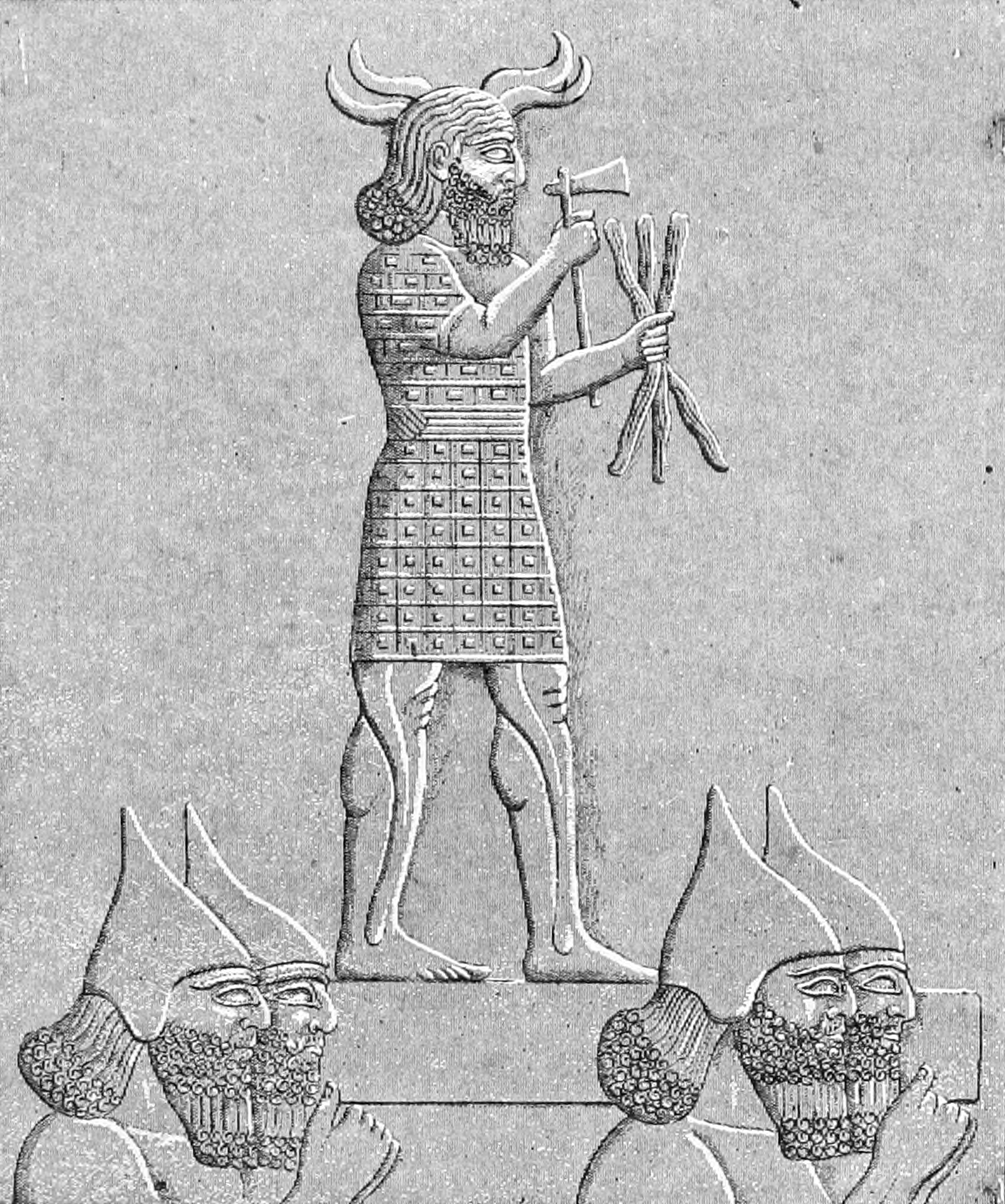
Assyrian soldiers carrying a statue of Adad
AbodeHeaven
SymbolThunderbolt, bull, lion
Genealogy
ParentsMost common tradition: Sin and Ningal, or Dagon
SiblingsKishar, Inanna
ConsortShala, Medimsha
ChildrenGibil or Girra
Equivalents
GreekZeus
RomanJupiter
EgyptianHorus
HurrianTeshub

Hadad (Ugaritic: 𐎅𐎄, romanized: Haddu), Haddad, Adad (Akkadian: 𒀭𒅎 DIM, pronounced as Adād), or Iškur (Sumerian) was the storm- and rain-god in the Canaanite and ancient Mesopotamian religions. He was attested in Ebla as "Hadda" in c. 2500 BCE.[1][2]

From the Levant, Hadad was introduced to Mesopotamia by the Amorites, where he became known as the Akkadian (Assyrian-Babylonian) god Adad.[3][4][5][6] Adad and Iškur are usually written with the logogram 𒀭𒅎 dIM[7] - the same symbol used for the Hurrian god Teshub.[8] Hadad was also called Rimon/Rimmon, Pidar, Rapiu, Baal-Zephon,[9] or often simply Baʿal (Lord); however, the latter title was also used for other gods. The bull was the symbolic animal of Hadad. He appeared bearded,[10][11] often holding a club and thunderbolt and wearing a bull-horned headdress.[12][13] Hadad was equated with the Greek god Zeus, the Roman god Jupiter (Jupiter Dolichenus), as well as the Babylonian Bel.[citation needed]

The Baal Cycle or Epic of Baal is a collection of stories about the Canaanite Baal, also referred to as Hadad. It was composed between 1400 and 1200 B.C. and rediscovered in the excavation of Ugarit, an ancient city in modern-day Syria.

The storm-god Adad and the sun-god Shamash jointly became the patron gods of oracles and divination in Mesopotamia.

Adad in Akkad and Sumer

[edit]

In Akkadian, Adad is also known as Rammanu ("Thunderer") cognate with Imperial Aramaic: רעמא Raˁmā and Hebrew: רַעַם Raˁam, a byname of Hadad. Many scholars formerly took Rammanu to be an independent Akkadian god, but he was later identified with Hadad.

Though originating in northern Mesopotamia, Adad was identified by the same Sumerogram dIM that designated Iškur in the south.[14] His worship became widespread in Mesopotamia after the First Babylonian dynasty.[15] A text dating from the reign of Ur-Ninurta characterizes the two sides of Adad/Iškur as threatening in his stormy rage, and benevolent in giving life.[16]

Iškur appears in the list of gods found at Shuruppak but was of far less importance, perhaps because storms and rain were scarce in Sumer and agriculture there depended on irrigation instead. The gods Enlil and Ninurta also had storm god features that diminished Iškur's distinct role, and he sometimes appears as the assistant or companion of these more prominent gods.

When Enki distributed the destinies, he made Iškur inspector of the cosmos. In one litany, Iškur is proclaimed again and again as "great radiant bull, your name is heaven" and also called son of Anu, lord of Karkara; twin-brother of Enki, lord of abundance, lord who rides the storm, lion of heaven.

In other texts Adad/Iškur is sometimes son of the moon god Nanna/Sin by Ningal and brother of Utu/Shamash and Inanna/Ishtar. He is also sometimes described as the son of Enlil.[17]

The bull was portrayed as Adad/Iškur's sacred animal starting in the Old Babylonian period[18] (early 2nd millennium BCE).

Adad/Iškur's consort (both in early Sumerian and the much later Assyrian texts) was the grain goddess Shala, who is also sometimes associated with the god Dagānu. She was also called Gubarra in the earliest texts. The fire god Gibil (Girra in Akkadian) is sometimes the son of Iškur and Shala.

He is identified with the Anatolian storm-god Teshub, whom the Mitannians designated with the same Sumerogram dIM.[8] Occasionally he is identified with the Amorite god Amurru.[citation needed]

The Babylonian center of Adad/Iškur's cult was Karkara in the south, his chief temple being É.Kar.kar.a; his spouse Shala was worshipped in a temple named É.Dur.ku. In Assyria, Adad was developed along with his warrior aspect. During the Middle Assyrian Empire, from the reign of Tiglath-Pileser I (1115-1077 BCE), Adad had a double sanctuary with Anu in Assur, and the two are often associated in invocations. The name Adad and various alternate forms (Dadu, Bir, Dadda) are often found in Assyrian king names.

Adad/Iškur presents two aspects in hymns, incantations, and votive inscriptions. On the one hand, he brings rain in due season to fertilize the land; on the other, he sends storms to wreak havoc and destruction. He is pictured on monuments and cylinder seals (sometimes with a horned helmet) with the lightning and the thunderbolt (sometimes in the form of a spear), and in hymns his sombre aspects predominate. His association with the sun-god Shamash, with the two deities alternating in the control of nature, tends to imbue him with some traits of a solar deity.

According to Alberto Green, descriptions of Adad starting in the Kassite period and in the region of Mari emphasize his destructive, stormy character and his role as a fearsome warrior deity,[19] in contrast to Iškur's more peaceful and pastoral character.[20]

Shamash and Adad jointly became the gods of oracles and divination, invoked in all the ceremonies to determine the divine will: through inspecting a sacrificial animal's liver, the action of oil bubbles in a basin of water, or the movements of the heavenly bodies. They are similarly addressed in royal annals and votive inscriptions as bele biri (lords of divination).

Hadad in Ugarit

[edit]
Stele of Baal with Thunderbolt, 15th–13th century BCE. Found at the acropolis in Ras Shamra (ancient city of Ugarit).

In religious texts, Ba‘al/Hadad is the lord of the sky who governs rain and crops, master of fertility and protector of life and growth. His absence brings drought, starvation, and chaos. Texts of the Baal Cycle from Ugarit are fragmentary and assume much background knowledge.

The supreme god El resides on Mount Lel (Night?) where the assembly of the gods meets. At the beginning of the cycle, there appears to a feud between El and Ba‘al. El appoints one of his sons, called both prince Yamm (Sea) and judge Nahar (River), as king over the gods and changes Yamm's name from yw to mdd ’il (darling of El). El tells his son that he will have to drive off Ba‘al to secure the throne.

In this battle Ba‘al is somehow weakened, but the divine craftsman Kothar-wa-Khasis crafts two magic clubs for Ba’al as weapons that help Ba’al strike down Yamm and Ba'al is supreme. ‘Athtart proclaims Ba‘al's victory and salutes Ba‘al/Hadad as lrkb ‘rpt (Rider on the Clouds), a phrase applied by editors of modern English Bibles to Yahweh in Psalm 68.4. At ‘Athtart's urging Ba‘al "scatters" Yamm and proclaims that he is dead and warmth is assured.

A later passage refers to Ba‘al's victory over Lotan, the many-headed sea dragon. Due to gaps in the text it is not known whether Lotan is another name for Yamm or a character in a similar story. These stories may have been allegories of crops threatened by the winds, storms, and floods from the Mediterranean sea.

A palace is built for Ba‘al with silver, gold, and cedar wood from Mount Lebanon and Sirion. In his new palace Ba‘al hosts a great feast for the other gods. When urged by Kothar-wa-Khasis, Ba’al reluctantly opens a window in his palace and sends forth thunder and lightning. He then invites Mot (Death, the god of drought and the underworld), another son of El, to join the feast.

But Mot, the eater of human flesh and blood, is insulted when offered only bread and wine. He threatens to break Ba‘al to pieces and swallow him, and even Ba‘al cannot stand against Death. Gaps here make interpretation dubious. It seems that by the advice of the sun goddess Shapash, Ba‘al mates with a heifer and dresses the resultant calf in his own clothes as a gift to Mot, and then himself prepares to go down to the underworld in the guise of a helpless shade. News of Ba‘al's apparent death leads even El to mourn. Ba‘al's sister ‘Anat finds Ba‘al's corpse, presumably really the dead calf, and she buries the body with a funeral feast. The god ‘Athtar is appointed to take Ba‘al's place, but he is a poor substitute. Meanwhile, ‘Anat finds Mot, cleaves him with a sword, burns him with fire, and throws his remains to the birds. But the earth is still cracked with drought until Shapsh fetches Ba‘al back.

Seven years later Mot returns and attacks Ba‘al, but the battle is quelled when Shapsh tells Mot that El now supports Ba’al. Mot surrenders to Ba‘al and recognizes him as king.

Hadad in Egypt

[edit]

In the Amherst Papyrus, Baal Zephon (Hadad) is identified with the Egyptian god Horus: "May Baal from Zephon bless you", Amherst Papyrus 63, 7:3 and in 11:13-14: "and from Zephon may Horus help us". Classical sources translate this name as Zeus Kasios, since in Pelusium, the statue of Zeus Kasios was considered the image of Harpocrates (Horus the Child).[21] Zeus Casius had inherited some traits from Apollo as well. They also recall his conflict with Typhon over that mountain (Mount Casius on the Syrian-Turkish border or Casion near Pelusium in Egypt). The reason why Baal could be both identified with Horus and his rival Set; is because in Egypt the element of the storm was considered foreign as Set was a god of strangers and outsiders, thus because the Egyptians had no better alternative to identify their native god Set with another neighboring deity, they tentatively associated him with Hadad since he was a storm-god, but when the god Baal (Hadad) is not specifically attributed the traits of rain and thunder and is instead perceived as a god of the sky generically, which is what is embodied by his form "Baal Zaphon" as the chief deity who resides on the mountain (for example a 14th-century letter from the king of Ugarit to the Egyptian pharaoh places Baʿal Zaphon as equivalent to Amun also),[22] in that case he's more similar to the Egyptian Horus in that capacity (comparable to Baalshamin as well). The different interpretation could also be based on the fact that Set had been associated with Hadad by the Hyksos. Most likely originally Set referred to another deity also addressed by the title "Baal" (one of the many; an example of this would be the Baal of Tyre) who happened to display storm-like traits especially in Egypt since they were foreign and as such duly emphasized; when instead his weather features probably weren't all that prominent in other cultures who worshipped equivalents of him, but given that the only storm-god available for identification in Semitic culture was Hadad and in Hittite Sutekh (a war-god who's been hypothesized to be an alternative name of Teshub, but it remains unclear), the traits matched the characteristics of the Egyptian deity, and an association between the two was considered plausible, also given by the fact that both the Hittites and Semitic Hyksos were foreigners in the Egyptian land who brought their gods with them, and their main god happened to display storm-like traits and was also associated with these foreigners who came to Egypt, a characteristic that would make him similar to the perception that the Egyptians had of Set. This would once again echo the mythological motif of a previous chief of the Pantheon who gets replaced by the new generation of deities represented by the younger ascendant ruler and newly appointed chief of the gods, as is the case also for the Hittite "Cycle of Kumarbi" where Teshub displaces the previously established father of the gods Kumarbi. In Amherst XII/15 the same identification as before is once again stated: "Baal from Zephon, Horus" (BT mn Şpn Hr).

Hadad in Aram and ancient Israel

[edit]
Colossal statue of Hadad, from Gerdshin near Sam'al, 775 BCE, Pergamon Museum

In the second millennium BCE, the king of Yamhad or Halab (modern Aleppo), who claimed to be "beloved of Hadad", received the tribute of statue of Ishtar from the king of Mari, to be displayed in the temple of Hadad in Halab Citadel.[23][24] Hadad is called "the god of Aleppo" on a stele of the Assyrian king Shalmaneser I.

The element Hadad appears in a number of theophoric names borne by kings of the region. Hadad son of Bedad, who defeated the Midianites in Moab, was the fourth king of Edom. Hadadezer ("Hadad-is-help") was the Aramean king defeated by David. Later Aramean kings of Damascus seem to have habitually assumed the title of Ben-Hadad (son of Hadad). One was Ben-Hadad, the king of Aram whom the Judean king Asa sent to invade the northern Kingdom of Israel.[25] A votive basalt stele from the 9th or 8th century, BCE found in Bredsh north of Aleppo, is dedicated to Melqart and bears the name Ben-Hadad, king of Aram.[26] The seventh of the twelve sons of Ishmael is also named Hadad.

A set of related bynames include Aramaic rmn, Old South Arabic rmn, Hebrew rmwn, and Akkadian Rammānu ("Thunderer"), presumably originally vocalized as Ramān in Aramaic and Hebrew. The Hebrew spelling rmwn with Masoretic vocalization Rimmôn[27] is identical with the Hebrew word meaning 'pomegranate' and may be an intentional misspelling and/or parody of the deity's original name.[28]

A stele from Bethsaida (et-Tell) depicting a Canaanite deity, possibly Hadad. On display at the Israel Museum in Jerusalem.[29]

The word Hadad-rimmon (or Hadar-rimmon) in the phrase "the mourning of (or at) Hadad-rimmon",[30] has aroused much discussion. According to Jerome and the older Christian interpreters, the mourning is for something that occurred at a place called Hadad-rimmon (Maximianopolis) in the valley of Megiddo. This event was generally held to be the death of Josiah (or, as in the Targum, the death of Ahab at the hands of Hadadrimmon). But even before the discovery of the Ugaritic texts, some suspected that Hadad-rimmon might be a dying-and-rising god like Adonis or Tammuz, perhaps even the same as Tammuz, and the allusion could then be to mournings for Hadad such as those of Adonis festivals.[31] T. K. Cheyne pointed out that the Septuagint reads simply Rimmon, and argues that this may be a corruption of Migdon (Megiddo) and ultimately of Tammuz-Adon. He would render the verse, "In that day there shall be a great mourning in Jerusalem, as the mourning of the women who weep for Tammuz-Adon" (Adon means "lord").[32] No further evidence has come to light to resolve such speculations.

In the Books of Kings, Jezebel – the wife of the Northern Israelite King Ahab promoted the cult of Ba'al in her adopted nation. John Day argues that Jezebel's Baʿal was possibly Baʿal Shamem (Lord of the Heavens), a title most often applied to Hadad.[33]

Sanchuniathon

[edit]

In Sanchuniathon's account Hadad is once called Adodos, but is mostly named Demarûs. This is a puzzling form, probably from Ugaritic dmrn, which appears in parallelism with Hadad,[34] or possibly a Greek corruption of Hadad Ramān. Sanchuniathon's Hadad is son of Sky by a concubine who is then given to the god Dagon while she is pregnant by Sky. This appears to be an attempt to combine two accounts of Hadad's parentage, one of which is the Ugaritic tradition that Hadad was son of Dagon.[35] The cognate Akkadian god Adad is also often called the son of Anu ("Sky"). The corresponding Hittite god Teshub is likewise son of Anu (after a fashion).

In Sanchuniathon's account, it is Sky who first fights against Pontus ("Sea"). Then Sky allies himself with Hadad. Hadad takes over the conflict but is defeated, at which point unfortunately no more is said of this matter. Sanchuniathion agrees with Ugaritic tradition in making Muth, the Ugaritic Mot, whom he also calls "Death", the son of El.

See also

[edit]

Notes

[edit]

References

[edit]
[edit]
Revisions and contributorsEdit on WikipediaRead on Wikipedia
from Grokipedia
Hadad (Aramaic: 𐡇𐡃𐡃) was a major Semitic storm god in the , worshiped under various names such as Adad in Akkadian and Mesopotamian traditions, Baal in Canaanite and contexts, and Ramman or in Aramaic sources, embodying the forces of thunder, rain, fertility, and destruction from at least the third millennium BCE. The earliest textual evidence for Hadad, spelled as Hadda, appears in third-millennium BCE documents from the Syrian city of , where he is already portrayed as a powerful associated with natural phenomena like storms and , interpreted as manifestations of divine intervention. In Mesopotamian pantheons, particularly among the Assyrians and Babylonians, Adad ranked high as a provider of life-sustaining rains for agriculture while also unleashing devastating floods and tempests, often depicted as a bearded figure wielding a and standing on the back of a , symbolizing strength and virility. His dual nature as both benevolent and fearsome extended to warfare, where he was invoked as a aiding kings in battle, as seen in royal inscriptions from and . Hadad's worship was widespread, with major cult centers in northern such as (where his temple stood prominently in the citadel), (dedicated to Hadad-Ramman), and Samal, as well as in and other Levantine sites, often involving rituals of and renewal tied to seasonal cycles and agricultural . In these regions, he frequently headed the pantheon de , often serving as the consort of the goddess , reflecting his central role in Semitic mythologies. Iconographically, Hadad was consistently represented with weapons of storm—lightning bolts, axes, and maces—and the bull motif, which linked him to fertility cults and influenced later Hellenistic depictions of or Heliopolitanus at . Historically, 's cult persisted from the Early through the and into the , with kings like those of bearing theophoric names such as Ben-Hadad ("son of Hadad") to invoke his protection, underscoring his enduring political and religious significance. His attributes as a storm-warrior also paralleled and possibly influenced the portrayal of in early Israelite religion, where similar motifs of divine combat against chaos appear in biblical texts. Comprehensive studies, such as Alberto R. W. Green's The Storm-God in the (2003), highlight Hadad's syncretic evolution across cultures, from Sumerian Ishkur to Hittite and Hurrian Tarhunna, illustrating the deity's adaptability and dominance in the religious landscape of the region.

Etymology and General Characteristics

Name Origins and Variants

The name Hadad originates from the Proto-Semitic root *ḥdd, which means "to thunder" or "to resound loudly," directly linking the deity to the auditory and destructive aspects of storms. This etymological connection is evident in the Akkadian form Adad (or Addu), a phonetic variant derived from the same *hdd, signifying thunder. In Arabic, a term hadd denotes a thunderclap or the crashing noise of rain and tempests, underscoring the root's enduring association with meteorological phenomena across . Regional variants of the name reflect linguistic adaptations and cultural integrations in the . In Akkadian texts, the deity is consistently rendered as Adad, appearing in script from early Mesopotamian records. West Semitic traditions, particularly in and Canaanite contexts, fuse the name with the title ("lord"), yielding Baal-Hadad, where Hadad emphasizes the specific storm aspect of the broader . sources employ (or Ramman), an meaning "thunderer," often used interchangeably with Hadad to highlight his rumbling voice. The name's evolution traces through ancient writing systems, beginning with its earliest attestations in tablets from around 2500 BCE, where it appears as Hadda, marking one of the oldest references to the storm god in Semitic pantheons. In Mesopotamian , the logographic and syllabic forms for Adad (such as dIM or a-da-ad) dominate from the third millennium BCE onward. By the second millennium, alphabetic renders it as Haddu or Hadad (𐎅𐎄), facilitating more precise phonetic representation in Northwest Semitic texts. This shift from syllabic to consonantal alphabets allowed for broader dissemination across Levantine cultures. A key distinction arises in Hurrian contexts, where Haddu serves as the borrowed name for the storm god, integrated into the Hurro-Hittite pantheon and often syncretized with , differing from the purely Semitic Hadad by embedding in non-Semitic mythological cycles focused on Anatolian weather and kingship motifs. This highlights phonetic similarity but cultural divergence, preventing conflation with the core Semitic thunder deity.

Core Attributes and Role as Storm God

Hadad, the preeminent storm god of the ancient Near Eastern pantheons, exercised dominion over storms, , thunder, and , elements that directly influenced the and vitality of the land. This control positioned him as a pivotal deity in Semitic , where his powers ensured agricultural prosperity through seasonal rains while also embodying the potential for cataclysmic destruction via floods and tempests. The dual nature of his influence—nurturing growth on one hand and wreaking havoc on the other—reflected the precarious balance of life in arid regions dependent on unpredictable weather patterns. In familial terms, Hadad is typically depicted as the son of the grain god Dagan within traditions, though he sometimes appears as a son of the supreme god El. His consorts included the warrior goddess , who complemented his martial aspects, and occasionally , linking him to broader fertility motifs. Hadad's occasional identification with imagery further symbolized his raw strength, virility, and generative force, evoking the bull's association with power and reproduction in Semitic . Theologically, Hadad functioned as a warrior who combated primordial chaos, confronting entities such as sea monsters to maintain cosmic order and ensure the renewal of creation. This role highlighted his protective function over the ordered world against disruptive forces. Structurally, Hadad parallels Indo-European thunder gods like and , who similarly wielded lightning against chaotic adversaries, but his Semitic uniqueness lay in his embedded ties to the cyclical rhythms of rain-fed and the pantheon's hierarchical dynamics.

Iconography and Symbolism

Visual Representations

Hadad is commonly depicted in ancient Near Eastern art as a bearded male figure wearing a horned helmet or cap, grasping a thunderbolt or axe in one hand, and often positioned atop a bull, lion-dragon, or mountainous base to emphasize his dominion over storms and fertility. This iconography underscores his role as a powerful warrior deity, with the bull symbolizing strength and virility, appearing across various media from the third millennium BCE onward. In Mesopotamian contexts, such as Old Babylonian molded terracotta plaques (ca. 2000–1600 BCE), Adad is shown standing beside or on a bull that tramples a lion-dragon, wielding lightning bolts as emblems of his atmospheric control. Specific examples include the from (ca. 1400–1200 BCE), where Hadad appears as a striding figure in a and short , raising a in his right hand and a in his left, standing in a smiting pose on a stepped base representing mountains and the sea, with a small figure below him; this artifact, now in the , exemplifies Late Levantine temple reliefs dedicated to the storm god. Another notable depiction is a relief from the Syrian site of (ca. 100–256 CE), portraying Hadad alongside , holding a trident-like weapon in a panel from a temple context, reflecting Hellenistic influences on earlier palace-style reliefs in the region. At Mari, an 18th-century BCE wall painting from the royal palace scene features the king receiving symbols from deities including Ishtar, with direct figural representations of the storm god appearing in associated votive contexts with similar attributes. Variations in Hadad's iconography evolved by period and region, with Mesopotamian art favoring a static horned cap on cylinder seals—such as Akkadian examples (ca. 2300–2100 BCE) showing Adad enthroned or striding with —contrasting Levantine seals where he emerges dynamically under a winged disc, as seen in Old Syrian glyptic from sites like Tell Ahmar (ca. 2000–1800 BCE). These seals, often carved in or steatite, capture him in combat poses, highlighting regional adaptations from static divine authority to more narrative storm motifs. Representations appear in diverse materials and media, including and stamp seals for administrative use, votive statues like the seated figure from Hazor (Middle , ca. 1750–1550 BCE) with a prominent horned headdress suggesting Hadad's enthroned form, and temple reliefs from and Hazor showcasing him in high-relief processions or smiting scenes. These artifacts, excavated from cult centers, illustrate Hadad's pan-regional presence while adapting to local artistic styles, from the detailed incisions of seals to the monumental scale of stelae.

Associated Symbols and Weapons

Hadad, the storm god revered across the , was closely associated with symbols embodying his dominion over weather, fertility, and natural forces. The lightning bolt served as his primary emblem, representing the destructive and life-giving aspects of storms, often depicted as a forked or multi-pronged in his grasp. The symbolized his power and , frequently portrayed as a charging or rampant animal to evoke strength and agricultural renewal brought by rain. Additionally, sacred trees and mountains underscored his control over nature, with trees like the signifying renewal and mountains evoking his lofty, thunderous abode. His weapons evolved over time, reflecting cultural and artistic developments. In early Sumerian representations of Iškur, the Sumerian precursor to Hadad, simple clubs or maces were common, symbolizing raw force. By the Akkadian and later periods, these gave way to more elaborate forms, including axes used for "felling enemies" akin to toppling trees in storms, and the or forked lightning bolt, which became iconic in the . The , often shown as a three-pronged thunder weapon, combined the motifs of and divine , appearing on seals and reliefs from the Neo-Assyrian era. Interpretations of these symbols linked Hadad to celestial and cosmic phenomena. The bull was interpreted as an astral emblem tied to the Taurus constellation, aligning the god's fertility with seasonal cycles and heavenly bodies. The thunderbolt, described in Ugaritic texts like the Epic of Baal as a bolt of divine fire, signified his role in cosmic battles and the ignition of life through rain and lightning. Archaeological evidence confirms these motifs through isolated depictions on amulets and seals. At Ebla, third-millennium BCE cylinder seals and reliefs show Hadad-like figures holding lightning bolts or axes and reins of bulls, isolated as protective emblems without full anthropomorphic scenes. Similarly, seals from Byblos, dating to the Early Bronze Age, feature bull and lightning motifs in isolation, likely serving as amulets invoking the storm god's power in Phoenician contexts.

Worship in Mesopotamia

Adad in Sumerian and Akkadian Contexts

In Sumerian tradition, the storm god known as Iškur served as a precursor to the later Akkadian Adad, embodying the dual forces of life-giving rain and destructive tempests. As the son of , Iškur was closely associated with the Ekur temple complex in , Enlil's primary cult center, where he was invoked as a provider of through seasonal storms. Sumerian hymns, such as those in the Temple Hymns corpus, portray Iškur leading rain-bringing processions across the land, scattering clouds to nourish fields and ensure bountiful harvests, while also emphasizing his capacity to devastate rebellious regions with wind and flood. For instance, one Early Dynastic hymn describes him as roaring like a to release waters that both sustain and punish, highlighting his role in maintaining cosmic order through weather phenomena. During the Akkadian period and into the Old Babylonian era (c. 2000–1600 BCE), the deity evolved into Adad, retaining core storm attributes but incorporating more pronounced warrior elements that paralleled those of , the divine avenger and agricultural patron. This is evident in texts where Adad wields thunderbolts and as weapons against chaos, much like Ninurta's battles against demonic foes, positioning him as a defender of urban centers and royal authority. In the Babylonian creation epic , Adad appears as a key ally to , contributing his stormy powers to the pantheon's support during the divine assembly, where the gods empower Marduk to confront and establish order from primordial waters. Here, Adad's thunderous voice and rain-provisioning role reinforce Marduk's victory, without dominating the narrative, underscoring Adad's integration into the broader Akkadian pantheon as a subordinate yet essential force. Adad's primary cult center was the southern Mesopotamian city of Karkara, where his temple É.Kar.kar.a—described in Sumerian hymns as a "house of roaring storms"—housed rituals invoking his presence for seasonal renewal. Historical attestations from Old Babylonian texts (c. 1800 BCE) frequently invoke Adad in legal and divinatory contexts, reflecting his practical significance in daily governance and . Rulers and officials swore oaths by Adad's name or his symbolic weapon, the kakkum, to bind treaties and judicial proceedings, believing his storms would punish perjurers with calamity. Similarly, weather oracles attributed to Adad, often delivered alongside those of , provided royal guidance on military campaigns and harvests; for example, letters from Mari describe Adad of issuing prophetic messages via thunder and rain patterns to King . These invocations, preserved in archives, demonstrate Adad's enduring role as a patron of , where his atmospheric signs were interpreted as direct communications from the divine assembly.

Cult Centers and Rituals

The cult of Adad, known as Iškur in Sumerian contexts, was centered in several key Mesopotamian sites from the third millennium BCE onward. One of the earliest attested centers was in , where a temple dedicated to Hadda (a local form of Hadad/Adad) of (modern ) existed during the Ebla period around 2500–2300 BCE, reflecting the god's influence in northern Syrian-Mesopotamian interactions. itself served as a possible early hub for the deity's worship, with textual evidence from Ebla archives indicating offerings and rituals directed toward Hadda of Halab, underscoring the god's regional prominence before the rise of major n and Assyrian centers. In , an early cult site was the temple É.U4.GAL.GAL ("House of Great Storms") in Karkara, dating to the third millennium BCE, where Adad received veneration alongside his consort in her temple É.Ḫur.sag.kalam.ma. In the Assyrian heartland, hosted a significant for Adad, attested as early as the second millennium BCE, which elevated the god's status in the Assyrian pantheon. This evolved into a double temple shared with , constructed by King (r. 1114–1076 BCE), symbolizing Adad's integration into the city's divine hierarchy as a protector against storms and a patron of royal power. Temples often featured iconographic elements like the , Adad's sacred animal, depicted in reliefs or as cult statues to invoke his stormy might. Rituals honoring Adad emphasized his dominion over weather and fertility, with practices designed to secure rain and avert destructive tempests. The annual festival in Assyrian cities, including , incorporated invocations to Adad for bountiful rains, featuring processions, recitations of myths, and communal feasts to renew cosmic order at the . Animal sacrifices, particularly of bulls symbolizing the god's thunderous roar, were central, accompanied by libations of water or beer poured at altars to mimic rainfall and appease his dual nature. known as bārû served as weather diviners, interpreting omens from , thunder, and formations as messages from Adad, often consulting extispicy (entrail reading) during rituals to guide agricultural and military decisions. Inscriptions provide key evidence of Adad's cultic integration into temple-building efforts. The Gudea Cylinders (c. 2125 BCE), detailing the ruler of Lagash's construction of the Eninnu temple for Ningirsu, describe cedar doors "roaring like Iškur above," incorporating Adad's stormy attributes into the structure and highlighting early between the war god Ningirsu and the storm deity Iškur/Adad. Such texts underscore how rulers invoked Adad to legitimize monumental projects, blending his power with local pantheons. Following the Assyrian empire's collapse after the conquest of in 612 BCE and the sack of in 614 BCE, Adad's cult experienced a shift in emphasis by the sixth century BCE, as Neo-Babylonian rulers prioritized and reduced focus on Assyrian deities amid the destruction of northern sanctuaries. While Adad's worship persisted in Babylonian contexts, such as oracles and minor temples, it waned in prominence compared to earlier imperial patronage, reflecting broader political realignments under Chaldean dominance.

Hadad in the Northwest Semitic World

Role in Ugaritic Mythology

In Ugaritic mythology, Hadad appears primarily under the epithet ("Lord"), portraying him as the dynamic storm god central to cosmic order and fertility in the , a series of six interconnected poetic narratives inscribed on clay tablets (KTU 1.1–1.6) unearthed at Ras Shamra and dated to the 14th–12th centuries BCE. These texts, composed in the , depict Baal-Hadad's quest for divine kingship within the assembly of gods led by the supreme deity El, emphasizing his role as the "Rider of the Clouds" who wields thunder and rain to sustain the land. The cycle opens with Baal's confrontation against Yam, the chaotic sea god who demands supremacy from El; armed with clubs forged by the craftsman god Kothar-wa-Hasis, Baal defeats Yam, thereby claiming victory over primordial disorder and asserting his authority as storm king. Supported by his fierce sister-consort , a warrior goddess who intercedes violently on his behalf, Baal petitions El for a grand palace to symbolize his kingship, which is constructed amid feasts and rituals in tablets KTU 1.3–1.4, marking his enthronement and the establishment of stable divine rule. Baal's intimate bond with , his primary consort associated with love and , underscores themes of , as their union evokes the renewal of through seasonal rains. Subsequent episodes in KTU 1.5–1.6 introduce conflict with Mot, the god of and sterility, who summons to the ; 's submission results in his , plunging the into and barrenness, a motif mirroring the dry summer season in the . Anat's gruesome dismemberment of Mot enables 's return from the netherworld, culminating in his triumphant battle against the fragmented Mot and the restoration of rains, crops, and life, thus completing the resurrection cycle tied to agricultural renewal. Unlike the Mesopotamian Adad's emphasis on martial prowess, Ugaritic portrayals uniquely highlight 's kingship as a mediator of cosmic balance through thunderous storms and vegetative resurgence, positioning him as subordinate yet essential to El's .

Worship in Aram, Phoenicia, and Canaan

In the Iron Age , Hadad, often syncretized with the title , was central to religious practices in Aram, , and , where he was revered as a storm god ensuring and victory. Building briefly on his mythological foundations as a divine against chaos, worship in these regions emphasized communal rituals tied to seasonal rains and campaigns. Major cult centers included the expansive temple complex at (ancient Heliopolis) in Phoenician territory, where Hadad served as the head of the local pantheon during the , with inscriptions attesting to his supremacy over other deities. In Aramean kingdoms, shrines dedicated to Hadad appeared at key sites such as (ancient Gozan), a ninth-century BCE center where the god was invoked alongside dynastic figures, and Samal (modern Zincirli), where royal inscriptions and temple annexes from the eighth century BCE highlight his role in funerary and protective cults. Phoenician high places, elevated sanctuaries on hillsides, facilitated open-air worship of Baal-Hadad, symbolizing his celestial domain and integrating him into local agrarian traditions. Practices involved syncretic festivals that merged Hadad's attributes with regional deities, such as combining his powers with local gods during rites to invoke and abundance. Votive offerings were common, including weapons symbolizing martial aid and terracotta figurines depicting the god or devotees, deposited in shrines to seek or . Royal patronage underscored these cults, as seen in the eighth-century BCE Zakir Stele from Hamath, where King Zakir credits Hadad with deliverance from through prophetic oracles and vows a temple in gratitude. Archaeological evidence reinforces Hadad's prominence, such as the ninth-century BCE Tel Dan inscription, which records "Hadad went before me" in a royal victory context, linking the god directly to Aramean warfare. At Hazor in , altars adorned with bull horns—symbolizing Hadad's virile strength—accompanied temple complexes where animal sacrifices, including oxen, were performed to honor the storm god. Socially, Hadad was invoked in Aramean kingdoms for both agricultural bounties, through rain-bringing rituals, and warfare, where kings like those of and Hamath dedicated spoils to him as a divine ally in battles. This dual role fostered community cohesion, with elites sponsoring festivals to legitimize rule and peasants participating in offerings for seasonal prosperity.

Biblical and Israelite Interactions

References in the Hebrew Bible

In the , Hadad is most frequently referenced through the epithet "" ("lord"), a title applied to the storm god in Canaanite and Aramaean traditions, with over 80 such mentions across various books attesting to Israelite encounters with neighboring cults. These allusions often depict worship as a form of , though they also appear in personal and place names, spanning texts composed or set between the late second millennium and the sixth century BCE. A prominent early reference occurs in Judges 2:13, where the are described as forsaking to serve and the Ashtaroth, signaling the integration of Canaanite deities into post-conquest religious practices around the 12th–11th centuries BCE. In a later , 1 Kings 18 recounts the prophet Elijah's contest against 450 prophets of on during the reign of King Ahab (ca. 874–853 BCE), where the failure of to send fire underscores the biblical against the god's in northern . Hadad also features as a theophoric element in personal names, notably ("Hadad is (my) help"), the Aramaean king of defeated by in 2 Samuel 8:3–12 and mentioned as an opponent in 1 Kings 11:23, reflecting Aramaean royal devotion to the in the 10th century BCE. Similarly, Hadad, an Edomite prince who escaped to after 's conquests and later opposed , is detailed in 1 Kings 11:14–25, highlighting the name's use among Edomite elites as a divine patron. Geographical references include Baal-Hermon, a name for associated with Baal's domain in Judges 3:3 and 1 Chronicles 5:23, indicating sites of potential cultic activity in the northern Transjordan during the monarchic period. In 2 Kings 5:18, the Aramean commander refers to the "house of Rimmon" in , where Rimmon serves as an for Hadad (likely meaning "thunderer"), in a request for pardon regarding obligatory participation in Syrian worship under King Ben-Hadad II (ca. 842 BCE). Collectively, these citations from Judges through Kings and Chronicles illustrate Hadad's prominence in regional exchanges, paralleling his veneration in Aramaean and Phoenician contexts without delving into Israelite religious reforms.

Syncretism and Opposition in Ancient Israel

In ancient Israelite religion, between and the storm god Hadad (often equated with ) manifested through the adoption of Canaanite storm imagery attributed to , as seen in , which echoes the structure and motifs of hymns, including descriptions of divine voice thundering over waters and shaking the temple. This integration reflects a broader process where assimilated attributes of regional deities to consolidate worship among the . Archaeological evidence from the 8th-century BCE site of further illustrates this blending, with inscriptions invoking " of Samaria and his ," suggesting —sometimes linked to 's consort —was venerated alongside in popular Israelite piety. Opposition to such syncretism emerged strongly in prophetic literature and royal reforms, condemning Baal worship as infidelity to Yahweh. In Hosea 2:8-17, the prophet portrays Israel's pursuit of Baal as marital adultery, urging a return to exclusive Yahwism by rejecting fertility rites associated with the storm god. The Deuteronomistic reforms under King Josiah in the late 7th century BCE explicitly targeted these practices, as described in 2 Kings 23, where altars, high places, and vessels dedicated to Baal were systematically destroyed across Judah to enforce centralized, monolatrous worship in Jerusalem. Archaeological finds underscore both the prevalence and suppression of Baal-related cult objects in Israelite contexts. Excavations at Tel Rehov, an Iron Age II site in the northern kingdom, have yielded cultic artifacts, including figurines, from the 9th-8th centuries BCE, indicating ongoing syncretic practices among the populace despite official Yahwism. Conversely, the Assyrian Lachish reliefs from Sennacherib's 701 BCE campaign depict the violent destruction of Judean fortifications and settlements, symbolizing external pressures during periods of religious reform against syncretism. These interactions left residual influences in post-exilic Jewish angelology, where and thunder motifs originally tied to were reassigned to angelic figures, such as the "angels of the winds" or cherubim in texts, facilitating a monotheistic framework by subordinating divine attributes to Yahweh's messengers.

Hadad in Egypt and Other Regions

Adoption in Egyptian Religion

The of Hadad, known in Egyptian contexts primarily as , into the pharaonic religious framework began during the Second Intermediate Period with the arrival of the , a Semitic dynasty that ruled parts of from approximately 1650 to 1550 BCE. These rulers, originating from the , introduced as a and , integrating him into the Egyptian pantheon through with the native god , who shared attributes of chaos, , and foreign associations. This process was facilitated by trade, migration, and political control in the , where Levantine influences permeated Egyptian religious practices. A key material manifestation of this adoption was the construction of a temple dedicated to Seth-Baal in Avaris, the Hyksos capital that later became associated with Tanis during the New Kingdom. Excavations at Tell el-Dab'a (ancient Avaris) have uncovered temple precincts from the Hyksos period featuring Levantine-style architecture and iconography, including motifs linked to Baal's storm attributes, such as weapons and Asiatic dress on Seth figures. This temple served as a cult center, reflecting the Hyksos rulers' preference for Seth-Baal as a patron deity symbolizing their martial prowess and control over chaotic forces. By the New Kingdom, particularly in the Ramesside period (c. 1292–1075 BCE), the deepened, with explicitly equated to in royal texts and as a of storms and disorder. Ramesside inscriptions, such as the 400-Year Stela of , portray Seth-Baal as a bearded, Asiatic warrior wielding a , emphasizing his role in upholding cosmic order through violence. Similarly, warrior stelae from the temple of at Soleb in depict Seth with Baal-like features, including a and Asiatic attire, highlighting his integration as a protective force against enemies during imperial campaigns. Archaeological evidence further attests to Baal's presence, including Papyrus Brooklyn 35.1446, a Middle Kingdom administrative document from the late 13th Dynasty (c. 1800–1700 BCE) that lists Semitic slaves and servants bearing theophoric names invoking , indicating early Levantine religious influence in . New Kingdom amulets and scarabs, often made of or steatite, frequently show or Seth-Baal holding a , symbolizing his powers and serving as apotropaic talismans for protection against chaos. These artifacts, dated to the 18th–19th Dynasties, underscore Baal's adaptation as a household and personal deity. In his adopted role, Baal-Seth functioned as a protector of the pharaohs in military contexts, invoked to ensure victory in battles against foreign foes. Ramesside royal inscriptions credit Seth-Baal with aiding pharaohs like during conflicts, such as the , where his storm attributes metaphorically overwhelmed enemies. Correspondence in the Amarna archive (14th century BCE) from Levantine vassals to the Egyptian court also references as a divine ally, requesting pharaonic intervention under his auspices, thereby reinforcing his status as a guardian of Egyptian imperial interests in the .

Accounts in Sanchuniathon and Hellenistic Sources

The accounts of Hadad in late Phoenician and Hellenistic sources primarily survive through fragmentary texts that interpret earlier traditions in a rationalized, euhemeristic framework, portraying gods as ancient human rulers and inventors. Sanchuniathon, a purported Phoenician historian from around the 13th century BCE, described a cosmogony in which the primordial union of Elioun (the sky god) and Beruth (the earth goddess) gave birth to several deities, including Kronos (equated with the Semitic El), who later ruled and sired Zeus Demarous—explicitly identified as Hadad (Adodos in Phoenician)—the king of the gods and storm deity. This narrative, preserved in Philo of Byblos' 2nd-century CE Greek translation of Sanchuniathon's work and quoted extensively by Eusebius of Caesarea in his Praeparatio Evangelica (4th century CE), positions Hadad as Kronos' son and a central figure in the succession of divine kingship, emphasizing his role in controlling thunder and fertility through rationalized myths of cosmic order. In these texts, Hadad's attributes are further elaborated through cultural innovations attributed to his era, including the invention of iron weapons and , which Philo attributes to descendants or associates of Kronos, symbolizing Hadad's martial and stormy prowess as the wielder of thunderbolts in human terms. ' quotations highlight how Sanchuniathon's original Phoenician history, drawing from temple archives predating the , portrayed these events as historical rather than mythical, influencing later Hellenistic interpretations that demythologized Hadad as a deified hero-king who brought and governance to early societies. Hellenistic further merged Hadad with Greek and local deities, notably as Zeus-Bel in Palmyrene , where inscriptions and reliefs depict him as the supreme storm god overseeing rain and thunder, blending Semitic Baal traditions with Zeus' iconography. , in his Bibliotheca Historica (1st century BCE), describes (Hadad) as the Phoenician thunder god whose cult involved rituals invoking lightning and storms for agricultural prosperity, equating him with as the ruler of celestial forces in Syrian temples. Archaeological evidence, such as Roman-era coins from (modern ) minted under emperors like Philip I (244–249 CE), shows Baal-Hadad standing with a in hand, affirming his enduring identity as the armed storm deity in Hellenistic-Phoenician contexts. These sources reflect a broader euhemeristic trend in Hellenistic thought, where Sanchuniathon's narratives—mediated through and Porphyry's Neoplatonic commentary—recast Hadad's myths as allegories for historical progress, influencing philosophers like Porphyry who cited them to argue for the antiquity and rationality of Phoenician theology over Greek traditions. This rationalization minimized supernatural elements, portraying Hadad's thunderbolt as a metaphor for technological mastery, and shaped Neoplatonic views on divine hierarchies as evolved human wisdom.

Legacy and Modern Interpretations

Influence on Later Deities

In the , Hadad, often manifested as or , was frequently equated with and through the process of and romana, particularly in Syrian contexts where local storm god attributes merged with the supreme sky deities of Greek and Roman pantheons. Inscriptions from Si', a key cult center for in , explicitly identify the god as Heliopolites or Optimus Maximus, reflecting direct that emphasized shared roles as lords of heaven and thunder. This equation extended to Phoenician influences, where Hadad's storm and fertility aspects contributed to the portrayal of the Tyrian god as , blending warrior-hero traits with elemental control in Hellenistic and Roman and cults. Within Abrahamic traditions, Hadad's legacy persisted through echoes in Christian and Islamic figures, where storm-riding motifs were repurposed to affirm monotheistic dominance over pagan deities. In Christian of the , Saint absorbed Baal-Hadad's attributes as a charioteer of storms, controlling thunder and lightning to bring rain, as seen in medieval hagiographies and rural rituals that transformed the prophet into a protector against . Similarly, in , the Meccan god embodied thunder god characteristics akin to Hadad-Baal, serving as a chief deity associated with and celestial power before Islamic reforms marginalized such figures. Beyond the immediate Near East, Hadad's cultic elements spread via trade routes, influencing peripheral storm deities in regions like Armenia. The Armenian god Vahagn, a fiery warrior and thunder-bringer, drew from Hadad's archetype as a dragon-slaying storm deity, evident in shared mythological motifs of cosmic battles and fertility provision in classical Armenian sources. Medieval persistence of Hadad's veneration appeared in rural Levantine folk practices, where pre-Christian storm god traits survived under Christian saint cults focused on rain invocation. Saints like George and Elijah were petitioned in agrarian rituals for precipitation, mirroring Baal-Hadad's ancient role and blending into a syncretic system of localized piety that endured into the Ottoman era.

Scholarly Views and Archaeological Evidence

Scholars debate the extent to which and Hadad represent a unified across the or distinct regional manifestations, with some arguing that Baal functions as a localized title for the storm god Hadad in Canaanite and Syrian contexts, while others emphasize variations in attributes and cult practices that suggest independent developments. For instance, in Aramaic-speaking regions, Hadad's central role in pantheons may have fostered a degree of cultural unity, yet local epithets and indicate adaptations to specific environmental and political needs. , in works such as The Origins of Biblical (2001), posits that Baal-Hadad's storm- typology influenced Israelite conceptions of , highlighting parallels in divine imagery while underscoring regional divergences in worship. Feminist scholarship has reexamined the roles of Hadad's consorts, particularly , challenging earlier portrayals of her as a mere figure and emphasizing her depiction as an autonomous goddess who wields violence independently of male deities. In , Anat's brutal exploits, such as wading through blood in battle, position her as a symbol of female agency and power, prompting interpretations that critique patriarchal biases in traditional readings of Canaanite mythology. This perspective highlights gender dynamics in the pantheon, where Anat's martial prowess complements rather than subordinates to Hadad's authority. Archaeological evidence bolsters these discussions, with recent excavations at Tell Atchana (ancient ) uncovering seals and impressions invoking Adad (the Mesopotamian counterpart to Hadad), such as one from the reign of King Idrimi bearing the inscription "servant of the God Adad," dating to the BCE and illustrating the god's integration into local royal ideology. Post-2010 reinterpretations of tablets from Ras Shamra have refined understandings of Hadad's cult, revealing nuances in ritual texts that link storm imagery to agricultural cycles and divine kingship, as explored in philological studies emphasizing comparative motifs with biblical parallels. In 2025, excavations at Ras Shamra resumed after a 14-year hiatus, potentially providing additional insights into Ugaritic religious practices including Hadad's worship. John Day's Yahweh and the Gods and Goddesses of (2000, with updates in later editions) addresses these -Baal parallels, arguing for syncretistic influences in ancient while cautioning against overgeneralizing Hadad's attributes across regions. Ongoing research gaps persist in , particularly regarding Hadad's Semitic and its ties to gender-inflected consort roles, as well as the full publication of Ras Shamra materials from the 2010s onward. Smith's and Day's contributions from the 1980s to 2020s remain seminal, advocating for interdisciplinary approaches that integrate textual, iconographic, and archaeological data to resolve these debates.

References

Add your contribution
Related Hubs
Contribute something
User Avatar
No comments yet.