Hubbry Logo
VarsoVarsoMain
Open search
Varso
Community hub
Varso
logo
8 pages, 0 posts
0 subscribers
Be the first to start a discussion here.
Varso
Varso
from Wikipedia

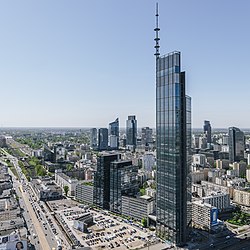
Varso or Varso Place is a neomodern office complex in Warsaw, Poland. It was designed by Foster + Partners and developed by HB Reavis. The complex features three buildings; the main one, Varso Tower, is the tallest building in Poland, the tallest building in the European Union, and the sixth-tallest building in Europe at 310 metres (1,020 ft) in height.[4] It was topped out in February 2021 and completed in September 2022.[5] The observation deck opened in September 2025.[6]

Key Information

Design

[edit]
Varso Tower's green (lower) observation deck

Varso Place is located in Wola, on the corner of Chmielna Street and John Paul II Avenue. Construction took place on a plot of 1.72 ha (4.3 acres), purchased in 2011 from PKP by the Slovak company HB Reavis for approximately 171 million złoty.[7]

The Varso logo

The estimated cost of construction was approximately 500 million (2.27 billion zł in 2021). Initially, the project was named Chmielna Business Center, being later changed to Varso, which references the Latin name for Warsaw—Varsovia.

The original plan was to build a 130-metre (430 ft) tall skyscraper. The project was later revised and the total height of Varso Tower was increased to 310 m (1,020 ft) including a spire surmounting the building.[1]

Varso Place is a complex of three buildings: a 310 m (1,020 ft) main tower (roof height reaching 230 m (750 ft) with an 80-metre (260 ft) spire on top) and two buildings with a height of 81 and 90 m (266 and 295 ft), respectively called Varso 1 and Varso 2. The total area of Varso Place is 140,000 m2 (1,500,000 sq ft), with 10,300 m2 (111,000 sq ft) dedicated to commercial services. British-based architecture studio Foster + Partners designed the main tower and HRA Architekci was responsible for designing the Varso 1 and Varso 2 buildings.[8]

Varso 1 and Varso 2

At a height of 230 m (750 ft) on the main tower, Vista Terrace will become a public observation deck offering panoramic views of the city. A restaurant and a bar called Skytop Restaurant & Bar will occupy the 46th and 49th floors. All three buildings will be connected to each other on the ground floor level and the entire complex will be connected to the Warsaw Central Station.

A four-storey underground car park will accommodate approximately 1,100 cars, 80 motorbikes and 750 bicycles. The modernisation of the surroundings around Chmielna Street is a part of the investment and it will include new pavements, street lamps, benches, bike stands and signage, as well as planting shrubs and trees.[9]

Construction

[edit]
The excavated glacial erratic seen on the Mokotów Field

The general contractor is HB Reavis Construction, a company from the HB Reavis Group. The building permit for Varso was obtained in December 2016, with construction work commencing the same month.[10]

In early 2017, the construction team had to move a transformer that was powering the Warsaw Central Station, as it was located exactly where the Varso Tower would be built.[11] In October 2017, at a depth of 10 m (33 ft), a 60 tonne glacial erratic was excavated at the construction site. It was pulled out using a specialized crane and then transported to Mokotów Field, where it stood next to the National Library. In the future, it will be moved back and displayed next to the entrance of Varso Tower.[12]

On 20 February 2021, the final piece of the spire was lifted to the top of Varso Tower, bringing the skyscraper to its full height of 310 metres (1,017 ft).[13][14] The tower was completed in September 2022.[15][16]

Varso Tower became the tallest building in the European Union by surpassing the Commerzbank Tower in Frankfurt, Germany, which previously held the record at 259 m (850 ft).[17]

[edit]

See also

[edit]

References

[edit]
[edit]
Revisions and contributorsEdit on WikipediaRead on Wikipedia
from Grokipedia
Varso Place is a mixed-use complex located in central , , comprising three high-rise buildings centered around the Varso Tower, which stands at a height of 310 meters and serves as the tallest structure in the . Designed by the architectural firm Foster + Partners in collaboration with local firms HRA Architekci and , and developed by HB Reavis, the project emphasizes sustainable urban design with WELL-certified offices, green rooftops, and public amenities including observation decks and a sky garden. Construction on the complex spanned from 2019 to 2022, with the Varso Tower reaching completion in September 2022, transforming the area at the intersection of Chmielna and Aleja Jana Pawła II into a vibrant hub for business, tourism, and community activities. The development integrates approximately 144,000 square meters of , a luxury hotel, an innovation center, retail outlets, fitness facilities, and health services, all connected by an underground passageway to Warsaw's central railway station. Notable features include two public s, at 205 and 230 meters, offering panoramic views of the city, the highest sky garden in , and BREEAM-rated measures such as smart building technologies and 750 spaces to promote eco-friendly commuting. In September 2025, the top 's highest—opened to the public, further establishing Varso Place as a key alongside its role in revitalizing Warsaw's and supporting the city's economic growth through modern, wellness-focused workspaces.

Background and Development

Planning and Approval

The development of Varso Place was initiated by international real estate developer HB Reavis to meet the rising demand for premium office space in Warsaw's , where the city had seen significant and a shortage of modern facilities in the early . Foster + Partners was commissioned as the lead architect for the project in 2016, with their design prioritizing seamless integration into the existing urban fabric around Warsaw Central Station through stepped and public realm enhancements. The planning phase involved overcoming regulatory challenges, including Warsaw's strict zoning laws that historically limited building heights in the city center to preserve views of landmarks like the Palace of Culture and Science, as well as conducting environmental impact assessments to ensure compliance with standards. By late 2016, HB Reavis secured the necessary building permits from local authorities, granting approval for the complex's scale, including the 310-meter height of Varso Tower with its spire, marking a key milestone that enabled construction to begin in December of that year.

Site Selection and Ownership

The site for Varso Place is located on Chmielna Street in Warsaw's , a choice driven by its strategic proximity to key hubs, including the Warsaw Central Railway Station, metro lines, trams, and buses, which facilitate seamless connectivity for workers, visitors, and residents. This positioning also aligns with broader urban revitalization efforts, transforming a historically significant yet underutilized area into a vibrant mixed-use hub that enhances the city's core accessibility and livability. The selection underscores the site's potential to integrate with 's evolving skyline while supporting pedestrian-friendly development near landmarks like the Palace of Culture and Science. Historically, the Chmielna Street area dates back to 1770, when it was documented as a garden with wooden structures that evolved into brick houses by the late , later incorporating railway warehouses due to its adjacency to rail infrastructure. Much of the site was destroyed during air raids and Nazi occupation in 1939, leading to postwar reconstruction that shifted it toward commercial and transport-related uses. Under Warsaw's #Warsaw2030 Strategy, adopted in 2018 to promote sustainable urban growth, the area was redesignated as a high-density zone to accommodate modern developments that prioritize mixed-use functionality, green spaces, and community integration, aligning Varso Place with the city's vision for a people-centered metropolis by 2030. This transformation from a fragmented postwar landscape to a planned high-rise precinct reflects ongoing efforts to revitalize central Warsaw's infrastructure. The project is led by Slovak developer HB Reavis, which acquired the land in 2011 from (PKP), marking a pivotal step in repurposing the former rail-adjacent site for contemporary development. HB Reavis serves as the primary owner and manager, overseeing the complex's operations through its investment arm. The development has been financed through substantial loans from an international banking consortium, including Santander Bank Polska, , Bank Pekao S.A., , and Bank AG, culminating in a record €510 million in 2025—the largest single-property loan in Polish commercial history. This funding structure, exceeding €500 million in total commitments, supports the project's scale and sustainability features while ensuring long-term financial stability. Preparation of the site involved the of existing low-rise structures and warehouses, completed by mid-2016 to clear the way for construction commencement in December of that year. This phase enabled the groundwork for the three-building complex, preserving the area's historical context while adapting it to modern urban needs.

Architecture and

Overall Complex Layout

Varso Place is a comprising three interconnected buildings: Varso Tower, rising to 310 meters over 53 floors; Varso 1, at 81 meters with 19 floors; and Varso 2, reaching 90 meters across 21 floors. These structures are linked by a shared that forms the base of the complex, creating a cohesive urban ensemble designed to blend office, retail, and public functions. The layout emphasizes vertical progression, with the lower buildings framing the dramatic ascent of the central tower, while the podium provides a pedestrian-friendly foundation that echoes the scale of surrounding architecture. The entire complex spans approximately 144,000 square meters of leasable space, dedicated to offices, retail outlets, , and communal areas. At the podium level, around 7,500 square meters are allocated to retail and dining facilities, complemented by 4,000 square meters of green spaces such as terraces, plazas, and landscaped areas that enhance and user comfort. Amenities integrated into this base include a fitness center, health services, and innovation hubs, fostering a vibrant environment for workers, visitors, and residents. Strategically positioned adjacent to , the complex facilitates seamless integration with the city's transport network through direct pedestrian links, including a recent underground passage connecting the podium to the station's gallery, enabling easy access to metro, rail, tram, and bus services. This connectivity underscores Varso Place's role as a central hub, with the layout designed to promote sustainable mobility and urban vitality.

Varso Tower Features

Varso Tower reaches a total architectural height of 310 meters, comprising a structural height of 230 meters to the roof and an 80-meter that enhances its slender . The building's facade features triple-glazed panels, designed to optimize energy efficiency by reducing loss and while allowing ample into the interior spaces. This modern envelope, primarily composed of and , contributes to the tower's elegant, vertical profile, formed by three rectilinear volumes that taper as they ascend, creating a dynamic yet harmonious form. Internally, the tower houses approximately 70,000 square meters of premium distributed across 53 floors, with large-span floorplates offering three-meter clear heights to support flexible, open-plan workspaces. A central core organizes the structure, housing high-speed elevators supplied by the , including 18 Schindler 7000 double-deck units among 26 total elevators for efficient vertical circulation, and escalators that facilitate rapid access throughout the building. These innovative systems, some reaching speeds of up to eight meters per second, ensure smooth passenger flow in this high-rise environment. At 230 meters, the tower culminates in a panoramic terrace providing 360-degree views of , accessible via dedicated panoramic lifts and serving as a public . The multi-functional top floor incorporates event spaces, a , and this terrace, transforming the uppermost levels into versatile venues for public and private gatherings while integrating seamlessly with the office layout below.

Sustainability and Green Elements

The Varso Place complex incorporates advanced standards, achieving the Outstanding certification across all three buildings, which recognizes excellence in , construction, and operation. This rating reflects the integration of resource-efficient systems, including to irrigate outdoor greenery and reduce water consumption through leak detection, aerators, and low-flow fixtures. Additionally, the complex features energy-efficient (HVAC) systems, such as high-efficiency heat exchangers and advanced cooling solutions with individual zone controls, which optimize energy use while maintaining occupant comfort. Biophilic design principles are prominently applied throughout Varso Place to foster a connection with nature, featuring approximately 4,000 square meters of rooftop and vertical greenery. This includes extensive green roofs on the podium levels utilizing ZinCo systems, such as Floradrain® and Stabilodrain® modules, which support diverse plantings like perennials, dwarf pines, and small trees, creating accessible sky gardens and landscaped areas. Vertical elements extend indoors, with 9-meter-high olive trees in the Varso Tower lobby supported by specialized green wall systems, alongside tree-lined courtyards and dozens of interior trees that enhance biodiversity and aesthetic appeal. The complex targets significant environmental performance through low-emission materials and aimed at reducing the overall compared to conventional high-rises, with environmental impact assessments conducted on all major components to minimize CO2 emissions during operations. and efficient facades contribute to lower demands, supporting broader goals. Public health is prioritized via features like natural ventilation zones enabled by operable tilt windows, which allow circulation, complemented by indoor plants and greenery that help improve air quality by filtering pollutants and increasing balance. The WELL Gold certification further validates these elements for occupant , including biophilic integrations that promote mental and physical , achieved in 2023.

Construction Process

Timeline and Phases

The construction of the Varso Place complex began with site preparation and initial foundation work in December 2016, marking the official start of building activities for all three structures. The ceremony, featuring the laying of the , occurred on March 2, 2017, initiating the foundational phase shared across the development. The project followed a phased approach, prioritizing the podium and substructure construction from 2017 to early 2019 to establish a stable base for the vertical elements, including retail, office podium levels, and underground facilities. This initial phase encompassed excavation to four basement levels and reinforcement for the entire complex, setting the stage for subsequent upward builds. Vertical construction then commenced progressively, with the shorter Varso 1 and Varso 2 advancing ahead of the tower; Varso 1 achieved topping out in April 2019, followed by Varso 2 on September 5, 2019, enabling both to reach structural completion by May 2020. For Varso Tower, vertical progression accelerated in , exceeding 75 meters by and continuing at a rate of approximately one floor per week. The tower's roof reached 230 meters in early 2021, with the spire installation in February 2021 bringing it to its full architectural height of 310 meters and solidifying its status as Poland's tallest building. The overall structural timeline from major groundwork to for the complex spanned roughly four years, reflecting coordinated sequencing to minimize disruptions in Warsaw's dense urban core. Post-topping out, activities shifted to finishing works, including spire installation, cladding, and comprehensive interior fit-outs across all buildings to prepare for operational use. These efforts concluded by mid-2022, with the full complex achieving substantial completion in September 2022, allowing initial tenant move-ins shortly thereafter.

Engineering Challenges

The construction of Varso Tower presented significant challenges due to its extreme of 310 meters, including the 80-meter , which required advanced strategies to manage wind-induced . The , exposed to wind forces comprising mean wind and dynamic , resonated at natural frequencies of 0.45 Hz, 1.2 Hz, and 3.2 Hz, potentially amplifying through . To mitigate this, three tuned mass (TMDs) were installed, each with a 750 kg vibrating mass (totaling 1,300 kg per segment), tuned precisely to these frequencies and providing a ratio of 14-16%, well above the target of 1.273%. Ambient tests using enhanced frequency domain decomposition (EFDD) and subspace identification (SSI) methods confirmed the effectiveness of these dampers in reducing amplitudes and increasing structural . Urban constraints in Warsaw's dense city center further complicated the build, as the site at the of Jana Pawła II and Chmielna Streets bordered a major with lines, paths, and underground rail infrastructure, limiting access and requiring minimal disruption to and utilities. Deliveries were restricted to the northern side via Chmielna Street, managed through a special register and timed slots to avoid delays, while the southern and western sides offered no viable access due to rail lines and adjacent buildings. To address these logistical hurdles, the project incorporated modular techniques, including off-site production of stairways and edge beams, which reduced on-site assembly time and minimized urban interference. Material logistics for the 53-floor structure involved coordinating large-scale sourcing and on-site handling of and , supported by a fleet of up to eleven tower cranes to lift components efficiently despite the compact footprint. All deliveries were meticulously planned in advance using specialized software to navigate the constrained site, ensuring steady progress without halting city operations. Safety incidents, particularly the in 2020, caused minor delays through initial uncertainties and mandated restrictions, but these were resolved by implementing enhanced protocols, including rigorous site safety measures and adaptations for worker protection, allowing construction to continue and achieve key milestones like at 230 meters.

Completion and Operations

Opening and Inauguration

The Varso Tower reached its full height on February 20, 2021, when the 80-meter was installed atop the structure, making it the tallest building in the at 310 meters. The complex was fully completed in September 2022, marking the official opening of Varso Tower and enabling the start of operations for the entire Varso Place development. Public access to the podium level and associated terraces of Varso Place became available in summer 2022, with full operational use of the complex, including office spaces and public amenities, achieved by September 2022. Media coverage at the time emphasized Varso Tower's status as the EU's tallest building, highlighting its architectural innovation and urban integration in .

Tenants and Commercial Use

Varso Place serves as a prominent destination in , accommodating a diverse array of major tenants across its office spaces. Prominent occupants include international law firms such as , which relocated its Polish headquarters to the complex in early 2025, occupying several floors in Varso Tower, and , which leased 5,000 square meters in the same building starting in 2022. Other key tenants encompass technology providers like and , as well as financial institutions including , which has leased 8,300 square meters for its headquarters within the complex. The occupancy rate for office spaces exceeded 70% as of late 2022, with Varso 2 reported as fully leased by mid-2024. The complex embodies a mixed-use configuration, with the majority of its 144,000 square meters dedicated to premium office environments that foster collaboration and innovation. Approximately 80% of the space supports office functions, including flexible workspaces and dedicated floors for . The remaining allocation includes about 10% for the Hotel in Varso 1, featuring over 300 rooms designed for business travelers, and another 10% for retail outlets, dining options, and the Cambridge Innovation Center (CIC) in Varso 2, which spans 14,000 square meters as a hub for startups and collaborative ventures. This blend supports daily operations for professionals while integrating leisure and networking facilities. Operational amenities enhance the tenant experience and attract visitors, including a variety of restaurants and coffee shops within the 7,500-square-meter retail area, co-working spaces at the CIC for flexible use, and the highest public terrace in —an at 230 meters on Varso Tower, which opened on September 9, 2025, with panoramic views of . These features promote and , with additional on-site services like a fitness club and medical center contributing to the complex's role as a vibrant urban node.

Significance and Impact

Architectural and Urban Role

Varso Tower, standing at 310 meters, has profoundly transformed 's skyline by becoming the tallest building in the and surpassing the iconic , which had dominated at 237 meters since 1955. This achievement has positioned as a burgeoning high-rise hub in , with the tower's elegant, tapered form by Foster + Partners defining the city's modern silhouette and signaling a shift toward ambitious vertical . In terms of urban integration, Varso Place emphasizes a walkable, people-oriented design that counters the density of high-rise development through extensive public realms. The complex dedicates 40 percent of its site to public use, featuring a central plaza enclosed by a glazed screen, full-height trees, pocket gardens, and an "inner street" that connects the buildings and extends the surrounding area's open ethos. These elements foster social interaction and accessibility, revitalizing a blighted quarter into a vibrant and hotspot at Warsaw's core. Culturally, Varso symbolizes Poland's post-communist modernization, embodying economic resurgence and the integration of global architectural practices with local urban fabric. By eclipsing Soviet-era landmarks like the Palace of Culture, it represents a break from historical impositions toward contemporary , while its sustainable features, including integrated green spaces, enhance the city's livability.

Records and Recognition

Varso Tower, standing at 310 meters, became the tallest building in the upon its completion in September 2022, surpassing the previous record holder, 's at 301 meters. This height also positions it as the sixth-tallest building in , behind supertalls primarily located in and the . Within the EU context, it exceeds all other structures, including those in major cities like and , while non-EU towers such as Moscow's (339 meters) remain taller overall but outside the union's boundaries. The tower's recognition extends to prestigious industry awards highlighting its architectural and construction excellence. In 2023, it received the Eurobuild Award for Best Office Building, the CEE Investment Award, and the Pascal Award, acknowledging its contributions to commercial real estate in . Additionally, at the CEEQA Awards 2023, Varso Tower was honored for its development and market impact. In 2025, Varso Tower earned the Council on Tall Buildings and Urban Habitat (CTBUH) Award of Excellence in the category, specifically for innovative construction logistics that ensured efficient delivery despite complex urban constraints. This accolade underscores the project's engineering achievements in one of Europe's densest central business districts. As of November 2025, Varso Tower continues to hold the record as the European Union's tallest building, with no completed structures in the bloc surpassing its height.

References

Add your contribution
Related Hubs
User Avatar
No comments yet.