
Vichy
View on Wikipedia | This article needs additional citations for verification. (October 2009) |
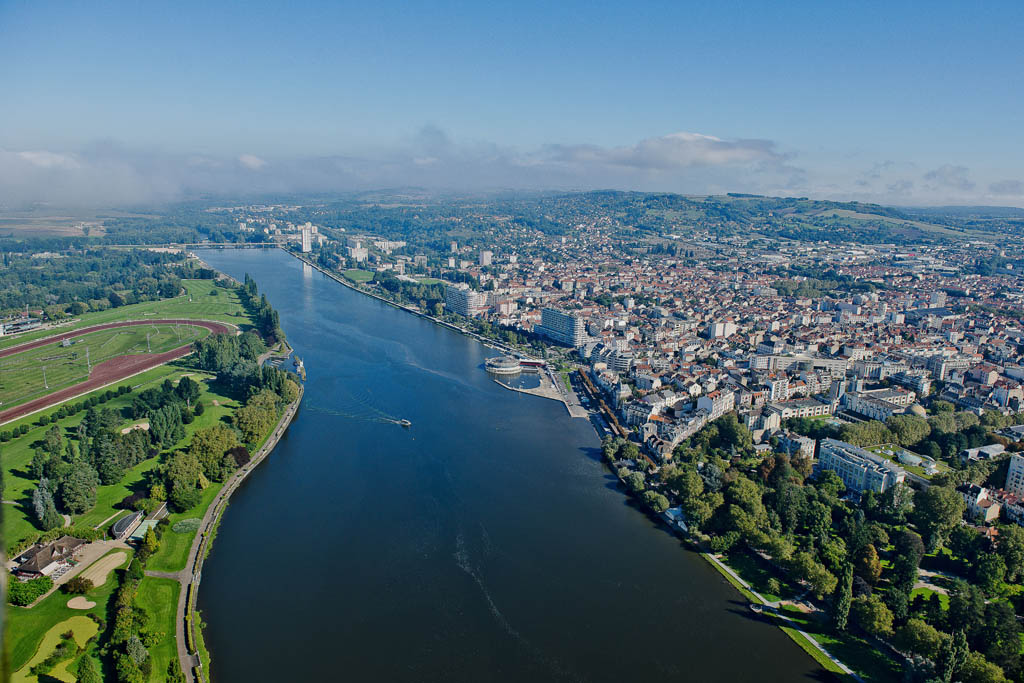
Vichy (/ˈvɪʃi, ˈviːʃi/, French: [viʃi] ⓘ; Occitan: Vichèi [viˈtʃɛj]) is a city in the central French department of Allier. Located on the Allier river, it is a major spa and resort town and during World War II was the capital of Vichy France. As of 2021, Vichy has a population of 25,789.
Key Information


Known for its mineral springs since the Roman times, Vichy had become a major destination for the French nobility and the wealthy by the late 18th century. The town developed further under the patronage of Napoleon III. Following the 1940 armistice, the pro-German collaborationist government headed by Philippe Pétain was set up at Vichy, which remained the de facto capital of the French rump state for the next four years. After the war, the city experienced a period of great prosperity but went into decline from the 1960s.
In 2021, the town became part of the transnational UNESCO World Heritage Site under the name "Great Spa Towns of Europe" because of its famous baths and its architectural testimony to the popularity of spa towns in Europe from the 18th through 20th centuries.[3][4]
Name
[edit]Vichy is the French form of the Occitan name of the town, Vichèi, of uncertain etymology. Dauzat & al. have proposed that it derived from an unattested Latin name (Vippiacus) referencing the most important regional landowner (presumably a "Vippius") during the time of the Roman emperor Diocletian's administrative reorganizations and land surveys at the end of the 3rd century AD.[5]
The name Vichy may be pronounced /ˈvɪʃi/ or /ˈviːʃi/ in either American or British English;[6][7] its usual French pronunciation is [viʃi].[citation needed][8] The pronunciation of the Occitan name Vichèi is [viˈʃe].[citation needed]
In French, the present-day demonym for a female resident or native of Vichy is Vichyssoise, f sg (Vichyssoises, f pl) and Vichyssois, m sg for a male, and Vichyssois m pl for a mixed group of both sexes. Until the 18th century, it was also common to use Vichois(e), which derived from the Occitan name of the town. The cold soup vichyssoise is also named after the town.
Geography and geology
[edit]Vichy lies on the banks of the river Allier. The source of the Allier is in the nearby Massif Central plateau which lies only a few miles to the south, near the region's capital, Clermont-Ferrand.
The historical existence of volcanic activity in the Massif Central is somewhat visually evident. Volcanic eruptions have happened for at least 150,000 years, but all volcanoes there have been dormant for at least 112 years.[citation needed] Volcanic activity in the area is the direct cause of the many thermal springs that exist in and around Vichy.
The famous mineral springs in Vichy are rich in trace elements such as lithium and fluorine, and high in sodium bicarbonate.[9] The temperatures of the spring range from 73 degrees C at Antoine Spring to 14 degrees C at Lafayette Spring.[9] In total, about 289 springs have been charted in Vichy and its surroundings. These springs are derived from infiltration through Oligocene-period sedimentary rocks, part of the Limagne Graben collapse basin.[9]
Climate
[edit]Vichy enjoys an oceanic climate (Cfb). Heavy snows in the Massif Central often make roads impassable, but Vichy is low enough—about 249 metres (817 feet) above sea level—that the climate is more continental than mountain. Rainfall is moderate around Vichy, averaging about 769.1 millimetres (30.3 in) annually.
| Town | Sunshine (hours/yr) |
Rain (mm/yr) |
Snow (days/yr) |
Storm (days/yr) |
Fog (days/yr) |
|---|---|---|---|---|---|
| National average | 1,973 | 770 | 14 | 22 | 40 |
| Vichy | 1,862 | 779.5 | 17.5 | 25.9 | 34.6[11] |
| Paris | 1,661 | 637 | 12 | 18 | 10 |
| Nice | 2,724 | 767 | 1 | 29 | 1 |
| Strasbourg | 1,693 | 665 | 29 | 29 | 56 |
| Brest | 1,605 | 1,211 | 7 | 12 | 75 |
| Climate data for Vichy (1991–2020 normals, extremes 1941–present) | |||||||||||||
|---|---|---|---|---|---|---|---|---|---|---|---|---|---|
| Month | Jan | Feb | Mar | Apr | May | Jun | Jul | Aug | Sep | Oct | Nov | Dec | Year |
| Record high °C (°F) | 19.2 (66.6) |
25.7 (78.3) |
27.0 (80.6) |
30.8 (87.4) |
33.5 (92.3) |
39.7 (103.5) |
41.2 (106.2) |
40.6 (105.1) |
36.4 (97.5) |
31.1 (88.0) |
26.2 (79.2) |
21.7 (71.1) |
41.2 (106.2) |
| Mean daily maximum °C (°F) | 7.9 (46.2) |
9.3 (48.7) |
13.6 (56.5) |
16.7 (62.1) |
20.6 (69.1) |
24.5 (76.1) |
26.8 (80.2) |
26.9 (80.4) |
22.5 (72.5) |
17.8 (64.0) |
11.9 (53.4) |
8.3 (46.9) |
17.2 (63.0) |
| Daily mean °C (°F) | 4.0 (39.2) |
4.6 (40.3) |
7.8 (46.0) |
10.5 (50.9) |
14.4 (57.9) |
18.1 (64.6) |
20.2 (68.4) |
20.1 (68.2) |
16.2 (61.2) |
12.6 (54.7) |
7.5 (45.5) |
4.6 (40.3) |
11.7 (53.1) |
| Mean daily minimum °C (°F) | 0.1 (32.2) |
−1.1 (30.0) |
2.0 (35.6) |
4.2 (39.6) |
8.2 (46.8) |
11.8 (53.2) |
13.6 (56.5) |
13.4 (56.1) |
9.8 (49.6) |
7.4 (45.3) |
3.2 (37.8) |
0.8 (33.4) |
6.2 (43.2) |
| Record low °C (°F) | −26.9 (−16.4) |
−24.0 (−11.2) |
−13.3 (8.1) |
−7.3 (18.9) |
−4.2 (24.4) |
−0.2 (31.6) |
3.7 (38.7) |
1.7 (35.1) |
−2.0 (28.4) |
−9.0 (15.8) |
−11.3 (11.7) |
−18.5 (−1.3) |
−26.9 (−16.4) |
| Average precipitation mm (inches) | 48.1 (1.89) |
37.5 (1.48) |
43.5 (1.71) |
68.5 (2.70) |
88.4 (3.48) |
72.7 (2.86) |
75.7 (2.98) |
76.1 (3.00) |
68.3 (2.69) |
70.2 (2.76) |
70.1 (2.76) |
50.0 (1.97) |
769.1 (30.28) |
| Average precipitation days (≥ 1.0 mm) | 9.9 | 8.7 | 8.8 | 10.3 | 11.6 | 9.0 | 8.4 | 8.6 | 8.5 | 10.3 | 10.6 | 9.9 | 114.6 |
| Average relative humidity (%) | 84 | 80 | 75 | 74 | 77 | 76 | 73 | 75 | 78 | 83 | 84 | 85 | 78.7 |
| Mean monthly sunshine hours | 71.5 | 96.6 | 156.1 | 180.8 | 204.4 | 224.5 | 254.2 | 244.8 | 189.9 | 127.5 | 80.2 | 61.2 | 1,891.6 |
| Source 1: Meteociel[12] | |||||||||||||
| Source 2: Infoclimat.fr (humidity, 1961–1990)[13] | |||||||||||||
History
[edit]Roman era
[edit] |
The first known settlement at Vichy was established by Roman legionaries in 52 BC. Returning south from their defeat at the Battle of Gergovia by the Gauls under Vercingetorix, they found the hot mineral springs beside the Flumen Elaver ("River Allier") and established the township of Aquae Calidae (Latin for "Hot Waters"). During the first two centuries AD, Vichy became fairly prosperous because of the supposed medicinal value of the thermal springs.
Middle Ages
[edit] |
On 2 September 1344, John II of France ceded the noble fiefdom of Vichy to Peter I, Duke of Bourbon. On 6 December 1374, the last part of Vichy was acquired by Louis II, Duke of Bourbon. At that point Vichy was incorporated into the House of Bourbon. In 1410, a Celestinian monastery was founded with twelve monks. A building located above the Celestinian Spring is still visible.
In 1527, the House of Bourbon was incorporated into the French Kingdom. By the end of the 16th century, the mineral baths had obtained a reputation for having quasi-miraculous curing powers and attracted patients from the noble and wealthy classes. Government officials, such as Fouet and Chomel, began to classify the curing properties of the mineral baths.
Vichy's thermal baths
[edit] |
Marie de Rabutin-Chantal, marquise de Sévigné was a patient in 1676 and 1677 and would popularize Vichy's Thermal Baths through the written descriptions in her letters. The Vichy waters were said to have cured the paralysis in her hands, thus enabling her to take up letter-writing. In 1761 and 1762, Adélaïde and Victoire of France, the daughters of Louis XV, came to Vichy for the first time and returned in 1785. The bath facilities seemed extremely uncomfortable to them because of the muddy surroundings and insufficient access. When they returned to Versailles, they asked their nephew Louis XVI to build roomier and more luxurious thermal baths, which were subsequently completed in 1787.
In 1799, Laetitia Bonaparte, mother of Napoleon, came to be cured with her son Louis. Under the Empire, Le Parc des Sources, was created on the Emperor's orders (Decree of Gumbinen of 1812).
Under Charles X, the great increase in patients wishing to be healed at the springs led to an expansion of the hydrotherapeutic facilities. Princess Marie-Thérèse-Charlotte expanded the Janson buildings under the plan of Rose – Beauvais (work completed in 1830). From 1844 to 1853, theatrical and poetry recitals were performed for the wealthy in the comfort of their own homes by Isaac Strauss.
Vichy in style
[edit] |
By the 19th century, Vichy was a station à la mode, attended by many celebrities. However, it was the stays of Napoleon III between 1861 and 1866 that were to cause the most profound transformation of the city: dikes were built along the Allier, 13 hectares (32 acres) of landscaped gardens replaced the old marshes and, along the newly laid-out boulevards and streets, chalets and pavilions were built for the emperor and his court. Recreational pursuits were not spared: in view of the park, a large casino was built by the architect Badger in 1865. The Emperor would be the catalyst of the development of a small rail station, which increased the number of inhabitants and visitors tenfold in fifty years.
After the Second French Empire, the Belle Époque marked the second large construction campaign in Vichy. In 1903, the Opera House (l'Opéra), the Hall of Springs and a large bath designed in the eastern style were inaugurated. In 1900, the Parc des Sources was enclosed by a metal gallery which came from the World Fair of 1889. 700 metres (2,300 feet) long, it is decorated by a frise de chardons and was completed by the ironworker Emile Robert. Many private mansions with varied architectural styles were erected during the first half of the 20th century.
Vichy welcomed 40,000 curistes in 1900, and that figure had risen to nearly 100,000 just before the onset of the First World War. La vie thermale had its heyday in the 1930s. The success in treating ailments that was attributed to the Vichy Baths led la Compagnie Fermière to enlarge the Baths again by creating the Callou and Lardy Baths. The Art Nouveau-style Opéra, inaugurated in 1903, accommodated all the great names on the international scene. Vichy became the summertime music capital of France, but the war of 1914 would put a brutal end to that development.
World War II – Seat of the pro-German collaborationist government
[edit]_2025-06-21.JPG)
Following the stunning defeat of Allied forces in just four weeks, on 10 June 1940 the French government fled Paris for Bordeaux. On 22 June France signed an armistice, which stipulated German occupation of the north and west of the country, including Paris and all of the Atlantic coast. The remaining two-fifths of France became the unoccupied Free Zone (Zone Libre). On 29 June the government and its parliamentarians moved to Clermont-Ferrand. Finding that city too cramped, on 1 July it moved on to Vichy.
German forces had taken the city unopposed on 19 June, but departed with the Armistice. Vichy had the country's second largest hotel capacity, and a modern telephone exchange and post office built for its international visitors. The city was in the unoccupied zone 45 km south of the Demarcation Line, relatively close to Paris (4.5 hours by train), and surrounded by productive agricultural lands. Pierre Laval, soon to be Prime Minister, hailed from Châteldon, a village 20 km south of Vichy. The city was, in any case, expected to be only a temporary seat of government until signature of the peace treaty.[14]
On 9–10 July, 670 of the 846 members of the Senate and Chamber of Deputies met in the Vichy Opera House, where they overwhelmingly voted full powers to Philippe Pétain and authorized him to revise the constitution. The new regime called itself simply the French State (État Français), but it quickly came to be known as Vichy France. While Paris remained the official capital and much of the bureaucracy stayed there, Vichy was the de facto capital. It was home to Pétain's cabinet, top civil servants, the diplomatic corps, and the neutered parliamentarians. As the volume of individuals engaged in government activity adversely affected locals and the spa business, a system of residence permits was established that permitted only five days' maximum stay between 1 June and 30 September.[15]
Following the Anglo-American invasion of North Africa in November 1942, Germany occupied the Free Zone, including Vichy. The Pétain government remained, albeit with an even smaller range of effective action. The city became a center for Gestapo and the Vichy milice. After the Allied breakout from Normandy in August 1944, the Germans took Pétain and his entourage to exile in Germany. The Envoy of the Swiss Confederation to France, Minister Walter Stucki, arranged for the peaceful withdrawal of local German forces and the milice. The FFI liberated the city on 26 August without bloodshed.[15]
The term "Vichyste", which designates partisans of the Pétain regime, should not be confused with "Vichyssois" which designates the inhabitants of the city. [citation needed]
Reine des villes d'eaux
[edit] |
The 1950s and 1960s would become the most ostentatious period for Vichy, complete with parading personalities, visits from crowned heads (Thami El Glaoui, the Pasha of Marrakech; Prince Rainier III of Monaco) and profits from a massive influx of North African French clients who holidayed in Vichy, spending lavishly. There were thirteen cinemas (which sometimes showed special previews), eight dance halls and three theatres. It was at this period that the station would take the title of "Reine des villes d'eaux" (Queen of the Spa Towns).
From June to September, so many French-Algerian tourists were arriving that it almost seemed like there was an airlift set up between Vichy-Charmeil and the airports of Algeria. Mayor Pierre Coulon (1950–1967) decided to create Lake Allier (10 June 1963) and Omnisports Park (1963–68), giving the city its current look.
Decline of Vichy
[edit] |
The war in Algeria (1950s–60s), which led to decolonization, marked once again a halt in the prosperity of Vichy, which from then on had to deal with much less favorable conditions. The need to continue to pay the debts incurred by the considerable investments that had been made in more prosperous times obligated the new mayor, Jacques Lacarin (1967–1989), the successor of Pierre Coulon, to adopt a much more careful policy of management.
Modern revival
[edit] |
Claude Malhuret, former Minister of Human Rights, born in Strasbourg in 1950, was mayor from 1989 to 2017. He and Bernard Kouchner are the co-founders of Doctors Without Borders (Médecins Sans Frontières). The city and its economic partners have concluded an important program of restoration and modernization. These projects include:
- creation of a vast pedestrian zone in the city center
- a program of modernization
- upgrading of hotels to the sector standards
- rebuilding and restoration of the thermal baths
- organization of a balneotherapy center dedicated to well-being
- development of the architectural heritage
- construction of a congress center within the old Casino, and
- restoration of the Opera
- rebuilding of the covered market, called "Grand Marché" (2006)
- restoration of the train station and surroundings (2009)
- restoration of the "Rue de Paris", a main street in the city centre (2010)
Administration
[edit]
| Period | Identity | Party | Profession |
|---|---|---|---|
| October 2017 | Frédéric Aguilera[18][1] | LR | |
| March 1989 to September 2017 | Claude Malhuret | UMP | Physician |
| September 1967 to March 1989 | Jacques Lacarin | Physician | |
| August 1950 to August 1967 | Pierre Coulon | Industrialist | |
| April 1949 to July 1950 | Pierre-Victor Léger | Pharmacist | |
| May 1945 to April 1949 | Louis Moinard | Trader | |
| August 1944 to May 1945 | Jean Barbier | Director of College | |
| May 1929 to August 1944 | Pierre-Victor Léger | Pharmacist | |
| December 1919 to May 1929 | Louis Lasteyras | Journalist | |
| May 1912 to November 1919 | Armand Bernard | Shareholder | |
| May 1900 to May 1912 | Louis Lasteyras | Journalist | |
| 21 May 1893 to 20 May 1900 | Ferdinand Debrest | Pharmacist | |
| 15 May 1892 to 21 May 1893 | Gabriel Nicolas | Lawyer | |
| June 1879 to May 1892 | Georges Durin | Lawyer | |
| January to September 1878 | Alfred Bulot | Lawyer | |
| 1876 to 1878 | Antoine Jardet | Physician | |
| 1874 to 1876 | Ernest Jaurand | Physician | |
| 1870 to 1874 | Antoine Jardet | Physician | |
| 15 September 1865 to 9 September 1870 | Joseph Bousquet | Lawyer | |
| 7 May 1860 to 15 September 1865 | Norbert Leroy | Notary | |
| 7 May 1857 to 7 May 1860 | Antoine Guillermen | Hotel owner | |
| 20 August 1853 to 7 May 1860 | Victor Noyer | Surgeon | |
| August 1848 to 1853 | Victor Prunelle | Physician and Waters inspector | |
| 1843 to 1848 | Claude Ramin-Prêtre | Hotel owner | |
| 1833 to 1842 | Christophe Bulot | Shareholder | |
| 1831 to 1832 | Louis Chaloin | Hotel master | |
| 1822 to 1831 | Baron Lucas | Physician and Waters inspector | |
| 26 October 1815 to 1822 | Antoine Fouet | ||
| 21 May 1815 to 26 October 1815 | Jean-Joseph Gravier | ||
| 17 March 1814 to 21 May 1815 | Antoine Fouet | ||
| 1809 to 10 March 1814 | Godefroy de Bardon | ||
| 29 March 1805 to 1809 | Gilbert Chocheprat | ||
| November 1802 to 29 March 1805 | Godefroy de Bardon | ||
| 13 July 1800 to November 1802 | Louis-Antoine Sauret | ||
| 1798 to 1800 | Jean-Joseph Gravier Du Monceau | ||
| 1791 to 1795 | Jean-Joseph Gravier Du Monceau | ||
| 2 February 1790 to 13 November 1791 | François-Claude Chocheprat |
Population
[edit]
|
| ||||||||||||||||||||||||||||||||||||||||||||||||||||||||||||||||||||||||||||||||||||||||||||||||||||||||||||||||||
| Source: EHESS[19] and INSEE (1968-2017)[20] | |||||||||||||||||||||||||||||||||||||||||||||||||||||||||||||||||||||||||||||||||||||||||||||||||||||||||||||||||||
Economy
[edit]
The city was first noted for its thermal cures in Roman times. Its waters come from springs such as the Vichy Celestins and Vichy Saint-Yorre.

Vichy Pastilles (made in Vichy) are octagon-shaped candies made from soda contained in the spring waters.
The health and beauty business, with the laboratories of the L'Oréal company, also make it possible to publicize the city's name to a worldwide audience under the Vichy brand.[21]
Unlike the neighbouring communes on the Allier such as industrial Montluçon and administrative seat Moulins, Vichy's economy is centred on the tertiary sector, with companies like the Compagnie de Vichy developing the health and well-being sector to mitigate the decline of medical hydrotherapy. The local market, open on Sundays, attracts shoppers from tens of kilometres around.
The closing of two important local employers, the Manurhin company and the Sediver company, has reduced employment in the Vichy basin. Job creation by developing companies such as the NSE electronics company or the Satel call center company may not completely compensate for the removal of jobs, despite the internet tour operator Karavel's establishment of a new call center in May 2005.
Nevertheless, the two most important employers of the city belong to the public sector: the hospital (1,120 employees), and the town hall (500[22]).
Since 1989, Vichy has been one of the seven sites of the European Total Quality Institute (Institut Européen de la Qualité Totale).[23]
The Pôle Universitaire de Vichy (previously called Pôle Universitaire et Technologique Lardy), born from a project of thermal waste land rehabilitation and launched during the mid-1990s, is an economic priority. This 9,000 m2 (2.2 acres) campus accommodates 600 students in the downtown area, in ten areas of study including the fields of biotechnology, international trade, multi-media and languages.
The CAVILAM – Alliance Française[24] (Centre of Live Approaches to Languages and the Media), receives students from diverse countries who want to learn French. Created in 1964, under the impulse of the Universities of Clermont-Ferrand and the city of Vichy, CAVILAM – Alliance Française joined the international network of the Alliance Française in 2012. After the Covid lockdown, the center developed online courses for FLE teachers,[25] FLE ressources pages,[26][27] and foreign language courses[28][29] for locals.
The Palace of the Congresses is a venue primarily for the conferences of trade associations and learned societies. The structure is 1,800 m2 (19,000 sq ft) in area, including two plenary rooms and fifteen multi-use rooms. With 25,000 visitors yearly, the conferences must carry the economic role once held by the hydrotherapy industry, which today counts only 12,000 patients each year. The hydrotherapy business will now have to reorganise itself to take a less strict therapeutic-only role, and adapt to patients' stays shorter than the traditional three weeks.
Building projects
[edit] | This section needs to be updated. (September 2016) |
Under the authority of the local communities, much work is being done on building sites and projects, which will deeply modify Vichy in the years to come. The construction by the Hotel of the Community of Agglomeration in September 2005 on the old site of the "Commercial City" may precede the total restoration of the market hall "Le Grand Marché" (which would cost €5.9 million) which would be delivered in September 2006. Other projects include the creation of a 12,000 m2 (130,000 sq ft) mother-child centre in the hospital complex, the restoration of the spa façade (removal of the metal boarding to uncover the original style of 1862), the transformation of the spa into a multi-use center, creation of parks with fountains in place of parking lots, the demolition and the transformation of the buildings in a congested area to create an enterprise center intended to create 800 jobs (opened in early 2008), the construction of a new aquatic stadium including five basins (open since 2008), and motorway connection (opened in early 2015).
Notable people
[edit]- Valery Larbaud (1881–1957), writer
- Albert Londres (1884–1932), journalist
- Guy Ligier (1930–2015), racing driver and founder of Équipe Ligier
- Raël (born 1946), religious leader and founder of the Raëlian Religious Movement
- Wilfried Moimbe (born 1988), footballer
Religion
[edit]A wide variety of faiths are practiced. Various Christian denominations such as diverse Orthodox, Catholic, and Protestant churches are found throughout the area along with adherents of Judaism, Islam, Buddhism, and others.
- Catholicism: Presbytère Saint-Louis Saint-Blaise de Vichy (in French) at 33 Rue Sainte-Cécile and Presbytère Sainte Jeanne d'Arc at 2 Rue Jeanne d'Arc
- Russian Orthodox Church: the nearby Château de Saint-Hubert in Chavenon
- Calvinism: Église reformée[30] located at 9 Rue de l'Intendance
- Lutheranism: Église Saint-Blaise de Vichy (in French) located on the Rue de l'Église
- Judaism: the Synagogue of Vichy[31] located at 2 Bis Rue Maréchal Foch
- Islam: the Mosquée al-Rahma[32] located at 51 Allée des Ailes
- Buddhism: the nearby Pagode Phap Vuong in Noyant-d'Allier
Transport
[edit]Highway access
[edit]Vichy is accessible from departmental road 2209, former route nationale 209 (from the towns of Gannat or Varennes-sur-Allier), the D906e, former D906 from Thiers, the D1093 from Randan or the D6 from Charmeil.
The city is situated 20 km (12 mi) from the A719 autoroute and 35 km (22 mi) from the A89 autoroute.
The A719 autoroute, connecting Vichy to the A71 to Clermont-Ferrand, opened in January 2015.[33]
In 2014, only regional two-lane highways (routes départementales) pass through the urban ring of Vichy. The D2209 is the principal axis of circulation for heavily loaded trucks, from the west (via Gannat) or the north (via Varennes-sur-Allier or Saint-Germain-des-Fossés); other important routes are the following (listed in the clockwise order):
- the D906e, former D906, from the south (Abrest, Saint-Yorre, Thiers, Ambert, Livradois and Le Puy-en-Velay);
- the D1093, from the southwest (Forest of Randan, Grande Limagne, Maringues, Riom, Clermont-Ferrand);
- the D984, from the west-southwest (Bellerive-sur-Allier, Effiat, Aigueperse);
- the D6, from the northwest (Charmeil, Saint-Pourçain-sur-Sioule).
The D67 is a loop to the north of the city created to limit traffic jams (access to Creuzier-le-Neuf, afterwards by the D907, Lapalisse and the N7).
-
 Entrance by departmental road 906e from Thiers
 -
 Entrance by the Pont de l'Europe
 -
 Entrance by Bellerive's bridge (Jacques-Chirac bridge)
 -
 Rue de l'Hôtel des Postes, a pedestrian way
_2022-12-25.JPG)


_2021-10-24.JPG)
Rail transport
[edit]
Vichy is served by the following train lines:
- Intercités (national trains, booking mandatory) to Paris (Bercy) and Clermont-Ferrand;
- TER trains: Moulins, Lyon (Part-Dieu and Perrache), Clermont-Ferrand, Vic-le-Comte, Issoire, and Brioude.
Public transport
[edit]MobiVie is the network of urban transport for six communes of Vichy Communauté intercommunality. This network is composed of eight lines as of 2022[update].[34]
"Mobival" is an on-call transportation service for Vichy and its neighborhood. This service offers the local communes a reliable transportation service for areas that are not served by the MobiVie network. Created in October 2004, it has ten lines.
Air transport
[edit]Vichy is five kilometres (3.1 mi) from Vichy — Charmeil Airport, and 55 kilometres (34 mi) from the larger Clermont-Ferrand Auvergne Airport.[35]
Cultural Events
[edit]Vichy hosted the 2024 Europe Triathlon Championships on 21–22 September, attracting top athletes from across Europe.[36] Known for its picturesque setting and rich sporting history, Vichy has previously welcomed major events like Challenge and Ironman. The championships further cemented its status as a premier triathlon destination.
Twin towns – sister cities
[edit]
 Bad Tölz, Germany
 Dunfermline, Scotland, United Kingdom
- Rhein-Neckar (district), Germany
 San Giuliano Terme, Italy
- Wilhelmshaven, Germany


See also
[edit]References
[edit]- ^ a b "Répertoire national des élus: les maires" (in French). data.gouv.fr, Plateforme ouverte des données publiques françaises. 13 September 2022.
- ^ "Populations de référence 2022" (in French). National Institute of Statistics and Economic Studies. 19 December 2024.
- ^ Landwehr, Andreas (24 July 2021). "'Great Spas of Europe' awarded UNESCO World Heritage status". Deutsche Presse-Agentur. Archived from the original on 25 July 2021. Retrieved 25 July 2021.
- ^ "The Great Spa Towns of Europe". UNESCO World Heritage Centre. Retrieved 25 July 2021.
- ^ Dauzat, Albert; et al. (1963), Dictionnaire Étymologique des Noms de Lieux en France [Etymological Dictionary of Names of Locations in France] (in French), Paris: Guénégaud.
- ^ "Vichy, n.", Oxford English Dictionary, Oxford: Oxford University Press, 1917.
- ^ "Vichy", Merriam-Webster Dictionary, Springfield: Merriam-Webster, 2019.
- ^ "Vichy | Definition". Dictionary.com. Retrieved 20 November 2020.
- ^ a b c Nomination of the Great Spas of Europe for inclusion on the World Heritage List (Report). United Nations Educational, Scientific, and Cultural Organization. Retrieved 21 August 2021.
- ^ Paris, Nice, Strasbourg, Brest
- ^ "Normales climatiques 1981-2010 : Vichy". www.lameteo.org. Retrieved 8 April 2022.
- ^ "Normales et records pour Vichy-Charmeil (03)". Meteociel. Retrieved 14 December 2024.
- ^ "Normes et records 1961–1990: Vichy-Charmeil (03) – altitude 249m" (in French). Infoclimat. Retrieved 30 December 2015.
- ^ Nazi Germany was never to sign a peace treaty with any of its defeated opponents, but this was not foreseen in 1940-41. The armistice arrangements with France perfectly satisfied its military, economic, and administrative requirements.
- ^ a b "Circuit Vichy 1939-1945," Vichy Mon Amour [Vichy tourist office website]
- ^ "List of mayors of Vichy". Francegenweb.org (in French). Retrieved 1 November 2014.
- ^ Carteret, Alain. "Ils ont fait Vichy [They made Vichy]" (in French). Retrieved 1 November 2014.
- ^ "Frédéric Aguilera (LR) est le nouveau maire de Vichy" [Frédéric Aguilera (The Republicans) is the new mayor of Vichy]. La Montagne (in French). 6 October 2017.
- ^ Des villages de Cassini aux communes d'aujourd'hui: Commune data sheet Vichy, EHESS (in French).
- ^ Population en historique depuis 1968, INSEE
- ^ "Saga Vichy". La Revue des marques. April 2002. Retrieved 30 June 2006.
- ^ "MAIRIE DE VICHY". Vichy-economie.com (in French). Vichy Val d'Allier Développement. Retrieved 21 September 2016.
- ^ "European Total Quality Institute". Ieqt.org (in French). Retrieved 1 November 2014.
- ^ "The school". CAVILAM - Alliance Française. Retrieved 13 February 2020.
- ^ "Online courses". MOOC Cavilam. Retrieved 30 January 2022.
- ^ "Le plaisir d'apprendre". Le plaisir d'apprendre. Retrieved 30 January 2020.
- ^ "La Fabrique CAVILAM". La Fabrique Cavilam. Retrieved 30 January 2022.
- ^ "Foreign languages for locals". DLE. Retrieved 30 January 2022.
- ^ "Le Journal de l'Eco". Retrieved 30 January 2022.
- ^ "Site de l'église protestante réformée de Vichy". Erfvichy.free.fr.
- ^ "Consistoire -". Consistoiredefrance.fr.
- ^ "Mosquée al-Rahma - Accueil". Archived from the original on 25 December 2018. Retrieved 24 August 2019.
- ^ "L'A719 Vichy-Gannat ouvrira le 12 janvier à midi" [A719 from Vichy to Gannat will open 12 January at noon]. La Montagne (in French). 22 December 2014. Retrieved 1 March 2020.
- ^ "En bus" [By bus] (in French). Retrieved 30 September 2025.
- ^ "En avion" [By avion] (in French). Retrieved 31 January 2022.
- ^ "2024 Europe Triathlon Championships Vichy". World Triathlon. Lausanne. Retrieved 26 December 2024.
- ^ "Jumelages" [Twin cities]. ville-vichy.fr (in French). Vichy. Retrieved 30 September 2025.
External links
[edit]
- Official website (in French)
- Travel Info |https://visitvichy.com/
- . The American Cyclopædia. 1879.
- . Encyclopædia Britannica. Vol. XXIV (9th ed.). 1888. p. 210.
- . Encyclopædia Britannica. Vol. 28 (11th ed.). 1911. p. 21.
- Online books on balneology and the city of Vichy Archived 5 October 2017 at the Wayback Machine (BU Clermont Auvergne)
- Vichy Minéral 89 - Análisis 2018 Archived 30 July 2018 at the Wayback Machine

|  | |
| International | |
|---|---|
| National | |
| Geographic | |
| Other | |

Vichy
View on GrokipediaEtymology and Identity
Origins and Historical Naming
The settlement at Vichy originated in Roman antiquity around the mid-1st century AD, when the site was developed as a spa town exploiting its geothermal springs along the Allier River; it was then known as Aquae Calidae, Latin for "hot waters," a name directly referencing the thermal features central to its early economy and appeal.[10][11] Roman infrastructure, including baths and roads, solidified this identity, positioning the town at key fluvial and land routes in northern Gallia Narbonensis.[12] Following the fall of the Western Roman Empire, the site's name evolved amid linguistic shifts in the region, transitioning through medieval Latin and Occitan forms; by the 14th century, it had stabilized as Vichèi in Occitan, reflecting phonetic adaptations from earlier Gallo-Roman designations.[13] The modern French "Vichy" represents a direct Gallicization of this Occitan variant, first attested in historical records around that period and tied to the town's enduring role as a resort.[14] The precise etymology of "Vichy" remains uncertain, with scholarly proposals linking it to an unattested Latin Viciacum—potentially denoting a small settlement (vicus) or deriving from a Gallo-Roman personal name like Vippius—though no consensus exists due to sparse epigraphic evidence.[14] This naming history underscores Vichy's identity as a perennial hydrotherapeutic center, distinct from transient political connotations later imposed during the 20th century.[13]Symbolic Associations Post-WWII
Post-World War II, the name Vichy became symbolically synonymous with French collaborationism, authoritarianism, and moral compromise during the Nazi occupation, as the city served as the de facto capital of the État Français regime from July 1940 to September 1944.[7] The regime's policies, including the October 1940 Statut des Juifs excluding Jews from public life and subsequent deportations of over 75,000 Jews from France, entrenched Vichy's association with active complicity rather than mere acquiescence, despite initial post-war narratives emphasizing national resistance over widespread collaboration.[7] Historian Henry Rousso termed this evolving collective reckoning the "Vichy syndrome," characterizing phases of repressed memory in the immediate aftermath—bolstered by Charles de Gaulle's promotion of a unified Resistance myth—followed by resurgences in the 1970s through media depictions and trials, and fuller national acknowledgment by the 1990s, such as President Jacques Chirac's 1995 admission of Vichy's direct role in the Vel' d'Hiv Roundup.[15] In political discourse, "Vichy" persists as a pejorative shorthand for puppet governance or ideological betrayal, invoked across the spectrum to discredit opponents, though empirical analysis reveals the regime's ideological roots in pre-war conservative nationalism rather than inherent "fascism."[16] For the city itself, this symbolic stigma inflicted lasting reputational and economic damage, transforming a pre-war belle époque spa destination—hosting up to 130,000 thermal cures annually in 1931—into a pariah site shunned by tourists wary of its wartime infamy.[17] Hotel capacity dwindled from 15,000 rooms in 1940 to about one-third by the 1980s, compounded by the loss of colonial clientele and declining faith in mineral water therapies, yet the Vichy association amplified avoidance, reducing cure visitors to around 20,000 per year amid broader spa tourism shifts.[17] Local authorities initially capitalized on the regime's arrival for economic influx—population swelling to 120,000 by autumn 1940—but post-liberation in September 1944, pursued deliberate amnesia, restoring spa tourism by the 1950s through emphasis on imperial-era glamour while minimizing Occupation references, such as omitting dedicated museums unlike sites in Paris or Lyon.[8] This "local silence," as described by historian Audrey Mallet, contrasted with national memorial obsessions, fostering a dual tourism stream: leisure seekers ignoring history and niche "dark tourism" visitors drawn to preserved sites like the Hôtel du Parc, Pétain's former office.[8] Rehabilitation efforts intensified from the late 20th century, with municipal investments in sports facilities, international language programs attracting thousands of students yearly, and events like the 2015 Ironman Triathlon to reframe Vichy as a vibrant resort akin to post-reunification Berlin shedding its Nazi-era shadow.[18] Government subsidies sustained thermal cures—covering 85% of costs for 600,000 nationwide in 1984, bolstering Vichy's ~100,000 annual vacationers—while advertising campaigns targeted younger demographics with branded products like Vichy water.[17] Despite these, the symbolic yoke endures, with locals and officials acknowledging multiple narratives but prioritizing pre-1940 heritage and modern reinvention over confrontation, reflecting a pragmatic causal realism: the regime's accidental choice of Vichy as capital—due to its hotels and central location—imposed an exogenous burden on a city otherwise unchosen for ideological reasons.[18][8]Geography and Natural Features
Topography and Location
Vichy is a commune in the Allier department of the Auvergne-Rhône-Alpes region in central France, positioned on the right bank of the Allier River, the principal tributary of the Loire.[19] The city's geographic coordinates are 46.131° N latitude and 3.427° E longitude, with an area of 5.85 km².[20][21] The topography of Vichy features relatively flat terrain suited to its historical role as a spa town, with an average elevation of 276 meters above sea level.[19] It lies within the Val d'Allier natural region of the department, characterized by river valleys amid the broader undulating landscapes of bocage, hills, and forests typical of the Allier, situated north of the Auvergne volcanic area.[22] This positioning places Vichy at a transitional zone between the Limagne plain to the west and the Montagne Bourbonnaise hills to the east.[19]Hydrology and Thermal Springs
Vichy's hydrology is dominated by the Allier River, a major left tributary of the Loire that flows northward through the city for approximately 5 kilometers, shaping its floodplain and supporting an interconnected alluvial aquifer system known for high hydrodynamic productivity and shallow groundwater resources.[23] The river's regime features seasonal variability, with peak flows in spring due to snowmelt and rainfall in the Massif Central headwaters, averaging an annual discharge of about 150 cubic meters per second at Vichy, though subject to floods that historically prompted dike construction along the banks in the 19th century.[24] This fluvial dynamic contributes to sediment deposition and nutrient cycling in the riparian zone, influencing local ecology and water quality, where strontium isotope studies indicate groundwater-river mixing with distinct signatures from upstream volcanic terrains.[25] The thermal springs of Vichy emerge from a distinct hydrogeological basin within the granitic and volcanic substrata of the Limagne fault zone, where meteoric waters infiltrate deeply—up to several kilometers—into fractured basement rocks, acquiring geothermal heat and dissolving minerals en route to the surface.[26] Nine primary springs are exploited commercially, with emergence temperatures ranging from 34°C at the Hôpital spring to 66°C at hotter outlets like the Lucas, reflecting subsurface equilibration around 135°C inferred from silica geothermometry, Na/K ratios, and calcite saturation indices.[26] These waters classify as sodium-bicarbonate type with elevated carbon dioxide content, featuring high total dissolved solids (up to 6 g/L), dominated by bicarbonate (2-3 g/L), sodium (1-2 g/L), and trace elements like lithium and boron, derived from leaching of volcanic tuffs and granites; such compositions support their documented digestive and hepatoprotective effects in controlled balneotherapy, though efficacy stems from empirical clinical trials rather than unverified therapeutic claims.[26] The basin's over 270 identified springs underscore a prolific geothermal field, but exploitation is regulated within protected perimeters to sustain recharge from the surrounding catchment.[27]Pre-20th Century History
Antiquity and Roman Influence
The region encompassing modern Vichy was settled by Gallic tribes, including the Bituriges Cubi, prior to Roman conquest, with evidence of pre-Roman use of the area's thermal springs by Celts for their purported medicinal properties.[28] The Romans, upon subjugating Gaul following Julius Caesar's campaigns, recognized the strategic value of the site along the Allier River, establishing an initial military settlement around 52 BC as legionaries secured the territory.[29] By the 1st century AD, the Romans formalized the urban center as Aquae Calidae (or Vicus Calidus, meaning "hot village" or "warm waters"), positioning it at the intersection of key land and river trade routes in northern Gallia Narbonensis, which facilitated economic growth through commerce and thermal tourism.[10] [30] The settlement prospered during the first two centuries of the Common Era, developing public bath complexes (thermae) that harnessed the naturally carbonated, mineral-rich springs—emerging at temperatures up to 38°C (100°F) from volcanic aquifers—for therapeutic bathing, a practice central to Roman hygiene and leisure culture.[29] These facilities, including heated pools and hypocaust systems, drew visitors seeking relief from ailments like rheumatism, underscoring Vichy's early role as a spa destination under imperial administration.[31] Archaeological excavations confirm the extent of Roman infrastructure, with a 1,700-year-old pool structure—dating to approximately 300 AD—unearthed in 2024 at a former park site, alongside remnants of aqueducts and bath conduits that channeled spring water.[32] This Gallo-Roman foundation laid the enduring template for Vichy's identity as a hydrotherapeutic hub, influencing subsequent medieval and modern developments despite the site's partial abandonment amid the 5th-century Germanic invasions.[30]Medieval Development
During the early Middle Ages, following the decline of Roman settlement at Aquae Calidae, Vichy reemerged under feudal structures in the 10th and 11th centuries, when local lords known as the seigneurs de Vichy established control over the strategic crossing of the Allier River.[33] These lords, with Théodebert identified as the earliest documented figure from the 11th century, constructed a castle approximately situated between the site of the former Saint-Blaise chapel and the present Tour des Halles, fostering the development of a modest settlement on the plateau overlooking the river.[33] This fortified nucleus attracted a population that grouped around the seigneurial authority by the mid-13th century, particularly on the rocky outcrop known as the rocher des Célestins, marking the consolidation of a feudal town centered on river tolls and defense rather than thermal exploitation.[34] The domain of the seigneurs de Vichy initially extended to nearby areas such as Busset and included fiefs reaching Arfeuilles, Jenzat, and Saint-Pourçain, but fragmentation occurred through generational inheritance, weakening direct control.[33] In 1344, Jean II de Vichy ceded the châtellenie to Duke Pierre I of Bourbon, initiating a shift toward Bourbonnais influence; this was completed between 1374 and 1384 when Louis II of Bourbon acquired the remaining castle holdings, fully integrating Vichy into the duchy.[33] Under Bourbon oversight, defensive works advanced: in 1409–1410, Louis II erected urban fortifications, including a crenelated curtain wall adapted to the travertine rock terrain, and founded a Celestin convent housing twelve monks near the thermal springs, though the settlement remained a small bourg with limited expansion until later centuries.[33][34] By the late 15th century, as the Allier River receded, some structures began appearing outside the walls, signaling a gradual transition from strictly defensive priorities.[34]Emergence as a Thermal Resort
The thermal springs of Vichy, utilized sporadically since antiquity, experienced a significant revival in the early modern period, marking the town's initial emergence as a recognized resort destination. At the outset of the 17th century, amid growing interest in thermal cures across Europe, King Henri IV commissioned the construction of Vichy's first modern bathhouse to capitalize on the springs' purported medicinal properties, including relief from digestive and rheumatic ailments.[28] This development aligned with broader trends in hydrotherapy, though Vichy's facilities remained modest compared to established spas like those in the Pyrenees or abroad. The marquise de Sévigné played a pivotal role in elevating Vichy's profile during her visits in 1676 and 1677, where she sought treatment for rheumatism; her extensive correspondence vividly described the waters' effects and the town's rustic accommodations, disseminating enthusiasm among the French aristocracy and literati.[10] By the late 18th century, Vichy had solidified as a fashionable retreat for nobility and affluent visitors, drawn by the bicarbonate-rich springs—such as the Célestins, Hôpital, Chomel, Lucas, and Grande-Grille—which were bottled and prescribed for their alkaline, mineral-laden composition aiding digestion and detoxification.[35] Annual curists numbered in the hundreds, prompting rudimentary infrastructure like expanded bathing halls, though the town still lacked the grandeur of emerging continental rivals. The 19th century catalyzed Vichy's transformation into a premier European thermal resort, propelled by imperial patronage and urban renewal. Napoleon III's inaugural visit on 27 July 1861 initiated a decade of state-sponsored enhancements; issuing a decree that day, he mandated dikes along the Allier River, parks, promenades, and opulent establishments including the Opéra de Vichy (completed 1865) and expanded thermal establishments to accommodate surging visitors.[10] His annual sojourns until 1869, ostensibly for health reasons, attracted elite society and international notables, boosting annual bathers from thousands to over 10,000 by mid-century and dubbing Vichy the "Queen of Spas."[35] This era saw commercialization of Vichy water via bottling companies, with exports rising sharply, while architectural ensembles in Second Empire style—featuring colonnades and pavilions—encapsulated the town's shift from provincial outpost to sophisticated hydrotherapeutic hub.[36] Empirical accounts from physicians underscored the springs' efficacy, though benefits were often anecdotal, rooted in the era's humoral medical paradigms rather than rigorous clinical trials.The Vichy Regime (1940-1944)
Context of Defeat and Armistice
The German Blitzkrieg offensive against France and the Low Countries began on May 10, 1940, with Army Group A advancing through the Ardennes Forest to outflank the Maginot Line, achieving rapid penetrations that shattered French defensive assumptions and encircled Allied armies in the north.[37] By late May, German panzer forces had isolated over 1 million British, French, and Belgian troops, prompting Operation Dynamo—the evacuation of 338,000 soldiers from Dunkirk between May 26 and June 4—though at the cost of abandoning most heavy equipment.[38] Italian forces declared war on France on June 10, opening a secondary front in the southeast, while German Army Group B secured the Low Countries by early June.[39] As German forces resumed their advance southward on June 5, the French government evacuated Paris, declaring it an open city to avoid destruction; troops entered unopposed on June 14.[40] Prime Minister Paul Reynaud, facing internal cabinet divisions over continued resistance versus negotiation, resigned on June 16, yielding to Marshal Philippe Pétain, who formed a new government and broadcast on June 17 the decision to seek an armistice with Germany to halt the "useless bloodshed."[41] This shift reflected Pétain's assessment, shared by military leaders like Maxime Weygand, that further fighting from metropolitan soil was untenable given the collapse of organized defenses and widespread demoralization.[37] The Franco-German Armistice was signed on June 22, 1940, in a railway carriage at Compiègne—the site of Germany's 1918 surrender—imposing terms that occupied northern and western France (approximately 55-60% of prewar territory, including Paris and key industrial areas) under direct German military administration, while ceding the south to nominal French sovereignty under a demilitarized regime.[42] France was required to demobilize its army to 100,000 troops, surrender hostages and war materials, and pay occupation costs equivalent to French franc-denominated support for German forces; the government retained control over its colonies and fleet but forbade any hostile acts against Germany.[43] A parallel armistice with Italy, signed June 24, further ceded border territories and demilitarized coastal zones.[42] Effective June 25, these agreements preserved a rump French state in the unoccupied zone libre, with its provisional seat at the central spa town of Vichy, enabling Pétain's administration to claim continuity from the Third Republic amid the defeat's institutional vacuum.[41]Establishment of the État Français
Following the Franco-German armistice signed on June 22, 1940, which divided metropolitan France into occupied and unoccupied zones, the French government under Prime Minister Philippe Pétain relocated to the spa town of Vichy in the Allier department of the unoccupied zone to continue operations away from direct German control.[42] Vichy was selected due to its capacity to host the National Assembly's combined chambers in its grand casino and hotels, accommodating approximately 550 deputies and senators amid wartime disruptions that prevented many from Paris.[44] On July 9 and 10, 1940, the Assembly convened for debates on granting extraordinary powers to Pétain, reflecting widespread defeatism and a desire for national regeneration after the rapid collapse of French forces in May-June 1940.[45] The pivotal vote occurred on July 10, 1940, when the National Assembly approved a resolution conferring "all powers to the government of the Republic, under the authority and signature of Marshal Pétain," to promulgate a new constitution by decree, with 569 votes in favor, 80 against, and 20 abstentions.[45] [44] This act, passed by a supermajority including most conservatives, centrists, and some socialists, effectively suspended the Third Republic's institutions and marked the legal birth of the État Français, replacing the designation "République française" to signify a shift toward an authoritarian framework centered on Pétain's personal leadership.[46] The opposition primarily consisted of leftist parliamentarians, though absenteeism and pressure from Pétain's appeals for unity influenced the outcome, as roughly 200 legislators had fled to form the Free French movement under Charles de Gaulle.[44] Subsequent constitutional acts formalized the structure: Act No. 1 of July 11, 1940, elevated Pétain to "Chef de l'État Français" with supreme authority over legislative, executive, administrative, and diplomatic functions until a new constitution was enacted.[46] Act No. 2 of the same day defined his powers explicitly, including the ability to appoint successors and delegate authority, while Act No. 3 on July 12 dissolved parliament pending further reforms.[46] These measures, drafted under Pétain's direction, established Vichy as the provisional capital and laid the groundwork for the "National Revolution," emphasizing hierarchy, tradition, and collaboration with Germany as a means of safeguarding French sovereignty in the unoccupied zone.[47] The État Français operated independently in the south until November 1942, when German forces occupied the full territory following Allied landings in North Africa.[45]Ideological Foundations and National Revolution
The National Revolution, proclaimed as the ideological core of the Vichy regime following the constitutional acts of July 11, 1940, sought to regenerate French society through a rejection of the Third Republic's liberal and parliamentary traditions, which were blamed for the nation's moral and intellectual decline culminating in the 1940 defeat.[48] Marshal Philippe Pétain positioned it as a program of redressement—moral, social, and political—emphasizing hierarchy, duty, and national unity over individualism and egalitarianism.[49] In his June 25, 1940, armistice speech, Pétain called for this renewal, framing the defeat as a consequence of decades of decadence, materialism, and disunity under republican governance.[48] Central to the ideology was the motto Travail, Famille, Patrie, supplanting the revolutionary triad Liberté, Égalité, Fraternité to prioritize collective obligations and traditional structures.[50] Travail enshrined labor as a moral imperative and social stabilizer, promoting corporatist organization to transcend class conflict via state-mediated professional syndicates, as formalized in the Charte du Travail of October 1941.[48] Famille elevated the nuclear family as the bedrock of social order, with policies like the November 1940 family code granting it political recognition and incentives for large families, while reinforcing patriarchal authority and gender roles centered on motherhood.[48] Patrie invoked a paternalistic nationalism rooted in rural virtues and a "return to the soil," critiquing urban materialism and advocating spiritual revival through folklore, youth indoctrination in groups like the Chantiers de la Jeunesse (established January 18, 1941), and anti-parliamentary authoritarianism.[48][49] The foundations drew from conservative republican strains, including nationalist thinkers like Maurice Barrès and influences from integral nationalism, adapting pre-1940 critiques of liberalism into a hierarchical, organic state model that claimed continuity with France's monarchical and Catholic heritage while distancing from explicit fascism.[49] Anti-materialism underpinned the vision, portraying the Third Republic's emphasis on consumption and pluralism as corrosive to national vitality, with regeneration pursued through eugenics-tinged social hygiene and exclusion of perceived internal threats to achieve a unified "new man."[48] Pétain, cultified as a providential savior in propaganda, embodied this through speeches decrying individualism (e.g., January 1941 in Revue Universelle) and promoting order as the path to authentic freedom.[48][49] Though presented as autonomous renewal, the ideology facilitated collaboration by aligning with Axis demands for stability, revealing tensions between traditionalism and pragmatic authoritarianism.[48]Administrative and Social Policies
The Vichy regime centralized administrative authority under Marshal Philippe Pétain following the National Assembly's vote on 10 July 1940, which granted him full legislative, executive, judicial, and diplomatic powers by a margin of 569 to 80, with 20 abstentions. Pétain subsequently issued constitutional acts on 11 and 12 July 1940 abolishing the Third Republic's institutions, dissolving the parliament, and vesting supreme authority in himself as Chef de l'État Français.[51] Political parties were banned by decree on 26 August 1940, and the regime replaced elected prefects, mayors, and other local officials with appointed loyalists to enforce ideological conformity and suppress dissent.[52] Although Pétain's 1940 constitutional outline promised a "totalitarian" state with decentralized administration to revive provincial traditions, implementation emphasized top-down control from Vichy, with limited genuine devolution amid wartime constraints and German oversight in the occupied zone.[53] Social policies centered on the Révolution Nationale, a conservative ideological framework promoting "Travail, Famille, Patrie" (Work, Family, Fatherland) as a rejection of Third Republic individualism and secularism, aiming to restore hierarchical social order rooted in rural, Catholic, and familial values. The regime expanded pronatalist measures from the pre-war Code de la Famille (1939), increasing family allowances (allocations familiales) by up to 40% for larger households and instituting medals for mothers of four or more children to combat depopulation, reflecting causal priorities on demographic recovery after World War I losses. Youth mobilization occurred through the Chantiers de la Jeunesse, established by decree on 20 December 1940 as a compulsory alternative to military service for males aged 18-21, emphasizing physical labor, moral discipline, and anti-urban patriotism in work camps modeled on scouting movements.[48] Educational reforms sought to inculcate regime values, with Minister Jérôme Carcopino's statute of 15 August 1941 restructuring secondary schools to prioritize classical humanities, physical training, and civic morality over modern sciences and laïcité, converting écoles primaires supérieures into collèges modernes while mandating courses on French history and Pétain's doctrines.[54] Labor policies advanced corporatism via the Charte du Travail promulgated on 30 July 1941 (effective October), which organized economic sectors into state-supervised professional syndicates to eliminate class conflict and strikes, subordinating unions to employer-employee corporations under government oversight.[55] These reforms, however, faced practical failures due to economic shortages and resistance, culminating in the Service du Travail Obligatoire (STO) law of 16 February 1943, which conscripted over 600,000 French workers—initially aged 20-23, later broadened—for mandatory labor in Germany, framed as reciprocal for prisoner exchanges but exacerbating social unrest.[56]Economic Management and Reforms
Following the Franco-German armistice of 22 June 1940, the Vichy regime faced an economy burdened by occupation costs equivalent to 20 million Reichsmarks daily in the occupied zone, later adjusted to 400 million francs monthly across both zones by 1942, compelling systematic resource extraction for Germany.[57] Vichy's economic management emphasized autarky, corporatism, and a return to agrarian roots under the National Revolution's ideology of "work, family, fatherland," aiming to reorganize production amid shortages and German requisitions that prioritized French industrial output for the Axis war effort.[58] This involved centralizing control through state-directed committees for key sectors, though implementation was hampered by divided authority between Vichy and German overseers, resulting in a French GDP contraction of approximately 50% from 1938 to 1944.[57] The Charte du Travail, promulgated on 4 October 1941, represented a cornerstone reform, establishing a corporatist labor framework that abolished independent trade unions—banned since August 1940—and replaced them with state-supervised syndicates organized by profession to eliminate class conflict and align workers with national production goals.[59] Intended to foster collaboration between employers and employees under government arbitration, it mandated family allowances and professional training but enforced wage freezes and mobility restrictions, contributing to labor discipline amid the Service du Travail Obligatoire (STO) introduced in 1942, which conscripted over 600,000 French workers for German factories by 1944.[59] In agriculture, the 1940 law creating the Corporative de la Production paysanne sought self-sufficiency by consolidating small farms into larger units and promoting rural exodus reversal, yet German demands for foodstuffs—extracting up to 20% of harvests—triggered domestic rationing from September 1940 and widespread black market activity, with caloric intake dropping to 1,300 per day by 1942.[60] Industrial policy under ministers like Jean Bichelonne focused on rationalization and modernization plans, including sector-specific organization committees that allocated raw materials and directed output toward German needs, such as 42% of France's coal and steel production funneled to the Reich by 1943.[61] Vichy's "politique de circuit" aimed to curb inflation by financing occupation payments through domestic borrowing rather than money printing, raising the debt-to-GDP ratio from 98% in 1939 to 216% by 1944, though this preserved nominal wages at the cost of real consumption collapse and hoarding.[62] These measures, while nominally protective of French sovereignty, facilitated exploitation, as Vichy negotiated but ultimately complied with clearance agreements that transferred billions in assets, underscoring a managed economy oriented toward collaboration over resistance.[57]Foreign Policy and Axis Collaboration
Following the Franco-German Armistice signed on June 22, 1940, and effective June 25, Vichy France's foreign policy was shaped by the need to preserve nominal sovereignty in the unoccupied zone while adhering to occupation costs equivalent to 400 million Reichsmarks daily, demobilization of its army to 100,000 troops, and surrender of military equipment.[43][42] The regime under Marshal Philippe Pétain initially pursued a policy of pragmatic accommodation with Nazi Germany, rejecting full belligerency or alliance but engaging in selective cooperation to mitigate harsher terms, including retaining control over its colonial empire and avoiding immediate annexation.[63] This stance reflected Pétain's belief in Germany's inevitable victory, prioritizing national regeneration through collaboration over continued resistance from abroad.[64] A pivotal shift occurred at the Montoire-sur-le-Loir meeting on October 24, 1940, where Pétain personally met Adolf Hitler and publicly shook hands, declaring France's willingness to enter "the path of collaboration" to foster a new European order under German dominance.[65][66] Pierre Laval, Vichy's vice-premier and a fervent advocate for alignment with Germany, accompanied Pétain and pushed for deeper integration, viewing it as essential for France's postwar role; he later negotiated protocols allowing German oversight of Vichy's foreign affairs.[67][68] Despite these gestures, Vichy never formally acceded to the Axis Pact, maintaining diplomatic neutrality while providing material support, such as dispatching workers under the Service du Travail Obligatoire to German factories and facilitating anti-Bolshevik rhetoric aligned with Operation Barbarossa.[69] Relations with Italy, regulated by the Armistice of Villa Incisa on June 25, 1940, were tense due to Mussolini's territorial claims on Nice, Savoy, and Tunisia; Vichy ceded border adjustments but resisted broader concessions, occasionally leveraging German-Italian rivalries to preserve colonial holdings.[70] Ties with Japan involved pragmatic concessions, including allowing Japanese occupation of northern Indochina bases in 1940 and southern ports in 1941, which enabled Tokyo's expansion but sparked localized conflicts, such as the 1941 Thai-Vichy border clashes resolved under Japanese mediation favoring Thailand.[71] By November 1942, following Allied landings in North Africa, Germany occupied the full Vichy zone (Case Anton), curtailing independent diplomacy and intensifying Laval's pro-Axis efforts, including proposals for French contingents against the Allies, though these yielded limited results amid Vichy's military constraints.[72][67]Antisemitism, Racial Laws, and Jewish Persecution
The Vichy regime's antisemitic policies were rooted in the National Revolution's emphasis on traditional French values, which included scapegoating Jews for perceived national decline, and were enacted independently of initial German impositions in the unoccupied zone. On October 3, 1940, Vichy promulgated the Statut des Juifs, defining Jews racially as individuals with three grandparents of the Jewish faith and excluding them from civil service, judiciary, military, education, media, and theater professions, with quotas limiting Jewish participation in other fields like medicine and law to 2-3 percent.[73] This legislation, drafted by Vichy officials without prior German consultation, applied nationwide, including overseas territories, and marked an initiative to "regenerate" France by purging Jewish influence, as evidenced by contemporaneous Vichy rhetoric portraying Jews as an internal threat.[74] Subsequent measures intensified exclusion and spoliation. In July 1941, a law mandated the Aryanization and liquidation of Jewish-owned businesses, transferring assets to non-Jews under state oversight, affecting thousands of enterprises and displacing Jewish economic activity. A second Statut des Juifs in June 1941 expanded definitions and restrictions, barring Jews from all public and many private sector roles. Vichy appointed Xavier Vallat as Commissioner for Jewish Affairs in 1941, who oversaw propaganda and enforcement, while René Bousquet, as Secretary-General of National Police, coordinated with German authorities from 1942 onward via agreements like the Bousquet-Oberg accord, granting French police autonomy in raids to maintain order but facilitating Jewish arrests.[75] These policies reflected Vichy's autonomous antisemitism, amplified by pre-war French xenophobia toward Eastern European Jewish immigrants, though they aligned with broader collaborationist goals.[74] Persecution extended to internment and deportation. Vichy expanded pre-war camps like Gurs—initially for Spanish refugees—in the unoccupied zone to hold approximately 15,000-20,000 Jews by 1941, including German Jewish refugees classified as "enemy aliens," under harsh conditions leading to thousands of deaths from disease and exposure. Pierre Laval, upon resuming as head of government in April 1942, prioritized deporting foreign Jews to meet German quotas, organizing roundups in the unoccupied zone and agreeing to include children in transports—famously stating he desired family unity—to expedite compliance, resulting in over 10,000 deportations from Vichy territory in 1942 alone. Overall, French authorities, including Vichy police, facilitated the deportation of about 76,000 Jews from metropolitan France to extermination camps, with Vichy's zone contributing through independent arrests and handovers despite partial exemptions for "native" French Jews, motivated by a mix of ideological zeal and pragmatic exchange for concessions.[76][77][50]Relations with Resistance and Internal Dissent
The Vichy regime systematically repressed the French Resistance, viewing it as an existential threat to national order and employing French police, judiciary, and paramilitary units to arrest, interrogate, and execute suspected resisters prior to the German occupation of the full territory in November 1942. In the unoccupied zone, Vichy's Ministry of the Interior directed prefects and gendarmes to monitor and dismantle early Resistance networks, resulting in hundreds of arrests by mid-1941 for activities such as distributing anti-Vichy leaflets or sabotage.[64] [78] This repression relied on Vichy's autonomous administrative apparatus, which processed over 1,500 communists and resisters through special tribunals between 1940 and 1944, often handing them over to German authorities for execution or deportation.[78] To intensify counter-Resistance efforts amid rising maquis guerrilla actions after 1942, Vichy created the Milice Française on 30 January 1943 under Joseph Darnand, a fascist-leaning paramilitary force initially numbering 10,000 and expanding to approximately 25,000-30,000 members by 1944. The Milice conducted raids, tortures, and summary executions targeting Resistance strongholds, collaborating with the Gestapo in operations that captured thousands of fighters; for example, in the Vercors region in July 1944, Miliciens assisted in the massacre of over 600 resisters following a maquis uprising.[79] [80] Vichy's regular police forces complemented these efforts, arresting an estimated 100,000 suspects overall during the occupation, with many Resistance members among the 20,000 non-Jewish civilians killed in massacres or shootings linked to anti-Resistance reprisals.[78] [81] Internal dissent within Vichy structures was limited and largely passive, as the regime's authoritarian controls— including loyalty oaths, surveillance, and purges—discouraged overt opposition among officials, who generally aligned with Pétain's National Revolution ideology. While some mid-level administrators, such as certain prefects, delayed implementation of repressive orders or provided discreet warnings to targeted individuals, documented cases of high-level political dissent were rare; for instance, Interior Minister Pierre Pucheu initially resisted expanding the Milice's powers in 1943 but ultimately complied with collaborationist policies.[45] [82] The regime responded to suspected internal non-cooperation by dismissing or arresting figures like Admiral François Darlan's rivals, maintaining cohesion through shared anti-communist and anti-Gaullist priorities until the regime's collapse in 1944.[6]Military Contributions and Constraints
The Franco-German Armistice of 22 June 1940 imposed severe restrictions on Vichy France's military capabilities, limiting the metropolitan armed forces—including the army, air force, and gendarmerie—to a total of 100,000 men for maintaining domestic order and policing duties, with no provisions for conscription, offensive operations, or heavy armament such as tanks, modern aircraft, or artillery beyond light field pieces.[43] Equipment in the unoccupied zone was to be stored under German and Italian oversight, prohibiting new production or fortification, while the navy was demobilized in ports subject to Axis control, retaining only units deemed necessary for colonial policing.[43] These clauses effectively neutralized Vichy as a combatant power, confining the Armée d'armistice to internal security roles along the demarcation line and borders with Italy and Spain, though some units engaged in limited training and covert modernization efforts amid regime ambitions for future autonomy.[83] The Armée d'armistice comprised approximately 94,200 personnel in the metropole by late 1940, organized into eight infantry divisions and supporting units with obsolete equipment, emphasizing infantry and gendarmerie over mechanized or air assets; the air force numbered around 300 mostly training aircraft, while the navy preserved about 70% of its pre-war tonnage but under strict non-aggression pledges.[84] Vichy's military contributions to Axis efforts were marginal and indirect, primarily through the Légion des Volontaires Français contre le Bolchevisme (LVF), a volunteer unit formed in July 1941 with regime encouragement, totaling some 6,000 men who fought alongside German forces on the Eastern Front against the Soviet Union, suffering heavy losses in battles near Moscow.[85] Colonial forces, exempt from metropolitan caps, provided more tangible engagement, as in the Syria-Lebanon Campaign of June-July 1941, where the Armée du Levant—numbering about 40,000 troops including Senegalese and Foreign Legion units—resisted Allied (Free French, British, and Commonwealth) invasion, inflicting over 4,000 enemy casualties through defensive use of terrain and air support before surrendering on 14 July after Vichy orders.[86] Post-Operation Torch in November 1942, German forces occupied the Vichy zone via Operation Anton on 11 November, prompting the armistice army's dissolution by 26 November under Hitler's directive, stripping the regime of organized military structures and forcing reliance on paramilitary groups like the Milice Française for internal repression against Resistance activities.[83] The French navy, loyal to Vichy neutrality pledges, executed Operation Lila at Toulon on 27 November, scuttling over 70 warships—including three battleships—to prevent German seizure, thereby denying Axis naval augmentation despite earlier colonial skirmishes like those in Madagascar.[87] These events underscored Vichy's military impotence, as armistice terms and subsequent occupation precluded any independent strategic role, reducing contributions to sporadic colonial defenses and volunteer detachments while enabling Axis dominance over French territory.[72]Postwar Reckoning and Legacy
Liberation, Trials, and Épuration
As Allied forces advanced following the Normandy landings on June 6, 1944, and Operation Dragoon in southern France on August 15, 1944, the Vichy regime's control eroded rapidly.[88] The provisional French government under Charles de Gaulle coordinated with liberating forces, culminating in the battle for Paris from August 19 to 25, 1944, when French and American troops entered the city, prompting German surrender.[89] Vichy's administrative apparatus disintegrated; by late August, key officials evacuated the spa town, with the rump government forcibly relocated by German authorities to Sigmaringen Castle in southwestern Germany on September 7, 1944, where it functioned as a puppet entity under Nazi oversight until the castle's liberation by French forces in April 1945.[90][91] Post-liberation, France initiated épuration, a dual process of purging Vichy collaborators through both spontaneous vigilantism (épuration sauvage) and formal judicial proceedings. The sauvage phase, peaking in summer and autumn 1944, involved Resistance fighters, civilians, and local militias executing suspected collaborators without trial, with estimates of 4,000 to 10,000 deaths from summary killings, beatings, and lynchings, often targeting milice members, black marketeers, and those accused of denouncing Jews or resisters.[92] These acts reflected pent-up wartime grievances but included excesses, such as attacks on women accused of horizontal collaboration with Germans, manifested in public humiliations like head-shaving. Parallel legal épuration, overseen by purge committees and courts from 1944 to 1949, processed over 300,000 cases, resulting in 791 executions, including Pierre Laval on October 15, 1945, for treason after his trial established his active role in deportations and labor conscription.[93] High-profile trials targeted regime leadership. Philippe Pétain faced the High Court of Justice from July 23 to August 15, 1945; despite his defense invoking armistice necessity and World War I heroism, he was convicted of intelligence with the enemy and sentenced to death, commuted by de Gaulle to life imprisonment in view of his age (89) and prior service, leading to confinement on Île d'Yeu until his death in 1951.[94] Joseph Darnand, head of the paramilitary Milice, was executed in October 1945 following conviction for organizing assassinations and aiding deportations. Other figures like journalist Robert Brasillach met similar fates for propaganda inciting hatred, while thousands received prison terms, national degradation, or civil disqualifications, purging Vichy loyalists from public office but straining administrative continuity amid postwar reconstruction.[95] The épuration's scale—disqualifying around 100,000 officials and professionals—aimed to restore republican legitimacy but sparked debates over proportionality, with critics noting procedural irregularities and political motivations, including targeting conservative or right-leaning figures disproportionately while shielding some Gaullist or communist affiliates. Empirical assessments, drawn from judicial archives, indicate that while official processes emphasized evidence of collaboration like administrative complicity in roundups, the sauvage elements often bypassed due process, contributing to a national reckoning that prioritized catharsis over exhaustive justice.Long-Term Historiographical Controversies
Historiographical debates on the Vichy regime have centered on its ideological character, the extent of its autonomy from Nazi Germany, and its role in French collaboration with the Holocaust. Postwar French scholarship initially emphasized a Gaullist narrative portraying Vichy as a temporary shield protecting the nation from direct German occupation, minimizing active complicity in atrocities. This view, rooted in national self-justification, portrayed Marshal Philippe Pétain as a paternal figure sacrificing for France's survival, while downplaying initiatives like the October 1940 Statut des Juifs, which excluded Jews from public life independently of German pressure.[96][7] Robert O. Paxton's 1972 monograph Vichy France: Old Guard and New Order marked a pivotal shift, drawing on newly accessible German archives to demonstrate Vichy's proactive collaboration, including voluntary deportations and anti-Semitic policies predating explicit Nazi mandates. Paxton's analysis revealed that Vichy officials, motivated by the "National Revolution" ideology emphasizing traditionalism, anti-parliamentarism, and corporatism, pursued alignment with Axis goals to regenerate France, rather than merely reacting defensively. This "Paxtonian revolution" provoked backlash in France, where it challenged entrenched myths and faced accusations of oversimplification, yet it compelled French archives to open and spurred domestic reevaluations, as evidenced by subsequent trials like those of Paul Touvier in 1994 and Maurice Papon in 1997-1998, where Paxton testified on regime culpability.[96][7][97] Henry Rousso's 1987 The Vichy Syndrome framed these tensions as phases of collective memory: initial postwar repression (1944-1958) via épuration trials purging around 10,000 collaborators; resurgence in the 1960s-1970s through films like The Sorrow and the Pity (1969) exposing collaboration; and a later "obsession" phase triggered by events such as the 1987 Klaus Barbie trial, leading to public reckonings like President Jacques Chirac's 1995 acknowledgment of French state responsibility for the 1942 Vél d'Hiv roundup of 13,152 Jews. Rousso argued this syndrome reflected unresolved trauma, blending denial with selective remembrance, though critics note his model underemphasizes ideological continuities from interwar right-wing movements. French academia's initial resistance to foreign-led critiques like Paxton's highlights systemic defensiveness, potentially influenced by Gaullist hegemony, contrasting with more detached analyses using multilingual sources.[98][99] Persistent controversies include Vichy's classification as fascist versus authoritarian conservatism. Proponents of the fascist label, citing elements like leader cultism around Pétain, youth indoctrination via Chantiers de la Jeunesse (mobilizing 600,000 youths by 1942), and racial exclusionism, argue it mirrored Mussolini's Italy in domestic totalitarianism. Counterarguments emphasize Vichy's rejection of mass mobilization and economic statism, viewing it instead as a reactionary regime restoring pre-1789 hierarchies amid perceived Third Republic decadence, with collaboration pragmatic rather than ideological affinity. These debates intensified in the 1990s-2000s, informed by opened archives showing Vichy's 1941-1942 eagerness in Rafle du Vél d'Hiv—arresting foreign Jews without German aid—yet revealing limits like Pétain's 1943 reluctance on full domestic roundups. Recent scholarship integrates Vichy into broader French continuities, cautioning against anachronistic fascist overlays while affirming empirical evidence of autonomous zeal in persecution, affecting 76,000 Jewish deportations from France. Academic biases, including postwar leftist dominance favoring resistance glorification, have skewed narratives toward moral absolutism, often sidelining causal factors like military defeat's demoralization of 1.8 million POWs.[96][100][101]Impact on French National Memory
Following the Allied liberation of France in August 1944, the dominant strand of national memory emphasized heroic resistance led by Charles de Gaulle and the Free French Forces, framing Vichy as an illegitimate interlude born of military defeat rather than broad complicity, thereby fostering postwar unity while suppressing evidence of widespread collaboration.[102] This narrative, termed résistancialisme, portrayed Marshal Philippe Pétain's regime as a mere puppet shielding the populace from harsher German demands, despite empirical records showing Vichy's autonomous pursuit of authoritarian reforms and ideological alignment with Nazi goals.[103] The publication of Robert O. Paxton's Vichy France: Old Guard and New Order in 1970 marked a pivotal rupture, drawing on German archives to demonstrate that Vichy leaders initiated collaborationist policies, including antisemitic statutes predating explicit German orders, thus debunking the shield thesis and igniting a historiographical revolution that compelled France to confront the regime's endogenous zealotry.[104] Paxton's findings, initially met with resistance in France due to entrenched denial, gradually permeated public discourse, evidenced by subsequent trials like those of Klaus Barbie in 1987 and Maurice Papon in 1998, which exposed French administrative complicity in deportations.[97] Henry Rousso's 1987 study The Vichy Syndrome formalized this memory dynamic as progressing through phases: postwar repression (1944–1954), where épuration purges targeted visible collaborators but spared broader society; resurgence (1954–1971) amid decolonization parallels; a "broken shield" crisis (1971–1974) triggered by Paxton; and an obsessional phase from the late 1970s, characterized by recurrent scandals, media fixation, and judicial reckonings that unearthed Vichy's role in facilitating the deportation of 76,000 Jews—75 percent foreign-born but arrested largely by French police—to extermination camps, with survival rates below 3 percent.[105] [106] By 1995, President Jacques Chirac's Vel' d'Hiv commemoration speech explicitly repudiated Gaullist minimization, declaring France's state under Vichy culpable for the 1942 roundup of 13,000 Jews, stating it "committed the irreparable" and betraying Enlightenment ideals, a breakthrough that integrated Vichy's moral stain into official memory.[107] Today, this legacy manifests in compulsory Holocaust education, memorials like the Mémorial de la Shoah, and annual commemorations, though surveys indicate lingering ambivalence— with majorities viewing Vichy as a national disgrace—while far-right fringes occasionally rehabilitate Pétain as a paternal figure, and Vichy's locale resists full memorialization to preserve tourism.[16] [108]Governance and Demographics
Current Administration
Vichy is administered as a commune within the Allier department and Auvergne-Rhône-Alpes region, governed by a municipal council of 45 elected members and a mayor with executive authority.[109] The current administration stems from the municipal elections held on March 15, 2020, where the list "Vichy Passionnément," led by Frédéric Aguilera of Les Républicains, secured victory in the first round with 43.56% of the votes, translating to 4,356 votes and a majority of 31 seats on the council.[109] Frédéric Aguilera has served as mayor since October 6, 2017, following his initial election to replace the previous incumbent, and was re-elected in 2020 for the term ending in 2026.[110] As mayor, Aguilera also holds the position of president of Vichy Communauté, the intercommunal authority encompassing Vichy and 31 surrounding communes, overseeing shared services such as economic development, waste management, and urban planning.[111] He is supported by 14 deputy mayors (adjoints) with delegated responsibilities, including Charlotte Benoit for urban planning, Yves-Jean Bignon for finance, and Evelyne Voitellier for social affairs, among others.[112] The municipal council meets regularly to deliberate on local policies, budgets, and bylaws, with the majority aligned to Aguilera's center-right platform emphasizing thermal tourism revitalization, infrastructure improvements, and fiscal prudence.[112] Opposition groups, including representatives from left-leaning lists that garnered around 30% of votes in 2020, provide checks through council debates and commissions.[109] As of 2025, the administration continues to focus on projects like the 2025-2030 urban renewal program for Vichy and adjacent Cusset, funded partly through national and European grants.[113]Population Dynamics and Migration
The population of Vichy has undergone a long-term decline since the late 1960s, followed by a modest reversal in recent years. In 1968, the commune recorded 33,506 inhabitants, decreasing to 24,383 by 2016 before rising to 25,702 in 2022, reflecting an average annual growth of +0.9% over the 2016–2022 period.[114] This trajectory contrasts with the broader Allier department, which lost approximately 4,669 residents between 2016 and 2022, a -1.38% decline, driven by persistent demographic aging and insufficient compensatory migration.[115] Vichy's urban area, encompassing surrounding communes, supports 66,886 residents as of 2022, underscoring its role as a regional hub amid rural depopulation in central France.[114]| Year | Population | Annual Change (%) |
|---|---|---|
| 1968 | 33,506 | - |
| 1975 | 32,117 | -0.6 |
| 1982 | 30,527 | -0.7 |
| 1990 | 27,714 | -1.2 |
| 1999 | 26,528 | -0.5 |
| 2006 | 26,108 | -0.2 |
| 2011 | 24,992 | -0.7 |
| 2016 | 24,383 | -0.4 |
| 2022 | 25,702 | +0.9 |