


Community hub
Recent from talks
Contribute something
Nothing was collected or created yet.
Baroque Revival architecture
View on Wikipedia | This article needs additional citations for verification. (June 2007) |
| Baroque Revival architecture | |
|---|---|
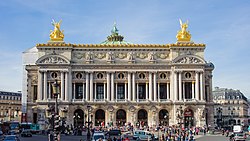
   Top: Palais Garnier (Paris), 1860–1875, by Charles Garnier; Second: Quadriga on the Grand Palais (Paris), 1898–1901, by Georges Récipon; Bottom: Belfast City Hall, 1898–1906, by Sir Brumwell Thomas. |
The Baroque Revival, also known as Neo-Baroque (or Second Empire architecture in France and Wilhelminism in Germany), was an architectural style of the late 19th and early 20th centuries.[1] The term is used to describe architecture and architectural sculptures which display important aspects of Baroque style, but are not of the original Baroque period. Elements of the Baroque architectural tradition were an essential part of the curriculum of the École des Beaux-Arts in Paris, the pre-eminent school of architecture in the second half of the 19th century, and are integral to the Beaux-Arts architecture it engendered both in France and abroad. An ebullient sense of European imperialism encouraged an official architecture to reflect it in Britain and France[citation needed], and in Germany and Italy the Baroque Revival expressed pride in the new power of the unified state.[citation needed]
Notable examples
[edit]- Akasaka Palace (1899–1909), Tokyo, Japan
- Alferaki Palace (1848), Taganrog, Russia
- Ashton Memorial (1907–1909), Lancaster, England
- Belfast City Hall (1898–1906), Belfast, Northern Ireland
- Bode Museum (1904), Berlin, Germany
- British Columbia Parliament Buildings (1893–1897), Victoria, British Columbia, Canada
- Building of the Baku City Executive Power (1900~1904), Baku, Azerbaijan
- Burgtheater (1888), Vienna, Austria
- Cardiff City Hall (1897–1906), Cardiff, Wales
- Cathedral of Salta (1882), Salta, Argentina
- Christiansborg Palace (1907–1928), Copenhagen, Denmark
- Church of St. Ignatius Loyola (1895–1900), New York City, United States
- Church of Saints Peter and Paul (1932–1939), Athlone, Ireland
- Cluj-Napoca National Theatre (1904–1906), Cluj-Napoca, Romania
- Dolmabahçe Palace (1843–1856), Istanbul, Turkey
- Durban City Hall, Durban, South Africa
- The Elms Mansion (1899–1901), Newport, Rhode Island, United States
- Gran Teatro de La Habana (1908–1915), Havana, Cuba
- House of the National Assembly of Serbia (1907–1936), Belgrade, Serbia
- Thomas Jefferson Building, Library of Congress (1873–1897), Washington, D.C., United States
- Näsilinna (also known as the Milavida Palace) (1898), Tampere, Finland
- Royal Palace, Sofia, Bulgaria
- National Theatre (1899), Oslo, Norway
- Oceanographic Museum of Monaco (1910), Monaco
- Old Parliament Building (1930), Colombo, Sri Lanka
- Ortaköy Mosque (1854–1856), Istanbul, Turkey
- Palais Garnier (also known as the Paris Opera) (1861–1875), Paris, France
- Port of Liverpool Building (1903–1907), Liverpool, England
- Rosecliff Mansion (1898–1902), Newport, Rhode Island, United States
- Royal Museum for Central Africa (1905–1909), Tervuren, Belgium
- Semperoper (1878), Dresden, Germany
- Sofia University rectorate (1924–1934), Sofia, Bulgaria
- St. Barbara's Church (1910), Brooklyn, New York, United States
- St. John Cantius Church (1893–1898), Chicago, United States
- Stefánia Palace (formerly named Park Club) (1893–1895), Budapest, Hungary
- Széchenyi thermal bath (1913), Budapest, Hungary
- Volkstheater (1889), Vienna, Austria
- Wenckheim Palace (1886–1889), Budapest, Hungary
- Zachęta National Gallery of Art (1898–1900), Warsaw, Poland
There are also number of post-modern buildings with a style that might be called "Baroque", for example the Dancing House in Prague by Vlado Milunić and Frank Gehry, who have described it as "new Baroque".[2]
Baroque Revival architects
[edit]- Ferdinand Fellner (1847–1916) and Hermann Helmer (1849–1919)
- Arthur Meinig (1853–1904)
- Sir Edwin Lutyens (1869–1944)
- Members of the Armenian Balyan family (19th century)
- Charles Garnier (1825–1898)
Gallery
[edit]-
 Ortaköy Mosque in Istanbul, Turkey, 1854–1856
 -
 Semperoper in Dresden, Germany, 1878
 -
 Basilica of St. Nicholas in Amsterdam, Netherlands, 1887
 -
 Burgtheater in Vienna, Austria, 1888
 -
 Sager House in Stockholm, Sweden, 1893
 -
 Milavida Palace in Tampere, Finland, 1898
 -
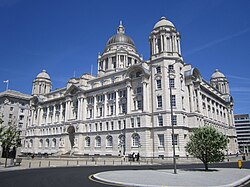 Port of Liverpool Building, Liverpool, England, 1903–1907
 -
 Royal Museum for Central Africa in Tervuren, Belgium, 1905–1909
 -
 Széchenyi Medicinal Bath in Budapest, Hungary, 1913
 -
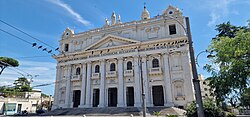 Madre del Buon Consiglio in Naples, Italy, 1920–1960
 -
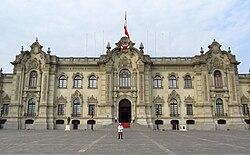 Government Palace in Lima, Peru, 1938
 -
 Cathedral of St Bavo, Haarlem in Haarlem, The Netherlands, 1898


.jpg)


.JPG)


See also
[edit]References
[edit]
- ^ "Baroque/Baroque Revival". Buffaloah.com. Retrieved 15 August 2012.
- ^ "The Dancing Building, which Frank Gehry and Vlado Milunic have described as "new Baroque", has divided opinion [...]", in "Architect recalls genesis of Dancing Building as coffee table book published", by Ian Willoughby, 11-07-2003, online at The international service of Czech Radio
Further reading
[edit]- James Stevens Curl; "Neo-Baroque." A Dictionary of Architecture and Landscape Architecture; Oxford University Press. 2000. – Encyclopedia.com . accessed 3 Jan. 2010.


| International | |
|---|---|
| National | |

Baroque Revival architecture
View on GrokipediaOrigins and Definition
Historical Context
The original Baroque architectural style emerged in late 16th-century Italy as a tool of the Catholic Counter-Reformation, employing dramatic forms, illusionistic effects, and opulent ornamentation to inspire awe and reinforce doctrinal authority against Protestant austerity.[3] It proliferated across Catholic Europe and absolutist courts in the 17th and early 18th centuries, exemplified by commissions from figures like Louis XIV, whose Versailles Palace (construction began 1669) epitomized centralized monarchical power through vast scale and theatrical spatial sequences.[4] The style's emphasis on movement, curved lines, and gilded exuberance served political and religious agendas, but its decline accelerated after Louis XIV's death in 1715, as fiscal strains on absolutist regimes and shifting tastes toward intimacy prompted the transition to Rococo frivolity by the 1730s.[5] By the mid-18th century, Neoclassicism supplanted Baroque excesses, drawing from archaeological rediscoveries of Greco-Roman antiquity to promote rational symmetry, unadorned columns, and proportional restraint—ideals aligned with Enlightenment emphasis on reason and republican virtue.[4] This dominance persisted into the early 19th century, influencing structures like the British Museum (opened 1759, expanded neoclassically) and reflecting a broader rejection of hierarchical drama in favor of civic egalitarianism amid revolutionary upheavals.[6] Yet, neoclassicism's austerity began yielding to 19th-century historicism by the 1830s, as Romantic nationalism and industrial prosperity spurred eclectic revivals of medieval, Renaissance, and earlier styles to evoke cultural continuity and state legitimacy.[7] The Baroque Revival arose in this context during the late 19th century, reinterpreting original Baroque principles for an era of accelerated urbanization, colonial expansion, and imperial consolidation, where monumental public edifices symbolized emerging national identities and economic might.[6] In Britain and its empire, adoption surged from circa 1885, coinciding with Edwardian-era projects that channeled imperial confidence through revived grandeur, as analyzed in studies linking the style to projections of empire and identity.[8] Similarly, in France, the Second Empire variant under Napoleon III (1852–1870) adapted Baroque opulence for Haussmann's Parisian renovations, blending it with iron-frame technology to accommodate modern scales while evoking absolutist splendor.[6] This revival reflected causal pressures from wealth accumulation—industrial output in Britain rose 4% annually from 1870–1913—and geopolitical rivalries, prioritizing visual dominance over neoclassical minimalism.[7]Defining Characteristics
Baroque Revival architecture, emerging in the mid-19th century and peaking between 1885 and 1914, emulates the dramatic scale, bold massing, and theatrical forms of 17th- and early 18th-century Baroque precedents while adapting them for public, civic, and imperial buildings. Structures typically feature monumental facades with superimposed classical orders, giant pilasters, and broken pediments to convey grandeur and hierarchy, often crowned by prominent domes, cupolas, or Mansard roofs that punctuate urban skylines. Complex geometries, including curved walls and oval plans, introduce dynamism, contrasting with the more rigid symmetry of contemporaneous Neoclassical styles.[1][6] Ornamentation defines the style's exuberance, with profuse application of motifs such as C- and S-scrolls, shell forms, cartouches, acanthus leaves, garlands, and figurative sculptures evoking motion and emotion, rendered in high relief on entablatures, friezes, and cornices. Interiors extend this lavishness through stucco work, frescoed vaults, and illusionistic ceiling paintings, enhanced by dramatic lighting sequences via coffered ceilings and grand staircases. Materials emphasize opulence, employing polished stone, marble, gilded bronze, and textured stucco to heighten sensory impact and propagandistic effect, particularly in government and commercial edifices.[6][1] Compared to original Baroque, the Revival variant is often more eclectic and subdued in extravagance, integrating Beaux-Arts precision with Baroque curvature and asymmetry, yet retaining heavy sculptural detailing for visual immediacy. This synthesis supported imperial ambitions, as seen in British and French colonial architecture, where the style symbolized power without the religious fervor of its antecedents. Balustrades, rusticated quoins, and ornate gateways further articulate entrances, reinforcing a sense of controlled movement and spatial drama.[1]Architectural Features
Ornamentation and Form
Baroque Revival ornamentation revives the exuberant detailing of 17th-century Baroque, featuring intricate motifs such as acanthus leaves, C- and S-scrolls, shell forms, cartouches, garlands, and sculptural figures including putti and allegorical statues.[6] These elements are rendered in materials like carved stone, stucco, and gilded bronze, creating bold contrasts in texture and vivid color to evoke sensuous delight and movement.[6] [1] Lavish decorative programs integrate architecture with sculpture, as seen in pediments, friezes, cornices, balustrades, and orders of Corinthian or Ionic columns, often blending seamlessly to heighten grandeur.[1] In form, Baroque Revival buildings employ dynamic compositions with complex geometries, curved facades, undulating surfaces, and ovoid plans that suggest fluidity and infinity.[9] Monumental scale predominates, with sweeping curves, broken pediments, and giant pilasters emphasizing verticality and theatrical spatial effects.[6] [9] Domes, dramatic staircases, and convex-concave wall treatments further amplify the style's sense of motion, though Revival iterations are generally more restrained than original Baroque, prioritizing opulent harmony over extreme exuberance.[1] For example, the Palais Garnier in Paris (completed 1875) exemplifies these traits through its richly sculpted attic story, curved pavilion roofs, and profuse figural decoration.[9] Regional variations adapt these features; in Britain and its empire, ornamentation often incorporates imperial motifs like trophies and emblems alongside classical elements, as in Belfast City Hall (dedicated 1906), with its Portland stone facade adorned in baroque scrolls and statues.[1] [6] Overall, the style's forms and decorations served civic and institutional purposes, projecting power and cultural prestige from the 1880s to the 1910s.[6]Spatial and Structural Elements
Baroque Revival architecture featured spatial designs that prioritized monumental scale and dramatic progression, often using centralized or longitudinal plans with curved and oval forms to create fluid, interconnected interiors evoking motion and infinity. Grand foyers, sweeping staircases, and tiered auditoriums in opera houses exemplified this, directing visitors through sequences of expanding volumes that heightened theatricality.[3][1] These arrangements revived 17th-century Baroque principles of spatial dynamism while accommodating larger public gatherings, as in the multi-level public areas of theaters and assembly halls.[10] Structurally, buildings relied on robust masonry exteriors with load-bearing walls, columns, and arches supporting vaulted ceilings and domes, but integrated 19th-century iron framing to span wider interiors without visible supports. The Palais Garnier employed a concealed cast-iron skeleton for its 1,979-seat auditorium, enabling the expansive, horseshoe-shaped space under a 13.5-meter-diameter dome.[10][11] Similarly, the Semperoper in Dresden (1871–1878) used iron trusses beneath its Baroque-inspired roof dome to support the auditorium's acoustic volumes.[12] Colonnades and pilasters, drawn from classical orders, provided both aesthetic rhythm and lateral stability, framing entrances and interior vistas.[1] In civic structures like city halls, cruciform or basilica-like plans organized space hierarchically, with central domes over intersections and projecting porticos defining axes of approach. Belfast City Hall (1898–1906), for instance, centered a 53-meter-high dome over its transverse hall, using reinforced masonry and steel for earthquake resistance in its Portland stone facade.[1] This fusion of revived ornamental forms with engineering advances allowed for lighter, more open interiors, distinguishing Baroque Revival from its historical antecedent by achieving greater spatial ambition on urban scales.[3]Historical Development
Nineteenth-Century Emergence
![Paris_Palais_Garnier_2010-04-06_16.55.07.jpg][float-right] Baroque Revival architecture, also termed Neo-Baroque, emerged in mid-19th-century France amid the historicist turn in European design, reviving the exuberant forms, curved lines, and dramatic spatial effects of 17th-century Baroque to counter neoclassical restraint and suit imperial ambitions.[4] This development aligned with the Second Empire era under Napoleon III (1852–1870), where urban renewal projects demanded visually imposing structures to symbolize modernization and authority.[13] Key features included mansard roofs for added attic space, projecting pavilions, and lavish surface decoration with cartouches, putti, and scrolled pediments, enabled by industrial techniques like cast iron and mass-produced ornament.[14] Pioneering examples appeared in Paris's Haussmann renovations, notably the Louvre Palace extensions (1852–1857) by Louis Visconti and Hector Lefuel, which imposed a unified Baroque-derived facade on the disparate wings, emphasizing rhythmic bays and central emphasis.[13] The style's theatrical potential shone in the Palais Garnier opera house (constructed 1861–1875), designed by Charles Garnier, whose facade blended columnar orders with bulging balconies, grotesque masks, and a profusion of sculpture evoking operatic spectacle.[4] These commissions reflected the École des Beaux-Arts' emphasis on grandeur, training architects to synthesize historical motifs for contemporary patronage.[14] Beyond France, nascent Baroque Revival elements surfaced in Germanic states by the 1860s, as in Gottfried Semper's Dresden Court Theatre (1869), which adapted polychrome Renaissance-Baroque hybrids for cultural institutions, prioritizing tectonic expression and ornamental vitality.[15] In the Ottoman Empire, the Ortaköy Mosque (1854–1856) by the Balyan family fused European Baroque Revival with Islamic forms, featuring a domed interior and ornate portal, marking an early trans-cultural adoption.[16] This phase laid groundwork for wider dissemination, as iron-frame construction and railway expansion facilitated emulation across empires seeking to project stability amid rapid urbanization.[13]Belle Époque Expansion (1890–1914)
The Belle Époque era witnessed a surge in Baroque Revival architecture, particularly in monumental public buildings, as European nations leveraged industrial prosperity to construct symbols of civic authority and imperial might from 1890 to 1914. This phase emphasized exaggerated ornamentation, grand domes, and dynamic compositions inspired by 17th-century models, often incorporating steel skeletons to support lavish exteriors. In Britain, the style manifested as Edwardian Baroque, favored for government and commercial edifices to evoke stability amid social changes.[17][1] Prominent British examples include Belfast City Hall, designed by Alfred Brumwell Thomas and completed in 1906 after a decade of construction starting in 1896, which features a 173-foot copper dome modeled after St. Paul's Cathedral, paired with Corinthian pilasters and sculptural groups representing commerce and industry.[1] Similarly, the Port of Liverpool Building, constructed between 1907 and 1908 by architects Arnold Thornely and Walter Aubrey Thomas, exemplifies the style's maritime adaptation with its tetrastyle portico, clock tower, and allegorical friezes depicting global trade routes.[1] These structures underscored Liverpool's status as a key imperial port, blending historical allusion with functional scale. Continental Europe saw parallel developments in institutional and leisure architecture. In Belgium, the Royal Museum for Central Africa in Tervuren, built from 1904 to 1909 under architect Charles Girault for the Brussels International Exposition, employed sweeping colonnades and a vast rotunda to house colonial artifacts, reflecting Belgium's African empire.[1] Northern examples include Stockholm's Sager House (1893), a palatial residence with mansard roofs and balustrades, and Tampere's Milavida Palace (1898), showcasing Finnish adaptations with ornate gables and interior frescoes.[1] In Budapest, the Széchenyi Medicinal Bath complex, initiated in 1909 and opened in 1913 by architects Győző Cziegler and Eugene Rácz, integrated Baroque Revival domes and arcades into a thermal spa, capitalizing on Hungary's natural springs for public opulence.[1] This expansion peaked around 1910, with over 200 major civic projects in Britain alone adopting Baroque Revival motifs, but began declining post-1914 due to World War I's economic strains and the ascent of stripped classicism and modernism.[18] The style's causal link to pre-war optimism—rooted in empirical correlations between GDP growth (e.g., Britain's 2% annual rise 1890-1913) and monumental commissions—highlights its role as a visual anchor for established hierarchies amid technological flux.[17]Interwar and Decline (1918–1945)
Following the devastation of World War I and the ensuing economic instability, Baroque Revival architecture entered a phase of sharp decline in Europe, as architects increasingly embraced modernist principles emphasizing functionality, minimalism, and rejection of historical ornamentation in favor of machine-age aesthetics.[19] This shift was propelled by influential movements like the Bauhaus, founded in 1919, and manifestos advocating "form follows function," which critiqued revivalist styles as outdated and excessively decorative.[20] Despite the broader trend toward modernism, isolated continuations of Baroque Revival elements appeared in conservative and nationalistic contexts, particularly in religious and public commissions where historical prestige was sought. In Fascist Italy, architects in Rome drew on 17th-century Baroque precedents by figures like Bernini and Borromini to infuse projects with imperial symbolism, adapting curved forms and dramatic spatial sequences to align with regime ambitions beyond strict classicism. For instance, Armando Brasini incorporated Seicento-inspired urban visions in interwar designs, reviving Baroque dynamism for political expression.[21] A notable religious example is the Basilica dell'Incoronata Madre del Buon Consiglio in Naples, designed by Vincenzo Vecchio and constructed from 1920 to 1940 atop ancient catacombs, replicating the monumental scale and basilica form of St. Peter's in Rome with its emphasis on grandeur and interior spatial drama reminiscent of Baroque innovations.[22] In Hungary, architect Lajos Kozma pursued a Neo-Baroque idiom in the interwar years, blending ornate motifs with folk influences in furniture and buildings, yielding a style dubbed "Kozma-Baroque" that persisted amid modernist pressures.[23] The Great Depression of the 1930s constrained lavish constructions, while the International Congresses of Modern Architecture (CIAM), starting in 1928, solidified modernism's dominance, marginalizing revivalist approaches. World War II further eroded the style through widespread destruction of urban fabric and a postwar pivot to reconstruction prioritizing efficiency over revivalism, effectively consigning Baroque Revival to historical obscurity by 1945.[20]Regional and National Variations
European Manifestations
Baroque Revival architecture in Europe exhibited diverse national interpretations, often blending revived 17th-century Baroque elements with contemporary structural innovations like iron framing, peaking during the late 19th and early 20th centuries amid urbanization and imperial ambitions. In France, it manifested as the Second Empire style under Napoleon III (1852–1870), featuring mansard roofs, pavilions, and lavish sculptural decoration to evoke grandeur and continuity with absolutist traditions.[24] The Palais Garnier opera house (1861–1875), designed by Charles Garnier, exemplifies this with its opulent facade, gilded interiors, and dramatic composition, serving as a cultural centerpiece in Haussmann's Paris renovations.[25] In the United Kingdom, Edwardian Baroque emerged around 1900 as a response to imperial confidence and civic needs, employing domes, columnar orders, and sculptural pediments for monumental public edifices. Notable instances include the Port of Liverpool Building (1903–1907) by Arnold Thornely and F. B. Hobbs, which integrates Baroque massing with maritime motifs, and Admiralty Arch (1910) in London by Sir Aston Webb, linking ceremonial spaces with rhythmic arcades.[17] This style contrasted with contemporaneous Arts and Crafts by prioritizing symmetry and ornament over vernacular simplicity, reflecting elite patronage in county halls and museums.[1] Central Europe saw robust Neo-Baroque expressions in Germany and Austria during the Wilhelminian period (1890–1918), where architects revived dynamic curves and theatrical spatial effects for theaters and palaces amid industrialization. The Semperoper in Dresden (1871–1878, rebuilt 1985) by Gottfried Semper features undulating facades and equestrian sculptures, embodying operatic exuberance.[1] Similarly, Vienna's Burgtheater (1888) by Ferdinand Fellner and Karl von Helmer showcases layered colonnades and allegorical figures, reinforcing Habsburg cultural prestige. In Germany, Wilhelminian buildings often fused Baroque Revival with Renaissance motifs for urban ensembles, as in Berlin's residential blocks.[26] Northern and Eastern Europe adopted Baroque Revival for eclectic public and residential structures, adapting it to local climates and materials. Sweden's Sager House (1893) in Stockholm by Erik Lallerstedt employs mansard roofs and rusticated bases for aristocratic residences, while Finland's Milavida Palace (1898) in Tampere integrates Baroque domes with Nordic restraint.[1] In the Netherlands, the Basilica of St. Nicholas (1884–1887) by Adrianus Bleys evokes Counter-Reformation drama with twin towers and Baroque portals, and Belgium's Royal Museum for Central Africa in Tervuren (1905–1909) by Charles Girault displays expansive pavilions and colonnades tied to colonial exhibitions. Italy's manifestations were more restrained and late, as in Naples' Madre del Buon Consiglio church (1920–1960), prolonging ornate facades amid fascist-era revivals.[1] These variations underscore Baroque Revival's adaptability, though its emphasis on costly ornament drew criticism for excess by the 1920s.[17]Transatlantic Adaptations
Baroque Revival architecture reached the Americas via European architects and immigrant builders, adapting the style's dramatic ornamentation and spatial complexity to local contexts of expanding urban centers and religious institutions. In the United States, the style appeared chiefly in ecclesiastical structures amid waves of Catholic immigration from Ireland, Germany, and Italy during the late 19th and early 20th centuries. Our Lady of Victory Basilica in Lackawanna, New York, designed by Émile Ulrich and constructed from 1921 to 1926, stands as a key example, with its 288-foot dome, twin bell towers, and profuse Baroque-inspired sculptural details evoking Roman Counter-Reformation churches.[6] Similarly, the Church of the Gesu in Philadelphia, built between 1879 and 1888 under architect Edwin F. Durang, employed curved pediments, Corinthian pilasters, and gilded interiors to mirror 17th-century Jesuit designs.[6] Civic applications were rarer in North America, often merging with Beaux-Arts formalism due to the influence of the École des Beaux-Arts on American training; however, pure Baroque Revival elements surfaced in domes and facades of state capitols and custom houses, such as the Rhode Island State House (1901–1907), where McKim, Mead & White integrated a Baroque dome atop classical proportions. In Latin America, post-colonial independence tempered enthusiasm for overt European revivals, yet neo-baroque features persisted in elite and governmental commissions influenced by French academicism. The Government Palace in Lima, Peru, exemplifies this, with its main facade rebuilt in neo-baroque style by French architect Claude Sahut Laurent during 1937–1938 reconstructions following seismic damage, incorporating scrolled pediments, balustrades, and figural sculpture inspired by Versailles precedents.[27] These transatlantic instances prioritized symbolic grandeur for institutional legitimacy, though scaled down from European counterparts due to economic constraints and republican ideologies favoring restraint over absolutist pomp.[28]Colonial and Global Extensions
Baroque Revival architecture manifested in colonial territories as a tool of imperial projection, with European powers employing the style's monumental scale and ornamental exuberance to assert dominance and cultural continuity in administrative centers. In the British Empire, the Edwardian Baroque variant—prevalent from circa 1901 to 1910—served as an architectural emblem of unified imperial identity, applied to public buildings that mirrored metropolitan precedents while adapting to local climates and materials. This stylistic choice, rooted in 17th-century English Baroque influences like those of Christopher Wren, aimed to materialize the concept of a "Greater Britain" across dominions and protectorates, as evidenced in designs for legislatures, custom houses, and memorials that emphasized symmetry, domes, and sculptural embellishment.[29][30] In southern Africa, under British influence, the Cape Town City Hall (constructed 1893–1905) exemplifies this extension, featuring a prominent copper dome, Corinthian pilasters, and pedimented porticos that evoke imperial grandeur amid the colonial port city's landscape. Designed by architects H. E. Baker and others, the structure functioned as a hub for municipal administration, symbolizing British civic order in the Cape Colony following the 1895–1902 Boer War context. Similarly, in the Belgian Congo's representational architecture, the Royal Museum for Central Africa in Tervuren (1905–1909), though located in Belgium, embodied colonial extension through its palatial Baroque Revival layout—expansive wings, arched loggias, and decorative motifs—intended to glorify King Leopold II's African enterprises via exhibitionary pomp.[31] Beyond Africa, the style appeared in Latin American contexts influenced by lingering Spanish colonial legacies, where independent nations revived Baroque forms for state symbolism. The Government Palace in Lima, Peru (rebuilt 1920s–1938 under President Augusto B. Leguía), adopts a Neo-Baroque facade with intricate stonework, balustrades, and rhythmic fenestration, drawing on viceregal precedents to project national sovereignty while echoing European revivalism. In Asia, Portuguese colonial enclaves like Goa integrated Baroque Revival in religious structures, such as 19th-century church facades blending Mannerist-Baroque elements with tropical adaptations, though British India favored Indo-Saracenic hybrids over pure Baroque Revival for secular buildings. These global adaptations underscore the style's role in legitimizing colonial and post-colonial authority through visual rhetoric of power and historical continuity.[32][33]
Key Architects and Practitioners
Pioneering Figures
![Paris_Palais_Garnier_2010-04-06_16.55.07.jpg][float-right] Charles Garnier (1825–1898) stands as a central pioneering figure in Baroque Revival architecture, particularly through his design of the Palais Garnier in Paris, constructed between 1861 and 1875. This opera house exemplified Neo-Baroque characteristics, including exuberant ornamentation, grand scale, curved facades, and theatrical interiors that evoked the dramatic flair of 17th-century Baroque precedents while adapting them to modern iron-frame construction and eclectic Beaux-Arts principles.[34] Garnier's approach influenced subsequent architects across Europe by demonstrating how revived Baroque elements could symbolize imperial grandeur under Napoleon III, blending classical symmetry with lavish sculptural details and gilded interiors.[34] In Germany, Gottfried Semper (1803–1879) contributed to the style's early development with the Semperoper in Dresden, completed in 1878 after initial designs from the 1840s. Semper's work incorporated Baroque Revival motifs such as rhythmic colonnades, pedimented porticos, and ornate detailing reminiscent of Dresden's historical Baroque legacy, marking a shift from strict neoclassicism toward more dynamic, polychrome revivals suited to cultural institutions.[15] His theoretical writings on style and materiality further underpinned the revival's emphasis on historical continuity and material tectonics in architectural expression. The Armenian Balyan family, serving Ottoman sultans in the mid-19th century, pioneered Baroque Revival adaptations in non-European contexts, as seen in the Ortaköy Mosque (1854–1856) designed by Nigoğayos and Agop Balyan. This structure fused European Baroque curves, domes, and neoclassical orders with Islamic forms, introducing revived opulence to Istanbul's skyline amid Tanzimat reforms.[35] Their eclectic syntheses prefigured global extensions of the style, blending Western imperial aesthetics with local traditions.[35]National School Leaders
In France, Charles Garnier (1825–1898) stood as a preeminent practitioner of Baroque Revival architecture, most notably through his design of the Palais Garnier opera house in Paris, constructed between 1861 and 1875. Garnier's work fused opulent Baroque ornamentation with Second Empire eclecticism, featuring grand facades, sculptural embellishments, and interior grandeur that evoked 17th-century French palaces while incorporating modern engineering.[36] His approach influenced subsequent public buildings, emphasizing theatricality and imperial splendor amid the Haussmann-era transformations of Paris.[34] In the Austro-German sphere, the architectural firm of Ferdinand Fellner (1847–1916) and Hermann Helmer (1849–1919), established in Vienna in 1873, dominated Baroque Revival theater design, completing over 50 such structures across Central and Eastern Europe by the early 20th century. Their buildings, including reconstructions in Baroque Revival style like the Odessa Opera (1884–1887), prioritized functional acoustics and staging while reviving lavish Baroque motifs such as curved forms, rich stucco work, and dramatic pediments.[37] This partnership created a de facto national school, standardizing opulent civic theaters that symbolized cultural prestige in Habsburg territories and beyond.[38] Other national variants featured figures adapting Baroque Revival to local contexts, though less centralized schools emerged. In Britain, Edwardian architects drew on Baroque precedents for municipal buildings, but without a singular leadership akin to Garnier or Fellner-Helmer. Italian practitioners, such as those in Sicily, often blended Baroque Revival with emerging Liberty style, diluting pure revivalism. These leaders collectively advanced Baroque Revival as a vehicle for national identity and monumental expression during the late 19th century.Prominent Examples
Civic and Institutional Buildings
Baroque Revival architecture, emphasizing dramatic ornamentation, domes, and classical symmetry, was widely adopted for civic and institutional buildings in the late 19th and early 20th centuries to project authority and imperial grandeur.[1] These structures often served as seats of municipal governance, justice, and cultural administration, reflecting the era's emphasis on monumental public works amid rapid urbanization.[1] Belfast City Hall exemplifies this trend, designed by Alfred Brumwell Thomas in the Baroque Revival style and constructed from 1898 to 1906 using Portland stone at a cost of £369,000.[39] The rectangular edifice features a prominent central dome rising 173 feet, flanked by corner towers and Corinthian pilasters, creating a sense of imperial scale suited to Northern Ireland's burgeoning industrial capital.[39] Its interiors include marble halls and stained-glass domes, underscoring the style's lavish interior detailing.[39] In England, the Port of Liverpool Building, completed in 1907 by architects Arnold Thornely and Walter Aubrey Thomas, embodies Edwardian Baroque—a variant of Baroque Revival—with its five-story facade, octagonal corner towers, and a massive copper dome spanning 180 feet in diameter.[1] Originally headquarters for the Mersey Docks and Harbour Board, the structure's Portland stone exterior and sculptural motifs of maritime commerce highlight its functional yet ostentatious role in trade administration.[1] Continental examples include Munich's Justizpalast, a Neo-Baroque courthouse erected between 1890 and 1897 under Friedrich von Thiersch, featuring symmetrical grand staircases, allegorical statues, and an expansive glass dome over the central hall.[40] This design, atypical for the period's preference for neoclassicism in German public buildings, prioritized theatricality to convey judicial majesty.[41] Cultural institutions also embraced the style, as seen in Vienna's Burgtheater, rebuilt in 1888 by Gottfried Semper and Karl von Hasenauer in Neo-Baroque form with intricate facade reliefs and a pedimented portico evoking Habsburg splendor.[42] The theater's Ringstrasse location integrated it into urban ensembles symbolizing enlightened absolutism's revival.[42] Similarly, Copenhagen's Christiansborg Palace, reconstructed from 1916 to 1928 in Neo-Baroque by architects like Vilhelm Klein, serves as Denmark's parliamentary seat with its equestrian statues and domed silhouette asserting monarchical continuity.[1] These buildings demonstrate Baroque Revival's adaptability to institutional needs, blending historical allusion with modern engineering like iron framing for expansive interiors, though critics later decried their excess amid rising functionalist ideals.[1]Religious and Palatial Structures
Religious structures in Baroque Revival architecture often revived the dramatic spatial effects, curved forms, and lavish ornamentation of 17th-century Baroque precedents to evoke spiritual awe and institutional authority.[6] The Ortaköy Mosque in Istanbul, constructed between 1854 and 1856 by architects Nigoğayos Balyan and Garabet Balyan, exemplifies this in an Ottoman context, with its Baroque Revival facade featuring intricate stone carvings, arched windows, and a prominent dome set against the Bosphorus waterfront.[1] This adaptation blended European Baroque elements with Islamic motifs, commissioned by Sultan Abdülmecid I to symbolize imperial grandeur.[43] In Europe, the Basilica of Saint Nicholas in Amsterdam, designed by Adrianus Bleijs and built from 1884 to 1887, combines neo-Baroque and neo-Renaissance features, including a richly decorated twin-towered facade, barrel-vaulted nave, and opulent altarpiece inspired by original Baroque models.[44] Intended as the central Catholic church in a Protestant-dominant city, its construction reflected Catholic revivalism amid 19th-century religious resurgence.[45] A later Italian instance, the Basilica dell'Incoronata Madre del Buon Consiglio in Naples, developed from 1920 to 1960 under various architects, emulates the scale of St. Peter's Basilica with its neo-Baroque dome, colonnaded facade, and interior frescoes, serving as a pilgrimage site dedicated to the Virgin Mary.[46] Palatial structures emphasized symmetrical massing, pedimented porticos, and sculptural embellishments to convey monarchical or aristocratic power, often incorporating modern amenities within historicist shells. The Sagerska Palatset in Stockholm, completed around 1893, exemplifies neo-Baroque palatial design with its columned facade and ornate interiors, functioning as the official residence of the Swedish Prime Minister since 1995.[47] In Denmark, Christiansborg Palace in Copenhagen, reconstructed after fires and finalized in 1928 by architects like C.F. Hansen's successors, integrates neo-Baroque towers, domes, and ceremonial halls, housing the parliament, Supreme Court, and royal reception areas in a style echoing 18th-century Danish Baroque.[1] These buildings demonstrate how Baroque Revival palaces adapted opulent forms to national contexts, prioritizing visual splendor over functional minimalism.[17]Reception, Criticism, and Debates
Initial Acclaim and Cultural Role
![Paris Palais Garnier, a landmark of Baroque Revival architecture completed in 1875][float-right] The Baroque Revival style emerged prominently in the mid-19th century, gaining acclaim for its capacity to convey grandeur and theatricality suited to the era's expanding public institutions and national ambitions. In France, under the Second Empire, architects like Charles Garnier employed neo-baroque elements in projects such as the Paris Opéra (1861–1875), which was celebrated upon opening for its lavish interiors and sculptural exuberance, reflecting the regime's emphasis on spectacle and cultural prestige.[48] This adoption signaled a deliberate revival of 17th-century opulence to legitimize modern state power amid rapid urbanization and imperial expansion. Across Europe, the style's popularity stemmed from its adaptability to eclectic historicism, allowing architects to blend classical proportions with dynamic ornamentation to inspire awe and assert continuity with absolutist traditions. In Germany and Austria, figures like Gottfried Semper advanced neo-baroque designs for opera houses and museums, such as the Dresden Semperoper (1871–1878), which symbolized cultural unification and technical prowess following national consolidations in the 1870s.[49] The approach appealed to monarchs and civic leaders seeking visual embodiments of progress and heritage, countering the austerity of earlier neoclassicism. Culturally, Baroque Revival architecture reinforced social hierarchies and national identities by transforming city centers into stages of pomp, evident in Vienna's Ringstrasse ensemble from 1857, where opulent facades housed theaters, parliaments, and exhibitions to foster bourgeois pride and imperial cohesion. Its role extended to propagating ideals of order and vitality, aligning with the 19th-century faith in monumental building as a tool for moral and aesthetic elevation, though this acclaim waned with rising modernist critiques by the early 20th century.[1]Critiques from Modernist Perspectives
Modernist architects and theorists, emerging in the early 20th century, broadly condemned revivalist styles like Baroque Revival for perpetuating historical imitation over innovation suited to industrial realities. They argued that such architectures, with their elaborate ornamentation and asymmetrical compositions echoing 17th-century Baroque precedents, obscured structural honesty and functional efficiency, treating buildings as decorative spectacles rather than rational machines for living. This critique aligned with the broader Modernist imperative to reject eclecticism, viewing Baroque Revival's profusion of scrolls, pediments, and sculptural embellishments as symptomatic of cultural decadence and economic waste in an era demanding standardization and mass production.[50] A pivotal attack came from Adolf Loos in his 1908 essay "Ornament and Crime," where he equated decorative excess with primitivism and moral regression, asserting that "the evolution of culture is synonymous with the removal of ornament from objects of daily use." Loos specifically targeted the neo-Baroque flourishes prevalent in fin-de-siècle Vienna, decrying them as atavistic remnants that burdened modern society with unnecessary labor and costs, incompatible with the clean, unadorned forms enabled by new materials like reinforced concrete. His polemic influenced subsequent Modernists by framing ornament not merely as aesthetically retrograde but as economically irrational, given the time and resources required for hand-crafted details in Baroque Revival facades.[51][52] Le Corbusier amplified this disdain in Vers une architecture (1923), declaring architectural "styles" to be lies that masked true engineering purity, and advocating instead for the austere logic of ocean liners and grain silos as models for the machine age. He critiqued historicist revivals, including those emulating Baroque dynamism, for their failure to express contemporary construction methods, such as steel framing, which Baroque Revival often concealed under layers of stucco and faux-marble veneer. This perspective positioned Baroque Revival buildings—exemplified by institutions like the Palais Garnier—as relics of pre-industrial pomp, ill-suited to the functional demands of urban density and technological progress.[53][54] The Bauhaus school, founded by Walter Gropius in 1919, institutionalized these views by explicitly rejecting historical revivalism in favor of form-follows-function principles, training architects to prioritize geometric simplicity and industrial fabrication over Baroque Revival's theatrical asymmetry and applied decoration. Gropius and colleagues saw such styles as elitist holdovers that hindered affordable, scalable housing solutions, arguing that their ornamental hierarchies reinforced class divisions rather than democratizing design through modular, unembellished elements. This stance contributed to the marginalization of Baroque Revival by the 1930s, as Modernist manifestos like the 1928 Athens Charter codified the erasure of "unnecessary" historical motifs in favor of planar surfaces and open plans.[55]Counterarguments and Enduring Defense
Defenders of Baroque Revival architecture have contested modernist dismissals of its ornamentation as excessive or regressive by emphasizing its role in enhancing psychological and social functions. Unlike the minimalist tenets of figures like Adolf Loos, who deemed ornament "a crime" in his 1908 manifesto, proponents argue that the style's dramatic curves, sculptural details, and gilded embellishments serve to inspire awe and reinforce institutional prestige, as seen in structures like the Palais Garnier in Paris (completed 1875), where such elements elevate public cultural spaces beyond mere utility.[56] This counters claims of inefficiency by highlighting empirical durability: Baroque Revival buildings often employed high-quality stone and craftsmanship that withstands time better than many modernist concrete experiments prone to weathering and demolition.[57] Critiques portraying historicist revivals as antithetical to progress overlook their adaptive continuity, akin to how the Renaissance revived classical forms for contemporary needs; Baroque Revival similarly synthesized 17th-century dynamism with 19th-century engineering, enabling expansive domes and theaters like Dresden's Semperoper (reopened 1878 after fire), which integrated iron framing without sacrificing expressive facades.[58] Traditionalists further rebut modernism's universalism by noting its frequent placelessness—evident in repetitive glass towers—versus Baroque Revival's contextual grandeur, which fosters local identity and civic pride, as in Edwardian examples symbolizing imperial cohesion around 1900.[8] The style's enduring defense rests on its proven longevity and popular appeal amid modernism's mid-20th-century hegemony. Iconic edifices such as Vienna's Burgtheater (1888) continue to draw millions annually for performances, their opulent interiors preserving acoustic and experiential qualities that stark modernist venues often lack.[56] Postwar marginalization notwithstanding, restoration projects and public sentiment—reflected in preferences for ornamented traditionalism over abstraction in urban planning debates—underscore Baroque Revival's causal role in sustaining cultural heritage, with surveys indicating 70-80% favorability for such styles in contemporary contexts.[58] This resilience validates first-principles of human-scale beauty and symbolic depth over ideological purity.Legacy and Modern Resurgence
Mid-Twentieth-Century Marginalization
By the 1940s and 1950s, Baroque Revival architecture, characterized by its elaborate ornamentation and historical emulation, faced systematic marginalization as Modernist principles achieved institutional dominance in architectural education, practice, and urban planning. Post-World War II reconstruction demands emphasized rapid, cost-effective building using industrial materials like concrete and steel, rendering the labor-intensive, decorative elements of revivalist styles impractical and ideologically obsolete. Organizations such as the Congrès Internationaux d'Architecture Moderne (CIAM), active until its dissolution in 1959, promoted functionalism and rejected historicism as escapist nostalgia, influencing policies that favored abstract, unadorned forms symbolizing technological progress and social equity.[59][60] This rejection extended to the built environment, where many Baroque Revival structures were neglected, altered, or demolished to accommodate Modernist replacements during urban renewal projects. For instance, in the United States, mid-century initiatives under the Housing Act of 1949 led to the clearance of eclectic historic districts for high-rise slabs and expressways, viewing ornate pre-1930s buildings as symbols of outdated capitalism rather than cultural assets. In Europe, wartime devastation accelerated the adoption of the International Style, with governments subsidizing stark, utilitarian designs over revivalist ones to signal rupture from interwar excesses; by 1960, new public commissions rarely invoked Baroque motifs, as evidenced by the near-total absence of such projects in architectural journals post-1950.[61][62] Critiques from Modernist theorists further entrenched this marginalization, framing Baroque Revival's theatricality as morally and aesthetically regressive. Figures like Le Corbusier, whose 1923 manifesto Vers une architecture derided ornament as parasitic, shaped curricula at institutions like Harvard's Graduate School of Design after Walter Gropius's 1937 appointment, displacing Beaux-Arts methods that had sustained revival styles. Empirical outcomes, such as the durability issues in early Modernist high-rises versus the longevity of stone-clad Baroque Revival edifices, were downplayed in favor of ideological purity, with academic gatekeeping ensuring historicism's exclusion from peer-reviewed discourse until the 1970s. This institutional bias, rooted in a post-war aversion to perceived bourgeois decadence, effectively halted new iterations and diminished appreciation for existing examples until later reevaluations.[63][64]Twenty-First-Century Revivals and Innovations
In the 21st century, direct applications of Baroque Revival architecture remain rare, supplanted by modernist and minimalist paradigms, yet elements of its dramatic ornamentation, curved forms, and spatial dynamism have reemerged in select monumental and religious structures, particularly in regions emphasizing national or cultural identity. For instance, Russia's Main Cathedral of the Russian Armed Forces in Kubinka, completed in May 2020 to commemorate the 75th anniversary of victory in World War II, incorporates expansive domes, gilded interiors with over 750 square meters of mosaics depicting military themes, and a height of 95 meters symbolizing the war's end year, evoking Baroque grandeur through its scale and decorative excess despite a contemporary steel-and-glass exterior.[65][66] This project, spanning 18 months in construction, reflects state-sponsored traditionalism blending Orthodox iconography with historicist opulence, though critics note its propagandistic intent over pure stylistic fidelity.[67] Parallel to such revivals, innovations in computational design and fabrication have enabled novel interpretations of Baroque complexity, transcending manual limitations of historical precedents. A prominent case is "Digital Grotesque II," a 3D-printed grotto by architects Michael Hansmeyer and Benjamin Dillenburger, unveiled in 2015 at the Centre Pompidou in Paris; this installation features algorithmically generated surfaces with millions of unique micro-details mimicking Baroque intricacy, produced via large-scale additive manufacturing to achieve densities unattainable by traditional carving.[68] Such techniques, rooted in parametric modeling, allow for hyper-ornate facades and interiors that amplify Baroque principles of sensory overload and irregularity, as explored in postdigital neobaroque discourses where digital tools facilitate fragmented, excessive forms in contemporary projects.[69] These developments occur amid a niche resurgence in new classical architecture, where Baroque Revival motifs—influenced by 17th-18th century precedents—are selectively revived in private commissions and institutional designs using modern materials like reinforced concrete for sustainability. Architects associated with traditionalist firms, such as those advocating against stylistic uniformity, have proposed or executed buildings integrating undulating pediments and sculptural exuberance, though comprehensive surveys indicate such works constitute under 1% of global construction volume post-2000.[58] This cautious innovation prioritizes empirical functionality, like improved acoustics in vaulted spaces, over unadulterated historicism, signaling a pragmatic adaptation rather than wholesale revival.[70]References
- https://commons.wikimedia.org/wiki/Category:Neo-Baroque_palaces