Hubbry Logo
Zoo TowerZoo TowerMain
Open search
Zoo Tower
Community hub
Zoo Tower
logo
8 pages, 0 posts
0 subscribers
Be the first to start a discussion here.
Zoo Tower
Zoo Tower
from Wikipedia
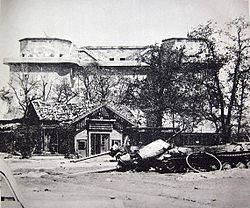
Destroyed IS-2 tanks after the Battle of Berlin, May 1945

The Zoo flak tower[1][2] (German: Flakturm Tiergarten, Tiergarten Flak Tower or commonly referred to as the "Zoo Tower") was a fortified flak tower that existed in Berlin from 1941 to 1947. It was one of several flak towers that protected Berlin from Allied bomber raids. Its primary role was as a gun platform to protect the government building district of Berlin; in addition, the Hochbunker (blockhouse) was designed to be used as a civilian air-raid shelter. It also contained a hospital and a radio transmitter for use by the German leadership and provided secure storage facilities for art treasures.[3]

During the Battle of Berlin, it acted as a citadel and by depressing its large anti-aircraft artillery, its garrison was able to provide support for ground operations against the Soviet Red Army.

Development

[edit]

The Berlin flak towers (Flaktürme, singular Flakturm) were originally built as a response to an attack on Berlin by a relatively small force of British bombers. Hitler ordered the construction of these towers after the first bomber attack on Berlin by the RAF on 25 August 1940. Although only 95 RAF bombers constituted the attack force, this was a grave domestic political embarrassment to Adolf Hitler, and in particular Hermann Göring, who had said that Berlin would never be bombed. The Zoo tower was built close to the Berlin Zoo, hence the name, and is the most famous of the flak towers. It was the first one built and protected the government quarter in Berlin.[4]

10.5 cm flak on the Zoo tower

Layout

[edit]

The Zoo tower was a first generation flak tower. Like all the flak towers, it had a main facility that housed the anti aircraft guns, the G building, and a smaller building, the L building, that had sensory equipment, including radar. The two were connected by a tunnel that carried a telephone line to transmit information needed to fight enemy aircraft; and also pipes and cables for water, heating, and electrical power.[5]

There was only one cellar floor and six upper floors above that, despite the tower being 39 m (128 ft) tall—about the height of a 13-storey building.[4] The second floor was used to house the most priceless and irreplaceable holdings of 14 museums from Berlin. The rooms were climate controlled. The third floor held an 85-bed hospital.[6]

The Zoo tower in 1946

Specifications

[edit]

As with all flak towers, the installation consisted of two towers, the main G tower, which held the anti-aircraft armaments, and the L tower which held radar and detection equipment. The G Tower could accommodate 15,000 people.[7]

The G tower was crewed by 350 anti-aircraft personnel and assisted by the Hitler Youth.

It was a ferro-concrete structure.[4] The larger tower was large, roughly 70 metres wide by 70 metres deep.[4] The walls were 2.4 meters thick, and the roof was 1.5 meters thick. It was the largest air raid shelter in Berlin.[4]

In terms of provisions, and the defenses of the Zoo Tower, the defenders certainly believed it to be sufficient - "The complex was so well stocked with supplies and ammunition that the military garrison believed that, no matter what happened to the rest of Berlin, the zoo tower could hold out for a year if need be."[7]

Armaments

[edit]

From 1943, the roof of the facility had four twin mounts of 12.8 cm FlaK 40. As bombers took to higher altitudes, these were the only guns that could hit them. Each barrel could fire 10 to 12 rounds a minute; thus, each twin mounted battery was rated to fire a maximum of 24 rounds a minute, and four twin mounts could fire as many as 96 rounds a minute. The guns were loaded electrically, with the ammunition fed into hoppers. Younger Hitler Youth, while officially not supposed to be combatants, assisted the military during the loading process. Before the 12.8 cm FlaK became available in sufficient numbers, the tower was armed with 10.5 cm FlaK 38.[8]

There was also an array of smaller (20mm and 37mm) anti-aircraft guns on the lower platforms.[4]

Usage during the war

[edit]
German soldiers on quad-mounted 2-cm-Flak, 16 April 1942

The primary purpose of the Flak Towers was to protect Berlin. Together with the Luftwaffe and a well organised fire brigade, the Berlin flak towers prevented the levels of the aerial attack damage that the RAF and the USAAF expected to occur and had occurred in other German cities. The RAF Bomber Command had been endeavouring to ignite firestorms in Berlin but had been unable to do so.[9]

The hospital facility, within the G tower, was used to treat wounded soldiers, shipped back from the front line. Luftwaffe ace Hans-Ulrich Rudel had his leg amputated there in February 1945.[10]

As the bombing continued, the facility was also used to store art treasures to keep them safe. The Zoo tower in particular stored the Kaiser Wilhelm coin collection,[4] the Nefertiti Bust, the disassembled Pergamon Altar from Pergamon, and other major treasures of the Berlin museums.[11]

There had been the option to use the Tower as a command facility for the defence of Berlin, by General Hellmuth Reymann, the Reich Commissioner in charge of the city's defence effort. Reymann had refused to move his headquarters there. Goebbels' headquarters was inside the tower,[12] though he himself stayed in the Führerbunker in his final days.[13]

Battle for Berlin

[edit]

With Soviet and Polish troops entering Berlin in 1945, civilians moved into the Zoo tower to escape harm.

Soviet troops (150th and 171st Rifle Divisions) attacked across the Moltke Bridge covering the River Spree.[14] This was defended by German infantry and rockets, who were under pressure from Soviet tanks crossing the bridge, until the heavier anti-aircraft guns from the Zoo tower could gain line of sight through the smoke. They destroyed the tanks and left the bridge covered in destroyed vehicles, which blocked further vehicles from crossing the bridge.[15] The heavier 12.8 cm FlaK 40 anti aircraft guns obliterated Soviet armour, particularly when hitting it from the side.[16]

With thousands of civilians crammed into the facility, conditions in the Zoo tower towards the end were close to unbearable; it was crowded and had little water, and the air was hard to breathe.[17][18] As the Soviet armies advanced inexorably towards the centre of Berlin, around 10,000 German troops retreated to the Government district. The tower was never successfully assaulted; therefore, it was still able to provide anti-tank support to the defenders in the Government district. For example, during daylight hours on April 30, the Soviets were unable to advance across the open areas in front of the Reichstag to attack the building because of heavy anti-tank fire from the 12.8 cm guns two kilometres away on the Zoo tower.[19][20]

Soviet troops, not wishing to attack the facility, arranged the surrender of the troops inside. Colonel Haller, negotiating on behalf of the tower, promised to capitulate at midnight. This was a ruse to allow for the forces in the Tiergarten area to make a breakout through the Soviet lines and away from Berlin. This they did, shortly before midnight.[21] The civilians then left the facility.

Resistance to damage

[edit]

The two towers resisted all attempts to destroy them by air attack and ground forces. They withstood the heaviest Soviet gun, the 203 mm howitzer.[17] Only after the war, with full access and planned demolitions, was the Zoo Tower completely destroyed.

Attempted demolition of the Zoo tower in 4 Sept 1947
The Zoo tower 4 Sept 1947
Post-war ruins of the Zoo Tower

After the war and demolition

[edit]

After the war the building was evacuated, and Soviet troops systematically emptied it of its treasures and sent them to Moscow.[22]

The tower was eventually demolished in 1947 by the British Army. The smaller L tower was blown up successfully on the first attempt on July 28, 1947. The first two attempts to demolish the larger G tower failed. Initially, the G tower was packed with 25 tons of explosives, and press had gathered to watch the demolition. The explosives were set off at 16:00 hours on August 30; however, when the dust cleared, the G tower still stood. One US journalist is reported to have remarked "Made in Germany".[23] The successful third attempt took four months of preparation and over four hundred holes drilled into the concrete which were filled with 35 tons of dynamite.[4] It was the only tower that was successfully completely blown up, though attempts were made on the others.

After the demolition, Berlin Zoo took over the land. As of 2012 the hippopotamus park occupies the G tower's spot while the L tower's location holds the bird preserve island.[4]

See also

[edit]

Notes

[edit]

References

[edit]
[edit]
Revisions and contributorsEdit on WikipediaRead on Wikipedia
from Grokipedia
The Zoo Tower, formally designated Flakturm I or Flakturm Tiergarten, comprised a pair of massive reinforced concrete towers erected by Nazi Germany in Berlin's Tiergarten park adjacent to the Berlin Zoological Garden between August and October 1941, functioning primarily as anti-aircraft gun emplacements and fortified air-raid shelters for civilians. Ordered by Adolf Hitler in response to intensified Allied bombing raids following the 1940 Blitz, the complex featured a larger G-Tower (70 meters tall, 8,500 square meters floor space) armed with eight 12.8 cm FlaK 40 guns and numerous lighter anti-aircraft weapons, alongside a smaller L-Tower (39 meters tall) serving as a command center, radar station, and searchlight platform, with the ensemble capable of housing up to 15,000 people during alerts. Beyond defensive operations, the Zoo Tower adapted to multifaceted wartime exigencies, including operation as a from 1943 onward—treating over 100,000 casualties by war's end—and secure storage for invaluable cultural artifacts such as paintings from the Berlin State Museums and gold reserves from the , underscoring its role in preserving assets amid urban devastation. During the 1945 , the towers withstood sustained Soviet artillery barrages, including from 203 mm howitzers, providing a stubborn that repelled assaults and anti-tank fire until capitulating with the city's overall surrender on May 2, 1945, after which its garrison continued firing on advancing forces. Postwar, under British occupation, proved arduous: the L-Tower succumbed to explosives on the first attempt in July 1947, while the G-Tower required three blasts, culminating in success on June 25, 1948, with 25 tons of deployed in the final effort, reflecting the structures' engineered resilience against both ordnance and postwar clearance.

Construction and Development

Origins and Planning

The planning for the Zoo Tower, also known as Flakturm Tiergarten, was initiated in direct response to the first bombing raid on Berlin on August 25, 1940, which exposed the capital's inadequate air defenses despite prior assumptions of relative safety. , viewing the raid as a strategic embarrassment, personally ordered the rapid development of large-scale anti-aircraft towers to integrate gun platforms, command centers, and civilian shelters, aiming to deter further incursions and protect central . The Tiergarten area adjacent to the was selected for the initial pair of towers—a gun tower (G-Turm) for and a leadership/command tower (L-Turm) for coordination—due to its central location, which allowed coverage of key and urban districts while minimizing disruption to existing . Preliminary designs emphasized massive construction for resilience against bombs, with the G-Turm prioritized for early armament to restore defensive posture. Construction contracts were awarded swiftly, bypassing standard bureaucratic delays under wartime emergency powers, with groundwork commencing in 1940. Architect Professor Friedrich Tamms, appointed as chief designer, refined the structural plans to meet Hitler's specifications for height, thickness, and multi-functionality, submitting the finalized for approval in March 1941; this incorporated self-contained power generation, ventilation, and capacity for up to 15,000 occupants per complex. The expedited timeline reflected causal priorities of immediate threat mitigation over long-term urban integration, with the Zoo Tower intended as a prototype for subsequent sites like Humboldthain and .

Construction Timeline and Methods

The construction of the Zoo Tower complex, comprising the primary combat tower (G-Turm) and the adjacent control tower (L-Turm), began in October 1940 in response to the initial RAF bombing raid on the previous month. The G-Turm, the larger structure housing anti-aircraft guns, was completed by April 1941, marking it as the first operational in and enabling rapid deployment against aerial threats. The L-Turm, responsible for directing fire control and operations, was finished concurrently or shortly after, allowing the pair to function as an integrated defensive unit by mid-1941. Architect Friedrich Tamms oversaw the design, with final plans submitted for approval in March 1941, though groundwork and preliminary site preparation had already commenced earlier to accelerate the timeline amid escalating air war pressures. The project adhered to Hitler's directive for swift erection of protective infrastructure, prioritizing speed over initial refinements seen in later towers. Construction methods relied on large-scale reinforced concrete pouring, utilizing high-strength concrete mixed with steel for structural integrity against blast impacts. Workers operated in continuous shifts, filling massive wooden formworks to form walls approximately 2 meters thick and roofs up to 2 meters, which provided sufficient protection for the era's bombing tactics without the heavier armoring of subsequent flak towers. This technique, adapted from bunker-building precedents, emphasized rapid curing and layering to minimize vulnerabilities during Allied raids that intensified during construction. Site excavation in the Tiergarten area incorporated the towers' bases directly into the landscape for stability, with internal compartmentalization added progressively to house guns, ammunition, and command facilities.

Architectural Design and Specifications

Overall Layout and Components

The Zoo Tower complex featured two interdependent structures: the larger combat tower, known as the Gefechtsturm (G-Turm), and the smaller command tower, the Leitturm (L-Turm). The G-Turm formed a square base measuring approximately 70 by 70 meters and rose to a height of about 40 meters, encompassing six above-ground floors plus a basement level. Its reinforced concrete walls reached thicknesses of up to 3 meters, with the roof similarly fortified for defensive resilience. The rooftop of the G-Turm hosted an open gun platform armed with four twin heavy anti-aircraft guns, augmented by lighter 37 mm guns at the corners and twin 20 mm guns in central positions on a gallery 5 meters below. Internal components included ammunition hoists and storage areas to support sustained firing, alongside facilities such as quarters for 350 personnel, a , , and bakery for self-sufficiency. Lower floors—ground through second—functioned as civilian air-raid shelters with capacity for up to 15,000 people, while the third floor contained a with 95 beds, including a maternity ward staffed by eight doctors, 20 nurses, and 30 aides. Cargo elevators facilitated movement of supplies, , and patients. The L-Turm, measuring roughly 50 by 23 meters at the base and matching the G-Turm's height, primarily housed elements, including the Würzburg-Riese with an 80-kilometer range and a dedicated fire-direction center. An auxiliary fire control station with a 4-meter was integrated into the G-Turm for redundancy. The towers were physically linked, enabling coordinated operations, and drew water from an to maintain independence from external utilities.

Structural Specifications

The Zoo Tower consisted of two primary structures: the G-Turm (gun tower), a massive square edifice measuring 70 meters by 70 meters at the base and rising 40 meters in height, and the adjacent L-Turm (command tower), with dimensions of 50 meters by 23 meters and similar height. These dimensions provided a footprint equivalent to several city blocks, enabling the mounting of heavy anti-aircraft batteries while serving as a fortified shelter. Construction utilized vast quantities of materials, including 78,000 tons of , 35,000 tons of , and 9,200 tons of for , poured into forms to create self-supporting walls without internal columns on the upper gun platforms for unobstructed 360-degree fields of fire. The concrete walls and roofs reached thicknesses up to 3 meters, designed to resist direct hits from conventional aerial bombs. Some assessments indicate side protections equivalent to 8 meters of and a 5-meter-thick rooftop slab, reflecting layered and the structure's bomb-resistant intent. The towers' multi-level design incorporated six above-ground stories, with the uppermost level forming an for , supported by the perimeter's massive mass exceeding thousands of tons per structure. Reinforcement consisted of steel embedded within the matrix, prioritizing and durability under explosive impacts, though exact rebar density remains undocumented in available records. This engineering approach, developed under architect Friedrich Tamms, emphasized rapid in-situ pouring techniques to achieve operational readiness in under six months despite wartime constraints.

Armaments and Defensive Systems

The Zoo Tower, as the primary combat structure (G-Turm) in its complex, was equipped with eight anti-aircraft guns arranged in four twin mounts on the rooftop platform. These heavy-caliber weapons, capable of firing 26 kg shells to altitudes exceeding 14,000 meters, formed the core of the tower's high-altitude air defense capability against strategic bombers. Complementing the main battery were multiple lighter anti-aircraft guns on intermediate platforms, including 37 mm FlaK guns for medium-range engagements and 20 mm Flakvierling quadruple mounts for rapid fire against low-flying and attacks. These secondary systems provided layered protection, with the 20 mm guns offering high-volume fire supported by integral searchlights for night operations. Defensive measures extended to close-in protection via machine guns emplaced around the base and lower levels, deterring assaults and low-level threats. The armament was integrated with fire-control systems in the adjacent L-Turm, which housed and command facilities to direct salvos, though the Zoo complex's guns operated semi-independently during intense raids.

Operational Roles During

Anti-Aircraft Defense Operations

The Zoo Tower's G-Tower functioned primarily as an anti-aircraft battery, armed with eight heavy guns mounted in armored cupolas, each capable of firing 12 rounds per minute to altitudes exceeding 14,000 meters. These were supported by sixteen 2 cm Flak 30 guns for close-range defense against low-flying aircraft, while the adjacent L-Tower housed command facilities and additional lighter 3.7 cm and 2 cm batteries for coordinated fire control. Crewed by around 350 anti-aircraft specialists, the installation integrated radar-directed predictors to track and engage high-altitude bomber streams. Construction completed in mid-1942 enabled the tower to contribute to Berlin's air defenses amid intensifying Allied raids, forming one vertex of a triangular flak umbrella with the and Humboldthain towers that concentrated fire over the city center. From late 1943 through early 1945, the Zoo Tower engaged formations during major operations such as the RAF's (November 1943–March 1944), expending thousands of shells in barrages that inflicted casualties on incoming B-17s, Lancasters, and Mosquitoes, though precise kill attributions remain elusive due to overlapping fire from dispersed flak units. German records indicate the 12.8 cm guns' high and flat trajectories enhanced accuracy against fast-moving targets, downing dozens of aircraft collectively across Berlin's towers, yet failing to deter sustained campaigns. Operational tempo peaked during daylight USAAF missions in 1944–1945, with the tower's elevated platforms allowing unobstructed 360-degree traversal and rapid reloading via mechanized hoists, sustaining rates of that contributed to the Luftwaffe's claim of over 20,000 Allied aircraft destroyed by flak overall, though independent assessments verify lower figures emphasizing the psychological deterrent over decisive impact. By April 1945, as Soviet ground forces encircled , the heavy guns were depressed for anti-tank against T-34s and IS-2s probing Tiergarten defenses, marking a shift from aerial to terrestrial engagements until the garrison's surrender on May 2. This adaptability underscored the tower's design versatility but highlighted the diminishing relevance of anti-aircraft roles amid total air superiority.

Shelter and Auxiliary Functions

The Zoo Tower served as a primary air raid shelter for Berlin's civilian population, with a capacity to hold up to 15,000 people in addition to its 350 military personnel complement. This function was critical during the escalating Allied bombing raids starting in 1943, providing protection within its heavily reinforced concrete structure against high-explosive and incendiary ordnance. The tower's self-contained design included provisions for water, electricity, and ventilation, enabling extended occupancy during prolonged alerts. Auxiliary roles expanded its utility beyond defense. The third floor accommodated an 85-bed facility, complete with operating rooms, for treating wounded soldiers and civilians injured in air attacks or ground fighting. By summer , the tower stored approximately 53,000 cubic feet of cultural artifacts from museums, safeguarding paintings and other valuables in climate-controlled rooms against bombardment damage. These storage vaults protected items such as works by Emanuel de Witte, among thousands of cubic meters transferred for security. In the war's closing phase, particularly during the in April 1945, the Zoo Tower functioned as a field headquarters for German forces, coordinating defensive operations from its secure interior. This multifaceted use underscored its role in sustaining both civilian morale and military command amid urban devastation.

Role in the

During the Soviet offensive on commencing on 16 April 1945, the Zoo Tower emerged as a critical defensive in the Tiergarten district, functioning as a field headquarters for German forces amid the encirclement of the city. Its elevated anti-aircraft batteries were adapted for against advancing and armor, with heavy guns depressed to low trajectories to target ground threats effectively. Equipped with four twin 12.8 cm FlaK 40 mounts supplemented by lighter 20 mm and 37 mm cannons, the tower's armament inflicted significant delays on Soviet units, notably preventing their crossing of the Moltke Bridge and impeding progress toward central strongpoints such as the Reichstag. These positions denied the opportunities for open daylight assaults in the vicinity, compelling attackers to maneuver under sustained fire from the structure's commanding vantage. The tower's engineering—featuring 8-meter-thick side walls and a 5-meter roof—absorbed repeated Soviet barrages without structural compromise, rendering it impervious to attempts during the urban combat phase. Beyond firepower, it sheltered approximately 350 troops and up to 15,000 civilians while operating an 85-bed hospital on an interior level, supporting both military and civilian endurance amid the siege. German control persisted until the battle's end, with the garrison under Colonel Haller capitulating only after the Soviet announcement of victory on 2 May 1945, marking the effective cessation of organized resistance in the sector.

Durability and Combat Performance

Resistance to Aerial Bombardment

The Zoo Flakturm was engineered with steel-reinforced concrete walls up to 3.5 meters thick, a specification calculated to resist penetration by the conventional high-explosive ordnance carried by RAF and USAAF heavy bombers. This fortification, combined with the tower's low profile relative to its mass, minimized vulnerability to blast effects and fragmentation, enabling sustained anti-aircraft operations amid ongoing raids. Berlin endured 363 air raids between 1940 and 1945, with intensified campaigns such as the RAF's from November 1943 to March 1944 delivering thousands of tons of bombs, yet the Zoo Tower suffered no catastrophic structural failure from aerial impacts. Direct hits on Flakturms, including those in , resulted in superficial damage to external features like gun platforms but left the core intact, as Allied pilots frequently bypassed the towers due to their proven durability and the risk posed by onboard 128 mm Flak 40 guns. from post-raid assessments confirms the towers' capacity to shelter up to 15,000 civilians while maintaining defensive fire, underscoring the causal efficacy of their over-engineered matrix against 500 kg and larger bombs. In the final phases of aerial operations over , such as the USAAF's daylight precision strikes in , the Zoo Flakturm continued to function without interruption, its resilience attributable to the high of wartime German formulations, which exceeded 30 MPa and absorbed from impacts without propagating cracks to critical supports. While propaganda exaggerated invincibility, operational records indicate zero instances of operational halt due to bombing damage, validating the first-principles approach of mass and material redundancy over active countermeasures alone.

Performance in Ground Engagements

During the from April 16 to May 2, 1945, the Zoo Tower served as a central for German defenses in the Tiergarten sector, with its anti-aircraft armament repurposed for ground combat support. The tower's six guns and lighter 20 mm and 37 mm batteries were depressed to engage Soviet infantry, armor, and assault groups advancing through surrounding streets, providing enfilading fire that disrupted enemy advances and prevented daylight penetrations toward key objectives like the Reichstag. Soviet forces, including elements of the 8th Guards Army, conducted repeated assaults on the Zoo sector starting around April 23, employing for into lower-level openings, heavy , and mortars in street-by-street fighting. However, the tower's 2.5-meter-thick walls and armored window protections withstood these attacks, with rounds causing only superficial damage and fragment casualties in impacted rooms while leaving upper platforms operational. Field fortifications and close-in defenses around the base further repelled infantry probes, maintaining control of the immediate area until the final days. By April 30, 1945, as Soviet encirclement tightened, the tower remained one of the few intact defensive positions in central , sheltering a of , over 1,500 wounded in its facilities, and civilians. Its contributed to holding the government district and Tiergarten against overwhelming odds, inflicting substantial attrition on attackers until the overall collapse of organized resistance. The structure surrendered intact on May 2, 1945, concurrent with 's general capitulation, under Colonel Haller, preserving its armament and allowing approximately 2,500 occupants to emerge without storming.

Engineering Factors Contributing to Resilience

The Zoo Tower's primary engineering resilience derived from its extensive use of , with walls measuring 2.5 to 3.5 meters in thickness and ceilings reinforced to depths of up to 3.8 meters. This material, poured in monolithic forms with embedded steel rebar and beams, provided high capable of withstanding blast pressures from conventional aerial bombs weighing up to 1,000 kilograms. Steel reinforcement grids within the layers prevented catastrophic spalling and cracking under impact, distributing shear forces across the structure's , which exceeded 20,000 cubic meters of for the . The hexagonal and stepped profile minimized vulnerability to toppling, maintaining structural integrity despite the tower's of approximately 39 meters. Internal design elements, including compartmentalized floors for gun platforms, command centers, and civilian shelters, incorporated blast doors and ventilation shafts with filters, reducing propagation of shock waves and within occupied spaces. These features, combined with the absence of large openings or weak points like windows, ensured the tower remained operational even after sustaining multiple near-misses from high-explosive ordnance during Allied raids. The foundational engineering prioritized over-engineering for static loads and dynamic impacts, drawing from pre-war bunker designs but scaled up with wartime , resulting in a that resisted efforts requiring thousands of kilograms of explosives over several attempts.

Post-War Fate and Demolition

Immediate Aftermath and Allied Assessments

The Zoo Flakturm's garrison, under Colonel Haller, surrendered to Soviet forces at midnight on May 1, 1945, coinciding with the collapse of organized German resistance in central . This capitulation included roughly 2,500 Germans, comprising about 1,000 combatants and 1,500 wounded sheltered in the tower's , averting a prolonged after the structure's guns had repelled earlier assaults. The surrender surprised Soviet commanders, who had anticipated fiercer opposition given the tower's role as a and command post during the final days of the . Soviet evaluations immediately post-surrender emphasized the tower's resilience, with its 3.5-meter-thick walls and steel plating shrugging off direct hits from 152 mm , T-34 tank fire, and even attempts by IS-2 heavy tanks, which suffered heavy losses in the vicinity—dozens of wrecks littered the Tiergarten approaches. Depressed 12.8 cm Flak 40 guns had been pivoted for anti-tank roles, inflicting significant casualties and stalling advances despite the defenders' dwindling ammunition and supplies. Following the handover, the facility briefly continued as a center for casualties, underscoring its dual military-civilian utility amid Berlin's devastation. Western Allied assessments, conducted as occupation zones were delineated, corroborated Soviet observations on the tower's engineering robustness. American Women's Army Corps personnel inspected its FuMG 39 Würzburg radar and gun emplacements in May 1945, documenting advanced fire-control systems that had coordinated Berlin's air defenses effectively until fuel shortages crippled operations. British sector authorities, assuming control of the Tiergarten area, noted the impracticality of aerial or artillery reduction, attributing this to the hasty yet over-engineered construction using 36,000 cubic meters of concrete poured in under six months. These findings highlighted systemic German prioritization of defensive depth over mobility, though critics among Allied engineers questioned the resource diversion from frontline needs.

Demolition Attempts and Challenges

The Zoo Tower complex, located in the British sector of post-war , presented formidable obstacles to demolition due to its massive structure designed for wartime resilience. British engineers targeted the larger G-tower first, detonating 25 tons of TNT inside it on August 30, 1947, but the explosion failed to collapse the structure, demonstrating the effectiveness of its up to 3.5-meter-thick walls. A subsequent attempt also fell short, underscoring the challenges posed by the tower's engineering, which prioritized durability against both aerial bombs and . Preparations for the final extended over four months, culminating in the use of 35 to 40 tons of explosives—much of it surplus wartime ordnance—on July 30, 1948, which finally brought down the G-tower. The L-tower met a similar fate through repeated efforts, marking the Zoo Tower as the only Flakturm completely razed post-war, though the process proved costly, time-intensive, and hazardous compared to leaving other towers intact due to prohibitive expense. Rubble from the was subsequently buried under war debris, allowing the site to be repurposed by the for enclosures, including a park.

Historical Assessment and Legacy

Tactical Effectiveness and Empirical Data

The Zoo Tower's primary tactical role involved anti-aircraft defense against Allied campaigns, but empirical indicate limited success in downing . Broader flak operations, including those from 's towers, required approximately 3,000 to 3,300 shells per confirmed kill, reflecting challenges posed by high-altitude formations, electronic jamming, and escort fighters. Specific kill tallies for the Zoo Tower remain sparse in declassified , though comparable Flakturms, such as Humboldthain, credited with only 32 downed over the entire war despite firing up to 8,000 rounds daily at peak. This marginal impact stemmed from Allied adaptations, including pathfinder marking and massed raids that overwhelmed concentrated fire, rendering the towers' 128 mm and 88 mm guns more symbolic for morale than decisive. In ground engagements during the (16 April–2 May 1945), the Zoo Tower demonstrated greater effectiveness as an improvised strongpoint. Its flak guns, depressed to low elevations, targeted Soviet armor and , destroying multiple and tanks in the vicinity, as evidenced by postwar photographs of wrecked vehicles adjacent to the structure. Crewed by roughly 350 personnel, the tower's batteries denied Soviet forces access to key routes like the Moltke Bridge, inflicting dozens of tank losses and sustaining defensive fire until the German surrender on 2 May. This localized resilience prolonged resistance in Berlin's government district but could not alter the battle's outcome, given the Red Army's overwhelming numerical superiority (over 2.5 million troops versus 766,000 defenders). Quantitative data on expenditure and casualties inflicted is fragmentary, with logs prioritizing operational uptime over precise tallies amid chaos. The tower's multi-level gun platforms enabled sustained volleys—up to four twin 128 mm mounts firing at 12–15 rounds per minute each—but vulnerability to and isolation limited broader tactical utility. Postwar Allied assessments acknowledged the structures' defensive value in urban combat yet critiqued their high resource cost (equivalent to multiple divisions' worth of and ) for negligible strategic gains against air superiority. Overall, while empirically potent in static ground denial, the Zoo Tower exemplified late-war German fortifications: tactically rigid and causally constrained by systemic attrition.

Engineering Innovations and Criticisms

The Zoo Flakturm exemplified engineering innovations in , featuring walls up to 3.5 meters thick constructed from -reinforced to withstand direct hits from heavy aerial bombs. This design leveraged dense reinforcement with beams in ceilings and walls, providing passive protection far exceeding contemporary standards and enabling the structure to up to 15,000 civilians while mounting eight 128 mm anti-aircraft guns on the . The towers incorporated multi-level functionality, including integrated systems—though retractable domes were more prominent in later models—and self-contained utilities like air filtration, allowing sustained operation under prolonged bombardment. Construction techniques emphasized rapid assembly using and poured , completing the Zoo tower by August 1941 despite its 39-meter height and 70-meter base dimensions, demonstrating efficient wartime engineering under resource constraints. This approach prioritized sheer mass and compartmentalization over mobility, reflecting a causal focus on absorbing from explosives through geometric stability rather than evasion. Criticisms of the design centered on the vulnerability of exposed rooftop gun emplacements, which, despite the tower's resilience, could be disabled by precise or low-altitude attacks, rendering the structure operationally ineffective even if physically intact. The heavy reliance on static, resource-intensive construction diverted vast quantities of and —equivalent to thousands of tons per tower—from mobile defenses or infrastructure, exacerbating Germany's material shortages by 1943. Furthermore, the monolithic form, while bomb-resistant, proved problematic for post-war demolition, requiring specialized explosives and multiple attempts due to the over-engineered reinforcement that prioritized wartime indestructibility over adaptability.

Broader Strategic Impact and Debates

The Zoo Flakturm, as part of Berlin's integrated air defense network, exemplified the Nazi regime's shift toward static, fortified countermeasures against Allied , which intensified from 1943 onward with campaigns like Operation Pointblank targeting German industry and cities. By concentrating anti-aircraft fire from 128 mm FlaK 40 guns capable of reaching 14,800 meters, the towers forced Allied planners to account for concentrated flak zones, contributing to higher losses in defended areas—German flak overall downed an estimated 20,000-30,000 Allied aircraft across the war, with raids seeing crews expend around 3,000-4,000 rounds per kill due to the volume of sorties. However, this defensive posture absorbed up to 80% of resources by 1944, including manpower, ammunition, and steel equivalent to thousands of tanks or fighters, diverting assets from offensive air operations or frontline reinforcements amid Germany's multi-theater commitments. Strategically, the Flakturms provided ancillary benefits beyond gunnery, such as sheltering up to 20,000 civilians per tower during raids and serving as command posts or hospitals, which sustained urban morale and functions in Berlin until the Soviet advance in April 1945. During the , the Zoo Tower remained operational, hosting SS and units that repelled ground assaults and provided covering fire, delaying Soviet penetration of the Tiergarten sector despite overwhelming odds. Yet, empirical outcomes underscore limited broader efficacy: Allied bombers adapted by flying above effective flak ceilings or using pathfinders for area bombing, rendering the towers unable to prevent Berlin's devastation—over 50,000 civilian deaths and widespread infrastructure collapse by war's end—while the static design neglected mobile threats like Soviet artillery. Debates among historians center on the opportunity costs of the Flakturm program, ordered by Hitler in 1940 despite reservations about fixed fortifications in an air war dominated by fighter escorts and . Proponents argue the psychological and sheltering roles justified the investment, as they preserved skilled labor in key cities and boosted civilian resilience, with some analyses crediting flak towers for forcing Allies to expend more resources on electronic countermeasures and escorts. Critics, however, contend the concrete volume—equivalent to multiple fleets—and gun allocations represented a net liability, as reallocating those to interceptors like the Me 262 or Eastern Front armor could have altered late-war dynamics, given flak's inefficiency against massed formations (one kill per 3,000+ shells) and the towers' vulnerability to post-war irrelevance without halting the . This tension reflects broader Nazi strategic misprioritization: engineering feats prioritizing defensive symbolism over adaptive warfare, informed by overconfidence in concrete's invincibility rather than integrated air superiority.

References

Add your contribution
Related Hubs
User Avatar
No comments yet.