


Community hub
0 subscribers8 pages, 0 posts
Recent from talks
All channels
Be the first to start a discussion here.
Be the first to start a discussion here.
Be the first to start a discussion here.
Be the first to start a discussion here.
Contribute something
Welcome to the community hub built to collect knowledge and have discussions related to 1555.
Nothing was collected or created yet.
from Wikipedia
| Years |
|---|
| Millennium |
| 2nd millennium |
| Centuries |
| Decades |
| Years |

| 1555 by topic |
|---|
| Arts and science |
| Leaders |
| Birth and death categories |
| Births – Deaths |
| Establishments and disestablishments categories |
| Establishments – Disestablishments |
| Works category |
| Gregorian calendar | 1555 MDLV |
| Ab urbe condita | 2308 |
| Armenian calendar | 1004 ԹՎ ՌԴ |
| Assyrian calendar | 6305 |
| Balinese saka calendar | 1476–1477 |
| Bengali calendar | 961–962 |
| Berber calendar | 2505 |
| English Regnal year | 1 Ph. & M. – 2 Ph. & M. |
| Buddhist calendar | 2099 |
| Burmese calendar | 917 |
| Byzantine calendar | 7063–7064 |
| Chinese calendar | 甲寅年 (Wood Tiger) 4252 or 4045 — to — 乙卯年 (Wood Rabbit) 4253 or 4046 |
| Coptic calendar | 1271–1272 |
| Discordian calendar | 2721 |
| Ethiopian calendar | 1547–1548 |
| Hebrew calendar | 5315–5316 |
| Hindu calendars | |
| - Vikram Samvat | 1611–1612 |
| - Shaka Samvat | 1476–1477 |
| - Kali Yuga | 4655–4656 |
| Holocene calendar | 11555 |
| Igbo calendar | 555–556 |
| Iranian calendar | 933–934 |
| Islamic calendar | 962–963 |
| Japanese calendar | Tenbun 24 / Kōji 1 (弘治元年) |
| Javanese calendar | 1473–1475 |
| Julian calendar | 1555 MDLV |
| Korean calendar | 3888 |
| Minguo calendar | 357 before ROC 民前357年 |
| Nanakshahi calendar | 87 |
| Thai solar calendar | 2097–2098 |
| Tibetan calendar | ཤིང་ཕོ་སྟག་ལོ་ (male Wood-Tiger) 1681 or 1300 or 528 — to — ཤིང་མོ་ཡོས་ལོ་ (female Wood-Hare) 1682 or 1301 or 529 |

1555 (MDLV) was a common year starting on Tuesday of the Julian calendar.
Events
[edit]January–March
[edit]- January 22 – The Kingdom of Ava in Upper Burma falls.
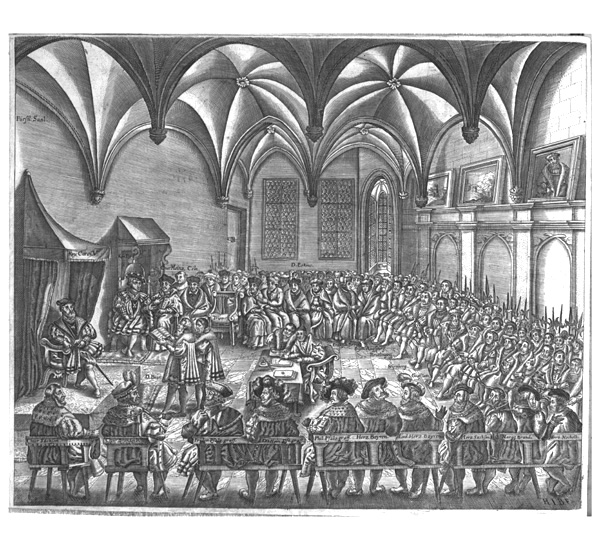
- February 2 – The Diet of Augsburg begins.
- February 4 – John Rogers is burned at the stake at Smithfield, London, becoming the first of the 284 Protestant martyrs of the English Reformation to be killed during the five and one-half year reign of Queen Mary I of England.[1] His death is followed within the week by that of Laurence Saunders on February 8 in Coventry, and Rowland Taylor, Rector of Hadleigh, Suffolk, and John Hooper, deposed Bishop of Gloucester on February 9.
- February 26 – The Muscovy Company is chartered in England to trade with the Tsardom of Russia[2][3] and Richard Chancellor negotiates with the Tsar.
- March 25 – Valencia, Venezuela, is founded by Captain Alonso Díaz Moreno.
April–June
[edit]- April 9 – Marcello Cervini degli Spannocchi is unanimously chosen as the successor to Pope Julius III, who died on March 23, and takes the name of Pope Marcellus II as the 222nd Pontiff of the Roman Catholic Church. He will reign for 22 days.[4]
- April 17 – After 18 months of siege, the Republic of Siena surrenders to the Florentine–Imperial army.
- May 1 – Foundation of St John's College, Oxford, England, to teach Catholic theology.
- May 30 – Foundation of Trinity College, Oxford, England, to teach Catholic theology.
- May 15 – The conclave opens with 42 of the 56 Roman Catholic cardinals to choose a successor to Pope Marcellus II, who had died on May 1.[5]
- May 23 – Giovanni Pietro Carafa, Cardinal of Naples, is elected as the new Pope after Giacomo del Pozzo fails to obtain the necessary two-thirds approval.[6] Carafa, the 223rd Pope, takes the name Pope Paul IV.[7]
- May 25 – Jeanne d'Albret becomes the Queen of Navarre upon the death of her father, King Henry II.[8]
- June 1 – The Treaty of Amasya between the Ottoman Empire and Safavid Persia concludes the Ottoman-Safavid War.
- June 22 – Adil Shah Suri becomes the Sultan of the Sur Empire at Delhi in India after Sikandar Shah Suri is forced to flee from the Mughal Empire forces.
July–September
[edit]- July 12 – Pope Paul IV creates the Roman Ghetto, the first Jewish ghetto in Rome.
- August 24 – England's Thomas Thirlby, the first and only Roman Catholic Archbishop of Norwich and Queen Mary's envoy to Pope Paul IV, returns to London from bearing a papal bull that confirms Queen Mary's jurisdiction over Ireland.[9]
- September 25 – The Peace of Augsburg is signed between Charles V, Holy Roman Emperor, and the Lutheran Schmalkaldic League, establishing the principle Cuius regio, eius religio, that is, rulers within the Empire can choose the religion of their realm.
- September – The 1555 Kashmir earthquake causes widespread destruction and death in Kashmir, India.[10]
October–December
[edit]- October 16
- (1st day of 10th month Tenbun 24) – At the Battle of Miyajima Island, Mori Motonari defeats Sue Harukata.[11]
- The first two Protestant Oxford Martyrs, Hugh Latimer and Nicholas Ridley, are burned at the stake in England.
- October 25 – Charles V abdicates as Holy Roman Emperor and is succeeded by his brother Ferdinand.
- November 1 – French Navy Vice-Admiral Nicolas Durand de Villegaignon leads a small fleet of two ships and 200 soldiers and colonists to take possession of Serigipe Island, near modern-day Rio de Janeiro in Brazil at Guanabara Bay, and builds Fort Coligny.[12]
- November 13 – Thomas Cranmer is officially removed from office as the Protestant Archbishop of Canterbury by order of Pope Paul IV and Queen Mary I.[13]
- December 11 – Cardinal Reginald Pole is made a cardinal-priest in the Roman Catholic Church and made the administrator of the See of Canterbury in England,[14] though he will not become the new Archbishop of Canterbury until the following March 20.
Date unknown
[edit]- Russia breaks a 60-year-old truce with Sweden by attacking Finland.
- Humayun resumes rule of the Mughal Empire.
- The Adal Sultanate in the Horn of Africa collapses.
- English captain John Lok returns from Guinea, with five Africans to train as interpreters for future trading voyages.
- Richard Eden publishes The Decades of the Newe Worlde or West India, a translation into English of parts of Pietro Martire d'Anghiera's De orbe novo decades, the Gonzalo Fernández de Oviedo y Valdés work Natural hystoria de las Indias and others, urging his countrymen to follow the lead of Spain in exploring the New World;[15] the work includes the first recorded use in English of the country name 'China'.
- Establishment in England of the following grammar schools: Boston Grammar School, Gresham's School at Holt, Norfolk (founded by Sir John Gresham) and Ripon Grammar School (re-foundation).
- William Annyas becomes the Mayor of Youghal, Ireland, the first Jew to hold such a position in Ireland.[16]
- John Dee is charged, but cleared, of treason in England.
- Orlande de Lassus' first book of madrigals is published, in Antwerp.
Births
[edit]
- January 26 – Charles II, Lord of Monaco (d. 1589)
- February 25 – Alonso Lobo, Spanish musician (d. 1617)
- March 18 – François, Duke of Anjou, youngest son of Henry II of France and Catherine de' Medici (d. 1584)[17]
- March 21 – John Leveson, English politician (d. 1615)
- March 31 – Elizabeth Stuart, Countess of Lennox, English countess (d. 1582)
- April 21 – Ludovico Carracci, Italian painter (d. 1619)
- April 28 – Karl Friedrich of Jülich-Cleves-Berg, heir apparent of Jülich-Cleves-Berg (d. 1575)
- May 5 – Queen Uiin, Korean royal consort (d. 1600)
- May 9 – Jerónima de la Asunción, founder of the first Catholic monastery in Manila, the Monastery of Santa Clara (d. 1630)
- May 29 – George Carew, 1st Earl of Totnes, English earl, general and administrator (d. 1629)
- June 11 – Lodovico Zacconi, Italian composer and music theorist (d. 1627)
- June 13 – Giovanni Antonio Magini, Italian mathematician, cartographer and astronomer (d. 1617)
- June 16 – Duke Otto Henry of Brunswick-Harburg, Hereditary Prince of Brunswick-Lüneburg-Harburg (d. 1591)
- July – Henry Garnet, English Jesuit (d. 1606)
- July 6 – Louis II, Cardinal of Guise, French Catholic cardinal (d. 1588)
- July 17 – Richard Carew, English scholar (d. 1620)
- August 1 – Edward Kelley, English spirit medium (d. 1597)
- September 3 – Jan Zbigniew Ossoliński, Polish nobleman (d. 1628)
- September 21 – John Thynne, English landowner and politician (d. 1604)
- September 23 – Louise de Coligny, princess consort of Orange (d. 1620)
- September 28 – Henri de La Tour d'Auvergne, vicomte de Turenne, duc de Bouillon, Marshal of France (d. 1623)
- October 6 – Ferenc Nádasdy, Hungarian noble (d. 1604)
- October 12 – Peregrine Bertie, 13th Baron Willoughby de Eresby, English baron (d. 1601)
- November 8 – Nyaungyan Min, king of Burma (d. 1605)
- December 4 – Heinrich Meibom, German historian and poet (d. 1625)
- December 27 – Johann Arndt, German Lutheran theologian (d. 1621)
- date unknown
- Lancelot Andrewes, English clergyman and scholar (d. 1626)
- Adam Sędziwój Czarnkowski, Polish nobleman (d. 1628)
- Samuel Eidels, Polish Jewish rabbi and Talmudist (d. 1631)
- Joshua Falk, Polish Jewish rabbi and commentator (d. 1614)
- Elijah Loans, German Jewish rabbi and kabbalist (d. 1636)
- François de Malherbe, French poet (d. 1628)
- Okudaira Sadamasa, Japanese nobleman (d. 1615)
- Konishi Yukinaga, Japanese Christian daimyō (d. 1600)
- Moderata Fonte, Italian poet, writer and philosopher (d. 1592)
- Maria van Schooten, Dutch war heroine (d. 1573)
- Naresuan, King of Ayutthaya (d. 1605)
Deaths
[edit]


- January 14 – Jacques Dubois, French anatomist (b. 1478)
- February 4 – John Rogers, English clergyman (burned at the stake) (b. c. 1505)
- February 8 – Laurence Saunders, English clergyman (burned at the stake) (b. 1519)
- February 9
- Christian Egenolff, German printer (b. 1502)
- John Hooper, English churchman (burned at the stake) (b. c. 1497)
- Rowland Taylor, English Protestant martyr (burned at the stake) (b. 1510)
- February 17 – Giuliano Bugiardini, Italian painter (b. 1475)
- March 14 – John Russell, 1st Earl of Bedford (b. 1485)
- March 23 – Pope Julius III (b. 1487)[18]
- March 27 – Al-Mutawakkil Yahya Sharaf ad-Din, Imam of the Zaidi state in Yemen (b. 1473)
- April 12 – Queen Joanna of Castile, long under confinement (b. 1479)
- April 18 – Polydore Vergil, English historian (b. 1470)[19]
- May 1 – Pope Marcellus II (b. 1501)
- May 21 – George III, Landgrave of Leuchtenberg (b. 1502)
- May 25
- Gemma Frisius, Dutch mathematician and cartographer (b. 1508)
- Henry II of Navarre (b. 1503)[8]
- June 10 – Elizabeth of Denmark, Electress of Brandenburg (1502–1535) (b. 1485)
- September 8 – Thomas of Villanova, Spanish Roman Catholic bishop and saint (b. 1488)
- October 5 – Edward Wotton, English zoologist (b. 1492)
- October 9 – Justus Jonas, German Protestant reformer (b. 1493)
- October 16
- Hugh Latimer, English clergyman (burned at the stake) (b. c. 1487)
- Nicholas Ridley, English clergyman (burned at the stake)
- Sue Harukata, Japanese retainer under the Ouchi clan (b. 1521)
- October 26 – Olympia Fulvia Morata, Italian classical scholar (b. 1526)
- November 4 – Agnes of Hesse, German nobleman, by marriage, Princess of Saxony (b. 1527)
- November 12
- Stephen Gardiner, English bishop and Lord Chancellor (b. 1493)
- Yang Jisheng, Ming Chinese statesman (beheaded) (b. 1516)
- Zhang Jing, Ming Chinese general (beheaded)
- November 21 – Georgius Agricola, German scientist (b. 1490)
- December – Stanisław Kostka, Polish noble (b. 1487)
- December 9 – Elisabeth of Culemborg, German noble (b. 1475)
References
[edit]- ^ Palmer, Alan; Palmer, Veronica (1992). The Chronology of British History. London: Century Ltd. pp. 150–153. ISBN 0-7126-5616-2.
- ^ Williams, Hywel (2005). Cassell's Chronology of World History. London: Weidenfeld & Nicolson. ISBN 0-304-35730-8.
- ^ Goldsmid, E. (ed.) (1886). The Principal Navigations, Voyages, Traffiques and Discoveries of the English Nation, collected by Richard Hakluyt, Preacher, Vol. III: North-Eastern Europe and Adjacent Countries, Part II: The Muscovy Company and the North-Eastern Passage. Edinburgh: E. & G. Goldsmid. pp. 101-112.
- ^ Maureen E. Buja (1996). Antonio Barré and Music Printing in Mid-sixteenth Century Rome. University of North Carolina at Chapel Hill. p. 81.
- ^ Chacón, col. 810-811; Panvinio, s. 427-428; por. Setton, s. 617.
- ^ Pastor, Ludwig von. History of the Popes. T. 14. London: Routledge & Kegan Paul, 1924
- ^ Paul Johnson (1997). The Papacy. Barnes & Noble Books. p. 216. ISBN 978-0-7607-0755-5.
- ^ a b Ronald Love (March 14, 2001). Blood and Religion: The Conscience of Henri IV. McGill-Queen's Press - MQUP. pp. 25–. ISBN 978-0-7735-6884-6.
- ^
 This article incorporates text from a publication now in the public domain: Cooper, Thompson (1898). "Thirlby, Thomas". In Lee, Sidney (ed.). Dictionary of National Biography. Vol. 56. London: Smith, Elder & Co. p. 137.
- ^ "Significant Earthquake Information India: Kashmir: Srinagar". ngdc.noaa.gov. NCEI. Retrieved August 7, 2021.
- ^ Stephen R. Turnbull, The Samurai: A Military History, (New York: Macmillan Publishing, 1977) pp. 131–134
- ^ Parkman, Francis (1983). France and England in North America Vol 1. New York, New York: Library of America. pp. 33–41.
- ^ "Marian Government Policies". Retrieved July 5, 2007.
- ^ Lee, Frederick George (December 6, 1888). "Reginald Pole, Cardinal Archbishop of Canterbury : an historical sketch, with an introductory prologue and practical epilogue". London : J. C. Nimmo – via Internet Archive.
- ^ Hadfield, Andrew (2004). "Eden, Richard (c.1520–1576)". Oxford Dictionary of National Biography (online ed.). Oxford University Press. doi:10.1093/ref:odnb/8454. Retrieved December 12, 2011. (Subscription, Wikipedia Library access or UK public library membership required.)
- ^ Ireland. Dept. of Foreign Affairs (1987). Ireland today. Information Section, Dept. of Foreign Affairs. Retrieved June 9, 2012.
- ^ Mack P. Holt (May 2, 2002). The Duke of Anjou and the Politique Struggle During the Wars of Religion. Cambridge University Press. p. 7. ISBN 978-0-521-89278-0.
- ^ "Julius III | pope". Encyclopedia Britannica. Retrieved May 3, 2019.
- ^ Catherine Atkinson (2007). Inventing Inventors in Renaissance Europe: Polydore Vergil's De Inventoribus Rerum. Mohr Siebeck. p. 86. ISBN 978-3-16-149187-0.

from Grokipedia
Historical Context
European Religious and Political Tensions
By 1555, the Protestant Reformation had deepened schisms across Europe, pitting adherents of Lutheran and emerging Calvinist doctrines against Catholic orthodoxy, while intertwining religious zeal with princely ambitions and imperial authority. In the Holy Roman Empire, Charles V's repeated military campaigns to enforce Catholic uniformity, including victory in the Schmalkaldic War of 1546–1547, failed to quell Protestant resistance, as princes rejected the Augsburg Interim of 1548 and revolted in 1552, prolonging instability until the Peace of Augsburg on September 25, 1555.[7][2] This treaty legalized Lutheranism alongside Catholicism, enshrining cuius regio, eius religio—the right of each territorial ruler to select his realm's faith—while mandating the return of church lands secularized before 1552 and excluding Calvinists and Anabaptists, thus institutionalizing confessional division but averting immediate civil war.[8] In England, Queen Mary I's accession in 1553 prompted rigorous suppression of Protestantism to realign with Rome, culminating in the reinstatement of 14th-century heresy laws and the burning of approximately 280–300 individuals between 1555 and 1558.[9][10] The executions commenced on February 4, 1555, with the martyrdom of John Rogers, a former Catholic priest turned Protestant chaplain, followed by bishops like John Hooper on February 9 and others, as authorities targeted clergy and laity refusing recantation amid fears of doctrinal contamination.[11] These acts, viewed by Catholic proponents as necessary to purge heresy, instead galvanized Protestant identity and propaganda, heightening tensions that persisted beyond Mary's death in 1558.[12] France experienced accelerating Protestant growth, with Calvinist congregations forming rapidly after 1555, especially among southern nobility, Normandy, and urban centers like Paris, where the first organized Reformed church emerged that year.[13][14] By mid-decade, estimates suggest thousands of adherents, fueled by John Calvin's Geneva-based influence and vernacular Bible translations, clashing with royal edicts against heresy under Henry II, whose death in 1559 left a fragile regency vulnerable to confessional strife.[13] Politically, these divisions overlaid Habsburg-Valois hostilities, as France covertly supported German Protestants against Charles V to weaken imperial power, blending ideological warfare with traditional rivalries.[14] Elsewhere, the Low Countries saw clandestine Anabaptist and Lutheran networks under Habsburg suppression, while Scandinavian kingdoms solidified Lutheran state churches, reflecting how religious fractures eroded universal Catholic sovereignty and empowered secular rulers to leverage faith for autonomy.[15] These dynamics underscored causal links between doctrinal disputes—over justification, sacraments, and ecclesiastical authority—and political fragmentation, setting precedents for confessional alliances and future conflagrations like the French Wars of Religion commencing in 1562.Developments in Asia and the Ottoman World
The Peace of Amasya, signed on 29 May 1555 between Sultan Suleiman I of the Ottoman Empire and Shah Tahmasp I of Safavid Iran, concluded the Ottoman–Safavid War (1532–1555) and marked the first formal treaty between the two powers.[16] [17] Under its terms, the Ottomans secured control over Iraq and eastern Anatolia, including Baghdad, while recognizing Safavid sovereignty over Azerbaijan, eastern Georgia, and parts of the Caucasus; this division stabilized the border for approximately two decades, allowing the Ottomans to redirect resources westward amid ongoing European conflicts.[16] The treaty reflected mutual exhaustion from prolonged campaigns, with Ottoman forces having advanced deep into Persian territory but facing logistical strains and Safavid guerrilla resistance.[17] In South Asia, the Mughal Empire under Humayun achieved a critical victory at the Battle of Sirhind on 22 June 1555, where Mughal forces led by Humayun and Bairam Khan defeated an army of approximately 90,000 under Sikandar Suri of the Sur Empire, reestablishing Mughal dominance in the Punjab and facilitating Humayun's return to Delhi after 15 years of exile in Persia.[18] This engagement, fought amid monsoon rains, exploited Sur internal divisions and Mughal tactical boldness, enabling Humayun to reclaim northern India until his accidental death in early 1556; it underscored the fragility of Afghan successor states following Sher Shah Suri's earlier conquests and set the stage for Akbar's consolidation.[18] In East Asia, the Ming dynasty grappled with intensified wokou (Japanese pirate) raids, which peaked in 1555, devastating coastal regions including Nanjing along the Yangtze River, where raiders pillaged for weeks and highlighted vulnerabilities in Ming naval defenses despite prohibitions on private maritime trade.[19] These incursions, involving Japanese ronin and Chinese collaborators, prompted defensive reforms but exposed systemic issues in Ming border security and economic policies restricting seafaring.[19] Concurrently, in Japan during the Sengoku period, the Battle of Miyajima in October 1555 saw Mōri Motonari decisively defeat Sue Harukata, leveraging tidal timing and shrine sanctity to eliminate a rival and expand control over western Honshu; this victory, alongside ongoing Takeda–Uesugi clashes at Kawanakajima, exemplified the era's daimyo warfare driven by feudal fragmentation.[20] Elsewhere, the fall of the Kingdom of Ava in Upper Burma on 22 January 1555 to Shan and Mon forces fragmented Taungoo influence temporarily, contributing to regional power shifts in Southeast Asia amid Burmese expansionism.[6] In parallel, Portuguese traders formalized settlement in Macau around 1555, securing a foothold for European commerce in China under Ming tribute protocols, though initial permissions were tied to silk-for-silver exchanges rather than outright colonization.[21]Key Events
January–March
On February 2, the Imperial Diet assembled in Augsburg under the auspices of Holy Roman Emperor Charles V to negotiate an end to religious strife between Catholic and Lutheran princes following the Schmalkaldic War.[22] The proceedings aimed to stabilize the empire's confessional landscape amid ongoing Protestant expansion, though consensus proved elusive until later in the year.[22] In England, Queen Mary I's campaign to restore Catholicism commenced with the execution of John Rogers, a clergyman and translator involved in the Matthew Bible, who was burned at the stake in Smithfield on February 4 as the inaugural Protestant martyr of her reign.[23] Rogers, aged approximately 55, had served as a chaplain under Edward VI and refused to recant his evangelical beliefs despite offers of clemency, including permission to view his wife and ten children one last time before his death.[24] His martyrdom, conducted publicly to deter heresy, marked the onset of approximately 287 burnings over the next three years, targeting reformers who rejected transubstantiation and papal authority.[24] On March 23, Pope Julius III died in Rome at age 67 after a five-year pontificate marked by efforts to convene the Council of Trent and mediate European conflicts, though his tenure faced criticism for nepotism and limited doctrinal progress.[25] His passing, attributed to natural causes without specified illness, prompted an immediate conclave among cardinals to select a successor amid tensions between pro-imperial and French factions.[26] Julius's death underscored the fragility of papal stability during the Reformation era, as the Church grappled with Protestant gains and internal reform demands.[25] These events reflected broader European religious polarization: the Augsburg Diet sought imperial compromise, while England's executions enforced Catholic uniformity, and the papal vacancy highlighted Rome's institutional challenges.[22][23][25]April–June
On April 9, 1555, a papal conclave convened since April 5 following the death of Pope Julius III elected Marcello Cervini as Pope Marcellus II, marking a brief pontificate noted for its reformist intentions amid the ongoing Counter-Reformation.[27] Cervini, aged 53, had previously served as a cardinal and co-president at the Council of Trent, advocating for doctrinal clarity and ecclesiastical discipline.[28] His reign lasted only 21 days, ending with his death on May 1, 1555, attributed to exhaustion and health issues shortly after issuing decrees to curb nepotism and resume Trent's sessions.[27] A second conclave began on May 15 and concluded on May 23 with the election of Gian Pietro Carafa as Pope Paul IV, a staunch advocate of inquisitorial measures against heresy.[27] Carafa, founder of the Theatine Order, prioritized aggressive Counter-Reformation policies, including the establishment of the Roman Inquisition's central tribunal and restrictions on Jewish residence in Rome via the bull Cum nimis absurdum.[29] His papacy intensified conflicts with secular powers, particularly Spain, leading to alliances with France and renewed hostilities.[30] In Italy, the Republic of Siena capitulated to Spanish-Imperial forces on April 17, 1555, after an 18-month siege initiated in 1554 as part of the Italian War of Siena.[31] The city's defenders, aided by French troops under Blaise de Monluc, faced starvation and defeat following the earlier Battle of Marciano in August 1554, which broke Sienese resistance.[32] Surrender terms allowed evacuation of French and rebel forces, but the territory was ceded to Cosimo I de' Medici in 1557 by Philip II, effectively ending Siena's independence and integrating it into the Grand Duchy of Tuscany.[32] In the Indian subcontinent, the Battle of Sirhind on June 22, 1555, saw Mughal forces under Humayun and Bairam Khan decisively defeat the army of Sikandar Shah Suri, restoring Mughal authority over Punjab and northern India.[33] Humayun, exiled since 1540 after losses to Sher Shah Suri, had returned with Persian support and exploited Sur Empire infighting following Islam Shah Suri's death in 1554.[34] The victory, involving a surprise raid in rainy conditions, enabled Humayun's reentry into Delhi by July, though he died the following year, solidifying Akbar's eventual succession.[35]July–September
On July 2, Ottoman admiral Turgut Reis (also known as Dragut) landed forces near Capo Vaticano in Calabria and marched to sack the town of Paola in southern Italy, capturing goods and prisoners as part of ongoing corsair raids against Habsburg territories.[36] This incursion highlighted the persistent naval threat posed by Ottoman forces in the Mediterranean during the mid-16th century.[36] On July 14, Pope Paul IV issued the papal bull Cum nimis absurdum, mandating the confinement of Rome's Jewish population to a designated walled district along the Tiber River, establishing the first ghetto in Europe and revoking prior freedoms of residence and occupation for Jews in the Papal States.[37] The measure required Jews to live in overcrowded, unhealthy conditions, wear identifying badges, and engage only in specified trades like moneylending, reflecting intensified Catholic efforts to segregate and control Jewish communities amid Counter-Reformation zeal.[37] In August, religious persecutions continued in England under Queen Mary I, with Protestant minister Robert Samuel burned at the stake in Ipswich on August 31 for heresy, one of several executions aimed at restoring Catholicism and suppressing Reformation influences.[38] These martyrdoms, documented in contemporary accounts, fueled Protestant resistance and propaganda against the Marian regime.[38] Philip II of Spain, consort to Mary I, departed England around late August, sailing from Dover after nearly a year of strained relations marked by limited political influence and England's inconclusive war efforts against France, underscoring the challenges of the Anglo-Spanish alliance.[39] The quarter culminated on September 25 with the signing of the Peace of Augsburg at the Imperial Diet in Augsburg, where Holy Roman Emperor Charles V's representatives, led by Ferdinand I, agreed with Lutheran princes to the principle of cuius regio, eius religio, permitting territorial rulers to select either Catholicism or Lutheranism as the official religion and granting secularized church lands to Protestants, though excluding Calvinists and Anabaptists.[1] This settlement, following years of conflict including the Schmalkaldic War, provided a temporary framework for religious coexistence in the Empire by prioritizing princely authority over imperial uniformity, but its ambiguities later contributed to renewed tensions leading to the Thirty Years' War.[1][2]October–December
On October 16, the English Protestant reformers Nicholas Ridley, former Bishop of London, and Hugh Latimer, former Bishop of Worcester, were burned at the stake in Oxford for heresy convictions during Queen Mary I's campaign to restore Roman Catholicism. Ridley endured prolonged agony due to inefficient burning, while Latimer encouraged him with words emphasizing steadfast faith; their executions exemplified the intensified persecution of Protestants following Mary's 1553 accession, with over 280 recorded martyrdoms by 1558.[40][41] On October 25, Holy Roman Emperor Charles V publicly abdicated his sovereignty over the Low Countries—encompassing the Netherlands and Duchy of Burgundy—in a formal ceremony at the Coudenberg Palace in Brussels, transferring authority to his son, Philip II of Spain. This act, attended by the Orders of the Netherlands, marked a pivotal step in Charles's phased retirement amid health decline and the burdens of ruling a vast, fragmented empire; it preserved Habsburg influence in the region but sowed seeds of future tensions under Spanish governance.[42][43] In November, Stephen Gardiner, Bishop of Winchester and Mary I's Lord Chancellor, died on November 12 at approximately age 72, having played a key role in enforcing Catholic orthodoxy and parliamentary acts reversing the Edwardian Reformation. His passing shifted influence toward more hardline advisors amid ongoing religious strife. On November 17, William, Prince of Orange (later William the Silent), was appointed to the Council of State of the Netherlands, positioning the young noble—then 22—for future leadership in resistance against Habsburg policies. Later that month, on November 25, Henry II of Navarre died in Hendaia, leaving his kingdom divided between Catholic France and Protestant factions, exacerbating regional instability.[44][45][46] On November 1, French Calvinist settlers under Nicolas Durand de Villegaignon established the short-lived France Antarctique colony near present-day Rio de Janeiro, Brazil, as an early Protestant foothold in the New World amid Huguenot aspirations for refuge from persecution.[47] In December, on the 4th, Pope Paul IV issued a papal bull formally degrading Thomas Cranmer, Archbishop of Canterbury, from his office for schism and heresy, paving the way for his 1556 execution and underscoring Rome's rejection of the English Reformation's ecclesiastical hierarchy.[48]Date Unknown
The Tsardom of Russia and the Kingdom of Sweden engaged in escalating border conflicts that developed into the Russo-Swedish War (1554–1557, with significant Russian incursions into Swedish-controlled Finnish territories occurring during 1555. These actions violated a truce dating back to 1495 and stemmed from territorial ambitions and personal rivalries between Tsar Ivan IV and King Gustav I Vasa, serving as a prelude to the larger Livonian War. Russian forces, numbering up to 20,000 in organized assaults, overwhelmed initial Swedish defenses in Finland, though the conflict ended inconclusively with the Treaty of Novgorod in 1557.[49]) In the Horn of Africa, Nur ibn Mujahid, Emir of Harar and effective leader of the Adal Sultanate's remnants, conducted military campaigns against the Ethiopian Empire in eastern regions during 1554–1555. These raids continued the intermittent warfare following the main Ethiopian–Adal War (1529–1543), aiming to expand Muslim influence and counter Ethiopian Christian forces under Emperor Galawdewos. Nur's efforts included fortifying Harar and launching punitive expeditions, though they did not achieve decisive gains and foreshadowed further clashes, including his 1559 invasion. These undated developments highlighted broader geopolitical tensions: Russian expansionism clashing with Swedish Baltic interests, and persistent religious-military strife in the Horn of Africa amid the Adal Sultanate's decline after Ahmad ibn Ibrahim al-Ghazi's campaigns. Both reflected the era's pattern of opportunistic warfare amid weakening central authorities and shifting alliances.[49]Significance and Impacts
Religious and Doctrinal Consequences
The Peace of Augsburg, signed on September 25, 1555, formalized the doctrinal schism between Catholicism and Lutheranism in the Holy Roman Empire by endorsing the principle of cuius regio, eius religio, which granted territorial rulers the authority to impose either Catholic orthodoxy or Lutheran teachings as defined by the 1530 Augsburg Confession.[1] This limited toleration to Lutheran doctrines emphasizing sola fide (justification by faith alone), sola scriptura (Scripture as the sole infallible authority), the priesthood of all believers, and rejection of papal supremacy, indulgences, and the full sacramental system of Catholicism, while excluding Calvinist predestination, Anabaptist rejection of infant baptism, and other variants.[50][8] Doctrinally, it institutionalized irreconcilable differences—such as Lutherans' consubstantiation versus Catholic transubstantiation in the Eucharist and denial of purgatory—without theological resolution, instead managing them through political sovereignty and enforced confessional uniformity within states, where minorities faced conversion, exile, or suppression.[1] In England, the Marian regime's execution of John Rogers on February 4, 1555, marked the onset of doctrinal reimposition of Catholicism, targeting Protestant adherence to Reformed views on the denial of transubstantiation, rejection of the Mass as a propitiatory sacrifice, and opposition to papal jurisdiction, as Rogers had propagated these through his Bible translation and preaching. This event, the first of approximately 290 burnings, aimed to eradicate evangelical doctrines introduced under Edward VI, reinforcing Catholic tenets on seven sacraments, invocation of saints, and ecclesiastical hierarchy, though it ultimately galvanized Protestant resistance and doctrinal identity.[24] The election of Pope Paul IV on May 23, 1555, following the brief tenures of Julius III and Marcellus II, amplified doctrinal enforcement through expansion of the Roman Inquisition's scope to encompass not only heresy but also moral lapses, intensifying scrutiny of deviations from Tridentine Catholic positions on grace, free will, and sacramental efficacy amid the ongoing Council of Trent's recess.[51] Paul IV's policies, including rigorous application of inquisitorial procedures, prioritized doctrinal purity over ecumenical dialogue, targeting Protestant influences and internal abuses to preserve Catholic orthodoxy against Reformation encroachments.[51] Overall, 1555's events entrenched a confessional landscape where doctrinal pluralism was territorially bounded rather than universally tolerant, perpetuating theological polarization: Lutheran states codified rejection of Catholic "works righteousness," while Catholic realms doubled down on tradition and hierarchy, laying groundwork for intensified confessionalization and future doctrinal clashes unresolved until later treaties like Westphalia.[1][8]Geopolitical Realignments
The Peace of Augsburg, concluded on September 25, 1555, between Holy Roman Emperor Charles V and the Schmalkaldic League of Lutheran princes, established the principle of cuius regio, eius religio, permitting rulers of imperial territories to select either Catholicism or Lutheranism as the official religion for their domains.[1] This agreement legalized Protestant territorial control, fragmenting the Empire's religious unity and granting princes greater autonomy in ecclesiastical matters, including the secularization of church lands.[8] By excluding Calvinism and Anabaptists, it temporarily stabilized Lutheran-Catholic relations but entrenched confessional divisions that reshaped alliances, with Protestant states aligning against perceived Catholic imperialism.[1] Emperor Charles V's abdication ceremony on October 25, 1555, in Brussels, transferred the Burgundian Circle—encompassing the Low Countries—to his son Philip II, marking the initial phase of partitioning the vast Habsburg inheritance.[52] This move, driven by Charles's exhaustion from prolonged wars, religious strife, and health decline, separated Spanish Habsburg interests in the Iberian Peninsula, Italy, and overseas colonies from the Austrian branch under Ferdinand I, who assumed the imperial title in 1556.[53] The bifurcation weakened the Habsburgs' capacity for coordinated dominance across Europe, allowing France to exploit divisions through diplomacy and subsidies to German princes, while Ottoman threats shifted Austrian focus eastward.[43] These developments collectively diminished centralized imperial authority, promoting a multipolar landscape where religious sovereignty bolstered princely independence and Habsburg fragmentation invited rival interventions.[8] In the Papal States, the election of Paul IV on May 23, 1555, oriented Vatican policy toward France against Habsburg Spain, further complicating Italian geopolitics and contributing to the 1556-1559 war.[54] Such shifts laid groundwork for enduring patterns of confessional realpolitik, evident in subsequent alliances during the French Wars of Religion and the lead-up to the Thirty Years' War.Long-term Historical Debates
Historians debate the Peace of Augsburg's success in establishing enduring religious stability within the Holy Roman Empire, with some viewing it as a pragmatic compromise that secured approximately 63 years of relative peace following the Schmalkaldic War, while others argue its ambiguities and exclusions inevitably precipitated the Thirty Years' War (1618–1648). The treaty's core principle of cuius regio, eius religio permitted territorial rulers to select either Lutheranism or Catholicism as the official faith, binding subjects to conform or emigrate, which reinforced princely authority but failed to accommodate emerging Calvinist movements or resolve disputes over ecclesiastical properties.[8][55] Critiques highlight the treaty's limited scope as a form of tolerance, emphasizing that it prioritized political order over confessional liberty, excluding non-Lutheran Protestants and Swiss Reformed traditions, which fueled subsequent tensions as Calvinism spread after 1555. The ecclesiastical reservation clause, mandating that Catholic bishops and prelates relinquish lands upon converting to Protestantism, sparked ongoing contention, partially mitigated by Ferdinand I's Declaration on September 24, 1555, allowing retention in some cases, though scholars dispute its legal force and long-term observance.[8][56] This provision's inconsistent application underscored the treaty's enforcement weaknesses, contributing to fragmented interpretations that undermined imperial unity.[8] Long-term analyses contend that the Peace accelerated the Empire's decentralization into a loose confederation of autonomous territories, diminishing centralized ecclesiastical influence and laying groundwork for modern state sovereignty, yet at the cost of suppressing religious pluralism within domains. While it legalized Lutheranism and ended immediate threats to the Reformation, its failure to foster broader coexistence—evident in the rise of confessional alliances by the early 1600s—invited external powers into German affairs, escalating conflicts beyond religious lines.[55][8] These debates reflect a consensus that the Augsburg settlement marked a transitional milestone rather than a definitive resolution, balancing short-term pragmatism against enduring doctrinal and jurisdictional fractures.[55]Notable Individuals
Births
- February 25 (baptized): Alonso Lobo (d. 1617), Spanish Renaissance composer known for sacred polyphony, including motets and masses influenced by Victoria and Morales.[57]
- April 21 (baptized): Ludovico Carracci (d. 1619), Italian painter and etcher who co-founded the Bolognese school, emphasizing naturalism and reform against Mannerism, mentoring his cousins Annibale and Agostino.[58]
- August 1: Edward Kelley (d. 1597), English alchemist and occultist who collaborated with John Dee on angelic communications via scrying, claiming transmutation of metals and authoring alchemical treatises.[59]
- September 23: Louise de Coligny (d. 1620), French Huguenot noblewoman, daughter of Admiral Gaspard de Coligny, who married William the Silent in 1583, becoming mother to Frederick Henry and advocating Protestant interests in the Dutch Republic.[60]
- c. 1555: Lancelot Andrewes (d. 1626), English bishop and scholar who served as Dean of Westminster and Bishop of Winchester, contributing to the King James Bible translation and known for learned sermons emphasizing patristic theology.[61]
Deaths
John Rogers, a Protestant reformer, Bible translator, and the first martyr executed under Queen Mary I's reign, was burned at the stake in Smithfield, London, on February 4.[23][4] John Hooper, former Bishop of Gloucester and Worcester, was burned at Gloucester on February 9 for denying transubstantiation and other Catholic doctrines.[62] Pope Julius III died in Rome on March 23 after a pontificate marked by efforts to convene the Council of Trent.[63] Joanna of Castile, known as Joanna the Mad and former Queen of Castile, died on April 12 at Tordesillas, having been confined for nearly fifty years due to mental instability.[64] Pope Marcellus II, who had reigned for only 22 days, died in Rome on May 1, possibly from exhaustion or illness following his election.[65][66] Henry II of Navarre died on May 25 at Hagetmau, leaving his kingdom to his daughter Jeanne d'Albret amid ongoing conflicts with Spain.[67][68] Thomas of Villanova, Archbishop of Valencia renowned for his charity toward the poor, died on September 8 in Valencia from heart disease.[69] Hugh Latimer, former Bishop of Worcester, and Nicholas Ridley, former Bishop of London, were burned at the stake in Oxford on October 16 for their Protestant beliefs, with Latimer famously encouraging Ridley during the execution.[40][70]References
- https://en.wikisource.org/wiki/Dictionary_of_National_Biography%2C_1885-1900/Kelley%2C_Edward