


Community hub
Recent from talks
Contribute something
Nothing was collected or created yet.
Alternation of generations
View on Wikipedia
Alternation of generations (also known as metagenesis or heterogenesis)[1] is the predominant type of life cycle in plants and algae. In plants, both phases are multicellular: the haploid sexual phase – the gametophyte – alternates with a diploid asexual phase – the sporophyte.
A mature sporophyte produces haploid spores by meiosis, a process which reduces the number of chromosomes to half, from two sets to one. The resulting haploid spores germinate and grow into multicellular haploid gametophytes. At maturity, a gametophyte produces gametes by mitosis, the normal process of cell division in eukaryotes, which maintains the original number of chromosomes. Two haploid gametes (originating from different organisms of the same species or from the same organism) fuse to produce a diploid zygote, which divides repeatedly by mitosis, developing into a multicellular diploid sporophyte. This cycle, from gametophyte to sporophyte (or equally from sporophyte to gametophyte), is the way in which all land plants and most algae undergo sexual reproduction.
The relationship between the sporophyte and gametophyte phases varies among different groups of plants. In the majority of algae, the sporophyte and gametophyte are separate independent organisms, which may or may not have a similar appearance. In liverworts, mosses and hornworts, the sporophyte is less well developed than the gametophyte and is largely dependent on it. Although moss and hornwort sporophytes can photosynthesise, they require additional photosynthate from the gametophyte to sustain growth and spore development and depend on it for supply of water, mineral nutrients and nitrogen.[2][3] By contrast to all modern vascular plants, the gametophyte is less well developed than the sporophyte, although their Devonian ancestors had gametophytes and sporophytes of approximately equivalent complexity.[4] In ferns, the gametophyte is a small flattened autotrophic prothallus on which the young sporophyte is briefly dependent for its nutrition. In flowering plants, the reduction of the gametophyte is much more extreme; it consists of just a few cells which grow entirely inside the sporophyte.
Animals develop differently. They directly produce haploid gametes. No haploid spores capable of dividing are produced, so generally there is no multicellular haploid phase. Some insects have a sex-determining system whereby haploid males are produced from unfertilized eggs; however, females produced from fertilized eggs are diploid.
Life cycles of plants and algae with alternating haploid and diploid multicellular stages are referred to as diplohaplontic. The equivalent terms haplodiplontic, diplobiontic and dibiontic are also in use, as is describing such an organism as having a diphasic ontogeny.[5] Life cycles of animals, in which there is only a diploid multicellular stage, are referred to as diplontic. Life cycles in which there is only a haploid multicellular stage are referred to as haplontic.
Definition
[edit]Alternation of generations is defined as the alternation of multicellular diploid and haploid forms in the organism's life cycle, regardless of whether these forms are free-living.[6] In some species, such as the alga Ulva lactuca, the diploid and haploid forms are indeed both free-living independent organisms, essentially identical in appearance and therefore said to be isomorphic. In many algae, the free-swimming, haploid gametes form a diploid zygote which germinates into a multicellular diploid sporophyte. The sporophyte produces free-swimming haploid spores by meiosis that germinate into haploid gametophytes.[7]
However, in land plants, either the sporophyte or the gametophyte is very much reduced and is incapable of free living. For example, in all bryophytes the gametophyte generation is dominant and the sporophyte is dependent on it. By contrast, in all seed plants the gametophytes are strongly reduced, although the fossil evidence indicates that they were derived from isomorphic ancestors.[4] In seed plants, the female gametophyte develops totally within the sporophyte, which protects and nurtures it and the embryonic sporophyte that it produces. The pollen grains, which are the male gametophytes, are reduced to only a few cells (just three cells in many cases). Here the notion of two generations is less obvious; as Bateman & Dimichele say "sporophyte and gametophyte effectively function as a single organism".[8] The alternative term 'alternation of phases' may then be more appropriate.[9]
History
[edit]In animals
[edit]Initially, Adelbert von Chamisso (studying salps, colonial marine animals between 1815 and 1818[10]) and Japetus Steenstrup (studying the development of trematodes in 1842, and also tunicates and cnidarians) described the succession of differently organized generations (sexual and asexual) in animals as "alternation of generations".[11] Later, the phenomenon in animals became known as heterogamy, while the term "alternation of generations" was restricted to the life cycles of plants, meaning specifically the alternation of haploid gametophytes and diploid sporophytes.[11]
In plants
[edit]In 1851, Wilhelm Hofmeister demonstrated the morphological alternation of generations in plants,[12] between a spore-bearing generation (sporophyte) and a gamete-bearing generation (gametophyte).[13][14] By that time, a debate emerged focusing on the origin of the asexual generation of land plants (i.e., the sporophyte) and is conventionally characterized as a conflict between theories of antithetic (Ladislav Josef Čelakovský, 1874) and homologous (Nathanael Pringsheim, 1876) alternation of generations.[11]
In 1874, Eduard Strasburger discovered the alternation between diploid and haploid nuclear phases,[11] also called cytological alternation of nuclear phases.[15] Although most often coinciding, morphological alternation and nuclear phases alternation are sometimes independent of one another, e.g., in many red algae, the same nuclear phase may correspond to two diverse morphological generations.[15] In some ferns which lost sexual reproduction, there is no change in nuclear phase, but the alternation of generations is maintained.[16]
Alternation of generations in plants
[edit]Fundamental elements
[edit]The diagram above shows the fundamental elements of the alternation of generations in plants. There are many variations in different groups of plants. The processes involved are as follows:[17]
- Two single-celled haploid gametes, each containing n unpaired chromosomes, fuse to form a single-celled diploid zygote, which now contains 2n (paired) chromosomes.[17]
- The single-celled diploid zygote germinates, dividing by the normal process (mitosis), which maintains the number of chromosomes at 2n. The result is a multi-cellular diploid organism called the sporophyte (because, at maturity, it produces spores).[17]
- When it reaches maturity, the sporophyte produces one or more sporangia (singular: sporangium) which are the organs that produce diploid spore mother cells (sporocytes). These divide by a special process (meiosis) that reduces the number of chromosomes by a half. This initially results in four single-celled haploid spores, each containing n unpaired chromosomes.[17]
- The single-celled haploid spore germinates, dividing by the normal process (mitosis), which maintains the number of chromosomes at n. The result is a multi-cellular haploid organism, called the gametophyte (because it produces gametes at maturity).[17]
- When it reaches maturity, the gametophyte produces one or more gametangia (singular: gametangium) which are the organs that produce haploid gametes. At least one kind of gamete possesses some mechanism for reaching another gamete in order to fuse with it.[17]
The 'alternation of generations' in the life cycle is thus between a diploid (2n) generation of multicellular sporophytes and a haploid (n) generation of multicellular gametophytes.[17]

The situation is quite different from that in animals, where the fundamental process is that a multicellular diploid (2n) individual directly produces haploid (n) gametes by meiosis. In animals, spores (i.e. haploid cells which are able to undergo mitosis) are not produced, so there is no asexual multicellular generation. Some insects have haploid males that develop from unfertilized eggs, but the females are all diploid.[17]
Variations
[edit]The diagram shown above is a good representation of the life cycle of some multi-cellular algae (e.g. the genus Cladophora) which have sporophytes and gametophytes of almost identical appearance and which do not have different kinds of spores or gametes.[18]
However, there are many possible variations on the fundamental elements of a life cycle which has alternation of generations. Each variation may occur separately or in combination, resulting in a bewildering variety of life cycles. The terms used by botanists in describing these life cycles can be equally bewildering. As Bateman and Dimichele say "[...] the alternation of generations has become a terminological morass; often, one term represents several concepts or one concept is represented by several terms."[19]
Possible variations are:
- Relative importance of the sporophyte and the gametophyte.
- Equal (homomorphy or isomorphy).
Filamentous algae of the genus Cladophora, which are predominantly found in fresh water, have diploid sporophytes and haploid gametophytes which are externally indistinguishable.[20] No living land plant has equally dominant sporophytes and gametophytes, although some theories of the evolution of alternation of generations suggest that ancestral land plants did. - Unequal (heteromorphy or anisomorphy).
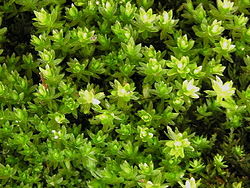
Gametophyte of Mnium hornum, a moss - Dominant gametophyte (gametophytic).
In liverworts, mosses and hornworts, the dominant form is the haploid gametophyte. The diploid sporophyte is not capable of an independent existence, gaining most of its nutrition from the parent gametophyte, and having no chlorophyll when mature.[21]
Sporophyte of Lomaria discolor, a fern - Dominant sporophyte (sporophytic).
In ferns, both the sporophyte and the gametophyte are capable of living independently, but the dominant form is the diploid sporophyte. The haploid gametophyte is much smaller and simpler in structure. In seed plants, the gametophyte is even more reduced (at the minimum to only three cells), gaining all its nutrition from the sporophyte. The extreme reduction in the size of the gametophyte and its retention within the sporophyte means that when applied to seed plants the term 'alternation of generations' is somewhat misleading: "[s]porophyte and gametophyte effectively function as a single organism".[8] Some authors have preferred the term 'alternation of phases'.[9]
- Dominant gametophyte (gametophytic).
- Equal (homomorphy or isomorphy).
- Differentiation of the gametes.
- Both gametes the same (isogamy).
Like other species of Cladophora, C. callicoma has flagellated gametes which are identical in appearance and ability to move.[20] - Gametes of two distinct sizes (anisogamy).
- Both of similar motility.
Species of Ulva, the sea lettuce, have gametes which all have two flagella and so are motile. However they are of two sizes: larger 'female' gametes and smaller 'male' gametes.[22] - One large and sessile, one small and motile (oogamy). The larger sessile megagametes are eggs (ova), and smaller motile microgametes are sperm (spermatozoa, spermatozoids). The degree of motility of the sperm may be very limited (as in the case of flowering plants) but all are able to move towards the sessile eggs. When (as is almost always the case) the sperm and eggs are produced in different kinds of gametangia, the sperm-producing ones are called antheridia (singular antheridium) and the egg-producing ones archegonia (singular archegonium).

Gametophyte of Pellia epiphylla with sporophytes growing from the remains of archegonia - Antheridia and archegonia occur on the same gametophyte, which is then called monoicous. (Many sources, including those concerned with bryophytes, use the term 'monoecious' for this situation and 'dioecious' for the opposite.[23][24] Here 'monoecious' and 'dioecious' are used only for sporophytes.)
The liverwort Pellia epiphylla has the gametophyte as the dominant generation. It is monoicous: the small reddish sperm-producing antheridia are scattered along the midrib while the egg-producing archegonia grow nearer the tips of divisions of the plant.[25] - Antheridia and archegonia occur on different gametophytes, which are then called dioicous.
The moss Mnium hornum has the gametophyte as the dominant generation. It is dioicous: male plants produce only antheridia in terminal rosettes, female plants produce only archegonia in the form of stalked capsules.[26] Seed plant gametophytes are also dioicous. However, the parent sporophyte may be monoecious, producing both male and female gametophytes or dioecious, producing gametophytes of one gender only. Seed plant gametophytes are extremely reduced in size; the archegonium consists only of a small number of cells, and the entire male gametophyte may be represented by only two cells.[27]
- Antheridia and archegonia occur on the same gametophyte, which is then called monoicous. (Many sources, including those concerned with bryophytes, use the term 'monoecious' for this situation and 'dioecious' for the opposite.[23][24] Here 'monoecious' and 'dioecious' are used only for sporophytes.)
- Both of similar motility.
- Both gametes the same (isogamy).
- Differentiation of the spores.
- All spores the same size (homospory or isospory).
Horsetails (species of Equisetum) have spores which are all of the same size.[28] - Spores of two distinct sizes (heterospory or anisospory): larger megaspores and smaller microspores. When the two kinds of spore are produced in different kinds of sporangia, these are called megasporangia and microsporangia. A megaspore often (but not always) develops at the expense of the other three cells resulting from meiosis, which abort.
- Megasporangia and microsporangia occur on the same sporophyte, which is then called monoecious.
Most flowering plants fall into this category. Thus the flower of a lily contains six stamens (the microsporangia) which produce microspores which develop into pollen grains (the microgametophytes), and three fused carpels which produce integumented megasporangia (ovules) each of which produces a megaspore which develops inside the megasporangium to produce the megagametophyte. In other plants, such as hazel, some flowers have only stamens, others only carpels, but the same plant (i.e. sporophyte) has both kinds of flower and so is monoecious.
Flowers of European holly, a dioecious species: male above, female below (leaves cut to show flowers more clearly) - Megasporangia and microsporangia occur on different sporophytes, which are then called dioecious.
An individual tree of the European holly (Ilex aquifolium) produces either 'male' flowers which have only functional stamens (microsporangia) producing microspores which develop into pollen grains (microgametophytes) or 'female' flowers which have only functional carpels producing integumented megasporangia (ovules) that contain a megaspore that develops into a multicellular megagametophyte.
- Megasporangia and microsporangia occur on the same sporophyte, which is then called monoecious.
- All spores the same size (homospory or isospory).


There are some correlations between these variations, but they are just that, correlations, and not absolute. For example, in flowering plants, microspores ultimately produce microgametes (sperm) and megaspores ultimately produce megagametes (eggs). However, in ferns and their allies there are groups with undifferentiated spores but differentiated gametophytes. For example, the fern Ceratopteris thalictrioides has spores of only one kind, which vary continuously in size. Smaller spores tend to germinate into gametophytes which produce only sperm-producing antheridia.[28]
A complex life cycle
[edit]
Plant life cycles can be complex. Alternation of generations can take place in plants which are at once heteromorphic, sporophytic, oogametic, dioicous, heterosporic and dioecious, such as in a willow tree (as most species of the genus Salix are dioecious).[29] The processes involved are:
- An immobile egg, contained in the archegonium, fuses with a mobile sperm, released from an antheridium. The resulting zygote is either male or female.
- A male zygote develops by mitosis into a microsporophyte, which at maturity produces one or more microsporangia. Microspores develop within the microsporangium by meiosis.
In a willow (like all seed plants) the zygote first develops into an embryo microsporophyte within the ovule (a megasporangium enclosed in one or more protective layers of tissue known as integument). At maturity, these structures become the seed. Later the seed is shed, germinates and grows into a mature tree. A male willow tree (a microsporophyte) produces flowers with only stamens, the anthers of which are the microsporangia. - Microspores germinate producing microgametophytes; at maturity one or more antheridia are produced. Sperm develop within the antheridia.
In a willow, microspores are not liberated from the anther (the microsporangium), but develop into pollen grains (microgametophytes) within it. The whole pollen grain is moved (e.g. by an insect or by the wind) to an ovule (megagametophyte), where a sperm is produced which moves down a pollen tube to reach the egg. - A female zygote develops by mitosis into a megasporophyte, which at maturity produces one or more megasporangia. Megaspores develop within the megasporangium; typically one of the four spores produced by meiosis gains bulk at the expense of the remaining three, which disappear.
Female willow trees (megasporophytes) produce flowers with only carpels (modified leaves that bear the megasporangia). - Megaspores germinate producing megagametophytes; at maturity one or more archegonia are produced. Eggs develop within the archegonia.
The carpels of a willow produce ovules, megasporangia enclosed in integuments. Within each ovule, a megaspore develops by mitosis into a megagametophyte. An archegonium develops within the megagametophyte and produces an egg. The whole of the gametophytic generation remains within the protection of the sporophyte except for pollen grains (which have been reduced to just three cells contained within the microspore wall).
- A male zygote develops by mitosis into a microsporophyte, which at maturity produces one or more microsporangia. Microspores develop within the microsporangium by meiosis.
Life cycles of different plant groups
[edit]The term "plants" is taken here to mean the Archaeplastida, i.e. the glaucophytes, red and green algae and land plants.
Alternation of generations occurs in almost all multicellular red and green algae, both freshwater forms (such as Cladophora) and seaweeds (such as Ulva). In most, the generations are homomorphic (isomorphic) and free-living. Some species of red algae have a complex triphasic alternation of generations, in which there is a gametophyte phase and two distinct sporophyte phases. For further information, see Red algae: Reproduction.
Land plants all have heteromorphic (anisomorphic) alternation of generations, in which the sporophyte and gametophyte are distinctly different. All bryophytes, i.e. liverworts, mosses and hornworts, have the gametophyte generation as the most conspicuous. As an illustration, consider a monoicous moss. Antheridia and archegonia develop on the mature plant (the gametophyte). In the presence of water, the biflagellate sperm from the antheridia swim to the archegonia and fertilisation occurs, leading to the production of a diploid sporophyte. The sporophyte grows up from the archegonium. Its body comprises a long stalk topped by a capsule within which spore-producing cells undergo meiosis to form haploid spores. Most mosses rely on the wind to disperse these spores, although Splachnum sphaericum is entomophilous, recruiting insects to disperse its spores.
-
 Alternation of generations in liverworts
 -
 Moss life cycle
 -
 Hornwort life cycle


The life cycle of ferns and their allies, including clubmosses and horsetails, the conspicuous plant observed in the field is the diploid sporophyte. The haploid spores develop in sori on the underside of the fronds and are dispersed by the wind (or in some cases, by floating on water). If conditions are right, a spore will germinate and grow into a rather inconspicuous plant body called a prothallus. The haploid prothallus does not resemble the sporophyte, and as such ferns and their allies have a heteromorphic alternation of generations. The prothallus is short-lived, but carries out sexual reproduction, producing the diploid zygote that then grows out of the prothallus as the sporophyte.
-
 Alternation of generations in ferns
 -
 A gametophyte (prothallus) of Dicksonia
 -
 A sporophyte of Dicksonia antarctica
 -
 Dicksonia antarctica frond with spore-producing structures


In the spermatophytes, the seed plants, the sporophyte is the dominant multicellular phase; the gametophytes are strongly reduced in size and very different in morphology. The entire gametophyte generation, with the sole exception of pollen grains (microgametophytes), is contained within the sporophyte. The life cycle of a dioecious flowering plant (angiosperm), the willow, has been outlined in some detail in an earlier section (A complex life cycle). The life cycle of a gymnosperm is similar. However, flowering plants have in addition a phenomenon called 'double fertilization'. In the process of double fertilization, two sperm nuclei from a pollen grain (the microgametophyte), rather than a single sperm, enter the archegonium of the megagametophyte; one fuses with the egg nucleus to form the zygote, the other fuses with two other nuclei of the gametophyte to form 'endosperm', which nourishes the developing embryo.
Evolution of the dominant diploid phase
[edit]It has been proposed that the basis for the emergence of the diploid phase of the life cycle (sporophyte) as the dominant phase (e.g. as in vascular plants) is that diploidy allows masking of the expression of deleterious mutations through genetic complementation.[30][31] Thus if one of the parental genomes in the diploid cells contained mutations leading to defects in one or more gene products, these deficiencies could be compensated for by the other parental genome (which nevertheless may have its own defects in other genes). As the diploid phase was becoming predominant, the masking effect likely allowed genome size, and hence information content, to increase without the constraint of having to improve accuracy of DNA replication. The opportunity to increase information content at low cost was advantageous because it permitted new adaptations to be encoded. This view has been challenged, with evidence showing that selection is no more effective in the haploid than in the diploid phases of the lifecycle of mosses and angiosperms.[32]
-
 Angiosperm life cycle
 -
 Tip of tulip stamen showing pollen (microgametophytes)
 -
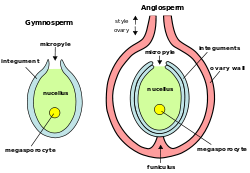 Plant ovules (megagametophytes): gymnosperm ovule on left, angiosperm ovule (inside ovary) on right
 -
 Double fertilization


Similar processes in other organisms
[edit]Rhizaria
[edit]
Some organisms currently classified in the clade Rhizaria and thus not plants in the sense used here, exhibit alternation of generations. Most Foraminifera undergo a heteromorphic alternation of generations between haploid gamont and diploid agamont forms. The diploid form is typically much larger than the haploid form; these forms are known as the microsphere and megalosphere, respectively.
Fungi
[edit]Fungal mycelia are typically haploid. When mycelia of different mating types meet, they produce two multinucleate ball-shaped cells, which join via a "mating bridge". Nuclei move from one mycelium into the other, forming a heterokaryon (meaning "different nuclei"). This process is called plasmogamy. Actual fusion to form diploid nuclei is called karyogamy, and may not occur until sporangia are formed. Karogamy produces a diploid zygote, which is a short-lived sporophyte that soon undergoes meiosis to form haploid spores. When the spores germinate, they develop into new mycelia.
Slime moulds
[edit]The life cycle of slime moulds is very similar to that of fungi. Haploid spores germinate to form swarm cells or myxamoebae. These fuse in a process referred to as plasmogamy and karyogamy to form a diploid zygote. The zygote develops into a plasmodium, and the mature plasmodium produces, depending on the species, one to many fruiting bodies containing haploid spores.
Animals
[edit]Alternation between a multicellular diploid and a multicellular haploid generation is never encountered in animals.[33] In some animals, there is an alternation between parthenogenic and sexually reproductive phases (heterogamy), for instance in salps and doliolids (class Thaliacea). Both phases are diploid. This has sometimes been called "alternation of generations",[34] but is quite different. In some other animals, such as hymenopterans, males are haploid and females diploid, but this is always the case rather than there being an alternation between distinct generations.
See also
[edit]- Apomixis – Replacement of the normal sexual reproduction by asexual reproduction, without fertilization
- Evolutionary history of plants#life cycles: Evolutionary origin of the alternation of phases
- Ploidy – Number of sets of chromosomes of a cell
Notes and references
[edit]- ^ "alternation of generations | Definition & Examples". Encyclopedia Britannica. Archived from the original on 2021-03-04. Retrieved 2021-02-25.
- ^ Thomas, R.J.; Stanton, D.S.; Longendorfer, D.H. & Farr, M.E. (1978), "Physiological evaluation of the nutritional autonomy of a hornwort sporophyte", Botanical Gazette, 139 (3): 306–311, doi:10.1086/337006, S2CID 84413961
- ^ Glime, J.M. (2007), Bryophyte Ecology: Vol. 1 Physiological Ecology (PDF), Michigan Technological University and the International Association of Bryologists, archived (PDF) from the original on 2013-03-26, retrieved 2013-03-04
- ^ a b Kerp, H.; Trewin, N.H. & Hass, H. (2003), "New gametophytes from the Lower Devonian Rhynie Chert", Transactions of the Royal Society of Edinburgh: Earth Sciences, 94 (4): 411–428, doi:10.1017/S026359330000078X, S2CID 128629425
- ^ Kluge, Arnold G.; Strauss, Richard E. (1985). "Ontogeny and Systematics". Annual Review of Ecology and Systematics. 16: 247–268. doi:10.1146/annurev.es.16.110185.001335. ISSN 0066-4162. JSTOR 2097049. Archived from the original on 2022-01-27. Retrieved 2021-02-25.
- ^ Taylor, Kerp & Hass 2005
- ^ ""Plant Science 4 U". Archived from the original on 18 August 2016. Retrieved 5 July 2016.
- ^ a b Bateman & Dimichele 1994, p. 403
- ^ a b Stewart & Rothwell 1993
- ^ "Object of the month: The poet and the dolphin skull". Hermann von Helmholtz-Zentrum für Kulturtechnik. 1 July 2023. Retrieved 4 May 2024.
- ^ a b c d Haig, David (2008), "Homologous versus antithetic alternation of generations and the origin of sporophytes" (PDF), The Botanical Review, 74 (3): 395–418, doi:10.1007/s12229-008-9012-x, S2CID 207403936, archived (PDF) from the original on 2014-08-19, retrieved 2014-08-17
- ^ Svedelius, Nils (1927), "Alternation of Generations in Relation to Reduction Division", Botanical Gazette, 83 (4): 362–384, doi:10.1086/333745, JSTOR 2470766, S2CID 84406292
- ^ Hofmeister, W. (1851), Vergleichende Untersuchungen der Keimung, Entfaltung und Fruchtbildildiung höherer Kryptogamen (Moose, Farne, Equisetaceen, Rhizocarpeen und Lycopodiaceen) und der Samenbildung der Coniferen (in German), Leipzig: F. Hofmeister, retrieved 2014-08-17. Translated as Currey, Frederick (1862), On the germination, development, and fructification of the higher Cryptogamia, and on the fructification of the Coniferæ, London: Robert Hardwicke, archived from the original on 2014-08-19, retrieved 2014-08-17
- ^ Feldmann, J.; Feldmann, G. (1942), "Recherches sur les Bonnemaisoniacées et leur alternance de generations" [Studies on the Bonnemaisoniaceae and their alternation of generations] (PDF), Ann. Sci. Natl. Bot., Series 11 (in French), 3: 75–175, archived from the original (PDF) on 2014-08-19, retrieved 2013-10-07, p. 157
- ^ a b Feldmann, J. (1972), "Les problèmes actuels de l'alternance de génerations chez les Algues", Bulletin de la Société Botanique de France (in French), 119: 7–38, doi:10.1080/00378941.1972.10839073
- ^ Schopfer, P.; Mohr, H. (1995). "Physiology of Development". Plant physiology. Berlin: Springer. pp. 288–291. ISBN 978-3-540-58016-4.
- ^ a b c d e f g h Foster & Gifford 1974,[page needed] Sporne 1974a[page needed] and Sporne 1974b. [page needed]
- ^ Guiry & Guiry 2008
- ^ Bateman & Dimichele 1994, p. 347
- ^ a b Shyam 1980
- ^ Watson 1981, p. 2
- ^ Kirby 2001
- ^ Watson 1981, p. 33
- ^ Bell & Hemsley 2000, p. 104
- ^ Watson 1981, pp. 425–6
- ^ Watson 1981, pp. 287–8
- ^ Sporne 1974a, pp. 17–21.
- ^ a b Bateman & Dimichele 1994, pp. 350–1
- ^ Chisholm, Hugh, ed. (1911). . Encyclopædia Britannica. Vol. 28 (11th ed.). Cambridge University Press. pp. 688–689.
- ^ Bernstein, H.; Byers, G.S. & Michod, R.E. (1981), "Evolution of sexual reproduction: Importance of DNA repair, complementation, and variation", The American Naturalist, 117 (4): 537–549, doi:10.1086/283734, S2CID 84568130
- ^ Michod, R.E. & Gayley, T.W. (1992), "Masking of mutations and the evolution of sex", The American Naturalist, 139 (4): 706–734, doi:10.1086/285354, S2CID 85407883
- ^ Szövényi, Péter; Ricca, Mariana; Hock, Zsófia; Shaw, Jonathan A.; Shimizu, Kentaro K.; Wagner, Andreas (2013), "Selection is no more efficient in haploid than in diploid life stages of an angiosperm and a moss", Molecular Biology and Evolution, 30 (8): 1929–39, doi:10.1093/molbev/mst095, PMID 23686659
- ^ Barnes et al. 2001, p. 321
- ^ Scott 1996, p. 35
Bibliography
[edit]- Barnes, R.S.K.; Calow, P.; Olive, P.J.W.; Golding, D.W. & Spicer, J.I. (2001), The Invertebrates: a synthesis, Oxford; Malden, MA: Blackwell, ISBN 978-0-632-04761-1
- Bateman, R.M. & Dimichele, W.A. (1994), "Heterospory – the most iterative key innovation in the evolutionary history of the plant kingdom" (PDF), Biological Reviews of the Cambridge Philosophical Society, 69 (3): 345–417, doi:10.1111/j.1469-185x.1994.tb01276.x, S2CID 29709953, archived from the original (PDF) on 2012-04-15, retrieved 2010-12-30
- Bell, P.R. & Hemsley, A.R. (2000), Green Plants: their Origin and Diversity (2nd ed.), Cambridge, etc.: Cambridge University Press, ISBN 978-0-521-64109-8
- Foster, A.S. & Gifford, E.M. (1974), Comparative Morphology of Vascular Plants (2nd ed.), San Francisco: W.H. Freeman, ISBN 978-0-7167-0712-7
- Guiry, M.D.; Guiry, G.M. (2008), "Cladophora", AlgaeBase, World-wide electronic publication, National University of Ireland, Galway, retrieved 2011-07-21
- Kirby, A. (2001), Ulva, the sea lettuce, Monterey Bay Aquarium Research Institute, archived from the original on 2011-05-16, retrieved 2011-01-01
- Scott, Thomas (1996), Concise Encyclopedia Biology, Berlin: Walter de Gruyter, ISBN 978-3-11-010661-9
- Shyam, R. (1980), "On the life-cycle, cytology and taxonomy of Cladophora callicoma from India", American Journal of Botany, 67 (5): 619–24, doi:10.2307/2442655, JSTOR 2442655
- Sporne, K.R. (1974a), The Morphology of Angiosperms, London: Hutchinson, ISBN 978-0-09-120611-6
- Sporne, K.R. (1974b), The Morphology of Gymnosperms (2nd ed.), London: Hutchinson, ISBN 978-0-09-077152-3
- Stewart, W.N. & Rothwell, G.W. (1993), Paleobotany and the Evolution of Plants (2nd ed.), Cambridge, UK: Cambridge University Press, ISBN 978-0-521-38294-6
- Watson, E.V. (1981), British Mosses and Liverworts (3rd ed.), Cambridge, UK: Cambridge University Press, ISBN 978-0-521-28536-0
- Taylor, T.N.; Kerp, H. & Hass, H. (2005), "Life history biology of early land plants: Deciphering the gametophyte phase", Proceedings of the National Academy of Sciences of the United States of America, 102 (16): 5892–5897, Bibcode:2005PNAS..102.5892T, doi:10.1073/pnas.0501985102, PMC 556298, PMID 15809414
| Subdisciplines | |||||||||||
|---|---|---|---|---|---|---|---|---|---|---|---|
| Plant groups | |||||||||||
| Plant anatomy |
| ||||||||||
| Plant physiology Materials | |||||||||||
| Plant growth and habit | |||||||||||
| Reproduction | |||||||||||
| Plant taxonomy | |||||||||||
| Practice | |||||||||||
| |||||||||||


Alternation of generations
View on GrokipediaDefinition and Basic Concepts
Core Definition
Alternation of generations refers to a reproductive life cycle in which an organism alternates between two distinct multicellular phases: a haploid gametophyte phase and a diploid sporophyte phase.[6] This cycle is characteristic of land plants (embryophytes) and some algae, where both phases are developmentally independent and multicellular.[1] In this life cycle, the gametophyte represents the sexual phase, producing haploid gametes through mitosis, while the sporophyte embodies the asexual phase, generating haploid spores via meiosis.[2] The alternation occurs as gametes from the gametophyte fuse during fertilization to form a diploid zygote, which develops into the sporophyte, and spores released from the sporophyte germinate to form new gametophytes.[1] This biphasic pattern, also known as diplohaplontic, differs from haplontic life cycles, where the multicellular phase is exclusively haploid and the diploid stage is limited to the zygote, and from diplontic cycles, where the multicellular phase is solely diploid and the haploid stage consists only of gametes.[7] In alternation of generations, both phases undergo significant somatic development, enabling ecological and morphological differentiation between them.[1] The basic cycle can be described textually as follows: Haploid gametes () from the gametophyte unite in fertilization to produce a diploid zygote (), which grows into the sporophyte; the sporophyte then undergoes meiosis () to yield haploid spores that develop into gametophytes, completing the alternation.[2]Key Phases and Transitions
The alternation of generations life cycle features two distinct multicellular phases: the gametophyte and the sporophyte. The gametophyte is the haploid (n) phase, consisting of multicellular structures that develop from spores and produce gametes—sperm and eggs—through mitotic divisions.[8] This phase is dedicated to sexual reproduction, where gametes are formed without reduction in chromosome number, allowing for genetic recombination upon fertilization.[9] In contrast, the sporophyte represents the diploid (2n) phase, arising from the fusion of gametes and producing haploid spores via meiosis within specialized structures called sporangia.[8] The sporophyte undergoes asexual reproduction through spore dispersal, with meiosis reducing the chromosome number from diploid to haploid, thereby initiating the gametophyte generation.[10] The transitions between these phases are mediated by two key processes: syngamy and meiosis. Syngamy, or the fusion of haploid gametes from the gametophyte, forms a diploid zygote that develops into the sporophyte, restoring the 2n condition.[8] Conversely, meiosis in the sporophyte generates haploid spores that germinate into gametophytes, completing the cycle by returning to the n state.[1] Genetically, the haploid gametophyte phase permits the direct expression of all alleles, including recessive ones, which can influence phenotype without masking.[11] In the diploid sporophyte, however, recessive alleles are often masked by dominant counterparts, providing a buffer against deleterious mutations but potentially delaying their elimination through selection.[11] The relationship between phases varies in form and dominance. In isomorphic alternation, the gametophyte and sporophyte are morphologically similar in size and structure, often indistinguishable without genetic analysis.[12] Heteromorphic alternation, by comparison, features phases that differ markedly in complexity and scale, with one typically dominant over the other in terms of size, longevity, or reproductive output.[12]Historical Development
Early Observations and Terminology
The earliest recorded observations of reproductive cycles in plants date back to the 4th century BCE, when Aristotle described the seasonal dependencies influencing plant generation and growth in his metaphysical and biological treatises, laying foundational ideas about cyclical natural processes without recognizing distinct alternating phases.[13] Advancements in microscopy during the 17th and 18th centuries enabled closer examination of reproductive structures, revealing elements that would later inform the concept of alternation. In 1665, Robert Hooke used his compound microscope to inspect moss capsules, noting the presence of exceedingly small white seeds—now identified as spores—and distinguishing them from larger reproductive bodies, which marked an initial step toward identifying gamete-like and spore-producing stages in plant life cycles.[14] By the early 19th century, naturalists grappled with phenomena suggesting generational shifts, leading to terminological confusion between plant and animal reproduction. The term "metagenesis," coined in the context of animal life cycles like those in salps and hydroids, was applied more broadly by figures such as Japetus Steenstrup in 1842 to describe apparent alternations of sexual and asexual forms across organisms, though it often conflated distinct processes in plants and animals without a unified framework.[15][16] This terminological ambiguity reflected a broader paradigm shift from preformationist doctrines, prevalent through the 18th century, which viewed reproduction as a linear unfolding of miniature preformed organisms from germ cells, to the emerging recognition of cyclical, dynamic life histories. Wilhelm Hofmeister's seminal 1851 work, Vergleichende Untersuchungen der Entwicklungsgeschichte und Morphologie der Cryptogamen, resolved much of this confusion by demonstrating a regular morphological and reproductive alternation in mosses, ferns, and related plants, introducing the precise term "alternation of generations" (from the German Generationenwechsel) to encapsulate the recurring transition between sexual (gametophyte) and asexual (sporophyte) phases.[17][16]Key Discoveries in Plants
In 1851, Wilhelm Hofmeister published his seminal work Vergleichende Untersuchungen, in which he conducted comparative studies on the life cycles of mosses, ferns, and seed plants, demonstrating that the gametophyte and sporophyte phases are homologous across all embryophytes and represent a unified alternation of generations.[18] This breakthrough resolved longstanding confusions about plant reproduction by showing that the spore-producing generation (sporophyte) develops from the fertilized egg of the sexual generation (gametophyte), establishing a consistent diplohaploid cycle throughout land plants. Building on this, 19th-century botanists provided key confirmations through detailed observations of moss life cycles. In the 1840s, Carl Nägeli elucidated critical aspects of moss reproduction, including the development of reproductive structures that foreshadowed the full alternation pattern later formalized by Hofmeister. By the 1870s, Julius Sachs integrated these insights into his influential Lehrbuch der Botanik (first edition 1868, revised 1874), where he synthesized alternation of generations as a fundamental principle of plant morphology and physiology, emphasizing its role in unifying diverse plant groups in textbooks that shaped botanical education. Advancements in cytology during the late 19th century further solidified the mechanism underlying alternation. Eduard Strasburger's microscopic studies in the 1880s on plants confirmed the occurrence of meiosis within sporangia, revealing how the diploid sporophyte reduces chromosome number to produce haploid spores, thus providing cytological evidence for the generational switch. These observations, enabled by improved microscopy, linked nuclear divisions directly to the reproductive phases. In the early 20th century, refinements explored deviations from the standard cycle. Frederick O. Bower's 1908 monograph The Origin of a Land Flora detailed apogamy (sporophyte development without fertilization) and apospory (gametophyte development without meiosis) in ferns, demonstrating these asexual transitions as experimental windows into the plasticity of plant life cycles and supporting evolutionary interpretations of alternation.[19] Collectively, these discoveries transformed botany by unifying plant taxonomy around life cycle patterns, enabling classifications based on the relative dominance of gametophyte versus sporophyte phases across bryophytes, pteridophytes, and seed plants.[20]Recognition in Animals and Other Groups
In the early 19th century, biologists began drawing analogies between plant life cycles and those observed in certain animals, though these interpretations often conflated distinct reproductive strategies. Adelbert von Chamisso introduced the term "metagenesis" in his 1819 dissertation De Salpa, describing an apparent alternation of sexual and asexual generations in salps (tunicates), where solitary sexual individuals give rise to chains of asexual forms. Building on this, Japetus Steenstrup's 1842 investigations into trematodes (flukes) and other invertebrates, such as cnidarians and tunicates, proposed a broader framework for "alternation of generations," noting that offspring often resemble grandparents rather than parents in form and reproduction. These animal cycles were initially seen as homologous to plant alternation, influencing early botanical interpretations following Wilhelm Hofmeister's 1851-1862 work on bryophytes and vascular plants. However, by the late 19th century, cytological studies revealed that animal metagenetic cycles did not constitute true alternation of generations, as they lacked a multicellular haploid phase and instead involved successive diploid generations differing in reproductive mode. In parasitic flatworms like flukes, complex larval stages and host shifts were misinterpreted as generational alternation, but meiosis occurs only in gamete formation without a free-living, multicellular gametophyte equivalent. This clarification arose amid 1850s-1900s debates, particularly through Rudolf Leuckart's work on polymorphism in parasites, where proponents argued for unified concepts across kingdoms, but opponents emphasized morphological and chromosomal distinctions.[21] The recognition of alternation in fungi and protists lagged due to a plant-centric focus in early historiography, with full integration occurring only in the mid-20th century alongside molecular and ultrastructural evidence. In the 1870s, Oskar Brefeld's detailed studies of myxomycetes (plasmodial slime molds) elucidated their life cycle, identifying the syncytial diploid plasmodium as a vegetative phase that produces haploid spores via meiosis, leading to amoeboflagellate cells and fruiting bodies—marking an early fungal example of true alternation. For protists, Franz Oltmanns's 1904-1905 monograph Morphologie und Biologie der Algen extended the concept to algae, demonstrating isomorphic or heteromorphic phases in groups like green and red algae, linking them explicitly to embryophyte cycles through shared multicellular haploid and diploid stages.[22] These debates over whether parasitic or unicellular cycles qualified were resolved by prioritizing multicellular phases, as articulated in mid-20th-century reviews, which highlighted how 19th-century plant bias delayed broader application until chromosomal confirmation unified the phenomenon across photosynthetic and non-photosynthetic lineages.Alternation in Plants and Algae
Fundamental Elements in Plants
In land plants, known as embryophytes, the alternation of generations manifests through two multicellular phases: the diploid sporophyte and the haploid gametophyte. The sporophyte develops from the zygote and represents the asexual phase, producing haploid spores through meiosis within specialized structures called sporangia. These spores germinate to form the gametophyte, the sexual phase, which generates gametes via mitosis. This cycle is characterized by the embryo—a young sporophyte—developing from the zygote and being nourished within the protective tissue of the female gametophyte, a defining feature that distinguishes embryophytes from other photosynthetic organisms.[23][24] The gametophyte produces male and female gametes in multicellular organs: antheridia, which release flagellated sperm, and archegonia, which house eggs. Fertilization occurs when sperm from an antheridium swims to an archegonium, often facilitated by water, forming a diploid zygote that initiates sporophyte development. In embryophytes, this zygote embryogenesis occurs embedded in gametophyte tissue, allowing the maternal gametophyte to provide nutrients and protection to the developing embryo. The mature sporophyte then produces spores in sporangia, completing the cycle.[24][23] A key variation in spore production is homospory versus heterospory. In homosporous plants, such as ferns, the sporophyte produces spores of a single size and type through a single type of sporangium; these germinate into typically bisexual gametophytes bearing both antheridia and archegonia. Heterospory, prevalent in seed plants, involves the production of two distinct spore types: smaller microspores that develop into male gametophytes (pollen grains) and larger megaspores that form female gametophytes within ovules. This dimorphism leads to unisexual gametophytes and enhances reproductive efficiency by separating male and female functions.[25][24] Nutrient and dependency dynamics between generations vary across embryophytes. In bryophytes, the gametophyte is the dominant, independent, photosynthetic phase, while the sporophyte remains physically attached and nutritionally dependent on the gametophyte throughout its life, relying on it for photosynthates and water. In vascular plants, the sporophyte achieves independence and dominance, becoming the prominent photosynthetic phase with extensive vascular tissues for nutrient transport; the gametophyte is correspondingly reduced in size and often dependent on the sporophyte for nourishment, particularly in seed plants where it is microscopic and enclosed within sporophyte structures. This shift underscores the evolutionary progression toward sporophyte prominence in land plants.[26][27]Variations in Plant Life Cycles
In plant life cycles, alternation of generations can exhibit isomorphic forms, where the gametophyte and sporophyte phases are morphologically similar, though this is rare among land plants and more commonly observed in certain algal ancestors or experimental contexts. More prevalent is heteromorphic alternation, characterized by distinct morphologies between the phases, with significant dominance shifts across plant groups.[28] In bryophytes, the gametophyte dominates as the independent, photosynthetic phase, while the sporophyte is reduced and dependent on the gametophyte for nutrition.[29] Conversely, in vascular plants such as ferns and seed plants, the sporophyte becomes the dominant, free-living phase, with the gametophyte greatly reduced in size and often embedded within sporophyte tissues.[28] Asexual modifications further diversify these cycles by bypassing key sexual processes. Apogamy involves the development of a sporophyte directly from gametophyte cells without fertilization, maintaining the haploid state initially but leading to diploidy through other means, as seen in some fern species like Ceratopteris richardii.[30] Apospory, in contrast, produces a gametophyte from sporophyte cells without meiosis, allowing diploid gametophytes and observed in various ferns and mosses.[28] These deviations enable reproduction without gamete fusion or reduction division, providing adaptive flexibility in challenging environments.[31] Polyploidy influences these cycles particularly in ferns, where endomitosis—chromosome duplication without cell division—can generate polyploid sporophytes from haploid gametophytes during apogamous development.[31] This process allows odd-ploidy levels to proceed through meiosis by first doubling chromosomes, enhancing genetic diversity and resilience in arid-adapted species.[32] Environmental factors also modulate phase transitions, with photoperiod and hormones playing key roles. Short-day conditions or specific light regimes can trigger spore germination and gametophyte differentiation in ferns, while hormones like auxin promote the transition to sporophyte formation by influencing cell polarity and meristem initiation in gametophytes.[33] Gibberellins and cytokinins further regulate these shifts, often in response to stress, facilitating apogamous pathways.[34]Life Cycles in Major Plant Groups
In bryophytes, including mosses, liverworts, and hornworts, the haploid gametophyte represents the dominant, free-living phase, forming the conspicuous leafy or thalloid structure that carries out photosynthesis and nutrient absorption.[35] The diploid sporophyte is reduced and parasitic, remaining physically attached to and nutritionally dependent on the gametophyte throughout its life, often appearing as a stalk or capsule atop the gametophyte.[36] The life cycle initiates with the germination of haploid spores released from the sporophyte; in mosses, these develop into a filamentous protonema that matures into the gametophyte bearing reproductive organs, while in liverworts and hornworts, they germinate directly into flattened thalloid gametophytes.[35] In pteridophytes (seedless vascular plants), alternation of generations features both phases as independent and free-living, with the diploid sporophyte dominant and larger. Most pteridophytes, such as ferns, are homosporous and manifest as familiar fronds with vascular tissues enabling upright growth.[37] The haploid gametophyte in these homosporous forms, known as the prothallus, is a small, heart-shaped structure that develops from spores and produces both antheridia and archegonia on its underside.[37] However, some pteridophytes, particularly certain lycophytes like Selaginella, are heterosporous, producing reduced, unisexual gametophytes that develop within spores. In ferns, spores are produced in sori, clusters of sporangia on the sporophyte's fronds, highlighting the shift toward sporophyte dominance compared to bryophytes.[37] In gymnosperms, the diploid sporophyte dominates as the large, woody tree or shrub, with the haploid gametophyte highly reduced and entirely dependent on the sporophyte for development and nutrition.[38] The male gametophyte consists of a few cells within the pollen grain, derived from microspores produced in male cones, while the female gametophyte develops from a megaspore retained within the ovule in female cones, forming a multicellular structure with archegonia.[38] This heterosporous condition allows for efficient pollen transfer without water dependence, marking an evolutionary advancement in reproductive independence.[39] Angiosperms display the most reduced gametophyte phase among vascular plants, confined to a few cells embedded within the sporophyte's flowers, underscoring the sporophyte's complete dominance as the visible plant body.[1] The male gametophyte is the pollen grain and tube, comprising generative and tube cells that deliver sperm to the ovule, while the female gametophyte is the embryo sac, an eight-nucleate structure including the egg and central cell.[1] A key innovation is double fertilization, unique to angiosperms, where one sperm fuses with the egg to form the zygote and another with the central cell to produce triploid endosperm, enhancing seed nutrition.[1]| Plant Group | Gametophyte Characteristics | Sporophyte Characteristics | Reproductive Innovations |
|---|---|---|---|
| Bryophytes | Dominant, free-living, leafy/thalloid; produces gametangia | Reduced, parasitic on gametophyte; spore-producing capsule | Protonema from spore germination in mosses (thalli in liverworts/hornworts); water-dependent fertilization[35][36] |
| Pteridophytes | Reduced but independent (prothallus in homosporous forms like ferns; reduced in heterosporous lycophytes); often bisexual, free-living | Dominant, vascular, frond-based in ferns; taller growth | Mostly homosporous (some heterosporous); sori in ferns; vascular tissues for independence[37] |
| Gymnosperms | Highly reduced, dependent (pollen grain male, ovule female); multicellular female | Dominant, woody, cone-bearing; heterosporous | Pollen for aerial transfer; retained megaspore in ovule[38][39] |
| Angiosperms | Extremely reduced, embedded (embryo sac female, pollen tube male); few-celled | Dominant, flowering; seeds in fruits | Double fertilization; flowers for animal pollination[1] |