


Community hub
0 subscribers8 pages, 0 posts
Recent from talks
All channels
Be the first to start a discussion here.
Be the first to start a discussion here.
Be the first to start a discussion here.
Be the first to start a discussion here.
Contribute something
Welcome to the community hub built to collect knowledge and have discussions related to London Underground.
Nothing was collected or created yet.
London Underground
View on Wikipediafrom Wikipedia
| London Underground | |
|---|---|
 | |
 The name "Tube" comes from the circular tube-like tunnels through which the small-profile (deep tube) trains travel. Here is a deep tube Northern line 1995 Stock train approaching Hendon Central. | |
 | |
| Overview | |
| Locale | |
| Transit type | Rapid transit |
| Number of lines | 11[1] |
| Number of stations | 272 served[1] (262 owned) |
| Daily ridership | 3.23 million (Average for 2023/24)[2] |
| Annual ridership | 1.181 billion (2023/2024)[2] |
| Website | tfl |
| Operation | |
| Began operation | 10 January 1863 |
| Operator(s) | London Underground Limited |
| Reporting marks | LT (National Rail)[3] |
| Technical | |
| System length | 402 km (250 mi)[1] |
| Track gauge |
|
| Electrification | Fourth rail, 630 or 750VDC |
| Average speed | 33 km/h (21 mph)[4] |

| Part of a series on the |
| London Underground |
|---|
 |
 London transport portal London transport portal |
The London Underground (also known simply as the Underground or as the Tube) is a rapid transit system serving Greater London and some parts of the adjacent home counties of Buckinghamshire, Essex and Hertfordshire in England.[5] It is part of the network of transport services managed by Transport for London.

The Underground has its origins in the Metropolitan Railway, opening on 10 January 1863 as the world's first underground passenger railway.[6] Despite sulfurous fumes, the line was a success from its opening, carrying 9.5 million passengers in the first year of its existence.[7] The Metropolitan is now part of the Circle, District, Hammersmith & City and Metropolitan lines. The first line to operate underground electric traction trains, the City & South London Railway in 1890, is now part of the Northern line.[8]
The network has expanded to 11 lines with 250 miles (400 km) of track.[9] However, the Underground does not cover most southern parts of Greater London; there are only 33 Underground stations south of the River Thames.[10] The system's 272 stations collectively accommodate up to 5 million passenger journeys a day.[11] In 2023/24 it was used for 1.181 billion passenger journeys.
The system's first tunnels were built just below the ground, using the cut-and-cover method; later, smaller, roughly circular tunnels—which gave rise to its nickname, the Tube—were dug through at a deeper level.[12] Despite its name, only 45% of the system is under the ground: much of the network in the outer environs of London is on the surface.[9]
The early tube lines, originally owned by several private companies, were brought together under the Underground brand in the early 20th century, and eventually merged along with the sub-surface lines and bus services in 1933 to form London Transport under the control of the London Passenger Transport Board (LPTB). The current operator, London Underground Limited (LUL), is a wholly owned subsidiary of Transport for London (TfL), the statutory corporation responsible for the transport network in London.[12] As of 2015[update], 92% of operational expenditure is covered by passenger fares.[13] The Travelcard ticket was introduced in 1983 and Oyster card, a contactless ticketing system, in 2003.[14] Contactless bank card payments were introduced in 2014,[15] the first such use on a public transport system.[16]
The LPTB commissioned many new station buildings, posters and public artworks in a modernist style.[17][18][19] The schematic Tube map, designed by Harry Beck in 1931, was voted a national design icon in 2006 and now includes other transport systems besides the Underground, such as the DLR, London Overground, Thameslink, the Elizabeth line, and Tramlink. Other famous London Underground branding includes the roundel and the Johnston typeface, created by Edward Johnston in 1916.
History
[edit]Early years
[edit]
Sub-surface lines
[edit]The idea of an underground railway linking the City of London with the urban centre was proposed in the 1830s,[21] and the Metropolitan Railway was granted permission to build such a line in 1854.[22] To prepare construction, a short test tunnel was built in 1855 in Kibblesworth, a small town with geological properties similar to London. This test tunnel was used for two years in the development of the first underground train, and was later, in 1861, filled up.[23] The world's first underground railway, it opened in January 1863 between Paddington and Farringdon using gas-lit wooden carriages hauled by steam locomotives.[24] It was hailed as a success, carrying 38,000 passengers on the opening day, and borrowing trains from other railways to supplement the service.[25] The Metropolitan District Railway (commonly known as the District Railway) opened in December 1868 from South Kensington to Westminster as part of a plan for an underground "inner circle" connecting London's main-line stations.[26] The Metropolitan and District railways completed the Circle line in 1884,[27] built using the cut and cover method.[28] Both railways expanded, the District building five branches to the west reaching Ealing, Hounslow,[29] Uxbridge,[30] Richmond and Wimbledon[29] and the Metropolitan eventually extended as far as Verney Junction in Buckinghamshire – more than 50 miles (80 km) from Baker Street and the centre of London.[31]
Deep-level lines
[edit]For the first deep-level tube line, the City and South London Railway, two 10 feet 2 inches (3.10 m) diameter circular tunnels were dug between King William Street (close to today's Monument station) and Stockwell, under the roads to avoid the need for agreement with owners of property on the surface. This opened in 1890 with electric locomotives that hauled carriages with small opaque windows, nicknamed padded cells.[32] The Waterloo and City Railway opened in 1898,[33] followed by the Central London Railway in 1900, known as the "twopenny tube".[34] These two ran electric trains in circular tunnels having diameters between 11 feet 8 inches (3.56 m) and 12 feet 2.5 inches (3.72 m),[35] whereas the Great Northern and City Railway, which opened in 1904, was built to take main line trains from Finsbury Park to a Moorgate terminus in the City and had 16-foot (4.9 m) diameter tunnels.[36]
While steam locomotives were in use on the Underground there were contrasting health reports. There were many instances of passengers collapsing whilst travelling, due to heat and pollution, leading for calls to clean the air through the installation of garden plants.[37] The Metropolitan even encouraged beards for staff to act as an air filter.[38] There were other reports claiming beneficial outcomes of using the Underground, including the designation of Great Portland Street as a "sanatorium for [sufferers of ...] asthma and bronchial complaints", tonsillitis could be cured with acid gas and the Twopenny Tube cured anorexia.[37]
Electrification
[edit]With the advent of electric Tube services (the Waterloo and City Railway and the Great Northern and City Railway), the Volks Electric Railway, in Brighton, and competition from electric trams, the pioneering Underground companies needed modernising.[39] In the early 20th century, the District and Metropolitan railways needed to electrify and a joint committee recommended an AC system, the two companies co-operating because of the shared ownership of the inner circle. The District, needing to raise the finance necessary, found an investor in the American Charles Yerkes who favoured a DC system similar to that in use on the City & South London and Central London railways. The Metropolitan Railway protested about the change of plan, but after arbitration by the Board of Trade, the DC system was adopted.[40]
Underground Electric Railways Company era
[edit].jpg)
Yerkes soon had control of the District Railway and established the Underground Electric Railways Company of London (UERL) in 1902 to finance and operate three tube lines, the Baker Street and Waterloo Railway (Bakerloo), the Charing Cross, Euston and Hampstead Railway (Hampstead) and the Great Northern, Piccadilly and Brompton Railway, (Piccadilly), which all opened between 1906 and 1907.[41][42] When the "Bakerloo" was so named in July 1906, The Railway Magazine called it an undignified "gutter title".[42] By 1907 the District and Metropolitan Railways had electrified the underground sections of their lines.[43]
In January 1913, the UERL acquired the Central London Railway and the City & South London Railway, as well as many of London's bus and tram operators.[44] Only the Metropolitan Railway, along with its subsidiaries the Great Northern & City Railway and the East London Railway, and the Waterloo & City Railway, by then owned by the main line London and South Western Railway, remained outside the Underground Group's control.[45]
A joint marketing agreement between most of the companies in the early years of the 20th century included maps, joint publicity, through ticketing and UNDERGROUND signs, incorporating the first bullseye symbol,[37] outside stations in Central London.[46] At the time, the term Underground was selected from three other proposed names; "Tube" and "Electric" were both officially rejected.[37] Ironically, the term Tube was later adopted alongside the Underground. The Bakerloo line was extended north to Queen's Park to join a new electric line from Euston to Watford, but the First World War delayed construction and trains reached Watford Junction in 1917. During air raids in 1915 people used the tube stations as shelters.[47] An extension of the Central line west to Ealing was also delayed by the war and was completed in 1920.[48] After the war, government-backed financial guarantees were used to expand the network and the tunnels of the City and South London and Hampstead railways were linked at Euston and Kennington;[49] the combined service was not named the Northern line until later.[50] The Metropolitan promoted housing estates near the railway with the "Metro-land" brand and nine housing estates were built near stations on the line. Electrification was extended north from Harrow to Rickmansworth, and branches opened from Rickmansworth to Watford in 1925 and from Wembley Park to Stanmore in 1932.[51][52] The Piccadilly line was extended north to Cockfosters and took over District line branches to Harrow (later Uxbridge) and Hounslow.[53]
London Passenger Transport Board era
[edit]
In 1933, most of London's underground railways, tramway and bus services were merged to form the London Passenger Transport Board, which used the London Transport brand.[54] The Waterloo & City Railway, which was by then in the ownership of the main line Southern Railway, remained with its existing owners.[55] In the same year that the London Passenger Transport Board was formed, Harry Beck's diagrammatic tube map first appeared.[56]
In the following years, the outlying lines of the former Metropolitan Railway closed, the Brill Tramway in 1935, and the line from Quainton Road to Verney Junction in 1936.[57] The 1935–40 New Works Programme included the extension of the Central and Northern lines and the Bakerloo line to take over the Metropolitan's Stanmore branch.[58] The Second World War suspended these plans after the Bakerloo line had reached Stanmore and the Northern line High Barnet and Mill Hill East in 1941.[59] Following bombing in 1940, passenger services over the West London line were suspended, leaving Olympia exhibition centre without a railway service until a District line shuttle from Earl's Court began after the war.[60] After work restarted on the Central line extensions in east and west London, these were completed in 1949.[61]
During the war many tube stations were used as air-raid shelters.[62] They were not always a guarantee of safety however; on 11 January 1941 during the London Blitz, a bomb penetrated the booking hall of Bank Station, the blast from which killed 111 people, many of whom were sleeping in passageways and on platforms.[63] On 3 March 1943, a test of the air-raid warning sirens, together with the firing of a new type of anti-aircraft rocket, resulted in a crush of people attempting to take shelter in Bethnal Green Underground station. A total of 173 people, including 62 children, died, making this both the worst civilian disaster in Britain during the Second World War, and the largest loss of life in a single incident on the London Underground network.[64]
London Transport Executive and Board era
[edit]
On 1 January 1948, under the provisions of the Transport Act 1947, the London Passenger Transport Board was nationalised and renamed the London Transport Executive, becoming a subsidiary transport organisation of the British Transport Commission, which was formed on the same day.[65][66][67] Under the same act, the country's main line railways were also nationalised, and their reconstruction was given priority over the maintenance of the Underground and most of the unfinished plans of the pre-war New Works Programme were shelved or postponed.[68]
The District line needed new trains and an unpainted aluminium train entered service in 1953, this becoming the standard for new trains.[69] In the early 1960s, the Metropolitan line was electrified as far as Amersham, British Railways providing services for the former Metropolitan line stations between Amersham and Aylesbury.[70] In 1962, the British Transport Commission was abolished, and the London Transport Executive was renamed the London Transport Board, reporting directly to the Minister of Transport.[66][71] Also during the 1960s, the Victoria line was dug under central London and, unlike the earlier tunnels, did not follow the roads above. The line opened in 1968–71 with the trains being driven automatically and magnetically encoded tickets collected by automatic gates gave access to the platforms.[72]
Greater London Council era
[edit]On 1 January 1970, responsibility for public transport within Greater London passed from central government to local government, in the form of the Greater London Council (GLC), and the London Transport Board was abolished. The London Transport brand continued to be used by the GLC.[73]
On 28 February 1975, a southbound train on the Northern City Line failed to stop at its Moorgate terminus and crashed into the wall at the end of the tunnel, in the Moorgate tube crash. There were 43 deaths and 74 injuries, the greatest loss of life during peacetime on the London Underground.[74] In 1976, the Northern City Line was taken over by British Rail and linked up with the main line railway at Finsbury Park, a transfer that had already been planned prior to the accident.[75]
In 1979, another new tube, the Jubilee line, named in honour of the Silver Jubilee of Elizabeth II, took over the Stanmore branch from the Bakerloo line, linking it to a newly constructed line between Baker Street and Charing Cross stations.[76] Under the control of the GLC, London Transport introduced a system of fare zones for buses and underground trains that cut the average fare in 1981. Fares increased following a legal challenge but the fare zones were retained, and in the mid-1980s the Travelcard and the Capitalcard were introduced.[77]
London Regional Transport era
[edit]
In 1984, control of London Buses and the London Underground passed back to central government with the creation of London Regional Transport (LRT), which reported directly to the Secretary of State for Transport, still retaining the London Transport brand.[78] One person operation had been planned in 1968, but conflict with the trade unions delayed introduction until the 1980s.[79]
On 18 November 1987, fire broke out in an escalator at King's Cross St Pancras tube station. The resulting fire cost the lives of 31 people and injured a further 100. London Underground was strongly criticised in the aftermath for its attitude to fires underground, and publication of the report into the fire led to the resignation of senior management of both London Underground and London Regional Transport.[80] Following the fire, substantial improvements to safety on the Tube were implemented – including the banning of smoking, removal of wooden escalators, installation of CCTV and fire detectors, as well as comprehensive radio coverage for the emergency services.[81]
In April 1994, the Waterloo & City Railway, by then owned by British Rail and known as the Waterloo & City line, was transferred to the London Underground.[55] In 1999, the Jubilee Line Extension project extended the Jubilee line from Green Park station through the growing Docklands to Stratford station. This resulted in the closure of the short section of tunnel between Green Park and Charing Cross stations. The 11 new stations were designed to be "future-proof", with wide passageways, large quantities of escalators and lifts, and emergency exits. The stations were the first on the Underground to have platform edge doors, and were built to have step-free access throughout.[82] The stations have subsequently been praised as exemplary pieces of 20th-century architecture.[83]
Transport for London era
[edit]In 2000, Transport for London (TfL) was created as an integrated body responsible for London's transport system. Part of the Greater London Authority, the TfL Board is appointed by the Mayor of London, who also sets the structure and level of public transport fares in London. The day-to-day running of the corporation is left to the Commissioner of Transport for London.[84]
TfL eventually replaced London Regional Transport, and discontinued the use of the London Transport brand in favour of its own brand. The transfer of responsibility was staged, with transfer of control of London Underground delayed until July 2003, when London Underground Limited became an indirect subsidiary of TfL.[85][86]
In the early 2000s, London Underground was reorganised in a Public-Private Partnership (PPP) as part of a project to upgrade and modernise the system. Private infrastructure companies (infracos) would upgrade and maintain the railway, and London Underground would run the train service. One infraco – Metronet – went into administration in 2007, and TfL took over the other – Tube Lines – in 2010.[87] Despite this, substantial investment to upgrade and modernise the Tube has taken place - with new trains (such as London Underground S7 and S8 Stock), new signalling, upgraded stations (such as King's Cross St Pancras) and improved accessibility (such as at Green Park). Small changes to the Tube network occurred in the 2000s, with extensions to Heathrow Terminal 5, new station at Wood Lane and the Circle line changed from serving a closed loop around the centre of London to a spiral also serving Hammersmith in 2009.[88]
In July 2005, four coordinated terrorist attacks took place, three of them occurring on the Tube network. It was the UK's deadliest terrorist incident since 1988.[89]
Electronic ticketing in the form of the contactless Oyster card was first introduced in 2003,[90] with payment using contactless banks cards introduced in September 2014.[91] In 2019[update], over 12million Oyster cards and 35million contactless cards were used, generating around £5billion in ticketing revenue.[92]
During the London 2012 Olympic and Paralympic Games, the Underground saw record passenger numbers, with over 4.3 million people using the Tube on some days.[93] This record was subsequently beaten in later years, with 4.82 million passengers in December 2015.[94] In 2013, the Underground celebrated its 150th anniversary, with celebratory events such as steam trains and installation of a unique Labyrinth artwork at each station.[95]
Under TfL, London's public transport network became more unified, with existing suburban rail lines across London upgraded and rebranded as London Overground from 2007, with the former East London line becoming part of the Overground network in 2010.[96][97] Many Overground stations interchange with Underground ones, and Overground lines were added onto the Tube map.
In the 2010s, the £18.8 billion Crossrail project built a new east–west railway tunnel under central London.[98][99] The project involved rebuilding and expanding several central Underground stations including Tottenham Court Road and Whitechapel.[98][100] By increasing rail capacity, the line aims to reduce overcrowding on the Tube and cut cross-London journey times.[100] The railway opened as the Elizabeth line in May 2022.[98] Although not part of the Underground, the line connects with several Underground stations.
In 2020, passenger numbers fell significantly during the COVID-19 pandemic and 40 stations were temporarily closed.[101] The Northern Line Extension opened in September 2021, extending the Northern line from Kennington to Battersea Power Station via Nine Elms. The extension was privately funded, with contributions from developments across the Battersea Power Station, Vauxhall and Nine Elms areas.[102][103]
Infrastructure
[edit]Railway
[edit]As of 2021, the Underground serves 272 stations.[104][105] Sixteen stations (eight on each of the Metropolitan and Central lines) are outside the London region, with five of those beyond the M25 London Orbital motorway (Amersham, Chalfont & Latimer, Chesham, and Chorleywood on the Metropolitan line and Epping on the Central).
Of the thirty-two London boroughs, six (Bexley, Bromley, Croydon, Kingston, Lewisham and Sutton) are not served by the Underground network, while Hackney has Old Street (on the Northern line Bank branch) and Manor House (on the Piccadilly line) just inside its boundaries. Lewisham was served by the East London line (with stations at New Cross and New Cross Gate) until 2010 when the line and the stations were transferred to the London Overground network.[106]

London Underground's eleven lines total 250 miles (402 km) in length,[1] making it the thirteenth longest metro system in the world. These are made up of the sub-surface network and the deep-tube lines.[1]
The Circle, District, Hammersmith & City, and Metropolitan lines form the sub-surface network, with cut-and-cover railway tunnels just below the surface and of a similar size to those on British main lines. These converge on a bi-directional loop in central London, sharing tracks and stations with each other at various places along their respective routes.
The Bakerloo, Central, Jubilee, Northern, Piccadilly, Victoria and Waterloo & City lines are deep-level tubes, with smaller trains that run in circular tunnels (tubes) with a diameter of about 11 feet 8 inches (3.56 m), with one tube for each direction. The seven deep-level lines have the exclusive use of tracks and stations along their routes with the exceptions of the Piccadilly line, which shares track with the District line, between Acton Town and Hanger Lane Junction, and with the Metropolitan line, between Rayners Lane and Uxbridge; and the Bakerloo line, which shares track with London Overground's Watford DC Line for its above-ground section north of Queen's Park.[107]
Fifty-five per cent of the system runs on the surface. There are 20 miles (32 km) of sub-surface tunnels and 93 miles (150 km) of tube tunnels.[1] Many of the central London Underground stations on deep-level tube routes are higher than the running lines to assist deceleration when arriving and acceleration when departing.[108] Trains generally run on the left-hand track. In some places, the tunnels are above each other (for example, the Central line east of St Paul's station); or trains run on the right (for example on the Victoria line between Warren Street and King's Cross St. Pancras, to allow cross-platform interchange with the Northern line at Euston).[107][109]
The lines are electrified with a fourth rail DC system: a conductor rail between the rails is energised at −210 V and a rail outside the running rails at +420 V, giving a potential difference of 630 V. On the sections of line shared with mainline trains, such as the District line from East Putney to Wimbledon and Gunnersbury to Richmond, and the Bakerloo line north of Queen's Park, the centre rail is bonded to the running rails.[110]
The average speed on the Underground is 20.5 mph (33.0 km/h).[9] Outside the tunnels of central London, many lines' trains tend to travel at over 40 mph (64 km/h) in the suburban and countryside areas. The Metropolitan line can reach speeds of 62 mph (100 km/h).[111]
Lines
[edit]The London Underground was used for 1.181 billion journeys in the year 2023–2024.[2]
| Name | Map colour [112] |
Opened
|
Type | Length | Termini | Stations
|
Depots | Current rolling stock |
Cars per train
|
Average weekday ridership (2017)[113] |
Trips per year | Average trips per mile | ||
|---|---|---|---|---|---|---|---|---|---|---|---|---|---|---|
| km | mi | ×1000 (2016/17)[114] | ||||||||||||
| Bakerloo line | Brown | 1906 | Deep tube | 23.2 | 14.4 | 25 |
|
1972 Stock | 7 | 401,123 | 117,000 | 8,069 | ||
| Central line | Red | 1900[a] | Deep tube | 74.0 | 46.0 | 49 |
|
1992 Stock | 8 | 1,021,084 | 288,800 | 6,278 | ||
| Circle line | Yellow | 1871[b] | Sub surface | 27.2 | 16.9 | Hammersmith (via Moorgate and Ladbroke Grove) |
Edgware Road (via Embankment and Notting Hill Gate) |
36 | Hammersmith | S7 Stock[117] | 7 | 257,391 | 73,000 | 4,294 |
| District line | Green | 1868 | Sub surface | 64.0 | 39.8 |
|
|
60 |
|
S7 Stock[117] | 7 | 842,991 | 226,100 | 5,652 |
| Hammersmith & City line | Pink | 1864[c] | Sub surface | 25.5 | 15.8 | Hammersmith |
|
29 | Hammersmith | S7 Stock[117] | 7 | 231,193 | 61,000 | 3,860 |
| Jubilee line | Grey | 1979 | Deep tube | 36.2 | 22.5 | 27 |
|
1996 Stock | 7 | 999,561 | 280,400 | 12,462 | ||
| Metropolitan line | Magenta | 1863 | Sub surface | 66.7 | 41.4 |
|
34 | Neasden | S8 Stock | 8 | 352,464 | 80,900 | 1,926 | |
| Northern line | Black | 1890[d] | Deep tube | 58.0 | 36.0 | 52 |
|
1995 Stock | 6 | 1,123,342 | 294,000 | 8,166 | ||
| Piccadilly line | Dark blue | 1906 | Deep tube | 71.0 | 44.1 | 53 |
|
1973 Stock | 6 | 710,647 | 206,900 | 4,670 | ||
| Victoria line | Light blue | 1968 | Deep tube | 21.0 | 13.0 | 16 | Northumberland Park | 2009 Stock | 8 | 955,823 | 263,400 | 20,261 | ||
| Waterloo & City line | Turquoise | 1898[e] | Deep tube | 2.5 | 1.6 | Bank | Waterloo | 2 | Waterloo | 1992 Stock[119] | 4 | 59,492 | 16,900 | 11,267 |
- ^ Known as the Central London before 1937.[50]
- ^ The Metropolitan and District railways joint inner circle service started in the shape of a horseshoe, a complete loop was formed in 1884[115] and the current spiral in 2009. The line has been referred to as the Circle line at least since 1936 and first appeared separately on the tube map in 1948.[116]
- ^ Originally a joint Great Western and Metropolitan railways service, the line first appeared separately on the tube map in 1990.[96]
- ^ The name dates from 1937.[50]
- ^ Until 1994 the Waterloo & City line was operated by British Rail and its predecessors.
View source data.
London Underground patronage by line in 2020–21
Services using former and current main lines
[edit]
The Underground uses several railways and alignments that were built by main-line railway companies.
- Bakerloo line
- Between Queen's Park and Harrow & Wealdstone this runs over the Watford DC Line also used by London Overground, alongside the London & North Western Railway (LNWR) main line that opened in 1837. The route was laid out by the LNWR in 1912–15 and is part of the Network Rail system.
- Central line
- The railway from just south of Leyton to just south of Loughton was built by Eastern Counties Railway in 1856 on the same alignment in use today.[120] The Underground also uses the line built in 1865 by the Great Eastern Railway (GER) between Loughton to Ongar via Epping. The connection to the main line south of Leyton was closed in 1970 and removed in 1972. The line from Epping to Ongar was closed in 1994; most of the line is in use today by the heritage Epping Ongar Railway.[120] The line between Newbury Park and Woodford junction (west of Roding Valley) via Hainault was built by the GER in 1903, the connections to the main line south of Newbury Park closing in 1947 (in the Ilford direction) and 1956 (in the Seven Kings direction).[120]
- Central line
- The line from just north of White City to Ealing Broadway was built in 1917 by the Great Western Railway (GWR) and passenger service introduced by the Underground in 1920. North Acton to West Ruislip was built by GWR on behalf of the Underground in 1947–8 alongside the pre-existing tracks from Old Oak Common junction towards High Wycombe and beyond, which date from 1904.[120] As of May 2013[update], the original Old Oak Common junction to South Ruislip route has one main-line train a day to and from Paddington.[121]
- District line
- South of Kensington (Olympia) short sections of the 1862 West London Railway (WLR) and its 1863 West London Extension Railway (WLER) were used when District extended from Earl's Court in 1872. The District had its own bay platform at Olympia built in 1958 along with track on the bed of the 1862–3 WLR/WLER northbound. The southbound WLR/WLER became the new northbound main line at that time, and a new southbound main-line track was built through the site of former goods yard. The 1872 junction closed in 1958, and a further connection to the WLR just south of Olympia closed in 1992. The branch is now segregated.[120]
- The line between Campbell Road junction (now closed), near Bromley-by-Bow, and Barking was built by the London, Tilbury & Southend Railway (LTSR) in 1858. The slow tracks were built 1903–05, when District services were extended from Bow Road (though there were no District services east of East Ham from 1905 to 1932). The slow tracks were shared with LTSR stopping and goods trains until segregated by 1962, when main-line trains stopped serving intermediate stations.[120]
- The railway from Barking to Upminster was built by LTSR in 1885 and the District extended over the route in 1902. District withdrew between 1905 and 1932, when the route was quadrupled. Main-line trains ceased serving intermediate stations in 1962, and the District line today only uses the 1932 slow tracks.[120]
- The westbound track between east of Ravenscourt Park and Turnham Green and Turnham Green to Richmond (also used by London Overground) follows the alignment of a railway built by the London & South Western Railway (LSWR) in 1869. The eastbound track between Turnham Green and east of Ravenscourt Park follows the alignment built in 1911; this was closed 1916 but was re-used when the Piccadilly line was extended in 1932.[120] The section between Turnham Green and Richmond still belongs to Network Rail now.[122]
- The line between East Putney and Wimbledon was built by the LSWR in 1889. The last scheduled main-line service ran in 1941[120] but it still sees a few through Waterloo passenger services at the start and end of the daily timetable.[123] The route is also used for scheduled ECS movements to/from Wimbledon Park depot and for Waterloo services diverted during disruptions and track closures elsewhere. This section is now owned by London Underground but the signalling is still operated by Network Rail.[122]
- Hammersmith & City
- Between Paddington and Westbourne Park Underground station, the line runs alongside the main line. The Great Western main line opened in 1838, serving a temporary terminus the other side of Bishop's Road. When the current Paddington station opened in 1854, the line passed to the south of the old station.[120] On opening in 1864, the Hammersmith & City Railway (then part of the Metropolitan Railway) ran via the main line to a junction at Westbourne Park, until 1867 when two tracks opened to the south of the main line, with a crossing near Westbourne Bridge, Paddington. The current two tracks to the north of the main line and the subway east of Westbourne Park opened in 1878.[124] The Hammersmith & City route is now completely segregated from the main line.
- Jubilee line
- The rail route between Canning Town and Stratford was built by the GER in 1846, with passenger services starting in 1847. The original alignment was quadrupled "in stages between 1860 and 1892" for freight services before the extra (western) tracks were lifted as traffic declined during the 20th century, and were re-laid for Jubilee line services that started in 1999. The current Docklands Light Railway (ex-North London line) uses the original eastern alignment and the Jubilee uses the western alignment.[120]
- Northern line
- The line from East Finchley to Mill Hill East was opened in 1867, and from Finchley Central to High Barnet in 1872, both by the Great Northern Railway.[120]
- Piccadilly line
- The westbound track between east of Ravenscourt Park and Turnham Green was built by LSWR in 1869, and originally used for eastbound main-line and District services. The eastbound track was built in 1911; it closed in 1916 but was re-used when the Piccadilly line was extended in 1932.[120]
Main line services using LU tracks
[edit]Chiltern Railways shares track with the Metropolitan Line between Harrow-on-the-Hill and Amersham. Three South Western Railway passenger trains a day use District Line tracks between Wimbledon and East Putney.[125]
Trains
[edit]
London Underground trains come in two sizes, larger sub-surface trains and smaller deep-tube trains.[126] Since the early 1960s all passenger trains have been electric multiple units with sliding doors[127] and a train last ran with a guard in 2000.[128] All lines use fixed-length trains with between six and eight cars, except for the Waterloo & City line that uses four cars.[129] New trains are designed for maximum number of standing passengers and for speed of access to the cars and have regenerative braking and public address systems.[130] Since 1999 all new stock has had to comply with accessibility regulations that require such things as access and room for wheelchairs, and the size and location of door controls. All underground trains are required to comply with The Rail Vehicle Accessibility (Non Interoperable Rail System) Regulations 2010 (RVAR 2010) by 2020.[131]
Stock on sub-surface lines is identified by a letter (such as S Stock, used on the Metropolitan line), while tube stock is identified by the year of intended introduction[132] (for example, 1996 Stock, used on the Jubilee line).
Depots
[edit]The Underground is served by the following depots:
- Bakerloo: Stonebridge Park, Queen's Park, London Road
- Central: Hainault, Ruislip, White City
- Circle: Hammersmith
- District: Ealing Common, Lillie Bridge, Upminster
- Hammersmith & City: Hammersmith
- Jubilee: Neasden, Stratford Market
- Metropolitan: Neasden
- Northern: Edgware, Golders Green, Highgate, Morden
- Piccadilly: Cockfosters, Northfields
- Victoria: Northumberland Park
- Waterloo & City: Waterloo
- London Underground: Acton Works
Disused and abandoned stations
[edit]In the years since the first parts of the London Underground opened, many stations and routes have been closed. Some stations were closed because of low passenger numbers rendering them uneconomical; some became redundant after lines were re-routed or replacements were constructed; and others are no longer served by the Underground but remain open to National Rail main line services. In some cases, such as Aldwych and Ongar, the buildings remain and are used for other purposes. In others, such as British Museum, all evidence of the station has been lost through demolition.
London Transport Museum runs guided tours of several disused stations including Down Street and Aldwych through its "Hidden London" programme. The tours look at the history of the network and feature historical details drawn from the museum's own archives and collections.[133]
Proposed line extensions
[edit]
Bakerloo line extension to Lewisham
[edit]A southern extension of the Bakerloo line from Elephant & Castle has been proposed multiple times since the line opened. In the 2010s, consultation events and preliminary design work took place on an extension. A route from Elephant & Castle to Lewisham via Old Kent Road and New Cross Gate was chosen by Transport for London in 2019.[134] The line could be extended further on the Hayes National Rail line in future. Estimated to cost between £4.7 billion to £7.9 billion (in 2017 prices), the extension would take around 7 years to construct.[135] Due to financial impacts of the COVID-19 pandemic, work to implement the extension is currently on hold.[136]
Other proposed extensions and lines
[edit]Several other extensions have been proposed in recent years, including a further extension of the Northern line to Clapham Junction.[137] The long proposed Croxley Rail Link (an extension of the Metropolitan line) was cancelled in 2018 due to higher than expected costs and lack of funding.[138][139]
In 2019, the Canary Wharf Group suggested the construction of a new rail line between Euston and Canary Wharf, to improve connections to the future High Speed 2 railway.[140]
In 2021, Harlow District Council proposed extending the Central line from its eastern terminus in Epping to Harlow. They argued this would reduce travel times to Epping and London, and help with efforts to add 19,000 new homes to the town and expand the population to 130,000. However, no funding has been allocated for this proposed extension.[141]
Line improvements
[edit] | This section needs additional citations for verification. (June 2015) |
Bakerloo line
[edit]The thirty-six 1972-stock trains on the Bakerloo line have already exceeded their original design life of 40 years. London Underground is therefore extending their operational life by making major repairs to many of the trains to maintain reliability. The Bakerloo line will receive new trains as part of the New Tube for London project. This will replace the existing fleet with new air-cooled articulated trains and a new signalling system to allow Automatic Train Operation. The line is predicted to run a maximum of 27 trains per hour, a 25% increase on the current 21 trains per hour during peak periods.[142][143]
Central line
[edit]
The Central line was the first line to be modernised in the 1990s, with 85 new 1992-stock trains and a new automatic signalling system installed to allow Automatic Train Operation. The line runs 34 trains per hour for half an hour in the morning peak but is unable to operate more frequently because of a lack of additional trains. The 85 existing 1992-stock trains are the most unreliable on the London Underground as they are equipped with the first generation of solid-state direct-current thyristor-control traction equipment. The trains often break down, have to be withdrawn from service at short notice and at times are not available when required, leading to gaps in service at peak times. Although relatively modern and well within their design life, the trains need work in the medium term to ensure the continued reliability of the traction control equipment and maintain fleet serviceability until renewal, which is expected between 2028 and 2032. Major work is to be undertaken on the fleet to ensure their continued reliability with brakes, traction control systems, doors, automatic control systems being repaired or replaced, among other components. The Central line will be part of the New Tube for London Project. This will replace the existing fleet with new air-cooled walkthrough trains and a new automatic signalling system. The line is predicted to run 36 trains per hour, a 25% increase compared to the present service of 34 trains for the busiest 30 minutes in the morning and evening peaks and 27–30 trains per hour during the rest of the peak.[142][144][145]
Jubilee line
[edit]The signalling system on the Jubilee line has been replaced to increase capacity on the line by 20%—the line now runs 30 trains per hour at peak times, compared to the previous 24 trains per hour. As with the Victoria line, the service frequency is planned to increase to 36 trains per hour. To enable this, ventilation, power supply and control and signalling systems will be adapted and modified to allow the increase in frequency. London Underground also plans to add up to an additional 18 trains to the current fleet of 63 trains of 1996 stock.[146][147]
Northern line
[edit]The signalling system on the Northern line has been replaced to increase capacity on the line by 20%, as the line now runs 24 trains per hour at peak times, compared to 20 previously. Capacity can be increased further if the operation of the Charing Cross and Bank branches is separated. To enable this up to 50 additional trains will be built in addition to the current 106 1995 stock. Five trains will be required for the Northern line extension and 45 to increase frequencies on the rest of the line. This, combined with segregation of trains at Camden Town junction, will allow 30–36 trains per hour compared to 24 trains per hour currently.[147][148]
Piccadilly line
[edit]The eighty-six 1973 stock trains that operate on the Piccadilly line are some of the most reliable trains on the London Underground. The trains have exceeded their design life of around 40 years and are in need of replacement. The Piccadilly line will be part of the New Tube for London Project. This will replace the existing fleet with new air-cooled walk-through trains and a new signalling system to allow Automatic Train Operation. The line is predicted to run 30–36 trains per hour, up to a 50% increase compared to the 24–25 train per hour service provided today. The line will be the first to be upgraded as part of the New Tube for London Project, as passenger numbers have increased over recent years and are expected to increase further. This line is important in this project because it currently provides a less frequent service than other lines.[142]
Victoria line
[edit]The signalling system on the Victoria line has been replaced to increase capacity on the line by around 25%; the line now runs up to 36 trains per hour compared to 27–28 previously. The trains have been replaced with 47 new higher-capacity 2009-stock trains. The peak frequency was increased to 36 trains per hour in 2016 after track works were completed to the layout of the points at Walthamstow Central crossover, which transfers northbound trains to the southbound line for their return journey. This resulted in a 40% increase in capacity between Seven Sisters and Walthamstow Central.[149][150]
Waterloo & City line
[edit]The line was upgraded with five new 1992-stock trains in the early 1990s, at the same time as the Central line was upgraded. The line operates under traditional signalling and does not use Automatic Train Operation. The line will be part of the New Tube for London Project. This will replace the existing fleet with new air-cooled walk-through trains and a new signalling system to allow Automatic Train Operation. The line is predicted to run 30 trains per hour, an increase of up to 50% on the current 21 trains per hour. The line may also be one of the first to be upgraded, alongside the Piccadilly line, with new trains, systems and platform-edge doors to test the systems before the Central and Bakerloo lines are upgraded.[142]
Sub-surface lines (District, Metropolitan, Hammersmith & City and Circle)
[edit]New S Stock trains have been introduced on the sub-surface (District, Metropolitan, Hammersmith & City and Circle) lines. These were all delivered by 2017. 191 trains have been introduced: 58 for the Metropolitan line and 133 for the Circle, District and Hammersmith & City lines. The track, electrical supply and signalling systems are also being upgraded in a programme to increase peak-hour capacity. The replacement of the signalling system and the introduction of Automatic Train Operation and Control is scheduled for 2019–22. A control room for the sub-surface network has been built in Hammersmith and an automatic train control (ATC) system is to replace ageing signalling equipment dating from between the mid-1920s and late 1980s, including the signal cabin at Edgware Road, the control room at Earl's Court, and the signalling centre at Baker Street. Bombardier won the contract in June 2011 but was released by agreement in December 2013, and London Underground has now issued another signalling contract, with Thales.[151][152][153]
New trains for deep-level lines
[edit] | This section needs to be updated. (June 2024) |
In mid-2014, Transport for London issued a tender for up to 18 trains for the Jubilee line and up to 50 trains for the Northern line. These would be used to increase frequencies and cover the Battersea extension on the Northern line.[154]
In early 2014, the Bakerloo, Central, Piccadilly and Waterloo & City line rolling-stock replacement project was renamed New Tube for London (NTfL) and moved from the feasibility stage to the design and specification stage. The study had shown that, with new generation trains and re-signalling:
- Piccadilly line capacity could be increased by 60% with 33 trains per hour (tph) at peak times by 2026.[155]
- Central line capacity increased by 25% with 33 tph at peak times by 2030.
- Waterloo & City line capacity increased by 50% by 2032, after the track at Waterloo station is remodelled.
- Bakerloo line capacity could be increased by 25% with 27 tph at peak times by 2033.
- A redesign of the northern concourse and a new southern concourse at Waterloo.[156]
The project is estimated to cost £16.42 billion (£9.86 billion at 2013 prices). A notice was published on 28 February 2014 in the Official Journal of the European Union asking for expressions of interest in building the trains.[157][158] On 9 October 2014, TFL published a shortlist of those (Alstom, Siemens, Hitachi, CAF and Bombardier) who had expressed an interest in supplying 250 trains for between £1.0billion and £2.5billion, and on the same day opened an exhibition with a design by PriestmanGoode.[159][160] The fully automated trains may be able to run without drivers,[161] but the ASLEF and RMT trade unions that represent the drivers strongly oppose this, saying it would affect safety.[162] The invitation to tender for the trains was issued in January 2016;[163] the specifications for the Piccadilly line infrastructure are expected in 2016,[157][158] and the first train is due to run on the Piccadilly line in 2023.[164] Siemens Mobility's Inspiro design was selected in June 2018 in a £1.5billion contract.[165]
Ventilation and cooling
[edit]When the Bakerloo line opened in 1906, it was advertised with a maximum temperature of 60 °F (16 °C), but over time the tube tunnels have warmed up.[166] In 1938 approval was given for a ventilation improvement programme, and a refrigeration unit was installed in a lift shaft at Tottenham Court Road.[166] Temperatures of 117 °F (47 °C) were reported in the 2006 European heat wave.[167] It was claimed in 2002 that, if animals were being transported, temperatures on the Tube would break European Commission animal welfare laws.[168] A 2000 study reported that air quality was 73 times worse than at street level, with a passenger inhaling the same mass of particulates during a twenty-minute journey on the Northern line as when smoking a cigarette.[169][170] The main purpose of the London Underground's ventilation fans is to extract hot air from the tunnels,[166] and fans across the network are being refurbished, although complaints of noise from local residents preclude their use at full power at night.[171]
In June 2006 a groundwater cooling system was installed at Victoria station.[172] In 2012, air-cooling units were installed on platforms at Green Park station using cool deep groundwater and at Oxford Circus using chiller units at the top of an adjacent building.[173] New air-conditioned trains have been introduced on the sub-surface lines, but were initially ruled out for the tube trains due to space being considered limited on tube trains for air-conditioning units and that these would heat the tunnels even more. The New Tube for London, which will replace the trains for the Bakerloo, Central, Waterloo and City and Piccadilly lines, is planned to have air conditioning for the new trains along with better energy conservation and regenerative braking.[130][174][175]
In the original Tube design, trains passing through close fitting tunnels act as pistons to create air pressure gradients between stations. This pressure difference drives ventilation between platforms and the surface exits through the passenger foot network. This system depends on adequate cross-sectional area of the airspace above the passengers' heads in the foot tunnels and escalators, where laminar airflow is proportional to the fourth power of the radius, the Hagen–Poiseuille equation. It also depends on an absence of turbulence in the tunnel headspace. In many stations the ventilation system is now ineffective because of alterations that reduce tunnel diameters and increase turbulence. An example is Green Park tube station, where false ceiling panels attached to metal frames have been installed that reduce the above-head airspace diameter by more than half in many parts. This has the effect of reducing laminar airflow by 94%.
Originally, air turbulence was kept to a minimum by keeping all signage flat to the tunnel walls. Now, the ventilation space above head height is crowded with ducting, conduits, cameras, speakers and equipment acting as a baffle plates with predictable reductions in flow.[176] Often, electronic signs have their flat surface at right angles to the main air flow, causing choked flow. Temporary sign boards that stand at the top of escalators also maximise turbulence. The alterations to the ventilation system are important, not only to heat exchange.
Air quality
[edit]The Committee on the Medical Effects of Air Pollutants (COMEAP) has reported on the relative risks of breathing air pollution in different situations. In January 2019, for example, it reported that pollution from particulates is up to 30 times higher on the London Underground than on streets in the roads above, with the Northern Line having the worst air quality.[177][178][needs update]
Lifts and escalators
[edit]
Originally access to the deep-tube platforms was by a lift.[179] Each lift was staffed, and at some quiet stations in the 1920s the ticket office was moved into the lift, or it was arranged that the lift could be controlled from the ticket office.[180] The first escalator on the London Underground was installed in 1911 between the District and Piccadilly platforms at Earl's Court and from the following year new deep-level stations were provided with escalators instead of lifts.[181] The escalators had a diagonal shunt at the top landing.[181][182] In 1921 a recorded voice instructed passengers to stand on the right and signs followed in the Second World War.[183] Travellers were asked to stand on the right so that anyone wishing to overtake them would have a clear passage on the left side of the escalator.[184] The first 'comb' type escalator was installed in 1924 at Clapham Common.[181] In the 1920s and 1930s many lifts were replaced by escalators.[185] After the fatal 1987 King's Cross fire, all wooden escalators were replaced with metal ones and the mechanisms are regularly degreased to lower the potential for fires.[186] The only wooden escalator not to be replaced was at Greenford station, which remained until March 2014 when TfL replaced it with the first incline lift on the UK transport network in October 2015.[187]
There are 426 escalators on the London Underground system and the longest, at 60 m (200 ft), is at Angel. The shortest, at Stratford, gives a vertical rise of 4.1 m (13 ft). There are 184 lifts,[188] and numbers have increased in recent years because of investment in making tube stations accessible. Over 28 stations will have lifts installed over the next 10 years, bringing the total of step-free stations to over 100.[189] Lift and escalators are abundant with advertising posters which can be used for artistic purposes due to the nature of their layout.[190]
Wi-Fi and mobile phone reception
[edit]In mid-2012, London Underground, in partnership with Virgin Media, trialled Wi-Fi hotspots in many stations, but not in the tunnels, that allowed passengers free internet access. The free trial proved successful and was extended to the end of 2012,[191] whereupon it switched to a service freely available to subscribers to Virgin Media and others, or as a paid-for service.[192] It was not previously possible to use mobile phones on most parts of the Underground (excluding services running overground or occasionally sub-surface, depending on the phone and carrier) using native 2G, 3G or 4G networks, and a project to extend coverage before the 2012 Olympics was abandoned because of commercial and technical difficulties.[193]
In March 2020, 2G, 3G and 4G signal was made available on parts of the Jubilee line, between Westminster and Canning Town, throughout the stations and tunnels as part of an initial trial.[194]
In June 2021, Vodafone dropped London Underground Wi-Fi connectivity across the entire network.[195][196] This was restored in April 2023 after control of the Wi-Fi connectivity moved from Virgin Media to Boldyn Networks as part of their 20-year concession deal with Transport for London, providing data connectivity across the entire network.[197]
In December 2022, additional mobile coverage, including 5G connectivity, launched at a small subset of stations and tunnel segments on the Central line, with a view to expand to the full set of sub-surface stations and tunnels on the London Underground, and also the Elizabeth Line, by the end of 2024.[198][199] Further stations on the Northern line were launched from January 2023, with additional Northern line stations also being added in June 2023. Not all stations have identical coverage solutions, with some not having 5G connectivity present.[200] As of June 2023, testing has begun on sections of the Bakerloo, Piccadilly and Victoria lines.[201][202]
In November and December 2023, more mobile data coverage was launched on more stations on the Northern and Central Lines. On the Northern line: all stations from Tottenham Court Road to Euston. on the Central line: from Oxford Circus to Chancery Lane.[203]
| Line | Sections of track or stations | Available from |
|---|---|---|
| Jubilee | Westminster – Canning Town | March 2020 |
| Central | Holland Park – Queensway | December 2022 |
| Central | Oxford Circus – Tottenham Court Road | September 2023 |
| Northern | Archway – Kentish Town | January 2023 |
| Northern | Tottenham Court Road | December 2023 |
| Northern | Camden Town | December 2023 |
| Northern | Kentish Town – Mornington Crescent | July 2023 |
| Northern | Archway – East Finchley | January 2024 – Highgate platforms have service, not the tunnels. Expected from Spring 2024[202] |
| Piccadilly | Russell Square – Covent Garden | Expected from Spring 2024[202] |
| Northern | Euston – Belsize Park | November 2023 |
| Central | Holland Park to Bank | February 2024 |
| Northern | Golders Green – Hampstead | Expected from Spring 2024[204] |
| Victoria | Euston - Oxford Circus | Expected from Spring 2024[204] (as of April 2024 there is service on all Euston platforms) |
Travelling
[edit]Ticketing
[edit]
The Underground received £2.669 billion in fares in 2016/17 and uses Transport for London's zonal fare system to calculate fares.[205] There are nine zones with zone 1 being the central zone, which includes the loop of the Circle line with a few stations to the south of River Thames. The only London Underground stations in Zones 7 to 9 are on the Metropolitan line beyond Moor Park, outside London region. Some stations are in two zones, and the cheapest fare applies.[206] Paper tickets, the contactless Oyster cards, contactless debit or credit cards[207] and Apple Pay[208] and Android Pay[209] smartphones and watches can be used for travel.[210] Single and return tickets are available in either format, but Travelcards (season tickets) for longer than a day are available only on Oyster cards.[211][212][213]
TfL introduced the Oyster card in 2003; this is a pre-payment smartcard with an embedded contactless RFID chip.[214] It can be loaded with Travelcards and used on the Underground, the Overground, buses, trams, the Docklands Light Railway, and National Rail services within London.[215] Fares for single journeys are cheaper than paper tickets, and a daily cap limits the total cost in a day to the price of a Day Travelcard.[216] The Oyster card must be 'touched in' at the start and end of a journey, otherwise it is regarded as 'incomplete' and the maximum fare is charged.[217] In March 2012 the cost of this in the previous year to travellers was £66.5million.[218]
In 2014, TfL became the first public transport provider in the world to accept payment from contactless bank cards.[16] The Underground first started accepting contactless debit and credit cards in September 2014.[15] This was followed by the adoption of Apple Pay in 2015[208] and Android Pay in 2016,[209] allowing payment using a contactless-enabled phone or smartwatch. Over 500million journeys have taken place using contactless payments, and TfL has become one of Europe's largest contactless merchants, with around 1 in 10 contactless transactions in the UK taking place on the TfL network.[16] This technology, developed in-house by TfL,[219] has been licensed to other major cities like New York City[220] and Boston.[221]
A concessionary fare scheme is operated by London Councils for residents who are disabled or meet certain age criteria.[222] Residents born before 1951 were eligible after their 60th birthday, whereas those born in 1955 will need to wait until they are 66.[223] Called a "Freedom Pass", it allows free travel on TfL-operated routes at all times and is valid on some National Rail services within London at weekends and after 09:30 on Monday to Friday.[224] Since 2010, the Freedom Pass has included an embedded holder's photograph; it lasts five years between renewals.[225]
In addition to automatic and staffed faregates at stations, the Underground also operates on a proof-of-payment system. The system is patrolled by both uniformed and plain-clothes fare inspectors with hand-held Oyster card readers. Passengers travelling without a valid ticket must pay a penalty fare of £80 (£40 if paid within 21days) and can be prosecuted for fare evasion under the Regulation of Railways Act 1889 and Transport for London Byelaws.[226][227]
Hours of operation
[edit]The tube closes overnight during the week, but since 2016, the Central, Jubilee, Northern, Piccadilly, and Victoria lines, as well as a short section of the London Overground have operated all night on Friday and Saturday nights. The first trains run from about 05:00 and the last trains until just after 01:00, with later starting times on Sunday mornings.[228][229] The nightly closures are used for maintenance,[228] but some lines stay open on New Year's Eve[230] and run for longer hours during major public events such as the 2012 London Olympics.[231] Some lines are occasionally closed for scheduled engineering work at weekends.[232]
The Underground runs a limited service on Christmas Eve with some lines closing early, and does not operate on Christmas Day.[230] Since 2010 a dispute between London Underground and trade unions over holiday pay has resulted in a limited service on Boxing Day.[233]
Night Tube
[edit]
On 19 August 2016, London Underground launched a 24-hour service on the Victoria and Central lines with plans in place to extend this to the Piccadilly, Northern and Jubilee lines starting on Friday morning and continuing right through until Sunday evening.[234] The Night Tube proposal was originally scheduled to start on 12 September 2015, following completion of upgrades, but in August 2015 it was announced that the start date for the Night Tube had been pushed back because of ongoing talks about contract terms between trade unions and London Underground.[235][236] On 23 May 2016 it was announced that the night service would launch on 19 August 2016 for the Central and Victoria lines. The service operates on the following lines:
- Central line between Ealing Broadway and Hainault via Newbury Park or Loughton. No service on the West Ruislip Branch, between Woodford and Hainault via Grange Hill or between Loughton and Epping.
- Northern line between Morden and Edgware / High Barnet via Charing Cross. No service on Mill Hill East, Battersea or Bank branches.
- Piccadilly line between Cockfosters and Heathrow Terminals 1, 2, 3 and 5. No service to Terminal 4 or between Acton Town and Uxbridge.
- Jubilee line full line – Stratford to Stanmore.
- Victoria line full line – Walthamstow Central to Brixton.
The Jubilee, Piccadilly and Victoria lines, and the Central line between White City and Leytonstone, operate at 10-minute intervals. The Central line operates at 20-minute intervals between Leytonstone and Hainault, between Leytonstone and Loughton, and between White City and Ealing Broadway. The Northern line operates at roughly 8-minute intervals between Morden and Camden Town via Charing Cross, and at 15-minute intervals between Camden Town and Edgware and between Camden Town and High Barnet.[237]
Night Tube services were suspended in March 2020 during the COVID-19 pandemic.[238] They were reinstated partially in November 2021 and fully in July 2022.[239]
Accessibility
[edit]
A wheelchair user on a S7 Stock Tube train
Accessibility for people with limited mobility was not considered when most of the system was built, and before 1993 fire regulations prohibited wheelchairs on the Underground.[240] The stations on the Jubilee Line Extension, opened in 1999, were the first stations on the system designed with accessibility in mind, but retrofitting accessibility features to the older stations is a major investment that is planned to take over twenty years.[241] A 2010 London Assembly report concluded that over 10% of people in London had reduced mobility[242] and, with an ageing population, numbers will increase in the future.[243]
The standard issue tube map indicates stations that are step-free from street to platforms. There can also be a step from platform to train as large as 12 inches (300 mm) and a gap between the train and curved platforms, and these distances are marked on the map. Access from platform to train at some stations can be assisted using a boarding ramp operated by staff, and a section has been raised on some platforms to reduce the step.[244][245]
As of April 2025[update], 93 London Underground stations (34%) are accessible from street to platform level.[246] and there are plans to provide step-free access at another 11 stations by 2024.[247] By 2016 a third of stations had platform humps that reduce the step from platform to train.[248] New trains, such as those being introduced on the sub-surface network, have access and room for wheelchairs, improved audio and visual information systems and accessible door controls.[248][131]
Delays and overcrowding
[edit]
During peak hours, stations can get so crowded that they need to be closed. Passengers may not get on the first train[249] and the majority of passengers do not find a seat on their trains,[250] some trains having more than four passengers every square metre.[251] When asked, passengers report overcrowding as the aspect of the network that they are least satisfied with, and overcrowding has been linked to poor productivity and potential poor heart health.[252] Capacity increases have been overtaken by increased demand, and peak overcrowding has increased by 16 per cent since 2004–05.[253]
Compared with 2003–04, the reliability of the network had increased in 2010–11, with lost customer hours reduced from 54million to 40million.[254] Passengers are entitled to a refund if their journey is delayed by 15minutes or more due to circumstances within the control of TfL,[255] and in 2010, 330,000 passengers out of a potential 11million Tube passengers claimed compensation for delays.[256] Mobile phone apps and services have been developed to help passengers claim their refund more efficiently.[257]
Safety
[edit]London Underground is authorised to operate trains by the Office of Rail and Road. As at 19 March 2013[update] there had been 310 days since the last major incident,[258] when a passenger had died after falling on the track.[259] As of 2015[update] there had been nine consecutive years in which no employee fatalities had occurred.[260] A special staff training facility was opened in TFL's Ashfield House, West Kensington in 2010 at a cost of £800,000. Meanwhile, Mayor of London Boris Johnson decided it should be demolished[citation needed] along with the Earls Court Exhibition Centre as part of Europe's biggest regeneration scheme.[261]
In November 2011 it was reported that 80 people had died by suicide in the previous year on the London Underground, up from 46 in 2000.[262] Most platforms at deep tube stations have pits, often referred to as 'suicide pits', beneath the track. These were constructed in 1926 to aid drainage of water from the platforms, but also halve the likelihood of a fatality when a passenger falls or jumps in front of a train.[263][264][265]
Tube Challenge
[edit]The Tube Challenge is the competition for the fastest time to travel to all London Underground stations, tracked by Guinness World Records since 1960. The goal is to visit all the stations on the system, but not necessarily using all the lines; participants may connect between stations on foot, or by using other forms of public transport.
As of 2021, the record for fastest completion was held by Steve Wilson (UK) and Andi James (Finland), who completed the challenge in 15 hours, 45 minutes and 38 seconds on 21 May 2015.[266]
Design and the arts
[edit]Map
[edit]

Early maps of the Metropolitan and District railways were city maps with the lines superimposed,[267] and the District published a pocket map in 1897.[268] A Central London Railway route diagram appears on a 1904 postcard and 1905 poster,[269] similar maps appearing in District Railway cars in 1908.[270] In the same year, following a marketing agreement between the operators, a joint central area map that included all the lines was published.[271] A new map was published in 1921 without any background details, but the central area was squashed, requiring smaller letters and arrows.[272] Although Fred H. Stingemore enlarged the central area of the map, it was Harry Beck who took this further by distorting geography and simplifying the map so that the railways appeared as straight lines with equally spaced stations.[273] He presented his original draft in 1931, and after initial rejection it was first printed in 1933. Today's tube map is an evolution of that original design, and the ideas are used by many metro systems around the world.[274][275]
The current standard Tube map shows the Docklands Light Railway, London Overground, IFS Cloud Cable Car, London Tramlink and the London Underground;[276] a more detailed map covering a larger area, published by National Rail and Transport for London, includes suburban railway services.[206] The tube map came second in a BBC and London Transport Museum poll asking for a favourite UK design icon of the 20th century[277] and the underground's 150th anniversary was celebrated by a Google Doodle on the search engine.[278][279]
Commissioned by Art on the Underground, the cover of the pocket map is designed by various British and international artists, one of the largest public art commissions in the UK.[280]
Roundel
[edit]
While the first use of a roundel in a London transport context was the trademark of the London General Omnibus Company registered in 1905, it was first used on the Underground in 1908 when the Underground Electric Railways Company of London (UERL) placed a solid red circle behind station nameboards on platforms to highlight the name.[281][282] The word "UNDERGROUND" was placed in a roundel instead of a station name on posters in 1912 by Charles Sharland and Alfred France, as well as on undated and possibly earlier posters from the same period.[283]
Transport administrator Frank Pick, wanting to establish a strong corporate identity and visual brand for the Underground, thought the solid red disc cumbersome and took a version where the disc became a ring from a 1915 Sharland poster and gave it to Edward Johnston to develop, and registered the symbol as a trademark in 1917.[39][284] The roundel was first printed on a map cover using the Johnston typeface in June 1919, and printed in colour the following October.[285]
After the UERL was absorbed into the London Passenger Transport Board in 1933, it used forms of the roundel for buses, trams and coaches, as well as the Underground. The words "London Transport" were added inside the ring, above and below the bar. The Carr-Edwards report, published in 1938 as possibly the first attempt at a graphics standards manual, introduced stricter guidelines.[286] Between 1948 and 1957 the word "Underground" in the bar was replaced by "London Transport".[287] As of 2013[update], forms of the roundel, with differing colours for the ring and bar, are used for other TfL services, such as London Buses, Tramlink, London Overground, London River Services and Docklands Light Railway.[288] Crossrail will also be identified with a roundel.[289] The 100th anniversary of the roundel was celebrated in 2008 by TfL commissioning 100 artists to produce works that celebrate the design.[290][291] Roundels are featured outside many underground stations; they are commonly mounted on a white pole known as a "Venetian mast".[292]
In 2016, Tate Modern commissioned conceptual artist Michael Craig-Martin to "reimagine" the roundel, changing its colours for the first time since the sign was introduced. His design was displayed at Southwark Station in collaboration with Art on the Underground to mark the opening weekend of the new Tate Modern gallery situated near the station.[293]
-
 An early form of the roundel as used on the platform at Ealing Broadway
 -
 Mosaic roundel used at Maida Vale station
 -
 The form used today outside Westminster tube station
 -
 Roundel and "way out" arrow on a platform at Bethnal Green station
 -
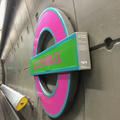 Michael Craig-Martin's 2016 roundel design
 -
 NO SMOKING signs using the roundel which are now present only on the 1972 stock trains of the Bakerloo line
 -
 Subway entrance to Piccadilly Circus tube station
 -
 Close up of sign at night


Architecture
[edit]Seventy of the 272 London Underground stations use buildings that are on the Statutory List of Buildings of Special Architectural or Historic Interest, and five have entrances in listed buildings.[294] The Metropolitan Railway's original seven stations were inspired by Italianate designs, with the platforms lit by daylight from above and by gas lights in large glass globes.[295] Early District Railway stations were similar and on both railways the further from central London the station the simpler the construction.[296] The City & South London Railway opened with red-brick buildings, designed by Thomas Phillips Figgis, topped with a lead-covered dome that contained the lift mechanism and weather vane (still visible at many stations, such as Clapham Common).[37][297] The Central London Railway appointed Harry Bell Measures as architect, who designed its pinkish-brown steel-framed buildings with larger entrances.[298]


In the first decade of the 20th century Leslie Green established a house style for the tube stations built by the UERL, which were clad in ox-blood faience blocks.[299] Green pioneered using building design to guide passengers with direction signs on tiled walls, with the stations given a unique identity with patterns on the platform walls.[300][301] Many of these tile patterns survive, though a significant number of these are now replicas.[302] Harry W. Ford was responsible for the design of at least 17 UERL and District Railway stations, including Barons Court and Embankment, and claimed to have first thought of enlarging the U and D in the UNDERGROUND wordmark.[303] The Met's architect Charles Walter Clark had used a neo-classical design for rebuilding Baker Street and Paddington Praed Street stations before the First World War and, although the fashion had changed, continued with Farringdon in 1923. The buildings had metal lettering attached to pale walls.[298] Clark would later design "Chiltern Court", the large, luxurious block of apartments at Baker Street, that opened in 1929.[304] In the 1920s and 1930s, Charles Holden designed a series of modernist and art-deco stations some of which he described as his 'brick boxes with concrete lids'.[305] Holden's design for the Underground's headquarters building at 55 Broadway included avant-garde sculptures by Jacob Epstein, Eric Gill and Henry Moore.[306][307]
When the Central line was extended east, the stations were simplified Holden proto-Brutalist designs,[308] and a cavernous concourse built at Gants Hill in honour of early Moscow Metro stations.[309] Few new stations were built in the 50 years after 1948, but Misha Black was appointed design consultant for the 1960s Victoria line, contributing to the line's uniform look,[310] with each station having an individual tile motif.[311] Notable stations from this period include Moor Park, the stations of the Piccadilly line extension to Heathrow and Hillingdon.
In recent years, the stations of the 1990s Jubilee Line Extension were designed in a high-tech style by architects such as Norman Foster and Michael Hopkins.[312] The project was critically acclaimed, with the Royal Fine Arts Commission describing the project as "an example of patronage at its best and most enlightened", and two stations shortlisted for the Stirling Prize.[313] Stations were built to the latest standards, future proofed for growth, with innovations such as Platform screen doors.[314] West Ham station was built as a homage to the red brick tube stations of the 1930s, using brick, concrete and glass.
Many platforms have unique interior designs to help passenger identification. The tiling at Baker Street incorporates repetitions of Sherlock Holmes's silhouette;[315] at Tottenham Court Road semi-abstract mosaics by Eduardo Paolozzi feature musical instruments, tape machines and butterflies;[316] and at Charing Cross, David Gentleman designed the mural depicting the construction of the Eleanor Cross.[37] Robyn Denny designed the murals on the Northern line platforms at Embankment.[315]
Johnston typeface
[edit]The first posters used various typefaces, as was contemporary practice,[317] and station signs used sans serif block capitals.[318] The Johnston typeface was developed in upper and lower case in 1916, and a complete set of blocks, marked Johnston Sans, was made by the printers the following year.[319] A bold version of the capitals was developed by Johnston in 1929.[320] The Metropolitan Railway changed to a serif letterform for its signs in the 1920s, used on the stations rebuilt by Clark.[321] Johnston was adopted systemwide after the formation of the LPTB in 1933 and the LT wordmark was applied to locomotives and carriages.[322] Johnston was redesigned, becoming New Johnston, for photo-typesetting in the early 1980s when Elichi Kono designed a range that included Light, Medium and Bold, each with its italic version. The typesetters P22 developed today's electronic version, sometimes called TfL Johnston, in 1997.[323]
Posters and patronage of the arts
[edit]
Early advertising posters used various typefaces.[324] Graphic posters first appeared in the 1890s,[325] and it became possible to print colour images economically in the early 20th century.[326] The Central London Railway used colour illustrations in their 1905 poster,[327] and from 1908 the Underground Group, under Pick's direction, used images of country scenes, shopping and major events on posters to encourage use of the tube.[328] Pick found he was limited by the commercial artists the printers used, and so commissioned work from artists and designers such as Dora Batty,[329] Edward McKnight Kauffer, the cartoonist George Morrow,[325] Herry (Heather) Perry,[329] Graham Sutherland,[325] Charles Sharland[330] and the sisters Anna and Doris Zinkeisen. According to Ruth Artmonsky, over 150 women artists were commissioned by Pick and latterly Christian Barman to design posters for London Underground, London Transport and London County Council Tramways.[331]
The Johnston Sans letter font began appearing on posters from 1917.[330] The Met, strongly independent, used images on timetables and on the cover of its Metro-land guide that promoted the country it served for the walker, visitor and later the house-hunter.[332][333] By the time London Transport was formed in 1933 the UERL was considered a patron of the arts[325] and over 1000 works were commissioned in the 1930s, such as the cartoon images of Charles Burton and Kauffer's later abstract cubist and surrealist images.[334] Harold Hutchison became London Transport publicity officer in 1947, after the Second World War and nationalisation, and introduced the "pair poster", where an image on a poster was paired with text on another. Numbers of commissions dropped, to eight a year in the 1950s and just four a year in the 1970s,[325] with images from artists such Harry Stevens and Tom Eckersley.[335]

Art on the Underground was launched in 2000 to revive London Underground as a patron of the arts.[336] Today, commissions range from the pocket Tube map cover, to temporary artworks, to large-scale permanent installations in stations.[337][336] Major commissions by Art on the Underground in recent years have included Labyrinth by the Turner Prize–winning artist Mark Wallinger, to mark the 150th anniversary of the Underground;[338] Diamonds and Circles, permanent works in situ by the French artist Daniel Buren at Tottenham Court Road;[339] and Beauty < Immortality, a memorial to Frank Pick by Langlands & Bell at Piccadilly Circus.[340]
Similarly, since 1986, Poems on the Underground has commissioned poetry that is displayed in trains.[341]
In popular culture
[edit] | This article appears to be slanted towards recent events. (May 2022) |
The Underground (including several fictitious stations[342]) has appeared in many movies and television shows, including Skyfall, Death Line, Die Another Day, Sliding Doors, An American Werewolf in London, Creep, Tube Tales, Sherlock and Neverwhere. The London Underground Film Office received over 200 requests to film in 2000.[343] The Underground has also featured in music such as the Jam's "Down in the Tube Station at Midnight" and in literature such as the graphic novel V for Vendetta. Popular legends about the Underground being haunted persist to this day.[344][user-generated source] In 2016, British composer Daniel Liam Glyn released his concept album Changing Stations based on the 11 main tube lines of the London Underground network.[345]
It has also served as the setting of several video games, including 2020 construction and management simulation game Overcrowd: A Commute 'Em Up, in which the player manages an underground station,[346][347] and Call of Duty: Modern Warfare 3, which has a single-player level named Mind The Gap where most of the level takes place between the dockyards and Westminster while the player and a team of SAS attempt to take down terrorists attempting to escape using the London Underground via a hijacked train. The game also features the multiplayer map "Underground", in which players are combating in a fictitious Underground station. The London Underground map serves as a playing field for the conceptual game of Mornington Crescent[348] (which is named after a station on the Northern line) and the board game The London Game.
In 1999, Carlton Television premiered a regional game show (Greater London area only) also called Mind the Gap.[349]
In 2023, social media influencer Sabrina Bahsoon created the viral '#TubeGirl' trend on TikTok, which involved Bahsoon and other users lip-syncing and dancing whilst on-board trains in the Underground network.[350][351]
Busking
[edit]The London Underground provides busking permits for up to 39 pitches across 25 central London stations, with over 100,000 hours of live music performed each year.[352] Performers are chosen by audition, with previous buskers including Ed Sheeran, George Michael and Rod Stewart.[353]
Notable people
[edit]- Harry Beck (1902–1974) designed the tube map, named in 2006 as a British design icon.[354]
- Hannah Dadds (1941–2011), the first female train driver on the London Underground.[355]
- John Fowler (1817–1898) was the railway engineer that designed the Metropolitan Railway.[356]
- MacDonald Gill (1884–1947), cartographer credited with drawing, in 1914, "the map that saved the London Underground".
- James Henry Greathead (1844–1896) was the engineer that dug the Tower Subway using a wrought iron shield patented by Peter W. Barlow, and later used the same tunnelling shield to build the deep-tube City & South London and Central London railways.[357][358]
- Edward Johnston (1872–1944) developed the Johnston Sans typeface, still in use today on the London Underground.[359]
- Charles Pearson (1793–1862) suggested an underground railway in London in 1845 and from 1854 promoted a scheme that eventually became the Metropolitan Railway.[360]
- Frank Pick (1878–1941) was UERL publicity officer from 1908, commercial manager from 1912 and joint managing director from 1928. He was chief executive and vice-chairman of the LPTB from 1933 to 1940. It was Pick that commissioned Edward Johnston to create the typeface and redesign the roundel, and established the Underground's reputation as patrons of the arts as users of the best in contemporary poster art and architecture.[361]
- Robert Selbie (1868–1930) was manager of the Metropolitan Railway from 1908 until his death, marketing it using the Metro-land brand.[359][362]
- Edgar Speyer (1862–1932) Financial backer of Yerkes who served as UERL chairman from 1906 to 1915 during its formative years.[363]
- Albert Stanley (1874–1948) was manager of the UERL from 1907, and became the first chairman of the London Passenger Transport Board (LPTB) in 1933.[364]
- Edward Watkin (1819–1901) was chairman of the Metropolitan Railway from 1872 to 1894.[365]
- Charles Yerkes (1837–1905) was an American who founded the Underground Electric Railways Company of London (UERL) in 1902, which opened three tube lines and electrified the District Railway.[366][367]
See also
[edit]
References
[edit]Citations
[edit]- ^ a b c d e f "About TfL – What we do – London Underground – Facts & figures". Transport for London. Archived from the original on 27 September 2014. Retrieved 17 June 2014.
- ^ a b c Transport for London (4 February 2023). "Public Transport Journeys by Type of Transport". London Datastore. Archived from the original on 22 March 2023. Retrieved 22 March 2023.
- ^ "National Rail Enquiries – London Underground". www.nationalrail.co.uk. Archived from the original on 10 May 2021. Retrieved 21 April 2021.
- ^ Transport for London (29 July 2019). "Facts & figures". Archived from the original on 27 September 2014. Retrieved 18 June 2014.
- ^ "An overview of the British rail industry" (PDF). Office of Rail and Road. 19 December 2014. Archived (PDF) from the original on 3 April 2016. Retrieved 5 January 2017.
- ^ Lee, Charles E (1973). The Metropolitan Line. London: London Transport. p. 7. ISBN 0-85329 033 4.
- ^ "London Underground". Britannica. Archived from the original on 29 May 2025. Retrieved 8 September 2025.
- ^ Wolmar (2004), p. 135.
- ^ a b c Attwooll, Jolyon (5 August 2015). "London Underground: 150 fascinating Tube facts". The Daily Telegraph. London. Archived from the original on 11 January 2022.
- ^ May, Jack (31 March 2017). "Why are there so few tube lines in South London?". City Monitor. Archived from the original on 10 May 2021. Retrieved 10 October 2019.
- ^ "Daily Ridership". Transport for London. Archived from the original on 24 January 2017. Retrieved 22 July 2016.
- ^ a b Croome & Jackson (1993), Preface.
- ^ "Annual Report and Statement of Accounts 2011/12" (PDF). Transport for London. pp. 98, 100. Archived (PDF) from the original on 20 December 2015. Retrieved 25 October 2015.
Fares revenue on LU was £2,410m... Operating expenditure on the Underground increased to £2,630m
- ^ "Annual Report and Statement of Accounts 2011/12" (PDF). TfL. p. 11. Archived (PDF) from the original on 20 December 2015. Retrieved 25 October 2015.
- ^ a b "Contactless payment on London Underground" (Press release). Transport for London. 9 September 2014. Archived from the original on 10 May 2021. Retrieved 20 November 2017.
- ^ a b c "Licencing London's contactless ticketing system" (Press release). Transport for London. 13 July 2016. Archived from the original on 1 December 2017. Retrieved 20 November 2017.
- ^ "Design in Relation to the Problem: The London Underground". Commercial Art & Industry: 38–59. 1932. Archived from the original on 15 May 2021. Retrieved 21 November 2017.
- ^ Sagittarius (1928). "Celebrities of Advertising II: Frank Pick". Commercial Art & Industry: 168–9. Archived from the original on 1 December 2017. Retrieved 21 November 2017.
- ^ Barman, Christian (1948). "Frank Pick and his Influence on Design in England". Graphis: 70–73. Archived from the original on 15 May 2021. Retrieved 21 November 2017.
- ^ Peacock (1970), pp. 37–38.
- ^ Day & Reed (2010), p. 8.
- ^ Jackson (1986), p. 19.
- ^ Bextor, Robin (2013). A History of the London Underground. Demand Media Limited. p. 34. ISBN 978-1909217379.
- ^ Day & Reed (2010), pp. 8, 14.
- ^ Simpson (2003), p. 16.
- ^ Day & Reed (2010), pp. 18–24.
- ^ Day & Reed (2010), pp. 27–28.
- ^ Day & Reed (2010), pp. 10–11.
- ^ a b Day & Reed (2010), p. 26.
- ^ Day & Reed (2010), p. 33.
- ^ Day & Reed (2010), p. 32.
- ^ Day & Reed (2010), pp. 40–45.
- ^ Day & Reed (2010), pp. 50–51.
- ^ Day & Reed (2010), pp. 52–56.
- ^ Day & Reed (2010), pp. 50, 53.
- ^ Day & Reed (2010), pp. 60–61.
- ^ a b c d e f Ackroyd, P. (2012). London Under. London: Vintage Books. ISBN 978-0-099-28737-7
- ^ Mason, M. (2013). Walk the Lines: The London Underground, Overground. London: Arrow Books. p.126. ISBN 978-0-099-55793-7
- ^ a b Emmerson, Andrew (2010). The London Underground. London: Shire Publications Ltd. ISBN 978-0-74780-790-2.
- ^ Day & Reed (2010), pp. 62–63.
- ^ Day & Reed (2010), pp. 69–72, 78.
- ^ a b Green (1987), p. 30.
- ^ Green (1987), pp. 24–28.
- ^ Wolmar 2004, p. 204.
- ^ Wolmar 2004, p. 205.
- ^ Horne (2003), p. 51.
- ^ Green (1987), p. 35.
- ^ Green (1987), p. 33.
- ^ Day & Reed (2010), p. 94.
- ^ a b c Day & Reed (2010), p. 122.
- ^ Day & Reed (2010), pp. 84–88.
- ^ Jackson (1986), pp. 134, 137.
- ^ Day & Reed (2010), p. 98–103, 111.
- ^ Day & Reed (2010), p. 110.
- ^ a b "Waterloo & City Line". Clive's Underground Line Guides. Clive Feather. 14 December 2007. Archived from the original on 12 April 2015. Retrieved 11 June 2015.
- ^ Green (1987), p. 46.
- ^ Day & Reed (2010), p. 118.
- ^ Day & Reed (2010), p. 116.
- ^ Day & Reed (2010), pp. 131, 133–134.
- ^ Horne (2006), p. 73.
- ^ Day & Reed (2010), pp. 144–145.
- ^ Day & Reed (2010), pp. 135–136.
- ^ "Tribute to Bank Tube station bomb victims of 1941". BBC London News. 11 January 2011. Archived from the original on 15 August 2021. Retrieved 15 August 2021.
- ^ "Bethnal Green Tube disaster marked 70 years on". BBC News. 3 March 2013. Archived from the original on 6 March 2013. Retrieved 11 June 2015.
- ^ Day & Reed 2008, p. 150.
- ^ a b Cooke 1964, p. 739.
- ^ Green (1987), p. 54.
- ^ Green (1987), pp. 56–57.
- ^ Green (1987), p. 56.
- ^ Day & Reed 2008, p. 163.
- ^ Day & Reed (2010), pp. 160–162, 166–168, 171.
- ^ Day & Reed 2008, p. 172.
- ^ "In Living Memory, Series 11: The 1975 Moorgate tube disaster". BBC Radio 4. 2 December 2009. Archived from the original on 4 February 2023. Retrieved 26 January 2012.
- ^ Green (1987), pp. 55–56.
- ^ Day & Reed (2010), pp. 178–181.
- ^ Green (1987), pp. 65–66.
- ^ Day & Reed (2010), pp. 186–187.
- ^ Croome & Jackson (1993), p. 468.
- ^ Fennell 1988, pp. 17–18.
- ^ "Kings Cross Tragedy Means Safety First For London Underground". London Transport. 21 October 1997. Archived from the original on 12 February 1998. Retrieved 14 August 2021.
- ^ Day & Reed (2010), pp. 206–211.
- ^ "Elizabeth Line "more mannered" than Jubilee predecessor says head of architecture". Dezeen. 10 May 2022. Archived from the original on 8 August 2022. Retrieved 8 August 2022.
- ^ "Chief Officers". Transport for London. Archived from the original on 22 January 2014.
- ^ "About TfL – How we work – How we are governed – Subsidiary companies". Transport for London. Archived from the original on 11 March 2015. Retrieved 17 June 2014.
- ^ "A brief history of the Underground – London Underground milestones". Transport for London. Archived from the original on 19 August 2014. Retrieved 6 June 2014.
- ^ Day & Reed (2010), pp. 215, 221.
- ^ "Circle Line extended to the west". BBC News. 5 March 2009. Archived from the original on 10 March 2009. Retrieved 24 November 2011.
- ^ "More than 50 killed in blasts". The Guardian. London. 8 July 2005. Archived from the original on 8 August 2022. Retrieved 8 August 2022.
- ^ Day & Reed (2010), p. 216.
- ^ Topham, Gwyn (16 September 2014). "London tube introduces contactless payments". The Guardian. London. Archived from the original on 10 May 2021. Retrieved 8 August 2022.
- ^ "Services - 541858-2020 - TED Tenders Electronic Daily". ted.europa.eu. Archived from the original on 8 August 2022. Retrieved 8 August 2022.
The Transport for London (TfL) Revenue Collection System collects in excess of GBP 5billion of revenue per annum (before Covid-19). Supporting transactions generated from over 16 million journeys per day, 0.5 million retail sales per day and in the last year 12 million Oyster and 35 million contactless payment card used to make journeys.
- ^ "London 2012: Games bring record London Underground users". BBC News. 4 August 2012. Archived from the original on 8 August 2022. Retrieved 8 August 2022.
- ^ "London Underground breaks the record again for busiest day ever on the Tube" (Press release). Transport for London. 9 December 2015. Archived from the original on 8 August 2022. Retrieved 8 August 2022.
- ^ "London Underground: 150 years". ITV News. 10 January 2013. Archived from the original on 8 August 2022. Retrieved 8 August 2022.
- ^ a b Rose (2007).
- ^ "East London line officially opens". BBC News. 27 April 2010. Archived from the original on 18 April 2015. Retrieved 2 April 2010.
- ^ a b c "Elizabeth line: What is Crossrail and when does it open?". BBC News. 24 May 2022. Archived from the original on 26 August 2022. Retrieved 8 August 2022.
- ^ "Elizabeth line: almost 50 years in the planning for Crossrail – timeline". The Guardian. 20 May 2022. Archived from the original on 10 January 2023. Retrieved 10 January 2023.
Proposals for east-west train route across London, first mooted in 1974, inspired by Paris RER
- ^ a b "Elizabeth line: Crossrail complete after decades of struggle". The Guardian. 23 May 2022. Archived from the original on 10 January 2023. Retrieved 10 January 2023.
- ^ "Coronavirus: 40 London Underground stations to be closed". BBC News. 19 March 2020. Archived from the original on 29 June 2021. Retrieved 11 February 2021.
- ^ "London Underground: Nine Elms and Battersea Power Station set to open". BBC News. 3 September 2021. Archived from the original on 5 September 2021. Retrieved 5 September 2021.
- ^ "Northern line extension". Transport for London. 2019. Archived from the original on 29 July 2019. Retrieved 26 January 2016.
- ^ "Northern Line extension: Two new Tube stations open". BBC News. 20 September 2021. Archived from the original on 20 September 2021. Retrieved 20 September 2021.
- ^ Attwooll, Jolyon (25 January 2018). "150 London Underground facts (including the birth of Jerry Springer in East Finchley station)". The Telegraph. London. Archived from the original on 11 January 2022. Retrieved 28 April 2020.
- ^ "East London Line opens to public". BBC. 27 April 2010. Archived from the original on 18 April 2015. Retrieved 8 June 2016.
- ^ a b "Detailed London Transport Map". cartometro.com. Archived from the original on 28 July 2020. Retrieved 1 December 2012.
- ^ Croome & Jackson (1993), pp. 26, 33, 38, 81.
- ^ Croome & Jackson (1993), pp. 327–328.
- ^ Martin, Andrew (26 April 2012). Underground, Overground: A Passenger's History of the Tube. London: Profile Books. pp. 137–138. ISBN 978-1-84765-807-4. Archived from the original on 19 January 2023. Retrieved 7 December 2012.
- ^ "Which London Underground line is the fastest?". 18 September 2017. Archived from the original on 15 May 2021. Retrieved 21 April 2021.
- ^ London Underground. "Standard Tube Map" (PDF). Transport for London. Archived (PDF) from the original on 25 June 2017. Retrieved 1 December 2017.
- ^ "Rolling Origin & Destination Survey (RODS)". Archived from the original on 4 November 2019. Retrieved 11 April 2019.
- ^ "Up to date per line London Underground usage statistics". TheyWorkForYou. 29 April 2018. Archived from the original on 2 July 2020. Retrieved 29 April 2018.
- ^ Horne (2006), pp. 13, 24.
- ^ Ovenden (2013), p. 220.
- ^ a b c "Commissioner's Report" (PDF). Transport for London. 26 March 2014. pp. 3–4. Archived (PDF) from the original on 10 October 2022. Retrieved 2 April 2014.
- ^ "Piccadilly Underground line – Transport for London". Transport for London. Archived from the original on 26 May 2021. Retrieved 17 March 2021.
- ^ Neil, Graham (4 August 2015). "London Underground Rolling Stock Information Sheet" (PDF). WhatDoTheyKnow. Archived (PDF) from the original on 5 May 2016. Retrieved 17 April 2016.
- ^ a b c d e f g h i j k l m Brown (2012).
- ^ Table 115 National Rail timetable, May 13
- ^ a b Section 10 - Network Rail, London Underground - Individual Working Alone, [1] Archived 4 February 2023 at the Wayback Machine
- ^ Maund, Richard (2013). Passenger Train Services over Unusual Lines Archived 1 July 2013 at the Wayback Machine.
- ^ Peacock (1970), p. 67.
- ^ Maund, Richard. "Passenger Train Services over Unusual Lines". Archived from the original on 22 October 2021. Retrieved 22 October 2021.
Point Pleasant Junction – East Putney
- ^ "Rolling Stock". Transport for London. Archived from the original on 19 May 2014. Retrieved 18 June 2014.
- ^ Day & Reed (2010), p. 159.
- ^ Day & Reed (2010), p. 205.
- ^ "Rolling Stock Data Sheet" (PDF). Transport for London. March 2007. Archived (PDF) from the original on 4 October 2013.
- ^ a b Connor, Piers (January 2013). "Deep tube transformation". Modern Railways. pp. 44–47.
- ^ a b "Making transport more accessible to all". Department for Transport. 3 October 2012. Archived from the original on 17 September 2013. Retrieved 17 March 2013.
- ^ Hardy (2002), p. 6.
- ^ "New Tickets Released for Hidden London tours". London Transport Museum. 25 January 2023. Archived from the original on 5 November 2023. Retrieved 15 February 2023.
- ^ "New consultation on Bakerloo line extension opens today". Transport for London. 14 October 2019. Archived from the original on 26 October 2022. Retrieved 2 April 2021.
- ^ "Bakerloo line extension Background to Consultation Summary Report October 2019" (PDF). Transport for London. October 2019. Archived (PDF) from the original on 24 March 2020. Retrieved 15 March 2021.
- ^ "Planning for the Future – Bakerloo line extension". Transport for London. Archived from the original on 29 September 2015. Retrieved 15 March 2021.
- ^ Henderson, Jamie (23 June 2013). "Clapham Junction next for Northern Line says London Assembly member". Wandsworth Guardian. Archived from the original on 24 December 2013. Retrieved 12 January 2014.
- ^ "Metropolitan line extension". Transport for London. Archived from the original on 17 July 2017. Retrieved 17 July 2017.
- ^ Smith, Rebecca (8 February 2018). "Metropolitan Line extension stalemate between mayor Sadiq Khan and government leaves TFL mulling bus scheme alternative". City AM. Archived from the original on 18 February 2019. Retrieved 26 October 2022.
- ^ Smale, Katherine (11 April 2019). "Canary Wharf Group in talks about rail link to Euston". New Civil Engineer. Archived from the original on 13 April 2019. Retrieved 25 April 2019.
- ^ "Harlow's addition to London Underground proposed by council". BBC News. 11 August 2021. Archived from the original on 25 March 2023. Retrieved 26 March 2023.
- ^ a b c d "New Tube for London Feasibility Report" (PDF). TfL. October 2014. Archived from the original (PDF) on 26 June 2015. Retrieved 25 June 2015.
- ^ "Bakerloo Line Fleet Life Extension" (PDF). TfL. 11 March 2015. Archived (PDF) from the original on 26 June 2015. Retrieved 25 June 2015.
- ^ "Central line train overhaul project" (PDF). TfL. Archived (PDF) from the original on 26 June 2015. Retrieved 25 June 2015.
- ^ "Central line timetable" (PDF). TfL. Archived from the original (PDF) on 15 April 2014. Retrieved 25 June 2015.
- ^ "Jubilee line 36tph upgrade" (PDF). TfL. Archived (PDF) from the original on 20 April 2015. Retrieved 25 June 2015.
- ^ a b "LU to source additional Tube trains" (Press release). TfL. 18 August 2014. Archived from the original on 26 June 2015. Retrieved 25 June 2015.
- ^ "Information on the Northern Line upgrade" (PDF). railway-technical. Archived from the original (PDF) on 30 August 2015. Retrieved 25 June 2015.
- ^ "Major works to improve Victoria line services this summer" (Press release). TfL. 17 February 2015. Archived from the original on 24 May 2015. Retrieved 25 June 2015.
- ^ Barnes, Tom (13 May 2016). "All Victoria Line trains to run 'end to end' for first time". East London and West Essex Guardian Series. Watford. Archived from the original on 10 May 2021. Retrieved 21 April 2021.
- ^ "Tube Improvements". TfL. n.d. Archived from the original on 11 July 2015. Retrieved 25 June 2015.
- ^ "Third Time Lucky: A Look At The New Sub-Surface Signalling Plan". London Reconnections. 15 June 2015. Archived from the original on 26 June 2015. Retrieved 25 June 2015.
- ^ "SSR Signalling contract" (PDF). TfL. Archived (PDF) from the original on 26 June 2015. Retrieved 25 June 2015.
- ^ "LU begins search for new Jubilee and Northern line train supplier". www.railtechnologymagazine.com. Archived from the original on 3 August 2020. Retrieved 5 October 2019.
- ^ "Picadilly Line Upgrade". TFL. Retrieved 30 July 2025.
- ^ "London Waterloo plan to 'transform' railway station". BBC News. 12 March 2024. Archived from the original on 13 May 2025. Retrieved 30 July 2025.
- ^ a b "New Tube for London Programme" (PDF). Board Minutes. Transport for London. 5 February 2014. Archived (PDF) from the original on 7 April 2014. Retrieved 3 April 2014.
- ^ a b "New Tube for London Programme". Railway Gazette. 28 February 2014. Archived from the original on 10 March 2014. Retrieved 3 April 2014.
- ^ "Design for the 'New Tube for London' revealed" (Press release). TfL. 9 October 2014. Archived from the original on 15 May 2021. Retrieved 9 October 2014.
- ^ "New Tube for London Programme". BBC News. 9 October 2014. Archived from the original on 20 June 2021. Retrieved 9 October 2014.
- ^ "TfL prepares for driverless tube". Railnews. 28 February 2014. Archived from the original on 6 April 2014. Retrieved 3 April 2014.
- ^ "Driverless Tube trains: Unions vow 'war' over plan". BBC News. 28 February 2014. Archived from the original on 30 April 2014. Retrieved 3 April 2014.
- ^ "New Tube for London invitations to tender issued". Railway Gazette. 18 January 2016. Archived from the original on 4 July 2018. Retrieved 14 November 2016.
- ^ "Khan: New Piccadilly rolling stock will be delivered by 2023". Rail Technology Magazine. 20 December 2016. Archived from the original on 15 May 2021. Retrieved 18 January 2018.
- ^ "East Yorkshire factory wins £1.5bn Tube train deal". BBC News. 15 June 2018. Archived from the original on 10 May 2021. Retrieved 15 June 2018.
- ^ a b c Croome & Jackson (1993), pp. 253–254.
- ^ Griffiths, Emma (18 July 2006). "Baking hot at Baker Street". BBC News. Archived from the original on 1 January 2016. Retrieved 31 March 2013.
- ^ "London's Tube 'unfit for animals'". The Daily Telegraph. London. 28 August 2002. Archived from the original on 11 January 2022. Retrieved 31 March 2013.
- ^ Croxford, Ben (4 December 2003). "Environmental Quality in Underground Railways". University College London. Archived from the original on 16 October 2013. Retrieved 5 November 2013.
- ^ Murray, Dick (23 August 2002). "Passengers choke on the Tube". London Evening Standard. Archived from the original on 8 November 2020. Retrieved 31 March 2013.
- ^ Westgate, Stuart; Gilby, Mark (8 May 2007). "Meeting Report: Cooling the tube" (PDF). LURS. Archived (PDF) from the original on 5 October 2013. Retrieved 31 March 2013.
- ^ "Water pump plan to cool the Tube". BBC News. 8 June 2006. Archived from the original on 6 July 2006. Retrieved 31 March 2013.
- ^ "Work begins to cool the platforms at two major central London stations" (Press release). Transport for London. 17 February 2012. Archived from the original on 27 March 2014. Retrieved 27 March 2014.
- ^ Abbott, James (January 2013). "Sub-surface renewal". Modern Railways. pp. 38–41.
- ^ "Improving the Tube – What we're doing – Improving the trains". Transport for London. Archived from the original on 15 August 2021. Retrieved 21 August 2021.
- ^ Demartini, L. C.; Vielmo, H. A.; Möller, S. V. (2004). "Numeric and experimental analysis of the turbulent flow through a channel with baffle plates". Journal of the Brazilian Society of Mechanical Sciences and Engineering. 26 (2): 153–159. doi:10.1590/S1678-58782004000200006. hdl:10183/75781. ISSN 1678-5878.
- ^ Finnis, Alex (10 January 2019). "One hour on the tube is as toxic as standing next to a busy road for an entire day". iNews.
- ^ Oglesby, Kate (12 January 2019). "Dust and air pollution higher on Northern Line than any other part of the Underground". The Times.
- ^ Croome & Jackson (1993), pp. 26, 35, 39, 87–89.
- ^ Croome & Jackson (1993), p. 540.
- ^ a b c Croome & Jackson (1993), pp. 114, 542.
- ^ Day & Reed (2010), p. 59.
- ^ Croome & Jackson (1993), pp. 154, 546.
- ^ Malvern, Jack (21 October 2009). "Mystery over Tube escalator etiquette cleared up by restored film". The Times. London. Archived from the original on 15 June 2011. Retrieved 9 December 2009.(subscription required)
- ^ Day & Reed (2010), p. 93.
- ^ "Pioneers of Survival: Fire". PBS. Archived from the original on 9 June 2021. Retrieved 4 September 2017.
- ^ "Incline lift at Greenford Tube station is UK first". Transport for London. 20 October 2015. Archived from the original on 29 June 2016. Retrieved 21 October 2015.
- ^ "Facts & figures". Transport for London. Archived from the original on 17 February 2017. Retrieved 20 November 2017.
- ^ "Improvements and Projects – Step-free access". Transport for London. Archived from the original on 10 May 2021. Retrieved 19 November 2017.
- ^ "London Underground Advertising | All Products & Formats". 31 December 2022. Retrieved 8 January 2023.
- ^ "Virgin Media extends free wi-fi on London Underground until 2013". Metro. London. 17 October 2012. Archived from the original on 20 November 2012. Retrieved 10 November 2012.
- ^ "Station Wifi". Transport for London. Archived from the original on 25 February 2013. Retrieved 12 March 2013.
- ^ Mulholland, Hélène (1 April 2011). "Plans for mobile network on London underground shelved". The Guardian. London. Archived from the original on 23 May 2021. Retrieved 1 April 2013.
- ^ "4G on Jubilee line tunnel section from March 2020". Transport for London (Press release). Archived from the original on 10 May 2021. Retrieved 3 August 2020.
- ^ Jackson, Mark (17 June 2021). "Vodafone UK Quietly Scrap London Underground WiFi Support". ISPreview UK. Archived from the original on 19 August 2023. Retrieved 19 August 2023.
- ^ Mansfield, Ian (17 June 2021). "Vodafone drops WiFi coverage from the London Underground". ianVisits. Archived from the original on 19 August 2023. Retrieved 19 August 2023.
- ^ Jackson, Mark (3 April 2023). "Vodafone UK Reintroduced Public WiFi to London Underground". ISPreview UK. Archived from the original on 19 August 2023. Retrieved 19 August 2023.
- ^ Transport for London (21 December 2022). "Three more London Underground stations begin offering high-speed mobile coverage to customers". Transport for London. Archived from the original on 19 August 2023. Retrieved 19 August 2023.
- ^ Jackson, Mark (21 December 2022). "EE and Vodafone UK Extend 4G Mobile to 6 New London Underground Stations". ISPreview UK. Archived from the original on 19 August 2023. Retrieved 19 August 2023.
- ^ a b "London Underground mobile connectivity map". mastdatabase.co.uk. Archived from the original on 19 August 2023. Retrieved 19 August 2023.
- ^ Mansfield, Ian (20 June 2023). "London Underground expands mobile phone coverage to Mornington Crescent station". ianVisits. Archived from the original on 19 August 2023. Retrieved 19 August 2023.
- ^ a b c Mansfield, Ian (8 September 2023). "London Underground expands mobile phone coverage and confirms Elizabeth line coming soon". ianVisits. Archived from the original on 15 December 2023. Retrieved 15 December 2023.
- ^ "Mobile phones and Wi-Fi underground". Transport for London. Archived from the original on 9 January 2024. Retrieved 9 January 2024.
- ^ a b c "Tube Map 4g - 5g Feb 2024" (PDF). Transport for london. February 2024. Archived from the original (PDF) on 12 March 2024. Retrieved 12 March 2024.
- ^ "TfL Statement of Accounts" (PDF). Archived (PDF) from the original on 15 August 2024. Retrieved 15 August 2024.
- ^ a b "London Rail & Tube Services Map" (PDF). Transport for London. May 2014. Archived (PDF) from the original on 3 July 2014. Retrieved 18 June 2014.
- ^ "Fares & payments – Contactless". Transport for London. Archived from the original on 12 March 2016. Retrieved 11 March 2016.
- ^ a b "TfL to accept Apple Pay on public transport" (Press release). Transport for London. Archived from the original on 10 May 2021. Retrieved 20 November 2017.
- ^ a b "Android Pay accepted for pay as you go travel in London" (Press release). Transport for London. Archived from the original on 10 May 2021. Retrieved 20 November 2017.
- ^ "Fares & payments – Contactless – Apple Pay". Transport for London. Archived from the original on 13 April 2016. Retrieved 11 March 2016.
- ^ "Where can I buy my ticket?" (PDF). Transport for London. January 2012. Archived from the original (PDF) on 1 April 2014. Retrieved 18 June 2014.
- ^ "Fares & payments – Fares – Tube, DLR and London Overground". Transport for London. Archived from the original on 21 June 2014. Retrieved 18 June 2014.
- ^ "Fares & payments – Ticket types". Transport for London. Archived from the original on 27 March 2014. Retrieved 18 June 2014.
- ^ "Travelcards make way for 'oyster'". BBC News. 30 June 2003. Archived from the original on 15 February 2009. Retrieved 7 March 2012.
- ^ "Getting around with Oyster" (PDF). Transport for London. January 2010. Archived (PDF) from the original on 26 September 2012.
- ^ "Fares & payments – Oyster – Using your Oyster card – Capping". Transport for London. Archived from the original on 12 June 2014. Retrieved 18 June 2014.
- ^ "Fares & payments – Oyster – Using your Oyster card – Incomplete journeys". Transport for London. Archived from the original on 5 June 2014. Retrieved 18 June 2014.
- ^ Murray, Dick (7 March 2012). "The £66.5million cost of not touching out your Oyster card". London Evening Standard. Archived from the original on 27 March 2014. Retrieved 30 March 2013.
- ^ "London's contactless fares system to power New York's subway, bus and rail journeys". MayorWatch. 25 October 2017. Archived from the original on 18 September 2020. Retrieved 20 November 2017.
- ^ Barron, James (23 October 2017). "New York to Replace MetroCard With Modern Way to Pay Transit Fares". The New York Times. ISSN 0362-4331. Archived from the original on 23 October 2017. Retrieved 20 November 2017.
- ^ "The MBTA has a $723 million plan to change the way you pay for rides". The Boston Globe. Archived from the original on 10 May 2021. Retrieved 20 November 2017.
- ^ "Freedom Pass". London Councils. Archived from the original on 19 March 2013. Retrieved 30 March 2013.
- ^ "Freedom Pass age change" (PDF). London Councils. November 2011. Archived from the original (PDF) on 1 September 2012. Retrieved 30 March 2013.
- ^ "Freedom Pass Map" (PDF). London Councils. December 2012. Archived from the original (PDF) on 25 May 2013. Retrieved 30 March 2013.
- ^ "Freedom passes". London Borough of Hammersmith & Fulham. 17 November 2010. Archived from the original on 13 May 2006. Retrieved 4 February 2011.
- ^ "Revenue Enforcement and Prosecutions Policy" (PDF). Transport for London. 18 August 2014. Archived from the original (PDF) on 17 November 2015. Retrieved 16 November 2015.
- ^ "Penalties & enforcement". Transport for London. Archived from the original on 1 January 2016. Retrieved 16 November 2015.
- ^ a b "Later London Underground service being considered". BBC News. 30 January 2013. Archived from the original on 10 May 2021. Retrieved 1 April 2013.
- ^ Beard, Matthew (30 January 2013). "Party on, London... Tube will run an hour later on Fridays and Saturdays". London Evening Standard. Archived from the original on 10 May 2021. Retrieved 1 April 2013.
- ^ a b "Transport in London over Christmas and New Year's Eve". Time Out London. Archived from the original on 10 February 2013. Retrieved 1 April 2013.
- ^ "London 2012 Olympics: Tube to shut hour later, TfL says". BBC News. 30 March 2011. Archived from the original on 10 May 2021. Retrieved 1 April 2013.
- ^ "Planned Works Calendar". Transport for London. 2013. Archived from the original on 31 March 2013. Retrieved 1 April 2013.
- ^ "London Tube strike on Boxing Day". BBC News. 17 December 2012. Archived from the original on 7 June 2021. Retrieved 1 April 2013.
- ^ "Night Tube services to start in August". BBC News. 23 May 2016. Archived from the original on 11 June 2021. Retrieved 23 May 2016.
- ^ "Night Tube start date postponed as talks continue". Sky News. 27 August 2015. Archived from the original on 29 August 2015. Retrieved 27 August 2015.
- ^ Topham, Gwyn (21 November 2013). "London tube to run all night at weekends but 750 jobs to go". The Guardian. London. Archived from the original on 10 May 2021. Retrieved 21 November 2013.
- ^ "The Night Tube". Transport for London. Archived from the original on 15 May 2021. Retrieved 21 April 2021.
- ^ "Coronavirus: London cuts Tube trains and warns 'don't travel unless you really have to'". Sky News. 19 March 2020. Archived from the original on 21 March 2020. Retrieved 17 April 2020.
- ^ "Full Night Tube service restored for the first time since the start of the pandemic" (Press release). Transport for London. 28 July 2022. Archived from the original on 30 November 2022. Retrieved 31 August 2024.
- ^ Cathcart-Keays, Athlyn (29 October 2014). "Disabled man takes on Tube challenge". The Guardian. Archived from the original on 10 May 2021. Retrieved 20 November 2018.
- ^ "The London Underground – An accessible future?". disability horizons. 24 July 2011. Archived from the original on 1 May 2013. Retrieved 20 April 2013.
- ^ LA Transport Committee (2010), p. 11.
- ^ LA Transport Committee (2010), p. 9.
- ^ "Step-free Tube Guide" (PDF). Transport for London. December 2023. Archived (PDF) from the original on 10 October 2015. Retrieved 8 February 2024.
- ^ "Transport accessibility – Wheelchair access & avoiding stairs". Transport for London. Archived from the original on 21 June 2014. Retrieved 18 June 2014.
- ^ Lydall, Ross (28 April 2025). "Revamped Tube station for visitors to Harvey Nichols, Harrods and Hyde Park". The Standard. Archived from the original on 28 April 2025. Retrieved 28 April 2025.
- ^ "Step-free access". Transport for London. Archived from the original on 5 February 2015. Retrieved 26 February 2020.
- ^ a b TfL (2012), p. 18.
- ^ LA Transport Committee (2009), p. 55.
- ^ "Overcrowding on Public Transport" (PDF). House of Commons Transport Committee. 17 September 2003. p. 17. Archived from the original (PDF) on 24 February 2021. Retrieved 2 April 2013.
- ^ LA Transport Committee (2009), p. 12.
- ^ LA Transport Committee (2009), p. 13.
- ^ LA Transport Committee (2011), pp. 22–23.
- ^ LA Transport Committee (2011), pp. 12–13.
- ^ "Fares & payments – Replacements & refunds – Charter refunds". Transport for London. Archived from the original on 27 March 2014. Retrieved 18 June 2014.
- ^ "London Underground: Millions not claiming Tube refund". BBC News. 9 March 2011. Archived from the original on 14 May 2021. Retrieved 21 June 2018.
- ^ Booth, Nick (11 August 2011). "Apps that help you get money back on Delays". City AM. London. Archived from the original on 3 July 2013. Retrieved 2 April 2013.
- ^ "Quarterly Health, Safety and Environment Performance Reports – Quarter 3, 2012/13" (PDF). Transport for London: Safety and Sustainability Panel. 19 March 2013. Archived from the original (PDF) on 11 April 2013. Retrieved 19 April 2013.
- ^ "Quarterly Health, Safety and Environment Performance Reports – Quarter 4, 2011/12" (PDF). Transport for London: Safety and Sustainability Panel. 10 July 2012. Archived from the original (PDF) on 17 August 2012. Retrieved 19 April 2013.
- ^ "TfL HSE Report 14/15" (PDF). Transport for London. Archived (PDF) from the original on 8 December 2015. Retrieved 1 December 2015.
- ^ Stevens, Michelle (18 January 2010). "Mock tube station gives London Underground staff real-life training". Chartered Institute of Personnel and Development. Retrieved 15 August 2024.
- ^ "Tube suicides rise 74% over last 10 years". Metro. London. 10 November 2011. Archived from the original on 6 May 2013. Retrieved 19 April 2013.
- ^ Coats, T. J.; Walter, D. P. (9 October 1999). "Effect of station design on death in the London Underground: observational study". British Medical Journal. 319 (7215). British Medical Association: 957. doi:10.1136/bmj.319.7215.957. PMC 28249. PMID 10514158. Archived from the original on 22 May 2006. Retrieved 11 July 2008.
- ^ Croome & Jackson (1993), p. 158.
- ^ "Pit falls halve tube deaths". BBC News. 8 October 1999. Archived from the original on 14 February 2009. Retrieved 20 April 2013.
- ^ "Fastest time to travel to all London Underground stations". Guinness World Records. Archived from the original on 4 March 2016. Retrieved 2 October 2021.
- ^ Ovenden (2013), pp. 21, 28–30.
- ^ Ovenden (2013), p. 51.
- ^ Ovenden (2013), pp. 52–53, 56.
- ^ Ovenden (2013), p. 93.
- ^ Ovenden (2013), p. 91.
- ^ Ovenden (2013), p. 142.
- ^ Kent, Alexander J. (1 February 2021). "When Topology Trumped Topography: Celebrating 90 Years of Beck's Underground Map". The Cartographic Journal. 58 (1): 1–12. Bibcode:2021CartJ..58....1K. doi:10.1080/00087041.2021.1953765. S2CID 236970579.
- ^ "Design Classics: Harry Beck". Transport for London. Archived from the original on 16 March 2011. Retrieved 27 March 2014.
- ^ Ovenden (2013), pp. 152–153, 168–169.
- ^ "Standard Tube Map" (PDF). Transport for London. December 2013. Archived (PDF) from the original on 26 September 2015. Retrieved 26 March 2014.
- ^ "Tube map voted a UK design icon" (Press release). Transport for London. 3 March 2006. Archived from the original on 27 June 2012.
- ^ Brown, Matt (9 January 2013). "London underground's 150th birthday celebrated in Google doodle". The Guardian. London. Archived from the original on 10 May 2021. Retrieved 9 January 2013.
- ^ "Google Doodle Marks 150 Years Of The London Underground". Londonist. 9 January 2013. Archived from the original on 14 January 2013. Retrieved 9 January 2013.
- ^ "Ten years of artists' tube map covers – in pictures". The Guardian. 2 May 2014. ISSN 0261-3077. Archived from the original on 10 May 2021. Retrieved 23 March 2021.
- ^ "History of the roundel". London Transport Museum. Archived from the original on 24 August 2012. Retrieved 12 April 2013.
- ^ Ovenden (2013), pp. 86–88.
- ^ Ovenden (2013), p. 67.
- ^ Ovenden (2013), pp. 112–113.
- ^ Ovenden (2013), pp. 126–127.
- ^ Ovenden (2013), pp. 155, 186.
- ^ Ovenden (2013), pp. 206, 218, 226.
- ^ "Interchange signs standard" (PDF). Transport for London. January 2009. Sections 3–7. Archived from the original (PDF) on 21 August 2012.
- ^ Bull, John (January 2009). "Crossrail Gets Its Roundel". London Reconnections. Archived from the original on 15 March 2013. Retrieved 12 April 2013.
- ^ "100 artists celebrate 100 years of Tube logo" (Press release). Transport for London. 4 September 2008. Archived from the original on 12 April 2013.
- ^ "100 Years, 100 Artists, 100 Works of Art". Art on the Underground. Archived from the original on 10 May 2021. Retrieved 18 August 2020.
- ^ "The evolution of the roundel". London Transport Museum. Archived from the original on 31 October 2020. Retrieved 7 June 2023.
- ^ Edmonds, Lizzie (17 June 2016). "Tate gives Tube roundels at Southwark station a modern makeover". Evening Standard. London. Archived from the original on 10 May 2021. Retrieved 30 December 2020.
- ^ "Heritage Library: Underground: Line". Urban Design. Transport for London. Archived from the original on 23 May 2013. Retrieved 15 May 2013.
- ^ Ovenden (2013), pp. 11, 18–19.
- ^ Ovenden (2013), pp. 26, 28.
- ^ Ovenden (2013), p. 35.
- ^ a b Ovenden (2013), p. 38.
- ^ Ovenden (2013), pp. 60–61, 70.
- ^ Ovenden (2013), pp. 71–72.
- ^ Fulcher, Kate (2012). "Conserving Heritage Tiles on the London Underground: Challenges and Approaches". Papers from the Institute of Archaeology. 22: 48–60. doi:10.5334/pia.402.
- ^ "London Underground's Edwardian Tile Patterns". Doug Rose. Archived from the original on 20 April 2012. Retrieved 12 July 2007.
- ^ Ovenden (2013), pp. 41, 63.
- ^ Green (1987), p. 44.
- ^ Ovenden (2013), pp. 150–152.
- ^ Ovenden (2013), p. 146.
- ^ "Underground Journeys: Charles Holden's designs for London Transport" (PDF). V&A RIBA architecture partnership. Archived from the original (PDF) on 14 March 2012. Retrieved 15 April 2013.
- ^ Ovenden (2013), p. 213.
- ^ Ovenden (2013), p. 214.
- ^ Ovenden (2013), p. 234.
- ^ Ovenden (2013), p. 243.
- ^ Day & Reed (2010), pp. 209–211.
- ^ Marrs, Colin (1 August 2017). "Big names call for rethink on Jubilee Line listing refusals". The Architects' Journal. Archived from the original on 15 May 2021. Retrieved 22 March 2021.
- ^ Ovenden (2013), pp. 268–269.
- ^ a b "Station architecture". Transport for London. Archived from the original on 20 October 2013. Retrieved 20 October 2013.
- ^ Day & Reed 2010, pp. 188–189.
- ^ Ovenden (2013), p. 21.
- ^ Ovenden (2013), p. 23.
- ^ Ovenden (2013), p. 112.
- ^ Ovenden (2013), p. 122.
- ^ Ovenden (2013), p. 139.
- ^ Ovenden (2013), p. 156.
- ^ Ovenden (2013), p. 250.
- ^ Ovenden (2013), p. 52.
- ^ a b c d e "London Transport Posters: Frank Pick's vision". Exploring 20th century London. Museum of London. Archived from the original on 4 August 2012. Retrieved 21 April 2013.
- ^ Jackson (1986), pp. 238–239.
- ^ Ovenden (2013), p. 53.
- ^ Ovenden (2013), pp. 88–89.
- ^ a b Artmonsky (2012), p. 117.
- ^ a b Ovenden (2013), pp. 124–125.
- ^ Artmonsky (2012), pp. 106–111.
- ^ Jackson (1986), p. 240.
- ^ Ovenden (2013), p. 109.
- ^ Ovenden (2013), pp. 160–161.
- ^ Ovenden (2013), pp. 246–247.
- ^ a b Coles, Alex (2007). Platform for Art: Art on the Underground. Black Dog. ISBN 978-1906155063.
- ^ "Overview". Art on the Underground. Transport for London. 5 March 2015. Archived from the original on 11 September 2018. Retrieved 15 July 2017.
- ^ "Labyrinth". Art on the Underground. Transport for London. Archived from the original on 12 January 2020. Retrieved 15 July 2017.
- ^ Morby, Alice (12 July 2017). "Daniel Buren completes installation at Tottenham Court Road tube station". Dezeen. Archived from the original on 24 June 2019. Retrieved 15 July 2017.
- ^ Craig, Zoe (10 January 2017). "The Frank Pick Roundel At Piccadilly Circus". Londonist. Archived from the original on 3 January 2019. Retrieved 15 July 2017.
- ^ "Poems on the Underground". Transport for London. Archived from the original on 28 March 2014. Retrieved 19 June 2014.
- ^ Nicholas, Dean (7 September 2011). "Mapped: Fictional Stations On The London Underground". Londonist. Archived from the original on 24 September 2011. Retrieved 7 September 2011.
- ^ "Tube's movie stardom". BBC News. 28 December 2000. Archived from the original on 19 March 2008. Retrieved 4 February 2011.
- ^ "London Underground Ghosts". h2g2. Archived from the original on 8 December 2010. Retrieved 14 October 2007.
- ^ "This synaesthetic composer turned the tube map into music". Time Out London. 24 February 2017. Archived from the original on 5 March 2019. Retrieved 24 February 2017.
- ^ Wales, Matt (7 June 2019). "Promising underground station sim Overcrowd is out now in Steam early access". Eurogamer. Archived from the original on 19 December 2024. Retrieved 18 December 2024.
- ^ Horti, Samuel (8 June 2019). "Overcrowd, a metro station management game, moves into Early Access". PC Gamer. Archived from the original on 19 December 2024. Retrieved 18 December 2024.
- ^ Knowles, Elizabeth, ed. (2006). "Mornington Crescent". A Dictionary of Phrase and Fable. Oxford University Press.
- ^ Quiz Mind the Gap Part 1 1999. Archived from the original on 11 April 2022. Retrieved 11 April 2022 – via YouTube.
- ^ "Tube Girl: How Sabrina Bahsoon became TikTok's latest icon". 16 September 2023. Archived from the original on 26 September 2025. Retrieved 1 August 2025.
- ^ "Tube Girl: How Sabrina Bahsoon became one of 2023's biggest TikTok stars". Sky News. Retrieved 1 August 2025.
- ^ "Busking". Transport for London. Archived from the original on 4 November 2022. Retrieved 4 November 2022.
- ^ Langfitt, Frank (31 August 2017). "London Underground Calling: Buskers Audition To Play On The Tube". NPR. Archived from the original on 4 November 2022. Retrieved 4 November 2022.
- ^ Ovenden (2013), p. 153.
- ^ "Dadds, Hannah". Explore 20th Century London. 13 November 2016. Archived from the original on 13 November 2016. Retrieved 20 September 2022.
{{cite web}}: CS1 maint: bot: original URL status unknown (link) - ^ Ovenden (2013), p. 11.
- ^ Ovenden (2013), p. 34.
- ^ Day & Reed (2010), pp. 40, 52.
- ^ a b Ovenden (2013), p. 69.
- ^ Ovenden (2013), p. 10.
- ^ Croome & Jackson (1993), pp. 512–513.
- ^ Jackson (1986), pp. 194, 346.
- ^ Lentin (2013), pp. 5, 6, 63.
- ^ Ovenden (2013), p. 63.
- ^ Jackson (1986), p. 334.
- ^ Ovenden (2013), p. 40.
- ^ Croome & Jackson (1993), pp. 49–51, 79–81.
Sources
[edit]- Artmonsky, Ruth (2012). Designing Women: Women Working in Advertising and Publicity from the 1920s to the 1960s (1st ed.). Artmonsky Arts. ISBN 978-0-9551994-9-3.
- Bonavia, Michael R. (1981). British Rail: The First 25 Years. Newton Abbot: David & Charles. ISBN 978-0-7153-8002-4.
- Brown, Joe (1 October 2012). London Railway Atlas (3rd ed.). Ian Allan Publishing. ISBN 978-0-7110-3728-1.
- Cooke, B.W.C., ed. (September 1964). "The Why and the Wherefore: London Transport Board". Railway Magazine. Vol. 110, no. 761. Westminster: Tothill Press.
- Croome, D.; Jackson, A (1993). Rails Through The Clay — A History Of London's Tube Railways (2nd ed.). Capital Transport. ISBN 978-1-85414-151-4.
- Day, John R; Reed, John (2010) [1963]. The Story of London's Underground (11th ed.). Capital Transport. ISBN 978-1-85414-341-9.
- Day, John R.; Reed, John (2008) [1963]. The Story of London's Underground (10th ed.). Harrow: Capital Transport. ISBN 978-1-85414-316-7.
- Fennell, Desmond (1988). Investigation into the King's Cross Underground Fire. Department of Transport. ISBN 978-0-10-104992-4. Scan Archived 14 May 2021 at the Wayback Machine available online at railwaysarchive.co.uk. Retrieved 27 October 2012.
- Green, Oliver (1987). The London Underground— An illustrated history. Ian Allan. ISBN 978-0-7110-1720-7.
- Hardy, Brian (2002) [1976]. London Underground Rolling Stock (15th ed.). Harrow Weald: Capital Transport. ISBN 978-1-85414-263-4.
- Horne, Mike (2003). The Metropolitan Line. Capital Transport. ISBN 978-1-85414-275-7.
- Horne, Mike (2006). The District Line. Capital Transport. ISBN 978-1-85414-292-4.
- Jackson, Alan (1986). London's Metropolitan Railway. David & Charles. ISBN 978-0-7153-8839-6. Snippet view Archived 19 January 2023 at the Wayback Machine at google.com, retrieved 20 August 2012
- Lentin, Antony (2013). Banker, Traitor, Scapegoat, Spy? The Troublesome Case of Sir Edgar Speyer. Haus. ISBN 978-1-908323-11-8.
- Ovenden, Mark (2013). London Underground by Design. Penguin Books. ISBN 978-1-84614-417-2.
- Peacock, Thomas B. (1970). Great Western London Suburban Services. Oakwood Press. ASIN B0006C7PD2.
- Rose, Douglas (December 2007) [1980]. The London Underground: A Diagrammatic History (8th ed.). Capital Transport. ISBN 978-1-85414-315-0.
- Simpson, Bill (2003). A History of the Metropolitan Railway. Vol 1. Lamplight Publications. ISBN 978-1-899246-07-6.
- Wolmar, Christian (2004). The Subterranean Railway: how the London Underground was built and how it changed the city forever. Atlantic. ISBN 978-1-84354-023-6.
- Transport Committee (December 2009). "Too Close For Comfort: Passengers' experiences of the London Underground" (PDF). London Assembly. Archived from the original (PDF) on 15 August 2012. Retrieved 1 April 2013.
- Transport Committee (November 2010). "Accessibility of the transport network" (PDF). London Assembly. Archived from the original (PDF) on 21 August 2012. Retrieved 20 April 2013.
- Transport Committee (September 2011). "The State of the Underground" (PDF). London Assembly. Archived from the original (PDF) on 5 May 2015. Retrieved 1 April 2012.
- "Your accessible transport network" (PDF). Transport for London. December 2012. Archived (PDF) from the original on 25 September 2013. Retrieved 20 April 2013.
External links
[edit]
KML is from Wikidata

- Official website

- London Underground Morphing Map
- London Underground API
- London Underground map and history
- London Underground history in a dynamic timeline map Archived 26 October 2016 at the Wayback Machine
- Documents and clippings about London Underground in the 20th Century Press Archives of the ZBW
London Underground track maps
[edit]- TfL Track Map Archived 6 March 2021 at the Wayback Machine (shows only London Underground-operated trackage)
- Carto.metro Track Map Archived 9 June 2021 at the Wayback Machine (more detailed; shows Underground, Overground, Crossrail, DLR, and mainline railway tracks as well)


Lines of the London Underground | |||||||||||||||||||||||||||||||||||||||||||||||||||||||||||||||||||||||||||||||||||||||||||||||||||||||||||||||||||||||||||||||||||||||||||||||||||||||||||||||||||||||||||||||||||||||||||||||||||||||||||||||||||||||||||||||||||||||||||||||||||||||||||||||||||||||||||||||||||||||||||||||||||||||||||||||||
|---|---|---|---|---|---|---|---|---|---|---|---|---|---|---|---|---|---|---|---|---|---|---|---|---|---|---|---|---|---|---|---|---|---|---|---|---|---|---|---|---|---|---|---|---|---|---|---|---|---|---|---|---|---|---|---|---|---|---|---|---|---|---|---|---|---|---|---|---|---|---|---|---|---|---|---|---|---|---|---|---|---|---|---|---|---|---|---|---|---|---|---|---|---|---|---|---|---|---|---|---|---|---|---|---|---|---|---|---|---|---|---|---|---|---|---|---|---|---|---|---|---|---|---|---|---|---|---|---|---|---|---|---|---|---|---|---|---|---|---|---|---|---|---|---|---|---|---|---|---|---|---|---|---|---|---|---|---|---|---|---|---|---|---|---|---|---|---|---|---|---|---|---|---|---|---|---|---|---|---|---|---|---|---|---|---|---|---|---|---|---|---|---|---|---|---|---|---|---|---|---|---|---|---|---|---|---|---|---|---|---|---|---|---|---|---|---|---|---|---|---|---|---|---|---|---|---|---|---|---|---|---|---|---|---|---|---|---|---|---|---|---|---|---|---|---|---|---|---|---|---|---|---|---|---|---|---|---|---|---|---|---|---|---|---|---|---|---|---|---|---|---|---|---|---|---|---|---|---|---|---|---|---|---|---|---|---|---|---|---|---|---|---|---|---|---|---|---|---|---|---|---|---|---|---|---|
| |||||||||||||||||||||||||||||||||||||||||||||||||||||||||||||||||||||||||||||||||||||||||||||||||||||||||||||||||||||||||||||||||||||||||||||||||||||||||||||||||||||||||||||||||||||||||||||||||||||||||||||||||||||||||||||||||||||||||||||||||||||||||||||||||||||||||||||||||||||||||||||||||||||||||||||||||


Rapid transit in Europe | |
|---|---|
Italics: under construction. | |


| International | |
|---|---|
| National | |
| Geographic | |
| Other | |
London Underground
View on Grokipediafrom Grokipedia
The London Underground, commonly known as the Tube, is a rapid transit system serving Greater London and parts of its surrounding counties, operated by Transport for London (TfL). It is the world's oldest underground railway system, with the first line—the Metropolitan Railway—opening on 10 January 1863 between Paddington (now Paddington Bishop's Road) and Farringdon Street, initially using steam locomotives to transport passengers through a 6.5 km cut-and-cover tunnel.[1][2] Today, the network comprises 11 lines spanning 402 km of track and connecting 272 stations, handling up to 5 million passenger journeys daily at peak times.[3]
The system's development began with the roots in the 1843 opening of the Thames Tunnel, the world's first tunnel beneath a navigable river, but it evolved rapidly in the Victorian era to alleviate overcrowding on London's surface transport. Key expansions included the 1868 opening of the Metropolitan District Railway from South Kensington to Westminster, forming the basis of the Circle line, and the 1890 launch of the City and South London Railway, the world's first deep-level electric tube railway.[1] The Central London Railway opened in 1900, and the first escalators on the Underground were introduced at Earl's Court station in 1911, marking innovations in underground engineering. The network unified under the London Passenger Transport Board in 1933, leading to modern lines like the Victoria line in 1969 and the Jubilee line extension to Stratford in 1999, with the most recent addition being the Northern line extension to Battersea Power Station and Nine Elms in 2021.[1]
As a vital artery of the city, the London Underground carries over 1.18 billion passengers annually as of 2023/24 and integrates with other TfL services like buses, the Docklands Light Railway, and the Elizabeth line.[1] Notable features include the introduction of the contactless Oyster card in 2003 for seamless ticketing and the Night Tube service launched in 2016, which operates on key lines overnight and served 7.8 million passengers in its first year.[1] Despite challenges like wartime disruptions and ongoing upgrades for accessibility—with 93 stations (34%) step-free as of 2025—the Tube remains an iconic symbol of London's engineering heritage and urban mobility.[1][4]
Route lengths include all branches and loops but exclude non-TfL extensions.[77][76]
Several lines feature complex configurations, including branches, loops, and shared track sections to optimize capacity and coverage. For instance, the Northern line splits into multiple branches north of Kennington, serving High Barnet, Edgware, and Mill Hill East, while also dividing at Camden Town for routes to Morden via Bank or Charing Cross. The Circle line operates as a 17-mile loop around central London, sharing much of its track with the District, Hammersmith & City, and Metropolitan lines between Aldgate and Edgware Road. Similarly, the District and Hammersmith & City lines overlap extensively in west London, with the latter branching off to form a partial loop via Paddington. These shared segments allow for efficient operation but require coordinated timetables to manage peak-hour traffic. The Jubilee line, opened in 1979 and extended in 1999, includes a curved loop configuration in its southern section, connecting Greenwich and Stratford via Canary Wharf.
Certain services extend beyond traditional Tube tracks onto mainline railways. The Metropolitan line runs TfL-operated trains to Amersham on tracks shared with National Rail services provided by Chiltern Railways, extending the effective route into Buckinghamshire. The Waterloo & City line, a short shuttle between Waterloo and Bank, is unique as it is owned and maintained by Network Rail but operated and staffed by TfL, with no intermediate stops. These extensions enhance connectivity but adhere to Underground standards for ticketing and signaling where applicable.
Passengers can interchange between lines at 55 stations where multiple platforms converge, enabling seamless transfers without exiting the system; notable examples include King's Cross St. Pancras (serving six lines) and Baker Street (five lines). This network of interchanges supports the system's role as a vital commuter artery, though it can lead to congestion during rush hours. As of 2025, the core route configurations remain unchanged from their established forms, with no major realignments, though temporary partial closures occur periodically for signaling upgrades and track maintenance to improve reliability.[78]
History
Origins in the 19th Century
In the 1840s, Charles Pearson, Solicitor to the City of London, envisioned an underground railway system to address London's severe surface congestion caused by rapid urbanization and the influx of workers into cramped central districts.[5] His proposal aimed to link major mainline termini, enabling commuters to travel efficiently from emerging suburbs while clearing slums in areas like the Fleet Valley to improve public health and economic productivity.[5] Pearson's ideas gained traction amid growing pressure from the 1851 Great Exhibition's aftermath, which highlighted transport bottlenecks, though his initial plans faced parliamentary rejection until merged with entrepreneurial schemes in 1854.[6] Parliament authorized the Metropolitan Railway Company in August 1854, raising £1 million in capital over five years to fund construction of the world's first underground line.[5] Work began in October 1859 under engineer Sir John Fowler, employing the cut-and-cover method: trenches were excavated along existing streets, lined with brick, roofed with iron girders and masonry arches, and then covered to restore surface traffic.[7] The initial 3.75-mile (6 km) route ran from Paddington (Bishop's Road) to Farringdon Street, primarily sub-surface with shallow cuttings beneath roads like the New Road and Farringdon Road.[8] Construction presented significant engineering hurdles due to the dense urban environment, including navigating beneath busy thoroughfares and coordinating with overlying infrastructure.[9] At King's Cross, complex intersecting tunnels required extensive timber shoring to form an "interminable tangle" of supports, preventing collapses in the soft clay soils, while a faulty boiler explosion in autumn 1860 killed two workers and injured another.[10] Further delays arose in 1862 when a nearby sewer burst, flooding half-built sections near the River Fleet with sewage, though no lives were lost; these incidents underscored the method's disruptiveness, as streets were torn up for months, impacting local commerce and pedestrians.[10] The project's momentum was bolstered by the 1862 International Exhibition in South Kensington, which drew over six million visitors and amplified calls for better intra-city connectivity to handle surging traffic.[11] The Metropolitan Railway opened to the public on 10 January 1863, with steam locomotives hauling gas-lit wooden carriages along the route, carrying approximately 38,000 passengers on the first day despite initial chaos from overcrowding.[7] Early operations relied on condensing steam engines designed to minimize exhaust, but smoke and fumes still filled the tunnels and stations, prompting complaints of a "sulphurous" atmosphere that posed health risks to passengers and staff.[12] Ventilation was rudimentary, with rooftop shafts and later tunnel openings to disperse gases, yet these measures proved inadequate until the shift to electric traction in the early 20th century.[7]Early 20th Century Expansion
The development of deep-level "tube" lines marked a pivotal advancement in London's underground railway system during the early 20th century, building on innovations in tunneling technology. The City and South London Railway (C&SLR), which opened on 4 November 1890, was the world's first deep-level electric tube line, constructed using engineer James Greathead's shield tunneling method to excavate twin tunnels approximately 16 feet (4.9 meters) in diameter at depths of up to 75 feet (23 meters) below the surface.[13] This 3.2-mile (5.1 km) route from Stockwell to the City of London featured eight stations and relied on electric traction powered by overhead wires, with small, gated carriages designed for the narrow tunnels.[14] The success of this pioneering project demonstrated the feasibility of boring cylindrical tunnels beneath the Thames and densely built urban areas, paving the way for further expansions.[15] Subsequent lines adopted similar deep-tube construction and electric propulsion, accelerating the network's growth. The Waterloo & City Railway, a 1.2-mile (1.9 km) shuttle linking Waterloo mainline station to Bank, opened on 11 July 1898 and was also built using Greathead shields, becoming the first fully electric underground line operated by the London and South Western Railway.[16] It used electric locomotives pulling gated trailer cars, emphasizing efficient commuter service for City workers.[17] In 1900, the Central London Railway (CLR) launched on 30 July, spanning 6.5 miles (10.5 km) from Bank to Shepherd's Bush with a flat fare of twopence, attracting massive ridership that quickly led to overcrowding and prompted calls for longer platforms and more frequent services. Innovations included the Central London Railway introducing the world's first escalator at Earl's Court station in 1911.[1] These early tubes employed "gate-stock" trains—electric multiple units accessed via lattice gates at each end of the open platforms—allowing rapid boarding but contributing to congestion in the confined spaces.[18] The formation of the Underground Electric Railways Company of London (UERL) in 1902 by American financier Charles Yerkes and investors revolutionized funding and coordination for new electric lines. Yerkes, drawing from his experience electrifying Chicago's traction system, consolidated capital to construct and operate deep tubes, including the Baker Street and Waterloo Railway (Bakerloo line, opened 1906) and the Great Northern, Piccadilly and Brompton Railway (GNP&BR, now Piccadilly line, opened 15 December 1906).[19] The GNP&BR extended 8.2 miles (13.2 km) from Finsbury Park to Hammersmith, serving affluent west London areas with oxblood-tiled stations designed by Leslie Green.[20] All UERL lines used electric traction from inception, with gate-stock formations of up to six cars, but persistent overcrowding—exemplified by the CLR carrying over 30 million passengers annually by 1905—highlighted the need for operational improvements amid booming urban demand.[1] By 1914, these expansions had significantly grown the network, transforming subterranean travel into a vital artery for London's expanding population.[21]Interwar Ownership and Electrification
The Underground Electric Railways Company of London (UERL), formed in 1902, played a pivotal role in consolidating ownership of London's underground railways during the interwar period. By 1913, the UERL had acquired the Central London Railway and the City and South London Railway, bringing most deep-level tube lines under its control and facilitating coordinated operations across the network.[19][22] This consolidation built on earlier electrification efforts, with the District line fully electrified by 1905 using multiple-unit electric trains powered by a new station at Lots Road.[23] By the early 1920s, the UERL had extended electrification to remaining sub-surface sections, including the Metropolitan line's inner services completed between 1905 and 1925, achieving full electric operation across the core network and enabling faster, more reliable services.[21][24] Under the leadership of Frank Pick, who joined the UERL in 1907 and became managing director in 1928, the interwar era marked a "golden age" of design and standardization for the Underground. Pick championed a unified corporate identity, formalizing the "Underground" brand that had first appeared on station signage in 1908 with the introduction of the roundel logo.[25][1] In 1933, following the creation of the publicly owned London Passenger Transport Board (LPTB), this branding was fully integrated across all services, including buses and trams, under the "London Transport" umbrella.[26] To support expanding suburban routes, the UERL introduced Standard Stock trains in 1923, featuring air-operated sliding doors, improved acceleration, and a consistent red livery, which became the backbone of tube services through the 1930s.[27] Significant line extensions during the 1930s further enhanced connectivity to London's growing suburbs, driven by UERL and LPTB investments. The Northern line reached Edgware in 1924 via an extension from Golders Green, incorporating new stations designed by architect Charles Holden to reflect modernist aesthetics.[28][29] Similarly, the Piccadilly line extended westward to Uxbridge in 1933, taking over former District line branches and adding stations like Sudbury Town to serve northwest London.[30] These developments, often featuring Holden's iconic brick and concrete structures, symbolized the era's ambition to link urban centers with interwar housing estates. The interwar period coincided with post-World War I economic recovery and the 1920s boom, fueling suburban migration and boosting Underground ridership. As London rebuilt from wartime disruptions, improved electrification and extensions supported a surge in commuters, with annual passenger numbers reaching record levels amid rising employment and urban expansion.[31][32] This growth underscored the system's role in facilitating London's economic vitality, though it strained infrastructure ahead of further challenges.World War II Disruptions and Post-War Recovery
During World War II, the London Underground played a critical role in civilian protection and transportation amid the Blitz, which began on September 7, 1940, and continued until May 1941. Stations were repurposed as air-raid shelters due to public demand, despite initial government reluctance to allow their use for this purpose.[33] In response, London Transport constructed eight deep-level shelters beneath existing Underground stations, authorized in November 1940 and completed by 1942, each capable of accommodating up to 8,000 people with facilities including canteens and medical posts.[34] These shelters, linked to stations along lines like the Northern, provided refuge during intense bombing campaigns. Additionally, the network supported evacuation efforts, transporting 1.25 million people from London between August and September 1939.[35] To minimize visibility to German aircraft, blackout operations were enforced, with trains fitted with blinds or running without lights during air raids.[35] The Underground suffered significant damage and loss of life from Luftwaffe attacks, disrupting services and highlighting the vulnerabilities of the infrastructure. Bombings struck numerous stations, with platforms and tracks often serving as makeshift sleeping areas for shelterers. A notable incident occurred at Balham station on October 14, 1940, when a bomb collapsed the road above, flooding the station and killing 68 people sheltering there.[36] Similar tragedies affected other sites, though exact counts of damaged stations vary; the Blitz overall caused widespread structural harm across the network, requiring repairs that strained resources during wartime. Services continued where possible, but evacuations and shelter use led to temporary closures and altered operations to prioritize safety.[36] Following the war, the London Underground underwent nationalization on January 1, 1948, under the Transport Act 1947, which placed the London Passenger Transport Board under the British Transport Commission as the London Transport Executive.[37] This shift to public ownership aimed to integrate and modernize transport amid post-war reconstruction, though organizational changes persisted into the early 1950s without major structural alterations to the executive's role.[8] Recovery in the 1950s focused on limited expansions and upgrades constrained by funding shortages and economic priorities. Planning for the Victoria line began in the early 1950s, rooted in pre-war proposals but formalized with parliamentary powers granted in 1955 to alleviate congestion on existing routes.[38] However, post-war austerity delayed construction until 1962, reflecting broader fiscal limitations on major infrastructure projects. As part of modernization efforts, the 1959 tube stock was introduced, featuring unpainted aluminum bodies for the first time on deep-level lines; initially ordered for the Piccadilly line, it entered service on the Central line in 1960 and later served multiple routes, enhancing reliability after years of wartime wear.[39] By the 1960s, recovery advanced with the phased opening of the Victoria line, marking the first new Underground line in over 50 years. The initial section from Walthamstow Central to Highbury & Islington opened on September 1, 1968, followed by an extension to Warren Street in December of that year.[38] Despite these developments, passenger numbers declined from a post-war peak of 720 million journeys in 1948 to around 530 million by the mid-1960s, driven by increased competition from private cars and buses.[40] This drop underscored challenges in adapting to suburbanization and modal shifts, even as public ownership facilitated gradual rebuilding.[41]Late 20th Century Challenges and Reforms
The London Underground faced significant financial and operational challenges during the 1970s, exacerbated by chronic underfunding from central government under the Greater London Council (GLC), which limited maintenance and investment in aging infrastructure. This period saw declining service reliability, with frequent breakdowns and overcrowding becoming commonplace as passenger demand grew without corresponding upgrades. The GLC's attempts to coordinate transport were hampered by budgetary constraints, leading to deferred repairs on tracks, signals, and rolling stock that had been inherited from post-war nationalization efforts.[42][43] A pivotal crisis occurred on November 18, 1987, when a fire at King's Cross station killed 31 people and injured over 60, originating from a discarded match igniting wooden escalator components in a poorly ventilated ticket hall. The blaze highlighted systemic safety deficiencies, including inadequate fire prevention measures and emergency protocols in deep-level stations. The subsequent Fennell Report, commissioned by the government, recommended sweeping reforms such as banning smoking underground, installing automatic train protection systems, and improving staff training and station ventilation, many of which were implemented in the following years to enhance fire safety.[44][45][46] Operational efficiencies were pursued amid these pressures, with the introduction of one-person operation (OPO) on sub-surface lines like the Circle and Hammersmith & City starting in the early 1980s using C Stock trains, reducing staffing needs while maintaining service levels. As an adjunct to the core network, the Docklands Light Railway (DLR) opened on August 31, 1987, providing automated light rail service to revitalize East London's Docklands area with 15 initial stations. Passenger numbers surged to approximately 900 million annually by the late 1990s, straining the system further and underscoring the need for expansion; however, planning for the Jubilee line extension, approved in 1990, faced delays due to funding disputes and complex tunneling through central London, with construction not beginning until 1993.[1][47][48] Political tensions peaked in 1982 when the GLC's "Fares Fair" policy, which had cut fares by 25% in 1981, was overturned by court ruling as exceeding its powers, resulting in a near-doubling of fares that sparked widespread protests and riots across London, including clashes at transport hubs. Reforms aimed to address these issues included the creation of London Regional Transport (LRT) in 1984 via the London Regional Transport Act, shifting oversight from the GLC to direct central government control under the Secretary of State for Transport to streamline decision-making and funding. Under Prime Minister John Major's Conservative government in the mid-1990s, attempts to privatize the Underground through outright sale or fragmentation failed amid union opposition and economic concerns, deferring major structural changes.[49][50][51] Partial modernizations continued, exemplified by the rollout of 1992 Stock trains on the Central line from 1993, featuring advanced automatic train operation and improved passenger information systems to boost capacity on one of the busiest routes. These eight-car units, built by BREL, replaced older stock and supported growing ridership, though broader infrastructure upgrades remained limited until the late 1990s.[52]21st Century Modernization under TfL
Transport for London (TfL) was established on 3 July 2000 as an integrated transport authority for the capital, following the Greater London Authority Act 1999 and the election of Ken Livingstone as the first Mayor of London.[53][54] TfL assumed responsibility for the London Underground from London Regional Transport, marking a shift toward centralized public management to address longstanding underinvestment and operational inefficiencies.[1] Under Livingstone's leadership, TfL prioritized modernization, including the controversial Public Private Partnership (PPP) initiated in early 2003, which divided Underground infrastructure maintenance and upgrades among two private consortia—Metronet and Tube Lines—while TfL retained operational control.[55] The PPP aimed to leverage private investment for £8.3 billion in upgrades over 30 years but collapsed in 2007 when Metronet entered administration due to cost overruns exceeding £2 billion, prompting government intervention and TfL's eventual buyout of the remaining contracts by 2010 at a cost of around £410 million to taxpayers.[56][57] Key early 21st-century projects under TfL included the completion of the Jubilee line extension, which opened in stages from May to December 1999, adding 10 new stations and enhancing connectivity to Docklands and Stratford, thereby boosting regeneration and daily capacity by up to 30%. The East London line, a historic Underground route, was closed in December 2007 for extensive upgrades and reopened in April 2010 as part of the new London Overground network, transferring it from core Underground operations to improve orbital connectivity and free resources for deeper-level lines.[58] Preparations for the 2012 Olympic and Paralympic Games drove significant capacity enhancements, with TfL investing over £6.5 billion network-wide, including signaling upgrades on the Jubilee line to increase frequencies and new platforms at Stratford station to handle peak crowds of up to 100,000 spectators daily.[59] In 2015, TfL launched the Night Tube service, extending operations to 24 hours on Fridays and Saturdays across the Central, Jubilee, Northern, Piccadilly, and Victoria lines (with the service fully commencing in August 2016 after delays due to industrial action), which has since supported London's nighttime economy by accommodating an additional 200,000 passengers per weekend night.[60][61] The Four Lines Modernisation programme, initiated in 2009, has been a cornerstone of TfL's infrastructure renewal, delivering new signaling, track improvements, and a fleet of 192 air-conditioned S-stock trains introduced between 2010 and 2017 on the Circle, District, Hammersmith & City, and Metropolitan lines, increasing capacity by 65% compared to legacy stock.[62] The COVID-19 pandemic severely impacted operations, with passenger numbers dropping to 5% of pre-pandemic levels in 2020, but recovery has been robust, reaching 1.216 billion journeys in the 2024/25 financial year— a 3% increase from 2023/24 and approximately 90% of 2019 levels—demonstrating resilience through enhanced cleaning protocols and flexible service adjustments.[63] As of November 2025, the Piccadilly line upgrade programme is advancing, with the first new Inspiro trains arriving for testing in October 2024 and integration trials on the network commencing in August 2025, aiming for passenger introduction in 2026 to boost capacity by 27% via longer, more frequent services and modern amenities like step-free access at key stations.[64]Infrastructure
Track and Tunnel Engineering
The London Underground operates on a standard gauge of 1,435 mm (4 ft 8½ in) throughout its network, enabling compatibility with conventional railway equipment while accommodating the unique constraints of urban tunneling.[65] Power is supplied via a four-rail direct current (DC) system at 630 V, with the third rail at +420 V and the fourth rail at -210 V relative to ground, positioned between the running rails to minimize interference and ensure safety in confined spaces.[66] This electrification method, inherited from early 20th-century designs, supports the system's total track length of approximately 402 km (250 miles) as of 2025, encompassing both passenger and non-revenue routes.[67] The network features a mix of sub-surface and deep-level tunnels, reflecting evolutionary construction techniques adapted to London's geology and urban density. Sub-surface sections, primarily on outer lines like the Metropolitan and District, were built using the cut-and-cover method, where trenches were excavated along streets and roofed with brick arches or concrete to form wide, rectangular tunnels typically 5-6 m high and 4-5 m wide.[68] Deep-level "tube" tunnels, characteristic of inner lines such as the Bakerloo and Northern, employ bored construction with tunneling shields, lined by cast-iron segments bolted together; these circular tunnels have diameters ranging from 21 ft (6.4 m) for early 20th-century builds to up to 27 ft (8.2 m) in more recent enlargements, allowing passage of modern rolling stock while navigating clay and water-bearing strata.[69] This dual typology—about 32 km of sub-surface and 150 km of tube—balances cost, depth, and ventilation needs across the system.[67] Notable engineering achievements underscore the system's ingenuity in overcoming subsurface challenges. The deepest point lies at Hampstead on the Northern line, reaching 58.5 m below ground level, where high water pressure and unstable soils necessitated reinforced segmental linings during construction in 1906.[70] The longest continuous tunnel spans 27.8 km along the Northern line from East Finchley to Morden (via Bank), a feat completed in phases up to 1926 that once held the world record for an underground railway tunnel and demonstrates the precision of gradient control in extended bores.[71] These elements highlight adaptations like segmental iron rings, which provide structural integrity against ground movement and flooding risks inherent to London's Thames basin location. Maintenance of the permanent way—encompassing rails, sleepers, and ballast—prioritizes safety and longevity through systematic renewals, with Transport for London (TfL) replacing aging bullhead rail on timber sleepers with modern flat-bottom rail on concrete sleepers across 13 km annually in recent programs.[72] In tunnels, slab track installations, consisting of pre-cast concrete slabs with resilient mounts, have been deployed to mitigate noise and vibration transmission to adjacent structures, reducing ground-borne noise by up to 10 dB in sensitive urban areas through isolation from direct rail contact.[73] These interventions, guided by TfL standards for geometry and alignment, ensure track faults like gauge deviations are addressed within defined response times to maintain ride quality and prevent derailments.[74] In the 2020s, TfL has advanced resignalling trials integrating automatic train operation (ATO) on select lines, building on the Four Lines Modernisation programme to enhance capacity without expanding physical infrastructure. For instance, the Sub-Surface Lines (Circle, District, Hammersmith & City, Metropolitan) have seen phased rollout of communications-based train control enabling GoA2-level ATO since 2019, with full implementation targeted for mid-decade to increase frequencies by 33%.[62] Similarly, Piccadilly line upgrades include ATO trials as part of a £2.9 billion investment, focusing on trackside sensors and software to support driverless operation while preserving tunnel integrity.[75] These efforts complement track engineering by optimizing train paths within existing tunnels, reducing wear and improving overall system resilience.Stations and Architectural Features
The London Underground network comprises 272 operational stations as of 2025, serving as key access points to its extensive rail system. These stations are broadly categorized into sub-surface and deep-level types, reflecting the engineering approaches used in their construction. Sub-surface stations, primarily on lines like the District, Circle, Hammersmith & City, and Metropolitan, feature open platforms at shallower depths, often integrated with cut-and-cover tunnels that allow for wider, more spacious layouts similar to overground railways. In contrast, deep-level stations on lines such as the Bakerloo, Central, Northern, Piccadilly, and Victoria are situated in narrower bored tunnels up to 58 meters below ground, relying on escalators or lifts for vertical circulation to manage the greater depths. This distinction influences not only passenger flow but also the architectural character of each station, with sub-surface examples often retaining a more Victorian or Edwardian aesthetic due to their earlier origins. The architectural evolution of London Underground stations mirrors the network's growth and design philosophies across eras. In the Edwardian period around 1905–1910, architect Leslie Green standardized station facades for the Underground Electric Railways Company of London (UERL) using distinctive oxblood red glazed terracotta tiles and semi-circular windows, as seen in stations like Gloucester Road and Lambeth North, to create a cohesive brand identity amid rapid expansion. The interwar years brought Art Deco and modernist influences through Charles Holden's designs for the London Passenger Transport Board (LPTB), exemplified by Sudbury Town station on the Piccadilly line (1931), which features clean brickwork, geometric forms, and integrated bus shelters to blend urban and suburban environments. Postwar modernization, particularly under the 1970s–1990s Jubilee line extension, was overseen by Roland Paoletti, who commissioned bespoke designs from architects like Norman Foster and Richard MacCormac; Canary Wharf station (1999), with its vast, light-filled atrium and etched glass panels, exemplifies this era's emphasis on functionality, natural illumination, and public art to enhance the passenger experience in deep-level settings. Over 40 stations have been disused or relocated since the network's inception, often due to low passenger usage, line rerouting, or wartime repurposing. Aldwych, originally Strand station, closed in 1994 after nearly a century of minimal ridership, serving as a branch from Holborn with platforms now preserved for film locations and occasional tours. British Museum station, opened in 1900 on the Central line, shut in 1932 owing to its proximity to Holborn and Tottenham Court Road, which drew away passengers; its ghost platforms remain beneath the street. During World War II, several stations like Aldwych and Down Street were converted into air-raid shelters, housing artifacts from institutions such as the British Museum, while others, including King William Street (closed 1900), were abandoned post-opening due to engineering limitations or integration into new routes. Accessibility enhancements have transformed many stations, with 93 achieving full step-free access from street to platform by late 2025 through targeted upgrades funded by Transport for London (TfL). These improvements, including new lifts and ramps, prioritize high-traffic sites like Knightsbridge (completed April 2025) and ongoing projects at Alperton and Arnos Grove. Platform screen doors, installed for safety and ventilation, appear at select deep-level stations on the Jubilee line extension, such as Westminster and Canary Wharf, where they prevent falls and reduce tunnel air pressure from passing trains. A notable historical milestone in vertical access was the installation of the world's first Underground escalators at Earl's Court station in 1911, replacing hydraulic lifts with electric moving staircases to efficiently handle growing passenger volumes between District and Piccadilly line platforms.Lines and Route Configurations
The London Underground network comprises 11 distinct lines, each assigned a specific color for easy identification on maps and signage, as standardized by Transport for London (TfL). These lines collectively cover about 250 miles (402 km) of track and serve 272 stations, facilitating millions of daily journeys across London and into adjacent areas. The routes include a mix of deep-level tube tunnels, sub-surface cut-and-cover sections, and elevated or surface-level tracks, with many lines interconnecting at key hubs to form an integrated system.[24][76] The lines vary significantly in length and configuration, from short shuttle services to extensive routes with branches and loops. The following table summarizes the 11 lines, their colors, and approximate route lengths:| Line | Color (Description) | Length (miles) |
|---|---|---|
| Central | Red | 46 |
| Piccadilly | Dark blue | 44 |
| Metropolitan | Magenta | 41 |
| District | Green | 40 |
| Northern | Black | 36 |
| Jubilee | Grey | 23 |
| Circle | Yellow | 17 |
| Hammersmith & City | Pink | 16 |
| Bakerloo | Brown | 14 |
| Victoria | Light blue | 13 |
| Waterloo & City | Turquoise | 1.5 |
Rolling Stock and Depots
The London Underground operates a diverse fleet of electric multiple-unit trains, divided into deep-tube stock for narrower-profile tunnels on lines such as the Bakerloo, Central, Jubilee, Northern, Piccadilly, and Victoria, and sub-surface stock for wider-profile sections on the Circle, District, Hammersmith & City, and Metropolitan lines. As of November 2025, the fleet totals approximately 600 trains, with ongoing transitions emphasizing improved reliability, accessibility, and passenger comfort. Deep-tube trains typically consist of 6-car formations, while sub-surface trains vary between 7 and 8 cars, reflecting operational demands on each route.[79] Deep-tube rolling stock includes several legacy and modern classes. The Bakerloo line runs 36 six-car 1972 Stock trains, the oldest in daily service at over 50 years old, with replacement expected in the late 2020s, supported by maintenance including parts cannibalized from retiring Piccadilly line units to extend service until then. The Piccadilly line's 43 six-car 1973 Stock trains, introduced in the mid-1970s, are being phased out between 2026 and 2029 in favor of 94 new nine-car 2024 Stock trains built by Siemens Mobility; these feature air-conditioning, open-gangway walk-through designs for better airflow and capacity, and are expected to enter passenger service in 2026, with full fleet replacement targeted for 2028. The Central line operates 85 six-car 1992 Stock trains, undergoing a £500 million Central Line Improvement Programme (CLIP) refurbishment for upgraded interiors and reliability, expected to extend service until 2029. The Jubilee line uses 59 six-car 1996 Stock trains, seven of which have been lengthened to seven cars for increased capacity, supporting up to 36 trains per hour. The Victoria line's 43 six-car 2009 Stock trains, the newest deep-tube class, lack air-cooling but maintain high reliability at 36 trains per hour, with no immediate replacement planned before the 2040s. The Northern line continues with 106 six-car 1995 Stock trains, similar in design to the Jubilee fleet.[79][80][81] Sub-surface rolling stock is dominated by the S Stock, comprising 192 air-cooled, walk-through trains delivered between 2010 and 2018: 63 seven-car S7 units primarily on the Metropolitan line and 129 eight-car S8 units across the Circle, District, and Hammersmith & City lines. These replaced older A60 and A62 Stock classes, offering enhanced energy efficiency and a service life projected to around 2060. Each S Stock train accommodates approximately 1,200 passengers, including 306 seats and dedicated spaces for up to four wheelchairs, representing a 25% increase in standing capacity over predecessors while prioritizing accessibility with low-floor designs and priority seating.[62][79][82] Train features across the fleet emphasize passenger capacity and inclusivity, with deep-tube units generally holding 700-800 passengers per train and sub-surface S Stock reaching up to 1,200, including multiple wheelchair-accessible bays per car to comply with accessibility standards. Capacities are optimized for peak-hour loads, with open-gangway designs in newer stock like the 2024 Piccadilly trains facilitating even distribution and emergency evacuation. All trains incorporate regenerative braking for energy savings and LED lighting for efficiency, though only the incoming Piccadilly fleet introduces full air-conditioning to deep-tube operations.[79][82][81] Maintenance and stabling occur at 11 primary depots, including Stonebridge Park and Queen's Park for the Bakerloo line, Hainault and White City for the Central line, Neasden for the Metropolitan line, Northumberland Park for Victoria line trains and emerging Piccadilly 2024 Stock stabling from 2026, and Morden for the Northern line. These facilities handle daily inspections, repairs, and overhauls, with Acton Works serving as a central engineering hub for fleet-wide refurbishments like the Central line's CLIP programme.[83][79]| Line | Stock Class | Number of Trains | Cars per Train | Key Features | Status (2025) |
|---|---|---|---|---|---|
| Bakerloo | 1972 Stock | 36 | 6 | Basic ventilation, no air-con | Replacement expected late 2020s[80] |
| Piccadilly | 1973 Stock / 2024 Stock | 43 / 94 | 6 / 9 | 2024: Air-con, walk-through | 1973 retiring 2026-2029; 2024 entering 2026[79][81] |
| Central | 1992 Stock | 85 | 6 | Refurbished interiors | CLIP upgrades to 2029[79] |
| Jubilee | 1996 Stock | 59 | 6-7 | Extended formations on some | Operational[79] |
| Victoria | 2009 Stock | 43 | 6 | High-frequency capable | Operational to 2040s[79] |
| Circle/District/H&C/Met | S Stock (S7/S8) | 192 | 7-8 | Air-cooled, wheelchair spaces | Full fleet since 2018[62] |