Hubbry Logo
Radio dramaRadio dramaMain
Open search
Radio drama
Community hub
Radio drama
logo
8 pages, 0 posts
0 subscribers
Be the first to start a discussion here.
Radio drama
Radio drama
from Wikipedia

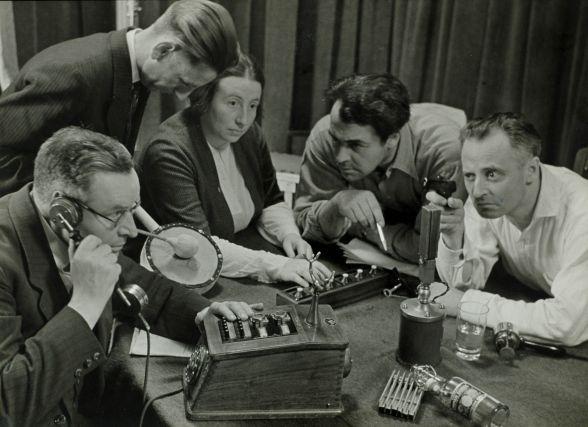
Recording a radio play in the Netherlands (1949)

Radio drama (or audio drama, audio play, radio play,[1] radio theatre, or audio theatre) is a dramatised, purely acoustic performance. With no visual component, radio drama depends on dialogue, music and sound effects to help the listener imagine the characters and story: "It is auditory in the physical dimension but equally powerful as a visual force in the psychological dimension."[2] Radio drama includes plays specifically written for radio, docudrama, dramatised works of fiction, as well as plays originally written for the theatre, including musical theatre, and opera.

Radio drama achieved widespread popularity within a decade of its initial development in the 1920s. By the 1940s, it was a leading international popular entertainment. With the advent of television in the 1950s, radio drama began losing its audience. However, it remains popular in much of the world.

Recordings of OTR (old-time radio) survive today in the audio archives of collectors, libraries and museums, as well as several online sites such as the Internet Archive.

By the 21st century, radio drama had a minimal presence on terrestrial radio in the United States, with much American radio drama being restricted to rebroadcasts of programmes from previous decades. However, other nations still have thriving traditions of radio drama. In the United Kingdom, for example, the BBC produces and broadcasts hundreds of new radio plays each year on Radio 3, Radio 4, and Radio 4 Extra. Like the US, Australia's network the ABC has abandoned broadcasting drama but in New Zealand on RNZ, continues to promote and broadcast a variety of drama over its airwaves.

Thanks to advances in digital recording and Internet distribution, radio drama experienced a revival around 2010.[3] Podcasting offered the means of inexpensively creating new radio dramas, in addition to the distribution of vintage programs.

The terms audio drama[4] or audio theatre are sometimes used synonymously with radio drama; however, audio drama or audio theatre may not necessarily be intended specifically for broadcast on radio. Audio drama can also be found on CDs, cassette tapes, podcasts, webcasts, or other digital downloads as well as broadcast radio.

History

[edit]

The Roman playwright Seneca has claim as a forerunner of radio drama because "his plays were performed by readers as sound plays, not by actors as stage plays... In this respect Seneca had no significant successors until 20th-century technology made possible the widespread dissemination of sound plays."[5]

1880–1930: early years

[edit]

Radio drama traces its roots back to the 1880s: "In 1881 French engineer Clement Ader had filed a patent for 'improvements of Telephone Equipment in Theatres'" (Théâtrophone).[6] English-language radio drama seems to have started in the United States.[7] A Rural Line on Education, a brief sketch specifically written for radio, aired on Pittsburgh's KDKA in 1921, according to historian Bill Jaker.[8] Newspaper accounts of the era report on a number of other drama experiments by America's commercial radio stations: KYW broadcast a season of complete operas from Chicago starting in November 1921.[9] In February 1922, entire Broadway musical comedies with the original casts aired from WJZ's Newark studios.[10] Actors Grace George and Herbert Hayes performed an entire play from a San Francisco station in the summer of 1922.[11]

An important turning point in radio drama came when Schenectady, New York's WGY, after a successful tryout on 3 August 1922, began weekly studio broadcasts of full-length stage plays in September 1922,[12] using music, sound effects and a regular troupe of actors, The WGY Players. Aware of this series, the director of Cincinnati's WLW began regularly broadcasting one-acts (as well as excerpts from longer works) in November.[13] The success of these projects led to imitators at other stations. By early 1923, original dramatic pieces written specially for radio were airing on stations in Cincinnati (When Love Wakens by WLW's Fred Smith),[13][14] Philadelphia (The Secret Wave by Clyde A. Criswell)[15] and Los Angeles (At Home over KHJ).[16] That same year, WLW (in May) and WGY (in September) sponsored scripting contests, inviting listeners to create original plays to be performed by those stations' dramatic troupes.[13][17]

Listings in The New York Times[18] and other sources for May 1923 reveal at least 20 dramatic offerings were scheduled (including one-acts, excerpts from longer dramas, complete three- and four-act plays, operettas and a Molière adaptation), either as in-studio productions or by remote broadcast from local theatres and opera houses. An early British drama broadcast was of Shakespeare's A Midsummer Night's Dream on 2LO on 25 July 1923.[19]

Serious study of American radio drama of the 1920s and early 1930s is, at best, very limited. Unsung pioneers of the art include: WLW's Fred Smith; Freeman Gosden and Charles Correll (who popularised the dramatic serial); The Eveready Hour creative team (which began with one-act plays but was soon experimenting with hour-long combinations of drama and music on its weekly variety program); the various acting troupes at stations like WLW, WGY, KGO and a number of others, frequently run by women like Helen Schuster Martin and Wilda Wilson Church; early network continuity writers like Henry Fisk Carlton, William Ford Manley and Don Clark; producers and directors like Clarence Menser and Gerald Stopp; and a long list of others who were credited at the time with any number of innovations but who are largely forgotten or undiscussed today. Elizabeth McLeod's 2005 book on Gosden and Correll's early work[20] is a major exception, as is Richard J. Hand's 2006 study of horror radio, which examines some programs from the late 1920s and early 1930s.[21]

Another notable early radio drama, one of the first specially written for the medium in the UK, was A Comedy of Danger by Richard Hughes, broadcast by the BBC on 15 January 1924, about a group of people trapped in a Welsh coal mine.[22] One of the earliest and most influential French radio plays was the prize-winning Marémoto ('Seaquake'), by Gabriel Germinet and Pierre Cusy, which presents a realistic account of a sinking ship before revealing that the characters are actually actors rehearsing for a broadcast. Translated and broadcast in Germany and England by 1925, the play was originally scheduled by Radio-Paris to air on 23 October 1924, but was instead banned from French radio until 1937 because the government feared that the dramatic SOS messages would be mistaken for genuine distress signals.[23]

In 1951, American writer and producer Arch Oboler suggested that Wyllis Cooper's Lights Out (1934–47) was the first true radio drama to make use of the unique qualities of radio:

Radio drama (as distinguished from theatre plays boiled down to kilocycle size) began at midnight, in the middle thirties, on one of the upper floors of Chicago's Merchandise Mart. The pappy was a rotund writer by the name of Wyllis Cooper.[24]

Though the series is often remembered solely for its gruesome stories and sound effects, Cooper's scripts for Lights Out were later recognised as well written and offered innovations seldom heard in early radio dramas, including multiple first-person narrators, stream of consciousness monologues and scripts that contrasted a duplicitous character's internal monologue and his spoken words.

The question of who was the first to write stream-of-consciousness drama for radio is a difficult one to answer. By 1930, Tyrone Guthrie had written plays for the BBC like Matrimonial News (which consists entirely of the thoughts of a shopgirl awaiting a blind date) and The Flowers Are Not for You to Pick (which takes place inside the mind of a drowning man). After they were published in 1931, Guthrie's plays aired on the American networks. Around the same time, Guthrie himself also worked for the Canadian National Railway radio network, producing plays written by Merrill Denison that used similar techniques. A 1940 article in Variety credited a 1932 NBC play, Drink Deep by Don Johnson, as the first stream-of-consciousness play written for American radio. The climax of Lawrence Holcomb's 1931 NBC play Skyscraper also uses a variation of the technique (so that the listener can hear the final thoughts and relived memories of a man falling to his death from the title building).

There were probably earlier examples of stream-of-consciousness drama on the radio. For example, in December 1924, actor Paul Robeson, then appearing in a revival of Eugene O'Neill's The Emperor Jones, performed a scene from the play over New York's WGBS to critical acclaim. Some of the many storytellers and monologuists on early 1920s American radio might be able to claim even earlier dates.

1930–1960s: widespread popularity

[edit]

Perhaps America's most famous radio drama broadcast is Orson Welles' The War of the Worlds (a 1938 version of H. G. Wells' novel), which inspired stories of a mass panic that, though greatly exaggerated, signaled the power of the form.[25] By the late 1930s, radio drama was widely popular in the United States (and also in other parts of the world). There were dozens of programs in many different genres, from mysteries and thrillers, to soap operas and comedies. Among American playwrights, screenwriters and novelists who got their start in radio drama are Rod Serling and Irwin Shaw.

Radio program written and performed in Phoenix, Arizona by children of Junior Artists Club (Federal Arts Program, 1935).

In Britain, however, during the 1930s BBC programming, tended to be more high brow, including the works of Shakespeare, Classical Greek drama, as well as the works of major modern playwrights, such as Chekhov, Ibsen, Strindberg, and so forth. Novels and short stories were also frequently dramatised.[26] In addition the plays of contemporary writers and original plays were produced, with, for example, a broadcast of T. S. Eliot's famous verse play Murder in the Cathedral in 1936.[27] By 1930, the BBC was producing "twice as many plays as London's West End" and were producing over 400 plays a year by the mid-1940s.[28]

Producers of radio drama soon became aware that adapting stage plays for radio did not always work, and that there was a need for plays specifically written for radio, which recognised its potential as a distinct and different medium from the theatre. George Bernard Shaw's plays, for example, were seen as readily adaptable.[29] However, in a lead article in the BBC literary journal The Listener, of 14 August 1929, which discussed the broadcasting of 12 great plays, it was suggested that while the theatrical literature of the past should not be neglected the future lay mainly with plays written specifically for the microphone.

In 1939–40, the BBC founded its own Drama Repertory Company which made a stock of actors readily available. After the war, the number was around 50. They performed in the great number of plays broadcast in the heyday of BBC radio drama of the 40s–60s.[30]

Initially the BBC resisted American-style 'soap opera', but eventually highly popular serials, like Dick Barton, Special Agent (1946–51), Mrs Dale's Diary (1948–69) and The Archers (1950–), were produced. The Archers is still running (as of July 2024) and is the world's longest-running soap opera with a total of over 18,400 episodes.[31] There had been some earlier serialised drama including, the six episode The Shadow of the Swastika (1939), Dorothy L. Sayers's The Man Born To Be King, in twelve episodes (1941), and Front Line Family (1941–48), which was broadcast to America as part of the effort to encourage the US to enter the war. The show's storylines depicted the trials and tribulations of a British family, the Robinsons, living through the war. This featured plots about rationing, family members missing in action and the Blitz. After the war in 1946 it was moved to the BBC Light Programme.[32]

The BBC continued producing various kinds of drama, including docu-drama, throughout World War II; amongst the writers they employed were the novelist James Hanley[33] and poet Louis MacNeice, who in 1941 became an employee of the BBC's. MacNeice's work for the BBC initially involved writing and producing radio programmes intended to build support for the US, and later Russia, through cultural programmes emphasising links between the countries rather than outright propaganda. By the end of the war MacNeice had written well over 60 scripts for the BBC, including Christopher Columbus (1942), which starred Laurence Olivier, The Dark Tower (1946), and a six-part radio adaptation of Goethe's Faust (1949).[34]

Following World War II the BBC reorganised its radio provision, introducing two new channels to supplement the BBC Home Service (itself the result of the fusion in September 1939 of the pre-war National and Regional Programmes). These were the BBC Light Programme (dating from 29 July 1945 and a direct successor to the wartime General Forces Programme) and the BBC Third Programme (launched on 29 September 1946).

The BBC Light Programme, while principally devoted to light entertainment and music, carried a fair share of drama, both single plays (generally, as the name of the station indicated, of a lighter nature) and serials. In contrast, the BBC Third Programme, destined to become one of the leading cultural and intellectual forces in post-war Britain, specialised in heavier drama (as well as the serious music, talks, and other features which made up its content): long-form productions of both classical and modern/experimental dramatic works sometimes occupied the major part of its output on any given evening. The Home Service, meanwhile, continued to broadcast more "middle-brow" drama (one-off plays and serialisations) daily.

The high-water mark for BBC radio drama was the 1950s and 1960s, and during this period many major British playwrights either effectively began their careers with the BBC, or had works adapted for radio. Most of playwright Caryl Churchill's early experiences with professional drama production were as a radio playwright and, starting in 1962 with The Ants, she wrote nine productions with BBC radio drama up until 1973, when her stage work began to be recognised at the Royal Court Theatre.[35] Joe Orton's dramatic debut in 1963 was the radio play The Ruffian on the Stair, which was broadcast on 31 August 1964.[36]

Tom Stoppard's "first professional production was in the 15-minute Just Before Midnight programme on BBC Radio, which showcased new dramatists".[36] John Mortimer made his radio debut as a dramatist in 1955, with his adaptation of his own novel Like Men Betrayed for the BBC Light Programme. However, he made his debut as an original playwright with The Dock Brief, starring Michael Hordern as a hapless barrister, first broadcast in 1957 on BBC Third Programme, later televised with the same cast and subsequently presented in a double bill with What Shall We Tell Caroline? at the Lyric Hammersmith in April 1958, before transferring to the Garrick Theatre. Mortimer is most famous for Rumpole of the Bailey, a British television series which starred Leo McKern as Horace Rumpole, an aging London barrister who defends any and all clients. It has been spun off into a series of short stories, novels, and radio programmes.[37]

Giles Cooper was a pioneer in writing for radio, becoming prolific in both radio and television drama. His early successes included radio dramatisations of Charles Dickens's Oliver Twist, William Golding's Lord of the Flies,[38] and John Wyndham's classic science fiction novel The Day of the Triffids.[39] He was also successful in the theatre. The first of his radio plays to make his reputation was Mathry Beacon (1956), about a small detachment of men and women still guarding a Top Secret "missile deflector" somewhere in Wales, years after the war has ended.[40] Bill Naughton's radio play Alfie Elkins and his Little Life (1962) was first broadcast on the BBC Third Programme on 7 January 1962. In it Alfie, "[w]ith sublime amorality... swaggers and philosophises his way through" life.[41] The action spans about two decades, from the beginning of World War II to the late 1950s. In 1964, Bill Naughton turned it into a stage play which was put on at London's Mermaid Theatre. Later, he wrote the screenplay for a film version, Alfie (1966), starring Michael Caine.

Other notable radio dramatists included Henry Reed, Brendan Behan, Rhys Adrian, Alan Plater; Anthony Minghella, Alan Bleasdale, and novelist Angela Carter. Novelist Susan Hill also wrote for BBC Radio, from the early 1970s.[39] Henry Reed was especially successful with the Hilda Tablet plays. Irish playwright Brendan Behan, author of The Quare Fellow (1954), was commissioned by the BBC to write a radio play The Big House (1956); prior to this he had written two plays for Irish radio: Moving Out and A Garden Party.[42]

Among the most famous works created for radio, are Dylan Thomas's Under Milk Wood (1954), Samuel Beckett's All That Fall (1957), Harold Pinter's A Slight Ache (1959), and Robert Bolt's A Man for All Seasons (1954).[43] Beckett wrote a number of short radio plays in the 1950s and 1960s, and later for television; his radio play Embers was first broadcast on the BBC Third Programme on 24 June 1959 and won the RAI prize at the Prix Italia awards later that year.[44]

Robert Bolt's writing career began with scripts for Children's Hour.[45] A Man for All Seasons was subsequently produced on television in 1957. Then in 1960, there was a highly successful stage production in London's West End and on New York's Broadway from late 1961. In addition there have been two film versions: in 1966 starring Paul Scofield and 1988 for television, starring Charlton Heston.[46]

While Alan Ayckbourn did not write for radio many of his stage plays were subsequently adapted for radio. Other significant adaptations included, dramatised readings of poet David Jones's In Parenthesis in 1946 and The Anathemata in 1953, for the BBC Third Programme,[47] and novelist Wyndham Lewis's The Human Age (1955).[48] Among contemporary novels that were dramatised were the 1964 radio adaptation of Stan Barstow's A Kind of Loving (1960); there had also been a 1962 film adaptation.[49]

1960–2000: decline in the United States

[edit]

After the advent of television, radio drama never recovered its popularity in the United States. Most remaining CBS and NBC radio dramas were cancelled in 1960.[50] The last network radio dramas to originate during American radio's "Golden Age", Suspense and Yours Truly, Johnny Dollar, ended on 30 September 1962.[51]

There have been some efforts at radio drama since then. In the 1960s, Dick Orkin created the popular syndicated comic adventure series Chicken Man. ABC Radio aired a daily dramatic anthology program, Theater Five, in 1964–65. Inspired by The Goon Show, "the four or five crazy guys" of the Firesign Theatre built a large following with their satirical plays on recordings exploring the dramatic possibilities inherent in stereo. A brief resurgence of production beginning in the early 1970s yielded Rod Serling's The Zero Hour for Mutual, National Public Radio's Earplay, and veteran Himan Brown's CBS Radio Mystery Theater and General Mills Radio Adventure Theater. These productions were later followed by the Sears/Mutual Radio Theater, The National Radio Theater of Chicago, NPR Playhouse, and a newly produced episode of the former 1950s series X Minus One. Works by a new generation of dramatists also emerged at this time, notably Yuri Rasovsky, Thomas Lopez of ZBS and the dramatic sketches heard on humourist Garrison Keillor's A Prairie Home Companion. Brian Daley's 1981 adaptation of the blockbuster space opera film Star Wars for NPR Playhouse was a notable success. Production costs on this serial were mitigated by the support of Lucasfilm, which sold the rights to NPR for a nominal $1 fee, and by the participation of the BBC in an international co-production deal. Star Wars was credited with generating a 40% rise in NPR's ratings and quadrupling the network's youth audience overnight. Radio adaptations of the sequels followed with The Empire Strikes Back in 1983 and Return of the Jedi in 1996.[52][53]

Thanks in large part to the National Endowments for the Arts and Humanities, public radio continued to air a smattering of audio drama until the mid-1980s. From 1986 to 2002, NPR's most consistent producer of radio drama was the idiosyncratic Joe Frank, working out of KCRW in Santa Monica. The Sci Fi Channel presented an audio drama series, Seeing Ear Theatre, on its website from 1997 to 2001. Also, the dramatic serial It's Your World aired twice daily on the nationally syndicated Tom Joyner Morning Show from 1994 to 2008, continuing online through 2010.

2000–present: radio drama's "new media" revival

[edit]

Radio drama remains popular in much of the world, though most material is now available through Internet download rather than heard over terrestrial or satellite radio.[54] Stations producing radio drama often commission a large number of scripts. The relatively low cost of producing a radio play enables them to take chances with works by unknown writers. Radio can be a good training ground for beginning drama writers as the words written form a much greater part of the finished product; bad lines cannot be obscured with stagecraft.

The BBC's sole surviving radio soap is The Archers on BBC Radio 4: it is, with over 18,700 episodes to date,[55] the world's longest-running such programme. Other radio soaps ("ongoing serials") produced by the BBC but no longer on air include:

In September, 2010 Radio New Zealand began airing its first ongoing soap opera, You Me Now, which won the Best New Drama Award in the 2011 New Zealand Radio Awards.

On KDVS radio in Davis, California there are two radio theatre shows, Evening Shadows, a horror/fantasy show paying tribute to classic old-time radio horror, and KDVS Radio Theater which commonly features dramas about social and political themes.

The audio drama format exists side by side with books presented on radio, read by actors or by the author. In Britain and other countries there is also quite a bit of radio comedy (both stand-up and sitcom). Together, these programs provide entertainment where television is either not wanted or would be distracting (such as while driving or operating machinery). Selected Shorts, a long-running NPR program broadcast in front of a live audience at Symphony Space in New York, originated the driveway moment for over 300,000 people listeners each week during readings of contemporary and classic short stories by well-known professional actors.[57]

The lack of visuals also enable fantastical settings and effects to be used in radio plays where the cost would be prohibitive for movies or television. The Hitchhiker's Guide to the Galaxy was first produced as radio drama, and was not adapted for television until much later, when its popularity would ensure an appropriate return for the high cost of the futuristic setting.

On occasion television series can be revived as radio series. For example, a long-running but no longer popular television series can be continued as a radio series because the reduced production costs make it cost-effective with a much smaller audience. When an organisation owns both television and radio channels, such as the BBC, the fact that no royalties have to be paid makes this even more attractive. Radio revivals can also use actors reprising their television roles even after decades as they still sound roughly the same. Series that have had this treatment include Doctor Who, Dad's Army, Thunderbirds[dubiousdiscuss] and The Tomorrow People. In 2013 BBC Radio 4 released a radio adaptation of Neverwhere by Neil Gaiman, featuring a cast of well known television and film actors.[58] Neil Gaiman has said he was excited about the radio drama adaptation as it allowed the work to be presented with a greater deal of special effects than was possible on television.[59] In the United States, an adaptation of The Twilight Zone aired to modest success in the 2000s (decade) as a syndicated program.

Regular broadcasts of radio drama in English can be heard on the BBC's Radio 3, Radio 4 and Radio 4 Extra (formerly Radio 7), on RTÉ Radio 1 in Ireland, and RNZ National in New Zealand. The Canadian Broadcasting Corporation produced notable radio plays in Calgary and Toronto in the postwar decades, from which many actors and directors proceeded to international careers, but abolished its radio drama department in the 1970s and finally ceased production of radio dramas in 2012.[60] BBC Radio 4 in today noted for its radio drama, broadcasting hundreds of new, one-off plays each year in such strands as The Afternoon Play, as well as serials and soap operas. Radio 4 Extra broadcasts a variety of radio plays from the BBC's vast archives and a few extended versions of Radio 4 programmes. The British commercial station Oneword, though broadcasting mostly book readings, also transmitted a number of radio plays in instalments before it closed in 2008.

In the United States, contemporary radio drama can be found on broadcasters including ACB radio, produced by the American Council of the Blind; on the Sirius XM Book Radio channel from Sirius XM Satellite Radio (previously Sonic Theater on XM); and occasionally in syndication, as with Jim French's production Imagination Theater. Several community radio stations carry weekly radio drama programs including KBOO, KFAI, WMPG, WLPP and WFHB.

A growing number of religious radio stations air daily or weekly programs usually geared to younger audiences, such as Focus on the Family's Adventures in Odyssey (1,700+ syndicated stations), or Pacific Garden Mission's Unshackled! (1,800 syndicated stations – a long-running radio drama), which is geared to adults. The networks sometime sell transcripts of their shows on cassette tapes or CDs or make the shows available for listening or downloading over the Internet. Transcription recordings of many pre-television shows have been preserved. They are collected, re-recorded onto audio CDs and/or MP3 files and traded by hobbyists today as old-time radio programmes. Meanwhile, veterans such as the late Yuri Rasovsky (The National Radio Theater of Chicago) and Thomas Lopez (ZBS Foundation) have gained new listeners on cassettes, CDs and downloads. In the mid-1980s, the nonprofit L.A. Theatre Works launched its radio series recorded before live audiences. Productions have been broadcast via public radio, while also being marketed on compact discs and via download.[61] Carl Amari's nationally syndicated radio series Hollywood 360 features four old-time radio shows during his four-hour weekly broadcasts. Amari also broadcasts old-time radio shows on The WGN Radio Theatre heard every Saturday night beginning at 22:00 on 720-WGN in Chicago.

In addition to traditional radio broadcasters, modern radio drama (also known as audio theatre, or audio drama), has experienced a revival, with a growing number of independent producers who are able to build an audience through Internet distribution.[3] While there are few academic programs in the United States that offer training in radio drama production, organisations such as the National Audio Theatre Festival teach the craft to new producers.

The digital age has also resulted in recording styles that differ from the studio recordings of radio drama's Golden Age. Not from Space (2003) on XM Satellite Radio was the first national radio play recorded exclusively through the Internet in which the voice actors were all in separate locations. Other producers use portable recording equipment to record actors on location rather than in studios.[3]

Podcasts are a growing distribution format for independent radio drama producers. Podcasts provides an alternative to mainstream television and radio which does not necessarily require a pitching process to be made and distributed (as these aspects of production can be learned by the creator) and which have no restrictions regarding programme length or content.[54]

Radio drama around the world

[edit]

Australia

[edit]

In Australia, as in most other developed countries, from the early years of the medium almost every radio network and station featured drama, serials, and soap operas as staples of their programming; during the so-called "Golden Years" of radio these were hugely popular. Many Australian serials and "soapies" were copies of American originals (e.g., the popular soap Portia Faces Life or the adventure series Superman, which featured future Australian TV star Leonard Teale in the title role), although these were typically locally produced and performed live to air, since the technology of the time did not permit high-quality pre-recording or duplication of programmes for import or export.

In this period radio drama, serials and soap operas provided a fertile training ground and a steady source of employment for many actors, and this was particularly important because at this time the Australian theatre scene was in its infancy and opportunities were very limited. Many who trained in this medium (such as Peter Finch) subsequently became prominent both in Australia and overseas.

It has been noted that the producers of the popular 1960s Gerry Anderson TV series Thunderbirds were greatly impressed by the versatility of UK-based Australian actor Ray Barrett, who voiced many roles in Anderson's TV productions. Thanks to his early experience on Australian live radio (where he often played English and American roles), Barrett was considered better than his English counterparts at providing a convincing transatlantic accent, and he could perform a wide range of character voices; he also impressed the Anderson team with his ability to quickly and easily switch from one voice/accent to another without the sound engineers' having to stop the recording.[62]

The effect of the introduction of television there in the late 1950s had the same devastating effects as it did in the US and many other markets, and by the early 1960s Australian commercial radio had totally abandoned radio drama and related programming (including comedy, soapies, and variety) in favour of music-based formats (such as Top 40) or talk radio ("talkback"), and the once-flourishing Australia radio production industry vanished within a few years. One of the few companies to survive was the Melbourne-based Crawford Productions, which was able to make the successful transition into TV production.

Despite the complete abandonment of drama and related programming by the commercial radio sector, the government-funded Australian Broadcasting Corporation (ABC) maintained a long history of producing radio drama. One of its most famous and popular series was the daily 15-minute afternoon soap opera Blue Hills, which was written for its entire production history by dramatist Gwen Meredith. It featured many well-known Australian actresses and actors, ran continuously for 27 years, from 28 February 1949 to 30 September 1976, with a total of 5,795 episodes broadcast, and was at one time the world's longest-running radio serial. It was preceded by an earlier Meredith serial The Lawsons, which featured many of the same themes and characters and itself ran for 1299 episodes.

In the 1960s and later, the ABC continued to produce many original Australian radio dramas as well as works adapted from other media. In recent years original radio dramas and adapted works were commissioned from local dramatists and produced for the ABC's Radio National network program Airplay, which ran from the late 1990s until early 2013. In late 2012 ABC management imposed budget cuts and axed a number of long-running arts programs, thereby ending the national broadcaster's decades-long history of producing radio drama (as well as its equally long history of providing daily serialised book readings).

Cyprus

[edit]

Since around the early sixties the Cyprus Broadcasting Corporation (RIK) features radio plays in the Cypriot Greek dialect. They are called Cypriot (radio drama) sketches and they are mainly about Cyprus's rural life, traditions and customs, its history and its culture, and it continues until today.

Also very popular in Cyprus during the sixties, seventies and early eighties Police drama was very popular. The series "Police Adventures" became associated with the name of Cyprus Broadcasting Corporation (CyBC) radio producer Mikis Nikitas, who was responsible for its production for many years. The *"Police Adventures"* series also attracted the interest of foreign radio stations, as a number of its episodes were sold to Bavarian Radio in 1970, according to information cited in an annual CyBC report.

The oldest part of CyBC's Radio Theater was "Theater by Radio", which was broadcast on Monday evenings, Also broadcasting theatrical plays, mainly by classical Greek and Cypriot playwrights, as well as works by contemporary Cypriot writers selected through an annual competition, along with classic foreign repertoire. This tradition has been in place since 1953, the year RIK was established. The works are written by established writers, but also from new writers through the Writing Contest of Cypriot Sketches issued annually by CyBC (RIK).[63] Currently, Cypriot sketches are broadcast every Sunday and have a mostly comedic character, satirising current events, they also include comedic song parodies. CyBC has also made other types of radio dramas, such as crime stories in the 2010s, which are available online.

Finland

[edit]

In Finland radio dramas (in Finnish kuunnelma) by the Finnish national broadcasting company Yleisradio have been popular since 1930s, and have always used well-known theatre or movie actors. The dramas include books converted to audio dramas, versions of popular theatre productions, pulp novels adapted for radio, or drama explicitly written as radio dramas. One of the most well known series was "Suomisen perhe" (the "Family Suominen") about a middle-class family, it became so popular that later the originally written for radio drama was converted into a movie series. Popular radio drama from other countries, like the BBC radio drama The Men from the Ministry was translated as "Knalli ja sateenvarjo" ("Bowler hat and umbrella") and became very popular. J. R. R. Tolkien's The Hobbit was converted to multi-part radio drama.

Germany

[edit]

The first German radio drama was produced in 1923. Because of the external circumstances in postwar Germany in which most of the theatres were destroyed,[64] radio drama boomed. Between 1945 and 1960 there were more than 500 radio plays every year. The German word for radio drama or audio play is Hörspiel. Today Germany is a major market for radio plays worldwide.[65] In particular, audio plays on CD are very popular. A popular audio play serial of Germany and of the world is Die drei ??? [de] (Three Investigators).

Berlin's Prix Europa includes a Radio Fiction category.[citation needed]

India

[edit]

Vividh Bharati, a service of All India Radio, has a long running Hindi radio-drama program: Hawa Mahal.

The Satyanweshi audio drama series created by actor Aneesh See Yay adapted twenty two Byomkesh Bakshi novels and eight original audio dramas in the Malayalam language.[66]

Republic of Ireland

[edit]

RTÉ Radio Drama is one of the oldest audio theatre departments in the radio world.[67]

Japan

[edit]

Radio dramas began in Japan in 1925, and enjoyed a great level of popularity after the hit of Tankou no Naka.[68][69][70] This resulted in the NHK hiring famous writers to write radio drama scripts for 500 yen in 1930, equivalent to 1 million yen today.[71]

Due to voice acting in Japan having its own distinct culture, audio dramas continue to be popular in Japan, where they are now primarily released on disc as "drama CDs" (ドラマCD). They are also referred to in Japanese as "voice dramas" (ボイスドラマ). Many such audio dramas are based on anime, manga, novels and video games, but there are also many that are completely original.[72] Though most drama CDs are commercial products made by corporate entities, there has been a growing number of doujin audio dramas in recent years due to it being easier for hobbyists to obtain the equipment required to make recordings, and the Internet making distribution easier.

Norway

[edit]

Radioteatret (Radio drama in Norway) has existed since 1926.[73]

Poland

[edit]

In Poland, radio dramas are sometimes called "the theatre of the imagination" (Polish: teatr wyobraźni). The first Polish radio drama, Warszawianka based on Stanisław Wyspiański's play, was produced in 1925 while the first radio drama written for radio was produced in 1929. Polish Radio has been successfully producing radio dramas since then – between 1925 and September 1939, over 2,500 were made.[74] In 1956, Polish Radio started broadcasting Matysiakowie, which is currently one of the longest-running radio plays in the world.[75] Audio plays based on literature are also popular in Poland, this is how the sound adaptations of George R. R. Martin's A Game of Thrones, Mario Puzo's The Godfather, Ken Follett's The Pillars of the Earth or Robert Kirkman's The Walking Dead were created.[76][77] Since 1988, the Polish Radio Theatre has awarded the Wielki Splendor [pl] awards to actors and authors of radio dramas.[78]

Romania

[edit]

Radio theatre (Teatru Radiofonic [7]) has a long tradition in Romania. The first piece was played in 1929. The 7000+ piece repertoire includes radio adaptations of both Romanian and international books/plays across many genres interpreted by the greatest Romanian actors of the time.

South Africa

[edit]

Radio broadcasting began in South Africa in 1924 and remained the dominant broadcast medium in the country until the late 1970s. Created by an act of Parliament in 1936, the South African Broadcasting Corporation (SABC) aired radio dramas along with news and British content in Afrikaans and English. Radio drama became more prominent with the launch of Springbok Radio, an English and Afrikaans commercial station operated by SABC between May 1950 and December 1985.

The SABC launched Radio Bantu in 1960s, broadcasting first in isiZulu and soon followed by other African languages, intended to serve as the apartheid state's propaganda channel. However, radio drama broadcast in African languages contributed to subverting the apartheid government by shaping culture and identity while challenging apartheid ideologies. Radio dramas were not subjected to the same level of apartheid editorial scrutiny, and therefore provided a forum for ideas without openly addressing politics.[79] Radio drama evolved with changing socio-economic contexts. Female characters began to feature more prominently.[80]

Radio drama continues to be a mainstay of South African radio. SABC's drama studios in each of the country's 9 provinces produce dramas for all 19 SABC radio stations.[81] Recognising radio's reach, some private sector entities have also invested in radio drama, such as Standard Bank's 5-minute Iketsetse Zenzele radio drama which aired for 8 years to raise awareness about financial literacy, fraud, and cybercrimes.[82] Non-governmental organisations widely use radio drama as part of campaigns for health awareness and rights activism, such as the long-running Soul Buddyz series focused on adolescent health,[83] Masiphephe Radio Drama addressing gender-based violence,[84] and the Plague in the Time of King Kapital and Queen Corona focused on Covid-19 awareness.[85]

Thailand

[edit]

A low power radio station "M.C.O.K. Radio 2" (formally Pira FM) introduces a new programming block called M.C.O.K. Television – aims to replace the regular evening music programmes. The programming block is composed of British radio dramas and an audio-described version of British TV programmes such as Doctor Who, EastEnders and Horrible Histories.

Since 1 November 2021, Radio dramas were scrapped and replaced with more (Audio-Described) programmes – All At Sea, Dad's Army, Mrs. Brown's Boys and The Outlaw. The radio station broadcasts on 87.2 MHz every evening / late night. Due to the nature of low-power VHF propagation, the coverage is very limited, the radio station can be heard only in Lat Luang (Bangkok / Samut Prakan area). It is the first radio station in Thailand to broadcast both English radio / TV programmes on FM.

Mainland China

[edit]

Before 2010, radio dramas on mainland China were usually performed by organisations associated with the Chinese Communist Party, such as the Central Radio Drama Troupe (Chinese: 中央广播剧团), which was founded in 1954.[86] Their content was also deeply related to the historical events of the corresponding period and they largely served as propaganda. 10,000 Pieces of Clipboards (Chinese: 一万块夹板), produced by the China National Radio in 1950 to commemorate the Great Strike of 7 February (Chinese: 二七大罢工), is considered to be the first radio drama after the CCP established the regime in mainland China. Similar radio dramas include The North Korean Zoya - Kim Yu Ji (Chinese: 朝鲜丹娘——金玉姬) and Thanks to Stalin (Chinese: 感谢斯大林).[87]

With the development of the Internet and the spread of Japanese ACG culture, ACG fans on mainland China began to independently produce radio dramas at around 2010. These radio dramas are usually not broadcast on radio stations, but uploaded to online audio platforms like MissEvan.[88]

See also

[edit]

References

[edit]

Further reading

[edit]
[edit]
Revisions and contributorsEdit on WikipediaRead on Wikipedia
from Grokipedia
Radio drama is a theatrical presentation intended for the aural medium, using voices, music, and sound effects to dramatize narratives exclusively through sound, compelling listeners to visualize scenes in their minds. The genre originated in the early 1920s with experimental broadcasts by entities like the , which produced initial radio plays around 1924 and refined production techniques through the decade. In the United States and Britain, radio drama proliferated during the from roughly 1930 to the 1950s, comprising up to 14 percent of network programming by 1930 and featuring serialized adventures, mysteries, and adaptations that captivated mass audiences. Key achievements include pioneering acoustic innovations in and narrative pacing tailored to audio, exemplified by ' 1938 Mercury Theatre on the Air production of , which mimicked news bulletins to simulate a Martian invasion and triggered widespread public panic due to its immersive realism. This incident highlighted both the medium's persuasive potency and early regulatory concerns over broadcast influence, though empirical evidence of harm remained anecdotal. Radio drama's defining characteristics—reliance on voice modulation, Foley artistry for effects, and minimalistic scripting—fostered unique dramatic forms distinct from visual media, influencing genres like series and soap operas that sustained listener loyalty through episodic . Its decline accelerated post-World War II with television's rise, shifting audiences to visual entertainment, yet the format persists and evolved into modern podcasts, leveraging for niche revivals while retaining core auditory principles.

Definition and Characteristics

Core Features of Radio Drama

Radio drama functions as a purely acoustic medium, devoid of visual or physical staging, compelling creators to construct narratives through alone to evoke and immersion in the listener's mind. This auditory exclusivity demands that all elements—setting, action, character development, and emotional tone—be conveyed via voice, effects, and composition, fostering a direct, intimate engagement that leverages human imagination as the primary visualizer. The absence of visuals necessitates heightened precision in audio layering, where overlapping sounds risk confusion if not meticulously balanced, as empirical production analyses show that listener retention drops sharply with auditory overload. Central to its structure are dialogue-driven and vocal , where actors employ intonation, pacing, and accents to delineate characters and imply physicality, such as footsteps or gestures through descriptive speech or reactive sounds. Sound effects replicate environmental realism—rain pattering on windows or doors creaking—to anchor scenes spatially and temporally, while integrates as a non-diegetic enhancer for tension or resolution, often drawn from orchestral scores in historical examples like broadcasts. These components interlock causally: propels plot causality, effects provide sensory evidence of events, and amplifies affective responses, with studies of early productions confirming that integrated audio fidelity correlates with audience reported vividness. Narrative economy defines the form's pacing, typically spanning 30-60 minutes per episode in serialized formats, prioritizing suggestion over explicitness to sustain and prevent listener disengagement from prolonged exposition. This contrasts with visual media by emphasizing internal and subjective perspectives, accessible via close-miked , which heightens psychological depth but requires scripts tested for auditory flow, as unedited drafts often fail clarity benchmarks in production trials. Overall, radio drama's stems from sound's innate evocative power, rooted in human auditory processing that fills perceptual gaps with personal imagery, a principle validated by listener surveys from mid-20th-century broadcasts showing 70-80% visualization rates under optimal conditions.

Distinctions from Podcasts and Other Audio Media

Radio drama, as a medium originating in the early , emphasizes scripted, performative through , sound effects, and music to evoke scenes entirely in the listener's imagination, typically produced for scheduled broadcast over radio waves. In contrast, podcasts encompass a broader spectrum of on-demand audio content, including non-fictional formats like interviews, narratives, and commentary, with only a subset—often termed "audio dramas" or "scripted fiction podcasts"—mirroring radio drama's fictional, dramatized structure. This distinction arises from radio drama's roots in theatrical adaptation for mass, linear broadcasting, where timing and continuity were constrained by live or near-live air schedules, whereas podcasts leverage for episodic, asynchronous consumption without such temporal limits. A primary production difference lies in editing and flexibility: traditional radio dramas were often performed live or recorded with minimal to fit precise broadcast slots, demanding real-time for errors and adherence to regulatory requirements like equal-time provisions or content standards imposed by networks such as the or in the 1930s–1950s. Podcasts, being pre-recorded and hosted on platforms like or , allow extensive editing, nonlinear storytelling, and integration of modern effects like binaural audio for immersion, enabling creators to bypass broadcast censorship and experiment with serialized formats that encourage binge-listening. For instance, while radio dramas like ' 1938 War of the Worlds broadcast relied on immediate audience capture via national frequencies, contemporary fiction podcasts such as The Truth (launched 2013) distribute episodes globally on-demand, amassing listeners through algorithmic recommendations rather than fixed air times. Relative to other audio media, radio drama diverges from audiobooks, which primarily feature solo narration of prose texts without dramatized or foley effects, focusing on literary reading rather than performative scene-building; audiobooks trace to early recordings like Caedmon's 1952 Dylan Thomas but lack the multi-actor ensemble typical of radio plays. Music programs or spoken-word broadcasts, meanwhile, prioritize composition or recitation over plotting with character arcs and plot twists central to radio drama's form. These boundaries have blurred in the digital era, with podcasts reviving radio drama techniques—evident in the post-2014 surge where fiction audio constitutes under 10% of total podcasts yet drives innovation in immersive —but radio drama's historical emphasis on ephemeral, communal listening events distinguishes it from the individualized, replayable nature of modern audio alternatives.

Historical Development

Origins and Early Experiments (Late 19th Century to 1920s)

The development of radio technology in the late laid the groundwork for audio , beginning with Heinrich Hertz's demonstration of electromagnetic waves in 1887 and Guglielmo Marconi's successful wireless transmission of signals across the Atlantic Ocean on December 12, 1901. Voice transmission emerged with Reginald Fessenden's experimental broadcasts, including the first public radiotelephone program featuring music and speech on Christmas Eve 1906 from Brant Rock, , though these focused on non-dramatic content such as violin performances and Bible readings. Early 20th-century experiments prioritized technical feasibility over entertainment formats, with broadcasts limited to music, news, and opera relays, such as the 1910 transmission of Enrico Caruso's performance from the House in . Commercial radio broadcasting commenced in the United States on November 2, 1920, when station KDKA in Pittsburgh aired election results and subsequent music programs, marking the shift toward regular audience-oriented content. Initial dramatic efforts were rudimentary; KDKA broadcast a brief sketch titled "A Rural Line on Education" in 1921, recognized as one of the earliest scripted pieces tailored for the medium, though it lacked the production values of later works. More structured experimentation occurred at WGY in Schenectady, New York, where program director Kolin Hager commissioned theater director Edward H. Smith to adapt plays for air. On September 21, 1922, WGY aired "The Wolf," a 40-minute adaptation of Eugene Walter's 1908 melodrama, featuring actors from Smith's local troupe and rudimentary sound effects, which elicited over 2,000 listener letters from within a 500-mile radius, demonstrating public interest. The WGY Players, formed shortly thereafter, pioneered the first regular series of radio dramas, producing 43 plays from fall 1922 to spring 1923, including adaptations like "The Second Mrs. Tanqueray" with innovative use of live sound effects such as slamming doors and footsteps to evoke settings. These efforts highlighted radio's potential for immersive storytelling through voice, minimal effects, and imagination, influencing subsequent stations. In the United Kingdom, the British Broadcasting Company (predecessor to the BBC) initiated transmissions on November 14, 1922, from station 2LO in London, followed by early dramatic experiments; by September 1925, it had produced over 140 plays, often adaptations of stage works broadcast without commercial interruptions to prioritize artistic development. These 1920s initiatives collectively established radio drama as a viable format, reliant on script adaptation, actor performance, and basic acoustics rather than visual elements.

Peak Popularity and Golden Age (1930s to 1950s)

The of radio drama, spanning to the 1950s, marked the medium's zenith in popularity, particularly , where radio sets proliferated amid economic hardship and global conflict, serving as a of , , and escapism. By 1934, approximately 60 percent of American households owned radios, reflecting rapid adoption driven by affordable receiver technology and network programming expansions by broadcasters like and . Radio drama constituted about 14 percent of all programming by 1930, encompassing genres such as mysteries, adventures, soap operas, and literary adaptations that captivated audiences through immersive soundscapes and live performances. Serial dramas and weekly anthologies dominated airwaves, with shows like (debuting in 1930) drawing loyal followings for its crime-fighting narratives featuring the tagline "Who knows what evil lurks in the hearts of men?" broadcast to millions weekly. Soap operas targeted daytime listeners, originating in the early as sponsored serials for homemakers, generating substantial revenue through product placements from manufacturers of household goods. During , radio dramas shifted to patriotic themes and morale-boosting stories, with production techniques emphasizing live broadcasts—unrecorded until the late 1940s—to maintain immediacy and authenticity. Audience engagement peaked, as evidenced by top programs reaching 20-40 million listeners per episode in the 1940s, underscoring radio's role as a unifying cultural force before television's rise. A landmark event illustrating radio drama's persuasive power occurred on October 30, 1938, when directed and narrated The War of the Worlds for the on the Air, adapting ' novel as a faux bulletin simulating a Martian , which sparked widespread panic among listeners mistaking it for reality. The broadcast, aired on , reached an estimated 6 million hearers, with reports of hysteria including traffic jams and evacuations, though subsequent analyses questioned the panic's scale, attributing much to media exaggeration. This incident propelled Welles to fame and highlighted radio's capacity for realism through innovative sound effects and narrative structure, influencing future productions while prompting regulatory scrutiny on broadcast responsibility. In the , the sustained radio drama through public service programming, with serials and plays fostering national cohesion during , though audience metrics lagged behind U.S. commercial peaks due to less advertising-driven expansion. By the early , as penetrated households—reaching 9 percent of U.S. homes by 1950—radio drama's live format began yielding to pre-recorded content and visual media, yet the era's innovations in , Foley effects, and suspense scripting laid foundational techniques for audio .

Decline Amid Competing Media (1960s to 1990s)

The proliferation of , reaching approximately 90% household penetration by 1960, precipitated a sharp decline in radio drama's commercial viability. Audiences migrated to the visual medium for , prompting networks to reallocate resources; radio stations pivoted to , talk, and formats that accommodated portable transistor radios and automotive listening. Iconic series such as CBS's , which had aired since 1942, and ended on September 30, 1962, symbolizing the cessation of sustained network drama production as sponsors and performers transitioned to television adaptations offering higher revenues and broader appeal. This erosion stemmed from television's capacity to deliver immediate visual and spatial cues, reducing the imaginative demands of audio-only narratives and capturing family viewing during prime evening hours when radio dramas traditionally aired. By the 1970s, residual efforts like the syndicated (1974–1982), hosted by and producing over 1,300 episodes, garnered initial listenership through nostalgia but could not reverse the trend, as competing media—including color TV expansion and records—further fragmented audio entertainment markets. In the , the publicly funded preserved radio drama through the 1960s–1990s via dedicated departments, enabling experimental works for niche audiences despite television's ascent, which by 1970 encompassed 95% of households. Output persisted on networks like Radio 4, but overall listenership waned relative to TV's dominance, with drama relegated to specialized slots amid rising multichannel options and cassette recorders by the , which enabled on-demand visual storytelling. By the , radio drama's marginal status reflected broader causal dynamics: advertisers favored television's demonstrable metrics and demographic targeting, while listeners accustomed to visuals found audio formats less compelling for serialized , confining the to remnants and occasional revivals without reclaiming mass appeal.

Digital Revival and Modern Adaptations (2000s to Present)

Digital technologies, including affordable workstations and high-speed , facilitated a resurgence of radio drama production starting in the early 2000s by reducing costs associated with and enabling direct distribution to global audiences via streaming and downloads. This transition from tape-based systems to software-driven editing and mixing allowed smaller teams and independent creators to achieve professional without reliance on large broadcast infrastructure. In the , public broadcaster maintained robust output through dedicated slots like Radio 4's Afternoon Drama and Drama on 4, while launching digital-exclusive channels to sustain the format; 7 debuted in 2002 as a platform emphasizing and , evolving into in 2011 with expanded archives and new commissions. These efforts preserved traditional scripting, , and effects-heavy narratives, adapting them for on-demand access via , which streams contemporary originals alongside classics. European traditions, particularly in with Hörspiel productions, similarly leveraged digital archiving and online delivery to reach younger listeners without diminishing core auditory immersion. In , the revival manifested through independent online anthologies and serialized audio works mimicking golden-age styles, such as Radio Drama Revival, an ongoing launched in 2007 that curates episodes from diverse creators to highlight scripted fiction's vitality. Organizations like Shoestring Radio Theater continued producing original plays for syndication and digital release, emphasizing narrative-driven formats over conversational podcasting. Streaming platforms, including and specialized audio services, broadened accessibility, contributing to market expansion with the global audio drama sector projected to reach $419.8 million by 2025 amid rising demand for narrative content. This era saw innovations like immersive for spatial effects, though traditional broadcast elements—full casts, foley artistry, and linear storytelling—persisted to differentiate from emergent audio genres.

Production Techniques

Scriptwriting and Narrative Structure

Radio drama scripts are formatted to prioritize auditory elements, with character names typically in uppercase followed by , and sound effects (often abbreviated as SFX) indicated in italics or parentheses to guide production without visual reliance. Scene transitions are denoted by abbreviations like INT for interior or EXT for exterior settings, alongside background (b/g) sounds, ensuring seamless flow through audio cues rather than physical staging. This , standardized in professional guidelines such as those from the , facilitates timing where one page approximates one minute of broadcast, emphasizing concise prose to maintain listener engagement. Narrative structure in radio drama hinges on to advance plot, reveal character motivations, and describe environments implicitly, as listeners construct mental images solely from spoken words and s. Unlike or screen scripts, which incorporate visual actions, radio narratives avoid explicit visual directives, instead embedding descriptive details within character speech—such as a verbalizing surroundings during tension-building moments—to evoke spatial . Plots typically follow a three-act framework: an opening within the first few minutes to capture attention amid potential listener distractions, rising action driven by interpersonal conflicts conveyed through vocal inflections, and a resolution reinforced by climactic sound layering. Sound design integrates narratively through precise cues that function as plot devices, such as fading echoes to signify emotional distance or rhythmic effects to heighten , demanding writers specify timings and intensities to support causal progression without visual crutches. Pacing is calibrated for auditory , with short scenes (often 2-5 minutes) separated by distinct audio shifts to prevent monotony, as extended monologues risk disengagement in a medium where spans average 10-15 minutes per segment in historical broadcasts. Character development relies on idiosyncratic speech patterns and vocal contrasts, enabling differentiation of up to 6-8 voices effectively, a limit derived from production practices to avoid listener confusion. In contrast to visual media, radio scriptwriting demands "first-person" immersion, where narrative causality emerges from sequential sounds and implying off-stage actions, fostering realism through implied rather than shown events—for instance, a chase sequence built via accelerating footsteps and breaths rather than depicted movement. This approach, rooted in early 20th-century experiments, prioritizes psychological depth over spectacle, with revisions focusing on auditory clarity to ensure verifiability of plot points through repeatable listening tests in production.

Sound Design, Effects, and Music Integration

Sound design in radio drama encompasses the creation and layering of audio elements to evoke settings, actions, and atmospheres without visual aids, relying on effects, ambience, and spatial techniques like reverb and panning to immerse listeners. Historically, sound effects were generated live during broadcasts using manual props such as creaker boxes for doors or ships and thunder drums, as practiced by dedicated teams like the WGY Noisemakers formed in 1922 by the WGY Players in . Pre-recorded effects on 78 RPM discs supplemented these for complex sounds like car engines or explosions, often cued from sound trucks with turntables during the from the 1930s to 1960s. Unlike Foley, which focuses on post-production synchronization of subtle human actions like footsteps to visuals, radio effects demand real-time execution across a wider range—from subtle cues to dramatic explosions—often employing creative substitutions such as an ice cream scoop for a gun cocking or wet wine corks scraped on glass for rat squeaks, as in the 1950 adaptation of "." These techniques prioritized suggestion over precise realism, sketching actions to punctuate dialogue rather than fully replicating reality, with omnidirectional microphones capturing ambience and unidirectional ones isolating performer sounds. Modern productions build on this by layering multiple elements in digital audio workstations (DAWs) like , combining libraries of recorded sounds with original manipulations to add depth, such as blending bass rumbles, sustains, and debris for an explosion. and contrast further enhance impact, as seen in strategic pauses before loud effects to heighten tension. Music integration serves to underscore emotional tones, facilitate scene transitions akin to theatrical curtains, and amplify narrative tension, often composed or selected to seamlessly blend with and effects without overpowering them. In early radio, live orchestras or stock cues provided thematic motifs and atmospheric support, evolving to include synthesized elements post-1958 with innovations like the Radiophonic Workshop's work on electronic scores. Effective production balances these layers through precise editing—fades, cuts, and level adjustments—to maintain clarity, ensuring music evokes mood while effects ground the action, as demonstrated in ' 1938 "War of the Worlds" broadcast, where integrated sounds convincingly simulated an . This holistic approach demands coordination among directors, actors, and technicians to synchronize cues, preserving the auditory illusion central to radio drama's appeal.

Voice Acting, Direction, and Technical Execution

Voice acting in radio drama demands precise vocal control to convey character, , and spatial dynamics without visual cues, relying on techniques such as modulation of pitch, , and pacing to evoke mental . Low pitches soothe listeners, while high pitches excite or disturb, allowing to shape audience perception through tonal patterns where major keys suggest cheerfulness and minor ones mournfulness. Dialects and phonetic consistency further distinguish characters, as seen in historical productions where employed exaggerated vernaculars to portray diverse personas, with pitch variations—such as low for and high for excitement—enhancing depth. technique is critical: maintain 10-18 inches distance for normal speech, backing off for loud effects to avoid , and using off-mic positioning for or distance, while angling speech to minimize plosives and sibilance. Direction involves guiding actors through structured rehearsals to integrate vocal delivery with timing and cues, typically starting with table readings for script familiarity, progressing to rehearsals for and balance, cue sessions for integration, and dress rehearsals for final timing. Directors position themselves on the studio opposite the cast, using —such as open palms to indicate waiting or pointing to cue entry—to maintain silent control during performances, fostering energy through slightly accelerated delivery and mechanical fluency from 5-10 line repetitions. prioritizes vocal contrast and adaptability, with auditions via monologues assessing and attitude, ensuring actors respond to direction without over-rehearsing to preserve spontaneity. For a 25-minute play, rehearsals total 30-35 minutes, followed by 2.5-hour productions emphasizing quick corrections in and tempo. Technical execution centers on studio acoustics, microphone arrays, and mixing to simulate environments, with soundproofed rooms featuring variable reverberation (0.5-1.2 seconds) and multiple microphones—velocity types for dramas covering 40-15,000 cycles per second—placed 1.5-2.5 feet from actors for on-mic intimacy or farther for off-mic effects. Control rooms employ mixing consoles with up to eight channels, pre-amplifiers, and volume indicators to balance dialogue against effects and music, using echo chambers for spatial depth like outdoor scenes. Scripts mark cues (e.g., pink for music, blue for reverb) and provisional cuts (30, 15, 10, 5 seconds) for precise execution, with live coordination via numbered cues per page and post-performance pickups for errors, transitioning in modern contexts to digital recording for layered editing.

Notable Works, Creators, and Innovations

Pioneering Figures and Series

The earliest known dramatic production written specifically for radio was "A Rural Line on ," a scripted telephone conversation between two farmers, broadcast on KDKA in on an unspecified date in 1921 by professors H.B. Allen and Paul C. Rouzer. This skit aired accidentally during the "National Stockman and Farmer Hour" and marked an initial foray into radio-specific narrative, though dramatic broadcasts expanded with the WGY Players in , who began performing weekly adaptations of stage plays in September 1922. Wyllis Cooper pioneered the horror genre in radio drama as creator, writer, and director of Lights Out, which debuted on NBC Blue in in 1934 as a late-night program featuring supernatural tales with innovative sound effects to evoke dread. Cooper's scripts emphasized psychological tension over visual gore, influencing subsequent suspense series, before he departed in 1936. succeeded Cooper on Lights Out from 1936, amplifying its focus on radio's auditory strengths through experimental techniques like layered voices and silence, while also authoring standalone plays such as the 1933 Futuristics. Oboler's work extended to anti-war dramas, highlighting radio's potential for social commentary amid rising global tensions. Orson Welles advanced radio drama's artistic boundaries with The Mercury Theatre on the Air, launching on in July 1938 with adaptations like , employing realistic news bulletins and immersive soundscapes to blur fiction and reality. His October 30, 1938, broadcast of by simulated a Martian invasion via faux eyewitness reports, demonstrating radio's persuasive power despite limited actual panic, as later analyses confirmed exaggerated media claims of hysteria. Welles's innovations in pacing, casting, and effects elevated the medium from mere to a sophisticated form. Norman emerged as a prolific writer-director-producer during the late and , crafting over 100 programs that integrated , , and philosophy, including the December 15, 1941, broadcast We Hold These Truths commemorating the Bill of Rights amid entry. 's sustaining series emphasized literary depth and moral inquiry, earning acclaim for expanding radio's role in public discourse without commercial constraints. Early anthology series like NBC's (1929) and Mutual's The Witch's Tale (1931) laid groundwork for genre specialization, fostering the and formats that defined the medium's peak.

Iconic Adaptations and Experimental Formats

One of the most iconic radio drama adaptations is ' presentation of ' The War of the Worlds on October 30, 1938, via CBS's on the Air, which simulated a live Martian through faux news bulletins and realistic sound effects, causing panic among listeners who tuned in late and missed the opening disclaimer. This 60-minute broadcast demonstrated radio's power to blur fiction and reality, with reports estimating thousands of callers to police and newspapers, though contemporary analyses indicate the panic was exaggerated by print media. Welles' adaptation innovated by interspersing dramatic scenes with simulated eyewitness accounts and expert interviews, setting a benchmark for immersive storytelling. Earlier that year, Welles adapted Victor Hugo's into a seven-part serial for , airing from July to August 1937, which condensed the novel's sprawling narrative into episodic radio format emphasizing character-driven dialogue and minimalistic soundscapes to evoke 19th-century . This production, starring Welles as , highlighted radio's efficiency in adapting epic literature, reaching audiences through weekly broadcasts that built suspense across installments. Similarly, the specialized in Hollywood film adaptations from to , such as the 1938 version of , featuring celebrity voice actors to recreate cinematic scenes via voice and effects alone. In the UK, Radio's adaptations of classic literature, like the 1943 serialization of ' David Copperfield, employed serialized formats to faithfully reproduce novelistic introspection through narrated inner monologues and subtle foley work. These efforts preserved literary depth while leveraging radio's intimacy, often running multiple episodes to cover full texts. Experimental formats emerged prominently through CBS's Columbia Workshop (1936–1943), which functioned as a testing ground for avant-garde techniques, including abstract sound collages and non-linear narratives, as in Irving Reis' 1938 production The First Bomb Falls that integrated documentary-style recordings with fictional drama to explore war's psychological impact. Arch Oboler's Lights Out (1934–1947) pushed boundaries with horror elements, using silence, distorted voices, and layered echoes—such as in the 1940 adaptation of his own story Drop Dead—to heighten tension without visual cues. Later experiments included Wisconsin Public Radio's Earplay (1970s), which commissioned original scripts with experimental audio processing, like multi-track voice layering for dream sequences, predating podcast-era immersion. By the 1980s, experiments, as in Spanish Radio Nacional de España's adaptations, employed to simulate 3D spatial audio, enhancing spatial realism in dramas like immersive sound fictions that mimic filmic movement. These formats prioritized auditory , using head-related transfer functions to place sounds around the listener, influencing modern revivals.

Global Perspectives

European Traditions and Influences

![Recording a radio play][float-right] The earliest structured radio dramas in Europe emerged in the early 1920s, coinciding with the establishment of public broadcasting services. In the United Kingdom, the British Broadcasting Company (later Corporation) initiated regular transmissions in November 1922, with the first original radio drama, The True Story of Father Christmas by Phyllis M. Twigg (under the pseudonym Moira Meighn), airing on 24 December 1922. This short piece marked the beginning of scripted audio storytelling tailored for the medium, initially drawing from theatrical conventions but adapting to rely solely on voice and basic sound effects. By January 1924, the BBC broadcast its first adult-oriented original play, Richard Hughes's A Comedy of Danger, which introduced innovative techniques such as realistic sound design to evoke tension in a coal mine setting without visual elements. German radio drama, known as Hörspiel, developed concurrently and emphasized experimental forms. The first German Hörspiel, Zauberei auf dem Sender ("Magic on the Air: Attempt at a Radio ") by Hans Flesch, was broadcast in 1924 from , pioneering the genre's focus on auditory illusion and disruption of broadcast norms through metafictional elements like studio intrusions. Flesch, as , advanced Hörspiel by integrating noise, music, and abstract soundscapes, influencing later works that treated radio as a distinct art form rather than mere theater adaptation. This tradition persisted through the , with over 1,000 Hörspiele produced by 1933, though Nazi control from 1933 suppressed creative freedom until postwar revival. In , radio drama evolved alongside private stations like Radio Paris, established in , with early experiments in the mid-1920s adapting literary and theatrical works for broadcast. Pioneering efforts included Gabriel Germinet and Pierre Cusy's Marémoto ("Seaquake"), an influential play that won prizes for its dramatic use of sound to depict natural disasters, setting precedents for narrative immersion. French productions in the interwar period emphasized serialized formats and programming, peaking in the 1930s when radio ownership reached millions, though wartime occupation curtailed output until 1944 liberation. These national traditions collectively shaped European radio drama by prioritizing acoustic realism, experimental acoustics, and , exerting influence on global practices through shared techniques and cross-border broadcasts.

North American Developments

Radio drama in originated in the United States during the early , coinciding with the expansion of . One of the earliest documented efforts was a weekly serialized program broadcast by station WGY in , starting in August 1922, featuring a troupe of actors and sound effects to dramatize stories. This marked an initial shift from scripted readings to fully produced audio plays, leveraging radio's ability to evoke imagery through voice and effects. By the late , national networks like and formalized the format, enabling widespread distribution and commercialization that propelled radio drama into a dominant medium. The from the 1930s to the 1940s saw peak innovation and popularity in the U.S., with programs emphasizing suspense, horror, and literary adaptations. Pioneers like advanced techniques in and on series such as Lights Out, which he directed from 1936, using innovative effects to simulate dread without visuals. , recruited by in 1938, elevated poetic and experimental drama through works like The Plot to Overthrow Christmas (1940), influencing wartime morale-boosting broadcasts. ' 1938 adaptation of on the demonstrated radio's immersive power, sparking public panic and highlighting the medium's societal influence. These developments relied on live performances, ad-libbed effects, and star voice actors, fostering genres from soap operas to serials that reached millions nightly. In Canada, radio drama paralleled U.S. trends but emphasized through the Canadian Broadcasting Corporation (CBC), established in 1936. CBC began producing dramas in the via predecessor stations, focusing on original Canadian scripts to counter American cultural dominance. Series like CBC Mystery Theatre (1966–1968) adapted thrillers and suspense tales, maintaining the format's vitality post-World War II amid television's rise. Public funding via CBC sustained production longer than in the commercial U.S. market, where radio drama waned by the mid-1950s as audiences shifted to visual media, though archival efforts preserved thousands of episodes for later revival. North American innovations, including experiments in the 1940s, laid groundwork for modern audio storytelling despite the format's eclipse by television.

Asian and Oceanic Variations

In , radio drama emerged concurrently with the start of in 1925, marking one of the earliest instances in , with Nippon Hoso Kyokai () producing programs that integrated narrative storytelling through voice and sound effects from its inception. These early works laid the foundation for a tradition that emphasized serialized formats and adaptations of , evolving alongside NHK's expansion into educational and cultural content by the pre-World War II era. India's radio drama scene developed through (AIR), established in 1936, though experimental plays predated it; the station broadcast the first Bengali radio play in 1927, featuring dramatic elements in a format tailored to local audiences. AIR's productions, spanning social, historical, and mythological themes across regional languages, reflected diverse Indian life and served as a primary medium for before television's rise, with ongoing output emphasizing community-rooted narratives. In , radio dramas were historically dominated by state-affiliated entities such as the Central People's Broadcasting Station, with content often aligned with government priorities from the mid-20th century onward; production surged in the late to early 1960s as stations competed with emerging television by commissioning scripts from younger writers for serialized broadcasts. Pre-2010 works typically adhered to official narratives, limiting independent experimentation until recent digital shifts introduced more varied, including niche genres. South Korea's radio dramas trace to the early , gaining prominence post-Korean War in the 1960s through (KBS) programs that utilized melodramatic voice performances to engage audiences amid rapid media growth. KBS's Radio Theater division continues to adapt novels into 20-minute episodes, maintaining a focus on literary sources while navigating state-influenced content standards. In , fostered a robust radio drama tradition via the Australian Broadcasting Corporation (ABC), with a golden age spanning the 1930s to 1950s featuring high-quality serials and one-hour plays that rivaled international standards. Iconic examples include Blue Hills, a daily 15-minute serial by Gwen Meredith that aired from February 28, 1949, to September 30, 1976, accumulating over 7,000 episodes and capturing rural Australian life. New Zealand's (RNZ) upholds an active radio drama practice, commissioning original plays and stories from local writers for broadcast in formats like full-cast productions and narrated works, contrasting with declines elsewhere by prioritizing contemporary and award-winning content such as Te Pō in 2023. This continuity reflects a cultural emphasis on audio , including adaptations of Māori narratives, amid a smaller market scale.

African and Other Regional Forms

In Africa, radio drama emerged concurrently with the continent's early broadcasting experiments, which began in with the first official transmission on December 18, 1923, in . South African stations like , operational from the 1950s, produced local dramas including adventure serials such as General Motors on Safari (1965–1969), which depicted African bushveld life, and (1972–1985), alongside mystery programs like Address Unknown (1954–1971). Zulu-language radio drama dates to 1941, evolving under apartheid-era constraints where state-controlled broadcasts like Radio Zulu served purposes, yet dramatic serials often incorporated subtle resistance narratives that fostered alternative identities among listeners. In , developed a vibrant tradition of radio drama tied to indigenous theater forms, particularly Yoruba traveling troupes that adapted to radio in the mid-20th century. Notable examples include Abule Oloke Merin, a serial broadcast in Yoruba and English on government stations, which drew large audiences through episodic but suffered from archival losses due to inadequate preservation practices. These programs emphasized moral and social themes, reflecting local oral traditions while reaching rural populations via shortwave and AM signals. Beyond , Latin American radio drama manifested primarily as radionovelas, serialized narratives that originated in and proliferated across the region by the 1930s, with Mexico's versions aligning with and factory work shifts through 15-minute daily episodes. Mexican radionovelas during appealed to wartime laborers, featuring melodramatic plots of romance and intrigue that prefigured television telenovelas, and by the , they had expanded to influence national cultural consumption patterns amid and media commercialization. In , BBC-commissioned works by Antônio Callado in the 1940s, such as wartime dramas for the Latin American Service, blended local themes with international elements, highlighting radio's role in cross-cultural exchange. These forms prioritized auditory immersion over visual spectacle, adapting European serial techniques to regional and social critiques.

Cultural and Societal Impact

Role in Propaganda, Education, and Public Morale

Radio drama functioned as a vehicle for in major 20th-century conflicts, enabling governments to shape public opinion through narrative storytelling. In , the regime under leveraged radio, including dramatic programming, to propagate ideology, enforce loyalty, and elevate troop and civilian morale; by 1939, over 70% of German households owned radios, largely due to subsidized "People's Receivers" designed for mass dissemination of state-approved content. In the United States during , networks integrated into serialized dramas, embedding messages promoting war bond sales, resource conservation, and anti-Axis sentiment within plots that evoked emotional responses, such as stories of heroism on the or battlefield sacrifices. Allied broadcasters, including the , employed radio drama to counter enemy narratives and foster resistance; for instance, psychological operations featured fabricated dramatic broadcasts mimicking German stations to sow discord and undermine Axis cohesion. These efforts demonstrated radio drama's capacity for , as its auditory format allowed immersive persuasion without visual censorship barriers, though effectiveness varied based on audience skepticism and competing information sources. In education, radio drama provided accessible tools for remote and underserved populations, predating widespread television. The first radio-specific play, "A Rural Line on Education," aired on KDKA in on November 2, 1921, illustrating early potential for instructional narratives. During the and beyond, programs like those under the U.S. enabled youth groups to produce dramas, fostering skills in writing, acting, and while disseminating cultural and historical knowledge. Postwar, radio dramas supported and historical reenactments in classrooms, with studies showing improved retention through collaborative audio production over passive reading. For public morale, radio drama offered escapism and reinforcement during crises. In Britain during , productions, including morale-focused features and adaptations, sustained civilian resilience amid , with listenership peaking at 90% of the population by 1941; series like "" blended humor and drama to address wartime anxieties without overt didacticism. In the U.S., dramas from 1930 to 1945, such as adaptations of patriotic tales, countered Depression-era despair and wartime fears by portraying triumph over adversity, contributing to unified national sentiment as evidenced by sustained high ratings amid and blackouts. These roles highlight radio drama's dual-edged utility: uplifting spirits through relatable stories while advancing institutional agendas, though over-reliance risked audience fatigue or backlash against perceived manipulation.

Influence on Broader Media and Storytelling Evolution

Radio drama's reliance on auditory elements alone compelled creators to innovate in , dialogue, and narrative pacing, techniques that later permeated film and television production. Early radio experiments, such as ' 1938 broadcast of , demonstrated how layered sound effects and voice modulation could evoke vivid imagery and tension without visuals, influencing cinematic audio practices where soundscapes now comprise up to 50% of a film's emotional impact in some analyses. This auditory-first approach fostered "theatre of the mind," prioritizing implication over explicit depiction, which contrasted with television's visual dominance but enriched hybrid media by emphasizing subtext in scripts and foley artistry transferred from radio studios. Adaptations of radio dramas to television in the mid-20th century, such as Arch Oboler's works transitioning from radio to TV formats by , highlighted both synergies and limitations, as visual elements often diluted radio's imaginative demands on audiences. Experimental studies from the compared radio and TV versions of stories, finding that radio formats elicited greater creative divergence in listeners' mental visualizations—children exposed to radio adaptations generated 20-30% more novel scenario extensions than those viewing TV counterparts—underscoring radio's causal role in honing listener-driven storytelling evolution. These shifts informed broader media by embedding radio-honed efficiencies, like concise exposition through and ambient cues, into TV serials and films, where they persist in genres reliant on psychological depth over spectacle. In contemporary audio media, radio drama's legacy manifests in podcasting's resurgence since the , where scripted fiction series adopt radio's serialized structure and immersive effects to reach over 100 million monthly U.S. listeners by , reviving techniques like non-linear sound layering for narrative ambiguity. Post-2014 podcast innovations, building directly on radio precedents, have diversified audio storytelling by integrating and , yet retain radio's core emphasis on evoking internal visualization, as evidenced by fiction podcasts outperforming visual media in listener retention for character-driven plots. This evolution underscores radio drama's enduring causal influence: by proving audio's sufficiency for complex world-building, it paved pathways for media forms prioritizing cognitive engagement over passive consumption, from video game audio narratives to soundscapes.

Criticisms, Limitations, and Debates

Artistic and Technical Constraints

Radio drama's audio-only format presents fundamental technical constraints, requiring producers to simulate visual and spatial elements through , voice modulation, and effects without any visual aids. Settings, character movements, and actions must be evoked via auditory cues such as footsteps, door creaks, or ambient noises, often using simple techniques like actors varying distance from microphones to imply depth. This reliance limits the depiction of complex or large-scale scenes, such as crowds or battles, which become challenging to render convincingly without overwhelming the listener or compromising audio clarity. Historically, production was further restricted by the absence of viable recording technology; major networks banned pre-recorded programs until the late due to the poor of early transcription discs, enforcing live broadcasts that demanded flawless timing and no opportunity for corrections. Even post-recording era advancements, modern spatial audio experiments like stereo panning or face playback limitations, as most audiences consume content in mono or basic stereo environments—such as vehicles or kitchens—where multitasking reduces immersion and excessive effects degrade intelligibility. Artistically, these technical bounds necessitate disciplined scripting, with dialogue serving dual roles to advance plot and describe unseeable details, often resulting in fewer characters distinguished by unique vocal traits to avoid confusion. Plots must prioritize simplicity and intimacy to sustain listener through , as the medium cannot rely on visual for rapid scene shifts or subtle non-verbal cues, potentially leading to expository overload if not balanced with music and . This favors or suspenseful narratives but constrains epic or visually dynamic stories, demanding writers craft "" where audience attention is paramount yet fragile amid competing distractions.

Societal Controversies and Real-World Effects

The War of the Worlds radio broadcast, aired on October 30, 1938, by and the on , exemplifies a key controversy surrounding radio drama's capacity to incite public alarm. Adapted from ' novel, the production employed realistic news bulletins depicting a Martian invasion of , leading some late-tuning listeners—estimated at a small fraction of the audience—to mistake it for genuine events, resulting in reports of fleeing crowds, traffic jams, and calls to authorities in areas like and . However, subsequent research, including surveys by scholars Hadley Cantril and Hazel Gaudet, revealed that widespread panic was a inflated by newspapers hostile to radio's competitive threat to print media; only about 2% of listeners panicked significantly, with most recognizing the fictional format upon hearing disclaimers or context. This episode underscored radio drama's persuasive power through immersive and narrative realism, but also exposed vulnerabilities in audience during an era of rising technological novelty. The incident prompted immediate backlash, including public outcry and calls for stricter broadcasting regulations to distinguish drama from news, influencing the Federal Communications Commission's emphasis on standards without enacting direct . Critics, including figures like the New York World's editor, accused Welles of irresponsibility, though Welles maintained the broadcast included multiple announcements of its fictional nature, attributing misunderstandings to listeners' selective attention amid global tensions preceding . In causal terms, the event demonstrated how radio's auditory intimacy could evoke visceral responses akin to direct experience, amplifying fears in a pre-visual media landscape, yet it also highlighted institutional biases: print outlets, facing circulation declines from radio's ascent, sensationalized anecdotes to portray broadcasters as reckless, thereby safeguarding their own dominance. Beyond isolated panics, radio dramas faced scrutiny for their role in propaganda during wartime, where dramatic storytelling facilitated ideological dissemination and morale manipulation. In Nazi Germany, state-controlled radio incorporated dramatic serials and sketches to normalize antisemitic narratives and glorify expansionism, reaching millions via mandatory receivers in public spaces by 1939, which suppressed dissent through pervasive messaging rather than overt force alone. Allied nations countered with productions like the BBC's Front Line Family (1941–1945), which embedded pro-war sentiments in domestic stories to sustain home front resilience, raising ethical debates on art's instrumentalization for state goals. These applications revealed radio drama's dual-edged societal effects: fostering unity and cultural cohesion in democracies, as evidenced by U.S. programs like The Great Gildersleeve boosting enlistment indirectly through normalized patriotism, yet enabling authoritarian control by embedding propaganda in entertainment, with long-term consequences for public trust in mediated narratives. Postwar analyses, such as those in Paul Lazarsfeld's media effects studies, affirmed radio's limited direct causation of behavior but potent role in agenda-setting, informing modern concerns over immersive audio's psychological sway.

References

Add your contribution
Related Hubs
User Avatar
No comments yet.