Hubbry Logo
The bushThe bushMain
Open search
The bush
Community hub
The bush
logo
8 pages, 0 posts
0 subscribers
Be the first to start a discussion here.
The bush
The bush
from Wikipedia

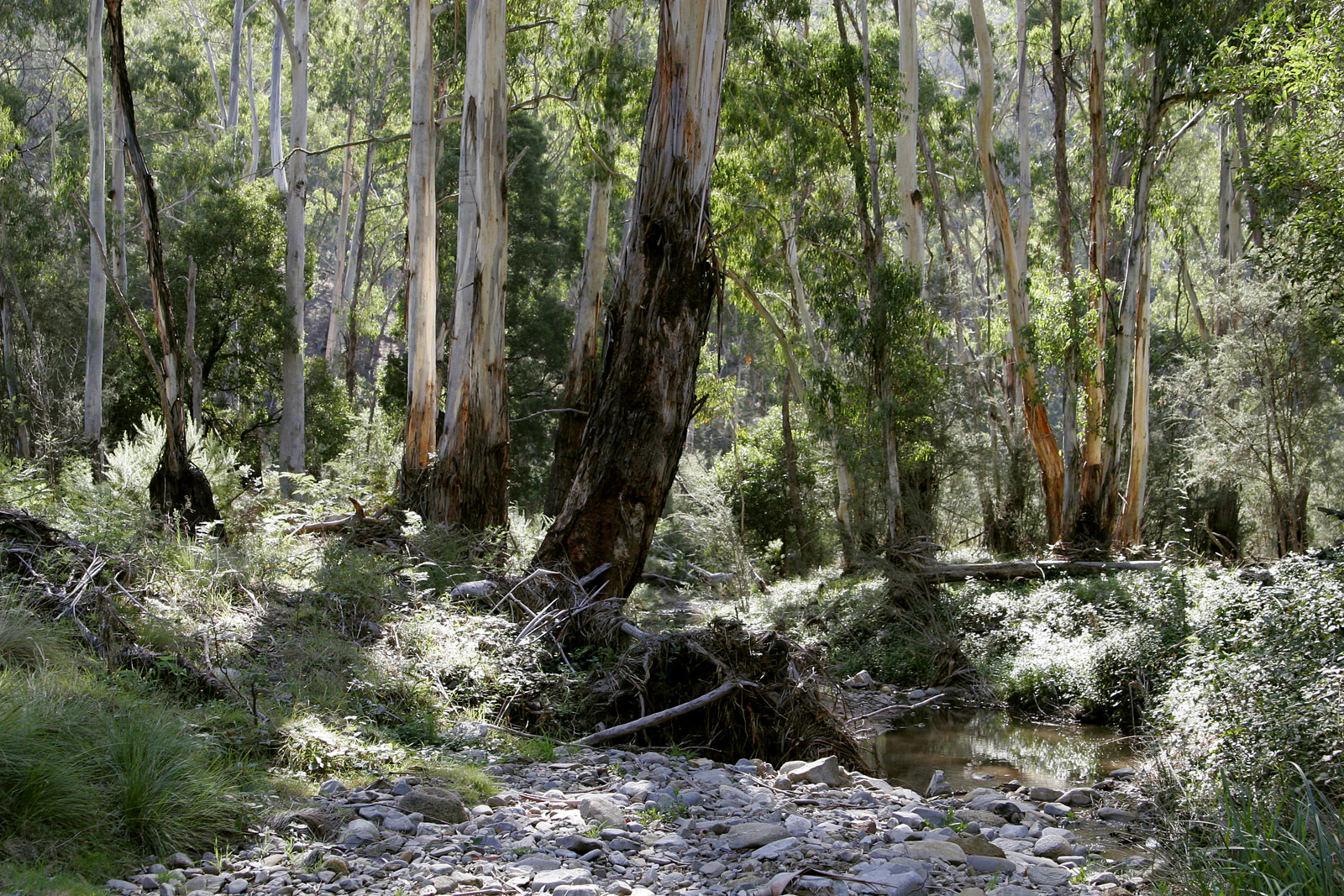
The Australian bush

"The bush", a term mostly used in the English vernacular of Australia, New Zealand and South Africa, is largely synonymous with hinterlands or backwoods.[1] The fauna and flora contained within the bush is typically native to the region, although exotic species may also be present. The word derives from Old French bos, and Old Norse buski, and related to Dutch bos and German Busch with the sense ‘uncultivated country’ coming directly from Dutch bos,

The expression has been in use in Australia from the earliest years of British settlement,[2] and it has inspired many derivative Australian English terms, such as bush tucker, bush mechanic, bush ballad and bushranger. The term is also widely used in Canada and the American state of Alaska to refer to the large, forested portions of their landscapes.

Usage by country

[edit]

Australia

[edit]
Frederick McCubbin's 1889 painting Down on His Luck shows a swagman camping in the bush. McCubbin and other members of the Heidelberg School art movement depicted the bush in many of their paintings, contributing to its mythological status within Australian culture.

The term "the bush" was imprinted in developing Australian English as a sign of settlers’ attempts to relate to their adopted country, so very different from the green European landscapes familiar to them, to refer at first to wilderness, and then to any sparsely inhabited region, regardless of vegetation.[1][3]

"The bush" in this sense became an iconic concept uniquely Australian[4] a signifier also of a pioneering or adventuring spirit.[5] Early uses of the term appear from the late 1700s,[2] frequently in Dawson's The Present State of Australia of 1831,[6] and in the 1839 compilation A Voice from the Bush in Australia,[7] in which unnamed immigrants' letters are reproduced.

Conversely, the word attached to fear of the unknown, as a place of danger from bushfire,[8] venomous[9] or predatory creatures,[10] and hostile aborigines,[11] a vast interior in which settlers, especially their children, could be lost,[12] the latter most notably being the theme of Joan Lindsay's 1967 novel Picnic at Hanging Rock.

The term "Outback" is also used, but usually in association with the more arid inland areas of Australia, as is, to a lesser degree "mulga". "The bush" also refers to any populated region outside of the major metropolitan areas, including mining and agricultural areas. Consequently, it is not unusual to have a mining town in the desert such as Port Hedland (population 14,000) referred to as "the bush".[13]

The First Nations over thousands of years developed ways of utilising natural resources for survival, mainly with bush tucker and the physical and spiritual healing of bush medicine.[14][11] For more than a century after the first British settlement in 1788 onwards, land was squatted, granted or sold to settlers and returned soldiers, resulting in many generally small but permanent human settlements in vast tracts of bush. Closer settlement in Australia has often resulted in fragmentation of the bush,[15] and bushfires, an ever-present hazard in many areas in summer months, have become more frequent with increasing suburbanisation of the Australian population.

The bush is a frequent theme or setting in Australian literature.[16] Bush poets such as Henry Lawson, in such works as The Bush Girl (1901)[17] or The Bush Undertaker (1892) and Banjo Paterson in A Bushman's Song (1892), In Defence of the Bush (1892), or A Bush Christening (1893), revered the bush as a source of national ideals, as did contemporaneous painters in the Heidelberg School such as Tom Roberts (1856–1931), Arthur Streeton (1867–1943) and Frederick McCubbin (1855–1917).[18] Romanticising the bush in this way through folklore cultivated 19th-century Australians' development of a distinct self-identity.

Thus Australians and New Zealanders attach the term "bush" to any number of other entities or activities to describe their rural, country or folk nature;[3] examples being such expressions as "bush telegraph", an informal human network through which news is passed on; "bush carpenter", a rough-and-ready builder; "to go bush", to escape from your usual haunts;[19] improvised "bush cricket", "bush music" (Australian folk music); "bush doof"; and the word bushranger, for the 19th-century criminals mainly in the eastern colonies who hid in the bush to escape from authorities. To be "bushed" is to be lost or exhausted.

New Zealand

[edit]
New Zealand's bush is variable in appearance, but generally the term connotes densely forested areas, like this one around Lake Gunn in Fiordland.

In New Zealand, bush primarily refers to areas of native trees rather than exotic forests. However, the word is also used in the Australian sense of anywhere outside urban areas, encompassing grasslands as well as forests.[20]

Areas with bush (i.e. native forest) are found in both the North Island and the South Island, some of it bordering towns and cities, but the majority of bush is found in large national parks. Examples of predominantly bush clad areas are Whanganui National Park, on Taranaki volcano, on which the bush extends in a uniformly circular shape to the surrounding farmland, and Fiordland in the South Island. Much of Stewart Island/Rakiura is bush-covered. In the North Island, the largest areas of bush cover the main ranges stretching north-northeast from Wellington towards East Cape, notably including the Urewera Ranges, and the catchment of the Whanganui River. Significant stands remain in Northland and the ranges running south from the Coromandel Peninsula towards Ruapehu, and isolated remnants cap various volcanoes in Taranaki, the Waikato, the Bay of Plenty and the Hauraki Gulf.

From the word comes many phrases including:[21]

  • bush-bash – to make one's way through the forest, rather than on a track or trail (cf. American English "bushwhack[ing]", "bushwack[ing]", or "bush-whack[ing]").
  • bush shirt – a woolen shirt or Swanndri, often worn by forest workers.
  • bush lawyer – the name of a number of native climbing plants or a layman who expounds on legal matters.
  • bush walk – short day walks (hikes) in the bush
  • going bush – to live in the bush for an extended period of time, which may include "living off the land" by means of hunting or fishing.
  • bushman – Used in the 19th century for New Zealand loggers. The term still stands for someone that lives in the bush as a means of preferable lifestyle.

South Africa

[edit]

In South Africa, the term (Afrikaans: die bos) has specific connotations of rural areas which are not open veldt. Generally, it refers to areas in the north of the country that would be called savanna. "Going to The Bush" (Bos toe Gaan) often refers to going to a game park or game reserve. Areas most commonly referred to as The Bush are the Mpumalanga and Limpopo Lowveld, The Limpopo River Valley, northern KwaZulu-Natal or any other similar area of wilderness.

Alaska and Canada

[edit]

The Bush in Alaska is generally described as any community not "on the road system", making it accessible only by more elaborate transportation. Usage is similar in Canada; it is called la brousse or colloquially le bois in Canadian French. In Canada, "the bush" refers to large expanses of forest and swampland which sprawl undeveloped, as well as any forested area.

[edit]
Icons of the Australian bush: bracken, corrugated iron, eucalyptus leaves, banksia, bramble, felt hat, billy, stockwhip and elastic-side boots

The term "to go bush" has several similar meanings all connected with the supposed wildness of the bush. It can mean to revert to a feral nature (or to "go native"), and it can also mean to deliberately leave normal surroundings and live rough, with connotations of cutting off communication with the outside world – often as a means of evading capture or questioning by the police. The term bushwhacker is used in Australia and New Zealand to mean someone who spends his or her time in the bush. Going bush, or living in bushland, is a major trope in New Zealand fiction, popularised in such novels as Barry Crump's "A Good Keen Man" (see Man alone).

The verb to bushwhack has two meanings. One is to cut through heavy brush and other vegetation to pass through tangled country: "We had to do quite a bit of bushwhacking today to clear the new trail." The other meaning is to hide in such areas and then attack unsuspecting passers-by: "We were bushwhacked by the bandits as we passed through their territory and they took all of our money and supplies."[example needed]

The Bushwhackers were also a New Zealand professional wrestling tag team that was inducted into the WWE Hall of Fame class of 2015.

In New Zealand, "The Bush" is a nickname for the Wairarapa Bush provincial rugby team. The team was formed by an amalgamation of two earlier teams, Wairarapa and Bush. The latter team had represented an area on the boundaries of the Wairarapa and Hawke's Bay which was in former times known as Bush due to its dense vegetation cover.

In the United States, minor league baseball, which is typically played in smaller cities, is sometimes derisively called "bush league baseball".

In Australia, "Sydney or the bush" equates with such terms as "Hollywood or bust" to mean staking total success or failure on one high-risk venture.[22][23]

See also

[edit]

References

[edit]
Revisions and contributorsEdit on WikipediaRead on Wikipedia
from Grokipedia
The bush is a term used in the English vernacular of Australia, New Zealand, South Africa, and Canada to refer to rural, remote, and undeveloped regions lying beyond major urban centers, typically comprising shrublands, woodlands, and arid zones dominated by native vegetation.

Etymology and Definition

Origins of the Term

The term "bush," denoting remote wooded or scrubby wilderness, originates from the Middle Dutch bosch, signifying forest or thicket, which entered English lexicon through 17th-century colonial encounters in Dutch-influenced territories like the . European settlers and explorers adapted it to describe undeveloped, vegetated frontiers, distinguishing such areas from cleared agricultural lands or settlements, as the word's application broadened beyond strictly forested zones to any uncultivated terrain. In by the early , "bush" had come to encompass scrubby woodlands or shrublands observed in colonial peripheries, reflecting empirical descriptions of barriers to expansion. This usage solidified in contexts during the late 1700s, with "the bush" emerging to specifically evoke uncleared, hazardous —first documented in Australian explorer accounts around the , such as those detailing inland excursions beyond coastal outposts, where it contrasted sharply with ordered European-style clearings. The phrase's adoption underscored a practical demarcation: habitable, modified landscapes versus primal, untamed expanses requiring labor to subdue.

Core Meanings and Variations

The term "the bush" primarily connotes remote, uncultivated rural hinterlands or , forming the periphery of settled or developed regions, where lifestyles emphasize self-sufficiency amid isolation from urban and services. This usage evokes expansive, sparsely populated areas reliant on local resources, distinguishing them causally from cities through geographic remoteness, limited accessibility, and economies tied to , , or rudimentary extraction rather than industrialized . Variations in meaning arise from environmental contexts, ranging from dense, indigenous woodlands to arid, scrub-dominated terrains, though implication remains untamed proximate to but distinct from civilization. In certain usages, "the bush" specifically denotes thick native forests, as seen in where it refers to pre-colonial indigenous ecosystems. In contrast, other applications highlight drier, low-vegetation expanses, such as Australia's native , which includes forests and woodlands spanning approximately 134 million hectares, or about 17% of the continent's area. "The bush" differs from terms like "" or "" by implying ongoing human engagement with the landscape—through settlement edges, rudimentary clearing, or resource use—rather than profound desolation or pristine uninhabitability; the , for instance, denotes more extreme arid interiors beyond typical bush frontiers, while suggests near-absolute absence of anthropogenic modification. This nuance underscores causal realism in : bush areas sustain marginal via adaptive human practices, fostering resilience against environmental hardships, unlike the outback's harsher barriers to sustained .

Historical Context

Colonial Origins and Early Usage

The term "bush" entered colonial lexicon through confronting dense, uncleared as a primary barrier to and settlement expansion, beginning with Dutch establishment of the in 1652, where "bosch" denoted uncultivated woodlands and scrub impeding farming. British colonists, encountering similar obstacles in North American frontiers during the , extended English usages of "bush" for thickets and wooded wilds to describe hazardous requiring clearance for cultivation, often evoking isolation and rudimentary survival tactics like axe-based land preparation. In , the arrival of the on January 26, 1788, introduced settlers to eucalyptus-dominated landscapes around , initially termed "woods" but soon redesignated "bush" by 1798 in records like John Broadbent's testimony of venturing "in the bush" for resources amid navigational perils and sparse paths. These areas, rich in timber for construction and opportunities yet fraught with risks from uneven and indigenous , necessitated pioneer practices of systematic felling to create viable pastures, as documented in early depositions and explorer logs. The term proliferated in pre-1850 diaries and maps across colonies, such as George Caley's 1801 letters identifying "bush natives" in uncleared interiors and James Grant's 1802 narrative of "thickness of the bush" at Westernport, framing it as terrain demanding resilience for resource extraction and territorial advance while underscoring causal links between vegetation density and delayed agrarian output. This application, independent of later cultural overlays, emphasized empirical clearance imperatives over idealized views, with prioritizing axe and fire to convert bush into productive holdings.

Evolution Across the 19th and 20th Centuries

The Australian gold rushes of the 1850s, particularly in Victoria, triggered a surge in population and economic activity in bush regions, drawing over 500,000 immigrants by 1861 and yielding 2.4 million ounces of in Victoria alone that decade. This influx spurred infrastructure development, including railways that connected remote bush areas to ports and markets; for instance, railways expanded from 1855 onward, reducing travel times from weeks to days and facilitating wool and exports from inland settlements. While these advancements integrated the bush into the colonial economy, they also perpetuated myths of isolation and hardship, as depicted in contemporary accounts of transient diggings and rudimentary transport amid vast, unforgiving landscapes. In the , transformed bush farming by alleviating labor-intensive toil; by the , tractors and combine harvesters supplanted horse-drawn implements, enabling larger-scale production on marginal lands and cutting harvest times dramatically in regions like South Australia's Mallee. Post-World War I accelerated, with Australia's urban population rising from 43% in 1921 to 64% by 1947, yet cultural narratives—through bush ballads and paintings—sustained the bush's symbolic allure as a site of rugged despite declining rural populations. Following World War II, soldier settlement schemes resettled over 100,000 veterans on rural blocks under government subsidies, aiming to develop underutilized bush lands for closer settlement; in states like Victoria and South Australia, these initiatives allocated 3 million acres by 1952, often on arid or uncleared tracts. However, persistent droughts, soil erosion, and uneconomic farm sizes prompted viability debates by the 1970s, with failure rates exceeding 50% in some schemes, shifting policy toward consolidated agribusiness and questioning the bush as a sustainable frontier for smallholders.

Usage by Region

Australia

In , "the bush" predominantly denotes the vast rural and remote countryside, including arid interiors, semi-arid zones, wooded fringes, eucalyptus forests, acacias, and diverse endemic flora and fauna beyond urban centers, rather than dense forests alone. This landscape, covering the majority of the continent's 7.7 million square kilometers, features extreme climatic variations from temperate to semi-arid, with annual below 500 mm in dominant landscapes, fostering unique ecosystems adapted to periodic droughts and frequent bushfires essential for ecological regeneration. surveys classify much of this expanse as arid or semi-arid. Demographically, the bush exemplifies extreme sparsity. Despite Australia's urbanization rates exceeding 86 percent, approximately 14 percent—around 3.6 million people—reside in rural and remote areas as of recent estimates, though the most isolated regions support far fewer, often less than 3 percent of the total despite occupying the majority of . This low , averaging under one person per square kilometer in very remote zones, underscores self-reliant traditions born of necessity, where communities depend on individual ingenuity for survival amid isolation and variable . Central to Australian cultural mythology, the bush symbolizes resilience, self-reliance, and mateship, epitomized by the archetypal bushman—hardy rural workers like stockmen and shearers—who shaped national identity. Cultural narratives highlight lifestyles, where stockmen herded cattle and sheep over thousands of kilometers along unfenced routes from the mid-, embodying practical skills in navigating unforgiving terrain. folklore, featuring figures like who operated in these fringes during the , romanticizes resistance against authorities, embedding themes of defiance and in —though historical accounts emphasize their criminality as escaped convicts and robbers preying on settlers. Originating in colonial usage possibly influenced by British convicts' familiarity with wooded hinterlands, the term evolved to encompass not only physical terrain but also a lifestyle of isolation, resourcefulness, and community forged in adversity, as depicted in 19th-century literature and art romanticizing outback hardships. Prior to British settlement in 1788, Indigenous Australians inhabited these regions for over 60,000 years, maintaining sustainable practices integral to the land's biodiversity through deliberate fire-stick farming and cultural burning regimes, applying frequent low-intensity fires to reduce fuel accumulation, promote biodiversity, and facilitate hunting—practices evidenced by paleoecological records showing mosaic landscapes rather than uniform dense vegetation. European settlement introduced pastoralism, agriculture, and environmental pressures like land clearance and invasive species, disrupting these systems via fire suppression, leading to higher fuel loads, altered ecology, and heightened fire risks, as confirmed by comparative studies of pre- and post-colonial vegetation patterns. Notable characteristics include prolific wildlife such as kangaroos, emus, and koalas, alongside hazards like venomous snakes, spiders, and intense wildfires that, while destructive, play a causal role in seed germination for many native plants. Rural bush communities sustain primary industries including mining, cattle grazing, and wheat farming, contributing significantly to the economy, yet face ongoing challenges from climate variability, population decline, and infrastructure limitations. The bush's enduring allure persists in tourism, recreational pursuits like camping and bushwalking, and its foundational influence on Australian values of egalitarianism and practical ingenuity.

New Zealand

In New Zealand, the term "bush" primarily refers to indigenous forests, encompassing dense native vegetation such as podocarp-broadleaf types dominated by species like rimu, totara, and beech. These forests exhibit high ecological density, with multi-layered canopies supporting diverse understorey plants and epiphytes adapted to the temperate, often wet climate. Indigenous forest cover now constitutes under 30% of New Zealand's land area, approximately 8 million hectares out of 27 million total, a reduction from pre-human estimates exceeding 80%. European logging from the early 1800s onward severely impacted these bush ecosystems, with systematic felling for ship masts, spars, and export timber beginning around trader arrivals and intensifying post-1840 settlement. Forests were cleared for and urban expansion, reducing coverage through the 19th and early 20th centuries via practices like slash-and-burn and selective milling, which targeted high-value podocarps. Conservation measures countered this exploitation; , established in 1952, protects over 1.2 million hectares of pristine bush, including fiord-side rainforests and alpine margins, safeguarding hotspots from further logging. Māori concepts of —guardianship emphasizing sustainable resource use and spiritual connection to the whenua (land)—integrated bush management into cultural practices, fostering restraint in harvesting unlike the rapid European depletion. This worldview views forests as kin requiring protection to maintain (life force), influencing modern co-governance in remnant bush areas.

South Africa

In South Africa, "bush" commonly refers to the bushveld, a subtropical characterized by mixed woodland savannas, thorny scrub vegetation, tall grasses, and moderate aridity, spanning northern provinces such as and at altitudes between 1,000 and 1,500 meters. This terrain, influenced by terminology derived from Dutch settlers, encompasses lowveld areas with dense thickets of and other shrubs interspersed with open grasslands, supporting pastoral herding and wildlife. During the colonial era, the bush served as frontier territory for Boer (Afrikaner) trekboeren—semi-nomadic farmers who practiced self-sufficient , hunting, and rudimentary amid the scrublands, fostering a cultural of rugged and to harsh, uncultivated environments. Originally exploited as hunting grounds by European colonists from the , bush areas transitioned into formalized conservation zones in the early , exemplified by the establishment of the Sabi Game Reserve in 1898, which evolved into in 1926 to protect big game populations depleted by overhunting and encroachment. This shift preserved in savanna ecosystems while enabling regulated , which now drives economic activity through photographic and hunting safaris. In 2018, in the Greater Kruger area generated approximately R5.8 billion in trip-related spending within , supporting 5,936 direct jobs and R726 million in worker income, with wildlife tourists averaging R1,700 daily expenditure in 2023—far exceeding general inbound spending. Kruger alone attracts over 1.5 million visitors annually in peak years, contributing to national GDP via lodges, guides, and anti-poaching operations, though visitor numbers dipped 51% below 2019 levels post-COVID as of 2023. Post-1994 land reforms, aimed at redressing apartheid-era dispossessions through restitution and redistribution, have introduced tensions in bushveld farming , where only 8% of white-owned farmland was transferred to black beneficiaries between 1994 and 2019, falling short of the African National Congress's initial target of 30% within five years. Many redistributed properties in rural bush areas experienced productivity declines due to insufficient post-transfer support, skills gaps, and capital shortages, leading to farm failures and debates over balancing historical restitution with agricultural output to sustain and safari-linked economies. These dynamics highlight causal trade-offs: while reforms addressed inequities, empirical outcomes underscore the challenges of maintaining viable in ecologically marginal bushveld without disrupting commercial farming traditions that underpin and export revenues.

North America

In North America, "the bush" primarily refers to remote, densely forested wilderness areas, especially the boreal taiga spanning northern Canada and Alaska, characterized by vast tracts of coniferous trees, wetlands, and challenging terrain that limit road access. This usage evokes untamed frontiers where human settlement and activity demand adaptation to isolation and harsh climates, distinct from more accessible woodlands. Access to the bush has relied heavily on since the , when bush pilots began operating floatplanes and ski-equipped to navigate unprepared lakes, rivers, and strips for runs, , and supply transport. In , early efforts included Carl Ben Eielson's 1924 flights, which pioneered reliable service amid unpredictable weather and short daylight, reducing isolation for scattered outposts. Similar developments in Canada's northern territories supported trappers and miners, with pilots logging thousands of hours annually in low-altitude operations ill-suited to conventional aviation. Economically, the bush sustains Indigenous subsistence practices alongside resource extraction booms. First Nations peoples in off-reserve communities harvest game, fish, and plants at rates exceeding urban averages, with 2016 data showing 40% of such adults engaging in or yearly to secure culturally vital "country foods" amid food insecurity risks. Conversely, and drive transient influxes; Alaska's bush regions host operations extracting , , and timber, contributing over $2 billion annually to the state's as of 2021, often via seasonal camps in areas unserved by roads. These activities highlight tensions between sustained-yield traditions and high-impact extraction, with remoteness metrics from Canadian censuses classifying many bush locales as "very high" in accessibility barriers, affecting over 100,000 residents. Culturally, the bush embodies "roughing it" ethos of self-reliant survival against elemental hardships, rooted in 19th-century journals depicting grueling clears and encounters. Susanna Moodie's 1852 Roughing It in the Bush, drawn from her 1832–1839 experiences in Upper Canada's backwoods, details axe work, rudimentary shelters, and isolation-induced resilience, influencing perceptions of fortitude over generations. Such accounts underscore causal realities of exposure—freezing temperatures, scarce provisions, and predatory risks—forcing pragmatic ingenuity, a theme echoed in later Alaskan tales of enduring subzero vigils for game or ore strikes.

Physical and Ecological Characteristics

Vegetation, Geography, and Climate

The bush encompasses diverse vegetation formations adapted to semi-arid and Mediterranean climates across regions like , , , and parts of . In , eucalypt woodlands dominate much of the bush, thriving in areas with mean annual rainfall of 250-800 mm, transitioning between grasslands and wetter forests. Arid eucalypt variants occur where rainfall averages 200-500 mm, often with winter-dominant precipitation supporting mallee shrublands. 's biome, a key bush analog, features sclerophyllous shrubs suited to winter rainfall regimes, with dry summers limiting growth to seasonal wet periods. New Zealand's bush consists primarily of evergreen broadleaf and podocarp forests, including kauri and species, in a temperate maritime with annual rainfall exceeding 1000 mm in many areas, fostering dense understories on hilly terrains. In , bush-like shrublands such as or desert scrub prevail in regions receiving 200-1000 mm of annually, with drought-adapted perennials and small-leaved shrubs characterizing in dry, seasonal environments. These s exhibit gradients that dictate plant density and composition, with lower rainfall correlating to sparser, fire-prone canopies. Geographically, bush terrains often feature undulating plateaus, ridges, and valleys that influence water availability and accessibility. Elevated plateaus with steep escarpments, as seen in Australian inland bush, concentrate runoff into seasonal rivers, creating linear corridors of denser riparian vegetation amid broader dry expanses. In regions, coastal plains and folded mountains channel winter rains, while New Zealand's bush aligns with volcanic plateaus and fault-block ranges that fragment habitats and elevate local microclimates. Climatic in bush areas typically involves hot, dry summers following milder wet winters, exacerbating fuel and elevating ignition potential. Australian eucalypt bush experiences peak dryness from to , with low and high temperatures drying leaf litter and undergrowth, thereby increasing flammability. Similar patterns in and North American scrublands heighten summer risk through prolonged phases, where reduced wetting rain events desiccate , though historical regimes have shaped adaptive traits like serotiny in eucalypts and proteas. These cycles underscore the bush's inherent variability, with wetter winters replenishing soils but dry summers testing .

Wildlife and Biodiversity

The Australian bush, characterized by sclerophyll woodlands and eucalypt forests, harbors a distinctive assemblage of marsupials, birds, and reptiles adapted to fire-prone, nutrient-poor soils. The (Macropus giganteus) exemplifies this , with populations exceeding 1.25 million across southeastern based on 2022 aerial surveys by state agencies, maintaining IUCN Least Concern status due to resilience despite episodic culls for agricultural conflict. Koalas (Phascolarctos cinereus), reliant on specific eucalypt species for foliage, number around 300,000–500,000 continent-wide but face decline, listed as Vulnerable by IUCN in 2022 assessments citing outbreaks and reducing suitable trees by 20–50% in key areas since 2000. Emus (Dromaius novaehollandiae), large flightless ratites foraging in open bush understory, hold Least Concern status with stable numbers over 600,000, though invasive predators like foxes contribute to localized eggshell predation rates of 10–20%. These species depend on bush vegetation for sustenance and refuge, with eucalypts supplying browse and hollows while grasses sustain grazers amid seasonal . Reptilian diversity thrives in the bush's leaf litter and bark habitats, encompassing over 140 lizard genera, many endemic; for instance, the bearded dragon (Pogona vitticeps) persists in arid woodlands at Least Concern, with populations bolstered by opportunistic insectivory in post-fire regrowth. Invertebrates, including endemic trapdoor spiders and jewel beetles, underpin food webs, with recent surveys in bush reserves documenting 1,500+ arthropod species per hectare in unburnt stands. Invasive species pose acute threats: feral cats (Felis catus) and red foxes (Vulpes vulpes) account for 1.5–3.5 billion native vertebrate deaths annually across , per 2023 modeling, disproportionately impacting small bush mammals like bandicoots, whose populations have halved in invaded ranges since 2010. Biodiversity hotspots, such as the , sustain elevated but register 15–25% native species loss from invasives and altered fire regimes in 2020–2024 monitoring. In New Zealand's bush—dominated by podocarp and beech forests—avian endemics like the North Island brown kiwi (Apteryx mantelli) number approximately 35,000 as of 2023 censuses, classified Vulnerable by IUCN owing to predation rates exceeding 5% annually from introduced stoats (Mustela erminea) and rats. The tuatara (Sphenodon punctatus), a "living fossil" reptile confined to bush islet refugia, maintains Least Concern status with ~55,000 individuals, though burrow-dependent habitat ties it to intact forest understory vulnerable to possum (Trichosurus vulpecula) browsing that defoliates 20–30% of canopy in unmanaged areas. Flightless insects, such as giant wetas weighing up to 70 grams, exemplify invertebrate reliance on bush ferns and logs, with endemicity rates over 90% in southern forests per 2022 surveys. Invasive mammals have extirpated 40% of native bush bird species since 1800, with current threats amplifying in low-elevation bush via edge effects reducing core habitat by 10–15% per decade. South African bushveld savannas support megafauna assemblages, including African lions (Panthera leo) at ~23,000 wild individuals continent-wide in 2020 estimates, rated Vulnerable by IUCN due to prey depletion in fragmented ranges. African bush elephants (Loxodonta africana), numbering ~415,000 in 2021 surveys, hold Least Concern status but exhibit density-dependent browsing that shapes acacia woodlands essential for their forage and for herbivores like (Aepyceros melampus, Least Concern). Reptiles such as the (Dispholidus typus) occupy tree-savanna interfaces, with high venomous snake diversity (over 50 species) tied to rodent-rich bush floors. Invasives like black rats exacerbate tick-borne diseases in biodiversity hotspots like , where thornveld vegetation interdependence sustains 147 mammal species but faces 5–10% annual grass cover loss from and . North American bush analogs, such as Alaskan and Canadian boreal woodlands, feature ungulates like (Alces alces) with populations of ~500,000 in alone per 2023 counts, Least Concern despite wolf predation cycles. Grizzly bears (Ursus arctos horribilis) number ~55,000 across North American bush ranges, Least Concern but with regional recoveries from 136 in Yellowstone area in 1975 to over 700 by 2022, reliant on berry-producing shrublands and salmon streams amid cover. Invasives including European starlings disrupt pollinators critical for bush , contributing to localized avian declines of 10–20% in fragmented habitats per 2020–2024 eBird data. These ecosystems underscore trophic links, with boreal bush vegetation buffering against climate shifts while supporting ~85,000 caribou in declining herds classified as Vulnerable.

Cultural and Social Significance

Symbolism in Folklore and Identity

In Australian folklore, the bush symbolizes rugged individualism and resilience, embodied by the archetype of the bushman—a solitary figure navigating harsh outback conditions with resourcefulness and stoic endurance. This image emerged prominently in the late 19th century, contrasting the perceived softness of urban life with the self-reliant demands of rural survival, as depicted in works by poets like A.B. "Banjo" Paterson, whose 1890 poem "The Man from Snowy River" portrays the bushman as a paragon of indomitable spirit. Paterson's defense of bush life in pieces such as "In Defence of the Bush" (published 1899) explicitly counters urban elitist dismissals, arguing that the bush fosters virtues like mateship and hardiness absent in city environments. The bushman's traits—hardiness, democratic spirit, and resourcefulness—have profoundly shaped Australian national identity, serving as a cultural counterpoint to centralized urban authority and dependency on state systems. Historical pioneer accounts from the 19th century, including settler diaries and oral traditions, emphasize the bush as a forge for personal autonomy, where isolation bred practical skills and mutual aid among equals, rather than hierarchical welfare structures. This valorization aligns with conservative emphases on self-reliance, critiquing modern urban-centric policies that, per some analyses, erode the independent ethos cultivated in rural frontiers. Links to military identity further entwine the bush with national lore, particularly through the ANZAC tradition, where bush training grounds in the early reinforced the bushman's qualities in soldiers, blending frontier resilience with wartime mateship during World War I campaigns starting in 1915. The legend's origins trace to Victorian-era symbolism of the toughened bushman, which informed perceptions of Australian troops' adaptability at Gallipoli, solidifying the bush as a mythic cradle of egalitarian fortitude over imported European models of deference. Such persists in countering narratives of collective vulnerability, prioritizing empirical accounts of individual agency in arid, unpredictable terrains over ideologically driven urban .

Representations in Literature and Media

Susanna Moodie's 1852 memoir Roughing It in the Bush portrays the Canadian bush as a site of unrelenting toil, isolation, and disillusionment for British emigrants, from her experiences near , , to warn against idealized notions of frontier life. The work contrasts romantic expectations of settlement with realities like harsh weather, primitive conditions, and cultural alienation, influencing later narratives. Australian bush ballads from the 1880s onward romanticized rural existence while acknowledging its demands, with Banjo Paterson's 1890 poem "The Man from Snowy River" celebrating the bushman's resilience and horsemanship in epic terms. Henry Lawson's contemporaneous stories and verses, such as those published in The Bulletin, offered grittier realism, emphasizing , , and selector struggles over heroic . This duality—Paterson's versus Lawson's pessimism—reflected class tensions, as Paterson idealized freedom while Lawson documented proletarian hardships. In film and television, early 20th-century adaptations perpetuated romantic tropes, but post-1950s works increasingly highlighted isolation's perils. The 1982 film The Man from Snowy River, based on Paterson's ballad, grossed over A$27 million domestically by evoking adventurous bush lore, yet later outback dramas like Wolf Creek (2005) shifted to horror-infused realism, depicting remote areas as zones of vulnerability and violence for urban intruders. Television series such as McLeod's Daughters (2001–2009), viewed by up to 1.5 million Australians weekly, blended family saga with authentic rural economic pressures, moving beyond heroism to portray emotional and financial strains of bush living. These evolutions underscore a transition from mythic exaltation to cautionary examinations of endurance amid adversity.

Economic Role

Primary Industries and Resource Extraction

In , sheep across vast bushlands underpins the and sectors, with the country producing approximately 25% of the world's greasy wool as of 2022. The broader industry, heavily reliant on bush-based , contributed 2.4% to national value-added GDP in 2023–24, supporting 315,600 jobs or 2.2% of national employment. This direct output generates economic multipliers through and exports, amplifying impacts to 12–15% of GDP when including related sectors like food manufacturing and transport. exports alone added $3.6 billion annually to the in recent assessments, with historical 20th-century booms—such as post-World War II demand—fueling and in remote bush areas. In , bush and high-country farming similarly centers on sheep, which have driven earnings since the , with and comprising a major share of agricultural into the late . At its 1980s peak, accounted for significant portions of GDP through , though numbers have since declined amid shifts to and ; products still form 35% of global sheep trade from the country. Economic multipliers arise from reliance, where bush-derived and sustain processing industries and rural supply chains, historically enabling national prosperity via overseas markets. South Africa's bushveld supports game ranching and hunting, generating R45 billion ($2.5 billion) annually as of , with trophy hunting alone contributing $130 million through and rural employment. in arid bush regions, including diamond extraction from areas like Kimberley, bolsters primary output, with the sector driving 0.8% quarterly GDP growth in Q2 via resource s. These activities create multipliers via local and revenues, sustaining bush economies dependent on global demand. In North American contexts, particularly Canada's boreal bush, dominates resource extraction, contributing $27 billion (0.9% of GDP) in 2023 through timber harvesting and value-added products like and pulp. Fisheries in coastal and inland bush-adjacent waters add to primary yields, with the combined sector's exports—valued at $45.5 billion in 2022—amplifying impacts via linkages. 20th-century booms expanded rail and port , fostering regional multipliers in . Labor in these bush industries features seasonal migration for tasks like Australian wool shearing or Canadian logging drives, with workforce numbers stabilizing post-1970s amid . Since the 1980s, adoption of labor-saving technologies—such as automated shearing and GPS-guided machinery—has reduced reliance on transient workers, boosting while contracting in remote areas. This shift has enhanced export competitiveness, with bush operations leveraging tech to sustain output amid declining farm labor pools.

Contributions to National Economies

The primary industries predominant in bush regions, including and , collectively contribute around 15% to Australia's GDP, with accounting for 12.2% and for 2.4% as of recent estimates. These sectors generate revenues exceeding hundreds of billions annually, diversifying the economy away from urban service dominance and mitigating risks of overreliance on city-based activities vulnerable to global financial fluctuations. Fiscal inflows from bush-based operations, particularly mining royalties and company taxes, provide critical buffering for national budgets. In 2022-23, the industry paid $43.1 billion in company taxes alone, while state royalties from minerals are projected at $73 billion over 2024-25, funding , , and services that extend to urban populations and reduce the net fiscal drain from city subsidies. This revenue stream, concentrated in resource-rich states like and , exemplifies how bush economies offset horizontal fiscal imbalances by channeling peripheral wealth to core urban demands. Employment in bush and rural areas sustains a workforce of roughly 4-5% in direct primary roles, encompassing 2.2% in and 2% in , but broader rural linkages expand this to 10-15% when including supply chains and services, fostering during urban downturns. Historical patterns, such as sustained exports amid Depression despite wool price collapses and droughts, underscore the bush's role in preserving export balances and averting total urban overdependence on imports.

Environmental Management and Debates

Bushfires, Hazards, and Mitigation Strategies

Bushfires form an integral part of the Australian bush's ecological dynamics, with sedimentary charcoal records from 223 sites across documenting variable fire regimes throughout the Late period, spanning tens of thousands of years. These paleoenvironmental data indicate that fires have occurred frequently in eucalypt-dominated landscapes, often linked to natural climatic oscillations such as El Niño-Southern Oscillation (ENSO) events, rather than unprecedented modern anomalies. Indigenous Australians practiced frequent, low-intensity cultural burning for at least 10,000 years, which paleorecords suggest helped maintain lower fuel loads and suppress large-scale fires, as evidenced by increased encroachment and accumulation in southeastern forests following the disruption of these practices post-colonization. In contrast, European settlement introduced aggressive fire suppression policies from the early , which reduced ignitions but allowed fuel accumulation—such as leaf litter, shrubs, and dead wood—to reach hazardous levels in many bush areas, altering historical fire intervals from years to decades in some ecosystems. The 2019–2020 "" fires exemplified these dynamics, burning over 17 million hectares across eastern , destroying more than 3,000 homes, and causing at least 33 human deaths amid prolonged and high temperatures. Critiques of pre-event conditions highlighted excessive fuel loads from decades of suppression and insufficient hazard reduction, compounded by natural variability like a strong positive ; while some analyses downplayed fuel's role relative to weather, others emphasized that suppression without proactive burning intensified fire behavior, independent of long-term climate trends. Mitigation strategies center on prescribed burning to emulate natural and Indigenous regimes by reducing fuel continuity and intensity. Studies in southeastern show that fuel reduction burns conducted within three years of extreme events can locally moderate severity and facilitate suppression, with broadscale applications in Victorian parks demonstrating containment success rates up to 20 years post-burn in some cases. However, efficacy varies; recent assessments find limited protection for structures in southern regions due to patchy implementation and rapid fuel re-accumulation in flammable eucalypt species, while regulatory barriers—such as environmental approvals and urban opposition—constrain burn frequency below ecological optima. Integrating Indigenous knowledge, which prioritizes mosaic burning over uniform suppression, offers potential for resilient outcomes, though modern often prioritizes over holistic regime restoration. Anthropogenic factors, including land-use fragmentation and invasive grasses, interact with variability and policy lapses to elevate risks, but empirical reconstructions affirm that bushfire cycles predate industrial emissions, underscoring the need for over singular attributions.

Conservation Efforts vs. Human Development

In , conservation efforts in regions have historically incorporated utilitarian elements, such as permitting within national parks established in the early , to balance preservation with ongoing land productivity. For instance, the , formalized in 1989, initially excluded from select sensitive zones while allowing it to persist in others, reflecting a pragmatic approach rooted in the pastoral of areas like the where seasonal stock movement had occurred since the . This model contrasted with stricter exclusions, such as the 1944 and 1958 bans on livestock and burning around , which aimed to restore native vegetation but highlighted tensions between halting human activity and maintaining ecological processes shaped by prior land use. Debates over bushland management often pit traditional Indigenous practices against modern preservationist ideologies that prioritize minimal human intervention, with favoring the former's role in sustaining open ecosystems. Pre-colonial Aboriginal , including frequent low-intensity burning, maintained grassy woodlands and reduced fuel loads, preventing the dense forests that emerged post-colonization due to suppression; landscapes described as open under Indigenous stewardship became afforested without such practices, underscoring how exclusionary conservation can disrupt causal ecological dynamics. Urban-driven environmental , frequently amplified by institutional biases toward restrictive policies, has vetoed developments like or in rural bush areas, yet these approaches overlook data showing that displacing human —such as or controlled burning—correlates with declines, as seen in critiques of "" paradigms that ignore Indigenous-shaped habitats. Evidence from mixed-use regimes demonstrates superior outcomes for both and land productivity compared to pure preservation zones, validating utilitarian strategies over ideological lockouts. In north-eastern , ongoing grazing on pastoral leases has facilitated the recovery of the endangered through habitat maintenance and predator control, with populations rebounding where human-managed landscapes persist rather than in untouched reserves. Systematic reviews confirm that active , including selective human interventions, enhances metrics across Australian ecosystems, countering narratives that equate development with inevitable degradation and supporting hybrid models that integrate conservation with resource use for resilient .

Modern Challenges and Developments

Infrastructure and Connectivity Issues

Rural areas in , often referred to as the bush, suffer from inadequate road networks characterized by a high proportion of unsealed local roads that are vulnerable to , flooding, and heavy vehicle wear. Approximately 73% of 's road network consists of local roads managed by local governments, many of which in rural regions remain gravel or dirt tracks requiring frequent that strains limited council budgets. Historical underinvestment in rural since the has contributed to a backlog, as federal-state arrangements prioritized urban arterial roads, leading to deteriorating conditions that increase transport costs for farmers and isolate communities during wet seasons. This deficit exacerbates rural brain drain, with younger residents relocating to urban centers for reliable access to services and employment opportunities less hindered by poor connectivity. Telecommunications connectivity in the bush lags significantly behind urban Australia, widening the digital divide and limiting economic participation. Mobile data speeds in rural towns, particularly those with substantial Indigenous populations, average 90% slower than in urban areas, with download speeds often below 5 Mbps during peak times due to sparse tower coverage and terrain challenges. Fixed broadband disparities have also grown, with the urban-rural download speed gap reaching 58 Mbps by 2024 according to OECD data, as fiber-optic rollout favors cities while rural users rely on fixed wireless or satellite options with higher latency. These shortcomings hinder telehealth, online education, and agribusiness operations, such as precision farming reliant on real-time data, further entrenching socioeconomic disadvantages. Emerging satellite technologies offer partial mitigation for connectivity gaps in remote bush regions. The National Broadband Network's (NBN) Sky Muster satellite service provides uncapped plans with speeds up to 100 Mbps for fixed locations, serving thousands of rural premises beyond fiber or wireless reach. Low-Earth orbit (LEO) solutions, including SpaceX's Starlink and Amazon's Project Kuiper—selected by NBN Co in August 2025 to supply wholesale broadband to over 300,000 regional, rural, and remote homes—promise lower latency and higher reliability compared to traditional geostationary satellites. However, adoption remains constrained by upfront equipment costs exceeding AUD 1,000 and variable performance in obstructed bush environments, underscoring ongoing challenges despite technological pilots.

Policy Responses to Rural Decline and Urban Encroachment

Australian rural areas have experienced shifts toward urban centers, contributing to decline marked by an aging ; for instance, individuals aged 20 to 44 years constituted 30% of the outside capital cities as of 2024, compared to 38% in urban areas. This aging trend, with older residents comprising a higher proportion in remote and regional bush communities, strains local services and economies reliant on primary industries. Urban encroachment compounds these pressures, as expanding settlements erode and fragment habitats; in areas like Canberra's periphery, urban growth has reduced cover by over 20% in some zones since recent expansions. Government responses in have included targeted interventions like the Renewable Energy Zones (REZs) program, which seeks to integrate solar and infrastructure into rural landscapes to support national emissions targets, but has elicited contention over agricultural land competition and visual impacts. A 2025 New South Wales parliamentary inquiry highlighted socioeconomic divisions, with rural stakeholders reporting conflicts among neighbors and concerns that REZ projects prioritize urban energy demands at the expense of farming viability, though proponents argue they generate jobs and revenue. State-level planning frameworks, such as Western Australia's State Planning Policy 3.0, aim to balance urban growth with bush preservation by directing development away from high-value rural lands, yet implementation often favors metropolitan expansion, leading to critiques of insufficient rural safeguards. In contrast, New Zealand's 1980s agricultural reforms, which eliminated most farm subsidies, demonstrate a model that fostered resilience; post-reform, the sector adapted through efficiency gains and market orientation, achieving export leadership without ongoing government support and avoiding dependency traps observed in subsidized systems. Australian analyses of similar deregulations, such as the industry's 2000 liberalization, affirm that removing supports and quotas enhanced and competitiveness, though initial adjustments displaced some operators. Policy proposals in increasingly advocate over perpetual subsidies, positing that the latter distort markets and perpetuate unviable operations; rural advocates, including those wary of net-zero mandates, argue for streamlined regulations to bolster self-reliant adaptations like diversified , while subsidy supporters, often from affected communities, emphasize transitional aid to mitigate short-term hardships. Bush residents have demonstrated , such as through cooperative and adoption independent of heavy intervention, underscoring arguments against urban-centric policies that redirect rural resources toward benefits. Empirical evidence from deregulation precedents suggests that prioritizing market-driven viability over welfare-style supports could counteract decline more sustainably, though comprehensive stakeholder consultation remains essential to address diverse regional needs.

References

  1. https://en.wiktionary.org/wiki/bush
Add your contribution
Related Hubs
User Avatar
No comments yet.