



Community hub
Automatic parking
View on Wikipedia| Part of a series on |
| Self-driving cars and self-driving vehicles |
|---|
 |
| Enablers |
| Topics |
| Related topics |

Automatic parking is an autonomous car-maneuvering system that moves a vehicle from a traffic lane into a parking spot to perform parallel, perpendicular, or angle parking. The automatic parking system aims to enhance the comfort and safety of driving in constrained environments where much attention and experience is required to steer the car. The parking maneuver is achieved by means of coordinated control of the steering angle and speed which takes into account the actual situation in the environment to ensure collision-free motion within the available space.[1]
Multiple car manufacturers have added limited versions of an Automated Valet Parking (AVP) system to their vehicles. The systems allow a car to park itself in certain parking lots or garages, without a driver in the vehicle.
Development
[edit]One of the first assistance systems for car parking was manual. It used four jacks with wheels to raise the car and then move it sideways into the available parking space. This mechanical system was proposed in 1934, but was never offered on any production model.[2]
One of the world's first experimental prototypes of automatic parallel parking was developed on an electric car Ligier at INRIA in the mid-1990s.[1][3] The underlying technology has been adopted by major automobile manufacturers offering an automatic parking option in their cars today.
The automatic parallel parking algorithm localizes a sufficient parking place along the roadside, attains a convenient start location for the car in front of the parking place, and performs a parallel parking maneuver. Automatic pulling out involves localizing an available space for the car motion within the parking place, placing the car at an appropriate spot at the rear of the parking place, and performing a maneuver to pull out of the parking place into the traffic lane.[4]
The key concept behind automatic parking is to plan and parameterize the basic control profiles of steering angle and speed in order to achieve the desired shape of the vehicle's path within the available space. The parking maneuver is performed as a sequence of controlled motions using sensor data from the car servo systems and range measurements about the environment. The steering and velocity controls are computed in real time and executed. The approach results in various path shapes required to perform parking maneuvers.[5][6]
The car is an example of a nonholonomic system where the number of control commands available is less than the number of coordinates that represent its position and orientation.
In 1992, Volkswagen proposed an automatic parking technology using four-wheel steering in its IRVW (Integrated Research Volkswagen) Futura concept car, allowing it to move sideward for parallel parking. However, no commercial version of this technology was ever offered.[7] The idea of four-wheel steering has been revisited in an electric vehicle ROboMObil of the German Aerospace Center. The vehicle stops in front of an empty parking spot and re-orients its four wheels in the perpendicular direction (leaving rubber marks on the road) to prepare for subsequent sideward motion.[8]
In 2004, a group of Linköping University students working with Volvo developed a project Evolve. The Evolve car can automatically perform parallel parking by using sensors and a computer to control steering, acceleration and braking of Volvo S60.
An automatic parking system uses various methods to detect objects around the vehicle. Sensors installed on the front and rear bumpers can act as both a transmitter and a receiver. These sensors emit a signal that will be reflected back when it encounters an obstacle near the vehicle. Then, the car will use the time of flight to determine the position of the obstacle. Other systems use cameras, e.g. omniview technology, or radars to detect obstacles and measure the parking space size and distance from the roadside.[9]
An automatic parking system has been shown to improve comfort and safety by reducing the level of stress people feel when manual steering for parallel parking and garage parking maneuvers.[10]
For articulated vehicle automatic parking systems, artificial intelligence (AI) techniques have been employed, such as adaptive neuro fuzzy inference systems (ANFIS) and fuzzy C-means (FCM).[11] Unlike regular cars, these vehicles need advanced technology to control their movements and avoid problems like jackknifing, where the trailer swings out of control.
Commercial systems
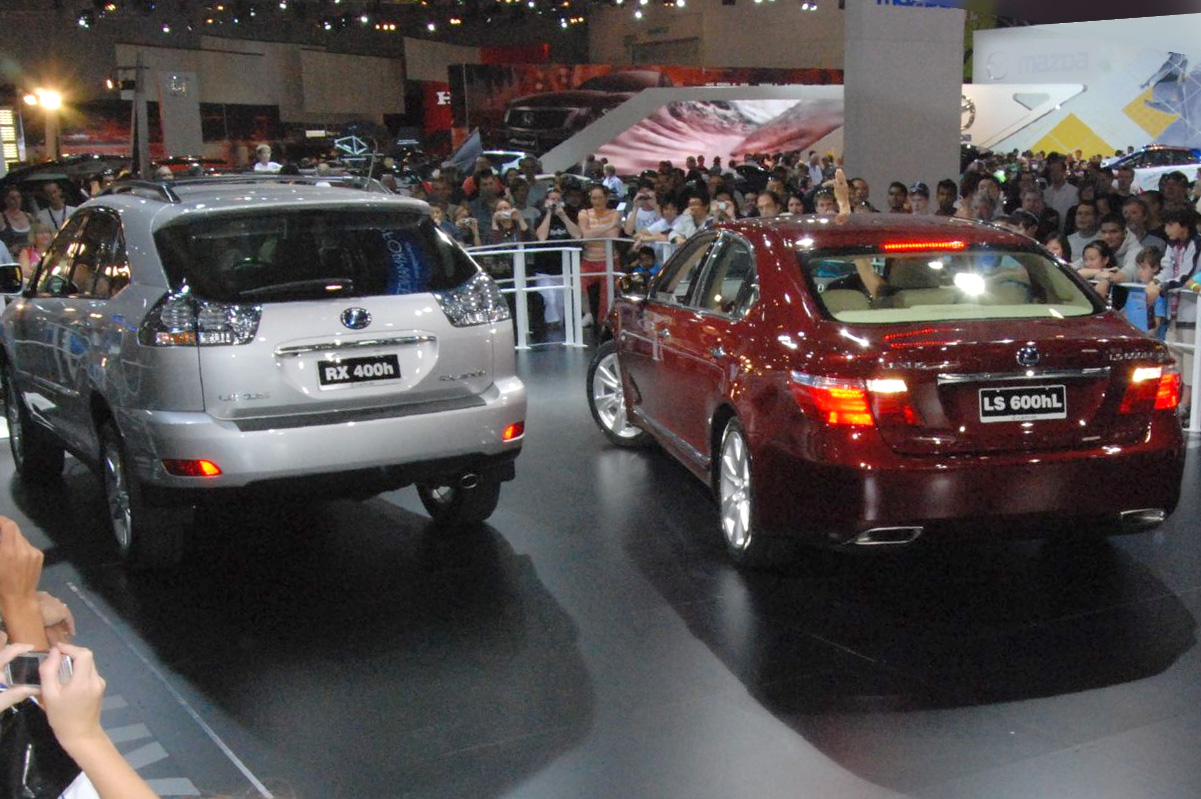
[edit]In 2003, Toyota began to sell their Japanese Prius hybrid vehicle with an automatic parallel parking capability offered as an option named Intelligent Parking Assist.[12] In 2006, Lexus added a self-parking system to the redesigned Lexus LS sedan; it parallel parks as well as angle parks. In 2009, Ford introduced their Active Park Assist beginning with their Lincoln models; it does parallel parking.[13] In 2010, BMW introduced a system called "parking assistant" on the redesigned 5 Series to perform parallel parking.[14]
Up to 2012, automatic parking systems were being developed by several automobile manufacturers. Ford and Lincoln offered active park assist on Ford Focus, Fusion, Escape, Explorer, and Flex and Lincoln MKS and MKT. Toyota and Lexus had advanced parking assistant on Toyota Prius V Five and Lexus LS460 and LS460 L. BMW all-new sixth-generation 3 Series used a system called parking assistant. Audi had a parking assistance system on the Audi A6. Mercedes-Benz also offered parktronic on their C-Class, CLS-Class Coupe, M-Class SUV, E-Class, S-Class, GL350, GL450 SUV (standard on the GL550), and R-Class in different prices.[15]
The Holden Commodore (VF), released in 2013, featured automatic parallel and 90-degree parking as standard across the entire range.[16]
Jeep introduced an automatic parallel and perpendicular parking system, called ParkSense, on its 2014 Cherokee model.[17] Chrysler introduced an all new 2015 200 sedan, offering ParkSense as part of a SafetyTec package.[18]
In 2014, BMW demonstrated an i3 equipped with a parking assistant system activated from a smartwatch.[19]
In 2015, Bosch announced plans to release a fully automated valet parking system. This driverless system allows the driver to get out of the car and activate an autonomous parking from a smartphone. The system will calculate a parking maneuver and monitor the surroundings.[20]
Automated Valet Parking
[edit]Multiple car manufacturers have added limited versions of an Automated Valet Parking (AVP) system to their vehicles. The systems allow a car to park itself in certain parking lots or garages, without a driver in the vehicle.
In 2019, Tesla added a "Smart Summon" ability as part of its Tesla Autopilot vehicle automation features.[21] In 2020, Mercedes-Benz introduced a system named Intelligent Park Pilot for its S-Class. The system was co-developed with Bosch and tested in Stuttgart Airport.[22][23] It was also later showcased in the EQS in Los Angeles.[24] Audi announced in 2021 that it is also working on Automated Valet Parking.[25] In February 2023, BMW announced that it was partnering with Valeo to develop an automated parking system.[26]
Ethical considerations
[edit]Through the increased of use of these systems, ethical questions regarding safety, accessibility, and user privacy are raised.
The shift from manual parking technology to reliance on automatic computer systems draws concerns to liability issues these companies may face. Highlighting the ethical and legal challenges surrounding autonomous systems, some argue for a shared liability model between users and developers to incentivize safety improvements while protecting consumers from undue burden.[27]
See also
[edit]References
[edit]- ^ a b Paromtchik, Igor; Laugier, Christian (April 1996). "Motion Generation and Control for Parking an Autonomous Vehicle" (PDF). Proceedings of the IEEE International Conference on Robotics and Automation. Vol. 4. Minneapolis, MN, USA. pp. 3117–3122. doi:10.1109/ROBOT.1996.509186. ISBN 0-7803-2988-0. Retrieved 10 May 2015.
- ^ Corporation, Bonnier (September 1934). "Four Wheels On Jacks Park Car". Popular Science Monthly. Retrieved 9 May 2015.
- ^ Paromtchik, Igor; Laugier, Christian (September 1996). "Autonomous Parallel Parking of a Nonholonomic Vehicle" (PDF). Proceedings of the IEEE Intelligent Vehicles Symposium. Tokyo, Japan. pp. 13–18. doi:10.1109/IVS.1996.566343. ISBN 0-7803-3652-6.
- ^ Paromtchik, Igor; Laugier, Christian (May 1998). "Automatic Parallel Parking and Returning to Traffic". Video Proceedings of the IEEE International Conference on Robotics and Automation. Leuven, Belgium. Archived from the original on 2021-12-21.
- ^ Paromtchik, Igor (June 2003). "Planning Control Commands to Assist in Car Maneuvers" (PDF). Proceedings of the IEEE International Conference on Advanced Robotics. Coimbra, Portugal. pp. 1308–1313. Retrieved 5 May 2015.
- ^ Paromtchik, Igor (June 2003). "Planning Control Commands to Assist in Car Maneuvers". Video presented at the IEEE International Conference on Advanced Robotics. Coimbra, Portugal. Archived from the original on 2021-12-21. Retrieved 5 May 2015.
- ^ "Volkswagen Futura" (video). YouTube. 2014. Archived from the original on 2021-12-21. Retrieved 5 May 2015.
- ^ "A car with space technology – driving with the ROboMObil" (video). YouTube. 2013. Archived from the original on 2021-12-21. Retrieved 1 March 2017.
- ^ Grabianowski, Ed (17 August 2006). "How Self-Parking Cars Work". Retrieved 5 May 2015.
- ^ Dizikes, Peter (5 November 2010). "AgeLab study: Driver-assistance systems can increase wellness and safety behind the wheel". MIT News. Retrieved 10 May 2015.
- ^ Nedamani, Hamidreza Rezaei (2023). "Soft Computing-Based Driver Modeling for Automatic Parking of Articulated Heavy Vehicles". SAE International Journal of Commercial Vehicles. 16 (02-16 – 04-0027): 385–402.
- ^ "Toyota unveils car that parks itself". CNN International. September 2003. Retrieved 5 May 2015.
- ^ Mays, Kelsey (15 January 2009). "Up Close: Ford's Self-Parking System". Archived from the original on 30 December 2014. Retrieved 9 May 2015.
- ^ Halvorson, Bengt (25 January 2010). "BMW Debuts New Parking Assistant In 2011 5-Series". Retrieved 9 May 2015.
- ^ Kane, Suzanne (October 2011). "2012 Family Cars with Self-Parking Technology". Archived from the original on 26 September 2015. Retrieved 6 May 2015.
- ^ "Holden VF Commodore: all models will park themselves". Drive. 2013-02-09. Retrieved 2023-07-09.
- ^ Morrison, Jim (15 October 2013). "2014 Jeep Cherokee Park Assist". YouTube. Retrieved 9 May 2015.[dead YouTube link]
- ^ "Chrysler Active Park Assist Demo". YouTube. 6 November 2014. Archived from the original on 2021-12-21. Retrieved 9 May 2015.
- ^ Poultney, Leon (17 December 2014). "BMW i3 parks itself at the touch of a smartwatch". The Sunday Times. driving.co.uk. Retrieved 9 May 2015.
- ^ "Bosch Fully Automated Parking". Bosch. 18 February 2015. Archived from the original on 18 February 2015. Retrieved 18 February 2015.
- ^ Braga, Beverly (2019-09-29). "What is Tesla Smart Summon?". J.D. Power. Retrieved 2023-03-10.
- ^ "BOSCH - STUTTGART AIRPORT SET TO WELCOME FULLY AUTOMATED AND DRIVERLESS PARKING". IoT Automotive News. Retrieved 2022-05-21.
- ^ "With the INTELLIGENT PARK PILOT, the "Valet Guys" stage a pioneering S-Class vehicle technology". marsMediaSite. Retrieved 2022-05-21.
- ^ Doll, Scooter (2022-03-20). "Mercedes-Benz showcases its Intelligent Park Pilot technology in Los Angeles, demonstrating an EQS autonomously valet itself". Electrek. Retrieved 2022-05-21.
- ^ "Automated Valet Parking: That time my Audi parked itself". Audi. 7 September 2021. Retrieved 2023-03-10.
- ^ Bruce, Chris (2023-02-14). "BMW And Valeo Partner To Create Level 4 Automated Parking System". Motor1.com. Retrieved 2023-03-10.
- ^ Gurney, J. K. (2013). "Sue My Car, Not Me: Products Liability and Accidents Involving Autonomous Vehicles." Journal of Law, Technology & Policy, 2013(2), 247-277.
Automatic parking
View on GrokipediaHistory
Early mechanical systems (1900s–1960s)
The earliest mechanical automated parking systems emerged in Europe during the early 1900s to address urban space constraints amid rising automobile ownership. In 1905, the Garage Rue de Ponthieu in Paris introduced the first such system, featuring elevators to vertically transport vehicles to multi-level storage within a compact concrete structure.[9] [10] These systems relied on manual operators to position cars onto platforms, which were then lifted and shifted mechanically, often incorporating turntables for rotation and alignment to optimize storage density.[11] By the 1920s, similar mechanical garages proliferated in the United States, particularly in densely populated cities like New York, Chicago, and Los Angeles, where land scarcity drove adoption for efficient vertical stacking.[12] In Chicago, a rotary parking system opened in 1932 on Monroe Street, utilizing rotating platforms and elevators to handle vehicles in a central urban location.[13] Westinghouse Electric and Manufacturing Company developed vertical parking prototypes during this era, including a 1932 machine in Chicago that elevated cars via mechanical lifts into multi-story slots, demonstrating engineering focused on minimizing footprint while accommodating dozens of vehicles in spaces equivalent to a few surface lots.[14] These systems reached peak popularity in the United States from the 1930s through the 1950s, fueled by the post-World War II surge in car ownership and continued urbanization.[9] Designs such as rotary towers, akin to Ferris wheels with suspended car cages, enabled stacking of 10 or more vehicles in the area of 2-3 conventional spots, with operators manually loading and retrieving cars to achieve throughput suited for high-demand downtown areas.[12] By 1957, dozens of such installations, including Bowser and Pigeon Hole variants, operated across major metros, though reliance on human attendants for loading and potential mechanical breakdowns constrained scalability and reliability.[15] Despite these limitations, the systems exemplified early causal engineering solutions prioritizing land efficiency over full automation, predating electronic controls.[16]Decline and technological hiatus (1970s–1990s)
Following the peak of mechanical automated parking systems in the mid-20th century, adoption declined sharply in the United States and Europe during the 1970s and 1980s, primarily due to persistent mechanical failures and operational inefficiencies that eroded user confidence. Early systems, reliant on Ferris wheel-like elevators or stacker mechanisms, frequently malfunctioned, leading to extended downtime and safety concerns, such as the 1970s incident in Denver where a paternoster-style parking elevator failed due to a broken bolt, leaving a vehicle precariously suspended. These breakdowns, combined with slow retrieval times that often exceeded manual parking durations, frustrated drivers and operators, prompting conversions of facilities like the Kent Automatic Garages in the U.S. to office space and condominiums by 1983.[9][17] The reduced urgency for space-efficient parking amid post-war suburbanization further diminished incentives for mechanical systems, as expanding urban peripheries offered abundant land for conventional garages staffed by low-cost human labor, which proved more reliable and adaptable to varying vehicle sizes. Larger postwar automobiles often exceeded the dimensions of cradles designed in the 1930s and 1940s, rendering many installations obsolete without costly retrofits, while manual operations avoided the high downtime risks of mechanical jams during peak hours. Regulatory scrutiny intensified following such incidents, favoring simpler, human-supervised structures that complied with evolving safety standards without the liability of complex machinery.[15][9] In Japan, where land scarcity persisted in dense cities, mechanical innovations like early puzzle parking systems—using sliding platforms and stackers—emerged in the 1970s to maximize vertical space, but their adoption remained regionally confined due to similar reliability challenges and limited export. By the 1990s, global development stalled, with U.S. interest waning as manual garages demonstrated superior long-term viability through flexible staffing and minimal capital outlay for maintenance. This hiatus reflected a pragmatic return to human-centric solutions, underscoring the era's prioritization of operational resilience over mechanized efficiency.[18][19]Modern resurgence and digital integration (2000s–present)
The resurgence of automatic parking technologies in the 2000s was driven by the integration of electronic controls with existing hydraulic steering systems, enabling pilot projects in densely populated regions like Japan and Europe. These early digital enhancements addressed urban parking constraints, where empirical studies indicate that up to 30% of traffic congestion in major cities stems from vehicles circling for spaces.[20] By combining computer algorithms with sensors such as ultrasonic detectors, vehicles could execute parallel or perpendicular maneuvers with minimal driver input, marking a shift from purely mechanical reliance to hybrid electro-hydraulic operation.[21] In the 2010s, advancements accelerated with demonstrations by suppliers like Bosch and Valeo, showcasing semi-autonomous self-parking in consumer vehicles using improved sensor fusion and path-planning software. Bosch's 2013 Frankfurt Motor Show exhibit highlighted real-time environmental mapping for precise maneuvering, while Valeo's 2014 Park4U system emphasized smartphone-activated automation.[22][23] These developments were causally linked to plummeting sensor costs, particularly LiDAR units dropping from approximately $75,000 in the early 2010s to under $1,000 by decade's end, facilitating broader scalability beyond niche applications.[24][25] The 2020s saw formalization of standards and initial deployments, with SAE International's J3016 taxonomy refinements around 2018 incorporating automated parking scenarios up to Level 4 autonomy, where vehicles operate without human oversight in defined domains like parking facilities. Notable milestones include Mercedes-Benz's 2021 approval for advanced automated valet parking trials in Germany and BMW's 2023 partnership expansions for Level 4 systems, reflecting regulatory progress amid urban drivers wasting an average of 17 hours annually searching for spots.[26][27][28][29] By 2025, the global automated parking market reached approximately $2.6 billion, growing at a compound annual rate of nearly 20% from prior years, propelled by AI-driven precision and infrastructure adaptations to escalating city densities.[30][31]Technical principles
Core technologies and sensors
Ultrasonic sensors form the primary hardware for close-range detection in automatic parking, using time-of-flight measurements of sound waves to determine obstacle distances with accuracies exceeding 99% in ranges from 0.15 meters minimum to up to 10 meters, though typically optimized for 0.2 to 2 meters in parking maneuvers.[32][33][34] These sensors offer a field of view of 60 to 75 degrees, enabling detection of curbs, vehicles, and walls during low-speed operations below 50 km/h.[35][33] Cameras complement ultrasonics by capturing visual data for parking space recognition, line detection, and environmental mapping, often integrated in surround-view systems to provide 360-degree oversight.[36] In advanced setups, LiDAR sensors generate high-resolution 3D point clouds for precise spatial modeling, measuring distances via laser pulses to support obstacle classification and path verification in complex scenarios.[37][38] Sensor fusion algorithms combine inputs from ultrasonics, cameras, and LiDAR to minimize individual sensor limitations, such as ultrasonic range constraints or camera sensitivity to lighting, achieving enhanced localization accuracy for maneuvers.[39][40] GPS and inertial measurement units (IMUs) provide vehicle positioning and orientation data, crucial in GPS-denied indoor environments like parking garages where satellite signals degrade.[41][42] In automated valet parking, vehicle-to-infrastructure (V2I) communication links onboard sensors to garage systems for pre-mapped slot allocation and real-time updates, facilitating unmanned navigation.[43][44] Empirical evaluations in controlled settings report parking success rates of 90% or higher, attributing reliability to multi-modal sensor integration handling static and dynamic obstacles.[45][46] From the early 2000s, when systems like Toyota's 2003 parking assist relied on basic ultrasonic arrays in hybrid vehicles, technologies have advanced to 2020s multi-sensor configurations incorporating fusion for dynamic obstacle avoidance and sub-meter precision.[47][48]Algorithms and control systems
Path planning in automatic parking systems relies on search algorithms to generate collision-free trajectories from the vehicle's initial position to the target parking spot. Sampling-based methods like Rapidly-exploring Random Trees (RRT) efficiently explore continuous state spaces for obstacle avoidance by incrementally building a tree of feasible motions, while grid-based approaches such as A* prioritize optimality through heuristic-guided searches on discretized environments.[49] [50] Hybrid variants combining these, often with kinematic constraints, produce initial paths that account for vehicle dynamics like turning radius and clearance requirements.[51] For trajectory optimization, model predictive control (MPC) refines these paths by solving constrained optimization problems over a receding horizon, minimizing errors in position, velocity, and orientation while anticipating disturbances like surface friction variations. MPC formulations incorporate vehicle models (e.g., bicycle kinematics) to predict future states and adjust controls preemptively, ensuring feasibility within actuator limits such as steering angle bounds.[52] [53] Simulations validate MPC performance by replicating real-world dynamics, with iterative tuning reducing trajectory deviations to levels where planned paths align closely with executed maneuvers under nominal conditions.[54] Low-level execution employs proportional-integral-derivative (PID) controllers to regulate steering torque and throttle/brake inputs, computing corrections based on error signals from the reference trajectory to dampen oscillations and achieve precise alignment. These feedback loops operate on causal principles of error minimization, where proportional terms provide immediate response, integral terms eliminate steady-state offsets from model mismatches, and derivative terms anticipate overshoot from inertial effects. [55] Post-2015 advancements integrate machine learning, particularly reinforcement learning, to refine policies for edge cases like tight spaces or dynamic obstacles, training agents to maximize rewards tied to successful docking metrics. These methods have demonstrated parallel parking success rates exceeding 95% in controlled tests, surpassing purely rule-based systems by adapting to unmodeled variabilities through data-driven updates without assuming unbounded generalization.[56] [57] Electronic control units (ECUs) integrate these algorithms in real-time loops, processing fused data to issue commands with latencies minimized for stability, as delays beyond milliseconds can amplify path errors in constrained maneuvers.[58]Autonomy levels per SAE standards
The SAE J3016 standard defines six levels of driving automation, applicable to parking maneuvers through distinctions in human driver engagement and system capability. In automatic parking contexts, lower levels (0–2) involve driver-initiated and supervised assistance, where the human performs part or all of the dynamic driving task (DDT), including monitoring for system limits. For instance, Level 1 systems, introduced in vehicles like the 2009 Lexus LS 600h, automate lateral control for parallel parking while requiring the driver to handle acceleration, braking, and oversight.[59] Level 2 partial automation, seen in 2010s features from manufacturers such as Ford and BMW, may integrate both lateral and longitudinal control but demands continuous driver attention and readiness to intervene, as evidenced by systems requiring button activation and visual confirmation.[60] Level 3 conditional automation for parking enables hands-off operation in defined environments like parking lots, with the system managing the full DDT but requiring the driver to remain responsive to requests for intervention, such as for edge cases like pedestrian incursions. Pilots emerged around 2020, with examples including Level 3 autonomous parking in Chinese vehicles like the Roewe Marvel R, where the system operates without steering input but mandates driver preparedness.[61] Higher levels shift to driverless operation: Level 4 high automation performs all parking tasks, including unmanned drop-off and retrieval, within geofenced operational design domains (ODDs) like mapped garages, without human fallback, as specified for automated valet parking (AVP) systems achieving driverless functionality.[62] Deployments, such as Bosch's Level 4 AVP trials starting in 2023 across German facilities, target geofenced zones compliant with ISO 26262 safety integrity levels for fault-tolerant operation.[63] Level 5 full automation, capable of parking in any environment without geographic or environmental restrictions, remains theoretical for parking due to unresolved edge cases like unstructured lots, with no commercial implementations as of 2025.[60]| SAE Level | Parking Context Description | Driver Role | Example Timeline/Implementation |
|---|---|---|---|
| 0 | No automation; manual parking only. | Full control and monitoring. | Pre-2000s baseline.[60] |
| 1 | Driver assistance for specific tasks (e.g., steering in parallel parking). | Performs remaining DDT aspects; monitors system. | 2009 Lexus systems.[59] |
| 2 | Partial automation (e.g., combined steering and speed control). | Engaged oversight; ready to intervene at any time. | 2010s Ford/BMW self-parking.[60] |
| 3 | Conditional automation in lots/garages; system handles DDT. | Responsive to intervention requests; no active control. | 2020s Chinese EV pilots (e.g., Roewe).[61] |
| 4 | High automation in geofenced ODDs (e.g., AVP unmanned). | None required within ODD; system self-manages failures. | 2023+ Bosch/AVP trials.[62] [64] |
| 5 | Full automation anywhere, including unstructured areas. | None; unlimited ODD. | Unachieved in parking as of 2025.[60] |