Hubbry Logo
Azolla pinnataAzolla pinnataMain
Open search
Azolla pinnata
Community hub
Azolla pinnata
logo
8 pages, 0 posts
0 subscribers
Be the first to start a discussion here.
Azolla pinnata
Azolla pinnata
from Wikipedia

Azolla pinnata
Scientific classification Edit this classification
Kingdom: Plantae
Clade: Tracheophytes
Division: Polypodiophyta
Class: Polypodiopsida
Order: Salviniales
Family: Salviniaceae
Genus: Azolla
Species:
A. pinnata
Binomial name
Azolla pinnata

Azolla pinnata is a species of fern known by several common names, including mosquitofern,[2] feathered mosquitofern and water velvet. It is native to much of Africa, Asia (Brunei Darussalam, China, India, Japan, Korea, and the Philippines) and parts of Australia. It is an aquatic plant, it is found floating upon the surface of the water. It grows in quiet and slow-moving water bodies because swift currents and waves break up the plant.[3] At maximum growth rate, it can double its biomass in 1.9 days, with most strains attaining such growth within a week under optimal conditions.[4]

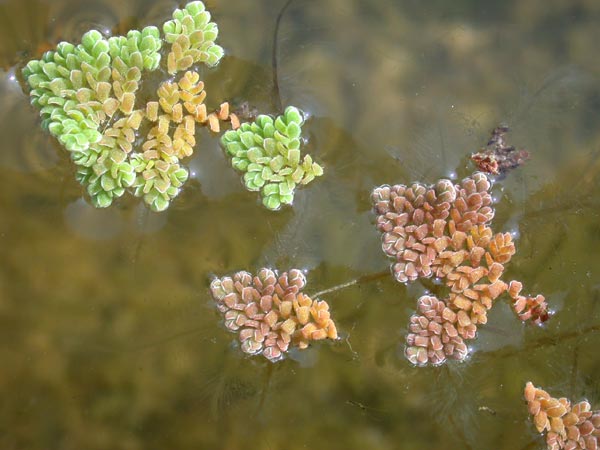
A. pinnata is a small fern with a triangular stem measuring up to 2.5 centimeters in length that floats on the water. The stem bears many rounded or angular overlapping leaves each 1 or 2 millimeters long. They are green, blue-green, or dark red in color and coated in tiny hairs, giving them a velvety appearance.[3] The hairs make the top surface of the leaf water-repellent, keeping the plant afloat even after being pushed under.[3] A water body may be coated in a dense layer of the plants, which form a velvety mat that crowds out other plants.[3] The hairlike roots extend out into the water.[3] The leaves contain the cyanobacterium Anabaena azollae, which is a symbiont that fixes nitrogen from the atmosphere that the fern can use.[3][5] This gives the fern the ability to grow in habitats that are low in nitrogen.[5]

The plant reproduces vegetatively when branches break off the main axis, or sexually when sporocarps on the leaves release spores.[6]

It is present in New Zealand as an introduced species and an invasive weed that has crowded out a native relative, Azolla rubra.[3] It is a pest of waterways because its dense mats reduce oxygen in the water.[7] The weevil Stenopelmus rufinasus is used as an agent of biological pest control to manage Azolla filiculoides, and it has been found to attack A. pinnata as well.[8]

Rice farmers sometimes keep this plant in their paddies because it generates valuable nitrogen via its symbiotic cyanobacteria.[3][6] The plant can be grown in wet soil and then plowed under, generating a good amount of nitrogen-rich fertilizer.[9] The plant has the ability to absorb a certain amount of heavy metal pollution, such as lead, from contaminated water.[10] It is 25-30% protein and can be added to chicken feed.[11][12]

Applications in environmental studies

[edit]

Recent studies show the usefulness of Azolla pinnata in the remediation of environmental pollutants. There are two main methods for utilising A. pinnata to clean up environmental pollutants. The first method is by adsorption, which required the A. pinnata fronds to be processed into powder and agitated with the wastewater for a fixed duration. The pollutant will adhere to the organic functional groups on the surface of the A. pinnata powder. In adsorption studies, A. pinnata was reported in the remediation of dye wastewater containing methyl violet 2B,[13] malachite green,[14] rhodamine B,[15] acid red 88[16] and acid blue 25.[17]

The second remediation method is phytoremediation, where living A. pinnata is suspended on the surface of the wastewater. A. pinnata was primarily studied due to its high tolerance to environmental pollutants, and ability to hyperaccumulate heavy metals.[18] Phytoremediation of industrial wastewater containing heavy metals (such as zinc, lead,[19] chromium,[20] mercury, cadmium,[21] copper, arsenic[18]) as well as organic dyes such as methyl violet 2B[22] and malachite green[23] are reported in literature. A.pinnata is also reported to be useful for treating the wastewater (remove nitrogenous waste and phosphorus) of poultry farms.[24]

References

[edit]
[edit]
Revisions and contributorsEdit on WikipediaRead on Wikipedia
from Grokipedia
Azolla pinnata, commonly known as mosquito fern or feathered mosquitofern, is a small, free-floating aquatic belonging to the Salviniaceae. It features overlapping pairs of tiny, ovate to broadly elliptic leaves, each less than 1 mm long and often purplish to reddish in color, arranged along branched stems that form triangular fronds measuring 1–3 cm long and 1–2.5 cm wide, with roots up to 5 cm long dangling into the water. Native to tropical and subtropical regions across , , , , , , and , it thrives in wind-protected, slow-moving freshwater bodies such as ponds, lakes, ditches, and rice paddies, tolerating low up to 30 mM and optimal temperatures of 29–33°C. This species is renowned for its rapid through fragmentation, doubling its biomass every 2–5 days under ideal conditions, which allows it to form dense surface mats that can cover entire water bodies. It also reproduces sexually via heterosporous spores produced in specialized sporocarps, though this mode is less common. A defining feature is its obligate with the cyanobacterium Anabaena azollae, hosted in leaf cavity hairs, which fixes atmospheric at rates supporting 40–60 kg per hectare annually, enhancing its role as a natural . Ecologically, A. pinnata contributes to nutrient cycling, by absorbing and pollutants, and by smothering breeding sites, while its dense growth can suppress weeds and in aquatic systems. In , Azolla pinnata has been utilized for centuries, particularly in , as in fields to boost and yields without synthetic inputs, and as a high-protein for , containing up to 25–35% crude protein. Its potential extends to sustainable practices like , climate-resilient farming, and even as a for genomic studies due to its unique and fast growth. However, in non-native regions like , it is considered invasive, potentially disrupting native aquatic ecosystems by outcompeting other plants and altering .

Description

Morphology

Azolla pinnata is a diminutive aquatic featuring a slender, triangular stem that measures up to 2.5 cm in length and floats on the surface. The stem displays pinnate branching, with side branches arranged alternately and becoming progressively longer toward the base, facilitating vegetative fragmentation for propagation as the main axis decomposes. The leaves are small, typically 1-2 mm long, and overlap in two ranks along the stem, consisting of a bilobed with an upper aerial lobe and a lower submerged lobe. The upper lobes exhibit colors ranging from green to or dark red, influenced by environmental factors such as light intensity, while the lower lobes are translucent and brownish. These upper lobes are covered with multicellular hairs that confer a velvety texture and water-repellent properties; the dorsal leaf cavities formed by these structures house symbiotic . Hairlike roots, often with a feathery appearance, extend downward from the fronds into the , primarily for nutrient uptake. The overall fronds form dense, floating mats on water surfaces, with individual typically 1-2.5 cm across, though colonies can expand more broadly. Morphological variations occur under differing conditions, such as reduced frond size and growth in low environments, where the adapts by forming tighter mats.

Symbiotic relationship

_Azolla pinnata forms a mutualistic with the endophytic cyanobacterium azollae (also referred to as azollae), which resides within specialized cavities on the dorsal surface of its leaves. These leaf cavities are lined with multicellular hairs that facilitate the enclosure and protection of the cyanobacterial filaments, creating a microhabitat where A. azollae colonizes the periphery of the cavity. This association is for the cyanobacterium, as it has lost the ability to survive independently outside the host. The primary function of this is biological , where A. azollae employs enzymes in specialized cells to convert atmospheric dinitrogen (N₂) into (NH₃), which is then assimilated into . This process supplies the majority of A. pinnata's requirements, often meeting nearly the entire demand of the host under optimal conditions, enabling the to thrive in nitrogen-poor aquatic environments. In exchange, the plant provides fixed carbon to the cyanobiont in the form of carbohydrates, such as , glucose, and , derived from host ; these sugars support the energy needs of A. azollae for activity and growth. The exchange occurs via the cavity hairs, which feature labyrinthine wall ingrowths that enhance nutrient transfer between partners. The symbiosis exhibits high specificity, with distinct strains of A. azollae adapted to particular Azolla species, showing genetic divergence that correlates with host taxonomy, such as between the Azolla and Rhizosperma sections. This host-species specificity ensures compatibility and efficient mutualism. The association is maintained through vertical inheritance, where cyanobionts are transmitted maternally via the gametophytes enclosed within spores; during sporocarp development, akinetes (dormant cyanobacterial cells) are incorporated into megasporocarps and subsequently transferred to developing fronds upon germination. Evolutionary evidence indicates that the - symbiosis originated approximately 80 million years ago during the in , coinciding with a whole-genome duplication event in the lineage that facilitated the stable, intergenerational transmission of the cyanobiont. Fossil records from formations like the Claggett and Judith River support this timeline, highlighting the ancient co-evolution of the partners into a highly integrated .

Taxonomy

Classification

Azolla pinnata is classified within the kingdom Plantae, phylum Tracheophyta, class Polypodiopsida, order Salviniales, family Salviniaceae, genus , and species A. pinnata. The species was first described by Robert Brown in 1810 in his Prodromus Florae Novae Hollandiae et Insulae Van-Diemen. The genus comprises 6–7 species of small, floating aquatic ferns, traditionally divided into two sections—section and section Rhizosperma—distinguished primarily by differences in frond shape and the position of sporocarps. Within the family Salviniaceae, is the sister genus to , with both genera characterized as heterosporous ferns adapted to aquatic environments.

Varieties

The of Azolla pinnata and related forms is debated. Some classifications recognize three exhibiting subtle variations in morphology and distribution: A. p. subsp. pinnata, the typical form with green to reddish fronds and elliptical dorsal leaf lobes, native to ; A. p. subsp. asiatica, featuring lax fronds with short, wide submerged lobes and more prevalent in ; and A. p. subsp. africana, primarily restricted to African regions. However, other authorities, such as , treat the Asian and African forms as distinct species: Azolla imbricata (corresponding to subsp. asiatica) and Azolla africana (corresponding to subsp. africana), with A. pinnata limited to its Australasian range. Identification to this level is often challenging without molecular tools due to morphological similarities. Historical synonyms include Azolla imbricata (applied to the Asian form due to misidentification of overlapping leaves). Genetic analyses reveal minor molecular differences among these forms, such as variations in DNA amplification patterns, alongside the noted morphological traits, yet they remain interfertile and capable of hybridization. The A. pinnata holds an status of Least Concern (as of 2018), reflecting its occurrence in its native range, though individual or related have not been assessed separately.

Distribution and habitat

Native range

Azolla pinnata is native to tropical and subtropical regions across , including areas such as the Nile Valley and , and extends through South and , , and , encompassing countries like , , , , and the . In these native areas, the species primarily occupies stagnant or slow-moving freshwater habitats, such as ponds, ditches, paddies, and protected backwaters of streams and rivers. Historical documentation of its presence and use dates back to ancient Asian agricultural texts, including the Er Ya from approximately 2000 years ago and Jia Ssu Hsieh's Chih Min Tao Shu in 540 A.D., where it is described in the context of cultivation practices. The plant prefers warm climates with temperatures ranging from 18°C to 28°C and neutral to slightly acidic conditions with a of 4.5 to 7, though it is notably absent from high-altitude zones and saline waters.

Introduced ranges

Azolla pinnata, native to regions in , , , and , has been introduced to various areas outside its indigenous range through human-mediated pathways. The species has been intentionally introduced for use as a and in , as well as through the aquarium and trade. Accidental introductions have occurred via attachment to waterfowl or contaminated trade materials, facilitating its dispersal to new water bodies. Introduced populations are established in , Pacific Islands such as the and , and parts of including and . In these regions, it has colonized tropical to temperate wetlands, forming dense floating mats on still or slow-moving waters. In the United States, Azolla pinnata is classified as a federal and is specifically listed as such in states including and , reflecting its potential to disrupt aquatic ecosystems where established. It has been reported in parts of , including historical records in the .

Ecology

Growth dynamics

Azolla pinnata exhibits rapid vegetative growth, with biomass doubling every 1.9 to 7 days under optimal conditions such as high light intensity and adequate phosphorus availability. This fast proliferation is facilitated by its floating habit, allowing efficient capture of sunlight and nutrients at the water surface. Growth rates can reach up to 0.321 day⁻¹, corresponding to a minimum doubling time of approximately 2.16 days in controlled environments with sufficient phosphorus supplementation. Nutritionally, A. pinnata has a high demand for , with optimal growth requiring at least 0.06 ppm in the medium, while it is largely independent of external sources due to its with the cyanobacterium azollae, which fixes atmospheric . Phosphorus limitation can significantly reduce biomass accumulation and efficiency. Growth is limited by sensitivities to certain environmental factors, including , which causes root detachment and even at low concentrations. The plant tolerates up to approximately 2 ppt, beyond which growth declines sharply due to osmotic stress. Additionally, A. pinnata prefers stagnant or gently flowing water, as high water velocities can disrupt mat formation. Under favorable conditions, A. pinnata populations rapidly expand to form dense surface mats, achieving 100% coverage of bodies within 2 to 4 weeks from initial . This mat development supports high yields, often reaching 10–20 t ha⁻¹ at saturation.

Interactions with environment

Dense mats formed by Azolla pinnata significantly reduce dissolved oxygen concentrations in bodies, often leading to hypoxic conditions that adversely affect populations and macroinvertebrate densities. This oxygen depletion arises from the plant's rapid surface coverage, which blocks atmospheric exchange and promotes anaerobic beneath the mats. In addition, these mats degrade overall by increasing through sediment entrapment and altering chemical parameters, such as reducing and conductivity while sequestering at rates up to 122 kg/ha/year. Although this nutrient uptake can temporarily mitigate excess , the subsequent of accumulated releases bound nutrients back into the , potentially perpetuating cycles in nutrient-rich environments. On biodiversity, A. pinnata outcompetes native aquatic plants by forming impenetrable surface layers that restrict light penetration to submerged vegetation, thereby decreasing native plant richness and abundance. This shading effect has been observed to suppress like Vallisneria americana, limiting their and growth, while also reducing populations due to diminished light availability. Dense mats also suppress algal blooms and weeds through competition and shading. In invaded ecosystems, such as northern waterways, A. pinnata has displaced native congeners like Azolla rubra, further eroding local aquatic biodiversity. In terms of climate interactions, A. pinnata serves as a potential , sequestering up to 21,266 kg CO₂/ha/year through its biomass accumulation, supported by symbiotic rates of 0.3–0.6 kg N/ha/day. However, the anaerobic decomposition of its dense mats can produce , contributing to releases in stagnant systems. This dual role underscores its influence on carbon and nutrient cycles in aquatic habitats. A. pinnata exhibits sensitivity to abiotic stressors, particularly herbicides; low doses of effectively inhibit its growth by disrupting , though regrowth may necessitate repeated applications for control.

Reproduction

Asexual reproduction

Azolla pinnata primarily reproduces through fragmentation, in which portions of the stem, including attached and fronds, detach and develop into independent . This process allows separated fragments to rapidly establish new colonies on surfaces, contributing to the ' ability to form dense mats in aquatic environments. Fragmentation occurs naturally as the grows, with stem pieces breaking off due to mechanical forces such as water currents or . The heavy reliance on this clonal propagation mechanism results in a clonal process, where populations expand primarily through identical copies of the parent plant, leading to low within many stands. Studies on species indicate that infrequent exacerbates this uniformity, limiting adaptability in some populations but enabling rapid in favorable habitats. This clonal dominance is evident in both native and introduced ranges, where genetic analyses reveal minimal variation attributable to vegetative spread. As the primary mode of reproduction, asexual fragmentation accounts for the majority of and spread in stable aquatic environments, often enabling to double every 3-5 days under optimal conditions such as moderate temperatures and adequate availability. This high efficiency allows A. pinnata to outcompete other floating plants and cover large areas quickly. Fragmentation in A. pinnata is often triggered by environmental factors like plant crowding, which increases mechanical separation of stems, or nutrient stress, such as limitation, that prompts vegetative dispersal to exploit new resources. These triggers enhance rates during periods of high or suboptimal conditions, facilitating survival and expansion without reliance on sexual phases.

Sexual reproduction

Azolla pinnata exhibits , producing microspores in microsporocarps and megaspores in megasporocarps on separate fronds, specifically arising from the ventral lobe of the first leaf on a . This process maintains the symbiosis with the cyanobacterium azollae, as megaspores contain filaments of the symbiont that are transmitted to the next generation. Microsporocarps are larger and brownish, containing up to 30 microsporangia per cross-section, with each microsporangium forming 3-6 massulae that hold 32 to 64 microspores approximately 0.035 mm in diameter, featuring a triradiate mark on their surface. In contrast, megasporocarps are smaller and develop a single functional megaspore, about 1.5 mm by 1 mm, surrounded by nine float-corpuscles (six below and three above) that provide , while eight initial megaspore mother-cells abort during development. Sporocarp development occurs after periods of vegetative growth and is triggered by environmental cues such as short photoperiods, high plant density, low temperatures in tropical regions, or stress from early summer heat in temperate areas, often observed post-rainy season in September-October with ripening by April. The sporocarps initially remain sunken within the fronds but eventually float to the surface for reproduction. Fertilization is water-mediated, with microspores germinating into male prothalli that release multiflagellated antherozoids, which swim to the female prothallus within the megaspore to reach archegonia (up to 30 or more per prothallus); however, natural success rates are low due to the rarity of synchronized sporulation and environmental challenges. Following fertilization, the develops into an within the megaspore. Germination of the fertilized megaspore occurs after subsequent rains, forming a prothallus that displaces the float-corpuscles, leading to the development of a new ; this process takes 1-2 months to produce a comparable in size to one grown vegetatively. Fertilized megaspores exhibit high viability, remaining dormant and viable for over a year in dry conditions. Sexual reproduction plays a minor role in population maintenance compared to asexual fragmentation, but it facilitates long-distance dispersal through buoyant sporocarps carried by currents, floods, or attached to birds and other animals.

Uses

Agricultural applications

Azolla pinnata has been utilized in Asian for centuries, with records indicating its application as a in cultivation in and dating back over 1,500 years in , with records from the 6th century AD in texts like the Qi-Min-Yao-Shu, and extensively used in today. This symbiotic , hosting the nitrogen-fixing cyanobacterium azollae, fixes atmospheric , contributing to its value in traditional farming systems. As a , A. pinnata is incorporated into paddies, typically providing 20–40 kg of per , which can increase yields by approximately 20%. This practice involves growing the in flooded fields before or alongside and plowing it under to release nutrients, thereby improving and reducing reliance on synthetic inputs. In integration, A. pinnata is employed in dual cropping with , where it forms a floating that suppresses weeds by up to 50–60% and reduces the need for chemical fertilizers by 25–50%. This method not only enhances availability but also minimizes volatilization from applied fertilizers, promoting more efficient nutrient use in paddy systems. A. pinnata serves as a high-protein animal , containing 25–35% crude protein on a dry weight basis, suitable for , , and fish feed, where inclusion rates of 5–25% have been shown to improve feed conversion efficiency and animal growth performance. Its nutrient-rich profile, including essential and minerals, makes it a cost-effective supplement in operations. In modern , A. pinnata is promoted for enhancing in tropical regions, particularly in integrated rice-fish systems and low-input farming, supporting climate-resilient practices amid growing concerns over chemical overuse. Its rapid biomass production and multifunctional benefits align with global efforts to foster eco-friendly crop intensification in Asia and beyond.

Environmental remediation

Azolla pinnata plays a significant role in environmental remediation through its capacity for bioaccumulating heavy metals from contaminated water bodies. The plant effectively absorbs lead (Pb), zinc (Zn), and cadmium (Cd), with accumulation levels ranging from 100 to 500 mg/kg dry weight in its tissues, depending on exposure concentration and duration. For instance, studies on Azolla species have reported up to 416 mg/kg for Pb and 259 mg/kg for Cd in fronds after exposure to polluted solutions, with A. pinnata showing similar accumulation potential (e.g., 310–740 mg/kg for Pb). This bioaccumulation process helps mitigate heavy metal toxicity in aquatic ecosystems, preventing their entry into the food chain. In addition to heavy metals, A. pinnata excels in adsorbing organic pollutants such as dyes and pesticides from . It achieves removal efficiencies of 70-90% for dyes like and , primarily through surface adsorption on its and enzymatic degradation. For pesticides, including neonicotinoids like and fungicides like difenoconazole, removal rates in constructed systems reach up to 92%, facilitated by the plant's rapid production and high surface area. These capabilities make A. pinnata a cost-effective biosorbent for treating industrial effluents. A. pinnata contributes to by absorbing excess nutrients, thereby reducing in nutrient-enriched waters. In constructed wetlands, it removes 25-38% of ammonia-nitrogen (NH₃-N), (PO₄³⁻), and (NO₃⁻) from agricultural runoff, promoting clearer and preventing algal blooms. Its symbiotic association with nitrogen-fixing enhances nutrient uptake efficiency. Furthermore, the plant's sequesters 10-20 tons of CO₂ per per year, supporting climate mitigation efforts through carbon fixation during growth. Recent research in the 2020s has explored A. pinnata in bioreactors and constructed wetlands for treating industrial effluents, such as mill and wastewater. These systems achieve substantial pollutant reduction, with heavy metal removals up to 88% for and improved overall , highlighting its for sustainable remediation. As of 2025, ongoing research highlights A. pinnata's application in constructed wetlands for treating agricultural runoff, achieving up to 80% reduction in residues in some systems.

Management

Cultivation techniques

Cultivation of Azolla pinnata typically begins with inoculum preparation using fresh, healthy to establish dense mats in controlled environments. A common approach involves inoculating shallow ponds, trays, or pits with 200–500 g/m² of fresh Azolla , often sourced from established cultures, to achieve rapid coverage. For larger setups, such as 5 × 4 × 0.3 m pits lined with impermeable sheets and a 10–15 cm layer of soft , an initial dose of 5 kg of pure inoculum is applied, followed by filling with water to a depth of 7–11 cm. This method ensures pest-free starting material and promotes vegetative propagation, with the biomass doubling every 2–5 days under favorable conditions. Optimal growth requires temperatures between 20–30°C, as higher levels above 37°C can harm the plants, and a pH range of 5.5–7.0, with neutral pH being ideal for maximal biomass accumulation. Light exposure of 6–8 hours of full sunlight per day, or equivalent intensities of 1413–1561 lux, supports robust development, while relative humidity of 65–80% and long photoperiods further enhance doubling rates. Phosphorus supplementation is critical, typically at 0.5–1 mg/L or 20 kg/ha of superphosphate, to boost nitrogen fixation by the symbiotic cyanobacterium Anabaena azollae and increase phosphorus availability by 20–30%; no additional nitrogen fertilizers are needed due to the plant's autotrophic capabilities. Organic amendments like 15 kg of fermented buffalo feces every 15 days can also sustain nutrient levels in pit systems. Harvesting occurs every 7–15 days once the mat reaches saturation, using manual methods to skim the surface without disturbing the . Yields typically range from 10–20 t/ha fresh weight or 3–9 t/ha dry matter annually, with weekly harvests producing up to 3.73 kg fresh and 172 g dry per pit under optimal conditions; this equates to approximately 1–2 kg dry matter/m² per month in high-productivity setups. Half of the harvested material is often reinoculated to maintain coverage, while the remainder supports agricultural applications like . For scaling, A. pinnata is integrated into fields at 0.5–1 t/ha post-transplanting or grown in separate using the half-saturation method, where initial densities of 300–500 kg/ha double weekly to cover larger areas. This approach is adaptable to low-labor systems, with the half-saturation technique originating in allowing expansion from small plots to 10–20 t/ha saturated densities. Pest management involves neem extracts to control , alongside integrated systems like rice-Azolla-duck-fish models where ducks naturally suppress pests; conventional options include furadan granules at 100 g/plot applied seven days post-inoculation if needed. Key challenges include controlling pests such as snails and weevils, which can damage mats, and preventing fragmentation from or turbulent ; pits should be cleared and reinoculated if infestations occur. Post-2020 sustainable protocols emphasize integrations, such as reducing synthetic fertilizers by 25% through Azolla biofertilization and incorporating it into carbon-sequestering systems for .

Control as invasive species

Mechanical removal is a primary strategy for managing small infestations of Azolla pinnata, involving raking, seining, or scraping the floating mats from surfaces to physically extract the . This method is effective for localized outbreaks in ponds or ditches, as it directly reduces biomass without chemicals, but it is labor-intensive and requires frequent repetition due to the plant's rapid regrowth, potentially doubling coverage every 4-5 days under favorable conditions. level drawdown can complement raking by exposing and desiccating the during dry periods, though it may disrupt aquatic ecosystems if not carefully managed. Chemical control targets A. pinnata with aquatic herbicides applied at low concentrations to minimize environmental impact. , a contact , provides good control when applied at rates of 0.1-0.37 kg per , achieving up to 80% reduction in coverage within weeks by disrupting . Fluridone, a systemic , is highly effective at 10-30 (0.01-0.03 ppm) in whole-water treatments from spring to mid-summer, inhibiting synthesis and leading to death over 30-90 days, with efficacy exceeding 90% in enclosed systems. These applications must account for water flow and dilution to ensure sustained exposure, and follow-up treatments are often needed for regrowth. Biological control employs the Stenopelmus rufinasus, a native North American specialized on species. This weevil has been introduced to manage invasive A. filiculoides in non-native regions such as , where releases since the 1990s have reduced Azolla biomass by up to 90% through larval and adult feeding on fronds, establishing self-sustaining populations that provide long-term suppression. It has also adopted A. pinnata as a host plant, with potential for use against it in invaded areas like , though establishment success varies with climate and initial densities. This agent is host-specific, minimizing risks to non-target . Integrated management combines multiple approaches for larger-scale infestations, enhancing efficacy while reducing reliance on any single method. Strategies include shading to limit , nutrient reduction to slow growth, and physical barriers like booms to contain spread, often paired with targeted or biological releases; these programs emphasize early detection to prevent dense mat formation, which exacerbates control challenges due to the plant's rapid vegetative spread. As of 2025, A. pinnata is part of Early Detection Rapid Response (EDRR) efforts in , including manual removal in waterways like . Regulations play a key role in preventing A. pinnata proliferation, with the species listed as a Federal Noxious Weed in the United States, prohibiting its possession, transport, or sale across states like Alabama, North Carolina, and Vermont where it is classified as a Class A noxious weed. Similar restrictions apply internationally, including bans in parts of Canada under Ontario's Invasive Species Act effective January 1, 2024. Monitoring efforts utilize remote sensing, such as satellite imagery and normalized difference vegetation index (NDVI) analysis, to detect and track infestations at landscape scales, enabling timely interventions in wetlands and rivers.

References

Add your contribution
Related Hubs
User Avatar
No comments yet.